HAL Id: tel-02600628
https://hal.inrae.fr/tel-02600628
Submitted on 16 May 2020
HAL is a multi-disciplinary open access archive for the deposit and dissemination of sci-entific research documents, whether they are pub-lished or not. The documents may come from teaching and research institutions in France or abroad, or from public or private research centers.
L’archive ouverte pluridisciplinaire HAL, est destinée au dépôt et à la diffusion de documents scientifiques de niveau recherche, publiés ou non, émanant des établissements d’enseignement et de recherche français ou étrangers, des laboratoires publics ou privés.
systems
T. Spiegelberger
To cite this version:
T. Spiegelberger. Plants, soil and the stability of mountain socio-ecological systems. Environmental Sciences. HDR, Université de Grenoble, 2014. �tel-02600628�
Mémoire pour l’obtention d’une
Habilitation à Diriger des Recherches
Dossier présenté par : Dr. Thomas SPIEGELBERGER Chargé de recherche Irstea, Centre de Grenoble UR Ecosystèmes montagnards 2, rue de la Papeterie ‐ BP 76 F‐38402 Saint‐Martin‐d'Hères cedex Tél : +33 4 76 76 28 19 Email : [email protected] Grenoble, 03‐12‐2014
Sommaire
1
THE WHO AND WHAT ‐ A SHORT PRESENTATION ... 1
1.1 Who ? ... 1 1.2 What ? ... 32
PLANTS, SOIL AND THE STABILITY OF MOUNTAIN SOCIO‐ECOLOGICAL SYSTEMS 5
2.1 Socio‐ecological systems in mountain areas ... 5 2.1.1 Socio‐ecological systems ... 6 2.1.2 Mountain ecosystems ... 9 2.2 Impacts of climate change ... 11 2.2.1 Studies along altitudinal gradients ... 15 2.2.2 Drought experiments ... 22 2.3 Consequences of land use changes ... 27 2.3.1 Local impacts on vegetation and its interaction with soil ... 27 2.3.2 Past land use changes at the landscape level ... 38 2.4 Stability of mountain socio‐ecological systems ... 42 2.4.1 Future of mountain grassland under climate changes ... 43 2.4.2 Ecological resilience and adaptive management ... 49 2.5 Exploring the limits ‐ will mountain grasslands change in the future? ... 53 2.5.1 Critical thresholds and early warning systems ... 53 2.5.2 Long‐term research and sustainability science ... 54 2.5.3 Where want I go from here? ... 56 2.6 Other topics I’m interested in ... ... 57 2.7 Bibliography ... 593
CURRICULUM VITAE ... 68
‐1‐
1 The who and what ‐ a short presentation
... the long and exhaustive presentation, you’ll find in chapter 3 ‐ Curriculum Vitae. Here, you’ll find key points which may contribute to better situating my professional development, the way I lead my research and the topics I work on.
1.1 Who ?
I am a scientific collaborator at Irstea (cf. box 1) working on the impact of climate and land‐use change on plant‐soil interactions and its consequence on the resilience of mountain grasslands.
After having obtained a first diploma as landscape gardener, I continued to work as gardener in Northern and Southern France, before starting my courses at the Technical University of Munich (TUM). During this time, I spent one semester in Angers, before assisting in landscape architecture offices for several months in England and in France. In 2002, I was graduated in landscape ecology and architecture at TUM after having accomplished a diploma thesis on the feeding habitat of manatees in French Guiana. I continued my studies in Switzerland as a PhD student working on land‐use, soil nutrient availability and conservation of mountain grasslands. During this time I discovered the huge advantage of long‐term datasets in ecology, a topic which continues fascinating me. In 2006 I obtained my PhD in biology from the University of Fribourg. It followed a short post‐doctoral stay at CABI Bioscience Europe, before I was appointed scientific collaborator (chargé de recherche) in the research unit Mountain Ecosystems at Irstea in 2006. I continued to work on the long‐term effects of nutrient changes on mountain grasslands and started to take over responsibility in the Alps LTSER platform founded in 2008. Between 2009 and 2011, I worked part‐time at
Box 1: Irstea
Irstea is a French public research institute focusing on land and water management and formerly known as Cemagref.
Its research aims on the production of new knowledge and technical innovations used by managers, policy makers and private companies to meet specific societal issues in the areas of resource management, development and land‐ use.
Irstea has inherited the research model finalised by Cemagref which is centred on scientific research that aims producing practical solutions for stakeholders, by concentrating of four fundamental parameters:
Cooperative research including private partners with a strong technological and method‐logical component;
Scientific cooperation with research bodies and universities;
Research that supports public policy through strong cooperative links between Irstea and the Ministries for Environment and Agriculture, regional authorities and devolved government services; A European and international setting, particularly with regard to involvement in European environmental research networks.
‐2‐
Irstea (30%) and at the Ecole Polytechnique Fédérale in Lausanne (70 %, Laboratory of Ecological Systems – ECOS). At the latter, I was in charge of the project MOUNTLAND where we studied the effect of land‐use and climate change on pasture woodlands and the interactions between plants and soil. After three years during which I also acted as adjunct of the ECOS director, I continued working at Irstea on different aspects of mountain ecosystems which I’ll expose in the following paragraph.
From 2006‐2013, my work at Irstea took place in the team "Ecology and restoration of grassland and mountain river ecosystems". The team’s main research topic was the functioning of mountain ecosystems and the ecosystem services associated with them. We were particularly interested in the dynamics of these environments and the interactions between certain characteristics of the ecosystems (beyond others: habitat function, nutrient cycles, plant diversity, forage value) and pastoral and/or agricultural practices, touristic uses and climate change.
Since 2013 I’m leading the team BIODIV 4D. Most of the team's work is centred on the study of effects from interactions between natural and social systems (socio‐ ecosystems) on mountain ecosystems, and how these interactions affect their persistence over time: meeting the needs of present and future generations, while at least keeping ecological quality, or even increasing it.
The team discusses mountain socio‐ecosystems in a multi‐scale perspective. Observations and experiments made at scales ranging from μ‐meter to the territory contribute ‐ through up‐scaling processes ‐ to modelling. The team’s study sites are areas of high natural value as protected areas (national and regional parks, natural and wilderness areas) that can be considered in the framework of ecological networks as a source of ecological diversity. More anthropogenic areas such as managed forests, mountain pastures and ski resorts could help identifing the effects of human influence on these ecosystems. Voluntarily the research team concentrates its field work on some major sites as for example the socio‐ecological observatory platform “Alps LTSER” which allows establishing long‐term observations and contribute to study ecosystem sustainability.
I wrote or contributed to 29 publications in international peer‐review journals (plus 6 currently submitted), three book chapters, eight technical publications in refereed journals and more than 50 publications at conferences. I supervised or co‐ directed four postdocs, one PhD‐student, 10 M2‐students, 6 M1‐students and 4 L3‐ students and I supervise two PhD‐students currently. I was a member of one thesis jury and I attended or I am part of four thesis committees.
‐3‐
Since 2009 I am responsible for a M2 teaching module at the Ecole Polytechnique de Lausanne (70h) where I teach the vast majority of the courses. I give regularly lectures in different master courses in Grenoble (STAGE, BEE).
I am co‐coordinator of the Zone Atelier Alpes labelled by the INEE (CNRS, National Centre for Scientific Research) and also labelled long‐term socio‐economy and ecology research platform (Alps LTSER) and I am head of the task force "Mountain LTER" grouping mountain sites within LTER Europe.
1.2 What ?
In the centre of my research stand the long‐term effects of global change on ecosystems under environmental stress and the consequences on the stability of these ecosystems with a particular focus on plant‐soil interactions. Although global change can be discriminated into four main groups (atmospheric gases, climate change, land use change, biotic exchange), I am mainly interested in the impacts of climate change and land use change on vegetation and the interaction between vegetation and soil. These two factors (climate change, land use change) requires an adaptation of the ecosystem and its use which then affect the goods (fodder, wood, etc.) and services (water retention, recreation
area, etc...) provided by the ecosystem (Figure 1). My research mainly concerns grasslands, but also wooded pastures of
the montane and
subalpine zone. For this I use observational and experimental approaches and collaborate with modellers to understand the changes over the last 100 years to present day in order to anticipate future changes.
‐4‐ Specifically, I examine the following questions: Q1 : How does climate change affect the vegetation and the interactions between vegetation and the soil? Q2 : What are the consequences of changing land use on ecosystem functioning and interactions between vegetation and soil? Q3 : How can we maintain the functioning of ecosystems and increase their resilience to reduce the vulnerability of ecosystems due to global change? I studied the resistance of plant communities to disturbances such as droughts (Deléglise et al. 2014; Jung et al. 2014), but also the increase in average temperatures (Gavazov et al. 2013; Gavazov, Spiegelberger & Buttler 2014c; Peringer et al. 2013), of land use
changes such as intensification or extensification (Spiegelberger et al. 2006b; Mariotte et al. 2013a). In cases where these disturbances cease, I observe and analyze the resilience of ecosystems (Spiegelberger et al. 2006a, 2010; Jaunatre et al. 2014; Mills et al. 2014) and their possible adaptation to deduce their vulnerability (Gavazov et al. 2013; Huber et al. 2013b). The objects of my studies are mainly the vegetation and the plant‐soil interactions (Spiegelberger et al. 2006a, 2010; Schaffner et al. 2012; Dommanget et al. 2013a; Puissant et al. 2013; Gavazov et al. 2014a; Jaunatre et al. 2014; Mills et al. 2014). My research on plant‐soil interactions is situated at different spatial scales ranging from a few centimetres (Spiegelberger et al. 2010; Spiegelberger, Steinlein & Schaffner 2014; Spiegelberger et al. 2006a; Cassagne et al. 2008; Schaffner et al. 2012; Mariotte et al. 2012, 2013a; Dommanget et al. 2013a; Deléglise et al. 2014; Gavazov et al. 2014a; Jung et
al. 2014; Mills et al. 2014) to several square kilometres (de Thoisy et al. 2003; Buttler et al. 2012b; Chételat et al. 2013; Huber et al. 2013b; Peringer et al. 2013). Timescales
include experiments lasting a few weeks (Dommanget et al. 2013a) and retro‐ perspective modelling and analysis on more than 100 years (Chételat et al. 2013; Peringer et al. 2013). By combining observational, experimental and modelling approaches, I try to get a complete picture of ecological processes in play (Spiegelberger
et al. 2012). The overarching aim of my research is reducing the vulnerability of socio‐
ecosystems. Parts of my work include proposing methods and tools for ecological analysis and making recommendations to land managers and other stakeholders in order to drive the ecosystem towards the desired objectives (cf. technical publications).
In the following chapters I will discuss my progress on each of these research
‐5‐
2 Plants, soil and the stability of mountain socio‐
ecological systems
In this main part of the present document, I aim at putting my scientific work in a broader context and at rendering clear the links between the different directions of research I took during the last years.
I hold the view that man is part of the ecosystem and I speak therefore of socio‐ ecosystems, which I’ll introduce together with the idea behind long‐term socio‐ecological research in the first chapter. Chapters two and three are dedicated to the impact of climate and land use change respectively on mountain ecosystems. The findings from the first chapters are used as base for the forth chapter where I focus on the stability and the resilience of mountain ecosystems before investigating up to which limits mountain ecosystems will change in the future. I’ll conclude this second part of this report with an outlook on the research questions I hope to focus on in the next years.
2.1
Socio‐ecological systems in mountain areas
In the last decades, social and ecological scientists have worked and developed their theories in more or less complete isolation from each other. While the former have often thought “as if nature did not matter” (Murphy 1995), the latter were particularly interested in the biological and physical dimension of nature. Moreover, human influence was and is still today often interpreted by ecologists as a “perturbation” (White & Jentsch 2001) and more rarely seen as part of the complex interactions in nature (Liu et al. 2007) while many sociologists regard nature as a purely social construction. Today’s environmental challenges, in particular the effects of global change and the predicted human impact via land use change on biodiversity (Sala et al. 2000) urges in particular sociologists, economists, climatologists and ecologists to develop common approaches in order to collaborate on one of the most pressing problems in the 21st century.
Recognition has grown in all parties over the last years that neither human nor biophysical systems can be studied autonomously. This recognition is the impetus for studying the dynamics of complex and interdependent social and ecological systems as it is done for example in LTSER research (Haberl et al. 2006).
‐6‐
Box 2: Sustainability
science
Sustainability science builds toward an understanding of the human–environment condition with the dual objectives of meeting the needs of society while sustaining the life support systems of the planet (Turner et al. 2003).
Sustainability science seeks understanding of the coupled human–environment system in ways that are useful to the different communities of stakeholders. A concern for many of these communities is an improved understanding and projection of the vulnerability of people, places, and ecosystems in the face environmental change, global or otherwise (Turner et al. 2003).
2.1.1 Socio‐ecological systems
Human impact has substantially change nature and the benefits people can take off from our environment (Millennium Ecosystem Assessment 2005). Today, there are hardly any natural systems without humans; all social systems are built on goods and services provided by nature. Therefore both systems constantly co‐evolve and are thus interdependent. Our environment is consequently best viewed as a social–ecological system. The science of socio‐ecological systems (SES) integrates
both and studies them parallel. Using SES as a study background puts the human in the centre of the investigations. In particular in the context of global change, humankind may adapt to alter climatic conditions, but this may be on the expenses of the capacity of ecosystems to provided service. This complex interaction is the focal point of sustainability science (cf. box 2).
SES are complex and adaptive systems which link the dynamics of ecosystems and the development of human society. SES are governed by adaptive cycles which passes through four phases (Walker et al. 2004): a growth and exploitation phase (r) merging into a conservation phase (K), followed by a chaotic collapse and release phase (Ω) that rapidly gives way to a phase of reorganization (α). The Ω and α phases together comprise an unpredictable backloop. The α phase leads into a subsequent r phase, which may be similar or different from the first r phase. Several frameworks have been proposed to study socio‐ecological systems. The one I
mainly use and which I’ll describe in the following is the press‐plus dynamics model (PPD; Collins et al. 2011). It contains four core components: (1) press and pulse events, (2) a biophysical template, (3) ecosystem services, and (4) a social template. The biophysical and the social template are both influenced by external drives such as the climate and globalisation. This rather general PPD model can be adapted to mountain ecosystems as demonstrated in Figure 2 .
‐7‐
According to Collins et al. pulse events are relatively discrete and rapidly alter species abundances and ecosystem functioning while press events, such as mean temperature increases, are sustained and chronic. Along the arrows, hypotheses can be dressed (Collins et al. 2011). Collectively, altered press and pulse events have quantifiable implications for and impacts on ecosystem goods and services, and changes in these services trigger adaptation of humans, e.g the social template.
Another yet rather similar framework which has it importance in the analysis of SES is the ecological institutions model (Chapin et al. 2006). Similar to Collins’ model it provides an ecological and a social subset. It explicitly integrates a spatial and a temporal component. Human actors (both individuals and groups) respond to social, environmental, and ecological impacts through a complex web of institutions which mean “the enduring regularities of human action in situations structured by rules, norms, and shared strategies” (Chapin et al. 2006, p. 16638). This model also allows an assessment of a suite of at least four policy strategies (adaptability, resilience, vulnerability and transformability) that could be integrated to address the consequences of large directional changes. These approaches differ in their presumed mechanisms.
Common to both frameworks is that the make reference to the concept of ecosystems goods and services. EGS (following the Millennium Ecosystem Assessment; MEA 2005) are goods and services that humans receive from nature. According to MEA,
‐8‐
EGS can be classified in four large categories: provisioning services (providing food, water, etc.), regulating services (regulating climate, floods, etc.), cultural services (aesthetic, spiritual, etc. values) and supporting services (nutrient cycling, soil formation etc.) which are on the base of the three others. In recent years EGS have become a conceptual and empirical link between ecological
quality and human wellbeing (Carpenter et al. 2009; Collins et al. 2011) and a way of communicating the importance of nature conservation to stakeholders (Daily et al. 2009).
Biodiversity, meaning the diversity of any kind of genes, species and habitats in a given area, supports EGS and contributes to human welfare and livelihoods. In general human use of biodiversity and ecosystem services is expanding, commensurate with growth in earth’s human population and expansion of consumption (Carpenter et al. 2009). Moreover, current consumption rates lead to a decrease in particular of regulating services such as air and water quality regulation, climate, natural hazards or erosion regulation, for which mountain ecosystems play a particular important role, and what is foreshading further declines in subsequent services such provisioning or cultural services. If the concept of ecosystem services is used for sustainable resource management, ecosystem services mapping needs to be conducted. The increasing use of GIS (including digital cartography, remote sensing, image analysis, and simulation) facilitates this task. However, without an understanding of the biophysical reality, any assessment of the impact of climate and land use change on the provision of EGS is futile (Carpenter et al. 2009). As plants are on the bottom of all trophical pyramids, approaches which focus on the vegetation may be seen as a rather integrative way to assess subsequent services such as pollinisation. A way this is commonly done is the integration of plant functional traits (PFT) which can be spatially represented into ecosystem service assessments (Quétier et al. 2007; Fontana et al. 2014), as PFT traits allow the description of important underlying properties of ecosystems and have thus been identified as useful indicators
‐9‐
Figure 3: Species-richness mountain grassland in the Swiss prealps.
2.1.2 Mountain ecosystems
Mountains, which occupy about 16.5 % of the earth surface (Körner, Paulsen & Spehn 2011) are characterised by steep gradients which exemplify “natural experiments” that permit testing ecological theories (Körner 2007). In general, an increase in altitude goes in hand with shorter vegetation period due to reduced ambient temperature, lower atmospheric pressure and CO2 concentrations and increased UV
radiation (Körner 2003). For temperate mountains ecosystems, precipitation increases from low to high altitudes (Körner 2007).
Within temperate mountains, semi‐
natural grasslands are widespread
components and play an important role by providing fodder for livestock. These ecosystems host species‐rich communities with up to 40 plant species per square meter (Figure 3) but are among the most
endangered ecosystems in Europe,
threatened by both land use (Fava et al. 2010) and climate change (Thuiller et al.
2005). Indeed, changes in agricultural practices, which have been accelerated since the 1950 in Central Europe are leading to intensification of well accessible sites paralleled by abandonment of less accessible sites in the European Alps (Tasser & Tappeiner 2002; Buttler et al. 2012a).
Biodiversity in temperate mountains follows the same pattern as temperature: plant species richness decreases with increasing altitude because of the environmental constraints. However, due to their steep gradients and in consequence the remoteness of same mountain areas, plant diversity of many traditionally managed mountain grasslands is still high, whereas it has dramatically decreased in lowland areas (MacDonald et al. 2000). When traditionally managed mountain grasslands below the tree line are abandoned, their floristic composition changes and their agricultural quality decreases, leading in the long term to reforestation and a significant reduction in biodiversity (Fischer & Wipf 2002). This development is difficult to reverse (Stampfli & Zeiter 2000), because of limited seed dispersal, recruitment and micro‐site availability (Zobel & Zobel 2002). Intensification, in particular the application of fertiliser, has also been shown to decrease the species richness of mountain grasslands (Theodose & Bowman 1997; Nagy et al. 2003).
‐10‐
Wooded pastures are a particular form of semi‐natural mountain grasslands (Figure 4). By combining typical forest and grasslands features they serve as refuge habitats for threatened species, because of their richness in vegetation types embedded into a dynamic forest‐grassland mosaic and are therefore ecosystems of high conservation value (Olff & Ritchie 1998). Wooded pastures are inherent dynamic systems with progressive and
regressive successions being driven by the grazing impacts of cattle. The landscape structure is a dynamic patch‐mosaic of different successional stages between grassland and woodland (Olff et al. 1999). In mountain areas, these dynamics are very slow because of the longevity of trees and the harsh climate and consequently, the impact of management actions and climate change may be delayed for decades. Overall, livestock stocking rate and climate both directly influence the establishment of trees, their regeneration being a critical stage in grazed systems (Vandenberghe et al. 2006, 2007; Vandenberghe, Frelechoux & Buttler 2008; Vandenberghe et al. 2009) determining landscape structure in the long run.
In the Swiss Jura Mountains, but also in other regions such as the Vércors in France, pasture‐woodlands represent a traditional form of semi‐natural landscape (Dufour et al. 2006). They depend on multiple and extensive land use, including cattle stocking and logging, that are still practiced or have been practiced until recent times and create small scale mosaics. However, intensification of agriculture has generally resulted in landscape changes from small‐grained heterogeneous patterns towards more monotonous and mono‐functional landscapes (Brandt 2003). Particularly the multi‐ functional pasture‐woodlands of Western Europe are threatened by a strong tendency towards segregation of land use, which leads to the spatial and functional isolation of large patches of intensively used grasslands from forests.
Mountains provide essential EGS both to people living in the mountains as well as to people living outside mountain areas (Grêt‐Regamey, Walz & Bebi 2008). Moreover, they play an important role in the hydrological cycle, as they influence weather patterns and rainfall. Vegetation and soil store rainwater, regulate water drainage and feed the ground water table of lowland areas. As a consequence, mountains can be seen as the
“undervalued ecological backbone of Europe” (EEA 2010).
‐11‐
2.2
Impacts of climate change
According to the fourth assessment report of the Intergovernmental Panel on Climate Change (IPCC 2007) the Earth’s climate has warmed by about 0.74°C over the past century. Climate scenarios for the 21st century predict further warming, with a best
estimate temperature rise of 4.0°C (likely range is 2.4°C to 6.4°C) for the high scenario A1FI (IPCC 2007). It has been suggested that these trends will be particularly pronounced at high latitudes altering snow cover, permafrost stability, growing season length, and productivity in arctic and boreal environments. Recent warming has already caused shifts in vascular plant communities in many cold regions of the world (see overviews in Post et al. 2009; Theurillat & Guisan 2001).
Global warming and related changes are expected to have equally a strong impact on high altitude ecosystems in the 21st century (IPCC 2007). In the European Alps,
evidence of climatic change in the 20th century was an increase of 1.5° C in mean annual
air temperature (Beniston 2006) accompanied by an increase in the maximum summer temperatures and precipitation decrease by 30% which leads to a marked increase in severe and prolonged droughts (Beniston 2009). Observed consequences are glacier retreat, decrease in snow‐cover extent and earlier snowmelt (Beniston 2006). Throughout the 21th century, these trends will increase and temperate mountains of the northern hemisphere will experience an increase in the more intensive temperature with a heating rate typically two to three times higher (2.8° C to 5.3° C) than that recorded in the 20th century (Nogues‐Bravo et al. 2007). Future consequences of climate change in the European Alps under the hypothesis of an upward shift of the vegetation could be that the nival, alpine and subalpine belt are predicted to lose 81%, 63%, and 9% respectively of their surface to the lower belts with an predicted medium temperature rise of 3.3° Celsius. Moreover, within each belt, the proportion of areas harbouring steep slope will increase what will restrict even more the currently available surfaces for today’s species (Theurillat & Guisan 2001) and increasing their vulnerability in the face of climate change (Guisan & Theurillat 2000). Based on these findings the reports of the IPCC have pointed mountain ecosystems as highly vulnerable to global climate change (IPCC 2007).
The capacity of mountain ecosystems to provide key services is therefore also at risk as high biodiversity assure high provision of EGS. Not only is global warming expected to have sudden critical impacts on terrestrial ecosystems in the coming decades (Malcolm et al. 2006), but so too are changes in political decision‐making at different
‐12‐
levels and in socio‐economic boundary conditions, as they are driving rapid changes in land use. These transitions pose great ecological and societal challenges, including how to handle the impacts of changes in species performance and ecosystem functioning on the provision of EGS (Schröter et al. 2005; Metzger et al. 2006). It is anticipated these changes will have severe socio‐economic implications and require the adaptation of social systems.
Studies on climate change concerning plant aboveground biomass, have reported different effects starting from an increase in annual herbaceous biomass production with warmer and drier climate (Bruelheide 2003; Sebastia 2007). Others (Harte & Shaw 1995; Zhang & Welker 1996), to the contrary, have observed no cumulative change in aboveground biomass. Drought alone has been found to exert a negative effect on plant biomass (Johnson et al. 2011). At the level of plant community composition, these studies fail to give a holistic picture on shifts in diversity resulting from a climate manipulation. Either graminoids or forbs have been shown to successfully dominate after a climatic perturbation. Opportunistic plants may be granted competitive advantage through advanced phenological development (Körner 2003), or through utilization of newly available nutrient resources (Bowman et al. 2006). Others may benefit from their inherent tolerance to specific environmental stress (Buchner & Neuner 2003). Overall, more fertile early‐successional grassland communities have been shown as more responsive to climate warming and drought, compared to late successional ones, typically found in areas of low intensity management (Grime et al. 2000). Drought resistance and recovery potential of plant communities have also been attributed to high species richness (Van Ruijven & Berendse 2010), whereas grazing of highland pastures has been shown to both promote herbaceous richness and decrease evapotranspiration loss and thus water consumption (Spehn, Liberman & Körner 2006). In comparison to grasslands, forests exhibit a more conservative water use and hence cope better with long‐lasting heat and drought stress (Teuling et al. 2010).
Litter and soil organic matter decomposition represent one of the major carbon fluxes from terrestrial ecosystems (Houghton 2007). Environmental conditions affect directly the rates of litter decomposition (Chapin et al. 1997) such that in cold environments, as the Alpine, ecosystems contain most of their carbon in the soil organic matter due to physiological constrains on the decomposers community (Körner 2003). Temperature apparently exerts a hierarchical control on litter decomposition, however soil moisture modulates its direct positive effect and often times causes contrasting directions of the response based on regional precipitation and evapotranspiration
‐13‐
regimes (Aerts 2006). Furthermore, indirect climate effects on decomposition are mediated by the vegetation through its litter quality (Cornelissen et al. 2007) and its feedback on microclimate (Körner 2003). Concomitant changes in the soil microbial communities further affect the carbon cycle (Bardgett et al. 2013), thus exerting indirect climate effects on litter decomposition rates too (Allison et al. 2013).
In a changing climate, where mountain systems are said to experience a disproportionately higher increase in atmospheric temperatures (Nogues‐Bravo et al. 2007), the coupling between land and atmosphere (Seneviratne et al. 2006) can induce positive feedbacks with far reaching implications for future terrestrial carbon cycling and litter decomposition in particular. Reports on confounding effects of soil moisture on the response of litter decomposition to climate warming come from both the Arctic (Robinson 2002) and the Alpine (Gavazov 2010), hence the relative importance of temperature and moisture remain hard to disentangle. Considering the dual role of soil moisture regime as both a result and a cause for rise in atmospheric temperatures (Mueller & Seneviratne 2012) one should investigate the effect of these environmental parameters on litter decomposition in concert.
The study of climate change can be best approached by combining
observations and
experiments, as both are
strengthened when
reconciled (Sagarin &
Pauchard 2010) and
extended to mathematical models (Reyer et al. 2013). The methodological triad (Figure 5) conceptualises the complementarity of the three approaches and shows their interplay (Spiegelberger et al. 2012).
The ideal way to study ecological communities and interactions is to observe patterns in nature, which allows for the formulation of hypotheses that are focused on a number of factors of potentially high importance as drivers of the patterns observed. Hypotheses
Figure 5: The methodological triad and its application to plant community ecology. Figure following Spiegelberger et al. 2012
‐14‐ can either be formulated based on observations in the field or ‐ if already existing ‐ on models. These hypotheses can then be tested with empirical explanatory models, either directly by manipulative experiments or indirectly by targeted observations for example along altitudinal gradients.
‐15‐
2.2.1 Studies along altitudinal gradients
Mountains have as common element their steepness (slope angle to the horizontal) (Körner et al. 2011). Their steepness shaped by gravity altitudinal gradients which are among the most powerful “natural experiments” for testing ecological responses to geophysical influences, such as changes in temperature and precipitation patterns (Körner 2007). Such elevation gradients can be used as surrogates for climate change driven changes (Körner 2007) avoiding ‐ due to their short latitudinal gradient ‐ confounding effects linked to features such as land use history, differences in soil depth or initial substrate (Beier et al. 2012).
Such a short horizontal but steep vertical gradient exist in a permafrost scree next to La Plagne in the Hauts de Chartreuse Nature Reserve, France. Despite being situated in the montane belt, such screes which can be found in many European mountains present distinctive features that would allow classifying them into the alpine zone. The cold microclimatic conditions of the site provide microhabitats with very thick raw humus colonized by many cold living plants and a particular soil fauna. These small‐scale habitats which are older than the surrounding biological matrix act as refugia and support communities unable to survive elsewhere in the landscape. Such paleorefugia are expected to be particularly vulnerable to changes in their environmental conditions in particular to climate warming (Nekola 1999; Noss 2001), and may therefore provide a sensitive indicator of climate change processes.
Based on observations done by N. Cassagne, a post‐doc at Irstea with whom I collaborated, we used this unique opportunity offered by the La Plagne scree to assess the long‐term effect of a temperature increase similar to the predictions of the IPCC climate scenario A1FI on the humus form and the soil fauna (Cassagne et al. 2008). In contrast to most other field studies where the effects of global warming are simulated over a limited number of years (Sjursen, Michelsen & Jonasson 2005; Aerts 2006), climatic conditions are similar at La Plagne scree since many centuries. A soil temperature by about 3.8 °C higher in the warmer plots covered by a dense pin forest led over time to a remarkable change in the soil faunal composition favouring in particular Oribatid mites. To date, differences in the pedofaunal community composition did not alter the humus form which may be explained by the extraordinary complexity of biotic soil interactions and the high functional redundancy of the soil fauna.
Our work is among the first which details the ecological components of the alpine ecosystems developed on frozen screes and confirm the importance of spatial and temporal scales in ecosystem response to environmental changes. In conclusion, works
‐16‐
on these alpine enclaves could help to predict the effects of changes in soil temperature on the alpine belt and to measure the magnitude of induced process shifts, such as faunal response.
In the Mountland project, my colleagues from the EPFL and I used an altitudinal gradient covering about 1000 elevation meters on a horizontal distance of about 19 km, spanning from Lake Geneva to the first Jura mountain summits in the Western part of Switzerland (Figure 6). This project allowed us to assess both, impacts of climate change and of land use change at
different spatial and temporal resolutions. Here I will only focus on the consequences of climate change while findings on land use changes will be reported in chapter 2.3 and combined effects of climate and land use change in chapter 2.4.
Soil monolith transplantation from high to low altitudes has been shown to effectively simulate warmer climate in various studies (Ineson et al. 1998; Hart & Perry 1999; Olofsson 2001; Link et al. 2003). It provides a natural year‐round experimental warming, which also accounts for associated changes in precipitation, snow‐to‐rain ratio, snowmelt, and length of the vegetation season. Therefore transplantation experiments along natural climatic gradients offer a powerful method for testing hypotheses about how species and communities are affected by future climatic changes. Although there are relatively few published studies using this technique, some successful attempts have been carried out in contrasting terrestrial environments: in peatlands (Wieder & Yavitt 1994; Breeuwer et al. 2010), in montane meadows (Bruelheide 2003), in subalpine grasslands (Sebastia 2007), and in alpine vegetation (Scheepens, Frei & Stocklin 2010). Their interpretation allows a more mechanistic understanding of primary ecological processes occurring along such gradients.
Figure 6: The Mountland Jura Transect and the altitudes of the study sites. Situation within Switzerland is indicated in the small map.
‐17‐
To asses effects of climate change in Mountland, we chose to transplant turfs of mountain pastures in 2009 from the initial donor site in Combe des Amburnex at 1 350 m to four recipient sites (Figure 6): the disturbance
control at 1 350 m
(Marchairuz, Figure 7), and the downslope sites at 1 010 m (St George), 570 m (Arboretum d'Aubonne) and 395 m (Bois Chamblard). The first site at 1 350 m served as
a transplantation control site, with a mean annual rainfall of ca. 1 750 mm including more than 450 mm of snow, and a mean annual temperature of 4.5 °C. The other two sites were chosen to represent a combination of an annual temperature increase of +2 K and a precipitation decrease of −20 % at 1 010 m (referred to as the +2 K scenario hereon), and of +4 K and −40 % at 570 m (referred to as the +4 K scenario hereon). The temperature increments were chosen in accordance with the moderate A1B and the intensive A2 climate change scenarios outlined by the 2007 IPCC report and the predicted concurrent decrease in precipitation for temperate regions (CH2011 2011).
Each mesocosm contained one of the following three land use types: a densely wooded (DW) pasture, a sparsely wooded (SW) pasture, or an unwooded (UW) pasture. This order reflects diminishing canopy cover of the dominant tree species Picea abies due to increasing intensity of pasture management. Unwooded pasture vegetation has a higher herbaceous productivity than its wooded pasture counterparts, and is characterized by a higher frequency of graminoids. Both wooded pasture types, in contrast, have higher frequencies of forbs. The three land use types have a similar vascular plant diversity of ca. 30 species m−2.
At each site, 15 mesocosms (i.e., five replicates of each land use type) were transplanted to a common garden according to a completely randomized design. A more detailed description of the sites, material and methods can be find elsewhere (e. g. Gavazov et al. 2013, 2014a; Mills et al. 2014).
‐18‐
This experiment, done largely in collaboration with my PhD‐ student K. Gavazov and two post‐ docs (A. Peringer and R. Mills), allowed us to show that these temperate subalpine pastures have in terms of productivity and plant diversity a resistance potential at moderate levels of climate change (+2 K scenario). The observed
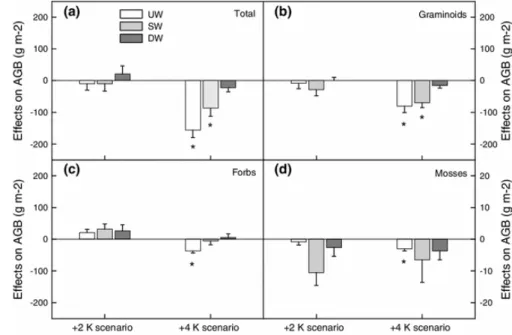
negative impact of the high level of climate change (+4 K scenario) was strongest in the intensively managed unwooded pasture system and only minimal in the extensively used sparsely and densely wooded pastures. This was visible for the plant species richness as well as for the diversity: plant communities that were transplanted in mesocosms to the warmer and drier climate experienced a marked loss in species richness (Figure 8) going up to 30 % at both transplantation altitudes, 1 010 m and 570 m, compared to the control site at 1 350 m. Similarly, total herbaceous biomass across all three land use types decreased to 45 % of that of the control site especially, when there was now shade (UW in Figure 9). This indicates that the pasture‐woodlands of the Jura Mountains are internally buffered to moderate climate perturbations, and that stronger impacts of climate change in the future
can be circumvented
through sustainable land use and by preserving the diversity of the landscape (Gavazov et al. 2014c).
From a below‐ground perspective, transplantation significantly increased soil temperature and decrease soil moisture compared to reference transplantation at 1 350 m (Figure 10). This combined effect lead to a significantly lower soil
Figure 8: a) Plant species richness and b) Shannon diversity for the vegetation communities in the three land use types: unwooded pasture (UW), sparsely wooded pasture (SW), and densely wooded pasture (DW). Significant (P < 0.05) factors (in italics) and interactions (marked with an X) are shown for each response variable. Figure from Gavazov et al. (2014b).
Figure 9: Effect of transplantation to a warmer and drier climate at 1 010 m (+2 K scenario) and 570 m (+4 K scenario) on aboveground biomass (AGB) production. Data presented in the plots are for a) the total biomass and the biomasses of b) graminoids, c) forbs, and d) mosses (y-axis scale varies). The three land-use types are: unwooded (UW), sparsely wooded (SW), and densely wooded (DW) pastures. Asterisks indicate significant differences (P < 0.05) from controls at 1 350 m. Figure from Gavazov et al. (2014b).
‐19‐
respiration at the transplanted sites in the field (Mills et al. 2014), but also a lower δ13C rate in unwooded compared to
wooded plots (Gavazov et al. 2014c). We further assessed a significant and overriding effect of moisture on soil respiration and its temperature response in situ in the pasture system (only open pasture plot were used in the study). However, under controlled conditions with the soil moisture effect being level out by watering soil samples to field capacity, respiration responses were site and temperature dependant. We concluded from those observations that the climate manipulations have affected the decomposer community response to temperature in terms of the magnitude of the flux, but not its intrinsic temperature sensitivity under standardised conditions. This highlights the resilience of the microbial community to extreme climatic change, but reinforces the reduction in the capacity to respond, and the consequences thereof for mineralisation processes and soil function.
These findings were confirmed by a decomposition experiment on the Mountland sites, where we followed decomposition of a standard litter type—senescent leaves of
Fagus sylvatica collected from a single location over 2.5 years (Gavazov et al. 2014b).
Decomposition in the drier unwooded pasture mesocosms increased with altitude, likely because of higher moisture at the highest sites. Decomposition in the more mesic mesocosms from sparsely and densely wooded sites was insensitive to altitude, suggesting an overriding moisture, rather than temperature, constraint on decomposition across these sites (Figure 11). The functional
composition of decomposer
microbial communities
(fungal/bacterial ratio) was
Figure 10: Daily mean soil moisture and temperature across the study period (May– September 2011) for the four study sites with elevation shown in metres above sea level. Figure from Mills et al. (2014b).
Figure 11: Leaf litter decomposition rates (K values) of Fagus sylvatica along an altitudinal gradient with mesocosms from three land-use types: unwooded pasture (UW), sparsely wooded pasture (SW), and densely wooded pasture (DW). Presented are mean values and standard errors for five replicate plots. Asterisks indicate significant effects of the specified factors. Figure from Gavazov et al. (2014b).
‐20‐
similarly insensitive to altitude. These findings add substantial evidence for the controlling role of soil moisture on litter decomposition, as well as for the indirect effects of climate through changes in the decomposer community.
Initial observations on changes in the quantity and quality of the SOM‐light fraction indicate that accumulations of unprotected organic matter may lead to a greater C and N source for decomposer communities during the winter, therefore potentially shifting a large proportion of the annual C and N budget outside of the growing season. The consequences of reduced function during the growing season carry negative implications for the sustainability of productivity in pasture systems, especially if limiting nutrients are only slowly returned to available pools. Whilst our results do not imply an increase in the losses of C as a function of climate change, a reduction in soil function will alter the storage capacity of C and macronutrients, which in the longer term will inevitably erode the stocks of C and N from organic matter (Mills et al. 2014). We therefore investigate more on the understanding of the seasonal dynamics of nutrient cycling (Gavazov et al. 2014a). Observation during winter show that naturally occurring warmer average winter temperatures resulted in thinner and inconsistent snow cover, which promoted soil frost and large diurnal temperature amplitudes. These exerted strong negative effects on soil microbial biomass and respiration rates during the winter. Considering we found below‐snow CO2‐efflux to be of greater magnitude than
that during the growing season, we conclude that a reduction in microbial activity due to climate warming may impede organic matter turnover and nutrient cycling in these subalpine pasture systems, with broad implications for ecosystem scale processes (Gavazov et al. 2014a). The results presented indicate a thermal decoupling of soil respiration under the snow, which is of general interest for the modelling of CO2
worldwide.
Year‐around measurements of soil enzymatic activity brought further evidence of for seasonal changes in soil carbon utilisation (Puissant et al. 2014). After four years of transplantations, we measured microbial biomass (MB), microbial community structure (MCS), and soil extracellular enzymatic activities (EEA) of nine hydrolytic and oxidative extracellular enzymes in the transplanted soils on a seasonal basis. We found a strong seasonal sampling date effect and a smaller but significant effect of the climate manipulation (soil transplantation) on EEA. Overall EEA was higher in winter and spring but enzymes linked to N and P cycles showed higher potential activities in autumn, suggesting that other factors than soil microclimate controlled their pool size, such as substrate availability.
‐21‐
The climate manipulation decreased EEA in most cases, with oxidative enzymes more concerned than hydrolytic enzymes. In contrast to EEA, soil MB was more affected by the climate manipulation than by the seasons. Transplanting soils to lower altitudes caused a significant decrease in soil MB, but did not affect soil MCS. Conversely, a clear shift in soil MCS was observed between winter and summer. Mass‐specific soil EEA (EEA normalized by MB) showed a systematic seasonal trend, with a higher ratio in winter than in summer, suggesting that the seasonal
shift in MCS is accompanied by a change in their activities (Figure 12). Surprisingly, we observed a significant decrease in soil organic carbon concentration after four years of soil transplantation, as compared to the control site, which could not be linked to any microbial data. We conclude that four years warming and decreased precipitation strongly affected MB and EEA but not MCS in subalpine grassland soils, and that those shifts cannot be readily linked to the dynamics of soil carbon concentration under
climate change (Puissant et al. 2014).
Figure 12: Redundancy analysis (RDA) of EEA (dry soil mass basis) using microbial biomass (MB), microbial community structure (PC 1; PC 2), SOC and C/N as constraining variables. Triangle = control site (1350 m a.s.l.), circle = lowest site (570 m a.s.l.); filled in = winter, empty = summer. Gray arrows and black arrows represent non-significant and significant explanatory variables, respectively (p<0.05).
‐22‐
2.2.2 Drought experiments
Extreme weather events are projected to increase in magnitude and in frequency due to climate change (IPCC 2007), calling for a shift from “trend‐focused” to “event‐ focused” climate change experiments (Jentsch, Kreyling & Beierkuhnlein 2007). Plants, as sessile organisms, are likely to be particularly exposed to an increasing frequency of extreme events. Understanding the mechanisms that underlie the response of plant communities which are on the base of the trophic cascade to such extreme weather episodes is a major challenge for predicting climate change effects on biodiversity (Smith 2011).
Besides the increase in the average temperature, the increase of droughts is a second phenomenon predicted for mountains worldwide (Beniston 2003). For Central Europe, extreme summer droughts are expected to be among the main consequences of climate change: the occurrence of dry summers droughts, comparable in severity to the summer drought in 2003, may represent the norm by the end of the 21st century in
which precipitation deficits might reach 70% in extreme years (Calanca 2007). For France, the number of summer heat waves will increase by about 1/3 for the future (2080 to 2099), as well as their duration which will last about 14 days in the future compared to about 10 days in the period 1961‐1990 (Meehl & Tebaldi 2004).
Given the key role of climate to vegetation distribution, a majority of scholars agree that extreme climatic events will induce vegetation shifts. However, it is also possible that no vegetation shift occurs after extreme climatic events due to site quality, variations in species and individual responses (tolerance, plasticity, and phenotypic variability), taxonomic and functional diversity, and biotic interactions such as facilitation or lowered competition
leading to a high resilience of ecosystems to droughts (Lloret et al. 2012).
Based in the results from the
Mountland study indicating
temperature sensivity at 1350 m, but soil moisture limitation at lower altitude, we studied in collaboration with my postdoc V. Jung in an
‐23‐
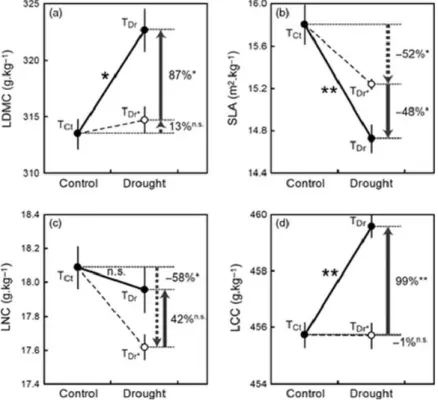
mechanisms that could explain the resilience of grasslands to droughts: intraspecific variability of functional traits (Jung et al. 2014). We analysed the short‐term functional response of subalpine grassland communities to a simulated drought by focusing on four leaf traits (LDMC: leaf dry matter content, SLA: specific leaf area, LNC: leaf nitrogen concentration, LCC: leaf carbon concentration). We therefore set up four rain shelters (Figure 13) in a species‐rich subalpine grassland vegetation in the Vercors Mountains and intercepted rain fall during five weeks, corresponding to a rainfall deficit of 115 mm (62 %) from the June‐July average rainfall (based on the 1952‐2009 data from Meteo‐ France). Control plots were watered twice a week following the local June‐July average rainfall. Plant species were recorded twice, immediately before and after the drought event using the “point‐quadrat” sampling method. Leaf traits were measured in each plot for the most abundant species with standard protocols (Cornelissen et al. 2003).
After evaluating species
turnover and intraspecific
variability separately, we
determined their relative
contribution in the community functional response to drought, reflected by changes in community weighted mean traits. We found significant species turnover and intraspecific variability, as well as significant changes in community weighted mean for most of traits. The relative contribution of intraspecific variability was more important (42 – 99 %) than the relative contribution of species turnover (1 – 58 %). Intraspecific variability either amplified (for LDMC, SLA and LCC) or dampened (for LNC) the community functional response mediated by species
turnover (Figure 14). We demonstrated that the small contribution of species turnover to the changes in community mean LDMC and LCC was explained by a lack of covariation between species turnover and interspecific trait differences. These results highlight the
Figure 14: Changes in community-weighted mean trait values due to both species turnover and intraspecific variability (solid line) and due to species turnover only (dashed line). TCt and TDr correspond to the observed community mean traits in control plots and in drought plots; TDr* corresponds to the community mean trait in drought plots recalculated from trait values measured in control plots. Data are means ± standard errors of community means of LDMC (a), SLA (b), LNC (c) and LCC (d). Arrows indicate the contributions of species turnover (CTurn; dashed line arrows) and of intraspecific variability (CIntra; solid line arrows) to the changes in community mean traits. CTurn and CIntra are expressed as percentages of their cumulative magnitude (Significance levels: *P < 0.05, **P < 0.01, n.s. not significant). Figure from Jung et al. (2014).
‐24‐
need for a better consideration of intraspecific variability to understand and predict the effect of climate change on plant communities. While both species turnover and intraspecific variability can be expected following an extreme drought, we report new evidence that intraspecific variability can be a more important driver of the sort‐term functional response of plant communities. This indicates that vegetation can adapt quickly by its intra‐specific variability, as species‐rich communities such as the grasslands under study are most often rich in plant functional traits.
In a further step, we crossed in a second drought experiment in collaboration with my former Master student C. Deléglise, now at Agroscope Changins,
CH, reduced
precipitation with real
grazing by sheep
(Figure 15). Simulating grazing by clipping or
mowing as widely
applied in other
experiments (Mariotte et al. 2013b) does not represented mechanisms correctly compared to grazers. We therefore aimed at predicting the effects of drought on the vegetation of temperate grasslands when grazed with real animals, which has, as far as we know, never been investigated and this despite the fact that cattle grazing is the main grassland management worldwide (WallisDeVries, Bakker & Van Wieren 1998). In many cases grazing is simulated trough cuttings, which are rarely applied in a selective manner, but for reasons of feasibility applied uniformly to the spot under study. However, grazing animals have feeding preferences due to their anatomy and their nutritional requirements. Moreover, through defoliation, dejections, and trampling, grazing can have positive or negative interactions with above and below‐ground components of grassland ecosystems (Kohler et al. 2006) and impact the spatial structure of the vegetation in various ways (Adler, Raff & Lauenroth 2001). In addition, numerous are the regions which are usually intensively grazed in a rotational systems which triggers a much more frequent utilization than under traditional mowing as
Figure 15: Pair of sheep grazing under a rain-out shelter during the simulated drought. Photo: C. Deléglise.
‐25‐
illustrated for the Jura Mountains (Jeangros & Scehovic 1996). While in general frequent grazing reduces the annual dry matter production, repeated defoliation forces plants into an active growing and tillering phase instead of maturing naturally which leads to a higher nutritive value to the forage (Bruinenberg et al. 2002). It is therefore likely that grazing influences the response of the vegetation to drought to another extent than mowing.
Similarly to other drought
experiments, we observed strong negative drought effects on forage production and, to a lesser extent, on the nutritive value of the forage with sheep grazing being more constraining than mowing (Deléglise et al. 2014). Changes in community weighted‐ mean traits (e.g. decrease in specific leaf area) accompanied these shifts, attesting for a decline in plant growth rates and an investment in structural tissue by plants, whereas species composition remained rather stable (Figure 16). Recurrent defoliation due to grazing and associated less leaf area remaining maintained vegetation in an early regrowth stadium more sensitive to water stress.
During the recovery phase after cessation of the drought, management effects remained visible, but resilience was observed for both managements in spring of the following year. Our results suggest that grazing increases drought effects, but reversible trait variation ensure stability of grasslands after a short‐term drought event, i.e. preventing long lasting shifts in species and trait composition, and therefore in forage production, even under a fairly intensive management. 0 5 10 15 20 25 30 35 0 5 10 15 20 25 30 35 VH (cm ) a b b c a b c b
Initial State Drought Recovery Resilience
May 2012 August 2012 Oct. 2012 May 2013
0 10 20 30 40 0 10 20 30 40 SL A mm² mg 1 a b c b ab a ab b ab a ab b 0 50 100 150 200 250 300 350 0 50 100 150 200 250 300 350 LDM C mg g 1 a b c b a b ab a 0 1 2 3 4 5 0 1 2 3 4 5 LN C (% ) C D C D C D C D C D C D C D C D M G M G M G M G a b c d a a b b
Figure 16: Community weighted mean traits in control (C) and drought (D) conditions in the mowing (M) and grazing (G) managements at four periods. VH: vegetative height; SLA: specific leaf area; LDMC: leaf dry matter content; LNC: leaf nitrogen content. Bars are means ± SE (n=4). Within each period, significant differences between treatments are indicated by different letters above bars (P < 0.05, Tukey’s post-hoc tests). Figure from Deléglise et al. (2014)
‐26‐
To go further from these two experiments, we also collected root samples from common plant species which are currently under study for assessing their mycorrhizal infestation rates. I wish to explore the consequences of two aspects of climate change (higher frequency in drought recurrence and increased temperature) on the interactions between plants and soil with a particular attention on the relationship between plants and mycorrhizal fungi (AMF). However, there could be a trade‐off between
positive (higher temperature at lower altitude increases mycorrhizal hyphae length and thus soil volume explored by AMF) and negative effects (increased drought frequency reduces AMF colonization rates of roots) due to climate change. Following these changes, I hypothesize that the interactions between plants and AMF slide towards the parasitic part of the mutualism‐parasitism continuum at intermediate altitudes and towards the mutualistic part at lower altitudes due to drought stress (Figure 17). This hypothesis is currently explored by my PhD student Anne‐Lena Wahl. Conclusion
I showed with the works presented in that chapter that subalpine and montane ecosystems are resistant against increase in temperature until a threshold which is situated in our case between +2 K et +4. I further demonstrated that collinean ecosystems are more water limited concerning soil functioning, but that vegetation at this altitudinal belt absorbs temporal decrease in water availability by intraspecific variability.
Figure 17: Current (blue) and future interactions between plants and mycorrhizae at different altitudinal zones due to thermal and water stress.
‐27‐
2.3 Consequences of land use changes
In Europe, grassland biodiversity has declined dramatically in the lowland due to agricultural intensification, while in many mountain areas grasslands are still managed in a traditional way (MacDonald et al. 2000). Semi‐natural mountain grasslands are widespread components of north‐temperate landscapes and play an important role by providing fodder for livestock and acting as reservoirs for both carbon (Follett & Reed 2010) and biodiversity (Mariotte et al. 2013c). These ecosystems host species‐rich communities with up to 40 plant species per square metre but are among the most endangered ecosystems in Europe, threatened by both climate (Mariotte et al. 2013b) and land use change (Fava et al. 2010). Changes in agricultural practices may lead to land use changes, which have been accelerated since the 1950 in Central Europe. Land use changes may be triggered by simple adaptations to currents managements (decreasing mowing intensification from 2 cuts per year to 1cut/year, adding fertiliser to increase biomass productivity, increasing cattle density per land unit, etc.) or by radical shifts as fallowing or transformation from haymeadows to pastures. At present, the intensification of easily accessible sites and in parallel abandonment of less accessible sites in the European Alps (Tasser, Mader & Tappeiner 2003) and in the Jura (Chételat et
al. 2013) became a reality.
Land use changes can act at different spatial scales. One of the most evident impacts because easily visible is the complete or gradual abandonment of an agricultural field which I qualify as changes at the “landscape scale”. However, as plant community structure (species diversity and composition) is largely the result of management (e. g. regular grazing) of seminatural grasslands, land use changes are likely to modify this structure and, as a consequence, perturb community stability and ecosystem functioning which in general acts at smaller spatial scale, which I call “local scale”. Accordingly, I’ll present my scientific contributions in two chapters: a first which focuses on the small scale impacts resulting from the adaptation of current management where I priviledged an observational or experimental approach and in a second chapter where models were used to asses impacts of land use change on the landscape level.
2.3.1 Local impacts on vegetation and its interaction with soil
While intensive forms of land use are essential for humans to obtain natural products such as food and fibre, they have contributed to the transformation of
‐28‐
ecosystem patterns and processes (Foley et al. 2005). In particular, human activities have altered the rate, pathways and efficiency of the movement of nutrients within and between the various biotic or abiotic ecosystem compartments. These changes in nutrient cycles do not only affect today’s ecosystem functioning but may also result in long‐term legacy effects on ecosystem processes, thereby changing the resilience of ecosystems and their adaptive capacity to sustain ecosystem services in the face of uncertainty and global change (Folke et al. 2002; Elmqvist et al. 2003; Carpenter et al. 2009).
Nutrient manipulations trough soil amendments (lime, fertiliser, carbon)
So far, most emphasis in terms of terrestrial nutrient cycling has been put on carbon (C), nitrogen (N) and phosphorus (P), because of their key roles in primary production and climate regulation (Galloway et al. 2008). For example, the effects of continuous fertilization of grasslands (Wedin & Tilman 1996; Stevens et al. 2004; Suding
et al. 2005; Silvertown et al. 2006), and to some extent also the changes after cessation of
fertilization (Spiegelberger et al. 2006a; Hrevusova et al. 2009; Pierik et al. 2011), have been well documented. Less well understood are the short‐term and long‐term effects on ecosystem patterns and processes of the addition of elements other than C, N or P, although they are also known to affect ecosystem functioning.
Calcium (Ca) is a key base cation in the soil influencing various physiological and structural processes both in animals and plants (McLaughlin & Wimmer 1999). Ca is a component of the soil buffering system, as CaCO3‐ and HCO3‐ are important sinks for
protons with a high buffering rate and consequently affects soil pH and all major soil processes that are modulated by soil pH. Furthermore, Ca as a bivalent cation with a rather strong sorption capacity is very effective in binding to soil particles, thereby increasing aggregate formation in soils and improving soil structure significantly, and an important early indicator of disturbance of nutrient cycling in terrestrial ecosystems (McLaughlin & Wimmer 1999). Large amounts of lime are applied to croplands, pastures and forests in many regions of the world (Jandl, Alewell & Prietzel 2004; Isselstein, Jeangros & Pavlu 2005; West & McBride 2005), and they are expected to further increase globally due to the expansion of intensive land use practices (Tilman et al. 2001). While liming can improve plant health in naturally or anthropogenically acidified soils (Shortle & Smith 1988; Alewell et al. 2000), it may also contribute to the loss of rare and threatened species (Tilman et al. 1994; Isselstein et al. 2005; Spiegelberger et al. 2006a) and is discussed controversially as either decreasing (Hamilton et al. 2007) or increasing