Digital Expansionism:
Exploring the U.S.-China Technology Dynamic Through
Cybersecurity Policy and International Marketing Strategies in the
Cloud Computing Sector
By
Julien Isaacs
BSFS Georgetown University, 2012
SUBMITTED TO THE MIT SLOAN SCHOOL OF MANAGEMENT IN PARTIAL FULFILLMENT OF THE REQUIREMENTS FOR THE DEGREE OF
MASTER OF SCIENCE IN MANAGEMENT STUDIES AT THE MASSACHUSETTS INSTITUTE OF TECHNOLOGY
JUNE 2019
@2019 Julien Isaacs. All rights reserved.
The author hereby grants to MIT permission to reproduce and to distribute publicly paper and electronic copies of this thesis document in whole or in part in any medium now
known or hereafter created.
Signature of Author:
Certified by:
Signature redacted
Julienisaacs MIT Sloan School of Management
Signature redacted
May 10, 2019Stuart Madnick John Norris Maguire Professor of Information Technologies, Sloan School of Management & Professor of Engineering Systems, School of Engineering Thesis Supervisor Accepted by: MASSACHUSTS NSTITUTE OF TECHNOLOGY
JUN 0
4
2019
LIBRARIES
ARCHIVEU
Signature redacted
Jake Cohen Se io Ass iate Dean, MIT Sloan Undergraduate & Masters Programs MIT Sloan School of ManagementDigital Expansionism:
Exploring the U.S.-China Technology Dynamic Through Cybersecurity Policy and International Marketing Strategies in the Cloud Computing Sector
By
Julien Isaacs
Submitted to MIT Sloan School of Management on May 10, 2019 in Partial Fulfillment of the
requirements for the Degree of Master of Science in Management Studies.
ABSTRACT
The U.S. and China remain largely separated from one another in terms of technological market access, with both sides implementing policy regimes serving as official or unofficial barriers to international trade, especially evident in data-sensitive industries, such as cloud computing. The result is a very low market share for American cloud computing providers in China, and vice-versa. This paper explores the U.S.-China dynamic insofar as government policy and action are concerned, the U.S. and China markets, and private enterprise's response and strategy in the cloud computing
industry, which is notable not only given its value, $278.3 billion worldwide by 2021, but also its central position in the flow of global data.'
The paper arrives at a number of conclusions. Firstly, given China's techno-nationalist policy regime, U.S. cloud computing firms, and by extension, all U.S. technology companies, will face increasingly limited market share and opportunity in
China. Conversely, Chinese cloud computing providers, and by extension Chinese technology products, in general, may be able to successfully garner market share in the
U.S. by offering innovative products with little to no substitutes, for which Americans will potentially waive their data privacy concerns in order to access (which may lead to unintended consequences). Lastly, the U.S. and China should work together to form, articulate and implement cybersecurity and data norms, enhancing international cooperation on a government and private enterprise level, effectively removing
international trade barriers and promoting and enhancing market access. Cooperation, however, remains a challenge, given the differing policy objectives of the U.S. and China.
Thesis Supervisor: Stuart Madnick
Title: John Norris Maguire Professor of Information Technologies, Sloan School of Management & Professor of Engineering Systems, School of Engineering
1 "Gartner Forecasts Worldwide Public Cloud Revenue to Grow 17.3 Percent in 2019." Gartner
/T Glossary, Gartner,
Inc., 2018, www.gartner.com/en/newsroom/press-releases/2018-09-12-gartner-forecasts-worldwide-public-cloud-revenue-to-grow-1 7-percent-in-2019.
Table of Contents
1. Introduction... 6
2. Cloud Com puting... 8
2.1 Cloud Com puting Technology Overview ... 8
2.2 Cloud Com puting: M arket Analyses ... 12
2.3 Cloud Com puting: U.S. M arket ... 16
2.4 Cloud Com puting: China M arket ... 17
3. Cybersecurity... 21
3.1 Cybersecurity; Overview & Fram ew ork ... 21
3. 2 Cybersecurity; International Trade ... 22
3.3 Cybersecurity; The Cloud ... 24
3.4 Parkerian Hexad...25
3.5 A Discussion on Cloud, Data and Consumer Data Privacy... 28
3.6 Porter's Five Forces...30
3.7 A Com prehensive Fram ew ork ... 31
4. A m erica to China: Cloud Expansion... 33
4.1 Am erica to China: Context & Background... 33
4.2 A Discussion on China & the W TO ... 35
4.3 A Discussion on T echno-nationalism ... 38
4.4 Am erica to China: Policy Background ... 40
4.41 2006 -2012: Early Policies & Initiatives ... 40
4.42 200 9 China Telecom Law ... 42
4.43 IC P & ISP Licenses ... 42
4.44 2012 Decision of the Standing Committee of the National People's Congress on Strengthening Inform ation Protection on Networks... 43
4.45 2015 National Security Law... 44
4.46 2017 Cybersecurity Law...45
4.5 America to China: Cloud Computing Case Study: Microsoft... 50
4.6 Am erica to China: Analysis ... 52
5. China to A m erica: Cloud Expansion... 55
5.11 A Discussion on Huawei & ZTE: A Helpful Precedent... 55
5 .1 2 F IR R M A & C F IU S ... 6 2 5.13 Exposing PLA Unit 61398 (-) ... 64
5.14 Increased U.S.-China Cyber Tension...65
5.15 2015 The U.S.-China Cyber Agreement ... 66
5.2 China to Am erica: Policy Background... 69
5.21 1986 Stored Communications Act (SCA) & 1986 Electronic Communications Privacy Act (ECPA)..70
5.22 1994 Communications Assistance for Law Enforcement Act (CALEA) & 2011 Patriot Act...70
5.2 3 2 0 1 8 C L O U D A ct... 7 1 5.3 China to Am erica: Main Case Study: Alibaba... 72
5.4 China to Am erica: Analysis ... 74
6. Conclusions ... 77
6.1 International Strategy Recom m endations ... 77
6 .1 1. A m erica to C h in a ... 7 7 6 .1 2 C h in a to A m erica ... 7 8 6.2 Policy R ecom m en dations ... 78
6.3 Cu rrent & Future A nalysis ... 8 1 6.4 In Summation: An Evolving Dynamic ... 83
List of Tables
Table 1: Cloud Service Models ... 11Table 2: Worldwide Public Cloud Services Revenue Forecast September 2018... 13
Table 3: Regional Public Cloud Leadership in North America, EMEA (Europe, Middle East and Africa), APAC (Asia Pacific) and Latin America ... 15
Table 4: laaS Only Market Share of the Top Five Providers, June 2018... 16
Table 5: Annual Run Rate Q4 2017 ... 17
Table 6: Chinese Cloud Service Providers: 2015... 19
Table 7: Chinese Cloud Service Providers: 2016... 20
Table 8: National Cybersecurity Concern Policy Motivations in the U.S. and China... 23
Table 9: The Parkerian Hexad: Component Definitions... 27
Table 10: The Updated Parkerian Hexad: Component Definitions ... 27
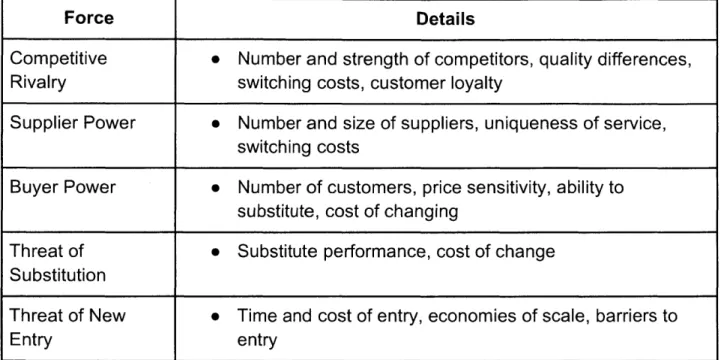
Table 11: Porter 5 Forces... 31
Table 12: Unique Elements of the Chinese State ... 38
Table 13: National Cybersecurity Concern Policy Motivations in China... 40
Table 14: Key Highlights from China's 2017 Cybersecurity Law... 46
Table 15: The Updated Parkerian Hexad: Chinese Consumer Risks for Microsoft Azure in China ... 5 3 Table 16: Porter 5 Forces for Microsoft Azure in China ... 54
Table 17: Summary of Recommendations from Investigative Report on the U.S. National Security Issues Posed by Chinese Telecommunications Companies Huawei and ZTE... 59
Table 19: National Cybersecurity Concern Policy Motivations in the U.S. ... 69
Table 20: The Updated Parkerian Hexad: American Consumer Risks for Alicloud in the U.S... 75
Table 21: Porter 5 Forces for Alicloud in the U.S ... 77
Table 22: U.S.-China Policy Recommendations & Perspectives ... 81
List of Figures
Figure 1: Cloud Infrastructure Services Market Share Trends ... 14Figure 2: Chinese Cloud Service Providers: 2017 ... 21
Figure 3: Cybersecurity & The Parkerian Hexad ... 25
Figure 4 : Porter's Five Forces ... 30
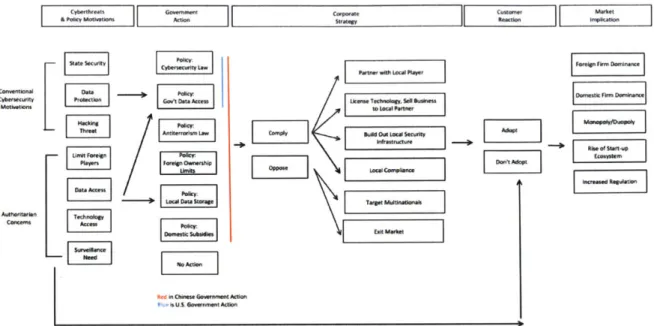
Figure 5: A Systems Dynamic Framework for U.S.-China Cybersecurity Policy & Cloud C om puting B usiness Expansion... 32
Figure 6: Understanding China's Strategic Goals ... 35
Figure 7: Required Steps for Data/Software U.S. Businesses in China as of 2017... 49
Figure 8: Unit 61398: Position Within in the PLA ... 65 Figure 9: Active Network Compromises Conducted by 72 Suspected China-Based Group: 2013-2 0 1 6 ... 6 8
1. Introduction
The U.S. and China represent two of the most important global economies and political heavyweights in the world today, both increasingly focused on the development and adoption of cutting-edge technologies, including cloud computing. In the
increasingly digitized, plugged in and automated age, inarguably, the technology dynamic between the United States and China will be a crucial relationship of greater future consequence and economic effect. Yet, especially in the technology space, the two remain separated by the Great Firewall, each relying on its own increasingly unique ecosystem, informed by government policies, consumer preferences, public perception and historical variables. Numerous American technology titans have headed to China. Once they arrive, their superstar status seems to fade. Similarly, Chinese technology superpowers struggle to find footing and traction with consumers in the American market. This leads to two core questions: (1) Why do American technology firms have so much trouble in the China market? and (2) Why do Chinese technology companies have an inability to make it big in America?
Perhaps in no sector are the bilateral issues more emblematic than in the cloud computing services business, which touches on many big-ticket issues such as Big Data (upon which Al is so dependent), consumer privacy, and localization requirements. The cybersecurity issue is especially salient here, as cybersecurity concerns have impacted governmental policies and, by extension and via reaction, the international strategy for cloud computing service firms in the U.S. and China. Summarily, this thesis, through an analytical framework centered on dissecting challenges around institutional, technological, social and managerial factors, and comprehensive case study analyses, will examine the current U.S.-China cloud dynamic and ultimately provide actionable strategies for how American cloud technology platforms can maximize their China market share, and vice-versa. However, serious challenges abound on both sides, much of which can only be remedied by substantial overhaul to current policy regimes.
Interestingly, both the U.S. and China cite "state security" as the motivation for limiting, either officially or unofficially, market access for foreign technology players, effectively serving as a barrier to international trade in the digital economy. In China, it seems, the Chinese Community Party (the "CCP" or "the Party"), primarily utilizes the notion of state security as a justification to grow its domestically Chinese national
champions, such as Tencent and Huawei, under the pretense of economic and political stability. The CCP correlates indigenous technological innovation as central to China's long terms strategic interests and, as a result, has implemented a "techno-nationalist" policy regime that has severely limited American technology companies' ability to succeed in the China market. This phenomenon is especially prevalent in the cloud services business, where American corporations such as Amazon and Microsoft that provide public cloud services in China were sent scrambling given a 2017 cybersecurity
law that mandated localized data storage for Chinese user generated data. Though other countries or nation-states also have data localization requirements, which, for
instance, in the EU serve to protect consumer privacy, China's data localization remains unique as a mechanism for the Chinese State to retain social control, ensuring political and economic stability. In the United States, state security is also cited as a reason to
limit Chinese technological access, with the goal of preventing economic espionage and the theft of intellectual property. Huawei and ZTE are especially useful precedents here. Governing bodies such as Congress have issued reports and passed legislation barring the governmental purchase and dissuading the private adoption of Chinese
telecommunications equipment. However, a less formalized policy regime exists against Chinese companies in America compared to American companies in China. A key factor in the U.S. is consumer preference. In other words, given the data security issues associated with Chinese technology products and services, American consumers will be less likely to adopt a Chinese technology product or service, such as cloud storage, compared to a perceived more secure American product, such as Amazon Web Services ("AWS"). However, American consumers, in the future, will likely be willing to adopt Chinese technology products and services, despite data security concerns, if there exists no direct domestic substitute, with current examples such as Bytedance's Al-informed viral short video app Tic Tok and DJI's drone technology.
The paper is organized as follows. In section two, cloud computing as a technology will be explained and the relevant security issues informing government policy and consumer adoption will be explored. A global market analyses will then be performed, followed by more specific examinations into the cloud markets in the U.S. and China, respectively. In section three, a cybersecurity overview will then be introduced. Frameworks to understand cybersecurity issues, international trade and consumer adoption preferences will be explored, for later application. Additionally, a discussion on cloud, data and consumer data privacy will be employed. Section four will detail and analyze the America to China cloud expansion dynamic, with a focus on examining the local market landscape, relevant policies and a select firm case study. Issues regarding China & the WTO and techno-nationalism will also be carefully
examined. Microsoft Azure in China will serve as the America to China cloud expansion case study. Following that, section five will explore the China to America dynamic for cloud computing services, which will then be analyzed, with a focus, again, on
examining the local market landscape, relevant policies and a select company case study. Issues regarding Huawei & ZTE, FIRRMA & CFIUS and U.S.-China
cybertensions will be explored. Alibaba's Alicloud (or Aliyun rJ i) in America will serve as the China to America cloud expansion case study. Analyses will be provided using an updated Parkerian Hexad and Porter's 5 Forces methodology for the two case studies. Finally, the paper will conclude by offering international strategy
recommendations for the U.S. and China, and a current and future analysis of the sector for foreign actors.
2. Cloud Computing
2.1 Cloud Computing Technology Overview
Since its inception, cloud computing has inexorably altered the software
landscape, introducing a new paradigm in terms of data storage and distribution. The term "cloud computing" appeared as early as 1996, cited first in the Compaq Computer
offices in Houston, Texas, as employees envisioned the future of the Internet and software transmission. Later in the mid 2000s, the term was popularized by major players such as Amazon and Google. Amazon, especially, contributed to the
mainstream adoption of the term with the release of Amazon Elastic Compute Cloud (Amazon EC2) in 2006.3
For the past decade, cloud has remained a buzzword in the technology industry, but an understanding of the fundamentals may remain vague for many. Below, formal definitions are provided.
Microsoft, via the Microsoft Azure service site, describes cloud computing as "the delivery of computing services--servers, storage, databases, networking, software, analytics, intelligence and more--over the Internet ("the cloud") to offer faster innovation, flexible resources, and economies of scale."4 According to the National Institute of
Standards and Technology (NIST), cloud computing enables ubiquitous access to a shared pool of computing resources.5 Cloud computing technologies have five main characteristics: on demand self-service, broad network access, resource pooling, rapid elasticity and measured service. The nature of the cloud allows for computing
resources, such as networks, storage, services, etc., to be rapidly provisioned to users with minimal management and limited interaction with the service provider. The official NIST cloud computing definition is as follows:
Cloud computing is a model for enabling ubiquitous, convenient, on-demand network access to a shared pool of configurable computing resources (e.g. 2 Regalado, Antonio. "Who Coined 'Cloud Computing'?" MIT Technology Review, MIT Technology Review, 30 Dec. 2013, www.technologyreview.com/s/425970/who-coined-cloud-computing/.
3 "Announcing Amazon Elastic Compute Cloud (Amazon EC2) - Beta." Amazon, Amazon, 2006,
aws.amazon.com/about-aws/whats-new/2006/08/24/announcing-amazon-elastic-compute-cloud-amazon-ec2---beta/. 4"What Is Cloud Computing? A Beginner's Guide I Microsoft Azure." A Beginner's Guide I Microsoft Azure,
azure. microsoft.com/en-us/overview/what-is-cloud-computing/.
5 Mell, Peter and Timothy Grance. "The NIST Definition of Cloud Computing." National Institute of Standards and
networks, servers, storage, applications, and services) that can be rapidly provisioned and released with minimal management effort or service provider interaction. This cloud model promotes availability and is composed of five essential characteristics, three service models, and four deployment models.6 Though some elements of this definition have become slightly outdated as the technologies powering cloud computing continue to advance and new service
mechanisms have been introduced, in general, the NIST definition of cloud computing remains the gold standard worldwide. NIST provides a more official and technical version than Microsoft, which reads more as a consumer friendly and easy to understand definition of the cloud.
In terms of service models, three main models compose the cloud service infrastructure: SaaS (software as a service), PaaS (platform as a service) and laaS (Infrastructure as a service).7 Arguably the most ubiquitous, SaaS (software as a service) allows users to access provider applications running on a cloud infrastructure. Examples of SaaS include Google Docs, Siri and Dropbox. PaaS (platform as a service) enables users to create or acquire applications via utilizing the cloud service provider's resources, including programming languages and libraries. Examples of PaaS include Openshift, Google App Engine and Heroku. laaS (Infrastructure as a service) enables users to create operating systems, storage, deployed applications and other
fundamental computing resources on the cloud service provider's underlying cloud infrastructure. The primary features of laaS are elasticity and virtualization. Examples of laaS include Rackspace and Cisco Metapod. To note, both Amazon Web Services and Microsoft Azure have PaaS, and laas functionalities. laaS is the base for all cloud
services, and the foundation upon which PaaS and SaaS applications are built. Virtualization technology is essential to cloud computing, acting as the
fundamental technology powering cloud computing. According to Madnick and Donovan (1973), virtualization "enables a single system to concurrently run multiple isolated virtual machines (VMs), operating systems or multiple instances of a single operating system (OS)."9 There are two main types of virtualization: application virtualization and server virtualization. Application virtualization allows for the delivery of an application, that is typically hosted on one or a few main servers, to be simultaneously delivered to a large number of users. Server virtualization hosts virtual machines using common
physical hardware, such as networks, storage or computing machines.10 In effect,
6 Ibid
7 'Types of Cloud Computing." Amazon, Amazon Web Services, aws.amazon.com/types-of-cloud-computing/.
8
Watts, Stephen. "SaaS vs PaaS vs laaS: What's The Difference and How To Choose." BMC Blogs, 2017, www.bmc.com/blogs/saas-vs-paas-vs-iaas-whats-the-difference-and-how-to-choose/.
9 Madnick, Stuart, and John Donovan. "Application and Analysis of the Virtual Machine Approach to Information System Security and Isolation." Contents: Using the Digital Library, ACM, 1973, dl.acm.org/citation.cfm?id=803961. 10 Ruparelia, Nayan. Cloud Computing. The MIT Press, 2016.
virtualization allows for the software manipulation of the hardware, which enables cloud computing technology to function effectively.
Beyond the more traditional SaaS, PaaS and laaS service models, three new service models have been more recently introduced: BPaaS (business process as a service), INaaS (information as a service), and DBaaS (database as a service)."
BPaaS (business process as a service) involves business processes outsourcing via a cloud service model, effectively reducing labor count, the traditional goal of business process outsourcing, through increased cloud automation. Examples of BPaaS include HR functions such as payroll and benefit administration. BPaaS usually sits on one of the three more foundational cloud service models, SaaS, PaaS or laaS. INaaS
(information as a service) allows any application to access information, often via an API, referring to the ability to access any remotely hosted information via the cloud.
Examples could include accessing the latest tax code and accounting regulations or stock price information. INaaS is unique from laaS since it not just involves the storage of data, but also requires the manipulation of data to present it in a meaningful and
useful way. DBaaS (database as a service) enables users to provision, configure and operate database software via the cloud of a remotely hosted database. Examples of
DBaaS include Xeround, which provides applications via the open source MySQL database, and Amazon Web Services' Amazon Relational Database Service (Amazon
RDS), which helps scale computing resources and scale capacity for relational
databases.1 4 BPaaS, INaaS and DBaaS represent three additional cloud service models
which are used widely but which do not fall within the NIST cloud computing definition. Table 1 below details the various cloud service models
Cloud Service Model Description
SaaS (software as a service) Allows users to access provider applications running on a cloud infrastructure
PaaS (platform as a service) Enables users to create or acquire applications via utilizing the cloud service provider's resources, including programming languages and libraries laaS (Infrastructure as a service) Allows users to create operating systems, storage,
deployed applications, etc. on the cloud service provider's underlying cloud infrastructure
I bid
12 Rouse, Margaret. "What Is BPaaS (Business Process as a Service)? - Definition from Whatls.com." SearchERP, searcherp.techtarget.com/definition/BPaaS-Business-Process-as-a-Service.
13 Mosbah Magdy, Mohamed, et al. "CURRENT SERVICES IN CLOUD COMPUTING: A SURVEY." International
Journal of Computer Science, Engineering and Information Technology (IJCSEIT), 2013,
pdfs.semanticscholar.org/3594/79fbca56b4bl 295734b8c4c1 6af0d1 7273f2.pdf.
BPaaS (business process as a Involves business processes outsourcing via a
service) cloud service model
INaaS (information as a service) Enables any application to access remotely hosted information, often via an API
DBaaS (database as a service) Allows for users to provision, configure and operate database software via a remotely hosted database
Table 1: Cloud Service Models
Distribution-wise, there are four main deployment models: private cloud,
community cloud, public cloud and hybrid cloud. Private cloud indicates that the cloud is to be used exclusively by a single institution. Community clouds are created to a serve a certain group of individuals that may share an objective, a mission or security
requirements. Public clouds are for the general public's open use, but may be owned by a company, government or academic institution. Lastly, hybrid clouds are a mix of two or more of the aforementioned cloud deployment models that are bound by either standardized or proprietary technology.
Four distinct participants, or actors, are involved in the chain of creation, delivery and consumption of cloud services: the cloud service creator, the cloud service
provider, the cloud service broker and the cloud service consumer. The cloud service creator optimizes the supply of resources that underpin a cloud service, and then provides those resources to a cloud service provider. Occasionally, cloud service
creators also act as cloud service providers. Cloud service providers are the entities that provide cloud computing services to the user. The service provider maintains the
service catalogue, sets the price and handles the contractual matters. The cloud service broker acts as an agent between numerous cloud service providers and the service consumer, ensuring optimum cost (and payment), quality and timeliness parameters. The cloud service consumer is the user of the cloud services, often concerned with service cost, quality and timeliness. Note that not all four entities must be present in every cloud service supply chain; it is possible to have just two entities, the cloud service provider and cloud service consumer.
With respect to cloud security, which will be discussed in more detail below, key issues include data privacy and service availability.1 5 Security problems can include
issues such as data security and user data privacy protection. Service availability
concerns includes maintenance of platform stability and cloud computing administration. Traditional cybersecurity issues such as security vulnerabilities, exposure to viruses and hacking threats are also applicable to cloud computing, especially the threat of hacking, 15 Liu, Wentao. "Research on Cloud Computing Security Problem and Strategy ."
2012 2nd International Conference
on Consumer Electronics, Communications and Networks (CECNet), 2012,
as malicious intruders may try to hack into cloud accounts and steal potentially sensitive data. Protection strategies can include data encryption, security authentications and access control policies. For the purposes of this paper, issues concerning data privacy and information security are the most salient and will be explored more thoroughly in the next section.
2.2 Cloud Computing: Market Analyses
Cloud computing is a rapidly growing market, globally, projected to grow to at least $278.3 billion by 2021 and, in many ways, has introduced a new paradigm for software, in terms of its distribution, and computing resources, including data storage and development tools, in terms of access. Many digital businesses today rely on cloud services for internal operations, such as data management, hosting services and
remote storage and, increasingly, modern enterprises utilize cloud services to provide services to their customers. As shown in Table 2, the public cloud services market is arguably the biggest and most valuable market, especially compared to the other
deployment models such as private and community cloud. In 2017, the worldwide cloud public cloud services market generated revenues of worth $145.3 billion, growing 21% in 2018 to $175.8 billion. The market is projected to grow to $206.2 billion in 2019, a 17% increase.16 By contrast, in the fourth quarter of 2017, public cloud generated revenues of $8.5 billion and private cloud $4.3 billion in revenue.17 Of the different service models, laaS is the fastest growing in the 2018 to 2019-time range, growing 27.6% from $31.0 billion in 2018 to $39.5 billion in 2019. Sid Nag, research director at Gartner, believes that PaaS and laaS will be instrumental in driving the next wave of cloud infrastructure adoption and key drivers of future demand.1 8 However, today, SaaS
still remains the largest cloud market segment, occupying 41% of the total public cloud service market in 2018. As enterprises have gone increasingly digital in the past ten years, the cloud service ecosystem has grown exponentially in revenues, in value and
in size.
16
"Gartner Forecasts Worldwide Public cloud Revenue to Grow 17.3 Percent in 2019." Gartner /T Glossary, Gartner,
Inc., 2018, www.gartner.com/en/newsroom/press-releases/2018-09-1 2-gartner-forecasts-worldwide-pu bl ic-cloud-revenue-to-grow-1 7-percent-in-2019.
17 "Public Cloud Expansion Drives Double-Digit Growth of Worldwide Cloud IT Infrastructure Revenues in
the Fourth Quarter of 2017, According to IDC." IDC: The Premier Global Market Intelligence Company,
2018, www.idc.com/getdoc.jsp?containerld=prUS43705018. 18 Ibid
Table 1. Worldwide Public Cloud Service Revenue Forecast (Biflions of U.S. Dollars)
2017 2018 2019 2020 0021
Cloud Business Process Services
'BPaaS) 42.2 46.6 50.3 54.1 58.1
Dloud Application Infrastructure
:ervices (PaaS) 11.9 15.2 18.8 23.0 27.7
Dloud Application Services (SaaS) 58.8 72.2 5.1 98.9 113.1 Cloud Management and Security
Services 8.7 10.7 12.5 14.4 6.3 Cloud System Infrastructure Services
'laaS) 23.6 31.0 39.5 49.9 63.0
Total Market 45.3 75.8 206.2 240.3 278.3
BPaaS = business process as a service; service; SaaS = software as a service
laaS = infrastructure as a service; PaaS = platform as a
Table 2: Worldwide Public Cloud Services Revenue Forecast September 201819
Of the cloud service providers, Amazon, Microsoft, Alibaba, Tencent and IBM are the current industry heavyweights worldwide, especially in terms of infrastructure
services such as laaS and PaaS. As shown in Figure 1, Amazon, with its Amazon Web Services suite of cloud computing services, currently dominates the public cloud market, and has an estimated 33% of the cloud infrastructure market share, almost 2.5 times greater than its closest competitor, Microsoft. Amazon has held its roughly worldwide market share for roughly twelve consecutive quarters; however incumbents such as Microsoft, which offers cloud services via Microsoft Azure, IBM, which offers cloud services via IBM Cloud, Google, which offers cloud services via Google Cloud Platform, and Alibaba, which offers cloud services via Alicloud, have all grown their market
shares, without reducing that of Amazon's as the cloud market has boomed in the past few years. The graph below illustrates this trend. It is worth noting that small to medium-size operators are the ones who have seen their market share and revenues diminish.20
19 Columbus, Louis. "Roundup Of Cloud Computing Forecasts And Market Estimates, 2018." Forbes, Forbes
Magazine, 24 Sept. 2018, www.forbes.com/sites/louiscolumbus/201 8/09/23/roundup-of-cloud-computing-forecasts-and-market-estimates-2018/#55bc055e507b.
20 Coles, Cameron. "AWS vs Azure vs Google Cloud Market Share 2018 Report." Skyhigh, Skyhigh Networks, 12 Sept. 2018, www.skyhighnetworks.com/cloud-security-blog/microsoft-azure-closes-iaas-adoption-gap-with-amazon-aws/.
Cloud Infrastructure Services - Market Share Trend
(laaS. PaaS, Hosted Private Cloud)
30% . Amazon > Microsoft 4P -8 20% IBM 0 Google 12 10% U - Alibaba 0% 04 01 Q2 Q3 Q4 01 02 03 04 01 15 16 16 16 16 17 17 17 17 18
Source: Synergy Research Group
Figure 1: Cloud Infrastructure Services Market Share Trends2
Unique to the cloud industry in the technology sector is the notion of scope and the importance of economies of scale. Essential to the concept of cloud computing is
"resource pooling," where cloud computing service providers can serve multiple
customers using a multi-tenant model that dynamically assigns resources according to demand.2 2 The significant cost savings for consumers and profit for cloud service providers are realized only after a certain level of scale have been achieved by the cloud service providers, especially given the initial cost of the data center which hosts the physical IT equipment. The price of data centers can be in the multi-millions and thus, a meaningful level of capital is needed to start hosting cloud services (which can
explain why so many Internet companies have invested their extra cash into cloud services businesses). The inherent nature of cloud computing resource sharing, amplified by the cost of building and maintaining expensive data centers results in a market where typically there are a few strong market players in public cloud services, with often one "monopoly-like" player who has successfully exploited economies of scale, which can be seen in Table 3, where a few Internet companies dominate the global landscape. Therefore, there are likely to be only a few dominant players in the cloud computing for any given local. Below, this will play out in both the U.S. and China markets and remains a unique feature of cloud computing markets worldwide.
21 Synergy Research Group. "Cloud Growth Rate Increased Again in Q1; Amazon Maintains Market Share
Dominance." Synergy Research Group, 2018, www.srgresearch.com/articles/cloud-growth-rate-increased-again-ql
-amazon-maintains-market-share-dominance.
22Jackson, Kevin. "The Economic Benefit of Cloud Computing." Forbes, Forbes Magazine, 12 May 2012,
Public Cloud Leadership by Region
-
Q1
2018
North
EMEA
APAC
Latin
S WI
America
Region
Region
America
Leader
AWS
AWS
AWS
AWS
AWS
#2
Microsoft Microsoft Microsoft
Alibaba
Microsoft
#3
Microsoft
#4
Alibaba
IBM
IBM
Salesforce
#5
IBM
Salesforce Salesforce
Tencent
IBM
Source: Synergy Research Group
Table 3: Regional Public Cloud Leadership in North America, EMEA (Europe, Middle East and Africa), APAC (Asia Pacific) and Latin America2 3
Since laaS is the backbone of both PaaS and SaaS, using laaS as a benchmark to analyze market share for the top cloud providers appears to be the most logical choice. The top five laaS service providers in 2016 and 2017 worldwide remained constant, as illustrated by Table 4. Amazon is the number one laaS provider, followed by Microsoft, Alibaba, Google and IBM. These five giant titans represent the
heavyweights for cloud computing service providers. Notably, four of these companies are based in the U.S. Only Alibaba is Chinese based.
23 Panettieri, Joe. "Cloud Market Share 2018." ChanneE2E, 2018,
Vendor 2016 2017 2017 Market Share (%) Annual Growth Rate (AGR) Amazon 9,775 12,221 54.1% 25.0% Microsoft 1,579 3,130 8.7% 98.2% Alibabs 670 1.090 3.7% 62.7% Google 500 780 2.8% 56.0% IBM 297 457 1.6% 53.9% Other Vendors 5.245 5.699 29.0% 8.6% Total Market 18,068 23,377 100.0% 29.4%
Table 4: laaS Only Market Share of the Top Five Providers, June 2018
2.3 Cloud Computing: U.S. Market
Cloud computing originated in the United States, and today, the United States remains one of the most robust, innovative and largest cloud markets. At the present time, the U.S. is the most valuable public cloud services market worldwide, with an estimated value of $97 billion in 2018, accounting for more than 60% of the global
market.24 Cloud computing officially came into existence in 2006 when Amazon created its Amazon Web Services subsidiary and released its Elastic Compute Cloud (EC2), a platform that provided developer computing capacity.25 Between 2008 and 2012, a variety of U.S. Internet companies and start-ups entered the market, including Google
(Google App Engine released in 2008, Google Compute Engine live in 2013), Microsoft (Microsoft Azure released in 2010), Rackspace (via Rackspace Hosting in 2010), IBM (IBM SmartCloud announced in 2011) and Oracle (Oracle Cloud released in 2012). Amazon, today, remains the market leader in both the U.S. and worldwide, especially given its first mover advantage in the field, aggressive expansion strategy and its leverage of the economies of scale inherent for success in cloud computing. Revenues and market value from the U.S. region are hard to pinpoint exactly, since cloud
computing providers don't typically report on region to region performance metrics publicly. However, Amazon is by far the market leader, followed by Microsoft and 24 McLaughlin, Kevin. "Alibaba Puts the Brakes on U.S. Cloud Expansion." The Information, 2018,
www.theinformation.com/articles/alibaba-puts-the-brakes-on-u-s-cloud-expansion?jwt=eyJhbGciOiJIUzi1 NiJ9.eyJzdWliOiJtcmpl bGllbmlzYWFjcOBnbWFpbC5jb2OiLCJIeHAiOjE1 NzkOOTE5 MTksIm4iOiJHdWVzdCIsInNjb3BIjpbInNoYXJ119.hZYDYKeQGrrbbnQgSslE5WEO1 gT8JK_w1 LHunxcqqNc&unlock =fbcd594fcdd32d70.
Google. One can view the annual revenue run, a metric used to project future financial performance based on current revenue, from Q4 2017 rate in Table 5 to get a good idea of their financial performance. Though Amazon remains the market leader, Microsoft is catching up fast and quickly growing its Azure business.
Cloud vendor Annual revenue run rate
Microsoft commercial cloud $21.2 billion
Amazon Web Services $20.4 billion
IBM $10.3 billion
Oracle $6.08 billion
Google Cloud Platform/G Suite $4 billion
Alibaba $2.2 billion
Table 5: Annual Run Rate Q4 201726
In terms of the policy regime, during the advent of cloud computing the U.S. government took a rather passive approach to governance, support or intervention, preferring to let the Silicon Valley corporations largely self-regulate and self-innovate.
Perhaps the first cloud-focused and cloud-specific policy that the American government passed was the CLOUD (Clarifying Lawful Overseas Use of Data) Act. Introduced in February 2018 and signed into law March 2018, the CLOUD Act, initiated at the behest of the FBI, allows U.S. federal law enforcement agencies to warrant or subpoena data stored on servers of U.S. companies no matter if the data is stored domestically in the
U.S. or internationally.27 However, this bill remains rather light-handed in terms of
government intervention and is solely targeted at U.S.-based technology entities. Moreover, the bill was introduced a full 12 years after the introduction of cloud computing services in 2006. Especially compared to China, which has introduced a bevy of domestic policy and regulatory initiatives directed at cloud computing, the U.S. governmental approach remains non-interventionist, with only slight policy aimed primarily at intelligence gathering.
2.4 Cloud Computing: China Market
As the digital economy in China has grown exponentially in the past decade, so too has cloud computing. China is the 5th largest public cloud market globally, with an
26 Dignan, Larry. "Top Cloud Providers: How AWS, Microsoft, Google, IBM, Oracle, Alibaba Stack Up." ZDNet, ZDNet, 16 Jan. 2019, www.zdnet.com/article/top-cloud-providers-201 8-how-aws-microsoft-google-ibm-oracle-alibaba-stack-up/.
27 "H.R.4943 - 115th Congress (2017-2018): CLOUD Act." Congress.gov, 6 Feb. 2018, www.congress.gov/bill/1 15th-congress/house-bill/4943.
estimated value of $5.4 billion in 2018. By 2019, the value of the China cloud
computing market is projected to reach 430 billion RMB.29 By 2021, China is expected
to become the second most valuable cloud market, after the U.S.3 0 Cloud was originally
adopted in China around 2009/2010, with the introduction of four pilot test cities in the Mainland to determine the efficacy of the technology. Government subsidies and partnerships, combined with policies that limit foreign competitors with equity caps and data localization requirements, have resulted in a robust, cloud computing service ecosystem that doesn't much match any other market in the world. All of the dominant firms in the China market are local. Moreover, the government has placed strategic
importance on the development of the cloud, through initiatives such as the Made in China 2025 Plan and the 13th 5 year plan, both of which identify cloud technologies as an essential backbone for the development and advancement of the Chinese IT
industry, the foundation for key industries such as Al and loT, and, by extension, as essential to cementing China's superpower status as an international technology force.
Even the Ministry of Industry and Information Technology regularly issues plans and reports, such as the Cloud Development Three Year Action Plan (2017-2019) ( (Atx AiR-=E*ff itt'J ( 2017 - 2019
)))
), illustrating specific measures intended to grow the cloud computing industry and technological development on a national level.In China, robust cooperation exists between the public and private sector, in a sui generis manner to the Chinese economy and State.
The biggest player in the Chinese market is Alibaba's Alicloud (or Aliyun EJ
z),
a cloud subsidiary of Alibaba, founded in 2009. Similar to its fellow e-commerce giant Amazon, Alibaba began to sell its extra data storage capacity, much of which was originally used to power its core e-commerce business. Since 2015, Alicloud hassuccessfully captured 30-45% of the cloud computing market share, especially the laaS market, in China, and remains the dominant market player, enabled by the economies of scale inherent in the cloud computing industry. Aliyun has a unique advantage in the China market, given its ability to successfully meet China's compliance, administrative, legal and financial requirements.
Table 6 illustrates the state of the Chinese cloud market in 2015. Alicloud is the dominant player, with approximately 31 % of the market share. Major Chinese telecom operators, China Telecom and China Unicom, had the next biggest market shares, at
13% and 8%, respectively and approximately. Microsoft, via its partnership with 21Vianet, had an approximate 7% share of the market. Other foreign cloud service
28 McLaughlin, Kevin. "Alibaba Puts the Brakes on U.S. Cloud Expansion."
295 ."18a-) % r JI-Afr_ m." PCOnine, 8 Mar. 2018,
servers.pconline.com.cn/1 091/10917424.html.
30 McLaughlin, Kevin. "Alibaba Puts the Brakes on U.S. Cloud Expansion."
31,, (Rit ER- *rTM it tJ ( 2017 - 2019w ) )) it .,P A R IVM AM tqr, 2017,
providers, such as Amazon, IBM, and Oracle, combined had not more than 5% of the market. From the 2015 perspective, Chinese domestic companies already dominated the local landscape, and this trend continues into 2016 and 2017.
AficIoudFiIU 31.0% 259.0 80.7% China Teecom** 1k 13.1% 109.8 59.9% China Unicom4'ENIN 7.6% 63.5 21.1% 21VianetMJER, (*R=- O 7.3% 61.1 102.5% R-f*) KIngsoftmW 4.5% 37.9 251.6% Amazon.comff-4* 4.3% 36.1 157.9%
CaptialOnline Data ServIce*#
1.2%
10.2
69.6%
ChinaCacheX3Ai 0.9% 7.9 17.0% Dr.Peng G(roupU 0.6% 4.8 41.2% Fujitsug R 0.5% 4.4 60.2% IBM 0.1% 1.1 27.9%
Oracd.l*t
0.0
VMware
0.0
Others 28.8% 241.0 59.5%Table 6: Chinese Cloud Service Providers: 201532
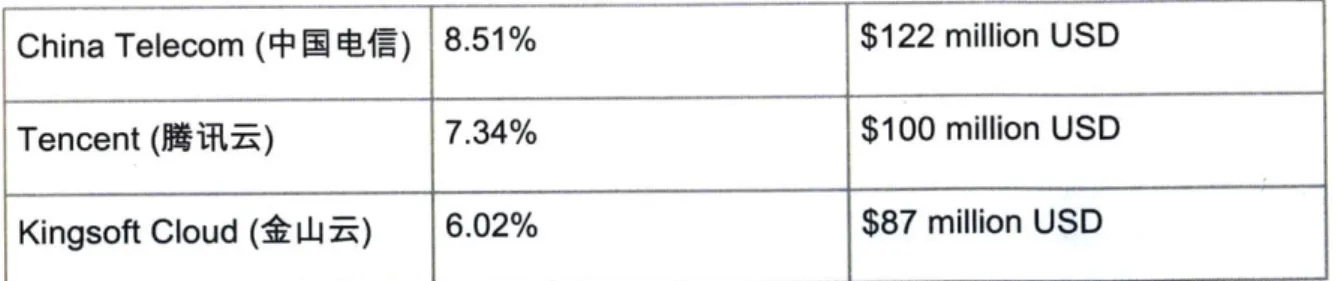
According to research firm IDC, the 2016 China cloud laaS market had four leaders: Aliyun, Chinese Telecom, Tencent and Kingsoft (Jinshan) Cloud. With $588 million USD in revenues, Aliyun had a market share of over 40% for the 2016 China laaS market. China Telecom had an 8.51% market share, with revenues of $122 million USD. Tencent, via Tencent Cloud, had revenues of $100 million USD, with a 7.34% market share. Tencent Cloud began in 2013 and by 2016 was a major force in the domestic Chinese market. Lastly, Kingsoft Cloud had a 6.02% market share with $87 million USD. Table 7 illustrates the 2016 China laaS market.
Cloud Service Provider Domestic Market Share Revenue
Aliyun (I-0Jl) 40%+ $4 billion RMB ($588 million
USD)
"2,, IDC : 2015 /rc i. r 199it, 2016,
China Telecom (r IIEgrA) 8.51% $122 million USD
Tencent (WiiR) 7.34% $100 million USD
Kingsoft Cloud (*O.Wk) 6.02% $87 million USD
Table 7: Chinese Cloud Service Providers: 2016
Two notable conclusions can be gleaned from the 2015 to 2016 market for China cloud computing. One is that local, domestic companies cemented their market dominance
from 2015 to 2016. In 2015, 21Vianet, via its partnership with Microsoft, still had a
sizeable market share, acting as the four biggest cloud service providers in China. Come 2016, the top four laaS providers were all local Chinese companies, with no foreign joint venture partners present. Second, Aliyun increased its market share from 2015 to 2016, further solidifying the notion that cloud companies benefit from
economies of scale.
In 2017, Aliyun continued to dominate the China cloud laaS market, increasing its market share to 47.6%. Once again, foreign cloud service providers were notably
absent from the list, with no mention of Amazon, Microsoft or IBM. Tencent, Kingsoft,
and China Telecom were once again the top providers, as well as start-up Ucloud. Figure 2 shows this phenomenon.
2017
(
HI) Public Cloud
Market
Share
(aaS)
2017* (18-6A
) *=#EIP5"0W
(lWaS)
Source. IDC AM a Cloud 47.8%
I
2nd -5t Vendors .5% 6.0% 5.5%I
.% 0 0 10 I 20 30 I 4050 (%)
Albaba Cloud * China Telecom* Tenoent
a
Kingsoft
* Ucloud * Others I IFigure 2: Chinese Cloud Service Providers: 2017
In terms of the policy regime, China, and the Chinese government, has enacted a long-term strategic push towards not only indigenous innovation, but also towards the control of data, viewing both as primary to its political and economic interests. China
has long used policy, including foreign equity caps, joint venture partnership
requirements and local subsidies, for Chinese telecommunications and, more recently, digital services. For instance, the 2017 Cybersecurity Law mandated that all data generated by Chinese users had to be stored in China and could not be sent out of the country without government consent, sending American companies scrambling to either construct extremely expensive local data centers with joint venture partners, such as Apple, or sell their China cloud business to their local partner, such as Amazon. One can view data localization as am international trade barrier which, combined with
localization and operational difficulties, can largely explain the paucity of successful foreign technology companies in the cloud services business. The China market, unlike any other cloud market today, is wholly dominated by domestic Chinese firms with little
market share from the major U.S. technology players.
Above is a brief overview of cloud computing as a technology, an introduction to key service models and operational processes and information on cloud security, market and computing resources. This background will help provide the necessary context for the analyses discussed below.
3. Cybersecurity
3.1 Cybersecurity; Overview & Framework
Cybersecurity is becoming an increasingly invoked and focal aspect of "national security."33 Labeled as the 'fifth domain,' cybersecurity has become an important part of national security and governments worldwide have responded accordingly with policy. Foreign economic and industrial espionage represent a significant threat to today's nations. Cyberspace remains the preferred operational domain for a variety of malicious actors, from rogue hackers to state-sponsored commercial enterprises. Advanced, development economies with corporations who engage in expensive and costly R&D with expensive IP are a particular target for developing economies hoping to advance on the global stage. The U.S. and China, currently, fit into this dialectical relationship, with China ostensibly hoping to access a variety of critical technologies, IP and trade
secrets to help leap-frog and spur its economic advancement and transition from a 3 Huang, Keman, et al. How Can Cybersecurity and International Trade Impact Each Other: A Systematic Framework. 2018.
manufacturing to a more services-oriented economy. Moreover, China has a complicated and multi-pronged strategy to support its strategic development goals, including science and technology advancement and military modernization, among others.4 China employs both licit and illicit methods. Licit methods can include joint venture partnerships that mandate technology transfer, which is legal under WTO
guidelines, while illicit means include hacking, cyber-espionage and cyber-theft. Thus, issues regarding data security are of foremost concern to data-sensitive U.S.-China cloud computing technologies and services.
Three key questions regarding data security, cloud computing and international trade will be explored through case studies and the lens of cybersecurity:
(1) Cybersecurity Risk: Whether the "cloud" increases or decreases the risks related to cybersecurity?
(2) Policy Implications: Whether and how countries construct barriers to cloud computing originating from other countries due to concerns about cybersecurity? (3) Strategy Reactions: If restrictive international trade policies do exist, how can business entities navigate these barriers, or not, to effectively form a viable strategy?
3. 2 Cybersecurity; International Trade
Cybersecurity concerns have increasingly impacted national security policy, both politically and economically, affecting international trade in the global, digital economy. As Huang, Madnick and Jonson (2018) explore via a systemic framework linking the relations between cybersecurity and international trade, cybersecurity is no longer solely a policy or regulatory issue, but increasingly a business strategy issue, irrevocably tied into geopolitics.3 5 Moreover, cybersecurity concerns impact national and organization
action, which reshapes the international trade environment and forms the nature of a given country's domestic market. We will see this dynamic play out, where cybersecurity concerns impact international trade for digital services access in cloud computing, in the U.S. and China case studies discussed below.
Cybersecurity concerns that impact international trade emerge from two different perspectives, national security concerns and supply chain concerns.36 For the purposes of this paper, national cyber security concerns will be mostly explored, though supply chain concerns are certainly applicable, especially in terms of hardware for cloud computing data center equipment. Khetri (2016) details categories to understand
34 "Foreign Economic Espionage in Cyberspace." NATIONAL COUNTERINTELLIGENCE AND SECURITY CENTER,
2018, www.dni.gov/files/NCSC/documents/news/20180724-economic-espionage-pub.pdf.
35 Huang, Keman, et al. How Can Cybersecurity and International Trade Impact Each Other: A Systematic
Framework.
national cybersecurity concerns: military security, political security, economic security and cultural security.37 For the majority of regulation in the U.S. and China, political security and economic security are the most salient dimensions, though cultural security certainly factors into the CCP's decision making process regarding how to create a
healthy cyberspace environment, in line with the public morals of China that maintains their public order. Political security includes preventing political espionage, such as a
malevolent actor obtaining sensitive political or military information, and thereby ensuring political stability, where the use of cyberspace could potentially undermine a government's political authority. In terms of economic security, economic espionage and
economic stability are key concerns. Economic espionage refers to the stealing of economic related trade information, and economic stability refers to the use of
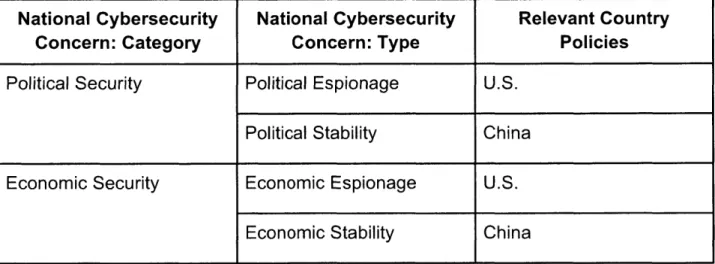
cyberspace that could lead to economic instability in a country. For the U.S. policy regime affecting cloud computing and data privacy, the U.S. government seems most concerned with preventing political espionage and economic espionage. For the
Chinese policy regime affecting cloud computing and data privacy, the Chinese
government seems most concerned with ensuring political and economic stability. Table 8 below highlights the respective governments national cyber security concerns which
impacts digital trade in the country.
National Cybersecurity National Cybersecurity Relevant Country
Concern: Category Concern: Type Policies
Political Security Political Espionage U.S. Political Stability China Economic Security Economic Espionage U.S.
Economic Stability China
Table 8: National Cybersecurity Concern Policy Motivations in the U.S. and China
Based upon these national cybersecurity concerns, governments tend to impose different policies and regulations, often in the form of trade regulations or barriers.39 According to the United Nations Conference on Trade & Development (UNCTAD) in
2012, non-tariff trade barriers exist relevant to cybersecurity and the digital economy. For the purposes of this paper, the following trade barriers are relevant to the
discussion: authorization or registration requirements, local content measures, foreign 37 ibid
38 Ibid 39 Ibid
direct investment barriers, restrictions on post-sales/digital services and intellectual property. In particular, restrictions on post-sales/digital services, especially data
localization regulations in China passed in 2017 via the Cybersecurity Law, are a major trade barrier in cloud computing, as identified by the United States Trade
Representative (USTR) in 2017.4
Thus, in summary, national cybersecurity concerns, especially those of political or economic natures, have implications on the drafting and implementation of trade policy that results in international trade barriers in the digital economy. These national cybersecurity concerns will be used to explore why U.S. cloud service operators have such a low market share in China, and vice-versa.
3.3 Cybersecurity; The Cloud
The Cloud Security Alliance (CSA) released its "Treacherous Twelve" in March of 2016, detailing the top 12 threats to cloud security. Foremost on the list is data
breaches. Cloud computing has transformed the ease with which to access and delivery technology globally, and use has skyrocketed in the past decade. However, the rise of cloud has also created new security vulnerabilities and has amplified pre-existing
issues, problems and concerns. Traditional cybersecurity threats, such as phishing, the use of malware, the installation of backdoors, are all applicable to the cloud. Other cloud-specific threats include attacks on virtualization and invasions of user data privacy, often by the cloud service provider itself, either knowingly or unknowingly. Liu (2013) identifies four main new security problems introduced by the advent of cloud computing. Summarily, they are: data security, user data privacy protection, cloud computing platform stability and cloud computing administration.41 For the purposes of
this paper, however, problems regarding cloud computing platform stability and cloud computing administration are assumed to be non-factors. Especially given the
technological advancement in the U.S. and China and the engineering skill from the main cloud computing service providers in the U.S. and China, such as Microsoft and Alibaba, cloud computing service offerings in the two countries are assumed to be stable and competently administered. Difference, though, will emerge, in terms of data security and user data privacy, especially impacted by government policy at a national level. Therefore, the key cybersecurity issues explored with respect to cloud will be data security and user data privacy, through an updated Parkerian Hexad model.
40 lbid
3.4 Parkerian Hexad
The Parkerian Hexad model is a useful tool by which to analyze information security for cloud computing operators. In 1998, information security researcher and consultant Donn B. Parker introduced the Parkerian Hexad in Fighting Computer
Crime.4 2 Building on the classic CIA triad, consisting of confidentiality, integrity and
availability, Parker introduced three new elements, possession, authenticity and utility, to form a more comprehensive and complete security model.4 3 While the CIA model primarily focused on the technological security risks, Parker sought to introduce the
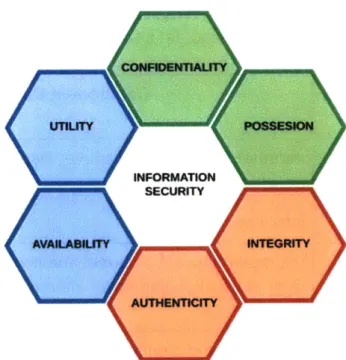
human element, honing in on the role that people play in defending and perpetuating information compromise. Parker suggested that the elements be understood in the following groupings: confidentiality and possession, integrity and authenticity, and availability and utility. A visual representation of the Parkerian Hexad is provided below
in Figure 3. CUl0HDEIATY INF=ORMATION SECURITY AVAILABILTY INTEGRITY AUTHENTICITY
Figure 3: Cybersecurity & The Parkerian Hexad"
42 Parker, Donn. Fighting Computer Crime: A New Framework for Protecting Information. ACM, 1998, dl.acm.org/citation.cfm?id=286060.
43 Pender-Bey, Georgie. "THE PARKERIAN HEXAD." Information Security Program at Lewis University,
cs.lewisu.edu/mathcs/msisprojects/papers/georgiependerbey.pdf.
44 Marks, Paul. "Cybersecurity and the Parkerian Hexad." European Niche Technology Recruitment - StaffHost, 2018, www.staffhost.co.uk/blog/2018/1 0/cybersecurity-and-the-parkerian-hexad.
The six elements of the Parkerian Hexad, confidentiality, possession/control, integrity, authenticity, availability and utility, form a useful lens for understanding the main concerns of IT security. Confidentiality, arguably the most important, refers to who can access what kind of information. Information should not be made available or
disclosed to unauthorized entities, individuals or processes. Possession or control define who or what systems can possess information or have control over information use. Confidential data can be accessed or controlled by unauthorized users without violating confidentiality; thus, Parker introduced the concept of possession/control to cover breaches when confidentiality is both salient yet non-existent.4 5 Integrity is the
ability for data to be correct and consistent with its original use. That is, the data has not been altered or changed in an unauthorized manner. If data is modified, either
intentionally or unintentionally, that would constitute a breach in data integrity.
Authenticity involves the notion of proof of identity, assuring the validity and accuracy of
the information's origin and creation. Availability is the ability to access information in a timely manner, maintaining and ensuring resource availability when required for
intended use. Though simple to describe, guaranteeing availability is one of the key challenges to IT security. Lastly, utility refers to the concept of usefulness, ensuring that the information is useable and useful in a manner so intended by the user. Table 9 below summarizes the key concepts and definitions of the Parkerian Hexad model.
Parkerian Hexad Component Definition
Element
Confidentiality Information is only available or disclosed to authorized users. Possession/Control Only designated users or systems may possess or control
information.
Integrity Information must be correct and consistent with its original use; information cannot be altered in an unauthorized manner.
Authenticity The origin and creation of the information must be valid and accurate.
Availability Access to information is available in a timely manner. Utility Information is in a useable and useful manner for the
intended user.
Table 9: The Parkerian Hexad: Component Definitions
In Cloud Computing by Nayan B. Ruparelia, the Parkerian Hexad is discussed as
it relates to cloud security.46 Since cloud user data storage may involve data being stored in a different country than the country in which the user generated the data, the
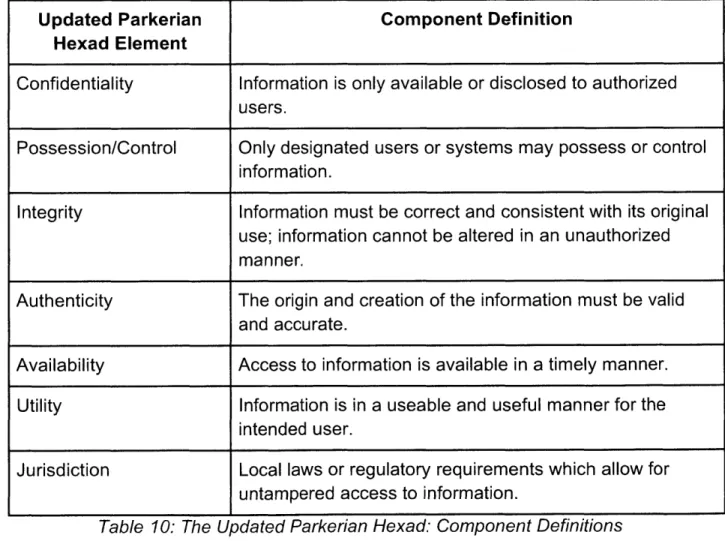
notion of international jurisdiction with regards to data protection mechanisms is crucial. Thus, Ruparelia proposes to add a seventh dimension to the Parkerian Hexad:
jurisdiction. The addition of jurisdiction helps account for the legal or regulatory
requirements, an increasingly important element in information security. The result is an updated Parkerian Hexad, now with seven critical information security elements, as shown in Table 10.
Updated Parkerian Component Definition
Hexad Element
Confidentiality Information is only available or disclosed to authorized users.
Possession/Control Only designated users or systems may possess or control information.
Integrity Information must be correct and consistent with its original use; information cannot be altered in an unauthorized manner.
Authenticity The origin and creation of the information must be valid and accurate.
Availability Access to information is available in a timely manner. Utility Information is in a useable and useful manner for the
intended user.
Jurisdiction Local laws or regulatory requirements which allow for untampered access to information.
Table 10: The Updated Parkerian Hexad: Component Definitions
Table 10 detailing the updated Parkerian Hexad will be used in later analysis of U.S. and China cloud computing operators expanding internationally into China and the U.S., respectively, and to explore how information security concerns impact downstream consumer adoption.