HAL Id: hal-01800668
https://hal.archives-ouvertes.fr/hal-01800668
Submitted on 14 Oct 2019
HAL is a multi-disciplinary open access
archive for the deposit and dissemination of
sci-entific research documents, whether they are
pub-lished or not. The documents may come from
teaching and research institutions in France or
abroad, or from public or private research centers.
L’archive ouverte pluridisciplinaire HAL, est
destinée au dépôt et à la diffusion de documents
scientifiques de niveau recherche, publiés ou non,
émanant des établissements d’enseignement et de
recherche français ou étrangers, des laboratoires
publics ou privés.
Computational constraint models for decision support
and holistic solution design
Carmen Gervet
To cite this version:
Carmen Gervet. Computational constraint models for decision support and holistic solution design.
Communicating Climate Change Information for Decision-Making, 2018. �hal-01800668�
HAL Id: hal-01800668
https://hal.archives-ouvertes.fr/hal-01800668
Submitted on 14 Oct 2019
HAL is a multi-disciplinary open access
archive for the deposit and dissemination of
sci-entific research documents, whether they are
pub-lished or not. The documents may come from
teaching and research institutions in France or
abroad, or from public or private research centers.
L’archive ouverte pluridisciplinaire HAL, est
destinée au dépôt et à la diffusion de documents
scientifiques de niveau recherche, publiés ou non,
émanant des établissements d’enseignement et de
recherche français ou étrangers, des laboratoires
publics ou privés.
Computational constraint models for decision support
and holistic solution design
Carmen Gervet
To cite this version:
Carmen Gervet. Computational constraint models for decision support and holistic solution design.
Communicating Climate Change Information for Decision-Making, 2018. �hal-01800668�
1
Computational constraint models for decision
support and holistic solution design
Summary. The paradigm of constraint reasoning, aims at creating computerized solution models to tackle combinatorial search problems. The methodology and prin-ciples of such models are based on relationships among data and variables, specified as constraints that must hold for a solution to solve a decision or optimization prob-lem. The relationships can be dependencies of any kind: geographical, engineering, environmental, or economic. Constraint models have been developed to this date to provide proactive analysis of some climate change issues, such as investment planning in renewable energies over a given horizon. The challenge of computerized constraint solution models is their reliability and effectiveness to become real world implemen-tations. This is feasible if : 1) the modeling approach taken is holistic and specifies the complexity of real world scenarios, and 2) the users feel involved and become actual actors in the decision process. Constraint models facilitate a holistic approach by focusing on the solution model, and allowing heterogeneous data, variables and constraint types to be modeled independently of their solving. In this article we give an overview of such approaches to foster the implementation of climate change solutions.
1.1 Introduction
Climate change is a fact. Whether human behavior is the major cause of it or not is no longer the core question. The issues today are manyfold: 1) monitoring the changes and contributing factors, 2) forecasting the evolution and assessing potential impacts, 3) modeling and implementing proactive solutions from a holistic perspective. This paper is concerned with the latest one. Thus it is not concerned with the causes or the problems of climate change, rather in solutions that can be put in place. The complexity lies in the interdisciplinary nature of the solution models, their scale, time span and of course the cost-effectiveness of their actual implementation. The main factors of climate change that we will consider in this short paper are:
• Heat, both in terms of abundant source of energy, and coping with increased temperatures.
• Water, both in terms of scarcity and flooding.
Regarding both factors, solutions can be global as well as local. As early as the 1920s, the Atlantropa project sought to bring together Europe and North Africa in one common electricity grid via a giant hydro power station in Gibraltar [16]. The support for this project was limited to architects and planners from Germany and some northern European countries. It never saw the light due to several issues, some of them being the lack of involvment or cooperation of Mediterranean countries, and the poor study of the impacts it would have had on the local communities of the Mediterranean coast. More recently in the same spirit, the Desertec project was founded in 2009 [10]. It carried out several studies to develop a global renewable energy plan, by creating sustainable power plants in the Northern African desert, and transferring this energy through high-voltage current to Europe. The solar energy was the main source even though wind power plants were also considered. However, by 2014, 47 of the 50 initial shareholders had left the consortium [25]. Clearly such visions come with a substantial financial commitment to become reality, but also a strong level of involvment from all parties, who can see their own gains and benefits in the short, medium, and longer term. They are global and complex projects which not only require a holistic perspective but also simulation tools to study the multiple issues at stake, to bring awareness and involvment of all the potential partners.
Today smaller scale solutions start to be implemented worldwide. Local initia-tives are also developed to bring inceninitia-tives to reduce home consumption of energy, and water. Desalination technologies are also being developed using solar power plants, often referred to as solar desalination [14] . For such proposals to be actually effective in the longer term, we also need to take many aspects and constraints into account as part of the solution design, and to raise acceptance and awareness of the different possible actors.
How computational decision models can contribute to guide the effective implementation of solutions under climate change
Let us illustrate the methodology with an example we investigated: the issue of techno-economics of renewable energy parks implantation [9]. Applied research in in this field raises complex challenges of a technological, environmental, social, eco-nomic and political nature. Thus they involve many constraints among disciplines that do not necessarily interact. The case study took place in Egypt, a large country with a fast increasing population, an increased level of heat and an increased de-mand in electricity, including the use of air conditioning systems to reduce indoors heat in large cities. The national goal, back in 2010, was to determine “how to sat-isfy 20 percent of the forecasted energy demand in 2020 using renewable energies, at minimal cost”. Even though this was a national project, it involved international technologies in Concentrated Solar Power (CSP), photovoltaic systems, wind tur-bines designs, as well as investments and planning. Under an Egyptian funding, the authors of [9] built a prototype tool based on constraint technology, that served as much as a communication tool between the parties involved, as a simulation tool for the potential actors to evaluate the impact and effectiveness of their choices. The computational model specified the rules and conditions that must hold on the envi-ronmental, energetic, and economic levels, and the objective functions to optimize. Examples of possible constraint rules are:
• A solar park must be at a given maximum distance of a connection point to the national grid,
1.2 Constraint-based reasoning in a nutshell 3 • A solar park cannot be built on a depression area in the desert,
• The production rate of a wind turbine is bounded by certain values, • The maximum investment per year is bounded by a certain cost.
The potential actors in such problems range from investors, engineers, economists, to local community representatives. This renders the actual implementation of a so-lution very complex in real life and often source of conflictsl. Hence the benefits of a holistic computational approach are numerous to guide the decision process, improve communication, and address different challenges in one integrated model. Furthermore, the technology combines the computational efficiency of powerful al-gorithms, with the modeling and expressive power of heterogeneous constraints. It brings together complementary fields and experts.
In the second section we will give an overview of constraint models and the methodological process. The third section will describe some existing solution de-signs under climate change. The fourth section will describe our vision for the next generation of holistic models coupled with interactive and persuavive interface to increase the involvement of the user, and his/her active role in the implementation process.
1.2 Constraint-based reasoning in a nutshell
The holy grail of constraint programming was “focus on the problem, the computer will take care of the solving”. It is a powerful paradigm developed in the late 70ies in the field of Artificial Intelligence, to tackle complex planning and scheduling prob-lems in areas such as transportation, production, networks, bioinformatics, configu-ration and logistics. The problems are of a combinatorial nature, which means that there is an exponential number of combinations of values to explore, when search-ing for a solution. The problem might end up besearch-ing unsatisfiable: no solution that satisfies all the constraints exists. In this case one will need to account for possible data uncertainties, or soften certain rules or constraints that render the problem unfeasible. The essence of constraint programming is to model the problem inde-pendently of its solving, by focusing on the properties a viable solution should have, and letting the underlying algorithms prune out combinations of values that can never hold. Today the paradigm draws from areas wider than Artificial Intelligence and combines methods and models from graph theory, Operations Research, and multi-agent systems, to address real-world combinatorial search and decision prob-lems. The field of constraint programming together with its application have been integrated in a comprehensive handbook [22]. We define the notion of a constraint problem modelled as a constraint satisfaction problem as follows:
Definition 1. A constraint satisfaction model is composed of a set of variables (un-known parameters), a set of domains where each variable can take its value from, and a set of constraints over the variables.
This definition has been extended to cases where the parameters defining the constraints can be uncertain, and with objective functions that turn the decision problem into an optimization problem. The methods to solve the decision problems are based on filtering and propagation techniques that prune the impossible values
from the domains in a deterministic fashion. Let us illustrate this core technique, through a simple example. Basically if you are a sudoku player, you do constraint propagation and search when filling up the grid cells. The sudoku is a logic puzzle, which can be found in all newspapers today. We have a 9 by 9 grid, composed of 9 blocks of 3 by 3 cells. Each cell must take a value in {1, ..., 9} such that no two cells in one column, row or block can share a value. The model and techniques of constraint solving mimic at different levels of inferences (more or less global) the human reasoning. The basic approach is one of trial and error without accounting for the structure of the problem or the globality of the constraints. A constraint model of a sudoku problem corresponds to 1) the data being the cells that have a known value, the decision variables that are the open cells with domains {1, .., 9}, and the constraints that simply state that any two pairs of cells cannot take the same value within a row, column or block. Thus if a row has the values 1, 3 and 5 taken, these will be removed from the related cells domains by filtering out the values and the domains will be reduced to {2, 4, 6, 7, 8.9}. Any change in the domain of a variable, triggers the constraints involving this variable to be checked again, to determine whether it propagates a change or not in the variables domain. Once we reach a stage where no more domains can be filtered, in this deterministic manner, a search procedure is triggered to find possible values for the non instantiated variables. Global filtering techniques are available in the numerous systems that exist on the market today, leading to powerful filtering of domains before searching for solutions. For instance if two of the variables in a given row share the same two values, we can filter out these values from the remaining 7 variables denoting the other cells in this row, since none of them can take them or the problem would fail.
Constraint programming is very well suited for the kind of decision combinato-rial problems where the number of potential combinations is large but few of them can lead to a solution (possibly none). Thus it can be of substantial help to seek solutions to new problems particularly of a holistic nature, with complex and het-erogeneous constraints involved. It is possible that for such problems, taking all the constraints at hand into account does not describe any solution, and thus the model needs to be refined. If one or several functions are added to the problem, the is-sue is one of optimization under constraints and constraint programming can then be combined with global optimization techniques from Operations Research (such as Linear Programming or mathematical programming) [20]. More information on constraint programming technology can be found in [22].
The methodological process of designing and implementing solution models to real world problems is an iterative and incremental one, involving all potential deci-sion makers, actors and domain experts in the specification of the problem. It consists of three main iterative procedures: 1) specification of the solution requirements, 2) solution design and implementation, 3) evaluation and testing. The methodology aims at ensuring an effective development process in the presence of heterogeneous sources of data, interdisciplinary sources of information, and a complex decision making process. It iterates over the definition phase, the construction phase and the visualization and interactive decision making phase. The construction phase is it-self composed of two activities, the solution design and the programming activities. This incremental and iterative methodology is necessary to ensure validation of the model by all the potential actors. An example of such a methodological process was developed by a consortium of academic and industrial partners to build solutions to
1.3 Example cases and thematic studies 5 large scale combinatorial optimization problems, of which holistic constraint models for solutions under climate change is an element [7, 8].
The methodology behind the models themselves, focusses on the design and im-plementation of practical solutions, satisfying geographical, economical or planning constraints at hand. In other words, by knowing the human factors that intensify climate change (e.g. factory farming, carbone dioxide emissions, energy sources), an expert can conceive means to reduce the impact of such factors. The idea behind con-straint based models and their design is to seek practical and viable socio-economico solutions and identify realistic means to implement them. The key lies in the effec-tiveness of migrating from a current practice to new practices that would reduce the human impact factors on climate change, as well as viable means to cope with foreseen scenarios that will require drastic changes to our ways of living.
Designing a constraint model...
Basically, a set of actors with complementary expertise, who seek the economic and societal viability of a new approach to water resource management, or migrating to renewable energy for a given country, needs to seek compromises between:
• Satisfying hard constraints such as ensuring that there will be enough resources to sustain the population, the demand can be fulfilled given the new means of production, the cost of implementing a new approach does not exceed a cer-tain limit. These constraints heterogeneous and bring together technological, economical and societal aspects. They can often take the form of relational and linear or non linear formulas, over the variables we seek a value to (amount of production, potential relevant localizations, ...), and the data available in terms of existing resources, and limitations.
• Reaching the objectives sought, such as by 2030 a given percentage of water resources comes from a desalination process, or a given percentage of electricity production, comes from renewable energy sources. Often the objective functions are multi-criteria ones, in the sense that a trade-off is sought to maximise for instance biodiversity, while ensuring a production level that is sustainable for the farmer. This multi-criteria approach ensures that all the relevant actors are involved in the design of the model, that it is viable, and represent a realistic transition from existing practices to more sustainable ones.
The iterative process of designing the model, evaluating the computerized so-lutions, and seeking experts and user feedback is a key component to the use of computational constraint technology to help guide the decision makers in the actual implementation of their solutions. It is also a valuable communication tool between the different actors who can see the effects of limitation of certain constraints on the solutions produced.
1.3 Example cases and thematic studies
To this date a large number of computational constraint models are proposed in applied research to address different aspects of climate change solution designs. We present a few to illustrate the approaches and their potentials. In the past 15 years, the novelty of these models is the motivation to design integrated systems that
include many different aspects of real life issues in one system, including existing data, environnemental, economical, societal and technological constraints. In this short article one can not be comprehensive in the survey of existing models but wet give an overview and idea of existing approaches that investigate the means and viability of solution implementations to different issues related to climate change. These include water resources management, migration to renewable energy sources, and biodiversity conservation. It is important to note that constraint based models and decision support tools, focus on helping different parties and decision makers become actors in the implementation of solutions to a given challenge and not on detecting the problem that could result from climate change.
1.3.1 Water resource management
This field seeks means to handle water scarcity, costs and migration towards dif-ferent systems. Some computational models have been proposed to help decision makers cooperate with a holistic perspective, including for instance the water re-source components and the economic ones. A mathematical programming model, with the objective of maximizing economic profits from water uses in various sec-tors is proposed in [4]. Such a model aims at addressing both the environmental and economic issues. It is one typical example of large scale holistic modeling for integrated river basin management. It raises also the issues of the complexity of holistic models, the handling of uncertainty ubiquitous in such problems and the involvment of various decision makers. A thorough review of approaches to char-acterize the economic value of water usage, and to embed these in computational models can be found in [12]. It presents various hydro-economic models addressing the issues of spatial and temporal dimensions of distributed water resource systems, infrastructure, management options and economic values in an integrated manner. These models specify hydrologic engineered systems while explicitly considering the economic nature of water demands and costs. Basically they provide a support for decision makers to analyze costs and profits, while considering the value of water services in planning and operation. As the authors say: “ until now, hydroeconomic modeling has been practiced in academic and policy circles with limited implemen-tation of study recommendations by water managers, operators, and practitioners. Hydroeconomic modelers can improve the impact of their work by collaborating with practitioners and extending existing (and trusted) operations models to include hy-droeconomic components.”
1.3.2 Renewable energy planning
Some computational models integrating economic, engineering and environmental aspects together are also being considered relative to the migration towards re-newable energies to produce electricity. The need for clean energy is recognized worldwide not only to face global warming and CO2 emissions, but also to reduce
grounds for international conflicts. National and international targets are being set [1, 2]. There are many aspects to the development of renewable energy technologies which can be broadly categorized into engineering & technological advancement as-pects, versus techno/economical and commercial ones. The engineering components
1.3 Example cases and thematic studies 7 deal with the construction of renewable plants that are reliable, effective and realis-tic including essentially hydro, solar (photo-voltaic and concentrated solar power), wind and bio-fuel. The techno-economical study of renewable energy on the other hand, investigates gradual implantation of Renewable Energy (RE) systems for a given country such that the installation and maintenance costs are minimized and the short/long term returns on investment are maximized. Studies in this field inves-tigate country profiles in terms of energy demand, available resources, anticipated renewable engineering cost reductions [17]. However, more is needed as highlighted in [13], that ”there is little economic analysis of renewable energy”. The main ob-jectives of studying the economics of RE is to attract investments (national and international) and set realistic targets and strategies that will remain so in the longer term.
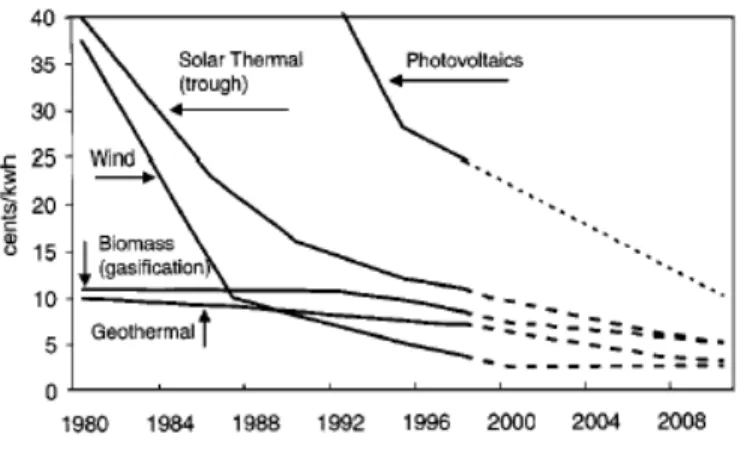
Comprehensive surveys are now available discussing the trends and current im-provements in the cost, performance, and reliability of renewable energy systems [1]. Clearly electricity from renewable energy remains generally more expensive than from conventional fossil-fuel sources. However, the cost of electricity from RE sources has been falling steadily for the last two decades and various estimates have been derived in terms of ”expected cost of electricity production from RE sources” [?]. Today wind energy is the least expensive option but requires more maintenance, and is space consuming compared to photo-voltaic solar panels which however, are currently more expensive. Note that the forecasts in price reduction are promising though, as shown in Figure 1.1 [1]. This indicates that taking into account forecast measurements is a strong element of effective decision making.
Fig. 1.1. RE costs forecast
Based on existing forecast studies, and each country renewable resources, which REs or portfolio of RE should a given nation invest in? How much should be invested now, or in 15 yeas time? These are questions at the heart of the ”economics of RE” for which our decision support tool aims to seek an answer. We seek the best trade-off cost/return on investment by taking into account physical installation constraints as well as energy requirements and costs.
The author in collaboration with the German University in Cairoand the NREA (New ad Renewable Authority in Egypt) studied this problem focussing on Egypt, where data and a govermental interested were provided [9]. Our goal was to build a decision support tool that will provide private and governmental investors into renewable energy systems, valuable insights to make informed short and longer term decisions with respect to the creation and placements of solar and wind turbine parks in Egypt. Egypt is growing at fast pace and relies extensively on fossil fuel as shown in the latest earth-trends survey [5]. Egypt enjoys excellent wind and solar resources and there are tremendous potentials for investment towards local consumption and even export. Research and onsite-projects are being carried out with a growing trend. A short-term government plan was to meet 20% of Egypt electricity demand by 2020 using RE sources. While wind farms installation is currently cheaper than solar panels of Concentrated Solar Power (CSP) plants, there are strong arguments in favor of solar energy. Thus it is essential to consider both. Basically solar energy can be installed on small surfaces (little cable and maintenance required), offers more stability especially in Egypt (sun is less dependent on season fluctuations for countries located on the sun belt), plus wasted heat has the advantage of being usable for water desalination [14]. Egypt can become a strong player in wind and solar energy. However, a specific strategy is still to be determined, together with investments.
The optimization problem we addressed is defined as follows. Given the country of Egypt with its data and constraints: 1) Egypt map of populated areas, 2) Wind and Solar atlas, 3) electricity grid map, 4) current and forecast energy cost per RE resource, 5) current and forecast energy demands per month, 6) a set of potential RE park locations; determine the set of energy parks to be invested in today, the set of energy parks to be invested in the future (e.g. 10-20 years time), such that 20% of the current and forecast energy demand are covered for each month of the year, and the anticipated financial cost is minimized. The cost is determined in terms of sum of total costs associated with each potential park: cost of connection to the grid, cost of installation, and cost of park maintenance.
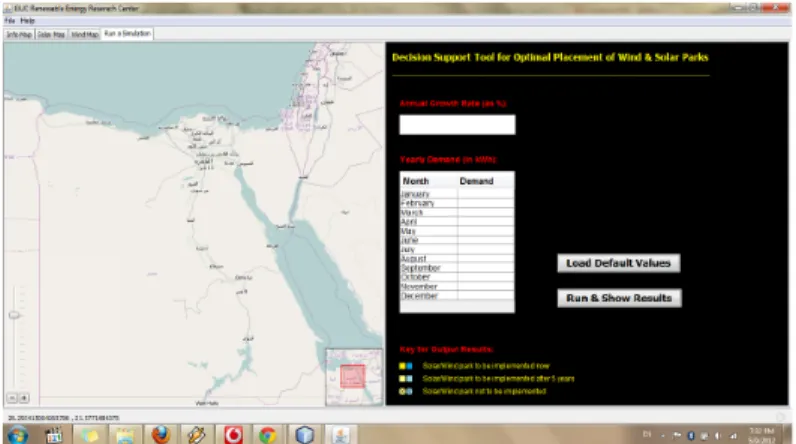
1.3 Example cases and thematic studies 9 The core contribution was a portfolio selection model for renewable energy parks, such that planning for both short and medium term park installation is seen as one decision problem. One key component to the realistic nature of the model lies in the data made available which consisted of wind and solar atlas, electricity grid and cost figures. The wind atlas for Egypt in the form of a hard copy document, was obtained from the NREA, who took measurements over 14 years in partnership with the Danish Ministry of foreign affairs (1991-2005). It provides a comprehensive overview of the wind resource over the entire land area (and sea) of Egypt. The maps produced indicate the mean power density, and wind speeds at a height of 50m over the actual land surface. It gives for a set of specific locations, the prediction of the average yearly energy production of a specific wind turbine or wind farm based on actual measurements of wind speed and direction [11]. The solar atlas fo Egypt, established in 1998 as part of a USAID project (United States Agency for International Development) and managed by the NREA, is a document including maps of solar energy density for each month. The data is the result of measuring the solar radiation daily in ten locations between 1980 and 1988. The maps were produced using a computerized model that distributes the daily value of global solar radiation into different energy bands [19].The different constraint models and algorithms used can be found in [9], and we illustrate in Figure 1.2 the decision support tool, designed to help the decision makers simulate different scenarios to take informed planning and investment decisions.
Other approaches and research developments aim at using remote sensing data to monitor climate change [21], and integrate such studies to build decision support systems for the planning of solar energy parks. For instance a study combines a Geographic Information System (GIS) tools or multicriteria decision making opti-mization models to determine the optimal placement of photovoltaic solar power plants in southeast Spain [24]. Such approaches bring together the analysis of data with the decision making process. Just like in the sudoku example, the power of cosntraint reasoning make it possible to reduce the areas of study by discarding the locations that cannot be used to implement renewable energy plants, because the cost to reach the grid is too high, or the location is to close to living areas, or corresponds to a desert depression, etc.
1.3.3 Biodiversity management
Another thematic strongly linked to human impact on climate change is biodiversity. A key challenge is the field of ecosystem services, and enhancing biodiversity lies in the policy and decision making processes. An increased number of constraint-based models seeks to evaluate the feasability of solutions and guide decision makers in relation with the environment and the actors involved. Some surveys article and specific case studies have been developed. We refer in particular to studies in the European Union [18], and different constraint based optimization models. Studies in-vestigated computational models to help design reserve networks for the persistence of biodiversity, with the same idea of developing tool that help dfferent actors com-municate through the use of decision aid tools. In [3] a computational site-selection tool applied to conservation planning is proposed bringing together scientists, man-agers and investors. Another set of computational constraint models also in the form of decision support tools, relate to conservation planning tools to seek means to reduce species extinction and preserve biodiversity. These studies address similar
challenges related to the necessary involment of different parties, and modelling of the constraints at hand in a holistic manner. We can refer in such cases to budgetary, ethical, and other sociopolitical constraints [23].
1.4 Perspectives
In the future, we foresee increased use of complex and holistic computational con-straint models to implement climate change solutions, such as water-use efficiency, solar energy-use efficiency or bio-diversity management. They will involve many more actors and decision makers by integrating all components in one tool. Re-search efforts in this field of Artificial Intelligence and Operational ReRe-search address the technical and modeling challenges, to handle the spatio-temporal aspects of planning new solutions, as well as the handling of uncertainties in the data available and forecasted.
Also, to help foster such tools to be active support and communication tools among different actors, we need to render them easy to use, attractive and inter-active. Indeed, if current behaviors, local as well as global are still passive, reasons can be that individuals do not feeling concerned, or information not being accessible (possibly to avoid non productive states of fear or panic), or feel powerless. Some studies related to this aspect investigate the “knowledgeignorance paradox” [26]. Recent research in the field of persuasive computing with serious games go in this direction. Their aim is to help the user feel engaged, involved and actor in the imple-mentation of changes. In [15], a set of approaches are discussed where various games are presented with different global warming scenarios. “ Players explore geoengi-neering, alternative energy sources and other options for protecting the planet over the next 200 years. “ The game presents various realistic predictions for different climate change models and allow the player to engage with different climate-change challenges. The ultimate goal is to bring awareness to the issues and make players, actors of change. Such approaches are to be used for local aspects of energy saving and water consumption in private homes.
However, we do believe that they can also be embedded in large scale constraint and decision models, which nowadays present a complex and integrated view of so-lutions design (economics, engineering, environmental), and be tailored to decision makers from different fields and expertise. As a conclusion, computational constraint models can help to simulate different scenarios and let the user see the impact of their actions or decisions. In general they aim at answering questions such as ”how, when and where to migrate to new solutions (e.g. renewable energy parks, hydro-economic models, river basin plans), such that a set of environmental, social, technical and economic constraints are satisfied simultaneously“. They are also a powerful com-munication tool among actors from different fields; The methodological process to build such models involves all the relevant parties to specify the requirements and existing constraints. The final tool can benefit from interactive interfaces to the computerized solutions. Enhancing such interfaces with techniques from persuasive computing and gamification, can involve the end-user further, increasing his aware-ness and make him actor in the implementation of the solutions.
References
1. S.R. Bull. Renewable energy today and tomorrow. in Proceedings of the IEEE, 89(8):1216-1226, 2001.
2. S.R. Bull. The integration of renewables. Technical Report 2004.
3. M. Cabeza and A. Moilanen. Design of reserve networks and the persistence of biodiversity. In Trends in ecology and evolution, 16(5), 242-248, 2001.
4. X. Cai. Implementation of holistic water resources-economic optimization models for river basin management - Reflective experiences. in Environmental Modelling and Software 23, Elsevier, 2008.
5. Earth Trends. Energy and resources. The environmental information portal, 2003. 6. L. Garcia. Renewabe energy applications in desalination: state of the art. Solar
Energy Journal, vol. 75, Issue 5, Elsevier, 2003.
7. C. Gervet. Large Scale Combinatorial Optimization: A Methodology for Hybrid Models and Solutions. in JFPC’98, 1998.
8. C. Gervet. Large Scale Combinatorial Optimization: A Methodological viewpoint. in DIMACS series , 2001.
9. C. Gervet and M. Atef. Optimal Allocation of Renewable Energy Parks: A two Stage Optimization Model. in RAIRO Operations Research, 2012.
10. J.L. Goudet. Desertec : le projet colossal du solaire saharien... pour l’Europe (in French). in Futura-Sciences, 2009.
11. J. C. Hansen et al. Wind Atlas For Egypt. NREA. 2005.
12. J. Harou, M. Pulido-Velazquez, D. Rosenberg, J. Medellin-Azuara, J.R. Lund, and R.E. Howitt. Hydro-economic models: Concepts, design, applications, and future prospects. in Journal of Hydrology 375, 627643, 2009.
13. G. Heal. The economics of renewable energy. In National Bureau of Economic Research, 2009.
14. M.N. El-Kordy, M.A. Badr, Abed K.A., and Ibrahim S.M.A. Economical eval-uation of electricity generation considering externalities. In Renewable Energy, 25:317-328.
15. A. Krotoski. Serious fun with computer games: Sophisticated multimedia exper-iments offer platforms for learning about science through play. in NATURE, Vol 466, 5,August 2010.
16. P.N. Lehmann. Infinite Power to Change the World: Hydroelectricity and En-gineered Climate Change in the Atlantropa Project. Oxford University Press, Vol 121, 1, 2016.
17. J.M. Loiter and V. Norberg-Bohm. Technology policy ad renewable energy:public roles in the development of new energy technologies. In Energy Policy, 27:85-97, 1999.
18. J. Maes, B. Egoh, L. Willemen, C. Liquete, P. Vihervaara, J. P. Schgner, B. Grizzetti et al. Mapping ecosystem services for policy support and decision making in the European Union. In Ecosystem Services 1, no. 1: 31-39, 2012.
19. M.A. Mosalam Shaltout. Solar energy variability over horizontal and inclined passive systems in Egypt. In proceedings of PLEA’88, Energy and Buildings for temperate Climates, A Mediterranean Regional Approach. Pergamon Press, 1988. 20. G.L. Nemhauser, L.A. Wolsey. Integer and Combinatorial Optimization. John
Wiley & Sons (1988)
21. R. Posselt, R.W. Mueller, R. Stckl and J. Trentmann. Remote sensing of solar surface radiation for climate monitoring the CM-SAF retrieval in international comparison. Remote Sensing of Environment 118, 186198, 2012.
22. Editors F. Rossi, P. Van Beek, and T. Walsh. Handbook of constraint program-ming. Elsevier Science, 2006.
23. S. Sarkar, R.L. Pressey,D.P. Faith, C.R. Margules, T. Fuller, D.M. Stoms, et al. Biodiversity conservation planning tools: present status and challenges for the future. In Annu. Rev. Environ. Resour., 31, 123-159, 2006.
24. M. Socorro Garcia-Cascales and J.M. Sanchez Lozano. Geographical Informa-tion Systems (GIS) and Multi-Criteria Decision Making (MCDM) methods for the evaluation of solar farms locations: Case study in south-eastern Spain. in Renewable and Sustainable Energy Reviews, 24, 2013.
25. S. Tagliapietra and G. Zachmann. Energy across the mediterranean: A call for realism. bruegel policy brief, issue 03, 2016.
26. S. Ungar. Knowledge, ignorance and the popular culture: climate change versus the ozone hole. in Public Understand. Sci. 9,297312, 2000.