1
www.eurosurveillance.org
Surveillance and outbreak reports
Intercontinental spread of OXA-48
beta-lactamase-producing Enterobacteriaceae over a 11-year period,
2001 to 2011
A Potron1, L Poirel1,2, E Rondinaud1, P Nordmann ([email protected])1,2
1. INSERM U914, Emerging Resistance to Antibiotics, Faculté de Médecine et Université Paris-Sud, K. Bicêtre, France 2. Medical and Molecular Microbiology Unit, Department of Medicine, Faculty of Science,University of Fribourg, Fribourg,
Switzerland Citation style for this article:
Potron A, Poirel L, Rondinaud E, Nordmann P. Intercontinental spread of OXA-48 beta-lactamase-producing Enterobacteriaceae over a 11-year period, 2001 to 2011. Euro Surveill. 2013;18(31):pii=20549. Available online: http://www.eurosurveillance.org/ViewArticle.aspx?ArticleId=20549
Article submitted on 14 November 2012 / published on 01 August 2013
OXA-48 beta-lactamase producers are emerging as an important threat mostly in the Mediterranean area. We report here the molecular epidemiology of a collection of OXA-48 beta-lactamase-positive enterobacterial isolates (n=107) recovered from European and north-African countries between January 2001 and December 2011. This collection included 67 Klebsiella pneumo-niae, 24 Escherichia coli and 10 Enterobacter cloacae. Using the EUCAST breakpoints, ninety-eight isolates (91.6%) were of intermediate susceptibility or resist-ant to ertapenem, whereas 66% remained susceptible to imipenem. Seventy-five per cent of the isolates co-produced an extended-spectrum beta-lactamase, most frequently CTX-M-15 (77.5%). Susceptibility testing to non-beta-lactam antibiotics showed that colistin, tigecycline, amikacin, and fosfomycin remain active against most of the isolates. Multilocus sequence typ-ing indicated that the most common sequence types (ST) were ST101 and ST38 for K. pneumoniae and
E. coli, respectively. The blaOXA-48 gene was located on a
62 kb IncL/M plasmid in 92.5% of the isolates, indicat-ing that a sindicat-ingle plasmid was mainly responsible for the spread of that gene. In addition, this study iden-tified multiple cases of importation of OXA-48 beta-lactamase producers at least in Europe, and spread of OXA-48 beta-lactamase producers giving rise to an endemic situation, at least in France.
Introduction
Currently, an emergence of carbapenem resistance in Enterobacteriaceae is reported, mostly related to the spread of carbapenemases [1]. Those carbapenem-hydrolysing beta-lactamases belong to the Ambler class A (e.g. KPC), class B (e.g. IMP, VIM and NDM) [1], and class D (e.g. OXA-48 and its variants possess-ing weaker but significant carbapenemase activity) [2]. OXA-48 had first been identified from a clinical Klebsiella pneumoniae isolate recovered in Istanbul, Turkey, in 2001 [3]. The corresponding gene, namely blaOXA-48, was then also identified in Escherichia
coli and Citrobacter freundii, still in Turkey [4]. For
several years, OXA-48 was identified only in Turkey, and almost all OXA-48 beta-lactamase producers were reported from patients hospitalised in Turkey or with a link to that country [4,5]. Since 2008, this gene has been identified in many other countries, most often in K. pneumoniae isolates [2,5-10]. OXA-48 is now identi-fied in the Middle East and in North African countries, and those countries are considered as reservoirs of OXA-48 beta-lactamase producers [2]. In addition to sporadic cases, an increasing number of outbreaks due to OXA-48-producing K. pneumoniae are currently observed, not only in Turkey but also in Belgium, France, Greece, the Netherlands and Spain [2,11-13]. K. pneumoniae strains belonging to specific sequence types (ST), such as ST395 and ST101, have been involved in those outbreaks [12,14].
In order to gain further understanding of that phe-nomenon, our study aimed at comparing the genetic features of OXA-48 beta-lactamase-producing strains recovered from various countries by analysing an exist-ing collection of 107 blaOXA-48-positive enterobacterial
isolates. The genetic context and the location of the blaOXA-48 gene were investigated, as well as resistance
to broad-spectrum beta-lactams and non-beta-lactam antibiotics.
Methods
Bacterial isolates
A total of 107 OXA-48 beta-lactamase-producing enter-obacterial isolates were investigated retrospectively. Enterobacteriacae producing OXA-48-like beta-lac-tamases were not included in this study. All isolates had been recovered from clinical specimens except a single isolate (one Serratia marcescens strain from an environmental water sample in Morocco), and had been received between January 2001 and December 2011 in our National Reference Laboratory which is also used as an International Reference Laboratory by many colleagues worldwide who send us their isolates for
2 www.eurosurveillance.org further characterisation. Of identical strains in an
out-break, only one was included in this work. The distri-bution of clinical samples was as follows: rectal swabs (n=33), urine samples (n=24), blood samples (n=12), wound samples (n=7), respiratory specimens (n=4), catheters (n=4), bone specimens (n=2), peritoneal flu-ids (n=2), and placenta specimen (n=1). One sample per patient was included. Detailed information could not be obtained for 18 clinical samples. The isolates were identified to species level using the API 20E sys-tem (bioMérieux, La Balme-les-Grottes, France).
Susceptibility testing
Routine antibiograms were determined by disk diffu-sion method on Mueller-Hinton (MH) agar (Bio-Rad, Marnes-la-Coquette, France) and interpreted using the guidelines of the Clinical and Laboratory Standards Institute (CLSI) (updated 2012) and of the European Committee on Antimicrobial Susceptibility Testing (EUCAST) for tigecycline and colistin [15,16]. In addi-tion, MICs were determined for imipenem, meropenem, ertapenem, cefotaxime, and ceftazidime using E-test (bioMérieux, La Balme-les-Grottes, France). The pro-duction of extended-spectrum beta-lactamases (ESBL) was evidenced by a double-disk synergy test per-formed with cefepime, ceftazidime, and ticarcillin/cla-vulanic acid disks [17] and more recently by using the rapid ESBL NDP test [18].
PCR and sequencing of
beta-lactamase-encoding genes
Whole-cell DNA was extracted using the QiaAmp DNA minikit and following the manufacturer’s recommenda-tions (Qiagen, Courtaboeuf, France). All isolates were screened by PCR for the Ambler class A and B carbap-enemase-encoding genes blaKPC, blaIMP, blaVIM, blaNDM
[19-20]. For each isolate, the blaOXA-48 gene was
ampli-fied using primers preOXA-48A and preOXA-48B, and subsequently sequenced [21]. Detection of other beta-lactamase genes such as blaTEM, blaSHV, blaCTX-M, blaAmpC
-like, and blaOXA-1 was performed with internal primers,
as described previously [19,22]. PCR products were analysed on agarose gel and sequenced by using the amplification primers with an automated sequencer (ABI PRISM 3100; Applied Biosystems). The nucleotide and deduced protein sequences were analysed using software from the National Center for Biotechnology Information (www.ncbi.nlm.nih.gov).
Strain typing
Multilocus sequence typing (MLST) with seven house-keeping genes (rpoB, gapA, mdh, pgi, phoE, infB and tonB) was performed for K. pneumoniae isolates according to Diancourt et al. [23]. Allele sequences and STs were verified at http://pubmlst.org/Kpneumoniae. Fragments of seven housekeeping genes (adk, fumC, gyrB, icd, mdh, purA and recA) were amplified and sequenced for E. coli isolates as described on the following website http://mlst.ucc.ie/mlst/dbs/Ecoli. A different allele number was given to each distinct sequence within a locus, and a distinct ST number
was attributed to each distinct combination of alleles. E. coli isolates were assigned to the major E. coli phy-logenetic groups (A, B1, B2, and D) by multiplex PCR, as described [24]. The genetic relationship between the Enterobacter cloacae isolates was studied using Diversilab, a semi-automated typing system based on repetitive sequence-based PCR (rep-PCR) following the manufacturer’s instructions (bioMérieux).
Plasmid DNA analysis, transformation
and mating-out assays
Plasmid DNA was extracted from the isolates using the Kieser technique [25]. E. coli NCTC50192, harbour-ing four plasmids of 154, 66, 48 and 7 kb, was used as plasmid size marker. Plasmid DNAs were analysed by agarose gel electrophoresis. Direct transfer of the car-bapenem resistance markers was attempted by liquid mating-out assays at 37°C, using E. coli J53 as recipi-ent, or by electrotransformation of plasmid DNA, using E. coli TOP10 as recipient as reported [3,4]. Selection was performed on agar plates supplemented with ertapenem (0.5 µg/ml) and azide (100 µg/ml) for mat-ing-out assays. In order to search for a possible chro-mosomal location of the blaOXA-48 gene in E. coli isolates
19 to 24, restriction with endonuclease I-CeuI followed by pulsed-field gel electrophoresis (PFGE) analysis was performed as described [26].
Replicon and transposon typing
PCR-based replicon typing (PBRT) of the main plasmid incompatibility groups reported in Enterobacteriaceae was performed as described [27] and using the spe-cific primers designed from plasmid pOXA-48a [28]. Genetic structures surrounding the blaOXA-48 gene were
determined according to the Tn1999-like PCR-mapping scheme as described [29].
Results
Bacterial isolates
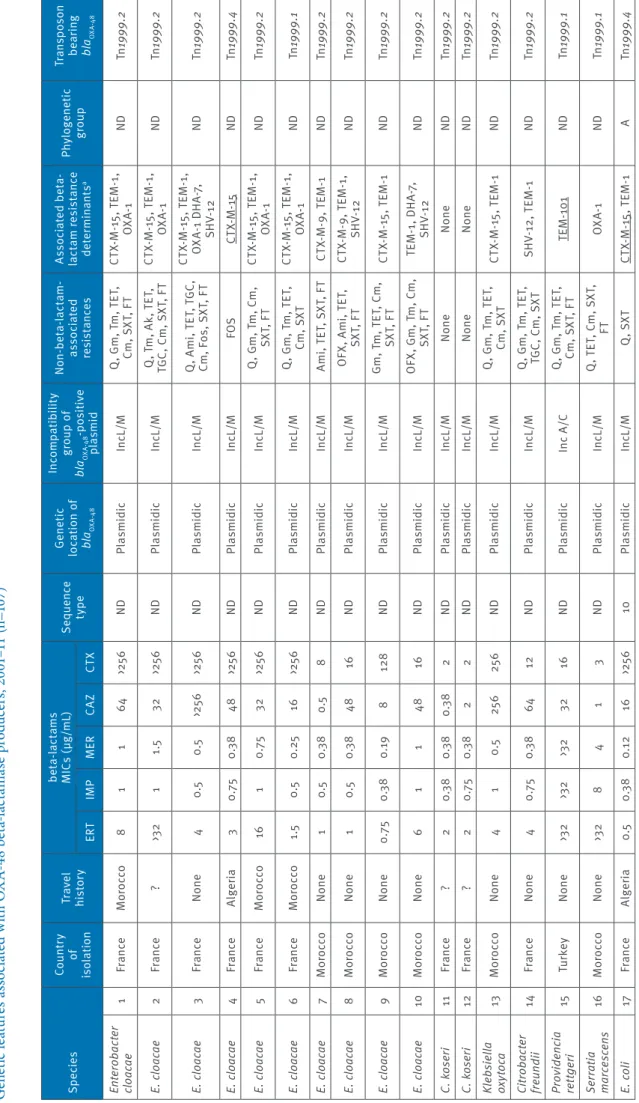
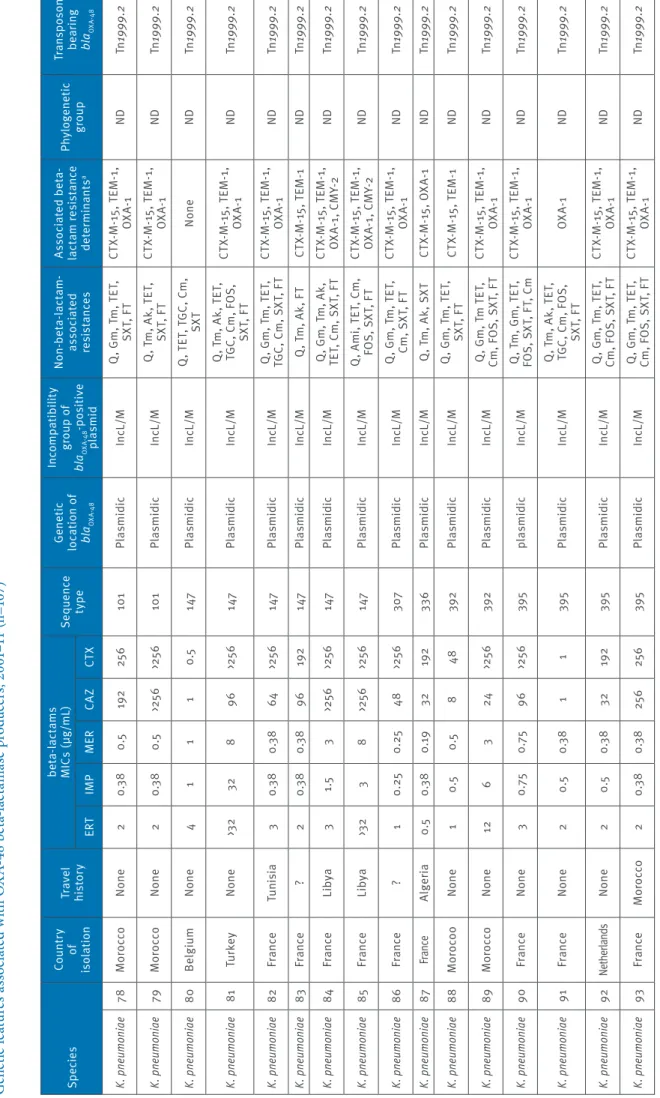
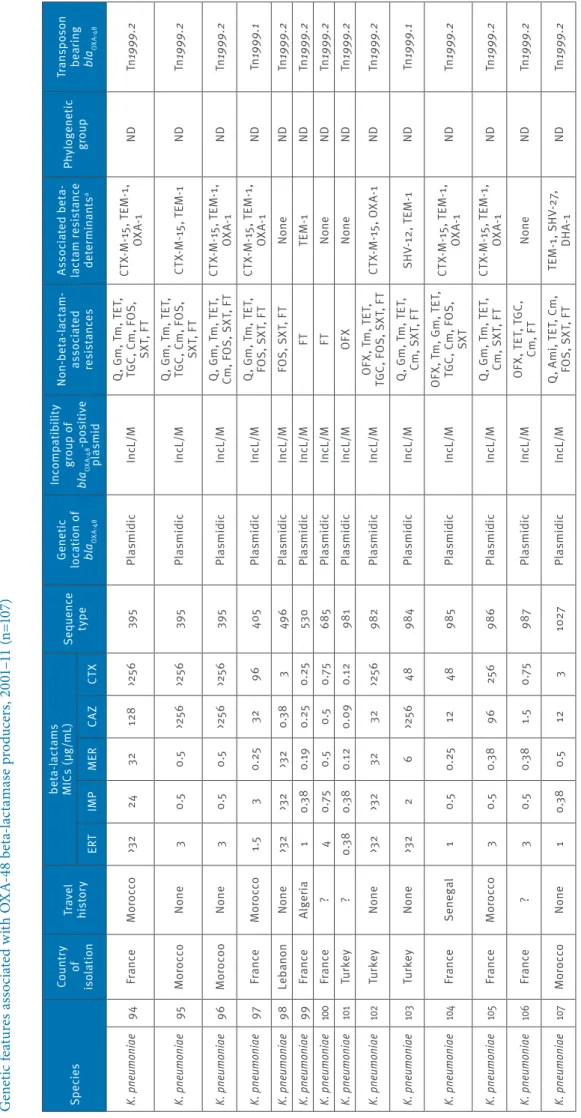
A total of 107 isolates were studied, including K. pneumoniae (n=67), E. coli (n=24), and E. cloacae (n=10) (Table 1). Other enterobacterial species were identified: Citrobacter koseri (n=2), C. freundii (n=1), Klebsiella oxytoca (n=1), Providencia rettgeri (n=1), and S. marcescens (n=1). They had been isolated in France (n=61), Morocco (n=22), Turkey (n=11), Egypt (n=3), Lebanon (n=2), Tunisia (n=2), Switzerland (n=2), South Africa (n=2), Belgium (n=1), and the Netherlands (n=1), respectively (Table 1). Among the 61 strains collected in France, 30 had a history of international travel to the following countries: Morocco (n=14), Tunisia (n=2), Libya (n=5), Algeria (n=4), Egypt (n=3), Senegal (n=1), and Kuwait (n=1). In 12 cases, no travel history from a foreign country was identified. For the remaining 19 cases, no precise travel information could be obtained (Table 1).
Ta bl e 1 a G en et ic f ea tu re s a ss oc ia te d w ith O X A-48 b et a-la ct am as e p ro du cer s, 2 00 1– 11 ( n= 10 7) Sp ec ie s Co un tr y of is ol at io n Tr av el his to ry be ta -la ct am s M IC s ( µg /mL ) Se que nc e ty pe Ge ne tic lo ca tio n o f bl aOXA -4 8 In co mp at ib ili ty gr ou p o f bl aOXA -4 8 -p os iti ve pl asmid N on -be ta -la ct am -as so ci at ed res is ta nc es As so ci at ed b et a-la ct am r es is ta nc e de te rm ina nt s a Phy lo gen et ic gr oup Tr an sp os on be ar in g bl aOXA -4 8 ER T IM P M ER CAZ CT X En te ro ba cte r cl oa ca e 1 Fr an ce M or occo 8 1 1 64 >25 6 ND Pl asmidic In cL /M Q , G m , T m , T ET , Cm , S XT , F T CT X-M -1 5, T EM -1 , OX A-1 ND Tn 1999 .2 E. c lo ac ae 2 Fr an ce ? >3 2 1 1.5 32 >25 6 ND Pl asmidic In cL /M Q , T m , A k, T ET , TG C, C m , S XT , F T CT X-M -1 5, T EM -1 , OX A-1 ND Tn 1999 .2 E. c lo ac ae 3 Fr an ce N one 4 0.5 0.5 >25 6 >25 6 ND Pl asmidic In cL /M Q , A m i, T ET , T GC , Cm , F os , S XT , F T CT X-M -1 5, T EM -1 , O XA -1 D H A-7, SH V-12 ND Tn 1999 .2 E. c lo ac ae 4 Fr an ce Al ge ria 3 0. 75 0.3 8 48 >25 6 ND Pl asmidic In cL /M FOS CT X-M -15 ND Tn 1999 .4 E. c lo ac ae 5 Fr an ce M or occo 16 1 0. 75 32 >25 6 ND Pl asmidic In cL /M Q , G m , T m , C m , SX T, F T CT X-M -1 5, T EM -1 , OX A-1 ND Tn 1999 .2 E. c lo ac ae 6 Fr an ce M or occo 1.5 0.5 0. 25 16 >25 6 ND Pl asmidic In cL /M Q , G m , T m , T ET , Cm, S XT CT X-M -1 5, T EM -1 , OX A-1 ND Tn 1999 .1 E. c lo ac ae 7 M or occo N one 1 0.5 0.3 8 0.5 8 ND Pl asmidic In cL /M A m i, T ET , S XT , F T CT X- M-9, T EM-1 ND Tn 1999 .2 E. c lo ac ae 8 M or occo N one 1 0.5 0.3 8 48 16 ND Pl asmidic In cL /M O FX , A m i, T ET , SX T, F T CT X-M -9 , T EM -1 , SH V-12 ND Tn 1999 .2 E. c lo ac ae 9 M or occo N one 0. 75 0.3 8 0. 19 8 128 ND Pl asmidic In cL /M Gm , T m , T ET , C m , SX T, F T CT X-M -1 5, T EM -1 ND Tn 1999 .2 E. c lo ac ae 10 M or occo N one 6 1 1 48 16 ND Pl asmidic In cL /M O FX , G m , T m , C m , SX T, F T TE M -1 , D H A-7, SH V-12 ND Tn 1999 .2 C. k ose ri 11 Fr an ce ? 2 0.3 8 0.3 8 0.3 8 2 ND Pl asmidic In cL /M N one N one ND Tn 1999 .2 C. k ose ri 12 Fr an ce ? 2 0. 75 0.3 8 2 2 ND Pl asmidic In cL /M N one N one ND Tn 1999 .2 Kle bs ie lla ox yt oca 13 M or occo N one 4 1 0.5 25 6 25 6 ND Pl asmidic In cL /M Q , G m , T m , T ET , Cm, S XT CT X-M -1 5, T EM -1 ND Tn 1999 .2 Cit ro bac te r fre un di i 14 Fr an ce N one 4 0. 75 0.3 8 64 12 ND Pl asmidic In cL /M Q , G m , T m , T ET , TG C, C m , S XT SH V-12 , T EM -1 ND Tn 1999 .2 Pro vi de nc ia ret tg er i 15 Tu rk ey N one >3 2 >3 2 >3 2 32 16 ND Pl asmidic In c A /C Q , G m , T m , T ET , Cm , S XT , F T TE M -10 1 ND Tn 1999 .1 Se rr at ia m ar ce sce ns 16 M or occo N one >3 2 8 4 1 3 ND Pl asmidic In cL /M Q , T ET , C m , S XT , FT OX A-1 ND Tn 1999 .1 E. co li 17 Fr an ce Al ge ria 0.5 0.3 8 0.1 2 16 >25 6 10 Pl asmidic In cL /M Q , S XT CT X-M -15 , T EM -1 A Tn 1999 .4 Ak : a m ik ac in ; A m i: a m in og ly co si de s; C m : c hl or am ph en ic ol ; C s: c ol is tin ; Tn 1999 : t ru nc at ed t ra ns po so n T n1 999 ; F O S: f os fo m yc in ; F T: n itr of ur an to in ; G m g en ta m ic in ; M IC : m in im um i nh ib ito ry c on ce nt ra tio n; ND : n ot d et er m in ab le ; O FX : o flo xa ci n; Q : f lu or oq ui no lo ne s; S XT : s ul fa m et ho xa zo le -t rim et ho pr im; T ET : t et ra cy cl in e; T GC : t ig ec yc lin e; T m : t ob ra m yc in . a Re si st an ce m ar ke rs b ei ng c o-ha rb ou re d b y t he bl aOX A-48 -c ar ry in g pl as m id ar e un de rli ne d.
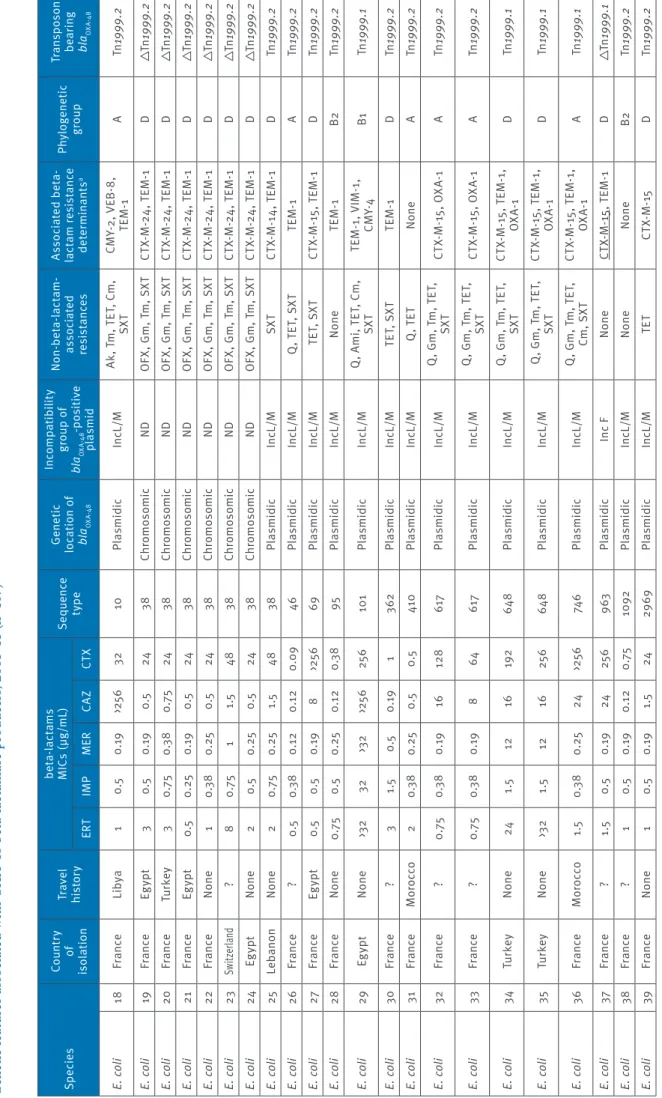
Ta bl e 1 b G en et ic f ea tu re s a ss oc ia te d w ith O X A-48 b et a-la ct am as e p ro du cer s, 2 00 1– 11 ( n= 10 7) Sp ec ie s Co un tr y of is ol at io n Tr av el his to ry be ta -la ct am s M IC s ( µg /mL ) Se que nc e ty pe Ge ne tic lo ca tio n o f bl aOXA -4 8 In co mp at ib ili ty gr ou p o f bl aOXA -4 8 -p os iti ve pl asmid N on -be ta -la ct am -as so ci at ed res is ta nc es As so ci at ed b et a-la ct am r es is ta nc e de te rm ina nt s a Phy lo gen et ic gr oup Tr an sp os on be ar in g bl aOXA -4 8 ER T IM P M ER CAZ CT X E. co li 18 Fr an ce Lib ya 1 0.5 0. 19 >25 6 32 10 Pl asmidic In cL /M Ak , T m , T ET , C m , SX T CM Y-2, V EB -8 , TE M -1 A Tn 1999 .2 E. co li 19 Fr an ce Eg ypt 3 0.5 0. 19 0.5 24 38 Chr om os omic ND O FX , G m , T m , S XT CT X-M -2 4, T EM -1 D Tn 1999 .2 E. co li 20 Fr an ce Tu rk ey 3 0. 75 0.3 8 0. 75 24 38 Chr om os omic ND O FX , G m , T m , S XT CT X-M -2 4, T EM -1 D Tn 1999 .2 E. co li 21 Fr an ce Eg ypt 0.5 0. 25 0. 19 0.5 24 38 Chr om os omic ND O FX , G m , T m , S XT CT X-M -2 4, T EM -1 D Tn 1999 .2 E. co li 22 Fr an ce N one 1 0.3 8 0. 25 0.5 24 38 Chr om os omic ND O FX , G m , T m , S XT CT X-M -2 4, T EM -1 D Tn 1999 .2 E. co li 23 Sw itze rla nd ? 8 0. 75 1 1.5 48 38 Chr om os omic ND O FX , G m , T m , S XT CT X-M -2 4, T EM -1 D Tn 1999 .2 E. co li 24 Eg ypt N one 2 0.5 0. 25 0.5 24 38 Chr om os omic ND O FX , G m , T m , S XT CT X-M -2 4, T EM -1 D Tn 1999 .2 E. co li 25 Le ban on N one 2 0. 75 0. 25 1.5 48 38 Pl asmidic In cL /M SX T CT X-M -1 4, T EM -1 D Tn 1999 .2 E. co li 26 Fr an ce ? 0.5 0.3 8 0.1 2 0.1 2 0.0 9 46 Pl asmidic In cL /M Q , T ET , S XT TE M -1 A Tn 1999 .2 E. co li 27 Fr an ce Eg ypt 0.5 0.5 0. 19 8 >25 6 69 Pl asmidic In cL /M T ET, S XT CT X-M -1 5, T EM -1 D Tn 1999 .2 E. co li 28 Fr an ce N one 0. 75 0.5 0. 25 0.1 2 0.3 8 95 Pl asmidic In cL /M N one TE M -1 B2 Tn 1999 .2 E. co li 29 Eg ypt N one >3 2 32 >3 2 >25 6 25 6 10 1 Pl asmidic In cL /M Q , A m i, T ET , C m , SX T TE M -1 , V IM -1 , CM Y-4 B1 Tn 1999 .1 E. co li 30 Fr an ce ? 3 1.5 0.5 0. 19 1 362 Pl asmidic In cL /M TE T, S XT TE M -1 D Tn 1999 .2 E. co li 31 Fr an ce M or occo 2 0.3 8 0. 25 0.5 0.5 410 Pl asmidic In cL /M Q , T ET N one A Tn 1999 .2 E. co li 32 Fr an ce ? 0. 75 0.3 8 0. 19 16 128 61 7 Pl asmidic In cL /M Q , G m , T m , T ET , SX T CT X-M -1 5, O XA -1 A Tn 1999 .2 E. co li 33 Fr an ce ? 0. 75 0.3 8 0. 19 8 64 61 7 Pl asmidic In cL /M Q , G m , T m , T ET , SX T CT X-M -1 5, O XA -1 A Tn 1999 .2 E. co li 34 Tu rk ey N one 24 1.5 12 16 19 2 64 8 Pl asmidic In cL /M Q , G m , T m , T ET , SX T CT X-M -1 5, T EM -1 , OX A-1 D Tn 1999 .1 E. co li 35 Tu rk ey N one >3 2 1.5 12 16 25 6 64 8 Pl asmidic In cL /M Q , G m , T m , T ET , SX T CT X-M -1 5, T EM -1 , OX A-1 D Tn 1999 .1 E. co li 36 Fr an ce M or occo 1.5 0.3 8 0. 25 24 >25 6 74 6 Pl asmidic In cL /M Q , G m , T m , T ET , Cm, S XT CT X-M -1 5, T EM -1 , OX A-1 A Tn 1999 .1 E. co li 37 Fr an ce ? 1.5 0.5 0. 19 24 25 6 963 Pl asmidic In c F N one CT X-M -15 , T EM -1 D Tn 1999 .1 E. co li 38 Fr an ce ? 1 0.5 0. 19 0.1 2 0. 75 10 92 Pl asmidic In cL /M N one N one B2 Tn 1999 .2 E. co li 39 Fr an ce N one 1 0.5 0. 19 1.5 24 29 69 Pl asmidic In cL /M TE T CT X-M -15 D Tn 1999 .2 Ak : a m ik ac in ; A m i: a m in og ly co si de s; C m : c hl or am ph en ic ol ; C s: c ol is tin ; Tn 1999 : t ru nc at ed t ra ns po so n T n1 999 ; F O S: f os fo m yc in ; F T: n itr of ur an to in ; G m g en ta m ic in ; M IC : m in im um i nh ib ito ry c on ce nt ra tio n; ND : n ot d et er m in ab le ; O FX : o flo xa ci n; Q : f lu or oq ui no lo ne s; S XT : s ul fa m et ho xa zo le -t rim et ho pr im; T ET : t et ra cy cl in e; T GC : t ig ec yc lin e; T m : t ob ra m yc in . a Re si st an ce m ar ke rs b ei ng c o-ha rb ou re d b y t he bl aOX A-48 -c ar ry in g pl as m id ar e un de rli ne d.
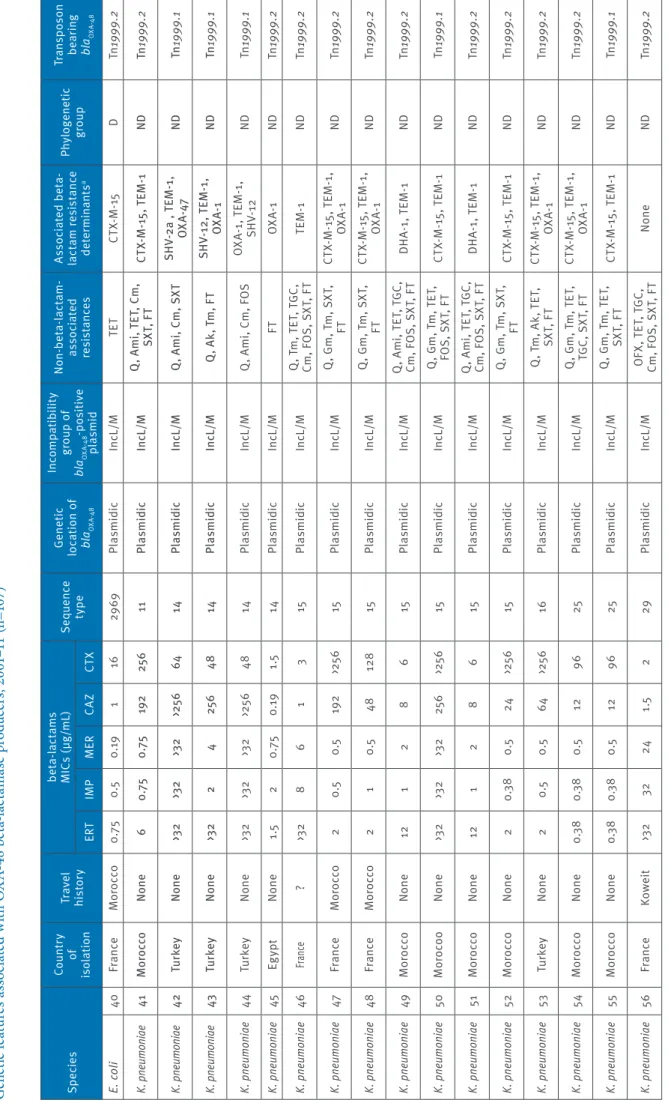
Ta bl e 1 c G en et ic f ea tu re s a ss oc ia te d w ith O X A-48 b et a-la ct am as e p ro du cer s, 2 00 1– 11 ( n= 10 7) Sp ec ie s Co un tr y of is ol at io n Tr av el his to ry be ta -la ct am s M IC s ( µg /mL ) Se que nc e ty pe Ge ne tic lo ca tio n o f bl aOXA -4 8 In co mp at ib ili ty gr ou p o f bl aOXA -4 8 -p os iti ve pl asmid N on -be ta -la ct am -as so ci at ed res is ta nc es As so ci at ed b et a-la ct am r es is ta nc e de te rm ina nt s a Phy lo gen et ic gr oup Tr an sp os on be ar in g bl aOXA -4 8 ER T IM P M ER CAZ CT X E. co li 40 Fr an ce M or occo 0. 75 0.5 0. 19 1 16 29 69 Pl asmidic In cL /M TE T CT X-M -15 D Tn 1999 .2 K. pn eumo niae 41 M or occ o No ne 6 0.7 5 0.7 5 19 2 25 6 11 Pl as m idic In cL /M Q , A m i, T ET , C m , SX T, F T CT X-M -1 5, T EM -1 ND Tn 1999 .2 K. pn eumo niae 42 Tu rk ey No ne >3 2 >3 2 >3 2 >25 6 64 14 Pl as m idic In cL /M Q , A m i, C m , S XT SH V-2a , T EM -1 , O XA -47 ND Tn 1999 .1 K. pn eumo niae 43 Tu rk ey No ne >3 2 2 4 25 6 48 14 Pl as m idic In cL /M Q , A k, T m , F T SH V-12 , T EM -1 , OX A-1 ND Tn 1999 .1 K. pn eumo niae 44 Tu rk ey N one >3 2 >3 2 >3 2 >25 6 48 14 Pl asmidic In cL /M Q , A m i, C m , F O S O XA -1 , T EM -1 , SH V-12 ND Tn 1999 .1 K. pn eumo niae 45 Eg ypt N one 1.5 2 0. 75 0. 19 1.5 14 Pl asmidic In cL /M FT OX A-1 ND Tn 1999 .2 K. pn eumo niae 46 Fra nce ? >3 2 8 6 1 3 15 Pl asmidic In cL /M Q , T m , T ET , T GC , Cm , F O S, S XT , F T TE M -1 ND Tn 1999 .2 K. pn eumo niae 47 Fr an ce M or occo 2 0.5 0.5 19 2 >25 6 15 Pl asmidic In cL /M Q , G m , T m , S XT , FT CT X-M -1 5, T EM -1 , OX A-1 ND Tn 1999 .2 K. pn eumo niae 48 Fr an ce M or occo 2 1 0.5 48 128 15 Pl asmidic In cL /M Q , G m , T m , S XT , FT CT X-M -1 5, T EM -1 , OX A-1 ND Tn 1999 .2 K. pn eumo niae 49 M or occo N one 12 1 2 8 6 15 Pl asmidic In cL /M Q , A m i, T ET , T GC , Cm , F O S, S XT , F T DH A-1 , T EM -1 ND Tn 1999 .2 K. pn eumo niae 50 Mo ro co o N one >3 2 >3 2 >3 2 25 6 >25 6 15 Pl asmidic In cL /M Q , G m , T m , T ET , FO S, S XT , F T CT X-M -1 5, T EM -1 ND Tn 1999 .1 K. pn eumo niae 51 M or occo N one 12 1 2 8 6 15 Pl asmidic In cL /M Q , A m i, T ET , T GC , Cm , F O S, S XT , F T DH A-1 , T EM -1 ND Tn 1999 .2 K. pn eumo niae 52 M or occo N one 2 0.3 8 0.5 24 >25 6 15 Pl asmidic In cL /M Q , G m , T m , S XT , FT CT X-M -1 5, T EM -1 ND Tn 1999 .2 K. pn eumo niae 53 Tu rk ey N one 2 0.5 0.5 64 >25 6 16 Pl asmidic In cL /M Q , T m , A k, T ET , SX T, F T CT X-M -1 5, T EM -1 , OX A-1 ND Tn 1999 .2 K. pn eumo niae 54 M or oc co N one 0.3 8 0.3 8 0.5 12 96 25 Pl asmidic In cL /M Q , G m , T m , T ET , TG C, S XT , F T CT X-M -1 5, T EM -1 , OX A-1 ND Tn 1999 .2 K. pn eumo niae 55 M or oc co N one 0.3 8 0.3 8 0.5 12 96 25 Pl asmidic In cL /M Q , G m , T m , T ET , SX T, F T CT X-M -1 5, T EM -1 ND Tn 1999 .1 K. pn eumo niae 56 Fr an ce Ko w ei t >3 2 32 24 1.5 2 29 Pl asmidic In cL /M O FX , T ET , T GC , Cm , F O S, S XT , F T N one ND Tn 1999 .2 Ak : a m ik ac in ; A m i: a m in og ly co si de s; C m : c hl or am ph en ic ol ; C s: c ol is tin ; Tn 1999 : t ru nc at ed t ra ns po so n T n1 999 ; F O S: f os fo m yc in ; F T: n itr of ur an to in ; G m g en ta m ic in ; M IC : m in im um i nh ib ito ry c on ce nt ra tio n; ND : n ot d et er m in ab le ; O FX : o flo xa ci n; Q : f lu or oq ui no lo ne s; S XT : s ul fa m et ho xa zo le -t rim et ho pr im; T ET : t et ra cy cl in e; T GC : t ig ec yc lin e; T m : t ob ra m yc in . a Re si st an ce m ar ke rs b ei ng c o-ha rb ou re d b y t he bl aOX A-48 -c ar ry in g pl as m id ar e un de rli ne d. Sp ec ie s Co un tr y of is ol at io n Tr av el his to ry be ta -la ct am s M IC s ( µg /mL ) Se que nc e ty pe Ge ne tic lo ca tio n o f bl aOXA -4 8 In co mp at ib ili ty gr ou p o f bl aOXA -4 8 -p os iti ve pl asmid N on -be ta -la ct am -as so ci at ed res is ta nc es As so ci at ed b et a-la ct am r es is ta nc e de te rm ina nt s a Phy lo gen et ic gr oup Tr an sp os on be ar in g bl aOXA -4 8 ER T IM P M ER CAZ CT X E. co li 18 Fr an ce Lib ya 1 0.5 0. 19 >25 6 32 10 Pl asmidic In cL /M Ak , T m , T ET , C m , SX T CM Y-2, V EB -8 , TE M -1 A Tn 1999 .2 E. co li 19 Fr an ce Eg ypt 3 0.5 0. 19 0.5 24 38 Chr om os omic ND O FX , G m , T m , S XT CT X-M -2 4, T EM -1 D Tn 1999 .2 E. co li 20 Fr an ce Tu rk ey 3 0. 75 0.3 8 0. 75 24 38 Chr om os omic ND O FX , G m , T m , S XT CT X-M -2 4, T EM -1 D Tn 1999 .2 E. co li 21 Fr an ce Eg ypt 0.5 0. 25 0. 19 0.5 24 38 Chr om os omic ND O FX , G m , T m , S XT CT X-M -2 4, T EM -1 D Tn 1999 .2 E. co li 22 Fr an ce N one 1 0.3 8 0. 25 0.5 24 38 Chr om os omic ND O FX , G m , T m , S XT CT X-M -2 4, T EM -1 D Tn 1999 .2 E. co li 23 Sw itze rla nd ? 8 0. 75 1 1.5 48 38 Chr om os omic ND O FX , G m , T m , S XT CT X-M -2 4, T EM -1 D Tn 1999 .2 E. co li 24 Eg ypt N one 2 0.5 0. 25 0.5 24 38 Chr om os omic ND O FX , G m , T m , S XT CT X-M -2 4, T EM -1 D Tn 1999 .2 E. co li 25 Le ban on N one 2 0. 75 0. 25 1.5 48 38 Pl asmidic In cL /M SX T CT X-M -1 4, T EM -1 D Tn 1999 .2 E. co li 26 Fr an ce ? 0.5 0.3 8 0.1 2 0.1 2 0.0 9 46 Pl asmidic In cL /M Q , T ET , S XT TE M -1 A Tn 1999 .2 E. co li 27 Fr an ce Eg ypt 0.5 0.5 0. 19 8 >25 6 69 Pl asmidic In cL /M T ET, S XT CT X-M -1 5, T EM -1 D Tn 1999 .2 E. co li 28 Fr an ce N one 0. 75 0.5 0. 25 0.1 2 0.3 8 95 Pl asmidic In cL /M N one TE M -1 B2 Tn 1999 .2 E. co li 29 Eg ypt N one >3 2 32 >3 2 >25 6 25 6 10 1 Pl asmidic In cL /M Q , A m i, T ET , C m , SX T TE M -1 , V IM -1 , CM Y-4 B1 Tn 1999 .1 E. co li 30 Fr an ce ? 3 1.5 0.5 0. 19 1 362 Pl asmidic In cL /M TE T, S XT TE M -1 D Tn 1999 .2 E. co li 31 Fr an ce M or occo 2 0.3 8 0. 25 0.5 0.5 410 Pl asmidic In cL /M Q , T ET N one A Tn 1999 .2 E. co li 32 Fr an ce ? 0. 75 0.3 8 0. 19 16 128 61 7 Pl asmidic In cL /M Q , G m , T m , T ET , SX T CT X-M -1 5, O XA -1 A Tn 1999 .2 E. co li 33 Fr an ce ? 0. 75 0.3 8 0. 19 8 64 61 7 Pl asmidic In cL /M Q , G m , T m , T ET , SX T CT X-M -1 5, O XA -1 A Tn 1999 .2 E. co li 34 Tu rk ey N one 24 1.5 12 16 19 2 64 8 Pl asmidic In cL /M Q , G m , T m , T ET , SX T CT X-M -1 5, T EM -1 , OX A-1 D Tn 1999 .1 E. co li 35 Tu rk ey N one >3 2 1.5 12 16 25 6 64 8 Pl asmidic In cL /M Q , G m , T m , T ET , SX T CT X-M -1 5, T EM -1 , OX A-1 D Tn 1999 .1 E. co li 36 Fr an ce M or occo 1.5 0.3 8 0. 25 24 >25 6 74 6 Pl asmidic In cL /M Q , G m , T m , T ET , Cm, S XT CT X-M -1 5, T EM -1 , OX A-1 A Tn 1999 .1 E. co li 37 Fr an ce ? 1.5 0.5 0. 19 24 25 6 963 Pl asmidic In c F N one CT X-M -15 , T EM -1 D Tn 1999 .1 E. co li 38 Fr an ce ? 1 0.5 0. 19 0.1 2 0. 75 10 92 Pl asmidic In cL /M N one N one B2 Tn 1999 .2 E. co li 39 Fr an ce N one 1 0.5 0. 19 1.5 24 29 69 Pl asmidic In cL /M TE T CT X-M -15 D Tn 1999 .2
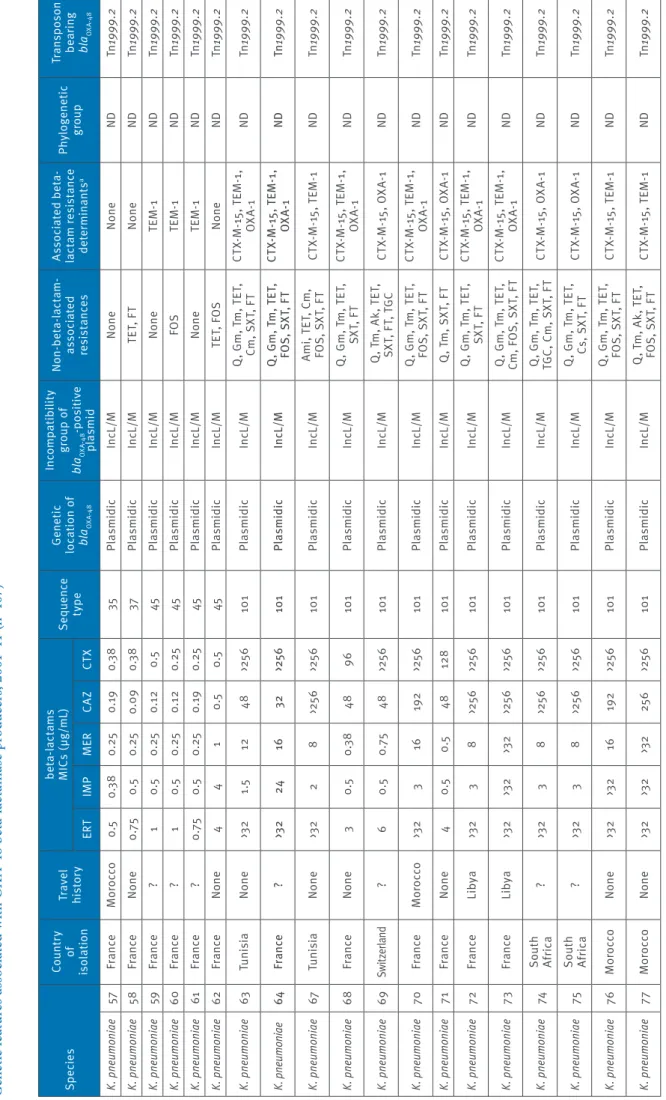
Ta bl e 1 d G en et ic f ea tu re s a ss oc ia te d w ith O X A-48 b et a-la ct am as e p ro du cer s, 2 00 1– 11 ( n= 10 7) Sp ec ie s Co un tr y of is ol at io n Tr av el his to ry be ta -la ct am s M IC s ( µg /mL ) Se que nc e ty pe Ge ne tic lo ca tio n o f bl aOXA -4 8 In co mp at ib ili ty gr ou p o f bl aOXA -4 8 -p os iti ve pl asmid N on -be ta -la ct am -as so ci at ed res is ta nc es As so ci at ed b et a-la ct am r es is ta nc e de te rm ina nt s a Phy lo gen et ic gr oup Tr an sp os on be ar in g bl aOXA -4 8 ER T IM P M ER CAZ CT X K. pn eumo niae 57 Fr an ce M or occo 0.5 0.3 8 0. 25 0. 19 0.3 8 35 Pl asmidic In cL /M N one N one ND Tn 1999 .2 K. pn eumo niae 58 Fr an ce N one 0. 75 0.5 0. 25 0.0 9 0.3 8 37 Pl asmidic In cL /M TE T, F T N one ND Tn 1999 .2 K. pn eumo niae 59 Fr an ce ? 1 0.5 0. 25 0.1 2 0.5 45 Pl asmidic In cL /M N one TE M -1 ND Tn 1999 .2 K. pn eumo niae 60 Fr an ce ? 1 0.5 0. 25 0.1 2 0. 25 45 Pl asmidic In cL /M FOS TE M -1 ND Tn 1999 .2 K. pn eumo niae 61 Fr an ce ? 0. 75 0.5 0. 25 0. 19 0. 25 45 Pl asmidic In cL /M N one TE M -1 ND Tn 1999 .2 K. pn eumo niae 62 Fr an ce N one 4 4 1 0.5 0.5 45 Pl asmidic In cL /M TE T, F O S N one ND Tn 1999 .2 K. pn eumo niae 63 Tu nisi a N one >3 2 1.5 12 48 >25 6 10 1 Pl asmidic In cL /M Q , G m , T m , T ET , Cm , S XT , F T CT X-M -1 5, T EM -1 , OX A-1 ND Tn 1999 .2 K. pn eumo niae 64 Fr an ce ? >3 2 24 16 32 >25 6 10 1 Pl as m idic In cL /M Q , G m , T m , T ET , FO S, S XT , F T CT X-M -1 5, T EM -1 , OX A-1 ND Tn 1999 .2 K. pn eumo niae 67 Tu nisi a N one >3 2 2 8 >25 6 >25 6 10 1 Pl asmidic In cL /M Am i, T ET , C m , FO S, S XT , F T CT X-M -1 5, T EM -1 ND Tn 1999 .2 K. pn eumo niae 68 Fr an ce N one 3 0.5 0.3 8 48 96 10 1 Pl asmidic In cL /M Q , G m , T m , T ET , SX T, F T CT X-M -1 5, T EM -1 , OX A-1 ND Tn 1999 .2 K. pn eumo niae 69 Sw itze rla nd ? 6 0.5 0. 75 48 >25 6 10 1 Pl asmidic In cL /M Q , T m , A k, T ET , SX T, F T, T GC CT X-M -1 5, O XA -1 ND Tn 1999 .2 K. pn eumo niae 70 Fr an ce M or occo >3 2 3 16 19 2 >25 6 10 1 Pl asmidic In cL /M Q , G m , T m , T ET , FO S, S XT , F T CT X-M -1 5, T EM -1 , OX A-1 ND Tn 1999 .2 K. pn eumo niae 71 Fr an ce N one 4 0.5 0.5 48 128 10 1 Pl asmidic In cL /M Q , T m , S XT , F T CT X-M -1 5, O XA -1 ND Tn 1999 .2 K. pn eumo niae 72 Fr an ce Lib ya >3 2 3 8 >25 6 >25 6 10 1 Pl asmidic In cL /M Q , G m , T m , T ET , SX T, F T CT X-M -1 5, T EM -1 , OX A-1 ND Tn 1999 .2 K. pn eumo niae 73 Fr an ce Lib ya >3 2 >3 2 >3 2 >25 6 >25 6 10 1 Pl asmidic In cL /M Q , G m , T m , T ET , Cm , F O S, S XT , F T CT X-M -1 5, T EM -1 , OX A-1 ND Tn 1999 .2 K. pn eumo niae 74 So ut h Af ric a ? >3 2 3 8 >25 6 >25 6 10 1 Pl asmidic In cL /M Q , G m , T m , T ET , TG C, C m , S XT , F T CT X-M -1 5, O XA -1 ND Tn 1999 .2 K. pn eumo niae 75 So ut h Af ric a ? >3 2 3 8 >25 6 >25 6 10 1 Pl asmidic In cL /M Q , G m , T m , T ET , Cs , S XT , F T CT X-M -1 5, O XA -1 ND Tn 1999 .2 K. pn eumo niae 76 M or occo N one >3 2 >3 2 16 19 2 >25 6 10 1 Pl asmidic In cL /M Q , G m , T m , T ET , FO S, S XT , F T CT X-M -1 5, T EM -1 ND Tn 1999 .2 K. pn eumo niae 77 M or occo N one >3 2 >3 2 >3 2 25 6 >25 6 10 1 Pl asmidic In cL /M Q , T m , A k, T ET , FO S, S XT , F T CT X-M -1 5, T EM -1 ND Tn 1999 .2 Ak : a m ik ac in ; A m i: a m in og ly co si de s; C m : c hl or am ph en ic ol ; C s: c ol is tin ; Tn 1999 : t ru nc at ed t ra ns po so n T n1 999 ; F O S: f os fo m yc in ; F T: n itr of ur an to in ; G m g en ta m ic in ; M IC : m in im um i nh ib ito ry c on ce nt ra tio n; ND : n ot d et er m in ab le ; O FX : o flo xa ci n; Q : f lu or oq ui no lo ne s; S XT : s ul fa m et ho xa zo le -t rim et ho pr im; T ET : t et ra cy cl in e; T GC : t ig ec yc lin e; T m : t ob ra m yc in . a Re si st an ce m ar ke rs b ei ng c o-ha rb ou re d b y t he bl aOX A-48 -c ar ry in g pl as m id ar e un de rli ne d.
Ta bl e 1 e G en et ic f ea tu re s a ss oc ia te d w ith O X A-48 b et a-la ct am as e p ro du cer s, 2 00 1– 11 ( n= 10 7) Sp ec ie s Co un tr y of is ol at io n Tr av el his to ry be ta -la ct am s M IC s ( µg /mL ) Se que nc e ty pe Ge ne tic lo ca tio n o f bl aOXA -4 8 In co mp at ib ili ty gr ou p o f bl aOXA -4 8 -p os iti ve pl asmid N on -be ta -la ct am -as so ci at ed res is ta nc es As so ci at ed b et a-la ct am r es is ta nc e de te rm ina nt s a Phy lo gen et ic gr oup Tr an sp os on be ar in g bl aOXA -4 8 ER T IM P M ER CAZ CT X K. pn eumo niae 78 M or occo N one 2 0.3 8 0.5 19 2 25 6 10 1 Pl asmidic In cL /M Q , G m , T m , T ET , SX T, F T CT X-M -1 5, T EM -1 , OX A-1 ND Tn 1999 .2 K. pn eumo niae 79 M or occo N one 2 0.3 8 0.5 >25 6 >25 6 10 1 Pl asmidic In cL /M Q , T m , A k, T ET , SX T, F T CT X-M -1 5, T EM -1 , OX A-1 ND Tn 1999 .2 K. pn eumo niae 80 Be lg iu m N one 4 1 1 1 0.5 147 Pl asmidic In cL /M Q , T ET , T GC , C m , SX T N one ND Tn 1999 .2 K. pn eumo niae 81 Tu rk ey N one >3 2 32 8 96 >25 6 147 Pl asmidic In cL /M Q , T m , A k, T ET , TG C, C m , F O S, SX T, F T CT X-M -1 5, T EM -1 , OX A-1 ND Tn 1999 .2 K. pn eumo niae 82 Fr an ce Tu ni si a 3 0.3 8 0.3 8 64 >25 6 147 Pl asmidic In cL /M Q , G m , T m , T ET , TG C, C m , S XT , F T CT X-M -1 5, T EM -1 , OX A-1 ND Tn 1999 .2 K. pn eumo niae 83 Fr an ce ? 2 0.3 8 0.3 8 96 19 2 147 Pl asmidic In cL /M Q , T m , A k, F T CT X-M -1 5, T EM -1 ND Tn 1999 .2 K. pn eumo niae 84 Fr an ce Lib ya 3 1.5 3 >25 6 >25 6 147 Pl asmidic In cL /M Q , G m , T m , A k, TE T, C m , S XT , F T CT X-M -1 5, T EM -1 , O XA -1, CM Y-2 ND Tn 1999 .2 K. pn eumo niae 85 Fr an ce Lib ya >3 2 3 8 >25 6 >25 6 147 Pl asmidic In cL /M Q , A m i, T ET , C m , FO S, S XT , F T CT X-M -1 5, T EM -1 , O XA -1, CM Y-2 ND Tn 1999 .2 K. pn eumo niae 86 Fr an ce ? 1 0. 25 0. 25 48 >25 6 307 Pl asmidic In cL /M Q , G m , T m , T ET , Cm , S XT , F T CT X-M -1 5, T EM -1 , OX A-1 ND Tn 1999 .2 K. pn eumo niae 87 Fra nce Al ge ria 0.5 0.3 8 0. 19 32 19 2 33 6 Pl asmidic In cL /M Q , T m , A k, S XT CT X-M -1 5, O XA -1 ND Tn 1999 .2 K. pn eumo niae 88 Mo ro co o N one 1 0.5 0.5 8 48 392 Pl asmidic In cL /M Q , G m , T m , T ET , SX T, F T CT X-M -1 5, T EM -1 ND Tn 1999 .2 K. pn eumo niae 89 M or occo N one 12 6 3 24 >25 6 392 Pl asmidic In cL /M Q , G m , T m T ET , Cm , F O S, S XT , F T CT X-M -1 5, T EM -1 , OX A-1 ND Tn 1999 .2 K. pn eumo niae 90 Fr an ce N on e 3 0. 75 0. 75 96 >25 6 39 5 pl asmidic In cL /M Q , T m , G m , T ET , FO S, S XT , F T, C m CT X-M -1 5, T EM -1 , OX A-1 ND Tn 1999 .2 K. pn eumo niae 91 Fr an ce N one 2 0.5 0.3 8 1 1 39 5 Pl asmidic In cL /M Q , T m , A k, T ET , TG C, C m , F O S, SX T, F T OX A-1 ND Tn 1999 .2 K. pn eumo niae 92 Ne the rla nd s N one 2 0.5 0.3 8 32 19 2 39 5 Pl asmidic In cL /M Q , G m , T m , T ET , Cm , F O S, S XT , F T CT X-M -1 5, T EM -1 , OX A-1 ND Tn 1999 .2 K. pn eumo niae 93 Fr an ce M or occo 2 0.3 8 0.3 8 25 6 25 6 39 5 Pl asmidic In cL /M Q , G m , T m , T ET , Cm , F O S, S XT , F T CT X-M -1 5, T EM -1 , OX A-1 ND Tn 1999 .2 Ak : a m ik ac in ; A m i: a m in og ly co si de s; C m : c hl or am ph en ic ol ; C s: c ol is tin ; Tn 1999 : t ru nc at ed t ra ns po so n T n1 999 ; F O S: f os fo m yc in ; F T: n itr of ur an to in ; G m g en ta m ic in ; M IC : m in im um i nh ib ito ry c on ce nt ra tio n; ND : n ot d et er m in ab le ; O FX : o flo xa ci n; Q : f lu or oq ui no lo ne s; S XT : s ul fa m et ho xa zo le -t rim et ho pr im; T ET : t et ra cy cl in e; T GC : t ig ec yc lin e; T m : t ob ra m yc in . a Re si st an ce m ar ke rs b ei ng c o-ha rb ou re d b y t he bl aOX A-48 -c ar ry in g pl as m id ar e un de rli ne d.
8 www.eurosurveillance.org Ta bl e 1 f G en et ic f ea tu re s a ss oc ia te d w ith O X A-48 b et a-la ct am as e p ro du cer s, 2 00 1– 11 ( n= 10 7) Sp ec ie s Co un tr y of is ol at io n Tr av el his to ry be ta -la ct am s M IC s ( µg /mL ) Se que nc e ty pe Ge ne tic lo ca tio n o f bl aOXA -4 8 In co mp at ib ili ty gr ou p o f bl aOXA -4 8 -p os iti ve pl asmid N on -be ta -la ct am -as so ci at ed res is ta nc es As so ci at ed b et a-la ct am r es is ta nc e de te rm ina nt s a Phy lo gen et ic gr oup Tr an sp os on be ar in g bl aOXA -4 8 ER T IM P M ER CAZ CT X K. pn eumo niae 94 Fr an ce M or occo >3 2 24 32 128 >25 6 39 5 Pl asmidic In cL /M Q , G m , T m , T ET , TG C, C m , F O S, SX T, F T CT X-M -1 5, T EM -1 , OX A-1 ND Tn 1999 .2 K. pn eumo niae 95 M or occo N one 3 0.5 0.5 >25 6 >25 6 39 5 Pl asmidic In cL /M Q , G m , T m , T ET , TG C, C m , F O S, SX T, F T CT X-M -1 5, T EM -1 ND Tn 1999 .2 K. pn eumo niae 96 Mo ro co o N one 3 0.5 0.5 >25 6 >25 6 39 5 Pl asmidic In cL /M Q , G m , T m , T ET , Cm , F O S, S XT , F T CT X-M -1 5, T EM -1 , OX A-1 ND Tn 1999 .2 K. pn eumo niae 97 Fr an ce M or occo 1.5 3 0. 25 32 96 40 5 Pl asmidic In cL /M Q , G m , T m , T ET , FO S, S XT , F T CT X-M -1 5, T EM -1 , OX A-1 ND Tn 1999 .1 K. pn eumo niae 98 Le ban on N one >3 2 >3 2 >3 2 0.3 8 3 49 6 Pl asmidic In cL /M FO S, S XT , F T N one ND Tn 1999 .2 K. pn eumo niae 99 Fr an ce Al ge ria 1 0.3 8 0. 19 0. 25 0. 25 53 0 Pl asmidic In cL /M FT TE M -1 ND Tn 1999 .2 K. pn eumo niae 10 0 Fr an ce ? 4 0. 75 0.5 0.5 0. 75 685 Pl asmidic In cL /M FT N one ND Tn 1999 .2 K. pn eumo niae 10 1 Tu rk ey ? 0.3 8 0.3 8 0.1 2 0.0 9 0.1 2 981 Pl asmidic In cL /M OF X N one ND Tn 1999 .2 K. pn eumo niae 10 2 Tu rk ey N one >3 2 >3 2 32 32 >25 6 982 Pl asmidic In cL /M O FX , T m , T ET , TG C, F O S, S XT , F T CT X-M -1 5, O XA -1 ND Tn 1999 .2 K. pn eumo niae 10 3 Tu rk ey N one >3 2 2 6 >25 6 48 984 Pl asmidic In cL /M Q , G m , T m , T ET , Cm , S XT , F T SH V-12 , T EM -1 ND Tn 1999 .1 K. pn eumo niae 10 4 Fr an ce Se ne gal 1 0.5 0. 25 12 48 985 Pl asmidic In cL /M O FX , T m , G m , T ET , TG C, C m , F O S, SX T CT X-M -1 5, T EM -1 , OX A-1 ND Tn 1999 .2 K. pn eumo niae 10 5 Fr an ce M or occo 3 0.5 0.3 8 96 25 6 986 Pl asmidic In cL /M Q , G m , T m , T ET , Cm , S XT , F T CT X-M -1 5, T EM -1 , OX A-1 ND Tn 1999 .2 K. pn eumo niae 10 6 Fr an ce ? 3 0.5 0.3 8 1.5 0. 75 987 Pl asmidic In cL /M O FX , T ET , T GC , Cm, F T N one ND Tn 1999 .2 K. pn eumo niae 10 7 M or occo N one 1 0.3 8 0.5 12 3 10 27 Pl asmidic In cL /M Q , A m i, T ET , C m , FO S, S XT , F T TE M -1 , S H V-27 , DH A-1 ND Tn 1999 .2 Ak : a m ik ac in ; A m i: a m in og ly co si de s; C m : c hl or am ph en ic ol ; C s: c ol is tin ; Tn 1999 : t ru nc at ed t ra ns po so n T n1 999 ; F O S: f os fo m yc in ; F T: n itr of ur an to in ; G m g en ta m ic in ; M IC : m in im um i nh ib ito ry c on ce nt ra tio n; ND : n ot d et er m in ab le ; O FX : o flo xa ci n; Q : f lu or oq ui no lo ne s; S XT : s ul fa m et ho xa zo le -t rim et ho pr im; T ET : t et ra cy cl in e; T GC : t ig ec yc lin e; T m : t ob ra m yc in . a Re si st an ce m ar ke rs b ei ng c o-ha rb ou re d b y t he bl aOX A-48 -c ar ry in g pl as m id ar e un de rli ne d.
9
www.eurosurveillance.org
Susceptibility to carbapenems and
broad-spectrum cephalosporins
Results of susceptibility testing are shown in Tables 2 and 3. According to the CLSI guidelines, 40 (60%) K. pneumoniae isolates, 20 (83%) E. coli isolates, and 10 (100%) E. cloacae isolates were susceptible to imi-penem (Table 2). In addition, 40 (60%) K. pneumoniae, 21 (88%) E. coli, and 9 (90%) E. cloacae isolates were susceptible to meropenem. By contrast, 62 (92%) K. pneumoniae, 20 (83%) E. coli, and 10 (100%) E. cloacae isolates were found of intermediate suscep-tibility or resistant to ertapenem (Table 2). Regarding the broad-spectrum cephalosporins, 73 (68%) and 90 (84%) isolates were resistant or of intermediate sus-ceptibility to ceftazidime and cefotaxime, respectively (Table 1 and 3).
Beta-lactamase genes
Among the 107 OXA-48-producing isolates, 80 (75%) co-produced an ESBL. A blaCTX-M-like gene was detected
in 71 (66%) of the isolates (89% of the ESBL-producing isolates). Among the different CTX-M variants iden-tified, those belonging to the CTX-M-1 and CTX-M-9 groups accounted for 87.5% (n=62) and 12.5% (n=9), respectively. CTX-M-15 was the only representa-tive of the CTX-M-1 group. In the CTX-M-9 group, the blaCTX-M-14 was identified in a single E. coli (Table 1). Two
E. cloacae isolates harboured a blaCTX-M-9 gene and 6
E. coli isolates harboured a blaCTX-M-24 gene. The other
ESBL determinants were SHV-2a (one K. pneumoniae), SHV-12 (three K. pneumoniae, two E. cloacae, and one C. freundii), SHV-27 (one K. pneumoniae) and TEM-101 (P. rettgeri isolate no. 15). Among the SHV-12-producing isolates, one E. cloacae co-produced CTX-M-9 (Table 1). In addition, a novel VEB variant, namely VEB-8, was identified in a single E. coli isolate from Libya that
co-produced CMY-2 (E. coli 18). VEB-8 differed from VEB-5 by a single amino acid substitution (GenBank accession number JX679208) [30,31]. It is interesting to note that ESBLs were not related to date or geographic area of isolation.
Furthermore, nine isolates (8.5%) co-produced a plas-mid-mediated AmpC-type beta-lactamase. Four isolates (3.8%) produced a CMY-type beta-lactamase, namely CMY-4 in a single E. coli isolate from Egypt and CMY-2 in three isolates (a single E. coli and two K. pneumo-niae isolates from Libya). Five isolates (5%) produced a DHA-like AmpC, namely DHA-1 in three K. pneumo-niae isolates and DHA-7 in two E. cloacae isolates. All the DHA-producing isolates originated from Morocco. A single isolate (E. coli 29 from Egypt) co-produced OXA-48 and another carbapenemase, namely VIM-1, in addi-tion to CMY-4. The non-ESBL beta-lactamases TEM-1 and OXA-1 were detected in 79 (74%) and 47 (44%) iso-lates, respectively.
Susceptibility to non-beta-lactam antibiotics
Results of susceptibility testing for non-beta-lactam antibiotics are shown in Table 3. Four antibiotics were active against the majority of the isolates; 104 (99%) of the 107 isolates were susceptible to colistin, 90 (84.1%) to tigecycline, 83 (77.6%) to amikacin, and 77 (72%) to fosfomycin. Conversely, 84 (78.5%) of the 107 isolates were resistant to sulfamethoxazole-trimethoprim, 72 (67.3%) to tetracycline, 64 (59.8%) to ciprofloxacin, and 61 (57%) to gentamicin. Resistant isolates that pro-duced an ESBL were mostly resistant also to non-beta-lactam antibiotics (Table 3).
Table 2
Susceptibility to carbapenems of Klebsiella pneumoniae, Escherichia coli and Enterobacter cloacae isolates, 2001–11 (n=107)
Species Antimicrobial drug
Susceptibility Number (%) of isolates
Susceptible Intermediate Resistant
K. pneumoniae (n=67) Imipenem 40 (60) 13 (19) 14 (21) Ertapenem 5 (7) 9 (13) 53 (79) Meropenem 40 (60) 6 (9) 21 (31) E. coli (n=24) Imipenem 20 (84) 3 (12) 1 (4) Ertapenem 4 (17) 8 (33) 12 (50) Meropenem 21 (88) 0 (0) 3 (12) E. cloacae (n=10) Imipenem 10 (100) 0 (0) 0 (0) Ertapenem 0 (0) 3 (30) 7 (70) Meropenem 9 (90) 1 (10) 0 (0)
The percentages are rounded so as to add up to 100%. The results in this Table are from E-tests.
10 www.eurosurveillance.org
Phylogenetic groups of the
Escherichia coli isolates
More than half of E. coli isolates belonged to the phylo-genetic group D (14 of the 24 E. coli isolates), seven E. coli isolates belonged to the phylogenetic group A, two belonged to the phylogenetic group B2, and one iso-late belonged to the phylogenetic group B1 (Table 1).
Mulilocus sequence typing
The distribution of the sequence types among the K. pneumoniae and E. coli isolates is shown in Figures 1 and 2, respectively. ST101 was the most commonly observed ST for the K. pneumoniae isolates, account-ing for 17 out of 67 isolates (25.4%), followed by ST395 and ST15 (7 isolates, 10.5%) (Figure 1). Six isolates (9%) belonged to ST147 (9%) and the other isolates to diverse STs, namely ST14 (n=4), ST45 (n=4), ST25 (n=2), ST392 (n=2), and one to other STs (Figure 1). Among the 24 OXA-48-positive E. coli isolates, seven belonged to ST38 (29.2%). The remaining 17 isolates belonged to STs 10, 617, 648 and 2969 (two isolates each) and to STs 46, 69, 95, 101, 362, 410, 746, 963 and 1092 (one isolate each) (Figure 2).
Since no MLST system has been developed for typing the E. cloacae species, these isolates were genotyped using the DiversiLab method. E. cloacae 7 and 9 recov-ered from Morocco were closely related, and E. cloacae 1, 2 and 5 (also from Morocco) belonged to the same cluster. The other E. cloacae isolates were distinct (data not shown).
Genetic location the bla
OXA-48gene
Using the specific primers designed from the refer-ence plasmid pOXA-48a of K. pneumoniae 11978 [27] to amplify its replicase gene, 99 of the 107 isolates (92.5%) carried an IncL/M-pOXA-48a-like backbone. For the eight other isolates (P. rettgeri isolate no. 15, E. coli isolates no. 19 to 24, and E. coli isolate no. 37), mating-out assays were performed and transcon-jugants harbouring the blaOXA-48 gene were obtained
for P. rettgeri isolate no. 15 and E. coli isolate no. 37. Plasmid DNA analysis of the two E. coli transconjugants revealed a single plasmid. Those two blaOXA-48-positive
plasmids corresponded to a ca. 150 kb IncA/C-type plasmid identified from P. rettgeri isolate no. 15 from Turkey and a ca. 160-kb IncF-type plasmid from an E. coli isolate from France. Despite repeated attempts, transconjugants or transformants were not obtained for six of the seven E. coli isolates belonging to ST38. Interestingly, I-CeuI analysis confirmed the chromo-somal location of the blaOXA-48 gene in those six isolates
(data not shown). Furthermore, one out of the seven blaOXA-48-positive ST38 E. coli harboured the epidemic
OXA-48 IncL/M-type plasmid.
Genetic environment of the bla
OXA-48gene
The blaOXA-48 gene was flanked by two copies of IS1999.
In 21 isolates (19.6%), the upstream copy remained intact. This structure corresponded to transposon Tn1999, whereas 84 isolates (78.5%) had a Tn1999.2 transposon structure in which the IS1999 is disrupted by insertion of an IS1R element [4]. In two isolates
Table 3
Susceptibility of the study isolates determined by disk diffusion method, 2001–11 (n=107)
Antimicrobial drug
Susceptibility Number (%) of isolates
Susceptible Intermediate Resistant
Total ESBL Non-ESBL Total ESBL Non-ESBL Total ESBL Non-ESBL
Ceftazidime 34 (31.8) 10 (9.4) 24 (22.4) 9 (8.4) 7 (6.5) 2 (1.9) 64 (59.8) 63 (58.9) 1 (0.9) Cefotaxime 17 (15.9) 0 (0) 17 (15.9) 8 (7.5) 1 (1.0) 7 (6.5) 82 (76.6) 79 (73.8) 3 (2.8) Tetracycline 34 (31.8) 21 (19.6) 13 (12.2) 1 (0.9) 1 (0.9) 0 (0) 72 (67.3) 58 (54.2) 14 (13.1) Tigecycline 90 (84.1) 69 (64.5) 21 (19.6) 5 (4.7) 4 (3.7) 1 (1.0) 12 (11.2) 7 (6.5) 5 (4.7) Fosfomycin 77 (72.0) 58 (54.2) 19 (17.8) 2 (1.8) 2 (1.8) 0 (0) 28 (26.2) 20 (18.7) 8 (7.5) Sulfamethoxazol/ trimethoprim 23 (21.5) 7 (6.5) 16 (15.0) 0 (0) 0 (0) 0 (0) 84 (78.5) 73 (68.2) 11 (10.3) Colistin 104a (99.0) 78 (74.3) 26 (24.7) 0 (0) 0 (0) 0 (0) 1 (1.0) 1 (1.0) 0 (0) Ciprofloxacin 39 (36.4) 21 (19.6) 18 (16.8) 4 (3.8) 4 (3.8) 0 (0) 64 (59.8) 55 (51.4) 9 (8.4) Amikacin 83 (77.6) 60 (56.1) 23 (21.5) 15 (14.0) 14 (13.1) 1 (0.9) 9 (8.4) 6 (5.6) 3 (2.8) Gentamicin 43 (40.2) 19 (17.8) 24 (22.4) 3 (2.8) 3 (2.8) 0 (0) 61 (57.0) 58 (54.2) 3 (2.8)
ESBL: extended-spectrum beta-lactamases.
a The Providencia rettgeri and the Serratia marcescens isolates were excluded because of their natural resistance to colistin. The percentages are rounded so as to add up to 100%.
11 www.eurosurveillance.org 0 2 4 6 8 10 12 14 16 18 Number of iso lat es Figure 1
Sequence types represented among OXA-48-producing Klebsiella pneumoniae isolates, 2001–11 (n=67)
Figure 2
Sequence types represented among OXA-48-producing Escherichia coli isolates, 2001–11 (n=24)
0 1 2 3 4 5 6 7 8 Number of iso lat es
12 www.eurosurveillance.org (E. cloacae isolate no. 4 and E. coli isolate no. 17,
recov-ered from the same patient), a new Tn1999 derivative was identified. This new transposon Tn1999.4 was composed of Tn1999.2 disrupted by another transpo-son, Tn2015 which, in turn, was composed of ISEcp1, blaCTX-M-15 and a truncated Tn2 transposase [32].
Discussion
We have analysed here many different features of 107 known OXA-48-positive enterobacterial isolates which are widely distributed at least in several European and North African countries, and also in Turkey. Noticeably, 25% of the OXA-48 beta-lactamase produc-ers remained susceptible to broad-spectrum cephalo-sporins, which therefore present possible therapeutic options. At least positive therapeutic outcomes have been obtained using an animal model of infection and broad-spectrum cephalosporins [33]. Those ESBL-negative isolates were most often susceptible to the other classes of antibiotics, which is in line with the fact that the epidemic plasmid encoding the blaOXA-48
gene does not carry additional resistance determinants [28].
However, 75% of the OXA-48-positive isolates in our study harboured an additional ESBL-encoding gene that confers resistance to broad-spectrum cephalo-sporins. We have recently reported the genetic asso-ciation of the blaCTX-M-15 and blaOXA-48 genes on the same
transposon, indicating that this combination of multid-rug-resistance genes may spread further in the future [32]. In addition, most of those ESBL-producing isolates were resistant to non-beta-lactam antibiotics, due to other resistance mechanisms. It is worth mentioning that 70 isolates (65%) were susceptible to imipenem and meropenem according to CLSI guidelines, further complicating the detection of OXA-48-producing iso-lates in laboratories. Conversely, most isoiso-lates showed intermediate susceptibility or resistance to ertapenem. Ertapenem may thus be the most appropriate car-bapenem molecule for detecting OXA-48 producers. Therefore, a selective medium containing ertapenem has recently been developed for the detection of all types of carbapenemase producers including the OXA-48 beta-lactamase producers [34]. Taking into account the fact that 75% of the OXA-48 isolates were ESBL pro-ducers and the level of resistance to non-beta-lactam molecules, treatment options for infections caused by OXA-48 beta-lactamase producers may be limited. The efficacy of carbapenems in treating infections due to OXA-48 beta-lactamase producers with susceptibility or low-level resistance to several carbapenems remains debatable, because carbapenems have been shown to be an inefficient therapy for treating mice with induced peritonitis caused by an OXA-48-producing K. pneumo-niae [33]. Also, imipenem-containing therapy failed to treat several OXA-48 infections in humans [4,11]. A sin-gle report described imipenem as efficient treatment against bacteraemia due to an OXA-48 K. pneumoniae isolate [35]. Controlled trials are needed to evaluate
the real clinical efficacy of carbapenems in treating infections due to OXA-48 beta-lactamase producers. The clonal distribution of OXA-48 beta-lactamase-positive isolates is interesting because a quarter of the K. pneumoniae isolates belonged to ST101. OXA-48-positive K. pneumoniae isolates belonging to ST101 have recently been implicated in an outbreak in Spain, and have also been detected in Tunisia [11,12]. We report here that the ST101 isolates were recovered from Tunisia, Morocco, and from South Africa and France from patients who did not travel abroad, sug-gesting that this ST has now widely spread in European countries and in Africa. Seven K. pneumoniae isolates belonged to ST395, a ST implicated in clonal outbreaks in Europe [11,14]. Interestingly, we detected seven ST15 among K. pneumoniae isolates recovered from patients who had a link with Morocco. That sequence type cor-responds to an internationally occurring clone and has been associated with different ESBL genes, but also with the metallo-beta-lactamase genes coding for NDM and VIM [36,37]. The occurrence of OXA-48 beta-lactamase in a ST15 K. pneumoniae isolate had been reported only once, in 2012, in an isolate from Finland [38]. Those data are likely to indicate that a novel OXA-48 K. pneumoniae clone belonging to ST15 may emerge in Morocco. K. pneumoniae isolates belonging either to ST392 or ST147 (differing at a single locus) were iden-tified in a total of eight isolates, with the two ST392 collected in Morocco and the six ST147 collected in Belgium, Turkey and France, and also from patients originating from Tunisia or Libya. This result highlights the dissemination of another OXA-48-producing clone, mainly in the Mediterranean area. The other K. pneu-moniae isolates belonged to diverse ST, supporting the hypothesis of the widespread dissemination of a single blaOXA-48-positive IncL/M plasmid among
vari-ous genetic backgrounds. Overall, there is no associa-tion between ST type and ESBL type among OXA-48 producers.
Among the 24 E. coli isolates, seven were of ST38, show-ing that this clone is widely disseminated, as previously suggested [7,39]. Interestingly, the blaOXA-48 gene was
chromosomally located in six of those isolates, as was speculated for the ST38 E. coli isolates recovered in the United Kingdom [7]. Such chromosomal location of the blaOXA-48 gene in E. coli may be associated to a lower
level of resistance (a single gene copy). The other 17 E. coli isolates were genetically distinct. Furthermore, it is interesting to note that 16 of the 24 OXA-48-positive E. coli belonged to phylogenetic group D or B2, which mainly include virulent strains. The E. cloacae isolates were overall clonally diverse.
As suggested previously, the blaOXA-48 gene was located
on a 62 kb IncL/M plasmid in most of our isolates (n=99, 92.5%), indicating that current spread of OXA-48 beta-lactamase producers is mainly related to the diffusion of this plasmid. The dissemination of the blaOXA-48 gene
13
www.eurosurveillance.org
Interestingly, 20% of OXA-48-producing isolates col-lected in France were considered to be autochthonous, indicating that the blaOXA-48 gene has already spread in
the community in France. This latter result indicates ongoing diffusion of OXA-48-type genes in Europe.
Acknowledgements
This work was partially funded by a grant from the INSERM (U914) and the Université Paris XI, France. We thank platform Genotyping of Pathogens and Public Health (Institut Pasteur, Paris, France) for coding MLST alleles and profiles and mak-ing them available at www.pasteur.fr/mlst.
References
1. Nordmann P, Naas T, Poirel L. Global spread of carbapenemase-producing Enterobacteriaceae. Emerg Infect Dis. 2011;17(10):1791-8. http://dx.doi.org/10.3201/ eid1710.110655 PMid:22000347 PMCid:PMC3310682 2. Poirel L, Potron A, Nordmann P. OXA-48-like carbapenemase:
the phantom menace. J Antimicrob Chemother. 2012;67(7):1597-606. http://dx.doi.org/10.1093/jac/dks121 PMid:22499996 3. Poirel L, Héritier C, Tolün V, Nordmann P. Emergence of
oxacillinase-mediated resistance to imipenem in Klebsiella
pneumoniae. Antimicrob Agents Chemother. 2004;48(1):15-22.
http://dx.doi.org/10.1128/AAC.48.1.15-22.2004 PMid:14693513 PMCid:PMC310167
4. Carrër A, Poirel L, Yilmaz M, Akan OA, Feriha C, Cuzon G, et al. Spread of OXA-48-encoding plasmid in Turkey and beyond. Antimicrob Agents Chemother. 2010;54(3):1369-73. http://dx.doi.org/10.1128/AAC.01312-09 PMid:20086157 PMCid:PMC2825965
5. Carrër A, Poirel L, Eraksoy H, Cagatay AA, Badur S, Nordmann P. Spread of OXA-48-positive carbapenem-resistant Klebsiella pneumoniae isolates in Istanbul, Turkey. Antimicrob Agents Chemother. 2008;52(8):2950-4. http://dx.doi.org/10.1128/ AAC.01672-07
PMid:18519712 PMCid:PMC2493117
6. Adler A, Shklyar M, Schwaber MJ, Navon-Venezia S, Dhaher Y, Edgar R, et al. Introduction of OXA-48-producing Enterobacteriaceae to Israeli hospitals by medical tourism. J Antimicrob Chemother. 2011;66(12):2763-6. http://dx.doi. org/10.1093/jac/dkr382
PMid:22191089
7. Dimou V, Dhanji H, Pike R, Livermore DM, Woodford N. Characterization of Enterobacteriaceae producing OXA-48-like carbapenemases in the UK. J Antimicrob Chemother. 2012;67(7):1660-5. http://dx.doi.org/10.1093/jac/dks124 PMid:22532467
8. Glupczynski Y, Huang T, Bouchahrouf W, Rezende de Castro R, Bauraing C, Gérard M, et al. Rapid emergence and spread of OXA-48-producing carbapenem-resistant Enterobacteriaceae isolates in Belgian isolates. Int J Antimicrob Agents. 2012;39(2):168-72.
http://dx.doi.org/10.1016/j.ijantimicag.2011.10.005 PMid:22115539
9. Pfeifer Y, Schlatterer K, Engelmann E, Schiller RA,
Frangenberg HR, Stiewe D, et al. Emergence of OXA-48-type carbapenemase-producing Enterobacteriaceae in German hospitals. Antimicrob Agents Chemother. 2012;56(4):2125-8. http://dx.doi.org/10.1128/AAC.05315-11 PMid:22290940 PMCid:PMC3318349
10. Poirel L, Carbonnelle E, Bernabeu S, Gutmann L, Rotimi V, Nordmann P. Importation of OXA-48-producing Klebsiella pneumoniae from Kuwait. J Antimicrob Chemother. 2012;67(8):2051-2. http://dx.doi.org/10.1093/jac/dks167 PMid:22577102
11. Cuzon G, Ouanich J, Gondret R, Naas T, Nordmann P.
Outbreak of OXA-48-positive carbapenem-resistant Klebsiella pneumoniae isolates in France. Antimicrob Agents Chemother. 2011;55(5):2420-3. http://dx.doi.org/10.1128/AAC.01452-10 PMid:21343451PMCid:PMC3088266
12. Pitart C, Solé M, Roca I, Fabrega A, Vila J, Marco F. First outbreak of a plasmid-mediated carbapenem-hydrolyzing OXA-48β -lactamase in Klebsiella pneumoniae in Spain. Antimicrob Agents Chemother. 2011;55(9):4398-401.
http://dx.doi.org/10.1128/AAC.00329-11 PMid:21746954 PMCid:PMC3165339
13. Voulgari E, Zarkotou O, Ranellou K, Karageorgopoulos DE, Vrioni G, Mamali V, et al. Outbreak of OXA-48 carbapenemase-producing Klebsiella pneumoniae in Greece involving an ST11 clone. J Antimicrob Chemother. 2013;68(1):84-8. http://dx.doi. org/10.1093/jac/dks356 PMid:22945916
14. Potron A, Kalpoe J, Poirel L, Nordmann P. European dissemination of a single OXA-48-producing Klebsiella pneumoniae clone. Clin Microb Infect. 2011;17(12):E24-6. http://dx.doi.org/10.1111/j.1469-0691.2011.03669.x PMid:21973185
15. Clinical and Laboratory Standards Institute (CLSI). Performance standards for antimicrobial susceptibility testing; twenty-second informational supplement. CLSI document M100-S22. Wayne, PA: CLSI, 2012. Available from: http://antimicrobianos. com.ar/ATB/wp-content/uploads/2012/11/M100S22E.pdf 16. European Committee on Antimicrobial Susceptibility
Testing (EUCAST). Breakpoint tables for interpretation of MICs and zone diameters, Version 2.0. EUCAST; 2012. Available from: http://www.eucast.org/fileadmin/src/ media/PDFs/EUCAST_files/Disk_test_documents/EUCAST_ breakpoints_v_2.0_120101.pdf
17. Drieux L, Brossier F, Sougakoff W, Jarlier V. Phenotypic detection of extended-spectrum ß-lactamase production in Enterobacteriaceae: review and bench guide. Clin Microbiol Infect. 2008;14(1):90-103. http://dx.doi.org/10.1111/j.1469-0691.2007.01846.x PMid:18154532
18. Nordmann P, Dortet L, Poirel L. Rapid detection of extended-spectrum-β-lactamase-producing Enterobacteriaceae. J Clin Microbiol. 2012;50(9):3016-22. http://dx.doi.org/10.1128/ JCM.00859-12 PMid:22760052 PMCid:PMC3421789
19. Poirel L, Dortet L, Bernabeu S, Nordmann P. Genetic features of blaNDM-1-positive Enterobacteriaceae. Antimicrob Agents Chemother. 2011;55(11):5403-7. http://dx.doi.org/10.1128/ AAC.00585-11 PMid:21859933 PMCid:PMC3195013 20. Poirel L, Walsh TR, Cuvillier V, Nordmann P. Multiplex
PCR for acquired carbapenemase genes. Diagn Microbiol Infect Dis. 2011;70(1):119-23. http://dx.doi.org/10.1016/j. diagmicrobio.2010.12.002 PMid:21398074
21. Potron A, Nordmann P, Lafeuille E, Al Maskari Z, Al Rashdi F, Poirel L. Characterization of OXA-181, a carbapenem-hydrolyzing class D β-lactamase from Klebsiella pneumoniae. Antimicrob Agents Chemother. 2011;55(10):4896-9.
http://dx.doi.org/10.1128/AAC.00481-11 PMid:21768505 PMCid:PMC3186949
22. Poirel L, Guibert M, Girlich D, Naas T, Nordmann P. Cloning, sequence analyses, expression, and distribution of ampC-ampR from Morganella morganii clinical isolates. Antimicrob Agents Chemother. 1999;43(4):769-76. PMid:10103179 PMCid:PMC89205
23. Diancourt L, Passet V, Verhoef J, Grimont PA, Brisse S. Multilocus sequence typing of Klebsiella pneumoniae nosocomial isolates. J Clin Microbiol. 2005;43(8):4178-82. http://dx.doi.org/10.1128/JCM.43.8.4178-412005;43(8):4178-82.2005 PMid:16081970 PMCid:PMC1233940
24. Clermont O, Bonacorsi S, Bingen E. Rapid and simple determination of the Escherichia coli phylogenetic group. Appl Environ Microbiol. 2000;66(10):4555-8. http://dx.doi. org/10.1128/AEM.66.10.4555-4558.2000 PMid:11010916 PMCid:PMC92342
25. Kieser T. Factors affecting the isolation of CCC DNA from Streptomyces lividans and Escherichia coli. Plasmid. 1984;12(1):19-36.
http://dx.doi.org/10.1016/0147-619X(84)90063-5 26. Liu SL, Hessel A, Sanderson KE. Genomic mapping with
I-CeuI, an intron-encoded endonuclease specific for genes for ribosomal RNA, in Salmonella spp., Escherichia coli, and other bacteria. Proc Natl Acad Sci USA. 1993;90(14):6874-8. http://dx.doi.org/10.1073/pnas.90.14.6874 PMid:8341713 PMCid:PMC47035
27. Carattoli A, Bertini A, Villa L, Falbo V, Hopkins KL, Threlfall EJ. Identification of plasmids by PCR-based replicon typing. J Microbiol Methods. 2005;63(3-:219-28.
28. Poirel L, Bonnin RA, Nordmann P. Genetic features of the widespread plasmid coding for the carbapenemase OXA-48. Antimicrob Agents Chemother. 2012;56(1):559-62. http://dx.doi.org/10.1128/AAC.05289-11 PMid:22083465 PMCid:PMC3256075
29. Aubert D, Naas T, Héritier C, Poirel L, Nordmann P. Functional characterization of IS1999, an IS4 Family element involved in mobilization and expression of β-lactam resistance genes. J Bacteriol. 2006;188(18):6506-14.
http://dx.doi.org/10.1128/JB.00375-06 PMid:16952941 PMCid:PMC1595497
30. Jacoby G. ß-Lactamase Classification and Amino Acid Sequences for TEM, SHV and OXA Extended-Spectrum
14 www.eurosurveillance.org
and Inhibitor Resistant Enzymes. Burlington: Lahey Clinic. [Accessed Jul 2013]. Available from: www.lahey.org/studies/ 31. Hidalgo L, Hopkins KL, Wareham DW, Gutierrez B,
Gonzalez-Zorn B. Association of extended-spectrum β-lactamase VEB-5 and 16S rRNA methyltransferase ArmA in Salmonella enterica from the United Kingdom. Antimicrob Agents Chemother. 2012;56(9):4985-7.
http://dx.doi.org/10.1128/AAC.00381-12 PMid:22710120 PMCid:PMC3421862
32. Potron A, Nordmann P, Rondinaud E, Jaureguy F, Poirel L. A mosaic transposon encoding OXA-48 and CTX-M-15; towards the panresistance. J Antimicrob Chemother. 2013;68(2):476-7. http://dx.doi.org/10.1093/jac/dks397 PMid:23027715 33. Mimoz O, Grégoire N, Poirel L, Marliat M, Couet W, Nordmann
P. Broad-spectrum β-lactam antibiotics for treating
experimental peritonitis in mice due to Klebsiella pneumoniae producing the carbapenemase OXA-48. Antimicrob Agents Chemother. 2012;56(5):2759-60. http://dx.doi.org/10.1128/ AAC.06069-11 PMid:22330912 PMCid:PMC3346608 34. Nordmann P, Girlich D, Poirel L. Detection of carbapenemase
producers in Enterobacteriaceae by use of a novel screening medium. J Clin Microb. 2012;50(8):2761-6. http://dx.doi. org/10.1128/JCM.06477-11 PMid:22357501 PMCid:PMC3421537 35. Maherault AC, Nordmann P, Therby A, Pangon B. Efficacy of
imipenem for the treatment of bacteremia due to an OXA-48-producing Klebsiella pneumoniae isolate. Clin Infect Dis. 2011;54(4):577-8. http://dx.doi.org/10.1093/cid/cir887 PMid:22157173
36. Poirel L, Benouda A, Hays C, Nordmann P. Emergence of NDM-1-producing Klebsiella pneumoniae in Morocco. J Antimicrob Chemother. 2011;66(12):2781-3. http://dx.doi.org/10.1093/jac/ dkr384 PMid:21930570
37. Sanchez-Romero I, Asensio A, Oteo J, Munoz-Algarra M, Isidoro B, Vindel A, et al. Nosocomial outbreak of VIM-1-producing Klebsiella pneumoniae isolates of mutilocus sequence type 15: molecular basis, clinical risk factors, and outcome. Antimicrob Agents Chemother. 2012;56(1):420-7. http://dx.doi. org/10.1128/AAC.05036-11 PMid:22005997 PMCid:PMC3256054 38. Osterblad M, Kirveskari J, Hakanen AJ, Tissari P, Vaara M,
Jalava J. Carbapenemase-producing Enterobacteriaceae in Finland: the first years (2008-11). J Antimicrob Chemother. 2012;67(12):2860-4. http://dx.doi.org/10.1093/jac/dks299 PMid:22855858
39. Poirel L, Bernabeu S, Fortineau N, Podglajen I, Lawrence C, Nordmann P. Emergence of OXA-48-producing Escherichia coli clone ST38 in France. Antimicrob Agents Chemother. 2011;55(10):4937-8. http://dx.doi.org/10.1128/AAC.00413-11 PMid:21768512 PMCid:PMC3186974