Sustainability
and the Anchoring of Capital: Negotiations
Surrounding
Two Major Urban Projects in Switzerland
THIERRY
THEURILLAT and OLIVIER CREVOISIER
Group of Research in Territorial Economy, Institute of Sociology, University of Neuchâtel, Faubourg de l’Hôpital 27, CH-2000 Neuchâtel, Switzerland. Emails: [email protected] and [email protected]
THEURILLAT T. and CREVOISIER O. Sustainability and the anchoring of capital: negotiations surrounding two major urban projects in Switzerland, Regional Studies. This article deals with the anchoring of mobilefinancial capital in the city and urban sus-tainability. Illustrated by a case study in the Swiss context, it develops the theory that new forms of negotiation are appearing around urban projects. Development/constructionfirms are playing a central role: they are capable of evaluating and translating the multiple dimensions of a project and certain sustainability challenges intofinancial terms, in a way that permits the anchoring of capital in the city. In parallel, the issue of sustainability depends greatly on the capacity of the local actors to negotiate with the promoters of urban projects.
Financialization Urban sustainability Mobility and anchoring offinance capital Urban projects
THEURILLATT. and CREVOISIERO.可持续性与资本锚定:瑞士两大主要城市计画的协商,区域研究。本文处理流通的 金融资本在城市中锚定与城市的可持续性。本研究透过瑞士脉络中的一个案例研究说明,发展出以下理论:有关城市 计画的崭新协商形式正在浮现。发展/建设公司扮演了核心角色:它们有能力评估计画的多重面向与特定的可持续性 挑战,并将之转译成金融专业用语,使得资本得以锚定于城市之中。同时,可持续性议题则大幅倚赖地方行动者与城 市计画提倡者进行协商的能力。
金融化 城市可持续性 金融资本的流通与锚定 城市计画
THEURILLATT. et CREVOISIERO. Durabilité et ancrage du capitalfinancier: négociations autour de deux grands projets urbains en Suisse, Regional Studies. Cet article aborde la question de l’ancrage du capital financier mobile dans la ville et la durabilité urbaine. Illustrée par une étude de cas en Suisse, il développe la thèse de l’apparition de nouvelles formes de négociations dans le cadre de projets urbains. Les entreprises de développement/construction jouent un rôle central: elles sont capables d’évaluer et de traduire les multiples dimensions d’un projet et certains enjeux de durabilité en termes financiers de manière à ce que l’ancrage du capital dans la ville puisse se réaliser. Parallèlement, la question de la durabilité dépend beaucoup de la capacité des acteurs locaux à négocier avec les promoteurs des projets urbains.
Financialization Durabilité urbaine Mobilité et ancrage du capitalfinancier Projets urbains
THEURILLATT. und CREVOISIERO. Nachhaltigkeit und die Verankerung von Kapital: Verhandlungen im Zusammenhang mit zwei großen urbanen Projekten in der Schweiz, Regional Studies. Themen dieses Beitrags sind die Verankerung von mobilem Finanzkapital in der Stadt sowie die urbane Nachhaltigkeit. Anhand einer Fallstudie aus der Schweiz wird die Theorie aufgestellt, dass im Umfeld von urbanen Projekten neue Formen der Verhandlung auftreten. Hierbei spielen Baufirmen eine zentrale Rolle: Sie sind in der Lage, die verschiedenartigen Dimensionen eines Projekts sowie bestimmte Nachhaltigkeitsprobleme zu bewerten und infinanzielle Begriffe zu übersetzen, was eine Verankerung von Kapital in der Stadt ermöglicht. Gleichzeitig hängt der Aspekt der Nachhaltigkeit in großem Umfang von der Fähigkeit der lokalen Akteure zur Verhandlung mit den Finanzierern von urbanen Projekten ab.
Finanzialisierung Urbane Nachhaltigkeit Mobilität und Verankerung von Finanzkapital Urbane Projekte
THEURILLAT T. y CREVOISIER O. Sostenibilidad y el fortalecimiento del capital: negociaciones en torno a dos importantes proyectos urbanos en Suiza, Regional Studies. Este artículo trata sobre el fortalecimiento del capital financiero móvil en la ciudad y la sostenibilidad urbana. A partir de un estudio de caso en el contexto suizo, desarrollamos la teoría de que están apareciendo nuevas formas de negociación en el marco de los proyectos urbanos. Las empresas de desarrollo/construcción desempeñan un papel principal: son capaces de evaluar y traducir las múltiples dimensiones de un proyecto y los diferentes
retos de sostenibilidad en términosfinancieros, facilitando así el fortalecimiento del capital en la ciudad. A su vez, la cuestión de la sostenibilidad depende en gran medida de la capacidad de los actores locales para negociar con los promotores de proyectos urbanos.
Financialización Sostenibilidad urbana Movilidad y fortalecimiento del capitalfinanciero Proyectos urbanos JEL classifications: G23, O16, O21, R3
INTRODUCTION
Since the built environment is today a category of finan-cial assets among others (company securities, state bonds, derivatives, etc.) that permit investors to diversify their portfolios, the impact of financialization on the urban landscape has not been extensively studied within urban geography (CLARK, 2006). This issue has received
even less attention from the sustainable development angle. Despite some work in the US context (H AGER-MAN et al., 2006, 2007), it is not known how the cities
reconcile two seemingly contradictory components within the transformation of their landscape.
Based on uniting two fields of literature on urban geography, this article develops a territorial approach (CREVOISIER, 2011) to urban governance and
nego-tiations, which are the basis of both the anchoring of capital in the city and urban sustainability. The first field is that of emerging literature on ‘actually existing sustainabilities’ (KRUEGER and AEGYMAN, 2005). By
focusing on the institutional and political character of sus-tainability, this approach seeks to examine it as it exists within urban reality. At the heart of urban policies and governance, sustainability is seen as an unavoidable chal-lenge and the subject of negotiations and institutional arrangements that reflect the tensions and conflicts of interest between the various actors involved. The second field of literature refers to what is termed here thefinancialization of the city. Defined as the construc-tion of the mobility/liquidity of capital (CORPATAUX
and CREVOISIER, 2005), financialization applies the
logic of financial investors to urban production and creates a new role for the developers/builders of urban projects. Since these latter possess the knowledge and information that are essential for investment, they are at the centre of evaluating urban projects and translating them intofinancial terms.
By putting into perspective sustainability and finan-cialization as they exist in the urban environment, the theory is developed that new forms of negotiation are appearing, and are driven by some coalition of pro-motion of the urban project that vary depending on the urban context. Directly involved in the negotiations withfinanciers and local urban actors, the development/ construction firms are playing a central role in this anchoring coalition: they are capable of evaluating and translating the multiple dimensions of a project and certain sustainability challenges intofinancial terms, in a way that permits the anchoring of capital in the city.
In parallel, the problematization of sustainability depends, to a large extent, on the capacity of the local actors– both private and public – to become mobilized and to negotiate with the promoters of urban projects. This theory is illustrated by comparing two major, emblematic real estate projects in Switzerland that were purchased byfinancial institutions.
The article is divided in two sections. Thefirst pre-sents the twofields of literature from which an approach is developed that permits one to consider the relations between ‘finance, city and sustainability’ as negotiated translations. The second section describes the forms taken by these negotiated translations in the case of two urban projects.
THE SUSTAINABILITY OF THE FINANCIALIZED CITY
This section develops a territorial approach (C REVOI-SIER, 2011) to the production of sustainability within
thefinancialized city, based on two fields of literature on urban geography. On the one hand, the work centred around urban policies and governance stresses the institutional and political character of sustainability and consequently the diversity of forms that it can take, depending on the urban context. On the other hand, recent work centred on the financial actors and their investments in major urban projects in metropolises demonstrates the functional and spatial changes brought about by strengthening the links between finance and real estate markets. In this way, uniting these twofields of literature makes it possible to demon-strate the new role played by the promoters of urban pro-jects and to define them as anchoring actors and, in parallel, to address both the anchoring of capital in the city and urban sustainability as a subject of negotiation.
Urban durability as an institutional and political challenge Falling within thefield of urban political geography, the emerging literature on‘actually existing sustainabilities’ (EVANS and JONES, 2008; KRUEGER and GIBBS,
2008; KRUEGER and AEGYMAN, 2005) is based on
the principle that sustainability is at present a part of urban policies and governance. This approach contra-dicts, in particular, literature based on the theory by HARVEY(1989) that stresses the move from managerial
governance. For Harvey, the new forms of urban policy are characterized by the priority given to economic growth within the framework of strengthening interur-ban competition following the increased mobility of capital.1Since cities play a strategic role in the accumu-lation of capital, they thus appear as privileged labora-tories for analysing the diversity of forms of ‘actually existing neoliberalism’ (BRENNER and THEODORE,
2002) which has developed gradually since the 1980s and has spread to all European countries and also to other continents (PECK and TICKELL, 2002; PECK
et al., 2009).
Considering that the‘neoliberal approach’ has a too structuralist perspective of analysing urban policy pre-venting from paying attention of the institutional change/evolution, an opposing theory, that of‘actually existing sustainabilities’ examines empirically the way in which sustainability occurs in the cities and forms part of the governance and institutional arrangements in differ-ent social, political and economic contexts (KRUEGER
and GIBBS, 2008). No cities, in fact, and even those
that are emblematic neoliberal cities in Europe such as Manchester and Leeds have growth and economic com-petitiveness as their sole priority: they must also respond to social and environmental demands (WHILE et al.,
2004). According to JONAS and WHILE (2007), it is a
question of analysing the‘new spaces within urban gov-ernance’, the institutional tensions and compromises between economic competitiveness, protection of the environment, and social justice. Today, some actors such as the environmental non-governmental organiz-ations (NGOs) and other institutions from civil society can be active stakeholders in the governance of cities and in the thematization of the environment or sustain-able development (GERBER et al., 2011; BULKELEY,
2005).
For WHILE et al. (2004), sustainable development
represents an opportunity for the urban elites, and leads to the emergence of a new form of urban regu-lation that they term a ‘sustainability fix’. This concept, based on HARVEY (1982), is derived from
the fact that the geographical reproduction of the capi-talist mode of production:
depends on uniting territorially-based class interests and factions behind a coherent line of action (or state strategy) in the form of a spatialfix, which is capable of holding for a time, though not necessarily resolving, tensions between capital and labour, and economic development and collec-tive consumption.
(Harvey, cited in WHILEet al., 2004, p. 551)
For others, even if sustainable development is more than a simple‘greening’, its influence on urban policies and governance varies, and gives rise to different interpret-ations. KRUEGER and GIBBS (2007, 2008) call ‘smart
growth’ the institutional compromises surrounding the sustainable city in the United States. It is seen as a com-promise between those seeking a new paradigm for
more compact urban development and those who prefer a market for the built environment without gov-ernmental intervention. Based on the UK context, RACO (2005) supports the theory that the debates and
practices relating to contemporary urban development are hybrid. They can refer to both the implementation of neoliberalism and of sustainable development.
Ultimately, this approach lays the foundations for a new way of understanding the question of sustainability in various territorial contexts within urban political geography. A priori not yet defined, urban sustainability takes on various forms that are not exempt from contra-dictions between sustainable development and neoliber-alism, since it is the result of negotiations and arrangements among the various actors involved in urban policies and governance. In this territorial approach, these negotiations and arrangements take place both in and on institutions which are both causes and results of interactions between actors (HODGSON, 1998). On one side, institutions are
framing the coordination between actors and are tools for their rationales. In the other side, institutions are also malleable as interactions are negotiation situations where particular human wills are confronting and rules adjusted to situations. In this way:
The actors are no longer autonomous, sufficient, equipped with a rationality that is independent of the context, but are institutionalized actors. They are traversed by logics that shape them and go beyond them, but on which they act in return.
(CREVOISIER, 2011, p. 6)
In this approach,‘institutions’, or more precisely the backcloth of institutions in which players act and move and the concept of‘territory’, are very similar frames of understanding.‘Territory’ is the set of rules and relations that tight human players together and human players with objects. Property rights are a good example of that. Just like institutions, territory is both the result of past human interactions and the matrices out of which human beings elaborate their projects for the future and give sense to their present behaviours.
Furthermore, territory adds the time and space dimension that was neglected by institutionalist econ-omists. It allows understanding the various forms that the institutional backcloth takes following the historical period and the concrete, specific place. In a territorial perspective, geographical and institutional scales can be understood as the contexts in which players interact, from the local to the global, depending on the insti-tutions they share (same language, same laws, same market, etc.).
Thefinancialization of the city
Although HARVEY(1982, 1985) was one of thefirst to
highlight the central role of the banking system in the creation of mobility and the urbanization of capital,
the concept offinancialization is relatively recent in lit-erature on real estate or the city. The origin of the links between real estate markets andfinancial markets began with the creation of secondary markets in the United States (WEBER, 2002). First, during the 1960s came,
on the one hand, the securitization of mortgage loans granted to the middle classes and the creation of semi-public institutions (Fannie Mae and Freddie Mac). On the other hand came the securitization of real estate and the emergence of a new type offinancial institution: real estate investment trusts (REITs). Second, during the 1980s, REITs in the United States inspired their cre-ation and development in various European countries, in Australia and in Japan (AVELINE-DUBACH, 2008),
bringing with it the modernization of real estate funds and the creation of new ones (LE FUR, 2006;
MARTY, 2005). The demand for investment in‘bricks
and mortar’, notably for company buildings (offices or commercial premises) on the part of financial insti-tutions thus grew.
The links between the built environment and finan-cial markets strengthened further as a result of the stock exchange crisis of 2000–2001 for company share markets (THEURILLAT and CREVOISIER, 2012). In
parallel, but linked thereto, urban megaprojects (FAINSTEIN, 2009) developed. Certainfinancial
invest-ments were made in large complexes (airports, stadiums, university buildings, hospitals, prisons, etc.) and in utili-ties (telecommunications, power, transportation, etc.), whose financing and ownership were traditionally in the hands of the public authorities. Other investments concerned major private objects (large shopping centres, business centres, etc.). With the growing invol-vement of financial actors in urban property, certain authors suggest that financialization shapes the urban landscape, which is increasingly being evaluated accord-ing tofinancial criteria (CLARKet al., 2009; RENARD,
2008).
Financial intermediation and the evaluation of the city on the financial markets. The financialization of the city sig-nifies, according to the present authors and extending in this way the work of CLARK and O’CONNOR
(1997), the development of a financialized circuit/ logic that makes it possible to evaluate the city on the financial markets (Table 1). Indeed, financial players
will set a monetary value on securities linked to such or such building or set of buildings. This valuation takes into account not only the quality of the building, but also all the features that influence the expected gen-erated income. Therefore, the qualities of the city (level of income, quality of the urban governance, social stab-ility, etc.), and of the nation (macroeconomic con-ditions, strength of the currency, etc.) where the object is located are also implicitly, but actually, evaluated.
Thefinancialized circuit is based on a logic of invest-ment portfolios typical of financial operators and that favours exit behaviour based on liquidity on the finan-cial markets. Investors who decide to use this circuit/ logic have therefore the possibility to have real estate assets in their portfolio while not buying and owning physical buildings. Thus, this circuit transforms a real, immobile asset such as a building or an infrastructure into afinancial asset that is negotiable on the financial markets, whether they are organized or over-the-counter markets.2 In that way, urban property then becomes liquid and mobile in space (CORPATAUXand
CREVOISIER, 2005) and this circuit enables investors
to behave according to a logic of portfolio management on the financial markets. The built environment rep-resents a category of assets that permits the diversi
fica-tion of investments. When deciding on the
composition of their portfolio, investors compare the financial risks and yields from one real estate investment funds with one another, but above all with those of other categories offinancial assets, by sector (company stocks, derivatives, commodities, for example) and by territory (European countries, emerging countries, etc.). This logic of mobility/liquidity on the financial markets is opposed to the direct or traditional circuit/ logic. When they choose this circuit, investors possess buildings or even infrastructures. Here, the risk and return of a building are assessed on the real property market. This means that the financial features as well as of other/extra-financial ones – such as sustainability for instance– are assessed individually and in the long-term (ten tofifteen years or even longer for infrastruc-tures, for instance) depending closely on the location of the real estate object and the property environment market of the city/region. In this manner, the urban income– that can of course be the object of speculative Table 1. Two ideal types of circuits/logics: financialized and direct
Types of market Terms of assessment/valuation Space/time features Financialized
circuit
Financial markets
Comparison of risks and returns of a share of a real estate fund with other such shares and with otherfinancial assets (stocks, states bonds, commodities, etc.)
Features of assets that belong to thefinancialized space Instantaneous portfolio management based on a
liquidity/mobility logic Direct circuit Real property
markets
Valuation of the risks and returns for each building/infrastructures
Features of property given by the local real estate market and the specificity of the location Long-term valuation of the property objects Source: Authors’ own elaboration.
behaviours– is managed on concrete terms which are closely related to territorial features and to the investors’ interests for buying/selling.
However, this distinction in two circuits/logics has to be considered as ideal typical. In real-world situations, those two circuits/logics may be much more inter-twined. First, the same players, for instance pension funds, insurance companies or real estate funds, may use both circuits/logics at the same time. Second, regarding yields evaluation and calculation, the question is whether value is estimated onfinancial market or on local real estate markets. Now, there exist funds that are not listed on stock market but which will use various real estate financial markets indices in order to estimate their value. Other players, like banks, can also do so, when they assess the liability of such a fund before deciding on credits. Therefore, not being listed does not mean that value is estimated on local real estate markets. Financial market, with their own life, which depends on the evolution of other sectors, others spaces and on mimetic behaviours may greatly influence this estimated value. Third, regarding risk cal-culation and evaluation, being listed on a financial market normally means that you can exit easily. Now, there exist of course specific agreements that can prevent such or such investor to withdraw, rendering the investment much less liquid. On the other hand, in non-listed funds, agreements may favour some players and guarantee them an easy exit, the other inves-tors being committed to buy back shares at a price defined earlier.
More fundamentally, the distinction between those circuits/logics allows at a micro-level to focus on the shareholder perspective and on the macro-level to understand the role of financial market in the global allocation of capital to real estate markets. Thus, by per-mitting the ongoing evaluation of investments on thefinancial markets (ORLÉAN, 1999), the
financializa-tion of the economy, in taking on new sectors and territories – and consequently the city – can be inter-preted as a process of constructing the liquidity/mobility of capital (CORPATAUX et al., 2009). In this way the
investors/shareholders can use all the usual techniques developed byfinancial investors, the first of them being the portfolio theory. Therefore, prices of real estate are largely influenced by indices of other financialized sectors and spaces as well as by the systemicfluctuations offinancial markets.
At a macro-level, the distinction between the two circuits/logics also allows one to understand the allo-cation of capital to the real estate sector. This phenom-enon has two important dimensions. First, it means that the global allocation of capital to the real estate sector is far from being calibrated to the ‘real’, local, estimated needs and means of local end users. This means that con-siderable money may flow from investors to local real estate markets. Fund managers may either by existing buildings or invest in projects elaborated by promoters
in order to answer to this demand– and not compulso-rily to a demand expressed by users. Second, regarding players, it means that players without any specific knowledge on real estate market may invest very large amounts of capital in this sector. They proceed with the same usual logic of portfolio risk management, just as they do in many other sectors, countries and vehicles (THEURILLAT, 2011; THEURILLATet al., 2010).
Specialized intermediation and the financial evaluation of the city on the real markets. Some majorfinancial investors (either RE funds, REITs or pension funds) have the competence to hold large real estate objects or infra-structures (THEURILLAT et al., 2010; TORRANCE,
2009). The various professions that shall be called those of specialized intermediation such as the promo-ters, the building companies and the real estate compa-nies (real estate services, brokers, agencies providing comparable information about various real estate markets) play a key role in the financial calculations and in obtaining capital on the part offinancial investors (purchase of existing objects or the development thereof) since they have the necessary knowledge of the local markets (GUY and HENNEBERRY, 2002;
TORRANCE, 2009). Consequently, and second, to
characterize one’s view of the financialization of the city, these professions had to adapt to the demands of their‘new’ financial clientele.
In the case of developing large urban projects, this adaptation supposes the acquisition of new competences in terms of legal and financial structuring. In a sliding movement from real estate towards urban networking structures with a view to diversifying risks, LORRAIN
(2002) observes that since the 1990s, groups have emerged in several countries that are capable of design-ing, builddesign-ing, marketing and managing larger, more integrated objects. In Spain, for instance, where real estate and construction have been one of the pillars of the economy since the 2000s, large promotion/con-struction groups have developed and have diversified their activities and products (POLLARD, 2007). On the
infrastructures market, TORRANCE (2009) shows how
the chain of actors has become more complex, and describes the essential role played by the various special-ized professions. By creating consortiums, financial investors are using assistance provided by specialists in technical aspects, legal issues, management and finance in order to analyse the local investment environment.
Moreover, certain professions involving real estate analysis and expertise also play an essential role in enhan-cing the transparency of the market for the built environment and the comparative financial evaluation of cities. In the case of the business real estate sector in Paris, AUVRAYet al. (2008) show that information is
pri-marily provided by real estate services companies and brokers which, in the course of their transactions, con-tribute to the databases created by the various insti-tutions specializing in the analysis of the real estate
markets (real estate study institutes or marketing agencies). The information thus produced (by object, market segment, region and district) then undergoes a series of phases that arefinancial abstraction and trans-lation operations regarding the object, intended for the financial investors, which ultimately leads to a focus on the risk and yield criteria. The sophistication of the models used may however give rise to drastic sim-plification in reality, with the decisions involving a con-siderable degree of subjectivity (ROBERTS and
HENNEBERRY, 2007).
Financialized urban spaces
The implication offinancial investors like REITs, RE funds or pension funds in thefinancialized circuit trans-forms the geography of the built environment. First, one notes a hierarchization of the space, since the invest-ments on the part of the financial institutions are closely correlated to the urban hierarchy. It is above all the main metropolises, in fact, that are preferred and within them, the investments target certain districts (THEURILLAT et al., 2010; HALBERT, 2004). Second,
financialization is an important factor within the spatial
expansion of the built environment markets
(HALBERT, 2010), since to an increasing extent they
function on a global scale and organize themselves glob-ally (TORRANCE, 2009; AVELINE-DUBACH, 2008).
Besides the size effect that makes institutional investors more focused on cities (NAPPI-CHOULET, 2006), this
spatial orientation offinancial capital can be explained in several ways:
First, it can be explained by the role of specialized intermediation and more particularly that of real estate services companies. FUCHSand SCHARMANSKI (2009)
observe that some of them have become genuine trans-national concerns capable of providing data on the markets of the main metropolises in different countries.3 On the one hand, the local information collected is at the basis of the investment models used by thefinancial investors, and makes it possible to rationalize their decision thanks to enhanced comparability. On the other hand, the databases created tend in return to orient and structure investments in the direction of certain objects and certain places. This leads to a‘place dependency’ effect, focusing on the main metropolises and certain objects because of growing yields once the local markets have become ‘transparent’, the creation of partnerships, or the construction of dominant, mimetic opinions within the community of investors (HALBERT and ROUANET, 2013; HENNEBERRY and
MOUZAKIS, 2013).
Next, the metropolises– mainly the largest of them – are also well known by real estate financial investors because they are also often major financial centres (LIZIERI, 2009). This proximity broadens, to an even
greater extent, the knowledge of the local real estate markets and of the need for business premises by the
main potential occupants such as multinationals: notablyfinancial companies or major retailing groups.
Finally, the urban attraction offinancial capital is also closely linked with the transformation of the urban land-scape, as seen virtually throughout the world in recent years. In the Western countries metropolises, this often takes place within the framework of urban regeneration in which the municipal authorities play an active role. Whereas in England, urban regeneration projects are con-sidered to be relatively risky by institutional investors (ADAIRet al., 2003), those implemented in France, and
particularly in the Paris region between 1997 and 2002, were extremely lucrative for certainfinancial institutions (NAPPI-CHOULET, 2006). On the one hand, the state
played an essential facilitating role regarding the invest-ments by planning the development of new districts and by providing infrastructure equipment. On the other hand, the investments mainly involved both high entre-preneurial risks (since the premises were not fully leased), and considerable leverage. In the US context, WEBER (2010) demonstrates that the municipal
auth-orities of Chicago constituted one of the driving forces behind financialization and the transformation of the urban landscape by means of a specific fiscal instrument consisting of the securitization of land and real estate income expected within the framework of urban projects. This type of product is among the alternativefinancial products that permit the diversification of institutional investors’ portfolios.
Thefinancialization of the city thus leads to a highly selective, partial appropriation of the urban space, with the central districts of the large metropolises as a priority: this means that ‘de-contextualized’ comparability is emerging among cities, based on yield and risk criteria alone. This draining of capital into the metropolises changes the modalities of urban production, and leads to questions regarding the way in which financial capital– today more mobile as a result of financialization – is invested in the city in concrete terms, and also the type of territorial challenges related to urban develop-ment and urban sustainability (Fig. 1). In this frame-work, the role of the specialized intermediaries is fundamental, since they perform two functions. The first one is their action on local real estate markets, where they can act as promoters, brokers, advisers, etc. The second function consists in providing information and services to global investors and tofinancial players. They turn local real estate property rights intofinancial products (investment funds, for instance). They trans-form the multiple, concrete characteristics of the build-ings and of local markets into centralized, standardized financial information that allows comparison and prior-itization by global investors. This‘overarching’ geogra-phy also gives rise to questions regarding the role and the power of the local urban actors such as the municipal authorities, the political parties, the environmental associations or more broadly the inhabitants, who inter-vene within the governance of urban projects.
Responding symmetrically to the mobility of capital, anchoring is defined as a negotiation process related to both the financial capital and the sustainability of the urban projects. In general, these relations between financialization and sustainability take on different forms depending on the urban context concerned. These forms are institutional arrangements negotiated by the actors involved and that lead to (or not) concrete objects being created (this is the issue that is of focus here, and not on the purchase of existing buildings by financial institutions).
The anchoring actors are urban coalitions with a direct interest in seeing the (new) project becoming a reality at that place. There are various types of them (private and/ or public actors, promoters, future users, etc.), depending on the project and the urban context. Among the pro-fessionals in the construction sector, it is considered that development/construction companies play a central role because they are involved in coordination with the landowners and the various specialized professions within the built environment sector (architects/engin-eers for the design, real estate services companies and brokers, etc.). In order for the project to take on concrete form, the private economic actors must also obtain support from, or negotiate with, the other local urban actors, both public (municipal authorities4; political parties) and private (NGOs, inhabitants).
The negotiations will consist in making two types of calculations. On the one hand, financial investors will evaluate the expected profit and risk on the base of the technical, economic and legal aspects (type of rents, quality of the construction, access infrastructures, ownership andfinancing, commercial activities, contri-butions of public authorities, etc.). In this evaluation, features linked to sustainable development will be included either as costs (for instance, better insulation) or as profits (for example, energy sparing) or as risk diminishing (for example, a lower exposition to future energy problems). On the other hand, local players like public authorities, inhabitants, NGOs, political parties, etc. will also make many, usually less quantified, calculations. They will evaluate the use value of the new buildings. Issues related to sustainability will be part of those calculations, either as monetary costs (if contri-butions are required) or as better-use value. Nego-tiations will therefore consist in finding an allocation of costs, profit and use values acceptable for both sides.
FINANCIAL NEGOTIATIONS REGARDING SUSTAINABILITY IN SWITZERLAND This section begins by addressing the way in which the sustainability of two real estate projects, located in two Fig. 1. The anchoring process of capital and of negotiation of sustainability
different urban contexts in Switzerland, was negotiated and translated intofinancial terms, and ultimately led to institutional arrangements for them to befinanced and owned by financial institutions. These arrangements fall within the framework of urban governance in which the local level has all the prerogatives in terms of construction and spatial planning (RÉRAT et al.,
2009). Moreover, legislation relating to environmental protection and land development guarantees environ-mental organizations and inhabitants the right to inter-vene. The practice in Switzerland is to publish planned building projects in order to grant the public the right to oppose them.
The two chosen urban projects are emblematic because they served as examples for other major projects in Switzerland. Located in the financial metropolis of Zurich, the ‘Sihlcity’ project was the country’s first urban entertainment centre (UEC). It was acquired for a cost estimated at CHF600 million by a pool compris-ingfinancial institutions managed by Crédit Suisse Asset Management Real Estate (CSAM-RE) that function on a mobility/liquidity logic and belong to thefinancialized circuit. The institutions are all among the main real estate investment entities in Switzerland: four real estate funds (two quoted on the stock exchange, two that are not quoted thereon and intended specifically for institutional investors and that can be considered as ‘real estate private equity funds’ for institutional inves-tors), the Crédit Suisse investment foundation (not quoted on the stock exchange and only intended for pension funds), and the real estate company Swiss Prime Site, quoted on the stock exchange.
The second project, La Maladière, is located in a medium-sized conurbation (Neuchâtel, 80 000 inhabi-tants), and was considered to be the first project on the public–private partnership (PPP) model in the country. It is both a shopping centre and a public facility (a football stadium with sports halls, andfire and emer-gency services), and was purchased for the sum of CHF180 million by two institutions not quoted on the stock exchange and functioning rather on a direct circuit logic: the country’s largest public pension fund (Publica) and one of its largest investment foundations, belonging to the Cantonal banks (Swisscanto), whose shareholders are exclusively pension funds (which belongs to the same group of‘private equity funds’ for institutional investor like the Crédit Suisse investment foundation above).
Based on research carried out within the framework of a national programme on the built environment and sustainability in Switzerland (PNR 54), the results pre-sented are based on in-depth interviews with all the actors involved in the project (investors; tenants, devel-opers/constructors; local municipal authorities and urban services; architects; managers; environmental pro-tection associations, etc.). In addition, a case study on La Maladière was carried out in parallel by another research team within the framework of the same research
programme (CSIKOS, 2009). From an epistemological
point of view, these case studies are an exploratory exer-cise intended to understand how contradictory social changes (financialization and sustainable development) can coexist or even articulate in a concrete, real situ-ation. The case study is considered here as an ‘opportu-nity to learn’ (STAKE, 2005) and not a tool for
generalization. What is important is not so much the enquiry itself than the result of it, that is to say, what has been learnt and what one would like to communicate.
La Maladière: an opportunity tofinance public needs
The way in which the negotiations regarding the finan-cing and sustainability of the La Maladière project took place was, from the outset, based on converging interests whereby the aspect of interpersonal relations was extre-mely important: between the three anchoring actors, that is, the Neuchâtel municipal authorities and in par-ticular the role played by the municipal councillor driving the project, on the one hand, and the main com-mercial operator (Coop, the country’s second largest retail group) and one of the country’s major pro-motion/construction groups (Hans Rutihauser Suter, HRS), on the other hand.
Since the end of the 1990s, the municipal authorities had needed to respond to a certain number of needs regarding real estate. The town’s dilapidated football stadium no longer met security standards, and consti-tuted the main investment (CHF20–25 million) to be decided upon. In parallel, Coop was looking for land on which to build a large shopping centre in the region with a view to revitalizing its services and in response to its major competitor (Migros), which also intended to modernize its existing complex on the out-skirts of the town.
Following thefirst contacts (early in 2002), the two partners rapidly reached agreement regarding the concept of a mixed construction including public facili-ties – mainly a football stadium that complied with international standards – plus a shopping centre with an underground car park. The location for the stadium was excellent: it was close to an exit from the highway that go through the town below ground, and close to the centre. In November 2002, the partners concluded a written agreement that committed them to creating the region’s largest urban complex rapidly and in aflexible way: a departure from the normal pro-cedure of public markets and the lengthy establishment of formal, precise specifications. Coop and its partner HRS, with whom several other commercial projects had been realized, had previously confirmed their respective interest and roles in a written agreement. Coop reserved the right to act as the owner of the build-ing (except for the stadium) or overall tenant of the commercial section (shopping centre and car park), and HRS would act as the initial investor and builder.
The Neuchâtel municipal authorities, with the support of a local firm of architects, would act as a future tenant (sports halls, fire and emergency services) and as owner (of the football stadium). The agreement also stated that the contracting parties wished to carry out the project based on a Minergie5concept and use the existing heating system in the district.
Structuring the project and translating it into finan-cial and sustainability terms was based on the allocation of tasks, reflecting the various legal and functional aspects of the complex. For this project, which required the approval of the municipal parliament because it called for a modification of the district zoning plan (non-commercial use) and the sale of public land, the municipal authorities played a double role. On the one hand, it lobbied political entities, local associations and public opinion, and on the other hand, it was in charge of the control and regulation (for the building and the urban planning). The private partners, for their part, handled the technical structuring of the project, its commercial operation and itsfinancing.
First, and in order to guarantee the rapidity promised to the private partners, an internal steering group was set up within the municipal authorities. The group was at the time led by the department of the municipal coun-cillor who had initiated the project (public works department) rather than the competent department (urban planning), which had expressed the opinion at the time that the procedural deadlines were unrealistic. Strangely, the group in question did not include a repre-sentative of thefinance department. Subsequently, with the objective of anticipating opposition, the project was the subject of a large public communication initiative, carried out in conjunction with the environmental sector (ecologist party, local branch of the Transport and Environment Association, one of the country’s largest environmental associations) and with local retai-lers (liberal/radical party, independent retailers) (CSIKOS, 2009).
The project was thus presented as an opportunity not to be missed. The town would be ‘given’ a stadium by private investors, through the sale of land (at a price negotiated at CHF36 million) and renting premises that would make it possible to provide public services. This aspect of being a facility of public interest was high-lighted, since it was of benefit to the population and to young people. In parallel, environmental impact studies demonstrated that the project complied with legal stan-dards regarding the protection of the environment and traffic. The three promoters also stressed the fact that the project also constituted the rehabilitation of urban wasteland, and thus contributed towards the densi fica-tion of the urban fabric, notably with the creafica-tion of a shopping centre within the urban space. In parallel, the promoters stated that the project included sustain-ability measures such as the creation of a new bus route from the town centre and a quite large car park (paid parking) with 930 spaces.6 Moreover, the
economic impact study commissioned by the municipal authorities and paid for by the two private partners demonstrated that the public authorities would benefit from the creation of 400 jobs and an improvement to regional centrality in the form of a new, attractive urban centre. Market analysis showed, in fact, that the effects would be positive and complementary for all the commercial areas of the town and in particular for the nearby town centre, which had been a cause for concern.
Once the project was accepted by the legislature (June 2003), the phase of publishing the plans for public reactions, mainly in connection with the modi fi-cation of the district zoning plan and, second, in order to obtain the construction permit, took place extremely rapidly (less than one year instead of the usual duration of several years) and the four cases of opposition led to agreements with the municipal authorities (CSIKOS,
2009). Among the said agreements was the official agreement between the municipal authorities and the Transport and Environment Association. The agree-ment specified a certain number of elements that were included in the project dossier, notably regarding the use of public transport (creation of a bus line, whose operation costs for the first two years were eventually borne by the private partners), the creation of a car park (paid parking after thefirst hour), and the reduction of noise in the district. It also recommended a study regarding the installation of solar panels on the complex. The construction permit (February 2004) confirmed the elements in the environmental impact studies drawn up for the district zoning plan. All the technical details regarding the quality of the project were in line with the usual legal standards. The permit also confirmed that solar panels would be erected on the roof of the stadium, for which the cost was eventually borne by the state (municipality and canton). The Minergie con-struction, however, disappeared completely, permitting the private actors to have a free hand in choosing the heating/cooling system.
The two private partners were thus in a favourable position to ensure the economic and financial profit-ability of the project, on the one hand, and to take on the management and technical control of the project, on the other hand. By its alliance with the municipal authorities, Coop found it easier to impose the construction of a new, well-located regional shop-ping centre. Since it considered the legal structure of co-ownership complicated, Coop rapidly decided to find an investor/owner. Acting as the main commercial renter (which means collecting leases for the investor/ owner once established and acting as the commercial manager), it thus assured the economic profitability of the project while maintaining control over its com-mercial partners (choice, price, duration of the lease), the design and volumes of the retail outlets, and the car park. Since sustainability was not at the economic heart of the project, and the price of the land had
been agreed upon with the municipal authorities, Coop and HRS were free to approach commercial operators and investors, and to define their respective profitability margins.
Two main lease were then signed, one of twenty years with Coop (CHF10 million per year) and a second one of thirty years with the municipal authorities (CHF1.3 million per year). Contacts were rapidly estab-lished with two investors on the basis of personal acquaintance to find the CHF180 million needed. A co-ownership company was established (Publicanto). The two investors became equal co-owners (February 2007).
For these institutional investors, this project was afirst within their real estate portfolio. None of them is listed quoted on the stock exchange. The strategy of thefirst one, the Swiss Confederation Pension Fund (Publica), was to increase its real estate direct investments. The second one, the Swisscanto Foundation, is in charge of real estate investments for its shareholders (which are pension funds). Their intervention took place once the financial parameters of the projects had been settled by all the other players. Thus, by remaining at a distance and by not being involved directly in the negotiations surrounding the structuring of the project, they were able to purchase a turnkey project, including public and private tenants who could be counted on for the long-term.
Sihlcity: sustainability as afinancial risk
The Sihlcity project began based on conflicts between the Zurich municipal authorities and the local concern Karl Steiner (KS), which is one of the largest develop-ment/construction groups in Switzerland. This situation at the outset to a large extent structured the relations between the anchoring actor (KS) and the authorities during the development of this private project.
Following the failure of a first project for an office space complex, designed during the 1980s and for which a construction permit had been issued after fifteen years of obstacles, negotiations were held between the two parties in the spring of 1999. On the one hand, KS wished to avoid losing any more time over a large plot of land (41 991 m2) for which it had an exclusivity contract with the owner. This land had a number of advantages: an excellent location close to the highway and near to the city centre of a conurbation with over 1 million inhabitants, and was moreover well linked to the public transport network (train, bus and tram), and required no changes to the zoning plan. On the other hand, the municipal authorities had adopted a ‘collaborative planning’ approach with private partners (RÉRATet al., 2009).
During the said negotiations, the authorities held the upper hand in order to establish the conditions regarding the structuring of the project. First, the rehabilitation of this urban wasteland was to be based on a mixed-use
concept. Moreover, the project should also be based on a new mobility model that consisted of reducing motorized traffic by half, which meant resizing the car park. These two demands were in line with the new urban densification and development strategy based on coherency between urban development and mobility policies, made possible thanks to massive investments in public transport– either completed or planned – in the Zurich conurbation.
A multipurpose urban entertainment concept, also including office space and a surface-level car park was rapidly drawn up, and KS was able to reach compro-mises with the city authorities. As the sole promoter, it handled the technical and political negotiations with a view to obtaining the construction permit and in par-allel, the economic and financial negotiations with a view to finding operators and investor/owners. Its purpose was to avoid the model traffic reduction concept placing the economic viability of the project at risk, or rendering the costs of it higher.
During the negotiations with the authorities, the promoter was a prisoner to the excellent connection of the land to the public transport networks, since the first market study demonstrated a considerable potential for clients (more than 20 000 visitor per day), of whom over 60% could use ‘soft’ means of transport (public transport or on foot/by bicycle). Since the new traffic concept was economically sound, the promoter then sought to negotiate the acceleration of the planned work of linking the complex to the various forms of public transport. Since the authorities refused to accept the proposed deadlines, KS eventually bore the costs of operating a bus line for the first two years in order for the construction permit to be issued as rapidly as possible. Despite the said permit being granted, KS was nevertheless forced to negotiate with the local branch of the Transport and Environment Association, which exercised its right of appeal. A game for three actors developed during 2002, with the city authorities intervening as a mediator with the association and the promoter, while the latter had established preliminary agreements with the main tenants and investors. In compliance with the association’s demands, the methods for calculating the number of parking spaces, the limits to traffic flows and the financial sanctions to be applied if they were exceeded were specified in a written agreement, and later in a second construction permit, issued shortly afterwards.
It was necessary for KS to demonstrate, to the poten-tial operators and investors, that the form to be taken for the project’s sustainability – linked to a reduction in individual traffic – did not penalize the catchment area for Sihlcity. The other argument, specifically intended for the investors, was the innovative aspect of the‘city in the city’ concept, with a blend of commercial and leisure areas of such a size and intended to respond to a demand by its clientele. Following several market studies that confirmed the economic potential of
Switzerland’s first urban entertainment centre, Crédit Suisse (CS) purchased the project in June 2003, when only half of the surfaces had been leased, by four major operators (Coop and Ochsner, its specialized sports equipment chain; and the Sheraton Hotels and Arena cinema chains).
Although KS had launched a call for offers abroad, believing that the project was too large for most Swiss investors, Crédit Suisse very rapidly expressed interest in the project, for many reasons. First, its various real estate investment funds – among the largest in the country – had liquid assets to invest. In addition, the concept of an urban entertainment centre was con-sidered profitable and would make it possible to diver-sify the various means of investment. For Sihlcity, Crédit Suisse set up an original operation by constituting a company (Sihlcity SA), held by its six financial insti-tutions and managed by its affiliate company (Wincasa), which had become specialized in the man-agement of shopping and leisure centres for institutional investors. Thisfirst case of pooling thus made it possible to absorb the CHF600 million paid for the project and to dilute the risk. Finally, and in parallel to thisfinancial operation, Crédit Suisse – based in Zurich and with offices facing Sihlcity – needed new premises. Knowl-edge of the district and the economic potential of Sihl-city played a crucial role for accepting the risks of the traffic model and the agreement with the Transport and Environment Association.
As soon as it had purchased the project, for which it believed higher profitability could be obtained by finding operators for the remaining commercial surfaces and ultimately achieving full occupation of the space and leases, representing CHF46 million per year as of the opening of the complex (March 2007), Crédit Suisse again took over the role of promoter, and not only that of financial intermediary. In parallel, it sought to optimize the economic profitability of Sihlcity in three ways. First, the connection to the public trans-port network was improved byfinancing the extension of a tram route and other‘soft mobility’ measures (pro-viding bicycles, home delivery service, etc.). Second, a new plan for surface allocation was rapidly drawn up in order to increase the overall surface area. Third, through calling upon a specialized company, the con-struction work was supervised with the intention of minimizing costs and guaranteeing the profitability of the investment.
Comparison of the cases
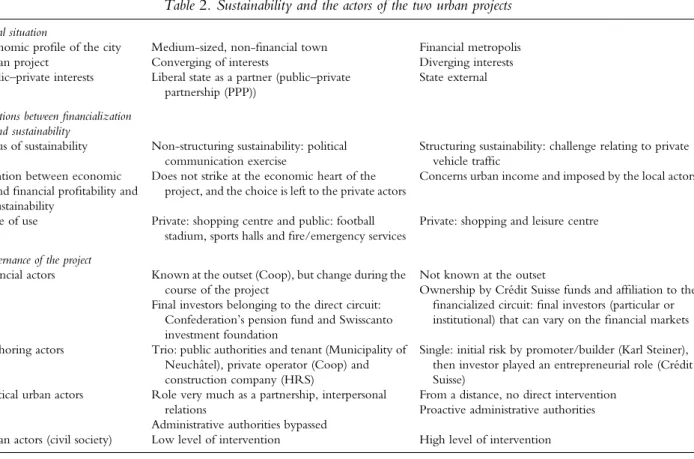
What has been learnt from these case studies regarding the way in which capital is currently becoming anchored in cities, in contexts characterized by sustain-ability concerns (Table 2)?
Thefirst case – that of La Maladière in Neuchâtel, a medium-sized town with no international financial activity – is interesting because it shows that towns Table 2. Sustainability and the actors of the two urban projects
Initial situation
Economic profile of the city Medium-sized, non-financial town Financial metropolis Urban project Converging of interests Diverging interests Public–private interests Liberal state as a partner (public–private
partnership (PPP))
State external Relations betweenfinancialization
and sustainability
Status of sustainability Non-structuring sustainability: political communication exercise
Structuring sustainability: challenge relating to private vehicle traffic
Relation between economic andfinancial profitability and sustainability
Does not strike at the economic heart of the project, and the choice is left to the private actors
Concerns urban income and imposed by the local actors
Type of use Private: shopping centre and public: football stadium, sports halls andfire/emergency services
Private: shopping and leisure centre Governance of the project
Financial actors Known at the outset (Coop), but change during the course of the project
Final investors belonging to the direct circuit: Confederation’s pension fund and Swisscanto investment foundation
Not known at the outset
Ownership by Crédit Suisse funds and affiliation to the financialized circuit: final investors (particular or institutional) that can vary on thefinancial markets Anchoring actors Trio: public authorities and tenant (Municipality of
Neuchâtel), private operator (Coop) and construction company (HRS)
Single: initial risk by promoter/builder (Karl Steiner), then investor played an entrepreneurial role (Crédit Suisse)
Political urban actors Role very much as a partnership, interpersonal relations
Administrative authorities bypassed
From a distance, no direct intervention Proactive administrative authorities Urban actors (civil society) Low level of intervention High level of intervention Source: Authors’ own elaboration.
of this size can today obtain investments from insti-tutional investors, who over the last twenty years had systematically preferred the financial markets. In Neu-châtel, within a coalition of three anchoring actors, a public one and two private, it must be stressed that sus-tainability was particularly addressed during the launch phase of the project, as a mandatory theme within pol-itical communication. The municipal authorities, with the specific role played by the (right-wing) municipal councillor driving the project, were included in the coalition of anchoring actors that was created, together with the two private partners. The PPP project was presented as an opportunity to be seized and handled rapidly. This meant, notably and from the outset, the absence of alternative projects, circumventing the public markets, and bypassing the expertise of two key municipal departments (urban planning and finance). After the approval by the legislature, the central commitment regarding sustainability that had been announced (Minergie construction) was left aside. This project was of great importance for the town since it resolved the issue of real estate need. It was built in accordance with the modalities of private financing, yet with numerous financial guarantees on the part of the municipal authorities, notably long-term leases. Subsequently, initiatives such as covering the roof with solar panels emerged, and the costs were ultimately borne by the state. Debate regarding sustainability was at no point at the heart of the project, however, that is, a shopping centre that was extremely easy to reach by car, and public guarantees regarding leases.
From the two ideal types of investment circuits point of view, this complex whose value is assessed on the real property market only would belong to the direct circuit. It is indeed directly held by Publica, the country’s large public pension fund, and by Swisscanto foundation, a structure created by the cantonal banks (which are private entities but guaran-teed by the cantons). These institutions invested their funds in the project, mainly as a precaution against the volatility of thefinancial markets. It was above all a case of investing in real estate (which at the beginning of the 2000s was considered to be less volatile than otherfinancial assets) and also one of having a direct link to the ownership and management of the complex (without needing to act via the markets). These institutions had– and still have – the objective of profitability from their investment by operating the complex on the long-term. Neuchâtel is not a town known by financial investors. Urban income is above all obtained from commerce, which competes within the catchment area. Despite the co-ownership structure created, the possibility of obtaining added value by reselling the complex is low. It is above the long-term profitability of the complex that is targeted, and this was consolidated before selling the project to the investors.
The second case– that of Sihlcity – benefits from an excellent location close to the centre of Zurich: the largest city in the country and a world-scale financial centre. Here, however, the authorities adopted a com-pletely different logic. They had from the outset an existing policy characterized by left-wing/green values: a vision of long-term development explicitly based on sustainable development and benefiting from their familiarity with managing major projects.
Regarding sustainability, the municipal authorities and subsequently an environmental organization inter-vened in turn in order to obtain improvements to a second, private project developed by the sole anchoring actor, the development/construction concern Karl Steiner. During the process, the tension reached a point where it was necessary to explore new options, and in particular the possibility of having a large-scale commercial centre accessible mainly by public transport. Expert evaluation revealed that such a choice was viable, so only a reduction to the parking surface area and the issue of financing the link to the public transport net-works remained to be negotiated. Sustainability in this case was a means for the municipal authorities and the environmental organizations to turn the potential urban income from this project into a complex that designed according to their vision of sustainability.
The second case would belong to the financialized circuit based on a logic of mobility/liquidity and on a valuation of buildings on the financial markets. For this investment, the bank Crédit Suisse, a worldwide financial actor, had offices facing the site. The district is clearly seen as an investment area for international investors, with excellent opportunities for financial added value regarding the value of the complex. In order for this potential to be realized, however, it was necessary for the complex to be integrated within the real estate companies or investment funds quoted on thefinancial markets. This was the role of some of the investment companies to which Crédit Suisse sold the shares in the project. Ultimately, it was the cash funds from the final investors who purchased shares on the markets that made it possible to finance the complex while preserving the operational control over the site. The negotiations in fact made it possible to allocate part of the income to sustainability. It was the investors, under the aegis of Crédit Suisse, who– by subscribing to the project – made it possible to turn the municipal authorities’ innovative mobility concept into reality, thanks to massive investment in the public transport net-works on the part of the state (city, canton and confederation).
The anchoring of capital in the Sihlcity project made it possible to reconcile an investment of mobile capital at an international scale with a firm urban sustainability policy. Thus, the pressure exerted over recent years by international investors in the area of large urban objects made it possible in this case to turn ambitious sustainability objectives into reality. This is something
of a paradox, however, since one could think that increasingly mobile capital, which leads cities to compete with one another, would tend to lower the demands regarding sustainability. The completely unique conditions here, however, should not be forgot-ten. The presence of the Crédit Suisse, an actor both global and extremely local, was decisive. It played the role of entrepreneur by purchasing the project before it wasfinished, and also that of operator and of reseller to the various real estate companies affiliated to it.
Would Crédit Suisse provide suchfirm support for a project in a city that was not as sought after by inter-national investors, even if the long-term operation of the complex guaranteed good profitability? This ques-tion remains open.
CONCLUSION
The objective of this article is to demonstrate how two apparently contradictory phenomena – financialization and sustainability – which characterize the production of today’s cities can be linked in a concrete way. The two projects analysed are emblematic of the major urban objects that have emerged in Switzerland in recent years, and that have been purchased byfinancial investors seeking alternative investments that permit them to diversify their portfolio.
On a theoretical level, by putting together different and separatedfields of literature, this article develops a territorial analytical framework based on the two con-cepts of mobility and anchoring, related both to finan-cial capital and to sustainability. On the one hand, financial investors can play on and with the various scales within a ‘financialized space’, by comparing the risks and yields of the real estate of a city (London) with economic activities of a region or a country (by investing in Swatchgroup, for instance). On the other hand, the urban organization takes place at the local scale with urban actors more or less linked to territory. In this way, anchoring is seen as a social and institutional process that gives rise to new forms of negotiations and a new role for the promoters of projects, that of anchoring actors. Within their concrete investments, which mainly take place in central areas of large cities, the financial actors call upon construction professionals, with the central role played by the major projects industry (devel-opment/construction companies). These latter do not act in a social‘void’ and must negotiate with the local urban actors: primarily the public sector (municipal authority, elected officials, and with those from the private sector and associations (NGOs, inhabitants).
The two case studies provide some responses regarding the way in which the negotiations take place and the financiers’ position towards the actors involved in the pro-jects and towards sustainability stakes. This anchoring process develops in two separated, yet interdependent, phases. During the development phase, negotiations
surrounding sustainability are to a large extent dependent on the urban actors and their capacity to become mobi-lized. Local players can express expectations in terms of sustainability, they can make concrete and realist proposals, and they can exert some political pressures on construc-ters/promoters. Financial players are not involved in this first phase of negotiation. They are of course implicitly present in the sense that the action of promoters/construc-ters aims at selling the project to them. In order to do that, they need to reach a credible minimum return rate on investment, imposed by financial markets. It has to be reached by the project before any formal investment decision. During this first phase, the negotiations concern the various qualitative dimensions of the project, including sustainable stakes. The promoters/ developers who own the project up to that point translate those qualitative features intofinancial data which demon-strate certain rates of return and risk. Then, there is a second a separate step in the anchoring process which is dedicated to the anchoring of capital. These negotiations occur in a bilateral way between the owner(s) of the project and the financial player(s) who intend to buy it. The interesting point regarding this sequential process is thatfinancial players do as if they would be in any way neither responsible for sustainability nor concerned by the fact that they have a more or less sustainable infrastruc-ture in their portfolio.
Today, the way in which the cities negotiate both the anchoring of financial capital and sustainability rep-resents a very concrete challenge regarding its analysis in terms of urban geography. Three main issues seem particularly relevant for further research. It would be of interest, first, to examine, in other cities and with regard to their size but also their economic specialization (financial centres or not), whether the local actors – notably those from the public sector– are in a position to negotiate the urban income with the financiers, taking the cultural and institutional contexts into account. What can be put forward here is a proactive role of government, not only in terms of subsidies or otherfinancial aids, but also in institutional and political terms. Local governments have often many ways of action or tools for negotiation particularly because they deliver the construction permit. In that way, various urban needs (such as transportation connexion, public space, etc.) or clear sustainability stakes can be conditions to promoters/investors.
Second, although an entirefield of literature has ana-lysed the role of actors specialized in urban production and particularly that of developers (for example, GUY
and HENNEBERRY, 2002; LORRAIN, 2002), their role
has not been linked to the financialization process of the built environment, or with the question of urban sustainability. In the present authors’ opinion, this industry increasingly develops large-scale projects for financial actors and has consequently a new role which consists of negotiating the anchoring of capital in the city subject to the constraints of sustainability.