HAL Id: halshs-01368873
https://halshs.archives-ouvertes.fr/halshs-01368873
Submitted on 9 Nov 2016
HAL is a multi-disciplinary open access archive for the deposit and dissemination of sci-entific research documents, whether they are pub-lished or not. The documents may come from teaching and research institutions in France or abroad, or from public or private research centers.
L’archive ouverte pluridisciplinaire HAL, est destinée au dépôt et à la diffusion de documents scientifiques de niveau recherche, publiés ou non, émanant des établissements d’enseignement et de recherche français ou étrangers, des laboratoires publics ou privés.
On the potential of corpus-based handwriting analysis: a
refined analysis of the Zhangjiashan tomb library
Daniel Patrick Morgan
To cite this version:
Daniel Patrick Morgan. On the potential of corpus-based handwriting analysis: a refined analysis of the Zhangjiashan tomb library. Scribal Hands and Scribal Practices in Manuscripts from Warring States and Early Imperial China, Universität Heidelberg, Nov 2016, Heidelberg, Germany. �halshs-01368873�
On the potential of corpus-based handwriting analysis
A refined analysis of the Zhangjiashan tomb library
Daniel Patrick Morgan 墨子涵*
(CNRS - Université Paris Diderot) paper presented at the workshop
Scribal Hands and Scribal Practices in Manuscripts from Warring States and Early Imperial China
戰國秦漢簡帛中的筆跡與書寫習慣 16 November 2016
Universität Heidelberg
Abstract (old): In this talk, I will present work conducted towards an analysis of the
scribal hands appearing in the Zhangjiashan M247 corpus, attempting to refine pre-vious work that I have already presented on the topic in the light of the workshop‘s suggested readings. Corpus-based handwriting analysis, I believe, has the potential to reveal the hand of the tomb occupant, particularly as a single hand might appear in multiple texts found therewith and in the very documents thought to be the most personal—agendas, diaries, etc. If we can identify the hand of the tomb occupant, this, among other things, will provide us with the smoking gun needed to lay to rest lingering doubts about the ‗realness‘ of tomb texts as mingqi 明器 specially pro-duced by funerary workshops. The Zhangjiashan M247 corpus provides us with an ideal set of circumstances in this regard, considering the presence of similar orthog-raphies in the calendar table and the back-and-forth seen in the mathematical manu-script Suanshushu 筭數術 (see Mo & Lin, 2016). In this talk, I will aim to press further on the problem of distinguishing hands from scripts so as to concretise this relationship and draw further connections across the M247 corpus.
Introduction
In this paper I will provide an overview of my recent work on discern-ing hands within manuscript corpus recovered from Zhangjiashan tomb 247 (sealed ≥186 BCE), concluding with my revised analysis of
November 2016. In short, having stumbled upon a rather peculiar al-ternation of hands in the mathematical manuscript Suan shu shu 筭數 書 with Karine Chemla, I have, since 2015, been working to explore what relation the two hands therein may have with the other manu-scripts with which the Suan shu shu was found. Put this way, the ques-tion seems only natural, but it is not one we often think to ask. The tomb library from Zhangjiashan M247 is eclectic, including a ‗calen-dar‘, tomb inventory, and lengthy texts on law, medicine, maths, sport,
* The research leading to these results received funding from the European
Re-search Council under the European Union‘s Seventh Framework Program (FP7/2007–2013) / ERC Grant agreement n. 269804 and was conducted in the con-text of the project SAW: Mathematical Sciences in the Ancient World (SAW). This working paper has been archived on 9 November 2016 at https://halshs.archives-ouvertes.fr/halshs-01368873.
and philosophy (see Table 1). Generally speaking, when faced with such a corpus, we tend to carve it into modern disciplines, plucking one text from the whole to read with others, plucked from theirs, in the name, say, of ‗the history of mathematics‘. That‘s fine to do, of course, but all of us have a common stake in questions of context, ownership, textual transmission and (re)production, and so on, to which the tomb as a whole speaks louder than the parts that we hold dearest.
If it proves that one person wrote some or all of this library, his/her hand might take us to interesting places across sport, maths, medicine, and law, if not beyond. Graphology provides us a tool to establish such connections, and it is my goals to make that tool efficient and easy to use. This is a work in progress. It has come a long ways since I began with the Suan shu shu, and, with your feedback, it will hopeful-ly go a long way further.
Title Abr. Subject Slips
1 Ernian lüling 二年律令 ENLL law 526
2 Gai Lu 蓋廬 GL military philosophy 55
3 *Lipu 曆譜 LP calendar 18
4 Mai shu 脈書 MS medicine 66
5 *Qiance 遣策 QC tomb inventory 41
6 Suan shu shu 筭數書 SSS mathematics 190
7 Yin shu 引書 YS sport 112
8 Zou yan shu 奏讞書 ZYS law 228
Table 1: Zhangjiashan M247 manuscript corpus. Asterisks indicate titles coined by the
edi-tors.
Recap
In January 2014, Karine Chemla and I began working together on the SSS, a manuscript composed of 69 maths problems in independent textual units beginning each with a heading in the upper margin. One of the first things we wanted to know was whether the headings, which do not appear on the Yuelu Academy manuscript Shu 數,1 were original to the Zhangjiashan manuscript or added later by another hand. Comparison of the headings with the same characters as they appear on the self-same slip revealed considerable differences at the level of character structure and calligraphic style, as you can see in Figure 1.2 From this, we concluded that there were clearly (at least) two ‗hands‘ present in the manuscript: SSS(A), in grey, and SSS(B), in white. We noted also that the distribution was more complex than simply B : heading :: A : body, as a handful of headings were indeed identical with what was written below them.
1 See Chen Songchang 陳松長, ed., Yuelu Qin jian 嶽麓秦簡 (Shanghai: Shanghai
cishu chubanshe, 2010–2015), vol. 2.
2
For a more detailed explanation of these differences, see Mo Zihan 墨子涵 (Daniel P. Morgan) and Lin Lina 林力娜 (Karine Chemla), ‗Ye you lunzhe xiede: Zhangjiashan Han jian Suan shu shu xieshou yu bianxu chutan‘ 也有輪着寫的:張 家山漢簡『筭數書』寫手與編序初探, Jianbo 簡帛 12 (2016): 237–39, the pre-pint of which is available for download here.
Figure 1: SSS headings vs contents. SSS(A) is in grey, SSS(B) in white.
From there, our questions turned to the distribution of ‗hands‘ with-in the body. At the outset, our methodology was an amalgam of what we what we had read from Mathias Richter and Li Songru 李松儒, as adapted to the particular circumstances of the SSS, and it evolved through several iterations.3 Where we were led astray, notably, is in assuming that the best place to begin was with the most prevalent character forms, such as 之 (‗it‘), 從 (‗from‘), and 乘 (‗multiply‘), which, as you can see in Figure 2, are highly variable within each sample. In a single slip (slip 17), for example, one sees the word shu ‗procedure‘ written variously as 術, 术, and 述—a different form eve-ry time. This was probably to be expected, as a colleague pointed out to us, given that the later calligraphic tradition indeed stresses the var-iation of forms like 之 for reasons of aesthetics.4
3
Specifically, Matthias L. Richter, ‗Tentative Criteria for Discerning Individual Hands in the Guodian Manuscripts‘, in Rethinking Confucianism: Selected Papers
from the Third International Conference on Excavated Chinese Manuscripts, Mount Holyoke College, April 2004, ed. 邢文 (San Antonio: Trinity University, 2006),
132–47; Li Songru 李松儒, ‗Guodian Chu mu zhujian ziji yanjiu‘ 郭店楚墓竹簡字 跡研究, Liaoning-sheng bowuguan guankan 遼寧省博物館館刊 1 (2006): 149–67; Li Songru 李松儒, ‗Guodian jian zhong suo jian ―niaochong shu‖ yu ―kedou wen‖ ziji yanjiu‘ 郭店簡中所見「鳥蟲書」與「蝌蚪文」字跡研究, Liaoning-sheng
bowuguan guankan 遼寧省博物館館刊 2 (2006): 162–77.
4 I thank ‗Célestin‘ Zhou Xiaohan 周霄漢 for opening our eyes to this point
providing a demonstration with Ming-Qing-era documents within the context of the ERC project SAW; cf. Matthias L Richter, The Embodied Text Establishing Textual
Figure 2: Unsuccessful criteria, SSS ‗hand‘
analysis. Prevalent character forms such as these prove highly variable within each ‗hand‘ as identified below by stable character forms.
Figure 3: Successful criteria, SSS ‗hand‘
analysis: (a) square vs round 又 compo-nent; (b) 為 ; (c) 實 , final stroke and composition (毌 vs 尹); (d) 廣, ‗feet‘ and component symmetry; (e) 木·禾 com-ponent symmetry; (f) exaggerated final stroke.
There might yet be some pattern behind a character like 之, whose form changes every several centimetres, but it is clearly not a good place to begin—not for the SSS. Instead, after several iterations, Kari-ne and I settled on a number of criteria at the compositional and stylis-tic level that proved both (1) consistent within individual slips and textual units and (2) consistently and markedly different from those appearing, consistently, elsewhere in the manuscript. Marking where each occurs in the MS, we then ‗paired‘ features that appear together, multiple times, on the same slip. The way this works is this: there are, for example, two ways to write 實 ‗dividend‘ (from 毌 vs 尹) and two ways to write 為 ‗is/makes‘ ( vs ); one notes that the one 為 ( ) occurs exclusively with the one 實 (from 毌), and ‗pairs‘ the two crite-ria as, in this case, ‗A‘; one then notes that there are two ways to write 有 ( vs ), and that the one appears exclusively with the one 為 ( ) and/or the one 實 (from 毌), further ‗pairing‘有 ( ) with ‗A‘. Each new ‗pairing‘ extends ‗A‘ into new slips and into the vicinity of new forms and features, which, if consistent with the criteria of consistency and consistent difference, open new possibilities for pairing. For the SSS, the pairing of seven criteria, in Figure 3, was sufficient to divide the near entirety of the MS into two ‗hands‘: SSS(A) and SSS(B), the alternation between which, in the body, happens to occur almost ex-clusively at section and ‗paragraph‘ breaks.
Figure 4: ‗Shao guang‘ question–answer alternation between SSS(B), in white, and SSS(A), in black.
Complicating a neat A–B division there remained 10 slips that mixed A and B forms, all of which happened to fall under the same section heading, ‗Shao guang‘ 少 廣 (Reduced Width). Upon re-inspection, it became clear that this ‗mixture‘ was in fact the product two ‗hands‘ alternating between question and answer, with B posing the questions, and A answering them (see Figure 4). Based on this information, we hypothesised that SSS may have been something like a school exercise, where ‗hand‘ B supplied ‗hand‘ A questions to an-swer and section headings to fill out with the correct lesson texts.5
On 25 November 2015, at the Workshop on Zhangjiashan Tomb 247, Université Paris Diderot, I attempted to expand my methodology to tackle the entirety of the Zhangjiashan M247 corpus, and the LP ‗calendar‘ in particular.6
The goal, in short, was to explore the bility of identifying the tomb occupant‘s handwriting, which, if
5 The results of this collaboration have been published in Mo Zihan and Lin Lina,
‗Ye you lunzhe xiede‘.
6 My talk, ‗What Can You Do with a Calendar?‘, is available here. Information
ble, would have important consequences for early Chinese manuscript studies. First, if one could prove that it was the tomb occupant wrote some of his texts, it would put an end to speculation that tomb texts are necessarily mingqi 明器 funerary-object ‗fakes‘ produced by fu-nerary workshops with little to say about their ostensible owners or the ‗real‘ manuscript culture in which they lived.7
Second, having the tomb occupant‘s handwriting would open the door to exploring its interaction with the literate community witnessed by the other hands in his collection, the question of ‗master vs student‘ raised by the SSS being a case in point. Third, and the most important in my opinion, the presence of the tomb occupant‘s handwriting across a corpus like that at Zhangjiashan might encourage the crossing of academic divides like ‗philosophy‘, ‗medicine‘, and ‗mathematics‘ for common ends.
My argument as to how we might do this at Zhangjiashan is as fol-lows. A priori, the QC tomb inventory and LP ‗calendar‘ provide us two documents at either end of the spectrum of possibility. The QC tomb inventory is, a priori, written after the tomb occupant‘s death, and thus cannot be in his handwriting. The LP, which, like other ‗cal-endar‘ diaries, records the personal affairs of some man we generally presume to be the tomb occupant, is by contrast, and a priori, proba-bly the most likely to have been written by him. If we can match the handwriting on the QC tomb inventory to that on another manuscript in the same tomb (including the calendar), that should prove that it was not the tomb occupant who wrote the latter. If, by contrast, we can match the handwriting in the occupant‘s personal ‗diary‘ to that in another of his manuscripts, that should give us reason to suspect that it
was the occupant who wrote the other manuscript.
The potential of the LP ‗calendar‘ and similar documents in provid-ing a sample of the tomb occupant‘s handwritprovid-ing rests on two condi-tions: one, that a ‗calendar‘/‗diary‘ found in a person‘s tomb is neces-sarily written about that person; two, that a ‗calendar‘/‗diary‘ found in a person‘s tomb is necessarily written by that person. These are differ-ent propositions, and neither is an a priori. Yes, people may have had assistants fill out their agendas; yes, pranksters may have gone around crashing ancient Chinese burials, tossing one man‘s diary into anoth-er‘s tomb; but ‗what if‘ stories get us nowhere if they are not
evi-denced and, preferably, falsifiable. To that end, let‘s put our
imagina-tions away and cut straight to matters of proof.
Can we assume that a ‗calendar‘/‗diary‘ is written about the person with whom it‘s buried? This is clearly the case at Yinwan 尹灣 M6. There, we find a calendar for 12 BCE that records a financial
transac-tion between ‗Shi Junxiong‘ 師君兄 and his brother, Shi Zixia 師子夏 (YM6D10). The same tomb produces three inventories that identify
7
On the topic of mingqi and funerary workshops as concerns this corpus specifi-cally, see for example Anthony J. Barbieri-Low and Robin D. S. Yates, Law, State,
and Society in Early Imperial China: A Study with Critical Edition and Translation of the Legal Texts from Zhangjiashan Tomb No. 247, 2 vols, Sinica Leidensia,
126/1-126/2 (Leiden: Brill, 2015). Note that due to the relocation of the Biblio-thèque de la Société Asiatique and the apparent non-existence of said book in any other Parisian library, I am citing Barbieri-Low and Yates‘ work, vaguely, based on personal communications with the authors and others who have read it. Particularly inspiring to me on this question is the rebuttal of the ‗tomb texts are mingqi‘ position given by Alain Thote based on the archaeologist‘s more global understanding of
mingqi as found in Warring States and Qin-Han tombs in his paper ‗Les manuscrits
de la région de Jingzhou au IIe s. avant notre ère: contexte archéologique‘, Work-shop on Zhangjiashan Tomb 247, Université Paris Diderot, 25 November 2015.
‗Junxiong‘ as the recipient of the funerary items found therein: ‗Junxiong yiwu shu‘ 君兄衣物疏 (YM6D12), ‗Junxiong zengfang tizhong wu shu‘ 君兄繒方緹中物疏 (YM6D13), and ‗Junxiong jiesi xiaowu shu‘ 君兄節司小物疏 (YM6D13). The same tomb produces ten calling cards featuring variously Junxiong, Rao 饒, or ‗The Hon-ourable [Mr] Shi‘ 師卿, who is identified as a scribe for the Donghai Commandery Labour Section 東 海 郡 功 曹 史 (YM6D14–23). The same tomb produces administrative ledgers of personnel, equipment, and so on for Donghai Commandery (YM6D1–8)—where Shi Rao/Junxiong worked—matching the sort of record-keeping for which we know a commandery-level Labour Section to be responsible. The same tomb, moreover, produces two other calendars for 11 BCE (slips
1–76) and 10 BCE (YM6D11), both of which document ‗Jun[xiong]‘, in the third person, travelling in the Donghai area on Labour Section business. Indeed, almost every single document in Yinwan M6 points back a single name, and this is this name with which the editors identi-fy the tomb occupant, and by means of his calendars that they date the tomb to Yuanyan (12–9 BCE) or ‗no later than the final years of
Em-peror Cheng (r. 32–7 BCE)‘.8
In Yinwan M6, the diary entries are clearly about the same person to whom the funerary items are destined—the tomb occupant. Yinwan M6 is only one tomb, but in the absence of counterevidence, it is probably a more reliable guide to second-century BCE burial practices
than twenty-first-century CE ‗what if‘ situations. What would falsify
this connection? First, you could have two peoples’ diaries in the same tomb. This once appeared to be case with the Yuelu Academy calendars, which frequently mention Teng 騰 and Shuang 爽;9 that said, this is not really a ‗tomb‘, and Chen Wei 陳偉 has since convinc-ingly argued that all three calendars are authored by the same man, who is Shuang‘s father.10 Second, you could have travel records that are impossibly far from the tomb. This does not happen: diaries from Jiangling describe voyages around Jiangling, and diaries from Lian-yungang, Lianyungang.11 Third, you could have a burial context that contradicts the contents of the diary. This does not happen either: the Shuihudi 睡虎地 M11 *Biannian ji 編年紀 ends when the protagonist, Xi 喜, is 46, and forensic analysis places the corpse at 40–45 years of age;12 the Kongjiapo 孔家坡 M8 diary is for a year in the occupant was not alive, and that diary, fittingly, is empty; in Zhangjiashan M247, lastly, the LP ‗calendar‘ ends nine years after its protagonist was ‗ill, relieved [of duty]‘ 病免 (slip 10), which fits the dove-head staff found with it in the tomb.13 I cannot think of any further tests to put to this hypothesis, but I challenge the reader to think of more.
Of course, the real challenge would not be to disprove the ‗tomb calendars are the tomb occupant‘s‘ hypothesis, but to live with the implications of its rejection. The assumption that tomb calendars be-longed to the tomb occupant, specifically, in the last years of his life,
8 Lianyungang-shi bowuguan 連雲港市博物館, ed., Yinwan Han mu jiandu 尹灣
漢墓簡牘 (Beijing: Zhonghua shuju, 1997), esp. 1.
9 Chen Songchang, Yuelu Qin jian, vol. 1.
10 ‗Yuelu shuyuan Qin jian ―zhiri‖ chubu yanjiu‘ 嶽麓書院秦簡「質日」初步研
究, Chūgoku shutsudo shiryō kenkyū 中國出土資料研究 16 (2012): 71–85.
11
See for example Ibid.
12 Yunmeng Shuihudi Qin mu bianxie zu 『雲夢睡虎地秦墓』編寫組, Yunmeng
Shuihudi Qin mu 雲夢睡虎地秦墓 (Beijing: Wenwu chubanshe, 1981), 68–69.
13 See Li Jingrong 李婧嶸, ‗The Ernian Lü Ling Manuscript‘ (Ph.D. diss.,
is the way that archaeologists date the sealing of many tombs (‗x or shortly after‘): Shuihudi M11 (≥217 BCE),14 Zhoujiatai 周家臺 M30 (≥209 BCE), 15 Zhangjiashan M247 (≥186 BCE), 16 Shuihudi M77
(≥157 BCE),17 Yinqueshan 銀 雀 山 M2 (≥134 BCE),18 Yinwan M6
(≥10 BCE),19 etc. If we reject that tomb calendars are the tomb occu-pant‘s, then we will have to issue retractions and throw out our entire chronology of the period.20 If we imagine that something like the Shuihudi M11 *Biannian ji or, indeed, the entire Yinwan M6 corpus were mass produced by funerary workshops with no special relation to individual tomb occupants, we will also need to give up talking about tomb occupants and excavated literature all together, because if it‘s all
mingqi ‗fakes‘, it might as well have no bearing on contemporary
real-ity and originate ten centuries later in the Tang (618–907). This leads by an endless regression of ‗what if‘ scenarios to nihilism and con-spiracy theories, where few, I think, are really prepared to go. Let us agree then, for our own sakes, and unless otherwise proven, that we must accept tomb calendars/diaries as written about the person with whom they‘re buried.
The real question standing in the way of a potential gestalt switch in the way that we read tomb texts is thus whether or not tomb calen-dars/diaries are written by the tomb occupant. To indulge in ‗what if‘, we might imagine three scenarios: (1) it‘s the tomb occupant who kept his daily diary; (2) it‘s his assistant who kept his daily diary; (3) the diary is a one-time, post facto copy. There are three million other situ-ations that one could imagine, but we should really only interest our-selves in those that can be proven or disproven and which speak to the underlying question: Is the calendar/diary written by the occupant? I have made significant progress to this end over what I had presented in November 2015, but the case I‘m building brings us far afield from Zhangjiashan M247, and it is several weeks away from a presentable state. For now, all I ask is that we accept that tomb calendars/diaries are written about the tomb occupant, that it is somewhere between ‗possible‘ and ‗likely‘ that they are written by that person, and that, while the matter is still inconclusive, we can nonetheless appreciate its potential when/if one day satisfactorily proven.
14 Yunmeng Shuihudi Qin mu, 68.
15 Hubei-sheng Jingzhou-shi Zhouliang yuqiao yizhi bowuguan 湖北省荊州市周
梁玉橋遺址博物館, ed., Guanju Qin-Han mu jiandu 關沮秦漢墓簡牘 (Beijing: Zhonghua shuju, 2001), 156.
16 Zhangjiashan ersiqi hao Han mu zhujian zhengli xiaozu 張家山二四七號漢墓
整理小組, Zhangjiashan Han mu zhujian (ersiqi hao mu) 張家山漢墓竹簡(二四 七號墓) (Beijing: Wenwu chubanshe, 2001), 1.
17 Hubei-sheng wenwu kaogu yanjiusuo 湖北省文物考古研究所 and
Yunmeng-xian bowuguan 雲夢縣博物館, ‗Hubei Yunmeng Shuihudi M77 fajue jianbao‘ 湖北 雲夢睡虎地 M77 發掘簡報, Jiang-Han kaogu 江漢考古 2008.4 (2008): 36.
18
Yinqueshan Han mu zhujian xiaozu 銀雀山漢墓竹簡整理小組, ed.,
Yinque-shan Han mu zhujian 銀雀山漢墓竹簡 (Beijing: Wenwu chubanshe, 1975), 5–6.
19 Yinwan Han mu jiandu, 1.
20 Here Mawangdui 馬王堆 M3 indeed offers us some food for thought about the
formula ‗x or shortly after‘, where x is the date of the latest tomb calendar: the planetary tables of the *Wuxing zhan 五星占 stop at 177 BCE, nine years prior to the occupant‘s known date of internment in 168 BCE; see Daniel Patrick Morgan, ‗The Planetary Visibility Tables in the Second-Century BC Manuscript Wu Xing Zhan 五 星占‘, East Asian Science, Technology, and Medicine 43 (2016): xx–xx.
Methodological Reflections
On 25 November 2015, I presented a report of my initial efforts to distinguish and connect the ‗hands‘ of the Zhangjiashan M247 corpus to the participants of the aforementioned workshop.21 I had my doubts about the results, and Enno Giele and Olivier Venture were kind enough to share with me their own, pointing me to Li Songru‘s much anticipated monograph for inspiration.22 This advice proved very fruit-ful, helping me to refine my analysis and bring it to different and more satisfactory results. Before getting to the results, however, I would like to share several critical reflections on what I think I did wrong and on the limitations and possibilities of Li Songru‘s work for a pro-ject such as this.
The goals of my November 2015 report were basically twofold: (1) to test a methodology developed for the SSS on a larger sample, where it would hopefully permit me to discern different ‘hands’ even in unfamiliar genres such as medicine and law; (2) to identify as the
same ‘hand’ writing found in different manuscripts, particularly the
SSS and LP, about which I have something to say. The challenges that I perceived as standing in the way of these goals were as follows. First, the approach of identifying formal binaries (e.g. vs , vs ) and ‗pairing‘ them is one that I developed in a two-‘hand’ context for the sake of differentiation. The situation of the SSS is however fun-damentally different than a manuscript and potentially
multi-‘hand’ corpus, and differentiation is a different prospect than identifi-cation. In the context of the SSS, for example, the presence of forms
like and on a given strip is a sufficient condition to distinguish the ‗hand‘ from that which consistently writes , , and the other SSS(B) forms in Figure 3, and distinction, in a two-‗hand‘ context, is identification (that which is not SSS(B) is, by necessity, SSS(A)). That said, none of these forms are unprecedented, so it is not
neces-sarily SSS(A) if we find something like in Mawangdui 馬王堆 M3,
nor, for that matter, need it be elsewhere in Zhangjiashan M247. Se-cond, where my SSS approach was bound to fail was faced with
dif-ferent ‘scripts’. We all know that there were difdif-ferent ‗scripts‘ in the
second century BCE, and that scribes were trained to write in some-thing like eight, so how do you identify one ‗hand‘ writing in different ‗scripts‘?23
My solution to the second problem was to attempt to define ‗scripts‘ by formal and structural criteria similar to those in Figure 3, the goal of which, simply put, was to distinguish ‗script‘-determined features from ‗script‘-independent idiosyncrasies. For my experiment, I began with the working hypothesis that Chen Songchang‘s 陳松長 division
21
That report, ‗Zhangjiashan M247 Corpus Writing Analysis‘, can be found here; my opening remarks discussing said report can be found here.
22 Namely, Li Songru 李松儒, Zhanguo jianbo ziji yanjiu: yi Shangbo jian wei
zhongxin 戰國簡帛字跡研究:以上博簡為中心 (Shanghai: Shanghai guji
chu-banshe, 2015).
23 The Zhangjiashan M247 manuscript ENLL, ‗Shi lü‘ 史 律 , dictates that
‗scribes… are furthermore to be tested in [the] eight scripts‘ 史…有(又)以八體 試之 (slip 475). This corresponds with Shuowen jiezi 說文解字 (Sibu congkan ed.), 15.2b, which reads that ‗[scribes] are furthermore to be tested in [the] eight scripts‘ 又以八體試之, which parallels the law that Han shu 漢書 (Zhonghua shuju ed.), 30.1721, cites Xiao He 蕭何 (257–193 BCE) as drafting at the beginning of the Han (206 BCE – 220 CE): ‗[scribes] are furthermore to be tested in [the] six scripts‘ 又以
of the Mawangdui M3 corpus into ‗seal clerical‘ 篆隸, ‗ancient cleri-cal‘ 古隸, and ‗Han clericleri-cal‘ 漢隸 scripts was correct.24
Based on this division, I collected sample characters from each script, organised them into tables (see Figure 5), and identified ‗script-specific features‘ from those consistent to all samples within a given ‗script‘. From there, I then divided the Zhangjiashan M247 corpus into two scripts accord-ing to these criteria (see Figure 6). Having eliminated ‗script-specific features‘ from the equation, I then concentrated on a reduced number of ‗personal idiosyncrasies‘ to divide the corpus into ‗hands‘, the re-sult of which was to: (1) discern A vs B ‗hands‘ in ENLL, SSS, and ZYS; and (2) identify GL = MS and SSS(B) = ZYS(B) ≈ LP (see Fig-ure 7).
I find my November 2015 approach dissatisfactory, and here, brief-ly, is why. First, there is no such thing as ‗scripts‘: ‗scripts‘, I have come to realise, exist only at the macro-level as abstract aggregates of individual habits; at the micro-level, ‗scripts‘ and ‗hands‘ are probably impossible to separate. Second, eliminating ‗script-specific features‘ halves the criterion used to distinguish and identify hands, severely handicapping one‘s efforts at identification in particular. Third, the results are more theoretically than visually compelling and, personally, failed to deliver the sort of ‗eureka moment‘ that I had experienced with the SSS.
Reading Li Songru‘s monograph helped me realise how this analy-sis could be better framed. It is probably more precise, for example, if we think in terms of ziji 字迹 rather than ‗hands‘ in treating the graphological phenomena in the preceding figures—even if I‘m not sure how the word translates (‗character traces‘, ‗handwriting‘, ‗writ-ing‘?). It is also probably wise to give up on questions of eliminating ‗script‘ from ‗hand‘, setting aside manuscripts in different ‗scripts‘ as irreconcilable ziji: ‗Texts written by the same scripteur can be pos-sessed of different styles. … Whether or not ziji pospos-sessed of such different styles came from the same hand is something about which we are often unable to make an exact and unanimous judgement‘.25 Then, once we have divided everything into ziji, we can reintroduce the question of ‗hands‘, if in a somewhat reduced capacity, because ‗the same scripteur can write different ziji, but identical ziji are defi-nitely written by the same scripteur‘.26 The question then is how we go about proving that certain ziji are ‗identical‘.
This is but a small sample of the valuable insights that Li‘s mono-graph brings to bear on the subject of mono-graphology. Li goes a long way to clarifying the exact phenomena to which we all bring our own vo-cabulary and assumptions, and hers will probably set the standard for the field. The structure of the book is furthermore very comprehensive. The first ‗half‘ (上編) provides the theoretical framework: Ch. 1 pre-sents the state of the field, providing an exhaustive list of scholarship on the subject; Ch. 2 is a magisterial overview of supports, writing materials, and writers, exploring the very material, physical, and so-cial factors at play in how writing looks; Ch. 3 presents an extensive typology of ‗characteristics‘ by which to delineate ziji, perhaps the most important element of which is her treatment of yunbi 運 筆
24 See Chen Songchang 陳松長, ed., Mawangdui boshu yishu 馬王堆帛書藝術
(Shanghai: Shanghai shudian, 1996).
25 Li Songru, Zhanguo jianbo ziji yanjiu, 40. 26
Fi g u re 5 : T ab le f ro m No v e m b er 2 0 1 5 a tt em p t to d isti n g u is h sc rip t-sp ec if ic ch ara cteristics in th e M aw an gd ui M 3 co rp us af ter Ch en S on gc ha ng ‘s d iv isio n of it in to ‗s crip ts‘.
Fi g u re 6 : T ab le f ro m No v e m b er 2 0 1 5 a tt em p t to d isti n g u ish sc ri p t-sp ec if ic ch ara cteristics in t he Z ha ng ji ash an M 24 7 co rp us af ter d iv id in g it in to th e ‗sc rip ts‘ of F ig ure 5
Fi g u re 7 : T ab le f ro m No v e m b er 2 0 1 5 a tt em p t to d isti n g u ish sc ri p t-in d ep en d en t p erso n al id io sy n cra sie s ac ro ss th e Zh an g ji ash an M 2 4 7 c o rp u s.
‗brush movement‘ (?); and Ch. 4 provides examples of what we can
do with ziji in terms of authentication, fragment-joining, and their
im-plications for the study of manuscript culture, etc. The second ‗half‘ (下編 ) then provides analysis in 39 chapters of the whole of the Shanghai Museum Chu manuscript collection.
There are many things that recommended Li Songru‘s book, but it falls short, in my opinion, of the sort of ready-made, point-and-shoot methodology that I was hoping to find there. There are, specifically, three aspects where I felt her work lacking in terms of application.
First, things get lost in transposition. In reviewing the catalogue of ‗ziji characteristics‘ in Ch. 3 and the worked examples in the second half of the book, one notes that much of what is suited for Warring States (480–221 BCE) Chu 楚 script(s) is ill-adapted for the clerical script(s) of the Qin (221–207 BCE) and Han (206 BCE – 220 CE). The issue, for example, of ‗alternate orthographies‘ 文字異寫 (?) related to loan words, allographs, etc., is simply not as present in clerical script(s) as it is in Chu, nor is the former nearly as affected by ‗homo-graphs‘ 同形字, or, at least, nor for the examples given: 天 vs 而, 不 vs 辛, 甲 vs 亡, and 火 vs 亦.27 There is nothing to say about decora-tive strokes and ‗ligature‘ 合文 composite graphs in clerical script(s), because they do not exist.28 More importantly, the change in script(s) and the evolution of brush-making, specifically, means that many of her finer points concerning characteristics of ‗character size‘ 字的大 小, ‗level, straight, and square turns‘ 平直方折 vs ‗curvy, arty‘ 彎轉、 藝術, and the ‗blades‘ 鋒 and ‗pause pressure‘ 頓壓 of the ‗first and final stroke‘ 起筆、收筆 are incommensurable, as presented, with Qin–Han writing.29 This is hardly surprising, as the book is written for Warring States Chu script(s), and for tackling the Shanghai Museum corpus in specific, but it awakes the reader to a realisation: this too must be a world apart from the tools of twenty-first century forensic graphology to which she appeals for kexue 科學 ‗scientific‘ authority. There is no doubt Li Songru‘s work is inspired by said ‗science‘, and that her proves inspirational to thinking about a corpus like Zhang-jiashan M247, but, at the end of the day, it seems that there are no universal precepts of ‗scientific‘ graphology that can solve our every problem.
Second, typology is not methodology. Ch. 3 gives the reader a marvellous array of ‗ziji characteristics‘ that, where applicable, one might go looking for in one‘s own materials, but many of her heuris-tics are contradictory. Take for example her explanation of what you can learn by determining the relative level of literacy manifest in ziji:
Changes in the characteristics of one‘s writing skills (level) develop by process of advancement from low to high; one does not get there in one leap. Thus, [such] changes will not manifest in an overly obvious manner over a short period of time. … As such, when faced with a large quantity of bamboo slips that exhibit and are able to reflect (?) a relative variety of copyist-hands, writing-level characteristics serve a prominent function in writing-hand classification. For example,
27 See Ibid., 141–48. Technical terms are translated where possible as per Qiu
Xigui 裘錫圭, Chinese Writing 文字學概要, trans. Gilbert L. Mattos and Jerry Norman, Early China Special Monograph Series, No. 4 (Berkeley: Society for the Study of Early China and the Institute of East Asian Studies, University of Califor-nia, 2000).
28 See Li Songru, Zhanguo jianbo ziji yanjiu, 149–51, 153–54. 29
boo slips written at the low level of … Shenzi yue gongjian 慎子曰恭 儉 and … Pingwang yu Wangzi Mu 平王與王子木 would not be mis-takenly inserted into the copies written at the high level of … Kongzi
Shi lun 孔子詩論, … Zhouyi 周易, and … Dizi wen 弟子問.
Distinguishing the course of a single copyist‘s copying over time is al-so extraordinarily important for the study of copy transmission. As we discovered by conducting ziji comparison on the A and B copies of
Junrenzhe hebi an zai 君人者何必安哉 made by one and the same
copyist in Shangbo [vol.] 7, said copyist [exhibits] different levels of copying [skills] as regards the characters of identical contents, and, from this, one can determine that the copy [exhibiting] low-level writ-ing [skills] should have been copied prior to the high-level copy. The reason is that, while copying bamboo slips of identical contents, the
ziji of what was written later was much more familiar to this
one-and-the-same copyist, and the writing-level would be higher than it was previously.30
In short, writing skills do not change in one sitting, and thus can be used to differentiate hands; also, writing skills do change in one sitting, and they can be used to establish the order of copies—but which is it, what‘s the difference, and how do we know? To be fair, if Li Songru were to expand Ch. 3 with all the rules necessary to understand the special conditions under which one ‗characteristic‘ trumps another, doesn‘t matter, or means the opposite, it would bring the book to a thousand pages; to understand her methodology, one must watch it in action in the second half.
Third, the analysis is not worked examples. The promise and prem-ise of Li Songru‘s monograph is that it will bring ‗science‘ to a do-main previously ruled by impressionistic judgements of calligraphic aesthetics and the personal authority of older scholars. The order of presentation in here analyses, however, lends to the opposite impres-sion. Typically, it is simply announced that such-and-such is written by the same hand and then we get a post facto explanation of what to expect in such a situation. On Kongzi Shi lun, Lubang dahan 魯邦大 旱, and Zigao 子羔, for example, she begins ‗Li Ling 李零 considers these three tracts as being ―identical in character form and identical also in [physical] structure‖, and we completely agree with this state-ment of his‘.31 Next, she supplies yunbi brush-level ‗characteristics‘ that the three share: (1) ‗brush strokes level and straight‘ 筆畫平直, (2) ‗clear brush-turn angle‘ 折筆角度明顯, (3) ‗brush-bend bend ex-hibits semicircle or near-semicircle arc‘ 彎筆轉彎處多呈半圓或近半 圓的弧線, and (4) ‗round points used for decorative strokes‘ 羨符用 圓點. Then, she supplies a table of ‗typical character examples‘ 典型 字 例 (Figure 8). Having furnished Li Ling‘s laconic, presumably ‗non-scientific‘ determination with ‗scientific‘ proof, the next section is ‗Discrepancies in Ziji‘ 字迹差異, which she opens by citing Feng Shengjun 馮勝君 to the effect that these three tracts exhibit different character forms, particularly as concerns 於, 則, 而, and 心. After matter-of-factly listing the discrepancies, she concludes that ‗the dif-ference in the ziji characteristics raised above is the result of con-scious/unconscious transformations on behalf of the self-same copyist, and they are not differences between the ziji of different copyists‘.32
30 Ibid., 129–30. 31 Ibid., 203. 32
Figure 8: ‗Typical Character Examples‘ 典型字例 for Kongzi Shi lun, Lubang dahan, and
Zigao; Li Songru, Zhanguo jianbo ziji yanjiu, 204.
Li Songru does supply the reader with a methodology as such; she has one, and it would seem to produce excellent results, so allow me to reverse-engineer what I see her doing and put it in my own words. At the core of here analyses would seem to be a phrase cited in the introduction: ‗Every person‘s biji 筆迹 is distinct from every other in its ensemble, which is to say that people are all different in terms of the sum or system of their biji characteristics, and not that an individu-al‘s every character and every stroke is unique‘.33
Elsewhere, Li Son-gru uses the characters 於, 則, 而, and 心 as hard proof in the distinc-tion of hands; the reason why the Kongzi Shi lun, Lubang dahan, and
Zigao in the previous example are however allowed ‗discrepancies in ziji‘ in this regard is because the sum of their common characteristics
outweighs that of their differences. Li criticises scholars like Nishiya-ma Hisashi 西山尚志 for using statistics to try identifying ‗hands‘ from the angles and ratios of components, because ‗using statistical methods to test brush-written ziji on Warring States manuscripts and [its] relationship to copyists is overly mechanical‘.34
The thing is that the methodology that I understand Li Songru to be using is amenable to statistics, be they statistics of a different sort. Let‘s say that we de-termined, through statistics, that 1/2 of Chu manuscripts exhibit ‗brush strokes level and straight‘, 1/8 have ‗brush-bend bend exhibits semi-circle or near-semisemi-circle arc‘, 1/4 have ‗round points used for decora-tive strokes‘, 1/10 write 而 with curly feet, and 1/5 write 德 in this particular manner. In this case, the odds that all of these characteristics would independently coincide in two writing samples from the same tomb would be 3200:1 against, necessitating, by the law of probability, their identification with the same ‗hand‘.
I call this ‗fingerprinting‘, since we‘re on the subject of ‗hands‘, and since it works by the same principles. ‗Fingerprinting‘ provides a
33
Jia Yuwen 賈玉文 and Zou Mingli 鄒明理, Zhongguo xingshi kexue jishu
daquan: wenjian jianyan 中國刑事科學技術大全·文件檢驗 (Beijing: Zhongguo
renmin gongan daxue chubanshe, 2002), 105; cit. Li Songru, Zhanguo jianbo ziji
yanjiu, 36.
34
Li Songru, Zhanguo jianbo ziji yanjiu, 33–34. For the statistical method to which Li Songru is responding, see Nishiyama Hisashi 西山尚志, ‗Kakuten sokan
Gosō shino‘ 郭店楚簡『語叢四』の抄者について-字形的バリエーションの
統計學的考察, Shogaku shodōshi kenkyū 書學書道史研究 17 (2007): xx. To this, one might add the sort of angle-measurements proposed in Richter, ‗Tentative Crite-ria for Discerning Individual Hands in the Guodian Manuscripts‘. Note that I have not had the opportunity to read Nishiyama due to the relocation of the Bibliothèque de la Société Asiatique this autumn and the apparent disappearance of the online, Chinese version of his article cited by Li Songru.
solution to the problem of identification, with which I was struggling in my November 2015 report, and it roots qualitative criteria like Li Songru‘s ‗characteristics‘ in the firm quantitative ground sought by those like Nishiyama. Here, as of November 2016, is my idea of how this might work.
FINGERPRINTING
Goals: To be perfectly cynical, the only real ‗proof‘ as concerns the identification of ziji/‗hands‘ in our field is (1) older expert authority and (2) ‗replicability‘ via visually striking juxtapositions that induce a conversion experience in the potentially non-expert reader. The prima-ry goal of ‗fingerprinting‘ should thus be to produce results with which authorities can/have already agreed and which produce a con-version experience for the reader. ‗Science‘ or not, graphological analysis it is a social and psychological operation and it must be con-ducted as such to be effective. One would also want that the method is replicable, adaptable, and efficient, so that others with less training than Li Songru or Li Ling could apply it to their own materials and, say, wrap up the Zhoujiatai M30 corpus in a single weekend while watching cartoons.
Criteria: The key to ‗fingerprinting‘ lies not in characteristics but
correlation, because the longer and more robust the chain of
correla-tions the less the probability of coincidence. This is a numbers game, and works in two dimensions: length we get in the case of the SSS by linking characteristics like (vs ), (vs ), and the 毌 (vs 尹) version of 實; strength, on the other hand, we get from characteristics that are both consistent and recurrent, 60 instances of vs , for example, outweighing 1 of vs . As the key to ‗fingerprinting‘ does not lie in the individual characteristic (e.g. vs ), that means that we are free to choose based on individual judgement and the ma-terials at hand. To this end, Li Songru‘s catalogue in Ch. 3 is an excel-lent place to turn for inspiration, but the choice and weighting of indi-vidual characteristics is up to you. Generally speaking, the best criteria are going to be those that are the most consistent and recurrent in your sample; even better, since this is a game of probability, is characteris-tics that are improbably rare. That said, there are no right answers; there are only longer and shorter chains made of stronger and weaker links, and all that matters is that they hold the weight of proof. All of this can be quantified, of course, but we needn‘t waste our time, be-cause all that proof requires, as per our goals, is to lead an audience to their own epiphany. As long as it gets us there, the car need not have all its wheels.
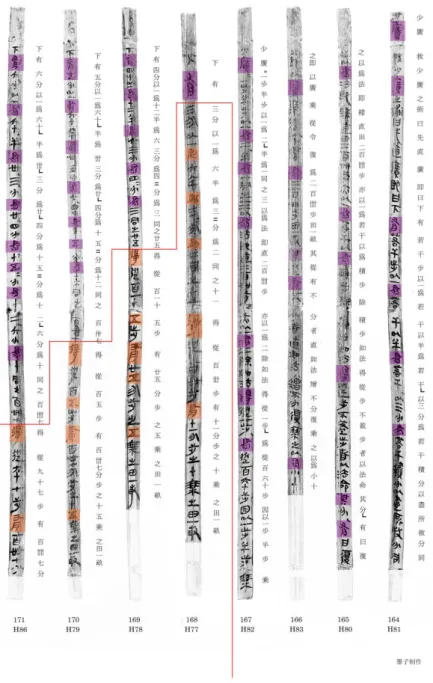
Implementation: ‗Fingerprinting‘ is an iterative process that be-gins with your primary source. Pick a manuscript—preferably one that you understand—and read it several times over in the original, high-lighting strange and recurrent things as you go in the PDF. Once you have a sense of your options in terms of characteristics, go through the PDF once more to mark every instance of the ones you‘ve chosen. If one of your choices proves inconsistent at the level of a single slip, eliminate it from consideration (e.g. 之, 從, and 乘 in Figure 2). If you have two or more forms of the same thing that appear consistently in discrete slips and sections (e.g. , , and for 為), however, you might have multiple ‗hands‘/ziji. If so, give them different colours and try to correlate the appearance of the one with other such phenomena
in the immediate vicinity (e.g. : : :: : : ). Repeat until the entire manuscript is colour-coded and the points of transition become apparent (see Figure 9). Once you‘re confident that you have a ‗long‘ and ‗strong‘ enough chain of characteristics to isolate the ‗hands‘/ziji in your sample, collect examples of what you judge to be the most prevalent/important of these into a table for ease of compari-son. Once you have compiled ‗fingerprints‘ for each segment of your corpus, you can then compare them to assess the probability that one or another ziji is the same (see Table 3). When this is done, compare whole slips from the ziji that your analysis has led you to differentiate or identify to see if it ‗looks right‘.
Worked Example: Zhangjiashan M247
Step 1: Divide your manuscripts into ziji
The only manuscripts in Zhangjiashan M247 corpus that look to have multiple ‗hands‘/ziji are, coincidentally, the longest ones: ENLL (526 slips), ZYS (228 slips), and SSS (190 slips). The shortest, in terms of characters, is the QC tomb inventory, which is simply too short and difficult to read to say. Leaving the QC aside, I will offer here a brief description of the graphological traits of each manuscript and the different ‗hands‘/ziji therein, moving from simple to complex. MS (66 slips) appears to be written in a different ‗script‘ than the others: its every stroke is comparatively long and fine, and it is the only one to feature the Qin orthography for 也. Other than that, there is no one thing that is truly and consistently anomalous com-pared to the other manuscripts, and its ‗script‘/style and characteristics appear consistent throughout.
LP (18 slips) is short and comprised almost entirely of the charac-ter 月 ‗month‘, numbers, and sexagenary dates. This does not give us much to work with: first, numbers like 一, 二, 三, 七, and 十 are too simple for meaningful comparison; second, here, as elsewhere, wen 文 -level characters like 月 exhibit considerable variation over a single
slip (e.g. slip 9: ); third, the wen-level
heavenly stems and earthly branches are similarly variable and do not occur that often in the other manuscripts. One does however note two unifying characteristics of the manuscript that set it apart from some
others in the corpus: horizontal strokes slope down ( ), and
his 5s are rarely crossed ( vs ZYS ).
GL (55 slips) is written in strikingly thick, even strokes throughout lending to an impression of its graphological integrity. Here again there is very little that is anomalous except, perhaps, that the upper part of 其 is consistently pinched to the left ( vs ZYS ). The typical array of characteristics prove consistent throughout.
YS (112 slips) is written with a similarly heavy hand, but a number of characteristics unique to and consistent throughout the manuscript stand out from the rest of the corpus. First, YS shows significant ‗pause pressure‘ on the first stroke of characters like 又 ( vs SSS , MS , etc.). Second, it tends towards heavy and short final strokes on characters like 得 ( vs ZYS‘s long-&-heavy or GL‘s short-&-light ). Third, its orthography for 為 is quite distinct from
the majority of other samples ( vs ENLL‘s , MS‘s ,
Figure 9: Example of the author‘s colour-coding of the SSS (slips 164–170) using the criteria
in Figure 3. SSS(A) is in orange, SSS(B) in purple. Image modified from Kankan Sansūsho:
Chūgoku saiko no sūgakusho 漢簡「算數書」:中國最古の數學書, ed. Chōkazan Kankan Sansūsho kenkyūkai 張家山漢簡「算數書」研究會 (Kyōto: Hōyū shoten, 2006).
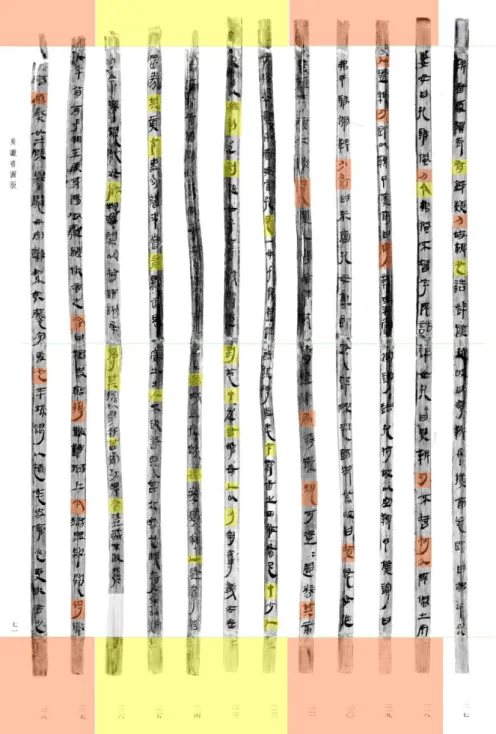
Figure 10: Example of the author‘s colour-coding of the ZYS (slips 217–228) using the
criteria in Table 3. ZYS(A) is in orange, ZYS(B) in yellow. Image modified from
Figure 11: Example of the author‘s colour-coding of the ZYS (slips 145–156) using the
criteria in Table 3. ZYS(A) is in orange, ZYS(C) in green. Image modified from
十一年八月甲申朔己丑… 八年十月己未… A, slips 1–68 七年八月己未江陵丞言… A, slips 68–73 B, slip 74 淮陽守行縣掾新郪獄,七月乙酉… B, slips 75–84 A, slips 85–98 四月丙辰黥城旦講乞鞫… B, slips 99–123 南邵卒史蓋廬、摯田叚(假)、卒史瞗… A?, slip 124 御史書以廿七年二月壬辰到南郡守府… A, slips 125–145 C, slips 146–148 A, slips 149–161 異時獄□曰… B, slips 162–173 異時魯灋… B, slips 174–179 故律曰… B, slips 180–196 六月癸卯,典贏告曰… A, slips 197–221 B, slips 222–226 A, slips 227–228
Table 2: Distribution of ziji in ZYS.
SSS (190 slips), as Karine Chemla and I have already shown, can be divided into A and B ziji. For more information, see above.
ZYS (228 slips) reveals two distinct ‗hands‘/ziji on a quick look-through done without any prior knowledge of the manuscript. Five characteristics of the ZYS stand out as anomalous in comparison with the rest of the corpus: (1) 其 from ×, ; (2) the near semi-circular end-stroke on 也, ; (3) 為, ; (4) the parallel curving lines of 而, ; and (5) the inward curl on 今 and 令 . These charac-teristics are consistent throughout certain portions of the manuscript; they are also consistently different from other portions where we see common forms like , , and , the equally peculiar , and a straight 今 with the propensity for pause-pressure on the terminal stroke ( ). Correlating these characteristics through colour-coding, a clear division and pattern of alternation emerges between two predom-inant ziji that we may call ZYS(A) and ZYS(B) (see Figure 10). This division, in turn, reveals a gap on slips 146–148, which correspond to neither A nor B, and, thus, which we shall dub ZYS(C) (see Fig-ure 11). Distribution is as per Table 2.
Figure 12: Example of the author‘s colour-coding of the ENLL (slips 168–179) using the
criteria in Table 3. ENLL(A) is in purple, ENLL(B) in yellow, and ENLL(C) in red. Image modified from Zhangjiashan Han mu zhujian (ersiqi hao mu), p. 21.
ENLL (526 slips) has already been divided slip by slip into three hands by Li Jingrong 李婧嶸.35 Starting over from scratch with crite-ria largely selected for dealing with the SSS, I arrived at roughly the division as did she; our main difference was that the ‗leftovers‘ that Li labels ENLL(C) in slips (1) 174–176, (2) 221–224, and (3) 331–332, 342, and 344 do strike me as necessarily identical at this date.36 For the criteria used in my analysis, see XX; for a sample of my colour-coding, see Figure 12. One notes that the signature ‗Copied by Zheng X‘ 鄭 寫 (slip 81) appears at the end of a section written most-ly/entirely by ENLL(A).
Having begun with eight manuscripts, we have now arrived at thir-teen ziji. Some of these ziji we have already proven to be different: SSS(A) ≠ SSS(B), and likewise for ZYS(A)–(C) and ENLL(A)–(C). Now the question is which of them are the same? Does, for example, SSS(A) = ZYS(A)?
Step 2: Build your ‘fingerprint’ database
In the process of dividing your manuscripts into ziji, you will have compiled a number of profiles or like those in Figure 3 and Figure 8. Each profile will be specific to the manuscript, because each manu-script features phenomena that are more or less present, more or less pronounced, and more or less indicative of internal divisions. To com-pare ziji between manuscripts, however, one needs profiles that are
comparable. To this end, combine your profiles into a single table and
fill out any cells left blank until you have something that looks like Table 3.
Step 3: Column sorting
Once you‘re ‗fingerprint‘ database is complete, you can sort the col-umns around as you like to determine what goes together. I tried sev-eral strategies to arrive at the column order in Table 3, settling finally on process of elimination.
ZYS(A), down the board, looks like no other ziji in the Zhang-jiashan M247 corpus. Yes, some of the characteristics chosen are not total anomalies: ZYS(A) crosses its 5s ( ) like 4 of 9 samples, and it writes 實 from 尹 (vs 毌) like 8 of 9 (setting aside the ‗feet‘). This coincidence is, however, measurably meaningless: the odds that two independent writing samples in this tomb might share these features are, one might say, 4:9 (44%) and 8:9 (89%), respectively. All of our samples meet one of these two conditions, but only ZYS(A) and ENLL(A) meet both. What are the odds!? They are 32:81 (39%), little lower than a coin toss. If you want a sense, by contrast, of just how specific a ‗fingerprint‘ like ZYS(A) here has, one need look no further than its five ‗anomalies‘ marked in a darker colour on Table 3. Here
35
‗The Ernian Lü Ling Manuscript‘, 33–50.
36 The other discrepancies in our results were these. First, page 23 was missing
from my PDF version of Zhangjiashan Han mu zhujian (ersiqi hao mu), so I did not get to analyse those slips (slips 192–203). Second, slip 58 came up for me as ENLL(A) rather than split between A and B. Third, slip 80 is hard to read and did not supply enough visual clues to me to identify a change of hands to B. Fourth, slip 164 came up as A rather than B. Fifth, I did not catch slips 342 and 344 as dif-ferent from their surrounding slips (B) or identify them with C. Sixth, slips 444–473 failed to provide me with conclusive data.
Ta b le 3 : ‗F in ge rp rin t d atab ase ‘ fo r Zh an g ji ash an M 2 4 7
Ta b le 3 (c o n ti n u ed )
we begin with lower individual odds by the same metric: 2:10 for cross-filled 其 ( ), 1:6 for the semi-circle 也 ( ), 1:11 for the gap-toothed 為 ( ), 2:11 for the dancing 而 ( ), and 1:10 for the curly 今 ( ). That‘s low, but the odds of their random co-occurrence in two independent samples would be 1:181500 (0.0005%). It is safe to say that we can set ZYS(A) aside as its own, independent ziji.
The same can be said of ENLL(B) and ENLL(C), thanks mostly to their peculiar orthographies for the recurrent characters 其, 為, and 而. SSS(A) stands out for being the only sample to write writes 實 from 毌 (vs 尹) and to insist throughout on a rectilinear 又 component ( ), marking it also as different from the rest. ENLL(A) and YS are less manifestly unique, and they see somewhat more variation in signature
orthographies like 為 ( , vs , , ) and 而 ( , , vs
, , ), which makes them more difficult to compare, except per-haps by the very metric of variability. Whatever the variability
be-tween these forms, one notes that they are, in the aggregate, dissimilar
to one another, and that none of these forms much resembles those that we find elsewhere in the corpus, except perhaps that YS looks passably similar to ZYS(B) . YS features additional characteristics that are unique within the corpus, e.g. pronounced pause pressure on all the ‗fingers‘ of 又 ( ) and the outward-curling 彳 component and short, teardrop terminal stroke on 得 ( ). ENLL(A) and YS can thus be set aside as independent ziji.
The QC tomb inventory, as already mentioned, does not provide us much by way of a fingerprint—not at least using the criteria in Table 3. A brief look at comparable forms does not, in my opinion, reveal re-semblances sufficiently compelling to merit identification with any other ziji.
What remains after eliminating the preceding samples is harder to distinguish one from the other, so here we move from differentiation to identification.
SSS(B) and GL share the most in common of any two samples. Both feature a 其 whose upper component is pinched left ( : ), which is the case for 3/10 samples. Both consistently use the same form for 為 ( : ), which is the case for 4/11. Both use the same 而 ( : ), as do, let‘s say, 3/11. Both imperfectly cross their 5s ( : ), as do 5/9. Both write 實 from 尹 (vs 毌), as do 8/9. The list goes on, but just from this we can say that the odds of all these features coinciding in two independent samples in this corpus are something like 1440:89010 (1%). It is true that SSS(B) prefers a somewhat more rounded and vertically-reaching 有 than does GL ( : ), but this alone does not outweigh the string of other criteria in Table 3. If any two manuscripts were written by the same hand in Zhangjiashan M247, it is SSS(B) and GL.
MS, as already noted, is written in a ‗style‘ or ‗script‘ different from that the other manuscripts, as evidenced for example by the ex-tended vertical strokes on characters like 而 ( vs ) and the Qin orthography for 也 ( vs ). ‗Script‘/‗style‘ aside, however, several features suggest identification with the hand behind SSS(B) and GL: the pinched 其 ( : and ), for 3/10; the 為 ( : and ), for 4/11; the uncrossed 5s ( : and ), for 5/9; and 實 from 尹 (vs 毌), for 8/9. The odds of the coincidence of these characteristics are higher, at 480:8910 (5%), so we might say that we are less sure of this identification—five times less sure, to be exact—but it is still rather likely that we‘re dealing with the same hand.
LP and ZYS(C) give us less to work with, but what they do pro-vide is a close match with the ziji in SSS(B) and GL. ZYS(C) is simp-ly identical to GL as concerns 而 ( : ) and 實 ( : ), as if the two were written in the same hour. LP is perhaps somewhat harder to say, but it gives us the same 為 and same uncrossed 5s as the others in this group at an odds of something like 20:99 (20%). Here we are even
less sure of this identification than the previous—four times less sure,
to be exact—but, of the options presented, we can say that LP looks more like the SSS(B)-GL-MS-ZYS(C) ziji than any other.
ZYS(B), lastly, gave me pause in November 2015 because of its uncrossed 5s and one particular occurrence of the SSS(B)-GL-MS-ZYS(C)-LP 為 ( vs, more normally, ). Upon re-examination, however, I am convinced that its other characteristics far outweigh this coincidence, marking ZYS(B) as its own ziji.
Step 4: Confirmation
‗Fingerprinting‘ led me to the conclusion that SSS(B), GL, MS, ZYS(C), and the LP ‗calendar‘ are all the same ziji and, thus, the same ‗hand‘. Comparing randomly chosen slips from each of these samples either confirmed or, at least, failed to disconfirm this conclusion. I, however, know exactly what I‘m looking for, so I prepared a ques-tionnaire to perform a blind test on friends and colleagues. The goal was to see if they would arrive by unguided visual intuition at the same conclusions drawn by my analysis. Between 8 and 9 November 2016, I gave this test in its entirety to three colleagues in my office at Université Paris Diderot—one a Chinese early modern historian, one a Japanese Sanskritist, and one a French Assyriologist with no training in Chinese. All three reached 3/4 of the same identifications as did I. Crowdsourcing the two samples featuring the LP ‗calendar‘ to Face-book, I was likewise pleased to see five early China scholars unani-mously identify the LP ziji with another belonging to the SSS(B)-GL-MS-ZYS(C) group. The questionnaire is found at the end of this PDF, I would love it if everyone here today gives it a try to see if your ex-pert eyes (without peaking at the answer!) lead you also to the same conclusion.
Conclusion
The actual work of mapping ziji hands onto a manuscript corpus like that from Zhangjiashan M247 is boring, thus my interest in making it simple and efficient so we can move on to something else. Frankly, I would rather not need to do this work, or teach myself how it is done, but the manuscripts in which I am most interested are not the ones that receive the sort of attention as does the Kongzi Shi lun. This is too bad, I think, because manuscripts on maths, astronomy, and calendars are manuscripts none the less, speaking to the self-same issues that inter-est us all in a special light; they are in the same tombs as the other texts we read and, potentially, in the same hand.37 If there is one place
37
On the ‗special light‘ that these manuscripts in particular shed on common top-ics in early manuscript studies, see Mo Zihan and Lin Lina, ‗Ye you lunzhe xiede‘, and Daniel P. Morgan, ‗What Good‘s a Text? Textuality, Orality, and Mathematical Astronomy in Early Imperial China‘, Archives internationales d’histoire des
where the method presented here is most lacking, I would say that it is this: graphic analysis is analysis of graphs, and graphs alone, passing over equally important criteria such as word-choice and habit of speech.38 Indeed: how could I take such things into account for texts like the ENLL and ZYS, which I have hardly read? But that‘s the beauty: if ‗fingerprinting‘ gets you most or all of the way to the results intended, that is a pretty good start; if it takes you unintended places in unfamiliar fields, that is even better.
Ziji do things. Li Songru dedicates an entire chapter to the
possibil-ities, focusing on the reconstruction of manuscripts from loose and broken slips, the authentication of black-market purchases, and the study of early writing, manuscript culture, and the history of calligra-phy.39 Hers is an excellent list of reasons to concern ourselves with the subject, and to that, I should like to add an existential one. The study of ziji, namely, has the potential to dispel existential doubts posed by proponents of the idea that tomb texts are nothing but mingqi‘ ‗fakes‘. As with the legal and divinatory documents from Baoshan 包山 M2, the complex back-and-forth that such analysis reveals in the SSS, ENLL, and ZYS evidences a writing process that is difficult to square with the sort of mass-produced burial items that do appear in contem-porary tombs.40 This is a losing battle if we must fight it text by text, but corpus-wide analysis has the potential to definitively end the epis-temic war. By identifying one of the hands of the SSS with no less than three other manuscripts in this tomb, for example, we can extend them all at once the credentials of its ‗realness‘. If my gambit concern-ing calendar/diaries pans out, furthermore, we might even turn the question on its head, starting from firm evidential grounds as to what tomb occupants did and didn‘t write. That, in my opinion, will take us much more interesting places than those inferred from theory or from the twenty-first-century imagination alone.
Ziji, if we do it right, will tell a story that we have never heard.
What we used to talk about as a treatise, it turns out, now looks very much like homework or an educational exchange. The hand that we once jokingly called ‗Sloppy‘, SSS(B), it turns out, is the one giving questions and correcting answers. The nicer writer must be the author-ity, I thought, like the headings must have come last, but my imagina-tion led me in the wrong direcimagina-tion: here, in the world of SSS, headings precede the body, and sloppy writers know their maths. Maybe, as Richter reminds us, writing does not only get better—maybe SSS(B) was simply old.41 Maybe, indeed, SSS(B) was even as old as the nameless and now formless man with which that text was buried—the man with the turtle-dove cane who kept his calendar nine years after
38 On this most important criteria completely elided by ‗fingerpriting‘, though
tak-en into my analysis of SSS with Karine Chemla, see Li Songru, Zhanguo jianbo ziji
yanjiu, 141–48; Olivier Venture, ‗Looking for Chu People‘s Writing Habits‘, Asiat-ische Studien/Etudes Asiatiques LXIII, no. 4 (2009): 943–57.
39 Li Songru, Zhanguo jianbo ziji yanjiu, 175–200. 40
On the alternation of ziji in the Baoshan documents, see Li Shoukui 李守奎, ‗Baoshan bushi wenshu shuji de fenlei yu shuxie de jiben zhuangkuang‘ 包山卜筮 文書書迹的分類與書寫的基本狀況, Zhongguo wenzi yanjiu 中國文字研究 1 (2007): 63–67; 李守奎, ‗包山司法簡致命文書的特點與 138–139 號簡文書內容的 性質‘, 古文字研究 28 (2010): 389–95; Zhu Xiaoxue 朱曉雪, ‗Baoshan bushi jidao jian ziji fenlei fenxi‘ 包山卜筮祭禱简字迹分類分析, Chutu wenxian yanjiu 出土文 獻研究 12 (2013): 47–57.
41 Richter, ‗Tentative Criteria for Discerning Individual Hands in the Guodian
retiring on account of his health. Whether or not he was that old it was nonetheless he who wrote that calendar and a manuscript on health. There is a story here, perhaps, as the thread winds on and into philos-ophy and the legal cases of the ZYS, but it is one that would I need other historians to help me follow down to who knows where. Or maybe I should just stick to the history of maths; because maybe the only story here is one of coincidence—whatever the odds—and
ingen-ious factory-floor replicas tossed meaninglessly into another man‘s
tomb. That, I‘ll let you decide, but I, for one, like stories that take me somewhere I‘ve never been.