HAL Id: hal-00716339
https://hal.archives-ouvertes.fr/hal-00716339
Preprint submitted on 10 Jul 2012
HAL is a multi-disciplinary open access
archive for the deposit and dissemination of
sci-entific research documents, whether they are
pub-lished or not. The documents may come from
teaching and research institutions in France or
abroad, or from public or private research centers.
L’archive ouverte pluridisciplinaire HAL, est
destinée au dépôt et à la diffusion de documents
scientifiques de niveau recherche, publiés ou non,
émanant des établissements d’enseignement et de
recherche français ou étrangers, des laboratoires
publics ou privés.
Non-Gaussianity and Dynamical Trapping in Locally
Activated Random Walks
Olivier Benichou, Nicolas Meunier, Sidney Redner, Raphael Voituriez
To cite this version:
Olivier Benichou, Nicolas Meunier, Sidney Redner, Raphael Voituriez. Non-Gaussianity and
Dynam-ical Trapping in Locally Activated Random Walks. 2012. �hal-00716339�
O. B´enichou,1 N. Meunier,2 S. Redner,3 and R. Voituriez1
1Laboratoire de Physique Th´eorique de la Mati`ere Condens´ee, CNRS UMR 7600,
case courrier 121, Universit´e Paris 6, 4 Place Jussieu, 75255 Paris Cedex
2MAP5, CNRS UMR 8145, Universit´e Paris Descartes,
45 rue des Saints-P`eres, 75270 Paris Cedex 06, France
3Center for Polymer Studies and Department of Physics,
Boston University, Boston, Massachusetts 02215, USA (Dated: December 3, 2011)
We propose a minimal model of locally activated random walks, in which the di↵usion coefficient of a one-dimensional Brownian particle is modified in a prescribed way — either increased or decreased — upon each crossing of the origin. Importantly, the case of a local decrease of the motion ability is at work in the process of formation of the atherosclerotic plaque, when describing the dynamics of a macrophage cell that grows when accumulating localized lipid particles. We show in the general case that localized perturbations have remarkable consequences on the dynamics of the di↵usion process at all scales, such as the emergence of a non-Gaussian multi-peaked probability distribution and a dynamical transition to an absorbing state. In the context of atherosclerosis, this dynamical transition to an absorbing state can be viewed as a minimal mechanism leading to the segregation of macrophages in lipid enriched regions and therefore to the formation of the atherosclerosis plaque.
PACS numbers: 05.40.Jc, 05.40.Fb
Many-particle systems that consume energy for self-propulsion — active particle systems — have received growing attention in the last decade, both because of the new physical phenomena that they display and their wide range of applications. Examples include molecular mo-tors, cell assemblies, and even larger organisms [1]. The intrinsic out-of-equilibrium nature of these systems leads to remarkable e↵ects such as non-Boltzmann distribu-tions [2], long-range order even in low spatial dimensions [3] and spontaneous flows [4].
At the single-particle level, the active forcing of a Brownian particle leads to non-trivial statistics. For ex-ample, it has been recently shown [5, 6] that a random walk which is reset to its starting point at a fixed rate has a non-equilibrium stationary state, as opposed to stan-dard Brownian motion. Another example is given by self-propelled Brownian particles [7], which can yield sharply peaked probability densities for the particle velocity.
In this letter, we consider a new class of problems in which the active forcing of a Brownian particle is localized in space. While the impact of localized perturbations on random walks has been investigated [8], in part because of its relevance to a wide range of situations, such as lo-calized sources and sinks [9, 10], trapping [11, 12] or dif-fusion with forbidden [13], hop-over [14] or defective [15] sites, the role of local activation on Brownian particles dynamics remains open. We present a minimal model of locally activated di↵usion, in which the di↵usivity of a Brownian particle is modified in a prescribed way — either increased or decreased — at each crossing of the origin. A prototypical example is a bacterium in the pres-ence of a localized patch of nutrients, which enhances the ability of the bacterium to move, or, alternatively, toxins that impair bacterial mobility.
Importantly, this type of localized decrease of the
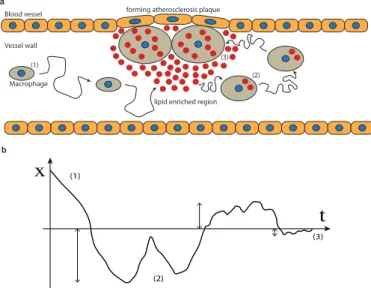
mo-tion ability is also at work when describing the dynamics of a cell (a macrophage e.g.) that grows when accumu-lating other smaller particles (lipid e.g.) that are local-ized at some point (Fig.. 1). As the cell size increases its ability to move decreases. Such a situation occurs in the process of formation of the atherosclerotic plaque [16]. The space localization is then due to the presence of lipids at some specific points of the arterial tree, which are determined, as is now well accepted, by the properties of the blood flow. Observations show that macrophages that have accumulated lipids are slowed down and even-tually stopped in lipid enriched regions, resulting in the formation of the atherosclerotic plaque [17, 18]. Here we propose a simple model accounting for this locally de-creased process and address in particular the questions of (i) the potential trapping of cells on locally lipid enriched regions and (ii) the kinetics of the resulting segregation process when it exists.
Our formalism allows us to describe both situations of decreased and increased localized processes. We show that this localized type of perturbation has remarkable consequences on the di↵usion process at all scales. From the theoretical point of view, we stress that the di↵usion coefficient of the active particle at any time depends on the entire history of the trajectory. Thus the evolution of the particle position is intrinsically non-Markovian [19– 22].
Our main findings are: (i) The probability distribution of the position has a non-Gaussian tail. (ii) For local ac-celeration, a di↵using particle is repelled from the origin, so that the maximum in the probability distribution is at non-zero displacement. (iii) For local deceleration, a dy-namical transition to an absorbing state occurs. For suf-ficiently strong deceleration, the particle can get trapped at the origin at a finite time. The exact time dependence
2
Blood vessel
Macrophage
lipid enriched region Vessel wall
forming atherosclerosis plaque
(1) (2) (3)
t
x
(1) (2) (3) a bFIG. 1: a. Sketch of the di↵erent stages involved in the process of atherosclerosis plaque formation: (1) a ”free” macrophage cell di↵uses ”rapidly”; (2) upon crossing of a localized lipid enriched region, the macrophage accumulates lipids, which makes it grow and slow down; (3) after a suf-ficient number of crossings of the lipid enriched region, the macrophage eventually gets trapped, resulting in the forma-tion of the atherosclerotic plaque. In this work, we discuss two questions: (i) Is the slow-down in the lipid enriched region ef-ficient enough to eventually induce trapping of macrophage cells ? (ii) If so, what is the kinetics of the resulting seg-regation process ? b. Sketch of a one-dimensional particle trajectory of the model of locally decelerated random walk.
for the particle survival probability is determined explic-itly. Conversely, if the deceleration process is sufficiently weak, the particle never gets trapped. (iv) This dynam-ical transition to an absorbing state provides a minimal mechanism that could help understand the kinetics of formation of the atherosclerosis plaque.
The Model. A one-dimensional di↵using particle is ac-celerated or deac-celerated whenever it crosses the origin x = 0 according to the following Langevin equations:
˙x =p2D ⇠(t) , D = f (D) (x) ,˙ (1) where ⇠ is a Gaussian white noise of intensity one, D the particle di↵usion coefficient, x the particle position, (x) the Dirac distribution, and f(D) an arbitrary prescribed function that accounts for the local activation. For sim-plicity, we assume that the particle is initially at x = 0 with D = D0> 0. Note that: (i) both the position x and
the di↵usion coefficient D are random variables; (ii) as mentioned previously, the evolutions of x or D alone are non-Markovian; (iii) the function f(D) can be positive (local acceleration) or negative (local deceleration), but with f(0) = 0 so that D remains non negative.
Following standard steps, the corresponding Fokker-Planck equation [23] for the joint distribution of position
x and di↵usion coefficient D at time t, P (x, D, t), is: @P @t = D @2P @x2 (x) @[f (D)P ] @D (t) (x) (D), (2) where the last term of the right side accounts for the ab-sorbing state at (x = 0, D = 0). The explicit expression for (t) is determined demanding that P is normalized, from which we obtain
(t) = lim
D!0
⇥
f (D)P (0, D, t)⇤. (3) When f(D) is positive, then D is always non zero. In this case, the particle is never trapped and (t) = 0 at all times. While intuitively obvious for local acceleration (f(D) > 0), we show below that (t) can equal zero for local deceleration processes.
Local Acceleration, f(D) > 0. Laplace transforming Eq. (2) gives s bP + D@ 2Pb @x2 = (x) h @(f bP ) @D (D D0) i , (4) where bP = bP (x, D, s) is the Laplace transform of the probability distribution. For x 6= 0, the solution is
b
P (x, D, s) = A(D, s) e |x|ps/D , (5) where the coefficient A(D, s) is determined by integrat-ing Eq. (4) across x = 0 to obtain the jump of the first derivative of bP with respect to x at this point:
D " @ bP @x x=0+ @ bP @x x=0 # = @[f bP (x = 0)] @D (D D0) . Using Eq. (5), we have
f@A @D +
h
f0+ 2psDiA = (D D0). (6)
When f(D) is positive, then A(D, s) = 0 for D < D0,
while for D > D0 the solution to (6) is
A = B(s)f (D0) f (D) e p 4s F , (7) with F (D)⌘ Z D D0 p D0 |f(D0)|dD0.
The unknown function B(s) is determined by the jump of A at D0:
A(D0+, s) A(D0, s) =
1 f (D0) ,
which finally yields b
P (x, D, s) = ⇥(D D0)
1 f (D)e
where ⇥ is the Heaviside step function and Z⌘ p|x|
D + 2F (D) .
Laplace inverting this expression, we obtain the joint dis-tribution
P (x, D, t) = ⇥(D D0) Z
f (D)p4⇡t3 e
Z2/4t . (9)
The marginal distribution with respect to x, that is, the probability distribution of positions, is obtained by integrating Eq. (9) over all D in the range [D0,1]. While
it does not seem possible to evaluate this integral ana-lytically, the large-x behavior can be obtained by the Laplace method. For the illustrative case where f(D) is a constant (that we define as a), this method gives
P (x, t)⇠ 1t r |x| 3a exp 8|x|3/2 9pa t x! 1 , (10) which we numerically checked is close to the exact value P (x, t) over a wide spatial range. We wish to empha-size two important features of this result for P (x, t) that are in marked contrast with the Gaussian propagator of the usual Brownian motion: (i) P (x, t) generally has a non-Gaussian tail; (ii) P (x, t) reaches its maximum at a non-zero displacement. Equation (10) shows that the location of this maximum asymptotically grows as t2/3
when f(D) = a. Thus local acceleration pushes a di↵us-ing particle away from the origin.
From the general expression (9), the marginal distri-bution with respect to D can also be easily obtained by integration over x. We find
P (D, t) = ⇥(D D0)
2pD f (D)p⇡t e
F2/t. (11)
In the particular case of f(D) = a, Eq. (11) shows that the di↵usion coefficient of the particle asymptotically grows as t1/3.
As a byproduct, Eq. (11) also provides the distribution of the local time ⌧(t) spent by the particle in the active zone (the origin for the present case) up to time t. Using the second of Eqs. (1), this basic observable in the theory of di↵usion [24] is related to the di↵usion coefficient at time t by ⌧ (t)⌘ Z t 0 (x(t0)) dt0=Z D D0 dD0 f (D0) . (12)
Thus the distribution of the local time, defined as P(⌧, t), is given by P(⌧, t) = f(D)P (D, t), with P (D, t) given by Eq. (11) and D implicitly defined as a function of ⌧ in Eq. (12). For the illustrative case of f(D) = a, the distribution of the local time at time t therefore is
P(⌧, t)=2 p a⌧ + D0 p ⇡t exp ( 4⇥(a⌧ +D0)3/2 D3/20 ⇤2 9a2t ) . (13)
This result strongly contrasts with the Gaussian distri-bution that arises in the case of Brownian motion, which can be recovered from Eq. (13) in the limit a ! 0:
PBM(⌧, t) =
2pD0
p ⇡t e
D0⌧2/t . (14)
Notice, in particular, the typical local time for an accel-erated particle with f(D) = a grows as t1/3 instead of
t1/2 in the case of Brownian motion.
It is worth noting an intriguing dichotomy with a discrete-time version of local acceleration — the “greedy” random walk [25]. In this discrete model, the step length `k after the kth return of a random walk to the origin is
given by `k = k↵. To match with the continuous model
with f(D) = D↵, one must choose the value ↵ = 1/2.
With this choice, Eq. (13) of [25] gives, ignoring all multi-plicative factors, P (x, t) / x1/3/t exp[ x4/3/t], which is
di↵erent from (10). The source of this discrepancy is that the probability of being at the origin is not a↵ected by the enhancement mechanism of greedy walks [25], while this return probability is fundamentally modified in the case of locally-activated random walks, as seen explicitly from the distribution of the local time (13). Thus our locally activated di↵usion model cannot be viewed as the continuous limit of the greedy random walk.
Local Deceleration, f(D)<0. Following the same anal-ysis as that used for local acceleration, the Laplace trans-form of the joint distribution is
b
P = ⇥(D0 D) |f(D)| e
Zps b(s)
s (x) (D) , (15) where b is the Laplace transform of (t) defined in Eqs. (2) and (3). Using these defining relations for (t), Eq. (15) gives b(s) = lim D!0 ⇥ f (D) bP (0, D, s)⇤= e p4s F , (16) where we define F (D)⌘ Z D0 0 p D0 |f(D0)| dD0.
In this result for b, we have used (D)f(D) = 0, since f (0) = 0 by the definition of our model. The important feature of Eq. (16) is that b(s) = 0 as soon as F diverges.
Thus our final result is b P (x, D, s)=⇥(D0 D) |f(D)| e Zps+ (x) (D) s e p 4s F , (17) which gives, after Laplace inversion,
P (x, D, t)=⇥(D D0) |f(D)| Z e Z2/4t p 4⇡t3 + T (t) (x) (D). (18)
4 Here T (t) = erfc⇣ 1p t Z D0 0 p D0 |f(D0)|dD0 ⌘ (19) is the trapping probability, namely, the probability that the particle becomes stuck at x = 0 by time t because the di↵usion coefficient has reached zero. As a corol-lary, the survival probability is given by S(t) = 1 T (t), and we have obtained this quantity for an explicitly non-Markovian process. We also mention that, as in the case of local acceleration, the joint distribution easily gives the marginal distributions of the position and the di↵usion coefficient, as well as the local time.
A fundamental consequence of the local deceleration of a Brownian particle is that two di↵erent dynamical regimes emerge. We illustrate these regimes for the par-ticular case where f(D) = D as D ! 0. If the decel-eration is sufficiently strong, which occurs when < 3/2, there is a non-zero probability for the particle to get trapped at the origin. More precisely, the survival prob-ability has the asymptotic behavior
S(t)⇠ 4D
3/2 0
p
⇡t (3 2 ) ! 0 t! 1 . (20) Thus in this regime of strong deceleration, the survival probability has the same scaling with time as in the case of a usual Brownian particle in the presence of a perfect trap. In the opposite case of 3/2, then S(t) = 1 for all t > 0 and the particle never gets trapped at the origin. Thus a locally decelerated Brownian particle un-dergoes a dynamical transition to the absorbing state (x = 0, D = 0) as the deceleration strength increases. Mathematically, this transition occurs at the point where F is no longer divergent.
In conclusion, we introduced a minimal model of lo-cally activated di↵usion, in which the di↵usion
coeffi-cient of a Brownian particle is modified in a prescribed way at each crossing of the origin. In one dimension, a purely di↵using particle hits the origin of the order ofpt times after a time t. Consequently, the local activation mechanism is repeatedly invoked during the trajectory of a Brownian particle. Thus the asymptotic dynam-ics of a Brownian particle is globally a↵ected, leading to markedly di↵erent behavior than that of pure di↵usion. Since the unusual properties of local activation rely on the recurrence of Brownian motion, we anticipate that qualitatively similar, but quantitatively distinct, behav-ior would arise in two dimensions.
Our model encompasses both the situations where the Brownian particle is locally accelerated or decelerated. For local acceleration, the probability distribution is non-Gaussian and multi-peaked, with maxima away from the origin no matter how weak the acceleration. For suffi-ciently weak local deceleration, a Brownian particle man-ages to avoid getting trapped at the origin in spite of its recurrence. However, for strong deceleration, there is a dynamical transition to an absorbing state in which the particle ultimately gets trapped at the origin.
In the context of atherosclerosis mentioned in intro-duction, this dynamical transition to an absorbing state can be viewed as a minimal mechanism leading to the segregation of macrophages in lipid enriched regions and therefore to the formation of the atherosclerosis plaque. Interestingly, our model suggests that there exists a crit-ical intensity of the mobility decrease that could be re-lated to the local lipid concentration for the cluster for-mation to occur. In addition, it could help understand the kinetics of the formation of the atherosclerosis plaque. SR gratefully acknowledges financial support from NSF Grant No. DMR-0906504 and the hospitality of UPMC where this work was initiated.
[1] J. Toner, Y. Tu, and S. Ramaswamy, Annals of Physics 318, 170 (2005).
[2] A. Puglisi, V. Loreto, U. Marini Bettolo Marconi, and A. Vulpiani, Phys. Rev. E 59, 5582 (1999).
[3] J. Toner and Y. Tu, Phys. Rev. Lett. 75, 4326 (1995). [4] R. Voituriez, J. F. Joanny, and J. Prost, Europhysics
Letters 70, 404 (2005).
[5] M. R. Evans and S. N. Majumdar, Phys. Rev. Lett. 106, 160601 (2011).
[6] M. R. Evans and S. N. Majumdar, ArXiv e-prints (2011), 1107.4225.
[7] P. Romanczuk and L. Schimansky-Geier, Phys. Rev. Lett. 106, 230601 (2011).
[8] B. D. Hughes, Random Walks and Random Environ-ments (Oxford Press, 1995).
[9] S. Redner and K. Kang, Phys. Rev. A 30, 3362 (1984). [10] S. N. Majumdar, Physica A: Statistical Mechanics and
its Applications 169, 207 (1990).
[11] G. Weiss, Aspects and Applications of the Random Walk (Amsterdam, Netherlands: North-Holland, 1994). [12] V. Tejedor, O. B´enichou, R. Voituriez, and M. Moreau,
Physical Review E 82, 056106 (2010).
[13] C. K. L., Markov Chains with Stationary Transition Probabilities (Springer, Berlin, 1960).
[14] R. K. P. Zia and Z. Toroczkai, Journal of Physics A: Mathematical and General 31, 9667 (1998).
[15] O. Benichou and G. Oshanin, Phys Rev E Stat Nonlin Soft Matter Phys 66, 031101 (2002).
[16] M. P. J. de Winther and M. H. Hofker, The Journal of Clinical Investigation 105, 1039 (2000).
[17] L. Yvan-Charvet, M. Ranaletta, N. Wang, S. Han, N. Terasaka, R. Li, C. Welch, and A. Tall, The Journal of Clinical Investigation 117, 3900 (2007).
[18] D. Siegel-Axel, K. Daub, P. Seizer, S. Lindemann, and M. Gawaz, Cardiovascular Research 78, 8 (2008). [19] N. V. Kampen, Stochastic Processes in Physics and
Chemistry (North -Holland, 1992).
[20] S. N. Majumdar and C. Sire, Phys. Rev. Lett. 77, 1420 (1996).
[21] S. N. Majumdar, Curr. Sci. 77, 370 (1999).
[22] S. Redner, A Guide to First-Passage Processes (Cam-bridge University Press, Cam(Cam-bridge, England, 2001). [23] C. Gardiner, Handbook of Stochastic Methods for
Physics, Chemistry and Natural Sciences (Springer, 2004).
[24] S. N. Majumdar and A. Comtet, Phys. Rev. Lett. 89, 60601 (2002).
[25] E. Ben-Naim and S. Redner, Journal of Physics A: Math-ematical and General 37, 11321 (2004).