HAL Id: hal-01176418
https://hal.archives-ouvertes.fr/hal-01176418
Submitted on 22 Jul 2015
HAL is a multi-disciplinary open access
archive for the deposit and dissemination of
sci-entific research documents, whether they are
pub-lished or not. The documents may come from
teaching and research institutions in France or
abroad, or from public or private research centers.
L’archive ouverte pluridisciplinaire HAL, est
destinée au dépôt et à la diffusion de documents
scientifiques de niveau recherche, publiés ou non,
émanant des établissements d’enseignement et de
recherche français ou étrangers, des laboratoires
publics ou privés.
Socially-Aware Interference Mitigation Game in
Body-to-Body Networks
Amira Meharouech, Jocelyne Elias, Stefano Paris, Ahmed Mehaoua
To cite this version:
Amira Meharouech, Jocelyne Elias, Stefano Paris, Ahmed Mehaoua. Socially-Aware Interference
Mitigation Game in Body-to-Body Networks. International Conference on NETwork Games, COntrol
and OPtimization (NETGCOOP 2014), Oct 2014, Trento, Italy. �hal-01176418�
Socially-Aware Interference Mitigation Game in
Body-to-Body Networks
Amira Meharouech
∗, Jocelyne Elias
∗, Stefano Paris
∗and Ahmed Mehaoua
∗ ∗LIPADE Laboratory, Paris Descartes University, France.
[email protected],
{jocelyne.elias,ahmed.mehaoua,stefano.paris}@parisdescartes.fr.
Abstract—Wireless wearable devices have recently gained in-creasing attention from industry in fields such as health, fitness, and entertainment. In this paper, we consider a dynamic system composed of several Body-to-Body Networks (BBNs) based on wearable technology, and we analyze the joint mutual and cross-technology interference problem due to the utilization of a limited number of channels by different transmission technologies (i.e., ZigBee and WiFi) sharing the same radio spectrum. To this end, we propose a game theoretical approach to address the problem of Socially-aware Interference Mitigation (SIM) in BBNs. Our approach considers a two-stage channel allocation scheme: a BBN-stage for inter-WBANs’ communications and a WBAN-stage for intra-WBAN communications, involving mutual and cross-technology considerations at each stage. We develop best response algorithms that converge fast to Nash equilibrium points. Simulation results show the efficiency of SIM game in optimizing the channel allocation in BBNs.
Index Terms—Body-to-Body Networks, 2.4 GHz ISM band, Cross-Technology Interference, Channel Allocation, Game Theory, Nash Equilibrium.
I. INTRODUCTION
Body-to-Body Networks have recently emerged as promis-ing solutions for the monitorpromis-ing of people behavior and their interaction with the surrounding environment [1]. BBNs may represent a number of scenarios: (i) different rescue teams in a disaster area, (ii) groups of soldiers on the battlefield, and (iii) different patients in a healthcare center, whose Wireless Body Area Networks (WBANs) interact with each other. The BBN consists of several WBANs, which in turn are composed of sensor nodes that are usually placed in the clothes, on the body or under the skin [2]. These sensors collect information about the person and send it to the sink (i.e., a Mobile Terminal (MT) or a PDA), in order to be processed or relayed to other networks.
Due to the scarce wireless channel resources, many ex-isting wireless technologies, like IEEE 802.11 (WiFi), IEEE 802.15.1 (Bluetooth) and IEEE 802.15.4 (ZigBee), are forced to share the same unlicensed 2.4 GHz Industrial, Scientific and Medical (ISM) band. Hence, mutual as well as cross-technology interference may occur between these technolo-gies. Furthermore, since WiFi transmission power can be 10 to 100 times higher than that of ZigBee, ZigBee communication links can suffer significant performance degradation in terms of data reliability and throughput. In addition to the previously mentioned challenging issues, the mobility of WBANs in their surrounding environment and their interactions with each other make the interference mitigation in body-to-body networks a very interesting and mandatory problem to address. This is
indeed the focus of the paper. Whereas in [3], this problem has been tackled in a completely centralized way, in the present work we address the interference issue in BBNs using concepts from Game Theory within a distributed model.
The main contributions of our work are the following:
• We propose a novel game theoretical approach for mutual
and cross-technology interference mitigation in BBNs.
• A detailed expression of Signal-to-Interference Ratio is
proposed to define the payoff function of the players.
• We develop a best response algorithm to compute the
channel allocations, that converges fast to Nash Equilib-rium (NE) points.
• We perform the performance analysis of the BBN- and
WBAN-game stages under different system parameters. II. TWO-STAGE GAME THEORETICAL APPROACH FOR
INTERFERENCE MITIGATION INBBNS
We consider a multi-BBN scenario where every single WBAN’s MT is muniequipped with one WiFi antenna and one ZigBee antenna and should dispose of non overlapping WiFi and ZigBee channels. We divide the operating time of the whole system into a set T of consecutive epochs. Let Cw and Cz denote, respectively, the set of WiFi and ZigBee
channels in the ISM band. No interference is present within a WBAN; we assume a TDMA-based medium access control implemented in each WBAN to deal with collisions. The interference between overlapping WiFi and ZigBee channels is represented by the matrix A, of size|Cw|×|Cz|, whose element
is a binary value: ac1c2 = 1 if WiFi channel c1 overlaps with
ZigBee channel c2 (0 otherwise). The degree of interference between overlapping WiFi channels is represented by the matrixW, of size |Cw| × |Cw|, whose element w
c1c2 ∈ [0, 1]
is a fractional value, defined in [4]. The set Lw(t) represents
all WiFi unidirectional links established by mobile terminals during the epoch t∈ T , and Lz
, represents the ZigBee unidi-rectional links used for intra-WBAN communication among the sensor nodes. To preserve the connectivity within the BBN, a unique WiFi channel is required by each connex component, i.e., the set of connected WBANs over WiFi links of the same BBN referred to as sub-BBN. Representative WBANs (delegates) decide the allocation of the needed WiFi channels for themselves and the underlying sub-BBNs. Such connectivity is represented using the |Lw| × |Lw| matrix B,
whose element is a binary value: bij = 1 if WiFi links i and
Thereby, we can define the BBN-stage of the SIM game such as the players are the set of BBNs represented by their delegates, each assimilated to its WiFi link l ∈ Lw
, the strategy/action, sl(t) = xl
c1(t), is to choose a WiFi channel
c1 to WiFi link l from the set of available channels in Cw
at time epoch t ∈ T , and the utility function consists in the worst SIR values perceived by the two radio interfaces, WiFi and ZigBee. We propose the following expression of SIR that considers interfering transmitters using different technologies:
SIRw(xl c1)(t) = 10log( gllplw Iw c1(xlc1) + Iw(xlc1) + Iwz(xlc1) ), (1)
Similarly, the WBAN-stage game is defined such as the WBANs are the players, each assimilated to its ZigBee link h∈ Lz
, the strategy/action sh(t) = yh
c2(t), is to choose a
ZigBee channel c2to ZigBee link h from the set of available
channels in Cz
. Finally, the utility function consists in the SIR considering the ZigBee interface which is used for intra-WBAN communications, given by:
SIRz(ych2)(t) = 10log( ghhphz Iwz(yh c2) + Iz(yhc2) ), (2) where Icw1(x l c1) = X k∈Lw bkl=0 xlc1x k
c1glkpkw: WiFi co-channel interference
Iw(xlc1) = X k∈Lw bkl=0 (X c∈Cw c6=c1 wc1cxlc1x k
c)glkpkw: WiFi mutual interference
Izw(xl c1) = X k∈Lz k6=h (X c∈Cz ac1cxlc1y k c)glkpkz : ZigBee cross-interference Iwz(yh c2) = X k∈Lw bkl=0 X c∈Cw acc2xkcy h c2ghkpkw: WiFi cross-interference Iz(ych2) = X k∈Lz ykc2y h
c2ghkpkz : ZigBee co-channel interference
glland ghhare respectively the channel gains of links l and h,
glk the link gain from the transmitter k to the receiver l, pkw
and pkz are the WiFi and ZigBee transmit power, respectively.
We demonstrate that, when a player l ∈ Lw
deviates from a strategy slto an alternate strategy ˆsl
, the change in a defined potential function exactly mirrors the change in l’s utility. The same applies to player h∈ Lz
. Therefore, the two-stage SIM game is an exact potential game, then, according to [5], it admits at least one pure Nash Equilibrium.
III. BEST-RESPONSE ALGORITHM FOR CHANNEL ALLOCATION INBBNS
Motivated by the Finite Improvement Property (FIP) of potential games, we propose an iterative algorithm that im-plements a best-response dynamics for our SIM game. The algorithm is processed at time epoch t ∈ T and starts with the initialization of WBANs with random WiFi and ZigBee channels, with respect to the connectivity criterion within BBNs. Then, the algorithm iteratively examines whether there exists any player that is unsatisfied, and in such case a greedy selfish step is taken so that such player l changes his current
strategy sl(τ ), τ < t, to a better strategy sl(τ +1) with respect
to the current action profile of all other players. The same applies to the ZigBee best-response update, except that the strategy domain of the ZigBee player h is delimited to the set of available ZigBee channels Chz(t), i.e., not overlapping with
its WBAN WiFi channel assigned at time epoch t. Due to the FIP property, such algorithm is guaranteed to converge in a finite number of iterations to a BBN-stage NE, and then to a WBAN-stage NE where no player has an incentive to deviate from his best-response choice.
IV. PERFORMANCE EVALUATION
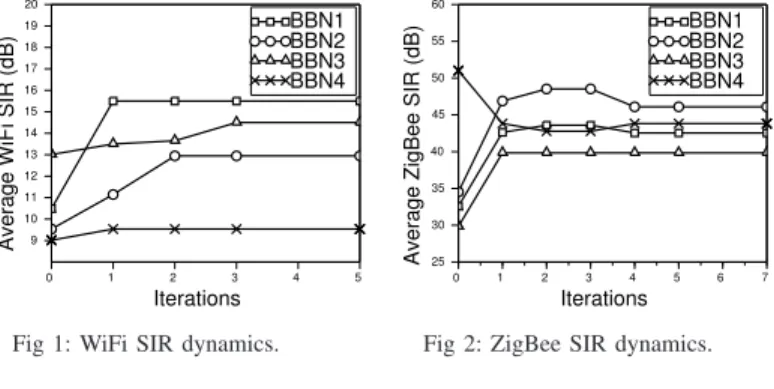
Different BBN scenarios have been simulated using the Scilab software package. We refer to the BBN-specific channel gain model in [6]. The mobile WBANs, which number varies in the range [20,40], are randomly deployed in a1000×1000m area, and divided into four overlapping BBNs. The mobility is simulated using the common random waypoint model. We specifically evaluate the effect of the WBANs density within the BBNs on the dynamics of the SIM game algorithm. As expected, increasing the BBN density results in increasing the network overall interference and then the number of iterations to reach an equilibrium. Besides, Fig.1 and Fig.2 display the evolution of the average signal-to-interference ratios by each BBN, for the BBN stage and WBAN stage respectively. Accordingly, our best-response algorithm is proved to ensure a rather fair, socially-aware channel allocation, so that both WiFi and Zigbee SIRs tend to be quite close to a mean value at the Nash Equilibrium. Finally, it has been observed that the best-response SIM algorithm quickly converges to a stable operational point in few iterations (less than 10), thus representing a practical solution for interference mitigation in realistic BBN scenarios. 0 1 2 3 4 5 9 10 11 12 13 14 15 16 17 18 19 20 Iterations
Average WiFi SIR (dB)
BBN1 BBN2 BBN3 BBN4
Fig 1: WiFi SIR dynamics.
0 1 2 3 4 5 6 7 40 60 30 50 25 35 45 55 Iterations
Average ZigBee SIR (dB)
BBN1 BBN2 BBN3 BBN4
Fig 2: ZigBee SIR dynamics.
REFERENCES
[1] S.L. Cotton and W.G. Scanlon. Using smart people to form future mobile wireless networks. Microwave Journal, 54(12):24–40, 2011.
[2] M. Chen, S. Gonzalez, A. Vasilakos, H. Cao, and V.C.M. Leung. Body area networks: a survey. Mobile Networks and Applications, 16(2):171– 193, April 2011.
[3] S. Paris, J. Elias, and A. Mehaoua. Cross technology interference mitigation in body-to-body area networks. In IEEE WoWMoM’13, pages 1–9, Madrid, Spain, June 2013.
[4] A.H. Mohsenian Rad and V.W.S. Wong. Partially overlapped channel assignment for multi-channel wireless mesh networks. In IEEE ICC’07, pages 3770–3775, Glasgow, Scotland, June 2007.
[5] N. Nisan, T. Roughgarden, E. Tardos, and V. V Vazirani. Algorithmic game theory. Cambridge University Press, 2007.
[6] R. Rosini, R. D’Errico, and R. Verdone. Body-to-body communications: A measurement-based channel model at 2.45 ghz. In IEEE PIMRC’12, pages 1763–1768, Sydney, Australia, Sept. 2012.