HAL Id: hal-01076092
https://hal.archives-ouvertes.fr/hal-01076092v2
Preprint submitted on 6 Nov 2014HAL is a multi-disciplinary open access archive for the deposit and dissemination of sci-entific research documents, whether they are pub-lished or not. The documents may come from teaching and research institutions in France or abroad, or from public or private research centers.
L’archive ouverte pluridisciplinaire HAL, est destinée au dépôt et à la diffusion de documents scientifiques de niveau recherche, publiés ou non, émanant des établissements d’enseignement et de recherche français ou étrangers, des laboratoires publics ou privés.
Distributed under a Creative Commons Attribution - NonCommercial - NoDerivatives| 4.0 International License
To cite this version:
Chi-Han Ai, Miguel Elosua, Shantong Li. Central-local authority relationships and the institutional process of city creation. 2014. �hal-01076092v2�
UrbaChina working paper series
No 4 / October 2014
Central-local authority relationships
and the institutional process of city creation
Authors:
AI Chi-han (Sun Yat-sen Univ.)
ELOSUA, Miguel (CNRS)
Coordinated by CNRS (France’s National Centre for Scientific Research), UrbaChina analyses China's urbanisation trends for the next 40 years and defines possible future scenarios with reference to concepts of sustainability. UrbaChina managed by a consortium of 11 leading Chinese and European research institutions:
•Centre National de la Recherche Scientifique •East China Normal University
•Development Research Center of the State Council •University of Birmingham
•Chinese Academy of Social Sciences •London School of Economics •Chinese Academy of Sciences
•Istituto di Studi per l'integrazione dei Sistemi •Universidade de Lisboa
•Renmin University of China
•Anhui Academy of Environmental Science Research
Report information
Title: Central-local authority relationships and the institutional process of city creation
Partners involved: Centre National de la Recherche Scientifique (CNRS), Development Research Center of the State Council (DRC)
Authors: Ai Chi-han, Miguel Elosua and Li Shantong Date of Publication: October 2014
研究伙伴:法国国家科学研究中心 (CNRS) ,国务院发展研究中心 (DRC)
研究作者:艾之涵, Miguel Elosua,李善同
出版日期:二零一四年十月
The views expressed in this paper are those of the author(s) and do not necessarily reflect the views of the UrbaChina programme.
The UrbaChina working paper series is edited by the UMR 8173, Centre China Korea Japan. Website: http://umr-ccj.ehess.fr/?lang=en
UrbaChina website: http://www.urbachina.eu
UrbaChina blog: http://urbachina.hypotheses.org
Recommended citation
AI, C.-H., ELOSUA, M. and LI S. (2013) Central-local authority relationships and the institutional process of city creation. UrbaChina working paper No.4 October 2014
Working papers series No. 4 / October 2014
UrbaChina, UMR 8173 Chine Corée Japon, 190-198 avenue de France 75244 Paris cedex 13, France [email protected]
3
-By Ai Chi-han, Miguel Elosua and Li Shantong
As one of the fastest-growing economies in the world, China is experiencing the largest scale of urbanisation in human history. More and more land is required to support this massive urbanisation. However, rural land acquisition and compensation to the changes in farmers’ household registration (hukou) are complex issues in the process of urbanisation under the dual land tenure between city and rural areas in China. Furthermore, local government has been under increasing financial pressure after the tax sharing system was implemented in 1994. To raise funds and develop urban construction, various cities have undertaken different strategies of land development during their on-going urbanisation, which is also discussed in this study. Urbanisation is a process of expanding urban space with a view to develop the land efficiently. Therefore, the objective of this study is to introduce the dual land system in China, the evolution of farmers' collective land ownership, and the process of governmental land acquisition. Subsequently, we will examine the case of the case of Shanghai Pudong New Area, which develops land with an insufficient financial support and its corresponding solutions. Finally, the authors highlight problems in the process of land acquisition and land development.
UrbaChina, UMR 8173 Chine Corée Japon, 190-198 avenue de France 75244 Paris cedex 13, France [email protected]
4
Table of contents
I. Urbanisation, land development and central-local relations ... 5
a) State-owned land and collectively-owned land ... 5
b) Rural collective land use rights ... 5
c) The process of governmental land acquisition ... 6
II. A special model of land development in Shanghai ... 7
III. Problems encountered in the land development process ... 8
a) The issue of migrant workers ... 8
b) Soaring land prices ... 9
c) Small property right housing ... 9
d) Farmers’ family register problems after their residence transferred from rural to state-owned urban land .. 9
e) Problems of migrant workers’ citizenisation ... 9
f) The contradiction between protection of basic food and urbanisation ... 10
Conclusion: Overemphasis on the benefits of land development leads to the neglect of the rights of farmers ... 10
References ... 11
Working papers series No. 4 / October 2014
UrbaChina, UMR 8173 Chine Corée Japon, 190-198 avenue de France 75244 Paris cedex 13, France [email protected]
Article 10 of the Constitution of the People’s Republic of China states that:
Land in the cities is owned by the State. Land in the rural and suburban areas is owned by collectives except for those portions which belong to the State as prescribed by law.1 In other words, two different land tenures exist in China, for cities and rural areas: state-owned land and collectively-owned land. This dual system was put into place after the Chinese government the land reforms of the household responsibility system (家庭承包制) and the lease of urban land. Today, the Chinese land system separates right of land ownership (state-owned and collectively-(state-owned) from the right of land use. This means that the right to use state-owned land can be transferred and traded, while for collectively-owned land, the right to use and manage the land belongs to individual farmers.
Under the rapid expansion of Chinese cities, local governments must expand urban space through land acquisition. However, some issues require clarification. What is the process of land acquisition? What financial budget do local governments’ have for land acquisition? What process follows land acquisition and what problems are encountered then? These questions are addressed in the following first section.
I. Urbanisation, land
development and
central-local relations
a) State-owned land and collectively-owned land
China’s dual land tenure system is related to land-use right, put into place after the 1978 economic reform. The government created a system in which only state land was liberalised, rather than the whole land market. The market for land was not liberalised in
1
Article 10 of the Constitution of the People’s Republic of China. 中国人民共和国宪法.
http://www.octs.org.hk/e_ConstitutionLaw.htm#Chap1. (accessed 25 May 2013).
rural areas because the assumption was that granting full ownership rights to farmers (with power of disposal) would have consequences such as (i) farmers’ losing their land by disposal at will in the case of any economic shortage, (ii) the loss of utilised arable land, therefore jeopardising country’s food security (it is often cited that China counts 22% of the world’s population with only 7% of its arable land), and (iii) the creation of slums as a consequence of the influx of surplus labourers to the cities. Underlying the academic discussions was a constant fear of returning to the pre-revolutionary situation where land was held in the hands of a few, which, according to Marxists, constitutes one of the great contradictions of capitalism.
In 1982, the Constitution (now in force) sanctioned the collective as owner of China’s rural land. The term “collective” refers simultaneously to three administrative levels: (i) the rural district (xiang/zhen), (ii) the administrative village (xingzheng cun) and (iii) the natural village or group of villages (nongcun jiti: ziran cun and cunmin xiaozu, respectively). In theory, land ownership is given to the natural village, which exercises its land ownership rights through the village committee (cunweihui, 村委会). In practice, it is the government institutions at the higher levels (rural district and administrative village) that wield effective power. This also shows the continuity with the system practiced until 1978, when the communes and brigades (now townships and administrative villages) administered land arbitrarily without respecting the natural village. The latter usually acts as a contributor to the fulfilment of the objectives of the local government.
The government gave the farmers' collective land use rights; therefore, only rural collective land can be used freely, while urban land can only be developed after a series of governmental procedures.
b) Rural collective land use rights
The collective distributes land use rights to households either for private farming or for home construction, theoretically allocating the rights free of charge and on an egalitarian basis. The distribution (and redistribution) of farmland to households is also known as the House Responsibility System (HRS), the original name when the scheme was launched at the outset of the economic reform, and which was later sanctioned by the 1982 Constitution. Households
UrbaChina, UMR 8173 Chine Corée Japon, 190-198 avenue de France 75244 Paris cedex 13, France
6
receive farmland without compensation in return (an application of the land to the tiller principle). Likewise, the collective allocates land for construction, ensuring farmers the right to adequate housing (zhaijidiquan, 宅基地权). This way, the government answers two basic needs of every individual: shelter and livelihood. Rural land use rights are uniquely associated to the collective identity. To be entitled to farmland (or land for home construction) a person need only be a member of the collective. The requirements to become a member of the collective are vague and imprecise, and are often a source of disputes in rural China. It is usually the agricultural registration or nongye hukou (imperative to every household) that qualifies a household for collective membership, although in some cases it is not sufficient.
The collective economy was set up in order to guarantee that every household had access to work and to adequate housing. Therefore, the collective identity is at the centre of land use right. This is important to note since the now promoted circulation of land rights outside the collective implies the detachment of this nucleus for the first time since its inception.
c) The process of governmental land acquisition
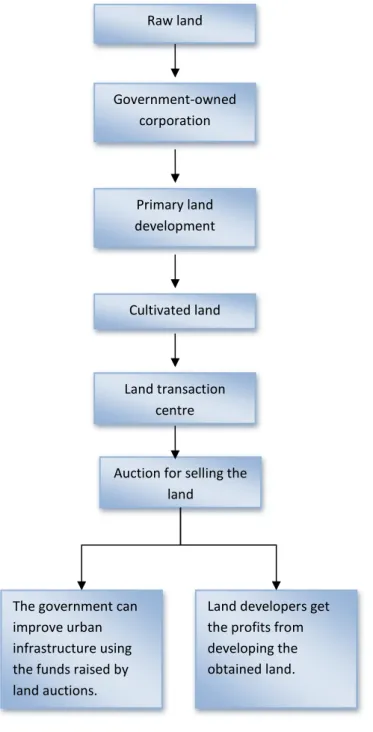
Within this dual land tenure, when urban development reaches a certain scale, more land is required. Therefore, the government levies collectively-owned land in rural areas and compensates the owners, then converts the land into state-owned land to facilitate city construction. Subsequently, the government conducts the primary land development, which is the process of investing in and developing the land before it is contracted to developers, commonly known as changing “raw land” into “cultivated land”.
Primary land development includes land acquisition, land consolidation, and land reserve. These three processes are needed to satisfy the requirements of municipal infrastructure indicators and urban planning guide for demolition, land levelling and construction of public facilities to achieve the standards for land transfer.
The executive units of primary land development are the local government or the companies specified by the local government, such as urban investment
companies and land reserve institutions, which are supervised by the government. After primary land development, ‘cultivated land’ can be traded in the land transaction centre. The government holds auctions where developers can participate in bidding. Developers are attracted to the profits they can make from developing this land. Meanwhile, the government can improve existing urban infrastructure using the funds collected by land auctions. Therefore, expansion into suburban rural land and the re-development of existing urban land are complementary activities.
After the implementation of the tax-sharing system in 1994, local finance was substantially affected, which allowed the central government to handle the majority of tax levies. As a result, land auctions became an important source of revenue for the local government. The government expected these auctions to increase land price, providing a greater budget for ongoing urban land development. According to the Eleventh Five-Year Guideline2, land transaction revenue grew rapidly from 767.7 billion RMB in 2006 to 2,911 billion RMB in 2010. The increase rate is approximately 35% that of the central government and 71.7% that of the local government. Also, according to the statistics of the land management department, the ratio of land conveyance income to local financial revenue from 1999 to 2009 had risen from 0.092: 1 to 0.437: 1, the ratio of land conveyance income to local non-budgetary income had risen from 0.163: 1 to 1.942: 1 (see Table 2).
As a part of extra-budgetary funds, land conveyance income is called “the second financial revenue” and its proportion in local financial revenue is gradually increasing. In some places, the land conveyance income exceeds other kinds of financial revenue, and has become the main source of revenue (see Table 3). As a result, land prices soar. Before 1992, the market economy was not established, and the compensation the government gave to the owners of
2 Woguo xiao chanquan fang wenti yanjiu: Xianzhuang yu chulu 我国小产权房问题研究:现状与出. REICO 工作室.
http://wenku.baidu.com/view/be3c12282af90242a895e53 d.html (accessed 5 February 2013)
Working papers series No. 4 / October 2014
UrbaChina, UMR 8173 Chine Corée Japon, 190-198 avenue de France 75244 Paris cedex 13, France
7
owned land was merely a formality. The government compelled the transfer of ownership. After 1992, once the market economy was established and developed, urban land prices increased. The significant difference between the price of collectively-owned land in rural areas and the price of land in the city, created several problems, such as violent land acquisition and forced demolition of farmers' property. Collectively-owned land cannot be developed directly, therefore, it is necessary to transform collectively-owned land into state-owned land. However, farmers still received little compensation, while the bidding for the rural land levied by the government tended to reach a sum tens or hundreds of times their compensation. The farmers felt that the government neglected their interests. As a result, a number of farmers are reluctant to sell their land, thereby resulting in obstacles and problems for urban development. As one of our interviewees stated:
Before 1992, all lands in China were owned by the state. But the regime changed in 1992. It decided to divide the ownership of lands: lands in the city belong to the state but rural lands are owned by the farming communities. If the government needs the land expansion for urbanisation, it must first expropriate lands from the farming communities.
As for the expropriation of land, the government gives a symbolic amount of money incomparable to the actual market value. In other words, the compensation is still meagre. Now the situation has changed; farmers come to realize their loss in the transfer of their lands to the state. Thus, farming communities become unwilling to give their lands to the government. This obliges the government to tear down houses or to take strong measures to enforce the expropriation. Although the government does increase the compensation in recent years, there is still a huge discrepancy between the actual market price and the price submitted by the state3.
The above section introduced the government land acquisition process and the contradictions and problems of urban development in China. In the
3
Interview of 15 March 2012, Kunming
following section, the example of Shanghai will be used to explain the relation between urban expansion and land finance, and the importance of land finance to the local government.
II. A special model of land
development in Shanghai
The relation between land expansion and local tax revenue has already been described, as well as the process of governmental land acquisition. However, there exists a special model of land development in the development zones of Shanghai (including Jinqiao, Lujiazui, Waigaoqiao, and Zhangjiang), different from those of other cities in China. The creation of this model is to avoid dependence on local finance. In these development zones of Shanghai, the Pudong New Area government is in charge, not the Shanghai city government. Because the Pudong New Area government is responsible for promoting investment and setting up infrastructures with limited financial resources, the government has designed a special model to finance and build the development zones. This land development model is called the “land rolling development model”.First of all, the Pudong New Area government evaluates the price of rural collectively-owned land, and then pays 30% of the estimated price as the “land pre-acquisition costs” to the rural collective land owner to convert the land into state-owned land. “Land pre-acquisition costs” cover the transfer of land ownership and land management. Then, the Shanghai Municipal Finance Bureau sets up the Development Zone Company. The funding provided to the company equals the estimated price of the rural collectively-owned land. When the Development Zone Company receives the fund, it purchases the development zone land from the Land Authority of Shanghai and signs the land use contract, thus acquiring the right to use the land. Next, the land ownership and the land management are transferred to the Development Zone Company. In this process, the flow of capital between the government and the Development Zone Company is counterbalanced. The land is transferred to the Development Zone Company without payment. In addition, the Development Zone Company may
UrbaChina, UMR 8173 Chine Corée Japon, 190-198 avenue de France 75244 Paris cedex 13, France
8
mortgage the land in order to receive loans to be used for the construction of the development zone. With the land loan, the Development Zone Company will need to pay only 70% of the property price to procure full ownership of the land and to develop it.2
This “land rolling development model” enables the Pudong New Area government to raise funds and build the necessary infrastructure within the development zone. This model can reduce the dependence of regional development on the local government. However, in the total cost of urbanisation in Shanghai, land development accounts for a major part of local fiscal spending.
Tax distribution and the reform of income tax-sharing have put a certain strain on the fiscal revenues of local governments, forcing them to find new fiscal sources by developing the construction industry and adding off-budget revenues. The reform of the urban housing system and enacting of the Law of Land Management in 1998 triggered the rapid rise of businesses’ and residents’ needs for urban land development. Accordingly, after the tax distribution system was adopted, the area of leased land in Shanghai increased considerably and its fiscal revenues also rose rapidly. In this context, land leasing and acquisition have become the major source for local governments to increase their budget and off-budget revenues. This way, land development and fiscal revenues in Shanghai form a mutually beneficial cycle. By using the large sum of revenues from land leasing and acquired urban land for development, local governments can pledge or guarantee their fiscal revenues to get larger financial loans for urban development. This way, land revenues, bank loans and land acquisition have become a constantly expanding cycle. This process has not only helped build the current urban landscape in Shanghai, but also brought about important sources of income for the Shanghai Municipal Government. At the same time, the mammoth wealth also influences the relations between the central government and local governments.
III. Problems encountered in
the land development
process
The process of urbanisation in China clearly depends heavily on land development and local fiscal financing, and there are several notable problems in the land development process.
a) The issue of migrant workers
The Chinese household registration (hukou system) divides rural and non-rural household registrations. Changing household registration is not allowed in most Chinese cities. However, people’s social security, children’s education, etc. depend on which system they fall under. Rural workers who move into the cities for work are not considered urban citizens, and therefore cannot benefit from urban welfare. After the economic reforms and opening up policies in China, foreign direct investment caused an increased demand for labour. This situation drove millions of rural workers to move into the cities without the urban hukou: these people are referred to as “migrant workers”.
Two phenomena contributed to the existence of migrant workers: active and passive migration. Active migration means that rural workers move into cities with the intention of finding a job with a salary high enough to offset their rural income. Because these workers keep their rural hukou identity, their social security and children’s education are subject to the administration of their original hukou system. These workers still possess a homestead ( 宅基地 ) and farmland in rural areas; however, they do not have a residence in the city. They usually have to live in a collective dormitory provided by their employer or rent a house of their own. By contrast, passive migration refers to the situation in which rural residents, who originally reside in the city suburbs, are absorbed by the city as a consequence of urban expansion. However, due to the previously mentioned restrictions to acquiring the urban hukou in large-sized cities, these new “urban peasants” keep their rural hukou.
Working papers series No. 4 / October 2014
UrbaChina, UMR 8173 Chine Corée Japon, 190-198 avenue de France 75244 Paris cedex 13, France
9
At the present stage, local governments want to acquire the land of passive migrants and to increase their taxes, which results in “hurrying farmers to move to high-rises (赶农民上楼 )”. This in turn means increasing land benefits by forcefully acquiring farmers’ collectively-owned land and moving the residents into urban high-rises. However, the main problems concerning migrants are caused by active migrant workers’ housing problem, social security issues, etc. Therefore, the way governments help migrants integrate the city after the acquisition of passive migrant worker’s land and improve active migrant workers’ housing situation remains an important issue to resolve.
b) Soaring land prices
After acquiring, demolishing, and levelling the land, the government trades it at the land transaction centre. According to Articles 4 and 27 of the Regulations for State Owned Land Bids, Auctions, and Quotations published by the Ministry of Land and Resources of the People's Republic of China, “certain types of land use (commerce, tourism, entertainment, and commodity housing) must be sold through bidding, auctions, or quotations.” Under this system, construction land can therefore only be obtained through these methods organised by the government. However, the auction system stimulates land prices to rise and influences the housing price decided by developers.
c) Small property right housing
Generally, collectively-owned land cannot be developed into commodity housing until it is changed into state-owned land. However, in recent years, because urban land and housing prices have climbed, small property right housing is being built on collectively-owned land. By selling small property right housing, farmers and the community can share the value-added benefits of the land. However, this type of housing is approved only by the township government or the village committee, not the central government. This is a clear sign of the lack of consistency in policy between the local and central government.
d) Farmers’ family register problems after their residence transferred from rural to state-owned urban land
As previously stated, differences exist between state-owned land and collectively-state-owned land in the Chinese land ownership system. In addition, there are difference between rural and urban family registers, as specified by the Chinese family register system. However, when a farmer's residence is transferred to state-owned land and as the city takes over the land, the farmers are forced to integrate into the city. In China, changing family register is strictly forbidden. Rural workers therefore cannot easily acquire the urban family register. This hinders population mobility and free migration between cities, which affects rural housing, free medical treatment and social insurance. According to Tang Mahuan4, employees whose family register is in Shanghai usually have pensions, unemployment insurance, medical insurance and a fund for their social insurance. Although the employees must pay a portion of the insurance premium, which is respectively 6%, 1%, 2 %, and 7% of their monthly income, their company pays a greater share, accounting for 22.5%, 2%, 12%, and 7 % respectively. However, the employees with a rural family register can only have medical insurance premium taken based on their monthly average income of the previous year, accounting for 2 to 3%. The farmers also pay social insurance for their pensions. In social assistance, urban family registers can have a minimum subsistence support of 3360 RMB per year, which is 1360 RMB higher than rural family registers. Additionally, urban family registers receive unemployment benefits, but rural family registers do not.
e) Problems of migrant workers’ citizenisation
A complex relationship exists between citizenisation of migrant workers and urbanisation, because rural workers generally have a lower education than urban residents do, and their life styles differ as well. When the land is levied by the government, farmers are
4
Tang Mahuan (2008) Study of problems and government countermeasures in the process of urbanisation: the case of Qingpu District in Shanghai. Master thesis, Shanghai Jiaotong University, Shanghai.
UrbaChina, UMR 8173 Chine Corée Japon, 190-198 avenue de France 75244 Paris cedex 13, France
10
forced to enter the city, yet they keep the rural register, which influences their medical benefits and their children's education. The hukou system has been eased somewhat by the Chinese government in recent years to enable migrant workers to benefit from urban social security, but the cities where it is eased are mostly small- and medium-size. The reason the government cannot liberalize the hukou completely in large cities is because this would bring a huge, and sudden, burden to their social insurance. Governments need to be extra prudent dealing with this reform. Helping the citizenisation of migrant workers and their integration into the city will be a crucial problem in China’s near future.
f) The contradiction between protection of basic food and urbanisation
Because of urbanisation, the government takes over agricultural land, which impacts agricultural production. Therefore, the Ministry of Land and Resources of the People's Republic of China regulates each city’s development to protect a certain area of agricultural land. However, each city has their position and strategy regarding development. Protecting agricultural land ensures the basic food supply, of course, but it obstructs the progress of urban development. One of our interviewees said, “the Shanghai government wants to reserve a portion of the farmland, but this policy should vary from city to city. We communicated the idea to the State Council, but the council did not agree.”
After the implementation of the tax-sharing system in 1994, local finance was substantially altered, which enabled the central government to handle the majority of tax levy. As a result, land auctioning became an important source of revenue for the local government. The government expects to increase land prices thanks to these auctions, providing a greater budget for their current urban land development. Therefore, the main objective of
China’s urbanisation is to develop the economy and raise land prices. This process requires the industrialisation and the development of real estate. Industrialisation attracts foreign investment, which helps increase the GDP of a region. Development of real estate helps raise the price of land, which provides indirect revenue for the local government. However, this pattern of urbanisation lacks sustainability in China, because it entails several conflicting situations.
First, this pattern directly influences the real estate industry. It has resulted in the high price of real estate, which may cause a property bubble. Furthermore, the effect of urbanisation may go well beyond the housing market. When a city is filled with expensive houses, the high cost of living may push away talented employees, preventing companies in the city from recruiting them. Also, the high price of real estate may increase companies’ production cost. I could also cause the appearance of “ghost towns”. Worse, this situation could lead to a decline of competitiveness in the manufacturing industry.
Secondly, the government also relies on the development of real estate to boost overall economic development, and financial benefits obtained in this way are used to build infrastructure and to invest in economic projects. The objective of urbanisation, however, is not to improve residential quality. In other words, there are two dynamic directions present in China’s urbanisation: impetus and traction. Impetus is mainly a result of labour flooding in from outside the city and work in industry; migrant labour encourages urbanisation in China. Traction results from industrialisation and economic growth, which helps promote urbanisation in China. However, China has focused on technical innovation and has neglected the quality of human capital, thereby preventing urbanisation from being sustainable at the present stage.
Thirdly, after the government acquires land, farmers are forced to enter the city, without then receiving a new urban register. The government does not have comprehensive measures to take care of rural workers’ medical benefits or their children's education. This in turn causes an inequality of quality of living between urban citizens and the rural worker living in urban areas.
Working papers series No. 4 / October 2014
UrbaChina, UMR 8173 Chine Corée Japon, 190-198 avenue de France 75244 Paris cedex 13, France
11
There are solutions to the problems mentioned above. First, the fiscal system in China should be reformed to help coordinate local governments’ financial demands and their plans for infrastructure (China’s current fiscal system works this way: the local government pays a certain percentage of the levied tax to the central government, but the needs of the
local government for the funding of infrastructure is not taken into account). Second, the land system should be reformed. Currently, the government has a monopoly on land, and auctions it off on the market, thereby generating high and competitive prices. The real estate industry should also be reformed along the same lines.
Chen, W. Z. (2006). The accumulation of and competition for land capital in the evolution of Shanghai’s urban space. Urban Planning Forum, Vol.3, 69-75.
Li, X. W., Fang J. Y. & Piao, S. L. (2003). The intensity and pattern of urban land expansion in Shanghai. Journal of Natural Resources, Vol.4, 412-421.
Li, Y. (2005). Institutional analysis of land use policies in China under the transition economy: with reference to rural to urban land conversion in Guangzhou. Hong Kong: The Hong Kong Polytechnic University.
Mahuan T. (2008). Study of problems and government countermeasures in the process of urbanisation: the case of Qingpu District in Shanghai. Master thesis, Shanghai Jiaotong University, Shanghai.
Shen, J. (2007). Scale, State and the City: Urban transformation in post-reform China. Habitat International, 31 (3-4), 303-316
Zhang L., Wang X. B. & Xu X. X. (2011). Fiscal incentives, political incentives and local officials’ land transfer. China Industrial Economics, Vol.4, 35-43.
UrbaChina, UMR 8173 Chine Corée Japon, 190-198 avenue de France 75244 Paris cedex 13, France
12
Table 1. Land revenue during the Eleventh Five-Year period in China (billion yuan, %)
Year Land transaction revenue in China National fiscal revenue Ratio of land transaction revenue to national fiscal revenue
Local fiscal revenue Ratio of land transaction revenue to local fiscal revenue 2006 767.7 3,876.0 19.8% 1,830.4 41.9% 2007 1,300.0 5,132.2 25.3% 2,357.3 55.1% 2008 1,037.5 6,133.0 16.9% 2,865.0 36.2% 2009 1,424.0 6,847.7 20.8% 3,258.1 43.7% 2010 2,911.0 8,308.0 35.0% 4,061.0 71.7%
Table 2. State-owned land transfer income turnover and compare with local finance income and local non-budgetary income: 1999-2009 (billion yuan)
Year Turnover Local fiscal revenue Local non-budgetary income Ratio of Land transfer income to local fiscal revenue
Ratio of Land transfer income to local
non-budgetary income 1999 51.43 559.487 315.472 0.092 0.163 2000 59.56 640.606 357.879 0.093 0.166 2001 129.59 780.33 395.3 0.166 0.328 2002 241.68 851.5 403.9 0.284 0.598 2003 542.13 984.998 418.743 0.55 1.295 2004 641.22 1189.337 434.849 0.539 1.475 2005 588.38 1510.076 514.158 0.39 1.144 2006 807.76 1830.358 594.077 0.441 1.36 2007 1221.67 2357.262 628.995 0.518 1.942 2008 994.39 2770.342 n/a 0.359 n/a 2009 1423.97 3258.074 n/a 0.437 n/a
Working papers series No. 4 / October 2014
UrbaChina, UMR 8173 Chine Corée Japon, 190-198 avenue de France 75244 Paris cedex 13, France
13
Table 3. Twenty cities with the highest land conveyance income in 2009 (billion yuan)
Ranking City 20095 Comparison with
2008 2008 Comparison with 2007 2007 1 Hangzhou 105.4 2.38 31.2 0.63 64.6 2 Shanghai 104.3 1.72 38.2 0.3 80.3 3 Beijing 92.8 0.85 50.3 1.12 43.8 4 Tianjin 73.2 0.67 43.9 0.89 38.8 5 Guangzhou 48.9 3.01 12.2 0.51 32.3 6 Ningbo 48.8 6.17 6.8 8.41 5.2 7 Chongqing 44 2.76 11.7 0.4 31.4 8 Wuhan 36.1 3.45 8.1 0.35 26.7 9 Foshan 33.2 3.9 6.8 0.54 21.6 10 Chengdu 32.4 3.89 6.6 -0.18 39.6 11 Wuxi 31.5 2.78 8.3 - 1.6 12 Xiamen 30.3 4.75 5.3 -0.14 35.2 13 Shenyang 29.5 0.93 15.3 -0.06 31.3 14 Suzhou 27.5 3.26 6.5 -0.35 42.2 15 Dalian 26.2 0.79 14.6 4.55 4.7 16 Nanjing 24.2 0.66 14.6 -0.37 38.3 17 Jinan 18.3 3.6 4 5.15 3 18 Changzhou 17.6 2.62 4.8 1.87 6.1 19 Qingdao 15.5 0.56 9.9 0.47 10.5 20 Hefei 15.4 1.37 6.5 0.79 8.6
Data sources: China's real estate index system database6
5 This table shows the land conveyance income between 2007 and 2009. Hangzhou has the highest land conveyance income in 2009, 105.4 billion yuan, and the growth rate is 2.38. In 2008, the growth rate is 0.63.
6
UrbaChina, UMR 8173 Chine Corée Japon, 190-198 avenue de France 75244 Paris cedex 13, France
14
Figure 1. Process of governmental land acquisition
Raw land Government-owned corporation Primary land development Cultivated land Land transaction centre
Auction for selling the land
The government can improve urban infrastructure using the funds raised by land auctions.
Land developers get the profits from developing the obtained land.
Working papers series No. 4 / October 2014
UrbaChina, UMR 8173 Chine Corée Japon, 190-198 avenue de France 75244 Paris cedex 13, France
15
Figure 2. “Land rolling development model” in Shanghai
Development Zone Company purchases development zone land using funds
provided by the government
Land ownership and land management are transferred to the Development Zone Company
Rural collectively-owned land
Pudong New Area government pays 30% of estimated price to convert land ownership and land management (land pre-acquisition costs)
Pudong New Area government
Government establishes the Development Zone Company
Development Zone Company may mortgage land for loans to construct the development zone.
Development Zone Company pays 70% of the land price to procure full ownership of the land