Working Papers
2015 / 01
M. Pizzetti, P. Seele, M. Gibbert
Experimental evidence of unethical gift reconstruction in consumer
moral reasoning
1
Experimental evidences of unethical gift reconstruction in consumer moral reasoning
Marta Pizzetti, Peter Seele, Michael Gibbert
Institute of Marketing and Communication Management Università della Svizzera italiana
2
Abstract
There are empirical evidences that consumers do not walk the talk. Although they express a
preference for ethical products, they often consume indifferently. Nonetheless, we know little about the factors that facilitate unethical consumption. This article uses the experimental method to investigate the unethical consumption in the gifting experience context and the impact of
psychological distance. An exploratory study shows that consumers are willing to accept morally questionable gifts in order to not hurt the giver. Moreover, two experiments demonstrate that consumers are a. eager to accept an unethical gifted product and b. they cognitively reconstruct it as less unethical. However, the unethical gift cannot be reconciled from an emotional standpoint, resulting in an emotional misalignment. The recipient feels guilty about the decision, especially if the product is sourced locally. Several theoretical and managerial contributions are derived from this study’s findings.
Keywords: experimental design, gift exchange, moral disengagement, psychological distance,
3
Introduction
Imagine receiving a gift that is inconsistent with one’s moral values, such as a product obtained from the poaching of endangered animal. What would you do with this gift? Would it be more socially acceptable to accept the gift and breach your moral values, or stand up for your values and refuse the gift? Ward and Broniarczyk (2011) analyze the purchasing of identity-contrary gift. They demonstrate that givers, who buy an identity-contrary gift to please a friend, subsequently buy an identity-confirming product for themselves in order to reduce the discrepancy between their identity and the purchase. What about the recipients? How do they reconcile the gap between their values and the gift features? How would they react emotionally?
We investigate the unethical consumption in the gift exchange context. With an exploratory study and two experiments, we show that gift recipients accept an unethical gift voluntarily and subsequently engage in self-justifying and reconstructing the decision cognitively. By means of moral disengagement reasoning (Bandura, 1991; 1999), such recipients reduce the cognitive dissonance that the decision creates and successively perceive the product as less unethical. However, they cannot reconcile the unethical decision from an emotional standpoint, which results in an emotional misalignment. Findings show higher intensity moral emotions (e.g. guilt, blame, embarrassment) in recipients than in participants asked to buy a self-gift. Moreover, psychological distance – the perception of being close or distant from a product – moderates moral emotions. According to previous research on psychological distance (Williams et al., 2014), feeling close to a product exacerbates the negative emotions and increases the moral disengagement.
By undertaking our research within a gifting setting, we contribute to the (un)ethical consumption and moral reasoning literature. Specifically, we focus on self-conscious moral emotions (i.e. blame, guilt, embarrassment, contrition), which consumer research should investigate given its influence on decisions (Haidt, 2001; Kim and Johnson, 2013). We empirically demonstrate the emergence of two divergent paths in unethical consumption. One is cognitively controlled and consists of a moral
4
justification and reconstruction of the unethical decision. The second is emotional and comprises eliciting moral emotions. Specifically, self-blame due to an unethical decision throws a shadow over the gift exchange experience, which is, usually, depicted as a happy moment. Our findings are in line with Sherry and colleagues’ (1993) conceptualization of the ‘dark side’ of the gift. In our research, the dark side comprises the self-attribution of blame, which is misaligned with the unethical decision’s cognitive reconstruction. Notably, guilt is maximized when the product is perceived as psychologically close. We therefore seek to explain why consumers retain unethical products, including the psychological distance, as a facilitator of unethical consumption. Previous research has demonstrated the influence of psychological distance on consumers’ evaluation. This research shows that psychological distance moderates the relationship between the gifting experience, the moral disengagement, and the unethicality perception. Further, psychological distance shapes the consumption emotions, amplifying the self-blame in the case of spatial proximity.
Theoretical background
1. The utility perspective: Reconstructing an unethical gift to maintain friendship
1.1 The moral dilemma of receiving an unethical gift
We internalize society rules, norms, and values from our reference groups. These internalized rules are the criteria for making decisions. However, in some situations, in which society rules and moral values contradict each other, individuals face a moral dilemma. In such situations, people might apply a utility-based approach, choosing the lesser of two evils. For example, receiving a gift that is incongruent with one’s moral value might create ambiguity regarding the most appropriate behavior. Although the gift is ethically challenged, gift are considered a token of love and givers’ efforts and motivations negate the potentially negative effects of a disliked gift (Ruth et al., 1999).
5
Moreover, the high ritualization of gift exchange obliges recipients to accept a gift (Mauss, 1956), to show their gratitude, and to use the gift (Sherry et al., 1993). According to the tacit norm of gift exchange, gift refusal is commonly considered impolite and hateful and could even damage or end their relationship with the donors (Sherry et al., 1993; Ruth et al., 1999).
However, not all gifts are equal, and although the majority comes from a donor, consumers often engage in buying products as gifts. A gift is a highly planned and symbolic self-communication (Mick and DeMoss, 1990; Mick and Faure, 1998), which differs from other personal purchases due to the situational and contextual factors (Mick and DeMoss, 1990). Self-gifting has two connotations. According to Luomala (1998), consumers buy gifts for themselves to alleviate stress, irritation, or negative moods in general. Besides for therapeutic reasons, consumers engage in purchasing self-gifts as rewards (Mick and DeMoss, 1990). In this instance, the self-gift is a self-indulgence that individuals feel they deserve for their personal success or another achievement (Mick and Faure, 1998). In both situations, uncommonness, and sacred aspects characterize self-gifts (Mick and DeMoss, 1990), which people use as a self-message and to protect or augment their self-esteem.
Self-gifting is a relevant phenomenon (Mick and DeMoss, 1990), but little attention has been devoted to examine it or to compare self-gifting with dyadic gift exchange (Belk, 1979). We combine these underresearched aspects and propose that gift experiences affect to the product perception and the consumer decision-making process. Specifically, given the confirmatory nature of self-gifts, individuals could refuse to buy a morally questionable product, although they feel to deserve such products. Conversely, given the relationship-breaking power of gifts, recipients might prefer to not hurt givers and thus accept morally questionable gifts if a friend were to gift them. More formally:
H1: Gifting experiences affect the acceptance of unethical products. If received as a gift (vs. self-gifted), the likelihood of unethical product acceptance increases
6 1.2 Making sense of unethical choices
According to social cognitive theory, confronted with a morally ambiguous situation, individuals behave in line with their internal moral standards (i.e. ethically), due to anticipatory self-sanctions. Following moral rules enhances self-esteem, whereas their violation activates self-punishment, which neuroscientific evidences also support. fMRI (functional magnetic resonance imaging) studies have confirmed an internal punishment-reward mechanism consisting of a neural activation when complying with or violating social rules (Rilling et al., 2002; de Quervain et al., 2004). However, by misrepresenting and reconstructing one’s actions, one can disengage from self-sanctions. Through this process, namely moral rationalization, unethical actions are self-justified and, consequently, considered less unethical and more acceptable (Bandura, 1991). Bandura (1991; 1999) maintains that the moral rationalization process comprises four moral disengagement functions, which operate separately, or successively. The functions are a) moral justification through cognitive reconstruction, or the euphemistic labeling of the behavior; b) minimization of the consequences; c) responsibility displacement or diffusion, and d) dehumanization of the victims. Moral justification consists of interpreting the phenomenon in such a way that it is consistent with one’s values, for example, defining a bribe as a gift. If the consequences are minimized, harmful conducts appear to have insignificant outcomes, for instance, believing that one citizen’s tax evasion will not hurt the entire community. Considering an immoral act as common, or believing that an authority necessitate it, are examples of responsibility displacement. Finally, dehumanization blocks empathetic reactions, or emphasizes the own dissimilarity with the victim.
The literature on moral reasoning suggests that individuals revert to the above process due to internal (Mazar et al., 2008) or external cues (Paharia et al., 2013). Empathy, moral identity, cynicism, and the locus of control are antecedents of moral disengagement (Detert et al., 2008; Vitell et al., 2011). Individuals high in self-efficacy are less likely to morally disengage, or behave unethically (Farnese et al., 2011; Shepherd et al., 2013), while self-centered individuals are more
7
inclined to morally disengage (Detert et al., 2008). Besides individual differences, external circumstances also relate to morally disengage (Kish-Gephart et al., 2014). For instance, work characteristics affect workers’ attitude to whether work harassment and organization deviance are acceptable (Claybourn, 2011; Samnani et al., 2014). This tendency is also manifested in consumption setting. Affective states (such as affection and love) influence consumers’ reasoning regarding the products, increasing their counterarguments (Ahluwalia et al., 2000). Further, conforming to social-norms facilitates the use of neutralization techniques to minimize the dissonance (Gruber and Schlegelmilch, 2014). Accordingly, the likelihood of moral disengagement is linked to the extent to which the group of important others considers specific behaviors a tacit rule. Likewise, we might expect the gifting experience to affect the moral disengagement process and a product’s unethicality evaluation, increasing the former and decreasing the latter. Our formal hypothesis is
H2: Gifting situations affect the evaluation of a product’s ethicality and the moral disengagement process. When a friend gifts an unethical product (vs. self-gifted) this leads to a lower perception of unethicality (H2a) and to increased moral disengagement (H2b).
2. Out of sight, out of mind: The psychological distance effect
2.1 The psychological distance effect on moral reasoning
Prior research suggests that the spatial or temporal position of an event, or a product, influences consumers’ evaluations and perceptions (Liberman et al., 2007). For example, individuals find performing tasks that are spatially distant from them less difficult (Thomas and Tsai, 2012) and value a high-price product less favorably when the purchase is imminent than when it is farther in the future (Bornemann and Homburg, 2011). These are examples in the growing stream of studies on psychological distance. Following Trope and Liberman (2010), psychological distance is defined
8
as the set of subjective experiences associated with being close or distant from some event, product, or person. A product or an event is psychologically distant when it belongs to someone else (i.e. social distance), when it comes from foreign countries (i.e. spatial distance), and when it is evaluated before it is available on the market (i.e. temporal distance) (Fujita et al., 2006; Bornemann and Homburg, 2011).
A wealth of psychological evidences suggests a link between psychological distance and construal level theory (Liberman et al., 2007). Individuals construe psychologically distant events in a high-level construal, which means that such events are mentally represented with simple, abstract, and decontextualized features. On the other hand, if an event will take place soon, individuals mentally provide it with concrete features and rich details (a low-level construal) (Trope and Lieberman, 2010). These changes in the way events and products are mentally represented influence choices and consumption practices. In a high-level construal, consumers prefer a larger assortment because they overlook the dissimilarities between products (Goodman and Malkoc, 2012). Conversely, psychological ownership is associated with a lower-level construal, because owned products are mentally provided with rich details and more concretely than not-owned ones (Claus et al., 2012). Psychological distance also affects moral evaluations. When individuals feel psychologically close to someone involved in dishonest behaviors, they are more likely to consider the action as less blameworthy or unethical, and, consequently, are more likely to also act unethically (Gino and Galinsky, 2012). The principle is that in close relationships, individuals tend to incorporate others’ behaviors in the self, and act similarly (Aron et al., 1991; Gino and Galinsky, 2012).
Prior research on psychological distance and moral reasoning has only focused on a single dimension of psychological distance – social distance (Gino and Galinsky, 2012; Choi and Winterich, 2013). Very little research has focused on the other psychological dimensions’ influence on (un)ethicality evaluations. Our paper aims at extending the moral disengagement literature by investigating how spatial distance dimension influences moral reasoning and its outcomes. Spatial
9
distance has a pervasive effect on judgments due to its primary appearance in children’s reasoning development (Henderson et al., 2006; William and Bargh, 2008;). Spatial relations are first learned by in children, who base their learning on senses and experiences (Clark, 1973; Mandler, 1992). Similarly, adults construe mental concepts in terms of “here” and “there”, and use spatial metaphors to represent abstract concepts (Kim et al., 2012). We expect that by accepting a gift perceived as psychologically close, recipients mentally represent it with concreate features. Subsequently they need to engage more in self-justifying or reevaluating it, in order to consider it less unethical. Thus, our formal hypothesis is:
H3: Moral disengagement reasoning mediates the relationship between receiving (vs. self-gifting) a psychologically distant unethical product (vs. close) and the lower perception of this gift’s unethicality.
2.2 Psychological distance and moral emotions
In addition, the existing studies on psychological distance and moral judgment have investigated the cognitive process and its outcomes, and there is few studies on the affective outcome. Williams and colleagues (2014) find that the psychological distance reduces the felt affect’s intensity, causing an increase in a negative experience’s positive affect. Building on Williams and colleagues (2014) findings and suggestions, we propose that the psychological distance decreases the moral emotions that an unethical decision engenders. In essence, we propose that moral emotions follow a separate route from the moral disengagement process, which only influences cognitive evaluations. Current theorizing on moral judgment emphasizes the presence of dissociable psychological processes, which provide opposing responses to moral decisions. Neuroimaging studies have showed that a moral dilemma activates two neurological paths: one associated with emotions, the other with cognition (Cushman and Green, 2012). The affective outcome is immediate and automatic, while the cognitive is effortful, controlled, and occurs ex post (Haidt, 2001; Valdesolo and DeSteno,
10
2006; Cushman and Green, 2012). Accordingly, it worth investigating these two dissociable consequences in consumption choice, which psychological distance moderates.
Moreover, emotions have been studied as antecedents of ethical behaviors, while their relationship with moral reasoning in consumption choice has not been investigated. Specifically, there is a gap in the literature regarding moral emotions, though their role in consumption choice (Haidt, 2001; Kim and Johnson, 2013). Moral emotions are important in decision-making, because, by defining an act as good or bad, they act as a compass needle. Moral emotions are classified into two categories. One refers to others’ behaviors, which include anger and disgust. The second category consists of those emotions evoked by the self-evaluation of the own conduct, such as guilt, blame, and embarrassment (self-conscious emotions: Haidt, 2003). This research aims to bridge the literature gap regarding moral emotions by investigating whether and how psychological distance and the gifting experience affect self-conscious emotions. More formally:
H4: When an unethical product is gifted (vs. self-gift), psychological closeness amplifies the moral emotions associated with acceptance of the gift.
3. Three studies on unethical consumption outcomes
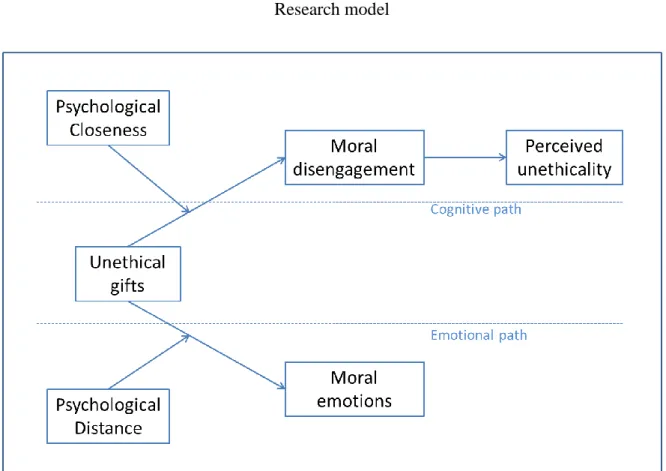
We next describe our exploratory study and two experiments we undertook to test our hypotheses. The exploratory study (Study 1) consists of an online investigation of user-generated content regarding morally questionable gifts. Study 2 manipulates the gifting experience to test whether a gift-receipt experience facilitates the acceptance of an unethical product (H1) and modifies the unethicality perception (H2b). Study 3 adds psychological distance as a second factor to test Hypothesis 4, which posits that psychological distance moderates moral emotions and also analyzed the mediating effect of moral disengagement on unethicality perceptions in depth (H2a, and H3). Figure 1 summarizes the research model.
11
Our experiments presented items obtained from the poaching of endangered animals as the unethical products. Unethical consumption covers a wide array of consumption practices. It is defined as the consumption of products whose production wastes natural resources, or harms humans or animals, such as products produced in sweatshop factories, or that have been tested on animals (Oh and Yoon, 2014). Specifically, we used a decorative ivory item (Study 1) and a scarf made of a Chiru antelope’s wool (Study 2). Ivory items are made from elephant tusks, for which elephants are killed. After a significant decrease in the elephant population from the mid-1970 onward, the 1989 Convention on International Trade in Endangered Species (CITES) banned the trade. However, CITES (2013) has showed that the total weight of seized ivory reached its maximum in 2011 (40.000 kg) and that the illegal trade is still increasing. The Chiru is an endangered species of Tibetan antelope that is killed to obtain its wool, known as shahtoosh. The wool of at least three antelope is needed to make a normal scarf. The number Chiru is decreasing by the year due to poaching in many Asian regions (The Guardian, 2014). To identify the product, we conducted a pretest asking 83 participants (mean age = 39,7; 47% male) to rate the perceived unethicality of products derived from the illegal trade in wildlife (i.e. an ivory item, a coral item, a Chiru wool scarf, a shell). The unethicality perception was assessed with two items on a 7-point Likert scale (adapted from Battacharjee et al., 2013). The ANOVA analysis revealed that the ivory item (M= 4.97) and the Chiru wool scarf (M=5.00) were perceived as significantly more unethical (F = 24.397, MSE =19.777, p < .01) than the coral item (M= 4.07) and shells (M= 4.23). Given the results, we selected the ivory item and the Chiru wool scarf as stimuli for our studies.
In addition, we developed fictitious scenarios to manipulate the levels of our independent variables. The scenarios consisted of moral dilemmas to generate ambivalence and ambiguity in the participants regarding the right thing to do. Moral dilemmas comprise short stories about a moral decision-making situation, followed by predefined questions. Initially developed by Kohlberg (1971), Rest and colleagues (1999a) have implemented the method, using multiple-choice questions
12
to assess moral judgments. Moral dilemmas have mostly been used to study moral reasoning and moral development, but have also been applied with regard to software piracy (Moores and Chang, 2006) and cause-related marketing campaigns (Kim and Johnson, 2013), and are particularly suited to trigger the participants’ moral reasoning (Lütge et al., 2014). Based on Rest and colleagues’ DIT (1999b), we created ad hoc a set of dilemmas to investigate consumer’s reasoning in gifting experiences.
PLACE FIGURE 1 ABOUT HERE
The methodology, procedures, and findings of the three studies are presented in the following sections.
Study 1: The case of non-vegan gifts to vegans
In Study 1, we qualitatively explored whether consumers are willing to accept a gift even though it is morally questionable. As a first step in our research, we sought evidence that consumers actually accept an unethical product when motivated by external circumstances, such as pleasing friends. To do so, we collected user-generated contents from vegan website regarding reaction to animal-derived gifted products (veganism is a style of life that avoids the consumption of animal products; Oxford Dictionary, 2014).
The sample, data collection, and coding process
Data collection occurred is September 2014. We searched for “non-vegan gift” and “what to do with non-vegan gift,” and we found 5 pages and 86 user-generated comments on vegan website and forums (i.e. vegancoach.com; veggieboards.com; reddit.com; answer.yahoo.com – see APPENDIX A for more details).
13
The contents were analyzed according to the Sherry’s (1983) model of gift-giving behavior and coded into the following categories: (1) response to the gift (2) justification for accepting the gift; (3) and disposal of the gift. A second, independent coder coded a random sample of the user-generated contents (10%), which was compared to the first coding to assess reliability (Krippendorf, 2004). The agreement was on an acceptable level, with the average Krippendorf’s α = .797. Table 1 summarizes the categories and the codes.
TABLE 1 ABOUT HERE
Overall, the analysis revealed that 69% of the respondent declared that they accept a non-vegan gift; nevertheless, only 12% uses the gift while the majority does not use it (5%), or gives it away (47,9%). Examining their justification for accepting the gift, we found that the recipients of a non-vegan gift do not want to hurt the giver’s feelings (8,5%) and justify the questionable gift as the giver’s unawareness of their veganism (11,3%). Table 2 provides relevant excerpts from the user-generated comments.
TABLE 2 ABOUT HERE
In sum, this study provides initial support for our hypotheses. However, given the size of the sample and the lack of control of the variables, it warrants further experimental investigation.
Study 2: it’s less unethical if it comes from you
This study is aimed at testing the effect of gift-receipt experience on product acceptance and unethicality perception. We expected the mere gift-receipt experience to increase the unethical product’s acceptance rate (H1) and to affect the unethicality perception when compared to a condition where the same product is purchased as a self-gift (H2a).
14
A total of 50 participants (mean age = 39,8; 52,4% male) were involved in a single factor (gifting experience: gift-receipt vs. self-gift) between-subject design. The participants were recruited through Amazon Mechanical Turk and participated in the study in exchange for a small payment (see Mason and Suri, 2012, for a review on AMTurk reliability and validity). All the participants were from the US Amazon Mechanical Turk sample. The key dependent variable was the perception of product unethicality. Before assessing the ethicality, the participants were asked to make a decision about the gift.
Procedures
The participants were randomly assigned to the conditions, and exposed to a gifting scenario after a short introductory page. In the gift-receipt condition, we asked the participant to think about a friend as a possible donor of a gift, to indicate the name, and to describe the friend in order to reinforce the connection with the donor. The scenario described a decorative ivory elephant gifted by the friend, and outlined the ambivalence of the gift, describing both the unethicality of the product and the friend’s kindness. In the self-gift condition, the same situation was described, but the unethical product was a self-gift. In this case too, the scenario highlighted the ambivalence of the self- gift (elephant as a protected animal vs. deserved self-gift) (see Appendix B for a complete description of the scenarios).
In line with moral dilemma procedures (Rest et al., 1999b), we asked the participants to indicate their decision about the product from the following options: a) should take the gift; b) can’t decide; c) should not take the gift. The perceived unethicality of the gift was assessed with two items adapted from Bhattacharjee and colleagues (2013) on a 7-point Likert scale (1=strongly disagree, 7=strongly agree) (Cronbach’s α = .884) (see Appendix C for scale items).
15
Decision about the product. The Chi-square test revealed a statistical difference between the two conditions. Significantly more participants preferred to not take the product in the self-gift condition compared to those in the gift-receipt condition (Pearson Chi-square= 10.629, df= 2, p < .01) (Figure 2).
Perceived unethicality. We conducted an ANOVA analysis with the experimental condition as a factor and the product’s perceived unethicality as a dependent variable. Our findings show a significant difference between the conditions. The participants in the self-gift condition rated the product more unethical than those in the gift-receipt condition (Mgift-receipt = 3.91 vs Mself-gift =5.11;
F(1,49) = 5.743, MSE =17.827, p < .05).
FIGURE 2 ABOUT HERE
These results provide the first empirical demonstration of a different evaluation in gift-receiving experiences compared to self-gift purchases. In support of H1, we demonstrated that consumers are more willing to accept an unethical product when it is gifted, but are not inclined to buy it. Moreover, the unethical perception is reduced in the gift-receipt condition (H2a supported).
Study 3: Rationalizing the unethical gift
Study 3 extended the previous findings investigating the effect of gift-receipt experience on moral reasoning. We assessed whether the moral disengagement predicts the reduced unethicality perception. In addition, we added psychological distance as the second factor to assess its effect on the cognitive and the emotional outcomes of unethical gifts.
Design and Sample
In return for a small payment, 152 participants (mean age = 38; 46% male) from the US Amazon Mechanical Turk sample were involved in our experiment. A 2 (gifting experience: gift-receipt vs
16
self-gift) x 2 (spatial psychological distance: close vs distant) between-subjects design was conducted.
Procedures
The procedures were exactly the same as those in Study 2. We presented a scenario describing an unethical product, which outlined the ambiguity of the situation. The scenario was the same as in Study 2, but was modified in terms of the second factor (i.e. the psychological distance). The psychological distance was manipulated in keeping with the literature that estimates a psychologically distant event as farther than 750 miles from the participant (Wood et al., 2013). In the psychologically close condition, the product came from a local market (vs. a market in Bangkok) (see Appendix B for a complete description of the scenarios). To reinforce the manipulation, we followed Williams and Bargh (2008), and asked participant to mark off two points on a world map: one indicating their home town, and the second the market place where the item was purchased. The obtained data was also used to check the manipulation’s effectiveness. An ANOVA analysis revealed a significant difference between the two conditions, confirming that the psychological distant condition led to the two points on the map being farther from each other (Mclose= 45.4 vs Mdistant= 198.4; F(1,148) = 32.599 p= < .01). After the gifting scenario, the
participants were asked to evaluate it in terms of ethicality (assessed as in Study 1; Cronbach’s α= .801), to answer questions about the moral disengagement reasoning, and moral emotions, and to make a decision about the product. Their moral disengagement reasoning was assessed with five items on a 7-point Likert scale adapted from Bandura et al. (1996) and Bhattacharjee et al. (2013) (Cronbach’s α = .869). We measured self-conscious moral emotions with four items on a 7-point Likert scale (from Markus and Kitayama, 1991; Cronbach’s analysis α = .864). We also assessed whether the respondents were animal rights activists with three items on a 7-point Likert scale adapted from Bolton and Reed (2004) (Cronbach’s α = .893) (see Appendix C for scale items).
17
Decision about the gift. We ran two separate Chi-square tests on the decision about the product and the two independent variables. The analyses revealed that the psychological distance did not affect the decision about the product, while the gifting experience significantly affected the decision (Pearson Chi-square= 86.778, df= 2, p < .01). Congruent with previous results, when the unethical product was gifted, the participants were more inclined to accept it: 78% participants would keep the gift, 87% of those in the self-gift condition decided to not buy the product.
Perceived unethicality. We ran an ANCOVA analysis on the dependent variable with the gifting experience and the psychological distance as the factors and the animal rights activism as a covariate. The ANCOVA analysis confirmed that the gifting experience influences the perception of the product unethicality, which was reduced in the gift-receipt condition (Mgift-receipt= 4.301 vs
Mself-gift= 5.828; F(1,147) = 55.249, p= < .01). Moreover, the analysis revealed a significant main
effect of psychological distance (Mclose= 5.654 vs Mdistant= 4.475; F(1,147) = 31.248 p= < .01) and a
significant interaction effect (F(1,145) = 4.437; p < .05). Specifically, post-hoc tests revealed that
psychological closeness amplified the unethicality perception in both conditions (Gift-receipt: Mclose=5.244 vs Mdistant=3.345, F(1,73) = 37.225 p < .01; Self-gift: Mclose=6.235 vs Mdistant=5.344,
F(1,73) = 8.391 p < .05), and especially in the self-gift condition compared to the gift-receipt (M gift-receipt=5.244 vs Mself-gift=6.234; F(1,88) = 15.478 p < .01). The covariate was significantly and
positively related (β = .336, t = 4.586, p < .01).
Moral disengagement. The ANCOVA analysis revealed two significant main effects. When the unethical product was gifted (Mgift-receipt= 3.286 vs Mself-gift= 2.332; F(1,147) = 24.530, p= < .01) and
when the product was perceived as psychologically close (Mclose= 3.102 vs Mdistant= 2.516; F(1,147) =
24.196 p= < .01), individuals were more engaged in moral disengagement reasoning. The covariate was significantly and negatively related (β = -.308, t = -5.095, p < .01). No other significant results were found.
18
Moderated mediation analysis. We examined the relationship between receiving an unethical product as a gift (vs. self-gifting) and the unethicality perception mediated by the moral disengagement reasoning. In our model, the relationship between the gifting experience and the moral reasoning (mediator) is moderated by the spatial psychological distance between the participant and the unethical product. According to our hypothesis (H3), the path from the gifting experience (independent variable) to the unethicality perception (dependent variable) runs through the moral reasoning and applies differently across the psychological distance conditions (see Figure 3 for reference).
To assess the proposed moderated mediation model, we used the bootstrapping method proposed by Preacher and colleagues (2007, model 2). In this study, the indirect effects’ 95% confidence interval was obtained with 5000 bootstrap resamples (Preacher et al., 2007). The first model regressed the moral disengagement on the gifting experience (B = -1.58, SE = .69 ; t = -2.25 , p < .05), on the psychological distance (B = -1.45, SE = .66; t = -2.22, p < .05), and their interactions, which yielded a non-significant two-way interaction (B = .44, SE = .41; t = 1.05 , p = .29). The second model regressed the perceived unethicality on the moral disengagement, the gifting experience, the psychological distance, and their interactions, which produced a significant effect (B = -.70, SE = .33; t = -2.13, p < .05).
In support of H3, we found that when individuals received an unethical gift, which was psychologically close, moral disengagement mediated the gifting experience’s effect on the perceived unethicality (B = -.69, SE = .07; t = -10.54, p < .05).
Testing for the moderator’s (psychological distance) indirect effect, we found that, in the psychologically close condition, the conditional indirect effect was significant (β = .48, SE = .18; z = 2.54; p < .05), but it was higher in the psychologically distant condition (β = .78, SE = .23; z = 3.32; p < .01) (See Figure 3).
19
Self-conscious moral emotions. The analysis confirmed that the gifting experience’s effect on the self-conscious moral emotions was significant (Mgift-receipt= 2.572 vs Mself-gift= 2.012; F(1,147) = 8.954,
p= < .01) and was moderated by the psychological distance (F(1,147) = 4.559, p= < .05). A post hoc
test revealed that when the unethical product was perceived as psychologically close, it created more self-conscious emotion when was gifted than when it was purchased as a self-gift (M gift-receipt=2.748 vs Mself-gift=2.064; F(1,88) = 8.158 p < .05) (see Figure 4 for reference). The covariate
animal rights activist identity was significantly and positively related to negative emotions (β = .207, t = 3.710, p < .01). No other significant effects were found.
Study 3’s findings confirmed the results of Study 2, as well as H1 and H2. It showed a decreased perception of unethicality in the gift-receipt experience, which is mediated by the moral disengagement reasoning. Specifically, we found that moral disengagement per se was not moderated by the psychological distance, but that the latter moderated the relationship between the gifting experience and the moral disengagement when the perception of unethicality was added (H3 supported). Surprisingly, the psychological closeness amplified the moral disengagement but the unethicality perception remained higher in the close condition. We explain this result by means of the construal level theory (CLT) (Liberman et al., 2007). As mentioned before, psychological closeness is associated with a low-level construal, which comprises a more detailed and concrete mental image. Likewise, the participants might be more engaged in self-justifying their choice, but these cognitive efforts were not strong enough to reduce the perceived ethicality of such a concrete ethical misconduct. Moreover, the findings showed two dissociable consequences of unethical consumption. We demonstrated that moral disengagement affected evaluation, but not emotions. Testing the relationships between the gifting experience moral disengagement self-conscious emotions, the multiple regression analyses demonstrated a not significant c’ path (β= .0813, t =
-20
1.09, p > .05), also when psychological distance was included as a moderator in a moderated mediation (β= .68, t = 1.03, p > .05). Consequently, the recipients still felt guilty after having received an unethical gift, especially when the product was perceived as psychologically close. The relevant role of animal rights activism should also be mentioned. The covariate was significantly related to all three the dependent variables; however, it did not affect the behavioral choice. The binary regression showed that the relationship between animal rights activism and the decision about the gift was not significant (p >.05).
FIGURE 4 ABOUT HERE
4. General discussion
While ethical consumption has received considerable attention in marketing and business ethics literature (see, e.g., Carrigan and Attalla, 2001; Crane, 2001; Auger and Devinney, 2007; Carrington et al., 2010; Eckhardt et al., 2010), little attention has been dedicated to test factors that facilitate unethical consumption. Our research does exactly that in a gift exchange setting and shows that individuals value and experience the unethical consumption differently, depending on the product’s purpose (gift vs. gift-receipt) and origin (close vs. distant). Compared to the self-gift situation, individuals evaluate a product as less unethical due to cognitive reconstruction and justification. The effect appeared to be robust. We found evidences of an unethicality reduction mechanism in gift-receipt setting across two studies, with two different products, and with regard to judgment and behavioral decisions. More specifically, this research demonstrated that individuals partially solve the moral dilemma of the unethical gift by accepting it (Study 2), disengaging from it (Study 3), but their emotions are misaligned with their cognitions. Indeed, the recipients still feel guilty about the decision, especially when the product is psychologically close (Study 3).
21
4.1 The paradox of cognitive reconstruction and emotional misalignment
The current work contributes to the literature in several ways. To begin, it furthers our understanding of the ‘dark side’ of gifts (Sherry et al., 1993). Although gift exchanges are often depicted as a happy moment, they create anxiety and exacerbate interpersonal conflicts (Sherry et al., 1993). We do not know if Sherry and colleagues paraphrased Pink Floyd on purpose (e.g. ‘the dark side of the moon’), but the citation has never seemed more appropriate. In our research, the dark side is the blame and guilt that the recipient fells after having accepted an unethical product.
These outcomes were, however, reversed when a product is perceived to be relatively less or more unethical. Our findings demonstrated the presence of an unethicality reduction mechanism, which comprises the cognitive reconstruction of the gift. However, it affects evaluation, but not emotional outcomes, resulting in an emotional misalignment. In essence, the unethical decision has two divergent consequences, since the moral dilemma is cognitively solved, but the recipient is emotionally unsettled. This research makes an important contribution, as it advances the idea of two separate paths in moral decision making. It also supports the ‘intuitionism model’, which defines moral judgment as the result of automatic intuitions, and emphasizes the role of culture (Haidt, 2001; Valdesolo and DeSteno, 2006).
Our findings also contribute to prior research on moral choice in a relevant and untested field. Beyond imitating behaviors and vicarious learning (Bandura, 1991, 2002; Gino and Galinsky, 2012), we demonstrated that high ritualization can affect not only choice, but also subjective judgment. As Vohs and colleagues (2013) show, rituals increase consumption and enhance evaluation (i.e. enjoyment, quality assessment). Similarly, we found evidences that gifting rituals modify evaluations. This research clarifies the reason for consumers accepting unethical product, demonstrating that individuals are more malleable when interpreting their moral criteria for consumption if products come from friends.
22
Similarly, we examined specific circumstances that can aggravate the perceived severity of moral values’ violation (i.e. psychological distance) and thereby change the behavioral outcome. While some research has showed psychological distance’s direct influence on evaluation (Liberman et al., 2007; Bornemann and Homburgh, 2011; Goodman and Malkoc, 2012) and moral reasoning (Gino and Galinsky, 2012), we demonstrated that psychological closeness per se is not detrimental for unethical choice. Feeling distant from a product does not influence the decision about the gift, but shapes the emotional outcome. We add to this literature by focusing on moral emotions, which are important because they guide individuals in defining behaviors as good or bad (Haidt, 2001). While, we show that the psychological distance influences self-conscious (i.e. guilt, shame, embarrassment), it does not influence the other-condemning moral emotions (i.e. anger, frustration). We assessed other-condemning moral emotions with three items on a 7-point Likert scale (Markus and Kitayama, 1991), but did not find significant differences across the conditions. This result might suggest that receivers do not question the giver’s morality and that the relationship is not threatened. Exploring unethical gifts’ effect on the relationship and perception of the giver and understanding moral emotions’ role in gifting require additional research.
4.2 The price of the unethical consumption
Last but not least, by undertaking the study within the gifting setting. We contribute to the “price” of consuming unethically. Specifically, our results illustrate that consumers pay a double price for unethically consuming. Besides their self-blame, moral disengagement requires cognitive efforts, which individuals are willing to pay to reduce their cognitive dissonance. It is important to note that consumers are eager to pay this ‘psychological price’ to avoid the ‘social price’ of offending a friend, but only when they do not pay a ‘monetary price’ to purchase an item. This finding also adds to the literature of gifts. To our knowledge, Study 2 and Study 3 are the first to compare self-gift and self-gift-receipt in morally ambiguous situations. Since this work is only the initial research on self-gift in unethical consumption, some aspects related to self-gift purchase remain open. For
23
example, further investigation is needed to provide insight into the differences between the two types of self-gift, i.e. mood-alleviating or deserved, the influence of personal factors, such as gender, and the post-purchase behavior. Exploring these aspects would further our understanding of self-indulgent consumption and its consequences.
4.3 Further research and implication for practitioners
Limitations are inherent in any research. First, our research included only US participants and did not allow for a comparison between different cultures. Previous research has emphasized the role of culture in gifting behavior (Park, 1998; Joy, 2001; Shen et al., 2011). Conducting this research in a different culture would allow more insight into the culture-specific rules of gift giving and self-gifts, which have been barely investigated outside the American culture (Tynan et al., 2010). Expanding the research to different cultural settings would enrich our knowledge of cognitive dissonance reduction in behavior that is self-indulgent by nature. Cross-cultural studies have also demonstrated the mediating effect of culture on moral decision making and ethical beliefs (Vitell et al., 1993; Wimalasiri, 2004). Enlarging the sample with non-American participants would further allow for investigating the role of culture in moral disengagement.
Another shortcoming of our studies is that we only measured perception of unethicality and emotional outcomes at the delivery stage. A longitudinal study might provide insights into the subsequent realignment between emotion and reasoning, as well as a posteriori moral disengagement along the reformulation phase (Sherry, 1983). Another area of interest in a gifting setting is the assessment of unethical gift’s relational outcomes. Ruth and colleagues (1999) find that specific features of the gift and the Prestation stage strengthen, affirm, or weaken the relationship with the donor. Situations with high moral ambiguity could have an impact on a gift’s relational consequences.
Third, in our studies, we operationalized the unethical consumption in terms of a product obtained from the poaching of animals. We made this decision, in part, due to the relevance of the illegal
24
trade in wildlife and because of the relative easiness with which these products can be purchased. For instance, the illegal trade in wildlife is a worldwide problem valued between USD 70-213 billion annually (Nellemann et al., 2014) and is the second largest illegal trade after narcotics (WWF, 2014). However, there are potentially many different ways of manipulating unethical consumption, which also allow for varying the violation’s perceived severity. For instance, a possible extension of our research could include counterfeit products or stolen items. It is likely that varying the perceived severity would influence both the moral disengagement and the moral emotions. Extending this research into this direction would allow for a greater generalizability of results.
Fourth, the consumers’ sensitivity to ethical issues is another factor worth investigating. In Study 2, we found a significant relation between animal right activism and our dependent variables. This result suggests that this trait influences the gifting experience, although the research design did not allow an in-depth explanation of how this variable affects the behavioral outcome. An interesting direction would be to investigate such a dynamic.
Finally, from a managerial standpoint, our findings provide useful information for policy makers, marketers, and NGOs. Knowledge of how consumers experience an moral dilemma offers a valuable opportunity to foster desirable ethical behaviors. Public policy makers can neutralize imitating behaviors by criticizing moral justifications, such as the diffusion of responsibility, and highlighting the related negative emotional consequences of ethical misconduct. Our findings suggest that psychological distance should be considered separately. Marketers shaping their communication strategy should consider presenting communication less abstractly. Distance does increase abstraction and decrease the salience of communication, thus reducing the likelihood of promoting ethical behaviors.
25
APPENDIX A – Study 1: description of the websites
Vegancoach.com
Vegan Coach is a public website started in February 2007. It consists of vegan recipes, cooking tutorials, and nutrition information. Users can suggest topics of discussion by means of a form. Other users can comment on each topic. The first comment on the discussion “What to do with non-vegan gifts” (http://www.non-vegancoach.com/what-to-do-with-non-non-vegan-gifts.html) was posted on January 29, 2011. Three others comments were posted, the last on December 27, 2012.
Veggieboards.com
Veggiboard is a community of vegetarian or vegan users, where they can share news and posts. Besides discussion topics, the website provides a list of vegetarians and vegan recipes, and reviews products. The forum includes a discussions of non-vegan gifts. The first discussion (“What do you do with a non-vegan gift?” http://www.veggieboards.com/forum/11-vegetarian-support-forum/11322-vegans-do-you-keep-non-vegan-gifts.html) was started on January 21, 2004, and 35 comments were posted up to January 25, 2004. The second discussion (“How do y’all handle receiving a non-vegan gift?” http://www.veggieboards.com/forum/60-vegan-support-forum/130057-non-vegan-gifts.html) was started October 16, 2011, and received 18 comments (last on October 25, 2011).
Reddit.com
Reddit is a social network that allows users to submit and comment on topics. It organizes discussions in general categories (e.g. books, philosophy, television, etc.), which could be commented on by Reddit members. We found the discussion “How do you handle non-vegan gifts”(http://www.reddit.com/r/vegan/comments/1y3b82/how_do_you_handle_nonvegan_gifts/) under the “Vegan” category. It consisted of 18 comments and was submitted February 16, 2014.
26
Yahoo! Answers
Yahoo! Answer is a community-driven website developed by Yahoo and launched in June 2008. Users can submit questions and answer questions posted by other users. The post “How do I
politely decline a non-vegan gift”
(https://answers.yahoo.com/question/index?qid=20110306201606AAGncqo) was posted in 2010 and eight users answered the question.
27
APPENDIX B – Scenarios of Study 2 and Study 3
Study 2
Scenario: gift-receipt condition
One of your friend gifts you a small decorative elephant to wish you good luck with your new job. Elephants are a symbol of good luck in many countries. The elephant is made of ivory, one of the rarest and most precious materials. You feel a bit uncomfortable with the gift because you know that elephants are a protected species, and trade in ivory is no longer legal. However, you appreciate the kind thought of your friend a lot.
So, what should you do with the gift?
Should take the gift Can’t decide
Should NOT take the gift
--- ---
Scenario: self-gift condition
You would like to buy something like a good luck self-gift in your new job. You find a small decorative elephant, which is a symbol of good luck in many countries. The elephant is made of ivory, one of the rarest and most precious materials. You feel a bit uncomfortable with the product, because you know that elephants are a protected species, and the trade in ivory is no longer legal. However, you find the elephant very nice, and you think you need a bit of luck in your new adventure.
So, what should you do with the elephant?
Should buy the elephant Can’t decide
Should NOT buy the elephant
28 Study 3
There are a total of four scenarios; the two independent variables—gifting experience and psychological distance—are manipulated
--- ---
Scenario: gift-receipt and psychological close condition
You have recently achieved an important success at your job. You worked very hard to obtain this result, which is important for your career. You spent may days, lso nights, working, and you haven’t taken good care of your family and
friends during the last months because of this. However, you are now highly satisfied, and you feel that all the efforts and energy you spent were not useless.
One day you meet your friend at the usual café. Your friend is very proud of you and your achievement. For this reason, your friend decided to buy you a special gift. From the backpack near his/her chair, he/she takes out a package. You unwrap it, and you find a scarf inside. The scarf is made of Chiru wool, a rare and precious fabric. Your friend explains that it comes from a local market in your town where almost everything is sold, both legally and illegally.
You feel a bit uncomfortable with the gift because you know Chiru, an endangered species of antelope, are killed to obtain their wool, and that the wool of at least three antelope is needed for a normal scarf. The number of these antelope decreases every year despite the introduced protection laws. However, you appreciate the kind thought of your friend a lot and you know that refusing the gift would hurt this friend, who bought this gift especially for you to show his/her friendship. Accepting and keeping the gift, even if you don’t like it, would make your friend happy and reinforce your relationship with him/her.
So, what should you do with the gift?
Should take the gift Can’t decide
Should NOT take the gift
29 Scenario: self-gift and psychological distant condition
You have recently achieved an important success at your job. You worked very hard to obtain this result, which is important for your career. You spent many days and nights working, and you haven’t taken good care your family and
friends during the last few months because of this. However, you are now highly satisfied, and you feel that all the efforts and energy you spent were not useless.
You thus leave for a vacation in South Asia to celebrate your success and relax. During a shopping tour in a market in Bangkok, where almost everything is sold whether legally or illegally, you notice a nice scarf on a stand. You think that it would be a perfect token of your recent success. The scarf is made of Chiru wool, a rare and precious fabric.
You feel a bit uncomfortable with the scarf because you know Chiru, an endangered species of antelope, are killed to obtain their wool, and that the wool of at least three antelope is needed for a regular scarf. The number of these antelope decreases by the year despite the introduced protection laws. However, you like a lot the scarf and, given its rarity, you find it perfectly suited to celebrate your success. You worked very hard to obtain the result and something unusual is the best way to celebrate and remember it in the future.
So, what should you do with the scarf?
Should buy the scarf Can’t decide
30
APPENDIX C – Scales of Study 2 and Study 3
Construct Items Scale
Perceived unethicality Adapted from scales in Bhattacharjee et al. (2013): 7-point Likert scale:
“strongly disagree” (1)/ “strongly agree” (7) (1) I find the elephant/scarf to be morally blameworthy
(2) The elephant/scarf is unethical
Moral disengagement Adapted from scales in Bandura et al. (1996) and
Bhattacharjee et al. (2013)
7-point Likert scale: “strongly disagree” (1)/ “strongly agree” (7) (1) It is alright to buy products made from endangered species
(2) Having items obtained from endangered species is not as bad as some of the other horrible things people do
(3) People should not be at fault for having products of threatened animals if these products are available on the market place
(4) People should not be at fault for having products of threatened animals when so many people have them
(5) It’s okay to buy one such product because it doesn’t really
do much harm
Self-conscious moral
emotions
Adapted from scales in Markus and Kitayama (1991): “Please indicate to what extent you would experience each of
the following emotions after having taken your decision about the scarf”:
5-point Likert scale “would not experience at all” (1)/ “would experience very much” (5) (1) Guilty (2) Blameworthy (3) Embarrassed (4) Repentant Other-condemning moral emotions
Adapted from scales in Markus and Kitayama (1991):
“Please indicate to what extent you would experience each of
the following emotions after having taken your decision about the scarf”:
5-point Likert scale “would not experience at all” (1)/ “would experience very much” (5)
31
(2) Angry (3) Irritated
Animal rights activist identity
Adapted from scales in Bolton and Reed (2004) 7-point Likert scale: “strongly disagree” (1)/ “strongly agree” (7) (1) I don't really think of myself as an animal-rights activist
[rev.]
(2) Being an animal-rights-conscious person is an important part of who I am
32
APPENDIX D – Descriptive Statistics of Study 2 and Study 3
Study 2
Decision about the product
What should you do? Total
Should take the gift
Can't decide
Should NOT take the gift
Gift-receipt 14 5 4 23
Self-gift 7 3 17 27
Total 21 8 21 50
Perceived unethicality
Gifting experience Mean Std. Deviation
Gift-receipt 3.9130 1.74286
Self-gift 5.1111 1.77771
Total 4.5600 1.84513
Study 3
Decision about the product and gifting experience
What should you do? Total
Should take the gift
Can't decide
Should NOT take the gift
Gift-receipt 58 7 9 74
Self-gift 7 3 68 78
33 Decision about the product and psychological distance
What should you do? Total
Should take the gift
Can't decide
Should NOT take the gift
Distant 32 3 28 63 Close 33 7 49 89 Total 65 10 77 152 Perceived unethicality Psychological Distance Gifting experience Mean Std. Deviation Distant Gift-receipt 3.3448 1.20014 Self-gift 5.3444 1.67580 Total 4.3616 1.76523 Close Gift-receipt 5.2444 1.37143 Self-gift 6.2348 .96336 Total 5.7341 1.28135 Total Gift-receipt 4.5000 1.59932 Self-gift 5.8739 1.36236 Total 5.1869 1.63310
34 Moral disengagement
Gifting experience Psychological Distance Mean Std. Deviation Gift-receipt Distant 3.8069 1.44468 Close 2.7778 1.28503 Total 3.1811 1.43237 Self-gift Distant 2.6667 1.31131 Close 2.0773 .98757 Total 2.3162 1.15865 Total Distant 3.2271 1.48252 Close 2.4315 1.19427 Total 2.7486 1.36887
Self-conscious moral emotions
Psychological Distance Gifting experience Mean Std. Deviation Distant Gift-receipt 2.2414 .82235 Self-gift 2.1083 1.27083 Total 2.1737 1.06700 Close Gift-receipt 2.8944 1.19598 Self-gift 1.8636 1.21097 Total 2.3848 1.30398 Total Gift-receipt 2.6385 1.10660 Self-gift 1.9628 1.23288 Total 2.3007 1.21567
35 References
Ahluwalia, R., Burnkrant, R. E. and Unnava, H. R. (2000). Consumer response to negative publicity: The moderating role of commitment. Journal of Marketing Research 37 (2), 203-214.
Aron, A., Aron, E. N., Tudor, M. and Nelson, G. (1991). Close relationships as including other in the self. Journal of Personality and Social Psychology 60 (2), 241–253.
Auger, P. and Devinney, T. M. (2007). Do what consumer say matter? The misalignment of preferences with unconstrained ethical intentions. Journal of Business Ethics 76 (4), 361-383.
Bandura, A. (1991). Social cognitive theory of self-regulation. Organizational Behavior & Human Decision Processes 50 (2), 248-288.
Bandura, A. (1999). Moral disengagement in the perpetration of inhumanities. Personality & Social Psychology Review 3 (3), 193-210.
Bandura, A. (2002). Selective moral disengagement in the exercise of moral agency. Journal of Moral Education 31 (2), 101-119.
Bandura, A., Barbaranelli, C., Caprara, G. V. and Pastorelli, C. (1996). Mechanisms of moral disengagement in exercise of moral agency. Journal of Personality & Social Psychology 71 (2), 364-374.
Belk, R. W. (1979). Gift-giving behavior. In J. Sheth (ed.), Research in Marketing, Vol 2, (pp. 95-126). JAI, Greenwich, CT.
Bhattacharjee, A., Berman, J. Z. and Reed II, A. (2013). Tip of the hat, wag of the finger: How moral decoupling enables consumers to admire and admonish. Journal of Consumer Research 39 (6), 1167-1184.
Bolton, L. E. and Reed II, A. (2004). Sticky priors: The perseverance of identity effects on judgment. Journal of Marketing Research 41 (4), 397-410.
Bornemann, T. and Homburgh, C. (2011). Psychological distance and the dual role of price. Journal of Marketing 38 (3), 490-504.
36
Carrigan, M. and Attalla, A. (2001). The myth of the ethical consumer: Do ethics matter in purchase behaviour? Journal of Consumer Marketing 18 (7), 560-577.
Carrington, M., Neville, B. and Whitwell, G. (2010). Why ethical consumers don't walk their talk: Towards a framework for understanding the gap between the ethical purchase intentions and actual buying behaviour of ethically minded consumers. Journal of Business Ethics 97 (1), 139-158.
Choi, W. J. and Winterich, K. P. (2013). Can brands move in from the outside? How moral identity enhances out-group brand attitudes. Journal of Marketing 77 (2), 96-111.
CITES (2013). ETIS Report of Traffic. Accessed at: http://www.cites.org/eng/cop/16/doc/E-CoP16-53-02-02.pdf
Clark, H. H. (1973). Space, time, semantics, and the child. In T.E. Moore (ed.), Cognitive development and the acquisition of language, (pp. 27–63). Academic Press, New York, NY.
Claus, B., Vanhouche, W., Dewitte, S. and Warlop, L. (2012). Walk A Mile In My Shoes: Psychological Ownership And Psychological Distance. Advances in Consumer Research 40, 1067-1068.
Claybourn, M. (2011). Relationships between moral disengagement, work characteristics and workplace harassment. Journal of Business Ethics 100 (2), 283-301.
Crane, M. (2001). Unpacking the ethical product. Journal of Business Ethics 30 (4), 361-373.
Cushman, F. and Greene, J. (2012). Findings faults. How moral dilemmas illuminate cognitive structure. Social Neuroscience 7 (3), 269-279.
de Quervain, D. J.-F., Fischbacher, U., Treyer, V., Schellhammer, M., Schnyder, U., Buck, A. and Fehr, E. (2004). The neural basis of altruistic punishment. Science 305, 1254-1258.
Detert, J. R., Treviño, L. K. and Sweitzer, V. L. (2008). Moral disengagement in ethical decision making: A study of antecedents and outcomes. Journal of Applied Psychology 93 (2), 374-391.
Eckhardt, G. M., Belk, R. and Devinney, T. M. (2010). Why don’t consumers consume ethically? Journal of Consumer Behaviour 9 (6), 426-436.
37
Farnese, M. L., Tramontano, C., Fida, R. and Paciello, M. (2011). Cheating behaviors in academic context: Does academic moral disengagement matter? Procedia – Social and Behavioral Science 29, 356-365.
Fujita, K., Trope, Y., Liberman, N. and Levin- Sagi, M. (2006). Construal levels and self-control. Journal of Personality and Social Psychology 90 (3), 351–367.
Gino, F. and Galinsky, A. D. (2012). Vicarious dishonesty: When psychological closeness creates distance from one’s moral compass. Organizational Behavior and Human Decision processes 119 (1), 15-26.
Goodman, J. K. and Malkoc, S. (2012). Choosing here and now versus there and later: The moderating role of psychological distance on assortment size preference. Journal of Consumer Research 39 (4), 751-768. Gruber, V. and Schlegelmilch, B. B. (2014). How techniques of neutralization legitimize norm- and attitude-inconsistent consumer behavior. Journal of Business Ethics 121 (1), 29-45.
Haidt, J. (2001). The emotional dog and its rational tail. Psychological Review 108 (4), 814–834.
Haidt, J. (2003). The moral emotions. In R. J. Davidson, K. R. Scherer & H. H. Goldsmith (eds.), Handbook of affective sciences, (pp. 852–870). Oxford University Press, Oxford, UK.
Henderson, M. D., Fujita, K., Trope, Y. and Liberman, N. (2006). Transcending the “here”: The effect of spatial distance on social judgment. Journal of Personality & Social Psychology 91 (5), 845-856.
Joy, A. (2001). Gift giving in Hong Kong and the continuum of social ties. Journal of Consumer Research 28 (2), 239–256.
Kim, B. K., Zauberman, G. and Bettman, J. R. (2012). Space, time, and interpersonal preferences. Journal of Consumer Research 39 (4), 867-880.
Kim, J–E. and Johnson, K. K. P. (2013). The impact of moral emotions on cause-related marketing campaigns: A cross-cultural examination. Journal of Business Ethics 112 (1), 79-90.
Kish-Gephart, J., Detert, J., Klebe Treviño, L., Baker, V. and Martin, S. (2014). Situational moral disengagement: Can the effects of self-interest be mitigated? Journal of Business Ethics 125 (2), 267-285 .
38
Kohlberg, L. (1971). From Is to Ought: How to Commit the Naturalistic Fallacy and Get Away with It in the Study of Moral Development. Academic Press, New York, NY.
Krippendorf, K. (2004), Content Analysis. An Introduction to its Methodology. Sage Publications, Thousand Oaks, CA.
Liberman, N., Trope, Y. and Wakslak, C. (2007). Construal level theory and consumer behavior. Journal of Consumer Psychology 17 (2), 113-117.
Luomala, H. T. (1998). A mood-alleviative perspective on self-gift behaviours: Stimulating consumer behavior theory development. Journal of Marketing Management 14 (1/3), 109-132.
Lütge, C., Rusch, H., and Uhl, M. (2014). Experimental ethics: Toward an empirical moral philosophy. Palgrave Macmillan.
Mandler, J. M. (1992). How to build a baby: II. Conceptual primitives. Psychological Review 99 (4), 587– 604.
Markus, H. R. and Kitayama, S. (1991). Culture and the self: Implications for cognition, emotion, and motivation. Psychological Review 98 (2), 224–253.
Mason, W. and Suri, S. (2012). Conducting behavioral research on Amazon’s Mechanical Turk. Behavior Research Methods 44 (1), 1-23.
Mauss, M. (1956). The Gift: Form and Functions of Exchange in Archaic Societies. Norton, New York, NY. Mazar, N., Amir, O. and Ariely, D. (2008). The dishonesty of honest people: A theory of self-concept maintenance. Journal of Marketing Research 45 (6), 633-644.
Mick, D. G. and DeMoss, M. (1990). Self-gifts: phenomenological insights from four contexts. Journal of Consumer Research 17 (3), 322-332.
Mick, D. G. and Faure, C. (1998). Consumer self-gift in achievement contexts: The role of outcomes, attributions, emotions, and deservingness. International Journal of Research in Marketing 15 (4), 293-307.