How to optimize the sport-study in Geneva for team
sports, taking as a benchmark the educational system
of different football academies in Europe?
Bachelor Project submitted for the obtention of the Bachelor of Science HES in International Business Management
by
Caroline MULHAUSER
Bachelor Project Advisor: Kurt STERCHI, Lecturer
Geneva, May 31st 2016
Haute Ecole de Gestion de Genève (HEG-GE) International Business Management
Declaration
This Bachelor Project is submitted as part of the final examination requirements of the Haute école de gestion de Genève, for the Bachelor of Science HES-SO in International Business Management.
The student accepts the terms of the confidentiality agreement if one has been signed. The use of any conclusions or recommendations made in the Bachelor Project, with no prejudice to their value, engages neither the responsibility of the author, nor the adviser to the Bachelor Project, nor the jury members nor the HEG.
“I attest that I have personally accomplished this work without using any sources other than those cited in the bibliography. Furthermore, I have sent the final version of this document for analysis by the plagiarism detection software URKUND using the address supplied by my adviser”.
Geneva, May 31st 2016
Acknowledgements
This Bachelor Thesis has been written with the participation and support of many people to whom I wish to express my gratefulness. I would like to warmly thank those who made this final project realizableand an amazing learning experience.
The availability, the presence and the indirect contribution of many people helped me to get precious information to conduct this work, especially within popular European Football Academies. Pointing out real issues, visiting different cities and studying different educational system was an amazing opportunity to get more knowledge of this particular environment, which is the sport business.
I will be forever thankful for the time those people below granted to me;
• Mr. Kurt STERCHI, my advisor, for his support, his advices and his availability throughout the redaction of this thesis
• Mrs Ava MONNET, Coordinator Sport-Art-Etude, at the Département de l’Instruction Publique, de la Culture et du Sport for her explanations about the current measures in place.
• Mr.Stéphane ROCHE, Mr. Gary ISOTT, Mr. Thierry COTTING Academy Directors of the academies visited, for their warm welcoming and the time they took to answer to my questions
• Mr. Michel PONT, ex assistant-coach of the Swiss National Football team, who shared his great international experience
• Mr. Christian LANZA, ex coach of the Servette FC and Pierre BISCHOFBERGER, Director of the C.O Cayla for their precious advices.
• Anthony, my family and my IBM Partner, Gaëlle, for their endless encouragement during this period.
Executive Summary
Today, in Geneva (and in Switzerland), practicing a sport at a professional level, and continuing the studies, is something difficult to combine. Not all the young athletes, playing in an Elite Team, have the possibility to follow an adaptable sport-study program.
The main problem that the sport-study is currently encountering is a question of budget. That’s why only the young athletes with a “Swiss Olympic Talent Card” can accede to the post-mandatory school in the sport study program. However it is interesting to see that in Geneva (during the year 2012-2013), 732 young athletes had a Swiss Olympic Talent Card. Out of these 732 young people, 79 are enrolled in a secondary school in the sport study program, and 77 in the post-mandatory, which represent 21% of all the holders of the Swiss Olympic Talent Card. What are the other
79% doing?
In order to compare the different educational system within sport organization it is easier to take into account only one specific sport. In this thesis, football will be the benchmark. Football is the most popular and accessible sport. Even if Switzerland does not have the most followed Championship, the country is one of the best in terms of promoting new generations of players and has a high potential of young talents. Between 28% and 36% of the players in the Swiss Championships (Super League and Challenge League) are under 21 years old. These numbers demonstrate the quality of the football development in Switzerland. However too many young players are quitting school because of a lack of measures that would enable them to combine their sport with their studies.
The question this thesis will try to answer is how to optimize the sport-study in Geneva for team sports in order to enable the young athletes to combine their passion, and their future reconversion.
This thesis will concentrate on three football academies in Europe: Crystal Palace FC in England, The Olympique Lyonnais in France, and Servette FC in Switzerland. The goal is to analyse what and how things are done abroad, and to give recommendations to improve the current measures in Geneva.
Contents
Declaration ... i
Acknowledgements ... ii
Executive Summary ... iii
Contents ... iv
List of Tables ... vi
1.
Introduction ... 1
1.1
Place of sport in the globalized world ... 1
1.2
Purpose of this Thesis ... 1
1.3
Objectives of the Thesis ... 3
1.4
Literature Review ... 3
2.
Football as a Benchmark ... 4
2.1
Football in Europe ... 4
2.1.1
Place of the Swiss Football Championship in Europe ... 4
2.1.2
Analysis of Training in Europe and in the Swiss Championship ... 6
2.2
Swiss Football Association ... 9
2.2.1
Structure of the Swiss Football Association (FooTeCo) ... 9
2.2.2
The Training Label ... 11
3.
Clubs’ academies Analyzed ... 13
3.1
Analysis of Servette FC ... 13
3.1.1
Actual Structure of the Club and the Academy (Legal, Financial, Professional) ... 14
3.1.2
Infrastructures ... 15
3.1.3
Education ... 16
3.1.4
What has to be improved? ... 18
3.2
Crystal Palace U.K ... 18
3.2.1
Actual Structure of the Club and the Academy (Legal, Financial, Professional) ... 19
3.2.2
Infrastructure ... 19
3.2.3
Education ... 20
3.2.4
What has to be improved? ... 21
3.2.5
Crystal Palace and Arsenal FC: What makes them so different? ... 22
3.3
Olympique Lyonnais FR ... 23
3.3.1
Actual Structure of the Club and the Academy (Legal, Financial, Professional) ... 24
3.3.2
Infrastructures ... 25
3.3.3
Education ... 26
4.
Discussion ... 29
4.1
Servette FC, Crystal Palace and Olympique Lyonnais: Comparison .... 29
4.1.1
Budget ... 29
4.1.2
Infrastructures ... 29
4.1.3
Education ... 30
4.2
The Sport-Study Structure in Geneva ... 31
4.2.1
Optimizing the sport-study: What can be done? ... 33
4.2.1.1
Creation of a Specific Option “Sport” at the ECG ... 33
4.2.1.2
A Sport-Study “Maturité Gymnasiale” ... 36
4.2.1.3
High School for Athletes ... 38
4.3
Impact for the future: Win-win situation ... 38
5.
Conclusion ... 39
Bibliography ... 40
Articles ... 40
Articles Online ... 40
Online Websites ... 42
Appendix 1: Interview with Mr. Stéphane ROCHE, ... 44
Appendix 2: Interview with Mr. Thierry COTTING ... 52
Appendix 3: Interview with Mr. Gary ISOTT ... 60
Appendix 4: Map of the Most Popular Sports in the World ... 67
Appendix 5: Athletes development in the promotion of a new generation of players in the ASF ... 68
Appendix 6: Pyramid of the training of football in Geneva ... 69
List of Tables
Table 1, Expatriates origins in the Big-5, 1st Semester 2012-13 ... 5
Table 2, Evolution of the number of Swiss expatriates in the Big-5 since 2009-2010 .... 6
Table 3, Origin Country of the Expatriate playing in the Big-5 ... 6
Table 4, Mean age evolution of the players, playing in Super League and Challenge League ... 7
Table 5, Mean age per season and per team (2009/10-2014/15) ... 7
Table 6, Mean distribution of players per age category ... 8
Table 7, Mean distribution of playing time per age category ... 8
Table 8, Regional Association of the ASF ... 10
Table 9, Athletes development in the promotion of a new generation of players in the ASF ... 11
Table 10, Teams that used the most U21 players, trained with their academy ... 28
Table 11, Example of the Specific Option “Sports” – Schedule ... 35
1. Introduction
1.1 Place of sport in the globalized world
Today, in our globalized world, sport is not only perceived as leisure time but also as means of social and economic development by improving the health and the personal development of people, especially the youngest ones. Activities that are linked to sport can also create jobs and produce economic activity at different levels.
In a world where different civilizations and cultures are melted, sport can also help to create a culture of peace and tolerance by gathering people on a common field, going beyond the national frontiers and promote friendship, understanding and mutual respect.
The fundamental principles of sport, the respect of the opponent and the rules, teamwork and sportsmanship are in compliance with the principles of the United Nations Charter (United Nations).
During the last decades, millions of dollars have being spent on the sport business thanks to important marketing strategies, sponsorships, TV rights and the purchase of players at a steep price.
Today, the biggest athletes in the world are promoting their sports, thanks to media coverage, marketing campaigns, and social media. Many young athletes are influenced by their example with the hope that one day they will be the new Cristiano Ronaldo, Lionel Messi or Roger Federer. Of course, not everybody has the same talent and the same technical and physical capacity, but the role of our society today, is to enable them to dream and help them to make their dreams become possible.
That’s why it is very important to implement training centres, where professionals would surround these young athletes in order to have the best development possible.
1.2 Purpose of this Thesis
This bachelor thesis will mainly concentrate on Football Academies in Europe, by comparing three institutions from different countries, Switzerland, England, and France on different points; Structure, Infrastructures and Education.
The main goal of this research is to give a new impulse of the “sport-study” in Geneva and to promote the importance of Training Centres not only for the personal development of young talents but also for the socio-economic development of the Canton.
In Switzerland it is difficult to implement a sport-study mentality and to offer the possibility to be good at both. This mentality is not yet settled in our roots and values, even if there were some improvements in the past few years. However, if we compare Switzerland with North America (The US and Canada), where sports have a place in the centre of each high school and university and where athletes have the possibility to follow a correct education and to practice their sport and become professional, we can say that Europe and especially Switzerland has a long way to go.
In Geneva, for example, which is not only one of the main cities in Switzerland but which also has an international reputation because of the numerous international institutions located in the region, sports and sporting events are not seen as a priority. However, there are many sports popular within the Canton: Ice Hockey, where the flagship team is one of the best in Switzerland, and the Academy of “Genève Futur Hockey” is becoming popular for its capacity to train young talents (The Novice Elite team of Geneva won their first Swiss Championship in April 2016). Servette Football Club, the popular club of the Canton of Geneva, is one of the oldest clubs in Switzerland and used to have an important role at a European level. However, these last few years the club went through different difficult situations not only on the financial level but also in the sport itself. But the Club continues to succeed in developing young talents (such as Lorenzo Gonzalez, 16 years old that has just signed a contract with Manchester City, Kevin Mbabu, 19 years old playing for Newcastle or Jeremy Guillemenot, 18 years old that will play next season with the U19 of FC Barcelona) and it is still one of the best academies in Switzerland. Finally Volleyball and Swimming are the two other sports with a great popularity in Geneva, and with the highest number of young athletes following a sport-study program.
In 2014, in the Canton of Geneva there were 60 places in the Secondary School (High school level) for young football athletes. Today, in 2016 there are only 35 places (out of 220) because of budgetcuts.
1.3 Objectives of the Thesis
Because of the lack of support from the State and from certain schools (lack of adaptation), too many young players are quitting school at the age of 16 or 17 because it becomes too complicated to conciliate their professional career with the willingness of continuing their studies for their future professional conversion.
This study attempts to describe what is already in place, by analyzing what and how things are done in other countries, in order to find a win-win situation for the clubs, the athletes and the state.
1.4 Literature Review
It doesn’t exist lots of theoretical literatures on my subject, since it is mainly based on existing reports and other information I gathered during my interviews with different clubs and people involved in the sport-study.
Michel Pont wrote a complete report in March 2012, “Concept Cantonal de Formation de la Relève du Football Genevois”. This report compares the existing structures in Switzerland and explains the position of the Servette FC. This research will be a starting point in my comprehension of the subject.
Moreover, I will also use the “Swiss Football Study”, made during the season 2009-10/2014-15. The data will give me important information about the evolution of young football players in Swiss clubs, and the proportion of young athletes playing in the different European leagues.
I will then use the ”Report on Youth Academies in Europe”, that compare 10 clubs of different European Championships (FC Barcelona, Arsenal FC etc..), their academies and the educational system in place. I will then be able to analyse what is done in big and famous football clubs in Europe and how I can deduct conclusions.
Finally, I will analyse the study made on the Sport-Art-Etude measures in Geneva, in order to better understand the current situation and to see where improvements have to be done.
2. Football as a Benchmark
In order to compare the different educational system within sport organization it is easier to take into account only one specific sport. In this thesis, football will be the benchmark.
Why football? Football is the most popular sport in the world. From South America, to Europe and Asia billions of people are either watching or playing football1. During the World Cup 2010 in South Africa, more than 3.2 billion people watched on TV at least one minute of this international event. The numbers of the World Cup 2014 are not yet available, but some preliminary analysis expects it to be higher. This means that one out of two people in the world has watched the World Cup
This sport is accessible everywhere and there are only little needs in terms of equipments and costs; sport cloths, a pair of shoes, shin pads and eventually a raincoat. The cost related to this activity are relatively low: From CHF 200.- to CHF 500.-, depending on the brand of the clothes.
Moreover, in primary school or even before, football is one of the first game children are playing together in the playground. Football, as many other sports, is a way to inculcate people with different values such as the respect of the opponent, discipline and sharing.
Many young people hope to be the idol of tomorrow. Only few would succeed. That’s why it is important to implement educational projects in academies in order to prepare correctly the future of the young athletes.
2.1 Football in Europe
2.1.1 Place of the Swiss Football Championship in Europe
Within Europe, Switzerland is one of the healthiest countries economically speaking. However, as it comes to sports and especially in the football field, our country can be seen as "the little chick". The Swiss football Championship does not have the same financial means than the Big-5 club in Europe: France, England, Germany, Spain and Italy. That’s one of the reasons it’s difficult to compare the Swiss Championship with the other ones since the financial investment within clubs is lower.
Nevertheless, where it is interesting to analyze the differences between the Swiss Championship with the one of the Big-5 is in their capacity to train young professional players and to analyze which foreign clubs would be interested to sign these futures talents.
It is difficult for a Swiss club (except Basel FC, or Young Boys FC) to compete against immense European clubs such as Arsenal in England, Paris in France, or Barcelona in Spain. That’s why, the Swiss championship is recognized for its quality of training. It is interesting to analyze the evolution of the number of Swiss players in other Championships. Despite its relatively small size, Switzerland placed number 6 during the season 2012-2013 with the most players playing in foreign Championship.
Table 1, Expatriates’ origins in the Big-5, 1st Semester 2012-13
Source: Schäfer, Poli (2013, p. 11) Moreover this table shows us that only Uruguay has a larger density of players in the Big-5 (per million of inhabitants) and if Switzerland had the same population as Brazil, there would approximately be 820 Swiss players in the Big-5 Europeans clubs.
During the season 2014-2015, we can see that the number above has increased: There were 42 Swiss players expatriated in one of the Big-5 Championships (such as the players listed above: Kevin Mbabu, Jeremy Guillemenot or Lorenzo Gonzalez next season), and Switzerland was the 4th country with the most expatriates. It is appealing
to see that all the countries that were ahead of Switzerland, have all won at least one World Cup.
Table 2, Evolution of the number of Swiss expatriates in the Big-5 since
2009-2010
Source: Schäfer, Poli (2015, p. 6)
Table 3, country of origin of the Expatriate playing in the Big-5
Source: Schäfer, Poli (2015, p. 6)
These figures demonstrate that even with the “poor” financial means of the Swiss clubs, Switzerland still has an important place in the European Championship and is able to provide, high-quality and well-trained players.
2.1.2 Analysis of Training in Europe and in the Swiss Championship
With the analysis made above, the goal was to demonstrate that the Swiss Championship is able to deliver quality players.In the two main divisions of the Swiss Championships, the Super League and the Challenge league, the mean age of each team is between 24 and 26 years old. This number has lightly increased these last few years, as we can see in the table below
Table 4, Mean age evolution of the players, playing in Super League and
Challenge League
Source: Schäfer, Poli (2015, p. 4) However, even if these numbers have a tendency to increase, in comparison with the Big-5 clubs, the Swiss Championship is the one that aligns the youngest players while the Italian and the English Championship align “oldest” players.
These figures demonstrate signs, not only of confidence regarding the training centre of the country but also of quality and professionalism of such centre.
Table 5, Mean age per season and per team (2009/10-2014/15)
Source: Schäfer, Poli (2015, p. 13) Having lots of young players in a team is good. But making them play is better. If a club has 50% of players under 21 years old, but aligns them only for 5% of the playing time, what’s the goal? That’s why it is also interesting to see the playing time of each age category, in each of the European division.
Table 6, Mean distribution of players per age category
Source: Schäfer, Poli (2015, p. 13) This table demonstrates (again) that the two main divisions of the Swiss Championship have confidence in their young players. In the Super League there are 28% of players under the age of 21, while in the Challenge league (2nd division) this number is higher
with 36%, while in the Premier League (England) or Serie A (Italy) the U21 represents “only” 15% of the total team.
Table 7, Mean distribution of playing time per age category
Source: Schäfer, Poli (2015, p. 13) In this table, we can see that the young players, in the two Swiss Championships are not there to play “secondary roles”. Even if their playing time does not represent one third of the total, in comparison with the other European Championships, their presence is not only important for the well-being of the team but also for their own development. Playing in professional championship(s), for the “under 21 teams”, provides them another level of experience and enables them to progress in different sectors of the game, something that could not be possible in a junior Championship.
In Switzerland there is a high potential of new talent, as all the figures above have demonstrated. Nevertheless it is important to be aware of that they won’t all turn into professional players in the long term. That’s why it is primordial for the Country, the
Cantons and the Clubs to set up educational programs that would enable them to follow their dreams as much as possible without damaging their future careers.
2.2 Swiss Football Association
Football is one of the most popular sports in the Country. The association considers the three first divisions - Raiffeisen Super league, Brack Challenge League and Promotion League - as professional. One third of the U21 teams (4) are playing in the third division (Promotion League), which prepares them to play more easily in an upper level, with real and experienced professional players.
2.2.1 Structure of the Swiss Football Association (FooTeCo)
The junior football elite structure in Switzerland is divided into five categories. This division enables clubs of each region to make a tight selection of the more talented players from the age of 14 to the age of 21 and offers them different adaptable measures such as the sport-study (Qu’est-ce que FooTeCo, ASF, 2014)
1. U14: 58 teams 2. U15: 41 teams 3. U16: 25 teams
4. U18: 23 teams (14 teams U18 and 9 teams U17)
5. U21: 13 teams – From the Promotion League to the Second League (Interregional)
In Switzerland, the Swiss Association of football (ASF) defined a training policy in the form of a partnership divided into geographical regions (13 regions), called FooTeCo (Football Technic and Coordination). The main objectives of this structure is to develop the potential of each player, it filters potential talents at the level of the preformation (FE-12 to FE-14) and enables them to reach the elite football in a U15 team.
Table 8, Regional Association of the ASF
Source: Association Suisse de Football, (2014, p.17) In order to better understand this concept, it is important to know how the Geneva Partnership2 works (Association Cantonale Genevoise de Football).
The Geneva Partnership’s mission is to organize and to set up the training structure. Servette FC has a partnership with Etoile Carouge FC and Meyrin FC beginning from the U14 until the U21. (Project FooTeCo)
In Geneva there are four so-called elite clubs. Etoile Carouge FC, Meyrin FC, Servette FC and ACGF (Association Cantonale Genevoise de Football) that possess a unit FooTeCo. Servette has eight partner clubs within the framework of this project: Avanchets, Vernier, City, Olympic of Geneva, Laconnex, Interstar, Signal-Bernex and the Italian CS. These clubs announce to the Servette FC which of their young players have the biggest potential. At the End of May, the trainers make a census of approximately 40 players, that they will have to reduce to 18 young people having a certain potential according to the criteria "PISTE” of the ASF.
Meyrin, Carouge and the ACGF do exactly the same thing within their geographical zones.
Then, this group of 18 players trains at Balexert (for the Servette group) once a week during the entire season, every Wednesday. This group is the team, which is called "Cellule FE12-13or 14, depending on their age category, of Servette FC". It means that they have an additional training in comparison with the other players of their club and they are surrounded with other excellent players that urge them to add an additional stage in their sports program. From 11 to 14 years, these players follow the FooTeCo
curriculum so that the club can observe them during a longer period. At the end of the FE14 either they integrate the U15 of Servette, Etoile-Carouge or FC Meyrin, or they return to their original club. For the self-fulfilment of the children, it is the best solution. To summarize, all the young players from U12 to U14 are playing in their local club. The best ones are selected in one of the four main clubs of the Canton in function of their localisation. Then a FE-12, 13, 14 is formed, and the players of each of these teams have an additional practice during the week. At the end of the year, the best players of these teams are selected to integrate the U13, U14 or U15 of one of the big four clubs of the Region.
The structure of the Swiss Football is in a Pyramid form, in order to bring the best players possible at the top.
Table 9, Athletes development in the promotion of a new generation of
players in the ASF
3Source: Knäbel, (2014, p.6)
2.2.2 The Training Label
The training label is in Switzerland a “standard” that “trainer clubs” have to follow in order to be categorized by the Swiss Football Association.
This label has requirements not only in terms of infrastructures but also in terms of the supervising staff such as the number of professional coaches, technical directors, and
talent managers, etc. that clubs have to implement in order to obtain subventions from the SFA.
The main objective of this label is to prepare players that later will be able to play at a national and international level, and to stay competitive on an international level. In order to do that, it is essential to:
• Improve the pre-training (M-15 teams)
• Improve the training and the post-training (M-16 to M-21) • Improve the technical, athletic, and mental ability of each player
Each person in the supervising staff will have to follow an important bill of specification in order to meet the different technical requirements of the Swiss Football Association This training label does not impose strict rules or standards in terms of the educational system. Each club has to organize the sport-study with its Canton. This is a point that can be improved by imposing requirements in terms of education.
3. Clubs’ academies Analyzed
In order to be able to make a comparative study of the Football Academy in Europe and the youth development within clubs mainly on the educative project and system within each of them, I have chosen to work on three training centres from three different countries. This practical approach was not only beneficial to bring added value to my bachelor thesis, but also for my personal knowledge on Sport Management. I have visited the academies of Crystal Palace, which first team is playing in the Premier League of the English Championship, The Olympique Lyonnais in France and of course Servette FC.
3.1 Analysis of Servette FC
Servette Football Club is one of the most popular football clubs in Switzerland. It was created in 1890 and enjoyed many successes: 17 Swiss Championships, and 7 Swiss Cups. These results made it the second most titled club of Switzerland behind GC (Grasshopper).
However the club has gone through difficult financial situations during the last decade. In 2005 a first bankruptcy was pronounced and the club was relegated to an amateur league. The second team of Servette, the U21 that was playing in the promotion league (third Division of the Swiss Championship) became the “first team” of Servette. A year after, in 2006 the team was promoted in the second division of the Swiss Championship. In 2011, they reached the first division again. However, in 2013, the club underwent another relegation to the second division. Last year, in 2015, after a critical financial situation, the Swiss Football Association took the decision to relegate Servette in the third division since they did not achieve the financial requirements for the second division.
With the help of private investors and Didier Fischer who became President, the Foundation 1890 was created, and it is now the Foundation 1890 who is in charge of the Servette FC 1890 S.A.
Today, May 2016, the club has been promoted again in the second division, with the objective, within two to three years, to be back on the top.
During these difficult periods that the Servette FC went through, one thing remained well: The Academy! In March 2015, while the Elite team was going through another
financial crash, the academy was the one that had the best talents. Seven juniors from Servette appeared among the various Swiss selections of U15 to U21 (MONNARD, 2015).
Last Year, the U17 won the Swiss Championship and was qualified for the UEFA Youth league. This season (2015-2016), the U15 won the Nike Cup (National Championship) for the first time since 20034.
There is a high potential and lots of talents in the Academy of Servette FC. With the numerous successes on the field, and the implementation of something new, the Academy could help to boost the image of the club.
3.1.1 Actual Structure of the Club and the Academy
(Legal, Financial, Professional)
Servette Football Club 1890 SA is a foundation with a Foundation Board, which takes care of managing the Incorporated Company (The Foundation Board, so-called Foundation 1890, was created in June 2015). Inside this council there is the Incorporated Company in which the U21 team is included (because semi-professional) and the Association (Academy).
It is also important to note that there are two operating budgets: One for the Association and the other one for the Incorporated Company.
The operating budget for the season 2015-2016 of the Incorporated Company was around 2.7 million CHF while the one for the Association was around 1.5 – 2 million CHF.
The Academy of the Servette FC, as explained in chapter 2.2.1, has a partnership with three other clubs in the Geneva region, in order to have the Label 1 for the training. In the canton of Geneva, there are 65 clubs, where 42 are training clubs (from the age of 5 to the age of 12). It is important to understand the structure as a "pyramid" of the football in Geneva and thus the training, which is offered to the young players. (Structure in place since 2012)5:
4 Appendix 2: Interview with Mr. Thierry COTTING.
1. The Apprenticeship, which includes: Feminine football, players from 5 to 13 years (in 65 different clubs) and the regional selection (U12 and U13)
2. The Pre-training includes: (In the four clubs of the Partnership)
• U13-14: preparation for the elite (There are four teams of each group for a total 8 teams)
• U15: from these four teams above, three teams are created. The best players go to the Servette FC team in U15, the second group with Etoile Carouge and the third group with Meyrin FC
• U16: from the three teams above, two teams of U16 are created. The best players integrate Servette in the U16a, and the others go with Etoile Carouge in U16b
The U15 and the U16 are considered as “elite team” since they are playing in the Swiss Championship.
3. Training:
• U17-U21: from this stage, there is only a single team of each category that are trained with Etoile Carouge (U17) while the U18 and the U21 are with Servette FC.
4. Professional Team: Servette Football Club and Etoile Carouge are playing both in the same Championship (season 2015-2016). Servette FC is about to be promoted in the second division while Etoile Carouge may be relegated in the fourth. (Official on may 28th 2016).
3.1.2 Infrastructures
Servette FC’s training sector has at its disposal the Balexert Sport Centre for its training and its games. It is also the headquarter of the team since 2005. This place, which is State-owned, has a total surface of 40’000m2 and includes:
• Two grass field
• One synthetic field (accredited until the 3rd division) • One synthetic field, which is no more practicable
• Locker rooms
There is also a small restaurant called “Le Grenat”. However there are neither bleachers nor specific or converted places around the field to seat and watch the games.
This sport centre generates high costs for the club. The annual maintenance work has a mean cost of CHF 281’237 per year (from 2011, until now) (MARIANI, 2015). It is important to note that other Swiss clubs such as FC Sion, Lausanne Sport or even Neuchâtel Xamas do not have to pay for the use of the installations that the Canton put at their disposal.
3.1.3 Education
The educational system of young athlete playing for the Servette FC is not optimal in terms of efficacy, but lots of efforts are being made not only by the club itself with Mr. Stéphane Mariller who is the “sport-study Manager” but also with the Department de l’Instruction Public with Mrs Ava Monnet as the coordinator.
The educational system in Switzerland is divided into three parts: 1. Primary School: From 4 to 12 years old
2. Secondary School: From 12-15 years old 3. Post-Mandatory: 15-19 years old
The two first parts are “mandatory”. But at the end of this cycle the young adult has to choose which pathway he wants to follow for his future
In the secondary school of Geneva, it exists special “sport-study” classes for all young athletes. Their schedules are a little bit adapted and lighter in terms of courses. A few years ago, the academy of the Servette FC set up during the Secondary School (Cycle d’Orientation), a gathering of the players in the same establishment.
(The U14 and the U15 of Servette were together in the same school (C.O Cayla), and the same uniting of the U14 and U15 of Carouge was done in C.O Pinchat.).
These young people have two tutoring periods (études surveillées) per week as well as two training sessions between 11:30 am and 1:30 pm so that they can be back home earlier in the evening.
Generally, those players have a “Region Talent Card”, which gives them access to this kind of organization. The validity of this card is limited to one year. Every year, the player is evaluated (in his/her sport) to see if he/she is still considered as a “Talent” (Association Suisse de Football, 2013, p8).
The Swiss Olympic Talents Card is defined as follow:
“The Swiss Olympic Talents Card (National or Regional) is an acknowledgement of
the actual performance, and the future potential of a young athlete, who has been selected in a “leading” team of a regional or national association”
(Association Suisse de Football, 2013, p.8)
There is also an important educational follow-up. Every day, two trainers are going to eat with the young players at their school and they are also accompanying them during the study tutoring periods.
At the end of the secondary school, not all the young athletes will be able to continue their studies with an adaptable schedule. A point of fact is that only the ones who have the “Swiss Olympic Talent Cards” will have access to a sport-study program in the Post-Mandatory School.
The Post-Mandatory School, on the other hand, is not always optimal in terms of organization for young professional athletes. Because of the complexity and the big amount of different classes (approximately 50), in three different curriculums (High School, Business School, ECG) it is complicated to implement such gathering of players; but not impossible. This year (2015-2016), there were a limited number of places for such a structure. For example, there were only 35 places for football players within the entire Canton, all categories included (U15-U18). Players are put in one class, with one or two other athletes. The teachers are aware of the situation, and generally do their best to help them when they have to miss one or several classes because of practices or national selection.
It is also important to understand that seven players of the U16 of Servette FC are selected with the Swiss national team, which corresponds to approximately two and a half months out of school. That’s why it is very important to have a good organization and understanding between the player, the school and the club.
3.1.4 What has to be improved?
The Academy of the Servette FC is one of the most successful of Switzerland. However some improvements have to be made on several aspects.
Firstly, the poor and inadequate infrastructures available for the club and the Academy have to be updated. Undeniably, two out of four fields would not respond anymore to the standard of the UEFA. Moreover there are no specific bleachers for spectators when they come to watch the games of the Academy and the locker rooms deteriorate slowly, but surely. A project of a new training centre does exist, with the construction of three new fields (in the first phase), locker rooms, fitness room, medical care centre. However, with the opposition of different parties involved, this project does not have a chance to be born before years.
Secondly, in terms of education, the club has little power to improve the current system. On the other hand, the Swiss Football Association should enforce, within the training label they credit to the clubs, an educational project that the different partnerships should put in place, in order to be better involved in the school education of their young players.
3.2 Crystal Palace U.K
Crystal Palace FC was created in 1905, in the surroundings of London. The club had mitigated results since its creation. Its best years were during the end of the 80s and the beginning of the 90s where it participates to its first FA Cup finale.
During the years 2000, the club went through many ups and downs, and was relegated to the Championship division (Second division in England).
The club succeeded to re-attain the Premier League division in 2013. Since then, the results are not spectacular, and Crystal Palace place is rather in the middle of the rankings than on the top.
Crystal Palace is still considered as a “rookie”, since the club has been playing in the “modern” Premier League for only three seasons. The financial means at disposal are relatively low in comparison with other big clubs in London, such as Arsenal or Chelsea. However, their perspective of progression is wide.
3.2.1 Actual Structure of the Club and the Academy
(Legal, Financial, Professional)
The Academy of Crystal Palace is an entire part of the club. Hierarchically speaking it is below the first team, and it provides players for the management to select.
The total budget of Crystal Palace is around 100 million £. The budget allocated for the academy is around 1.2 million £, which represents approximately 1% of the total budget.
In the Premier League structure, there are different categories of Academies. Crystal Palace, Watford and Bournemouth are the three last clubs being in the Category 2. All the other academies of the Premier league are in Category 1. However it is important to take into account that Crystal Palace has been playing in the Premier league for only three years, (as explained above, the club has been promoted to the Premier League in 2013). That’s why it takes time to enforce quality programs, and improvements are made one step at a time.
Clubs from the Category 1 receive a 750’000 £ grant (by the league) while the ones in Category 2 receive 480’000 £.
In order to be “upgraded” or even to stay in a certain category, different criteria standards exist on facilities, staffing, training programs (such as coaching methodologies, schooling etc.).
The club has no regional partnerships (such as the ones of Servette FC), with whom they can collaborate. They have 5 regional scouts in London with their own teams (about 40 scouts in London) and their mission is to go and watch players from other clubs within London and to find players with interesting potential. However, in the English Championship it is not legal to appoint foreign players until the age of 16. That’s why the recruitment process is mainly done at a regional level.
Today the academy of Crystal Palace has about 230 players, divided up from U7 to U21.
3.2.2 Infrastructure
The infrastructures of Crystal Palace are quite poor. The training centre included three grass fields, physical therapists rooms, a fitness room and a cafeteria for the players.
The infrastructures at the disposal of the club are the big weak points and are one of the reasons the club is in Category 2 in terms of Academy.
The club is projecting to invest £100 million into a new training centre that both the Academy and the elite team would use.
3.2.3 Education
The education system in England is divided into four different stages that are based upon the age:
• The Early Years Foundation Stage (3 to 5 years old), • The primary school (5 to 11 years old),
• The secondary school (11-18 year old) and
• The tertiary education, which is generally a university level (18+).
As in Switzerland, the full-time education is mandatory from the age of five to the age of sixteen. However, more traditionally speaking, parents have the possibility to offer an independent schooling to their children such as Home schooling. The idea is that they can choose the way they want to educate their children with various means at their disposal.
The educational system within the academy of Crystal Palace offers the possibility to the young players to pursue their studies, while practicing their sport. Moreover, the Premier League has imposed strict rules concerning the implementation of educational system within each club. These standards concern different structures of the sport study, for the players that are full-time, part-time or hybrid. Each of these categorizes have a plan in order to provide an education to all the athletes of the club.
Here is what a typical training week looks like of the different categories of Crystal Palace:
• U16: 5-7 trainings per week and 1 game. They have school four times a week • U18: Generally players from this category are at the academy from 8:30am to
3pm. They have not only trainings on the field, but also fitness or video sessions.
• U21: Same as the U18. They are present at the academy 8:30am to 3pm and have different training sessions, such as yoga, gym, and video analysis. They also have lunch together.
The players from the U13 to U16 go to the same school. Four mornings per week they have training from 8am to 9:30am. The club has a bus that brings them to school, which is not too far from the academy, at 10:00am. Every Tuesday and Thursday, the players are having lunch at the academy and have an afternoon practice. The players from U16 to U18 years generally have class one and half days a week. This system is very different from the other ones in Europe and that’s why it is difficult to know exactly the equivalences in other countries. The players can receive a BTEC (Business and Technology Education Council). This diploma is from a secondary school leaving qualification to England, Wales and Northern Ireland. Others can also receive a NVQ, which is a National Vocational Qualification.
These diplomas can enable some of them to obtain an American scholarship to study at a university in the US or in England (some universities may ask for complementary skills).
For the Academy of Crystal Palace, having all the players in one school makes it easier to manage and have direct contacts with everybody involved in the education (teachers, supervisors, etc.) of their young players. However all the players have to follow the same school curriculum, because it would be not only to expensive to offer different classes but also to complicated to manage different programs for each one. During the year, meetings are organized with teachers and supervisors in order to have direct feedbacks on the performance of the young players. The club and the coaches take their responsibility when it comes to motivate their players to succeed by not allowing them to practice if they are not making sufficient effort in school.
3.2.4 What has to be improved?
The main priority of the club is to be upgraded in the Category 1 for the academy. In order to achieve this, some efforts have to be made, and especially on the current infrastructures in place that are not sufficient.
In addition, a bigger budget should be allocated to the academy in order to offer greater means for the training of young athletes and to better compete with the other academies in the country. The level of the premier league is very high, but the
academy of Crystal Palace has only one player eligible for the first team (Premier League) every two to three years and more or less one player eligible to play in the Championship division (second division in England) every season.
3.2.5 Crystal Palace and Arsenal FC: What makes them so different?
Arsenal FC is one of the most popular clubs not only in England but also in Europe. Arsenal FC has been playing in the Premier league for years and has won 13 times the English Championship, which makes it the third most titled club of England.The Academy of Arsenal has been created in 1954. Today, it is one of the best ones worldwide. The training of young players is in the mission/philosophy and the core values of the club. Many of the coaches have once played for Arsenal FC.
The club has two training centres: One for the age group from 8 to 16 years old, with seven fields and another for all the players over 16 years old and up to the first team. The training centre for the second age group has "state of the art" infrastructures; three pitches with under-soil heating, a building with a swimming pool, a number of locker rooms, a fitness rooms, a restaurant and several conference rooms.
The second age group is the one with top-quality players, especially from the U19 where the club has big expectations. Moreover, Arsène Wenger himself, the coach of the first team, trains players from the U20 and the U21, during International breaks. The educational system within the Academy is well implemented and offers to the young athletes the possibility to continue their studies normally. Up to 16 years old, all the players can follow the normal school curriculum. Their training centre is not far from the centre of London, which allows them to get there easily.
From the age of 16, there is a special school program that has been created together with the club and the Government in order to offer (to the players), the possibility to obtain a two A Levels (pre-university). This program mainly focuses on English and life skills (finance, media, social media, social behaviour).
These subjects are closely related to sports. The idea is to enable the young players to have a proper education and to pursue another career if they don’t become professional football players (FONTEIN, al, 2012, p.30).
The main differences between these two clubs, playing in the same division, but with different financial terms, are firstly the means each club is investing in their training
centre (Academy). Crystal Palace has 1.5 million € budget while Arsenal as more than 3 million €. Secondly, Crystal Palace has been playing in the Premier League for only three years. Their main goal is to keep a certain stability within the first team, increase the budget and improve their infrastructure that are not at the same level as the one in Arsenal FC. Training young players is not yet a priority for the club, in comparison with Arsenal FC where they want to integrate as many young players as possible within the first team.
3.3 Olympique Lyonnais FR
The Olympique Lyonnais is quite a young club, if we compare it with Crystal Palace and Servette FC. It was created on August 3rd 1950 and evolved in the League 1 since 1989. However, since its creation, the club has won many titles; 7 French Championship consecutively, 5 French Cup and 1 League Cup. It has also attained twice the semi-finales of the UEFA Champion’s league6.
The Olympic Lyonnais is one of the most stable clubs in Europe. Its President, Mr Jean-Michel Aulas, chairs the club since 1987. Moreover since 1995, it participates at least in one European Competition per year.
During the last decade, more than 40 players (47) who trained in the club have signed a professional contract with the Olympic Lyonnais. For the season 2012-2013, 12 out of 27 players came from the training centre of the club.
The club has been elected six times over the last decade as the best training club: • The professional “reserve team” has won the French Championship 7 times • The U19 won the Gambardella Cup 3 times,
• The U17 won the French championship 7 times
It is also important to note that the club has a popular women’s team, which has won 9 times the French Championship in a row for a total of 13 and 7 French Cup titles. They have also won twice the UEFA Champion’s League, in 2011 and 2012.
In France, most of the clubs have a training centre to be able to keep their best players. The problem is that a professional club cannot offer a contract to an « aspirant » or a
6 Histoire de l’OL :Palmarès, [Online], http://www.olweb.fr/fr/club/histoire-de-lol-palmares-1-194.html
« trainee » before the age of 16. That is why, without a training centre the club would lose most of the players.
3.3.1 Actual Structure of the Club and the Academy
(Legal, Financial, Professional)
Since its creation, the Olympique Lyonnais is not only an association with an affiliation number at the French Football Federation (FFF), under the name “Olympique de Lyon et du Rhône” but also a company with a unique president. The company has the status of an Incorporated Company of Professional Sports (Société Anonyme Sportive
Professionelle). The OL Group is since February 8th 2007 listed at the stock exchange.
The Academy of the Olympique Lyonnais is considered as an association to the CFA (Championnat de France Amateur), which allows it to have subsidies and public contribution. However, it is also connected financially to the OL Group (the incorporated company). As an example, if it finds itself overdrawn, subsidies generally do not cover all, and the education, the educators, the licenses of the players are then directly linked to the budget of the group. The salary of the frame (educators, trainers) is paid under OL SASU (Simplified stock company to unique partner).
The club has a total budget of €170 million, which is the 3rd biggest of the Ligue 1, behind Paris SG and AS Monaco. The Academy’s budget, including the boys' and the girls' academies, represents approximately 7 to 8 millions (this budget takes into account contracts, travel, coaches, educators (tutors), accommodation etc). The budget allocated for the Academy represents more or less 5% of the total budget. The club has to answer to different specifications in terms of structure. The approvals with the FFF (French Federation of Football) are made every 4 years but there is still a follow-up season by season.
The Academy of the Olympique Lyonnais has a wide regional and international network. It collaborates, within their region, with 4 clubs, categorized as “Réseau Sport Excellence” (RS) and with 15 clubs as “Réseau Sport”. This exchange and cooperation enable the club to7:
• Improve the image and the identity of the club in order to create a local and regional identity, and to share a game philosophy under the same functioning.
7 Académie, Centre de Formation [Online] http://www.olweb.fr/fr/academie/centre-de-formation-218.html
• Implement the Label RSE, developed by the OL to other regional clubs.
• Select and integrate the best players of the region with the Olympique Lyonnais.
Today the Academy of the Olympique Lyonnais has approximately8: • 80 players under a training convention (U16 to U20 years) • 60 players in pre-training (preformation) (U13 to U15 years) • 80 awakening (éveil) (U7-U12)
The supervisory staff includes 40 to 50 people full-time. They also have school tutors with whom they have temporary work agreements, and other jobs under agreements such as physical trainers etc.
The academy of the Olympic Lyonnais has proved over the years its capability to train and to develop talents. Because of the high potential of its talents, lots of investments are made not only on the structure and the infrastructures of the academy but also in the educational system, which can make an important difference when integrating the club.
3.3.2 Infrastructures
Concerning the infrastructures, it is necessary for the club to answer certain requirements; in terms of numbers of fields, locker rooms, private study rooms, accommodation etc. From those specific requirements, The National Technical Direction is able to classify training centres into different categories: A, B or C. Of course the Academy of the OL is in Category A.
The main infrastructures of the club, such as the Training Centre, called “ Centre Tola Vologe” are located in Gerland, near the main stadium. This site regroups the training place for the Elite Team, but also the headquarters of the club and the Academy. The site is composed of
• 8 fields (4 grass and 4 synthetic) • Fitness centre
• Medical area for physical therapy • Class rooms, and bedrooms for players
In January 2016, the club inaugurated its new Stadium, “Stade Lumière”, totally financed and owned by the Olympic Lyonnais. After three years of construction and a cost of €405 million, the stadium has 58’000 places (3rd largest in France), and it will not only host all the game of the Olympic Lyonnais but also six games of the European championship 2016 in France (BOUTELET, 2016, p. 6-7). The Park OL (The new stadium) also includes a real business centre with a medical centre, a spare time centre, restaurants, and hotels.
The training centre will also move, in September 2016 to Meizieux, where a new training ground has been built. The club is in a phase of change, moving to the Park OL (the new stadium) as well the new academy to Meizieux. It also wants to set off again on something new. In Gerland, the amateurs (associations) and the pros were side by side. Now they are going to be separated. There will be 2km between the Park OL (Stadium) and the Academy in Meizieux. Thanks to the proximity the club used to have, it had created lots of connections and exchanges. This is something that they will have to try to keep up in the future.
3.3.3 Education
The Academy of the Olympic Lyonnais has a complete educational project. The young football player has to adhere to both the training and the educational project9.
The club tries to find adequate education programs for each of its athletes. The main objective is to find a balance between the professional development as a football player and to prepare him to his future reconversion.
The club has different partnerships with public establishments and tries to cooperate as much as possible in order to accompany the young player throughout his studies. On the other hand if the parents disengage (which often arrives) many do not succeed, the club tries then to put sport penalties so that they become aware of the importance of their studies.
9 Académie, Centre de Formation, [Online] http://www.olweb.fr/fr/academie/centre-de-formation-218.html
The young player has the possibility to follow various pathways, as any other student of the same age:
• CAP (Certificat d’Aptiude Professionnelle) • Bac Pro Commerce
• Bac Généraux (S, ES, STMG)
In the sports section, the Bac (High school) is completed normally in 3 years. The classes, which overlap the training schedule, are caught up by means of the remedial courses, within the academy (thanks to external tutors)10.
Here is what typical training week looks like in the different categories of the Olympic Lyonnais:
• U15-U16: 4-5 trainings per week and 1 game • U16-U18: 5-6 trainings per week and 1 game • U18-U20: 7-8 trainings per week and 1 game
The academy of Lyon has decided to pursue a Bac “training” over 3 years (instead of 4 previously) so that in the last two years of internship, players from U18 to U20) are totally released from their school obligations and can concentrate all their energy on their football training, since, as shown above, the intensity and the number of trainings is higher than in the categories below.
The players of the Olympic Lyonnais are mixed in the classes with other sportsmen/women (basketball players, handball players, hockey players etc.). It is important to note that all the players of the academy have access to the sport study program.
The club tries to encourage as much as possible all the young athletes during their studies but cannot force anyone to pursue a certain educational program. However, before they totally abandon, the academy can put sport-penalties (such as no practices or no games during a week) only to make them aware of the importance of the studies.
3.3.4 What has to be improved?
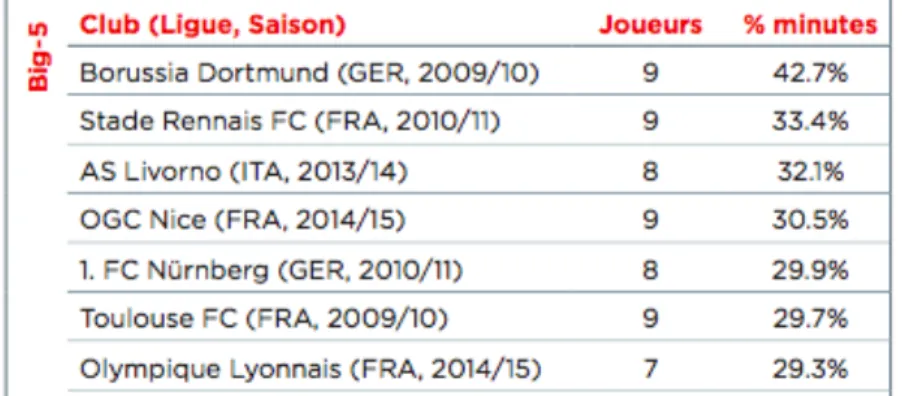
The Olympic Lyonnais has one of the best academies in Europe. Every season, an average of six to eight players are integrated into the Elite team. Moreover, during the season 2014-2015, the playing time of the U21 players with the elite team represents almost 30% of the overall time.
Table 10, Teams that used the most U21 players, trained with their
academy
Source: Schäfer, Poli (2015, p. 16) The educational system in Lyon is very well implemented and could be an example to follow. The infrastructures the clubs have, enables them to provide the players the maximum help possible.
4. Discussion
4.1 Servette FC, Crystal Palace and Olympique Lyonnais:
Comparison
The analysis of the three different academies made above enables to make a comparison on the structure, the infrastructures and on the educational system each of these academies have.
4.1.1 Budget
It is interesting to analyse first how important an academy is for the club, within each organization.
As described in each section above, the budget allocated for each academy varies in function of the country and the league in which the training centre is implemented. For the academy of Servette FC, the budget represents more than 40% of the total one of the organization. For the training centre of the Olympique Lyonnais, the budget represent 5% of the total one, and the one of Crystal Palace represents only 1%. It is interesting to see that there is a positive correlation between the total budget allocated for each academy, and the number of young talent trained in these three different countries. As demonstrated in Chapter 2, the Swiss Championship enables lots of young player to play and to develop their skills in a professional championship, while in England (in the Premier League Championship) young players have fewer opportunities to play, during their training, in the professional league. However, in France, this ratio (5%) is a little bit misleading, especially for the Olympique Lyonnais, knowing that every year, six to eight players integrate the professional team. The mean sets up by the organization are well optimized. Moreover, in the Ligue 1 Championship in France, it is a high priority for a club to have an academy in order to keep its talent as already explained. That’s why almost all the clubs of the Ligue 1 have a training centre.
4.1.2 Infrastructures
Another point, which is interesting to analyse, is the facilities available for each club. Except for the three clubs in the Category 2 in England (Crystal Palace, Watford and Bournemouth), all the academies have great and modern infrastructures, from the
fields to the building that includes fitness rooms, medical care rooms and some classrooms. The academy of the Olympic Lyonnais in France also has this type of great infrastructure. However it is not the case for the Academy and the Club itself of Servette FC. Knowing that this academy is one of the best in Switzerland, the poor infrastructure at their disposal is a shame. Two fields out of four are not responding anymore to the required standards, there are no specific places to sit to watch the games of the academy’s teams, and the other infrastructures at their disposal such as offices, medical care rooms, locker rooms and fitness rooms are dilapidated.
There is an on-going project concerning a future training centre for the football in Geneva, more precisely at Pré-du Stand in Grand-Saconnex, near the airport. This new training centre would have in a first time, three new fields, an a new building that would welcome not only the management of the Servette FC but also new locker rooms, medical care rooms, fitness rooms and also small meeting rooms in order to have private tutors, coming to the centre for the young athletes.
4.1.3 Education
The way the education is implemented within each of these three organizations, vary from one country to another, since the educational systems are different. However, English and French academies give great importance to the intellectual education of their young athletes and their development within the society in order to offer them a balance with their sport life, and the life that is waiting for them after their career. First of all, in England, in the Academy of Crystal Palace, the idea is to enable the young players to have the minimum level required to accede to a university with an American scholarship. At the age of 18, all the players are done with their studies and can totally concentrate on football.
Secondly, in France, in all the Academies, including the one of the Olympic Lyonnais, great means are invested for the education of young players. Almost all the academies have partnerships with public high schools, in which each player can follow the curriculum they want (CAP, BacPro & Bac Généraux). The players are mixed in special classes with other athletes and follow (more or less) the normal curriculum in three years. Few years ago, they could follow the program in four years. But the Academy of Lyon decided to follow the normal curriculum in order to enable the young players to be done with their studies at the age of 18 and then to give them the opportunity to be totally focused on football. When they have to miss classes because of games or
practices, private tutors are hired and come to the training centre, several times during the week, in order to enable them to catch up with the school program.
Finally, the academy of Servette doesn’t have the same means at their disposal concerning the education of their young players. The organization in place for the secondary school (Cycle d’Orientation) is well implemented and organized. However things are becoming more complicated for the athletes when they want to accede to a sport-study program at the post-mandatory level. As explained in the chapter 3.1.3, the young players can only accede to this kind of service if they are holder of a “Swiss
Olympic Talent Card, Regional, National or Local”, because the number of places is
restricted. Only the best players of each team are admitted in this specific program, where schedule is a little bit lightened and where they can be granted with additional vacations because of different competition or national team training.
To summarize, the current situation in Geneva regarding the sport-study program, taking as a benchmark the football Academy of Servette, is not the best it can be. Not all the athletes, coming from an elite club/ or team have the opportunity to follow an adapted post-mandatory program.
4.2 The Sport-Study Structure in Geneva
Today in Geneva, there are seven secondary schools (CO) and six post-mandatory schools (PO) that offer a sport-study program. In September 2013, Swiss Olympic recognized the sport-study measure in Geneva and attributed the Swiss Olympic
Partner School Label to the SAE* (Sport-Art-Etude) establishments of the Canton of
Geneva (JAUNIN, BENNINGHOFF, 2014, p.10).
The budget allocated to each of these schools – Secondary and Post-Mandatory – is as follows11:
• CHF 550’000 for the Secondary School, which includes, a SAE Dean in every partner establishment, coordination by a class master (a teacher in charge of the class only for the three establishments grouping individual sports), and support classes in every partner establishment.
11
Interview with Ms. Ava MONNET, « Coordinatrice sport-art-étude », au Département de l’instruction publique, de la culture et du sport (DIP), Genève