• Aucun résultat trouvé

Structural and functional characterization of the CAP domain of pathogen-related yeast 1 (Pry1) protein

N/A
N/A
Protected

Academic year: 2021

Partager "Structural and functional characterization of the CAP domain of pathogen-related yeast 1 (Pry1) protein"

Copied!
2
0
0

Texte intégral

(1)

Supplementary material for

Structural and functional characterization of the CAP domain of pathogen-related yeast 1 (Pry1) protein

Authors: Rabih Darwiche, Alan Kelleher, Elissa M. Hudspeth, Roger Schneiter, and Oluwatoyin A. Asojo

(2)

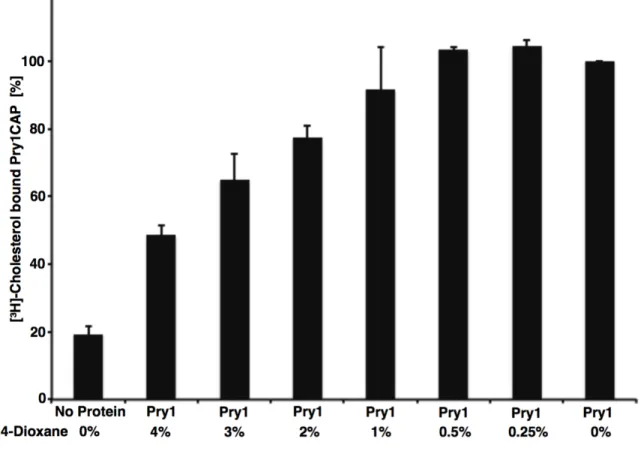
Figure S.1. 1,4-Dioxane inhibits cholesterol binding in a dose dependent manner. Data represents mean ±standard deviation of two independent experiments. In the experiments, purified protein (0 or 100 pmol) in binding buffer (20 mM Tris, pH 7.5, 30 mM NaCl, 0.05% Triton X-100) was incubated with [3H]-cholesterol (50 pmol) with 1,4-dioxane (0-4% v/v) for 1 h at 30oC. The protein was then separated from the unbound ligand by adsorption to Q-sepharose beads (GE healthcare, USA), beads were washed, and the radioligand was quantified by scintillation counting.
Figure

Figure S.1. 1,4-Dioxane inhibits cholesterol binding in a dose dependent manner. Data represents  mean ±standard deviation of two independent experiments

Références

Documents relatifs

Inspection of the Tb b VSP1 tetramer structure reveals that conformation of calcium binding loops is stabilized by electrostatic and hydrogen bonding interactions with

The conserved C-terminal RBD of PUF proteins recognize an eight nucleotide long RNA motif (PRE) within the 3′UTR of target mRNAs resulting in the destabilization or repres- sion

and the launching, three years later, of WHO's Programme for the Pre- vention of Blindness came the reorientation of strategies away from single-cause prevention

Figure 1: Pry1 protein binds eugenol: Purified Pry1 protein (100 pmol) was incubated with [3H]-cholesterol (50 pmol) as a ligand in the absence (0 pmol),

Les techniques permettant un résultat esthétique suffisant sont donc les techniques à trois couches, ou apparentées comme la tech- nique de Vanini, ou les techniques apparentées

Fine mapping and characterization of the binding domain of the HRSV Phosphoprotein with the M2-1 protein.. International Conference on Negative Strand Viruses, Jun 2015,

Through this analysis, we propose that the protein encodes (at least) twenty nine repeated sequences of 11 or 18 aa residues that influence tail length and infectivity, and

In conclusion, yeast cells transformed with plasmids driving the expression of TtABA- WDS and HvABA-WDS are less sensitive to abiotic stress (salt, cold and heat) compared to