REVIEW
Subtype-selective GABA
A
receptor mimetics
—novel
antihyperalgesic agents?
Hanns Ulrich Zeilhofer&Robert Witschi&
Katharina Hösl
Received: 8 January 2009 / Revised: 11 February 2009 / Accepted: 16 February 2009 / Published online: 4 March 2009 # Springer-Verlag 2009
Abstract Agonists at the benzodiazepine-binding site of ionotropicγ-aminobutyric acid (GABAA) receptors are in
clinical use as hypnotics, anxiolytics, and anticonvulsants since the early 1960. Analgesic effects of classical benzodiazepines have occasionally been reported in certain subgroups of patients suffering from chronic pain or after spinal delivery through intrathecal catheters. However, these drugs are generally not considered as analgesics but should in fact be avoided in patients with chronic pain. Recent evidence from genetically modified mice now indicates that agents targeting only a subset of benzodiaz-epine (GABAA) receptors should provide pronounced
antihyperalgesic activity against inflammatory and neuro-pathic pain. Several such compounds have been developed recently, which exhibit significant antihyperalgesia in mice and rats and appear to be devoid of the typical side-effects of classical benzodiazepines.
Keywords Pain . Analgesia . GABA . GABAAreceptor .
Benzodiazepine . Neuropathy
More than 40 years ago, the so-called gate control theory of pain proposed by Ronald Melzack and Patrick Wall [1] has postulated that inhibitory neurons in the spinal cord dorsal horn would control the transmission of nociceptive (“pain”) signals coming from the periphery through the spinal cord to higher brain areas where pain becomes conscious. Since these early days, the nature of this inhibitory control has been unraveled and γ-aminobutyric acid (GABA) and glycine have been identified as the two fast inhibitory neurotransmitters in the spinal dorsal horn. Subsequently, it was proven that pharmacological blockade of GABA or glycine receptors in the spinal dorsal horn provokes pain sensation in animals as well as in humans [2, 3]. More recently, several groups could also demonstrate that a reduction in GABAergic and glycinergic neurotransmission occurs naturally in the course of inflammatory and neuropathic pain [4]. Accordingly, restoring the function of inhibitory neurotransmission in the spinal dorsal horn should be a rational approach to the treatment of chronic pain conditions. However, attempts to translate the gate control theory into novel pharmacotherapies of pain have failed miserably. This is particularly surprising because GABAA receptors are among the most successfully
exploited drug targets. Drugs acting at GABAA receptors
include the benzodiazepine site agonists (“benzodiaze-pines”) which facilitate the action of GABA at GABAA
receptors and which are widely used clinically for their sleep promoting, anxiolytic, and anticonvulsive effects. However, although anecdotal evidence exists for a pain-relieving effect in certain groups of patients, the vast majority of reports indicate that benzodiazepines do not exert a clear analgesic effect in patients or in human
H. U. Zeilhofer (*)
:
R. WitschiInstitute of Pharmacology and Toxicology, University of Zurich, Winterthurerstrasse 190,
CH-8057 Zurich, Switzerland e-mail: [email protected] H. U. Zeilhofer
:
R. Witschi Institute of Pharmaceutical Sciences, Swiss Federal Institute of Technology (ETH), Zurich, SwitzerlandK. Hösl
Institute for Experimental and Clinical Pharmacology and Toxicology, University of Erlangen-Nürnberg, Erlangen, Germany
Present address: K. Hösl
Department of Neurology, University of Erlangen-Nürnberg, Erlangen, Germany
experimental pain models [5]. This is again surprising for several reasons. Benzodiazepine-sensitive GABAA
recep-tors are found in the spinal terminals of primary nociceprecep-tors as well as at other sites in the pain pathway including neurons in the superficial layers of the spinal dorsal horn [6], a pivotal structure for the processing of pain signals. Local spinal injection of benzodiazepines (mainly diazepam or its short acting and rather hydrophilic derivative midazolam) is antinociceptive both in animal experiments [7-9] and in human patients [10, 11]. Part of this discrepancy is probably due to the fact that experimental studies hardly discriminated between acute analgesic (anti-nociceptive) effects (e.g. [12]) and a reversal of patholog-ically increased pain sensitivity (antihyperalgesia). In fact, a recent study showed that intrathecal injection of diazepam in mice normalized pain thresholds in mice suffering from increased pain sensitivity due to peripheral inflammation or nerve damage but had no effect on acute nociceptive pain [13]. It is however still surprising that classical benzodia-zepines are not analgesic in patients with chronic pain who usually also show pronounced hyperalgesia.
What are possible explanations for this apparent dis-crepancy? Animal studies on pain largely rely on the assessment of nociceptive withdrawal reflexes upon expo-sure of a paw or the tail to a painful stimulus (heat, cold, or mechanical stress) as a measure of changes in pain sensitivity. Positive results from animal studies could hence be confounded by sedation, muscle relaxation, or reversal of anxiety-induced hyperalgesia. It is also possible that pain relief might occur only at doses sufficiently high to provoke at the same time strong sedation making it extremely difficult to distinguish analgesia from sedation. Alterna-tively, if benzodiazepines were in fact analgesic after spinal but not after systemic application, pronociceptive effects at supraspinal sites might antagonize spinal antihyperalgesic actions. Such pronociceptive effects have indeed been reported after intracerebroventricular injection of midazo-lam [8].
Fortunately, benzodiazepines exert their effects not through a single but through at least four different subtypes
of GABAAreceptors enabling the pharmacological
separa-tion of different benzodiazepine effects. GABAAreceptors
are heteropentameric chloride channels assembled from a repertoire of α, β, γ, δ, ɛ, θ, π, and ρ subunits [14]. Benzodiazepine-sensitive GABAA receptors, which make
up the majority of GABAAreceptors in the nervous system
including the spinal cord, are composed of twoα (α1, α2, α3 or α5) subunits, two β subunits, and one γ2 subunit. All benzodiazepine-sensitive GABAA receptors contain a
conserved histidine residue in their extracellular N-terminal domain, while the benzodiazepine-insensitive subunits (α4 andα6) carry an arginine at the same site [15]. Mutation of this histidine residue renders GABAA receptor α subunits
diazepam-insensitive. The generation of so-called point mutated or knock-in mice for all four benzodiazepine-sensitive GABAA receptor α subunits (α1(H101R), α2
(H101R), α3(H126R), and α5(H105R)) by Rudolph and Mohler [16] allowed to attribute the different in vivo actions of benzodiazepines to molecularly defined GABAA
receptor subtypes (Fig.1). Using these mice, it has become possible to attribute the sedative effects of diazepam to GABAAreceptors containing theα1 subunit [17], while the
anxiolytic effects were mediated through the α2 GABAA
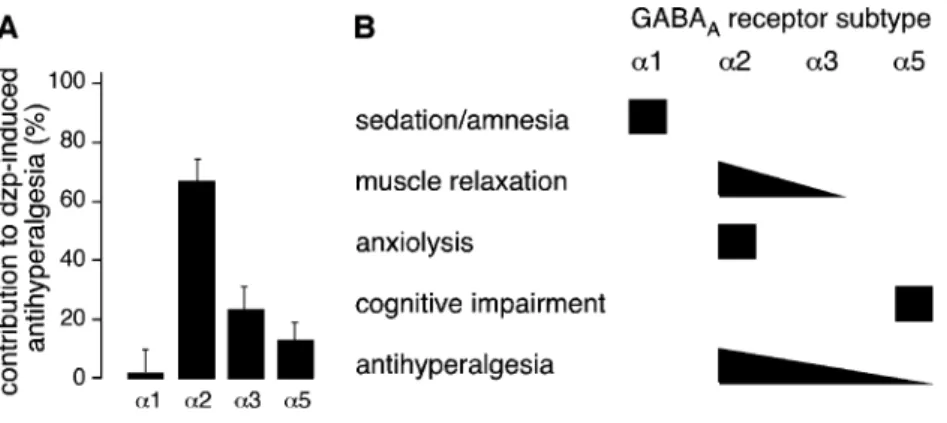
receptors [18]. Using these mice in models of inflammatory and neuropathic pain, we were recently able to demonstrate that the spinal antihyperalgesic effects of diazepam were mediated mainly through GABAAreceptors containingα2
subunit [13].α1 subunits did not contribute significantly in any of the pain models tested, while α3 and α5 subunits showed some contribution depending on the pain model used and the type of stimulus (heat, cold, or mechanical stress) employed. Importantly, intrathecal treatment with diazepam did not cause sedation and did not affect responses of the non-inflamed or non-injured paw indicat-ing that sedation or muscle relaxation were not major confounding factors. Importantly, these results also indicat-ed that the GABAA receptor subtypes responsible for
benzodiazepine-induced antihyperalgesia were different from those that mediate sedation. This allowed the investigation of possible antihyperalgesic actions of
sys-Fig. 1 Contribution of different GABAAreceptor subtypes to
benzodiazepine-mediated spinal antihyperalgesia (A) and in comparison to other desired or undesired effects of classical benzodiazepines (B). Data modified from references [13], [17], [18], [28], and [29]
temic benzodiazepines in the absence of sedation either through the analysis of mice carrying mutatedα1 subunits or through the use of so-calledα1-sparing or non-sedative benzodiazepine site ligands.
Both approaches yielded similarly positive results. A recent study investigated the possible antihyperalgesic effect of systemic diazepam in mice carrying point mutated α1 subunits (α1(H101R)) [19]. These mice displayed antihyper-algesia in response to systemic diazepam virtually identical to that seen in the corresponding wild-type mice but without any signs of sedation. The same study also analyzed mice which carried in addition to α1(H101R) a second benzodiazepine-insensitiveα subunit. Experiments in these double point-mutated mice confirmed that α2 and α3 subunits were the most important subunits for diazepam-mediated antihyperalgesia also after systemic treatment. They also demonstrated that sedation and antihyperalgesia exhibit a similar dose-dependence, which stresses the problem of previous studies trying to distinguish antihyper-algesia from confounding sedation. Finally, they showed that the maximum levels of antihyperalgesia achievable with diazepam either in wild-type mice after spinal application or inα1(H101R) point-mutated mice after systemic application were very similar suggesting that pronociceptive effects arising from benzodiazepines at supraspinal sites are not of major relevance after systemic treatment.
The results obtained in GABAA receptor point-mutated
mice provided the basis for the rational quest for benzodiazepine-site ligands with a better side-effect profile.
Several subtype-selective compounds have been identified and published in the recent years (Table1). To test whether such compounds would display antihyperalgesic efficacy after systemic treatment, we tested as a proof-of-principle experi-ment the α1-sparing (non-sedative) partial benzodiazepine-site agonist L-838,417, which is an antagonist at the benzodiazepine binding site of GABAAreceptorα1 subunits
and a partial agonist atα2, α3, and α5 [20]. L-838,417 not only reduced nociceptive withdrawal reflexes in behavioral studies in rats, but also decreased pain-related brain activity in functional magnetic resonance imaging (fMRI) experi-ments evoked by stimulation of an inflamed hindpaw [13] providing direct evidence that L-838,417 interfered with the sensory and emotional components of pain (and not just with nociceptive reflex activity). Similar antihyperalgesic effects were achieved in the mouse formalin test with SL651498, a full agonist atα2 and α3 subunits and a partial agonist at α1 andα5 subunits [21], by our group [19], and with NS11394, which displays a functional specificity profile ofα5 > α3 > α2 > α1 [22], by a different laboratory [23] (Table 2). NS11394 displayed an antihyperalgesic efficacy in neuro-pathic pain models comparable to that achieved with gabapentin, a drug frequently used for the treatment of neuropathic pain in human patients. Data from this group also suggest that not only are rather high doses of benzodiazepines needed to yield sufficient antihyperalgesia (comparable to those required for sedation and significantly higher than anxiolytic doses) but also that a rather high intrinsic activity is necessary. Bretazenil, a non-selective
Table 1 Subtype-selective benzodiazepine site ligands in comparison to diazepam
Compound Intrinsic activity atα1/α2/α3/α5 Major pharmacological activities Reference Diazepam 0.71/0.81/0.88/0.57a Sedation, anxiolysis, motor impairment, muscle relaxation [31]
L-838,417 0.01/0.43/0.43/0.38a Anxiolysis, no sedation, no motor impairment [20]
SL651498 0.45/>1/0.83/0.50b Anxiolysis, muscle relaxation, no sedation [21]
TPA023 0/0.11/0.21/0.05c Anxiolysis, no sedation [27]
NS11394 0.078/0.26/0.52/0.78d Anxiolysis, no sedation, no motor impairment [22] a
Potentiation of GABA-induced currents in recombinantαx/βy/γ2GABAAreceptors at EC20 of GABA b
Relative to zolpidem (α1) or diazepam (α2, α3 and α5)
cRelative to chlordiazepoxide d
Relative to diazepam
Table 2 Effects of subtype-selective benzodiazepine site ligands on pain-related behavior
Compound Effects on pain-related behavior Reference
L-838,417 Antihyperalgesic against inflammatory and neuropathic pain, no effect on acute pain (heat and mechanical stimulation), reduced hyperalgesia-related brain activity in fMRI experiments
[13] SL651498 Reduced electrically evoked flexor reflexes, reduced flexor responses in the mouse formalin test [33], [19] NS11394 No effect on acute pain in the hot plate test, reduced flexor responses in the formalin test, reduced capsaicin-induced
flexor responses, increased weight bearing on inflamed paw, reduced neuropathic pain (allodynia)
agent with low intrinsic activity, was devoid of antihyper-algesic effects in different pain models despite of good anxiolytic activity [23]. Cases like that of bretazenil also demonstrate that the in vivo specificity of subtype-selective agents is determined not only by their subunit specificity but also by other factors including intrinsic activity, active metabolites, and pharmacokinetic properties such as on-set and duration of action. These factors often limit the comparability of data obtained with selective compounds or with genetically modified mice.
Pharmacological and genetic evidence clearly indicates that a genuine antihyperalgesic effect of benzodiazepines exists after spinal as well as after systemic application—at least in mice and rats. The two pertinent questions at present are, can other unwanted effects besides sedation also be avoided with subtype-selective (or partial) agonists and does the concept of a benzodiazepine-mediated anti-hyperalgesia also work in humans. Both questions are at present difficult to answer. The latter one has to await the availability of subtype-selective agents suitable for clinical trials in humans. While L-838,417 possesses undesirable pharmacokinetics in man [24], those of TPA023 and SL651498 appear favorable [25, 26]. It is, however, not yet clear whether these compounds would be suitable for human pain studies. Possible caveats include the rather low intrinsic activity of TPA023 [27] and remaining activity at α1 subunits of SL651498 [21] which might cause signif-icant sedation when given in antihyperalgesic doses.
The question whether other side effects apart from sedation can be avoided with subtype-selective agents should in principle be easier to answer but is also not yet solved. Tolerance development (closely related to physical dependence), reinforcing properties (related to addiction), and memory impairment are probably the most relevant of such side-effects. There is some reason to assume that subtype-selective compounds should have a reduced risk for these side effects. Data obtained inα1(H101R) point-mutated mice indicate that potentiation of GABAAreceptor
α1 subunits underlies also the amnestic effects of benzo-diazepines [17]. However, hippocampus-dependent learn-ing involves also α5 GABAA receptors [28], a finding
which is supported by the positive cognitive effects of inverse agonists at α5 GABAA receptors [29]. Published
evidence suggests that physical dependence does not occur with severalα1-sparing agents (L-838,417, SL651498, and TPA023) [30] and at least in the case of L-838,417, tolerance against the antihyperalgesic effect was complete-ly absent during a 9-day treatment period—in striking contrast to morphine, which had lost its analgesic activity already after 6 days [13]. However, besides subunit specificity the lower intrinsic activity of these compounds could also play a role [31], leaving it open whether compounds with full intrinsic activity would retain this
advantage. The potential reinforcing properties appear even more complex. High intrinsic activity atα1 GABAA
receptors clearly promotes reinforcing effects of benzodia-zepines, but compounds devoid of activity atα1 (such as L-838,417) still have some reinforcing potential [31] and other factors apart from subunit specificity and intrinsic activity such as a rapid onset of action in the CNS might contribute as well [32].
In summary, recent evidence obtained either with genetically modified mice or with subtype-selective benzo-diazepine site ligands indicates that benzobenzo-diazepines pos-sess significant antihyperalgesic activity. With classical benzodiazepines, this antihyperalgesia requires a high receptor occupancy leading to strong sedation and other undesired effects which probably mask beneficial effects on pain and which preclude their therapeutic use as analgesics. Novel subtype-selective agents are in development which should not only lack undesired sedation but might also be devoid of other unwanted effects such as memory impair-ment, physical dependence, and addiction. They will likely possess anxiolytic and possibly muscle relaxant efficacy in addition to antihyperalgesic properties.
References
1. Melzack R, Wall PD (1965) Pain mechanisms: a new theory. Science 150:971–979
2. Beyer C, Roberts LA, Komisaruk BR (1985) Hyperalgesia induced by altered glycinergic activity at the spinal cord. Life Sci 37:875–882
3. Yaksh TL (1989) Behavioral and autonomic correlates of the tactile evoked allodynia produced by spinal glycine inhibition: effects of modulatory receptor systems and excitatory amino acid antagonists. Pain 37:111–123
4. Zeilhofer HU (2008) Loss of glycinergic and GABAergic inhibition in chronic pain—contributions of inflammation and microglia. Int Immunopharmacol 8:182–187
5. Jasmin L, Wu MV, Ohara PT (2004) GABA puts a stop to pain. Curr Drug Targets CNS Neurol Disord 3:487–505
6. Bohlhalter S, Weinmann O, Mohler H, Fritschy JM (1996) Laminar compartmentalization of GABAA-receptor subtypes in the spinal
cord: an immunohistochemical study. J Neurosci 16:283–297 7. Jourdan D, Ardid D, Bardin L, Bardin M, Neuzeret D,
Lanphouthacoul L, Eschalier A (1997) A new automated method of pain scoring in the formalin test in rats. Pain 71:265–270 8. Luger TJ, Hayashi T, Weiss CG, Hill HF (1995) The spinal
potentiating effect and the supraspinal inhibitory effect of midazolam on opioid-induced analgesia in rats. Eur J Pharmacol 275:153–162
9. Scholz J, Broom DC, Youn DH, Mills CD, Kohno T, Suter MR, Moore KA, Decosterd I, Coggeshall RE, Woolf CJ (2005) Blocking caspase activity prevents transsynaptic neuronal apopto-sis and the loss of inhibition in lamina II of the dorsal horn after peripheral nerve injury. J Neurosci 25:7317–7323
10. Tucker AP, Lai C, Nadeson R, Goodchild CS (2004) Intrathecal midazolam I: a cohort study investigating safety. Anesth Analg 98:1512–1520
11. Tucker AP, Mezzatesta J, Nadeson R, Goodchild CS (2004) Intrathecal midazolam II: combination with intrathecal fentanyl for labor pain. Anesth Analg 98:1521–1527
12. Thurauf N, Ditterich W, Kobal G (1994) Different sensitivity of pain-related chemosensory potentials evoked by stimulation with CO2, tooth pulp event-related potentials, and acoustic event-related
potentials to the tranquilizer diazepam. Br J Clin Pharmacol 38:545–555
13. Knabl J, Witschi R, Hösl K, Reinold H, Zeilhofer UB, Ahmadi S, Brockhaus J, Sergejeva M, Hess A, Brune K, Fritschy J-M, Rudolph U, Möhler H, Zeilhofer HU (2008) Reversal of pathological pain through specific spinal GABAA receptor
subtypes. Nature 451:330–334
14. Barnard EA (2001) The Molecular Architecture of GABA-A Receptors. In: Möhler H (ed) Pharmacology of GABA and glycine neurotransmission. Springer, Berlin, pp 79–99
15. Wieland HA, Luddens H, Seeburg PH (1992) A single histidine in GABAAreceptors is essential for benzodiazepine agonist binding.
J Biol Chem 267:1426–1429
16. Rudolph U, Mohler H (2006) GABA-based therapeutic approaches: GABAA receptor subtype functions. Curr Opin
Pharmacol 6:18–23
17. Rudolph U, Crestani F, Benke D, Brunig I, Benson JA, Fritschy JM, Martin JR, Bluethmann H, Mohler H (1999) Benzodiazepine actions mediated by specific gamma-aminobutyric acid(A) recep-tor subtypes. Nature 401:796–800
18. Low K, Crestani F, Keist R, Benke D, Brunig I, Benson JA, Fritschy JM, Rulicke T, Bluethmann H, Mohler H, Rudolph U (2000) Molecular and neuronal substrate for the selective attenuation of anxiety. Science 290:131–134
19. Knabl J, Zeilhofer U, Crestani F, Rudolph U, Zeilhofer HU (2009) Genuine antihyperalgesia by systemic diazepam revealed by experiments in GABAA receptor point-mutated mice. Pain
141:233–238
20. McKernan RM, Rosahl TW, Reynolds DS, Sur C, Wafford KA, Atack JR, Farrar S, Myers J, Cook G, Ferris P, Garrett L, Bristow L, Marshall G, Macaulay A, Brown N, Howell O, Moore KW, Carling RW, Street LJ, Castro JL, Ragan CI, Dawson GR, Whiting PJ (2000) Sedative but not anxiolytic properties of benzodiazepines are mediated by the GABAAreceptorα1 subtype. Nat Neurosci 3:587–
592
21. Griebel G, Perrault G, Simiand J, Cohen C, Granger P, Decobert M, Francon D, Avenet P, Depoortere H, Tan S, Oblin A, Schoemaker H, Evanno Y, Sevrin M, George P, Scatton B (2001) SL651498: an anxioselective compound with functional selectivity forα2- and α3-containing gamma-aminobutyric acidA (GABAA) receptors. J
Pharmacol Exp Ther 298:753–768
22. Mirza NR, Larsen JS, Mathiasen C, Jacobsen TA, Munro G, Erichsen HK, Nielsen AN, Troelsen KB, Nielsen EO, Ahring PK (2008) NS11394 [3 ′-[5-(1-hydroxy-1-methyl-ethyl)-benzoimida-zol-1-yl]-biphenyl-2-carbonitrile], a unique subtype-selective GABAA receptor positive allosteric modulator: in vitro actions,
pharmacokinetic properties and in vivo anxiolytic efficacy. J Pharmacol Exp Ther 327:954–968
23. Munro G, Lopez-Garcia JA, Rivera-Arconada I, Erichsen HK, Nielsen EO, Larsen JS, Ahring PK, Mirza NR (2008) Comparison of the novel subtype-selective GABAA receptor-positive allosteric modulator
NS11394 [3 ′-[5-(1-hydroxy-1-methyl-ethyl)-benzoimidazol-1-yl]-biphenyl-2-carbonitrile] with diazepam, zolpidem, bretazenil, and gaboxadol in rat models of inflammatory and neuropathic pain. J Pharmacol Exp Ther 327:969–981
24. Rogawski MA (2006) Diverse mechanisms of antiepileptic drugs in the development pipeline. Epilepsy Res 69:273–294
25. de Haas SL, de Visser SJ, van der Post JP, de Smet M, Schoemaker RC, Rijnbeek B, Cohen AF, Vega JM, Agrawal NG, Goel TV, Simpson RC, Pearson LK, Li S, Hesney M, Murphy MG, van Gerven JM (2007) Pharmacodynamic and pharmacokinetic effects of TPA023, a GABAA α2,3
subtype-selective agonist, compared to lorazepam and placebo in healthy volunteers. J Psychopharmacol 21:374–383
26. de Haas SL, Franson KL, Schmitt JA, Cohen AF, Fau JB, Dubruc C, van Gerven JM (2008) The pharmacokinetic and pharmacodynamic effects of SL65.1498, a GABA-A α2,3 selective agonist, in comparison with lorazepam in healthy volunteers. J Psychopharma-col, epub ahead of print doi:10.1177/0269881108092595
27. Atack JR, Wafford KA, Tye SJ, Cook SM, Sohal B, Pike A, Sur C, Melillo D, Bristow L, Bromidge F, Ragan I, Kerby J, Street L, Carling R, Castro JL, Whiting P, Dawson GR, McKernan RM (2006) TPA023 [7-(1,1-dimethylethyl)-6-(2-ethyl-2H-1,2,4-tria-zol-3-ylmethoxy)-3-(2-fluor ophenyl)-1,2,4-triazolo[4,3-b]pyrida-zine], an agonist selective for α2- and α3-containing GABAA
receptors, is a nonsedating anxiolytic in rodents and primates. J Pharmacol Exp Ther 316:410–422
28. Crestani F, Keist R, Fritschy JM, Benke D, Vogt K, Prut L, Bluthmann H, Mohler H, Rudolph U (2002) Trace fear condi-tioning involves hippocampal α5 GABAA receptors. Proc Natl
Acad Sci U S A 99:8980–8985
29. Dawson GR, Maubach KA, Collinson N, Cobain M, Everitt BJ, MacLeod AM, Choudhury HI, McDonald LM, Pillai G, Rycroft W, Smith AJ, Sternfeld F, Tattersall FD, Wafford KA, Reynolds DS, Seabrook GR, Atack JR (2006) An inverse agonist selective forα5 subunit-containing GABAAreceptors enhances cognition. J
Phar-macol Exp Ther 316:1335–1345
30. Mirza NR, Nielsen EO (2006) Do subtype-selective gamma-aminobutyric acid A receptor modulators have a reduced propensity to induce physical dependence in mice. J Pharmacol Exp Ther 316:1378–1385
31. Licata SC, Rowlett JK (2008) Abuse and dependence liability of benzodiazepine-type drugs: GABAA receptor modulation and
beyond. Pharmacol Biochem Behav 90:74–89
32. Samaha AN, Robinson TE (2005) Why does the rapid delivery of drugs to the brain promote addiction. Trends Pharmacol Sci 26:82–87 33. Griebel G, Perrault G, Simiand J, Cohen C, Granger P, Depoortere H, Françon D, Avenet P, Schoemaker H, Evanno Y, Sevrin M, George P, Scatton B (2003) SL651498, a GABAAreceptor agonist
with subtype-seletive efficacy, as a potential treatment for generalized anxiety disorder and muscle spasm. CNS Drug Reviews 9:3–20