DOI: 10.1007/s11211-004-2058-y
Why People are Committed to Human Rights
and Still Tolerate Their Violation: A Contextual
Analysis of the Principle–Application Gap
Christian Staerkl´e1and Alain Cl´emence2
We report results from two experimental studies that show a large gap between support for general principles contained in the Universal Declaration of Human Rights and denunciation of concrete violations of these principles. Participants in both studies read different scenarios involving human rights violations committed by various authorities in Western contexts. In all situations, attributes or actions of the victims could be used to justify the violations. Participants indicated their level of support for each human right and the unacceptability of violations of it. A dual principle was found to organize positioning towards the violations: par-ticipants with a rights-based orientation denounced the violation independently of the victims’ attributes, whereas context-oriented respondents relied on the per-ceived deservingness of victims and considered the violation a just sanction of an unacceptable act. Judgmental differences were moderated by the situational context and participants’ extent of agreement with human rights.
KEY WORDS: human-rights; violation; positioning; deservingness; punishment.
One of the puzzling concerns in the social justice domain is the gap between the widespread endorsement of general legal principles and the equally common tolerance of concrete violations of these principles. This is particularly true for the principles of human rights. When human rights are invoked to regulate social relations within particular contexts, they lose a great deal of their prescriptive power. Their rather abstract and general formulation gives rise to conflicting interpretations of the limits of application of human rights. A case in point concerns the recent discussions about the treatment granted to suspected terrorists who are
1Faculty of Psychology and Educational Sciences, University of Geneva, Switzerland. 2Institut des Sciences Sociales et Politiques, University of Lausanne, Switzerland.
389
held in secretive army bases. Should they be treated according to the same legal principles that apply to other individuals charged with a crime, or should the gravity of their suspected activities be reason enough to bypass legal protection such as the Geneva Convention?
In this paper, we explore these questions by examining how lay persons uphold human rights principles when they are confronted with concrete events involving rights violations. We investigate the role of human rights in common thinking because they are based on the principle of universalism. Human rights are a powerful normative device precisely because they are, at least by intention, inalienable. Hence, they should be applied across different contexts without con-sideration of any attributes of victims of human rights violations which could be used to justify exceptions to fair and equal treatment (e.g., their suspected terrorist activities).
If in the judicial context rights and procedures are indispensable to achieve fair outcomes, in everyday life rights are frequently detached from formally codified procedures applied by legal institutions (Cl´emence and Doise, 1995; Miller, 2001; Skitka, 2002; Skitka and Houston, 2002). The just world belief (Lerner, 1977) illustrates neglect of procedural consideration in lay judgments of reprehensible acts. This belief exemplifies everyday justice thinking, which is practiced without much concern for the rights of persons. Instead, perceived deservingness of individuals determines to what extent individuals should be en-titled to fair and good treatment. If victims of unfair treatment are perceived as undeserving, they are easily derogated and rejected (Feather, 1999), even when they are innocent (Hafer, 2002). Therefore, violations should be more easily tolerated when the violation can be considered a just sanction for an unac-ceptable act. Crandall and Beasley (2001) neatly summarized this tautological lay logic: “Good people deserve good treatment, and bad people deserve bad treatment.”
Thus, in everyday thinking, people become unconcerned with how justice is achieved, as long as it is achieved. Commitments to fair procedures destined to protect people from arbitrary treatment become eroded, because individuals follow contextual norms rather than formal norms destined to protect individuals from mistreatment by authorities (Darley, 2002). In this way, rights of persons are neglected and exceptional characteristics of the victims or their acts are used to construct fairness judgments (Nisbett and Ross, 1980). Outside the courtroom, for example, people may tolerate violations of the right to a court hearing when that right is insistently claimed by a person confined in a psychiatric institution. Similarly, people may show acceptance of degrading treatment applied to terrorists (Bechlivanou et al., 1990; Doise, 2002). Thus, individuals have recourse to norms of justice that favor sanctions of victims while protecting authorities committing the violations. By taking into account the context of a human rights violation, individuals tend to give more credit to the efficient functioning of governmental authorities than to the respect of civil rights (Crandall and Beasley, 2001). Because
such lay reasoning is more concerned with the protection of the existing social order and its authorities than with the upholding of the principle of fair treatment, it also supports system justification (Jost and Banaji, 1994).
The gap between endorsement of rights principles and attitudes towards their concrete implementation is thus explained by the fact that individuals activate contextual norms of justice more easily than norms of procedural rights (Van den Bos, 2003). Recent research shows that neglect of procedural information is most likely to occur when social comparison information or other reference points are available in the judgmental context (Skitka and Houston, 2002; Van den Bos and Lind, 2002).
While it is plausible that lack of knowledge of legal procedures promotes to some extent the activation of context-based judgments of human rights violations, it seems more appropriate to view the gap between support for general principles and tolerance of particular violations as an ideological dilemma opposing two sides that may be perceived as equally legitimate (Billig, 1989; Emler, 2003). On the one hand, individuals may defend the necessity of respecting formally established rights irrespective of the particular circumstances, and on the other hand they may advocate punishment of offenders and protection of innocents from potential wrongdoers. This situation reflects a conflict between two justice norms, one that consists in sanctioning reprehensible acts (context-based principle), and one that is concerned with the protection of the rights of the person who has committed them (rights-based principle). This dilemma will increase with the degree of rejection of the victims of the human rights violation, that is, the more the victim’s acts are objectionable, the more people will be inclined to tolerate violations. In order to apply a rule that is consistent with universalistic human rights principles, individuals must cognitively dissociate the violations from the victim’s acts. That is, they must believe that the condemnation of the victim’s acts should not be used to restrain his or her rights.
Human Rights in Context
The general prediction of the two studies reported here is that the level of adherence to principles of human rights should be uniformly high, whereas con-demnations of violations should vary as a function of the context in which these violations occur and are reported. Three strategies were used to investigate the sta-bility of human rights principles across different contexts. In the first experiment, we varied the type of victim of the same forms of mistreatment by authorities. If respondents do not take into account contextual information, and instead apply the same procedures to both types of victims, then the human rights violation should be equally condemned in both contexts. On the other hand, if respondents do take into account the context of the violations, the severity of condemnations of violations should be stronger when victims of these violations are judged as
deserving good treatment. In this case, the context is expressed by taking into account personal characteristics of the violation victim or the severity of his or her acts, because these determine perceived deservingness.
A second strategy to operationalize context consists in varying the commu-nicative context. Violations are rarely directly observed, but are instead conveyed through the media. It is therefore important to analyze how the framing (e.g., Nelson and Kinder, 1996; Sears, 1993) affects the meaning associated with vi-olations. In order to address this question, we manipulated in both studies the indications given to the participants about the scope of the research. Each study was either presented as a study on “human rights” or on ordinary “news events.” Two alternative hypotheses were tested. On the one hand, the reference to human rights should emphasize the positive and universalistic meaning attributed to such rights. As a result, rights violations should be less tolerated. On the other hand, the opposite prediction is also plausible: in the West, judgments in terms of human rights are generally reserved for massive violations occurring “elsewhere” (e.g., deportations, disappearances, torture). Hence, they tend to be easily bypassed in the case of local and particularistic events (e.g., unlawful arrest, expulsion of asy-lum seekers). Because we are studying relatively local situations, violations could be judged as more acceptable when they are framed as human rights reports. Using a range of different scenarios, we will identify those contexts in which a reference to human rights exerts a positive impact on judgments.
Finally, in Study 2, a third approach to the contextualization of rights will be employed. We created an individual difference measure to distinguish between individuals who justify the legitimacy of some human rights violations by taking into account the contextual characteristics of the victim from those who defend the rights of victims, irrespective of the context of the violation.
These questions were investigated by analyzing judgments concerning con-crete human rights violations as regularly reported in news media. These scenarios describe human rights violations committed by authorities, including the police, the government, political parties, law courts, army officers, and schoolteachers. The general objective was to test the robustness of human rights commitments when individuals are confronted with concrete violations. We expect individu-als to be inclined to disregard to varying degrees their convictions in matters of (human) rights when they are qualified by exceptional circumstances.
STUDY 1
The aim of Study 1 was to examine the strength of the condemnation of human rights violations in a communicative context either referring to a study about news events or about human rights. Moreover, we varied the type of victim for the same human rights violations. Endorsement of various human rights principles
and condemnation of concrete violations were then compared, and the difference between these two measures was used as an indicator of the principle-application gap. We then assessed the stability of the condemnation of violations in different experimental settings and across five concrete situations in which human rights violations were described.
Method
Participants
One hundred and seventy-two pupils (105 females and 67 males) ranging in age from 14 to 16 years, attending 8th and 9th grades at a secondary school in Geneva participated in the experiment. Six participants were removed from the analysis because they failed to complete the entire questionnaire.
Procedure
Participants completed a questionnaire during regular class time. The intro-duction manipulated the first experimental variable by referring to the study as being about “the views people have on human rights” or “the views people have on
news items.” Afterward, participants received a brief description of five scenarios,
each containing a real or potential violation of a human right as defined by the Universal Declaration of Human Rights (UDHR) and by the two international covenants concerning Civil and Political Rights (CPRC) and Social Economical and Cultural Rights (SECRC). The issues described concerned the prohibition of inhumane treatment, right to asylum, right to free primary schooling, right to invi-olability of privacy, and interdiction of death penalty for minors. The victims of the violations were either individuals who committed reprehensible acts (in the cases of inhumane treatment, violation of privacy and death penalty) or individuals who petitioned for a legitimate cause (the violation of the right to free schooling and refusal of asylum). For each scenario, two vignettes were created in order to vary the type of violation victim (for the exact wording of the vignettes see Table I). The difference between judgments of two types of violation victims indicates that judgments of identical violations are moderated by perceived characteristics of the perpetrators. A pre-test established the perceived gravity of violations and made it possible to balance the two final questionnaire variants. Participants were invited to indicate to what extent they considered unacceptable (seven-point scale,
1: acceptable, 7: unacceptable) effective or potential right violations; similarly,
they evaluated the behavior or the situation of the violation victims. They also es-timated the frequency of such scenarios on a seven-point scale (1: rarely, 7: often) and the availability of sufficient information to form an opinion (1: insufficient, 7:
Table I. News Items (Human Rights Violations) Used in Study 1, with Victim Type
News item 1: No interference with privacy
V1 : Drug traffic, V2: Shoplifter
Thursday at 7 a.m., the police searched, without a warrant, the house of a young woman suspected of heroin trafficking (shoplifting). After a meticulous search, the police found some proof of the offense.
Violation of human right: Home search without a warrant
Art. 12 UDHR: No one shall be subjected to arbitrary interference with his privacy, family,
home or correspondence, nor to attacks upon his honor and reputation. Everyone has the right to the protection of the law against such interference or attacks.
News item 2: Free elementary schooling
V1: Immigrant children, V2: Handicapped children
In order to reduce the educational budget, a political party has requested the suppression of free primary schooling for certain children. This measure could be applied to immigrant (handicapped) children.
Violation of human right: Suppression of free schooling
Art. 26.1 UDHR: Everyone has the right to education. Education shall be free, at least in the
elementary and fundamental stages. Elementary education shall be compulsory. Technical and professional education shall be made generally available and higher education shall be equally accessible to all on the basis of merit.
News item 3: Political asylum
V1: Algerian opponent, V2: Chinese opponent
Swiss government has refused asylum to an Algerian (Chinese) opponent and has immediately deported him. Swiss government has argued that the request was unjustified because the life of the man was not in danger in his country.
Violation of human right: Refusal of asylum
Art. 14.1 UDHR: Everyone has the right to seek and to enjoy in other countries asylum from
persecution.
News item 4: Life
V1: Murder, V2: Rape
After a lengthy deliberation, an American court has sentenced a 17-year-old man to death. The young man was found guilty of the murder of a 45-year-old man (of the rape of a 5-year-old girl).
Violation of human right: Death penalty
Art. 3 UDHR: Everyone has the right to life, liberty and security of person. News item 5: No inhumane treatments
V1: Soldiers, V2: Pupils
Several young soldiers (pupils) have complained about corporal punishments inflicted by some officers of the Swiss army (teachers in a Swiss school). The recruits (pupils) testified that officers (teachers) did not hesitate to kick or, more seriously, to use electric shocks for punishing those who refused to comply with an order (request).
Violation of human right: Inhumane and degrading treatment
Art. 5 UDHR: No one shall be subjected to torture or to cruel, inhumane or degrading
treatment or punishment.
Participants then received the second part of the questionnaire booklet that started with a list of the five human rights alluded to in the scenarios. They first indicated their degree of agreement with each of the five rights. In a free recall task, participants were instructed to write down the rights and the scenarios they judged in the first part of the questionnaire. The aim of this task was to check to what extent participants established a connection between each scenario and the corresponding human right.
Results
Association Between Human Rights and Scenarios
Results of the recall task were first analyzed to check the relevance of par-ticular human rights to judge concrete situations. Results show that, on average, 57% of the participants connected a scenario to the human right evoked by the sce-nario and 10% associated it with another human right. The context of the scesce-nario moderated the recall. Thus, right to life was associated with the death penalty sce-nario by 54% of the participants when it concerned a murderer, and only by 25% (X2(1)= 13.77; p < .0005) when a rapist was involved. Similarly, interdiction
of inhumane treatment was associated with the corresponding scenario by 65% of participants when soldiers were involved and by 45% in the school context (X2(1)= 6.07; p < .05). Finally, right to asylum was associated with the asylum
scenario by 84% of the participants when a Chinese dissident was involved, and by only 69% for an Algerian member of the opposition (X2(1)= 4.29; p < .05).
Judgments of Human Rights as Principles and as Concrete Violations
In order to assess the principle-application gap, we compared unacceptability ratings of the violations evoked in the scenarios with the level of adherence to the corresponding rights. Not surprisingly, results show that participants adhered almost without reservation to the rights proclaimed in the UDHR (all M > 5.50). Their disapproval of the concrete violations of these rights, however, was less clear-cut (all M < 4.75; all t(165) > 7.90; all p < .0001). One remarkable exception concerned the prohibition of torture and inhumane treatments: the condemnation of this violation (M= 6.77) was stronger than the agreement with the corresponding right (M = 6.23).
Unacceptability of the (Actions of the) Victims of Violations
Unacceptability ratings of the victims’ violations (i.e., their action or their request) were submitted to an analysis of variance with the two experimental
factors (Reference: human rights vs. news items× Victim Type: variant 1 vs.
variant 2) as sources of variation. This analysis was conducted in order to check the effect of the two different contexts introduced by the variant of the victim
type scenario. Condemnation of rape (M= 6.51) appeared to be stronger than
condemnation of murder (M = 5.09; F (1, 165) = 38.26; p < .001) in the
con-text of the death penalty. No statistically significant differences appeared in the comparison of means according to victim type for the other scenarios. No main or interaction effects involving scenario framing were significant. However, it must be noted that the actions described in three out of five scenarios (murder/rape,
drug traffic/shoplifter, free schooling for immigrant/handicapped children) were clearly rejected (all M > 4.09). In the two remaining situations, the actions (asy-lum request of an Algerian/Chinese opponent, disobedience of soldiers/pupils) were not condemned (all M < 3.37).
Unacceptability of Violations
In this analysis, we evaluated the extent to which the two forms of context manipulated in this experiment moderated the condemnation of human rights
violations. For each scenario, a 2× 2 (Reference × Victim Type) ANOVA was
performed on the unacceptability judgments of concrete violations. In order to control for the effects of attitudes towards human rights in general, acceptance of the right corresponding to the scenario was introduced as a covariate. Similarly, we controlled for the effects of the association between the human right and the corresponding scenario in the recall task. Sex and school section of the participants had no statistical effects, and were not further investigated.
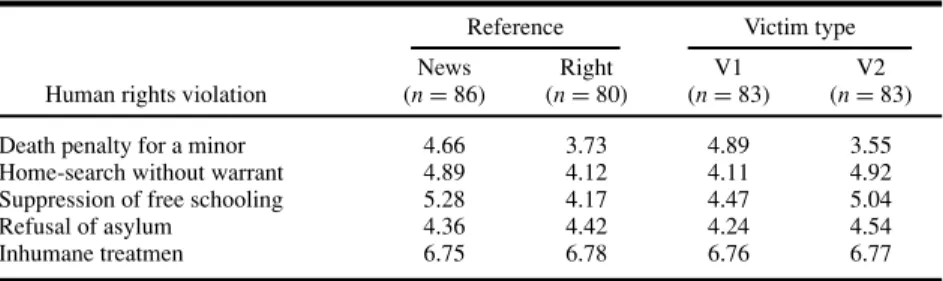
Results reveal no interaction effects in the entire set of analyses. The two experimental factors explained a significant part of the variance on the judgments of the violations of three scenarios: death penalty, home-search without a warrant, and suppression of free primary schooling (Table II). Inspection of the detailed analyses shows that condemnation of the death penalty is stronger when the victim committed a murder rather than a rape (F (1, 165)= 18.07; p < .001) and when the reference concerned News items rather than Human rights (F (1, 165)= 10.11;
p < .005). Regarding privacy violation, the condemnation of the search without a warrant was more severe when the person was suspected of stealing than when the person was alleged to deal drugs (F (1, 165)= 8.64; p < .01). Reference to Human rights moderated the condemnation of the violation in comparison with the News item reference (F (1, 165)= 8.05; p < .01). The suppression of primary school gratuity again was judged as less unacceptable in the Human rights condition (F (1, 165)= 10.00; p < .005). The main effect of the victim type was
Table II. Mean Condemnation of the Violations by Reference (Study Frame) and Type of Victim of The Violation
Reference Victim type
News Right V1 V2
Human rights violation (n= 86) (n= 80) (n= 83) (n= 83)
Death penalty for a minor 4.66 3.73 4.89 3.55
Home-search without warrant 4.89 4.12 4.11 4.92
Suppression of free schooling 5.28 4.17 4.47 5.04
Refusal of asylum 4.36 4.42 4.24 4.54
Inhumane treatmen 6.75 6.78 6.76 6.77
weaker (F (1, 165)= 4.10; p < .05): participants more strongly condemned the violation when victims were handicapped rather than immigrant children. The two experimental variables had no impact on the evaluation of the rejection of an Algerian or Chinese asylum-seeker (F s < 1) and on the condemnation of the violation of the inhumane treatment interdiction (F s < 1).
Effects of covariates showed that a higher agreement with human rights principles enhanced the condemnation of the violation in three cases: death penalty (F (1, 165)= 6.32; p < .05), refusal of asylum (F (1, 165) = 10.14; p < .005), and inhumane treatment (F (1, 165)= 11.55; p < .001). An unexpected inverse relationship was found for the case of privacy violation (F (1, 165)= 5.32; p <
.05). A non-significant increase of condemnation was observed for all scenarios when participants correctly associated principles and concrete violations.
Discussion
Results confirm that general human rights principles are almost consensu-ally endorsed, whereas concrete violations of these same principles are, at least to some extent, tolerated. Thus, the high level of agreement with institution-ally defined rights drops when such a right is concretely or potentiinstitution-ally violated. However, a remarkable exception to this pattern concerns the principle of pro-hibition of inhumane treatment that participants seem to apply in a consistent way to concrete facts. In the present case the consensual adherence to this right would confirm its inscription in the central core of human rights (see Amnesty International, 1992, p. 68). It should be noted, however, that one cannot exclude the possibility that this finding would be due to the specific events studied in this investigation, and that participants would give up their formal adherence when confronted with individuals having committed more reprehensible acts than the mere refusal to comply with an order or a request. Yet, judgments of this violation were not moderated by any variable other than the adherence to the right itself, a finding that confirms the significance attributed to this right by participants.
Judgments of three violations (death penalty, home search, suppression of free schooling) were moderated by the two contextual variables, that is, the char-acteristics of the violation victim and the frame of reference in which violations are presented. It must be emphasized that the rejection of violation victims was strongest in these three scenarios. Therefore, the dilemma between the endorse-ment of rights principles and the legitimacy of the rights violation was strongest in these cases. The murderer, the thief, and the handicapped person seemed more acceptable (or less unacceptable) and deserving better treatment than the rapist, the drug dealer and immigrant. Hence, sanctions against the former were more firmly rejected than sanctions against the latter. It is interesting to note that, contrary to the judgments of the rights violations committed by authorities, judgments of the
victim’s acts varied only slightly across the different variants (except for the death penalty scenario). This suggests that judgments of human rights violations are more prone to contextual reasoning than are judgments of the victims’ actions.
When the object of study was presented as dealing with news items rather than with human rights issues, more severe condemnations of rights violations were observed for the same three scenarios discussed above (death penalty, home search, suppression of free schooling). This intriguing effect suggests that under some circumstances it is counterproductive to argue in terms of human rights, because this paradoxically seems to increase rather than decrease tolerance of violations. Although it is not possible to draw any firm conclusions about this effect, our results indicate that such framing effects are likely to develop when the moral dilemma between the endorsement of the general principle and the acceptance of the violation is strong, that is, when individuals have good reasons to dislike or disrespect violation victims.
Results support the general claim that two forms of reasoning can be distin-guished in judgments of daily human rights violations in a dilemma situation. A rights-oriented principle is used when the context of judgment induces participants to dissociate the two sides of the dilemma and a context-oriented principle is at work when they consider the violation by authorities to be a fair sanction of an unacceptable act.
STUDY 2
Study 2 examined more directly the hypothesis that rights- vs. context-oriented principles in judgments of human rights violations could be activated. This was accomplished by measuring the first reaction participants expressed fol-lowing a human rights violation. We reasoned that participants whose statements reflected a denunciation of the violation (a rights-oriented principle) should con-demn more firmly the violations than those who associated the violation with a fair sanction of an unacceptable act (i.e., a context-oriented principle). Furthermore, the same experimental induction manipulating the communicational context was used. Characteristics of the human rights victims, however, were no longer varied.
Method
Participants
Eighty-eight pupils ranging in age from 16 to 20 years (48 females and 40 males) from a high school in the French-speaking part of Switzerland participated in the experiment. They belonged to three grades of two academic sections. Two participants were removed from the analyses because they failed to complete the entire questionnaire.
Procedure
The questionnaire, similar to the one used in Study 1, was presented to participants on a personal computer and was created with Authorware software. The beginning of the questionnaire introduced the first experimental variable: the study was randomly presented as either a Study on News Items or a Study
on Human Rights. In both conditions, participants read that the study dealt with
two countries, Belgium and Switzerland. Belgium was selected after a pilot study showed that the level of human rights respect was perceived to be similar to that in Switzerland. Two national contexts were studied in order to assess a possible ingroup favoritism effect such that participants would condemn more strongly violations occurring in a national context other than their own (Moghaddam and Vuksanovic, 1990). Participants were asked to answer some personal ques-tions concerning their age, gender, nationality, and school section in order to become familiar with the computerized procedure. The second experimental vari-able was then introduced. Respondents were informed that they were to judge succinctly described scenarios that occurred in one of the two mentioned coun-tries. The label of the randomly selected country remained visible on the top of the screen.
Three short vignettes describing a violation of a right were presented in random order (see Table III). Respondents were invited to provide three words or phrases summarizing their first reaction toward the presented violation. Sub-sequently, they were asked to judge each scenario (which remained visible on the screen) on four dimensions, by clicking their answer on a seven-point scale: acceptability of the violation committed by authorities (1: acceptable, 7:
unac-ceptable), acceptability of the victim’s act (1: acceptable, 7: unacunac-ceptable), and
link to the human rights issue (1: no link at all, 7: very much linked). Finally, words previously generated by participants were retrieved and presented on the screen. For each word or expression, they were instructed to indicate whether it was positive, negative, neutral, or whether it referred to a question.
Table III. News Items and Human Right Issues Used in Study 2
News item 1: No interference with privacy
Without a warrant, the police searched a person’s home. Police suspected the person of drug trafficking.
Violation of human right: Home search without a warrant (Art. 12 UDHR: see Table I) News item 2: Free elementary schooling
A local council suppressed the free primary schooling for handicapped children. The council considered that these children should attend a particular school.
Violation of human right: Suppression of free schooling (Art. 26.1 UDHR: see Table I) News item 3: Political asylum
The government has denied the right to asylum to a political opponent from Algeria by arguing that his life was not really in danger in his home country.
In the second part, the rights corresponding to the violations occurring in the previously described scenarios were shown on the screen, again in random order, phrased in the official language of the UDHR. Participants were invited to indicate to what degree they agreed with each right on a seven-point scale (1: no
agreement at all, 7: full agreement). The last part of the questionnaire involved a
recall task in order to determine whether participants associated each scenario with the corresponding human right. Each scenario was broken up into two sentences, one containing the request or the act of the victim and the other the rights violation. The six sentences were presented simultaneously to the participants who were instructed to match the sentences and the corresponding right.
Results
Spontaneous Expressions Triggered by the Scenarios
Words and phrases expressed as reactions to the scenarios were analyzed by examining the valence (positive, negative, or neutral) ascribed to them.
Par-ticipants labeled more words as negative (M= 4.11) than neutral (M = 2.28)
or positive (M = 1.40). Words appearing at least three times (N = 102) were
analyzed with the technique of automatic textual analysis (ALCESTE, Reinert, 1986) in order to detect lexical categories. The analysis revealed four categories with a level of association with the category of p < .10 (X2(1) > 2.90). In the
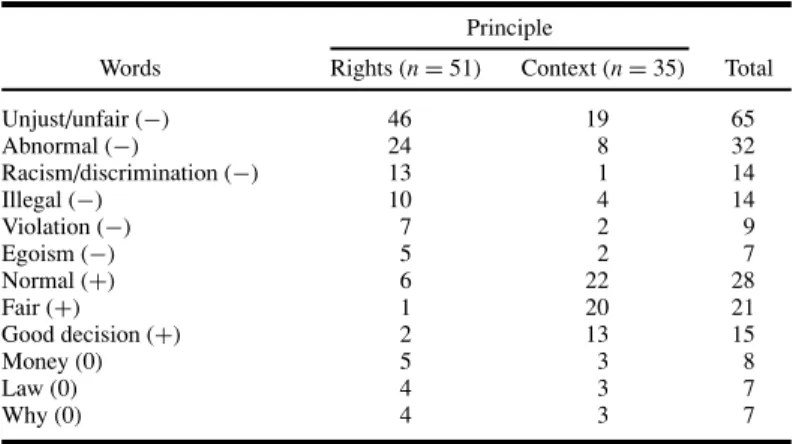
first category, decisions made by authorities were assimilated with just sanctions (words labeled as positive by the participants), whereas in two other categories these decisions were considered violations of rights or personal liberties (negative words). The last category contained references to doubts about the lawfulness of the decisions (neutral words). A word labeled as positive was associated with a context-oriented judgment and a negative one with a rights-oriented judgment. In order to confirm this result, participants were categorized into two groups on the basis of the valence ascribed to their responses. Respondents who labeled at least three words as negative for each positive word were classified as oriented by a rights-based principle. Remaining participants were classified as oriented by a context-based principle. The examination of the most frequently cited words by these two groups provides support for this classification (see Table IV). This cate-gorization (rights- vs. context-based principle) was then retained as an independent variable for subsequent analyses.
Association Between Human Rights and Scenarios
In the recall task, participants associated the violation of each scenario with the corresponding human right 85% (privacy), 84% (free schooling), and 80% (asylum) of the time. No experimental variable affected these results.
Table IV. Most Cited Words by Rights- and Context-Oriented Participants Principle
Words Rights (n= 51) Context (n= 35) Total
Unjust/unfair (−) 46 19 65 Abnormal (−) 24 8 32 Racism/discrimination (−) 13 1 14 Illegal (−) 10 4 14 Violation (−) 7 2 9 Egoism (−) 5 2 7 Normal (+) 6 22 28 Fair (+) 1 20 21 Good decision (+) 2 13 15 Money (0) 5 3 8 Law (0) 4 3 7 Why (0) 4 3 7
Note: Valence of each word is indicated in parentheses.
Judgments of Human Rights as Principles and as Concrete Violations
The principle-application gap was demonstrated by the comparison between acceptability judgments of violations and the degree of agreement with the corre-sponding rights. Adherence to the institutionally defined right (all M > 5.83) was always stronger than the denunciation of its concrete violation (all M < 5.55; all
t(85) > 5.29; all p < .0001). The national context (Belgium vs. Switzerland) had no effect on these judgments.
Judgments of Concrete Violations
The actions of the victims were positively judged for the scenarios involving
free schooling (M= 1.97) and asylum seeking (M = 3.10). Only the drug dealer
was negatively evaluated (M= 6.38), so the dilemma between the violation of
the right and the rejection of the victim was strongest in this situation.
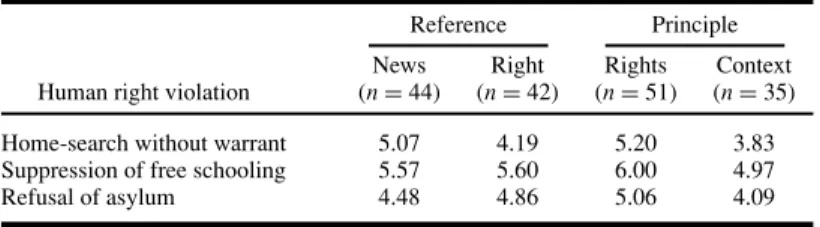
Judgments of violations were submitted to a 2 (reference: News vs. Human rights) × 2 (principle: rights-based vs. context-based orientation) analysis of variance with the agreement with the corresponding human right principle and the victim’s unacceptability judgment as covariates (see Table V). National context, sex, and school section of participants had no effect on results and were not further analyzed.
For all scenarios, unacceptability judgments of the victim covaried negatively with the condemnation of the violation (search without warrant: (F (1, 85)= 4.35;
p < .05) free schooling: (F (1, 85)= 22.16; p < .001) and refusal of asylum: (F (1, 85)= 30.44; p < .001). Agreement with the relevant human rights principle increased the condemnation of the violation in the “search without a warrant” scenario only (F (1, 85)= .60; p < .001).
Table V. Mean Condemnation of the Violations by Reference (Study Frame) and Principle Orientation
Reference Principle
News Right Rights Context
Human right violation (n= 44) (n= 42) (n= 51) (n= 35)
Home-search without warrant 5.07 4.19 5.20 3.83
Suppression of free schooling 5.57 5.60 6.00 4.97
Refusal of asylum 4.48 4.86 5.06 4.09
Note: Scale: 1: acceptable; 7: unacceptable.
Analyses revealed a main effect of the frame of reference on the condemnation of search without warrant (F (1, 85)= 3.97; p < .05), indicating stronger denun-ciation when the scenario was framed in terms of news items rather than human rights. For all scenarios, a rights-oriented judgment principle induced a stronger condemnation than a context-oriented principle. The difference reached an accept-able level of statistical significance for search without warrant (F (1, 85)= 5.97;
p < .05) and refusal of asylum (F (1, 85)= 5.34; p < .05). For the suppression of free schooling, the effect was less clearcut (F (1, 85)= 2.77; p < .10). An interaction effect between Reference and Principle was observed for the refusal of asylum scenario (F (1, 85)= 5.32; p < .05). A post hoc multiple comparison (Tukey test) shows that condemnation of the violation was stronger in the rights-based orientation than in the context-rights-based orientation only in the News condition (respectively, Ms= 5.07 and 3.53; p < .05). In the Human rights condition, the difference was not significant (Ms= 5.04 and 4.61 respectively).
Discussion
The analysis of spontaneous expressions associated with the three violations revealed lexical categories illustrating various representations manifested in this setting. Reactions did not differ much according to the type of scenario, which suggests that participants used similar criteria for assessing different events. Some of them solved the dilemmas by denouncing violations of rights whereas others expressed their agreement with the authority’s interventions. We therefore propose that the former refer their judgments to a normative universe largely influenced by the human rights idea that is chiefly characterized by the inalienability of rights (rights-oriented principle), whereas the latter put forth a conception of justice benefiting authorities at the expense of particular individuals, especially those deemed to be undeserving (context-oriented principle). This latter conception is therefore instrumental to the justification of an existing social order and its authorities.
The analysis of the unacceptability judgments of the scenarios directly con-firmed that condemnation of concrete violations was less consensual than ad-herence to institutionally defined rights. This result provides evidence for the principle-application gap, and suggests that whereas concrete dilemmas were in-terpreted with a great deal of variation, general rights principles were accepted on the basis of a consensually shared positive, yet abstract meaning.
Inspection of response variation about condemnation of violations supports the general conjecture bearing on the differentiated activation of references to hu-man rights in the judgments. First, the more participants associated words labeled as negative to the scenarios, the stronger their denunciation of the violations. Such a reaction was based on a principle that dissociates the judgment of a human rights violation from the actions perpetrated by the victims of the violation. This result offers support for the hypothesis that the judgment of the scenarios was anchored either in a rights- or in a context-based orientation.
Second, the impact of the frame of reference replicated the results of the first study when the dilemma was most intense, that is, for the drug dealer situation in which the violation of the right and the act of the victim were both clearly rejected. Although the data did not support the hypothesis that the News reference would increase the activation of a rights-oriented principle in all instances, it must never-theless be emphasized that the strongest denunciation of the violation is observed in the News condition for participants holding a rights-based orientation. The strong effect of the rights- and context-oriented principles could be explained by a self-generation effect (Greenwald, 1980), which occurs when internally generated information exerts a robust anchoring effect (Mussweiler and Strack, 1999). On the other hand, externally provided information (e.g., through priming) should exert a weaker impact on judgments.
CONCLUSION
As illustrated in interviews reported by Bechlivanou and colleagues (1990) and Doise (2002), laypersons define rights not by strictly applying principles that they endorse, but by focusing on the normality of acts committed by individuals to which principles need to be applied. They adjust their decisions as a function of contexts and persons. As discussed in the domain of social rights (Cl´emence
et al., 1994; Gilens, 1999; Staerkl´e et al., 2003), in daily life justice cannot be
achieved without taking into account the perceived deservingness of the actors (Feather, 1999). Individuals not only reject the universality of rights, which is seen as a source of misuse, but also their restrictive application, which is seen as a cause of exclusion. If one fundamental principle of institutional justice dealing with the rights of the accused is the presumption of innocence, in common sense thinking the non-condemnation of a culprit is as unjust as the condemnation of
an innocent person (Skitka and Houston, 2002). This is why the unconditional granting of equal rights to all is considered intolerable.
In the present study, we examined how human rights become disconnected from formal justice norms when they are analyzed from the point of view of representational everyday thinking. As our findings suggest, the variations in responses are regulated by two normative principles described as rights-based and context-based orientations. This is illustrated by the disparity between participants who denounced institutional misbehaviors as concrete human rights violations (following a rights-oriented principle) and those who on the contrary analyzed them as fair sanctions taken against deviant groups or individuals (following a context-oriented principle). From the point of view of a rights-based orientation, whether an act is considered a human rights violation does not depend on the characteristics of the victim. Rights-based thinking is oriented by the interpretation of the violation with reference to inalienable human rights, in which case people are normatively induced to condemn the violation independently of its context. When following a context-oriented principle, however, we have a tendency to connect our judgment of a violation to our evaluation of the victim of this violation (e.g., his or her acts or personal characteristics), resulting in a redefinition of the situation: the violation becomes a legitimate sanction of an unacceptable act. The violation is dissociated from a reference to rights and approached from the perspective of the (unacceptable) action of the victims; as a consequence, the gravity of the human rights violation is minimized.
Apparently, participants reserve references to human rights for important issues or for massive violations that rarely occur in their daily environments. Media reports largely facilitate such anchoring as they emphasize the human rights dimension of wars, torture, and the lack of freedom occurring in remote and unfamiliar settings. This view of human rights renders them distant and quite irrelevant to everyday life matters, at least in Western countries. On the other hand, in local and familiar contexts, media easily insist on the necessity and the fairness of sanctions of socially unacceptable acts, even when these sanctions are clear human rights violations. This is how it can be understood that when misbehaviors committed by authorities in familiar and proximal contexts are framed as human rights violations, they may paradoxically seem distant and irrelevant to everyday life, and trigger “not-my-problem” and “blame-the-victim” attitudes (Lerner and Goldberg, 1999). Reference to news items, on the other hand, may make events seem “closer,” thereby facilitating the dissociation between violations and acts of the victim, as these events could happen in close proximity as well. Under these conditions, rights violations become less acceptable.
This “news item effect” could explain the recent reactions towards the U.S. treatment of prisoners in Iraq and the Guantanamo Bay camp. Before major news-papers revealed these mistreatments, most people (including members of the elite) presumably shared the point of view that the prisoners were dangerous people who must have committed highly reprehensible acts. Therefore, it would be justified
if they were not to be protected by human rights conventions. Such a judgment, typically reflecting a context-based principle, was apparently impervious to the repeated declarations made by important international organizations (e.g., the Red Cross) who reported the human rights violations. However, the diffusion of crude pictures in the media very quickly created a new, rights-oriented frame, which was adopted by a large number of citizens in the U.S. and elsewhere. The condemna-tion of the inhumane treatment of the prisoners has not suppressed the rejeccondemna-tion of their acts. Instead, these two phenomena were dissociated. As a result, most people accepted that prisoners deserve the application of human rights principles and the protection of international legal conventions, no matter what the circumstances were that brought them into the prisons. This rapid and massive shift in public and elite opinion provides a dramatic illustration of how context- and rights-oriented principles of judgment can be activated by media reports, thereby shaping attitudes toward human rights violations.
ACKNOWLEDGMENTS
We would like to thank Willem Doise for his constant and helpful support during the realization of the present research, John Jost, and two anonymous reviewers for their comments on an earlier draft of this paper. The research was sponsored by the Swiss National Science Foundation (grant no. 1114-037604.93).
REFERENCES
Amnesty International (1992). Au del`a de l’Etat. Le droit international et la d´efense des Droits de
l’Homme, Amnesty International, Paris.
Bechlivanou, G., Delmas-Marty, M., Doise, W., Duchesne, S., Gonzalez, L., and Lenoir, R. (1990). Discours juridique et discours ordinaire. La perception des droits de l’homme dans la soci´et´e contemporaine. Archives de Politique Criminelle 12: 145–166.
Billig, M. (1989). Ideological Dilemmas: A Social Psychology of Everyday Dilemmas, Sage, London. Cl´emence, A., and Doise, W. (1995). La repr´esentation sociale de la justice: Une approche des droits
dans la pens´ee ordinaire. L’Ann´ee Sociologique 45: 371–400.
Cl´emence, A., Egloff, M., Gardiol, N., and Gobet, P. (1994). Solidarit´es Sociales en Suisse, R´ealit´es sociales, Lausanne.
Crandall, C. S., and Beasley, R. K. (2001). A perceptual theory of legitimacy. Politics, prejudice, social institutions, and moral value. In Jost, J. T., and Major, B. (eds.), The Psychology of Legitimacy.
Emerging Perspectives on Ideology, Justice, and Intergroup Relations, Cambridge University
Press, Cambridge, pp. 77–102.
Darley, J. (2002). Just punishments: Research on retributional justice. In Ross, M., and Miller, D. T. (eds.), The Justice Motive in Everyday Life, Cambridge University Press, Cambridge, pp. 314–333. Doise, W. (2002). Human Rights as Social representations, Routledge, London.
Emler, N. (2003). Morality and political orientations: An analysis of their relationship. In Stroebe, W., and Hewstone, M. (eds.), European Review of Social Psychology, Vol. 13, Chichester, Wiley, U.K., pp. 259–291.
Feather, N. T. (1999). Values, Achievement, and Justice: Studies in the Psychology of Deservingness, Kluwer Academic, New York.
Feather, N. T. (2003). Distinguishing between deservingness and entitlement: Earned outcomes versus lawful outcomes, Eur. J. Soc. Psychol. 33: 367–385.
Gilens, M. (1999). Why Americans Hate Welfare: Race, Media and the Politics of Antipoverty Policy, University of Chicago Press, Chicago.
Greenwald, A. G. (1980). The totalitarian ego: Fabrication and revision of personal history. Am.
Psychol. 35: 603–618.
Hafer, C. (2002). Why we reject innocent victims. In Ross, M., and Miller, D. T. (eds.), The justice
motive in everyday life, Cambridge University Press, Cambridge, pp. 109–126.
Jost, J. T., and Banaji, M. R. (1994). The role of stereotyping in system-justification and the production of false consciousness. Br. J. Soc. Psychol. 33: 1–27.
Lerner, M. J. (1977). The justice motive: Some hypotheses as to its origins and its forms. J. Pers. 45: 1–52.
Lerner, M. J., and Goldberg, J. H. (1999). When do decent people blame victims: The differing effects of the explicit-rational and implicit-experiential cognitive systems. In Chaiken, S., and Trope, Y. (eds.), Dual process theories in social psychology, Guilford, New York, pp. 627–640.
Miller, D. T. (2001). Disrespect and the experience of injustice, Ann. Rev. Psychol. 52: 527–553. Moghaddam, F. M., and Vuksanovic, V. (1990). Attitudes and behavior toward human rights across
different contexts: The role of right-wing authoritarianism, political ideology, and religiosity. Int.
J. Psychol. 25: 455–474.
Mussweiler, T., and Strack, F. (1999). Comparing is believing: A selective accessibility model of judgmental anchoring. In Stroebe, W., and Hewstone, M. (eds.), European Review of Social
Psychology, Vol. 10, Chichester, Wiley, U.K., pp. 135–167.
Nelson, T. E., and Kinder, D. R. (1996). Issue frames and group-centrism in American public opinion.
J. Pol., 58: 1055–1078.
Nisbett, R. E., and Ross, L. (1980). Human Inference: Strategies and Shortcomings of Social Judgment, Prentice Hall, Englewood Cliffs, New Jersey.
Reinert, M. (1986). Un logiciel d’analyse lexicale (ALCESTE). Cahiers de l’Analyse des Donn´ees 4: 471–484.
Sears, D. O. (1993). Symbolic politics: A socio-psychological theory. In Iyengar, S., and McGuire, W. J. (eds.), Explorations in Political Psychology, Durham, Duke University Press, North Carolina, pp. 113–149.
Skitka, L. J. (2002). Do the means always justify the ends or do the ends sometimes justify the means? A value protection model of justice, Pers. Soc. Psychol. Bull. 28: 588–597.
Skitka, L. J., and Houston, D. A. (2002). When due process is of no consequence: Moral mandates and presumed defendant guilt or innocence. Soc. Justice Res. 14: 305–326.
Staerkl´e, C., Roux, P., Delay, C., Gianettoni, L., and Perrin, C. (2003). Consensus and conflict in lay conceptions of citizenship: Why people reject or support maternity policies in Switzerland.
Psychologica Belgica (Special issue: Social Identity and Citizenship) 32: 9–32.
Van den Bos, K. (2003). On the subjective quality of social justice: The role of affect as information in the psychology of justice judgments. J. Pers. Soc. Psychol. 85: 482–498.
Van den Bos, K., and Lind, E. A. (2002). Uncertainty management by means of fairness judgments. In Zanna, M. P. (ed.), Advances in Experimental Social Psychology, Vol. 34, San Diego, Academic Press, California, pp. 1–60.