Sources and level of information about health issues and preventive
services among young-old persons in Switzerland
Laurence Seematter-Bagnoud, Brigitte Santos-Eggimann
Health Services Research, Institute of Social and Preventive Medicine (IUMSP), Centre Hospitalier Universitaire Vaudois and University of Lausanne, Lausanne, Switzerland
Submitted: 4 July 2006, Revised: 20 March 2007, Accepted: 29 March 2007
Brief Report Int J Public Health 52 (2007) 313–316
1661-8556/07/050313-4 DOI 10.1007/s00038-007-6086-© Birkhäuser Verlag, Basel, 2007
Summary
Objectives: to describe the sources of health information in young-old persons, and how they feel informed about preven-tive services.
Methods: 1,567 randomly selected persons aged 65–69 years were asked where they did get information about health, and whether they felt suffi ciently informed about recommended preventive services.
Results: Most participants (over 90 %) cited their physician as a source of health information, while only 4 % cited the Inter-net. Level of information was low for several preventive serv-ices, including colon cancer screening (55 % felt suffi ciently informed) and immunization against pneumonia (27 % suffi -ciently informed).
Conclusions: Promotion of preventive services in older popula-tions should take into account the preponderant role of physi-cians as a source of information and advice.
Key words: Aged – Preventive health services – Information systems – Knowledge.
The baby-boom generation is reaching the age of retirement in Switzerland as in other European countries. Consequently, the segment of the population comprising people aged be-tween 60–65 years and 75–80 years, the so-called young-old persons, is expected to grow massively in the next decades. Although most young-old persons are in relatively good health, they face a high risk of chronic diseases and cancer, some of which are preventable. Delivery of preventive and screening services is therefore important in this age category,
but previous studies have reported a low level of preventive services uptake (Birchmeier et al. 2002; Blozik et al. 2007; Peter-Wuest et al. 2000). In this context, assessing the level of information of young retirees about recommended preventive services is important to defi ne health education and health promotion strategies.
Besides investigating which preventive services are less fa-miliar to young-old persons, knowing where they get health-related information is essential to develop strategies aiming at increasing access to prevention in later life. The way older persons inform themselves on health issues has not been widely investigated, except in a few studies on specifi c dis-eases, such as cancer (Basch et al. 2004). Physicians are a traditional source of information about health, and probably continue to play a major role in the older population. How-ever, the Internet is assumed to be used by an increasing pro-portion of individuals reaching the old age.
The objectives of this analysis were to examine which sources of health information were used by young-old persons and their self-reported level of information about specifi c preven-tive services.
Methods
In Spring 2004, 3,056 community-living residents of Lausanne born in 1934–38 were randomly sampled using the population registry. These persons were contacted by mail to participate in a cohort study on age-related frailty (Santos-Eggimann 2005). Baseline data were collected in 2004 on 1,567 persons using a postal questionnaire about different aspects of health (physical, mental, social), as well as about signifi cant events throughout their life course. In order to create the Lausanne Cohort Lc65+, baseline data collection was completed in 2005 with a face-to-face interview, a physical examination, as well as with tests of physical and mental performances. x
314 Int J Public Health 52 (2007) 313–316 Sources and level of information about health issues and preventive © Birkhäuser Verlag, Basel, 2007 services among young-old persons in Switzerland
The initial postal questionnaire also asked participants where they searched for information about health (physicians, rela-tives, medias, Internet, home help agencies, others), and whether they felt suffi ciently informed about specifi c preven-tive services.
This work fi rstly investigates the pattern of utilization of sources of health information by gender, and then describes the proportion of participants reporting suffi cient knowledge about preventive services, again with a gender comparison. For bivariate analyses, participants who mentioned only phy-sicians as a source of health information were compared to all other participants, using chisquared tests. Variables signifi -cantly associated with the use of physicians as unique source of information were then included in a multivariable logistic regression model.
Results
A majority of participants were women (58.7 %), and most were born in Switzerland (77.2 %). There was no statistical difference in the gender of participants and non-participants (p = .934), nor in the distribution of their years of birth (men: p = .271, women: p = .600). Data extracted from the 2000 Federal Census and the 31.12.2004 population registry were also used to compare study participants to the original sam-ple frame of Lausanne residents registered in the same age category. The comparison showed that the participants were highly representative regarding all variables available (gen-der, year of birth, nationality, marital status, proportion liv-ing alone, and current professional activity), except for the level of achieved education: the proportion of persons having completed university was slightly higher, but this difference might result from the presence of missing data (16.2 %) in the Federal Census, while missing education was less than 1 % in the study. About two-thirds (62.5 %) of the participants rated their health as good or very good. Most reported one or more chronic conditions (86.9 %), and had at least one medical visit during the previous year (92.5 %).
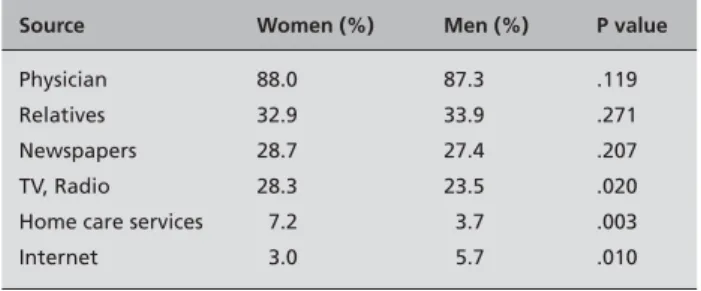
A large majority of men and women (87.8 %) would turn to physicians in case they would need information about health
issues. Then, relatives were reported by about a third (32.9 %). While 28.1 % of participants cited the television and radio as sources of health information, only 4.2 % reported using the Internet to this purpose.
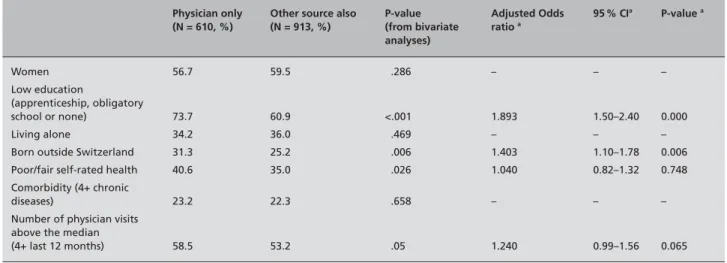
Table 1 displays self-reported sources of information in men and women. Although the gender comparison shows few sig-nifi cant differences, women tended to use more frequently each possible source of information, except the Internet. About 40 % of the participants relied exclusively on physi-cians as a source of health information. As shown in Table 1, these participants were more frequently born outside Switzer-land, had a lower education, a worst self-reported health, and a higher number of physician visits. In multivariate analysis, using no other source of health information than physicians was associated to being born outside Switzerland and to a lower level of achieved education. A borderline association was found with a higher number of physician visits during the last year.
Most participants felt suffi ciently informed about infl uenza vaccination (94.6 %). By contrast, only one in four partici-pants reported suffi cient information concerning immuniza-tion against pneumonia (26.6 %). Among cancer screening in-terventions, colon cancer was the item for which participants felt less frequently informed (men: 50.7 %, women: 58.5 %). Most women were satisfi ed with their knowledge regarding screening for gynaecologic cancers (breast: 96.8 %, cervix: 92.3 %), while 71.1 % of men felt informed about screen-ing for prostate cancer. Again, although the difference did not always reach statistical signifi cance, gender comparisons showed that women more frequently reported a suffi cient level of information for all preventive measures (data not shown).
Discussion
Our results emphasize the role of physicians as the preponder-ant source of health information for most young-old persons. Lower education seems to be the major factor associated with relying on physicians as unique source of health information. Being born outside Switzerland was also associated with re-porting no other source. Searching for information by physi-cians might be related to cultural beliefs, or to diffi culties in understanding the information given in the medias. Newspa-pers, television and radio were however cited by about one in four persons as a source of health information, which con-fi rms their role in conveying preventive messages.
In spite of the belief that the Internet is increasingly used among young-old persons, a very low proportion of partici-pants exploited it to get health information. In another Swiss study, 10 % of primary care patients reported using the Inter-net to get medical information, and the proportion decreased Table 1 Source of health information, by gender
Source Women (%) Men (%) P value
Physician 88.0 87.3 .119
Relatives 32.9 33.9 .271
Newspapers 28.7 27.4 .207
TV, Radio 28.3 23.5 .020
Home care services 7.2 3.7 .003
Sources and level of information about health issues and preventive Int J Public Health 52 (2007) 313–316 315 services among young-old persons in Switzerland © Birkhäuser Verlag, Basel, 2007
to 1 % among those aged 65 years and older (Jeannot et al. 2004). The higher proportion of 4 % in this sample might be explained by the urban setting in which the study took place, and the population constituted of young-old persons exclu-sively. As reported in a recent study (Seniorwatch 2002) on the familiarity of communication technologies among older people, use of the Internet decreases sharply with age. This work showed that 12.8 % of people aged 60–69 years in Eu-rope were regular Internet users, but did not report about the purposes of Internet use in this population. Another recent study in Sweden showed that the proportion of people using the Internet to retrieve health information did double between year 2000 and year 2005, among younger adults as well as among middle-aged ones, and achieved 20 % in persons aged 50 to 64 years in 2006 (Rahmqvist & Bara 2006). The use of the Internet will probably increase regularly during the next decades, but it seems to be currently strongly related to having a professional occupation. A higher proportion of men quot-ing this source of information in our data and the drop in use with age reported in other studies support this hypothesis. Women more frequently reported several sources of health information. They also more often reported suffi cient knowl-edge about preventive measures. These fi ndings are in ac-cordance with previous studies. Women usually show more interest in health subjects than men and want to get more in-formation (Beier et al. 2003; Stewart et al. 2004), which is probably related to their social role of caregivers.
Self-reported knowledge varied widely across the different screening and preventive services, from most persons report-ing suffi cient knowledge about infl uenza vaccination to most feeling insuffi ciently informed when pneumococcus vaccine was concerned. A limitation to the interpretation of these
re-sults is that they are based on self-report, and do not necessar-ily refl ect true knowledge of participants. However, subjective assessment regarding health matters should not be discarded, as subjective health is correlated with risk of death (Singh-Manoux et al. 2007). Interestingly, the pattern of knowledge about recommended preventive services is quite consistent with the pattern of delivery of these interventions in Swiss older persons. Indeed, a study did show a very low prevalence of immunization against pneumococcus compared to infl u-enza (Birchmeier et al. 2002), and older Swiss women par-ticipating in the Survey of Health, Aging and Retirement in Europe also reported a higher use of mammography as com-pared to colonoscopy or fecal occult blood testing1. A sensible interpretation of our data is that there is a real lack of informa-tion among those persons who report being insuffi ciently in-formed, while we cannot really assess the level of knowledge among those reporting having suffi cient information.
As physicians represent the preponderant source of informa-tion, their central role must be recognized. Previous work indicated that physician advice and support are the main factors increasing uptake of preventive care (Yanovitzky & Blitz 2000). Physicians may not be aware of this role, or face several barriers, such as lack of time or insuffi cient train-ing (Hudon et al. 2004). The traditional role of physicians is probably more oriented towards curing than preventing, and most physician visits are devoted to the current health prob-lem of the patient, allowing little time to address prevention. Gynaecologists are a special case, because part of their work consists in gynaecological check-ups, with cancer screening. In Switzerland, a high proportion of women are used to plan Physician only Other source also P-value Adjusted Odds 95 % CIa P-value a
(N = 610, %) (N = 913, %) (from bivariate ratio a
analyses) Women 56.7 59.5 .286 – – – Low education (apprenticeship, obligatory school or none) 73.7 60.9 <.001 1.893 1.50–2.40 0.000 Living alone 34.2 36.0 .469 – – –
Born outside Switzerland 31.3 25.2 .006 1.403 1.10–1.78 0.006
Poor/fair self-rated health 40.6 35.0 .026 1.040 0.82–1.32 0.748
Comorbidity (4+ chronic
diseases) 23.2 22.3 .658 – – –
Number of physician visits above the median
(4+ last 12 months) 58.5 53.2 .05 1.240 0.99–1.56 0.065
a Adjusted odds ratios (95 %CI and P-value) from logistic regression model, including education, place of birth, self-rated health, and number of
physician visits (excluding variables not signifi cantly associated in bivariate analyses).
Table 2 Comparison of participants according to the use of physician as unique source of information and adjusted odds ratios
316 Int J Public Health 52 (2007) 313–316 Sources and level of information about health issues and preventive © Birkhäuser Verlag, Basel, 2007 services among young-old persons in Switzerland
regular gynaecological check-ups, and this is consistent with a large majority of women reporting suffi cient information about screening for gynaecological cancers. In Germany, where gynaecological check-ups are reimbursed by the statu-tory health insurance, more than 80 % of women report hav-ing received information about gynaecological screenhav-ing by gynaecologists (Klug et al. 2005).
Another factor that might discourage physicians of recom-mending preventive services is the cost imputed to the patient. In this context, it is worth noting that immunization against pneumococcus is not reimbursed by the social health insur-ance in Switzerland, as opposed to infl uenza vaccination. Fi-nally, even though most older persons rely on physicians to get health information, better knowledge on some preventive issues might refl ect more extensive reporting in the medias.
Notably, there are national campaigns supporting infl uenza vaccination, and several Cantons have implemented breast cancer screening programmes with systematic mailing of in-vitations to participate.
In conclusion, promotion of preventive services in older populations should take into account the preponderant role of physicians as a source of information and advice, particularly for subgroups with unfavourable socio-economic profi le, and offer training and support for advising about and delivering preventive care.
Acknowledgements
The authors wish to thank the study participants, and are grateful to the City of Lausanne and to the Service de la Santé Publique du Canton de Vaud for funding this project.
References
Basch EM, Thaler HT, Shi W, Yakren S, Schrag D
(2004). Use of information resources by patients with cancer and their companions. Cancer 100: 2476–83.
Beier ME, Ackerman PL (2003). Determinants of
health knowledge: an investigation of age, gender, abilities, personality and interests. J Pers Soc Psychol 84: 439–48.
Birchmeier M, Favrat B, Pécoud A et al (2002).
Improving infl uenza vaccination rates in elderly. J Fam Pract 51: 856.
Blozik E, Meyer K, Simmet A, Gillmann G, Bass AA, Stuck AE (2007). Gesundheitsförderung und
Prävention im Alter in der Schweiz. Ergebnisse aus dem Gesundheitsprofi l-Projekt. Sch-weizerisches Gesundheitsobservatorium, Neuchâtel. Arbeitsdokument No 21.
Hudon E, Beaulieu M-D, Roberge D (2004).
Integration of the recommendations of the Canadian Task Force on Preventive Health care. Obstacles perceived by a group of family physicians. Fam Pract 21: 11–7.
Jeannot JG, Froehlich F, Wietlisbach V, Burnand B, Terraz O, Vader JP (2004). Patient use of the
Internet for health care information in Switzerland. Swiss Med Wkly 134: 307–12.
Klug S, Hetzer M, Blettner M (2005). Screening
for breast and cervical cancer in a large German city: participation, motivation and knowledge of risk factors. Eur J Public Health 15: 70–7.
Peter-Wuest I, Stuck AE, Dapp U et al (2000).
Präventive Hausbesuche im Alter: Entwicklung und Pilottestung eines multidimensionalen Abklärungsintruments. Z Gerontol Geriatr 33: 44–51.
Rahmqvist M, Bara AC (2006). Patients
retrieving information via the Internet: a trend analysis of a Swedish population, 2000–2005. Poster, Conference of the European Public Health Association, Montreux.
Santos-Eggimann B (2005). Maladies
cardio-vasculaires et indicateurs de fragilité lors du recrutement de la 1ère vague de la cohorte LC65+. Rapport au Service de la Santé Publique du canton de Vaud. Institut de Médecine Sociale et Préventive, Lausanne, avril 2005. Available on www.iumsp.ch, Unité des Services de Santé. SeniorWatch (2002). Older people and information society technology. A global analysis. Available on www.seniorwatch.de.
Singh-Manoux A, Guegen A, Martikainen P, Ferrie J, Marmot M, Shipley M (2007). Self-rated
health and mortality: short-and long-term associations in the Whitehall II Study. Psychosom Med 69: 138–43.
Stewart DE, Abbey SE, Shnek ZM, Irvine J, Grace SL (2004). Gender differences in health
information needs and decisional preferences in patients recovering from an acute ischemic coronary event. Psychosom Med 66: 42–8.
Yanovitzky I, Blitz CL (2000). Effect of media
coverage and physician advice on utilization of breast cancer screening by women 40 years and older. J Health Comm 5: 117–34.
Address for correspondence
Dr Laurence Seematter-Bagnoud Health Services Research, Institute of Social and Preventive Medicine (IUMSP) Centre Hospitalier Universitaire Vaudois and University of Lausanne
Bugnon 17 CH-1005 Lausanne Switzerland
e-mail: Laurence.Seematter-Bagnoud@ chuv.ch
To access this journal online: http://www.birkhauser.ch/IJPH