Claudio Soravia Celia D. DeLozier Zuzana Dobbie Claudine Rey Berthod Eviano Arrigoni Marie-Anne Bründler Jean-Louis Blouin William D. Foulkes Pierre Hutter Accepted: 15 March 2005 Published online: 5 April 2005
# Springer-Verlag 2005
Double frameshift mutations in
APC and MSH2
in the same individual
Abstract Heterozygous germline DNA mismatch repair gene mutations are typically associated with HNPCC. Here we report the case of a proband whose father was known for familial adenomatous polyposis. The number of polyps (<10) was not typical of polyp-osis, therefore the diagnosis of HNPCC was entertained. Microsatellite in-stability analyses were performed on peripheral blood and biopsy of a right-sided dysplastic adenoma. The tumour tissue showed high-grade instability and subsequently immunohistochem-istry showed that neither MSH2 nor MSH6 proteins were expressed in tumour cells. Prophylactic colectomy was performed and an adenocarcinoma developing within the adenoma was diagnosed (pT1N0). Genomic DNA analysis revealed a novel mutation in MSH2 as: a frameshift mutation in exon 7 (c.1,191_1,192dupG). Both parents of the proband were analyzed for MSH2 and APC mutations, and in the father a truncating mutation in exon 15 ofAPC was identified as del3471-3473GAGA. This mutation was found to be present in the proband. His mother was found to bear theMSH2 exon 7 mutation. At follow-up, the proband was diagnosed with fundic, antral and duodenal adenomas (one fundic adenoma showed low-grade dysplasia). Several tubular rectal ade-nomas with low-grade dysplasia were excised. The patient later developed an intra-abdominal desmoid tumour.
Keywords Hereditary colorectal cancer . Mismatch repair . Familial adenomatous polyposis . Hereditary nonpolyposis colorectal cancer . Microsatellite instability
Abbreviations HNPCC: hereditary nonpolyposis colorectal cancer . MMR: mismatch repair . FAP: familial adenomatous polyposis . AFAP: attenuated familial adenomatous polyposis . CRC: colorectal cancer . MSI: microsatellite instability . IHC: immunohistochemistry . ACF: aberrant crypt foci . NF1: neurofibromatosis type 1 C. Soravia
Clinic of Visceral Surgery, Geneva University Hospital, Geneva, Switzerland C. D. DeLozier . J.-L. Blouin Division of Medical Genetics, Geneva University Hospital, Geneva, Switzerland Z. Dobbie
Division of Medical Genetics, Department of Clinical and Biological Sciences, Basel, Switzerland C. R. Berthod . P. Hutter Genetics Unit, ICHV, Sion, Switzerland E. Arrigoni
Gastroenterology Practice, Geneva, Switzerland M.-A. Bründler
Division of Clinical Pathology, Geneva University Hospital, Geneva, Switzerland W. D. Foulkes
Departments of Medicine, Oncology and Human Genetics, McGill University,
Montreal, Québec, Canada C. Soravia (*) Route de Chêne 11, 1207 Geneva, Switzerland e-mail: [email protected] Tel.: +41-22-7863292 Fax: +41-22-7863285
Introduction
Among the known genetic predispositions to cancer syn-dromes, two confer a high risk of colorectal cancer (CRC). Familial adenomatous polyposis (FAP), generally due to mutations in theAPC gene on chromosome 5, is responsible for approximately 1% of all CRC. Mutations in at least four mismatch repair (MMR) genes,MLH1, MSH2, MSH6 and PMS2, result in Lynch syndrome, or HNPCC (hereditary nonpolyposis colorectal cancer); together these MMR gene mutations account for 3–5% of all CRC [1–3]. Given the relatively high incidence of these conditions, one would expect an occasional individual to be homozygous for the two APC or two MMR mutations, or to be a carrier of compound heterozygous germline mutations in APC and MMR genes [4–9] Table1.
To our knowledge however, the present case is the first patient observed with concomitant inheritance of patho-genic frameshift mutations inAPC and MSH2.
We report here a complete description of this family with 5-year follow-up of the proband. As he presented fewer polyps than expected at age 25 in a patient with FAP: the differential diagnosis was between HNPCC and attenuated FAP (AFAP) [10,11].
Case report
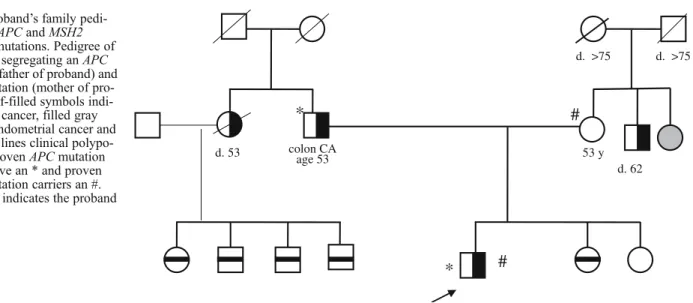
The proband, a 24-year-old man, consulted because of a history of FAP in his father and at least seven other members of his southern Italian family (Fig.1). His father’s medical record was not available when this study begun and no genetic testing had been performed. Five polyps were detected on ileocoloscopy, two in the right colon and three in the sigmoid; four of the polyps were adenomas, one of which was dysplastic.
As the number of polyps was not typical of polyposis, the diagnosis of HNPCC was entertained. Microsatellite in-stability analysis was performed on DNA from dysplastic adenoma and from peripheral blood. The tumour tissue showed high-grade instability (MSI-H) at all four markers tested: BAT25, BAT26, D2S123 and D5S346. IHC on four DNA mismatch repair proteins was also performed. MSH2 and MSH6 were not expressed in tumor cells, whereas MLH1/ PMS2 expression was conserved.
Genetic analysis started withMSH2 and bidirectional se-quencing of the exons and the intron–exon junctions using amplification products obtained by PCR from genomic DNA. A novel mutation was identified inMSH2: insertion of a G in codon 398, in exon 7 at position 1,191 (c.1, 191_1,192dupG), had created a premature termination 19 codons downstream.
The patient opted for prophylactic surgery at age 25 and underwent total colectomy with ileo–rectal anastomosis. In the prophylactic colectomy specimen, a small well-dif-ferentiated adenocarcinoma (pT1N0), developing from a tubulo–villous adenoma was found in the right colon, along with“multiple” flat adenomas and associated aberrant crypts. No intra-abdominal desmoid tumour was found at this time. Over the last 4 years, the patient has experienced nu-merous complications: soon after colectomy, he had fre-quent episodes of gastro–esophageal reflux which were temporarily lessened by a proton-pump inhibitor (panto-prazol). At the age of 25 oeso–gastroduodenoscopy showed chronic gastritis (negative forHelicobacter pylori), hiatal hernia and approximately 30 fundic polyps. Out of three adenomas excised from duodenum, antrum, and gastric fundus, the latter showed low-grade dysplasia. Rectoscopies were carried out at 3-month intervals over the following year, and showed the presence of two to nine polyps, at least one of which was a tubular adenoma with mild dysplasia. The patient was placed on rofecoxib in an attempt to reduce polyp development, but micro-perforations led to peritoni-tis and emergency surgery. On this occasion, a mesenteric desmoid tumour was diagnosed from biopsy. To eliminate the risk of additional rectal cancer a proctectomy with endo-anal mucosectomy, and implementation of a pelvic pouch procedure was proposed, but was declined by the patient.
Bi-annual rectoscopy and esogastroduodenoscopy are currently carried out as surveillance. At his most recent examination (at age 28), the proband presented with fewer than ten rectal polyps (one serrated adenoma) but presented multiple gastric fundic polyps (excised polyp was adenoma with low-grade dysplasia).
At the time of their son’s surgery for colectomy both parents consulted. As already mentioned, the father pre-sented with familial adenomatous polyposis (FAP); he had undergone colectomy at age 53 after FAP with colon carcinoma was diagnosed. AnAPC gene mutation search was initiated in our laboratory. PTT detected a truncating mutation in exon 15, then caracterized as c.del3471_3474-GAGA. This frameshift mutation creates a premature stop Table 1 Summary of reported families withAPC and MMR germline
mutations References Genes involved Clinical findings Scheenstra et al. (2003)[9] APC, MLH1
10-year old with symptomatic FAP, rapid progression of adenomas Yuan et al.
(1998)[7]
APC, MLH1
APC polymorphism I1307K; family not of Jewish origin; does not segregate with HNPCC disease phenotype Yuan et al.
(1999)[8]
APC,
MSH2 APC polymorphism I1307K; AshkenaziJewish individual; variant does not segregate with HNPCC disease phenotype
Present case (2004)
APC, MSH2
Right-sided polyps (AFAP), but early age of CRC (24), gastric and rectal adenomas with dysplasia
codon six codons downstream. His son (the proband), car-rying theMSH2 exon 7 mutation, was found to have inher-ited theAPC exon 15 mutation from his father. The MSH2 mutation was absent in the father.
We then analyzed the proband’s 53-year-old mother, who had no significant medical history but had not undergone colonoscopy, carries theMSH2 mutation. Clinical screening for digestive and gynecological pathologies was recom-mended. Of her seven siblings, a brother reportedly died of colon cancer in his fifties and a sister of uterine cancer at age 62. Genetic testing was offered to all at-risk family members.
Discussion
At the age of 25, the proband’s clinical presentation was more suggestive of HNPCC or possibly AFAP than of clas-sical FAP, on both clinical and histological grounds. This observation, along with the lack of confirmatory medical records about his father, led us to perform screening tests (MSI, IHC) for HNPCC. The proband was found to harbour two germline mutations predisposing to CRC: anAPC exon 15 frameshift mutation inherited from his father and a frameshift mutation inMSH2, inherited from his mother.
Upon further evaluation, the proband showed clinical characteristics of both disorders: desmoid tumours are indicative of FAP, and the small number of polyps in the proximal colon (less than ten) was suggestive of AFAP or HNPCC. His clinical course has, however, been relatively severe, with an adenocarcinoma of the right colon diag-nosed at age 25, and the postoperative development of a mesenteric desmoid tumour. Desmoid tumours occur in 80% of individuals with FAP who undergo prophylactic colon surgery [14]. Several studies have demonstrated an increased risk for desmoid tumours, in patients withAPC mutations occuring between codons 1,310 and 2,011 [12–14]. In our
patient, the APC mutation is located at codon 1,157 and there is no family history of desmoids in this kindred.
Gastric adenoma and/or cancer has been described in both AFAP and HNPCC [15–17].Helicobacter pylori in-fection may induce atrophic gastritis in FAP patients and trigger adenoma development, but our patient tested neg-ative forHelicobacter pylori. As gastric cancer/dysplasia is part of the HNPCC tumour spectrum, MLH1 and MSH2 mutations may influence gastric cancer progression.
A more aggressive clinical course has been reported in the handful of reported patients with bothAPC and a second predisposing mutation in a different gene. Zajac and col-leagues [18] reported an 18-year-old with inherited FAP and >1,000 polyps. The familial mutation, upstream from the mutation cluster region in theAPC gene, had not been asso-ciated with a particularly severe phenotype in this family. Because of the proband’s clinical severity a search for ad-ditional mutations was undertaken and a germlinep53 mu-tation identified. The authors hypothesized that the mother, who died at age 28 of uterine carcinoma, may have also had double mutations.
The only other patient reported to harbor concomitant mutations inAPC and a MMR gene was a 10-year-old child with symptomatic polyposis; theAPC mutation was a ma-ternally-inherited prevalent frameshift in exon 15, and the paternally-inherited MMR mutation was a splice site mu-tation inMLH1 [9]. The authors hypothesized that the rapid progression to high-grade adenomas in this patient was due to the influence of the MLH1 mutation; high-grade dys-plasia was associated with loss of MLH1 expression by IHC criteria. Surely, the severe phenotype may simply be a re-flection of the clinical variability seen in both FAP and HNPCC.
It is worth noting that in mice that are compound het-erozygotes forAPC and MLH1 germline mutations, cancer phenotypes are also enhanced [19,20].
53 y d. >75 d. >75 colon CA age 53 d. 53 d. 62
*
#
#
*
Fig. 1 Proband’s family pedi-gree withAPC and MSH2 germline mutations. Pedigree of the family segregating anAPC mutation (father of proband) and MSH2 mutation (mother of pro-band). Half-filled symbols indi-cate colon cancer, filled gray symbols endometrial cancer and horizontal lines clinical polypo-sis coli. ProvenAPC mutation carriers have an * and proven MSH2 mutation carriers an #. The arrow indicates the proband
Two families have been described [7,8] with an MMR gene mutation plus theAPC missense variant I1307K. The latter change, present in 6% of the Jewish population, does not result in FAP, but in some individuals appears to pre-dispose to colorectal polyps, as a possible result of hyper-mutability of the altered region of theAPC gene; the relative risk of CRC with the I1307K polymorphism has been reported as 1.5–2.0 [21]. In the first of the two families, a French Canadian CRC kindred with an MLH1 truncating mutation, there was no clear association between theAPC I1307K polymorphism and the development of cancer [7]. The same was true in a second such family, of Ashkenazi origin, which fulfilled the Amsterdam criteria for HNPCC. Affected individuals had a missense mutation of MSH2, which was later proven to be pathogenic [22]; however, pres-ence or abspres-ence of theAPC I1307K genotype did not cor-relate with disease. Thus, in these two families, one clear mutation (in a MMR gene which correlated with the HNPCC phenotype) was defined, whereas theAPC polymorphism was transmitted independently of the CRC phenotype.
Kinzler and Vogelstein [23] proposed that theAPC gene serves as the “gatekeeper” of epithelial proliferation, thus exerting a major influence on initiation of the neoplastic process. By contrast, the MMR mutations underlying HNPCC alter “caretaker” genes, and would accelerate carcinogen-esis, once the initiation step has occurred. However, the
distinction between gatekeeper and caretaker roles has recently become somewhat blurred, as the mutation ofAPC could not be shown to be a compulsory step in all CRC. Indeed, a significant proportion of colorectal cancer may be initiated through the epigenetic silencing of alternative genes implicated in apoptosis and mismatch repair [24]. In dysplastic microscopic epithelial lesions referred to as aberrant crypt foci (ACF), flat tubular adenomas, and pol-ypoid tubular adenomas, the frequency ofAPC mutations is reported to be 0, 7 and 36%, respectively [25]. Moreover, genomic instability has actually been detected in ACF. These observations led to two contrasting hypotheses: a“dysplasia ACF–adenoma–carcinoma sequence”, or a “heteroplastic ACF–adenoma–carcinoma sequence”. These observations may suggest the APC mutation consistently triggers ad-enoma formation before theMSH2 mutation participates in tumorigenesis through MSI. Molecular analysis of ACF or the demonstration that very early adenomas show abnor-mal expression of beta-catenin [26], should help to clarifiy this issue.
Acknowledgements This work was supported by a grant from the Geneva University Hospitals (PRD-01-2-23 to JLB and CDD). PH was supported by the Fonds National Suisse de la Recherche Scientifique (No 3138-051088) and by la Recherche Suisse Contre le Cancer (No AKT1446).
References
1. Altonen LA, Salovaara R, Kristo P et al (1998) Incidence of hereditary nonpol-yposis colorectal cancer and the feasi-bility of molecular screening for the disease. N Engl J Med 338:1481–1487 2. Lynch HT, de la Chapelle A (2003)
Hereditary colorectal cancer. N Engl J Med 348:919–932
3. Soravia C, Cohen Z (2005) Familial adenomatous polyposis. In: Fazio VW, Church JM, Delaney CP (eds) Current therapy in colon and rectal surgery. Elsevier Mosby, Philadelphia, pp 349– 353
4. Kariola R, Otway R, Lonnqvist KE et al (2003) Two mismatch repair gene mutations found in a colon cancer patient—which one is pathogenic? Hum Genet 112(2):105–109 5. Whiteside D, McLeod R, Graham G
et al (2002) A homozygous germ-line mutation in the human MSH2 gene predisposes to hematological malig-nancy and multiple café-au-lait spots. Cancer Res 62:359–362
6. Gallinger S, Aronson M, Shayan K et al (2004) Gastrointestinal cancers and neurofibromatosis type 1 features in children with a germline homozygous MLH1 mutation. Gastroenterology 126:576–585
7. Yuan ZQ, Kasprzak L, Gordon PH, Pinsky L, Foulkes WD (1998) I1307K APC and hMLH1 mutations in a Jewish family with hereditary non-polyposis colorectal cancer. Clin Genet 54:369–370
8. Yuan ZQ, Wong N, Foulkes WD et al (1999) A missense mutation in both hMSH2 and APC in an Ashkenazi Jewish HNPCC kindred: implications for clinical screening. J Med Genet 36:790–793
9. Scheenstra R, Rijcken FE, Koornstra JJ et al (2003) Rapidly progressive ade-nomatous polyposis in a patient with germline mutations in both the APC and MLH1 genes: the worst of two worlds. Gut 52:898–899
10. Soravia C, Berk T, Madlensky L et al (1998) Genotype–phenotype correla-tions in attenuated adenomatous polyp-osis coli. Am J Hum Genet 62:1290– 1301
11. Cao Y, Pieretti M, Marshall J, Khattar NH, Chen B, Kam-Morgan L, Lynch H (2002) Challenge in the differentiation between attenuated familial adenoma-tous polyposis and hereditary nonpol-yposis colorectal cancer: case report with review of the literature. Am J Gastroenterol 97(7):182
12. Soravia C, Berk T, McLeod RS, Cohen Z (2000) Desmoid disease in patients with familial adenomatous polyposis (FAP). Dis Colon Rectum 43:363–369 13. Davies DR, Armstrong JG, Thakker N et al (1995) Severe Gardner syndrome in families with mutations restricted to a specific region of theAPC gene. Am J Hum Genet 57:1151–1158
14. Caspari R, Olschwang S, Friedl W et al (1995) Familial adenomatous polypo-sis: desmoid tumours and lack of ophthalmic lesions (CHRPE) asso-ciated withAPC mutations beyond codon 1444. Hum Mol Genet 4:337– 340
15. Bertario L, Russo A, Sala P et al (2003) Multiple approach to the exploration of genotype–phenotype correlations in fa-milial adenomatous polyposis. J Clin Oncol 21:1698–1707
16. Aarnio M, Salovaara R, Aaltonen LA, Mecklin JP, Järvinen H (1997) Features of gastric cancer in hereditary non-polyposis colorectal cancer syndrome. Int J Cancer 74:551–555
17. Nakamura S, Matsumoto T, Kobori Y, Iida M (2002) Impact ofHelicobacter pylori infection and mucosal atrophy on gastric lesions in patients with familial adenomatous polyposis. Gut 51:485–489
18. Zajac V, Tompka M, Ilencikova D, Majek P, Stevurkova V, Kirchoff T (2000) A double germline mutations in the APC and p53 genes. Neoplasma 47 (6):335–341
19. Edelmann W, Yang K, Kuraguchi M et al (1999) Tumorigenesis in Mlh1 and Mlh1/Apc1638N mutant mice. Cancer Res 59:1301–1307
20. Shoemaker AR, Haigis KM, Baker SM et al (2000) Mlh1 deficiency enhances several phenotypes of Apc(Min)/+ mice. Oncogene 19:2774–2779 21. Niell BL, Long JC, Rennert G, Gruber
SB (2003) Genetic anthropology of the colorectal cancer-susceptibility allele APC I1307K: evidence of genetic drift within the Ashkenazim. Am J Hum Genet 73:1250–1260
22. Foulkes WD, Thiffault I, Gruber SB et al (2002) The founder mutation MSH2*1906G->C is an important cause of hereditary nonpolyposis colo-rectal cancer in the Ashkenazi Jewish population. Am J Hum Genet 71:1395– 1412
23. Kinzler KW, Vogelstein B (1996) Lessons from hereditary colorectal cancer. Cell 87:159–170
24. Yuen ST, Chan TL, Ho JW et al (2002) Germline, somatic and epigenetic events underlying mismatch repair de-ficiency in colorectal and HNPCC-related cancers. Oncogene 21 (49):7585–7592
25. Jass JJ, Whitehall VLJ, Young J, Legget BA (2002) Emerging concepts in colorectal neoplasia. Gastroenterol-ogy 123:862–876
26. Mirabelli-Primdahl L, Gryfe R, Kim H et al (1999) Beta-catenin mutations are specific for colorectal carcinomas with microsatellite instability but occur in endometrial carcinomas irrespective of mutator pathway. Cancer Res 59:3346– 3351