HAL Id: hal-03201936
https://hal.archives-ouvertes.fr/hal-03201936
Submitted on 19 Apr 2021
HAL is a multi-disciplinary open access archive for the deposit and dissemination of sci-entific research documents, whether they are pub-lished or not. The documents may come from teaching and research institutions in France or
L’archive ouverte pluridisciplinaire HAL, est destinée au dépôt et à la diffusion de documents scientifiques de niveau recherche, publiés ou non, émanant des établissements d’enseignement et de recherche français ou étrangers, des laboratoires
platforms
Olena Havrylchyk
To cite this version:
Olena Havrylchyk. Regulatory framework for the loan-based crowdfunding platforms. 2018,
Regulatory framework
for the loan-based
crowdfunding platforms
Olena Havrylchyk
Organisation for Economic Co-operation and Development
ECO/WKP(2018)61
Unclassified English - Or. English
13 November 2018 ECONOMICS DEPARTMENT
REGULATORY FRAMEWORK FOR THE LOAN-BASED CROWDFUNDING
PLATFORMS
ECONOMICS DEPARTMENT WORKING PAPERS No. 1513 By Olena Havrylchyk
OECD Working Papers should not be reported as representing the official views of the OECD or of its member countries. The opinions expressed and arguments employed are those of the author(s).
Authorised for publication by Álvaro Pereira, Director, Country Studies Branch, Economics Department.
All Economics Department Working Papers are available at www.oecd.org/eco/workingpapers.
OECD Working Papers should not be reported as representing the official views of the OECD or of its member countries. The opinions expressed and arguments employed are those of the author(s).
Working Papers describe preliminary results or research in progress by the author(s) and are published to stimulate discussion on a broad range of issues on which the OECD works. Comments on Working Papers are welcomed, and may be sent to OECD Economics Department, 2 rue André Pascal, 75775 Paris Cedex 16, France, or by e-mail to
All Economics Department Working Papers are available at www.oecd.org/eco/workingpapers.
This document and any map included herein are without prejudice to the status of or sovereignty over any territory, to the delimitation of international frontiers and boundaries and to the name of any territory, city or area.
The statistical data for Israel are supplied by and under the responsibility of the relevant Israeli authorities. The use of such data by the OECD is without prejudice to the status of the Golan Heights, East Jerusalem and Israeli settlements in the West Bank under the terms of international law.
On 3 May 2018, the OECD Council invited Lithuania to become a Member. At the time of publication the deposit of Lithuania’s instrument of accession to the OECD Convention was pending and therefore Lithuania does not appear in the list of OECD Members and is not included in the OECD zone aggregates.
On 25 May 2018, the OECD Council invited Colombia to become a Member. At the time of publication the deposit of Colombia’s instrument of accession to the OECD Convention was pending and therefore Colombia does not appear in the list of OECD Members and is not included in the OECD zone aggregates.
© OECD (2018)
You can copy, download or print OECD content for your own use, and you can include excerpts from OECD publications, databases and multimedia products in your own documents, presentations, blogs, websites and teaching materials, provided that suitable acknowledgment of OECD as source and copyright owner is given. All requests for commercial use and translation rights should be submitted to [email protected]
ABSTRACT/RÉSUMÉ
Regulatory framework for the loan-based crowdfunding platforms
In a growing number of OECD countries policymakers are designing specific regulations for lending-based crowdfunding platforms. In March 2018, as a part of its Fintech action plan, the European Commission also presented its proposal for the EU-wide passporting regime. To evaluate these new regimes, this study collects information about the regulation of lending-based crowdfunding platforms in 17 OECD countries and proposes a theoretical framework to reflect about different regulatory regimes. In this context, we explore market failures in lending-based crowdfunding and identify regulatory challenges. Although lending-based crowdfunding platforms do not technically perform risk and maturity transformation, in some countries, flexible regulation allows them to experiment with different business models to provide services of credit risk management (via risk grades, provision funds, automated lending) and liquidity provision (via secondary markets). These platforms could perform the same functions as banks in the future, but there are theoretical reasons to believe that platform-based intermediation could be more stable than banking intermediation. The success of lending-based crowdfunding platforms hinges on their ability to solve moral hazard issues and overcome significant barriers to entry related to scale and scope economies, adverse selection, as well as funding cost advantage of incumbent large banks. There are also risks related to an excessive reliance on funding of leveraged and ‘too big to fail’ institutional investors that are prone to runs and moral hazard problems.
JEL classification: G21, G23, G01, O33, D40
Keywords: lending-based crowdfunding, Fintech, financial regulation, barriers to entry
Cadre réglementaire des plateformes de financement participatif par prêt
Dans un nombre croissant de pays de l’OCDE, les responsables politiques sont en train d’élaborer des réglementations spécifiques aux plateformes de financement participatif par prêt. En mars 2018, dans le cadre du plan d’action FinTech, la Commission européenne a également présenté une proposition de système de passeport à l’échelle de l’UE. En vue d’évaluer ces nouveaux systèmes, les auteurs de la présente étude ont réuni des informations sur la réglementation des plateformes de financement participatif par prêt dans 17 pays de l’OCDE et proposent un cadre théorique permettant de réfléchir à différents types de réglementations. Dans ce contexte, nous avons étudié les défaillances de marché dans les activités de financement participatif par prêt et recensé les défis qui se présentent en matière de réglementation. Si, techniquement, ces plateformes ne procèdent pas à des transformations de risques et d’échéances, dans certains pays, la souplesse de la réglementation leur permet toutefois de tester divers modèles économiques de fourniture de services de gestion du risque de crédit (au moyen de systèmes de notation des risques, de fonds de réserve, de prêts automatisés) et d’offre de liquidité (par le biais des marchés secondaires). À l’avenir, ces plateformes pourraient avoir les mêmes fonctions que les banques, mais des raisons théoriques portent à croire que leur intermédiation pourrait se révéler plus stable que l’intermédiation bancaire. Le succès de ces plateformes dépendra de leur capacité à résoudre les problèmes d’aléa moral et à surmonter plusieurs obstacles à l’entrée non négligeables liés aux économies d'échelle et de gamme, à l’antisélection, mais aussi à l’avantage dont jouissent les grandes banques classiques en termes de coûts de financement. Il existe également des risques induits par le recours excessif à des investisseurs institutionnels endettés et d’importance systémique prompts à opérer des mouvements de retraits massifs et exposés aux problèmes d’aléa moral.
Classification JEL: G21, G23, G01, O33, D40
Table of contents
REGULATORY FRAMEWORK FOR THE LENDING-BASED CROWDFUNDING
PLATFORMS ... 6
Executive summary ... 6
Coordination problems and runs ... 7
Adverse selection and moral hazard ... 8
Market power and barriers to entry ... 9
Introduction ... 10
Do crowdfunding platforms perform the same functions as banks? ... 11
Lending-based crowdfunding platform is not a ‘shadow bank’ ... 15
The growth of lending-based crowdfunding ... 15
Implications for financial regulation ... 19
Panorama of lending-based crowdfunding regulations ... 19
Coordination problems and secondary markets ... 20
Adverse selection ... 22
Moral hazard and incentives ... 23
Contingency or provision funds/Insurance ... 24
Capital requirements ... 25
Resolution plans ... 26
Institutional investors ... 27
Transparency and disclosure ... 28
Market power and barriers to entry ... 29
Regulatory barriers ... 30
Natural or structural barriers ... 31
Strategic barriers ... 33
How to overcome barriers? ... 33
Government policies to support lending-based crowdfunding ... 36
Conclusions ... 37
Bibliography ... 39
Appendixes ... 42
A1. REGULATION OF LENDING-BASED CROWDFUNDING PLATFORMS IN AUSTRIA ... 42
A2. REGULATION OF LENDING-BASED CROWDFUNDING PLATFORMS IN BELGIUM ... 43
A3. REGULATION OF LENDING-BASED CROWDFUNDING PLATFORMS IN FINLAND ... 44
A4. REGULATION OF LENDING-BASED CROWDFUNDING PLATFORMS IN FRANCE 45 A5. REGULATION OF LENDING-BASED CROWDFUNDING PLATFORMS IN GERMANY ... 47
A6. REGULATION OF LENDING-BASED CROWDFUNDING PLATFORMS IN ISRAEL .. 48
A7. REGULATION OF LENDING-BASED CROWDFUNDING PLATFORMS IN MEXICO 50 A8. REGULATION OF LENDING-BASED CROWDFUNDING PLATFORMS IN PORTUGAL ... 51
A9. REGULATION OF LENDING-BASED CROWDFUNDING PLATFORMS IN THE UK . 53 B. REGULATION OF LENDING-BASED CROWDFUNDING IN THE EUROPEAN UNION ... 55
Tables
Table 1. Summary of activities that are allowed by lending-based crowdfunding platforms ... 7 Table 2. A working taxonomy of debt-based crowdfunding platforms ... 12 Table 3. Main functions of lending-based crowdfunding platforms and banks ... 14
Figures
Figure 1. Lending-based crowdfunding platforms and banks ... 12 Figure 2. The volume of marketplace lending/lending-based crowdfunding in the US (in $ million).. 16 Figure 3. The volume of lending-based crowdfunding in the UK (in £ million) ... 16 Figure 4. The volume of lending-based crowdfunding in France (in € million) ... 17 Figure 5. The volume of lending-based crowdfunding in Germany (in € million) ... 17 Figure 6. The volume of consumer lending-based crowdfunding in the continental Europe (in €
million) ... 18 Figure 7. The volume of business lending-based crowdfunding in the continental Europe (in €
million) ... 18 Figure 8. Business lending-based crowdfunding in the UK ... 19 Figure 9. The share of institutional investors in lending-based crowdfunding platforms ... 27
REGULATORY FRAMEWORK FOR THE LENDING-BASED
CROWDFUNDING PLATFORMS
By Olena Havrylchyk1
Executive summary
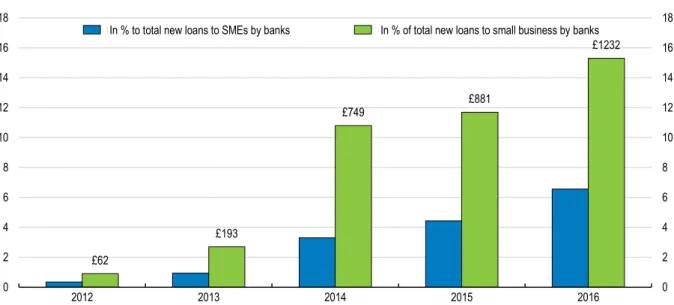
Enabled by new information and communication technologies, lending-based crowdfunding platforms represent a new mode of financial intermediation by connecting directly lenders and borrowers via internet platforms. While the share of loans facilitated by lending-based crowdfunding platforms is still very small, in some niche markets, platforms are becoming a real alternative to bank credit. For example, in 2016, business lending facilitated by UK crowdfunding platforms amounted to 15% of the total new loans to small businesses, compared to less than 1% in 2012 (Zhang et al., 2017).
To review the existing regulatory practices, we have sent a questionnaire about regulation of crowdfunding to all OECD countries and have received 17 replies (Austria, Belgium, Denmark, Finland, France, Germany, Ireland, Israel, Italy, Mexico, the Netherlands, Poland, Portugal, Norway, the Slovak Republic, Sweden, the UK). While most OECD countries require lending-based crowdfunding platforms to adapt to the existing regulation, a growing number of countries have set up a new legislation to explicitly regulate this novel mode of financial intermediation. Following numerous consultations and reports, the European Commission has presented in March 2018 a proposal for the EU-wide passporting regime that concerns both lending-based and investment-based crowdfunding (EC, 2018b). Such proposal was likely motivated by the fact that the lack of the EU wide regulation was identified as an obstacle for the development of the crowdfunding market in Europe.
Although lending-based crowdfunding platforms do not technically perform risk and maturity transformation, there is an ongoing experimentation with different business models that could allow them to perform bank-like functions in the future. Firstly, many platforms allow lenders to automate their lending process by setting their lending criteria (risk, maturity, etc), which lowers their transaction costs and permits diversification. Secondly, platforms use credit scoring to assign a risk band to every borrower and effectively play the role of a delegated monitor insofar as lenders delegate to them due-diligence. Thirdly, platforms provide liquidity services when they create secondary markets on which lenders can sell their loans to other investors. In 2016, Zopa, the first lending-based crowdfunding platform, has announced that it was applying for a UK banking license. This is symbolic because Zopa has created the business model of P2P lending and its application for the banking licence signifies, on the one hand, the limits of the platform business model and, on the other hand, its similarity with the banking model.
1 External consultant to the OECD. University of Paris 1 Panthéon-Sorbonne, CES, Labex ReFi.
E-mail : [email protected]. The author would like to thank the OECD, and in particular Aida Caldera Sanchez, Pierre Beynet, Mamiko Yokoi-Arai, Alvaro Pereira, Caroline Roulet, and Sebastian Schich for their help in the creation and the organization of the questionnaire for this paper and for their constructive criticism. She would also like to thank all delegates of OECD countries and their respective policymakers for completing the questionnaire. Finally, she is grateful to Marianne Verdier for their numerous discussions.
Table 1. Summary of activities that are allowed by lending-based crowdfunding platforms
AUT BEL FIN FRA* ISR* DEU MEX PRT GBR EU
Max loan (in mln)
€ 1.5 € 0.3 No limit € 1/2.5 NIS 1/6 € 2.5 ? € 1 £ 5 € 1 Investment in facilitated loans Yes Yes Yes No No/
Yes
No Yes No Yes No Automated lending No NR NR NR Yes NR NR No Yes NR Secondary markets No No No No/NR Yes/
No
No Yes NR Yes Yes
Provision funds No NR No NR NR NR NR NR Yes NR
Yes/No – if activity is allowed/not allowed; NR – if activity is not regulated or not mentioned in the law. *Information is provided separately for two legal statuses of lending-based platforms that facilitate loan agreements and investment based platforms that facilitate debt securities.
Source: OECD Questionnaire
Regulators face a significant trade-off between encouraging innovation and preserving financial stability. The results of our questionnaire, summarised in Table 1, show that current regulatory texts do not propose any regulatory instruments, but rather define the scope of activities of crowdfunding platforms. While some regulators restrict crowdfunding platforms to simple credit intermediation, others explicitly set high maximum amount for originated loans, allow automated lending, provision funds, secondary markets and platforms’ investments in loans that they facilitate. While the former approach limits short-term risks, it also prevents platforms from experimenting with business models and eventually competing with banks in the future. In this context, the recent EC proposal appears to be more on the conservative side since it does not mention automated lending, limits the maximum loan amount to 1 million Euros, explicitly forbids platforms’ investment in loans and limits the responsibility of platforms in the organization of the secondary markets (called bulletin boards).
To structure the discussion about regulation, we explore three types of market failures in the financial system that need to be addressed by the regulators: (1) coordination problems and runs (2) moral hazard and adverse selection (3) market power and barriers to entry. This will allow to reflect about the need to regulate the lending-based crowdfunding and highlight challenges that need to be addressed.
Coordination problems and runs
Secondary markets are offered by many large lending-based crowdfunding platforms. They are a useful feature for providing liquidity to investors and could be essential for scaling-up of platforms. Theoretically, there is a good reason to believe that platforms with secondary markets would not be subject to coordination problems and self-fulfilling runs in the same way as banks are. The direct link between lenders and borrowers ensures that lenders’ strategy (to run or not to run) does not depend on the strategy of other lenders, but only on the solvency of borrowers in their loan portfolio. Nevertheless, secondary markets might become illiquid and misprice traded securities. Also, it would be misleading for platforms to promise lenders maturity transformation (i.e. their investment can be always liquidated). Currently, secondary markets are forbidden in many countries and in some cases the regulatory approach is not clear (see Table 1). In particular, the EU proposal explicitly states that platforms cannot put in place a trading system but, instead, proposes a bulletin board that allows investors to interact directly with each other to buy and sell loan
agreements or transferable securities. Importantly, such buying and selling activity on crowdfunding platforms is at the client's own discretion and responsibility.
Regulatory challenges: To allow or not the functioning of secondary markets? If secondary markets are allowed, how to ensure that insider trading and market abuse are forbidden? How to ensure that platforms do not guarantee the transformation of maturity to lenders and communicate this clearly?
Adverse selection and moral hazard
Retail lenders face severe adverse selection problems when they have to decide to whom to lend. This problem is particularly acute because most regulators set a low limit on the maximum size of loans (see Table 1), thus, allowing lending only to small businesses, which tend to be riskier and more opaque. To mitigate this problem of adverse selection, lenders delegate due-diligence to crowdfunding platforms, but they still bear most of the losses. Hence, addressing problems related to informational asymmetries should be at the heart of the financial regulation and it is important to ensure that platforms have good risk management systems in place. Many platforms are likely to experiment with new methods of credit scoring that rely on big data and machine learning. While these techniques are promising, they are still untested. Importantly, due diligence and scoring models are currently not supervised.
Since lenders bear all credit losses, alignment of incentives between platforms and lenders is important. To signal risk retention, several platforms invest in loans that they facilitate, while others use their own capital to create provision funds that absorb first losses. Indeed, if platforms do not retain risk of loans that they facilitate, their business model could resemble an “originate and distribute” model of the securitization process that was pointed out as one of the major causes of the global financial crisis due to the loosening credit standards. However, in the EU proposal, platforms are explicitly forbidden to invest in loans that they facilitate in several countries (see Table 1). This rule is motivated by the potential conflicts of interest that could lead to “cherry picking” the best loans. Such concerns are legitimate and if platforms invest in loans, they should invest in all loans. Finally, if platforms become systemically important in the future, it is important to ensure the possibility of an orderly resolution, i.e. the continuation of loan repayments so that lenders do not lose money solely as a result of the platform’s failure. It is important because the existence of financial institutions that are too big or too interconnected to fail increases the likelihood of state bail-outs, and, hence, intensifies moral hazard concerns. While we have yet to experience a failure of a large platform, the direct connection between lenders and borrowers gives us reason to think that it is easier to design an orderly resolution of a platform than that of a bank. Since all lenders bear their own losses, it is comparable to a bail-in mechanism.
Regulatory challenges: How to ensure that platforms have good risk management systems in place without constraining innovation in scoring models? How to regulate the alignment of incentives between platforms and lenders? If platforms are allowed to invest in loans that they facilitate, how to ensure that there is no cherry-picking? How to design minimum capital requirements that ensure platforms’ solvency and align incentives between lenders and platforms? How to ensure a smooth resolution of platforms in the case of the failure?
Most platforms allow investment of sophisticated institutional lenders, such as insurance companies, banks, hedge funds, investment groups or family offices. While a co-financing
model between retail and institutional investors provides an important guarantee to borrowers that their loans will be funded, an excessive reliance on the institutional money might pose significant risks to the financial stability in the long run. Most institutional lenders are leveraged and ‘too big to fail’ institutions that are prone to runs and moral hazard problems. In this case, all the advantages of the lending-based crowdfunding business model (e.g. less prone to runs, easier resolution, no leverage) are lost.
Regulatory challenges: How to ensure fair treatment of retail and institutional investors? How to avoid the interconnectedness of lending-based crowdfunding platforms with leveraged and ‘too big to fail’ institutions?
Market power and barriers to entry
Even if well-designed lending-based crowdfunding platforms might represent a better business model of financial intermediation than banking, they are facing numerous barriers to entry (regulatory, structural and strategic). They are entering a market dominated by large banks and, due to high switching costs, platforms are forced to pursue the market expansion strategy towards risky borrowers that are underserved by the incumbent banks. This has worked during the post-crisis period, when banks needed to deleverage and have cut their loan supply to creditworthy borrowers. However, if entrants serve only borrowers that are rejected by banks, they risk to have higher default rates and lose servicing fees. Hence, the long-term viability of the crowdfunding business model is likely to require a direct competition with banks for good borrowers. This is complicated by the fact that incumbent banks have a distinct informational advantage over lending-based crowdfunding platforms. Due to long-term banking relationships, they possess granular data on their borrowers that allow them to model default risk. Scale and scope economies, inherent in the financial intermediation, also represent a significant barrier to entry. Finally, an explicit and implicit government guarantees imply a funding cost advantage, allowing large banks to provide credit at a lower interest rate than crowdfunding platforms, all other things being equal.
Regulatory challenges: How to level the playing field between platforms and banks? How to ensure that new entrants do not face adverse selection problems with respect to banks’ borrowers? Should policymakers facilitate switching to new technologies and with what instruments? How to ensure that policies towards incumbent banks (such as explicit and implicit guarantees that result in lower funding costs) do not distort the level playing field between banks and crowdfunding platforms?
In many countries authorities design policies that support lending-based crowdfunding. In particular, development banks lend via crowdfunding platforms and invest in them, which provides a valuable signal that the crowdfunding business model is viable. Also, authorities in several countries have adapted their taxation policies to lending-based crowdfunding. Notably, lenders are able to subtract crowdfunding losses from their revenues in the calculation of the tax base. In some countries, the authorities have introduced tax benefits for the crowdfunding activity that are similar to other financial products. While such government support could be an essential tool in helping crowdfunding platforms to overcome high barriers to entry, it would be worth considering accompanying it with impact assessments.
Introduction
Enabled by new information and communication technologies, lending-based crowdfunding platforms represent a new mode of financial intermediation by connecting directly lenders and borrowers via internet platforms. When first platforms appeared in the UK and the US, they were called peer-to-peer (P2P) consumer (or business) lending platforms. As the role of institutional investment increased, the term ‘marketplace lending’ has become the norm in the US2. The European Commission (EC) uses the term
‘lending-based crowdfunding platforms’, the term which is also used in this paper, while the UK Financial Conduct Authority (FCA) prefers the term ‘loan-based crowdfunding platforms’. “Investment-based” crowdfunding platforms are different from “lending-based” crowdfunding platform in the sense that funders invest in unlisted shares or debt securities issued by businesses. However, from the economist’s perspective, as long as crowdfunding platforms offer secondary markets, the difference between a loan agreement and a debt security is blurred. This is why the analysis in this paper applies to all crowdfunding platforms that facilitate debt, notwithstanding the legal nature of the underlying financial instrument (loan agreement, notes, minibonds, debentures or other debt securities).3
All these platforms are a part of the wider Fintech movement, which is often viewed as an opportunity of making financial intermediation more transparent, efficient and stable. The share of loans facilitated by lending-based crowdfunding platforms is still very small and even in countries with the most developed crowdfunding markets, only around 1% of total loans are facilitated by platforms. In some countries’ niche markets, however, platforms are becoming a real alternative to bank credit and their importance is growing. For example, in 2016, business lending facilitated by UK crowdfunding platforms amounted to 15% of the total new loans to small businesses by banks, compared to less than 1% in 2012 (Zhang et al., 2017).
This paper reviews the existing regulatory practices of 17 countries that replied to an OECD questionnaire about regulation of lending-based crowdfunding platforms (Austria, Belgium, Denmark, Finland, France, Germany, Ireland, Israel, Italy, Mexico, the Netherlands, Poland, Portugal, Norway, the Slovak Republic Sweden, the UK). A growing number of countries have set up a specific legislation to explicitly regulate lending-based crowdfunding platforms. Following numerous consultations and reports (EC, 2015, 2016, 2017), the European Commission has presented in March 2018 a proposal for the EU-wide passporting regime that concerns both lending-based and investment-based crowdfunding (EC, 2018b). This proposal is part of the EU Fintech action plan (EC, 2018a) and was likely motivated by the fact that the lack of the EU wide regulation was identified as an obstacle for the development of the cross-border crowdfunding market in Europe (EC, 2017).
2 When discussing the US market, the term marketplace lending platforms is used because in the US
the word crowdfunding applies only to equity, reward and donation crowdfunding platforms and might be misunderstood. When referring to the UK platforms, the term of P2P is occasionally used.
3 This study excludes equity crowdfunding platforms that connect directly investors and start-ups
and are seen as an alternative to the venture capital or seed capital. While this form of crowdfunding is becoming an important source of start-up financing, its analysis requires a different theoretical framework. It also excludes research on reward and donation crowdfunding that is alternative to traditional charity and patronage activities. Finally, this paper does not cover balance sheet lenders, because the business model is close to a shadow bank and, hence, their regulation is covered by the literature on the shadow banking.
This paper explores these new regulatory regimes of lending-based crowdfunding platforms and identifies regulatory challenges. Lending-based crowdfunding platforms are often presented as an alternative to traditional banks and, therefore, it is first assessed whether these new actors could perform the same functions as banks. Although lending-based crowdfunding platforms do not technically transform risk and maturity, there is an ongoing experimentation with different business models (automated lending, provision funds, secondary markets, etc.) that allows platforms to manage risk, play the role of delegated monitor and provide liquidity services (Havrylchyk and Verdier, 2018). Hence, they could perform functions similar to banks.
To identify regulatory challenges, the discussion is structured about three types of market failures that need to be addressed by the regulator: (1) coordination problems and runs (2) moral hazard and adverse selection (3) market power and barriers to entry (Freixas and Rochet, 2008). Careful analysis of these market failures provides justification for the financial regulation. Importantly, different business models of lending-based crowdfunding platforms could lead to different market failures. Since platforms are entering a market dominated by large incumbent banks, careful attention is devoted to barriers to entry (regulatory, structural and strategic), platforms’ strategies to overcome them as well as government support policies.
This paper contributes to the earlier work about regulation of lending-based crowdfunding platforms undertaken by different European institutions (ESMA, 2014, EBA, 2015, EC, 2015, 2016, 2017). In particular, this paper is closely related to the report of the EC (2016) that surveys new regulatory regimes in the EU member states that were specifically designed for lending-based crowdfunding platforms. The contribution of this paper is twofold. First, it extends the survey to cover regulatory practices in OECD countries. Second, and more importantly, it specifically addresses the question of platforms’ business models and how regulation could define the scope of their activities. It is important because the design of lending-based crowdfunding platforms impacts their ability to perform bank-like functions. More generally, earlier studies assume that crowdfunding platforms fill a niche by serving credit-constrained borrowers excluded from the banking sector. In contrast, our study takes a more forward-looking approach grounded in the financial intermediation theory to understand whether lending-based crowdfunding platforms could compete with banks in the future and how regulation could influence this scenario.
Do crowdfunding platforms perform the same functions as banks?
4Table 2 presents the classification of lending-based crowdfunding platforms that follows the taxonomy developed by the Cambridge Center for the Alternative Finance. Lending-based crowdfunding platforms offer credit to consumers (e.g. Zopa and Ratesetter in the UK, Prosper and Lending Club in the US, Bondora in Estonia) and to SMEs (e.g. Funding Circle in the UK, Geldvoorelkaar in the Netherlands, Lendix and Unilend in France). Some platforms specialize in property-secured lending to property developers (e.g. LendInvest in the UK), while others offer a possibility to SMEs to sell their invoices to investors (e.g. MarketInvoice in the UK, Investly in Estonia) or invest in sustainable development (e.g. Lendosphere in France, Abundance in the UK).
Table 3 summarizes the main differences between business models of lending-based crowdfunding platforms and banks. Both banks and lending-based crowdfunding platforms
perform the brokerage role by connecting funders (depositors in the case of banks and lenders in the case of platforms) and borrowers (individuals and businesses). While bank depositors do not have much visibility of how their money is used, crowdfunding platforms remove the need for balance sheet intermediation and give the possibility to retail investors to choose to whom they would like to lend (Figure 1). Indeed, many lenders are attracted to this form of intermediation because it allows them to invest in local businesses as well as socially and environmentally responsible projects. This decision can be made by analyzing credit score (assigned by the platform to every project), interest rate, industry, location and the objective of the project.
Figure 1. Lending-based crowdfunding platforms and banks
Table 2. A working taxonomy of debt-based crowdfunding platforms
Crowdfunding business model Definition Marketplace/P2P Consumer
Lending Individuals or institutional funders provide a loan to a consumer borrower. Marketplace/P2P Business
Lending Individuals or institutional funders provide a loan to a business borrower. Invoice Trading Individuals or institutional funders purchase invoices or
receivable notes from a business at a discount. Marketplace/P2P Property
Lending Individuals or institutional funders provide a loan secured against a property to a consumer or business borrower. Debt-based Securities Individuals or institutional funders purchase debt-based securities, typically a bond or
debenture at a fixed interest rate.
Mini-Bonds Individuals or institutions purchase securities from companies in the form of an unsecured retail bonds.
Note: Debt-based crowdfunding applies to lending-based crowdfunding platforms as well as investment-based
crowdfunding platforms that facilitate the issue of minibonds and other debt securities.
Most mature platforms offer the function of the automated lending (also called auto-bid or auto-selection), where a lender can set lending criteria, such as risk band, maturity, interest rate, maximum investment in one loan, industry, location, etc. Several online platforms pool loans in different portfolios that differ with respect to risk or even go a step further and pool all loans together by offering a lender an opportunity to spread their funds across the entire loan book. The minimum sum that can be invested in each business is small on all platforms, ranging from 1 to 20 €/$/£, allowing retail lenders to diversify their investment. The survey of the Cambridge Center for the Alternative Finance shows that 77% of P2P Consumer Lenders and 49% of P2P Business lenders in Europe make use of auto-bid or auto-selection function for their platform lending (Ziegler et al., 2018). The figure is expected to go up as the crowdfunding goes mainstream and attracts less sophisticated investors. The availability of the automated investment decreases lenders’ transaction costs and allows them to diversify their loan portfolio, which are the two essential functions of financial intermediaries.
Another important function of financial intermediaries is the alleviation of problems related to informational asymmetries. Depositors delegate the job of monitoring borrowers to a bank and this results in risk transformation.5 In the case of standard crowdfunding
platforms, platforms do not hold loans on their balance sheets and lenders bear all credit risks. Hence, theoretically they need to monitor both borrowers and platforms, which should increase monitoring costs. In practice, the majority of platforms sets interest rates on loans that depend on borrower’s credit score and loan maturity, and survey evidence shows that almost 70% of lenders in the UK rely on the due-diligence conducted by platforms (Zhang et al., 2017). Numerous observers in the UK believe that even though crowdfunding platforms do not perform risk transformation, they are similar to banks because lenders rely on platforms’ due diligence in a manner not fundamentally different from bank deposits (FCA, 2016).
Successful development of platform intermediation requires the alignment of incentives of platforms and lenders. Platforms attempt to signal the quality of their due-diligence and credit risk assessment in two important ways. First, some platforms (or platform owners) invest in loans that they originate to signal that their incentives are aligned with those of lenders. (e.g. Lendix). Second, platforms create contingency or provision funds that allow smoothing returns (e.g. Ratesetter, Prexem, Assetz Capital). These funds are financed either by a risk-weighted contribution paid by borrowers or lenders and/or by the capital provided by the platform itself. Importantly, even if some provision funds could have a 100% track record (e.g. Ratesetter), these platforms do not represent a guaranteed-return business model and if losses are greater than the provision fund, they will be borne by lenders. The existence of a provision fund could be an important strategy, because as long as realized returns are equal to projected returns, lenders do not need to audit the platform and can delegate the monitoring of borrowers to platforms, which is in line with the model of Diamond (1984). Even in the absence of provision funds, platforms could signal the quality of their scoring models by publishing projected returns (taking into account projected bad debt), which would allow lenders to compare them with realized returns.
If a borrower defaults on their loans, platforms promise to make their best efforts on behalf of lenders to recover the unpaid balance from delinquent borrowers. This involves structuring a new payment plan, selling collateral, contacting external collection agencies and taking other appropriate actions to recover a loan. Sometimes, platforms charge fees
for this activity. When platforms have access to credit registries and bureaus, they also report delinquent borrowers to them.
Another difference between banks and lending-based crowdfunding platforms is the fact that platforms do not guarantee liquidity transformation. However, a growing number of platforms organize secondary markets allowing lenders to liquidate their investment by selling their loans to other lenders. In more mature platforms, buyers and sellers can post their prices online and the deal is settled more or less automatically if the demand and supply meet. Selling a loan could be done with a premium or a discount, depending on the market supply and demand. Defaulted loans are sometimes excluded from the sale. A sale fee is charged by some platforms. Unlike banks, withdrawing funds from lending-based crowdfunding platforms is not guaranteed and is done only as long as there are interested buyers. While one could imagine that liquid secondary markets could help lenders to sell their loans without losses during normal times, this is not guaranteed if secondary markets are illiquid during crisis times.
Unlike banks that earn their profits from the interest spread, platforms earn their profits from fees. Most platforms charge an origination fee (in % of the loan) at the time of loan origination and a servicing fee (in % of capital due) that is paid during loan reimbursement. If a loan defaults, P2P lending platforms do not perceive servicing fees, which impact their profits. In addition, some P2P lending platforms charge borrowers a collection fee in percent of the amount recovered in the case of no litigation, or in percent of hourly attorneys’ fees if litigation is involved. Given that standard crowdfunding platforms do not themselves invest in their loans, the fee structure that is skewed to the origination fee creates a principal-agent problem as platforms have a short-run incentive to maximize loan volume, which could loosen their credit standards (Davis and Murphy, 2016).
Finally, modern banks create money every time when they extend a credit. Such monetary creation is important because around 90% of money in the modern economy is created by private banks. Lending-based crowdfunding platforms do not create money; they only intermediate money between lenders and borrowers. This implies that in the platform-based financial intermediation, innovative ways of monetary creation should be envisaged. Otherwise, economic growth could suffer from too little credit.
Table 3. Main functions of lending-based crowdfunding platforms and banks
Lending-based crowdfunding platforms Bank Brokerage function Direct lending via a platform. Removes the need for
balance sheet intermediation.
Orderly resolution is possible via a built-in ‘bail-in’ mechanism
Intermediated lending. Bank is a black box.
Orderly resolution is difficult. Bank as delegated
monitor Possible duplication of monitoring costs if lenders have to monitors borrowers and platforms. Platforms publish credit scores, but they do not invest in loans (No skin in the game) ? moral hazard problems. Platforms may signal the reliability of information by investing in loans. Monitoring costs go down if returns are smoothed via provision fund.
Banks act as delegated monitors due to the existence of the risk-free deposit contract.
Capital adequacy rules ensure that banks absorb losses, which signals the reliability of information that they produce.
Risk transformation No, losses are born by lenders
(unless returns are smoothed via provision fund)
Yes Liquidity provision and
maturity transformation No (unless secondary market). Hence, not subject to bank runs If there is no liquidity on the secondary markets, this is similar to the suspension of deposit convertibility
Yes, which makes them very fragile to self-fulfilling bank runs without government guarantees Monetary creation No Yes. When bank extends a loan, it
Lending-based crowdfunding platform is not a ‘shadow bank’
A standard lending-based crowdfunding platform cannot be considered as a ‘shadow bank6’. Since lenders bear all risks, funding does not have deposit-like characteristics and
platforms do not perform risk transformation. Platforms, even those with secondary markets, do not guarantee maturity transformation and/or liquidity transformation and, hence, are not subject to self-fulfilling bank runs. Finally, platforms do not use direct or indirect leverage. However, attention should be paid to hybrid business models that could promise deposit-like characteristics and liquidity transformation.
As a caveat, it is important to distinguish between lending-based crowdfunding platforms and other fintech start-ups that perform credit intermediation, in particular balance sheet lenders (e.g. Kabbage, OnDeck, SoFi). As the name suggests, balance sheet lenders keep originated loans on their own balance sheets and, hence, they retain all credit risk. While their capital ratios are currently multiple times higher than those of banks, these intermediaries perform risk transformation and rely on leverage and, hence, have a business model that is similar to banks, i.e. they are shadow banks (Buchak et al., 2017). Fintech balance sheet lenders are excluded from our analysis, because internet has not fundamentally transformed their business model.
The growth of lending-based crowdfunding
The first P2P lending platform, Zopa, was launched in the UK in 2006. Shortly afterwards, two P2P lending platforms, Prosper and Lending Club, were founded in the US. These two countries remain the leaders of lending-based crowdfunding among OECD countries. In the US, consumer lending amounted to $21.1 billion in 2016, compared to $7.6 billion in 2014, while business and property lending is less developed (Figure 2). In the UK, all lending-based crowdfunding amounted to £4.1 billion, almost equally divided between consumer, business and property lending (Figure 3). In continental Europe, lending-based crowdfunding started developing much later and in 2016, in France, the continental leader in terms of total lending-based crowdfunding (consumer and business loans, invoice financing, mini-bonds and other debt securities), only €0.31 billion of debt financing was facilitated by platforms (Figure 4). Germany is the second largest market for lending-based crowdfunding, with £0.22 billion of loans (Figure 5). Figures 6 and 7 report the amount of consumer and business lending in the continental Europe, where Netherlands and Germany lead in business and consumer lending, respectively.
Even in countries with the most rapid development of lending-based crowdfunding platforms, the share of loans facilitated by platforms is less than 1% of total loans originated by banks. It is better to consider the importance of crowdfunding in niche markets, such as small business lending or consumer lending. For example, in 2017, business lending facilitated by the UK crowdfunding platforms amounted to 15% of total new loans to small businesses by banks, compared to less than 1% in 2012 (Figure 8). Hence, for the UK small businesses, P2P lending platforms are becoming a real alternative to bank credit and their importance is growing. Unfortunately, it is difficult to measure the importance of
6 The October 2011 Financial Stability Board report defines shadow banking system as a "the system
of credit intermediation that involves entities and activities outside the regular banking system". The European Comission (2012) has complemented this definition with the following characteristics of a shadow bank: (1) accepting funding with deposit-like characteristics; (2) performing maturity and/or liquidity transformation; (3) undergoing credit risk transfer; and, (4) using direct or indirect financial leverage.
crowdfunding in other niche markets, because reliable data on new loans for small businesses or consumers originated by banks is scarce. Specifically, since banks hold loans on their balance sheet, official statistics capture only outstanding loans, while crowdfunding platforms report data on new loans.
Figure 2. The volume of marketplace lending/lending-based crowdfunding in the US (in $ million)
Source: Cambridge Center for the Alternative Finance.
Figure 3. The volume of lending-based crowdfunding in the UK (in £ million)
Source: Cambridge Center for the Alternative Finance.
0 5000 10000 15000 20000 25000 0 5000 10000 15000 20000 25000
Consumer Lending Business Lending Property Lending
2014 2015 2016 0 200 400 600 800 1000 1200 1400 0 200 400 600 800 1000 1200 1400
Consumer Lending Business lending Property lending Invoice Financing Debt-based Securities/
Debentures
Figure 4. The volume of lending-based crowdfunding in France (in € million)
Source: Cambridge Center for the Alternative Finance.
Figure 5. The volume of lending-based crowdfunding in Germany (in € million)
Source: Cambridge Center for the Alternative Finance.
0 20 40 60 80 100 120 140 160 180 200 0 20 40 60 80 100 120 140 160 180 200
Consumer Lending Business Lending Invoice Financing Mini bonds Debt-based securities
2013 2014 2015 2016 0 20 40 60 80 100 120 140 160 180 200 0 20 40 60 80 100 120 140 160 180 200
Consumer Lending Business Lending Invoice Financing Debt-based securities
Figure 6. The volume of consumer lending-based crowdfunding in the continental Europe (in € million)
Source: Cambridge Center for the Alternative Finance.
Figure 7. The volume of business lending-based crowdfunding in the continental Europe (in € million)
Source: Cambridge Center for the Alternative Finance.
0 20 40 60 80 100 120 140 160 180 200 0 20 40 60 80 100 120 140 160 180 200
DEU FRA FIN EST POL ITA LVA LTU CZE CHE SWE ESP SVK BEL
2013 2014 2015 2016 0 20 40 60 80 100 120 140 0 20 40 60 80 100 120 140
NLD FRA FIN ESP DEU DNK ITA LTU EST LVA POL BEL SWE CHE
Figure 8. Business lending-based crowdfunding in the UK
Source: Cambridge Center for the Alternative Finance
Implications for financial regulation
In light of the earlier discussion, this section draws a theoretical framework that would allow policymakers to think about the regulation of this new type of financial intermediaries. This helps assess existing regulatory practices in the OECD countries as well as the EU proposal for the regulation of crowdfunding (EC, 2018).
Panorama of lending-based crowdfunding regulations
To do a review of the existing regulatory practices in the OECD countries, a questionnaire was sent to regulators of all OECD countries and 17 countries have replied (Austria, Belgium, Denmark, Finland, France7, Germany, Ireland, Israel, Italy, Mexico, the
Netherlands, Norway, Poland, Portugal, the Slovak Republic, Sweden, the UK). Appendix A summarized new regulatory regimes that have been explicitly designed for lending-based crowdfunding platforms or for investment-based crowdfunding platforms that allow debt securities. The details of the EU proposal are summarized in Appendix B.
Different countries have chosen different regulatory approaches towards lending-based crowdfunding platforms. A number of countries have set-up a specific legislation to explicitly regulate lending-based crowdfunding platforms (France, the UK and Israel). Other countries have introduced crowdfunding regulation that either applies to both lending-based and investment-based crowdfunding or appears to not distinguish between the two business models (Austria, Belgium, Finland, Mexico, Portugal). The EU proposal falls into the latter category. Germany has introduced only investment-based crowdfunding regulation, but it allows debt securities and, hence, it is included in this analysis. In contrast,
7 As shown in Appendix A, France and Israel have introduced two separate regimes for
lending-based and investment-lending-based crowdfunding platforms. Since several investment-lending-based platforms intermediate minibonds and other debt securities, our analysis applies to them as well.
£62 £193 £749 £881 £1232 0 2 4 6 8 10 12 14 16 18 0 2 4 6 8 10 12 14 16 18 2012 2013 2014 2015 2016
Italy has set up the investment-based crowdfunding regulation that refers only to equity securities and, hence, is excluded from this analysis8.
In countries that do not have any lending-based crowdfunding regulation, platforms adapt to the existing regulation of securities trading, banking or payment institutions. In the Netherlands, consumer-to-business platforms have to get an individual release from the Dutch Financial Markets Authority to perform brokerage activities, while consumer-to-consumer platforms require a creditor license. In Sweden and Denmark, lending-based platforms operate as payment institutions, while in Norway – they are registered as loan intermediaries. In France, where banking monopoly still exists for consumer credit, one consumer-to-consumer platform has obtained a credit institution license. In Estonia, consumer-to-consumer lending platforms fall under the regulation of consumer lending by the Financial Supervision Authority, while consumer-to-business lending is not regulated. In Ireland, platforms operate without any legal status of the financial intermediary. Financial regulation is designed to address three types of market failures in the financial system: (1) Coordination problems and runs (2) Moral hazard and adverse selection (3) Market power (Freixas and Rochet, 2008). As it was discussed earlier, lending-based crowdfunding platforms perform the brokerage role of the financial intermediation, but unlike banks they do not transform maturity and risk. These differences are important because they imply that a well-designed lending-based platform intermediation might have several advantages over banking intermediation, as will be discussed in what follows.
Coordination problems and secondary markets
Crowdfunding platforms are not subject to inefficient ‘bank runs’ because there are no coordination problems between lenders. In contrast, in a fractional banking system, even solvent banks are fragile to self-fulfilling panics because if a depositor thinks that other depositors are going to withdraw money, the only rational decision for this depositor is to withdraw money before other depositors. This first-come, first-served rule is important not only in causing individual run, but also in causing contagion and systemic banking panics9.
Deposit insurance and lender of last resort are modern solutions to the problem of self-fulfilling bank runs (Schich, 2014).
In the case of platforms, the first-come, first-served rule does not apply because lenders and borrowers are connected directly. Lenders’ return depends on the solvency of the borrowers in their loan portfolio and not on the decision of other lenders to keep their loans or sell them on the secondary markets. It is true that if all other lenders decided to sell their loans, market liquidity would dry up and a lender would need to wait till loan maturity to recuperate his/her money. However, the investment return of this lender would not change and would be even higher if we assume non-zero fees on the secondary market. Hence, if a lender does not experience a liquidity shock and he/she thinks that borrowers are solvent,
8 Italy has been the first EU member country that took advantage of the exemption of Directive
2004/39/EC (“MiFID I”) and introduced in 2013 a national regulatory framework for equity based crowdfunding. Since 2013, 20 platform managers (for equity crowdfunding) have been authorized by Consob (the Italian stock exchange authority), which is the competent authority for equity crowdfunding in Italy. Platform managers can also operate under the scope of MiFID II if they are authorized as investment firms or banks. As of now only two of them have chosen this regime.
9 Self-fulfilling bank runs are modeled by Diamond and Dybvig (1983). There are three solutions to
this problem: narrow banking, deposit insurance and convertibility of deposits; equity financing of a bank (Freixas and Rochet, 2008).
the only rational decision is to keep the money invested via the platform. From this discussion follows that crowdfunding platforms do not require government deposit insurance to reach this unique equilibrium. Secondary markets on platforms could function similarly to the limited convertibility of deposits (Freixas and Rochet, 2008).
While secondary markets are a useful mechanism for providing liquidity to investors, they are forbidden in several countries and the regulatory approach is not clear in most countries (see more details in Table 1 or the Appendices A and B). In Israel, secondary markets are allowed for smaller loans, but would require a stock exchange management license for larger loans and debt securities. In contrast, in France, secondary markets “are not foreseen” for lending-based crowdfunding platforms (for loans up to 1 mln Euros) but “are not excluded” for investment-based crowdfunding platforms (for debt securities up to 2.5 mln Euros) and even “foreseen” for minibonds that will be traded on the blockchain (as it is explained later). In this context of regulatory uncertainty, none of the French platforms offers secondary markets because they are not sure whether they have the right to do it. Several authorities have noted that platforms would need to obtain an additional license to organize secondary market (e.g. MiFID license in several EU countries). In Portugal, secondary markets are not forbidden but legislation provides no details about their organization. The EU proposal introduces a concept of a bulletin board that allows investors to interact directly with each other to buy and sell loan agreements or transferable securities which were originally crowdfunded on their platforms. However, the crowdfunding platform should inform their clients that they do not operate a trading system and that such buying and selling activity on their platforms is at the client's own discretion and responsibility.
There appears to be two reasons for the lack of consensus about whether to allow or not secondary markets. First, some regulators are concerned that secondary markets transform lending-based crowdfunding into the securitization, which has been identified as a key cause of the global financial crisis. However, the problem with the securitization is related to the loose underwriting standards of the ‘originate and distribute model’ and a ‘shadow bank’ nature of the special purpose vehicles, not the existence of the secondary markets. Second, there are concerns about insider trading and market abuse (when loans are traded with discounts and premiums), which call for the appropriate regulation of platforms’ secondary market. For example, to avoid insider trading, one could envisage a regulation that prevents the lender to choose which loans are liquidated, so that the decision is only made when a lender needs liquidity and cannot use its private information.
Currently, functioning secondary markets exist in the US and the UK. While the lack of data on order books prevents researchers to investigate their functioning, there is evidence that the use of secondary markets is rather limited, with annual transactions amounting to less than one-fifth of the size of the loan book on the largest UK platforms (Zopa, Ratesetter, Funding Circle) (Oxera, 2016). Investors appear to use secondary markets to exit their investment in the event of the liquidity shock and not as a speculative tool. Such usage is reinforced by fees that are charged by most platforms and by forbidding to sell defaulted loans on some platforms.
In France, the ordonnance from December 2017 has introduced the concept of the blockchain (dispositif d’enregistrement électronique partagé) that will allow the registration and trading of different financial instruments, including minibonds issued by French investment-based crowdfunding platforms. This legislation provides a framework for experimentation with a new technology in the organization of secondary markets.
Development of secondary markets might be a necessary condition for scaling up of lending-based crowdfunding because lenders seek liquid assets. However, several platforms have begun to offer investors to take out their money after a certain notice period or initial term, which introduces a worrying maturity mismatch (FCA, 2016). Many observers in the UK feel that platforms that promise investors instant access to their money would be making unclear, unfair or misleading promotions (FCA, 2016). Hence, platforms should issue risk warnings to explain to investors that even in the presence of secondary markets, unlike banks, they do not guarantee contractual liquidity, but establish conditions for market liquidity. In other words, they do not perform maturity transformation. Moreover, platforms should have the mechanisms to detect, prevent and respond to any potential market manipulation. Eventually, for secondary markets to function properly, a more comprehensive regulation suitable for the trading of unlisted securities should be developed.
Regulatory challenge: How to ensure that platforms issue risk warnings to explain to investors they do not perform maturity transformation? How to prohibit insider trading and market abuse to allow secondary markets to function correctly?
Adverse selection
Retail investors that rely on crowdfunding platforms face important adverse selection problems because they do not know the quality of borrowers. This problem is particularly acute because most regulators set a low limit on the maximum size of loans (e.g. EUR 1 mln in the EU proposal), hence constraining lending-based crowdfunding to small businesses that are inherently risky and opaque (see more details about maximum size of loans in Table 1 or the Appendices A and B). To mitigate adverse selection problem, lenders rely on the due diligence and credit risk assessment of platforms that, similar to credit rating agencies, provide risk grades to potential borrowers. Although this is a form of financial advice to potential lenders (Davis and Murphy, 2016), platforms do not bear the responsibility for the quality of their advice and argue that their risk grades are provided for the information purpose only and do not constitute investment advice.
The current regulation of lending-based crowdfunding platforms obliges platforms to disclose main features of loans and characteristics of borrowers. However, the correctness of this information is not always verified. Moreover, platforms’ due-diligence and credit risk assessment are not supervised. To be clear, the supervisor faces a trade-off between innovation and financial stability. Several lending-based crowdfunding platforms are seeking to replace relationship lenders and traditional credit scoring with innovative algorithms based on big data and machine learning. Still in its infancy, such analysis attempts to predict creditworthiness by analysing buying habits, memberships, reading proclivities, lifestyle choices, trustworthiness and satisfaction scores on eBay, Amazon and TripAdvisor, information from Facebook, LinkedIn, etc. These models are untested and the evaluation of their prediction power is a difficult task, but it is important to experiment with these innovative scoring methodologies.
Internet provides an opportunity to harness the ‘wisdom of crowds’ (i.e. soft information collected and processed by individual lenders) that could complement hard data to solve information asymmetries (see literature surveys by Morse, 2016; and Belleflamme et al., 2015; Havrylchyk and Verdier, 2018). An extensive research on this topic documents that social ties, such as endorsement and bids on friends’ applications or friends’ creditworthiness, provide an informative signal for lenders and raises their returns (Freedman and Jin, 2014; Everett, 2010, Lin, Prabhala, and Viswanathan, 2013, Lu, Gu,
Ye, and Sheng, 2012). Nevertheless, it also shows that such information could be easily manipulated as friends learn to bid on each other’s applications to increases their chances of being funded (Freedman and Jin, 2014). Also, the ‘crowd’ is not always ‘wise’ but could also make decisions driven by irrational discrimination (Ravina, 2016). Finally, the value of such soft information could decline as online lending goes mainstream and becomes automated.
Regulatory challenge: How to ensure that lending-based crowdfunding platforms have sound due diligence and credit risk assessment without constraining credit scoring innovation?
The problem of adverse selection is aggravated if lending-based crowdfunding platforms lend to riskier projects that are not financed by banks and, hence, no credit history exists to build robust scoring models. This appears to be the strategy of lending-based crowdfunding platforms that have difficulty attracting borrowers with banking relationships and, hence, try to scale-up by lending to riskier projects. A survey in the US finds that online lenders target SMEs that tend to be smaller, younger and less profitable than those borrowing from banks. It also documents that borrowers from online lenders have submitted more applications than borrowers from traditional banks (Wiersch et. al. 2016). A survey of Funding Circle, the largest UK platform that serves SMEs, shows that their borrowers choose crowdfunding because they do not have collateral (Pierrakis and Collins, 2013). De Roure et al. (2016) study borrowers from Auxmoney, the largest consumer P2P lending platform in Germany, finding that they pay a higher interest rate and are riskier than those of banks. Indeed, the website of Auxmoney explains that borrowers can receive a loan despite a bad credit rating provided by the Schufa, the German private credit bureau. Morse (2015) studies consumer lending in the US and also concludes that crowdfunding platforms’ borrowers are likely to be more debt-laden and to be in more financial distress than the mean US borrower.
In this context, it is important to state that large traditional banks have a distinct informational advantage over lending-based crowdfunding platforms. Due to long-term banking relationships, banks possess granular data on their borrowers that allows them to model default risk. New entrants do not have access to this data and need to buy it. However, data provided by private companies is expensive and incomplete. These adverse selection problems constitute an important barrier to entry for new players, discussed in the next section. The disadvantage of new platforms could be diminished if they have access to information credit sharing schemes, such as public credit registries or private credit bureaus. The current regulations in Portugal, Finland and Belgium do not foresee this opportunity.
Regulatory challenge: How to diminish banks’ informational advantage? Should platforms have access to the comprehensive data from public credit registries or private credit bureaus?
Moral hazard and incentives
Although the supervision of due-diligence and credit scoring models is a difficult task, the regulator should ensure that financial intermediaries should have proper incentives to do it.10 As more and more lenders are willing to rely on the automated lending function (where
10 Moral hazard concerns have been pointed out as one of the main reasons for the banks’ excessive
a lender can set lending criteria and automate lending), they delegate to the platform the task of screening and monitoring of borrowers. The existence of automated lending function decreases lenders’ transaction costs, particularly when they want to diversify their portfolio by investing small amounts in numerous projects. Indeed, the existence of automated lending is essential for the scaling-up of lending-based crowdfunding because lowering transaction costs and diversification are two main reasons (along with liquidity provision and management of adverse selection problems) that explain the existence of financial intermediaries. In a number of countries, automated lending has been forbidden or not foreseen by the regulations (see more details in Table 1 and the Appendices A and B).
Regulatory challenge: Allow or not automated lending?
The business model of platform intermediation could be viewed as a form of ‘originate and distribute model’, which has undermined incentives to properly assess risks and has led to the build-up of risks before the global financial crisis (Keys et al., 2010). In the wake of the crisis, the regulators have imposed the risk retention requirement (a securitizer is required to retain at least 5% of the credit risk) to create economic incentives for securitizers to monitor the quality of the securitized assets. The ultimate goal is to help align the interests of securitizers with those of investors.
It appears that the risk retention requirement does not apply to the crowdfunding activity and in several countries, platforms are explicitly forbidden to invest in loans that they facilitate due to potential conflicts of interest (e.g. France, Germany, Israel and Portugal). The EU proposal also takes this position (See Table 1 and the Appendices A and B for more details). Despite such interdiction, some platforms design ways to invest in loans to signal their “skin in the game”. In this case, to avoid any conflict of interest, platforms should be discouraged from cherry picking the best loans and should invest in all loans equally.
In several countries, lending-based crowdfunding platform have started to engage in the explicit securitization of loans that they facilitate (e.g. the US and the UK). In this case, the risk retention principle is obligatory in the US (Manbeck et al., 2017). In the UK, when Funding Circle securitized its loans, Moody, which rated the deal, noted that there was a potential misalignment of interest because Funding Circle did not have an economic stake in the securitization.
Regulatory challenge: How to align the interests of lenders and platforms? Should platforms be allowed to invest in loans that they facilitate (without cherry-picking) to align incentives between lenders and the platforms?
Contingency or provision funds/Insurance
Several platforms have set up contingency or provision funds that should smooth lenders’ returns. There are different designs of provision funds in operation. While some platforms
option because bank owners participate only in the upside of their risk decisions, while their losses are limited to their paid-in capital. Such asymmetric pay-off encourages banks’ excessive risk making. Hence, the objective of increased banks’ capital requirements in the wake of the crisis is to render profits and losses more symmetric. This moral hazard problem is exacerbated by the explicit deposit insurance that reduces deposit interest rates and lowers market discipline (Demirguc-Kunt and Huizinga, 2004; Nier and Baumann, 2006). Furthermore, large banks that enjoy implicit government subsidies due to the ‘too-big-to-fail’ problems have incentives to take even more risks.