HAL Id: hal-00318003
https://hal.archives-ouvertes.fr/hal-00318003
Submitted on 22 Nov 2005
HAL is a multi-disciplinary open access
archive for the deposit and dissemination of
sci-entific research documents, whether they are
pub-lished or not. The documents may come from
teaching and research institutions in France or
abroad, or from public or private research centers.
L’archive ouverte pluridisciplinaire HAL, est
destinée au dépôt et à la diffusion de documents
scientifiques de niveau recherche, publiés ou non,
émanant des établissements d’enseignement et de
recherche français ou étrangers, des laboratoires
publics ou privés.
The new Athens center on data processing from the
neutron monitor network in real time
H. Mavromichalaki, G. Souvatzoglou, C. Sarlanis, G. Mariatos, M.
Gerontidou, A. Papaioannou, C. Plainaki, S. Tatsis, A. Belov, E. Eroshenko,
et al.
To cite this version:
H. Mavromichalaki, G. Souvatzoglou, C. Sarlanis, G. Mariatos, M. Gerontidou, et al.. The new Athens
center on data processing from the neutron monitor network in real time. Annales Geophysicae,
European Geosciences Union, 2005, 23 (9), pp.3103-3110. �hal-00318003�
Annales Geophysicae, 23, 3103–3110, 2005 SRef-ID: 1432-0576/ag/2005-23-3103 © European Geosciences Union 2005
Annales
Geophysicae
The new Athens center on data processing from the neutron monitor
network in real time
H. Mavromichalaki1, G. Souvatzoglou1, C. Sarlanis1, G. Mariatos1, M. Gerontidou1, A. Papaioannou1, C. Plainaki1,
S. Tatsis1, A. Belov2, E. Eroshenko2, and V. Yanke2
1University of Athens, Physics Department, Section of Nuclear and Particle Physics, Zografos 15 771, Athens, Greece 2Institute of Terrestrial Magnetism, Ionosphere and Radio Wave Propagation (IZMIRAN), 142190, Troitsk, Russia
Received: 22 February 2005 – Revised: 8 June 2005 – Accepted: 15 June 2005 – Published: 22 November 2005 Part of Special Issue “1st European Space Weather Week (ESWW)”
Abstract. The ground-based neutron monitors (NMs) record
galactic and solar relativistic cosmic rays which can play a useful key role in space weather forecasting, as a result of their interaction with interplanetary disturbances. The Earth’s-based neutron monitor network has been used in or-der to produce a real-time prediction of space weather phe-nomena. Therefore, the Athens Neutron Monitor Data Pro-cessing Center (ANMODAP) takes advantage of this unique multi-directional device to solve problems concerning the di-agnosis and forecasting of space weather. At this moment there has been a multi-sided use of neutron monitors. On the one hand, a preliminary alert for ground level enhancements (GLEs) may be provided due to relativistic solar particles and can be registered around 20 to 30 min before the arrival of the main part of lower energy particles responsible for radiation hazard. To make a more reliable prognosis of these events, real time data from channels of lower energy particles and X-ray intensity from the GOES satellite are involved in the anal-ysis. The other possibility is to search in real time for predic-tors of geomagnetic storms when they occur simultaneously with Forbush effects, using hourly, on-line accessible neu-tron monitor data from the worldwide network and applying a special method of processing. This chance of prognosis is only being elaborated and considered here as one of the possible uses of the Neutron Monitor Network for forecast-ing the arrival of interplanetary disturbance to the Earth. The achievements, the processes and the future results, are dis-cussed in this work.
Keywords. Interplanetary physics (Cosmic rays; Energetic
particles; Instruments and techniques)
Correspondence to: H. Mavromichalaki
1 Introduction
Fundamental research of the cosmic ray variations and their relation to different parameters of solar activity leads to a possibility of their application to a modern and essential problem: monitoring and prediction of space weather by cos-mic rays (CR), using on-line data. There are two types of space phenomena for which monitoring and forecasting are very important: the big space radiation storms caused by the solar cosmic rays accelerated to energies up to 15–20 GeV during the great solar flares (Tylka, 2001), and the great in-terplanetary disturbances which produce large geomagnetic storms at the Earth (Dorman et al., 2003; Villoresi et al., 1995). Various methods and approaches, with an attempt to make such a prognosis reliable, have been elaborated on and discussed in different papers (Belov et al., 1995, 2003; Dor-man et al., 1993, 2003; Bieber and Evenson, 1995; DorDor-man, 2003; Kudela et al., 2000).
To employ the cosmic ray data for the space weather prob-lem, three important tasks need to be solved with the exist-ing neutron monitor network: 1) providexist-ing the good qual-ity, real-time data at every station in the Internet; 2) pro-viding reliable access to these data, with the possibility of collecting them at one point (Center) for the joint process-ing; 3) adjusting the programs calculating the key parameters of the space weather to the quasi-real-time operation. After the IZMIRAN neutron monitor started to present continuous data in the Internet in 1997, many new stations were involved in this process (Mavromichalaki et al., 2001; 2004), and at the present, about twenty-five NM stations provide their data in real or quasi-real time, in digital and/or graphical form. The location of these stations on Earth is illustrated in Fig. 1. Nowadays,a number of special programs, such as the Global Survey Method (GSM), the Ring Station Method (RSM), and others, allowing for the derivation of the cosmic ray density, anisotropy and pitch angle distribution from the NM network data, are elaborated and used in the fundamental research.
3104 H. Mavromichalaki et al.: The new Athens center on data processing
Table 1. List of real-time neutron monitor stations connected to the Athens Center.
Stations Abbrev. Lat(◦) Long(◦) Alt(m) H0(mb) Rc(GV)
APATITY APTY 67.55 33.33 177 977.80 0.55 ATHENS ATHN 37.97 23.72 260 974.70 8.53 BAKSAN BKSN 43.28 42.96 0 818.50 6.91 BARENTSBURG BRBG 78.12 14.42 0 964.70 0.20 CAPESCHMIDT CAPS 68.92 180.53 0 1021.30 0.52 EREVAN ERVN 40.17 44.25 2000 798.30 7.36 EREVAN-3 ERV3 40.17 44.25 3200 683.90 7.36 ESOI ESOI 33.30 35.79 2025 800 10.41 FORTSMITH FSMT 60.00 −112.00 0 996.10 0.30 INUVIK INVK 68.35 −133.72 21 1019.10 0.14 IRKUTSK IRKT 52.47 104.03 433 965 3.49 KIEL KIEL 54.34 10.13 54 981.40 2.36 LOMNICKY STIT LMKS 49.20 20.22 2634 733 3.88 McMURDO MCMD −77.85 166.72 48 985.10 0.00 MOSCOW MOSC 55.47 37.32 200 991.90 2.30 NORILSK NRLK 69.26 88.05 0 1015.30 0.53 NOVOSIBIRSK NVBK 54.80 83.00 163 999.20 2.69 NEWARK NWRK 39.68 −75.75 50 1008.60 2.21 OULU OULU 65.05 25.47 0 990.00 0.77
SOUTH POLE SOPO −88.00 210.00 2820 687.70 0.05
THULE THUL 76.50 −68.70 260 1011.50 0.00
TIXIE BAY TXBY 71.6 128.90 15 1019.90 0.43
YAKUTSK YKTK 62.02 129.73 105 10.20.70 1.55
10
Figure 1
Fig. 1. A global distribution of all online Neutron Monitor stations.
The first steps in the process of collect data from a num-ber of stations and analyzing them in real time have been made by the Bartol cosmic ray group (Bartol Research
In-stitute – BRI) in the frame of the Space Ship Earth project (http://neutronm.bartol.udel.edu//). Then, a new real-time data collection system was developed by the IZMIRAN cos-mic ray group, using the latest networking methods, in order to obtain data from the maximum possible number of sta-tions, to provide sufficiently reliability of further analysis. The use of all stations as a unified, multi-directional detector makes the accuracy of the measurements substantially higher (<0.1% for hourly data).
During the last two years the Athens Neutron Monitor Data Processing (ANMODAP) Center is being created at Athens University on the basis of the cosmic ray group ac-tivity.
2 ANMODAP Center
2.1 Data collection system in Athens
Accounting for the above-mentioned experience, in the Athens cosmic ray station a data collection system has been developed, with the capability of obtaining data from a large number of remote stations. The system is rather flexible and can be upgraded at any time. It is important to outline that the
H. Mavromichalaki et al.: The new Athens center on data processing 3105
11
Figure 2
LOCAL DATABASE OF STATION1 REMOTE STATION1 GLOBAL CONFIGURATION TABLE 1Min Calling Flugs 2Min Calling Flugs 3Min Calling Flugs 4Min Calling Flugs ..
1440Min Calling Flugs PROPERTIES DATABASE PROGRAM
Station1, Properties, polling period1 Station2, Properties, polling period2 .
. .
StationN, Properties, polling periodN
PROPERTIES DATABASE SCHEDULER TIMER STATION1.EXE LOCAL DATABASE OF STATION2 REMOTE STATION2 STATION2.EXE LOCAL DATABASE OF STATION(N) REMOTE STATION(N) STATION(N).EXE
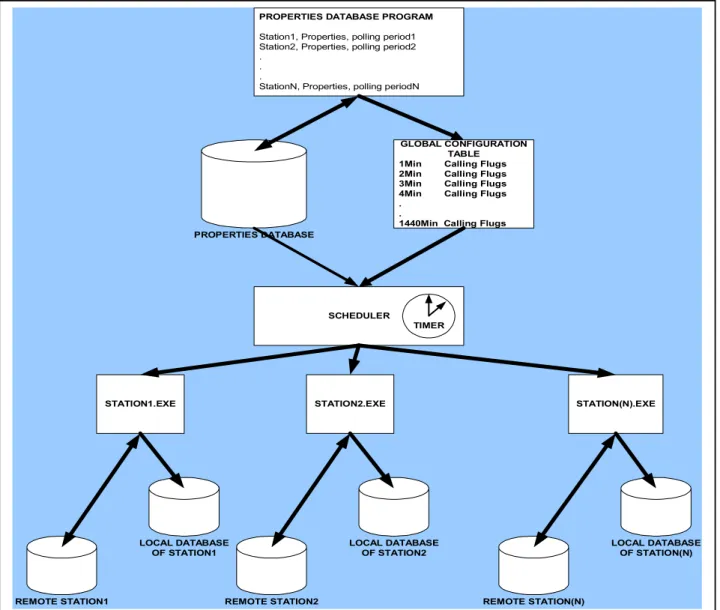
Fig. 2. A schematic diagram of the ANMODAP Center in real time.
system has the ability to provide reliable data, using indepen-dent programs of simultaneous data collection from different stations in a periodic scheme with a specific time period ei-ther automatically or even manually. Until today, ei-there are 23 stations from which the described system could collect data. The characteristics of these NM stations (geographic coordinates, altitude, standard pressure, cut-off rigidity) are presented in Table 1. However, up to now, only 19 of these stations are accessible online. In order to produce a contin-uous upgrade of the developed system, a number of algo-rithms and programs have been developed. The overall pro-cess of data can be seen in Fig. 2. The properties of every station from the network are input to one database program, the “Properties Database”. Within the same database the ini-tialization parameters of the data collection on poling are be-ing deposed for every station. In particular, a “scheduler” algorithm has the ability to call various types of executable
downloaders. A “Scheduler” program reads the properties of each station and makes a decision as to whether or not to make a data collection call to a station. For every different station there is a single data collection program which up-loads data from a remote station to the local database of the network in Athens. For our study not only collecting data but also data presentation are very important. The neutron monitor recording system transfers one minute and hourly data to their server and refreshes their database every hour. A special program included in a ‘scheduler’ creates a graph-ical file once per hour which is displaced on the web page of the station presented at the server of the Athens Center. An advanced processing system of 1-, 5-, 15-, and 60-min data refreshes the database of every station, providing both graphical and digital form of presentation. Recently, an effort to combine the results of the NMN and those presented by other sources has been achieved, urging us into going forth
3106 H. Mavromichalaki et al.: The new Athens center on data processing
12
Figure 3
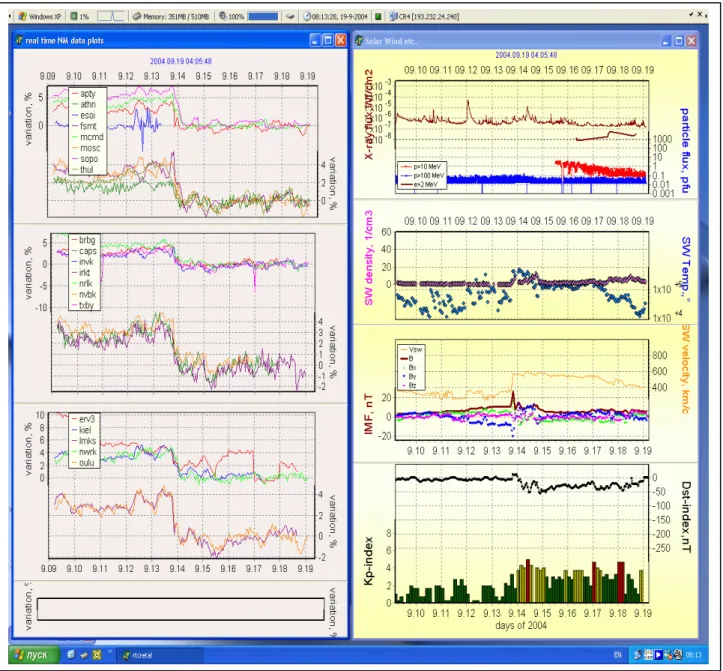
Fig. 3. Plots of real-time data from the NM Network (left panel) and from other sources (right panel).
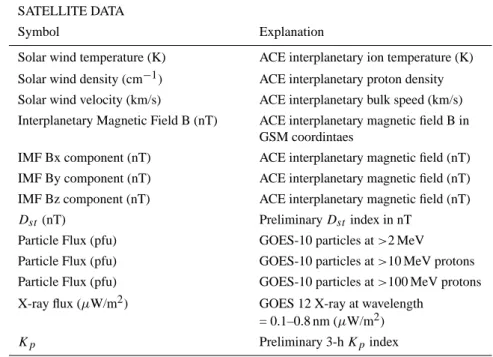
with an even more detailed analysis. An example of the pre-sentation of the collected data can be seen in Fig. 3, where, together with the data from different NMs, the various data from GOES and ACE satellites are presented online. An ex-planation of the relative parameters appearing on the graphs is given in Table 2.
2.2 Applications of the Athens data processing center Collecting real-time data from the NM network can be used for diagnosing and forecasting aims, and are processed by the special programs on some key derived parameters. At this point the network data can be used in two directions: specif-ically first to a monitor and search for the Ground Level En-hancement (GLE) onset by the 1- and 5-min data and
work-ing out the “Alert” signal in this connection, and second the CR variation monitoring by the hourly data and the search-ing for the predictors of the interplanetary shock arrival on the basis of CR density and anisotropy behavior.
2.2.1 The GLE onset
Some offers and possibilities for selecting the GLE onset are described in Dorman et al. (2004). A special program for searching the onset was elaborated by the Athens CR group. Data from at least three NM stations at Earth (two high latitudinal and one/two low latitudinal) and two inde-pendent satellite channels, for example, X-ray on GOES10 and GOES12, are processed every minute to search for the
H. Mavromichalaki et al.: The new Athens center on data processing 3107
Table 2. Satellite data parameters being presented by the ANMODAP Center.
SATELLITE DATA
Symbol Explanation
Solar wind temperature (K) ACE interplanetary ion temperature (K) Solar wind density (cm−1) ACE interplanetary proton density Solar wind velocity (km/s) ACE interplanetary bulk speed (km/s) Interplanetary Magnetic Field B (nT) ACE interplanetary magnetic field B in
GSM coordintaes
IMF Bx component (nT) ACE interplanetary magnetic field (nT) IMF By component (nT) ACE interplanetary magnetic field (nT) IMF Bz component (nT) ACE interplanetary magnetic field (nT)
Dst(nT) Preliminary Dstindex in nT
Particle Flux (pfu) GOES-10 particles at >2 MeV Particle Flux (pfu) GOES-10 particles at >10 MeV protons Particle Flux (pfu) GOES-10 particles at >100 MeV protons X-ray flux (µW/m2) GOES 12 X-ray at wavelength
= 0.1–0.8 nm (µW/m2)
Kp Preliminary 3-h Kpindex
Table 3. Results of the ALERT program on the event of 20 January 2005.
20 January 2005
NM stations Moscow Kiel Oulu Norilsk
Event started at 6:51 UT 6:51 UT 6:52 UT 6:31 UT Established alert signal 6:55 UT 6:55 UT 6:56 UT 6:35 UT Maximum of the event 7:05 UT 7:05 UT 7:00 UT 6:41 UT
start of the ground level enhancement. If the enhancement is found at least on two monitors and in X-ray channels simul-taneously, it means the start of GLE, and our computer sends a signal to collect data from all neutron monitors through-out the network. The obtained alert signal is sent through-out as a forecasting signal by e-mail, and is mainly to run a system of minute data collection from the whole NM network, to be used in further, more complicated processing. In this case data on the network station are very important to be updated not less than every 5 min. The number of necessary stations should be about 10–20. It may turn out to be that the NM net-work will be the only source of information during the pow-erful proton event because of the spoiled connection with the satellite.
Regarding the real-time searching for GLE onset we can say that for the event registered on 20 January 2005 our sys-tem was able to give an alarm with a 95% accuracy at approx-imately 5 to 10 min before the maximum of the event at the high latitude stations. The results of analysis of this event, after having applied our ALERT program, using data from four neutron monitor stations, are presented in Table 3. It
is clearly seen that the obtained onset time from the ALERT program onset time is very close to the value calculated with the 2.5 sigma criterion (Dorman et al., 2004; Mavromicha-laki et al., 2004). It is evidence of a good agreement be-tween the onset times for the Moscow and Kiel stations. The event was registered at the Oulu NM station one minute later, whereas the Norilsk station recorded an increase twenty min-utes earlier than the other three stations. In such cases of sig-nificant differences between the output onset times, an extra check should be made. In order to define whether the earliest onset time is a real ALERT or not, the data of the 100 MeV proton channel should be analyzed. Our code is also being developed in this direction.
During the last two years GLEs Alerts were also estimated using this program. Usually we don’t get false alarms. Tak-ing into consideration that in the analysis the data from high latitude stations are included and also the fact that our pro-gram uses 5-min separate and X-ray data from GOES for a comparison, the probability that the observed increase is not associated with GLE is very low.
3108 H. Mavromichalaki et al.: The new Athens center on data processing 13 Figure 4 1600 1800 2000 2200 2400 10-2 10-1 100 101 102 103 >=100 MeV >=50 MeV >=10 MeV Pa rt ic le s c m -2 s -1 sr -1 Hours of 2003/11/02
Fig. 4. The powerful SEP event on 2 November 2003.
14
Figur e 5
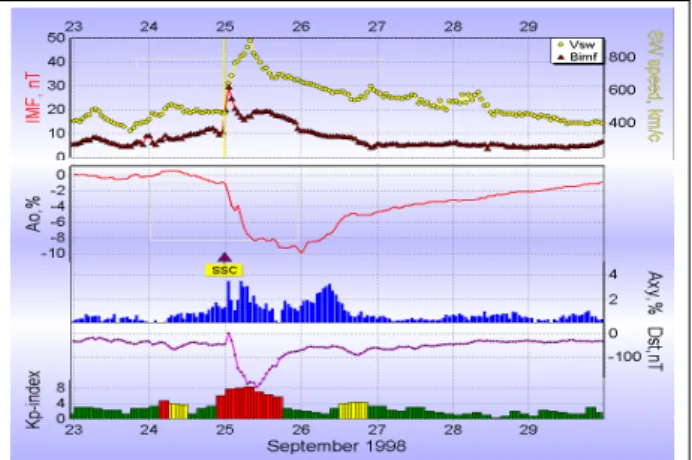
Fig. 5. A large heliospheric storm, as indicated by different space
weather parameters.
In order to be accurate the real time algorithm takes different kinds of inputs from all the available sources. For big events the Alert stage is scheduled to be about 99% ac-curate. Our statistic is still poor because to the continuous upgrades of the input data source code in the program. It is possible that very soon we will present a full analysis of all the old available GLE data. It is well known that GLEs accompany only small fractions of the strong solar proton
events and also that not all proton events result in ground en-hancements, as well. However, a technique of calculating the relative flux increases using the data of high latitude stations eliminates the possibility of losing an event. An improved version of the ALERT program will be available soon via a link from the main page of the Athens Neutron Monitor sta-tion, visualizing all the forecasted events in real time. 2.2.2 Prognosis of the low energy particle event evolving Solar relativistic particles registered at the Earth have an es-sential property to pro information on solar and interplane-tary conditions much earlier than low- and mid-energy solar particles. Due to their big diffusion coefficient high-energy particles come from the Sun 8–20 min after the accelera-tion and escape into the solar wind, whereas the main part of lower energy particles, which cause dangerous situation for electronics and hazard radiation, usually come 30–60 min later. Proton events registered at the Earth (GLEs) have a complete profile well before the main development of the low-energy particle profiles. This is clearly seen in Fig. 4 with an example of the powerful SEP event on 2 November 2003. This fact can be used for the calculations of spectra and fluxes for lower energies at different levels 20–30 min after the onset by the ground level measurements (NMN), with an improvement of these results over the time. On the whole, it allows prognosis time behavior of non-relativistic solar protons up to 10–15 h (Dorman et al., 2004).
After the Alert is defined, our program sends a signal to collect data from all neutron monitors throughout the net-work. While the minute data are collected, the program of the proton enhancement analysis is running. It calculates spectra and other parameters for the estimation of the expected CR profiles for lower energies at different altitudes, several hours ahead. The proton spectrum will be derived with more and more accuracy along the accumulation of new and new data. This program is not realized yet, but it is under construction now.
2.2.3 Geomagnetic storms
A large heliospheric storm, indicated by different space weather parameters, is shown in Fig. 5, where significant variations in CR density and in the first harmonic of the CR anisotropy, derived from the NM network data, occurred simultaneously with dramatic changes in the interplanetary and geomagnetic parameters. Specific properties of the CR behaviour before the strong geomagnetic storms allow them to be used for the forecasting of the interplanetary distur-bance arrival at the Earth (Belov et al., 1995; Ruffolo et al., 1999; Belov et al., 2001; Belov et al., 2003; Leerungnavarat et al., 2003 and references therein). So, another aspect of the real-time ground level monitoring of cosmic rays is to obtain galactic cosmic ray characteristics for diagnosing a situation in the heliosphere to predict some dangerous events in the Earth’s vicinity.
H. Mavromichalaki et al.: The new Athens center on data processing 3109 The proposed method on the prognosis of geomagnetic
storms consists of the following steps:
– System of data collection in real time from a neutron
monitor network has been created and supports an un-limited number of stations. In this listing high latitudi-nal stations, as well as mid- and low-latitudilatitudi-nal stations should be included.
– After collection data for a current hour from at least
15 stations (optimum 30) the program of analysis by the global survey method (GSM) (Belov et al., 2005) is started up. In result the CR density, the spectral pa-rameters of density, and the three components of CR anisotropy vector are derived at this current hour.
– Amplitude of isotropic variation and characteristics of
the CR anisotropy (first harmonic) are collected at the web site in real time and are the initial experimental data (so-called, key parameters) for analysis of the cur-rent heliospheric situation. To carry out more reliable analysis it would be desirable to use these results, to-gether with relevant data on solar and solar wind mea-surements.
This program is now being revised by the collaboration of the IZMIRAN and ATHENS groups, through the current hourly data, coupling coefficients, and response functions, which were calculated earlier (Clem and Dorman, 2000; Villoresi et al., 2000) and tested. Of course, we use preliminary (“raw”) data, and they are not always of good quality at the separate stations, as seen in Fig. 3. But the algorithm dismisses the data jumping if it exceeds three standard statistical errors at one or two stations.
3 Conclusions
The new Athens Neutron Monitor Data Processing Center based on the activity of the cosmic ray group at Athens Uni-versity, provides real-time monitoring of cosmic ray varia-tions. It was also created with the aim to make feasible the use of the neutron monitor network data in real time for the space weather tasks. The modern methods applied to these data give the possibility for forecasting the arrival at Earth of the powerful disturbances from the Sun. At present, twenty-five NM stations are operating continuously at different lo-cations on the Earth and presenting their data in the Inter-net. The Athens Center, simultaneously with some other Centers (IZMIRAN, BARTOL University), gathers data to detect possible abrupt changes in the cosmic rays associated with the real solar wind and geomagnetic disturbances. This Center puts the basis of a world-wide data collection system in real time from the network and utilizes adjusted software capable of employing the real-time data for the space weather forecasting.
This Center offers a program with the possibility of suc-cessful prediction of the behavior of the low energy part of
the SEP events near Earth by the ground-based cosmic ray measurements. The Center also accumulates experience and tested methods, and tries to elaborate on the more modern methods, in order to carry out a timely and feasible progno-sis of the geomagnetic storms deriving precursors from the worldwide NM network.
By way of a conclusion we can say that the joint complex analysis of the relevant information from space-borne and ground-based detectors will minimize the number of false alarms and will maximize the reliability and the timely fore-casting of the arrival of dangerous fluxes and disturbances from space.
Acknowledgements. Thanks are due to all NM groups for posting
the data in the Internet and kindly provided these to the NM Net-work: Bartol Research Institute NSF grant ATM-0000315; IEP SAS in Kosice by VEGA grant 1147; Oulu; all Russian stations etc. This work is partly supported by PYTHAGOPAS II Project of the Greek Ministry of Education and by IZMIRAN RFFR grants 03-07-90389 and 04-02-16763. Thanks are also due to the anonymous referee for very useful remarks on this article. Many thanks to COST724 project supporting A. Papaioannou to present this work in the 1st European Space Weather week in Holland.
Topical Editor R. J. Forsyth thanks R. Pyle and another referee for their help in evaluating this paper.
References
Belov, A. V., Dorman, L., Eroshenko, E., Iucci, N., Villoresi, G., and Yanke, V.: Search for predictors of Forbush decreases, Proc. 24-th ICRC, 4, 888–891, 1995.
Belov, A. V., Bieber, J. W., Eroshenko, E. A., Evenson, P., Pyle, R., and Yanke, V. G.: Pitch-angle features in cosmic rays in advance of severe magnetic storms: Neutron monitor observations, Proc. 27 ICRC Hamburg 9, 3507–3510, 2001.
Belov, A. V., Bieber, J. W., Eroshenko, E. A., Evenson, P., Pyle, R., and Yanke, V. G.: Cosmic ray anisotropy before and during the passage of major solar wind disturbances, Adv. Space Res., 31, N4, 919–924, 2003.
Belov, A. V., Baisultanova, L. M., Eroshenko, E. A., Mavromicha-laki, H., Yanke, V., Pchelkin, A., Mariatos, G., and Plainaki, C.: Magnetospheric effects in cosmic rays during the unique mag-netic storm in November 2003, J. Geophys. Res., in press, 2005. Bieber, J. W. and Evenson, P.: Spaceship Earth – an optimized net-work of neutron monitors, Proc. 24th Intern. Cosmic Ray Conf., Rome, 4, 1316–1319, 1995.
Clem, J. and Dorman, L. I.: Neutron monitor response functions, Space Sci. Rev., 93, 1, 335–359, 2000.
Dorman, L. I., Iucci, N., and Villoresi, G.: The use of comic rays for continuous monitoring and prediction of some dangerous phe-nomena for the Earth’s civilization, Astrophys. and Space Sci-ence, 208, 55–68, 1993.
Dorman, L. I.: Principles of cosmic ray using for space weather monitoring and forecasting, Proc. 28th Intern. Cosmic Ray Conf., Tsukuba, 7, 4269–4272, 2003.
Dorman, L. I., Belov, A. V., Eroshenko, E. A., Pustil’nik, A., Stern-lieb, A., Yanke, V. G., and Zukerman, I.G.: Possible cosmic ray using for forecasting of major geomagnetic storms, accompa-nied by Forbush-effects, Proc. 28th Intern. Cosmic Ray Conf., Tsukuba, 6, 3553–3556, 2003.
3110 H. Mavromichalaki et al.: The new Athens center on data processing
Dorman, L. I.: Cosmic Rays in the earth’s atmosphere and under-ground, Kluwer Academic publishers, 2004.
Dorman, L. I., Pustilnik, L. A., Sternlieb, A., Zukerman, I. G., Belov, A. V., Eroshenko, E. A., Yanke, V. G., Mavromichalaki, H., Sarlanis, C., Souvatzoglou, G., Tatsis, S., Iucci, N., Villoresi, G., Fedorov, Yu., Shakhov, B. A., and Murat, M.: Monitoring and Forecasting of Great Solar Proton Events Using the Neutron Monitor Network in Real Time, IEEE for Plasma Science, 32, 1478–1488, 2004.
Kudela, K., Storini, M., Hoffer, M., and Belov, A.: Cosmic Rays in relation to space weather, Space Sci. Rev., 93, 153–174, 2000. Leerungnavarat, K., Ruffolo, D., and Bieber, J. W.: Loss cone
precursors to Forbush decreases and advance warning of space weather effects, The Astronomical J., 593, 587–596, 2003. Mavromichalaki, H., Sarlanis, C., Souvatzoglou, G., Tatsis, S.,
Belov, A., Eroshenko, E., Yanke, V., and Pchelkin, A.: Athens Neutron Monitor and its aspects in the cosmic-ray variations studies, Proc. 27th ICRC Hamburg, 10, 4099–5004, 2001.
Mavromichalaki, H., Yanke, V., Dorman, L., Iucci, N., Chill-ingaryan, A., and Kryakunova, O.: Neutron Monitor Network in Real Time and Space Weather, Monograph NATO series, Ef-fects of Space weather on Technology Infrastructure, 301–317, 2004.
Ruffolo, D., Bieber, J., Evenson, P., and Pyle, R.: Precursors to For-bush decreases and space weather predictions. Proc. 26 ICRC, 6, 440–443, 1999.
Tylka, A. J.: Solar energetic particles and space weather, Space Technology and Applications International Forum, Proc. AIP Conference Albuquerque, 552, 1185–1190, 2001.
Villoresi, G., Dorman, L. I., Iucci, N., and Ptitsyna, N. G: Cos-mic ray survey to Antarctica and coupling functions for neutron component near solar minimum (1996–1997), 1. Methodology and data quality assurance, J. Geophys. Res., 105(A9), 21 025– 21 034, 2000.
Villoresi, G., Dorman, L. I., Ptitsyna, N. G., Iucci, N., and Tyasto, M. I.: Forbush-decreases as indicators of health-hazardous geo-magnetic storms, Proc. 24th Intern. Cosmic Ray Conf. Rome, 4, 1106–1109, 1995.