HAL Id: hal-00296562
https://hal.archives-ouvertes.fr/hal-00296562
Submitted on 2 Jun 2008
HAL is a multi-disciplinary open access
archive for the deposit and dissemination of
sci-entific research documents, whether they are
pub-lished or not. The documents may come from
teaching and research institutions in France or
abroad, or from public or private research centers.
L’archive ouverte pluridisciplinaire HAL, est
destinée au dépôt et à la diffusion de documents
scientifiques de niveau recherche, publiés ou non,
émanant des établissements d’enseignement et de
recherche français ou étrangers, des laboratoires
publics ou privés.
Utilising shade to optimize UV exposure for vitamin D
D. J. Turnbull, A. V. Parisi
To cite this version:
D. J. Turnbull, A. V. Parisi. Utilising shade to optimize UV exposure for vitamin D. Atmospheric
Chemistry and Physics, European Geosciences Union, 2008, 8 (11), pp.2841-2846. �hal-00296562�
www.atmos-chem-phys.net/8/2841/2008/ © Author(s) 2008. This work is distributed under the Creative Commons Attribution 3.0 License.
Chemistry
and Physics
Utilising shade to optimize UV exposure for vitamin D
D. J. Turnbull and A. V. Parisi
Centre for Rural and Remote Area Health, University of Southern Queensland, Toowoomba, Queensland 4350, Australia Received: 29 November 2007 – Published in Atmos. Chem. Phys. Discuss.: 16 January 2008
Revised: 7 April 2008 – Accepted: 9 May 2008 – Published: 2 June 2008
Abstract. Numerous studies have stated that humans need
to utilise full sun radiation, at certain times of the day, to as-sist the body in synthesising the required levels of vitamin D3. The time needed to be spent in the full sun depends on a
number of factors, for example, age, skin type, latitude, solar zenith angle. Current Australian guidelines suggest exposure to approximately 1/6 to 1/3 of a minimum erythemal dose (MED), depending on age, would be appropriate to provide adequate vitamin D3levels. The aim of the study was to
de-termine the exposure times to diffuse solar UV to receive ex-posures of 1/6 and 1/3 MED for a changing solar zenith angle in order to assess the possible role that diffuse UV (scattered radiation) may play in vitamin D3 effective UV exposures
(UVD3). Diffuse and global erythemal UV measurements were conducted at five minute intervals over a twelve month period for a solar zenith angle range of 4◦ to 80◦at a
lati-tude of 27.6◦S. For a diffuse UV exposure of 1/3 MED, solar zenith angles smaller than approximately 50◦can be utilised for exposure times of less than 10 min. Spectral measure-ments showed that, for a solar zenith angle of 40◦, the UVA (315–400 nm) in the diffuse component of the solar UV is reduced by approximately 62% compared to the UVA in the global UV, whereas UVD3 wavelengths are only reduced by approximately 43%. At certain latitudes, diffuse UV under shade may play an important role in providing the human body with adequate levels of UVD3 (290–315 nm) radiation without experiencing the high levels of UVA observed in full sun.
Correspondence to: D. J. Turnbull
1 Introduction
The health effects of solar UV radiation vary significantly, from initiating the synthesis of vitamin D3 to the severe
degradation of the human body. Excessive solar UV radia-tion exposure led to the premature deaths of approximately 60 000 people in the year 2000 (Lucas et al., 2006). It is well known that exposure to small amounts of UV radiation are beneficial for the human body and important in the produc-tion of vitamin D3, whereas excessive exposure to sunlight is
known to cause skin cancer, immune suppression, DNA dam-age, erythema and sun-related eye disorders (Baron et al., 2003; Glerup et al., 2000; Terenetskaya, 2000; Sliney, 2004; Setlow et al., 1993). Approximately 90–95% of our vita-min D3requirement comes from exposure to the sun (Holick,
2004; Holick, 1998). The synthesis of pre-vitamin D3is
ini-tiated through exposure of human skin to terrestrial UV ation from 290 to 315 nm. The longer wavelength UV radi-ation (greater than 315 nm) plays no part in the synthesis of pre-vitamin D3in humans. Although, over exposure to UV
wavelengths is known to cause damage, vitamin D3
synthe-sis occurs at doses far below those needed for erythema to arise (Webb, 1993). Small amounts of vitamin D3can also
be obtained from some foods, for example oily fish and eggs or by fortifying foods with vitamin D3. It has been shown
that the vitamin D3from these sources cannot provide
suffi-cient vitamin D3for the elderly (Mosekilde, 2005). Vitamin
D3can also be obtained through vitamin tablets; however the
simplest way to obtain vitamin D3is from moderate
expo-sure to sunlight (Holick, 2004). Furthermore, this is also the cheapest way without the cost burden of vitamin tablets.
Current Australian guidelines suggest exposure to approx-imately 1/6 to 1/3 of a MED (minimum erythemal dose), de-pending on age, would be appropriate to provide adequate vitamin D3 levels (Samanek et al., 2006; CDHAA, 2004).
Older people require more frequent exposures as vitamin D3
2842 D. J. Turnbull and A. V. Parisi: Utilising shade to optimize UV exposure for vitamin D the young (Holick et al., 1989). Also, people with highly
pig-mented skin would require exposures 3–4 times greater than those necessary for fair skinned people (Pathak et al., 1999). Recent research suggests that the optimal serum vitamin D3
level for bone health and protection against other diseases is between 800 and 2000 IU per day (Aloia and Li-Ng, 2007; Lappe et al., 2007; Vieth et al., 2007; Dawson-Hughes et al., 2005); with 1000 IU equivalent to exposing 15% of the human body to approximately 1/3 MED (PS, 2006). A posi-tion statement was recently approved by the Working Group of the Australian and New Zealand Bone and Mineral So-ciety, Endocrine SoSo-ciety, Osteoporosis Australia, Australian College of Dermatologists and the Cancer Council Australia recommending five minutes solar UV exposure either side of the peak UV periods on most days of the week in sum-mer and approximately 2–3 h solar UV exposure over a week in winter (PS, 2006). This position statement is still behind emerging scientific findings (e.g. Giovannucci et al., 2006; Grant et al., 2007; Gorham et al., 2007; Garland et al., 2007). Nevertheless, it is still the most up to date statement that has been distributed to the public. The position statement is also a generalized report as sun exposure varies significantly with latitude and atmospheric conditions.
Solar UV radiation is incident on the earth’s surface in two distinct components, direct and diffuse. The direct compo-nent is straight forward to minimise by simply blocking its path, whereas the diffuse component is incident from all di-rections and is difficult to minimise. Atmospheric scatter-ing which is influenced by factors such as solar zenith angle (SZA), clouds and atmospheric constituents plays a major role in determining the proportions of UVB (280–315 nm) and UVA (315–400 nm) in diffuse UV, with greater scatter-ing occurrscatter-ing at the shorter UVB wavelengths than at the longer wavelength UVA. Turnbull et al. (2005) found that UVA was reduced by as much as 65% when utilising a shade umbrella, whereas UVB exposures were only reduced by ap-proximately 48%. Therefore, at certain SZA, the diffuse UV may provide adequate levels of the effective wavelengths needed for vitamin D3production (UVD3), without produc-ing erythema. In comparison, mutagenic and carcinogenic effects on human skin have been shown to be caused by ex-posure to UVA radiation (Agar et al., 2004; Moan et al., 1999; Garland et al., 2003). Therefore, reducing personal exposures to UVA radiation while still receiving sufficient amounts of the UVD3 wavelengths required to produce rec-ommended vitamin D3levels is essential.
The importance of this research is that it provides a basis for public health campaigns aimed at reducing the incidence of hypovitaminosis D and its attendant disorders, as well as reducing over exposure to harmful solar UV radiation. In the light of the considerable body of evidence regarding the harm done by excessive UV exposure and the public aware-ness of skin cancer, any new public health program would need to avoid confusing the public with seemingly oppos-ing messages. Utilizoppos-ing diffuse solar UV radiation to obtain
beneficial amounts of UV, while at the same time minimiz-ing personal overexposure to UVA radiation may prove to be absolutely necessary for an improvement in public health. Studies have shown that shade structures are important as a UV minimisation strategy; however, shade settings may also play an important role in providing exposures to the human body with adequate levels of UV radiation for vitamin D3
production without experiencing the higher levels of UVA experienced in full sun. The lengths of exposure to solar UV at noon in major Australian cities to produce exposures of 1/3 and 1/6 MED has previously been reported (Samanek et al., 2006). Shade as a protective device has been discussed numerous times before (e.g. Turnbull and Parisi, 2006) and it is not the aim of this paper. This current paper is about the exposures that humans may receive when utilising solar UV for vitamin D3 synthesis and the possible methods to
opti-mise this radiation. The author’s are unaware of any similar research or attempts to show how solar UV exposures can be optimised so humans can receive adequate vitamin D3levels
as well as reducing their total UV exposure.
2 Materials and methods
2.1 Integrated automated cloud and spectral UV measure-ment system
An integrated automated cloud and spectral UV measure-ment system was employed at a Southern Hemisphere site at Toowoomba, Australia (27.6◦S, 151.9◦E, 693 m above sea
level) for automatically measuring every five minutes both the cloud fraction and the UV spectrum. The system was lo-cated on the roof of a building with relatively unobstructed views and the surrounding topography does not provide any significant obstruction to the field of view of the instruments. The cloud detection system is a Total Sky Imager (TSI) (model TSI-440, Yankee Environmental Systems, MA, USA) with approximately 160◦ field of view of the sky. The TSI consists of a CCD camera suspended over a hemi-spherical reflective dome that points upwards on a horizontal plane. For each image, digital analysis provides the fraction of cloud cover as a number between 0 and 1 where 1 repre-sents total cloud cover. The uncertainty in the determination of the amount of cloud has been reported as ±10% at least 95% of the time (Sabburg and Long, 2004).
The spectral UV measurement system is located within three metres of the cloud detection system and is housed in an environmentally sealed box with a fibre optic connecting the diffuser to the input slit of the monochromator through a hole with a seal around the fibre to protect the equipment inside the box from the environment. The system is based on a double monochromator system model (DTM300, Ben-tham Instruments, Reading, UK) with the gratings having 2400 grooves/mm. The input and output slit widths on the monochromator of 0.37 mm have been selected to provide a
bandwidth of 0.5 nm. The spectral UV data was recorded from 280 to 400 nm in 0.5 nm increments. The input optics are provided by a diffuser (model D6) with the manufacturer determined error associated with the cosine response as less than ±0.8% for a SZA up to 70◦ and ±3.3% for an SZA of 80◦. The system is scheduled to scan every five minutes from 05:00 EST (Eastern Standard Time) to 17:00 EST and the start of the initialisation of a spectral scan is one minute before the TSI obtains an image of the sky. This allows the spectral scan to start at approximately the same time that the TSI takes the sky image. Wavelength and irradiance calibra-tion of the spectral UV system was undertaken by employing the 365 nm mercury spectral line and a 150 Watt quartz halo-gen lamp with calibration traceable to the National Physical Laboratory, UK standard.
2.2 Diffuse and global erythemal UV
Two erythemal UV meters (UV-Biometer Model 501, Solar Light Co., Philadelphia, PA. USA) were employed to moni-tor the diffuse and global erythemal UV (UVery). The diffuse
UVery meter is a global UVery meter that has been
specif-ically set up to measure the diffuse erythemal radiation. It utilizes a shadow band, which is aligned east-west, to block the sun during the day. The shadow band is 0.076 m wide and the distance from the shadow band to the top of the dif-fuse UVerymeter varies from 0.25 m to 0.27 m as it is moved
with the seasons. The shadow band blocks out part of the sky view and the amount blocked has been measured at ap-proximately 10%. A correction has been applied to all of the data to account for this. The diffuse and global UVery
ters were set up to record data every five minutes. The me-ters are temperature stabilized to 25◦C and calibrated twice
a year during clear sky conditions against the scanning spec-troradiometer. The daily atmospheric column of ozone as obtained from the TOMS (Total Ozone Mapping Spectrom-eter) ranged from 243.5 to 337.0 DU and the SZA ranged from 4◦ to 80◦ over the twelve month measurement period from January to December 2003.
3 Results
3.1 Diffuse and global erythemal UV
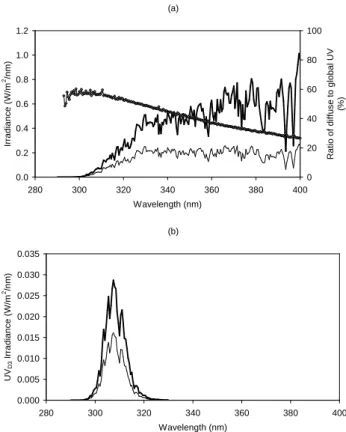
An example of diffuse and global UV spectra is shown in Fig. 1a for a cloud free period on 17 August 2005 at 11:55 EST for an SZA of 40◦. This illustrates the
varia-tion in the relative proporvaria-tions of the different wavelengths when comparing diffuse UV to global UV. For Fig. 1a, the diffuse spectral irradiance summed over the UVA waveband was 16.8 W/m2compared to 44.5 W/m2for the global UVA. Similarly, the diffuse UVB was 0.63 W/m2 compared to 1.12 W/m2for global UVB. For this specific date and time, the UVA was reduced by approximately 62% compared to the global UVA, whereas the diffuse UVB was only reduced
(a) 0.0 0.2 0.4 0.6 0.8 1.0 1.2 280 300 320 340 360 380 400 Wavelength (nm) Ir ra d ia n c e ( W /m 2/n m ) 0 20 40 60 80 100 R a ti o o f d if fu s e t o g lo b a l U V (% ) (b) 0.000 0.005 0.010 0.015 0.020 0.025 0.030 0.035 280 300 320 340 360 380 400 Wavelength (nm) U VD 3 I rr a d ia n c e ( W /m 2/n m )
Fig. 1. Diffuse (light line) and global (heavy line) spectral UV irra-diances taken on 17 August 2005 at approximately 11:00 EST and the spectral ratio of diffuse to global UV (a); and global and diffuse spectral irradiances from Fig. 1a weighted with the pre-vitamin D3 action spectrum (CIE, 2006) (b).
by approximately 44%. The ratio of the diffuse to global UV plotted on the right hand axis of Fig. 1b gives an indication of the change in ratio when comparing global and diffuse UV wavelengths.
Figure 1b provides the global and diffuse solar UV spectra (from Fig. 1a) weighted with the pre-vitamin D (CIE, 2006) action spectrum. Pre-vitamin D3 exposure was reduced by
43% whereas UVA exposure was reduced by 64%. These spectral measurements were obtained using the spectral mea-surement system described earlier.
3.2 Exposure times for 1/3 MED
The times required for an exposure of 1/3 MED on a hori-zontal plane for SZA greater than 4◦for the atmospheric and
cloud conditions during 2003 are shown in Fig. 3a for dif-fuse and Fig. 3b for global UVery. Over 25 000 data points
are provided in each figure for diffuse and global UVeryfor
all SZA, sky and atmospheric conditions encountered over this period. The average times for an exposure equivalent to 1/3 MED for vitamin D3and erythema are shown in Table 1
for diffuse and global UV. For a SZA of 5◦, the average time needed to receive an exposure of 1/3 MED due to erythemal
2844 D. J. Turnbull and A. V. Parisi: Utilising shade to optimize UV exposure for vitamin D
Table 1. Average times for an exposure equivalent to 1/3 MED for vitamin D3and erythemal effective UV radiation.
Global UVD3 Diffuse UVD3 Global UVery Diffuse UVery
SZA (min) (min) (min) (min) 5◦ 2.2 (0.8) 3.2 (0.5) 4.4 (2.5) 6.8 (2.8) 15◦ 2.5 (3.4) 3.9 (3.1) 5.1 (5.9) 7.7 (5.2) 25◦ 2.8 (1.8) 4.5 (2.6) 6.0 (4.5) 8.7 (4.0) 35◦ 3.5 (2.0) 5.2 (2.5) 7.1 (4.2) 10.2 (4.3) 45◦ 5.7 (3.8) 7.1 (3.1) 10.8 (6.6) 13.7 (5.4) 55◦ 10.1 (5.9) 13.2 (7.7) 19.9 (16.5) 24.2 (16.3) 65◦ 27.5 (19.0) 27.2 (17.2) 42.0 (30.8) 43.6 (25.1) 75◦ 103.3 (63.5) 97.7 (47.7) 110.3 (56.3) 111.6 (49.3) (a) 0 10 20 30 40 50 60 0 10 20 30 40 50 60 70 80 SZA (o) T im e f o r 1 /3 M E D ( m in ) (b) 0 10 20 30 40 50 60 0 10 20 30 40 50 60 70 80 SZA (o) T im e f o r 1 /3 M E D ( m in )
Fig. 2. The times required for an exposure of 1/3 MED due to dif-fuse UVery(a) and global UVery(b) as a function of SZA for all
sky conditions during 2003.
UV was 4.4 and 6.8 min for global and diffuse respectively. Whereas, the average time needed to receive an equivalent exposure of 1/3 MED for vitamin D3production was 2.2 and
3.2 min for global and diffuse respectively. These times are based on exposing 15% of the human body to UV radiation. Increasing the exposed body surface will subsequently de-crease the time needed for vitamin D3 production (e.g.
ex-posing three times more body surface will reduce the expo-sure times presented in this research by a factor of three).
(a) 0 10 20 30 40 50 60 0 10 20 30 40 50 60 70 80 SZA (o ) D if fu se U V E xp o s u re T im e s (m in ) (b) 0 10 20 30 40 50 60 0 10 20 30 40 50 60 70 80 SZA (o ) D if fu se U V E xp o s u re T im e s (m in )
Fig. 3. Times for exposure to 1/3 MED of diffuse UV for cloud cover of 0 to 80% (a) and 85 to 100% (b).
However, the time for 1/3 MED of erythemal effective UV will remain the same.
As shown in Fig. 3a and b, this data has been broken down into separate cloud levels of 0 to 80% and 85 to 100%, re-spectively. This was undertaken to illustrate that 0 to 80% of cloud cover has a lesser effect on the diffuse UV compared to 85 to 100% of cloud.
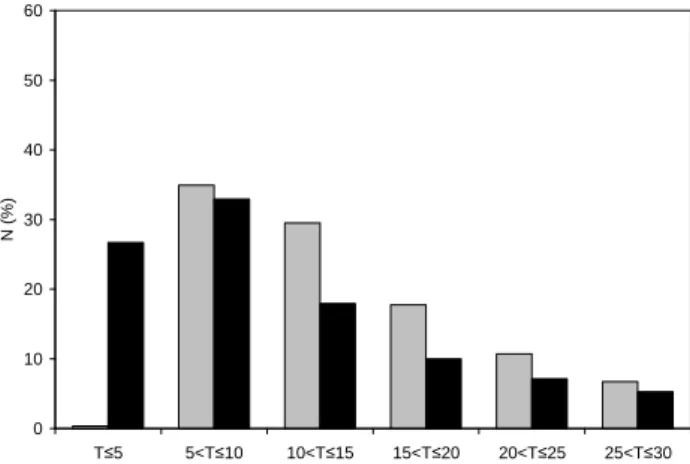
The times required for an exposure of 1/3 MED due to the diffuse and global UVeryon a horizontal plane expressed
as a percentage of occurrence for 2003 are shown in Fig. 4. For diffuse UVery, the maximum incidence for 1/3 MED was
in the range of 5 to 10 min with an occurrence of 34.9%, fol-lowed by 29.5% for 10 to 15 min, and 17.8% for 15 to 20 min. For global UVery, the maximum incidence of the times for
1/3 MED was in the range of 5 to 10 min with an occurrence of 32.9%, followed by 26.7% for less than or equal to 5 min, and 17.9% for 10 to 15 min.
4 Discussion
Studies on the levels of UV observed in the shade of different shade environments have shown that the relative proportions of UVA and UVB in the shade are significantly different to those in full sun (Turnbull et al., 2005; Turnbull and Parisi, 2003; Turnbull et al., 2003; Parisi et al., 2001). The relative proportions of the UVA in shade to those in full sun are de-creased compared to the relative proportions of the UVB in shade to those in full sun. At certain latitudes and SZA, un-protected exposure for short periods to the UV under shade structures may be the best course of action as it will con-tribute more toward vitamin D3production than toward
ery-thema compared to exposing the body to full sun UV due to the reduced relative component of the UVA in the shade.
The average time for an exposure of 1/3 MED due to dif-fuse UVerywas 6.8 min for a SZA of 5◦. Whereas, the
av-erage time needed to receive an equivalent exposure of 1/3 MED for vitamin D3 production was only 3.2 min. These
times are longer for larger SZA and for overcast conditions. For an exposure of 1/3 MED, SZA smaller than approxi-mately 50◦ can be utilised for exposure times of less than 10 min. For SZA between 4◦to 50◦, 94% of the data shows that an exposure of 1/3 MED requires less than 20 min of ex-posure to diffuse UV. Although the measurements are at one latitude, the data was collected for the SZA range of 4◦ to 80◦. This will allow the results to be applicable at latitudes that experience these SZA.
The values provided in this paper are for pale skin and for a sky view that is not blocked, apart from the blocking of the solar disc. However, research is currently being conducted beneath various shade environments and initial results show that shade environments of at least 50% sky view exhibit cellent correlation with the values shown in Fig. 2a. For ex-ample, at approximately 18◦ SZA the average time for 1/3
MED from diffuse UVeryon a horizontal plane is
approxi-mately 7.5 min. Initial results for the same SZA show that the times for 1/3 MED in the shade of a shade umbrella and on the southern side of a building were approximately 7 min and 9 min respectively. For larger structures the amount of sky view will be reduced due to the structural components of the shade structure, causing the exposure times required for the respective exposures due to the diffuse UVeryto be
0 10 20 30 40 50 60 T 5 5<T 10 10<T 15 15<T 20 20<T 25 25<T 30 N ( % )
Fig. 4. The percentage of instances when the time required for an exposure of 1/3 MED due to diffuse (grey bar) and global (black bar) UVeryfalls within a certain time range (provided in units of
minutes).
slightly longer. Nevertheless, the findings in this paper may have significant ramifications for future public health policy regarding sun exposure, which is currently being debated in many countries (Diffey, 2006; Gillie, 2006). Also, the find-ings of this research may prove useful to those that work from 9 a.m. to 5 p.m., where solar UV exposure at noon or during a lunch break may be the only option for the necessary UV exposures to initiate the synthesis of vitamin D3. Therefore,
advice to stay out of the sun in the middle of the day, which is best for vitamin D3synthesis in the skin, can be adjusted to
advocate the possible use of appropriate shade environments. However, in the shade there is the potential danger due to the filtering of the infrared waveband, which may cause pro-longed exposures.
Acknowledgements. This research was supported by a Project
Grant awarded by The Cancer Council Queensland.
Edited by: J. Groebner
References
Agar, N. S., Halliday, G. M., Barnetson, R. S., Ananthaswamy, H. N., Wheeler, M., and Jones, A. M.: The basal layer in human squamous tumors harbors more UVA than UVB fingerprint mu-tations: a role for UVA in human skin carcinogenesis, Proc. Nat. Acad. Sci., 101, 4954–4959, 2004.
Aloia, J. F. and Li-Ng, M.: Correspondence, Epidemiol. Infect., 135, 1095–1098, 2007.
Baron, E. A., Fourtanier, A., Compan, D., Medaisko, C., Cooper, K. D., and Stevens, S. R.: High ultraviolet A protection affords greater immune protection confirming that ultraviolet A con-tributes to photoimmunosuppression in humans, J. Invest. Derm., 121, 869–875, 2003.
CDHAA, Commonwealth Department of Health and Ageing Australia, Ministry of Health New Zealand and National Health
2846 D. J. Turnbull and A. V. Parisi: Utilising shade to optimize UV exposure for vitamin D
and Medical Research Council: Nutrient reference values for Australia and New Zealand including recommended dietary intakes, Draft 2004, available at: http://www.moh.govt.nz/ moh.nsf/0/CC515A13536B3CB4CC256F6D000ABDE0/$File/ nutrientreferencevalues.pdf, last access: 2 February 2006. CIE (International Commission on Illumination): Action spectrum
for the production of previtamin D3 in human skin, CIE, 174,
2006.
Dawson-Hughes, B., Heaney, R. P., Holick, M. F., Lips, P., Meu-nier, P. J., and Vieth, R.: Estimates of optimal vitamin D status, Osteoporos. Int., 16, 713–716, 2005.
Diffey, B.: Do we need a revised public health policy on sun expo-sure?, Brit. J. Dermatol., 154, 1046–1051, 2006.
Garland, C. F., Garland, F. C., and Gorham, E. D.: Epidemiologic evidence for different roles of ultraviolet A and B radiation in melanoma mortality rates, Ann. Epidemiol., 13, 395–404, 2003. Garland, C. F., Gorham, E. D., Mohr, S. B., Grant, W. B., Giovan-nucci, E. L., Lipkin, M., Newmark, H., Holick, M. F., and Gar-land, F. C.: Vitamin D and prevention of breast cancer: Pooled analysis, J. Steroid. Biochem. Mol. Biol., 103, 708–711, 2007. Gillie, O.: A new government policy is needed for sunlight and
vitamin D, Brit. J. Dermatol., 154, 1052–1061, 2006.
Giovannucci, E., Liu, Y., Rimm, E. B., Hollis, B. W., Fuchs, C. S., Stampfer, M. J., and Willett, W. H.: Prospective study of pre-dictors of vitamin D status and cancer incidence and mortality in men, J. Nat. Cancer Inst., 98, 451–459, 2006.
Glerup, H., Mikkelsen, L., Hass, E., Overbeck, S., Thomsen, J., Charles, P., and Eriksen, E. F.: Commonly recommended daily intake of vitamin D is not sufficient if sunlight exposure is lim-ited, J. Intern. Med., 247, 260–268, 2000.
Gorham, E. D., Garland, C. F., Garland, F. C., Grant, W. B., Mohr, S. B., Lipkin, M., Newmark, H. L., Giovannucci, E., Wei, M., and Holick, M. F.: Optimal vitamin d status for colorectal cancer prevention a quantitative meta analysis, Am. J. Prev. Med., 32, 210–216, 2007.
Grant, W. B., Garland, C. F., and Gorham, E. D.: An estimate of cancer mortality rate reductions in Europe and the U.S. with 1000 I.U. of oral vitamin D per day, Rec. Results. Cancer. Res., 174, 225–234, 2007.
Holick, M. F., Matsuoka, L. Y., and Wortsman, J.: Age, vitamin D, and solar ultraviolet, Lancet, 2, 1104–1105, 1989.
Holick, M. F.: Evolution, biologic functions, and recommended dietary allowances for vitamin D, in: Vitamin D: Physiology, Molecular Biology and Clinical Applications, Humana Press, New Jersey, 1–16, 1998.
Holick, M. F.: Sunlight and vitamin D for bone health and preven-tion of autoimmune diseases, cancers, and cardiovascular dis-ease, Am. J. Clin. Nutr., 80, 1678S–1688S, 2004.
Lappe, J. M., Travers-Gustafson, D., Davies, K. M., Recker, R. R., and Heaney, R. P.: Vitamin D and calcium supplementation re-duces cancer risk: results of a randomized trial, Am. J. Clin. Nutr., 85, 1586–1591, 2007.
Lucas, R., McMichael, T., Smith, W., and Armstrong, B.: Solar ultraviolet radiation: global burden of disease from solar ultravi-olet radiation, World Health Organization, Switzerland, 250 pp., 2006.
Moan, J., Dahlback, A., and Setlow, R. B.: Epidemiological support for an hypothesis for melanoma induction indicating a role for UVA radiation, Photochem. Photobiol., 70, 243–247, 1999. Mosekilde, L.: Vitamin D and the elderly, Clin. Endocrinol., 62,
265–281, 2005.
Parisi, A. V., Kimlin, M. G., and Turnbull, D.: Spectral shade ra-tios on horizontal and sun normal surfaces for single trees and relatively cloud free sky, J. Photochem. Photobiol. B Biol., 65, 151–156, 2001.
Pathak, M. A., Nghiem, P., and Fitzpatrick, T. B.: Acute and chronic effects of the sun, in: Fitzpatrick’s dermatology in gen-eral medicine, McGraw-Hill, New York, 1598–1607, 1999. PS (Position Statement): Estimates of beneficial and harmful sun
exposure times during the year for major Australian population centres, Med. J. Aust., 184, 338–341, 2006.
Sabburg, J. and Long, C. N.: Improved sky imaging for studies of enhanced UV irradiance, Atmos. Chem. Phys., 4, 2543–2552, 2004,
http://www.atmos-chem-phys.net/4/2543/2004/.
Samanek, A. J., Croager, E. J., Gies, P., Milne, E., Prince, R., McMichael, A. J., Lucas, R. M., and Slevin, T.: Estimates of beneficial and harmful sun exposure times during the year for major Australian population cities, Med. J. Aust., 184, 338–341, 2006.
Setlow, R. B., Grist, E., Thompson, K., and Woodhead, A. V.: Wavelengths in the induction of malignant melanoma, Proc. Nat. Acad. Sci., 90, 6666–6670, 1993.
Sliney, D. H.: Epidemiological studies of sunlight and cataract: the critical factor of ultraviolet exposure geometry, Ophthalmic Epi-demiol., 1, 107–119, 1994.
Terenetskaya, I.: Spectral monitoring of biologically active solar UVB radiation using an in vitro model of vitamin D synthesis, Talanta, 53, 195–203, 2000.
Turnbull, D. J. and Parisi, A. V.: Spectral UV in Public Shade Set-tings, J. Photochem. Photobiol. B Biol., 69, 13–19, 2003. Turnbull, D. J., Parisi, A. V., and Kimlin, M. G.: Vitamin D effective
wavelengths due to scattered UV in the shade, J. Ster. Biochem. Mol. Biol., 96, 431–436, 2005.
Turnbull, D. J., Parisi, A. V., and Sabburg, J.: Scattered UV be-neath public shade structures during winter, Photochem. Photo-biol., 78, 180–183, 2003.
Turnbull, D. J. and Parisi, A. V.: Effective Shade Structures, Med. J. Aust., 184, 13–15, 2006.
Vieth, R., Bischoff-Ferrari, H., Boucher, B. J., Dawson-Hughes, B., Garland, C. F., Heaney, R. P., Holick, M. F., Hollis, B. W., Lamberg-Allardt, C., McGrath, J. J., Norman, A. W., Scragg, R., Whiting, S. J., Willett, W. C., and Zittermann, A.: The urgent need to recommend an intake of vitamin D that is effective, Am. J. Clin. Nutr., 85, 649–650, 2007.
Webb, A. R.: Vitamin D synthesis under changing UV spectra, in: Environmental UV Photobiology, Plenum Press, New York, 185–202, 1993.