HAL Id: insu-01356057
https://hal-insu.archives-ouvertes.fr/insu-01356057
Submitted on 24 Aug 2016
HAL is a multi-disciplinary open access
archive for the deposit and dissemination of
sci-entific research documents, whether they are
pub-lished or not. The documents may come from
teaching and research institutions in France or
abroad, or from public or private research centers.
L’archive ouverte pluridisciplinaire HAL, est
destinée au dépôt et à la diffusion de documents
scientifiques de niveau recherche, publiés ou non,
émanant des établissements d’enseignement et de
recherche français ou étrangers, des laboratoires
publics ou privés.
Effective elastic thickness and crustal thickness
variations in west central Africa inferred from gravity
data
Y. Poudjodmj Oma, J. Nnange, M Diament, C.J. Ebinger, J Fairhead
To cite this version:
Y. Poudjodmj Oma, J. Nnange, M Diament, C.J. Ebinger, J Fairhead. Effective elastic thickness
and crustal thickness variations in west central Africa inferred from gravity data. Journal of
Geo-physical Research : Solid Earth, American GeoGeo-physical Union, 1995, vol.100 (B11), pp.22047-22070.
�10.1029/95JB01149�. �insu-01356057�
JOURNAL OF GEOPHYSICAL RESEARCH, VOL. 100, NO. B 1 l, PAGES 22,047-22,070, NOVEMBER 10, 1995
Effective
elastic thickness and crustal thickness variations
in west central Africa inferred from gravity data
Y. H. Poudjom
Djomani,
1'2
J. M. Nnang½,
2'3
M. Diamcnt,
and J. D. Fairhead
2
1 C. J. Ebinger,
2
Abstract. The west central African region is characterized by various geological features: Cretaceous rifts (Benue), Tertiary domal uplift (Adamawa volcanic uplift), Tertiary-Recent volcanoes (Cameroon Volcanic Line or CVL), Tertiary sedimentary basins (Chad basins), and cratonic region (Congolese craton). In this study, we investigate the relationship between these tectonic features and the flexural rigidity of the lithosphere in Cameroon, in terms of effective elastic thickness (Te), by the use of the coherence function analysis. For that purpose, we use a new dataset of-32,000 gravity and topography points from Cameroon and the adjacent countries. The Te contour map deduced from this study shows a good relationship between the tectonic provinces and the rigidity of the lithosphere, the minima (14-20 km) are beneath the active rifted and volcanic areas (Benue, CVL, and Adamawa), and the maxima (-40 km) correspond to the Archean reworked unit in Congo. A spectral analysis of the gravity data is performed to determine the crust-mantle boundary in these tectonic provinces. The crustal thickness (Tc) contour map shows a variation from 14 km to about 45 km, consistent with other geophysical data. The lower values (14-20 km) are obtained in central Cameroon on the Adamawa uplift, and the highest values are found in southern Cameroon (Archean reworked Congolese craton). Comparing Te and Tc values shows that there is generally a positive correlation between the two parameters, with an exception in Chad where this correlation is rather negative.
Introduction
Research into the origin of large igneous provinces (LIPs) worldwide has led some scientists to propose that lithospheric structural discontinuities in part control the location of oceanic plateaus and continental flood basalt provinces [e.g., Hopper et al., 1992; Anderson, 1994]. One of these LIPs, the Cameroon Volcanic Line (CVL) extends across both oceanic and continental lithosphere, but volcanism shows no age progression [e.g., Fitton and Dunlop, 1985]. The continental part of the CVL and surrounding regions can be divided into
two domains: a mobile belt in the north and a cratonic belt in
the south, with the seismically and volcanically active CVL lying between the two (Figure 1).
The flexural rigidity (D), or equivalently, the effective elastic thickness (EET or Te), describes the manner in which a plate responds to lateral density variations applied at the surface or within the plate. Studies of T e and its variations within the oceanic plates show that T e is dependent upon the thermal structure of the plate, and studies of the more complicated continental plates also show some thermal dependence, although the temperature is not the only factor that controls T e in continents [e.g., Burov and Diament, 1995]. Thus lateral variations in T e may provide information on the location and depth extent of thermal and structural
t Laboratoire de Gravim6trie et G60dynamique, Institut de Physique
du Globe, Paris.
2Department
of Earth
Sciences,
University
of Leeds,
Leeds,
England.
3Institut de Recherche G6010gique et Mini•re, Yaound6, Cameroon. Copyright 1995 by the American Geophysical Union.Paper number 95JB01149. 0148-0227/95/95JB-01149505.00
discontinuities within the lithosphere. The objective of our study is to investigate variations in lithospheric structure beneath west central Africa, including the continental region of the CVL, and to relate these variations to Cenozoic rifting and volcanic processes.
Gravity and topography data from continental regions provide a means of mapping out variations in crustal thickness and mechanical thickness of the lithosphere. Forsyth [1985] introduced the coherence function as a robust means of estimating T e in continental regions. Unlike
admittance functions, the coherence method assumes that
topographic relief reflects both surface and subsurface density contrasts, or loads, and exploits the relationship between the Bouguer gravity and topography as a function of the wavelength. In this study, we first estimate the thickness of the crust (T c) throughout west central Africa by means of the gravity power spectra [e.g., Spector and Grant, 1970]. We then use the coherence method to examine variations in T e throughout the study region, using existing seismic data to constrain density models.
Geological Setting
The area of investigation (Figure 1) is a part of the central African mobile belt and also includes a part of the Congolese craton. The latter was created during the Liberian cycle (2800 Ma) and rejuvenated during the Ebumean (230 -1800 Ma). The entire area was affected by the Pan-African cycle (600 + 100 Ma) during which important tectonic movements occurred, giving rise to megashear zones in Africa [e.g., Ngako et al.,
1991]. One of these zones, oriented ENE-WSW, is called the Central African Shear Zone (CASZ) and extends over about 2000 km from Sudan to Cameroon [Cornacchia and Dars, 1983; Moreau et al., 1987; Ngako et al., 1991]. It is a dextral
22,048 POUDJOM DJOMANI ET AL.: ELASTIC THICKNESS IN WEST AFRICA PLATEAU 10øN 5øN • "•' BIU ß PLATEAI ADA Foumban , m Yaounde
'
10øE 15øE 0 250 500 km I I ICASZ : Central African Shear Zone FSZ:FoumbanShearZone
Sedimentary cover Basement Igneous rocks
/
Tertiary-Quaternary
•
Proterozoic
ii• Volcanics
•
Mesozoic
•
Panafrican
•
Younger
granites
•
Northern
margin
of
Fault
_Shear
Zone t'' the
congolese
craton
Figure 1. Geological map of the study area. The northern limit of the Congolese craton is not well known to the east of the area. Volcanic centers between Mount Oku and Biu plateau are not shown. Also shown are the Precambrian and reworked faults (e.g., CASZ, Sanaga). After Cornacchia and Dars [1983] and Sanaga fault zone from Dumont [ 1986].
shear zone associated with broad mylonite belts predating the opening of the South Atlantic Ocean in Cretaceous times [e.g., Jorgensen and Bosworth, 1989]. This fault extends into Brazil as the Pernambuco polycyclic lineaments [De Almeida and Black, 1967; Martin et al., 1981; Popoff, 1988]. Parallel to this fault zone and to the south of it is the Sanaga fault zone. It is also a dextral shear running from Cameroon to Central African Republic [Dumont, 1986].
The "younger granites" of the Jos plateau in Nigeria, roughly oriented along a N-S axis, give Rb-Sr ages between 213 and 141 Ma [Rahaman et al., 1984; Vail, 1989]. Their origin is related either to the migration of the African plate over a mantle plume [e.g., Karche and Vachette, 1976] or shear movements along preexisting ENE-WSW trending faults in the Pan-African basement [e.g., Black et al., 1985].
The opening of the South Atlantic Ocean in Cretaceous times resulted in a series of basins and grabens in the study
area,
such
as the Benue
in Nigeria-Cameroon,
the Mb•re and
Djerem in south Adamawa, and the Chad sedimentary basins [Benkhelil and Guiraud, 1980; Genik, 1992]. The Benue trough is a NE-SW trending basin that extends for some 900 km northeastward from the Niger delta basin on the northern end of the Gulf of Guinea to Lake Chad (Figure 1). The northeastern part consists of the Yola rift arm in Cameroon and the Gongola arm in Nigeria beneath the Chad basin. The orientation of the trough seems to be controlled by northeast trending dextral shear zones of late Pan-African age [Guiraud and Maurin, 1992]. Volcanic activity in the trough was particularly important during Cretaceous-early Tertiary times [Baudin et al., 1991; Wilson and Guiraud, 1992]. The BenuePOUDJOM DJOMANI El' AL.: ELASTIC'THICKNESS IN WEST AFRICA 22,049 6 8 10 12 14 16 18 20 1 14 12 10 CHAD 6 8 10 12 14 16 18 20 12 10 metres Above 2000 1800 - 2000 1600 - 1800 1400 - 1600 1200 - 1400 1000 - 1200 800 - 1000 600 - 800 400 - 600 200 - 400 0- 200 Below 0 • Undef
East longitudes
Plate 1. Topographic map of west central Africa. Note the high altitudes over the Jos, Biu and Adamawa plateaus and the volcanic centers of the Cameroon Volcanic Line oriented in a N70 ø to 90 ø direction (refer to Figure 1 for location of these features). The Benue trough and the Chad sedimentary basins are characterized by altitudes less than 400 m. CAR, Central African Republic.
6 8 10 12 14 16 18 20 , 14 8 10 i ' -- i ! i .... 12 14 16 18 20 -12 '10 mGal Above 20 10 - 20 0- 10 '.T77 40- o -_:2] -•o- 40 ___-•_• -30 - -20 -40 - -30 • -50 - -40 -60 - -50 • -70 - -60 -80 - -70 -90 - -80 -100 - -90 I Below -100 :_-_•21 un,•,• East longitudes
Plate 2. Bouguer anomaly map of Cameroon and the adjacent countries computed using the data in Figure 2. The map is dominated by a long-wavelength negative Bouguer anomaly in central Cameroon corresponding to the Adamawa uplift, negative anomalies on the Congolese craton, and positive anomalies on the Benue trough (refer to Figure 1 for the location of these features).
22,050 POUDJOM DJOMANI E-'I' AL.: ELASTIC THICKNESS IN WEST AFRICA
trough is characterized by a broad positive Bouguer anomaly interpreted as crust that has been thinned and replaced by anomalous upper mantle material [e.g., Fairhead and Okereke, 1987]. The Mbere and Djerem sedimentary basins are limited to the north by the CASZ (known in Cameroon as the Foumban shear zone, or Ngaoundere rift) and characterized by conglomerates and mylonites localized along the fault zone [Ngangom, 1983]. The Chad basin is one of the African
intracontinental basins in the Pan-African reactivated
basement. Its origin is controversial: Burke [1976], and, recently, Genik [1992] suggest that the basin owes its origin to the existence of a number of peripheral uplifts and is underlain by deep rift systems formed in Early Cretaceous during the separation of Africa from South America. Cratchley et al. [1984] and Freeth [1984] suggest a Precambrian origin
for the basin.
The area is also dominated by a series of Tertiary-Recent volcanic centers that form the CVL. This 1600-km-long line straddles the west African continental margin, and extends from the Atlantic Ocean to the Biu plateau in northern Nigeria
(Figure 1). Magmatic activity has occurred on the line from 65 Ma to Present and shows no age progression [Fitton and Dunlop, 1985]. A part of the line runs eastward toward the Adamawa volcanic uplift in central Cameroon (Figure 1). Thus the line seems to be superimposed on the preexisting CASZ which cuts across the Adamawa uplift [e.g., Moreau et al., 1987' De'ruelle et al., 1991; Wilson and Guiraud, 1992]. Seismological studies revealed low upper mantle velocities, interpreted as an abnormally hot upper mantle beneath the Adamawa uplift, and a lithospheric thinning [Dorbath et al., 1986; Plomerova et al., 1993]. Several earthquakes have been registered in the area within the last 5 years, with magnitudes up to 4.8. Seismological studies show that this recent seismic activity is related to the magmatic activity of the line [Tabod
et al., 1992].
The topographic map of the study area correlates well with the tectonic provinces (Plate 1). The 130-km-wide Jos plateau is characterized by elevations above 800 m. Also elevated is the 700-m-high Biu plateau. The highest elevations occur in southwest Cameroon and correspond to the volcanic centers of
6 8 E E E 1 E E E 13N 11N 9N 7N SN ß +
'.'...
.NIGERIA
13N I1 N 7 N 3N 1NA'Llan'Lic
Ocean
o
EG
ßlIBON
6E E E E E EZAIRE
,I N E P '---I I I t--- I 0 1Go • 30o 41:10 500 k i lomof, er"sFigure 2. Gravity data distribution in Cameroon and adjacent countries. EG, Equatorial Guinea. See text for
POUDJOM DJOMANI E1 AL.: ELASTIC THICKNESS IN • AFRICA 22,051
Political boundary
Figure 3. The 33 grids used for the estimation of T e, as well as for the Moho depth. Note that the grids are overlapping on each other. All the grids are numbered in their center.
the CVL. In this area, Mount Cameroon, the only active
volcano of the line, rises to 4095 m. The Cretaceous Benue
trough is characterized by altitudes less than 200 m, and steep topographic gradients on the flanks, whereas the Tertiary sedimentary basins in Chad are at altitudes between 300 m and 500 m. The Congolese craton is characterized by altitudes between 500 m and 800 m. The study area thu. s encompasses several geological features, of different ages, length scales, and elevations, suggesting different modes of isostatic compensation and/or lithospheric structure.
Data and Grids
The data used in this study were acquired during several surveys carded out in Cameroon and adjacent countries by (1) ORSTOM (Institut Franqais de la Recherche Scientifique pour le DEveloppement en CoopEration, France) between 1960 and 1967, (2) J. D. Fairhead in 1982, (3) Nnange [1991] at IRGM (Institute of Geological and Mining Research, Cameroon) and University of Leeds (England), (4) DMA (U.S. Defense Mapping Agency), and (5) ELF Aquitaine oil company (unpublished). These data sets consist of approximately 32,000 irregularly spaced elevation points and corresponding gravitational acceleration values determined from both land and air surveys (Figure 2). Where height information was available, Hammer's [1939] method was used for terrain corrections on the data [Nnange, 1991]. All the data were tied to the IGSN71 reference system. A density reduction of 2670
kg/m
3 was
used
for the Bouguer
correction.
Latitudes
and
longitudes were converted to (x,y) coordinates using a UTM projection and a central meridian at longitude 13 ø E. Data were then interpolated to a 18.5-km-spacing grid using a finiteele•nent algorithm [Inoue, 1986; El Abbass et al., 1990]. The total grid has 85 x 79 points (in the x and y directions, respectively), which means 1554 km x 1443 km. The same transformations were applied to the gravity and topographic data. From the total grid, we extracted 33 subgrids of gravity and corresponding topography, each 444 km x 444 km (25 x 25 points). These subgrids (Figure 3) were used to perform source depth estimations by spectral analysis of the gravity data and also to estimate the effective elastic thickness (Te) of the lithosphere.
We computed the two-dimensional (2-D) Fourier transform of the data on each subgrid using the algorithm of Singleton [1969]. This allowed us to obtain the spectral amplitudes of Bouguer gravity and topography. Prior to this transformation, the gridded data were mirrored about their eastern and southern boundaries in order to avoid edge effects. This produced data sets twice the original length and width. The longest wavelengths in the Fourier transform exceed the initial dimensions of the grids, due to mirroring, and were rejected before the inversion for T e.
Plate 2 is a new Bouguer anomaly map of Cameroon and adjacent countries. This map clearly shows the long wavelength negative Bouguer anomaly of about -120 mGal
centered on the Adamawa massif in central Cameroon. This
anomaly is oriented NE-SW near the coast following the
volcanic massifs of the CVL, and it becomes E-W in the
Adamawa region. The long-wavelength negative Bouguer anomaly beneath the Adamawa uplift can be compared to the anomalies of other African uplifts (Hoggar, Air, Darfur, and Tibesti and the Keny a dome) and is commonly interpreted as due to a low-density body in the upper mantle [Browne and Fairhead, 1983; Okereke, 1988].
Located at the western margin of the CVL, the Benue trough is characterized by NE-SW relative positive anomalies of amplitude 40 mGal. These anomalies could be compared to
those of other active rift zones in east Africa. The anomalies
northwestward of the trough are to be interpreted with care because of a lack of data in this area. The SW-NE positive
anomalies observed in Chad correlate with either the
sedimentary basins and grabens that initiated duri. ng Cretaceous times [Genik, 1992] or a basic intrusion into the basement beneath shallow sedimentary cover, which could represent a suture zone [e.g., Freeth, 1984]. We can also note the negative anomalies of the CASZ in central Africa, in a
ENE-WSW trend.
Southern Cameroon is characterized by negative anomalies (-80 mGal) which correspond to the northern part of the Congolese craton. The limit of this craton is marked by a low and regular vertical gradient of about 1 mGa!/km, which marks a change in density of crustal rocks from the north to the south [Collignon, 19•68]. On the gravity map, it is shown as E-W positive anomalies between the negative anomalies to the north (Adamawa uplift) and to the south (Congolese craton). In the next sections, we use these gravity anomalies to constrain the crustal structure and the mechanical lithospheric thickness beneath the CVL and west central Africa to investigate the possible control of the lithosphere on the location of the
CVL.
Structure of the Crust
In this part of the study, we use the 33 subt,_•_ds of Figure 3 to estimate the crustal thickness (Tc) and its variations within
22,052 POUDJOM DJOMANI ET AL.: ELASTIC THICKNESS IN WEST AFRICA
the study area, by spectral analysis of the gravity data. The same subgrids for T e estimations will be used in the second section of the paper.
Method
Spector and Grant [1970] described a statistical method to determine average depths of various magnetic layers by considering the random distribution of sources. This is achieved by a plot of the logarithm of the power of the magnetic anomalies versus the wavenumber. This method was improved and adapted for gravity data by Syberg [1972].
Given a grid of data and its corresponding 2-D Fourier transform, the 2-D power spectrum is calculated by the relation
=
+ xix,y)
where
XR(kx,
ky
) and
Xl(kx,
ky) are the real and
imaginary
parts respectively of the data at the point (k,
,
x,
ky. After
) this, the radial spectrum is computed by averaging the powerspectrum
in concentric
rings
of constant
Ikl,
where
Ikl--(kx2+
ky2)l/2=
2•/•,
and
)• is the
wavelength.
So,
if k denotes
the
wavenumber and S(k) denotes the power spectrum, the depth to the body (h) can be estimated by
h =- Ln [S(k)l/21kl
If we plot the logarithm of the power spectrum versus the wavenumber, some straight-line segments can be identified, the slopes of which are proportional to the depth to the top of the buried body [e.g., Pal et al., 1979; Chakraborty and Argawal, 1992; Poudjom Djomani et al., 1992]. This depth is estimated by a least squares fitting of the linear segments on the data points.
Error Estimations on T c
While computing the power or radial spectrum for source depth estimations, errors due to three important points must be considered: the window size, the data spacing, and the selection of the linear segments on the plots [Dimitriadis et al., 1987]. Regan and Hinze [1976] show that for gravity fields, a window size of 6 times the source depth is required for less than 10% information loss. In our case, each grid is 444 km x 444 km, and we limit depth estimates to 74 km. Grid spacing also affects the depth estimation. According to Cianciara and Marcak [1976], the shallowest depth estimate from a power spectrum must be at least 40% of the grid spacing interval. Since our grid spacing is approximately 18.5 km, this equates to shallowest estimated depth of 7.4 km. The third source of error relates to the choice of the regression lines. In general, more than one linear segment can be seen on the plots; the high frequency components indicate noise effects, the low frequencies indicate the regional effects, and the intermediate frequencies represent the target sources. In this study, we present and discuss only the results corresponding to the depth to the crust-mantle boundary. In order to choose the proper wave band for this depth, we use seismic refraction constraints. That is, on the spectrum corresponding to the only region where some seismic
refraction results are available (in the Adamawa region), first, we define several possible linear segments and estimate the corresponding depths (Figure 4, grid 21). Then we select the wavenumber band that gives a depth closest to the Moho determined from seismic data, i.e., 23 km [Smart et al., 1985].
This
wave
band
is between
0.06 km
-1 and
0.12
km
-1 (Figure
4).
Note that a slight variation of the limits of the waveband gives rise to an error on the depth between 2 and 4 km. Since all the 33 subgrids are the same size, we finally obtain T c values from the slopes of the straight lines of the 32 spectra in this selected wave band. However, according to the shape of each spectrum, we slightly vary the selected wavenumber band, such as to choose the group of data points which best fits a linear segment near the predefined wavenumber range (see, for example, grids 16 and 22 on Figure 4). The errors in the depth estimates are thus due to the quality of the linear fit and to the choice of the wave band (Figure 4). They vary from 1 to 10 km (Figure 5 and Table 1).T c Map and Interpretation
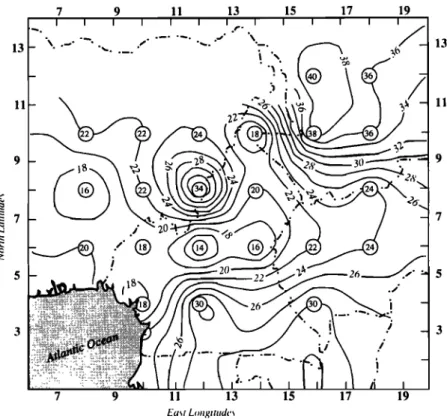
The values of Table 1 were interpolated to compute a map of T c variation within the area (Figure 6). T c varies from 14 km in the NE of the map to 45 km in the south. Also evident on the map is a thinning of the crust along an E-W trend in central Cameroon, beneath the Adamawa uplift. Some clear
trends are visible if we subdivide the area into four blocks: the northeastern, central, transition, and southern blocks.
Northeastern block (grids 5 and 6). This block correlates with the poorly understood region in Chad where little subsurface information exists (Figure 1). The regression line is well defined on both plots, and the corresponding depths (13.6 + 2 km and 14.6 + 1 km for grids 5 and 6, respectively) are the lowest values obtained in the study area. The Chad region has good data coverage, and the size of the box was shown, in the previous section, to be sufficient for the estimation of depths up to 74 km. However, we enlarged the box to 555 km x 666 km and obtained a depth of about 15
km. So, our result here is well constrained. The thickness of a
normal cratonic crust is commonly more than 30 km [e.g., Mourgues, 1983; Sollet et al., 1982; Hadiouche and Jobeft,
1988]. Thus it seems that in this area, the crust-mantle
boundary is masked by a more pronounced intracrustal density
contrast which is determined here. This area needs to be
investigated by additional geophysical methods to confirm
our results.
Central block (grids 15 to 24). This region corresponds to the Adamawa uplift in central Cameroon. The average crustal thickness determined here is between 18 and 23 km. In order to test the reliability of our result in this area, we selected a larger box, 444 km x 888 kin. The slope of the regression line in the selected wave band gives an estimate of 23 + 2 km for the average crustal thickness. These results
show that the crust is thinned in this area relative to the
surrounding, in agreement with seismic refraction studies which show that T c varies from 23 km in the north of the Adamawa uplift to 33 km in the south [Stuart et al., 1985]. On the other hand, petrologic studies carried out on mantle xenoliths suggest that the crust-mantle boundary beneath the Adamawa uplift is not deeper than 25 km [Girod et al., 1984]. The main result here is that the central block (Adamawa uplift) is characterized by a thinning of the crust.
Transition block (grids 7, 8, 9, 10, 11, 13, 14, and 19). This corresponds to all the areas where the crustal
POUDJOM DJOMANI El AL.: ELASTIC THICKNESS IN WEST AbiCA 22,053
Grid 16
Grid 21
-2 -4 -8 ß i7-10:23.4
km
7-12:17.5
lcm
8-14:15.7
lcm
_ ~ 2-6 lcm 0.00 0.04 0.08 0.12 0.16 0.20 0.24 Wavenumber(l/kin) 2 •-8
[ '
0.00 0.04 Selecte• points: 9-12:22.5 km 9-13:19.7 lcm 7-12:18.6 km Error ~ 24 km 0.08 0.12 0.16 Wavenumber (l/kin) 0.20 0.24Grid 22
4 I
-6 1
0.00 Selectext points: 10-12:20.3 km 10-14:17.2 km 7-14:16 km Error~ 3-4 km 0.04 0.08 0.12 0.16 Wavenumber (l/lorn) 0.20 0.24Figure 4. Selection of the wave bands for the estimation of the average crust-mantle boundary and error estimations: example of grids 16, 21, and 22 corresponding to the Adamawa uplift. For each plot, the first set of points selected give the average crust-mantle boundary. The other sets of points are selected to show the possible variation of the limits of the wavenumber band and the corresponding errors on the depth.
thickness varies from 24 to 33 km. These areas are localized
to the north, the southeast, and south of the Adamawa uplift. To the northwest, the Jurassic Jos granitic plateau in Nigeria is characterized by a 27 + 5 km thick crust. Southward, in the Benue rift, the average crustal thickness is between 15 and 33 km. The 15-km-thick crust belongs to the central lower
Benue, while the 33 km thickness is for the western lower
Benue. A value similar to the latter is found along the northwestern margin of the Adamawa uplift and corresponds to the Gongola rift (a branch of the Benue trough). Previous
gravity studies of the Benue trough show that the amount of crustal extension is about 90 km perpendicular to the axis of the trough [Fairhead and Okereke, 1987, 1990]. Eastward, beneath the Yola rift, T c is about 25 km. These results suggest
that the crust is thinned beneath the Yola rift, north of the
Adamawa uplift. Fairhead and Okereke [1987] performed a three-dimensional inversion of gravity data, taking into account the seismological constraints [Stuart et al., 1985]. This inversion reveals that the average crustal thickness is 20, 23 and 30 km for the lower Benue, the Yola, and the Gongola
22,054 POUDJOM DJOMANI E1 AL.: ELASTIC THICKNESS IN WEST AFRICA Gridl Grid2 O- 0 Tc = 17.8_+1 km
-4-
•
-6- o _& o o-bø.•O
o.os o.,o o.,s o.•o o.•
-2-
-4-
-6-
Tc = 30.2-t-1 km
oo
-b•.6o
'o.05 'o. io 'o.
i5 'o.•o 'oi•5
E o J Grid3 -2 Tc = 16.2+1 km
-6- "• øo
I o•.•o -o.05
•o.
i o -o.
i s" o.•o
Grid5 Tc = 15.6.•2 km O- o o c -4 o o o --6! . ,
o.oo o.o5 o. io o. i5 o.•o 0.25
Grid4 -2- -4-
•60 '
Tc = 20.7+4 km o o o0.'65 'o.•o 'o. i5 'o.•o 'o.•s
Grid6 co Tc = 14.6;I;1 km o o o -4- '• C O
•?•o o.os o. io o.,5 o.•o o.•5
Grid7 Grid8 2 Tc = 25.7+4 km 0 o o o c c
•.00 0.05 0.10 0.15 0.20 0.25
-2 -4- -6- --8' o Tc = 28.8+6 km o o c o c-bO.;o
o.o5 o, ,o.
o ,,.
o.•o o.•Wovenumber (1/kin)
Figure 5. Plots of the logarithm of the gravity power spectrum versus the wavenumber, for the 33 grids. For
each
grid the slope
of the selected
regression
line gives
the value
of T c which
is indicated
at the upper
right
comer of each plot with the corresponding error. The T c values are listed in Table 1.POUDJOM DJOMANI E1 AL.: ELASTIC THICKNESS IN WEST AFRICA 22,055 Grid9 Grid10
O-C• 1½
= •.6::1:.8
km
-•
<o o o
o •.00 0.05 o. zo o.z5 0.20 0.25 0 Tc = 28.'!:.5 km o o o o o o-•6.•0 0.05 0.10 0.15 0.20
Grid I 1 o oOo
ø Tc = 24.4.•5
km
o o o o o I • t>'
-•760 o.0s o,o o.,• o.•o o.•
> cn Grid13 a'• 4 o _..I 2 Tc = 33.7.-1:6 km o
•)8.•0 0.05 0.10 0.15 0.20 0.25
Grid12 Tc = 25.7'!'1 krn 0 q5 o o o -2- o -4< I o o _ 6.4 0 I•.oo-o.os o.•o o.•s o.•o o.•s
Grid14 Tc = 14.9.-!:.1 km 0
08.00
0.05 0.10 0.15 0.20 0.25
Grid15 -2- --6 -8 o Tc = 18.5•2 km q• 0.00 0.05 0.10 0.15 0.20 0.25 Grid16 -2- -4 " Tc = 23.4+6 km c c o 6 c 8 0.00 0.05 0.!0 0.15 0.20 0.•:Wovenumber (1/l•m •
! Figure 5. (continued)22,056 ,POUDJOM DJOMANI ET AL.: ELASTIC THICKNESS IN WEKr AFI•CA Grid17 Grid18 Tc = 11.4-t-1 km o 0 oo o
-2- •o
o o•6o o.0• 'o.
io 'o.i• 'o.•o
•0.•
O- -4- oo Tc = 16.7-1-4 km o o o o o o
'38.00
'o.05 o.•o o. i5 'o.:•o
'0.2.-
Grid19 4
:3 i
Tc
= 31.7:1:8
km
0 o -21 I o _ o Q- o->' 'b"!o
o.o•
o.
io o.• 0.20
-o.•
c• Grid21 • 4 0 o Tc = 22.5+4 km o 0 oo -4
6
o o
08.00
o.o• o.
io o.i• o.•o o.:•
Grid20
o
2 0 Tc = 22.6+3 km
o c•
-2 oo
-•86o
•0.0• 'o.,o o.,• o.•o 'o.•
Grid22
-2
Tc = 20.5+3 km
Oo
•.•o o.o• o.•o o.•s o.•o o.a•
Grid23 Grid24 o 2 Tc = 21.2.•8 km 0 oO o o 6 c o 0.00 0.05 0.10 0.15 0.20 0.25 -2 -4 O 2 Tc = 22+7 km c 0 0 o o -2 o
o•.•o
o.o• o.•o o•.
o•o.
o.:Wovenumber
.POUDJOM
DJOMANI
EI AL.:
ELASTIC
THI•SS IN WEST
AFRICA
Grid25 Grid26 -2 -4- Tc = 35.•10 km o o o-b?(•o
o.b• 'o. io '
o o o. i5 o.•o o.•5 2. 00 Tc = 29.7ñ1 km O- o _•. o --4' o o
ß o 'o.65 'o. io 'o.i5 'o.•o 'o.•. •
22,057 Grid27 E tO 0- Q. • -2- Tc = 524-4 km o o o o o •. 8 • -• o.oo 0.05 O. lO 0. iS 0.20 0.25 ,.... c• Grid29 [j• 2 o o -2 c O, Tc = 59:1=3 km 4 o o
6
• o o o
•o o.o• o. io o.• o.zo o.z•
41
Grid282t
o0 Tc
= 40.-1:5
km
ø1%
-4
0
-6 0 0 0•)8.•o
0.05 o.•o 0.•5 o.•o
0.25Grid30 o Tc = 47+10 km 2 o o 0 -2 0.00 0.05 0.10 0.15 0.20 0.25 Grid31 -2 -4 -6 c o o Tc = 45;I;8 km o c C ..8 I 0.00 0.05 0.10 0.15 0.20 0.25 Grid32 Tc = 5i+10 km -2 6 ,'3. 8
o.oo 0.05 o.•o o.• o.•o ø.z5
Wavenumber (1/km)
22,058 POUDJOM DJOMANI ET AL.: ELASTIC'THICKNESS IN WEST AFRICA
Grid33
E • -4- -6- 0.00Tc -
45.8ñ5
km
0 o0.65 o. io 'o.i5 'o.o 'o.z5
Wvenumber (1/kin)
Figure 5. (continued)
riffs, respectively. According to these estimates and in the
view of our results, the crust is thinner in the lower than in the
upper Benue rift.
To the south of the Adamawa uplift, T c increases to 26 km. This value is consistent with seismic data which suggest that
the crust becomes thicker as one moves southwards of the
uplift [Stuart et al., 1985]. This area appears to be a transition
zone between the "Pan African" and the "cratonic" crust here
after presented.
Southern block (grids 25 to 33). T c estimates are more than 30 km and could be as high as 50+ 10 km in the northern part of the Congolese craton. A larger grid (333 km x 666 km) produces a T c of about 29 km, which is less than the previous 50 km. This could be due to the data distribution, since the larger grid also includes some areas with very few data. The results show that in the Congolese craton area the
crust is thicker than beneath the mobile belts and rifted
regions to the north.
Mechanical Behavior of the Lithosphere
Observed coherence
The method used to estimate the flexural rigidity (D), or, equivalently the effective elastic thickness (Te)of the lithosphere, is the coherence function analysis [e.g., Forsyth, 1985]. This method exploits the wavelength dependence between gravity and topography. Flexural models of isostatic compensation for continental lithosphere assume that a thin elastic plate overlying a fluid asthenosphere is deflected by surface (e.g., topographic) and subsurface (e.g., Moho) loads. The amplitude and wavelength of the deflection of the plate thus depend on the flexural rigidity and distribution of the loads. For example, the classical Airy model (local compensation) corresponds to a flexural model where the plate has no rigidity. If the plate has a nonzero rigidity (regional compensation), at short wavelengths, surface and subsurface loads are supported by the rigidity of the lithosphere and the plate is not deflected. As a consequence, the gravity and
topography are incoherent and the coherence is close to 0. At long wavelengths, the plate is deflected by surface loads, and loading from below leads to the formation of topographic reliefs. Therefore gravity and topography are coherent and the coherence is close to 1. The steep curves at the transitional wavelength where loads are partially supported by plate strength and by flexure give an estimate of the flexural rigidity of the lithosphere (Figure 7). The T e and the flexural rigidity of a plate are related by
D = ETe
3 / [12(1-
v2)],
(1)
where E is Young's modulus and v is Poisson's ratio.The observed coherence is computed, in the frequency domain, by [Forsyth, 1985]:
yo2(k)
= Cs
2 (k) / [EH(k)
EG(k)I
(2)
where
Cs
2 (k) is the
square
of the
cross
spectrum
of gravity
and
topography,
EH(k)
= <H(k)
H*(k)>
is the
average
spectrum
of
topography,
EG(k
) = <G(k)G*(k)>
the
average
spectrum
of
gravity, asterisk is the complex conjugation, and k=lkl the
two-dimensional
wavenumber
is
equal
to
(kx
2 + ky2)
1/2,
k
x and
ky are wavenumbers
in the
x and
y directions,
respectively.
In
order to avoid the biasing of the values by noise in the data sets, we computed the coherence using [Munk and Cartwright,1966]
T
2 = (nTo
2 - 1)/(n-
1)
(3)
where n is the number of independent Fourier coefficients in a given wave band. Note that from (3), if a wave band contains a Table 1. T c Values and Selected Wavebands for the Regression Lines in Figure 5Grid Selected Wavebands 'rc, km 1 7to 12 17.8_+ 1 2 7 to 10 30.2 _+ 1 3 9 to 13 16.2 _+ 1 4 8to 11 20.7 _+4 5 8to 14 13.6_+2 6 8to 13 14.6_+ 1 7 8 to 11 25.7 + 4 8 8to 11 28.8+6 9 6 to 9 33.6 _+ 8 10 6 to 10 28.0 _+ 5 11 6 to 10 24.4 _+ 3 12 8 to 11 25.7 _+ 1 13 6 to 10 33.7 _+ 6 14 9 to 15 14.9 _+ 1 15 9 to 13 18.5 _+ 2 16 7 to 10 23.4 _+ 6 17 9 to 14 11.4 _+ 1 18 5to8 16.7 _+ 4 19 6 to 9 31.7 _+ 8 20 6 to 10 22.6 _+ 3 21 9 to 12 22.5 + 4 22 10 to 12 20.5 + 3 23 8 to 11 21.2 _+ 8 24 8 to 11 22.0 _+ 7 25 8 to 10 35.0 _+ 10 26 6 to 10 29.7 _+ 1 27 4 to 8 32.0 _+ 4 28 7 to 10 40.0 _+ 5 29 4 to 8 59.0 _+ 3 30 8 to 10 47.0 _+ 10 31 6 to 9 45.0 _+ 8 32 6 to 10 51.0 + 10 33 5 to 10 45.8 -+ 5
POUDJOM
DJOMANI
E1 AL.: ELASTIC
THICKNESS
IN WEST
AFRICA
22,059
6 8 10 12 14 16 18 20 12 12 10 26 26 'x <.3o•
x
/
22
/ ?'"
'•"
%
2
2
•
W•
, ;••••._••
26 10 ' 4 6 8 10 12 14 16 18 20 East Longitudes ... Political boundaryFigure
6. Average
crustal
thickness
contour
map
of the
study
area
obtained
by interpolation
of the
values
in
Table 1. Contour
interval
is 2 km. Note the correlation
with tectonic
provinces
(Figure
1). The Adamawa
uplift
(center
of the
map)
and
the
Benue
trough
(to the
west
of the
Adamawa)
are
characterized
by a crustal
thinning
(T
c = 22-33
km). The
Congolese
craton
in southern
Cameroon
has
a thicker
crust
(T
c >45
km).
small
number
of points
(n) and
the
coherence
(To
2) is small,
then
y2 could
be negative.
The standard
errors
on the
coherence
within each subregion were computed as follows [Bendat and Piersol, 1980]'AT
2 = (1-
To
2) (2To2/n)
112
(4)The method
explained
here
was
thus
applied
to each
of the
33 subgrids
to compute
the observed
coherence.
The size
of
the grids
was small
enough
such
that the Te does
not vary
significantly within a region.Density Model and Inversion for D
We inverted the observed coherence using the method of
Forsyth
[1985],
briefly
summarized
here. We assume
that
several factors contribute to the observed Bouguer anomaly in each grid. We also assume that density contrasts occur at twointerfaces
producing
surface
topography
(H) and
relief
at the
Moho (W). We then
chose
a simple
two-layer
density
rnodel
for all the 33 subgrids
(Table 2). This model takes
into
account both the surface and subsurface loads. Thus, according to this model, the relief on each density contrast hascomponents
resulting
from loading
on the two interfaces
[Forsyth,
1985]. The separation
of the components
of relief
on the two interfaces is accomplished with the 2-D Fourier transform of the thin elastic plate equation as follows:Dk
4 U(k)
+ Prng
U(k)
= Q(k)
(5)
where D is the flexural rigidity, U(k) is the amplitude of the
plate
deflection,
Pm
the mantle
density,
g is the gravitational
acceleration and Q(k) the applied load on a given interface.Using
(5), expressions
are derived
for each
component
of relief
(topographic
loading,
loading
on the Moho) [Forsyth,
1985;
Bechtel et al., 1987]. The solution of the system obtained isunique
and
occurs
for
Dk
4 • O.
At wavenumbers
where
Dk
4 = O,
surface and subsurface loads are indistinguishable because all loads are locally compensated.
The amplitudes
of relief
obtained
from
the further
equations
are substituted into the power of the topography. The power ofgravity
is obtained
by upward
continuation
of the relief
on the
subsurface density contrast [Forsyth, 1985]. After all substitutions in (2) , the predicted coherence becomes:= < I-ItWt
+
/
<wt:
+ Wb2>
(6)
where H is the surface topography, W is the relief at the Moho,
and
subscripts
t and
b stand
for top (or surface
topography)
and
bottom
(or base
of the crust)
loads,
respectively.
Equation
(6)
is simplified
by assuming
that
surface
and
subsurface
loads
are
independent
processes,
which
means
that the cross
products
HtWt,
HbW
t, etc.,
in the
expressions
for the
spectra
E H, E G,
and
C
s are
cancelled
in the
formula
for
)02
. In this
case,
the
flexural
rigidity
can
be determined
uniquely
[Forsyth,
1985].
For the 33 grids,
we first assume
a flexural
rigidity
and
solve
for H t, H b, W
t, and
W
b. After
that,
we estirnate
the
predicted
coherence
using
(6) for a range
of flexural
rigidities.
22,060 POUDJOM DJOMANI E1 AL.: ELASTIC THICKNESS IN WEST AFRICA 1.0 0.8 0.6 0.4 0.2 0.0 -0.2 -0.4 0.01
Wavelength (kin)
Gridl Grid2 • . _ , 100 • • • 100 •- Te = 40+2/-10 km , , . 1.0 0.8 0.6 0.4 0.2 0.0 -0.2 -0.4 0.01 Te = .58+7/-2 km 0.1 c 1.0 0.8 0.6 0.4 0.2 0.0 -0.2 -0.4 0.01 Grid3 • . . • 100 •I Te
=
40+,5/-2
km
1.0 0.8 0.6 0.4 0.2 0.0 -0.2 -0.4 0.01 Grid5 • . . • 1oo • Te = 40+?/-12 km•;,- ;= ---;
0.1 c0.8
!
0.64 0.4 • 0.2 0.0 -0.2 -0.4 • 0.01 Grid4 ß • lOO • Te = 18+4/-2 kmß .i,
0.1•=;•
1.0 0.8 0.6 0.4 0.2 0.0 -0.2 -0.4 0.01 Grid6 lOO 36+?/-2 km 0.1 1.0 0.8 0.6 0.4 0.2 0.0 -0.4 0.01 Grid7 lOO • ß22+4/-2
km
1.0 0.8 0.6 0.4 o.a0.0
-0.2 -0.4 0.01 0.1Wovenumber (1/kin)
Figure
7. Comparison
between
observed
coherence
(the triangles)
and
predicted
coherence
(circles)
corresponding
to the
best
fitting
models
for the
large
box
of Chad
area
(grid
Chad)
and
each
of the
33 grids
of
Figure 3. The T e values are indicated for each plot and listed on Table 3 with the rms errors.POUDJOM DJOMANI E-'I AL.: ELASTIC THICKNESS IN WEST AFRICA 22,061 c Grid9
.
• • Te
=
24=1=2
km
0.80.6
0.4 • '0.2
o.o
-0.2
-0.41 0.01 0.1Wavelength (,kin)
Grid10 ß 100 . . •1.01'
' . , ...
•..
0.8
'i
= 18+2/-1
km
0.6 0.4 o.o, aa= -0.2 -0.4 . , 0.01 0.1 Grid 1 1 _• . , • 100 t 1.0 Te = 30+5/-8 m 0.8 0.6 0.4 0.2 0.0 -0.2 -0.4 , , 0.01 0.1 1.0 0.8 0.6 0.4 0.2 0.0 -0.2 -0.4 0.01 Grid13 • . . • 1oo • = 16+4 km o c o Grid12 • , , • 100 • • 1.0 0.8 0.6 0.4 0.2 0.0 -0.2 -0.4 0.01 36+?/-2 km ß 0.1 1.0 0.8 0.6 0.4 0.2 0.0 -0.2 -0.4 0.01 Grid14 • . , • lOO Te = 22+2 km Grid15 • , . • 100 • • 1.0 0.8 0.6 0.4 0.2 0.0 -0.2 -0.4 0.01 Te = 34+4/-8 km ß 0.1 l.O 0.8 0.6 0.4 0.2 0.0 -0.2 -0.4 0.0] Grid16 • , , • 100 T Te = 30.-1:2 km ; . ..,,, 0.1Wovenumber (1/kin)
Figure 7. (continued)22,062 POUDJOM DJOMANI ET AL.: ELASTIC THICKNESS IN WEST AFRICA 0.8 0.6 0.4 0.2 0.0 -0.2 -0.4 0.01
Wavelengfh (km)
Grid17 Gridlõ•
100 •
. •
100 •
Te = 40+4/-38 km , 0.1 ß 91.0
0.8 0.6 0.4 0.2 , 0.0 -0.2 -0.4 0.01 Te = 40:1;6 km o c Grid19 - 1001-0t
• ' _ • ...
e = 20..-I;2 km• . ,
0.8 0.6 0.4ø.•
I
-. •
o.o
-0.2
t
-0.4 0.01 0.1 1.0 0.8 0.• 0.4 0.• 0.0 -0ø2 -0.4 0.01 Grid21 • . • 1oo ••
Te
= 14;!;2
km
0.1 o c o 1.0 0.8 0.6 0.4 0.2 0.0 -0.2 -0.4 Grid20 , . ß • 100 , . •I• Te
--
18+2/-4
km
1.0 0.8 0.6 0.4 0.2 0.0 -0.2 -0.4 0.01 Grid22 • . . • 100 ••5
= 1 6d;2
krn
0.1 1.0 0.8 0.6 0.4 0.20.0
t
-o.• t -0.4 0.01 Grid23 • 100 • Te = 22+3/-1 km Grid2410•[
ß• _ . • 100 •
Te = 40+?/-4 km T 0.60.2
T •'
o.o
-
•-c
• •
-0.2 • -0.4 0.01 0.1Wavenumber (1/km)
hgure 7. (continued)POUDJOM DJOMANI ET AL.: ELASTIC THICKNESS IN WEST AFRICA 22,063
Wavelength (km)
Grid251.0 •,
Te = 18+1/-3 km
0.6
0.4
, J0ø2
-o.4[ , 0.01 0.1 Grid26 • . • 100 • • 1.0 Te = 30+9/-6 km 0.8 0.6 T 0.4 - 0.2o.o
-0.2 -0.4 ... 0.01 O. 1 1.0 0.8 0.6 0.4 0.2 0.0 -0.2 -0.4 0.01 1.0 0.8 0.6 0.4 0.2 0.0 -0.2 -0.4 0.01 Grid27 • , , • 100 • • Te = 40+?/-õ km 0.1 Grid29 Te = 40+7/-8 km m•,w• •mmm , 0.1 1.0 0.8 0.6 0.4 0.2 0.0 -0.2 -O.4 OOl 1.o 0.8 0.6 0.4 0.2 o.o -0.2 0.01 Grid28 • . . • lOO • • Te = 30+3/-8 km , 0.1 Grid30 • , , • lOO • . 22+4/-2 km=
0.1 Grid31 Grid32• , , •
100 •
•
1.0 1.00.8
Te = 40+8/-10 km
0.8
Te = 40+10/-12 krr
0.6 0.60.4 C•
0.4
0.2
.•
0.2
-0.2 -0.2 , • , -0.4 ... -0.4 0.01 '0 I 0.01 O. 1Wovenumber (1/km)
Figure 7. (continued)22,064 POUDJOM DJOMANI ET AL.: ELASTIC THICKNESS IN WEST AFRICA 1.0 0.8 0.6 0.4 0.2 0.0 -0.2 -0.4 0.01 Grid33 ? , , • 100 • •
Wavelength
Te = 34+6/-4 km)Grid
Chad
• 100 • Te = 38+4 krn o.1 O.OlWovenumber
0 .'1 Figure 7. (continued)Crustal
and
mantle
densities
of 2670
kg/m
3 and
3300
kg/m
3,
respectively, were assumed for each subregion. As an independent check on our T c estimates, we varied the crustal thickness from 10 to 40 km in each region. The best fitting elastic plate thickness for each subregion is obtained by minimising the residuals between the observed and predicted coherence. After a series of tests on grid 21 (the Adamawa uplift) where constraints on the Moho depth exist from seismic refraction data [Stuart et al., 1985], we estimated the residuals by a one-norm misfit method [e.g., Parker and McNutt, 1980]. It is important to note that the misfit error estimated in this case is higher than that reported in earlier studies [e.g., Bechtel et al., 1987]. Table 2 shows a listing of the physical parameters used to estimate the observed and predicted coherence for all the subregions.
Description of Coherence Models
The observed coherence and the best fit model of computed coherence for the 33 subgrids are shown in Figure 7. These plots allow comparison between elastic plate thickness beneath active and inactive volcanic areas, sedimentary basins and cratonic subregions. For all the grids, the coherence is close to zero at short wavelengths and gradually approaches 1 at long wavelengths where the plate is weak and deflected by surface and/or subsurface loads. At short wavelengths, the plate is strong enough to support topographic loads with no corresponding Bouguer gravity anomalies. The transition from low to high coherence occurs within a narrow wave band, with large error bars caused by wavenumber averaging in fall- Table 2. Physical Parameters Used for the Estimation of the
Observed and Predicted Coherence
Parameters Definitions Value Z m or T c Moho depth, depth to
subsurface load
Pc average crustal density
Pm upper manfie density
g gravity acceleration
G gravitational constant
E Young's modulus v Poisson's ratio
T e effective elastic thickness
D flexural rigidity 10-40 km 2670 kg m -3 3300 kg m -3 9.8 m s -2 6.67 x 10'tim • kg-ts '2 1 x 10 • N m '2 0.25 inverted E Te • [12(1-v2)] 4
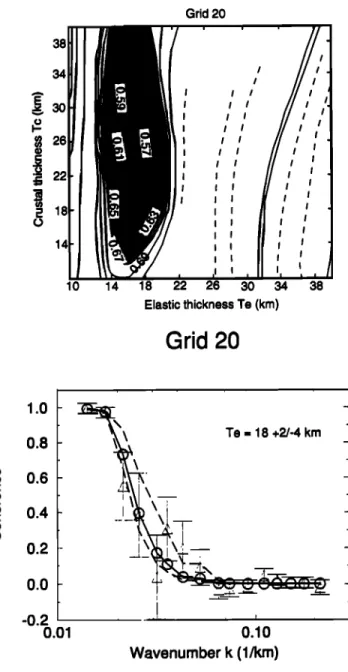
off wave bands. As discussed below, the transition may be more broad and show scatter, indicating that the region considered is not uniformly rigid (e.g., Figure 7, grid 7). In that case, the resulting coherence represents an average of subregions with different flexural rigidities weighted by the product of the powers of gravity and topography. Comparing the observed and predicted coherence allows us to determine the flexural rigidity and thus the effective elastic thickness; evidently, the transitional wave band is shifted to longer wavelengths with increasing flexural rigidity [Forsyth, 1985]. The coherence models for grids 1, 2, 3, and 4 have to be interpreted with care because of a lack of data in these areas. Thus, while computing an elastic thickness map, these values are rejected. For grids 30, 31, 32, and 33, the coherence is not well constrained and the values are also rejected. The T e values obtained for each region and the corresponding root-mean- square (rms) errors are listed on Table 3.
Error Estimations of Te
Several methods can be used to estimate the errors on T e values. The common way is to find the minimum and maximum values of T e that fit the same number of points in the fall-off wave band, as the best fitting coherence model [e.g., Ebinger et al., 1989]. In this study, we used a different approach. For each grid, T e and T c are varied within a range of values, and the best fitting model corresponds to the (T e , T c) couple with the smallest rms error which measures the residual between the observed and predicted coherence. The results show that the rms errors lie between 0.55 and 1.83 (Table 3). The lower value corresponds to grid 20 located at the Benue trough axis, while the highest error is obtained for grid 6, the eastern part of Chad basin. Since both parameters are varied, we can draw, for each grid, arms error contour map for T c versus T e. After we have selected the best fitting model (Te), the shaded region in each rms error contour drawing sets the upper and lower confidence limits for T e (Figure 8). The minimum rms residual is increased by no more than 0.12 to give the rms contour for the limits to T e. This approach is illustrated in Figure 8, and the minimum and maximum T e curves for the three selected grids (20, 2,6 and 5) are also shown. For the first contour map (Figure 8a, grid 20), the best fitting model gives a T e value of 18 km (with T c = 28 km), the minimum is 14 km and the maximum is 20 km. Thus the T e value for this grid is 18 +2/-4 km. Figure 8b (grid 26) shows that the best fitting model corresponds to a T e of 30 km (T c =