HAL Id: insu-01717290
https://hal-insu.archives-ouvertes.fr/insu-01717290
Submitted on 26 Feb 2018HAL is a multi-disciplinary open access
archive for the deposit and dissemination of sci-entific research documents, whether they are pub-lished or not. The documents may come from teaching and research institutions in France or abroad, or from public or private research centers.
L’archive ouverte pluridisciplinaire HAL, est destinée au dépôt et à la diffusion de documents scientifiques de niveau recherche, publiés ou non, émanant des établissements d’enseignement et de recherche français ou étrangers, des laboratoires publics ou privés.
Multiple crust reworking in the French Armorican
Variscan belt: implication for the genesis of
uranium-fertile leucogranites
Christophe Ballouard, Marc Poujol, Armin Zeh
To cite this version:
Christophe Ballouard, Marc Poujol, Armin Zeh. Multiple crust reworking in the French Armorican Variscan belt: implication for the genesis of uranium-fertile leucogranites. International Journal of Earth Sciences, Springer Verlag, 2018, 107 (7), pp.2317-2336. �10.1007/s00531-018-1600-3�. �insu-01717290�
1
Multiple crust reworking in the French Armorican Variscan belt:
implication for the genesis of uranium-fertile leucogranites
C. Ballouarda,b*, M. Poujolb, A. Zehc
1
aDepartment of Geology, University of Johannesburg, PO Box 254, Auckland Park 2006, 2
South Africa
3
bUniv Rennes, CNRS, Géosciences Rennes - UMR 6118, F-35000 Rennes, France 4
c Institute of Applied Geosciences – Karlsruhe Institute of Technology (KIT), Campus South, 5
Mineralogy and Petrology, Adenauerring 20b, 50.4, D-76131 Karlsruhe, Germany
6
* Correspondence:
7
[email protected], [email protected], +27648303568
8
Keywords: peraluminous granites, zircon U-Pb dating, Hf-Nd isotope analyses, Variscan 9
orogeny, uranium metallogenesis 10
Abstract 11
Muscovite peraluminous granites (MPGs) form by partial melting of the continental crust and
12
can be related to metalliferous deposits such as tin, tungsten and uranium (U). Metal enrichment
13
in MPGs commonly results from fractional crystallization, but the metal contents of the source
14
play a major role for their fertility. Between ca. 320 and 300 Ma (Late Carboniferous), the
15
French Armorican Variscan belt was intruded by numerous U-fertile MPGs that contain
16
inherited zircon grains with a wide range of ages from Archean-to-Carboniferous. U-Pb and Hf
17
isotopic data of zircon grains from Brioverian-to-Carboniferous sediments, Cambrian-to-Early
18
Carboniferous granitoids and Late Carboniferous MPGs indicate that the crust of the Armorican
19
Manuscript Click here to download Manuscript Ms_Ballouard et
al__IJES_R1.docx
2
Massif is made up by detritus mainly derived from the West African craton (3500-1600 Ma;
20
TDM = 3.8-2.3 Ga), Grenvillian belt (1200-900 Ma; TDM = 2.7-1.2 Ga) and Avalonian-Cadomian 21
belt (800-550 Ma; TDM = 2.5-0.8 Ga), and that the crust was affected by magmatic events at 22
510-470 Ma (TDM = 1.6-0.6 Ga), 410-330 Ma (TDM = 1.6-1 Ga) and 320-300 Ma. Furthermore, 23
they reveal that the Late Carboniferous MPGs were mainly formed by partial melting of
24
Brioverian sediments with Cambro-Ordovician and Devonian-Carboniferous granitoids, which
25
are all genetically linked with each other and characterized by Th/U < 4. The new data suggest
26
that the U-fertile MPGs result from multiple reworking of U-rich Brioverian sediments,
27
deposited ca. 550 Ma ago on the northern margin of Gondwana, and partially molten during
28
several Paleozoic events, causing a successive increase in U content in the middle-upper crust.
29
Introduction 30
In late orogenic setting, the partial melting of the crust during extensional and/or
31
transcurrent tectonic regimes commonly lead to the emplacement of peraluminous granitoids
32
(e.g. Barbarin 1999) including cordierite bearing peraluminous granites (CPGs), muscovite
33
bearing peraluminous granites (MPGs; Barbarin 1996, 1999) and related LCT
(lithium-cesium-34
tantalum) pegmatites (Černý and Ercit 2005). Peraluminous granites and pegmatites are
35
generally considered to form by the partial melting of sedimentary rocks at lower or
36
intermediate crustal levels (e.g. Bernard-Griffiths et al. 1985; Le Fort et al. 1987; Vielzeuf and
37
Holloway 1988; Patiño-Douce and Johnston 1991; Montel and Vielzeuf 1997; Patiño-Douce
38
1999; Shaw et al. 2016) but highly peraluminous melts can also be produced through the partial
39
melting of mica rich igneous rocks (e.g. Turpin et al. 1990; Castro et al. 1999; Villaseca et al.
40
2012; García-Arias et al. 2015; Gao et al. 2016; Laurent et al. 2017; López-Moro et al. 2017).
41
MPGs and related pegmatites can be associated with various metalliferous deposits such as tin
42
(Sn), tungsten (W), uranium (U), lithium (Li) and tantalum (Ta). The genesis of these deposits
43
relates significantly to fractional crystallization and hydrothermalism but the pre-concentration
3
of these lithophile elements in the source region submitted to partial melting is a necessary
45
requirement for the genesis of peraluminous granites and pegmatites associated with
46
economically significant metal deposits.
47
Recent studies (Romer and Kroner 2015, 2016) suggested that the formation of granites
48
associated with Sn-W deposits and LCT pegmatites may result from weathering-related rare
49
element enrichment in sediments prior to partial melting. Epicontinental black shales deposited
50
after major glaciation events also have the capacity to trap a large amount of U (Cuney 2010)
51
and their partial melting can lead to the formation of U rich melts. Emplacement of igneous
52
rocks formed by the partial melting of an enriched lithospheric mantle can also result in the
53
enrichment of incompatible element in the continental crust (Cuney 2010). Furthermore, crustal
54
reworking can achieve significant metal enrichment at the scale of the lower, middle and upper
55
crust. During granulite-facies metamorphism, dehydration of the lower crust can lead to the
56
production of fluids enriched in F, large ion lithophile elements and rare metals. These fluids,
57
preferentially channeled along regional shear zones, may enhance the partial melting of the
58
middle crust resulting in the formation of magmas enriched in rare metals and U (Cuney and
59
Barbey 2014). A comparable model was proposed by Eglinger et al. (2016) in the Pan African
60
Lufilian belt where a crustal-scale Ca-Na metasomatism has leached U from the basement, and
61
transported and redistribute it into supracrustal rocks along the brittle-ductile transition. Finally,
62
crustal-derived magmatism can also induce significant metal mobility at the scale of the crust.
63
Such process is well recorded in the uraniferous Mesoproterozoic western Namaqua province
64
(South Africa) where voluminous granitic magmatism, recorded for a period of about 200 Ma,
65
led to progressive U enrichment of the lower-middle crust (e.g. Andreoli et al. 2006).
66
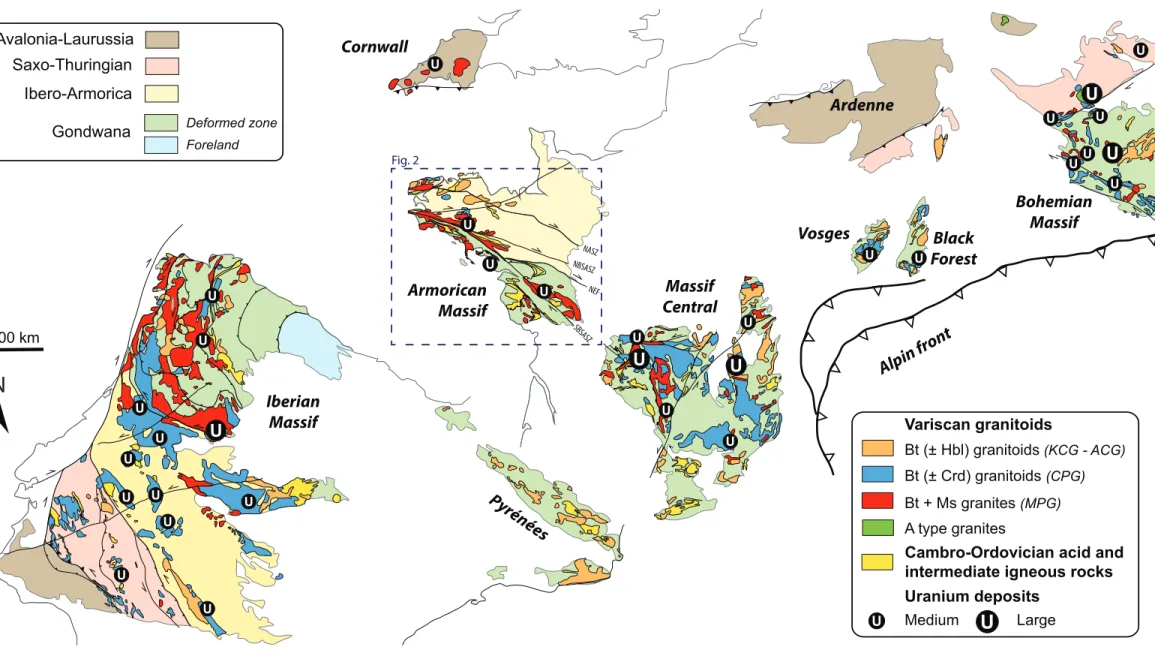
In the European Variscan belt (EVB), a large proportion of the hydrothermal U deposits are
67
spatially associated with uraninite bearing low-Ca Late Carboniferous MPGs (e.g. Cathelineau
68
et al. 1990; Cuney et al. 1990; Tischendorf and Förster 1994; Ballouard et al. 2017a, in press)
4
(Fig. 1) and in the Armorican Massif (French part of the EVB) 20.000 t of U (20 % of the
70
French production; UDEPO database: https://infcis.iaea.org) were extracted from the deposits
71
spatially associated with the syntectonic MPGs (leucogranites) emplaced in the southern part
72
of the massif (Fig. 2). Overall, most of the MPGs emplaced along the south Armorican shear
73
zone (SASZ), a lithospheric scale strike-slip fault (e.g. Jégouzo 1980; Gumiaux et al. 2004a, b;
74
Gapais et al. 2015), appear to be U-fertile, either because they are the source for several
75
economically significant U deposits, such as the Mortagne (Cathelineau 1982) and Pontivy
76
(Marcoux 1982; Ballouard et al., in press) MPGs or because they liberated an important amount
77
of U during post-magmatic hydrothermal alteration, such as the Questembert MPG (Tartèse et
78
al. 2013). In contrast, MPGs that were emplaced in extensional setting to the south of the SASZ
79
(Gapais et al. 2015), are barren. The only exception is the U-fertile Guérande MPG, which is
80
spatially associated with U deposits (Cathelineau 1981; Ballouard et al. 2017a). The distribution
81
of the U-rich MPGs in the Armorican Massif fits widely the distribution of the so-called high
82
heat production and flow belt (HHPFB; Fig. 2) defined by Jolivet et al. (1989) and Vigneresse
83
et al. (1989). This belt shows a NW-SE orientation, is ca. 50 km wide, and characterized by an
84
elevated heat flux. Granites in this belt have heat production values more than twice the values
85
of the surrounding geological formations (Jolivet et al. 1989; Vigneresse et al. 1989).
86
Vigneresse et al. (1989) therefore suggested that the HHPFB reflects the presence of an upper
87
to intermediate continental crust enriched in radioactive elements and that partial melting of
88
this crust caused the formation of U-fertile MPGs.
89
Recent studies focused mainly on the detailed deciphering of intramagmatic and
90
hydrothermal processes leading to the genesis of the U deposits associated with the Guérande
91
and Pontivy MPGs (Ballouard et al. 2015a, 2017a, 2017b, in press). However, the more global
92
reasons behind the U-fertility of the MPGs in the Armorican Massif, and particularly the role
93
of their source(s), remain unclear. To place new constraints on this open issue new sets of data
5
are presented in this study, comprising whole rock trace elements and Nd-Sr isotopic analyses,
95
U-Pb ages and Hf isotopic data of inherited zircon grains from Late Carboniferous MPGs,
96
detrital zircon from Brioverian to Carboniferous sedimentary rocks and zircon crystals from
97
pre-Late Carboniferous igneous rocks surrounding the MPGs. Finally, the implication of the
98
new data sets for the genesis of U-fertile MPGs is discussed.
99
Geological context 100
The Armorican Massif belongs to the European Variscan Belt (EVB), a Paleozoic orogenic
101
belt that extends from Western (Iberian Massif) to Central Europe (Bohemian Massif) and
102
results from the convergence of the Gondwana and Avalonia continents (Fig. 1;) (Ballèvre et
103
al. 2009, 2013, 2014; Kroner and Romer 2013). The oldest rocks from the European Variscan
104
belts are the Icartian orthogneisses that outcrop sporadically to the north of the Armorican
105
Massif (Vidal et al. 1981). These, ca. 2 Ga old metagranitoids, are the witnesses of a
106
Paleoproterozoic continental crust (Samson and D’lemos 1998). The Neoproterozoic-Cambrian
107
Cadomian orogeny represents the main Pre-Variscan orogenic event (Linnemann et al. 2008,
108
2014). Strong Cadomian imprints are preserved in the Saxo-Thuringian domains of the
109
Bohemian and Iberian Massifs, and the main type locality is the northern part of the Armorican
110
Massif (Figs. 1 and 2). The Cadomian-Avalonian orogen is the result of the succession of
111
variable geodynamic events occurring along the northern margin of the West African craton
112
(Gondwana). These events include the formation of a continental magmatic arc from ca. 750 to
113
570 Ma, back-arc basin closure followed by arc-continent collision from ca. 570 to 540 Ma and
114
major granitoid magmatism at ca. 540 Ma (Linnemann et al. 2008, 2014, Koglin et al. 2018).
115
During the Cambro-Ordovician (ca. 510 – 470 Ma), a widespread extension event, leading to
116
the separation of continental micro-blocks (Ibero-Armorica) from the northern Gondwana
117
margin, induced an important magmatism related to the emplacement of various granitoids and
118
volcanic rocks (Fig. 1) (Ballèvre et al. 2012, 2013, 2014; Kroner and Romer 2013; Villaseca et
6
al. 2016; Koglin et al. 2018). Subduction of oceanic then continental domains in the EVB
120
occurred until ca. 350-340 Ma and transition from a compressive to an extensive regime
121
occurred at ca. 315-310 Ma (Kroner and Romer 2013; Ballèvre et al. 2014). From Middle
122
Carboniferous to Early Permian (e.g. Romer et al. 2007; Martínez Catalán et al. 2014; Laurent
123
et al. 2017; Ballouard et al. 2017b), the EVB experienced an important magmatism leading to
124
emplacement of crustal-derived MPGs and CPGs as well as hybrid or mantle-derived K-rich
125
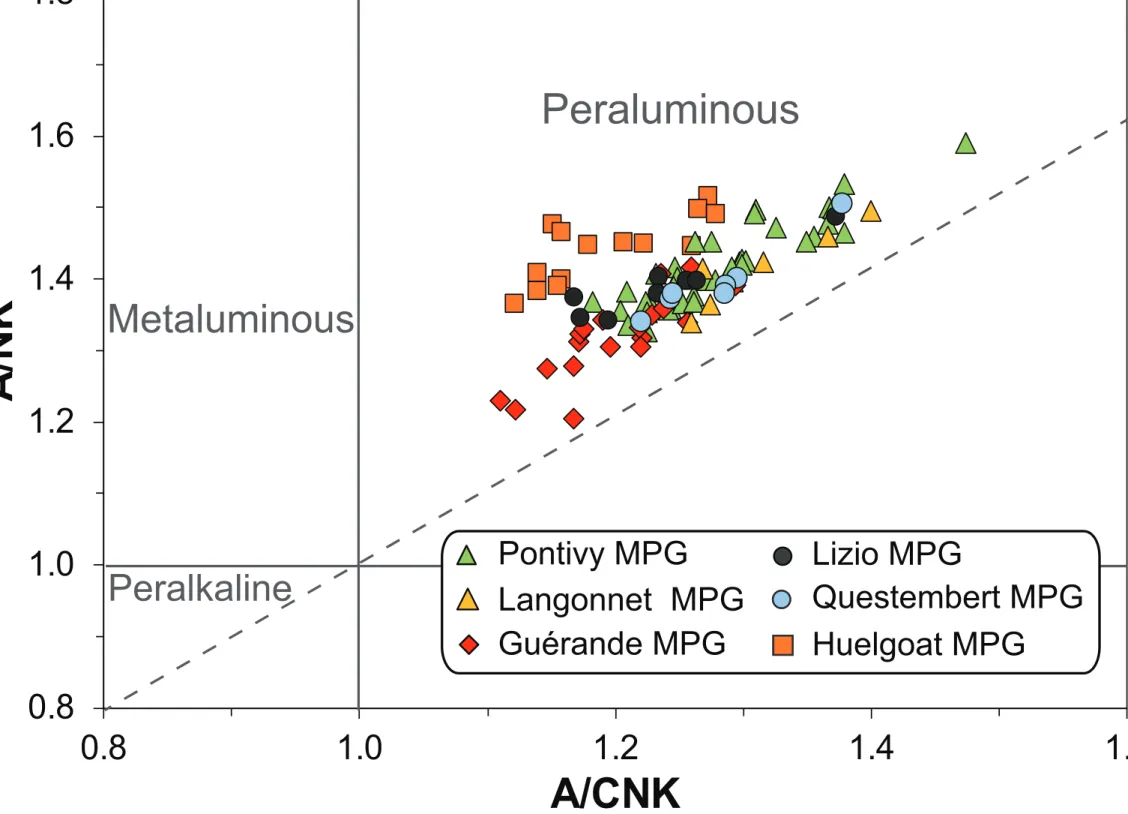
K-feldspar porphyritic calc-alkaline (KCGs) and amphibole-rich calc-alkaline (ACGs)
126
granitoids (Barbarin 1999) (Fig. 1). The EVB represents an important metallogenic province
127
for U where vein, episyenite-type, breccia-hosted or shear zone-hosted U deposits occur
128
throughout the belt (Fig. 1). A large proportion of these hydrothermal deposits are spatially
129
associated with Late Carboniferous MPGs and mineralizing events mostly occurred during the
130
Permian from ca. 300 to 260 Ma (e.g. Cathelineau et al. 1990; Cuney et al. 1990; Tischendorf
131
and Förster 1994; Cuney and Kyser 2008; Romer et al. 2010; Ballouard et al. 2017a, in press).
132
The Armorican Massif is separated into three main domains by the north Armorican shear
133
zone (NASZ) and the south Armorican shear zone (SASZ), two dextral crustal to
lithospheric-134
scale strike-slip faults (Fig. 2) (e.g. Gumiaux et al. 2004b). The northern domain is mostly made
135
of Cadomian basement that belonged to the upper crust during Variscan orogeny (Ballèvre et
136
al. 2001; Brun et al. 2001). The central domain is dominantly composed of Brioverian
137
(Neoproterozoic-Cambrian) to Lower Carboniferous sediments that were mostly deformed
138
under greenschist facies conditions during strike-slip deformation (Gumiaux et al. 2004a).
139
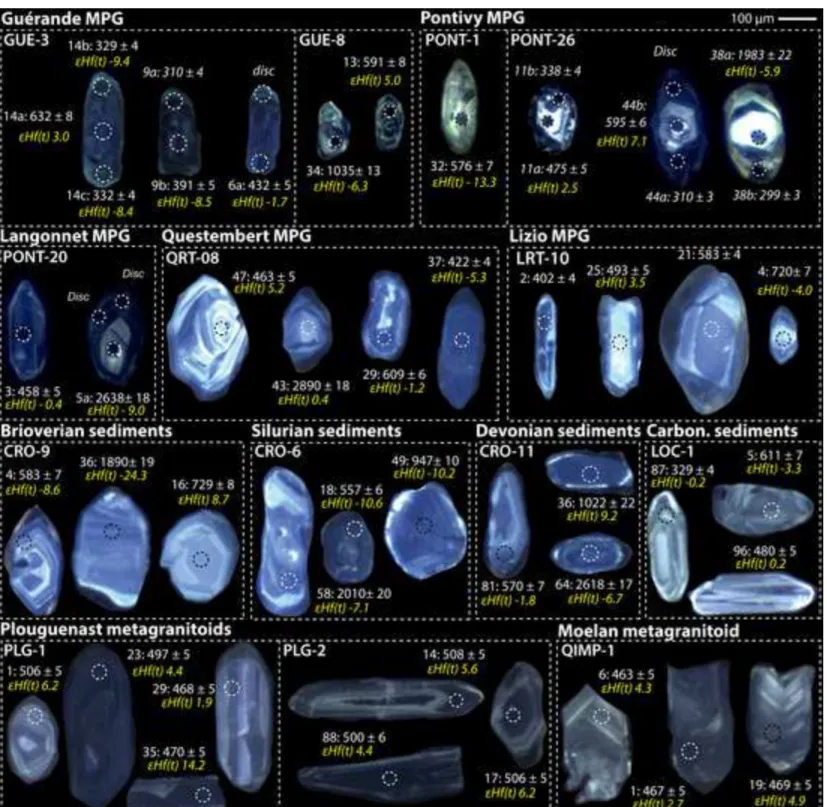
Brioverian sediments in this domain constitute a more than 1000 m thick monotonous and
140
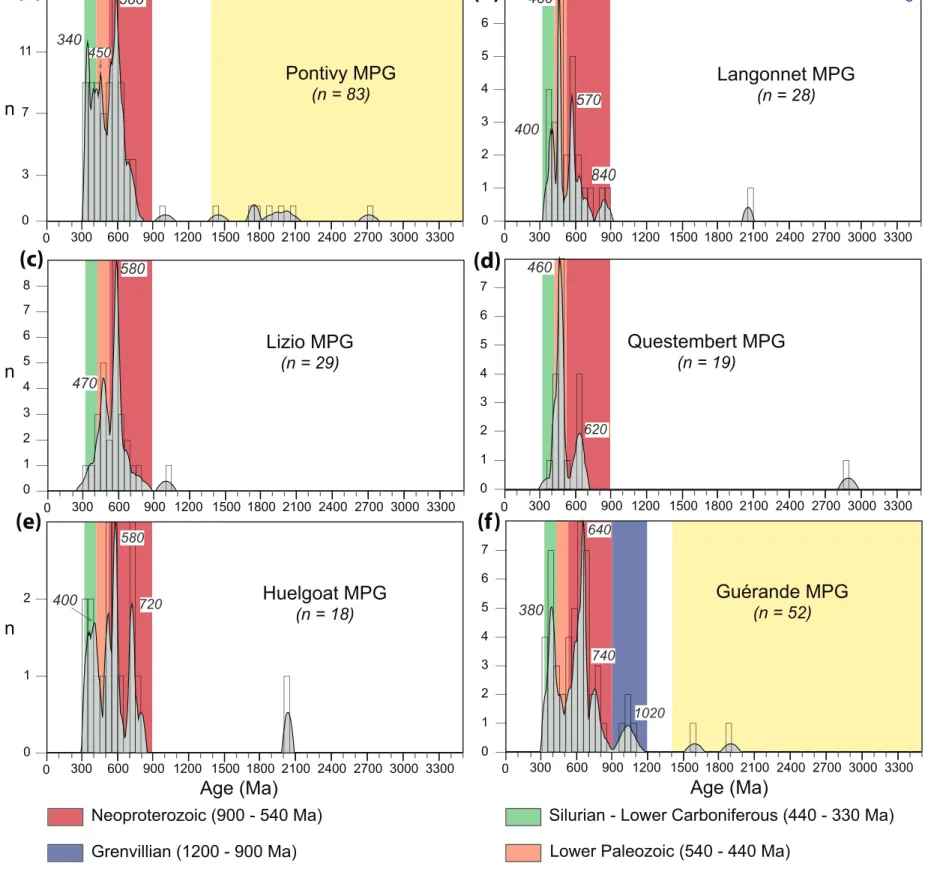
immature detrital succession of wacke-type sandstones (Dabard et al. 1996). The Ordovician to
141
Lower Carboniferous sediments form a heterogeneous mostly siliciclastic succession with a
142
thickness above 3500 m. Carbonates mostly occur in Devonian sediments whereas black shales
143
are characteristic of the Silurian and the Upper Devonian (Pelhate 1994; Vidal et al. 2001). The
7
southern domain, that belongs to the internal part of the Variscan belt, is characterized by an
145
intense deformation and by the presence of high grade metamorphic rocks (e.g. Gapais et al.
146
2015).Three tectono-metamorphic units can be distinguished in this domain and comprise from
147
top to bottom: (i) HP-LT rocks, composed of Ordovician acid metavolcanic rocks (Ballèvre et
148
al. 2012) and blueschists subducted and exhumed between ca. 370 and 350 Ma (e.g. Bosse et
149
al. 2005), (ii) micaschists, and (iii) migmatite-bearing units (Fig. 2). Migmatites, mostly formed
150
by partial melting of pre-Carboniferous sediments and Early Paleozoic orthogneisses and
151
recorded peak P-T condition of 0.8 GPa, 750-850 °C (Jones and Brown 1990; Augier et al.
152
2015).
153
Magmatism in the Armorican Massif occurred during four main periods. During the
154
Cadomian period from ca. 750 to 580 Ma, the northern domain was affected by acid and mafic
155
arc magmatism followed by voluminous granitoid plutonism at ca. 540 Ma (Ballèvre et al. 2001,
156
2013). In the Early Ordovician times (ca. 490 – 470 Ma), intracontinental rifting was
157
responsible for the emplacement of tholeitic mafic magmas and voluminous acid metavolcanics
158
(Vendée porphyroids) in the southern domain (Ballèvre et al. 2012), whereas Late
Cambrian-159
Early Ordovician granitoids intruded the whole massif (Fig. 2). The Devonian-Early
160
Carboniferous period is marked by the emplacement of gabbros and various granitoids
161
(Marcoux et al. 2009; Capdevila 2010) (Fig. 2) as well as by the development of an extensive
162
network of mafic dikes at ca. 360 Ma (Pochon et al. 2016). This period is related to Early
163
Variscan subduction and initial collision. During the Late Carboniferous (from ca. 320 to 300
164
Ma), dextral wrenching of the central domain and crustal extension in the southern domain, led
165
to the exhumation of migmatitic core complex (Gapais et al. 2015), coeval with the
166
emplacement of three main types of granitoids (Fig. 2).
167
(1) MPGs: they were mostly emplaced either along extensional deformation zone in the
168
internal domain of the Armorican Variscan belt, such as the Quiberon (Gapais et al. 2015) and
8
Guérande (309.7 ± 1.3 Ma: Ballouard et al. 2015a) MPGs, or along the SASZ such as the
170
Questembert (316.1 ± 2.9 Ma: Tartèse et al. 2011b), Lizio (316.4 ± 5.6 Ma: Tartèse et al. 2011a)
171
and Pontivy (316.7 ± 2.5 Ma: Ballouard et al. 2017b) MPGs. Some of them were also emplaced
172
to the north of the SASZ such as the Langonnet (304.7 ± 2.7 Ma: Ballouard et al. 2017b),
173
Huelgoat (314.0 ± 2.8 Ma: Ballouard 2016) and Saint-Renan MPGs (316.0 ± 2.0 Ma: Le Gall
174
et al. 2014). Previous isotopic studies (Bernard-Griffiths et al. 1985; Euzen 1993; Tartèse and
175
Boulvais 2010; Ballouard et al. 2015a, 2017a, 2017b) revealed that these MPGs are
176
characterized by high δ18O ratios (> 11), sub-chondritic to chondritic εNd(T) and elevated initial 177
87Sr/86Sr (> 0.705) values in agreement with a crustal origin. 178
(2) CPGs: the Rostrenen (Euzen 1993; Ballouard et al. 2017b) and Huelgoat (Georget 1986)
179
CPGs were emplaced at 315.5 ± 2.0 Ma (Ballouard et al. 2017b) and 314.8 ± 2.0 Ma (Ballouard
180
2016), respectively. These granites were emplaced synchronously with small stocks of
mantle-181
derived mafic to intermediate igneous rocks.
182
(3) KCGs: these metaluminous biotite ± hornblende granitoids consist of a
magnesio-183
potassic (Mg-K) and ferro-potassic (Fe-K) suite emplaced between 325 and 300 Ma and
184
associated with mantle-derived mafic to intermediate rocks (Peucat et al. 1984; Capdevila,
185
2010; Caroff et al. 2015; Ballouard et al. 2015b).
186
At a global scale, crustal partial melting to the south of the SASZ, during the Late
187
Carboniferous, was triggered by lithospheric thinning during late orogenic extension. In
188
contrast, to the north of the SASZ, partial melting of the crust and of a lithospheric mantle,
189
metasomatized during previous subduction events, were likely induced by asthenosphere
190
upwelling during diffuse strike-slip deformation of the central domain and subsequent
slab-191
tearing (Ballouard et al. 2017b).
9
In the Armorican Massif, U was mostly mined in the district of Mortagne, Pontivy and
193
Guérande. In the Guérande and Pontivy districts, the MPGs were the main source for the U
194
mineralization found in the intra to perigranitic vein and episyenite type hydrothermal deposits.
195
Leaching of magmatic U oxides from the MPGs was promoted by the infiltration at depth of
196
oxidized surface-derived hydrothermal fluids(Ballouard et al. 2017a, in press). U-Pb dating of
197
U oxides from the Guérande, Pontivy and Mortagne district deposits reveal several mineralizing
198
events that occurred by pulse from ca. 300 to 260 Ma (Cathelineau et al. 1990; Ballouard et al.
199
2017a, in press).
200
Samples and methods 201
A description and the GPS coordinates of Late Carboniferous MPGs, sedimentary rocks,
202
and Cambro-Ordovician granitoid samples selected for whole-rock major and trace element
203
analyses as well as zircon U-Pb and Hf isotope analyses are provided in Table 1 and
204
Supplementary file 1.
205
MPGs selected for U-Pb (and Hf) isotope analyses on inherited zircon grains include the U
206
mineralized Guérande and Pontivy MPGs as well as the Questembert, Lizio, Langonnet and
207
Hulgoats MPGs that are not spatially associated with U deposits (Fig. 2). Most sandstone or
208
siltstone samples (Brioverian to Devonian) were collected in the region of Crozon in the western
209
edge of the central Armorican domain (Fig. 2). In addition, a Lower Carboniferous (this study)
210
and Devonian sandstone (Ducassou et al. 2014) were sampled in the Châteaulin basin (western
211
part of the central domain, Fig. 2) and the Chalonnes region (eastern part of the central domain,
212
Fig. 2), respectively. One metagranite (sample PLG-1), two metatonalites (samples PLG-2 and
213
PLG-4) and one undeformed granite (sample PLG-3) from the Lower Paleozoic Plouguenast
214
orthogneissic complex (central domain, Fig. 2), as well as one metatonalite (sample QIMP-1)
215
from Moëlan (southern domain, Fig. 2) were also selected for zircon U-Pb dating.
10
Whole rock isotopic, major and trace element analyses
217
Large samples (5 to 10 kg) were crushed in the Geosciences Rennes Laboratory using agate
218
mortars. Chemical analyses were performed by the Service d'Analyse des Roches et des
219
Minéraux (SARM; CRPG-CNRS, Nancy, France) using a ICP-AES for the major elements and
220
a ICP-MS for the trace elements following the techniques described in Carignan et al. (2001).
221
The results of the analyses are provided in Supplementary file 2. Whole rock Sr and Sm-Nd
222
isotope analyses were performed at Geosciences Rennes, on two samples from the Guérande
223
MPG (muscovite-tourmaline coarse grained facies, see Ballouard et al. 2015a) and one Lower
224
Carboniferous sandstone sample from the Châteaulin Basin. The methodology and analytical
225
conditions are described in Ballouard et al. (2017b) and the results of the isotope analyses are
226
provided in Supplementary file 3.
227
Zircon U-Pb and Hf isotope analyses
228
A classical mineral separation procedure was applied to concentrate zircon grains using the
229
facilities available at Geosciences Rennes (Ballouard et al. 2015a). Zircon grains were imaged
230
by cathodoluminescence (CL) using a Reliotron CL system equipped with a digital color
231
camera available at the Geosciences Rennes laboratory.
232
U-Pb dating of zircon was performed by in-situ laser ablation inductively coupled plasma
233
mass spectrometry (LA-ICP-MS) using a ESI NWR193UC Excimer laser coupled to a
234
quadrupole Agilent 7700 x ICP-MS equipped with a dual pumping system to enhance
235
sensibility. The methodology and analytical protocol used to perform the analyses can be found
236
in Ballouard et al. (2015a) and Supplementary file 4. The analyses with a degree of concordance
237
between 90 and 110% are provided in Supplementary file 5 with errors listed at 1σ. Histograms
238
(50 Ma bins) and Kernel density estimates (KDE, 25 Ma bands) of the zircon U-Pb dates were
239
realized using the DensityPlotter software (Vermeesch 2012). 206Pb/238U dates were used for
11
zircon with a 207Pb/206Pb date < 1.0 Ga whereas 207Pb/206Pb dates were used for zircon with a
241
207Pb/206Pb date > 1.0 Ga. 242
Hafnium (Hf) isotope analyses were performed at Goethe-University Frankfurt using a
243
Thermo-Finnigan NEPTUNE multicollector ICP-MS coupled to a Resolution M-50
244
(Resonetics) 193 nm ArF Excimer laser (ComPexPro 102F, Coherent), using the procedure
245
outlined in detail in Gerdes and Zeh (2006, 2009) and summarized in Supplementary file 4. The
246
epsilon Hf values [εHf(t)] were calculated using the chondritic uniform reservoir (CHUR) as
247
recommended by Bouvier et al. (2008; 176Lu/177Hf = 0.0336 and 176Hf/177Hf = 0.282785) and a
248
decay constant of 1.867x10⁻¹¹ yr−1 (Scherer et al. 2001; Söderlund et al. 2004). The initial
249
176Hf/177Hft, εHf(t) values and hafnium model ages (T
DM) (for zircon grains with a degree of 250
concordance between 90 and 110%) were calculated using 206Pb/238U ages for zircon with
251
206Pb/207Pb ages < 1.0 Ga and 206Pb/207Pb ages for zircon with 206Pb/207Pb ages > 1.0 Ga. The 252
result of analyses and additional information are provided in Supplementary file 6.
253
Results 254
Geochemical features and U-Th distribution
255
All investigated Late Carboniferous MPGs of the Armorican Massif are highly
256
peraluminous and characterized by A/CNK [Al2O3 / (CaO + Na2O + K2O), molar proportions] 257
values > 1.1 (Fig. 3). However, the Huelgoat MPG plot on a different trend than the others
258
MPGs, with relatively higher A/NK values at low A/CNK ratio, reflecting a higher CaO
259
content. In Figure 4, these MPGs are mostly characterized by low and highly variable
whole-260
rock Th/U ratio mostly from ~0.1 to 2, as well as variable U content from 1 to 27 ppm.
261
The whole-rock composition of silicoclastic sediments and peraluminous igneous rocks
262
representing potential source for the Late Carboniferous MPGs were also reported in the U
263
versus Th diagram (Fig. 4). The U contents of the Brioverian and Paleozoic sediments
12
(Ordovician to Devonian) range between ~1 and 7 ppm. However, the Paleozoic sediments
265
generally show much higher Th/U ratios (between ~4 and 7), i.e., above the average value of
266
the upper continental crust (UCC ~ 4), compared to most Brioverian sediments (Th/U ratio
267
mostly between ~2 and 4). Most Ordovician (meta)volcanics (Lower Paleozoic) are
268
characterized by U contents between ~1 and 7 ppm and variable Th/U ratios between ~2 and
269
20 whereas Cambro–Ordovician (Lower Paleozoic) and Early Carboniferous (Pertre MPG)
270
granitoids show more variable U contents between ~2 and 40 ppm and are generally
271
characterized by relatively low but variable Th/U ratios ranging from ~0.5 to 4.
272
Whole-rock Sr-Nd isotope data
273
Most MPGs are characterized by elevated initial 87Sr/86Sr [ISr (315 Ma] ratios ranging from 274
0.706 (Pontivy MPG) and 0.719 (Guérande MPG) and negative εNd (315 Ma) values (-2.3 >
275
εNd (315 Ma) > -8.0) with two stage Nd model ages (TDM) between 1.2 (Pontivy and Langonnet 276
MPG) and 1.8 Ga (Guérande MPG, Fig. 5). However, two samples from the Pontivy MPG
277
display super-chondritic εNd (315 Ma) values (1.2 and 2.2) with relatively low ISr (0.704 and 278
0.706) ratios and young TDM (1.0 and 0.9 Ga). As noticed by Bernard-Griffiths et al. (1985), 279
the ISr (315 Ma) and εNd (315 Ma) values of MPG increase and decrease, respectively, from 280
north to south with an evolution from the Pontivy–Langonnet-Lizio MPG, Questembert MPG
281
to Guérande MPG (Figs. 2 and 5).
282
U-Pb dating
283
Inherited zircon from MPG
284
Zircon grains from all investigated MPGs of the Armorican Massif are generally euhedral.
285
They commonly show inherited cores surrounded by magmatic rims in CL images (Fig. 6).
U-286
Pb ages obtained on inherited zircon cores or grains from the MPGs are reported in form of
287
histograms and KDE in Figure 7. In general, five ages populations can be distinguished which,
13
however do not occur in all MPGs: (1) an Archean-Mesoproterozoic population at 3500-1400
289
Ma, (2) a Grenvillian population at 1200-900 Ma, (3) a Neoproterozoic population at 900-540
290
Ma, (4) a Cambro-Ordovician population at 540-440 Ma and (5) a Silurian–Lower
291
Carboniferous population at 440-330 Ma (Table 1). All MPG samples are dominated by zircon
292
grains of the populations (3), (4) and (5). A significant amount of population (1) zircon occurs
293
only in the Pontivy MPG (8%), and of population (2) zircon in the Guérande MPG (8%; see
294
Fig. 7 and Table 1).
295
Detrital zircon from sediments
296
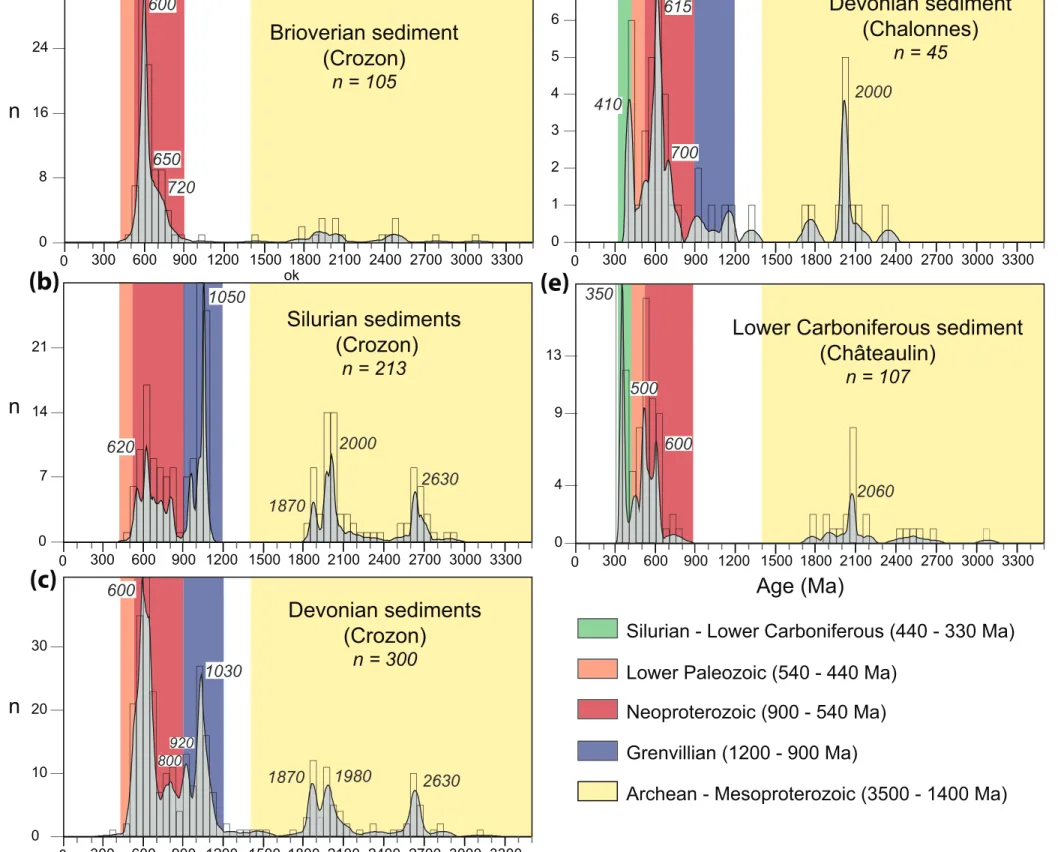
U-Pb dates obtained on detrital zircon grains from the main sedimentary formations of the
297
Armorican Massif are reported in Figure 8 and summarized in Table 1.
298
Zircon grains from the different sedimentary rocks show an euhedral to rounded shape and
299
appear zoned or homogeneous in CL images (Fig. 6). The detrital grains reflect similar age
300
populations (1 to 5) than the ones obtained from the xenocrysts in the MPGs (Table 1).
301
However, the amount of Archean-to-Mesoproterozoic grains (population 1) is higher in the
302
sediments compared to the MPGs, especially in Silurian and Devonian sediments (Fig. 8 and
303
Table 1). The most significant difference is that some samples contain abundant zircon grains
304
of Grenvillian age (population 2), e.g., the Silurian and Devonian sediments from Crozon
(24-305
32%), whereas they are completely absent or very scares in the Brioverian sandstone from
306
Crozon (1%) and the Lower Carboniferous sediments from Châteaulin (0%). It is important to
307
note that zircon age spectra similar to those of Silurian and Devonian sediments were obtained
308
for an Ordovician sandstone from Crozon (Matteini et al. 2014). A minor Grenvillian
309
population is also observed in the Devonian sandstone from Chalonnes (10%; Fig. 8 and Table
310
1).
311
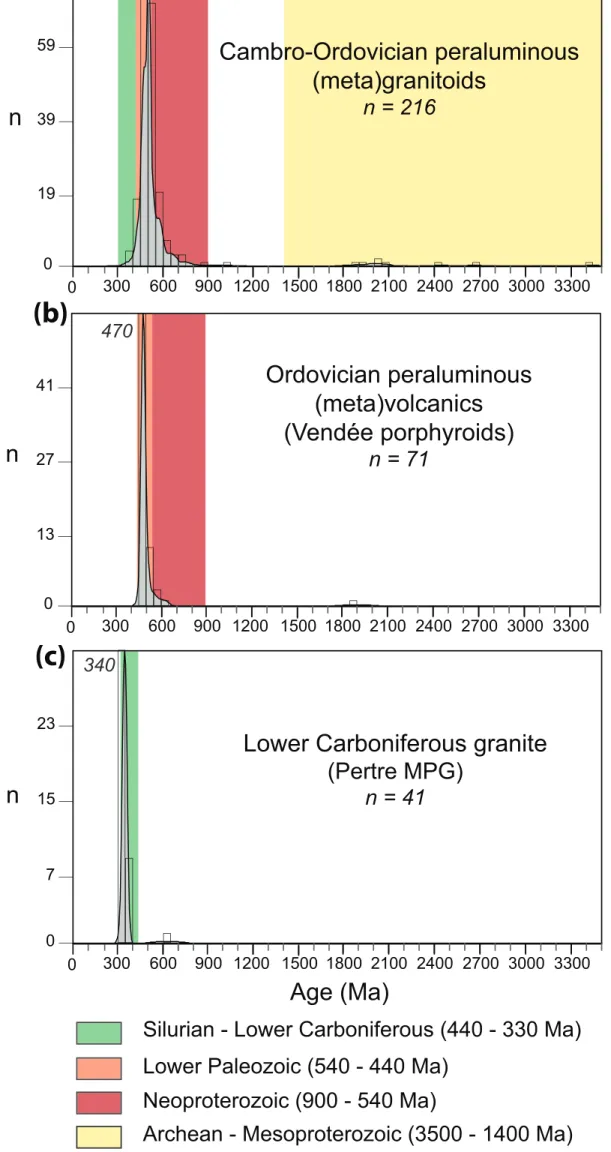
Zircon from Cambrian to Lower Carboniferous peraluminous (meta)igneous rocks
14
Results of U-Pb dating reveal that the (meta)granitoids from Plouguenast and Moëlan (Fig.
313
2) intruded between 504.5 ± 1.8 (PLG-2) and 466.2 ± 3.6 Ma (QIMP-1) – (for details see text
314
and diagrams in Supplementary file 7), and that most of them contain inherited components
315
(Fig. 9a and Table 1). Zircon shapes are euhedral to sub-euhedral, and CL images reveal
well-316
developed grow zonation for most grains (Fig. 6). Xenocrystic zircon crystals in the
317
(meta)granitoids overlap in age with the previously defined populations 1 (4%) and 3 (18%,
318
Table 1). Zircon analyses with apparent Silurian to Devonian ages (7%) are interpreted to result
319
from Pb loss (see Supplementary file 7 for details).
320
The result of zircon U-Pb dating performed by Ballèvre et al. (2012) on acid peraluminous
321
(meta)volcanics from the southern domain (Vendée Porphyroids, Fig. 2) are reported in Figure
322
9b and Table 1. These (meta)volcanics contains Neoproterozoic xenocrysts (6%), belonging to
323
the population 3 defined in the Late Carboniferous MPGs, whereas the Early Paleozoic grains
324
(population 4: 93%) brackets the age of intrusion from 494 ± 4 to 472 ± 4 Ma (Ballèvre et al.
325
2012). These ages are much older than those obtained on zircon grains from the Pertre MPG
326
(Vernhet et al. 2009) in the central domain (Fig. 2) that yield 206Pb/238U ages between 362 ± 2
327
and 330 ± 4 Ma (population 5, 93 %) with a marked peak at ca. 340 Ma, interpreted to reflect
328
the time of intrusion (Fig. 9c and Table 1) (Vernhet et al. 2009). One Neoproterozoic xenocryst
329
belongs to the population 3 defined in the Late Carboniferous MPGs whereas two zircon grains
330
with apparent ages of 323 ± 3 and 321 ± 4 Ma, respectively, reflect Pb loss (Vernhet et al. 2009).
331
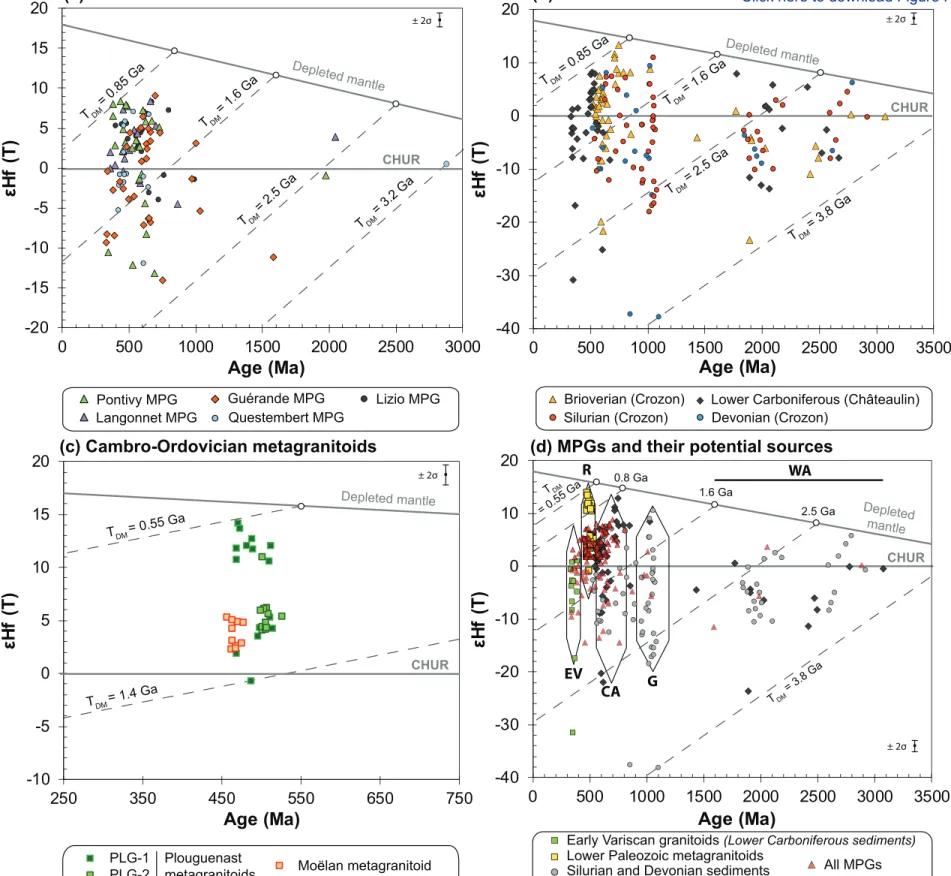
Hf analyses
332
The results of Hf isotope analyses on inherited zircon grains from MPGs are reported in a
333
εHf(t) versus age diagram (Fig. 10a). The Hf isotope compositions of inherited zircon grains in
334
all investigated MPGs are similar. The rare Archean-to- Paleoproterozoic grains (2890-1590
335
Ma) show superchondritic to subchondritic compositions (εHf(t) = 3.9 to -11.5), whereas
15
Mesoproterozoic-to-Carboniferous xenocrysts (1035-329 Ma) yield mostly superchondritic
337
εHf(t) up to +9.1 (> 60%). Superchondritic xenocrysts are predominant in the Pontivy (-14.3 to
338
+8.3), Lizio (-4 to +8.2) and Langonnet (-10.3 to +8.4) MPGs, and mostly characterized by
339
hafnium model ages (TDM) between 1.6 and 0.9 Ga. In contrast, the Questembert MPG (-12.1 340
to 7) is dominated by subchondritic grains, even though most of them also show TDM between 341
1.6 and 0.9 Ga. Then, zircon grains from the Guérande MPG (-14.2 to 9.1) show a wide and
342
relatively continuous range of εHf(t) from sub- to superchondritic (Fig. 10a). About 70% of
343
zircon are characterized by TDM between 1.6 and 0.9 Ga whereas others show older TDM between 344
1.60 and 2.3 Ga.
345
The εHf(t) values of detrital zircon grains from the Brioverian and Lower Carboniferous
346
sediments shows a remarkable overlap with those of the MPGs (Figs. 10b and 10d):
Archean-347
Mesoproterozoic zircon grains (3080-1430 Ma) show TDM from 3.7 to 2.2 Ga and about 75 % 348
of the Neoproterozoic-Carboniferous grains (851-329 Ma) are characterized by TDM between 349
and 1.6 and 0.9 Ga. In contrast, detrital zircon grains in the Silurian and Devonian sedimentary
350
rocks show significantly different Mesoproterozoic-to-Cambrian εHf(t)spectra characterized
351
by a wide range in εHf(t)at 1200-900 Ma (-38 to +10.8; TDM = 3.8-1.2 Ga), and by about 70 % 352
of subchondritic εHf(t) for ages < 900 Ma (-37 to +8; TDM = 3.6–1.1 Ga; Fig. 10b). This 353
difference is also reflected by the generally much older Hf model ages for the
Neoproterozoic-354
to-Cambrian population, with more than 50 % between 1.6 and 2.5 Ga (Fig. 10b). The Hf
355
isotopic data of the Archean-to-Paleoproterozoic grains (2922-1841 Ma; TDM = 3.5-2.5 Ga) in 356
the Silurian-Devonian sediments overlap with those in the Brioverian-Carboniferous sediments
357
and in the MPGs.
358
The εHf(t) values of magmatic zircon grains from the Cambro-Ordovician metaigneous
359
rocks (510-460 Ma) vary from -0.7 to +14.2, corresponding to hafnium model ages between
360
1.4 and 0.6 Ga (Fig. 10c). It is pertinent to note, that these TDM overlap with those obtained 361
16
from most Neoproterozoic-to Carboniferous xenocrysts in the MPGs (Figs. 10a and 10d).
362
However, there is also an important number of grains showing significantly higher εHf(t), very
363
close to the depleted mantle. Such grains were mostly found in sample PLG-1 from the
364
Plouguenast orthogneissic complex (Fig. 10c).
365
Discussion 366
Pre- to Early Variscan zircon record
367
Neoproterozoic to Early Cambrian zircon grains (850 – 530 Ma, Fig. 7a) in the Brioverian
368
sediments likely result from magma mixing, which occurred during the formation of the
369
Cadomian-Avalonian belt, an Andean-type cordillera located at the northern margin of
370
Gondwana, e.g. to the north of the Armorican Massif (Fig. 2a), between approximately 800 and
371
540 Ma (e.g. Nance and Murphy 1994; Dabard et al. 1996; Ballèvre et al. 2001; Brun et al.
372
2001; Zeh et al. 2001; Linnemann et al. 2008, 2014; Koglin et al. 2018). This hypothesis is
373
supported by the vertical array in the εHf(t) vs. age diagram (array CA in Figure 10d), reflecting
374
the interaction of crustal melts formed by reworking of Archean-to-Paleoproterozoic crust of
375
the West Africa craton (εHft down to -22), and mantle-derived melts (εHft up to +13). Then,
376
most Archean-to-Mesoproterozoic zircon grains (3080 – 1430 Ma; Fig. 8a) likely originated
377
from the erosion of the West African craton (Fig. 10d), that represented the hinter land of the
378
Cadomian orogeny (e.g. Zeh et al. 2001; Linnemann et al. 2008, 2014), whereas the ca. 2000
379
Ma old Icartian orthogneisses (e.g. Samson and D’Lemos 1998) only represented a minor
380
source (e.g. Dabard et al. 1996).
381
The Silurian and Devonian sediments might result from internal reworking of a very
382
heterogeneous Grenvillian crust (indicated by the vertical array G in Fig. 10d), with minor
383
contribution from the Cadomian-Avalonian crust. The Grenville zircon grains are very likely
384
to be derived from a southern Gondwana-connected source, whereas a northern Baltica
17
provenance can be excluded. Indeed, Grenvillian zircon populations were found in many
386
Paleozoic sediments throughout the EVB, commonly associated with a predominant
387
Neoproterozoic-Cambrian (800-500 Ma), and a subordinate Archean-to-Palaeoproterozoic
388
zircon population (1700-3500 Ma), and with a pronounced age gap between 1.2 and 1.7 Ga
389
(e.g. Zeh et al. 2001; Linnemann et al. 2008, 2014). In fact, these are the same features observed
390
in the Armorican sediments during this study (Fig. 10b). In contrast, zircon grains derived from
391
Baltica, have ages mostly between 1.0 and 1.8 Ga, as it has been demonstrated for Paleozoic
392
(meta)sediments from the Rhenohercynian Domain (Avalonia-Laurussia in Fig. 1), and the
393
Mid-German Crystalline Zone (northwestern edge of the Saxo-Thuringian in Fig. 1) of the
394
eastern EVB (Geisler et al. 2005; Zeh and Gerdes 2010).
395
The overlap in zircon Age-Hf isotopic data suggests that the Cambro-Ordovician
396
(meta)granitoids of the Armorican Massif were predominantly formed by partial melting of
397
Brioverian sediments (Fig. 10d). However, the highly superchrondritic εHf(t) (near to depleted
398
mantle) signature of some zircon grains from the granitoids of the Plouguenast orthogneissic
399
complex additionally reveals that new (juvenile) crust was formed at the same time. In this
400
context it is pertinent to note that Cambro-Ordovician juvenile crust formation (in addition to
401
crustal melting) is not restricted to the Armorican Massif (e.g. Bernard-Griffiths et al. 1986;
402
Ballèvre et al. 2012) but has been reported from many other areas throughout the EVB, e.g.,
403
from the NW Iberian Massif (e.g. Arenas et al. 2016), French Massif Central (e.g.
Chelle-404
Michou et al. 2017) and Saxothuringian Domain (e.g. Bankwitz et al. 1994; Höhn et al. 2017),
405
where it is related to the breakup of continental microterranes from the northern Gondwanan
406
margin (e.g. Kroner and Romer 2013). The relatively wide variation in εHf(t) of the
Cambro-407
Ordovician metaigneous rocks (array R in Fig. 10d) is ambiguous. It could be explained by
408
heterogeneities of the source (Brioverian sediments), but, more probably, by mixing of juvenile
18
melts (depleted mantle-related) and crustal-derived melts, formed by the partial melting of
410
Brioverian sediments.
411
The Age-Hf-isotopic data furthermore suggest that the Brioverian sediments and the
412
Cadomian-Avalonian basement together with Cambro-Ordovician igneous rocks were the main
413
sources for the detrital zircon grains in the Lower Carboniferous sediments (Fig. 10b).
414
Moreover, a significant addition from zircon grains derived from Early Variscan granitoids
415
emplaced between ~400 and 330 Ma (array EV in Fig. 10d) such as the ca. 340 Ma old Pertre
416
granite (Fig 9c), is revealed by isotopic data. Most 390 to 330 Ma old zircon grains in the Lower
417
Carboniferous sediments are characterized by TDM from 1.2 to 1.6 Ga that overlap with those 418
of Neoproterozoic zircon in the Brioverian sediments (Figs 10b and d), suggesting that these
419
zircon grains crystallized in a crustal-derived granitic magma formed by the partial melting of
420
Brioverian sediments. This hypothesis is in agreement with the presence of a ca. 625 Ma old
421
zircon xenocryst in the Pertre granite (Fig. 9c, Table 1).
422
Crustal sources of Late Carboniferous MPGs
423
The highly peraluminous character (A/CNK > 1.1, Fig. 3) of the MPGs is in agreement with
424
a crustal origin and suggest that they were produced by the partial melting of mica-rich rocks
425
with a peraluminous composition (e.g. Gao et al. 2016).
426
Whole-rock Nd and Sr isotope analyses indicate a significant difference in composition
427
between the MPGs emplaced to the north of the SASZ (i.e. Pontivy, Langonnet, Lizio) and the
428
Guérande MPG intruded to south of the SASZ (Figs. 2 and 5). The Questembert MPG, which
429
emplaced between the two branches of the SASZ, has an intermediate composition. The
430
negative εNd(315 Ma) values of the Guérande MPG (-7.6 to -9.5) could be explained by the
431
partial melting of Cambro-Ordovician acid (meta)volcanic rocks as well as Ordovician to
432
Devonian sediments from the south Armorican domain, although some samples plot at the
19
lower boundary of the range defined by Brioverian sediments from the central domain (Fig. 5).
434
The εNd(315 Ma) values of the Questembert MPG (-3.9 to -5.7) overlap with those obtained
435
from the Brioverian sediments from the central domain as well as with Cambro-Ordovician acid
436
(meta)volcanic rocks. Then, the composition of the Pontivy, Langonnet and Lizio MPGs (-2.3
437
to -4.7) is similar to that of Brioverian sediments from the central domain as well as the
Cambro-438
Ordovician (meta)granitoids and (meta)volcanic rocks. The super-chondritic εNd(315 Ma)
439
composition of two Pontivy MPG samples could be explained by the partial melting of
Cambro-440
Ordovician (meta)granitoids. However, the Nd isotopic values on their own are ambiguous, and
441
do not allow a detailed source characterization. Two reasons may be proposed at this stage.
442
First, the MPG melts can be derived from several sources and, second, some sources show a
443
wide range in εNd values (Fig. 5), e.g., the Cambro-Ordovician acid (meta)volcanics rocks,
444
which themselves were formed by melting of even older crustal components such as Brioverian
445
sediments (Ballèvre et al. 2012).
446
Combined U-Pb and Hf isotopic data of zircon xenocrysts (2890-329 Ma; Table 1; Figs. 7
447
and 10d) suggest that the Late Carboniferous MPGs were formed by partial melting of a
448
heterogeneous crust mainly consisting of Brioverian sediments, Cambro-Ordovician acid
449
igneous rocks and Devonian to Early Carboniferous granitoids. In contrast, Ordovician to
450
Devonian sedimentary rocks seems to play only a subordinate role during U-fertile MPGs
451
formation for several reasons. First, they contain an important Grenvillian population (1.2-0.9
452
Ma: this study, Matteini et al. 2014) with a wide range in εHf(t) (-38 to 10.8), which is barely
453
seen in the xenocrysts from the MPGs (Fig. 10d). The only exceptions are four grains (8%) in
454
the Guérande MPG and one grain in the Lizio (3%) and Pontivy (1%) MPGs, respectively
455
(Table 1, Figs 7). Second, the Silurian and Devonian sediments contain a pronounced Archean
456
to Mesoproterozoic population (3.5-1.4 Ga; 23-36%) which is not observed in the MPGs (<
457
10%, Table 1). Third, detrital zircon grains from Silurian to Devonian sediments with ages <
20
0.9 Ga mostly show subchondritic εHf(t) values (ca. 70%), corresponding to Hf model ages of
459
2.5 to 1.6 Ga, which are much older than those of most MPGs (0.9 to 1.6 Ga). On the other
460
hand, a significant number of Neoproterozoic to Carboniferous (750-329 Ma) zircon with old
461
TDM from 1.6 to 2.5 Ga (Fig. 10a) together with some Grenvillian grains (1080-974 Ma; Fig. 462
7f) in the Guerande MPG suggests a minor contribution of Ordovician to Devonian sediments
463
in its source, in agreement with its high sub-chondritic εNd composition (Fig. 5). Moreover, the
464
contribution of Lower Carboniferous sediments in the source of all MPGs is unlikely and
465
difficult to explain structurally. Indeed, the central domain that was mainly deformed under
466
strike-slip deformation regime during the Carboniferous was poorly thickened during the
467
Variscan orogeny (Gumiaux et al. 2004a; Gapais et al. 2015) and the burying, and subsequent
468
partial melting, of Lower Carboniferous sediments probably never occurred in the central
469
domain. Then, it is unlikely that important partial melting of the Lower Carboniferous
470
sediments occurred in the region without partial melting of Ordovician to Devonian sediments
471
that are structurally below. Alternatively, the partial melting of the Devonian to Early
472
Carboniferous granitoids such as the 391-385 Ma old peraluminous Plounévez-Lochrist
473
orthogneiss (Marcoux et al. 2009) (Fig. 2) can explain the younger range of inheritance
474
observed in all the MPGs (population 5, Table 1). Finally, metatexites and diatexites derived
475
from pre-Carboniferous sediments and Ordovician orthogneisses are abundant in the southern
476
Armorican domain (e.g. Augier et al. 2015) (Fig. 2). These rocks reached peak P-T conditions
477
of 0.8 GPa, 750-850 °C followed by near isothermal decompression down to 0.4 GPa, 750 °C
478
and melting occurred, during the Late Carboniferous, from water saturated solidus to biotite
479
breakdown conditions (Augier et al. 2015; Jones and Brown, 1990), in agreement with the role
480
of Brioverian sediments and Paleozoic orthogneisses as a major source for the MPGs.
481
Implication for the U-fertility of MPGs
21
The results of this study show that the U-fertile Pontivy and Questembert MPGs, and the
483
U-unfertile Lizio, Langonnet and Hulgoat MPGs, all emplaced to the north of the southern
484
branch of the SASZ, result from the melting of the same heterogeneous crust, which consisted
485
of Brioverian sediments, Cambro-Ordovician acid igneous rocks and
Devonian-to-486
Carboniferous granitoids. Similar hafnium model agesfurthermore suggest that all these rocks
487
are genetically linked, and result from the successive internal reworking of Brioverian
488
sediments (Fig. 10d). Age-Hf isotopic data also suggest that the U-fertile Guérande MPG,
489
emplaced to the south of the SASZ, result from the partial melting of a similar crust with only
490
a minor contribution from Ordovician to Devonian sediments.
491
Thus, fertility or non-fertility of the Late Carboniferous MPGs from the Armorican Massif
492
is obviously controlled primarily by differences during the reworking process, comprising local
493
variations of source rocks (sediment vs. orthogneiss), degree of melting and fractionation, and
494
the melting history itself (unique or multiple), as well as hydrothermal processes during and
495
after each magmatic cycle. The complex interplay of all these processes has been demonstrated
496
by recent studies suggesting that the Lizio and Questembert MPGs represent “twin”
497
leucogranites but that the Questembert MPG is more differentiated than the Lizio MPG because
498
the former traveled a greater vertical distance in the crust, enhancing crystal segregation from
499
the melts and U enrichment in the residual liquids (Tartese and Boulvais 2010; Tartèse et al.
500
2013).
501
The formation of U rich peraluminous liquid is favored by an elevated U content of its
502
sedimentary and/or igneous sources. However, the proportion of U located outside the lattice
503
of accessory minerals poorly soluble in peraluminous melts, such as zircon and monazite
504
(Watson and Harrison 1983; Montel 1993), has a primordial importance for the genesis of
U-505
fertile MPGs (e.g. Cuney 2014). In the absence of a detailed petrographic study, the whole-rock
506
Th/U ratio can be used as a preliminary indicator of the fertility of a rock for the genesis of
22
rich melts during anatexis. High Th/U ratios, above the average value of the upper continental
508
crust (UCC Th/U value = 3.8, Rudnick and Gao 2003), suggest that most U is hosted in
Th-509
bearing, highly refractory, minerals such as monazite (xenotime and zircon), whereas Th/U
510
ratios < 3.8 suggest that a significant amount of U is localized along microcracks or in
511
adsorption on the surfaces of rock forming minerals. In most favorable cases, peraluminous
512
igneous rocks with Th/U < 1 and U contents > ~10 ppm can host U oxides (Peiffert et al. 1996,
513
1994). By taking these points into account, we suggest that the U-fertile MPGs (~0.1 < Th/U <
514
~2, Fig. 4) of the Armorican Massif were formed by partial melting of peraluminous mica-rich
515
lithologies characterized by Th/U < ~4 and U content > ~2.7 ppm (average UCC values). Such
516
rocks comprise the Brioverian sediments, but also Cambro-Ordovician and Devonian-Early
517
Carboniferous peraluminous igneous rocks (Fig. 4). In contrast, the Ordovician to Devonian
518
sediments and Cambro-Ordovician acid volcanic rocks with Th/U > 4 and U < 2.7 ppm, can be
519
considered as less fertile. Our new data also suggest that U-fertility of a crust increases if
one-520
and-the same (peraluminous) crust is affected by multiple melting events, which obviously
521
occurred in the Armorican Massif during the internal reworking of already U-rich (low Th/U)
522
Brioverian sediments during the Cambro-Ordovician, Devonian-Lower Carboniferous and
523
finally during the Upper Carboniferous, in particular along or close to the crustal to lithospheric
524
scale shear zones. More specifically, multiple crustal reworking can induce progressive U
525
enrichment of some crustal domains (i.e. middle crust) and in late orogenic context, the melting
526
of these domains can lead to the formation of U-fertile granites. These interpretations are in
527
good agreement with the fact that peraluminous orthogneisses of Cambro-Ordovician, and
528
Devonian-Early Carboniferous ages occur in the source regions of nearly all Late Carboniferous
529
MPGs throughout the EVB, comprising the French Massif Central (Turpin et al. 1990; Laurent
530
et al. 2017), the Iberian Massif (e.g. Villaseca et al. 2012 ; López-Moro et al. 2017), and the
531
Bohemian Massif in Germany and the Czech Republic (Tichomirowa et al. 2012), three
23
historical mining provinces for granite-related hydrothermal U deposits (Fig. 1). In this context,
533
it is interesting to note that, the Cambro-Ordovician Saint-Goueno MPG from the Plouguenast
534
orthogneissic complex in the Armorican Massif (Fig. 2) hosts intragranitic U occurrences
535
(Carric et al., 1980), suggesting that it contained magmatic U oxides, and reached U-fertility
536
long before the Variscan orogeny.
537
Comparison with other uraniferous provinces worldwide
538
In the Armorican Variscan belt, multiple partial melting of the crust is associated with
539
progressive increase of the U-fertility of crustal-derived granitoids with time (Fig. 4). This is
540
revealed by, in general, a progressive decrease of the Th/U ratio from the Brioverian sediments
541
(~2 < Th/U < ~4), Cambrian-Early Carboniferous granitoids (~0.5 < Th/U < ~4) to Late
542
Carboniferous MPGs (~0.1 < Th/U < ~2). To see if this behavior can be generalized to other
543
crustal domains, we report in Figure 11 the evolution of the Th-U contents of granitoids from
544
two major U provinces for comparison, from:
545
(1) the Archean Gabonese craton that surrounds the Paleoproterozoic Franceville basin,
546
well known for hosting U deposits with natural fission reactors such as Oklo.
547
Ultimately, the U from the deposits likely originates from the leaching of U-rich
548
minerals present in the basin, such as monazite, thorite and possibly uraninite,
549
themselves coming from the erosion of the surrounding Archean basement (e.g.
550
Gauthier-Lafaye and Weber 2003). In the basement, granitoid plutonism occurred from
551
2.94 to 2.71 Ga with an evolution from TTG gneiss, grey granitoids, pink granitoids to
552
Neoarchean granites and pegmatites (Thiéblemont et al. 2009).
553
(2) the Mesoproterozoic western Namaqualand province, South Africa, representing a
554
granulite- to amphibolite-facies metamorphic terrane characterized by the presence of
555
granites and charnokites highly enriched in U and Th (Andreoli et al. 2006). In the
24
region, crustal-derived granitic magmatism occurred over a period of ca. 200 Ma (Robb
557
et al. 1999).
558
Despite the different degree of enrichment, by one order of magnitude, the U (and Th)
559
contents of the granitoids from both provinces increase progressively and significantly with
560
time. In the Gabonese craton, U increase from ~0.1-0.2 ppm (TTG), ~0.2-1 ppm (grey
561
granitoids) to ~1-4 ppm (pink granites), and in the Namaqualand province, from ~1-10 ppm
562
(Little Namaqualand suite), 3-60 ppm (Early Spektakel suite) to 3-800 ppm (Late Spektakel
563
suite). In the two provinces, fractionation of U over Th, a process that can lead, ultimately, to
564
the crystallization of magmatic uraninite (Cuney, 2014), is only recorded by the youngest
565
granites and pegmatites (Neoarchean granites and pegmatites in Fig. 11a and granites of the
566
Late Spektakel suite in Fig. 11b). To summarize, the recycling of the crust by multiple partial
567
melting events seems to be an important mechanism for the concentration of U, the fractionation
568
of U over Th, and finally for the genesis of U-fertile granites.
569
Conclusion 570
(1) Age-Hf isotopic data of detrital zircon grains in Brioverian to Carboniferous sediments,
571
magmatic and inherited zircon crystals in Cambrian to Early Carboniferous (meta)igneous
572
rocks, and xenocrysts in the Late Carboniferous MPGs indicate that the crust of the
573
Armorican Massif is made up by detritus derived from three major sources: West African
574
craton (3500-1600 Ma; TDM = 3.8 to 2.2 Ga), Grenville belt/domains (1200-900 Ma; TDM 575
= 2.7 to 1.2 Ga), and predominately Avalonian-Cadomian belt (800-550 Ma; TDM = 2.5 to 576
0.8 Ga). Moreover, the crust was affected by magmatic events at 510-460 Ma
(Cambro-577
Ordovician; TDM = 1.6 to 0.6 Ga), 410-330 Ma (Devonian-Carboniferous; TDM = 2.1 to 1.0 578
Ga), and 320-300 Ma (Late Carboniferous).
25
(2) These data also reveal that the Late Carboniferous MPGs (300-320Ma) were mainly formed
580
by partial melting of Brioverian sediments, Cambro-Ordovician igneous rocks and
581
Devonian-Early Carboniferous granitoids, which are all genetically linked with each other,
582
as is indicated by a remarkable overlap in their Hf model ages between 1.6 to 0.8 Ga. In
583
contrast, Ordovician, Silurian and Devonian sediments of the Armorian Massif contain a
584
significant Grenvillian zircon population (~ 30%) with mostly older Hf model ages
585
between 1.6 and 2.5 Ga, which are barely seen in the Late Carboniferous MPGs (Huelgoat,
586
Langonnet, Pontivy, Lizio and Questembert), except for a minor amount in the Guérande
587
MPG (~ 10%).
588
(3) In contrast to Ordovician to Devonian sediments (Th/U > 4), Brioverian sediments and
589
Cambrian to Early Carboniferous granitoids characterized by U > 2.7 ppm and Th/U < 4
590
represent an ideal source for the generation of U-fertile MPGs.
591
(4) All data suggests that the U-fertile MPGs of the Armorican Massif result mainly from
592
multiple internal reworking of relatively U-rich Brioverian sediments, which were
593
originally deposited along the northern Gondwanan margin at ca. 550 Ma, and became
594
partially molten during several Paleozoic events, causing a successive increase in
U-595
content by crystal fractionation, and intermediate hydrothermal processes in the
middle-596
upper crust. Similar multiple, internal reworking processes of Neoproterozoic-Cambrian
597
sediments is recorded by rocks from many areas across the EVB hosting economically
598
important U deposits, such as Iberia, French Massif Central and Bohemian Massif.
599
(6) Comparison with other U provinces of different ages worldwide suggest that crustal
600
reworking by multiple partial melting events is a major mechanism for U concentration,
601
fractionation of U over Th, and the genesis of U-fertile granites.
602
Acknowledgment 603
26
This work was supported by the 2012-2013 NEED-CNRS (AREVA-CEA) and
2015-604
CESSUR-INSU (CNRS) grants attributed to M. Poujol. We are very grateful to M.P. Dabard
605
as well M. Jolivet, R. Tartèse and P. Bessin who helped for the sampling. We also want to
606
thanks Y. Lepagnot and D. Vilbert (Geosciences Rennes) for crushing the samples and realizing
607
whole-rock radiogenic isotope analyses (Sm-Nd and Sr), respectively. Comments from C.
608
Villaseca and A.S. André-Mayer significantly improved the quality of the manuscript. Finally,
609
this study is dedicated to the memory of M.P. Dabard who left us too early.
610
References 611
Andreoli MAG, Hart RJ, Ashwal LD, Coetzee H (2006) Correlations between U, Th Content
612
and Metamorphic Grade in the Western Namaqualand Belt, South Africa, with implications for
613
radioactive heating of the crust. J Petrol 47: 1095–1118
614
Augier R, Choulet F, Faure M, Turrillot P (2015) A turning-point in the evolution of the
615
Variscan orogen: the ca. 325 Ma regional partial-melting event of the coastal South Armorican
616
domain (South Brittany and Vendée, France). Bull Société Géologique Fr 186: 63–91
617
Arenas R, Sánchez Martínez S, Díez Fernández R, Gerdes A, Abati J, Fernández-Suárez J,
618
Andonaegui P, González Cuadra P, López Carmona A, Albert R, Manuel Fuenlabrada J, Rubio
619
Pascual FJ (2016) Allochthonous terranes involved in the Variscan suture of NW Iberia: A
620
review of their origin and tectonothermal evolution. Earth-Sci Rev 161: 140–178
621
Bailie R, Armstrong R, Reid D (2007) The Bushmanland Group supracrustal succession,
622
Aggeneys, Bushmanland, South Africa: Provenance, age of deposition and metamorphism.
623
South Afr J Geol 110: 59–86
624
Ballèvre M (2016) Une histoire géologique du Massif armoricain. Géochronique 140
27
Ballèvre M, Martínez Catalán JR, López-Carmona A, Pitra P, Abati J, Díez Fernández R,
626
Ducassou C, Arenas R, Bosse V, Castiñeiras P, Fernández-Suárez J, Gómez Barreiro J, Paquette
627
JL, Peucat JJ, Poujol M, Ruffet G, Sánchez Martínez S (2014) Correlation of the nappe stack
628
in the Ibero-Armorican arc across the Bay of Biscay: a joint French– Spanish project. Geol Soc
629
London Spec Publ 405: 77–113
630
Ballèvre M, Bosse V, Dabard MP, Ducassou C, Fourcade S, Paquette JL, Peucat JJ, Pitra, P
631
(2013) Histoire géologique du Massif armoricain: actualité de la recherche. Bulletin de la
632
Société géologique et minéralogique de Bretagne 500: 5-96.
633
Ballèvre M, Fourcade S, Capdevila R, Peucat JJ, Cocherie A, Fanning CM (2012)
634
Geochronology and geochemistry of Ordovician felsic volcanism in the Southern Armorican
635
Massif (Variscan belt, France): Implications for the breakup of Gondwana. Gondwana Res 21:
636
1019–1036
637
Ballèvre M, Bosse V, Ducassou C, Pitra, P (2009) Palaeozoic history of the Armorican Massif:
638
Models for the tectonic evolution of the suture zones. Comptes Rendus Geosci 341: 174–201
639
Ballèvre M, Le Goff E, Hébert R (2001) The tectonothermal evolution of the Cadomian belt of
640
northern Brittany, France: a Neoproterozoic volcanic arc. Tectonophysics 331: 19–43
641
Ballouard C (2016) Origine, évolution et exhumation des leucogranites peralumineux de la
642
chaîne hercynienne armoricaine: implication sur la métallogénie de l’uranium. Dissertation,
643
Université de Rennes 1
644
Ballouard C, Poujol M, Mercadier J, Deloule E, Boulvais P, Cuney M, Cathelineau M (in press)
645
Uranium metallogenesis in the peraluminous leucogranites from the Pontivy-Rostrenen
646
magmatic complex (French Armorican Variscan Belt): the result of long term oxidized
28
hydrothermal alteration during strike-slip deformation. Miner deposita. DOI :
10.1007/s00126-648
017-0761-5
649
Ballouard C, Poujol M, Boulvais P, Zeh A (2017b) Crustal recycling and juvenile addition
650
during lithospheric wrenching: The Pontivy-Rostrenen magmatic complex, Armorican Massif
651
(France), Variscan belt. Gondwana Res 49: 222–247
652
Ballouard C, Poujol M, Boulvais P, Mercadier J, Tartèse R, Venneman T, Deloule E, Jolivet
653
M, Kéré I, Cathelineau M, Cuney M (2017a) Magmatic and hydrothermal behavior of uranium
654
in syntectonic leucogranites: The uranium mineralization associated with the Hercynian
655
Guérande granite (Armorican Massif, France). Ore Geol Rev 80: 309–331
656
Ballouard C, Poujol M, Jolivet M, Boulvais P, Tartese R, Dubois C, Hallot E, Dabard MP,
657
Ruffet G (2015b) Geochronological and thermochronological constraints on the Carboniferous
658
magmatism from the Armorican Massif: from the source to the exhumation. The Variscan Belt:
659
Correlations and Plate Dynamics, Variscan Conference 2015, Rennes (France), 9–11 June 2015
660
Ballouard C, Boulvais P, Poujol M, Gapais D, Yamato P, Tartèse R, Cuney M (2015a) Tectonic
661
record, magmatic history and hydrothermal alteration in the Hercynian Guérande leucogranite,
662
Armorican Massif, France. Lithos 220–223: 1–22
663
Bankwitz P, Bankwitz E, Kramer W, Pin C (1994) Early Paleozoic bimodal volcanism in the
664
Vesser area, Thuringian Forest, eastern germany. Z Geol Paläontol I 1992: 1113-1132
665
Barbarin B (1996) Genesis of the two main types of peraluminous granitoids. Geology 24: 295–
666
298
667
Barbarin B (1999) A review of the relationships between granitoid types, their origins and their
668
geodynamic environments. Lithos 46: 605–626
29
Béchennec F, Thiéblemont D (2013) Baud 384, Carte géologique de France 1:50 000. BRGM
670
Béchennec F, Hallégouët B, Thiéblemont D (2001) Rosporden 347, Carte Géologique de
671
France 1:50 000. BRGM
672
Béchennec F, Hallégouët B, Thiéblemont D (1999) Quimper 346, Carte Géologique de France
673
1:50 000. BRGM
674
Béchennec F, Guennoc P, Guerrot C, Lebret P, Thiéblemont D (1996) Concarneau 382, Carte
675
Géologique de France 1:50 000. BRGM
676
Bernard-Griffiths J, Carpenter MSN, Peucat JJ, Jahn BM (1986) Geochemical and isotopic
677
characteristics of blueschist facies rocks from the Île de Groix, Armorican Massif (northwest
678
France). Lithos 19: 235–253
679
Bernard-Griffiths J, Peucat JJ, Sheppard S, Vidal P (1985) Petrogenesis of Hercynian
680
leucogranites from the southern Armorican Massif: contribution of REE and isotopic (Sr, Nd,
681
Pb and O) geochemical data to the study of source rock characteristics and ages. Earth Planet
682
Sci Lett 74: 235–250
683
Bosse V, Féraud G, Ballèvre M, Peucat JJ, Corsini M (2005) Rb–Sr and 40Ar/39Ar ages in
684
blueschists from the Ile de Groix (Armorican Massif, France): Implications for closure
685
mechanisms in isotopic systems. Chem Geol 220: 21–45
686
Bouvier A, Vervoort JD, Patchett PJ (2008) The Lu–Hf and Sm–Nd isotopic composition of
687
CHUR: Constraints from unequilibrated chondrites and implications for the bulk composition
688
of terrestrial planets. Earth Planet Sci Lett 273: 48–57