HAL Id: hal-02347034
https://hal.archives-ouvertes.fr/hal-02347034
Submitted on 5 Nov 2019
HAL is a multi-disciplinary open access
archive for the deposit and dissemination of
sci-entific research documents, whether they are
pub-lished or not. The documents may come from
teaching and research institutions in France or
abroad, or from public or private research centers.
L’archive ouverte pluridisciplinaire HAL, est
destinée au dépôt et à la diffusion de documents
scientifiques de niveau recherche, publiés ou non,
émanant des établissements d’enseignement et de
recherche français ou étrangers, des laboratoires
publics ou privés.
IDP-like Asteroids Formed Later than 5 Myr After
Ca–Al-rich Inclusions
Marc Neveu, Pierre Vernazza
To cite this version:
Marc Neveu, Pierre Vernazza.
IDP-like Asteroids Formed Later than 5 Myr After Ca–Al-rich
Inclusions.
The Astrophysical Journal, American Astronomical Society, 2019, 875 (1), pp.30.
IDP-like Asteroids Formed Later than 5 Myr After Ca–Al-rich Inclusions
Marc Neveu1,2 and Pierre Vernazza3
1University of Maryland, 4296 Stadium Dr., College Park, MD 20742, USA;[email protected] 2NASA Goddard Space Flight Center, 8800 Greenbelt Rd., Greenbelt, MD 20770, USA
3Aix-Marseille Université, CNRS, Laboratoire d’Astrophysique de Marseille, 38 Rue Frederic Joliot Curie, F-13013 Marseille, France
Received 2019 January 17; revised 2019 February 14; accepted 2019 March 5; published 2019 April 10
Abstract
The parent bodies of ordinary chondrites, carbonaceous CM chondrites, and interplanetary dust particles (IDPs) represent most of the mass of the solar system’s small (D250km) bodies. The times of formation of the ordinary and carbonaceous CM chondrite parent bodies have previously been pinpointed, respectively, to≈2 and 3–4 million years after calcium–aluminum-rich inclusions (CAIs). However, the timing of the formation of IDP parent bodies such as P- and D-type main-belt asteroids and Jupiter Trojans has not been tightly constrained. Here, we show that they formed later than 5–6 million years after CAIs. We use models of their thermal and structural evolution to show that their anhydrous surface composition would otherwise have been lost due to melting and ice-rock differentiation driven by heating from the short-lived radionuclide26Al. This suggests that IDP-like
volatile-rich small bodies may have formed after the gas of the protoplanetary disk dissipated and thus later than the massive cores of the giant planets. It also confirms an intuitive increase in formation times with increased heliocentric distance, and suggests that there may have been a gap in time between the formation of carbonaceous chondrite (chondrule-rich) and IDP (chondrule-poor) parent bodies.
Key words: Kuiper belt: general – minor planets, asteroids: general – minor planets, asteroids: individual (Egeria, Eugenia, Hektor)
1. Introduction
Relating the compositional diversity among small bodies to their spatial distribution through time informs the under-standing of solar system formation and evolution. Especially crucial to this understanding are S-, C-, and P- and D-type small bodies, which seem related, respectively, to ordinary chondrites (Burbine et al.2002; Nakamura et al.2011; Cloutis et al.2014), carbonaceous chondrites (Johnson & Fanale1973; Lodders & Osborne 1999; Lauretta et al. 2015; Perna et al. 2017), and interplanetary dust particles (IDPs; Sandford & Bradley1989; Liou et al.1996; Bradley2003; Vernazza et al. 2015), and represent the majority of the mass of observed small bodies (Pieters & McFadden 1994; DeMeo & Carry 2013), recovered fragments (Harvey & Cassidy1989; Burbine et al. 2002; Meteoritical Bulletin Database 2018), and estimated mass flux of extraterrestrial infall materials (Love & Brownlee1993).
The compositions of small bodies have deviated from those of the materials accreted due to processes such as differentia-tion, aqueous alteradifferentia-tion, and/or thermal metamorphism. These require a heat source, understood since Urey (1955) to likely be the decay of short-lived radionuclides such as 26Al, which
would have governed their early thermal evolution (e.g., Grimm & McSween 1989; Bennett & McSween 1996). Therefore, the present-day compositions observed among small bodies and their associated fragments result from (i) the accretion onset time, which controlled the amount of initial
26Al; (ii) the formation location, which controlled the initial
rock/ice ratio; (iii) the size of the parent body; and (iv) the accretion duration, because accretion need not have been systematically instantaneous.
The accretion timing of major classes of small bodies can be constrained based on their (or their fragments’) composition using telescopic observations, meteorite analyses, and thermal models. Inward of the snow line, the time of complete accretion
has been constrained for the H chondrite parent body to ∼2±0.2 Myr after Ca–Al-rich inclusions (CAIs; Henke et al. 2012; Monnereau et al. 2013; Blackburn et al. 2017) with a short accretion duration of 2×10⁵yr (Monnereau et al.
2013). Spectroscopic investigation of H-like asteroids con-firmed those findings (Vernazza et al.2014).
Observations of bodies bearing surface hydrated silicates (Usui et al. 2019) with a composition akin to CM or CI chondrites (e.g., Howard et al.2009,2011), suggest a later or longer accretion to avoid loss of volatiles from intense 26Al
heating, but not so late so water ice could have melted and altered silicates (Grimm & McSween 1989; Bischoff 1998; Cohen & Coker 2000; Young et al. 2003). To accrete the volatiles responsible for alteration, these bodies must have originated beyond the snow line (i.e., likely beyond Jupiter; Warren 2011; Budde et al. 2016; Kruijer et al. 2017; Desch et al.2018). The coexistence of observed hydrated phases with dry silicates such as pyroxene and olivine (Howard et al. 2009,2011) suggests that aqueous alteration was limited either in time or by the availability of fluid (water-to-rock mass ratio below unity; Tomeoka & Buseck 1985; Grimm & McSween1989; Zolensky et al. 1993; Rosenberg et al.2001; Neveu et al.2017).
Thermal evolution simulations suggest that melting and pervasive aqueous alteration can take place in small bodies forming 3–3.5 Myr after CAIs, but not for formation past 4 Myr after CAIs (Bland & Travis2017). Accretion may have started earlier, perhaps as early as it did inward of the snow line, as suggested by evidence for material isotopically related to carbonaceous chondrites but having undergone thermal metamorphism or rock-metal differentiation. This includes clasts in CV chondrites (Weiss & Elkins-Tanton 2013), iron meteorite groups IIC, IID, IIF, IIIF, and IVB (Kruijer et al. 2017), and Eagle Station pallasites (e.g., Greenwood et al. 2017). However, this material represents only a small fraction
of the meteorite collection compared to the bulk of carbonac-eous chondrites (Meteoritical Bulletin Database 2018), and does not undermine the conclusion that much of the material of carbonaceous chondrite parent bodies was likely accreted between 3 and 4 Myr after CAIs.
Yet more distant, volatile-rich bodies such as IDP-like P- and D-type main-belt asteroids and Jupiter Trojans, as well as some closer-in C-types, show little to no evidence for surface hydration (Usui et al. 2019). Instead, their surfaces comprise likely indigenous anhydrous silicates (e.g., Emery et al.2006; Vernazza et al. 2012,2015,2017) and water ice (Campins et al.2010; Rivkin & Emery2010; Licandro et al. 2011; Hargrove et al.2012; Takir & Emery2012). The higher bulk abundances of low-density volatiles (ices) in these bodies is also indicated by lower observed bulk densities, near 1500 kg m−3but possibly as low as 800 kg m−3(Vernazza & Beck2017; Pajuelo et al.2018; Castillo-Rogez et al.2019, and references therein). Those of the Jupiter Trojans Hektor and Patroclus are also in this range (Marchis et al.2014; Emery et al. 2015 and references therein). The surfaces of more distant objects such as Centaurs and KBOs, the likely parent population of P/D-type asteroids and Jupiter Trojans (e.g., Morbidelli et al.2005; Fraser et al.2014), also show a lack of aqueous alteration: their red coloration suggests irradiated methanol (e.g., Brown et al.2011), which in the presence of liquid water would have been lost to aqueous chemical reactions (Neveu et al.2017).
Beyond their higher propensity for volatile retention, which suggests intuitively that IDP-like bodies experienced a later and longer accretion than carbonaceous chondrite parent bodies at higher heliocentric distances, it is the fact that the outer shells of these bodies (first ∼20–40 km below the surface) never witnessed liquid water that may place a more precise constraint on the timing of their accretion. So far, this timing has not been pinpointed beyond the looser constraints that volatiles must have been retained (Jewitt et al.2007) and that a decreasing protoplanetary disk surface density with heliocentric distance beyond the snow line results in slower accretion of more distant objects (Kenyon & Luu1998; Kenyon et al.2008).
Here, we show with thermal evolution simulations that IDP-like bodies (P- D-, and some C-types) must have finished accreting at least 5–6 Myr after CAIs in order to have retained an outermost layer containing silicates unaltered by any deeper melting of ice. We also simulate the thermal evolution of CM-like bodies and confirm that the time of accretion of their outer layers—those observed today—is constrained to 3–4 Myr after CAIs. These modeling results, combined with previous telescopic observations and analyses of meteorites, confirm that the duration of planetesimal formation—at least for the last generation of bodies, which accounts for the majority of the observed small bodies and infall mass on Earth as ordinary chondrites, CM chondrites, and IDPs—steadily increased with heliocentric distance and that its influence on the compositional distribution of small bodies has not been strongly overprinted by any subsequent orbital migration.
This paper is structured as follows. In Section2, we describe the thermal evolution code used for our calculations. We present results for carbonaceous chondrite and IDP-like parent bodies in Section3, and discuss implications of these results in Section4.
2. Thermal Evolution Model
We model the thermal evolution of both volatile-rich and CM-like planetesimals with radius R≈ 100 km, with accreted
26Al abundances ranging from negligible (accretion many
e-folding times past its 0.7 Myr half-life) to those corresp-onding to an accretion 2 Myr after the formation of CAIs. We model planetesimals as objects with a porosity-free density of 1955 kg m−3, corresponding to a 70% rock—30% ice
composition by mass, and a starting bulk porosity of 0.4 (starting overall density of 1173 kg m−3). For comparison, the
bulk densities of CM chondrites, between 1800 and 2500 kg m−3 (Macke et al. 2011), suggest a similar value for those of their parent bodies, or perhaps slightly lower if ejected CM material experienced partial volatile loss. This is consistent with telescopic observations of the spectrally CM-like asteroids (Ch- and Cgh-types) for which bulk densities have been measured sufficiently precisely as to constrain their bulk composition, with values in the range of 1600–2300 kg m−3(Carry2012).
The evolution of internal temperatures and structure is computed numerically using a one-dimensional code (Desch et al.2009). The planetesimals are assumed to be made of rock (idealizing a mixture of refractory materials such as silicates, metals, and carbonaceous material) and ice (water with 2 mass% ammonia) in proportions set by the bulk density. They are assumed to accrete homogeneously, at the equilibrium temperature corresponding to their distance from the (present-day luminosity) Sun, with accretional heating assumed negligible.
Simulations start once the objects are fully formed, neglecting the progressive accretion of material over time. Material accreted after CAI+2 Myr is never hot enough in our simulations for rock-metal differentiation, which is neglected. Any material accreted earlier would comprise only a small fraction of 100 km-class bodies (about 1% for material at radii <20–25 km and 10% for material <45 km). These deviations are smaller than those expected from varying thermo-mechan-ical properties of rock and ice within reasonable ranges of uncertainty.
Mass is distributed assuming spherical symmetry on a fixed-volume one-dimensional grid, with a specified number of zones (here, 200) evenly distributed in radius. The internal energy in each grid zone is computed from the initial temperature, here assumed homogeneous, using equations of state for rock and ice. A thermal structure is determined by balancing conductive heat transfer with primarily radiogenic heating by26Al and the long-lived radionuclides 40K, 232Th, 235U, and 238U, using a finite-difference method and a 50 yr time step, for 5 Gyr. Initial radionuclide abundances are provided in Table1. The effect of short-lived radionuclides other than26Al (e.g.,60Fe and53Mn)
is neglected. Combined heating by these nuclides could be as high as that due solely to 26Al depending on the bulk rock
composition (e.g., Travis et al.2012), but this could be offset by our assumed relatively high Al abundance of 1.5% by mass of rock (after Lodders2003), at the upper end of the range for chondrites (0.8%–1.75%; Wasson & Kallemeyn 1988). A factor of two variation in abundance is equivalent to shifting the time of accretion by the radionuclide half-life, ∼1 Myr. Thermal conductivities depend on composition, temperature, and porosity.
Porosity can compact at rates determined from material viscosities (Neveu & Rhoden 2017). Volume changes due to ice melting or freezing are neglected. Convection can occur in
the ice shell and/or fractured core (hydrothermal circulation) if the Rayleigh number appropriate for convection between two plates or for porous media, respectively, exceeds a critical value (Neveu et al. 2015). In convective grid zones, an effective thermal conductivity is computed through multi-plication by the Nusselt number (ratio of convective to conductive heat fluxes, a function of the Rayleigh number; Desch et al. 2009). In liquid grid zones, an effective thermal conductivity is set to 400 W m−1K−1, high enough to yield a
nearly isothermal liquid layer, yet sufficiently low to satisfy the Courant criterion.
Instantaneous differentiation happens first in the innermost (warmest) grid zones if the eutectic temperature of the H2O–NH3 system (176 K) is exceeded, assuming that
sufficiently large rock grains settle via Stokes flow on timescales smaller than one time step. It then proceeds outward if the interior keeps warming. This yields a gravitationally unstable structure: the topmost undifferentiated layers are denser than underlying layers, which are poorer in rock. Therefore, if the body is differentiated out to more than R/2, differentiation is assumed to proceed by gravitational (Rayleigh–Taylor) instabilities: layers overturn if their visc-osity is below a threshold that corresponds to T≈ 140 K (Rubin et al. 2014). Differentiation is assumed to be incomplete, with 25% (volatile-rich bodies) or 90% (CM-like asteroids; Bland & Travis2017) of rock assumed to be sufficiently fine-grained to remain suspended in melted and refrozen grid zones (Neveu & Desch2015). The rheology of the rock-ice mixture (and, therefore, its ability to overturn) is assumed to be controlled by pure water ice as long as the volume fraction of ice in rock does not exceed the close packing fraction of rock grains (60–65vol% rock). This is the case for all simulations here.
Surface temperatures are assumed to be 100 K or 60 K, i.e., the equilibrium temperatures for objects with an albedo of 0.05 at about 8 and 20 au from the present-day Sun (or 6.5 and 18 au from an early Sun with 75% the present-day luminosity). These correspond to the presumed formation regions of the volatile-rich main-belt asteroids and Trojans/ Kuiper Belt Objects, respectively (Johansen et al.2015). For CM-like bodies, the surface temperature is set to 140 K, consistently with a presumed accretion at 3.5 to 4 au (Desch et al.2018). We also perform runs with a 100 K surface to assess the effect of heliocentric distance on their thermal evolution.
3. Results
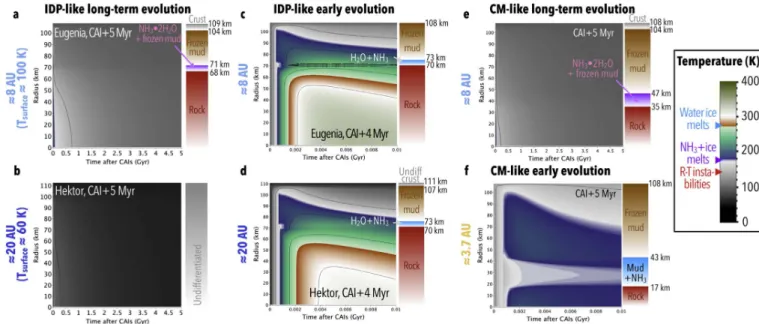
3.1. IDP-like C/P/D-Type Asteroids and Jupiter Trojans Example results of thermal evolution simulations are shown in Figure 1 for objects with surface temperatures of 100 K (IDP-like C/P/D-type asteroids; Figure 1(a)) and 60 K (Trojans/Centaurs/KBOs; Figure 1(b)). In a typical simula-tion, the object undergoes a first phase of intense heating within the first 10 Myr after its accretion (Figures1(c), (d)), due to the decay of 26Al. Subsequently, it cools to relatively
homo-geneous temperatures of<100–200 K by the present day, as it is generally too small for heat from long-lived radionuclide decay to accumulate and result in a second temperature peak. These results are consistent with thermal evolution models of outer solar system bodies akin to Saturn’s captured moon Phoebe (radius≈100 km; density 1670 kg m−3; Castillo-Rogez
et al.2019).
The extent of differentiation thus depends on the amplitude of the short-lived radiogenic heat peak, such that the persistence of an anhydrous surface hinges on late accretion. As shown in Figures1(b),1(d), and2, on R≈ 100 km objects at 20 au, a formation 5 Myr after CAIs allows the persistence of a30 km undifferentiated crust to the present day. Thinner crusts (Figures 1(a), (d)) are expected to undergo significant mixing or overturn due to impact bombardment.
Computed crustal thicknesses as a function of size and time of accretion are shown in Figure2. Only objects with R≈ 100 km formed after 5–6 Myr can retain an anhydrous surface. This suggests that IDP-like small bodies in this size range and bearing evidence of dry silicates finished forming after 5 Myr. We do not expect any other potential later-stage heating process to affect the persistence of surface anhydrous material. Such processes include large-scale planetary migration induced by gravitational perturbations, in which objects may have moved closer in (5 au for Trojans) in the first gigayear after formation (Morbidelli et al.2005). Indeed, inside volatile-rich objects, the mud layer surrounding the rocky core remains nearly as cold as the surface past 0.5 Gyr, irrespectively of heliocentric distance (Figures1(a), (b)). Likewise, warming by impacts is not expected to exceed a few kelvin globally given likely projectile kinetic energies of 1022–1023J (Wilhelms & Squyres1984; Marinova et al.2011).
Instead of primordial undifferentiated crust, the anhydrous material might be fine rock grains suspended in “frozen mud” overturned by Rayleigh–Taylor instabilities below the melting point of H2O(-NH3) ice. However, melting must occur at depth
in order to initiate the differentiation of the central regions
Table 1
Short- and Long-lived Radionuclide Parameters Adopted in the Thermal Evolution Model
Radionuclide Half-life Initial Abundance Energy Per Decay Initial Specific Heat Production Rate (Gyr) ppb by Mass of Rock J (kg nuclide)−1 W (kg nuclides)−1 W (kg rock)−1 26Ala,b 0.000716 724 1.15×10¹³ 0.352 2.55×10⁻⁷ 40Kb,c 1.265 1389 1.46×10¹² 2.53×10⁻⁵ 3.52×10⁻¹¹ 232Thb,c 14.0 67.59 1.61×10¹³ 2.52×10⁻⁵ 1.71×10⁻¹² 235Ub,c 0.704 9.21 1.74×10¹³ 5.44×10⁻⁴ 5.01×10⁻¹² 238Ub,c 4.47 29.49 1.85×10¹³ 9.11×10⁻⁵ 2.69×10⁻¹² Notes. aCastillo-Rogez et al. (2007). bLodders (2003). cDesch et al. (2009).
necessary to yield a gravitationally unstable configuration. Indeed, deep liquid water persists for 10 Myr (Figures1(c), (d)), and convectively overturned material would have likely been sourced from (or at least come in contact with) such deeper melted material and undergone some degree of hydration. Therefore, we deem it unlikely that endogenous surface silicates can remain dry unless the surface material has remained undifferentiated.
3.2. CM-like Asteroids and CM Parent Bodies Simulation results depicting the computed evolution of CM-like objects are shown in Figures 1(e), (f). These objects invariably fully overturn (crust at most a few kilometers thick), owing to the more homogeneous distribution of temperatures inherent to their assumed “mudball” interior, comprised of a small rocky core overlain by a thick mud layer (Bland & Travis2017), which is convective early on when differentiation takes place. At 3.7 au, the surface is at 140 K and the interior necessarily warmer, so Rayleigh–Taylor instabilities can
overturn any gravitationally unstable configuration generated by deep melting. This occurs even by long-lived radionuclide heating alone (no26Al); only objects with a 100 K surface and
without26Al can maintain a thick crust over the age of the solar
system.
For aqueous alteration to take place, CM-like objects must accrete early. Unless these objects accrete past 6 Myr after CAIs, the warmest temperatures are experienced during the first 10 Myr of their evolution, owing to the decay of 26Al. For
R≈ 100 km bodies, H2O–NH3 ice melts only for accretion
<5 Myr after CAIs, and reaches several dozen °C (the alteration temperatures inferred from CM chondrite analyses; Guo & Eiler 2007; Cody et al. 2008) for accretion around 3 Myr after CAIs. To melt pure H2O ice, accretion must take
place before 4 Myr after CAIs. Thus, the presence of aqueously altered material at the surface of CM-like asteroids suggests that these objects completed accretion no later than 3–4 Myr after CAIs. This is consistent with constraints from the meteorite record (Sugiura & Fujiya2014, their Figure2).
Note that in the first 0.01 Gyr (Figure1(f)), the liquid layer (“Mud+NH3”) is slightly colder than the overlying “frozen
mud” layer composed of rock and H2O ice (it is assumed that
NH3 remains in the liquid upon partial freezing until the
eutectic composition is reached). At this early time, internal energy is still relatively homogeneous among all grid zones. Because the liquid layer is near freezing, part of its internal energy is used as latent heat in keeping H2O and NH3melted,
whereas in the solid layers above and below, all of the internal energy is used to elevate their temperature above 0 K. During this brief time, the heat flux across the base of the frozen mud layer, driven by temperature differences, is positive going inward. In IDP-like body simulations, this stage also occurs but temperatures revert even more quickly (within ≈1 Myr) to a monotonous gradient (colder going outward) because of the more concentrated radiogenic heat production in the lar-ger core.
Figure 1. Panels (a)–(b): thermal evolution of R=100 km-class volatile-rich objects in limit cases of ice-rock differentiation. Indicative heliocentric distances are shown to the left of each plot. Internal structures at the present day (4.56 Gyr) are shown as bars to the right of each temperature plot. The time of accretion in megayears is indicated in the top left corner of each panel, along with the indicative name of a solar system body of similar size and possible place of accretion. Panels (c)–(d): first 10 Myr of the thermal evolution of volatile-rich objects assuming accretion 4 Myr after CAIs. Internal structures after 10 Myr are shown as bars to the right of each temperature plot. Panels (e)–(f): long-term and early thermal evolution of CM-like objects. Even for late-accreting objects at 8 au, internal structures (bars to the right) at 4.56 Gyr suggest that an anhydrous crust thick enough to withstand impacts cannot persist.
Figure 2. Thickness of the undifferentiated crust of IDP-like bodies as a function of radius and time of formation. Numbers indicate the thickness in kilometers of the undifferentiated outer layer (simulation result). Crusts thinner than 20–30 km are likely overturned by impacts.
4. Discussion
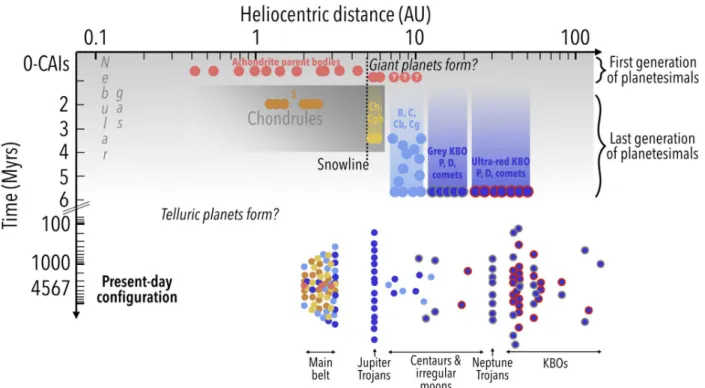
In Figure3, we use the results of our simulations along with those obtained for the formation time of inner solar system S-type asteroids (Monnereau et al.2013) to depict our current understanding of the time and duration of formation of the different compositional classes of D≈200 km bodies as a function of heliocentric distance. The likely—yet not firmly established—formation locations for the different classes of small bodies were retrieved from Vernazza & Beck (2017). It appears that the timescale of completion of formation of the last generation of small D200 km bodies (in megayears) is positively correlated with their formation location (in astro-nomical units). Accretion ended earlier inward of the snow line (≈2 Myr for ordinary chondrite parent bodies; Henke et al. 2012; Monnereau et al.2013; Blackburn et al.2017) than just beyond Jupiter (3–4 Myr, CM-like bodies), which itself stopped earlier than for objects farther out (>5 Myr for IDP-like bodies at≈8 au and >6 Myr at ≈20 au).
Meteoritic evidence suggests the existence of at least one previous generation of planetesimals, which would also have formed later at higher heliocentric distances (Kruijer et al. 2017). In the inner solar system, this first generation comprises the parent bodies of differentiated achondrites (Russell et al. 2006). Beyond the snow line, it includes achondritic meteoritic material (groups IIC, IID, IIF, IIIF, and IVB of iron meteorites) isotopically related to carbonaceous chondrites and IDPs. Inferred accretion times for these objects suggest that the onset of planetesimal formation also seems to have occurred later beyond the snow line (≈1 Myr; Kruijer et al.2017) than inward of it (≈0.2 Myr). Thus, the accretion of D≈200 km bodies seems to have both started and ended later at greater
heliocentric distances, even though the periods of accretion inside (0.2–2 Myr) and beyond the snow line (1–6+ Myr) overlapped.
Although the meteorite record has also been interpreted in terms of continuous accretion over these time ranges, this likely concerns only a small fraction of the mass of the small body populations as inferred from telescopic observations (types other than S/C/P/D) and the astromaterial record (primitive achondrites). In this interpretation, some bodies accreted early enough to have experienced at least partial dehydration (Weiss & Elkins-Tanton 2013). The latter case is not supported by current measurements of the spectral properties and densities of D>150 km CM-like bodies (Carry 2012; Vernazza et al. 2016; Vernazza & Beck2017; Carry et al.2019), whose low values are more compatible with a mostly or fully homogenous interior.
Also arguing against accretion sustained at a continuous pace over this period is the (albeit possibly biased) scant representation of observed bodies (e.g., A-type and K-type bodies) related to meteorites of intermediate thermal alteration stages such as CV and CK chondrites (DeMeo & Carry2013). Likewise, primitive achondrites of intermediate age are under-represented in the meteorite collection, even compared to differentiated achondrites from the earliest planetesimals (Meteoritical Bulletin Database 2018). Therefore, we do not exclude that the objects simulated here could have accreted over several megayears (Figure 3; colored gradient boxes starting at≈2 Myr), provided that the bulk of accretion took place sufficiently late as to avoid any significant thermal alteration and rock-metal differentiation.
Figure 3. Postulated sequence of events tracing the time, place, and duration of formation of small bodies (top) to present-day observed characteristics (bottom; vertical spread reproducing roughly the distribution of orbital inclinations). The accretion duration is shown as gradient boxes ending at the fully formed bodies. Meteorite analyses indicate that achondrite parent bodies began accreting before 2 Myr even beyond the snow line. Their formation is depicted as occurring slightly earlier in the inner solar system compared to beyond 5 au; this is speculative and solely based on mirroring the trend inferred for the second generation of bodies. Our simulations suggest that volatile-rich bodies accreted their outer layers after 5–6 Myr, but the onset of their accretion is unconstrained if these are a separate generation of bodies.
The delay or extension of the accretional period beyond the snow line may be rooted in a much lower initial surface density of the protoplanetary disk there than inward of the snow line, at least for a few megayears until the disk density at 5–10 au increased due to outward viscous spreading (e.g., Desch et al. 2018). Assuming that the small body accretion timescale was proportional to the surface density in the accretion disk of the Sun and in proportion to the Keplerian orbit period (i.e., accretion duration proportional approximately to the cube of the heliocentric distance; Jewitt et al.2007), the formation of IDP-like bodies may have taken much longer (tens of megayears) than the lower bound of 5–6 Myr implied by our results. The strong time dependence of accretion on helio-centric distance breaks down at several tens of astronomical units, where the accretion timescale is longer than that of orbital velocity dispersion excitation to the point where collisions become destructive (Kenyon & Luu 1998; Jewitt et al.2007; Schlichting & Sari2011), placing an upper bound of<100 Myr to form 100 kilometer-class Kuiper Belt objects. The accretion timescales inferred from this study confirm that there has not been a universal formation process for solar system bodies. Indeed, Jupiter must have reached a significant size by 3 Myr or even earlier (1 Myr following Kruijer et al. 2017) in order to retain its massive gaseous envelope and create a gap in the disk that would naturally explain the isotopic dichotomy between enstatite/ordinary chondrites and carbo-naceous chondrites (e.g., Warren2011; Budde et al.2016), at a time when our results suggest IDP-like P- and D-type bodies were not yet formed. The same applies to the remaining giant planets that must have accreted before dissipation of the gas. This illustrates the fact that specific locations in the disk such as the snow line favored the rapid formation of large, massive bodies (giant planet cores) whereas other formation regions only allowed the formation of small (D∼200 km) bodies (e.g., formation region of IDP-like bodies) at a slow pace (a few megayears to grow from dust particles to ∼200 km). Such a slow pace of accretion for distant small bodies is consistent with the late accretion of comet 67P (Mousis et al.2017) and the presence of many contact binaries among KBOs (Thirouin & Sheppard2018), including the KBO Ultima Thule recently flown by the New Horizons mission.
The completion of IDP-like P- and D-type asteroid accretion past 5–6 Myr also makes it less likely that the pebble accretion (Levison et al. 2015a, 2015b) and Grand Tack scenarios (Walsh et al.2011) can describe the accretion of the bulk of their mass and their early migration (if any), respectively. Indeed, these models require nebular gas, which would likely have disappeared by 5 Myr (Walsh et al.2012), although a few extrasolar disks have been observed to persist until 10 Myr (Russell et al. 2006). If these scenarios apply, our results strongly constrain the time window in which they should have operated (and in which IDP-like bodies finished accreting) to CAI+5–6 Myr, assuming nebular gas persisted long enough.
The authors contributed equally to this article. We thank an anonymous reviewer for comments that helped improve this article. M.N. thanks S. Desch for providing access to the computers on which simulations were run.
Software:IcyDwarf (https://github.com/MarcNeveu/Icy Dwarf).
ORCID iDs
Marc Neveu https://orcid.org/0000-0002-6220-2869 References
Bennett, M. E., & McSween, H. Y. 1996,M&PS,31, 783
Bischoff, A. 1998,M&PS,33, 1113
Blackburn, T., Alexander, C. M. O., Carlson, R., & Elkins-Tanton, L. T. 2017,
GeCoA,200, 201
Bland, P. A., & Travis, B. J. 2017,SciA,3, e1602514
Bradley, J. P. 2003, in Treatise on Geochemistry, Vol. 1 ed. H. D. Holland & K. K. Turekian (Amsterdam: Elsevier), 1
Brown, M. E., Schaller, E. L., & Fraser, W. C. 2011,ApJL,739, L60
Budde, G., Burkhardt, C., Brennecka, G. A., et al. 2016,E&PSL,454, 293
Burbine, T. H., McCoy, T. J., Meibom, A., Gladman, B., & Keil, K. 2002, in Asteroids III, ed. W. Bottke et al. (Tucson, Arizona: Univ. Arizona Press),653
Campins, H., Hargrove, K., Pinilla-Alonso, N., et al. 2010,Natur,464, 1320
Carry, B. 2012,P&SS,73, 98
Carry, B., Vachier, F., Berthier, J., et al. 2019,A&A,623, A132
Castillo-Rogez, J., Matson, D., Sotin, C., et al. 2007,Icar,190, 179
Castillo-Rogez, J., Vernazza, P., & Walsh, K. 2019,MNRAS, in press Cloutis, E. A., Binzel, R. P., & Gaffey, M. J. 2014,Elements, 10, 25 Cody, G., Yabuta, H., Kilcoyne, A., et al. 2008,E&PSL,272, 446
Cohen, B. A., & Coker, R. F. 2000,Icar,145, 369
DeMeo, F. E., & Carry, B. 2013,Icar,226, 723
Desch, S. J., Cook, J. C., Doggett, T., & Porter, S. B. 2009,Icar,202, 694
Desch, S. J., Kalyaan, A., & Alexander, C. M. O. 2018,ApJS,238, 11
Emery, J. P., Cruikshank, D. P., & Van Cleve, J. 2006,Icar,182, 496
Emery, J. P., Marzari, F., Morbidelli, A., French, L. M., & Grav, T. 2015, in Asteroids IV, ed. P. Michel, F. E. DeMeo, & W. F. Bottke (Tucson, AZ: Univ. Arizona Press),203
Fraser, W. C., Brown, M. E., Morbidelli, A., Parker, A., & Batygin, K. 2014,
ApJ,782, 100
Greenwood, R. C., Burbine, T. H., Miller, M. F., & Franchi, I. A. 2017,ChEG,
77, 1
Grimm, R. E., & McSween, H. Y. 1989,Icar,82, 244
Guo, W., & Eiler, J. M. 2007,GeCoA,71, 5565
Hargrove, K. D., Kelley, M. S., Campins, H., Licandro, J., & Emery, J. 2012,
Icar,221, 453
Harvey, R., & Cassidy, W. 1989, Metic,24, 9
Henke, S., Gail, H.-P., Trieloff, M., Schwarz, W. H., & Kleine, T. 2012,A&A,
545, A135
Howard, K., Benedix, G., Bland, P., & Cressey, G. 2009,GeCoA,73, 4576
Howard, K., Benedix, G., Bland, P., & Cressey, G. 2011,GeCoA,75, 2735
Jewitt, D., Chizmadia, L., Grimm, R., & Prialnik, D. 2007, in Protostars and Planets V, ed. B. Reipurth, D. Jewitt, & K. Keil (Tucson, AZ: Univ. Arizona Press),863
Johansen, A., Mac Low, M.-M., Lacerda, P., & Bizzarro, M. 2015, SciA, 1, e1500109
Johnson, T. V., & Fanale, F. P. 1973,JGR,78, 8507
Kenyon, S. J., Bromley, B. C., OÕBrien, D. P., & Davis, D. R. 2008, The Solar System Beyond Neptune (Tucson, Arizona: Univ. Arizona Press),293
Kenyon, S. J., & Luu, J. X. 1998,AJ,115, 2136
Kruijer, T. S., Burkhardt, C., Budde, G., & Kleine, T. 2017,PNAS,114, 6712
Lauretta, D. S., Bartels, A. E., Barucci, M. A., et al. 2015,M&PS,50, 834
Levison, H. F., Kretke, K. A., & Duncan, M. J. 2015a,Natur,524, 322
Levison, H. F., Kretke, K. A., Walsh, K. J., & Bottke, W. F. 2015b,PNAS,
112, 14180
Licandro, J., Campins, H., Kelley, M., et al. 2011,A&A,525, A34
Liou, J.-C., Zook, H. A., & Dermott, S. F. 1996,Icar,124, 429
Lodders, K. 2003,ApJ,591, 1220
Lodders, K., & Osborne, R. 1999, Composition and Origin of Cometary Materials (Berlin: Springer), 289
Love, S. G., & Brownlee, D. E. 1993,Sci,262, 550
Macke, R. J., Consolmagno, G. J., & Britt, D. T. 2011,M&PS,16, 1842
Marchis, F., Durech, J., Castillo-Rogez, J., et al. 2014,ApJL,783, L37
Marinova, M. M., Aharonson, O., & Asphaug, E. 2011,Icar,211, 960
Meteoritical Bulletin Database 2018, https://www.lpi.usra.edu/meteor, retrieved Dec. 20
Monnereau, M., Toplis, M. J., Baratoux, D., & Guignard, J. 2013,GeCoA,
119, 302
Morbidelli, A., Levison, H. F., Tsiganis, K., & Gomes, R. 2005,Natur,435, 462
Mousis, O., Drouard, A., Vernazza, P., et al. 2017,ApJL,839, L4
Nakamura, T., Noguchi, T., Tanaka, M., et al. 2011,Sci,333, 1113
Neveu, M., & Desch, S. J. 2015,GeoRL,42, 10, 197
Neveu, M., Desch, S. J., & Castillo-Rogez, J. C. 2015,JGRE,120, 123
Neveu, M., Desch, S. J., & Castillo-Rogez, J. C. 2017,GeCoA,212, 324
Neveu, M., & Rhoden, A. R. 2017,Icar,296, 183
Pajuelo, M., Carry, B., Vachier, F., et al. 2018,Icar,309, 134
Perna, D., Barucci, M. A., Ishiguro, M., et al. 2017,A&A,599, L1
Pieters, C. M., & McFadden, L. A. 1994,AREPS,22, 457
Rivkin, A. S., & Emery, J. P. 2010,Natur,464, 1322
Rosenberg, N. D., Browning, L., & Bourcier, W. L. 2001,M&PS,36, 239
Rubin, M. E., Desch, S. J., & Neveu, M. 2014,Icar,236, 122
Russell, S. S., Hartmann, L., Cuzzi, J., et al. 2006, in Meteorites and the Early Solar System II, ed. D. S. Lauretta & H. Y. McSween Jr. (Tucson, AZ: Univ. Arizona Press),233
Sandford, S. A., & Bradley, J. P. 1989,Icar,82, 146
Schlichting, H. E., & Sari, R. 2011,ApJ,728, 68
Sugiura, N., & Fujiya, W. 2014,M&PS,49, 772
Takir, D., & Emery, J. P. 2012,Icar,219, 641
Thirouin, A., & Sheppard, S. S. 2018,AJ,155, 248
Tomeoka, K., & Buseck, P. R. 1985,GeCoA,49, 2149
Travis, B., Palguta, J., & Schubert, G. 2012,Icar,218, 1006
Urey, H. C. 1955,PNAS,41, 127
Usui, F., Hasegawa, S., Ootsubo, T., & Onaka, T. 2019,PASJ,71, 1
Vernazza, P., & Beck, P. 2017, in Planetesimals: Early Differentiation and Consequences for Planets, ed. L. T. Elkins-Tanton & B. P. Weiss (Cambridge: Cambridge Univ. Press),269
Vernazza, P., Castillo-Rogez, J., Beck, P., et al. 2017,AJ,153, 72
Vernazza, P., Delbo’, M., King, P. L., et al. 2012,Icar,221, 1162
Vernazza, P., Marsset, M., Beck, P., et al. 2015,ApJ,806, 204
Vernazza, P., Marsset, M., Beck, P., et al. 2016,AJ,152, 54
Vernazza, P., Zanda, B., Binzel, R. P., et al. 2014,ApJ,791, 120
Walsh, K. J., Morbidelli, A., Raymond, S. N., O’Brien, D. P., & Mandell, A. M. 2011,Natur,475, 206
Walsh, K. J., Morbidelli, A., Raymond, S. N., O’Brien, D. P., & Mandell, A. M. 2012,M&PS,47, 1941
Warren, P. H. 2011,E&PSL,311, 93
Wasson, J. T., & Kallemeyn, G. W. 1988,RSPTA,325, 535
Weiss, B. P., & Elkins-Tanton, L. T. 2013,AREPS,41, 529
Wilhelms, D. E., & Squyres, S. W. 1984,Natur,309, 138
Young, E. D., Zhang, K. K., & Schubert, G. 2003,E&PSL,213, 249