HAL Id: hal-00305139
https://hal.archives-ouvertes.fr/hal-00305139
Submitted on 5 Mar 2008
HAL is a multi-disciplinary open access
archive for the deposit and dissemination of
sci-entific research documents, whether they are
pub-lished or not. The documents may come from
teaching and research institutions in France or
abroad, or from public or private research centers.
L’archive ouverte pluridisciplinaire HAL, est
destinée au dépôt et à la diffusion de documents
scientifiques de niveau recherche, publiés ou non,
émanant des établissements d’enseignement et de
recherche français ou étrangers, des laboratoires
publics ou privés.
recovery from acidification: an analysis of the 30-year
record from Birkenes, Norway
R. F. Wright
To cite this version:
R. F. Wright. The decreasing importance of acidification episodes with recovery from acidification:
an analysis of the 30-year record from Birkenes, Norway. Hydrology and Earth System Sciences
Discussions, European Geosciences Union, 2008, 12 (2), pp.353-362. �hal-00305139�
Hydrol. Earth Syst. Sci., 12, 353–362, 2008 www.hydrol-earth-syst-sci.net/12/353/2008/ © Author(s) 2008. This work is licensed under a Creative Commons License.
Hydrology and
Earth System
Sciences
The decreasing importance of acidification episodes with recovery
from acidification: an analysis of the 30-year record from Birkenes,
Norway
R. F. Wright
Norwegian Institute for Water Research, Gaustadall`een 21, 0349 Oslo, Norway
Received: 23 October 2006 – Published in Hydrol. Earth Syst. Sci. Discuss.: 11 September 2007 Revised: 3 December 2007 – Accepted: 5 February 2008 – Published: 5 March 2008
Abstract. The 30-year record 1975–2004 of weekly samples
of streamwater chemistry from Birkenes, Norway, shows 106 acid episodes below the threshold of ANC−50 µeq l−1. The frequency, severity and duration of episodes have diminished since about 1990 due to chemical recovery following reduced deposition of sulphur. In particular SO4-driven episodes in
the first runoff following drought have become less intense and less frequent, whereas episodes driven by climate (wind, high flow) continue. The data show significant empirical re-lationships between strength of the driver, degree of chemical recovery, and severity of ANC depression.
1 Introduction
Long-term deposition of sulphur and nitrogen compounds from the atmosphere has caused widespread acidification of sensitive freshwaters (Overrein et al., 1980). Acidification is often characterised by chronic low pH and acid neutralising capacity (ANC) with elevated concentrations of inorganic aluminium species (Aln+). Superimposed on the chronic
acidification are acid episodes, often defined as short-term decrease of pH or ANC (Wigington et al., 1992). The acid episodes are of particular interest as they can cause acute bi-ological damage, especially in streams. Episodes in lakes are less prominent because the volume of water in the lake damps the response to episodic inputs.
In Norway investigations of the causes of acid episodes began in the 1970s prompted by a fish kill in association with snowmelt in 1975 (Leivestad and Muniz, 1976). Studies were made of episodes caused by snowmelt (Skartveit and Gjessing, 1979; Johannessen et al., 1980). Acid episodes during snowmelt have also been extensively investigated in streams in northern Sweden (Laudon and Bishop, 1999).
Correspondence to: R. F. Wright
Acid runoff following summer drought has been studied in Norway (Christophersen et al., 1982) and in Ontario, Canada (Dillon et al., 1997). In near coastal areas acid episodes can be driven by seasalt deposition (Skartveit, 1982; Hindar et al., 1994). High discharge can also cause acid episodes (Mul-der et al., 1995). In the late 1980s the United States Environ-mental Protection Agency (US EPA) conducted a compre-hensive project (Episodic Response Project) on acid episodes in 13 streams in the northeastern United States (Wigington et al., 1996).
Since the mid-1980s deposition of S and N (mostly S) has decreased substantially in most parts of Europe and eastern North America as a result of national measures and interna-tional agreements to reduce the emissions of acid precursors (UNECE, 1999). Surface waters in these regions have begun to recover; chemical conditions have improved and in some cases biological recovery has been observed (Evans et al., 2001; Skjelkv˚ale et al., 2003).
The goals of this work are to (1) determine the dominant causes of acid episodes at Birkenes, (2) assess the role of cli-mate as a driver of acid episodes, and (3) assess the changes in frequency, severity and duration of episodes during the process of recovery. The aim is to search for simple empiri-cal relationships that can be used to predict the severity and duration of episodes as the catchment recovers from acidi-fication in the future. The analysis was carried out for the small catchment at Birkenes, Norway, which has a 30-year record of streamwater discharge and chemistry, bulk depo-sition volume and chemistry, and meteorological data from nearby stations.
2 Materials and methods
Birkenes is a 0.41-km2 coniferous-forested catchment lo-cated about 20 km from the south coast of Norway. The site is characterised by thin podsols and brown earth soils
developed on patchy moraine of granitic mineralogy over-lying biotite granite. The climate at Birkenes is mar-itime, with annual precipitation about 1400 mm and runoff about 1200 mm. Winters are often characterised by fre-quent snowmelt periods. Deposition of seasalts at Birkenes is relatively high (1974–2004 mean bulk deposition of Cl 94 meq m−2yr−1)due to the proximity to the coast.
Birkenes has been a research and monitoring site since 1972 and is part of the Norwegian programme for monitor-ing long-range transported air pollution (SFT, 2006). Dis-charge is measured by the Norwegian Water Resources and Electricity Board with a level recorder and a V-notch weir and reduced to mean daily discharge. Starting July 1972 samples for determination of chemical composition of runoff have been taken weekly (daily until December 1974) by the Norwegian Institute for Water Research (NIVA). No samples were collected in 1979 and 1984. Samples were analysed at NIVA for major ions using routine, accredited methods (SFT, 2006). Prior to May 1974 only pH, Ca, SO4and NO3plus
either Na or Cl were determined, and thus ANC cannot be calculated for these samples. The record from July 1972– December 2004 comprises 2293 water chemistry samples.
Samples for volume and chemical composition of bulk precipitation and air were collected daily beginning July 1972 by the Norwegian Institute for Air Research (NILU) (Aas et al., 2004). Samples were analysed at NILU for major ions using routine, accredited methods. During the first years not all major ions were measured; Ca measurements began in 1974, Na and K in 1986, and Cl in 1980.
Meteorological data came from nearby stations operated by the Norwegian Meteorological Institute. Daily data for precipitation amount come from station 38450 Herefoss and for temperature from 39690 Byglandsfjord. These stations are located <20 km distant and at approximately the same elevation as Birkenes. Derived parameters such as Palmer drought index were kindly provided by the Norwegian Mete-orological Institute.
The ability of the weekly sampling interval to capture episodes was evaluated on the basis of the 2-year record of daily water chemistry determinations for several parameters (July 1972–November 1974). The autocorrelation was com-puted for time lags of 1–30 days. Also the extreme value of each parameter (2nd or 98th percentile) was calculated for subsets of the data comprising samples collected at 1–14 day intervals.
ANC was used as the measure of acidification. ANC is a calculated parameter defined as the equivalent difference between sum of base cations (Ca+Mg+Na+K) minus sum of strong acid anions (SO4+Cl+NO3)(Reuss and Johnson
1986). Changes in ANC can thus be readily assigned to changes in concentrations of specific ions (Wigington et al., 1996). The concentrations of the various ions, especially the strong acid anions, are closely related to key sources and bio-geochemical processes operating in soil and surface waters.
Relationships between ANC and discharge were based on daily mean discharge measurement for the day of the chem-ical sample (generally once a week). Results were grouped into 5-year periods beginning with 1975. Because no sam-ples were collected in 1979 and 1984, the periods 1975–1979 and 1980–1984 had data for only 4 years.
Acid episode was defined as a short-term decrease in ANC (Wigington et al., 1996). This definition requires specifi-cation of an ANC threshold below which the episode oc-curs. A threshold of ANC<−50 µeq l−1 was used as the criterion for an episode at Birkenes. This level was cho-sen such that the majority of the samples were above the threshold; it has no inherent biological significance. The operational definition of Wigington et al. (1996) was used to identify episodes relative to this threshold. Namely, the start of an episode was taken as the date at which the ANC fell below −50 µeq l−1, the duration as the number of weeks during which the ANC remained below −50 µeq l−1, and the end of the episode as the date at which the last sample had ANC below −50 µeq l−1. The severity of the episodes was classed relative to two further thresholds, ANC<−75 and <−100 µeq l−1. The difference in ANC between the sample before the episode and the minimum reached dur-ing the episode is termed “delta ANC”. Episodes with delta ANC<−5 µeq l−1were excluded.
Assignment of the major ion driver causing each episode was based on the difference in concentration of major ions in the sample with minimum ANC measured during the episode minus the concentration in the sample collected immediately prior to the onset of the episode. By definition a decrease in ANC must be due to decrease in one or more base cation or increase in one or more strong acid anion, or a combina-tion of both. The individual ion contribucombina-tion to each episode was calculated as a percentage. Each episode was assigned to one of four main drivers: direct influence of precipitation (termed here “hydrology” and indicated by decrease in base cation concentrations, due mostly to a dilution of Ca), sum-mer drought (SO4peak), snowmelt (SO4+ NO3peaks), and
seasalt deposition (Cl peak). Much of the analysis followed the procedures used by Evans et al. (2008).
3 Results
Autocorrelation with time lag of 1–30 days for the water samples collected daily in 1972–1974 showed that for the parameters pH, H+, SO
4, NO3, and Ca the concentrations
were significantly correlated (95% confidence bounds) at time steps less than about 18 days. Discharge, on the other hand, was significantly autocorrelated only at time lags less than 5 days. For a 7-day time lag the correlation coefficients ranged from 0.54 for H+ to 0.67 for SO
4 and Ca, whereas
only 0.13 for discharge. Also the 98th percentile concen-tration varied by less than 5% for sampling intervals of 14 days or less. These results indicate that weekly sampling
R. F. Wright: Acid episodes at Birkenes, Norway 355 -150 -100 -50 0 50 100 72 77 82 88 93 99 04 µ e q l -1 ANC 0 50 100 150 200 250 300 72 77 82 88 93 99 04 µ e q l -1 SO4 0 20 40 60 80 100 120 72 77 82 88 93 99 04 µ e q l -1 NO3 0 50 100 150 200 250 300 350 72 77 82 88 93 99 04 µ e q l -1 Cl 0 10 20 30 40 50 60 70 80 72 77 82 88 93 99 04 m m d a y -1 discharge
439
440
441
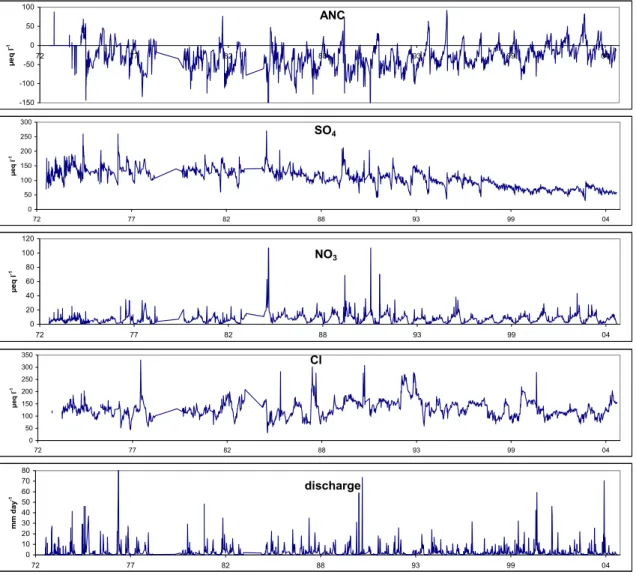
Figure 1. ANC, concentrations of SO , NO , and Cl and discharge of streamwater at
Fig. 1. ANC, concentrations of SO4, NO3, and Cl and discharge of streamwater at Birkenes, Norway, over the period 1972–2004. Data for
the years 1979 and 1984 are lacking; measurements for several of the major ions are lacking for samples collected prior to 1975.
is sufficient to capture episodes at Birkenes, and in particu-lar the severe episodes of several weeks duration with particu-large delta ANC. Weekly sampling, of course, is insufficient to de-tect the absolute minimum ANC (or pH) during an episode.
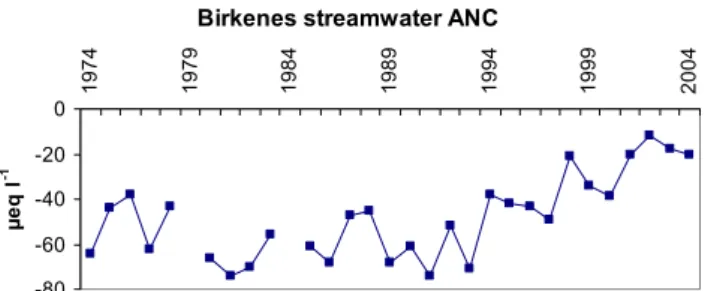
The time series of ANC in runoff at Birkenes shows marked and at times frequent episodes of low ANC concur-rent with peaks in the major four drivers (Fig. 1). The record also shows clear improvement in water quality from about 1990, with decreasing concentrations of SO4and increasing
ANC (Fig. 2). The minimum ANC recorded during episodes has gradually increased in parallel with the general increase in mean ANC (Fig. 3). October 1993 was the last time ANC decreased to below −100 µeq l−1, and November 2000 was the last time ANC decreased to below −75 µeq l−1. Over the period 1975–2004 a total of 106 episodes with ANC<−50 µeq l−1 were identified, of which 54 reached ANC<−75 µeq l−1and 14 reached ANC<−100 µeq l−1.
High flow episodes. ANC typically drops during high discharge events. These episodes are characterised by di-lution of base cations, mainly Ca. Ca comes principally from weathering of soil minerals and secondarily from atmo-spheric deposition; the volume-weighted mean concentration of Ca in runoff 1975–2003 was 45 µeq l−1, whereas bulk pre-cipitation had only 8 µeq l−1. The hypothesised mechanism
is that soil solution in the upper mostly organic soil layers has lower concentrations of base cations because of lower rates of chemical weathering relative to soil solution in the lower mineral soil. At high flow a larger proportion of runoff comes from the base-cation poor upper soil, and in addition is di-luted by Ca-poor precipitation (Christophersen et al., 1982). Regressions of ANC on discharge for samples collected during 5-year time blocks yield significant relationships (p<0.001), with lower ANC at high flow (Table 1). The regression lines for successive 5-year blocks are roughly
Birkenes streamwater ANC -80 -60 -40 -20 0 1 9 7 4 1 9 7 9 1 9 8 4 1 9 8 9 1 9 9 4 1 9 9 9 2 0 0 4 µ e q l -1 445
Fig. 2. Volume-weighted annual average ANC (µeq l−1)in runoff at Birkenes 1974–2004. Birkenes 1974-04 1992-2004 y = 1.02x - 31 R2 = 0.74 -350 -300 -250 -200 -150 -100 -50 0 -80 -70 -60 -50 -40 -30 -20 -10 0
year mean ANC µeq l-1
m in im u m A N C µ e q l -1
Fig. 3. Relationship between mean volume-weighted yearly ANC
and minimum ANC (µeq l−1)in runoff at Birkenes 1974–2004.
The regression is based on the years 1992–2004.
parallel but at slightly higher ANC (Fig. 4). ANC at high flow (98th-percentile) is higher in the period 2000–2004 rel-ative to earlier periods (Fig. 5). The trend over time in ANC at high flow reflects the general recovery trend for annual volume-weighted mean ANC in runoff at Birkenes.
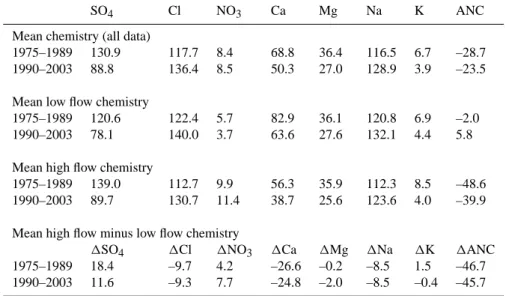
Grouping of the samples into those at low flow (Q below 25th percentile) and those at high flow (Q above 75th per-centile) indicates that the lower ANC at high flow is mainly due to dilution; about half of the decrease can be accounted for by lower concentrations of Ca at high flow (Table 2, Fig. 6). This has apparently not changed significantly over time, although the role of SO4is diminished in the later
pe-riod because of lower concentrations of SO4 in deposition
and runoff.
Summer drought episodes. The first runoff following
sum-mer drought consistently has an elevated concentration of SO4 and a markedly lower ANC. The mechanism is
prob-ably the reduction of SO4and storage as reduced S in anoxic
parts of the soil during dry periods with the subsequent re-oxidation and flushing out of SO4with the first runoff (Dillon
et al., 1997). Acid cations (H+and Aln+)comprise a
frac-tion of the accompanying cafrac-tions and thus ANC decreases. At Birkenes the onset of autumn rain has been late August or September in most years.
Table 1. Linear regression of ANC (µeq l−1)on log discharge (mm/day) for samples collected during 5-year time blocks at Birkenes. n = number of samples. All regressions are significant at p<0.001 level.
period n slope intercept r2
1975–1979 215 –21.4 –23.2 0.32 1980–1984 190 –35.9 –37.4 0.37 1985–1989 238 –28.1 –40.2 0.23 1990–1994 245 –23.2 –42.9 0.32 1995–1999 257 –19.3 –24.2 0.25 2000–2003 210 –29.1 –7.5 0.45
ANC (µeq l-1) vs. logQ (mm day-1)
-300 -250 -200 -150 -100 -50 0 50 100 -3 -2 -1 0 1 2 3 1980-84 1990-94 2000-04 453
Fig. 4. Scatter plot of ANC (µeq l−1)on log discharge (mm day−1) for samples from three 5-year periods at Birkenes (1980–1984, 1990–1994 and 2000–2004).
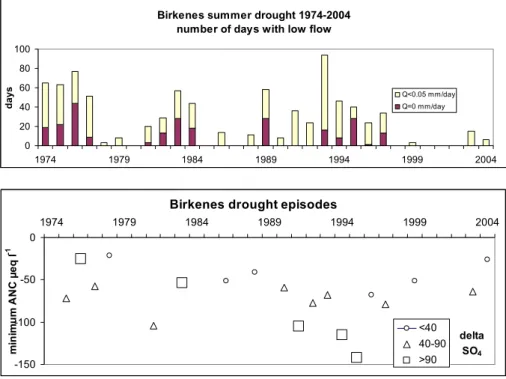
The discharge record for Birkenes shows three general pe-riods of pronounced summer drought: 1974–1977, 1981– 1984, and 1989–1997 (Fig. 6). There have been no ma-jor droughts during the last 7 years of the record (1998– 2004). The Palmer drought index for the nearby meteorolog-ical station also shows these three general periods of summer drought. The increase in SO4concentration in first runoff
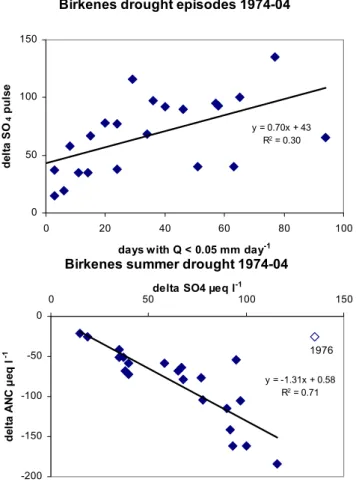
fol-lowing the drought is a function of the severity of the drought (as indicated by the number of days with low flow). A lin-ear least-squares regression model explains about 25% of the variance. The decrease in ANC is correlated to the increase in SO4(Fig. 7).
The mean annual SO4 concentration has decreased
dra-matically since about 1990. Whereas the severe droughts in the 1970s led to increase in SO4concentration in first runoff
of 100–150 µeq l−1, droughts of similar magnitude in the 1990s led to increase of only 40–60 µeq l−1. It is expected that with the continued decline in mean annual SO4
concen-tration a severe drought in recent years would cause even less of a peak in SO4, but there have been no major droughts since
1997 and thus this could not be tested.
Snowmelt episodes. In many streams spring snowmelt is
often the time of lowest ANC. The first meltwater contains a greatly disproportionate fraction of the dissolved constituents stored in the snowpack (Johannessen and Henriksen, 1978). At sites receiving acid deposition, the first meltwater thus
R. F. Wright: Acid episodes at Birkenes, Norway 357
Table 2. Arithmetic mean concentrations of ions (µeq l−1)contributing to ANC in runoff samples at low flow (<25th percentile) and high flow (>75th percentile) collected at Birkenes. The data are split into two periods: 1975–1989 and 1990–2003.
SO4 Cl NO3 Ca Mg Na K ANC
Mean chemistry (all data)
1975–1989 130.9 117.7 8.4 68.8 36.4 116.5 6.7 –28.7
1990–2003 88.8 136.4 8.5 50.3 27.0 128.9 3.9 –23.5
Mean low flow chemistry
1975–1989 120.6 122.4 5.7 82.9 36.1 120.8 6.9 –2.0
1990–2003 78.1 140.0 3.7 63.6 27.6 132.1 4.4 5.8
Mean high flow chemistry
1975–1989 139.0 112.7 9.9 56.3 35.9 112.3 8.5 –48.6
1990–2003 89.7 130.7 11.4 38.7 25.6 123.6 4.0 –39.9
Mean high flow minus low flow chemistry
1SO4 1Cl 1NO3 1Ca 1Mg 1Na 1K 1ANC
1975–1989 18.4 –9.7 4.2 –26.6 –0.2 –8.5 1.5 –46.7
1990–2003 11.6 –9.3 7.7 –24.8 –2.0 –8.5 –0.4 –45.7
Birkenes ANC at extreme flow
-100 -80 -60 -40 -20 0 20 40 75-79 80-84 85-89 90-94 95-99 00-04 A N C µ e q l -1 Flow 10th Flow 25th Flow 50th Flow 75th Flow 90th Flow 98th 458
Fig. 5. ANC at various levels of discharge (percentiles of
distribu-tion of Q) for samples collected during 5-year intervals at Birkenes. Shown are values obtained from linear regressions of ANC on log Q. Bold line indicates ANC expected at high flow (98th percentile).
contains high concentrations of SO4 and to a lesser extent
NO3. The subsequent phases of snowmelt cause dilution of
runoff, especially of base cations derived from the soil such as Ca. Chemical changes during spring snowmelt have been extensively studied in northern Sweden (Laudon and Bishop, 1999).
Because Birkenes lies near the south coast and experiences mild winters (for Norway). Mid-winter melting is usual, and thus development of a long-lasting snowpack rarely occurs. Over the 30-year period major spring snowmelt episodes occurred only 4 years. Mid-winter melting episodes were more common, but with much less pronounced in chemical changes in runoff. The most pronounced spring snowmelt occurred in 1985 with peak in SO4and NO3concentrations
in the first runoff followed by strong dilution as indicated by decrease in Ca concentration. -30% -20% -10% 0% 10% 20% 30% 40% 50% 60% 70%
dSO4 dCl dNO3 dCa dMg dNa dK
1975-1989 1990-2004
Fig. 6. Contribution of individual ions to decrease in ANC between
low flow and high flow (25th and 75th percentile, respectively) in runoff samples collected in 1975–1989 and 1990–2004 at Birkenes.
Seasalt episodes. Storms with high wind and often
pre-cipitation cause episodes of high deposition of seasalts to near coastal areas. Subsequent runoff has marked increases in concentrations of Cl and drop in ANC. The response is due to the differential mobility of Cl and Na, the major accompa-nying base cation. While Cl is quite mobile, Na participates in cation exchange reactions in the soil. A fraction of the Na (and also Mg) is exchanged for acid cations H+and Aln+on
the soil ion-exchange sites.
Due to its proximity to the coast, Birkenes is strongly in-fluenced by seasalt deposition. Volume-weighted mean con-centration of Cl in runoff over the period 1974–2004 was 130 µeq l−1. Seasalt deposition is larger during the winter,
Birkenes summer drought 1974-2004 number of days with low flow
0 20 40 60 80 100 1974 1979 1984 1989 1994 1999 2004 d a y s Q<0.05 mm/day Q=0 mm/day 470
Birkenes drought episodes
-150 -100 -50 0 1974 1979 1984 1989 1994 1999 2004 m in im u m A N C µ e q l -1 <40 40-90 >90 delta SO4 471
Fig. 7. Birkenes summer droughts. Upper panel: number of days with low flow each year. Dark colour: 0 mm/day; light colour:
<0.05 mm/day. Mean daily discharge is about 3.3 mm/day. Lower panel: Minimum ANC reached in the first runoff following drought,
grouped by change in SO4concentration (delta = after − before). The size and shape of the symbols denote the magnitude of SO4increase.
due to higher frequency of storms. Seasalt deposition caused 34 of the 93 episodes in which ANC fell below the threshold of −50 µeq l−1 during the period 1980–2004. Particularly large seasalt episodes occurred in October 1990, November 1990, January 1993 and November 2000. January 1993 had the highest deposition of seasalt of any month over the en-tire record from 1975–2004. At each of these four large seasalt episodes Cl concentrations in runoff increased by >80 µeq l−1.
During seasalt episodes the decrease in ANC is a function of the increase in Cl (Fig. 9). Since the general ANC level has increased due to recovery since 1990, a seasalt episode of a given magnitude does not cause ANC to decrease to as low value as early in the record; relative to the ANC thresh-old of −50 µeq l−1seasalt episodes have become less severe (Fig. 9).
Summary of episode frequency, severity and cause. With
the threshold of ANC<−50 µeq l−1there were 106 episodes during the period 1975–2004. The mean number of episodes per year was highest in the early 1980s (>6 per year) and since the mid-1990s has declined dramatically to <1 per year (Fig. 10). Also the severity and duration of the episodes has declined. The role of SO4in driving ANC depressions has
diminished substantially since 1980 (Fig. 11).
4 Discussion
The data from Birkenes show that during periods of high flow streamwater is more acidic with lower ANC and higher con-centrations of Aln+. The common explanation is that dur-ing periods of high flow a larger portion of runoff comes from the upper soil horizons, which have lower stores of base cations and thus lower ANC. In addition high amounts of base cation-poor precipitation cause dilution of base cations in soil water, and the resulting runoff has lower ANC rel-ative to baseflow. At Birkenes this was first modelled in the form of two soil boxes (Christophersen et al., 1982) and later interpreted as mixing of two end-members (precipita-tion and soil water) with differing water chemistry (Christo-phersen et al., 1990). A similar conclusion was reached by (Laudon and Bishop 1999) for streams in northern Swe-den. A review of acid episodes in Europe conducted by (Davies et al., 1992) concluded that changing flowpaths dur-ing hydrological-driven events are of overwhelmdur-ing impor-tance in determining the chemical character of runoff during episodes.
Acid pulses caused by peaks in SO4 concentrations in
the first runoff following summer drought were identified at Birkenes already in the 1970s, and readily simulated by a simple 2-box model (Christophersen and Wright, 1981). The mechanism was thought to be desorption of SO4in the
up-per soil horizons. Investigations of SO4pulses after summer
R. F. Wright: Acid episodes at Birkenes, Norway 359
Birkenes drought episodes 1974-04
y = 0.70x + 43 R2 = 0.30 0 50 100 150 0 20 40 60 80 100
days with Q < 0.05 mm day-1
d e lt a S O 4 p u ls e
478
0Birkenes summer drought 1974-04
y = -1.31x + 0.58 R2 = 0.71 -200 -150 -100 -50 0 0 50 100 150
delta SO4 µeq l-1
d e lt a A N C µ e q l -1 1976
Fig. 8. Summer drought episodes at Birkenes (one per year, but not
all years experienced drought). Left panel: Magnitude of the
in-crease in SO4concentration in first runoff following drought (delta
SO4pulse) in relation to the severity of the drought (indicated by
number of days with flow <0.05 mm/day). Right panel: Magnitude
of the decrease in ANC in relation to the increase in SO4(year 1976
is excluded from the regression).
phenomenon is likely caused by reduction of SO4in anoxic
zones of wet soils and peatlands during drought followed by oxidation and flushing of previously-reduced sulphur com-pounds in the first runoff (Dillon et al., 1997). Measure-ments of the stable isotope ratios of δ34S and δ18O in SO4
confirm that the SO4released is from previously reduced S
(Schiff et al., 2005). Further, at Plastic Lake in Ontario the wetland pool of reduced S has apparently not been depleted by droughts and is sufficient to cause drought-related SO4
events in the future (Eimers et al., 2006). This is apparently not the case at Birkenes, as the magnitude of the SO4pulse
following drought has diminished in recent years. The stored pool of reduced S is presumably smaller at Birkenes because most of the catchment is comprised of well-drained forest soils. Drought-induced SO4episodes have also been reported
from northern Sweden (Laudon and Bishop, 2002).
Birkenes seasalt episodes
-150 -100 -50 0 1980 1985 1990 1995 2000 2005 m in im u m A N C µ e q l -1 <20 20-50 >50 delta Cl µeq l-1
Fig. 9. Seasalt episodes at Birkenes 1980–2004 showing minimum
ANC reached during the episodes, grouped by change in Cl concen-tration (delta = after − before). The size and shape of the symbols denote the magnitude of Cl increase.
Snowmelt commonly causes acid episodes in streams and lakes and spring snowmelt is usually the time of the year dur-ing which minimum pH levels are observed. Low pH and ANC are the result of first the preferential loss of pollutants from the snowpack in the first phases of melt (Johannessen and Henriksen, 1978; Johannessen et al., 1980) and then di-lution by the ion-poor meltwater (Johannessen et al., 1980; Laudon and Bishop, 1999; Laudon et al., 2000). Predict-ing the severity of snowmelt episodes is difficult, although factors such as the amount of acid pollutants stored in the snowpack, rapidity of the melting process and enhancement by rain on snow clear exacerbate the acid depression (Johan-nessen et al., 1980; Laudon et al., 2000). Due to its proximity to the coast and low elevation, winters at Birkenes are rela-tively mild, with frequent mid-winter melting. Only during unusually cold winters does a deep and persistent snowpack accumulate. Over the 30-year period 1974–2004 a snow-pack with major snowmelt in April occurred only in the mid-1980s. Midwinter melting, however, caused ANC depres-sion to <−50 µeq l−11–2 times a year during the 1980s and 1990s, but since 2000 only 1 such episode has occurred.
Seasalt deposition is a major driver of episodic ANC de-pression at Birkenes. Approximately one-third of all the ANC<−50 µeq l−1 episodes during the period 1980–2004 were driven primarily by seasalts (Fig. 10). A dramatic seasalt episode in January 1993 caused fish kill in several rivers in southernmost Norway (Hindar et al., 1994). Seasalt-driven acid episodes have been reported from coastal areas of eastern North America (Heath et al., 1992), Scotland (Lan-gan, 1989) and Wales (Neal et al., 1988), and the cation-exchange mechanism has been experimentally demonstrated at the catchment scale (Wright et al., 1988).
In response to decreasing levels of sulphur and to a lesser extent nitrogen deposition since the mid-1980s, the general level of acidification at Birkenes has decreased. Volume-weighted annual average ANC levels have increased from <−70 µeq l−1to >−30 µeq l−1, and the severity and duration of episodes has decreased in parallel (Fig. 3). Whereas in the early 1980s the majority of samples had ANC<−50 µeq l−1, since 2000 most of the samples have
Birkenes frequency of episodes 0 1 2 3 4 5 6 7 1975-79 1980-84 1985-89 1990-94 1995-99 2000-04 n u m b e r p e r y e a r < -50 < -75 < -100 ANC µeq l-1
493 Birkenes mean duration of episodes
0 1 2 3 4 5 6 7 8 1975-79 1980-84 1985-89 1990-94 1995-99 2000-04 w e e k s < -50 < -75 < -100 ANC µeq l-1
494 Birkenes mean number of weeks per year below threshold
0 2 4 6 8 10 12 14 1975-79 1980-84 1985-89 1990-94 1995-99 2000-04 w e e k s < -50 < -75 < -100 ANC µeq l-1 495
Fig. 10. Summary of episodes with threshold ANC<−50 µeq l−1
at Birkenes 1975–2004 by 5-year period. Upper panel: mean fre-quency of episodes; middle panel: mean duration of episode; lower panel: mean number of weeks per year below threshold.
ANC>−25 µeq l−1(Fig. 1). SO4 is diminishing in
impor-tance as a driver of acid episodes at Birkenes, in a similar fashion as found in northern Sweden (Laudon and Bishop, 2002). The drivers high flow and seasalts, however, have not diminished in intensity, and thus caused acid episodes throughout the record, also in recent years.
Several of the causes of acid episodes at Birkenes are clearly related to climate and independent of deposition of S and N compounds. Future changes in climate can affect the frequency and severity of episodes. The declining rate of SO4deposition presumably means that the pool of reduced
S in the soil has decreased during recent years and thus now there is a smaller pool available for oxidation during drought. But there has not been a major drought at Birkenes since 1997. Reduced S might be accumulating in the catchment and a severe acid episode might occur after the next major drought.
Seasalt deposition and seasalt-induced acid episodes are also clearly related to climate. Skartveit (1982) showed that the production rate of seaspray aerosols doubles with each
Birkenes main driver of episodes ANC < -50 µeq l-1
0 2 4 6 8 10 12 14 1975-79 1980-84 1985-89 1990-94 1995-99 2000-04 n u m b e r in p e ri o d drought seasalts nitrogen high flow 500
Fig. 11. Main driver of episodes at Birkenes 1975–2004 by 5-year
period.
2 m s−1increase in surface wind. Future climate change may entail increased frequency and severity of storms with both high wind and high amounts of precipitation.
The statistical relationship between flow (Q) and mini-mum ANC can be used to predict ANC depression given mean ANC and Q (Fig. 5). If future climate entails increased frequency of storms with high precipitation, then high flow acid episodes can be expected to become more frequent.
The role of NO3. A major source of major uncertainty
seems to be NO3. During the 30-year record at Birkenes
its role has apparently not changed. N deposition has not changed much, mean NO3concentrations show no clear time
trend (Fig. 1), and the catchment retains >90% of the incom-ing N. Over the 30-years there have been several NO3peaks
as large as 100 µeq l−1, certainly more than sufficient to drive ANC depression well below the threshold of −50 µeq l−1. The NO3 peaks were associated with snowmelt or heavy
rain events in the autumn. Even if the catchment recovers such that runoff achieves mean ANC>0 µeq l−1, NO3-driven
episodes could potentially cause ANC depressions below the threshold for biological damage. Furthermore, if future cli-mate change entails a warmer clicli-mate, potentially stored N in the catchment soils could be released due to increased mineralisation of soil organic matter, as was found in the CLIMEX experiment conducted at Risdalsheia, about 10 km from Birkenes (van Breemen et al., 1998; Wright, 1998).
Biological relevance. This analysis of episodes at Birkenes used the threshold of ANC−50 µeq l−1. This value was chosen simply to illustrate the effect of recovery on the frequency and causes of episodes in the 30-year record. To have biological relevance the threshold must be much higher. A sustainable population of brown trout in the Birkenes stream probably requires yearly ANC>0 µeq l−1. A survey of brown trout population status and ANC in about 1000 Norwegian lakes showed that at ANC 0 the probability of a sparse or good population was about 50% (Lien et al., 1996). The relationship between minimum ANC and mean ANC (Fig. 3) indicates that the threshold for biologically-damaging episodes at Birkenes probably should be above −30 µeq l−1.
R. F. Wright: Acid episodes at Birkenes, Norway 361
5 Conclusions
The frequency, severity and duration of acid episodes in streamwater at Birkenes have diminished since about 1990 due to chemical recovery following reduced deposition of sulphur. Acid episodes at Birkenes are associated with one or more conditions such as high flow, first runoff after drought, storms with high atmospheric inputs of seasalts, and snowmelt. Several of the causes of acid episodes at Birkenes are clearly related to climate and independent of deposition of S and N compounds.
SO4 is diminishing in importance as a driver of acid
episodes; the magnitude of the SO4pulse following drought
has declined in recent years. Acid episodes caused by snowmelt are infrequent at Birkenes because of its mild winters due to proximity to the coast and low elevation. Seasalt deposition is a major driver of episodic ANC de-pression at Birkenes. Approximately one-third of all the ANC<−50 µ eq l−1 episodes during the period 1980–2004 were driven primarily by seasalts. The drivers high flow and seasalts have not diminished in intensity, and thus caused acid episodes throughout the record, also in recent years.
Future changes in climate can affect the frequency and severity of episodes. Future climate change may entail in-creased frequency and severity of storms with both high wind and high amounts of precipitation.
A major source of major uncertainty seems to be NO3. At
Birkenes the NO3peaks were associated with snowmelt or
heavy rain events in the autumn. Even if the catchment re-covers, NO3-driven episodes could potentially cause ANC
depressions below the threshold for biological damage. Fur-thermore, if future climate change entails a warmer climate, potentially stored N in the catchment soils could be released due to increased mineralisation of soil organic matter.
Acknowledgements. This work was supported in part by the
Eurolimpacs project (the Commission of European Communities GOCE-CT-2003-505540), the Research Council of Norway, the Norwegian State Pollution Control Authority, and the Norwe-gian Institute for Water Research. I thank C. Evans (CEH) for inspiring this analysis, my colleagues at NIVA T. Larssen, J. Moe, B. L. Skjelkv˚ale, and H. de Wit for helpful discussion, and T. Høg˚asen (NIVA) for work with the database.
Edited by: P. Dillon and R. F. Wright
References
Aas, W., Solberg, S., Berg, T., Manø, S., and Yttri, K. E.: Monitor-ing of long-range transported polluted air and precipitation, At-mospheric deposition 2003, 903/2004, The Norwegian State Pol-lution Control Authority, Oslo, Norway, 2004 (in Norwegian). Christophersen, N., Neal, C., Hooper, R. P., Vogt, R. D., and
An-dersen, S.: Modelling streamwater chemistry as a mixture of soil
water end-members; A step towards second generation acidifica-tion models, J. Hydrol., 116, 307–320, 1990.
Christophersen, N., Seip, H. M., and Wright, R. F.: A model for streamwater chemistry at Birkenes, Norway, Water Resour. Res., 18, 977–996, 1982.
Christophersen, N. and Wright, R. F.: Sulfate budget and a model for sulfate concentrations in streamwater at Birkenes, a small forested catchment in southernmost Norway, Water Resour. Res., 17, 377–389, 1981.
Davies, T. D., Tranter, M., Wigington, P. J., and Eshleman, K. N.: “Acidic episodes” in surface waters in Europe, J. Hydrol., 132, 25–69, 1992.
Dillon, P. J., Molot, L. A., and Futter, M.: The effect of El Nino-related drought on the recovery of acidified lakes, Environ. Monit. Assess., 46, 105–111, 1997.
Eimers, M. C., Watmough, S. A., Buttle, J. M., and Dillon, P. J.: Drought-induced sulphate release from a wetland in south-central Ontario, Environ. Monit. Assess., 127, 399–407, 2007, 2007.
Evans, C., Reynolds, B., Hinton, C., Hughes, S., Norris, D., Grant, G., and Williams, B.: Effects of decreasing acid deposition and climate change on acid extremes in an upland stream, Hydrol. Earth Syst. Sci., 12, this special issue, 2008.
Evans, C. D., Cullen, J., Alewell, C., Kop´acek, J., Marchetto, A., Moldan, F., Prechtel, A., Rogora, M., Vesel´y, J., and Wright, R. F.: Recovery from acidification in European surface waters, Hydrol. Earth Syst. Sci., 5, 283–298, 2001,
http://www.hydrol-earth-syst-sci.net/5/283/2001/.
Heath, R. H., Kahl, J. S., Norton, S. A., and Fernandez, I. J.: Episodic acidification caused by the seasalt effect in coastal Maine streams, Water Resour. Res., 28, 1081–1088, 1992. Hindar, A., Henriksen, A., Tørseth, K., and Semb, A.: Acid water
and fish death, Nature, 372, 327–328, 1994.
Johannessen, M. and Henriksen, A.: Chemistry of snowmelt water: changes in concentration during melting, Water Resour. Res., 14, 615–619, 1978.
Johannessen, M., Skartveit, A., and Wright, R. F.: Streamwater chemistry before, during and after snowmelt, 224–225, in: Eco-logical Impact of Acid Precipitation, edited by: Drabløs, D. and
Tollan, A., SNSF project, ˚As, Norway, 1980.
Langan, S. J.: Sea-salt induced streamwater acidification, Hydrol. Processes, 3, 25–41, 1989.
Laudon, H. and Bishop, K.: Episodic stream water pH decline dur-ing autumn storms followdur-ing a summer drought in northern Swe-den, Hydrol. Processes, 16, 1725–1733, 2000.
Laudon, H. and Bishop, K. H.: Quantifying sources of acid neu-tralisation capacity depression during spring flood episodes in northern Sweden, Environ. Pollut., 105, 427–435, 1999. Laudon, H. and Bishop, K. H.: The rapid and extensive
recov-ery from episodic acidification in northern Sweden due to de-clines in SO4-2 deposition, Geophys. Res. Lett., 29, 1594, doi:10.1029/2001GL014211, 2002.
Laudon, H., Westling, O., and Bishop, K. H.: Cause of pH decline in stream water during spring melt runoff in northern Sweden, Can. J. Fisheries Aquatic Sci., 57, 1888–1900, 2000.
Leivestad, H. and Muniz, I. P.: Fish kill at low pH in a Norwegian river, Nature, 259, 391–392, 1976.
Lien, L., Raddum, G. G., Fjellheim, A., and Henriksen, A.: A criti-cal limit for acid neutralizing capacity in Norwegian surface
ters, based on new analyses of fish and invertebrate responses, Sci. Total Environ., 177, 173–193, 1996.
Mulder, J., Christophersen, N., Kopperud, K., and Fjeldal, P. H.: Water flow paths and the spatial distribution of soils as a key to understanding differences in streamwater chemistry between three catchments (Norway), Water Soil Air Pollut., 81, 67–91, 1995.
Neal, C., Christophersen, N., Neal, R., Smith, C. J., Whitehead, P. G., and Reynolds, B.: Chloride in precipitation and streamwa-ter for the upland catchment of river Severn, mid-Wale; some consequences for hydrochemical models, Hydrol. Processes, 2, 155–165, 1988.
Overrein, L., Seip, H. M., and Tollan, A.: Acid precipitation – Ef-fects on forest and fish. Final report of the SNSF-project 1972–
1980, FR 19-80, SNSF project, ˚As, Norway, 1980.
Reuss, J. O. and Johnson, D. W.: Acid Deposition and the Acidifi-cation of Soils and Waters, Springer Verlag, New York, 1986. Schiff, S. L., Spoelstra, J., Semkin, R. G., and Jeffries, D. S.:
Drought induced pulses of SO2−4 from a Canadian shield
wet-land: use of δ34S and δ18O in SO2−4 to determine sources of
sulfur, Appl. Geochem., 20, 691–700, 2005.
SFT: The Norwegian monitoring programme for long-range trans-ported air pollutants, Annual report – Effects 2005, TA-2205/2006, The Norwegian Pollution Control Authority (SFT), Oslo, 2006.
Skartveit, A.: Wet scavenging of sea-salts and acid compounds in a rainy coastal area, Atmos. Environ., 16, 2715–2724, 1982.
Skartveit, A. and Gjessing, Y. T.: Chemical budgets and chemical quality of snow and runoff during spring snowmelt, Nordic Hy-drol., 10, 141–154, 1979.
Skjelkv˚ale, B. L., Evans, C. D., Larssen, T., Hindar, A., and Rad-dum, G. G.: Recovery from acidification in European surface waters: A view to the future, Ambio, 30, 170–175, 2003. UNECE: The 1999 Protocol to Abate Acidification, Eutrophication
and Ground-level Ozone, Document ECE/EB.AIR, United na-tions Economic Commission for Europe, New York and Geneva, 1999.
van Breemen, N., Jenkins, A., Wright, R. F., Arp, W. J., Beerling, D. J., Berendse, F., Beier, C., Collins, R., van Dam, D., Rasmussen, L., Verburg, P. S. J., and Wills, M. A.: Impacts of elevated carbon dioxide and temperature on a boreal forest ecosystem (CLIMEX project), Ecosystems, 1, 345–351, 1998.
Wigington, P. J., Davies, T. D., Tranter, M., and Eshleman, K. N.: Comparison of episodic acidification in Canada, Europe and the United States, Environ. Pollut., 78, 29–35, 1992.
Wigington, P. J., DeWalle, D. R., Murdoch, P. S., Kretser, W. A., Simonin, H. A., Van Sickle, J., and Baker, J. P.: Episodic acidi-fication of small streams in the northeastern United States: ionic controls of episodes, Ecol. Appl., 6, 389–407, 1996.
Wright, R. F.: Effect of increased CO2and temperature on runoff
chemistry at a forested catchment in southern Norway (CLIMEX project), Ecosystems, 1, 216–225, 1998.
Wright, R. F., Norton, S. A., Brakke, D. F., and Frogner, T.: Experi-mental verification of episodic acidification of freshwaters by sea salts, Nature, 334, 422–424, 1998.