CORE STRUCTURE CONSTRAINTS
DERIVED FROM SKS AND SKKS OBSERVATIONS by
DAVID ALLAN REED
B.S., MICHIGAN STATE UNIVERSITY (1968)
SUBMITTED IN PARTIAL FULFILLMENT OF THE REQUIREMENTS FOR THE DEGREE OF MASTER OF SCIENCE
at the
MASSACHUSETSS INSTITUTE OF TECHNOLOGY NOVEMBER, 1973
.6.
3/97
Signature of Autho
Department of Earth and Planetar Sciences, November 1973
Certified by
Thesis Supervisor Accepted by
DERIVED FROM SKS AND SKKS OBSERVATIONS
by
DAVID ALLAN REED
Submitted to
the Department of Earth and Planetary Sciences
November 1973
in partial fulfillment of the requirements of the degree
of Master of Science
ABSTRACT
We have made an extensive study of SmKS arrivals in
order to 1) examine the transmission and reflection response
of the core-mantle boundary and 2) constrain the velocity
structure of core regions in which PmKP waves do not bottom.
The SmKS data set included measurements of SKS/SKKS amplitude
ratios, SKKS phase lags (relative to SKS), travel times and
dT/dA values. In addition to long period data, we have measured over 500 short period travel times corresponding to SKS, SKKS,
and SKKKS. SKKKS-SKKS and SKKS-SKS travel time differences have
also been employed in this study.
We have isolated an SKS/SKKS amplitude ratio minimum and
a region of phase shifts in our data for epicentral distances
ii
with the transmission of SKS through the core-mantle boundary
and that as a consequence, the SKS p-A curve is constrained
to pass through the mean value of wave slowness for diffracted
P (~ 4.55 sec/deg) between distances of 1094 and 1100. Once the SKKS internal caustic is taken into consideration, we
find that theoretical transfer functions for a sharp
core-mantle boundary model similar to the B2 model of Bullen and
Haddon (1967) provide a reasonable fit to our amplitude ratio
and phase lag data. We also find that the SKS/SKKS amplitude
ratios exhibit a negligible dependence on frequency, and
that if present, core-mantle boundary layering is probably
less than about 10 to 15 kilometers in extent.
The second part of this thesis delineates the results
from our study of the outer core velocity structure. We
derive a velocity model (SKORl) for the outer core and
dis-cuss the fit of this model to our SmKS travel times and dT/dA
values as well as the 1968 Herrin times for PKP. The outer
600 kilometers of SKOR1 were constrained by our SKKS dT/dA values as well as SKKS, SKKKS, SKKKS-SKKS and SKKS-SKS travel
time data. We find that the P wave velocity at the core mantle
boundary is about 8.015 km/sec and that it increases at a
nearly constant rate of about -0.00155 sec~1 throughout the
outer 250 kilometers of the core. However, the velocity
gradient changes to a value of about -0.0022 sec~1 between
radii of 3050 and 3250 kilometers, and this change is
The remaining portions of SKORl were constrained by
SKKS-SKS time differences and by the absolute times of the
SKS first arrivals (usually referred to as the AC branch). We find that SKOR1 possesses a positive perturbation in
velocity (relative to other recent core models) centered at
a radius of about 2500 kilometers. This features is very
similar to the results given in the Bl model of Jordan (1973).
The improved resolution of the SmKS arrivals provided by our
short period data has resulted in initial evidence for
addi-tional SKS travel time branches. We are currently
under-taking an analysis of a combined PmKP and SmKS data set in order
to obtain a consistent explanation for these "secondary"
Acknowledgements
The results presented in this thesis would not have been
possible without the help of many friends. To name them all
seems like a formidable task. I am particularly grateful
to Professor Keiiti Aki for originally suggesting study
of SmKS arrivals, to Dr. Clint Frasier for the many hours
which he spent helping me with the core-mantle boundary
portion of this thesis, and to Professor M. Nafi Toksoz
for his guidance of my efforts to determine the velocity
structure of the outer core. I would also like to thank
Dr. Bruce Julian, Dr. Anton Dainty, Ken Anderson and Robert
M. Sheppard for making their computer programs available to
me, Russ Needham and Larry Lande for showing me how to interpret
seismograms and to Dr. David Davies, Dr. John Filson and
Raymon Brown for their suggestions throughout the course of
this study. The presentation of this thesis was greatly
expedited because of the help that I received from Dorothy
Frank and Carol Van Etten in typing the manuscript. The
long hours spent by these two people is deeply appreciated.
The time spent in preparing a thesis can sometimes
produce a significant burden on the human spirit. For this
reason, I feel a need to express gratitude for the patience,
encouragement, understanding, and above all, friendship of
Professor M. Nafi Toksoz, Dr. Clint Frasier, Raymon Brown,
This research was sponsored by the Air Force Cambridge
Research Laboratories, Air Force Systems Command under
Table of Contents gaqs Abstract Acknowledgements IV Table of Contents Vi Chapter 1 Introduction 1
Tables and Figures 4
Chapter 2 Sources and Analysis of Data
2.1 Data Source 7
2.2 Signal Travel Time and dT/dA Analysis 8 2.3 Signal Amplitude Analysis 9
2.4 Signal Phase Analysis 10
Figures 14
Chapter 3 Study of the Core-Mantle Boundary 22
3.1 Data Base for the CMB Study 23
3.2 Interpretation of the CMB Data Base 25 3.3 Conclusions from the CMB Study 30
Tables and Figures 32
Chapter 4 Inversion of the Outer Core Velocity Structure
4.1 Constraints on the Velocity Structure for 51 the outer 600 kilometers of the core
4.2 Analysis of Core Model SKOR1 56
4.3 Evidence for Additional SKS Travel Time 59 Branches
4.4 Conclusions from the Outer Core VelociLy 60 Study
References
Appendix Reflection and Transmission Coefficients
Al The P-P Reflection Coefficient A2 The P-S Transmission Coefficient A3 The S-P Transmission Coefficient A4 Conversion to Energy
Tables and Figures
87 92 93 96 99
1. Introduction
Improvements in instrumentation and technique developed
in the past decade have been largely responsible for an
increasing number of seismic wave studies aimed at refining
the early core models of Jeffreys (1938, 1939a, 1939b),
Gutenberg and Richter (1934, 1935, 1946, 1939) and Gutenberg
(1958). Most of these refinements have been based on
studies of short period core arrivals which propagate through
the mantle in the longitudinal mode. Seismic waves used for
this purpose include PmKP (m = 1 through 9), PKIKP, PKiKP and PKJKP (Adams and Randall, 1964; Bolt, 1964, 1970; Ergin, 1967;
Shurbet, 1967; Engdahl, 1968; Shahidi, 1968; Bolt and Qamar,
1970; Engdahl et al., 1970; Buchbinder, 1971; Adams, 1972; Yanovskaya, 1972; Jordan, 1973; Qamar, 1973; Toksoz et al.,
1973). However, all of these studies are biased towards con-straining core models at depths greater than about 3900
kilo-meters, because PmKP waves do not bottom in the upper regions
of the outer core. This bias has resulted in a deficiency
of the high quality data prerequisite to a better understanding
of the core at depths less than 3900 kilometers. Indeed,
complete characterization of the outer core is particularly
germane to the questions of core formation and generation of
the carth's magnetic field.
ThLs thesis presents original data and preliminary
verse mode) which have been examined in order to: 1)
deter-mine their usefulness for constraining core-mantle boundary
(CMB) models; 2) constrain core regions in which the PmKP waves
do not bottom; and 3) test models derived to explain PmKP
observations (this is possible, because PmKP and SmKS waves
sample overlapping regions of the core). Typical SKS and SKKS
ray paths shown in Figure 1.1 (Toksoz et al.; 1973) indicate
that study of SKKS arrivals is well suited for constraining
the upper 600 kilometers of the core (since S interferes with
SKS at distances less than 85*), while study of SKS arrivals provides us with the desired constraints for outer core regions
at radii less than approximately 3000 kilometers.
Recently, several core studies employing SKS and SKKS
observations have appeared in seismological literature. The
data employed in these studies included travel times (Hales
and Roberts, 1970, 1971a, 1971b; Randall, 1970) and dT/dA values
(Toksoz et al., 1973; Wiggins et al., 1973) measured on
seis-mograms from long period horizontal component instruments.
However, we believe that the long period nature of these waves
(typically 15 to 30 seconds) has limited their usefulness for
detecting fine structure in the earth's outer core. The
approach taken in this investigation presents two main
advan-tages over those previously used for SmKS study:
1) the data set includes many short period SKS and SKKS observations which provide improved resolution of travel
3
times at closer distances and of additional SKS branches
and; 2) travel times have been combined with dT/dA
measure-ments, SKS/SKKS amplitude ratios and SKS-SKKS phase lags in
order to obtain a consistent understanding of model constraints.
The second chapter of this thesis describes the
tech-niques which we have employed for data collection and analysis,
while the remaining chapters delineate our interpretations of
the SmKS data set. Results from the core-mantle boundary
study are presented in chapter 3. Chapter 4 describes our
base model for the outer core, and the fit of this model to
SmKS and PKP travel times. The fourth chapter also contains
a description of some initial evidence for SKS "secondary"
arrivals which may imply the necessity for future
pertur-bations to our base model at radii less than about 2700
DEEP EVENTS STUDIED DATE 7/06/65 11/03/65 3/17/66 6/22/66 2/15/67 10/07/68 8/04/69 7/31/70 8/30/70 1/29/71 11/20/71 ORIGIN TIME 18:36:47.3 1:39:02.5 15:50:32.2 20:29:03.6 16:11:11.8 19:20:20.3 17:19:19.6 17:08:05.4 17:46: 09.0 21:58:05.4 7: 28 :01.0 DEPTH(KM) 510 583 626 507 597 516 521 651 645 544 551 MAG 6.5 6.2 6.2 6.1 6.2 6.1 6.2 7.1 6.6 6.1 6.0 REGION Solomon Islands Peru-Brazil Border Fiji Islands Banda Sea Peru-Brazil Border Bonin Islands Banda Sea Colombia Sea of Okhotsk Sea of Okhotsk
FIGURE CAPTIONS
Figure 1.1 SKS and SKKS ray plots for the core model
of Toksoz et al. (1973) showing the SKKS internal caustic and SKS focusing.
2. Sources and Analysis of Data
2.1 Data Source
The results presented in this study are based on
original data extracted from SmKS waveforms and travel times.
The SKS and SKKS observations utilized in constructing this
data base came from three sources: 1) long period WWSSN
seismograms for 1970 and 1971 M b>6.0 events; 2) LASA and NORSAR data tapes from 1965 to 1973; and 3) long and short period WWSSN seismograms for the 11 deep events listed in
Table 1.1. Although thousands of seismograms were examined.
during this study, we choose to limit our data base to
approximately 700 high quality SKS, SKKS and SKKKS arrivals.
Examples of these arrivals are shown in Figures 2.1 (long
period) and 2.2 (short period).
Most of the data employed in this study fall within
the distance range 85*<A<135*. The lower limit is imposed
by the condition that S, SKS and SKKS travel times inter-sect near this distance making signal separation difficult
for A<85*. We found that signal polarization provided a
useful tool for separating S and SmKS arrivals. Continuity
cf particle velocity at the core-mantle boundary requires
IV-polarization of SmKS arrivals (assuming zero core rigidity).
Although observed SKS and SKKS arrivals are not of pure
SV-mode, they are very nearly so as shown in the examples of
ratios for both NS and EW components in order to avoid the
mistake of incorporating S waves into our data. This approach
is particularly effective at distances greater than about 1000,
because diffracted S waves are primarily polarized in the
SH-mode (Cleary, 1969). The upper distance limit has been imposed
by our desire to concentrate primarily on the outer core and core-mantle interface. Consequently, only a limited number of
travel times have been measured for distances greater
than 1350.
2.2 Signal Travel Time and dT/dA Analysis
2.2.1 SKS and SKKS travel times.
Examination of seismograms for the deep events
listed in Table 1.1 provided approximately 500 short period SKS
and SKKS signals for which accurate arrival times could be obtained. These data were supplemented with arrival times
from selected long period WWSSN seismograms which exhibited
clear signal onsets. We found that it was particularly
difficult to determine SKKS arrival times, because their onsets
are not sharp as in the case of SKS. This problem is due to
the fact that SKKS is not a minimum time path arrival (note
the SKKS internal caustic in Figure 1.1; Shimamuro and Sato,
1965; Jeffreys and Lapwood, 1957), All arrival times were converted to travel times using NOAA source parameters
and recorded to the nearest 0.1 second. Distances and
azimuths were computed for each event-station pair
using a program provided by Mr. R.M. Sheppard. The
travel time versus distance data set was next corrected
for depth of focus (correction to 33 kilometers) using
the Jeffreys-Bullen Tables (Travis, 1965) and for earth
ellipticity using the ellipticity tables of Bullen (1939).
Errors present in our final travel time versus
distance table come from several sources: 1) origin time
errors; 2) event location errors; 3) onset measurement
errors; and 4) errors inherent in the models used for
depth of focus and ellipticity corrections. We estimate
that SKS travel times have an accuracy of ± 1.0 second and ± 0.2 seconds for the long and short period arrivals
respectively, while the error limits for SKKS arrivals
are approximately twice these values.
2.2.2 SKS and SKKS dT/dA values.
SKS and SKKS dT/dA values were measured using the Data Analysis facilities of the Lincoln Laboratory
Seismic Discrimination Group. LASA and NORSAR long period
data tapes provided about 40 events for which SKS and/or
SKKS signals were easily identified. Time delays of these
signals at each array sensor location were converted to
were then computed to obtain dT/dA values. We have
computed 95% confidence limits for these measurements
using the formula given in equation 2.1 (Kelley, 1964):
Y = (6/N)1/2 (TC/L) 2.1
where a = standard deviation, N = number of sensors used, T = RMS time error of plane wave fit, L = array aperature and C = expected phase velocity.
2.3 Signal Amplitude Analysis
Except for LASA and NORSAR arrivals, all amplitudes
used in this study were measured on 15X enlargements of
70 mm film chips for the WWSSN seismograms. Only those long period seismograms which showed SKS and SKKS arrivals
with signal to noise ratios greater than about 5 were
subjected to amplitude analysis. We also chose to use
only a limited number of short period SKS and SKKS arrivals for amplitude study, because these waves have periods which
fall on steep portions of the WWSSN instrument magnification
curves making corrections difficult.
Peak to peak amplitudes of the SKS and SKKS arrivals
were measured with an accuracy of ±0.2 mm. Since the long
than 20 mm, measurement errors are estimated to be less
than 2%. Short period signal amplitudes could be in
error by as much as 10%. Measured amplitudes were
corrected for instrument magnification using WWSSN
magnification curves and the signal frequency of peak
power obtained from spectral analysis. Corrections for
azimuthal direction of the incoming waves were applied
under the assumption of SV-polarization. Finally, we
chose to normalize all amplitudes to a NOAA magnitude
of 6.5 Mb by multiplying them by the factor 10AMb, where
AMb equals 6.5 minus the NOAA event magnitude.
2.4 Signal Phase Analysis.
In order to avoid the complication of calculating
source radiation patterns for all of the events studied,
we chose to examine the phase difference of SKS and SKKS.
At first, this phase difference was determined using the
imaginary and real parts of the SKS/SKKS spectral ratio.
We found, however, that phase spectra obtained in this
way were oscillatory and difficult to interpret. Consequently,
we decided to employ a technique of phase shift filtering
and signal correlation. This technique (performed on
the computing facilities of the Lincoln Laboratory Seismic
Discrimination Group) consisted of several steps: 1) The
record section containing SKS and SKKS signals for a given
frequency of peak power for the broadest of the two waves
was visually placed around each signal; 3) The SKS time
window was placed in a reference buffer, while the SKKS
time window was iteratively passed through a Hilbert
transform phase shift filter at 10 degree intervals. The
correlation coefficient of the SKS and SKKS time windows
was computed after each iteration; 4) This iteration was
repeated in 1 degree intervals over the 20 degree range
of best correlation, and the phase shift providing the
highest degree of correlation determined; 5) The SKS
and shifted SKKS signals were compared on the CRT facility
after the analysis to visually check our results.
The phase shift and correlation technique utilized in
this study was made under the assumption that all frequencies
of the SKS and SKKS signals have been shifted through a
constant phase angle. Although this assumption is not
strictly true, we feel that the simple time domain shapes
of these waves combined with their rapid amplitude decay
away from the peak frequency of their power spectra indicates
that favoring this dominant frequency should provide a good
first approximation to the SKS-SKKS phase difference.
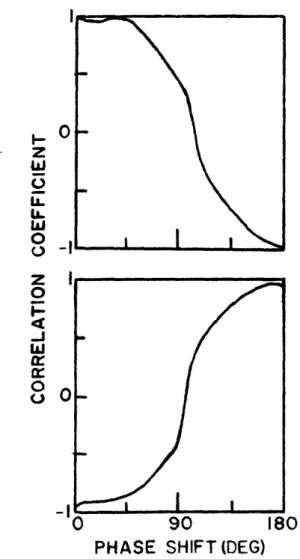
Ficure 2.4 illustrates typical SKS and SKKS record sections
and the corresponding power spectra, while Figure 2.5
13
and correlation technique. The results shown in Figure 2.5
indicate that SKKS phase lags (relative to SKS) obtained
Figure 2.1
Figure 2.2
Figure 2.3
Figure 2.4
Figure 2.5
Examples of long period SmKS arrivals:
A: 2/15/67 NUR-E; B: 6/5/70 ALQ-N; C: 2/15/67 HLW-E; D: 2/21/71 NOR-N; E: 4/20/70 KBL-E; F:
6/17/71 AAE-E; G: 4/16/70 AAE-N; H: 5/2/71 LPB-N; I: 3/27/70 TOL-E; J: 5/2/71 ANT-N; K: 8/13/71 N4B-E; L: 4/16/70 NAI-N; M: 1/29/71 BUL-N; N:
11/21/69 LE4-N; 0: 1/29/71 ARE-N; P: 8/30/70 LPB-E.
Examples of short period SmKS arrivals:
A: 10/7/68 JER-E; B: 10/7/68 HLW-E; C: 1/29/71 AAE-N; D: 8/4/69 UME-E; E: 1/29/71 CAR-N; F:
1/29/71 BAG-N; G: 3/17/66 SJG-E; H: 11/20/71 KBL-E; I: 8/4/69 GOL-E; J: 1/29/71 BUL-E; K: 1/29/71 PRE-N. Seismograms showing SV-polarization of SKS and
SKKS. A: 2/21/71 NUR; B: 11/20/71 KBL.
Power spectra for typical long period SKS and SKKS arrivals.
Determination of the SKKS phase lag (relative to SKS) using the phase shift and correlation
A= 100.65*
A=103.16*
=108.58*
A=109.98*
A=III.62*
A=114.58*
A= 105.32*
A=107.95*
y
I
I I I I I I I I I 1SKS SKKS
FIGURE 2.IA
IIIV IV ISKS
SKKS
60 SEC
ii
V
B''b
I II B II B 11 B I * I B I B I I I B B~A
A:118.400
A= 118.840
A=121.80*
N
0
p
B B I I I BIA
a B I I I B I B I B a I IL B II I iiiA=127.97*
A=131.42*
A=
132.520
SK SK KSKS
SKKS
FIGURE 2JB
60 SEC
SKS
SKKS
A= 88.580
Ii
A
=92.41*
C
A=96.42*
D
A=101.72*
E ~ I '4 I I I I I I I I III Infl
IA L=110.19**
A=112.25*
Ii ISKS
SKIKS
SKKS
FIGURE 2.2A
lull,.
11'*
iiI
I I I I I I I I I I~
I\MLhNAAfA~w\4bvv~M
k
A=119.61*
I I I I I I I A=123.37*A= 125.42*
A= 129.820K
I I I I I I I jSKKS
SKKKS
I I60 SEC
FIGURE 2.2B
SKS
:N-S
A=111.30*
AZIMUTH
=
259.31*
E-W
SKKS
S
(V'*'
1
N-S
A=119.70
0AZIMUTH
=
99.21*
%A
E-W
ISI
I
SKS
SKKS
FIGURE 2.3
A
I
SKS
0 0. -30 -40 0 -10 W- 2 0 -0 0--30 -40. 0 .04 .08 .12 16 20 FREQUENCY (HZ.) FIGURE 2.4
SKKS 11/21/69 LF3 - N SKKS ADVANCED 30* IN PHASE SKS SKKS 3/27/70 TOL- E 0 0 -c 90 180
PHASE SHIFT (DEG)
FIGURE 2.5 I
I
i9
V
SKKS ADVANCED 1710 IN PHASE
NW.W=Wmma SKS41
3. Study of the Core-Mantle Boundary
Recent studies of the core-mantle boundary (CMB)
have been based on PcP and ScS arrivals (Balakina et al.,
1966; Kanamori, 1967; Buchbinder, 1968; Vinnik and Dashkov, 1970; Ibrahim, 1971, 1973; Frasier, 1972; Kogan, 1972;
Berzon and Pasechnik, 1972; Bolt, 1972; Anderson and
Jordan, 1972), diffracted arrivals (Alexander and Phinney,
1966; Sacks, 1966, 1967) and free oscillations (Dorman et al., 1965; Derr, 1969). Since the nature and extent
of any CMB layering is one of the issues still subject
to considerable debate, we examined the SmKS data set to
determine what information can be obtained from waves
which sample the transmission and reflection response of
this interface.
Figure 3.1 illustrates theoretical amplitude and
phase curves for the CMB transmission and reflection
response. We have calculated these curves using the B2
model of Bullen and Haddon (1967). CMB incidence angles
for SKS and SKKS (assuming the B2 model and the
Jeffreys-Bullen Tables -- Travis 1965) are shown in Figure 3.2. This diagram indicates that SKKS transmits through the
CMB past the P-wave critical angle (2132.5*) for the
distance range 85*6A-135*. On the other hand, SKS
transmits through the CMB at angles less than critical
Figure 3.1, the passage of SKS through the CMB at
distances where this critical angle is reached should
produce a narrow amplitude minimum and region of phase
shift. Consequently, we isolate this feature in section
3.1 and then interpret our observations in terms of CMB model studies in section 3.2.
3.1 Data Base for the CMB Study
The observed long period SKS and SKKS amplitudes
(corrected for instrument magnification, azimuth and event
magnitude as described in section 2.3) are shown in Figure 3.3.
The scatter inherent in the present form of these data
prohibits their use for interpreting CMB properties.
However, valuable information can be extracted from the
SmKS data by using amplitude ratios (Kanamori, 1967), since
most of this scatter probably results from near source and
receiver effects. General expressions for observed SKS
and SKKS amplitudes are of the form:
A(f,A) = S(f,i,O) I(f,e,G) G(A) B(fA) D(f,A) 3.1
where S(f,i,O) is the source spectrum as a function of
frequency, take-off angle and azimuth; I(f,e,O) is the
instrument response spectrum as a function of frequency,
spreading factor; B(f,A) is the CMB response spectrum;
and D(f,A) is the attenuation spectrum given by
D(f,A) = exp(-t*f) 3.2
where t* =f ds
3v (S) Q TT'S)
SKS and SKKS take-off angles are shown in Figure 3.4. This diagram indicates that the upper mantle paths for
both wave types should be similar. Consequently, formation
of the amplitude ratio SKS/SKKS results in the approximate
cancellation of source and receiver uncertainties, and
hence a reduction in data scatter as shown in Figure 3.5.
We also show short period SKS/SKKS amplitude ratios in
this diagram for comparison, but these short period ratios
have not been corrected for any differences in frequency
content between SKS and SKKS.
Figure 3.6 illustrates the correlation between
amplitude ratio and phase information derived from the
data set. The amplitude ratio portion of this diagram
was obtained by taking the median value of Figure 3.5 in
1.0 degree intervals for 100* A: 135*. We found no evidence for an amplitude ratio minimum and phase shift
at A = 106*, but have isolated these features near
Figure 3.6 illustrates other regions (B through D) with
anomalous amplitude and phase values, we found that
these features occurred at distances which precluded
the possibility of their being an expression of CMB
transfer function effects. Consequently, we concentrate
on explaining region A in section 3.2 and then examine
the origin of features B through D in chapter 4.
3.2 Interpretation of the CMB Data Base
The results shown in Figure 3.1 as well as the
CMB model studies discussed in this section have been
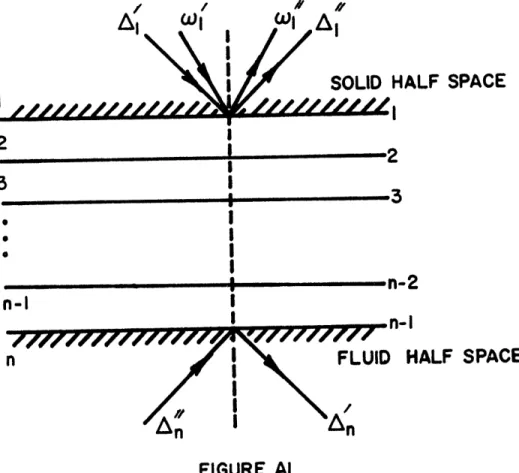
calculated using the propagator matrix technique for
homogeneous plane layers (Thomson, 1950; Haskell, 1953,
1962; Gilbert and Backus, 1966). These results are
subject to our basic assumption of plane waves and layers.
In order to evaluate the validity of assuming a plane
CMB, we invoked the Saggital Approximation for estimating
the effect of curvature (Born and Wolf, 1964). We find
that CMB curvature implies a/X ratios of 0.2% and 4% for
waves with periods of 1 and 35 seconds respectively (see
Figure 3.7 for nomenclature). Since the effect of
curvature is small for a/A ratios less than about 10%,
we conclude that the plane layer approximation should
not affect the basic results of this study.
differences calculated for the B2 model of Bullen and
Haddon (1967) are shown in Figure 3.8. We have calculated
these curves using the Jeffreys-Bullen travel times for
SKS and SKKS (Travis, 1965). All CMB models discussed
is this chapter are listed in Table 3.1. As noted earlier,
Jeffreys-Bullen p-A values reproduce the amplitude ratio
minimum and phase shift at A = 1060 rather than the observed distance of 1090-1100. Figure 3.8 also shows
that the computed amplitude ratios decay more rapidly
than our data beyond distances of about 1200.
The coefficient describing the partition of energy
for a mantle S wave which transmits through a non-layered
CMB and converts to a P wave in the core is given by:
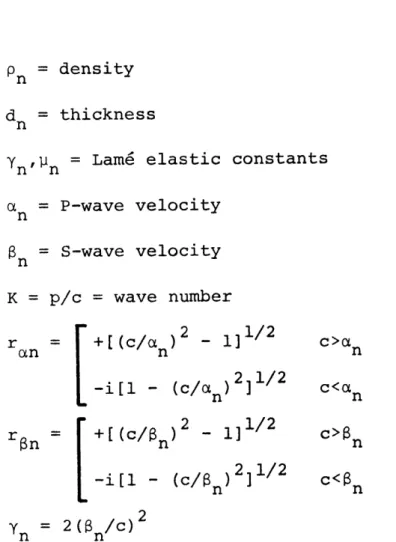
4 p2 3 (1-p26 )21/2 3.3 m m TSP p a (1-p2a ) 1/2 4p2 3 (l_ 2 t2) 1/2 (1_p2 2 ) 1/2 c m c m c m aY'2 --AM+ (1-4p2 2+4pF)4 4)+ C[m m p a (1-f#2(2 21/2 m mX m c m c
where p = ray parameter divided by the CMB radius ratio and subscripts m and c refer to parameters for the mantle
and core respectively. Equation 3.3 shows that the
amplitude ratio minimum and phase shift are associated with
the zero location of the term (1-p2a2)1
2 Bolt (1972) m
has found a mean wave slowness of about 4.55
t
0.05 sec./deg. for 1 waves diffracted at the core-mantle boundary.associated with TSP near region A implies that the SKS
p-A curve goes through the value 4.55 ± 0.05 sec./deg. at distances of about 109*-110*. We find that the
theoretical SKS p-A curve corresponding to our velocity model SKOR1 (chapter 4) passes through this critical
value at distances of about 107.5*. This distance
is in reasonable agreement with the observed location
for feature A. Since a preliminary SKS p-A curve was
used in constructing model SKOR1, we anticipate an
improved fit to the location of feature A once this
curve has been constrained to fit all of the SKS
observations. Consequently, to aid comparison with
our data at this time, we have set am = 13.86 km./sec. so that theoretical CMB transfer functions computed
using the present form of our p-A curves would pass
through the T5S minimum between 109* and 110*. Substituting 13.86 km./sec. for a m, we have
recalculated the CMB transfer function for the B2 model
of Bullen and Haddon using the p-A curves corresponding
to model SKOR1. The results of this calculation are
compared to our mediap SKS/SKKS amplitude ratio curve
and SKS-SKKS phase lag data in Figure 3.6. The theoretical
phase lag curve shown in this diagram has been given a
90* correction to compensate for the SKKS internal
fit to observed amplitude ratio data beyond distances
of about 1200 is due to the incorporation of our SKKS
p-A values in these calculations (primarily because of the high values of SKKS d 2T/dA2 for A = 115*-1200).
We next examined our ability to constrain a sharp
CMB model. We found that perturbations in ac and m by more than about ± 0.3 km./sec. (relative to the values
for model B2) were required to produce transfer function
changes which exceeded the present scatter in our data.
We also calculated CMB transfer functions for several
recently published models (Balakina et al., 1966;
Buchbinder, 1968). The results of these calculations
are shown in Figure 3.9. This diagram indicates that
the addition of small amounts of outer core ridigity
produces only minor perturbations to models with yic = 0 (and hence S c = 0). Consequently, this study does not allow us to place any constraints on this parameter. On
the other hand, theoretical amplitude ratios for the CMB
model proposed by Buchbinder (1968) do not fit our
observations. Buchbinder proposed this model
(characterized by a unity CMB density ratio and 7.5 km./
sec. value for ac ) to explain a PcP/P amplitude ratio
minimum and phase reversal near A = 32*. Our rejection of this model is in agreement with the results of Frasier
(1972), Berzon and Pasechnik (1972), Kogan (1972) and Chowdhury and Frasier (1973) which indicate that the
PcP/P amplitude ratio minimum and phase reversal do not
exist, but that the first PcP extremum is often buried
in noise near A = 32* making phase determination difficult. Having completed our study of sharp CMB models, we
examined theoretical transfer functions for models
incorporating layered transition zones in order to:
1) test our ability to resolve the extent of CMB layering; and 2) see if layered model results could provide an
improved fit to our data.
We first considered a transition zone model consisting
of a homogeneous layer of 100 kilometer thickness (model
#81 of Alexander and Phinney, 1966). Theoretical amplitude ratio and phase lag results for this model are shown in
Figures 3.10 and 3.11. Although observed phase lag data
were only obtained from long period signals, the amplitude
ratios shown in Figure 3.5 represent data from signals
with periods ranging from 1 to 45 seconds. We find no
evidence for the large variation in amplitude ratio with
period at distances less than about 110* shown in Figure
3.10. Consequently, we next considered a model in which the transition zone thickness was reduced to 30 kilometers
(model #94 of Alexander and Phinney, 1966). The theoretical
frequency which exceeded the extent of our data scatter.
Recently, several authors (Dorman et al., 1965; Ibrahim,
1971, 1973) have proposed CMB models consisting of a number of interbedded layers 10 to 15 kilometers thick. Figures
3.14 and 3.15 show theoretical CMB transfer function results
for the model of Dorman et al. (1965). As anticipated,
the results for this model are very similar to those for
a sharp CMB. In particular, the addition of a thin layer
transition zone does not improve the fit to our data.
3.3 Conclusions from the CMB Study
Theoretical transfer functions for layered and
non-layered CMB models have been compared to observed
SKS/SKKS amplitude ratios and SKS-SKKS phase lags. We
have isolated an SKS/SKKS amplitude ratio minimum and region
of SKS-SKKS phase shift near A = 109.50 due to the CMB transfer function, and find that our observations can be
explained reasonably well by a non-layered interface model
similar to the B2 model of Bullen and Haddon (1967), but
with am = 13.86 km./sec. We do not purport that 13.86
km./sec. represents a derived value for the compressional wave
velocity at the CMB. Rather, we indicate that this value
for am is required to compensate for the inaccuracy of our
not allow us to resolve variations in ac o c as suggested by Balakina et al. (1966). On the other hand, we conclude that the model of Buchbinder (1968) which incorporates a
CMB density ratio of unity does not imply transfer
functions which fit our data.
We also find that theoretical transfer functions for
models containing homogeneous transition zones 30 kilometers
or more in thickness exhibit a dependence on frequency which
exceeds the scatter of our data. However, this observation
does not preclude the existence of lateral variations in
the mantle's D" region as suggested by Alexander and
Phinney (1966), Toksoz et al. (1967), Husebye et al. (1971),
Davies and Sheppard (1972), Kanasewich et al. (1972), Vinnik
et al. (1972), Julian and Sengupta (1973) and Jordan and
Lynn (1973). Rather, it indicates that a single homogeneous
layer is an inadequate model for this region. If present,
we conclude that a CMB transition zone consists of homogeneous
layers less than about 10 to 15 kilometers in thickness. The
"sharpness" of this interface is also suggested by the
remarkable similarity of P, PcP and PKKKP for a given
CORE - MANTLE BOUNDARY MODELS
a (km/sec) a (km/sec) p (g/sec)
TRANSITION LAYER THICKNESS
(km)
B2 (Bullen and Haddon,1967) 13.64
8.128 Balakina et al. (1966) 13.64 8.128 Buchbinder Dorman et al. (1968) (1965) #81 (Alexander and 1966) Phinney, 13.64 7.51 13.69 13.0 11.6 10.2 8.15 13.6 13.3 8.3
#94 (Alexander and Phinney,
1966) 13.6 10.0 8.3 0 5.687 9.891 1:1.818 1:1 5.65 5.66 5.67 6.2 7.304 0 7.304 0.7 7.29 7.21 6.84 6.1 5.2 0 7.5 4.8. 0 7.5 2.8 100 9.4 5.5 6.7 9.5 5.5 6.7 9.5
FIGURE CAPTIONS Figure 3.1 Figure 3.2 Figure 3.3 Figure 3.4 Figure 3.5 Figure 3.6
Theoretical amplitude and phase curves for
CMB transmission and reflection coefficients.
Calculations were made assuming the B2 model
of Bullen and Haddon (1967).
SKS and SKKS CMB incidence angles calculated using the B2 model of Bullen and Haddon (1967)
and the Jeffreys-Bullen Tables for SKS and
SKKS (Travis 1965).
Observed long period SKS and SKKS amplitudes
(corrected for instrument magnification, azimuth
and event magnitude as described in section 2.3).
SKS and SKKS take-off angles assuming the ray parameters implied by equations 4.1 and 4.2 and
0 = 3.40 km./sec., 6500 = 5.28 km./sec.
SKS/SKKS amplitude ratios. Short period ratios
(solid circles) have not been corrected for
any differences in the frequency content of
SKS and SKKS.
Correlation between amplitude ratio and phase
lag data. Amplitude ratio curve (solid line)
was obtained by taking the median value of
Figure 3.7 Figure 3.8 Figure 3.9 Figure 3.10 Figure 3.11 Figure 3.12
B2 model of Bullen and Haddon (1967), (but with
am = 13.86 km./sec.) and the SmKS ray parameters corresponding to model SKORl.
Nomenclature for the Sagittal approximation
to curvature effect.
Theoretical SKS/SKKS amplitude ratios and SKKS
phase lags (relative to SKS) for the B2 model of
Bullen and Haddon (1967) and the Jeffreys-Bullen
travel times for SKS and SKKS (Travis 1965).
Theoretical SKS/SKKS amplitude ratios and SKKS
phase lags (relative to SKS) for the CMB models
of Balakina et al. (1966) and Buchbinder (1968).
Theoretical SKS/SKKS amplitude ratios as a
function of period for CMB model #81 of Alexander
and Phinney (1966).
Theoretical SKKS phase lags (relative to SKS)
as a function of period for CMB model #81 of
Alexander and Phinney (1966).
Theoretical SKS/SKKS amplitude ratios as a
function of period for CMB model #94 of
Figure 3.13
Figure 3.14
Figure 3.15
Theoretical SKKS phase lags (relative to SKS)
as a function of period for CMB model #94 of
Alexander and Phinney (1966).
Theoretical SKS/SKKS amplitude ratios as a
function of period for the CMB model of Dorman
et al. (1965).
Theoretical SKKS phase lags (relative to SKS)
as a function of period for the CMB model of
w
z
uJ
-180,
0
30
60
CMB INCIDENCE ANGLE (DEG)
FIGURE 3.1
SKS
--- SKKS901
w
0z
w
z
w
230
0120
DELTA (DEG)
FIGURE 3.2
ft.Nftaf-at ftft"*mtutf "fta af* No otff
01
0 00
od)c
80 8 ooo0-
C
0 0 00 00 o 0 0 00 0 0 00 0 00 Oo 0 0 00 00 000 00 06)
0 00 0 0 0 0 0o
0 0OCP
0 0 0 0 0 0120
DELTA (DEG)
I I130
100
1O1
120
DE LTA(DEG)
FIGURE 3.3
SKS
07-Co
z
0 LIcc
2
0 0 0o80
5--co 0 i I100
.I
110
130
5
|-0 000013>
-w s120
DELTA(DEG) FIGURE 3.4
w
a C,) .5 100110
120
130
DELTA (DEG)
FIGURE 3.5
0 00
0o-I
I
110gumbo*
01/ I
-9o006
0
0 L - o mm .. -0 0 0 000 0Q * 0 0 0 0 0 0 0 (A
1O1
S I120
DELTA (DEG)
FIGURE 3.6
130
0 o 6 0 "Jw
I-.J (L1801
901
0H--90
100
a IX2- 2X+2
2cR2
o SMALL
aze OXe
R
2 2 2y'
=X
2 R
X 2R
/Io~Nr WAVE
SAGGITAL
APPROXIMATION
FIGURE 3.7
DELTA (DEG)
FIGURE 3.8
43 0I-w
0-Dn -J360
270
CDw
*m w 0 010-270 180 90 0 -901--100 DELTA (DEG) 110 120 DELTA (DEG) FIGURE 3.9 -- --- BUCHBINDER (1968) 0
w
CCli.5
1300 4
w
0I-:3
0. 4 U,. Co Co CoDELTA (DEG)
FIGURE 3.10
110
120
130
DELTA (DEG)
FIGURE 3.11
OS
90 -0 0-90
L-100
'o --- - \WM , O --0
N-i
I
(01
i000W03
DETA(DG
F
cc
cnI
F
h
100
110
120 130DELTA (DEG)
FIGURE 3. 12
110 120 130 DELTA (DEG) FIGURE 3.14 5 0
w
C.
.5 c') 100DELTA (DEG)
FIGURE 3.15
4. Inversion of the Outer Core Velocity Structure
This chapter delineates our preliminary model for
the outer core velocity structure which has been inverted
to fit SmKS travel time and dT/dA observations. Since
our study indicates that the true nature of the SKS
travel time curve may be more complicated than previously
thought, we have decided not to invert specific details
of the velocity structure below a radius of about 2900
kilometers until a more sophisticated inversion
incor-porating PmKP data and an analysis for uniqueness has
been completed. Instead, we present a detailed analysis
of velocities in the core's outer 600 kilometers based on
dT/dA observations and travel times corresponding to SKKS, SKKKS, SKKKS-SKKS and SKKS-SKS. The remaining portions
of the core are constrained only by our SKKS-SKS time
differences and by the absolute times of the first SKS
arrivals. We should point out that the results presented
in this chapter are subject to any errors inherent in the
Jeffreys-Bullen ScS travel times used for "stripping"
the mantle contributions from our observations.
4.1 Constraints on the Velocity Structure for the Outer 600 Kilometers of the Core
Figure 4.1 shows the total SmKS travel time
data set. Those travel times corresponding to SKKS, SKKKS
data from Figure 4.2 were least squares fit with a second
degree polynomial in delta and the derivative taken in
order to obtain a ray parameter versus epicentral distance
table for SKS and SKKS. These polynomials (valid for
90*<A<135*) are given in equations 4.1 and 4.2
TSKS = 1481.28 + 4.5926 (A-105') - 0.0337 (A-105')2 4.1
TSKKS = 1523.99 + 7.0314 (A-105') - 0.0125 (A-105')2 4.2
where the RMS deviations are 1.84 and 2.28 seconds
respectively for SKS and SKKS. We compare SKS and SKKS
travel times corresponding to equations 4.1 and 4.2 to
those of Hales and Roberts (1971) and the Jeffreys-Bullen
Tables in Table 4.1. Since we have mainly used short
period data, the fact that our travel times are generally
shorter than those of Hales and Roberts (1971) may reflect
the effect of instrument group delay.
We next "stripped" the mantle contributions from
calculated epicentral distances using the relations
presented in equations 4.3 and 4.4 and the Jeffreys-Bullen
AK(SKS) = ASKSP - AScS(P) 4.3
AK(SKKS) = 1/2 [ASKKS(P) - A'O(P)] 4.4
This process provided us with ray parameter information
for core distances between 150 and 1200. Since
core-mantle boundary studies did not permit determination of
the outer core velocity at this interface, a technique
given by Randall (1970) was employed for this purpose.
This technique assumes that ( = 2danr/dknn is constant throughout the region of interest, and that as a
consequence, velocity follows the simple power law
v = vcmb (r/r cmb) (where n = r/v and a = §. = rdv/vdr= constant). Equations 4.5 and 4.6 (Randall, 1970) are
derived under this assumption and solved simultaneously
to provide estimates for vcmb'
tK = 2rcmb/(l-a)vcmb sin[AK(l-a)/2] 4.5
p = dtK/dAK = OTrcmb/l8 0 vcmb) cos [AK(1-)/2 4.6
This approach was applied to SKKS(90*-130*) and SKS(90*)
data on p, tK and AK. Values for vcmb obtained by this
method (assuming rcmb = 3485 kilometers) were grouped between 8.006 and 8.011 km./sec. using data from SKKS
bottoming depth increased. We show this trend in the
results of Table 4.2.
The values of v b which we have obtained are
slightly higher than the values of 7.893 to 7.909 km./sec.
obtained by Hales and Roberts (1971), but in good agreement
with the recently derived velocities of 8.02 km./sec.
(Jordan, 1973), 8.05 km./sec. (Toksoz et al., 1973) and
8.056 km./sec. (Qamar, 1973). It is important to note that similar to our results, Randall (1970) obtained a
relatively high value for vcmb (8.256 km./sec.) using
SKS data. This observation suggests that the simple velocity power law assumption may only be valid in the
outer few hundred kilbmeters of the core.
The p-AK curves obtained from equations 4.1 and 4.2
are compared to observed SKKS dT/dA values from LASA
and NORSAR in Figure 4.3. This diagram indicates that
the p-AK curve relevant to the determination of compressional
wave velocities in the upper 600 kilometers of the core
possesses structure not contained in the limited information
provided by travel times alone. In particular, our
observations indicate the existence of a significant
increase in the slope of the p-A K curve between core
distances of about 350 to 40*. This region of increased p-AK slopes corresponds to SKKS arrivals between epicentral
55
distances of about 1100 to 120*. Since the geometrical
spreading effect is proportional to
Id
2T/dA 21 (Bullen, 1965), we anticipate that this slope change should be reflected inour amplitude data. Figure 3.3 shows that this is indeed
the case. SKKS amplitudes increase rapidly with increasing
epicentral distance, reach a maximum between distances of
about 110* and 1200 and then decrease. We conclude that
this rapid slope increase in the p-AK curve is responsible
for the amplitude ratio minimum in region C of Figure 3.6.
Although this feature is localized between distances of
about 116* to 1200 in Figure 3.6, we believe that region C
encompasses the approximate distance range 1120<A<120* (the minimum being located near 117.50), but that SKS
focusing (discussed in section 4.3) is superimposed on this
feature in region B (112*<A<115*). As an independent check,
we examined SKKKS/SKKS amplitude ratios. Preliminary
results from this study shown in Figure 4.4 indicate that
the SKKKS/SKKS amplitude ratio gradually increases with
increasing delta until it reaches a maximum at distances
of about 1500 to 165*. This maximum location is consistent
with the results for SKKS.
Using 8.01 km./sec. as a starting value for vcmb' we
next examined a suite of p-AK models in order to determine
which ones would simultaneously fit our dT/dA data and
Figure 4.3 provided the best fit to both sets of data.
The resulting velocity structure (shown in Figure 4.3) is
characterized by a CMB velocity of 8.015 km./sec. and a
change in dv/dr from about -0.00155 sec~ for the outer
250 kilometers to a maximum of about -0.0022 sec near a radius of 3175 kilometers. These results are consistent
with those from the vcmb extrapolation, and the break down of the Randall technique for rays which bottom more
than a few hundred kilometers below the CMB. We should
point out that p-AK models which provided a better fit
to observed SKKS ray parameters less than about 6.2 sec./
deg..produced core velocities too high to satisfy our
travel time data for SKS and SKKS (A>l250).
Although a detailed analysis similar to the study
by Wiggins et al. (1973) should be made, a preliminary study indicates that the scatter in our SKS, SKKS, SKKKS,
SKKKS-SKKS and SKKS-SKS times constrain the model of Figure 4.3 within about ±0.02 km./sec (subject to
uncertainties in the Jeffreys-Bullen ScS times). We
discuss the fit to these travel times in section 4.2.
4.2 Analysis of Core Model SKORl
Having obtained a velocity model for the outer
600 kilometers of the core, we combined our p-AK data from section 4.1 with the SKS ray parameter data implied by
57
equation 4.1. The resulting p-AK curve was inverted
using the Herglotz-Wiechert technique to obtain our base
model for the outer core velocity structure. This velocity
model (SKORl) is compared to other core models in Figure
4.5 and listed in Table 4.3. Except for the change in
dv/dr between radii of 3050 and 3250 kilometers derived
in section 4.1, SKOR1 is similar to most of the other
recently derived core models (particularly the Bl model
of Jordan, 1973). As we discuss in section 4.3, however,
SKORI may require revision at radii less than about 2700
kilometers in order to satisfy our total SKS data set.
We first considered the fit of SKORl to our absolute
travel times. Figure 4.2 shows the comparison between
theoretical SKS, SKKS and SKKKS travel times computed for
SKORl and those observed in this study. The theoretical
travel times shown in this diagram all fall within the
limits of our data scatter, with SKS showing a slight
tendency to be earlier than our observed times at distances
qreater than about 100* (bottoming radius less than about
2700 kilometers). Next, we compared theoretical SKKKS-SKKS and SKKS-SKS time differences computed for SKOR1 to our
observed data. Figure 4.6 shows that these theoretical
time differences fall within the scatter of our data as
in the case of the absolute travel times.
spreading ratio computed for SKORl. We find that SKOR1
reproduces the amplitude ratio minimum at distances of
about 117.5*. It should also be noted that the decrease
in slope of our p-AK curve between 3 7*%AK%4 2* produces a region of high SKS/SKKS amplitude ratios between
120*%A%123* similar to our observations in region D of
Figure 3.6. Computed slopes of kn(ASKS/ASKKS) versus
frequency plots are shown in Figure 4.8. This diagram
indicates that the effect of attenuation may differ for
SKS and SKKS. Consequently, differences in SKS and SKKS attenuation, and possibly tunnelling effects (Richards,
1973) will have to be considered before theoretical amp-litude ratios such as those given in Figure 4.7 can be
placed in proper perspective to observed ratios.
As an independent check, we computed theoretical PKP
travel times for model SKOR1 and the mantle P wave
velocities from the Bl model of Jordan (1973). These
theoretical travel times are compared to the PKP times
of Perrin (1968) in Table 4.4. We find that theoretical
and observed PKPAB times agree within 0.5 seconds for
opicentral distances of 170* to 1500 (bottoming radius
greater than about 2250 kilometers), but that our times
are increasingly too long for rays bottoming below this
radius. We also find that our PKP focus location of
determined by Shahidi (1968). However, we do not
purport to have constrained velocities in the lower
portions of the outer core at this time.
4.3 Evidence for Additional SKS Travel Time Branches
The data presented in this section represent
preliminary observations indicative of additional SKS
travel time branches. As such, they are presented at
this time in order to provide insight into areas
requiring future study.
Figure 4.9 shows a comparison'between the p-A
curve implied by SKOR1 and our observed SKS ray
parameters. The data shown in this diagram indicates
that the SKS travel time curve may possess "secondary"
branches in addition to the AC-branch. Figure 4.1 shows
an alignment of arrivals between SKS and SKKS. Similar
observations were made by Gutenberg and Richter (1936).
These travel times may correlate with our dT/dA observations
between 5.0 and 5.5 sec./deg. Figure 4.10 shows a detailed
section of our travel time data for 85*<A<105*. It is
important to note that the triangles shown in this
diagram represent travel times for arrivals observed after
the initial SKS onset for a given seismogram. This diagram
shows that secondary SKS arrivals form a cusp at distances
distances where other "secondary" SKS arrivals have been
observed. This diagram illustrates one alignment of
arrivals which have a slope of about 4.0 sec./deg. These
data may correlate with the p-A structure observed at this
value of wave slowness in Figure 4.9. Figures 3.1 and 3.6
illustrate the presence of high SKS amplitudes and SKS-SKKS
phase shifts indicative of SKS focusing between distances of
1120 and 1150. The dT/dA observations near 4.0 sec./deg.
shown in Figure 4.9 suggest that this focusing may be
associated with the cusp of the proposed SKS branch.
Figure 4.11 also shows an alignment of arrivals
with a slope of about 3.1 sec./deg. These data may be
the SKS equivalent of the precursors to PKP. Figure 4.2
shows several examples of the observed "secondary" SKS
arrivals.
4.4 Conclusions From The Outer Core Velocity Study
We have obtained a preliminary model for the
outer core velocity structure based on absolute and
differential SmKS travel times. The main emphasis of
this study was that of constraining the outer 600 kilometers
start from a value of about 8.015 km/sec. at the CMB and
increase with a nearly constant rate in the outer 250
kilometers of the core. The rate of velocity increase
with increasing depth is significantly higher between
radii of about 3250 and 3050 kilometers, however.
We inverted an outer core velocity model (SKORl)
by using our results for the outer 600 kilometers and constraining the remaining depths with our travel times
for initial SKS onsets. SKOR1 possesses a positive
perturbation in compressional wave velocity (relative
to other recent core models) centered at a radius of
about 2500 kilometers. This feature is very similar to
the results given in the Bl model of Jordan (1973).
Section 4.3 of this chapter provided initial evidence
which indicates the existence of additional SKS travel
time branches. We are currently examining a combined
PmKP and SmKS data set in an effort to arrive at a
COMPARISON OF SKS AND SKKS TRAVEL (DEPTH OF FOCUS = 33 KM) DISTANCE 900 950 1000 1050 1100 1150 1200 1250 1300 EQUATION 4.1 1404.8 1432.0 1457.5 1481.3 1503.4 1523.8 1542.6 1559.6 1575.0 SKS
HALES AND ROBERTS
1405.8 1434.4 1460.7 1484.9 1506.8 1526.5 1544.0 1559.4 1572.5 J-B 1403.7 1432.0 1457.9 1481.4 1503.1 1522.8 1540.8 1556.7 1570.7 SKKS
EQUATION 4.2 HALES AND ROBERTS J-B
1415.7 1452.4 1488.5 1524.0 1558.8 1593.1 1626.7 1659.6 1692.0 1421.3 1458.4 1494.7 1530.2 1564.9 1598.8 1631.9 1664.0 1695.5 1413.0 1449.0 1485.0 1521.0 1556.0 1591.0 1625.0 1657.9 1690.9 TIMES
TABLE 4.2
RESULTS FROM VCMB EXTRAPOLATION
p (sec/deg) 7.4064 7.1564 6.9064 6.6564 6.4064 5.6392 t (sec) r( mi C km/sec) k (sc bottomning CMB 113.167 165.315 213.497 258.567 300.990 364.053 3435 3380 3310 3180 3020 2890 8.011 8.006 8.029 8.063 8.104 8.173 SOURCE SKKS SKKS SKKS SKKS SKKS SKS (900) (1000) (1100) (1200) (1300) (900) Ak (DEG) 15.028 22.191 29.043 35.688 42.183 53.298 -0.6913 -0.7680 -0.6706 -0.5728 -0.4888 -0.5285
MODEL SKOR1 RADIUS (km) 3485 3450 3400 3350 3300 3250 3200 3150 3100 3050 3000 2950 2900 2850 2800 2750 2700 2650 VELOCITY (km/sec) 8.015 8.072 8.149 8.230 8.308 8.389 8.482 8.592 8.667 8.730 8.807 8.879 8.950 9.022 9.096 9.155 9.219 9.283 RADIUS (km) 2600 2550 2500 2450 2400 2350 2300 2250 2200 2150 2100 2050 2000 1950 1900 1850 1800 VELOCITY 9.343 9.398 9.449 9.494 9.534 9.573 9.610 9.643 9.674 9.705 9.735 9.765 9.802 9.832 9.862 9.890 9.922 (km/sec)