HAL Id: hal-03038344
https://hal.inria.fr/hal-03038344
Submitted on 3 Dec 2020
HAL is a multi-disciplinary open access
archive for the deposit and dissemination of
sci-entific research documents, whether they are
pub-lished or not. The documents may come from
teaching and research institutions in France or
abroad, or from public or private research centers.
L’archive ouverte pluridisciplinaire HAL, est
destinée au dépôt et à la diffusion de documents
scientifiques de niveau recherche, publiés ou non,
émanant des établissements d’enseignement et de
recherche français ou étrangers, des laboratoires
publics ou privés.
Crowd Navigation in VR: exploring haptic rendering of
collisions
Florian Berton, Fabien Grzeskowiak, Alexandre Bonneau, Alberto Jovane,
Marco Aggravi, Ludovic Hoyet, Anne-Hélène Olivier, Claudio Pacchierotti,
Julien Pettré
To cite this version:
Florian Berton, Fabien Grzeskowiak, Alexandre Bonneau, Alberto Jovane, Marco Aggravi, et al..
Crowd Navigation in VR: exploring haptic rendering of collisions.
IEEE Transactions on
Visu-alization and Computer Graphics, Institute of Electrical and Electronics Engineers, 2020, pp.12.
�10.1109/TVCG.2020.3041341�. �hal-03038344�
Crowd Navigation in VR: Exploring Haptic
Rendering of Collisions
Florian Berton, Fabien Grzeskowiak, Alexandre Bonneau, Alberto Jovane, Marco Aggravi, Ludovic Hoyet,
Anne-H ´el `ene Olivier, Claudio Pacchierotti, Julien Pettr ´e
Fig. 1. Our objective is to understand whether and to what extent providing haptic rendering of collisions during navigation through a virtual crowd (right) makes users behave more realistically. Whenever a collision occurs (center), armbands worn on the arms locally vibrate to render this contact (left). We carried out an experiment with 23 participants, testing both subjective and objective metrics regarding the users’ path planning, body motion, kinetic energy, presence, and embodiment.
Abstract—Virtual reality (VR) is a valuable experimental tool for studying human movement, including the analysis of interactions
during locomotion tasks for developing crowd simulation algorithms. However, these studies are generally limited to distant interactions in crowds, due to the difficulty of rendering realistic sensations of collisions in VR. In this work, we explore the use of wearable haptics to render contacts during virtual crowd navigation. We focus on the behavioural changes occurring with or without haptic rendering during a navigation task in a dense crowd, as well as on potential after-effects introduced by the use haptic rendering. Our objective is to provide recommendations for designing VR setup to study crowd navigation behaviour. To this end, we designed an experiment (N=23) where participants navigated in a crowded virtual train station without, then with, and then again without haptic feedback of their collisions with virtual characters. Results show that providing haptic feedback improved the overall realism of the interaction, as participants more actively avoided collisions. We also noticed a significant after-effect in the users’ behaviour when haptic rendering was once again disabled in the third part of the experiment. Nonetheless, haptic feedback did not have any significant impact on the users’ sense of presence and embodiment.
Index Terms—Crowd, Human interaction, Haptic rendering, Virtual Reality
F
1
I
NTRODUCTIONVirtual Reality (VR) offers interesting opportunities for the study of human behaviours, including the possibility of accurately controlling experimental conditions, reproducing them across different subjects and trials, and easily accessing environmental information. For example, we use VR in crowd modelling and simulation for analysing the dynamics of local interactions between individuals in crowded envi-ronments [9].
To achieve good crowd models and simulations, we need to very well capture human behaviour. However, this is not an easy task, since human behaviour relies on many different variables and covers a wide range of interactions. Moreover, when running crowd behaviour experiments in Inria, Univ Rennes, M2S, CNRS, IRISA, France
e-mail: [email protected]
VR, there is a high chance that participants will behave differently from how they behave in real life. This mis-match is due to different reasons, most of them linked to the limited sense of realism that VR provides. In this respect, significant efforts have been put in the evalua-tion of the realism of behaviours in VR [16], [33], in the understanding of the visual information required [31] or in the development of highly-realistic VR environments and characters [1]. However, despite these efforts, most VR experiences still lack of any haptic sensation, which is of course of paramount importance when studying crowd behaviour and interactions. For example, if we are unable to render the sensation of bumping into virtual characters when navigating in a crowded environment, participants might stop avoiding collisions, leading to data that does not capture well how humans truly behave.For this reason,
studies of collective behaviour in VR are often limited to cases considering distant interactions only [38], [39], so as not to require any haptic feedback.
This paper explores the role of contact interactions (col-lisions) during navigation in a crowded environment. To do so, we employ a set of wearable haptic interfaces able to provide compelling vibrotactile sensations of contact to the user’s arms. Our objective is to investigate whether and to what extent the rendering of contacts influences the user’s behaviour in this context, as well as limits the occurrence of certain well-known artifacts, such as when the user’s virtual avatar interpenetrates other virtual characters. We conducted an experiment (N=23) where participants were equipped with four wearable haptic interfaces (two on each arm), and asked to navigate in a densely-crowded virtual train station. We evaluate objective metrics related to the user’s behaviour with respect to the crowd, as well as subjective metrics related to the user’s sense of presence and embodiment. First, we carried out the experiment without haptic rendering of contacts, then with haptic rendering, and finally once again without haptic rendering. This exper-imental design enables us to register the difference in user’s behaviour when activating the haptic feedback as well as the persistence of any relevant after-effect. These results are expected to help all researchers planning to use VR for studying human behaviour when navigating a crowded environment.
The rest of the paper is structured as follow. Section 2
summarizes the state of the art on the topic, comparing what has been presented in the literature to what we are propos-ing in this paper. Then, Section3describes the experimental setup, methods, and task. Section4presents the metrics we considered, based on the study of local body movements, trajectories, energy, contacts, embodiment, and presence. Section5discusses the results and analyses the differences between the considered conditions using inferential statis-tical analysis methods. Section6 discusses our findings as well as their implications for crowd experiments in VR. Finally, Section 7 draws the final remarks and discusses future work on the topic.
2
R
ELATEDW
ORK2.1 Pedestrian Interaction Behaviours
Understanding how pedestrians interact is a fundamental requirement for the design of realistic crowd simulators. To that purpose, several studies have been conducted in real conditions to investigate collective behaviours. For exam-ple, Seyfried et al. [44] have shown that speed depends on density in a crowd (i.e., fundamental diagram) and this relation is affected by cultural aspects [10]. Bonneaud et al. [6] showed that, without any instruction, collective behaviour can emerge within a group of walkers and this behaviour can be described according to several patterns, such as the anisotropy of interpersonal distance or speed synchronization. Some other studies focused on the local aspects of interactions. Using pairwise situations, authors previously showed that pedestrians adapt their motion only if there is a future risk of collision [35]. Authors considered the effect of situational factors such as crossing angle [24], [25], crossing order [34] or orientation [8] as well as personal
factors such as gender and personality [25] or body size [8] on motion adaptations. While these previous studies have considered the kinematics of the adaptions, other works were interested in the gaze activity, showing that it can predict future crossing order [17] and that gaze behaviour is task-dependent [22].
Nevertheless, interactions between humans are multi-factorial and challenging to fully control and standardize for studying purposes. To tackle this issue, recent works have proposed to use virtual reality to design new ex-periments on person-person interactions. A lot of effort has been put to validate this tool, both for the study of trajectory [33], [45] and gaze [4] behaviours. Studies agree that virtual reality is very promising for conducting such experiments, since the nature of the interactions is preserved and participants are expected to behave in the same way as in real conditions. However, some quantitative differ-ences have been observed, e.g., an increase of the crossing distance and larger head movements, which can be due to the distorted perception of distances and limitations of the field of view introduced by VR head-mounted displays. Nevertheless, VR opens large perspectives in the design of new experiments for understanding pedestrian behaviours. For examples, having only one participant at the same time, researchers were able to evaluate the effect of specific factors such as emotions of the crowd on participant behaviours and proxemics [7], [23], [49] or the effect of density on gaze behaviour [3], user experience [19] as well as navigation strategies when facing a group of moving people (i.e., going around or going through the group) [9].
While the interest of virtual reality is widely established for the study of interactions between pedestrians, studies in VR have mainly designed experimental paradigms which involved vision, proprioception as well as the vestibular system to perceive user actions and their surroundings in the virtual environment. It is worth to note that these studies did not provide haptic feedback to the users, which appears as an important input when dealing with person-person interactions and detection of collisions with other walkers, especially when navigating in dense crowds. Our paper can be seen as a continuation of previous work that explored realism of locomotion trajectories [16], [33] under various conditions of VR setup designs, while we now consider the effect of haptic rendering.
2.2 Virtual Realty and Collision Rendering
Immersive VR must actively engage one’s senses to make the human user feel truly part of the virtual world. This feeling of immersion is achieved through multiple types of features and information that flow from the virtual envi-ronment to the human user. Rich sensory feedback is of course a fundamental pillar of this feeling of immersion in VR, which includes the rendering of virtual contacts. Pacchierotti et al. [36] presented a review paper on wearable haptic devices used to render contact sensations at the fin-gertip and hand. Notable examples of this technology used for VR applications are [12], [14], [41], [43]. Collisions are of course not limited to the hand, especially when dealing with crowded environments. In this respect, Lindeman et al. [28], [29] developed a wearable haptic vest and belt capable
of providing distributed vibrotactile feedback sensations in VR. Vibrations were used to indicate a contact in the virtual environment or to provide information about areas of the environment yet to explore. More recently, Mestre et al. [32] performed an experiment where participants had to walk through a door with a variable width in VR with or without haptic rendering or 3d body representation. Haptic rendering was a vibrotactile feedback at the shoulders no-tifying users when they were in close vicinity of the door structure (from 10 cm until contact). Participants showed the same basic behaviour (shoulder rotation when passing a narrow door) with and without haptic rendering or body representation. Furthermore, the optimal behaviour to avoid collision with the door’s borders required the presence of body representation and vibrotactile feedback. Louison et al. [30] tested wearable vibrotactile feedback in an industrial VR training application. Participants wore a haptic sleeve on their right arm, which provided vibrotactile feedback sensations via ten vibrating motors. Users had to activate or deactivate a series of targets in VR, following a given order. Contacts between the environment and the user’s arm were rendered by vibrotactile feedback, where trials with vibro-tactile feedback showed a higher spatial awareness and less contacts with the environment. Bimbo et al. [5] employed eight vibrotactile motors in two armbands to provide the user with feedback information about the collisions between a robotic arm and the cluttered environment it operated in. A similar work was presented recently in [2]. Regarding interaction with virtual characters, Krogmeier et al. [26] designed an experiment where participants had to bump into a virtual character, with or without haptic rendering of contacts. This haptic rendering was performed using the “Tactsuit”1, equipped with 70 haptic points of contact. In this preliminary study, they showed that this kind of haptic feedback improves presence and embodiment. In another context, Krum et al. [27] were interested in the impact of different locomotion techniques and priming haptic render-ing on proxemics and subjective social measures durrender-ing interaction with a virtual character. The priming haptic rendering corresponded to a simulated touch by the virtual human. Their results showed that priming haptic rendering did not influence participant’s proxemics but influenced the subjective social measures. For instance, it improved the sympathy and the relation toward the virtual character. Furthermore, Faure et al. [20] asked participants to perform a collision avoidance task with a virtual character, while walking on a treadmill. They used a cable mechanism to render physical contacts, which increased the minimal distance between the participant and the virtual character, as well as made participants tend to initiate the avoidance strategy sooner.
All these studies focus on the interaction with one virtual character. However, to the best of our knowledge, no study designed an experiment where participants had to navigate in a dense virtual crowd while wearing haptic rendering de-vices. The use of tactile feedback therefore raises questions about their effect on participants’ behaviour, which sets the objective of our study, as described in the next section.
1.https://www.bhaptics.com/
3
E
XPERIMENTALO
VERVIEWThe purpose of this study is to investigate the effect of haptic rendering of collisions on participants’ behaviour during navigation through a static crowd in VR. To explore this question, we immersed participants in a virtual train station and asked them to perform a navigation task which involved moving through a crowd of virtual characters. In some conditions, collisions with the virtual characters were rendered to participants using 4 wearable vibrotactile haptic devices (actuated armbands). Our general hypothesis is that haptic rendering changes the participants’ behaviour by giving them feedback about the virtual collisions. Moreover, we also expect that even after removing haptic rendering, an after-effect still persists on the participants’ behaviour.
3.1 Materials & Methods
3.1.1 Apparatus
For the purpose of immersing participants in the virtual environment and investigating the potential effects of haptic rendering while navigating in groups of characters, we used the following devices, which are summarized in Figure2:
• Motion Capture: to record participants’ body mo-tions, as well as to render their animated avatar in the scene, we used an IMU-based (Inertial Measurement Unit) motion capture system (Xsens2). The Xsens system provides real-time, easy-of-use, reliable and accurate human motion tracking. IMU sensors were equipped on the participants using motion capture suit and straps, while body tracking was handled by the Xsens MVN Animate software and streamed to Unity in real time.
• HMD: to immerse participants in the virtual envi-ronment, we chose to use a Pimax3 virtual reality headset, in particular because of the wide field of view provided in these situations of close proximity with other characters (specifications: 90 Hz, 200◦f ov, 2560 × 1440 resolution). The HMD was used with 4 SteamVR 2.0 base stations, providing a tracking area of approximately 10×10 m. This setup enabled participants to physically walk in the real space, while their walking movements were displayed on their avatar in the size-matched virtual environment. • Haptic Rendering: to render haptic collisions be-tween participants and the virtual characters, we equipped participants with four armbands (one on each arm and forearm) [42]. Each armband is com-posed of four vibrotactile motors with vibration fre-quency range between 80 and 280 Hz and controlled independently. Motors are positioned evenly onto an elastic fabric strap (see Figure3). An electronics board controls the hardware. It comprises a 3.3 V Arduino Mini Pro, a 3.7 V Li-on battery, and a Bluetooth 2.1 antenna for wireless communication with the external control station.
• Computer: to let participants move freely in the environment, they were equipped with a MSI VR One backpack computer, which was running the 2.https://www.xsens.com/
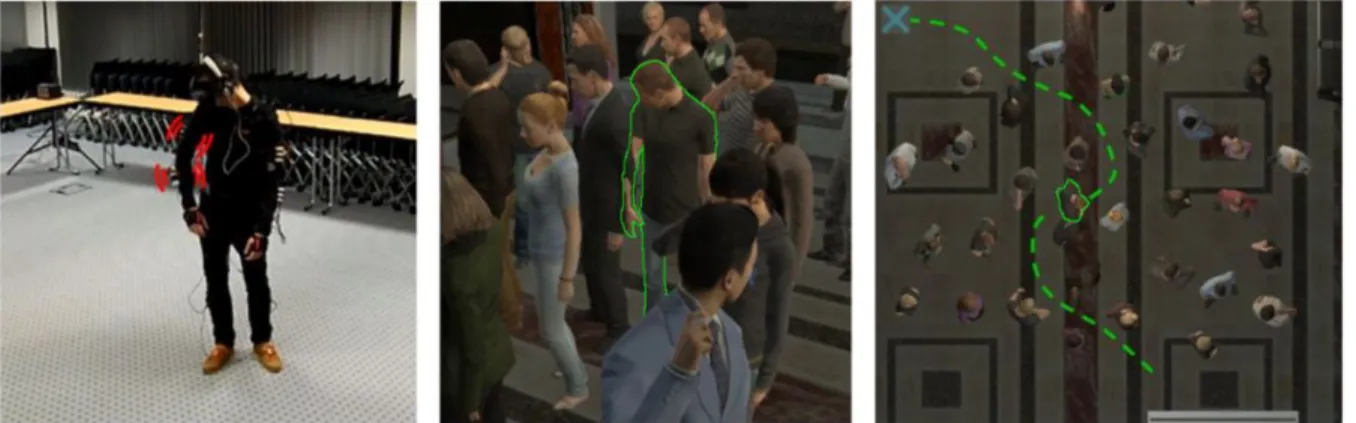
Fig. 2. Devices worn by participants during the experiment.
Fig. 3. Wearable vibrotactile armband, composed of four vibrating mo-tors (A). The electronics is enclosed in a 3D-printed case (B) [42].
experiment. All the devices were connected directly to this computer (specifications: NVidia GTX 1070, Intel Core i7-7820HK processor, 32 GB RAM). 3.1.2 Haptic rendering
Haptic rendering requires collisions to be detected in the VR environment. Since haptic devices were worn on par-ticipant’s arms, we detected collisions between their avatar (animated using the Xsens motion capture system) and the virtual crowd. To this end, we segmented each avatar’s arm into three parts (arm, forearm, and hand), and attached to each segment a Unity capsule collider that reported on col-lisions with other objects in the scene (see Figure4). When a collision was detected, that is if one of the six segments of the avatar entered in collision with the geometry of any virtual crowd character, one of the four haptic devices was activated. More specifically, colliders on the left (resp. right) virtual forearm and hand activated the armband located on participants’ left (resp. right) forearm, while colliders on the left (resp. right) virtual upper arm activated the armband located on participants’ left (resp. right) upper arm.
In terms of vibrations, each vibro-motor of an armband was driven using a single parameter called vibrotactile rate, which controlled both the amplitude and the frequency of vibration. During the experiment, all the motors of an activated armband were therefore controlled using the same vibrotactile rate, which varied according to a 10 Hz-period sine wave profile. The variation of the vibrotactile rate resulted in a frequency of vibration in the range of [ 57– 126 ] Hz. Although these motors can vibrate up to 255 Hz,
a) b)
Fig. 4. Male (a) and female (b) avatars used to represent the partici-pants in the virtual environment. For both avatars the capsule around each segment represents the solid used to compute collisions.
we decided to limit their range after participants in a pilot study reported the full vibrating range to be too strong.
Communication with the armbands was performed at 4 Hz, meaning that collisions with a duration lower than 250 ms were not rendered to participants, and that there was a maximum delay of 250 ms in activating (resp. stopping) the armbands after a collision was detected (resp. ended).
3.2 Environment & Task
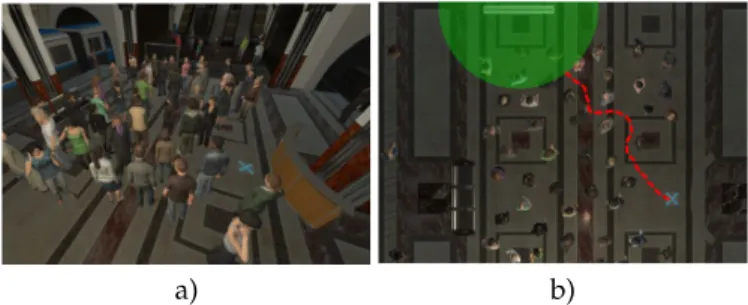
Participants were immersed in a digital reproduction of the metro station “Mayakovskaya” in Moscow, amongst a virtual static crowd (see Figure5). A total of 8 different con-figurations of the scene were prepared in advance and used in the experiment. A configuration is defined by the exact position of each crowd character in the virtual station. In each configuration, the crowd formed a squared shape, and character positions followed a Poisson distribution resulting in a density of 1.47 ± 0.06 character/m2. Such a distribution combined with such a level of density ensures that a gap of 0.60 m on average exists between each character. The crowd is composed of standing virtual characters animated with various idle animations (only small movement but standing in place). In each configuration, characters were animated according to two types of behaviour, either wait-ing (oriented to face the board displaywait-ing train schedules, moving slightly the upper body) or phone-calling (with a random orientation). We used several animation clips for each of the two behaviours, in order to prevent the exact same animation clip to be used for two different virtual characters.
At the beginning of each trial, participants were initially standing at one corner of the square crowd, embodied in a gender-matched avatar (see Figure4). They were instructed to traverse the crowd so as to reach the board displaying train schedules, and to read aloud the track number of the next train displayed on the board before coming back to their initial position. They were physically walking in the real room, while their position and movements were used to animate their avatar. This task required participants to reach the opposite corner of the space in order to read information on the board, while forcing them to move through the virtual crowd. Also, the screen displayed the train information only when participants were at less than 2 m from it (i.e., when they reached the green area displayed
a) b)
Fig. 5. Snapshots of the environment under two different points of view. Participants started from the blue cross on the floor, and were instructed to reach the screen board. Figure (b) displays an example trajectory in a red doted line. The screen displayed the train information only when participants reached the green area.
in Figure 5.b). Furthermore, we provided the following instruction to participants prior to the experiment: “Walk through the virtual train station as if you were walking in a real train station”.
3.3 Protocol
Upon arrival, participants were asked to fill in a consent form, during which they were presented the task to perform. They were then equipped with the equipment listed in Sec-tion3.1.1. Calibration of the Xsens motion capture system was then performed to ensure motion capture quality, as well as to resize the avatar to participants dimensions. Once ready, participants performed a training trial in which they could explore the virtual environment and get familiar with the task.
The experiment then consisted of 3 blocks of 8 trials, where the blocks were presented for all participants in the following order: NoHaptic1, Haptic, and NoHaptic2. The Haptic block corresponded to performing the task with haptic rendering of contacts, while the NoHaptic blocks did not involve any haptic rendering of contacts. The ex-periment therefore consisted in performing first a block without haptic rendering, in order to measure a baseline of participants’ reactions. The purpose of the second block was then to investigate whether introducing haptic rendering influenced their behaviour while navigating in a crowd, while the purpose of the last block (without haptic) was to measure potential after-effects. In each trial, participants performed the task described in Section 3.2 once. Each block was comprised of 8 trials, corresponding to the 8 crowd configurations presented in Section3.2, performed in a random order. At the end of each block, participants were asked to answer the Embodiment and Presence questionnaires (Tables 2, 3, 4 & 5) while remaining in the virtual envi-ronment. Finally, at the end of the experiment, participants filled in a demographic questionnaire.
3.4 Participants
Twenty-three unpaid participants, recruited via internal mailing lists amongst students and staff, volunteered for the experiment (8F, 15M; age: avg=26 ± 6, min=18, max=43). They were all naive to the purpose of the experiment, had normal or corrected-to-normal vision, and gave written and informed consent. The study conformed to the declaration
of Helsinki, and was approved by the Inria internal ethical committee (COERLE).
3.5 Hypotheses
H1: Haptic rendering will not change the path followed by participants through the crowd. Indeed, pedes-trians mainly rely on vision to control their loco-motion [37], [50], and we replicated each crowd configuration across the 3 blocks, resulting into iden-tical visual information for participants to navigate. Therefore the followed path will be similar in the tree blocks of the experiment (NoHaptic1, Haptic and NoHaptic2).
H2: Haptic rendering of collisions will make participants aware of collisions and influence their body motion during the navigation through the crowd. Therefore, concerning the NoHaptic1 and Haptic blocks of the experiment, we expect that:
H21: Participants will navigate in the crowd more carefully in the Haptic block in order to avoid collisions. There will be more local avoidance movements (e.g., increased shoulder rotations) and a difference in participants’ speed. H22: With theses changes on participants’ local
body motions, there will be both less collisions, and smaller volumes of interpenetration when a collision occurs.
H3: We expect some after-effect due to haptic rendering, i.e., we expect that participants will remain more aware and careful about collisions even after we disabled haptic rendering. Therefore we expect H21 and H22to remain true in the NoHaptic2 block. H4: Haptic rendering will improve the sense of presence
and the sense of embodiment of participants in VR, as they will become more aware of their virtual body dimensions in space with respect to neighbour virtual characters.
4
A
NALYSISThis section presents the collected data as well as the vari-ables used to evaluate our hypotheses.
4.1 Collected Data
During the experiment, we recorded at 45 Hz the trajectories of participants, as well as the position and orientation of their limbs in the virtual environment using the Xsens sensors and Unity. We also recorded the body poses over time of each character of the virtual crowd. Then, we were able to replay offline the entire trials in order to compute complex operations such as the volume of each collision.
4.2 Trajectories
To study H1, we compared participants’ trajectories through the virtual crowd. To this end, we decomposed the environ-ment into cells based on a Delaunay triangulation [11], the vertices of which were the crowd characters. A trajectory is then represented as a sequence of traversed cells. An
Fig. 6. Illustration of a participant’s trajectory in a crowd, and the decom-position of the environment in cells using Delaunay triangulation [11].
example is displayed in Figure 6, where the displayed trajectory corresponds to the following sequence of cells: C15C18C13C31C5C30C2C34C4.
Represented this way, comparison is possible only when the configuration of crowd characters is identical, which is one reason why we ensured to repeat the same configu-rations through the 3 studied blocks (cf. Section3). In other words, we first grouped trajectories by crowd configuration, and then compared the set of trajectories performed in the same crowd configuration across different conditions.
Comparison was based on the Dice similarity coefficient (DSC) [47]. The DSC computes the similarity between two sets A and B according to:
DSC(A, B) = 2|A ∩ B|
|A| + |B| (1)
Since our trajectories are sets of traversed cells, two trajectories traversing the same set of cells will be 100% similar. Similarity will decrease with the number of different cells traversed by the participant (occurring in one trajectory and not the other).
4.3 Body Motions
Navigating in cluttered environments, such as studied in this experiment, requires participants to weave with their body through the crowd. This section presents the data that will be used to analyse body movements when navigating through the virtual crowd to study H21.
4.3.1 Shoulder Rotation
Turning the shoulders is a known strategy for squeezing through narrow openings [51], i.e., in our case to get between two close characters. To evaluate the effect of haptic rendering on the emergence of such behaviours we measured the shoulder orientation at certain critical points of the path. These critical points are the crossing points between the Delaunay cell boundaries (cf. Section4.2) and the participant’s trajectories.
More specifically, we computed the angle αSA between the participants’ shoulder-to-shoulder axis and the segment connecting the two considered virtual characters, as shown in Figure7. This angle provides information about the orien-tation of the shoulders, and thus the trunk, at the narrowest parts of their path when participants passed between two characters. The larger this angle, the more careful – trying to lower their width at the maximum – participants were when traversing the opening between the two virtual characters.
Fig. 7. Shoulder rotation. AngleαSA∈ [0, 90]◦is defined between the
participants’ shoulder-to-shoulder axis and the segment connecting the two virtual characters. Left: top view of the scene. Right: diagram with the Delaunay triangles, the virtual characters, and the participant.
4.3.2 Walking Speed
Beyond the postural analysis introduced in the previous sec-tion, we are also interested in the walking speed to analyse whether participants performed the motion task differently according to conditions. To evaluate this parameter only during the navigation, we removed portions of trials where participants were mostly static (e.g., the time during which they were reading the board). To this end, we computed the minimum distance between the participant and the screen, which corresponds to the moment when participants stopped to read the information. We then removed all the frames when the participant’s position was less than one step from this position (chosen as 0.74 m for men and 0.67 m for women [15]).
4.4 Collisions
A collision is the detected contact between any part of the participant’s virtual body and any part of the mesh of one virtual character. We identify a collision by the pair participant-virtual character as well as the initial time. This means that we separately classify collisions with different characters, even if they are happening at the same time. This also means that we can detect several collisions with the same character but with different initial times. The detection starts at the first contact of any of the limbs of the character involved and the participant’s geometry, and it lasts until there is no more contact detected between the two respective meshes. To analyse the collisions we selected two main values of interest: the number of collisions and the maximum volume of interpenetration between the participant and the virtual character during a collision:
• Number of collisions. We count any collision with an interpenetration volume greater than 10−6 m3 and lasting more than 10 ms.
• Maximum volume of interpenetration. The maximum volume of interpenetration between a participant’s
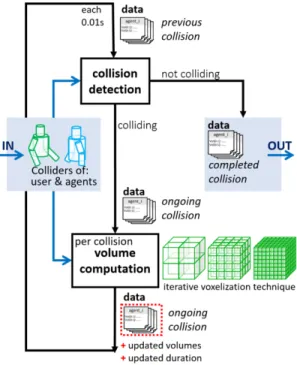
Fig. 8. Collision iteration loop scheme representing one step of the collision detection, in which we detect if there is a collision (either a new or an ongoing one) and compute its volume. We add this information to collision’s data. When the collision is finished we send out the data.
avatar and a virtual character during a collision is computed at each time stamp through the voxeliza-tion of the intersecvoxeliza-tion of their respective meshes, according to the following procedure. Each 10 ms the computation starts from the meshes of the two char-acters involved. Around those, we build an AABB (axis aligned bounding box), which is then iteratively subdivided in octant where, at each of this octant-iteration, only the voxels in collision are kept. The octant-iteration stops when the target voxel size is reached. In our analysis, it was set to a cube of width 0.01 m. This process is shown in Figure9. At the end we collect all the volumes computed at each time interval of 10 ms and we extract the maximum one.
4.5 Presence and Embodiment
Another important aspect of our analysis is its percep-tual relevance. In accordance with H4, we looked for any difference in the users’ feelings of presence and embodi-ment, comparing the registered subjective perception with and without haptic rendering. Participants answered both questionnaires at the end of each block (Embodiment then Presence), answering each question on a 7-point Likert scale. 4.5.1 Presence
Using an haptic device is generally expected to increase the user’s immersion in the virtual world [26], as it adds a new sensorial feedback, even though it does not always lead to an increase of perceived realism [46]. For this reason, we measured Presence using the Slater-Usoh-Steed (SUS) questionnaire [48] (Table5). Each user answered the set of 6 questions, summarized in Table5, at the end of each block.
a) b) c)
Fig. 9. Volume computation using iteration of voxel spaces of de-creasing dimensions. (a) Starting from the AABB around the selected geometries, the first voxel space with 8 voxels (green cubes) is created and intersected with the geometries. (b) In the next iteration only the in-tersecting voxels are kept, and further subdivided into 8 cubes each. (c) The process is iteratively applied until reaching the minimum subdivision size, where the final interpenetration volume is displayed in purple.
4.5.2 Embodiment
As for Presence, we focused on comparing the sense of embodiment between different blocks to study the influence of the haptic rendering on the perception of the virtual body. We measured embodiment based on the Roth and Latoschik questionnaire [40]. Participants answered Em-bodiment questionnaires simultaneously with those about Presence.
4.6 Statistical Analyses
Our objective is to understand whether and to what extent users change their behaviour in each experimental block. To do so, we analysed the differences across blocks for all the aforementioned variables.For all dependent variables, we set the level of significance to α = 0.05. First, a Shapiro-Wilk test was performed to evaluate whether the distribution of our data followed a normal distribution. If the distribution was not normal, a Friedman test was performed to evaluate the effect of the condition on these variables. Post-hoc comparisons were then performed using a Wilcoxon signed rank test with Bonferroni correction. On the other hand, if the distribution was normal, a one-way analysis of variance (ANOVA) with repeated measures was performed. Greenhouse-Geisser adjustments to the degrees of freedom were applied if the data violated the sphericity assumption. Bonferroni post-hoc tests were used to analyse any significant effects between groups.
5
R
ESULTSThis section presents the results of our experiment, starting with the study of H1 on the trajectories formed by par-ticipants through the virtual crowd. We then explore H21 and H22with respect to the analysis of body movements. Finally, we report the results on collision metrics so as to evaluate H3, to finish with the answers to the Presence and Embodiment questionnaires related to H4.
5.1 Trajectory Analysis
Table 1 shows the results of the Dice similarity measure between all possible pairs of blocks. Similarity ranges from 84.7% (Nohaptic1 vs. Haptic blocks) to 88.5% (Hap-tic vs. NoHap(Hap-tic2 blocks). The score is higher for Hap(Hap-tic
Fig. 10. Participants’ trajectories and Delaunay triangulation for trialT6 for blocks NoHaptic1 (left), Haptic (middle) and NoHaptic2 (right). The
color-bar represents the number of times participants walked on a triangle.
vs. Nohaptic2 blocks (88.6 ± 4.1%) and for Nohaptic1 vs. Nohaptic2 (85.9 ± 4.0%).
Because it is difficult to identity from this data only whether the obtained level of similarity is due to natural va-riety in human behaviours, or to the difference in conditions explored in each block, we propose to measure similarity between paths belonging to the same block as follows. For each block and each configuration, we randomly divided the trajectories into two subsets and computed the Dice similarity score between them. We repeated this process 30 times (which changes the way trajectories are divided into 2 subsets). Performing this process and computing similarity over the 3 blocks resulted into 90 measures of “intra-block similarity”. The obtained average value is 81.2 ± 3.3%, that can be compared with the “inter-block similarity” scores presented in Table1.
Our results show that there is no statistical difference between intra-block and Nohaptic1 vs. Haptic blocks simi-larity measure (p > 0.05). There is however a significant difference between intra-block and Haptic vs. Nohaptic2 blocks (p < 0.01), as well as intra-block and Nohaptic1 vs. Nohaptic2 (p < 0.05), where intra-block similarity measures are always lower. Given that similarity measures between pairs of blocks were either as similar or more similar than intra-block similarities, we can conclude that participants chose their path through the crowd similarly, irrespective of the block condition, which supports H1. To better illustrate the similarity in navigation paths, Figure10displays all the participants’ trajectories and the triangles used to compute the Dice for the specific T6configuration.
5.2 Body Motion
5.2.1 Shoulder Rotation
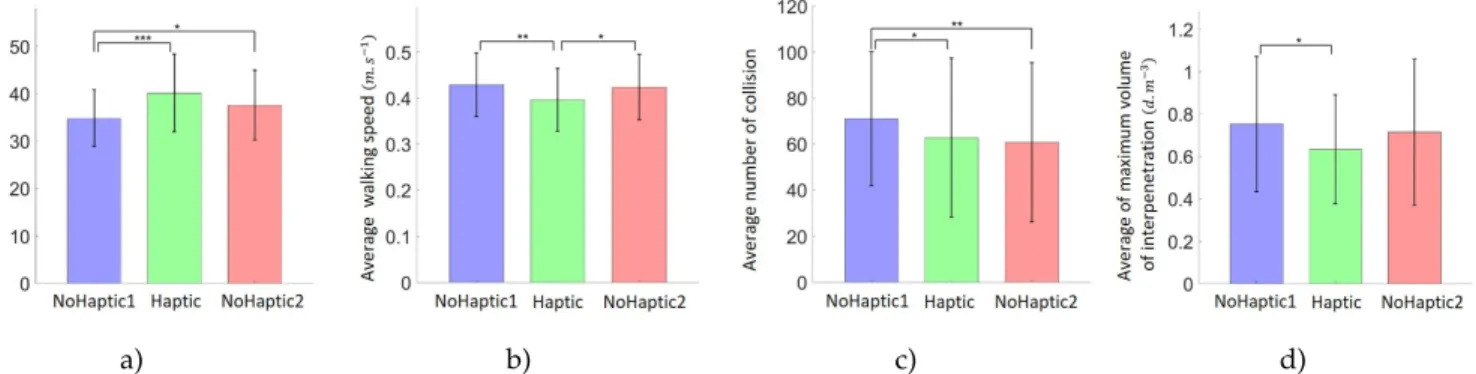
The average amplitude of shoulder rotations αSA, illus-trated in Figure 11.a, was significantly different in each block (F (2, 44) = 13.0, p < 0.001, ηp2 = 0.37). In partic-ular, it was significantly higher in the block with haptic rendering (40.1±8.2◦), than in the first block without haptic rendering (34.3 ± 6.0◦). We remind that a higher αSAangle means that participants made a larger rotation to squeeze
TABLE 1
Similarity measure (Dice) of participant trajectories between all blocks (NoHaptic1, Haptic, NoHaptic2) for all the trials.
Trials NoHaptic1 vs. Haptic Haptic vs. NoHaptic2Blocks NoHaptic1 vs. NoHaptic2
T1 84.0% 88.6% 85.0% T2 88.4% 93.8% 88.3% T3 78.1% 93.2% 79.4% T4 91.9% 88.7% 90.7% T5 88.4% 90.2% 85.3% T6 82.8% 85.8% 91.0% T7 78.8% 81.6% 82.0% T8 85.0% 85.9% 85.3% Tall TTallall 84.7 ± 4.8%84.7 ± 4.8%84.7 ± 4.8% 88.6 ± 4.1%88.6 ± 4.1%88.6 ± 4.1% 85.9 ± 4.0%85.9 ± 4.0%85.9 ± 4.0%
between virtual characters, therefore validating the hy-potheses H21. Furthermore, it was also significantly higher in block NoHaptic2 (38.7 ± 3.7◦) than in block NoHaptic1, suggesting that participants continued to turn more their shoulders even after haptic rendering was disabled, there-fore supporting H3.
5.2.2 Walking Speed
We found an effect of haptic rendering (F (1.56, 34.2) = 7.14, p = 0.005, ηp2 = 0.245) on participant’s average walking speed (Figure 11.b), where participants’ walking speed was on average significantly lower in theHaptic block (0.40 ± 0.07 m/s) than in the NoHaptic1 (0.43 ± 0.07 m/s) and NoHaptic2 (0.42±0.07 m/s) blocks. This result therefore supports hypothesis H21.
5.3 Collisions
Figures 11.c and 11.d illustrate the results regarding col-lision characteristics, i.e., number of colcol-lisions as well as volume of interpenetration.
The average number of collisions per trial was influ-enced by haptic rendering with a large effect (F (2, 44) = 7.13, p = 0.002, η2
p = 0.25). Post-hoc analysis showed that the number of collisions was higher during the NoHaptic1 block (71 ± 29.2) than during the Haptic (62.8 ± 34.6, p = 0.018) and NoHaptic2 blocks (60.7 ± 34.6, p = 0.002), which shows that participants made on average more colli-sions before they experienced haptic rendering.
a) b) c) d)
Fig. 11. Main significant differences between the three blocks of the experiment (NoHaptic1, Haptic and NoHaptic2): a) amplitude of shoulder rotations (αSA), b) walking speed, c) number of collisions per trial, d) volume of interpenetration. Error bars depict standard deviation of the mean.
The average volume of interpenetration was also influ-enced by the block (F (2, 44) = 4.35, p = 0.019, η2
p = 0.16), where post-hoc analysis showed that this volume was smaller (p = 0.016) in the Haptic block (0.6 ± 0.3 dm−3) than during the NoHaptic1 (0.8 ± 0.3 dm−3).
These results validate our hypothesis H22, that states that haptic rendering reduces the severity of collisions be-tween participants and virtual characters. Furthermore, as the number of collisions is higher during block NoHaptic1 than during block NoHaptic2, this also supports H3 on potential after-effects of haptic rendering.
5.4 Presence and Embodiment
The average participant ratings and all the questions for
embodimentare shown in Tables2,3and4. We did not find any significant effect of the blocks for Agency (p = 0.438), Change (p = 0.085) and Ownership (p = 0.753). Furthermore, Table 5 shows the questions and the average participant ratings for presence, for which we also did not find a significant effect of the blocks (p = 0.222). These results therefore do not support hypothesis H4, suggesting that haptic rendering does not improve the sense of presence or the sense of embodiment of participants in VR.
TABLE 2
Agency questionnaire: average participant ratings for the three blocks.
Questions blocks
NoHaptic1 Haptic NoHaptic2 The movements of the virtual body felt like
6.1 ± 0.9 6.0 ± 0.8 5.9 ± 0.7 they were my movements.
I felt like I was controlling the movements of the virtual body
I felt like I was causing the movements of the virtual body.
The movements of the virtual body were in sync with my own movements.
TABLE 3
Change questionnaire: average participant ratings for the three blocks.
Questions NoHaptic1 BlocksHaptic NoHaptic2
I felt like the form or appearance of my own
3.6 ± 1.3 3.8 ± 1.5 3.3 ± 1.5 body had changed.
It felt like the weight of my own body had changed.
I felt like the size (height) of my own body had changed.
I felt like the width of my own body had changed.
TABLE 4
Ownership questionnaire: average participant ratings for the three blocks.
Questions Blocks
NoHaptic1 Haptic NoHaptic2 It felt like the virtual body was my body.
4.9 ± 1.4 5.1 ± 1.2 5.0 ± 1.2 It felt like the virtual body parts were
my body parts.
The virtual body felt like a human body. It felt like the virtual body belonged to me.
TABLE 5
Slater-Usoh-Steed (SUS) questionnaire [48] and average participant ratings for the three blocks.
Questions NoHaptic1 BlocksHaptic NoHaptic2
I had a sense of being there in the train station.
5.2 ± 0.9 5.2 ± 1.2 5.0 ± 1.1 There were times during the experience when...
the train station was the reality for me... The train station seems to me to be more like... I had a stronger sense of...
I think of the train station as a place in a way similar to other places that I’ve been today. During the experience I often thought that I was really standing in the train station.
6
D
ISCUSSIONThe main objective of this study was to evaluate the effect of haptic rendering of collisions on participants’ behaviour while navigating in a dense virtual crowd. To this end, we designed an experiment where participants had to reach a goal by physically walking in a virtual train station populated with a dense crowd. Participants were equipped with vibrotactile sensors located on their arms and per-formed this task following 3 blocks: NoHaptic1, Haptic and NoHaptic2, for which haptic rendering of collisions with virtual characters was not experienced, experienced, and not experienced again, respectively.
6.1 Trajectories
In Section 5.1, the analysis of the Dice similarity measure showed that haptic rendering did not change the way par-ticipants selected their path through the crowd, as stated in hypothesis H1. We even found that paths across blocks were “more similar” than within the same block. One possible explanation is given by the way we compose the sets we compare the similarity of, where we assume that paths are independent from participants. Indeed, the intra-block similarity measure required us to split a set of trajecto-ries belonging to the same block and crowd configuration,
which resulted into comparing paths performed by different participants. In contrast, the inter-block analysis considered sets that were split according to haptic rendering conditions, thus comparing paths performed by the same group of 23 participants.
In spite of this limitation in our analysis, we consider that paths are similar across blocks. One can describe human motion as a trajectory resulting from a perception-action loop [21], [50]. Depending on the tasks, the loop is a multi-modal one, meaning that different senses are used to control motion. However in the context of walking, several studies [37], [50] have shown that vision is the most used perceptual input to navigate to the goal. Such statements hold in our case, where a major difference with previous work is the higher density of obstacles. Nevertheless, assuming that tactile feedback may affect path selection, it would have been probable that some participants reversed their course after a collision has been rendered, which was not observed.
6.2 Avoidance Behaviour
In this experiment, we demonstrated that haptic rendering had an effect on shoulder rotations, which supports hypoth-esis H21. In particular, participants rotated more their shoul-ders when traversing the gaps between virtual characters during the Haptic block than during the NoHaptic1 block. This result is consistent with the observations of Mestre et al. [32] with participants passing through a virtual half-open door with or without haptic rendering. More generally, let us remind that the human trunk is most often larger along the transverse axis than along the antero-posterior axis. Thus, the more the participants turn their shoulders the smaller the volume swept by their body motion. Our results therefore suggest that participants might have tried to minimize the risk of collision with virtual characters more in the condition where they experienced haptic rendering than in the first block of the experiment. The slower speed observed in the Haptic block also reveals that participants moved more cautiously.
Being more cautious effectively resulted into less colli-sions as expected in hypothesis H22. Results presented in Section5.3 show that the average number of collisions as well as the average volume of interpenetration were signifi-cantly lower in the Haptic block than in the NoHaptic1 block. Furthermore, this observation is consistent with previous studies [30] where haptic feedback lowered the number of collisions with a static object.
6.3 Haptic Rendering After-effects
While there were less collisions and more shoulder rota-tions observed in the Haptic block in comparison with the NoHaptic1 block, there was no difference between the Haptic and the NoHaptic2 blocks. This supports hypothesis H3 on potential after-effects of haptic rendering. However, such an after-effect did not equally influence all measurements, such as walking speed that increased again in the NoHaptic2 block. One possible explanation might be a perceptual cal-ibration of the participants. During the experiment, partici-pants became more familiar with the environment, the task to be performed, but also the virtual representation of their body and the virtual environment, enabling them to move
faster and better avoid collisions with the virtual characters in the last block (NoHaptic2). Another point to highlight is that participants, at the beginning of the Haptic block, did not know that contacts would now trigger a vibrotactile haptic sensation. For this reason, we might expect to see a short learning phase at the beginning of the block, where participants learn to deal with the newly-rendered haptic collisions. Considering this point, we can expect the effect of providing haptic sensations of collisions even stronger than registered. However, to provide a more definitive con-clusion on the role of the haptic after-effect would require to add a control group with no haptic rendering throughout the 3 blocks of the experiment, which could be explored in future work.
These results can also open perspectives regarding the design of new experiments including haptic priming tasks. In a recent study, Krum et al. [27] showed that haptic priming of collision had no effect on participants’ proxemics and more precisely on distances with a virtual character. It is important to note that the task was different: it included an interaction with one virtual character and there were no risks of collision since the virtual character never came very close to the participant. It would be interesting then to re-evaluate such influence when the intimate space is violated by a virtual character.
6.4 Embodiment and Presence
In contrast with our hypothesis H4, we did not find any significant change in terms of user’s perceived senses of em-bodiment and presence when experiencing haptic feedback. This result is quite surprising, as we did find significant effects in other measurements, suggesting that participants took different actions when provided with haptic sensations of contact. An explanation for this result could lie in the fact that users already registered high embodiment and presence levels without experiencing haptic feedback in the first condition (NoHaptic1), leaving little room for improvement in the Haptic condition. Another possibility is that vibrotac-tile feedback is not suited to render collisions in crowds, although there are several examples of this type of feedback being used to render similar events [5], [18]. Finally, a last explanation could be the location and number of our haptic devices. Employing a higher number of bracelets spread throughout the body might better render the target contact sensations. All these considerations will drive our future work.
6.5 Limitations
Our study had a few limitations. As explained above, we employed a limited number of haptic rendering devices located on participants arms only. It is quite possible that employing more devices, including some for the legs and hips, would have resulted in stronger effects. However, our setup still revealed significant effects, and the question of nature, number, and location of haptic devices would prob-ably require a fully dedicated study. Another related issue is the quality of the provided haptic sensations. Our devices show high wearability and portability, but can only provide vibrotactile haptic sensations. Other haptic delivery options include the use of arm or full-body exoskeletons, which
can provide well-rounded force sensations. However, these devices are significantly more cumbersome and expensive that those employed in this work, severely limiting their applicability and availability.
A second limitation concerns the behaviour of the virtual characters present in the crowd. Indeed, they do not react to collisions, as noticed by some participants in their feedback. It would therefore be required to have an animation tech-nique capable of reacting to collisions such as, for instance, the virtual character taking a step in the opposite direction of the collision. We could also trigger verbal reactions to express that virtual characters are embarrassed by collisions. Adding such virtual behaviours combined with haptic feed-back could improve participants’ immersion and feeling of presence.
Finally, one last point concerns the many devices (arm-bands, MSI VR one, HMD, X-Sens, etc.) required to be worn by participants for a significant amount of time. Carrying such equipment can have an effect on participants’ motion as well as comfort. In our case, the experience was still rela-tively short and lasted only for 15 to 20 minutes. However, longer immersion durations might require to use wireless HMD solutions instead, even if this today means decreasing the field of vision.
7
C
ONCLUSIONIn this paper, we designed an experiment to evaluate the effects, as well as the after-effects, of haptic rendering on a motion task in a highly crowded environment. Participants performed a goal-directed navigation task through a dense virtual crowd. Wearable haptic devices provided them with vibrotactile feedback whenever a collision with their arms occurred. Results showed that providing haptic feedback impacted the way participants moved through the virtual crowd. They were more cautious about the collisions they provoked with virtual characters, but they did not change their global trajectories. We also demonstrated the presence of an after-effect of haptic feedback, since changes in their movements remained after haptic feedback was disabled. Finally, quite surprisingly, we did not notice any impact of haptic rendering on the perceived Presence and Embodi-ment. These results show that visual information is probably the main sense used for navigation in dense crowds. How-ever, a combination of visual and haptic feedback improves the overall realism of the experience, as participants show a more realistic behaviour: they are more cautious about not touching virtual characters. For this reason, we therefore suggest using haptic rendering to study human behaviour and locomotion interactions that may lead to contacts.
For future work, we are interested in populating our virtual environments with more interactive and reactive virtual characters. This is a crucial aspect since it seems to be a requirement to further improve the feeling of presence of participants. Also, the use of reactive characters may increase the effect of haptic rendering, since we could ex-pect stronger participant reactions when virtual characters would also react after a collision. A more detailed analysis that evaluates motion before and after a collision is rendered and a virtual character reacts would then also be relevant to
study. We are also interested in carrying out experiments en-rolling more subjects and analysing a wider range of metrics in different scenarios (e.g., considering a dynamic crowd, measuring the effect on shoulder hunching, carrying out a control experiment where no haptics is applied).Finally, we plan to use more compelling wearable haptic devices to provide a more realistic sensation of collision while keeping the overall system compact and easy to wear, e.g., skin stretch [13] or tapping devices for the shoulder and upper arm.
A
CKNOWLEDGMENTSThis project has received funding from the European Union’s Horizon 2020 research and innovation programme under grant agreement No 779942 Crowdbot and No 856879 PRESENT, as well as from the ANR OPMoPS project (ANR-16-SEBM-0004).
R
EFERENCES[1] J. Achenbach, T. Waltemate, M. E. Latoschik, and M. Botsch. Fast generation of realistic virtual humans. In Proceedings of the 23rd ACM Symposium on Virtual Reality Software and Technology, pp. 1– 10, 2017.
[2] M. Aggravi, F. Paus´e, P. R. Giordano, and C. Pacchierotti. Design and evaluation of a wearable haptic device for skin stretch, pres-sure, and vibrotactile stimuli. IEEE Robotics and Automation Letters, 3(3):2166–2173, 2018.
[3] F. Berton, L. Hoyet, A.-H. Olivier, J. Bruneau, O. Le Meur, and J. Pettr´e. Eye-gaze activity in crowds: Impact of virtual reality and density. In 2020 IEEE Conference on Virtual Reality and 3D User Interfaces (VR). IEEE, 2020.
[4] F. Berton, A.-H. Olivier, J. Bruneau, L. Hoyet, and J. Pettr´e. Studying gaze behaviour during collision avoidance with a virtual walker: Influence of the virtual reality setup. In 2019 IEEE Conference on Virtual Reality and 3D User Interfaces (VR), pp. 717– 725. IEEE, 2019.
[5] J. Bimbo, C. Pacchierotti, M. Aggravi, N. Tsagarakis, and D. Prat-tichizzo. Teleoperation in cluttered environments using wearable haptic feedback. In Proc. IEEE/RSJ International Conference on Intelligent Robots and Systems (IROS), pp. 3401–3408, 2017. [6] S. Bonneaud, K. Rio, P. Chevaillier, and W. H. Warren. Accounting
for patterns of collective behavior in crowd locomotor dynamics for realistic simulations. In Transactions on Edutainment VII, pp. 1–11. Springer, 2012.
[7] A. B ¨onsch, S. Radke, H. Overath, L. M. Asch´e, J. Wendt, T. Vier-jahn, U. Habel, and T. W. Kuhlen. Social vr: How personal space is affected by virtual agents’ emotions. In 2018 IEEE Conference on Virtual Reality and 3D User Interfaces (VR), pp. 199–206, 2018. [8] S. M. Bourgaize, B. J. McFadyen, and M. E. Cinelli. Collision
avoidance behaviours when circumventing people of different sizes in various positions and locations. Journal of Motor Behavior, pp. 1–10, 2020.
[9] J. Bruneau, A.-H. Olivier, and J. Pettre. Going through, going around: A study on individual avoidance of groups. IEEE transac-tions on visualization and computer graphics, 21(4):520–528, 2015. [10] U. Chattaraj, A. Seyfried, and P. Chakroborty. Comparison of
pedestrian fundamental diagram across cultures. Advances in complex systems, 12(03):393–405, 2009.
[11] L. P. Chew. Constrained delaunay triangulations. Algorithmica, 4(1-4):97–108, 1989.
[12] F. Chinello, M. Malvezzi, D. Prattichizzo, and C. Pacchierotti. A modular wearable finger interface for cutaneous and kinesthetic interaction: control and evaluation. IEEE Transactions on Industrial Electronics, 67(1):706–716, 2019.
[13] F. Chinello, C. Pacchierotti, J. Bimbo, N. G. Tsagarakis, and D. Prat-tichizzo. Design and evaluation of a wearable skin stretch device for haptic guidance. IEEE Robotics and Automation Letters, 3(1):524– 531, 2017.
[14] F. Chinello, C. Pacchierotti, M. Malvezzi, and D. Prattichizzo. A three revolute-revolute-spherical wearable fingertip cutaneous de-vice for stiffness rendering. IEEE Transactions on Haptics, 11(1):39– 50, 2017.
[15] S. Cho, J. Park, and O. Kwon. Gender differences in three dimen-sional gait analysis data from 98 healthy korean adults. Clinical biomechanics, 19(2):145–152, 2004.
[16] G. Cirio, A.-H. Olivier, M. Marchal, and J. Pettre. Kinematic evaluation of virtual walking trajectories. IEEE transactions on visualization and computer graphics, 19(4):671–680, 2013.
[17] J. L. Croft and D. Panchuk. Watch where you’re going? interferer velocity and visual behavior predicts avoidance strategy during pedestrian encounters. Journal of motor behavior, 50(4):353–363, 2018.
[18] L. Devigne, M. Aggravi, M. Bivaud, N. Balix, S. Teodorescu, T. Carlson, T. Spreters, C. Pacchierotti, and M. Babel. Power wheelchair navigation assistance using wearable vibrotactile hap-tics. IEEE Transactions on Haptics, 2020.
[19] P. Dickinson, K. Gerling, K. Hicks, J. Murray, J. Shearer, and J. Greenwood. Virtual reality crowd simulation: effects of agent density on user experience and behaviour. Virtual Reality, 23(1):19– 32, 2019.
[20] C. Faure. Vers des environnements virtuels plus ´ecologiques: ´etude des modifications du comportement moteur en r´ealit´e virtuelle lors de l’ajout d’informations haptiques par un m´ecanisme parall`ele entraˆın´e par cˆables. 2019.
[21] J. J. Gibson. Visually controlled locomotion and visual orientation in animals. British journal of psychology, 49(3):182–194, 1958. [22] R. S. Hessels, A. J. van Doorn, J. S. Benjamins, G. A. Holleman, and
I. T. Hooge. Task-related gaze control in human crowd navigation. Attention, Perception, & Psychophysics, pp. 1–20, 2020.
[23] P.-H. Huang and S.-K. Wong. Emotional virtual crowd on task completion in virtual markets. Computer Animation and Virtual Worlds, 29(3-4):e1818, 2018.
[24] M. Huber, Y.-H. Su, M. Kr ¨uger, K. Faschian, S. Glasauer, and J. Hermsd ¨orfer. Adjustments of speed and path when avoiding collisions with another pedestrian. PloS one, 9(2), 2014.
[25] A. G. Knorr, L. Willacker, J. Hermsd ¨orfer, S. Glasauer, and M. Kr ¨uger. Influence of person-and situation-specific charac-teristics on collision avoidance behavior in human locomotion. Journal of experimental psychology: human perception and performance, 42(9):1332, 2016.
[26] C. Krogmeier, C. Mousas, and D. Whittinghill. Human, virtual human, bump! a preliminary study on haptic feedback. In 2019 IEEE Conference on Virtual Reality and 3D User Interfaces (VR), pp. 1032–1033, 2019.
[27] D. M. Krum, S.-H. Kang, and T. Phan. Influences on the elici-tation of interpersonal space with virtual humans. In 2018 IEEE Conference on Virtual Reality and 3D User Interfaces (VR), pp. 223–9, 2018.
[28] R. W. Lindeman, R. Page, Y. Yanagida, and J. L. Sibert. Towards full-body haptic feedback: the design and deployment of a spa-tialized vibrotactile feedback system. In Proceedings of the ACM symposium on Virtual reality software and technology, pp. 146–149, 2004.
[29] R. W. Lindeman, Y. Yanagida, H. Noma, and K. Hosaka. Wearable vibrotactile systems for virtual contact and information display. Virtual Reality, 9(2-3):203–213, 2006.
[30] C. Louison, F. Ferlay, and D. R. Mestre. Spatialized vibrotactile feedback improves goal-directed movements in cluttered virtual environments. International Journal of Human–Computer Interaction, 34(11):1015–1031, 2018.
[31] S. D. Lynch, R. Kulpa, L. A. Meerhoff, J. Pettre, A. Cretual, and A.-H. Olivier. Collision avoidance behavior between walkers: global and local motion cues. IEEE transactions on visualization and computer graphics, 24(7):2078–2088, 2017.
[32] D. R. Mestre, C. Louison, and F. Ferlay. The contribution of a virtual self and vibrotactile feedback to walking through virtual apertures. In International Conference on Human-Computer Interac-tion, pp. 222–232. Springer, 2016.
[33] A.-H. Olivier, J. Bruneau, R. Kulpa, and J. Pettr´e. Walking with virtual people: Evaluation of locomotion interfaces in dynamic environments. IEEE transactions on visualization and computer graphics, 24(7):2251–2263, 2017.
[34] A.-H. Olivier, A. Marin, A. Cr´etual, A. Berthoz, and J. Pettr´e. Col-lision avoidance between two walkers: Role-dependent strategies. Gait & posture, 38(4):751–756, 2013.
[35] A.-H. Olivier, A. Marin, A. Cr´etual, and J. Pettr´e. Minimal pre-dicted distance: A common metric for collision avoidance during pairwise interactions between walkers. Gait & posture, 36(3):399– 404, 2012.
[36] C. Pacchierotti, S. Sinclair, M. Solazzi, A. Frisoli, V. Hayward, and D. Prattichizzo. Wearable haptic systems for the fingertip and the hand: taxonomy, review, and perspectives. IEEE Transactions on Haptics, 10(4):580–600, 2017.
[37] A. E. Patla. Understanding the roles of vision in the control of human locomotion. Gait & Posture, 5(1):54–69, 1997.
[38] K. Rio and W. H. Warren. The visual coupling between neighbors in real and virtual crowds. Transportation Research Procedia, 2:132– 140, 2014.
[39] K. W. Rio, G. C. Dachner, and W. H. Warren. Local interactions underlying collective motion in human crowds. Proceedings of the Royal Society B: Biological Sciences, 285(1878):20180611, 2018. [40] D. Roth and M. E. Latoschik. Construction of a validated virtual
embodiment questionnaire. arXiv preprint arXiv:1911.10176, 2019. [41] S. V. Salazar, C. Pacchierotti, X. de Tinguy, A. Maciel, and M.
Mar-chal. Altering the stiffness, friction, and shape perception of tangible objects in virtual reality using wearable haptics. IEEE transactions on haptics, 13(1):167–174, 2020.
[42] S. Scheggi, M. Aggravi, and D. Prattichizzo. Cooperative naviga-tion for mixed human–robot teams using haptic feedback. IEEE Transactions on Human-Machine Systems, 47(4):462–473, 2016. [43] S. B. Schorr and A. M. Okamura. Three-dimensional skin
defor-mation as force substitution: Wearable device design and perfor-mance during haptic exploration of virtual environments. IEEE transactions on haptics, 10(3):418–430, 2017.
[44] A. Seyfried, B. Steffen, W. Klingsch, and M. Boltes. The fundamen-tal diagram of pedestrian movement revisited. Journal of Statistical Mechanics: Theory and Experiment, 2005(10):P10002, 2005.
[45] W. S. Silva, G. Aravind, S. Sangani, and A. Lamontagne. Healthy young adults implement distinctive avoidance strategies while walking and circumventing virtual human vs. non-human obsta-cles in a virtual environment. Gait & posture, 61:294–300, 2018. [46] M. Slater. A note on presence terminology. Presence connect, 3(3):1–
5, 2003.
[47] T. J. Sørensen. A method of establishing groups of equal amplitude in plant sociology based on similarity of species content and its application to analyses of the vegetation on Danish commons. I kommission hos E. Munksgaard, 1948.
[48] M. Usoh, E. Catena, S. Arman, and M. Slater. Using presence ques-tionnaires in reality. Presence: Teleoperators & Virtual Environments, 9(5):497–503, 2000.
[49] M. Volonte, Y. C. Hsu, K.-y. Liu, J. Mazer, S.-K. Wong, and S. Babu. Effects of interacting with a crowd of emotional virtual humans on users’ affective and non-verbal behaviors. In 2020 IEEE Conference on Virtual Reality and 3D User Interfaces (VR). IEEE, 2020.
[50] W. Warren. Visually controlled locomotion: 40 years later. Ecologi-cal Psychology, 10(3-4):177–219, 1998.
[51] K. Wilmut and A. L. Barnett. Locomotor adjustments when navigating through apertures. Human Movement Science, 29(2):289– 298, 2010.
![Fig. 3. Wearable vibrotactile armband, composed of four vibrating mo- mo-tors (A). The electronics is enclosed in a 3D-printed case (B) [42].](https://thumb-eu.123doks.com/thumbv2/123doknet/14460291.520350/5.918.75.444.69.338/wearable-vibrotactile-armband-composed-vibrating-electronics-enclosed-printed.webp)
![Fig. 6. Illustration of a participant’s trajectory in a crowd, and the decom- decom-position of the environment in cells using Delaunay triangulation [11].](https://thumb-eu.123doks.com/thumbv2/123doknet/14460291.520350/7.918.114.392.86.365/illustration-participant-trajectory-crowd-position-environment-delaunay-triangulation.webp)