Cookie Clicker
by
Kai Yuanqing Xiao
S.B., C.S. M.I.T., 2017
Submitted to the Department of Electrical Engineering and Computer Science
in partial fulfillment of the requirements for the degree of
Master of Engineering in Electrical Engineering and Computer Science
at the
Massachusetts Institute of Technology
February 2018
c
○2018 Kai Y. Xiao. All rights reserved.
The author hereby grants to MIT permission to reproduce and to distribute
publicly paper and electronic copies of this thesis document in whole or in
part in any medium now known or hereafter created.
Author . . . .
Department of Electrical Engineering and Computer Science
Feb 2, 2018
Certified by . . . .
Erik D. Demaine
Professor
Thesis Supervisor
Accepted by . . . .
Christopher J. Terman
Chairman, Masters of Engineering Thesis Committee
Cookie Clicker
by
Kai Yuanqing Xiao
Submitted to the Department of Electrical Engineering and Computer Science on Feb 2, 2018, in partial fulfillment of the
requirements for the degree of
Master of Engineering in Electrical Engineering and Computer Science
Abstract
Cookie Clicker1 is a popular online incremental game where the goal of the game is to
gen-erate as many cookies as possible. In the game you start with an initial cookie generation rate, and you can use cookies as currency to purchase various items that increase your cookie generation rate. In this paper, we analyze strategies for playing Cookie Clicker optimally. While simple to state, the game gives rise to interesting analysis involving ideas from NP-hardness, approximation algorithms, and dynamic programming.
This is joint work with Erik D. Demaine2, Hiro Ito3, Stefan Langerman4, Jayson Lynch2, and Mikhail Rudoy5.
Thesis Supervisor: Erik D. Demaine Title: Professor
1http://orteil.dashnet.org/cookieclicker/ 2CSAIL, Massachusetts Institute of Technology 3University of Electro-Communications
4Directeur de Recherches du F.R.S.-FNRS, Université Libre de Bruxelles 5CSAIL, Massachusetts Institute of Technology; now at Google
Acknowledgments
I would like to thank Erik D. Demaine for supervising me, as well as the other co-authors who contributed to this work - Hiro Ito, Stefan Langerman, Jayson Lynch, and Mikhail Rudoy. I would also like to thank Wenkai Lei for various discussions about this topic.
Contents
1 Introduction 9 1.1 Models . . . 10 1.2 Results . . . 10 1.3 Useful Tools . . . 11 2 Positive Results 17 2.1 1-Item Cookie Clicker Solution . . . 172.2 Fixed-Cost Cookie Clicker for 2 Items . . . 19
2.3 Fixed-Cost Cookie Clicker for 𝑘 Items . . . 26
2.3.1 Dynamic Programming Solution . . . 27
2.3.2 Local Optimizations . . . 27
2.4 Increasing-Cost Cookie Clicker for 𝑘 Items . . . 28
2.4.1 Dynamic Programming Solution . . . 28
2.4.2 Greedy Solutions . . . 30
2.4.3 Approximation Ratio . . . 30
3 Negative Results 41 3.1 𝑅 version is at least as hard as 𝑀 version . . . 41
3.2 Weak NP-hardness of 𝑅 version . . . 42
3.3 Cookie Clicker with Initial Cookies . . . 44
3.3.1 Dynamic Programming Solution . . . 44
3.3.2 Weak NP-hardness of Cookie Clicker with Initial Cookies . . . 45
Chapter 1
Introduction
Figure 1-1: Screenshot of Cookie Clicker v.2.002. In Cookie Clicker, your goal is
to generate as many cookies as possible. You can click on a big cookie icon to bake a cookie, and you can also purchase items that automatically generate cook-ies for you over time. We model the ability to click on the big cookie icon as an initial cookie generation rate. You can use the cookies you have generated as currency to purchase various items that increase your cookie generation rate. Items can be purchased multiple times, but
af-ter each item purchase, the item’s cost will increase at an exponential rate, given by 𝐶𝑛 = 𝐶1 · 𝛼𝑛−1, where 𝐶1 is the cost of the first item and 𝐶𝑛 is the cost of item 𝑛. In
the actual game, 𝛼 = 1.15. The real game has no explicit end condition, but in this paper we define two possible end conditions: reaching a certain number 𝑀 of cookies, or reaching a certain cookie generation rate 𝑅.
Cookie Clicker falls into a broader class of popular online games called incremental games or idle games [Wik14], in which the primary mechanic of the game is acquiring income and spending that income on income generators in order to acquire even more income. Some other well-known games in this genre include Adventure Capitalist, Cow Clicker, Clicker Heros, Shark Souls, Kittens Game, Egg Inc., and Sandcastle Builder (based on the xkcd comic 1190, Time).
1.1
Models
In most of this paper, we will assume that you start with 0 cookies and that the initial cookie generation rate from clicking on the big cookie icon is 1. We will describe each item by a tuple (𝑥, 𝑦, 𝛼), where 𝑥 denotes how much the item will increase your cookie generation rate, 𝑦 denotes the initial cost of the item, and 𝛼 denotes the multiplicative increase in item cost after each purchase. The case where 𝛼 = 1 for every item is a special case called the fixed-cost case. The goal of the game is to find the optimal sequence and timing of item purchases that optimizes some objective.
There are multiple possible objectives that we could want to optimize for, but we focus on the following two:
1. Reaching 𝑀 cookies in as little time as possible
2. Reaching a generation rate of 𝑅 in as little time as possible
We will usually begin by discussing the 𝑀 version of the problem and then explain how to extend our results to the 𝑅 version. A third natural objective is to maximize the number of cookies 𝑀 or the generation rate 𝑅 achieved given a total amount of time 𝑇 , and it can be solved by any algorithm that solves the first two variants using binary search on the values of 𝑀 and 𝑅.
1.2
Results
Our analysis of various versions of Cookie Clicker gives rise to interesting and varied results; refer to Table 1.1. First, we present some general results, such as the fact that the optimal
strategy involves a Buying Phase where items are purchased in some sequence as quickly as possible, and then a Waiting Phase where no items are purchased.
We begin our version-by-version analysis by examining the case where exactly 1 item is available for purchase, and we present formulas describing how many copies of the item should be purchased in both the fixed-cost case and increasing-cost case.
Next, we analyze cases involving 2 items. In the 2-item fixed-cost case, we prove that the optimal solution always involves consecutively buying some number of copies of one item, followed by consecutively buying some number of copies of the other item.
Then, we analyze the case involving 𝑘 items. In the 𝑘-item fixed-cost case, a weakly polynomial time dynamic programming solution can be used to find the optimal sequence of items to buy, and in the increasing-cost case, a strongly polynomial time dynamic pro-gramming solution can be used. Additionally, a greedy algorithm can be devised with an approximation ratio that approaches 1 for sufficiently large values of 𝑀 .
Afterwards, we present negative results, including proofs of weak NP-hardness of the decision version of the problem of reaching a generation rate of R as quickly as possible, as well as for a version of Cookie Clicker that allows you to start with a nonzero number of cookies. Finally, we define a discretized version of Cookie Clicker where decisions regarding whether or not to buy an item happen in discrete time steps and prove strong NP-hardness for that version.
Python implementations of the dynamic programming solution and the greedy solutions to the General Cookie Clicker problem, and the dynamic programming solution to the Fixed-Cost Cookie Clicker problem, are available.1
1.3
Useful Tools
Before proceeding to our main results, we develop some useful tools for finding optimal solutions for playing Cookie Clicker. We present these tools and show how they are applied to the 1-Item Case, but these tools are applicable to all versions of the game.
First, we can define a game state as a tuple (𝑐, 𝑛1, 𝑛2, . . . , 𝑛𝑘) where 𝑐 is the number of
1
Problem Variant Result for 𝑀 version Result for 𝑅 version 1-Item Fixed-Cost with item
(𝑥, 𝑦, 1) [§2.1]
OPT takes ≈ 𝑦𝑥ln𝑀𝑦 time 𝑂(1) to compute OPT
OPT takes ≈ 𝑦𝑥ln𝑅𝑥 time 𝑂(1) to compute OPT 1-Item Increasing-Cost with
item (𝑥, 𝑦, 𝛼) [§2.1]
OPT will stop Buying Phase after log𝛼 𝑀𝑦 items
𝑂(1) to compute OPT
OPT will stop Buying Phase after 𝑅𝑥 items
𝑂(1) to compute OPT 2-Item Fixed-Cost with items
(𝑥𝑖, 𝑦𝑖, 1) where 𝑦2 > 𝑦1 [§2.2]
OPT is of the form [1, 1, . . . , 1, 2, . . . , 2] for large enough 𝑀
𝑢1log𝜑𝑢2+𝑂(𝑢1) to compute
OPT, where 𝑢𝑖 ≈ 𝑦𝑥𝑖𝑖log 𝑀𝑦𝑖
OPT is of the form [1, 1, . . . , 1, 2, . . . , 2, 1, 1] for a small number of 1’s at the end for large enough 𝑅. 𝑘-Item Fixed-Cost with items
(𝑥𝑖, 𝑦𝑖, 1) [§2.3]
𝑂(max𝑖(𝑀 𝑥𝑦𝑖𝑘
𝑖 )) to compute
OPT using Dynamic Pro-gramming
𝑂(𝑘𝑅) to compute OPT us-ing Dynamic Programmus-ing
𝑘-Item Increasing-Cost with items (𝑥𝑖, 𝑦𝑖, 𝛼𝑖) [§2.4]
𝑂(max𝑖(𝑘 log𝑘𝛼𝑖
𝑀
𝑦𝑖)) to
com-pute OPT using Dynamic Programming
Greedy Algorithm has Ap-proximation Ratio of 1 + 𝑂(log 𝑀1 )
𝑂(max𝑖(𝑘(𝑥𝑅
𝑖)
𝑘)) to compute
OPT using Dynamic Pro-gramming
Weakly NP-hard by reduc-tion from Partireduc-tion
𝑘-Item Increasing-Cost with items (𝑥𝑖, 𝑦𝑖, 𝛼𝑖) with Initial
Cookies [§3.3]
Weakly NP-hard by reduc-tion from Partireduc-tion
Weakly NP-hard by reduc-tion from 𝑀 version
𝑘-Item Increasing-Cost with items (𝑥𝑖, 𝑦𝑖, 𝛼𝑖) and Discrete
Timesteps [§3.4]
Strongly NP-hard by reduc-tion from 3-Partireduc-tion
Strongly NP-hard by reduc-tion from 𝑀 version
Table 1.1: Summary of results. Positive results are listed first, followed by negative results. OPT in the table denotes the optimal solution, and runtimes listed correspond to how long it takes to determine OPT.
cookies you have and 𝑛𝑖 is the quantity of item 𝑖 that you have. In the 1-Item case, the tuple
is just (𝑐, 𝑛1). Note that your current state in the game is entirely described by this tuple.
In general, the following claim is true.
Claim 1.3.1. If the next step of the optimal strategy involves buying an item at some point in the future, you should buy the item as soon as you can afford it.
Proof. Suppose that from a given game state, a strategy involves buying the 𝑖th item 𝑡 seconds after you can afford it. Let 𝐺 denote the cookie generation rate at the game state.
The net change in game state after these 𝑡 seconds is a gain of 1 copy of item 𝑖 and a change in the amount of cookies by 𝐺𝑡 − 𝑦′.
Then, consider the strategy that buys the 𝑖th item as soon as you can afford it and waits 𝑡 seconds afterwards. In this case, the net change in game state after these 𝑡 seconds is a gain of 1 copy of item 𝑖 and a change in the amount of cookies by (𝐺 + 𝑥)𝑡 − 𝑦′. Thus, this new strategy results in the exact same result as the original strategy, except that it gains an extra 𝑡𝑥 cookies, which is strictly better. Thus, an optimal strategy that intends to buy an item as its next step must buy it as soon as it can be afforded.
This claim tells us that the optimal strategy will always wait until it can purchase an item and purchase it immediately, or it will wait until the target number of cookies 𝑀 is reached. Thus, the problem boils down to jumping between game states in which you have 0 cookies and need to decide between waiting to reach 𝑀 cookies or purchasing an item. This means that the only thing we need to keep track of to determine our game state is (𝑛1, 𝑛2, . . . , 𝑛𝑘), the number of each item we have purchased. For example, in the 1-Item
case, we only need to keep track of a single number 𝑛1. Thus, we can define 𝑓 (𝑛) to be the
minimum amount of time needed to reach 𝑀 cookies from the game state (0, 𝑛).
From Claim 1.3.1, we can deduce that the optimal solution will have 2 phases. We will call them the Buying Phase, where the solution tries to buy items, and the Waiting Phase, where the solutions has bought all the items it needs and just waits until the items generate 𝑀 cookies. Every optimal solution can be represented by the sequence of items that should be bought in the Buying Phase.
Next, we define some general notation that will be useful in the future.
Definition 1.3.2. 𝐵([𝑖1, 𝑖2, . . . , 𝑖𝑛], 𝐺, 𝑋, 𝑌, 𝐴) is the amount of time needed to buy the items
𝑖1, 𝑖2, . . . , 𝑖𝑛in order from an initial state with rate 𝐺 and rate gains, costs, and cost increases
described by the vectors 𝑋 = (𝑥1, 𝑥2, . . . , 𝑥𝑘), 𝑌 = (𝑦1, 𝑦2, . . . , 𝑦𝑘), and 𝐴 = (𝛼1, 𝛼2, . . . , 𝛼𝑘)
respectively.
In cases where 𝐴 = (1, 1, . . . , 1), we may leave out the 𝑋, 𝑌, 𝐴 parameters in the notation, as they are fixed throughout the problem. Sometimes, we also leave out 𝐺 if it is clear what 𝐺 is being referred to.
It is often helpful to bound the value of 𝐵. The following two results are true in general. Lemma 1.3.3. The following inequalities hold:
𝐵([𝑖1, 𝑖2, . . . , 𝑖𝑛], 𝐺) ≤ (︃ 𝑛 ∑︁ 𝑘=1 𝑦𝑖𝑘 )︃ /𝐺 𝐵([𝑖1, 𝑖2, . . . , 𝑖𝑛], 𝐺) > (︃ 𝑛 ∑︁ 𝑘=1 𝑦𝑖𝑘 )︃ / (︃ 𝐺 + 𝑛 ∑︁ 𝑘=1 𝑥𝑖𝑘 )︃
Proof. Let 𝐺𝑖𝑘 be the generation rate just before purchasing item 𝑖𝑘. Note that for all 𝑘,
𝐺 ≤ 𝐺𝑖𝑘 < 𝐺 +
∑︀𝑛
𝑘=1𝑥𝑖𝑘. Additionally, we know that 𝐵([𝑖1, 𝑖2, . . . , 𝑖𝑛], 𝐺) =
∑︀𝑛 𝑘=1 𝑦𝑖𝑘 𝐺𝑖𝑘. Then we have that 𝑛 ∑︁ 𝑘=1 𝑦𝑖𝑘 𝐺𝑖𝑘 ≤ 𝑛 ∑︁ 𝑘=1 𝑦𝑖𝑘 𝐺 = (︃ 𝑛 ∑︁ 𝑘=1 𝑦𝑖𝑘 )︃ /𝐺 and 𝑛 ∑︁ 𝑘=1 𝑦𝑖𝑘 𝐺𝑖𝑘 > 𝑛 ∑︁ 𝑘=1 𝑦𝑖𝑘 𝐺 +∑︀𝑛 𝑘=1𝑥𝑖𝑘 = (︃ 𝑛 ∑︁ 𝑘=1 𝑦𝑖𝑘 )︃ / (︃ 𝐺 + 𝑛 ∑︁ 𝑘=1 𝑥𝑖𝑘 )︃
Next, we determine conditions for when buying an item is optimal. In general, we can determine an upper bound on the generation rate 𝐺 beyond which it will not be worth it to purchase any more items.
Lemma 1.3.4. If your current cookie generation rate is 𝐺 and the items have rate increases and costs (𝑥𝑖, 𝑦𝑖), you should stop buying items if and only if
𝐺 > max 𝑖 (︁𝑀 𝑥𝑖 𝑦𝑖 − 𝑥𝑖 )︁
To prove the result, we begin by proving an alternate form of the result for the 1-Item example.
Lemma 1.3.5. If your current cookie generation rate is 𝐺, you should buy an item with cost 𝑦 and rate increase 𝑥 if and only if
𝑀
𝑦 ≥ 1 + 𝐺
Proof. Suppose we are at a state where we have purchased 𝑛1 items. Then, the optimal
decision is either to purchase another item or to enter the Waiting Phase.
In the first case, the time taken is equal to 𝑦 𝐺+ 𝑓 (𝑛1+ 1) ≤ 𝑦 𝐺 + 𝑀 𝐺 + 𝑥,
because a valid (but possibly not optimal) strategy from the state (0, 𝑛1 + 1) is to wait.
In the second case, the time taken is equal to 𝑀𝐺.
Thus, if it is the case that
𝑦 𝐺 + 𝑀 𝐺 + 𝑥 ≤ 𝑀 𝐺, (1.2)
then we should go with the first strategy and purchase an item. Rearranging (2) gives (1). This means that if (1) is satisfied, purchasing the item is better.
Now we show that if (1) is not satisfied, then waiting is better. Suppose that (1) is not satisfied, so 𝑀𝑦 < 1 + 𝐺𝑥. Written in the form of (2), this inequality becomes 𝐺𝑦 +𝐺+𝑥𝑀 > 𝑀𝐺. Note that for any rate 𝐺′ > 𝐺 and 𝑦′ ≥ 𝑦, the inequality 𝑀
𝑦′ < 1 + 𝐺 ′
𝑥 still holds. Now,
suppose that the optimal strategy from this point forward is to purchase 𝑘 items for some 𝑘 > 0 and then wait. Let 𝑦𝑖 and 𝐺𝑖 denote the price and cookie generation rate after 𝑖 item
purchases from this point forward, and note that 𝐺𝑚 = 𝐺𝑚−1+ 𝑥. Then the time taken to
achieve this equals 𝐵([1, . . . , 1 ⏟ ⏞
𝑘
], 𝐺) + 𝑀
𝐺𝑘. Note that for any 𝑘 > 0
𝐵([1, . . . , 1 ⏟ ⏞ 𝑘 ], 𝐺) + 𝑀 𝐺𝑘 = 𝑦 𝐺+ 𝑦1 𝐺1 + · · · + 𝑦𝑘−2 𝐺𝑘−2 + 𝑦𝑘−1 𝐺𝑘−1 + 𝑀 𝐺𝑘−1+ 𝑥 > 𝑦 𝐺+ 𝑦1 𝐺1 + · · · + 𝑦𝑘−2 𝐺𝑘−2 + 𝑀 𝐺𝑘−1 = 𝐵([1, . . . , 1 ⏟ ⏞ 𝑘−1 ], 𝐺) + 𝑀 𝐺𝑘−1
Thus, we have that 𝐵([1, . . . , 1 ⏟ ⏞ 𝑘 ], 𝐺) + 𝑀 𝐺𝑘 > 𝐵([1, . . . , 1 ⏟ ⏞ 𝑘−1 ], 𝐺) + 𝑀 𝐺𝑘−1 > 𝐵([1, . . . , 1 ⏟ ⏞ 𝑘−2 ], 𝐺) + 𝑀 𝐺𝑘−2 · · · > 𝐵([1], 𝐺) + 𝑀 𝐺1 = 𝑦 𝐺 + 𝑀 𝐺 + 𝑥 > 𝑀 𝐺
Thus, if (1) is not satisfied, then the optimal strategy is to wait. This completes the proof of the lemma.
Isolating 𝐺 from Lemma 1.3.5 and reversing the statement, the following corollary holds. Corollary 1.3.6. If your current cookie generation rate is 𝐺, you should stop buying items with cost 𝑦 and rate increase 𝑥 if and only if
𝐺 > 𝑀 𝑥 𝑦 − 𝑥.
Chapter 2
Positive Results
2.1
1-Item Cookie Clicker Solution
Armed with the tools we developed in the previous section, we solve the 1-Item Cookie Clicker problem. Based on the results of the previous section, the optimal strategy is to purchase 𝑘 items for some 𝑘 ≥ 0 as soon as each item becomes affordable and then wait until we reach 𝑀 cookies. The total time that this takes is
𝐵([1, . . . , 1 ⏟ ⏞ 𝑘 ], 1, 𝑥, 𝑦, 𝛼) + 𝑀 1 + 𝑘𝑥 = 𝑘−1 ∑︁ 𝑛=0 𝑦 · 𝛼𝑛 1 + 𝑛𝑥 + 𝑀 1 + 𝑘𝑥.
By Lemma 1.3.5, we know that if our current cookie generation rate is 𝐺′ and the current cost of the item is 𝑦′, then we should stop buying the item when 𝑀𝑦′ < 1 +
𝐺′
𝑥. After buying
𝑘 items, we have that 𝐺′ = 1 + 𝑘𝑥 and 𝑦′ = 𝑦 · 𝛼𝑘.
In the special case of 𝛼 = 1, which we call the fixed-cost case, the inequality becomes 𝑀 𝑦 < 1 + 1 + 𝑘𝑥 𝑥 = 1 + 𝑘 + 1 𝑥
𝑀
𝑦 − 1 − 1
𝑥. In this case, the total time the optimal solution takes is equal to 𝑘−1 ∑︁ 𝑛=0 𝑦 1 + 𝑛𝑥+ 𝑀 1 + 𝑘𝑥 = 𝑦 𝑥 𝑘−1 ∑︁ 𝑛=0 1 1/𝑥 + 𝑛 + 𝑀 1 + 𝑘𝑥 ≈ 𝑦 𝑥 𝑘−1 ∑︁ 𝑛=0 1 𝑛 + 𝑀 1 + 𝑘𝑥 ≈ 𝑦 𝑥ln 𝑘 + 𝑀 1 + 𝑘𝑥 ≈ 𝑦 𝑥ln 𝑀 𝑦 + 𝑀 𝑀 𝑥 𝑦 = 𝑦 𝑥 (︂ ln𝑀 𝑦 + 1 )︂ .
If 𝛼 > 1, the inequality then becomes 𝑀 𝑦 · 𝛼𝑘 < 1 + 1 + 𝑘𝑥 𝑥 = 1 + 𝑘 + 1 𝑥 ⇐⇒ 𝑀 𝑦(1 + 𝑘 +𝑥1) < 𝛼 𝑘 ⇐⇒ log𝛼𝑀 𝑦 − log𝛼 (︂ 1 + 𝑘 + 1 𝑥 )︂ < 𝑘.
In most reasonable cases, the log term on the left hand side of the inequality is fairly small, so 𝑘 ≈ log𝛼 𝑀𝑦 .
Now, we derive similar results for the rate-goal version of the problem, where the goal is to reach a final rate of 𝑅 cookies. Note that in this version, there is no Waiting Phase, so only the Buying Phase needs to be analyzed. The optimal strategy for the rate-goal version is quite simple: buy the item whenever possible until the goal rate is reached. The goal rate of 𝑅 is reached after 𝑘 = ⌈𝑅−1𝑥 ⌉ purchases of the item.
will be 𝑘−1 ∑︁ 𝑛=0 𝑦 1 + 𝑛𝑥 = 𝑦 𝑥 𝑘−1 ∑︁ 𝑛=0 1 1/𝑥 + 𝑛 ≈ 𝑦 𝑥 𝑘−1 ∑︁ 𝑛=0 1 𝑛 ≈ 𝑦 𝑥ln 𝑘 = 𝑦 𝑥ln ⌈︁𝑅 − 1 𝑥 ⌉︁ .
And for the increasing-cost case, the total time needed to reach the rate goal is
𝑘−1
∑︁
𝑛=0
𝑦 · 𝛼𝑛 1 + 𝑛𝑥.
2.2
Fixed-Cost Cookie Clicker for 2 Items
In this section and the next, we analyze the case where all the 𝛼’s are equal to 1, which we call Fixed-Cost Cookie Clicker. This is a natural starting point, as it corresponds to the economic situation in which items are fixed in price due to enough supply existing. You can think of this game as modeling the problem of optimizing discrete investments.
In the 2 Item Cookie Clicker problem, our goal is to reach 𝑀 cookies as quickly as we can, and the 2 items available are described by the tuples (𝑥1, 𝑦1) and (𝑥2, 𝑦2). These are defined
analogously to the 1 item case. Without loss of generality, we can assume that 𝑦2 > 𝑦1. In
this problem, we will also make the assumption that 𝑥2
𝑦2 >
𝑥1
𝑦1. This is because if the reverse
inequality held, then buying 𝑦2
𝑦1 copies of item 1 gives a higher rate increase than buying a
single instance of item 2, which means that it will never be optimal to buy item 2 if 𝑀 is large enough1.
We can apply the general claims from the 1 item analysis here, so we know from Claim 1.3.1 that the optimal strategy will jump between states where we have 0 cookies, and that there is a Buying Phase and a Waiting Phase. As before, we can represent every optimal solution by the sequence of items that should be bought in the Buying Phase.
1𝑀 must be large enough so that the effect of 𝑦2
We now solve this problem. We will show that the sequence of items in the Buying Phase must be [1, 1, . . . , 1, 2, 2, . . . , 2] when 𝑀 is large enough. Then, finding the optimal solution simply involves figuring out when to stop buying item 1 and when to start buying item 2, which can be determined in polynomial time.
To help us solve our problem, we will define the following.
Definition 2.2.1. The efficiency score of an item of cost 𝑦 and rate increase 𝑥 when you have generation rate 𝐺 is 𝑦𝑥+ 𝐺𝑦.
Lemma 2.2.2. If you plan to buy both items consecutively, you should always buy the item with the lower efficiency score. In particular, let 𝑇 = (𝑦2− 𝑦1)/(𝑥𝑦11 − 𝑥𝑦22). Then, if 𝐺 < 𝑇 ,
you should purchase item 1 followed by item 2, and if 𝐺 > 𝑇 , you should purchase item 2 followed by item 1.
Proof. The efficiency score of an item dictates whether buying item 1 then item 2 is better than buying item 2 then item 1.
Suppose we have generation rate 𝐺. Then the cost of buying item 1 then item 2 is equal to 𝑦1
𝐺 + 𝑦2
𝐺+𝑥1 and the cost of buying item 2 then item 1 is equal to
𝑦2
𝐺 + 𝑦1
𝐺+𝑥2. If 𝐺 < 𝑇 , we
can rearrange the inequality to get that
𝐺 < 𝑦2− 𝑦1 (𝑦1 𝑥1 − 𝑦2 𝑥2) ⇐⇒ 𝑦1 𝐺 + 𝑦1 𝑥1 < 𝑦2 𝐺 + 𝑦2 𝑥2 ⇐⇒ 𝑦1 (︁𝐺 + 𝑥1 𝑥1 )︁ < 𝑦2 (︁𝐺 + 𝑥2 𝑥2 )︁ ⇐⇒ 𝑦1 (︁ 𝑥2 𝐺(𝐺 + 𝑥2) )︁ < 𝑦2 (︁ 𝑥1 𝐺(𝐺 + 𝑥1) )︁ ⇐⇒ 𝑦1 (︁1 𝐺− 1 𝐺 + 𝑥2 )︁ < 𝑦2 (︁1 𝐺 − 1 𝐺 + 𝑥1 )︁ ⇐⇒ 𝑦1 𝐺 + 𝑦2 𝐺 + 𝑥1 < 𝑦2 𝐺 + 𝑦1 𝐺 + 𝑥2 . On the other hand, if 𝐺 > 𝑇 , then the reverse is true.
Now, suppose that we have some optimal solution represented as a sequence of 1’s and 2’s. Now, we know that until the rate 𝐺 reaches 𝑇 , we will never have a 2 followed by a 1.
Similarly, after the rate 𝐺 passes 𝑇 , we will never have a 1 followed by a 2. Thus, the final sequence must be of the following form.
[1, 1, . . . 1, 1, 2, 2, . . . , 2, 2, 1, 1, . . . , 1, 1].
Somewhere in the middle of the sequence of 2’s, the generation rate reaches 𝑇 .
Now, we will show that for large enough 𝑀 , there will be no sequence of 1’s at the end of the optimal solution.
Theorem 2.2.3. Let 𝑓 (𝑥1, 𝑥2, 𝑦1, 𝑦2) = max
(︁ 2,𝑥2 1· 𝑦1+𝑦2 𝑦1 𝑥1− 𝑦2 𝑥2 )︁ If 𝑀 ≥ (𝑓 (𝑥1, 𝑥2, 𝑦1, 𝑦2) + 2) · 𝑦1,
then the optimal solution will have no 1’s at the end.
Proof. Suppose for the sake of contradiction that there are 𝑘 1’s at the end of the sequence representing the optimal solution for some 𝑘 > 0. We will show that replacing the final 1 with a 2 results in a better solution, which disproves the optimality of the original solution.
Denote that the rate before purchasing the final 1 in the optimal solution as 𝑅.
The time it takes to buy the final 1 and then wait until the goal 𝑀 is reached is equal to 𝑦1
𝑅 + 𝑀
𝑅+𝑥1. The time it takes to buy a 2 instead of the final 1 and then wait until the goal
𝑀 is equal to 𝑦2
𝑅 + 𝑀
𝑅+𝑥2. We want to prove that
𝑦2 𝑅 + 𝑀 𝑅 + 𝑥2 < 𝑦1 𝑅 + 𝑀 𝑅 + 𝑥1 or equivalently that 𝑀 𝑅 + 𝑥2 − 𝑀 𝑅 + 𝑥1 < 𝑦1 𝑅 − 𝑦2 𝑅. (2.1)
Now, we know from Lemma 1.3.5 and the fact that the optimal solution bought the final 1 that 1 + 𝑅 𝑥1 ≤ 𝑀 𝑦1 ⇐⇒ 𝑀 𝑅 + 𝑥1 ≥ 𝑦1 𝑥1 .
Similarly, because the optimal solution can not buy another 2 after the final 1, we know that 1 + 𝑅 + 𝑥1 𝑥2 > 𝑀 𝑦2 ⇐⇒ 𝑀 𝑅 + 𝑥1+ 𝑥2 < 𝑦2 𝑥2 .
Combining the above two equations, we end up with 𝑀 𝑅 + 𝑥1+ 𝑥2 − 𝑀 𝑅 + 𝑥1 < 𝑦2 𝑥2 − 𝑦1 𝑥1 ⇐⇒ 𝑀 𝑅 + 𝑥2 − 𝑀 𝑅 + 𝑥1 < 𝑦2 𝑥2 − 𝑦1 𝑥1 + 𝑀 𝑅 + 𝑥2 − 𝑀 𝑅 + 𝑥1+ 𝑥2 = 𝑦2 𝑥2 − 𝑦1 𝑥1 + 𝑀 𝑥1 (𝑅 + 𝑥2)(𝑅 + 𝑥1+ 𝑥2) < 𝑦2 𝑥2 − 𝑦1 𝑥1 + 𝑀 𝑥1 𝑅2 .
Thus, to prove (3), we just have to prove that 𝑦2 𝑥2 − 𝑦1 𝑥1 +𝑀 𝑥1 𝑅2 < 𝑦1 𝑅 − 𝑦2 𝑅 or that 𝑀 𝑥1 𝑅2 + 𝑦2− 𝑦1 𝑅 < 𝑦1 𝑥1 − 𝑦2 𝑥2
Now note that because the optimal solution can not buy another 1 after the final 1, 1 + 𝑅 + 𝑥1 𝑥1 > 𝑀 𝑦1 ⇐⇒ 𝑅 >(︁𝑀 𝑦1 − 2)︁𝑥1.
Because 𝑀 ≥ (𝑓 (𝑥1, 𝑥2, 𝑦1, 𝑦2) + 2) · 𝑦1 and 𝑓 (𝑥1, 𝑥2, 𝑦1, 𝑦2) ≥ 2, we can deduce that
𝑀 ≥ 4𝑦1 ⇐⇒ 𝑀/2 ≥ 2𝑦1 ⇐⇒ 𝑀 − 2𝑦1 ≥ 𝑀/2, and therefore 𝑅 >(︂ 𝑀 𝑦1 − 2 )︂ 𝑥1 = 𝑥1 𝑦1 (𝑀 − 2𝑦1) ≥ 𝑥1 𝑦1 ·𝑀 2 = 𝑀 𝑥1 2𝑦1 . Thus, 𝑀 𝑥1 𝑅2 = 𝑀 𝑅 𝑥1 𝑅 < 2𝑦1 𝑥1 𝑥1 𝑅 = 2𝑦1
𝑅 . Using this, all we have to prove now is that
2𝑦1 𝑅 + 𝑦2− 𝑦1 𝑅 = 𝑦1+ 𝑦2 𝑅 < 𝑦1 𝑥1 − 𝑦2 𝑥2
or equivalently that 𝑦1+ 𝑦2 𝑦1 𝑥1 − 𝑦2 𝑥2 < 𝑅. But this is true because
𝑅 > 𝑀 𝑥1 2𝑦1 ≥ (𝑓 (𝑥1, 𝑥2, 𝑦1, 𝑦2) + 2) · 𝑥1 2 > 𝑓 (𝑥1, 𝑥2, 𝑦1, 𝑦2) · 𝑥1 2 ≥ 𝑦1+ 𝑦2 𝑦1 𝑥1 − 𝑦2 𝑥2 .
Thus, we have shown that for large enough 𝑀 , the optimal solution will be of the form [1, 1, . . . 1, 1, 2, 2, . . . , 2, 2],
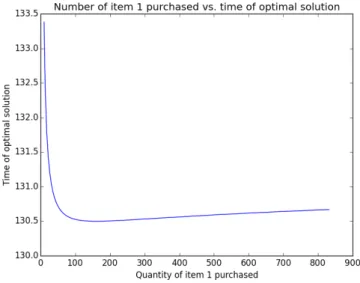
where the 1’s only appear if the total generation rate at that point is less than the threshold 𝑇 . We can experimentally verify that the point at which the optimal solution transitions from 1’s to 2’s is not exactly 𝑇 , but is usually close to 𝑇2. An example of this is displayed in Figure 2-1. For every integer 𝑖, we can consider the optimal strategy that starts off by buying exactly 𝑖 copies of item 1 then transitioning to item 2. Figure 2-1 plots the amount of time each optimal solution takes.
We then have the following corollary
Corollary 2.2.4. Fixed-Cost Cookie Clicker for 2 Items can be solved in 𝑢1log𝜑𝑢2+ 𝑂(𝑢1)
time, where 𝑢1 = 𝑂(𝑦𝑥11 log 𝑀𝑦1) and 𝑢2 = 𝑂(𝑥𝑦22 log 𝑀𝑦2).
Proof. To solve Fixed-Cost Cookie Clicker for 2 Items, we just have to find the optimal number of 1’s to buy before transitioning to 2’s and subsequently solving the 1-Item Cookie Clicker game. Finding this optimal number involves maximizing a function of two bounded discrete variables (the number of 1’s to buy and the number of 2’s to buy), which can be done in polynomial time.
In particular, let us define
𝑛(𝑟, 𝑠) = 𝐵([1, . . . , 1 ⏟ ⏞ 𝑟 , 2, . . . , 2 ⏟ ⏞ 𝑠 ]).
Figure 2-1: Plot showing the amount of time the optimal solution takes as the number of copies of item 1 it buys at the beginning varies. Here, 𝑀 = 60000, 𝑋 = [10, 100], 𝑌 = [72, 700], 𝑇 = 3140, and 𝐺 = 1611 at the minimum of the curve, which corresponds to the correct number of item 1’s to purchase in the optimal solution. For most parameter settings, there is exactly one local minimum. However, this is not always the case.
Then the function 𝑛 is unimodal in 𝑠, because for a fixed 𝑟, we are essentially solving 1-Item Cookie Clicker using the item 2. We can obtain rough upper bounds for each of 𝑟 and 𝑠, which we denote by 𝑢1 = 𝑂(𝑥𝑦1 1 log 𝑀 𝑦1) and 𝑢2 = 𝑂( 𝑦2 𝑥2 log 𝑀 𝑦2), by considering an instance of
1-Item Cookie Clicker with just item 1 or just item 2. Then, we can find an optimal solution in 𝑢1log𝜑𝑢2+ 𝑂(𝑢1) [DL05].
Next, we analyze the rate-goal version of Fixed-Cost Cookie Clicker for 2 Items and obtain a similar result about the structure of solutions.
Theorem 2.2.5. For large enough 𝑅, any optimal solution to the rate-goal version of Fixed-Cost Cookie Clicker for 2 Items must be of the form
[1, 1, . . . 1, 1, 2, 2, . . . , 2, 2, 1, . . . , 1], where the number of 1’s at the end is upper bounded by ⌈𝑥2/𝑥1⌉
(︁⌊︁ 1/(𝑥2 𝑥1 − 𝑦2 𝑦1) ⌋︁ + 1)︁.
This theorem lets us restrict the space of possible solutions, and we can use brute force on the number of 1’s at the end to obtain an algorithm that finds the optimal solution in
the same amount of time as in the 𝑀 version, up to a multiplicative factor corresponding to the brute force search.
Proof. First, we know using the same swapping argument as before that the solution must be of the form
[1, 1, . . . 1, 1, 2, 2, . . . , 2, 2, 1, 1, . . . , 1, 1].
Thus, we only have to show that the number of 1’s at the end must be small. The primary idea is that if item 2 is indeed more efficient, you should be able to replace ⌊︁𝑥2
𝑥1
⌋︁
copies of item 1 with a single copy of item 2, giving a greater rate increase in less time, which can only improve your solution. This argument isn’t always easy to prove, depending on the costs and rate increases of items 1 and 2. Thus, we will instead argue that buying 𝑛 copies of item 1 at the end is worse than buying 𝑚 copies of item of item 2 for some positive integers 𝑛 and 𝑚. In particular, the minimal 𝑛 such that the rational number 𝑚𝑛 satisfies the equation
𝑥2 𝑥1 > 𝑛 𝑚 > 𝑦2 𝑦1
is sufficient for large enough 𝑅. It is difficult to find the minimal 𝑛, but we know that if we choose an 𝑚 such that 𝑚1 < 𝑥2
𝑥1−
𝑦2
𝑦1, then there must exist some 𝑛 that satisfies the inequality
and is less than ⌈𝑥2/𝑥1⌉𝑚. Thus, one valid choice of 𝑚 is
⌊︁ 1/(𝑥2 𝑥1 − 𝑦2 𝑦1) ⌋︁ + 1, and 𝑛 is then upper bounded by ⌈𝑥2/𝑥1⌉ (︁⌊︁ 1/(𝑥2 𝑥1 − 𝑦2 𝑦1) ⌋︁
+ 1)︁. This 𝑛 upper bounds the number of trailing 1’s we can have in any solution.
To prove the above claim, consider replacing 𝑛 trailing copies of item 1 in some solution 𝑆 with 𝑚 copies of item 2 to produce the new solution 𝑆′:
[1, . . . 1, 2, . . . , 2, 1, . . . , 1, 1, . . . , 1 ⏟ ⏞ 𝑛 ] → [1, . . . 1, 2, . . . , 2, 1, . . . , 1, 2, . . . , 2 ⏟ ⏞ 𝑚 ].
The rate increase from the 𝑛 trailing item 1’s in 𝑆 is 𝑛𝑥1, and the rate increase from the
trailing item 2’s in 𝑆′ is 𝑚𝑥2. Based on our definition of 𝑛 and 𝑚, we know that the rate
increase from the trailing item 2’s in 𝑆′ is higher, so 𝑆′ will also reach the goal rate of 𝑅. Now, we just have to show that the solution 𝑆′ takes less time than the solution 𝑆. Suppose that the generation rate before purchasing the 𝑛 copies of item 1 is 𝐺. The amount
of time it takes to buy the 𝑛 copies of item 1 in 𝑆 is 𝐵([1, . . . , 1 ⏟ ⏞ 𝑛 ], 𝐺) > 𝑛 𝑦1 𝐺 + 𝑛𝑥1 .
The amount of time it takes to buy the 𝑚 copies of item 2 in 𝑆′ is 𝐵([2, . . . , 2
⏟ ⏞
𝑚
], 𝐺) ≤ 𝑚𝑦2 𝐺, where both inequalities are derived from Lemma 1.3.3.
Thus, we just have to show that
𝑛 𝑦1 𝐺 + 𝑛𝑥1 > 𝑚𝑦2 𝐺 or equivalently, that 𝑛𝑦1𝐺 > 𝑚𝑦2𝐺 + 𝑚𝑛𝑥1𝑦2 or 𝐺 > 𝑚𝑛𝑥1𝑦2 𝑛𝑦1− 𝑚𝑦2 (2.2) Let 𝑅′ be the fraction on the right hand side of (4). The denominator of 𝑅′ is positive from the definition of 𝑛 and 𝑚, so as long as 𝐺 is large enough, buying 𝑚 copies of item 2 at the end also takes less time than buying 𝑛 copies of item 1. Thus, as long as 𝑅 > 𝑅′+ 𝑛𝑥1, the
optimal solution will have at most 𝑛 trailing 1’s.
2.3
Fixed-Cost Cookie Clicker for 𝑘 Items
A natural follow-up is to extend this problem from 2 items to 𝑘 items. Here, we present a weakly polynomial time dynamic programming solution and discuss an attempt using local optimizations to achieve a faster runtime.
2.3.1
Dynamic Programming Solution
In the fixed-cost case, the items do not change in price over time. Thus, the only thing that determines the game state is the current generation rate. Using Lemma 1.3.4, the final generation rate is bounded above by max𝑖
(︀𝑀 𝑥𝑖
𝑦𝑖 )︀. Let DP[𝑛] denote the minimal amount of
time needed to reach a goal of 𝑀 from a state where you have 0 cookies and generation rate 𝑛. The dynamic program can be solved by the following recurrence:
𝐷𝑃 [𝑛] = min (︁𝑀 𝑛 , min𝑖 (︁𝑦𝑖 𝑛 + 𝐷𝑃 [𝑛 + 𝑥𝑖] )︁)︁ ,
where the 𝑀𝑛 term corresponds to entering the Waiting Phase after achieving a generation rate of 𝑛. If there are 𝑘 items, then solving the original problem, which is equivalent to finding the value of DP[1], takes 𝑂(max𝑖(𝑀 𝑥𝑦𝑖𝑖𝑘)).
For the rate-goal version of this problem, we can define the same subproblem DP[𝑛], and the recurrence can be modified slightly to
𝐷𝑃 [𝑛] = ⎧ ⎪ ⎨ ⎪ ⎩ min𝑖(𝑦𝑛𝑖 + 𝐷𝑃 [𝑛 + 𝑥𝑖]) if 𝑛 < 𝑅, 0 otherwise.
Again, the final problem reduces to finding DP[1], and the total runtime is 𝑂(𝑅𝑘).
2.3.2
Local Optimizations
One idea for a faster algorithm is to use local optimizations on a given solution sequence to try to obtain a better one.
As we saw from the analysis of Fixed-Cost Cookie Clicker for 2 Items, one example of a local optimization is a “swap" that involves swapping consecutive elements in a solution if doing so improves the solution. Another natural local optimization, which we saw in the proof of Theorem 2.2.3, was the replacement of one item in a solution sequence with another. Thus, to try to solve this problem, we tried using random local optimizations on a randomly generated initial solution until it reached a point where local optimizations could no longer improve the solution. The local optimizations we used included:
1. Adding an item to the solution at a specific index 2. Deleting an item from the solution at a specific index 3. Replacing one item with a different item at a specific index
4. Moving an item from one index to another. If an item is moved from index 𝑖 + 1 to 𝑖, this is equivalent to a “swap".
5. Sorting the solution so that the cheapest items come first
In general, these local optimizations would improve the initial solution sequences. In some cases these local optimizations would result in a final solution that matched the globally optimal solution computed using dynamic programming. However, in other cases, these local optimizations get stuck at a local optimum, which are points that are worse than the global optimum, but can not be improved any further using any of these local optimization operations. Thus, this leads us to the conclusion that our list of local optimizations is insufficient for finding a global solution, and any proof that relies solely on these operations will not be able to show global optimality of a solution.
2.4
Increasing-Cost Cookie Clicker for 𝑘 Items
From this point forward, we assume that the 𝛼’s, the cost increase rates, all satisfy 𝛼 > 1. This is how the original Cookie Clicker game works, and is also a reasonable assumption. It corresponds to the economic situation in which items increase in price due to limited supply.
2.4.1
Dynamic Programming Solution
In this section, we present a dynamic programming solution which finds optimal solutions in 𝑂(𝑘 log𝑘𝛼(𝑀
𝑦)) time.
For simplicity, let us solve the problem for the case with 2 items first. Recall that your state in the game is completely described by the tuple (𝑛1, 𝑛2), where 𝑛𝑖 denotes the
if the item costs more than the goal 𝑀 . This gives us upper bounds on 𝑛1 and 𝑛2, namely,
𝑛𝑖 < log𝛼𝑖
𝑀
𝑦𝑖 + 1. This motivates us to define
𝐷𝑃 [𝑎][𝑏] := the minimum time it takes to reach 𝑀 from the state (a,b).
Let the cookie generation rate at state (𝑎, 𝑏) be represented by 𝑔𝑎𝑏 = 1 + 𝑎𝑥1+ 𝑏𝑥2. From the
state (𝑎, 𝑏), the optimal strategy is one of the following three choices: entering the Waiting Phase, buying item 1, or buying item 2. We can then derive the recurrence
𝐷𝑃 [𝑎][𝑏] = min(︁𝑀 𝑔𝑎𝑏 ,𝑦1· 𝛼 𝑎 1 𝑔𝑎𝑏 + 𝐷𝑃 [𝑎 + 1, 𝑏],𝑦2· 𝛼 𝑏 2 𝑔𝑎𝑏 + 𝐷𝑃 [𝑎, 𝑏 + 1])︁
corresponding to each of those three choices. If 𝐴 and 𝐵 are the upper bounds for 𝑛1 and
𝑛2 respectively, then we can revise the recursive formulas for 𝐷𝑃 [𝐴][𝑏] and 𝐷𝑃 [𝑎][𝐵] for any
𝑎 and 𝑏 in the proper range to only correspond to two choices (e.g. for 𝐷𝑃 [𝐴][𝑏], you can either buy item 2 or wait). We only need to initialize the value 𝐷𝑃 [𝐴][𝐵] = 𝑔𝑀
𝐴𝐵 and then
use the recurrence to fill out the rest of the dynamic programming table. Finally, our answer is 𝐷𝑃 [0][0].
Initializing the single boundary value takes 𝑂(1) time. Then, filling out the rest of the 𝐴x𝐵 table takes 𝑂(𝐴𝐵) time, so the total runtime is 𝑂(𝐴𝐵).
This dynamic programming approach can easily be extended to the 𝑘-item problem. As before, one can note that the game state of the 𝑘-item problem is described entirely by the 𝑘-tuple (𝑛1, 𝑛2, . . . , 𝑛𝑘), where 𝑛𝑖 is the quantity of item 𝑖 that you have purchased. We can
use the same upper bound 𝑛𝑖 < log𝛼𝑖(
𝑀
𝑦𝑖) + 1. Let 𝑁𝑖 = log𝛼𝑖(
𝑀
𝑦𝑖) + 1 denote the upper
bounds for each 𝑛𝑖.
We can similarly define 𝐷𝑃 [(𝑛1, 𝑛2, . . . , 𝑛𝑘)] to be the minimum time it takes to reach
M from the state (𝑛1, 𝑛2, . . . , 𝑛𝑘). Then, filling in any square in the grid involves
check-ing the solutions the adjacent squares and docheck-ing an 𝑂(1) computation for each adjacent square. In total, this takes 𝑂(𝑘) time. The only square we need to initialize is the corner 𝐷𝑃 [(𝑁1, 𝑁2, . . . , 𝑁𝑘)]. Thus, the total time complexity of this program is 𝑂(𝑘∏︀𝑘𝑖=1𝑁𝑖) =
𝑂(𝑘𝑁𝑚𝑎𝑥𝑘 ) = 𝑂 (︁ 𝑘 log𝑘𝛼 (︁𝑀 𝑦 )︁)︁ .
For the rate-goal version of the problem, we can also use dynamic programming to compute the optimal solution, but the complexity is significantly worse. We also define 𝐷𝑃 [(𝑛1, 𝑛2, . . . , 𝑛𝑘)] to be the minimum time it takes to reach 𝑅 from the state (𝑛1, 𝑛2, . . . , 𝑛𝑘),
but we can only obtain a naive upper bound for each 𝑛𝑖 of 𝑁𝑖 = 𝑥𝑅𝑖. This upper bound does
not have a log like the upper bound for the 𝑀 version of the problem because we can not take advantage of the fact that costs increase. No matter how costly the items get, we still have to get to the final rate 𝑅. Using this upper bound, this dynamic programming approach takes 𝑂(𝑘∏︀𝑘 𝑖=1𝑁𝑖) = 𝑂(𝑘𝑁𝑚𝑎𝑥𝑘 ) = 𝑂 (︁ 𝑘(︁𝑅 𝑥 )︁𝑘)︁ .
2.4.2
Greedy Solutions
Natural Greedy Solution: One greedy solution that arises naturally in normal game-play involves buying the item that has the highest rate increase to cost ratio 𝑥𝑖
𝑦𝑖. This is
the calculation that most human players do when playing the game unaided. For the 2 item case, given most reasonable setting of the parameters, this approach actually performs fairly well. However, for certain settings of the parameters, this approach can be quite bad. For example, take 𝑀 = 10000, (𝑥1, 𝑦1, 𝛼1) = (1, 10, 2), (𝑥2, 𝑦2, 𝛼2) = (10000, 9999, 2). In this
case, the second item has a much higher rate increase to cost ratio, which means that the natural greedy solution would save up for a long time to purchase the second item. However, it is much better to purchase the first item and increase your generation rate incrementally. Efficiency Score Greedy Solution: As we saw in the analysis of the fixed-cost case, the efficiency score was a helpful metric to determine which item to buy. Another idea for a greedy algorithm is to compute the efficiency score of each item and always choose the item with the lowest efficiency score. This approach is generally very close to optimal. In fact, we can prove approximation guarantees for this greedy solution.
2.4.3
Approximation Ratio
Once again, we will begin with the 2 Item case. We derive an approximation ratio for the Efficiency Score Greedy Solution that approaches 1 for sufficiently large 𝑀 . Specifically, we
will prove the following theorem.
Theorem 2.4.1. The Efficiency Score Greedy Solution obtains an approximation ratio of 1 + 𝑂(︁log 𝑀1 )︁ for sufficiently large 𝑀 .
Proof. The main idea is to use two propositions:
1. Proposition 1: Before you’re anywhere close to reaching the goal 𝑀 , you’ll want to purchase at least one more copy of item 1 and at least one more copy of item 2 2. Proposition 2: When 𝐺 is “big enough", 𝛼 > 1 means that the most efficient item is
locally and globally optimal
Using these two propositions, the greedy solution can be compared to the optimal solution in three phases.
∙ Phase 1: In this phase, the greedy algorithm reaches a certain generation rate 𝐺, which corresponds to the “big enough" 𝐺 referred to in Proposition 2. “Big enough" is quantified in Claim 2.4.2. The time taken is labeled as 𝑇1.
∙ Phase 2: The optimal algorithm will buy some amount of each of the 2 items, reaching 𝑐1 copies of item 1 and 𝑐2 of item 2 (the game state (𝑐1, 𝑐2)) near the tail end of the
Buying Phase. From this point onwards, the optimal algorithm will only purchase one type of item — this is Phase 3.
We will show that the greedy algorithm also reaches the state (𝑐1, 𝑐2). The interval
between the end of Phase 1 and reaching the state (𝑐1, 𝑐2) is Phase 2. In this phase, the
greedy algorithm and optimal algorithm would be equivalent from the same starting state2. If we let 𝑇
2 denote the amount of time the greedy algorithm uses in Phase 2,
and we let 𝑂2 be the amount of time optimal algorithm takes to reach (𝑐1, 𝑐2) from
(0, 0), then 𝑇2 < 𝑂2.
∙ Phase 3: In this phase, Proposition 1 listed above is no longer true. Let 𝑤 denote the number of consecutive copies of a single item that the optimal algorithm buys at the
2In the final analysis, we compare the time needed by the optimal algorithm starting from a worse state
very end of the Buying Phase. If 𝑇3 is the amount of time the greedy algorithm takes
in this phase and 𝑂3 is the amount of time the optimal solution takes, we can show
that 𝑇3 < 𝑂3(𝛼1(𝑤 · 𝑥𝑥2
1 + 1)) if the single item is item 2, and 𝑇3 < 𝑂3(𝛼2(𝑤 +
𝑥2
𝑥1)) if
the single item is item 1. Furthermore, we can bound the value of 𝑤, so 𝑇3 < 𝑑2𝑂3 for
a constant 𝑑2 that depends only on the 𝑥’s and 𝛼’s.
Here is an example of the greedy solution compared to the optimal solution, with the three phases labeled. Take 𝑀 = 100000, 𝑋 = {10, 90}, 𝑌 = {80, 800}, 𝛼 = {1.2, 1.1}. Optimal Solution: [1, 1, 1, 1, 1, 2, 2, 2, 2, 2, 2, 2, 2, 1, 2, 2, 1, 2, 2, 1, 2, 2, 1, 2, 2, 1, 2, 2, 1 ⏟ ⏞ 𝑂2 , 2 ⏟ ⏞ 𝑂3 ] Greedy Solution: [1, 1, 1, 1, 1, 1, 2, 2 ⏟ ⏞ 𝑇1 , 2, 2, 2, 2, 2, 2, 2, 2, 1, 2, 2, 1, 2, 2, 1, 2, 2, 1, 2, 2, 1 ⏟ ⏞ 𝑇2 , 2 ⏟ ⏞ 𝑇3 ] To begin, we will show that, when Proposition 1 is true and 𝐺 is sufficiently large, then Proposition 2 is true.
Suppose without loss of generality that we are currently at a state where 𝐵([1, 2]) < 𝐵([2, 1]). We will say that this state has the 𝐸1 property, meaning that item 1 is currently
more efficient, and the locally optimal decision would be to buy item 1.
Due to Proposition 1, we know that any optimal solution from this current state will purchase 𝑘 copies of item 2 followed by a copy of item 1 for some number 𝑘. We want to show that given a solution where 𝑘 > 0, we can produce a better solution by choosing to purchase item 1 first before purchasing any of the 𝑘 copies of item 2. That is, given that 𝐵([2, 1]) > 𝐵([1, 2]), then
𝐵([2, 2, . . . 2, 1]) > 𝐵([1, 2, 2, . . . 2]) which can be argued by sequentially showing that
𝐵([2, 2, . . . 2, 2, 1]) > 𝐵([2, 2 . . . 2, 1, 2]) > 𝐵([2, 2 . . . 1, 2, 2])
.. .
This would be true if the 𝐸1 property still held after each purchase of item 2. Intuitively, it
should, because purchasing item 2 actually makes future purchases of item 2 more expensive. However, the 𝐸1 property doesn’t necessarily hold after some number of purchases of item
2 because when the generation rate goes up, the more expensive item, which could be item 2, could become the more efficient item. Thus, we will rely on the following claim.
Claim 2.4.2. Let 𝑞2 = 𝑥𝐺2. Suppose that a state with generation rate 𝐺 satisfies the 𝐸1
property. Then the next item that should be purchased is item 1 if 𝑞2
2 + 2𝑞2 ≥ 𝛼21−1.
Proof. Let 𝑦1 and 𝑦2 denote the current costs of item 1 and item 2 after factoring in the cost
increases. If item 1 has a lower efficiency score than item 2 at generation rate 𝐺, then 𝑦1 𝑥1 +𝑦1 𝐺 ≤ 𝑦2 𝑥2 + 𝑦2 𝐺.
First, we find conditions when 𝐵([1, 2]) < 𝐵([2, 1]) =⇒ 𝐵([2, 1, 2]) < 𝐵([2, 2, 1]). To show that 𝐵([2, 1, 2]) < 𝐵([2, 2, 1]), we need to prove that
𝑦1 𝑥1 + 𝑦1 𝐺 + 𝑥2 ≤ 𝛼2 (︁𝑦2 𝑥2 + 𝑦2 𝐺 + 𝑥2 )︁ . We know that 𝑦1 𝑥1 + 𝑦1 𝐺 + 𝑥2 < 𝑦1 𝑥1 +𝑦1 𝐺 ≤ 𝑦2 𝑥2 + 𝑦2 𝐺, so we just have to show that
𝑦2 𝑥2 + 𝑦2 𝐺 ≤ 𝛼2 (︁𝑦2 𝑥2 + 𝑦2 𝐺 + 𝑥2 )︁ .
Notice that 𝑎𝑦2 𝑥2 +𝑦2 𝐺 ≤ 𝛼2 (︁𝑦2 𝑥2 + 𝑦2 𝐺 + 𝑥2 )︁ ⇐⇒ 𝑦2 𝐺 ≤ (𝛼2− 1) 𝑦2 𝑥2 + 𝛼2𝑦2 𝐺 + 𝑥2 ⇐⇒ 1 𝑥2𝑞2 ≤ (𝛼2− 1) 1 𝑥2 + 𝛼2 𝑥2𝑞2+ 𝑥2 ⇐⇒ 𝑞2+ 1 ≤ (𝛼2− 1)𝑞2(𝑞2+ 1) + 𝛼2𝑞2 ⇐⇒ 1 ≤ (𝛼2− 1)(𝑞22+ 2𝑞2) ⇐⇒ 1 𝛼2− 1 ≤ 𝑞2 2 + 2𝑞2.
This is the original assumption in Claim 2.4.2. Thus, we know that 𝐵([2, 1, 2]) < 𝐵([2, 2, 1]) if the original condition holds. We also know that 𝐵([1, 2, 2]) < 𝐵([2, 1, 2]), so the optimal solution from our current state can not start with a [2, 1] sequence or a [2, 2, 1] sequence.
Now, we claim that this holds for any string of 2’s in the beginning, that is, 𝐵([2, 2, . . . 2, 1, 2]) < 𝐵([2, 2, . . . 2, 2, 1]). This is true because at the point where [1, 2] needs to be compared to [2, 1], the generation rate 𝐺′ satisfies 𝐺′ > 𝐺, so 𝑞′2 > 𝑞2. Then, the same argument holds
because 1 𝛼2− 1 ≤ 𝑞2 2 + 2𝑞2 < 𝑞′22 + 2𝑞 ′ 2.
Thus, if 𝐺 is large enough and we are in a state that satisfies the 𝐸1 property, then the next
item that should be purchased must be item 1.
Next, we will prove another claim that helps us analyze Phase 2 of the two solutions. Claim 2.4.3. Let 𝑂𝑃 𝑇 (𝑛1, 𝑛2) denote the minimum amount of time needed to reach the goal
𝑀 from a state where you have 0 cookies, 𝑛1 ≥ 0 copies of item 1 have been purchased, and
𝑛2 ≥ 0 copies of item 2 have been purchased. If 𝑛1+ 𝑛2 > 0, then 𝑂𝑃 𝑇 (𝑛1, 𝑛2) < 𝑂𝑃 𝑇 (0, 0).
The same statement holds if the final goal is not reaching 𝑀 cookies but to obtain 𝑐1 > 𝑛1
copies of item 1 and 𝑐2 > 𝑛2 copies of item 2.
doesn’t purchase items when it has more items than 𝑂𝑃 𝑇 (0, 0). Specifically, when 𝑂𝑃 𝑇 (0, 0) purchases its 𝑛th copy of item 1, 𝑆 will also choose to purchase the same item unless 𝑛 < 𝑛1,
in which case 𝑆 will do nothing. When 𝑂𝑃 𝑇 (0, 0) enters the Waiting Phase, 𝑆 will as well. Due to how 𝑆 is defined, when 𝑆 gets to the Waiting Phase, the generation rate of 𝑆 will be at least that of 𝑂𝑃 𝑇 (0, 0). On the other hand, anything that happens before that will take 𝑆 less time than 𝑂𝑃 𝑇 (0, 0) takes because 𝑆 starts with more items and this gives 𝑆 a higher generation rate and/or lets 𝑆 save time because 𝑆 may not have to purchase some items that 𝑂𝑃 𝑇 (0, 0) does. Thus, it is clear that, 𝑂𝑃 𝑇 (𝑛1, 𝑛2) ≤ 𝑆(𝑛1, 𝑛2) < 𝑂𝑃 𝑇 (0, 0).
The following claim is also necessary in conjunction with Claim 2.4.3.
Claim 2.4.4. If the optimal strategies ends up at the state (𝑐1, 𝑐2) just before Phase 3, the
greedy algorithm will also reach the state (𝑐1, 𝑐2).
Proof. In fact, a stronger claim is true: the greedy and optimal algorithms end up converging quite soon after Phase 1. To see why this is the case, consider a point in Phase 2 where the greedy algorithm has reached the state (𝑎, 𝑏), where both 𝑎𝑥1 and 𝑏𝑥2 are both larger than
𝑞2𝑥2. This ensures that (𝑎, 0) and (0, 𝑏) are also points in Phase 2. Suppose without loss
of generality that it arrives at this state from the prior state (𝑎 − 1, 𝑏). Then, consider the optimal solution. At some point, the optimal solution must reach either (𝑐, 𝑏) where 𝑐 < 𝑎 or (𝑎, 𝑑) where 𝑑 < 𝑏. In the first case, we know that upon reaching (𝑐, 𝑏), the optimal solution will be following a greedy solution from that point forward. We also know that from the state (𝑎 − 1, 𝑏), the greedy solution chose to purchase item 1, indicating that from the state (𝑐, 𝑏), it is also more efficient to purchase item 1. This analysis holds true until the optimal solution reaches (𝑎, 𝑏), which means that the optimal solution has converged to the greedy solution. In the second case, we know that upon reaching (𝑎, 𝑑), the optimal solution will also be following a greedy solution from that point forward. We also know that the greedy solution must have purchased item 2 at some state (𝑒, 𝑑) where 𝑒 < 𝑎 (because the greedy solution eventually reaches the state (𝑎 − 1, 𝑏)). Thus, if it was more efficient to buy item 2 at the state (𝑒, 𝑑), the same will hold at the state (𝑎, 𝑑). This analysis applies until 𝑑 = 𝑏, indicating that the optimal solution will also reach (𝑎, 𝑏).
Thus, the optimal and greedy solutions will definitely converge soon after Phase 1, and they will stay the same as long as Proposition 1 holds true, which is the entirety of Phase 2. Thus, both solutions will reach the same state (𝑐1, 𝑐2) at end of Phase 2.
Finally, we need one last claim to analyze Phase 3 of the two solutions. As described before, Phase 3 corresponds to the optimal solution only buying 𝑤 copies of the same item and taking 𝑂3 time.
Claim 2.4.5. Let 𝑇3 and 𝑂3 denote the time taken by the greedy and the optimal solutions
in this section, respectively. If the optimal solution only buys item 2 at the end, then 𝑇3 <
𝑂3(𝛼1(𝑤 ·𝑥𝑥21 + 1)). If the optimal solution only buys item 1 at the end, then 𝑇3 < 𝑂3(𝛼2(𝑤 + 𝑥2
𝑥1)).
Proof. We’ll begin by analyzing the case where the optimal solution buys 𝑤 copies of item 2 at the end. The greedy algorithm will buy 𝑚 copies of item 2 and 𝑛 copies of item 1. We know that if we look at the last item the greedy algorithm buys, the generation rate before buying that last item must be less than the optimal algorithm’s end generation rate. Thus, either 𝑚𝑥2+ (𝑛 − 1)𝑥1 < 𝑤𝑥2, so 𝑛 < (𝑤 − 𝑚)𝑥𝑥21 + 1, or (𝑚 − 1)𝑥2+ 𝑛𝑥1 < 𝑤𝑥2, so
𝑛 < (𝑤 − 𝑚 + 1)𝑥2
𝑥1. The two cases are similar, so we will just analyze the first one.
First, we observe that the greedy algorithm will never buy item 1 if its cost is more than item 2. Thus, at any point in time, item 1 can cost at most 𝛼1 times as much as item 2, or
𝑦1 < 𝛼1𝑦2.
The total time needed by the greedy algorithm is the total time need to buy the 𝑚 copies of item 2 plus the total cost of the 𝑛 copies of item 1. Buying 𝑚 copies of item 2 takes at most 𝑚𝑤𝑂3 (because the items get more expensive). Each copy of item 1 can’t take more
than 𝛼1 times the maximum time needed to buy a copy of item 2 in the greedy solution,
which must be less than the maximum time need to buy item 2 in the optimal solution, which must be less than 𝑂3. Thus, buying 𝑛 copies of item 1 can’t take more than 𝑛𝛼1𝑂3.
Thus, we have that 𝑇3 < 𝑂3(𝑚𝑤 + 𝑛𝛼1) < 𝑂3(𝑚𝑤 + 𝛼1((𝑤 − 𝑚)𝑥𝑥2
1 + 1)). This approximation
ratio achieves its maximum when 𝑚 = 0, giving 𝑇3 < 𝑂3(𝛼1(𝑤 ·𝑥𝑥21 + 1)). This completes the
To prove the same result for the case where the optimal solution only buys item 1 at the end, we can observe that the greedy algorithm will never buy item 2 if 𝑦2 > 𝑥𝑥21𝑦1, so in the
worst case, 𝑦2 < 𝛼2𝑥𝑥2
1𝑦1 at any moment. The rest of the argument proceeds similarly.
Finally, we provide a bound on the 𝑤 defined above. We will derive an expression for the case where the optimal solution only buys copies of item 2; the bound for the other case can be derived similarly.
Claim 2.4.6. 𝑤 < 𝑗 log(𝑗𝛼1)
log(𝛼2) + 1, where 𝑗 =
⌈︀𝑥2
𝑥1⌉︀.
Proof. If the optimal solution buys 𝑘 copies of item 2 at the end, 𝑘 can not be too big because otherwise we could replace the purchase of the final 2 with 𝑗 purchases of item 1, which would give a greater rate increase and also take less time.
If the optimal solution buys 𝑤 copies of item 2 at the end, it must have bought item 1 right before that. Thus, at that moment, the optimal and greedy solutions match, and 𝑦1 < 𝑦2.
After 𝑤 − 1 purchase of item 2, purchasing another copy of item 2 would cost 𝑦2𝛼𝑤−12 . On
the other hand, purchasing 𝑗 copies of item 1 would cost 𝛼1𝑦1(1 + 𝛼1+ · · · + 𝛼𝑗−11 ) < 𝑦1𝑗𝛼𝑗1.
Technically, the generation rates when each of these items is purchased is different, but we can argue that the rates are all close enough to each other (say, within a small constant factor), and the overall argument still holds.
Then, it must be the case that
𝑦1𝛼𝑤−12 < 𝑦2𝛼𝑤−12 < 𝑦1𝑗𝛼𝑗1
Taking logs of both sides and rearranging gives the desired result.
From Claim 2.4.2, Claim 2.4.3, Claim 2.4.4, Claim 2.4.5, and Claim 2.4.6, we can show that the greedy algorithm that uses the efficiency score is an approximation algorithm whose approximation ratio approaches 1 as 𝑀 → ∞.
Suppose we are given an instance of Cookie Clicker for 2 Items with sufficiently large 𝑀 . Without loss of generality, suppose that 𝑥2 > 𝑥1. Let 𝑄2 be the larger positive solution to
𝑥2+ 2𝑥 = 𝛼1
Consider the greedy algorithm on this instance of Cookie Clicker. We will let 𝐺(0, 0) be the amount of time it takes to reach the goal 𝑀 . At the end of Phase 1, it will reach a rate of 𝐺 ≥ 𝑄2𝑥2. We denoted the amount of time taken in this phase by 𝑇1. The amount of time it
takes to reach this point is bounded above by the amount of time it takes to purchase ⌈𝑄2⌉
copies of item 2 while ignoring item 1, which is a function of the inputs 𝑥2, 𝑦2, 𝛼2. Thus,
𝑇1 < 𝑑1, where 𝑑1 = 𝑓 (𝑥2, 𝑦2, 𝛼2).
Next, suppose that when the greedy algorithm passes the rate 𝑄2𝑥2, it has 𝑛1 copies
of item 1 and 𝑛2 copies of item 2. The greedy algorithm will continue to make locally
optimal decisions from that point forward, which, as Claim 2.4.2 shows, are globally optimal decisions. Let 𝐺(𝑛1, 𝑛2, 𝑐1, 𝑐2) denote the amount of time it takes the greedy solution to reach
the end of the Phase 2. Now define 𝑂𝑃 𝑇 (𝑛1, 𝑛2, 𝑐1, 𝑐2) similarly for the optimal algorithm.
Claim 2.4.4 tells us that we can use the same values of 𝑐1 and 𝑐2. Then we know that
𝐺(𝑛1, 𝑛2, 𝑐1, 𝑐2) = 𝑂𝑃 𝑇 (𝑛1, 𝑛2, 𝑐1, 𝑐2). Finally, we let 𝑇3 denote the amount of time taken
in Phase 3 of greedy algorithm. Then, using Claim 2.4.3, Claim 2.4.4, Claim 2.4.5, and Claim 2.4.6, we have that
𝐺(0, 0) = 𝑇1+ 𝑇2+ 𝑇3
= 𝑇1+ 𝐺(𝑛1, 𝑛2, 𝑐1, 𝑐2) + 𝑇3
= 𝑇1+ 𝑂𝑃 𝑇 (𝑛1, 𝑛2, 𝑐1, 𝑐2) + 𝑇3
< 𝑑1+ 𝑂𝑃 𝑇 (0, 0, 𝑐1, 𝑐2) + 𝑑2𝑂3,
where 𝑑2, depending on whether the optimal solution buys item 2 or item 1 at the end, has
the form (︁𝛼1 (︁(︁⌈︀𝑥2 𝑥1 ⌉︀ log(︀⌈︀𝑥2 𝑥1 ⌉︀ 𝛼1 )︀ log(𝛼2) + 1 )︁ · 𝑥2 𝑥1 + 1 )︁)︁ = 𝑓 (𝑥1, 𝑥2, 𝛼1, 𝛼2).
Finally, note that in the optimal solution, the maximum possible generation rate that the solution will have before going into the Waiting Phase is 𝑥1log𝛼1
𝑀
𝑦1+𝑥2log𝛼2
𝑀
𝑦2, which grows
with 𝑂(log 𝑀 ). Thus, the Waiting Phase will take at least 𝑂(log 𝑀 )𝑀 time, so 𝑂𝑃 𝑇 (0, 0) > 𝑐 ·log 𝑀𝑀 , where 𝑐 is a function of (𝑥1, 𝑥2, 𝑦1, 𝑦2, 𝛼1, 𝛼2) but is independent of 𝑀 .
The approximation ratio of our greedy algorithm is 𝑂𝑃 𝑇 (0,0)𝐺(0,0) , and we know that 𝐺(0, 0) 𝑂𝑃 𝑇 (0, 0) < 𝑑1+ 𝑂𝑃 𝑇 (0, 0, 𝑐1, 𝑐2) + 𝑑2𝑂3 𝑂𝑃 𝑇 (0, 0, 𝑐1, 𝑐2) + 𝑂3 = 𝑑1+ (𝑑2− 1)𝑂3 𝑂𝑃 𝑇 (0, 0) + 1 < 𝑑1 𝑐 · log 𝑀 𝑀 + (𝑑2− 1)𝑂3 𝑐 · log 𝑀 𝑀 + 1 = 𝑂(︁log 𝑀 𝑀 )︁ + 𝑂(𝑂3log 𝑀 𝑀 ) + 1.
We can make 𝑀 large enough such that the generation rate 𝐺 after the Buying Phase is as big as we want it to be. If we have purchased 𝑛1 copies of item 1 and 𝑛2 copies of
item 2, then 𝐺𝑛1,𝑛2 = 1 + 𝑛1𝑥1+ 𝑛2𝑥2. Using Lemma 1.3.5, the optimal algorithm will stop
purchasing additional copies of item 2 when 𝑀 < 𝑦2 · 𝛼𝑛22(1 + 𝐺𝑛1,𝑛2
𝑥2 ). However, because it
was worth it to purchase the 𝑛2th copy, we know that
𝑀 ≥ 𝑦2· 𝛼𝑛22−1 (︁ 1 + 𝐺𝑛1,𝑛2−1 𝑥2 )︁ > 𝑦2· 𝛼𝑛22−1· 𝑛2.
Thus log 𝑀 = 𝑂(log 𝑛2 + 𝑛2) = 𝑂(𝑛2), so 𝑛2 = 𝑂(log 𝑀 ). Note that the cost of the
last item purchased in this phase is 𝑂(𝑀 𝑥2/𝐺𝑛1,𝑛2) = 𝑂(𝑀/𝑛2) = 𝑂(𝑀/ log 𝑀 ). Because
each of the 𝑤 items bought in Phase 3 can cost at most the cost of the last item, we have that the total cost of the last phase in the optimal solution is at most 𝑤 · 𝑂(𝑀/ log 𝑀 ). Recall from Claim 2.4.6 that 𝑤 does not depend on 𝑀 . The minimum rate in this phase is 𝐺 − 𝑤𝑥2 = 𝑂(log 𝑀 ), so Lemma 1.3.3 tells us that the total time cost is 𝑂3 = 𝑂(𝑀/𝑙𝑜𝑔2𝑀 ).
Plugging this in for 𝑂3 in the final expression, we get that the approximation ratio is
𝑂(︁log 𝑀 𝑀 )︁ + 𝑂(︁ 1 log 𝑀 )︁ + 1 = 1 + 𝑂(︁ 1 log 𝑀 )︁ .
Thus, as 𝑀 → ∞, the 𝑂(log 𝑀1 ) term approaches 0, and so the approximation ratio can be arbitrarily close to 1 for sufficiently large 𝑀 .
The above results can be extended to the case of 𝑘 items, as the local “swapping" argument at the core of Claim 2.4.2 works for any pair of consecutive item purchases. Thus, once
the generation rate 𝐺 exceeds max𝑖𝑞𝑖𝑥𝑖, where each 𝑞𝑖 is the smallest integer satisfying
𝑞2
𝑖 + 2𝑞𝑖 ≥ 𝛼𝑖1−1, Phase 1 will end. Phase 1 could take longer in the 𝑘 item case than in
the 2 item case, but the amount of time it takes is still independent of 𝑀 . Claim 2.4.3 and Claim 2.4.4 also hold for more items. Finally, Claim 2.4.5 applies to any pair of items, so the number of items in Phase 3 is upper bounded by the value of 𝑤 derived from every pair of items, which is still a function of just the 𝑥’s and 𝛼’s, independent of 𝑀 . Thus, the same analysis applies, and we can achieve the same approximation ratio for larger 𝑘.
For the rate-goal version of the problem, we believe that a similar approach could work, but it does not follow as easily. This is because the Waiting Phase does not exist, which is an essential part of proving the approximation ratio in the 𝑀 version. One approach that could work is to show that Phase 3 of the optimal and greedy solutions match exactly. If that can be proven, then we can prove an approximation ratio of 1 + 𝑂
(︁
𝑅 𝑐𝑅
)︁ .
Chapter 3
Negative Results
3.1
𝑅 version is at least as hard as 𝑀 version
We will begin by showing that the 𝑅 version of the problem is at least as hard as the 𝑀 version of the problem using a simple polynomial time reduction.
Theorem 3.1.1. The 𝑀 version of Cookie Clicker is polynomial time reducible to the 𝑅 version of Cookie Clicker
Proof. Suppose we are given an instance of the 𝑀 version of the problem with 𝑘 items having the parameters (𝑥𝑖, 𝑦𝑖, 𝛼𝑖) for 1 ≤ 𝑖 ≤ 𝑘.
Then, we can construct an instance of the 𝑅 version of the problem with 𝑘 + 1 items having the parameters (𝑥𝑖, 𝑦𝑖, 𝛼𝑖) for 1 ≤ 𝑖 ≤ 𝑘 and (𝑍, 𝑀, −) for item 𝑘 + 1, where 𝑀 is the
target number of cookies in the simulated original problem, 𝑍 is the rate goal in the new problem, and - is an arbitrary value. We let 𝑍 be sufficiently large such that it is faster to purchase item 𝑘 + 1 to achieve the rate goal of 𝑍 than it is to achieve the same rate goal by purchasing only the first 𝑘 items.
Then, the optimal solution must purchase item 𝑘 + 1. To do so, we would need 𝑀 cookies as quickly as possible from the initial state by using just the first 𝑘 items. Thus, solving this specific instance of the 𝑅 version is equivalent to solving the 𝑀 version for 𝑘 items. Thus, the 𝑀 version is polynomial time reducible to the 𝑅 version and the 𝑅 version is at least as hard as the 𝑀 version.
3.2
Weak NP-hardness of 𝑅 version
We will now prove weak NP-hardness of the 𝑅 version of 𝑘-item increasing-cost Cookie Clicker using a reduction from the weakly NP-hard problem Partition [GJ79].
The problem Partition is the following: Given a multiset 𝑆 of positive integers, can 𝑆 be partitioned into two subsets 𝑆1 and 𝑆2 such that the sum of the numbers in each subset
is equal?
Because we want to prove NP-hardness results, we will use a decision version of the rate-goal Cookie Clicker problem rather than the original optimization version. The problem is the following: Given 0 initial cookies, an initial cookie generation rate of 1, and 𝑘 items described by tuples (𝑥𝑖, 𝑦𝑖, 𝛼𝑖), is there a strategy that can obtain a rate of 𝑅 by target time
𝑇 ?
Theorem 3.2.1. The 𝑅 version of Cookie Clicker is weakly NP-hard.
Proof. Suppose we are given an instance of Partition in the form of a set of positive integers (𝑎1, 𝑎2. . . 𝑎𝑘) such that ∑︀𝑘𝑖=1𝑎𝑖 = 2𝐵. We will construct an instance of rate-goal
Cookie Clicker such that solving this instance is equivalent to solving the input Partition instance.
First, we choose 𝑊 = 𝐵2+ 𝐵 + 1 and let 𝐿 represent an extremely large number such
that it is never worth it to purchase two copies of any one item. Then, we construct the following instance of rate-goal Cookie Clicker:
∙ (𝑥𝑖, 𝑦𝑖, 𝛼𝑖) = (𝑎𝑖/𝑊, 𝑎𝑖, 𝐿) for 1 ≤ 𝑖 ≤ 𝑘
∙ 𝑅 = 1 + 𝐵/𝑊 ∙ 𝑇 = 𝐵
Our goal is to prove the following
Lemma 3.2.2. A partition exists for the Partition instance if and only if there exists a solution for the corresponding rate-goal Cookie Clicker instance which takes at most 𝐵 time.
Proof. First, note that a partition exists if and only if there exists a sequence of items whose rate gains add up to 𝐵/𝑊 .
We’ll begin by assuming that a partition 𝑎𝑝1, 𝑎𝑝2, . . . , 𝑎𝑝𝑟 exists. Let 𝑆𝑝denote the strategy
that purchases the sequence of items 𝑝1, 𝑝2, . . . , 𝑝𝑟. We will show that this strategy 𝑆𝑝 takes
at most 𝐵 time.
Because item costs and rate gains are proportional in this instance of Cookie Clicker, the total cost (in cookies) of the items in strategy 𝑆𝑝 is 𝐵. Then, using Lemma 1.3.3, the total
amount of time needed for strategy 𝑆𝑝 is
𝐵([𝑝1, . . . , 𝑝𝑟], 1) ≤ 𝑟
∑︁
𝑖=1
𝑦𝑝𝑖 = 𝐵
which proves the desired result.
Next, we will show that if no partition exists, then any solution to the Cookie Clicker instance will take more than 𝐵 time. If no partition exists, then no sequence of item purchases will add a rate gain of exactly 𝐵/𝑊 . Thus, any solution to Cookie Clicker must end at a rate of 1 + (𝐵 + 𝑛)/𝑊 for some positive integer 𝑛. Consider any strategy 𝑆 that ends at such a rate. Again, because item costs and rate gains are proportional, the total cost (in cookies) of the items in strategy 𝑆 is 𝐵 + 𝑛. Suppose that the items purchased in 𝑆 have indices 𝑞1, 𝑞2, . . . , 𝑞𝑠. Again, using Lemma 1.3.3, the total amount of time needed for strategy 𝑆 is
𝐵([𝑞1, . . . , 𝑞𝑠], 1) > ∑︀𝑠 𝑗=1𝑦𝑞𝑗 1 + (𝐵 + 𝑛)/𝑊 = 𝐵 + 𝑛 1 + (𝐵 + 𝑛)/𝑊 = 𝑊 (𝐵 + 𝑛) 𝑊 + 𝐵 + 𝑛. We want to show that
𝑊 (𝐵 + 𝑛) 𝑊 + 𝐵 + 𝑛 > 𝐵 or equivalently, that
𝑊 > 𝐵(𝐵 + 𝑛) 𝑛
The final inequality is true as long as 𝑊 > 𝐵(𝐵 +1) because the right-hand side is maximized when 𝑛 = 1, so 𝑊 = 𝐵2+ 𝐵 + 1 works. Thus, we have shown that if no partition exists, then
the proof of the lemma.
Lemma 3.2.2 is a proof that the reduction from Partition holds, implying the statement of Theorem 3.2.1 that the R version of Cookie Clicker is weakly NP-hard. As of now, we have not been able to prove the same result for the M version of Cookie Clicker, so we provide a weaker hardness result for a variant of the M version of Cookie Clicker in the following section.
3.3
Cookie Clicker with Initial Cookies
We will now define a more general version of the Cookie Clicker problem where you start with some initial cookies. We will provide a pseudo-polynomial time algorithm for solving it and a weak NP-hardness proof. First, we define the inputs to this problem, which are
∙ 𝑛, the initial number of cookies you start out with;
∙ Vectors 𝑋, 𝑌 , and 𝐴, where each triple (𝑥𝑖, 𝑦𝑖, 𝛼𝑖) represents the (generation rate gain,
initial cost, cost gain) of each item. The vectors are of length 𝑘; ∙ 𝑟, the initial generation rate; and
∙ 𝑀 , the target number of cookies.
The goal of this game is to find the optimal order of items to purchase to reach the goal 𝑀 as quickly as possible. This game is the original cookie clicker game with the extra parameters 𝑛 and 𝑟.
3.3.1
Dynamic Programming Solution
This section is not a negative result, but it describes a weakly-polynomial time solution to the Cookie Clicker with Initial Cookies problem.
The dynamic programming solution from Section 2.3.1 can be modified slightly to solve this generalized problem. We will use the 2 Item case to illustrate our example.