LETTER TO THE EDITOR
Thromboelastometry changes in myeloproliferative
neoplasms—surrogate for a procoagulant haemostatic
imbalance or a consequence of technical reasons?
Comment on A. Tripodi et al. Ann Hematol (2013) 92:1633–1639
Michael Nagler&Hugo ten Cate
Received: 16 February 2014 / Accepted: 15 March 2014 / Published online: 29 March 2014 # Springer-Verlag Berlin Heidelberg 2014
Dear Editor,
With great interest, we read the article by Tripodi et al. [1] investigating the changes of global hemostatic parameters in patients with myeloproliferative neoplasms (MPN). The au-thors aimed to study whether global tests would be able to detect a “procoagulant imbalance” that correlates with an increased risk for thromboembolism in patients with MPN and to propose a measure for risk assessment and follow-up in clinical trials. This issue is in line with efforts to establish global measures of bleeding and thrombotic risks in a variety of clinical situations [2, 3]. However, the most important questions to give an answer on this issue are as follows: (1) Do the changes represent the thrombotic risk or are they a consequence of confounding variables? (2) Is the degree of changes relevant? We feel that these issues require critical appraisal.
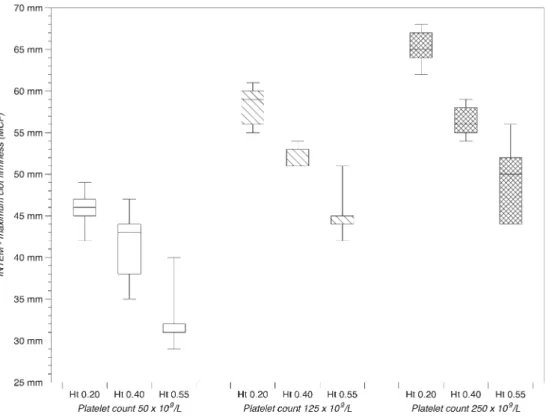
The authors compared thromboelastometry measure-ments in patients with essential thrombocythemia (ET), primary myelofibrosis (IMF), and polycythemia vera (PV) with healthy controls. The median platelet count (PLT) in ET and IMF patients was much higher than that in PV patients and healthy controls ([1], Table 1). The influence of PLT on thromboelastometry parameters is well-established [4], and our group was able to show that PLT is a major factor of influence, independent from
other factors that may affect coagulation (Fig. 1) [5]. Thus, it seems likely that observed changes are the result of a varying PLT and not an “intrinsic procoagulant imbalance”. This is promoted by the fact that no differ-ences have been found in PV patients ([1], Figure 3).
Another issue is that the investigation is based on the assumption that patients with MPN have a “procoagulant imbalance” in general. Most patients were on antiplatelet therapy, phlebotomy, and cytoreductive therapy, which are effective measures to reduce the thromboembolic risk in MPN patients [6]. We are convinced that a study aiming to propose a measure for risk assessment and follow-up must be done using clinical outcomes such as thromboembolic events or at least established risk factors of thromboembolic events in MPN patients [7].
The authors report on two out of nine parameters of INTEM test. A median maximum clot firmness (MCF) of 68 mm in ET and IMF (range 56–76 and 57–78, respec-tively) was reported versus 61 mm in healthy controls (range 51–68 mm). CFT was 47 s (30–91) in ET, 53 s (34–104) in IMF, and 71 s in controls (range 47–121). The differences were stated to be statistically significant (p < 0.05), but it was not reported if the analysis was corrected for multiple testing (nine parameters of INTEM test). Furthermore, given the large variability and recog-nized problems in reproducibility [8–10], it has to be discussed which degree of changes is considered as rele-vant to promote its use in clinical practice and scientific inquiry.
Development of global measures of bleeding and thrombotic risks is an important issue in thrombosis and hemostasis research. However, all validity aspects have to be mentioned to be of value in scientific inquiry and clinical practice.
M. Nagler (*)
Department of Haematology and Central Haematology Laboratory, Inselspital University Hospital, 3010 Berne, Switzerland
e-mail: [email protected] H. ten Cate
Department of Internal Medicine, Laboratory of Clinical Thrombosis and Haemostasis, and Cardiovascular Research Institute, Maastricht University Medical Center, Maastricht, The Netherlands
Ann Hematol (2014) 93:1781–1782 DOI 10.1007/s00277-014-2059-3
Conflicts of interest The authors declare that they have no conflict of interest.
References
1. Tripodi A, Chantarangkul V, Gianniello F, Clerici M, Lemma L, Padovan L, Gatti L, Mannucci PM, Peyvandi F (2013) Global coagulation in myeloproliferative neoplasms. Ann Hematol 92(12): 1633–1639. doi:10.1007/s00277-013-1834-x
2. Dargaud Y, Sorensen B, Shima M, Hayward C, Srivastava A, Negrier C (2012) Global haemostasis and point of care testing. Haemophilia 18(Suppl 4):81–88. doi:10.1111/j.1365-2516.2012.02855.x
3. ten Cate H (2012) Thrombin generation in clinical conditions. Thromb Res 129(3):367–370. doi:10.1016/j.thromres.2011.10.017
4. Lier H, Vorweg M, Hanke A, Gorlinger K (2013) Thromboelastometry guided therapy of severe bleeding. Essener Runde algorithm. Hamostaseologie 33(1):51–61. doi:10.5482/HAMO-12-05-0011
5. Nagler M, Kathriner S, Bachmann LM, Wuillemin WA (2013) Impact of changes in haematocrit level and platelet count on thromboelastometry parameters. Thromb Res 131(3):249–253. doi:
10.1016/j.thromres.2013.01.009
6. Tefferi A (2012) Polycythemia vera and essential thrombocythemia: 2012 update on diagnosis, risk stratification, and management. Am J Hematol 87(3):285–293. doi:10.1002/ajh.23135
7. Barbui T, Finazzi G, Carobbio A, Thiele J, Passamonti F, Rumi E, Ruggeri M, Rodeghiero F, Randi ML, Bertozzi I, Gisslinger H, Buxhofer-Ausch V, De Stefano V, Betti S, Rambaldi A, Vannucchi AM, Tefferi A (2012) Development and validation of an International Prognostic Score of thrombosis in World Health Organization-essential thrombocythemia (IPSET-thrombosis). Blood 120(26): 5128–5133. doi:10.1182/blood-2012-07-444067, quiz 5252 8. Nagler M, ten Cate H, Kathriner S, Casutt M, Bachmann LM,
Wuillemin W (2014) Consistency of thromboelastometry analysis under scrutiny: results of a systematic evaluation within and between analysers. Thromb Haemost. doi:10.1160/TH13-10-0870
9. Chitlur M, Sorensen B, Rivard GE, Young G, Ingerslev J, Othman M, Nugent D, Kenet G, Escobar M, Lusher J (2011) Standardization of thromboelastography: a report from the TEG-ROTEM working group. Haemophilia 17(3):532–537. doi:10.1111/j.1365-2516.2010. 02451.x
10. Kitchen DP, Kitchen S, Jennings I, Woods T, Walker I (2010) Quality assurance and quality control of thrombelastography and rotational Thromboelastometry: the UK NEQAS for blood coagulation experi-ence. Semin Thromb Hemost 36(7):757–763. doi: 10.1055/s-0030-1265292
Fig. 1 Changes of
thromboelastometry parameters with increasing platelet count. Results of an in vitro investigation studying the impact of hematocrit level (Ht) and platelet count on thromboelastometry parameters [5] are shown (maximum clot firmness (MCF) of the INTEM test with varying platelet counts at different Ht; unpublished figure). Box plots display median, inter-quartile range, and range