HAL Id: hal-01639659
https://hal.archives-ouvertes.fr/hal-01639659
Submitted on 13 Apr 2018
HAL is a multi-disciplinary open access
archive for the deposit and dissemination of
sci-entific research documents, whether they are
pub-lished or not. The documents may come from
teaching and research institutions in France or
abroad, or from public or private research centers.
L’archive ouverte pluridisciplinaire HAL, est
destinée au dépôt et à la diffusion de documents
scientifiques de niveau recherche, publiés ou non,
émanant des établissements d’enseignement et de
recherche français ou étrangers, des laboratoires
publics ou privés.
Quantifying the release of climate-active gases by large
meteorite impacts with a case study of Chicxulub.
Natalia Artemieva, Joanna Morgan, S.P.S. Gulick, E. Chenot, G.L.
Christeson, P. Claeys, C.S. Cockell, M.J.L. Coolen, L. Ferrière, C. Gebhardt,
et al.
To cite this version:
Natalia Artemieva, Joanna Morgan, S.P.S. Gulick, E. Chenot, G.L. Christeson, et al..
Quantify-ing the release of climate-active gases by large meteorite impacts with a case study of
Chicxu-lub.. Geophysical Research Letters, American Geophysical Union, 2017, 44 (20), pp.10180-10188.
�10.1002/2017GL074879�. �hal-01639659�
Quantifying the Release of Climate-Active Gases
by Large Meteorite Impacts With a Case
Study of Chicxulub
Natalia Artemieva1 , Joanna Morgan2 , and Expedition 364 Science Party3
1
Planetary Science Institute, Tucson, AZ, USA,2Department of Earth Science and Engineering, Imperial College London, London, UK,3See section A2
Abstract
Potentially hazardous asteroids and comets have hit Earth throughout its history, with catastrophic consequences in the case of the Chicxulub impact. Here we reexamine one of themechanisms that allow an impact to have a global effect—the release of climate-active gases from sedimentary rocks. We use the SOVA hydrocode and model ejected materials for a sufficient time after impact to quantify the volume of gases that reach high enough altitudes (> 25 km) to have global consequences. We vary impact angle, sediment thickness and porosity, water depth, and shock pressure for devolatilization and present the results in a dimensionless form so that the released gases can be estimated for any impact into a sedimentary target. Using new constraints on the Chicxulub impact angle and target composition, we estimate that 325 ± 130 Gt of sulfur and 425 ± 160 Gt CO2were ejected and produced severe changes to the
global climate.
Plain language Summary
Potentially hazardous asteroids and comets have hit Earth throughout its history, with catastrophic consequences in the case of the Chicxulub impact 66 Myr ago. Here we reexamine one of the mechanisms that allow an impact to have a global effect—the release of climate-active gases from terrestrial sedimentary rocks after the high-velocity impact. We estimate that 325 ± 130 Gt of sulfur and 425 ± 160 Gt CO2were ejected into the atmosphere at velocities> 1 km/s. These numbers have to be used inglobal climate models to quantify possible changes of solar irradiation, surface temperature, and duration of stressful conditions for biota.
1. Introduction
The hazardous effects of impacts became a topic of great interest following the realization that the Earth was hit by a large asteroid or comet ~ 66 Ma and that this impact coincided with the K-Pg mass extinction (Alvarez et al., 1980). It is obvious why a large impact might be locally devastating, with the emission of high levels of thermal radiation from the impact plume, the generation of hurricane-force winds, and potential to cause tsunamis and landslides (Bourgeois et al., 1988; Bralower et al., 1998; Collins et al., 2005; Ward & Asphaug, 2000). For an impact to cause a mass extinction it must have global consequences. Proposed kill mechanisms for the K-Pg mass extinction include the following: short-term cooling and darkness produced by dust, soot, and sulfur in the atmosphere (Alvarez et al., 1980; Brett, 1992; Pierazzo et al., 1998; Sigurdsson et al., 1992; Toon et al., 1982); long-term warming from the release of massive volumes of CO2 (O’Keefe & Ahrens,
1989; Pope et al., 1994); ocean acidification (e.g., D’Hondt et al., 1994); and global firestorms ignited when ejecta heats up as it reenters the Earth’s atmosphere and emits thermal radiation (Melosh et al., 1990; Morgan et al., 2013; Wolbach et al., 1985).
The cause of the K-Pg mass extinction remains a matter of some debate, but the environmental effects of climatically active gases released from sedimentary rocks at the Chicxulub impact site is still one of the widely favored kill mechanisms (Brugger et al., 2017; Schulte et al., 2010). When an impact-induced shock wave of sufficiently high pressure passes through sedimentary rocks, they decompose and form part of the expanding impact plume. For Chicxulub, where seawater, porous carbonates, and evaporites formed the upper portion of the target, this process led to the injection of CO2, S-bearing gases, and water vapor into the atmosphere.
In these circumstances sulfur rapidly forms an aerosol, which backscatters and absorbs solar radiation causing rapid cooling at the Earth’s surface, while the addition of CO2contributes to longer-term warming
(Kring, 2007). Early estimates of the released gases (e.g., Sigurdsson et al., 1992; Takata & Ahrens, 1994)
Geophysical Research Letters
RESEARCH LETTER
10.1002/2017GL074879
Key Points:
• We use a hydrocode to model shock pressures, ejection velocities, and amount of gases released from sedimentary rocks after large impacts • We use new constraints on impact
angle and target composition to improve estimates of the gases released by the Chicxulub impact • We investigate the effects of sediment
porosity, submergence under water, and uncertainties in devolatilization pressures on our estimates
Supporting Information: • Supporting Information S1 Correspondence to: N. Artemieva, [email protected] Citation:
Artemieva, N., Morgan, J., & Expedition 364 Science Party (2017). Quantifying the release of climate-active gases by large meteorite impacts with a case study of Chicxulub. Geophysical Research Letters, 44, 10,180–10,188. https://doi.org/10.1002/2017GL074879
Received 13 JUL 2017 Accepted 18 SEP 2017 Published online 30 OCT 2017
©2017. American Geophysical Union. All Rights Reserved.
were hampered by uncertainty in the target rocks at the impact site and inaccurate equations of state; these issues were partially addressed by Pierazzo et al. (1998), who determined that 40–560 Gt of sulfur, 350– 3,500 Gt of CO2, and 200–1,400 Gt of water vapor were released into the atmosphere. The large range of
esti-mated values arises, in part, due to uncertainty in the angle of impact and the relative volumes of carbonates and evaporites in the target rocks. Due to computational cost, this and all other previous models (e.g., Ivanov et al., 1996) only modeled thefirst few seconds of a vertical impact, meaning that they were able to estimate the amount of highly shocked sedimentary rock but unable to quantify the volume of gases ejected to a suf-ficient height in the atmosphere (>25 km) to cause a global effect (Toon et al., 1997).
Here we revisit these calculations with the goal of improving estimates of the release of climate-active gases during large impacts in general and the Chicxulub impact in particular. Released gases are important inputs to global climate models (GCM), which are used to simulate the environmental changes over the months to hundreds of years following an impact (Pierazzo et al., 2003) and suggest that surface temperatures were reduced by > 20°C and took over 30 years to recover following the Chicxulub impact (Brugger et al., 2017). We use a more advanced hydrocode (Artemieva, 2017) and recent improvements in the equations of state (EOS) (Melosh, 2007) and run the simulations for at least 15–30 s (depending on impact scenario) to ensure that all ejecta with velocities>1 km/s has exited the growing crater. This approach more accurately estimates the total mass ejected to>25 km altitude for a range of different impact scenarios. For Chicxulub, we use new constraints on impact angle (Collins et al., 2017) and target composition (Belza et al., 2012; Kenkmann et al., 2004) to estimate the gases released by this impact.
2. Method
We use the multiphase hydrocode SOVA (Shuvalov, 1999), which is a 3-D Eulerian code that models multidi-mensional, multimaterial, large deformation, strong shock wave physics (see section A3). We use SOVA for several reasons, but principally because, unlike the widely used CTH and iSALE hydrocodes, it has the capabil-ity to simulate the dynamics of different materials within the impact plume. Due to improvements in compu-tational power, we are able to model oblique impacts and run our simulations for longer time periods and with millions of tracer particles (as opposed to a thousand in previous studies) to more accurately capture properties such as maximum shock compression, gas/vapor/melt production, and ejecta velocity.
A major uncertainty in calculations of gases released from sedimentary rocks is the assignment of shock pres-sures for incipient and complete vaporization (Bell, 2016). Experiments on rock samples in containers are con-sidered to overestimate shock pressures for degassing due to the lack of free space (Langenhorst & Deutsch, 2012) and lower energy gain during decompression (Prescher et al., 2011). Results from individual laboratory experiments and various theoretical studies indicate that calcite decomposes to CO2and CaO at pressures of between 10 and 100 GPa (Kotra et al., 1983; Lange & Ahrens, 1986; Tyburczy & Ahrens, 1986; Yang et al., 1996). Although rocks with dry porosity decompose at lower shock pressures than nonporous rocks (Ivanov & Deutsch, 2002; Martinez et al., 1995), rocks with wet porosity appear to show similar behavior to nonporous rocks (Güldemeister et al., 2013; Kowitz et al., 2016). For this reason, we have assumed that both the porous (water-saturated) and nonporous calcite decompose at the same shock pressure, with incipient decomposi-tion starting at 60 GPa and full decomposidecomposi-tion at shock pressures of 100 GPa, in accordance with shock experiments, numerical simulations, and thermodynamic calculations by Yang et al. (1996). In the supporting information, we include additional estimates with different shock devolatilization pressures in order to inves-tigate how uncertainties in the critical pressures for decomposition of calcite affect our estimates of released gases.
For our compilation of results, we use a carbonate target (analytical equations of state, ANEOS, for calcite) with 0 and 20% wet porosity (mass fraction of calcite 0.91), a projectile of 10 km in diameter traveling at 18 km/s, and impact angles of 15, 30, 45, 60, and 90° to the horizontal. We select a resolution of 20 cells per projectile radius, a density of 2.6 g/cm3for the projectile and nonporous target, and 2.28 g/cm3for the porous target. For our simulations using porous calcite, we assume that pores arefilled with water (mixed ANEOS as described in Pierazzo et al., 2005). For all the results presented here, we only include materials that are ejected from the impact site with velocities higher than 1 km/s, because ejecta with lower velocities will not reach high altitudes and, hence, cannot be redistributed globally. For the case study of Chicxulub, we investigate the addition of anhydrite of zero porosity within the target. According to laboratory
experiments and theoretical studies, anhydrite degasses between 30 and 180 GPa (Badjukov et al., 1995; Gupta et al., 2001; Ivanov et al., 1996; Yang et al., 1996). Here we assume incipient decomposition of anhydrite at 30 GPa and full decomposition at 120 GPa, in accordance with thermodynamic and experimental data (Gupta et al., 2001; Prescher et al., 2011). We do not use anhydrite EOS for our mixed calcite/anhydrite target (Pierazzo et al., 1998) as the anhydrite EOS requires additional adjustment before it can be incorporated into the new version of the ANEOS package (Melosh, 2007) and the SOVA code is not able to deal with four different materials in one computational cell. We also examine the effect of submerging the sedimentary sequence under water, as was the case for the Chicxulub impact.
3. Results
The mass of CO2 generated by the decomposition of porous (P) and
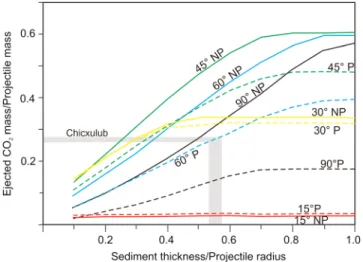
nonporous (NP) calcite and ejected to>25 km altitude is shown in Figure 1 and the mass of calcite ejected as a solid in Figure 2. The results are presented in dimensionless form so that they can be used to calculate the volumes of gases (Figure 1) and solid calcite (Figure 2) released from carbonate sequences of different thicknesses and for different impactor sizes. For example, it has been suggested that the 26 km diameter Ries crater could have been formed by a 1.5 km diameter projectile traveling at 18 km/s that hit the Earth at a ~ 30° impact angle (Artemieva et al., 2013). Using these values and a density of 2.6 g/cm3, the projectile mass is 4.6 Gt. The uppermost target rocks in the area are thought to include a ~ 300 m thick porous water-saturated carbonate, which cor-responds to a ratio on the X axis (thickness of sedimentary rock/projectile radius) of 0.4, leading to a degassed CO2 mass of ~1.3 Gt (~0.29 times the projectile mass), and solid sediment mass of 19 Gt.
To use the results shown in Figures 1 and 2 for other impacts on Earth, the projectile diameter (Dpr) should be scaled so that it reproduces the diameter of the observed transient cavity (Dtc) for an impact velocity of
18 km/s using the scaling law from Holsapple and Housen (2007):
Dtc¼ 180:44Dpr0:78
Impact angles of between 30° and 60° (50% of all impacts occur in this interval) are more effective at producing gas, and this occurs because near-vertical impacts produce less high-velocity ejecta whereas more oblique impacts produce smaller volumes of highly shocked materials (Figure 1 and Table S1). We note, however, that a 90° impact into a thick nonporous sedimentary sequence releases a surprising amount of gas. Figures 1 and 2 show that the total mass of CO2 and solid calcite
released is generally lower for the porous calcite than the nonporous, which is expected given that 9% of the calcite mass is replaced with water. However, the dependence of ejecta on porosity is quite complex and does not just lead to a simple reduction by a factor of 0.91 in released gases. At highly oblique impact angles the ratio of degassed sediments in porous and nonporous cases is 1.36 (i.e., a factor of 1.5 lar-ger than expected), and for vertical impacts the ratio is only 0.44 (a fac-tor of 2 smaller than expected) (Table S2). For solid ejecta, the dependence on impact angle is smoother: the ratio of solid sediments released from porous and nonporous calcite is 1.1 for a 15° impact and then approaches the expected value of ~0.9 at impact angles of>45°.
Figure 1. Mass of CO2ejected to high altitudes (> 25 km), relative to the
mass of the projectile (Y axis) for impact angles of 15 (red), 30 (yellow), 45 (green), 60 (blue), and 90° (black). Solid and dashed lines are for nonporous (NP) and porous (P) calcite, respectively. The X axis is carbonate thickness divided by projectile radius. Assuming an impact angle of 60° and projectile radius of 6.1 km for Chicxulub, the colored gray zone shows the range cov-ered by carbonate thicknesses of between 3.3 km and 3.5 km, which corre-spond to X axis values of 0.54 and 0.57, respectively.
Figure 2. Mass of solid calcite ejected to high altitudes (> 25 km), relative to the mass of the projectile (Y axis) for impact angles of 15 (red), 30 (yellow), 45 (green), 60 (blue), and 90° (black). Solid and dashed lines lines are for non-porous (NP) and non-porous (P) calcite, respectively. The X axis is carbonate thickness divided by projectile radius. Assuming an impact angle of 60° and projectile radius of 6.1 km for Chicxulub, the colored gray zone shows the range covered by carbonate thicknesses of between 3.3 km and 3.5 km, which correspond to X axis values of 0.54 and 0.57, respectively.
Sedimentary sequences close to continental margins are often submerged. Figure 3 shows the results for a thick nonporous sedimentary target without a water layer (Figures 3a and 3c) and submerged in water, where the water has a thickness equal to one fourth of the projectile radius (Figures 3b with 3d). These plots show that the addition of a water layer leads to minimal changes in maximum shock pressure (compare Figures 3a and 3b) and ejection velocity (compare Figures 3c with 3d) with depth. The total amount of sedimentary ejecta is lower by ~20 to 35% for a 60 and 30° impact into water, respectively (see column 6 in Table S1), and the amount of decomposed high-velocity sedimentary rocks decreases by 10–30% (see column 3 in Table S1). The other notable difference is that the addition of a water layer leads to the ejection of water, steam, and sea salt to high altitudes. Water is vaporized between pressures of 4 and 10 GPa, and, for the case shown in Figure 3d, the mass of ejected steam and water is ~0.8 and 0.67 of the projectile mass, respectively.
4. Chicxulub
Recent IODP-ICDP drilling of the peak ring of the Chicxulub impact crater (Morgan et al., 2016) along with geophysical data have been used to ground truth 3-D numerical simulations of crater formation (Collins et al., 2017). Collins et al. (2017) estimate that the angle of impact at Chicxulub was ~60° with a downrange direction to the southwest. We scale the size of the projectile so that with an impact velocity of 18 km/s, it produces a crater with the correctly sized transient cavity (Artemieva & Morgan, 2009), which gives a projec-tile diameter of 12.2 km (Table S2) and a projecprojec-tile mass of 2,500 Gt (density = 2.6 g/cm3). Our numerical simu-lations indicate that the sedimentary rocks degassed by this impact would have been located in the downrange direction, between 180° and 270° from the crater center. Using offshore seismic data, the sedi-mentary sequence to the west of the crater center is estimated to be 3.8 ± 0.2 km thick (Bell et al., 2004). No nearby onshore wells to the south of the crater reach crystalline basement, and the sedimentary rocks in the deepest well, Y-2, are 2.8 km thick (López-Ramos, 1975; Rebolledo-Vieyra & Urrutia-Fucugauchi, 2004); hence, their total thickness in this direction is likely to be greater than 2.8 km. In addition, the sedimen-tary sequence thickens from onshore to offshore and from east to west along reflection profile, Chicx-A/A1, closest to the Yucatán coastline (Morgan & Warner, 1999). Given these considerations, we use a value of 3.3–3.5 km for sedimentary thickness in the southwest portion of the crater, which corresponds to X axis values of between 0.54 and 0.57 in Figures 1 and 2.
Using Figure 1, for a 60° impact angle into a sedimentary target composed of 50% carbonate and 50% anhy-drite target (one of the proposed scenarios in Pierazzo et al., 1998) in which the two lithologies are equally distributed, 330 Gt of CO2and 400 Gt of S are ejected to altitudes greater than 25 km. The angle of impact is not likely to be exactly 60°, however, and if we assume that it is 60 ± 10°, then we can use Figure 1 to place error bars on our estimates, which gives 330 ± 60 Gt CO2and 400 ± 60 Gt S. Note that as we vary the impact
angle the projectile size varies respectively (see column 1 in Table S2), which means that the X axis values also change. The distribution of anhydrite within the target is also important, and data from the Yaxcopoil-1 drill Figure 3. Maximum pressure in the plane of symmetry for a 60° impact into a (a) sedimentary target and (b) sedimentary target covered by water. X and Y axes are horizontal distance and depth and correspond to 10 times and 4 times projectile radius, respectively. Red arrow shows impact point, and red line shows water depth which is one fourth of the projectile radius. (c and d) Ejection velocity of target materials for Figures 3a and 3b; X and Y axes are 10 times and 1 times projectile radius, respectively.
hole (which is in the southwest direction and just outside the excavation cavity) indicate that the ~600 m thick sedimentary section is late Albian to Campanian in age (Belza et al., 2012) of which ~ 27% is anhydrite (Kenkmann et al., 2004). To the south and southwest of the crater the lower half of the sedimentary sequence is lower Cretaceous in age and ~60% anhydrite (López-Ramos, 1975; Rebolledo-Vieyra & Urrutia-Fucugauchi, 2006). Using the assumption that the upper half of sedimentary sequence is 75% calcite and 25% anhydrite and the lower half is 60% anhydrite and 40% calcite, the ejected masses become 425 ± 60 Gt CO2and 325 ± 60 Gt S (Table S3).
At the time of the impact, there was probably a fairly shallow sea covering the northern half of the Yucatán peninsula, but water depths may have been up to 1.5 km deep to the northeast of the point of impact (Gulick et al., 2008), which corresponds to the water thickness (one fourth of the projectile radius) shown in Figures 3b and 3d. We note that if the downrange direction is to the southwest, however, the high-velocity ejecta originate mainly from the target in this direction, which suggests that the effect of deep water in the northeast direction may have been quite minor for the Chicxulub impact.
5. Discussion
The lack of a reliable EOS for anhydrite, as well as uncertainties in devolatization pressures for calcite and anhydrite, remain a potential source of error in our estimates. Given this, we also ran simulations using pressures of 40 GPa and 80 GPa for incipient degassing and 80 and 120 GPa for complete decomposition of calcite, so that our results can be reassessed should better constraints arise in the future (columns 2–4 in Table S1). For our Chicxulub calculations, changing decomposition pressures by ±20 GPa changes our esti-mates of released gases by ±35%. If we assume that there is a ± 35% uncertainty in our calculations for both calcite and anhydrite and combine this with the ±60 Gt error due to uncertainty in impact angle, we get values of 425 ± 160 Gt CO2and 325 ± 130 Gt S. Also, we note that gypsum produces less sulfur than anhydrite (Table S3), which needs to be taken into account in any future estimates of released climatic gases, should better constraints on target rock composition become available. For all three scenarios, the total amount of ejecta with velocity> 1 km/s remains constant (column 6 in Table S1), and the relative mass of ejected gas versus solid sediment decreases as the critical shock pressures are increased (columns 2–4 in Table S1). Surprisingly, our results for the Chicxulub impact are comparable to previous estimates by Ivanov et al. (1996) and Pierazzo et al. (1998) (Table S4) and significantly less than Sigurdsson et al. (1992) and Takata and Ahrens (1994). Various factors influence the production of climate-active gases presented here, with some leading to an increase and others a decrease in comparison to previous calculations (see Table 1). All previous calcula-tions assumed lower decomposition pressures for porous calcite (20–30 GPa), which recent research suggests may be incorrect when the pore spaces arefilled with water (Güldemeister et al., 2013; Kowitz et al., 2016). We also use different decomposition pressures for anhydrite, based on research published after these earlier cal-culations were made (Gupta et al., 2001; Prescher et al., 2011). On the other hand, Pierazzo et al. (1998) assumed that ~31% of the ejected CO2 would be removed early on within the expanding impact plume
due to back reactions and thus would not contribute to the global inventory (Table 1). While we recognize that these back reactions do occur and are important, they are not included in our calculations as they are difficult to quantify. We do consider that it is important to ensure that the gases are ejected from the crater at sufficient velocities to reach high altitudes, whereas previous calculations only ran for a few seconds in order to determine shock pressures and then assumed all gases released by shock devolatization would con-tribute to the global inventory. Our estimates show that in the case of a thick sedimentary cover (thickness Table 1
The Role of Different Factors in CO2Production
Pierazzo et al. (1998) (P98) This work (A and M) Effect on net production
Pressure for devolatilization (GPa) 20 60 (Incipient degassing) 100 (Complete degassing) P98> A and M
Assumed recombination 31% Not accounted for P98< A and M
Ejection from the crater Not accounted for Only includes material ejected at>1 km/s P98> A and M
Impact obliquity Vertical only 15–90° (Max. between 30–60°) P98< A and M
larger than the projectile radius), only 6–20% (depending on impact angle and porosity) of the highly shocked sediments (P > 60 GPa) are ejected with velocities of >1 km/s (compare columns 3 and 7 in Table S1). The remaining shocked materials are either ejected with lower velocity and, hence, stay in the cra-ter vicinity (both CO2and SOxare heavier than atmospheric gases) or stay within the crater and form part of
the melt pool and/or suevitic layer. In the Chicxulub case, with a sediment thickness that is equal to 0.54–0.57 of the projectile radius, the effect is smaller: approximately 50% of the sedimentary rocks shocked>60 GPa reach altitudes of>25 km. Finally, impact obliquity has an important effect on released gases with maximum gas production for impact angles of 30–60° (Figure 1).
Another important output from our calculations is the mass of solid sediment ejected to high altitudes (Figure 2), which for Chicxulub corresponds to ~12,000 Gt (4.8 × projectile mass). This is consistent with the observation offine-grained shocked and unshocked carbonate and dolomite clasts in the upper layer of the K-Pg boundary at the Demerara Rise, where they are coincident with shocked tectosilicates (Schulte et al., 2009). The abundance of sedimentary clasts at this location led the authors to conclude that they are a much more common component of Chicxulub ejecta than previously thought. In addition, Schulte et al. (2009) interpret some of the morphologic features (fluidal-shaped micrometer-sized pores) in these clasts as evidence of their formation within the high-temperature impact plume. We propose an alternative expla-nation, that these high-temperature features may also have been formed when the clasts were heated during atmospheric reentry. This is of particular interest here as it would mean that additional climatic gases were released during the reentry of solid sedimentary material. Future 3-D simulations of the transport of ejecta around the globe will be performed to investigate this further.
6. Conclusions
Our calculations of released gases from sedimentary rocks in general and Chicxulub in particular are more realistic and, thus, improve on previous models because they use a more advanced 3-D hydrocode (Artemieva, 2017) and take into account the following: (1) an updated EOS (Melosh, 2007); (2) the velocity of the ejected gases and ensure that they reach high enough altitudes to have a global effect; (3) improved knowledge of the thickness and composition of the Chicxulub target from new offshore seismic data (Bell et al., 2004) and well data from Yaxcopoil-1 (Kenkmann et al., 2004); and (4) new constraints on the Chicxulub impact angle and direction (Collins et al., 2017). These new estimates of released climatic gases are important inputs to GCM for models of temperatures at the Earth’s surface and within the ocean after large impacts (e.g., Brugger et al., 2017) and for quantifying ocean acidification (e.g., D’Hondt et al., 1994). Our estimate of 325 ± 130 Gt of sulfur released is larger than the value used by Brugger et al. (2017) in their GCM, whereas our estimate of 425 ± 160 Gt of CO2is smaller than their input. This suggests that surface
tem-peratures were likely to have been significantly reduced for several years and ocean temperatures affected for hundreds of years after the Chicxulub impact.
Appendix A
A1. Author Contribution
N. A. performed all the SOVA hydrocode simulations. J. M. provided new data for the Chicxulub impact site, drafted thefigures, and coordinated the preparation of the manuscript. Expedition 364 scientists participated in discussions of the results and edited drafts.
A2. Additional Expedition 364 Scientists (http://www.ecord.org/expedition364/participants/)
S. P. S. Gulick1, E. Chenot2, G. L. Christeson1, P. Claeys3, C. S. Cockell4, M. J. L. Coolen5, L. Ferrière6, C. Gebhardt7, K. Goto8, S. Green9, H. Jones10, D. A. Kring11, J. Lofi12, C. M. Lowery1, R. Ocampo-Torres13, L. Perez-Cruz14, A. E. Pickersgill15,16, M. Poelchau17, A. S. P. Rae18, C. Rasmussen19, M. Rebolledo-Vieyra20, U. Riller21, H. Sato22, J. Smit23, S. M. Tikoo24, N. Tomioka25, J. Urrutia-Fucugauchi14, M. T. Whalen26, A. Wittmann27, L. Xiao28, K. E. Yamaguchi29,30, W. Zylberman31,32, and third party scientists G. S. Collins18and T. J. Bralower10.
1Institute for Geophysics and Department of Geological Sciences, Jackson School of Geosciences, University
of Texas at Austin, Austin, TX, USA,2Biogéosciences Laboratory, Université de Bourgogne-Franche Comté, Dijon, France,3Analytical, Environmental and Geo-Chemistry, Vrije Universiteit Brussel, Brussels, Belgium,
4Centre for Astrobiology, School of Physics and Astronomy, University of Edinburgh, Edinburgh, UK,
5
Department of Chemistry, WA-Organic and Isotope Geochemistry Centre, Curtin University, Perth, Western Australia, Australia,6Natural History Museum, Vienna, Austria,7Alfred Wegener Institute Helmholtz Centre of Polar and Marine Research, Bremerhaven, Germany,8International Research Institute of Disaster Science, Tohoku University, Sendai, Japan,9British Geological Survey, Edinburgh, UK,10Department of Geosciences, Pennsylvania State University, University Park, PA, USA,11Lunar and Planetary Institute, Houston, TX, USA,
12
Géosciences Montpellier, Université de Montpellier, Montpellier, France,13Groupe de Physico-Chimie de l’Atmosphère, L’Institut de Chimie et Procédés pour l’Énergie, l’Environnement et la Santé (ICPEES), Université de Strasbourg, Strasbourg, France,14Instituto de Geofísica, Universidad Nacional Autónoma De México, Mexico, Mexico,15School of Geographical and Earth Sciences, University of Glasgow, Glasgow, UK,
16Argon Isotope Facility, Scottish Universities Environmental Research Centre, East Kilbride, UK, 17Department of Geology, University of Freiburg, Freiberg, Germany,18Department of Earth Science and
Engineering, Imperial College London, London, UK,19Department of Geology and Geophysics, University of Utah, Salt Lake City, UT, USA, 20Independent consultant, Cancun, Mexico 21Institut für Geologie, Universität Hamburg, Hamburg, Germany, 22Japan Agency for Marine-Earth Science and Technology, Kanagawa, Japan,23Faculty of Earth and Life Sciences (FALW), Vrije Universiteit Amsterdam, Amsterdam, Netherlands,24Earth and Planetary Sciences, Rutgers University, New Brunswick, NJ, USA,25Kochi Institute for Core Sample Research, Japan Agency for Marine-Earth Science and Technology, Kochi, Japan,
26
Department of Geosciences, University of Alaska Fairbanks, Fairbanks, AK, USA, 27LeRoy Eyring Center for Solid State Science, Arizona State University, Tempe, AZ, USA,28School of Earth Sciences, Planetary Science Institute, China University of Geosciences, Wuhan, China, 29Department of Chemistry, Toho University, Chiba, Japan,30NASA Astrobiology Institute 31Aix Marseille Université, CNRS, Institut pour la Recherche et le Développement, Coll France, CEREGE, Aix-en-Provence, France, 32Centre for Planetary Science and Exploration and Department of Earth Sciences, University of Western Ontario, London, Ontario, Canada
A3. Code and Data Sharing
The SOVA code, as most of the hydrocodes used in impact science, is not currently available for public use. The performance of the code was verified during a special benchmark and validation project (Pierazzo et al., 2008). Raw tracer data (three-dimensional distributions of maximum shock pressure and ejection velocity) are avail-able from thefirst author upon request. Data used to produce Figures 1 and 2 can be found in Table S1.
References
Alvarez, L. W., Alvarez, W., Asaro, F., & Michel, H. V. (1980). Extraterrestrial cause of the Cretaceous–Tertiary extinction. Science, 208, 1095–1108.
Artemieva, N. A. (2017). Ejection of climate active gases after large impacts, LunarPlanet. Sci. Conf. XLVII, Abstract 2150. Artemieva, N. A., & Morgan, J. V. (2009). Modeling the formation of the K-Pg boundary layer. Icarus, 201, 768–780.
Artemieva, N. A., Wünnemann, K., Krien, F., Reimold, W. U., & Stöffler, D. (2013). Ries crater and suevite revisited—Observations, modeling Part II: Modeling. Meteoritics and Planetary Science, 48, 590–627.
Badjukov, D. D., Dikov, Y. P., Petrova, T. L., & Pershin, S. V. (1995). Shock behavior of calcite, anhydrite and gypsum, Lunar Planetary Science Conference. XXVI, 63–64.
Bell, C., Morgan, J. V., Hampson, G. J., & Trudgill, B. (2004). Stratigraphic and sedimentological observations from seismic data across the Chicxulub impact basin. Meteoritics and Planetary Science, 39, 1089–1098. https://doi.org/10.1111/j.1945-5100.2004.tb01130.x Bell, M. S. (2016). CO2release due to impact devolatilization of carbonate: Results of shock experiments. Meteoritics and Planetary Science, 51,
619–646. https://doi.org/10.1111/maps.12613
Belza, J., Goderis, S., Keppens, E., Vanhaeke, F., & Claeys, P. (2012). An emplacement mechanism for the mega-block zone within the Chicxulub impact crater, (Yucatán, Mexico) based on chemostratigraphy. Meteoritics and Planetary Science, 47, 400–413.
Bourgeois, J., Hansen, T. A., Wiberg, P. L., & Kauffman, E. G. (1988). A tsunami deposit at the Cretaceous-Tertiary boundary in Texas. Science, 241, 567–570.
Bralower, T. J., Paull, C. K., & Leckie, R. M. (1998). The Cretaceous-Tertiary boundary cocktail: Chicxulub impact triggers margin collapse and extensive sediment gravityflows. Geology, 26, 331–334.
Brett, R. (1992). The Cretaceous-Tertiary extinction: A lethal mechanism involving anhydrite target rocks. Geochim Cosmochima Acta, 56, 3603–3606.
Brugger, J., Feulner, G., & Petri, S. (2017). Baby, it’s cold outside: Climate model simulations of the effects of the asteroid impact at the end of the Cretaceous. Geophysical Research Letters, 44, 419–427. https://doi.org/10.1002/2016GL072241
Collins, G. S., Melosh, H. J., & Marcus, R. A. (2005). Earth Impact Effects Program: A Web-based computer program for calculating the regional environmental consequences of a meteoroid impact on Earth. Meteoritics and Planetary Science, 40, 817–840.
Collins, G. S., Patel, N., Rae, A. S., Davies, T. M., Morgan, J. V., Gulick, S. P. S., & Expedition 364 Scientists (2017). Numerical Simulations of Chicxulub crater formation by oblique impact, Lunar Planetary Science Conference XLVII, Abstract 1832.
D’Hondt, S., Pilson, M. E. Q., Sigurdsson, H., Hanson, A. K., Jr., & Carey, S. (1994). Surface-wateracidification and extinction at the Cretaceous-Tertiary boundary. Geology, 22, 983–986.
Acknowledgments
The European Consortium for Ocean Drilling (ECORD) implemented Expedition 364 with funding from the International Ocean Discovery Program (IODP) and the International Continental scientific Drilling Project (ICDP). Artemieva was supported by NASA grant 15-EXO15_2-0054 and Morgan by NERC grant NE/P005217/1.
Güldemeister, N., Wünnemann, K., Durr, N., & Hiermaier, S. (2013). Propagation of impact-induced shock waves in porous sandstone using mesoscale modeling. Meteoritics and Planetary Science, 48, 115–133.
Gulick, S. P. S., Barton, P., Christeson, G. L., Morgan, J. V., McDonald, M., Mendoza-Cervantes, K.,… Warner, M. R. (2008). Importance of pre-impact crustal structure for the asymmetry of the Chicxulub pre-impact crater. Nature Geoscience, 1, 131–135.
Gupta, S. C., Ahrens, T. J., & Yang, W. (2001). Shock-induced vaporization of anhydrite and global cooling from the K⁄T impact. Earth and Planetary Science Letters, 188, 399–412.
Holsapple, K. A., & Housen, K. R. (2007). A crater and its ejecta: An interpretation of deep impact. Icarus, 191, 586–597.
Ivanov, B. A., & Deutsch, A. (2002). The phase diagram of CaCO3in relation to shock compression and decomposition. Physics of the Earth and
Planetary Interiors, 129, 131–143.
Ivanov, B. A., Badukov, D. D., Yakovlev, O. I., Gerasimov, M. V., Dikov, Y. P., Pope, K. O., & Ocampo, A. C. (1996). Degassing of sedimentary rocks due to Chicxulub impact: Hydrocode and physical simulations. In G. Ryder, D. Fastovsky, & S. Gartner (Eds.), The Cretaceous Tertiary Event and Other Catastrophies in Earth History, Special Papers Geological Society of America (Vol. 307, pp. 125–139). https://doi.org/10.1130/0-8137-2307-8.125
Kenkmann, T., Wittmann, A., & Scherler, D. (2004). Structure and impact indicators of the Cretaceous sequence of the ICDP drill core Yaxcopoil-1, Chicxulub impact crater, Mexico. Meteoritics & Planetary Science, 39, 1069–1088.
Kotra, R. K., See, T. H., Gibson, E. K., Hörz, F., Cintala, M. J., & Schmidt, R. S. (1983). Carbon dioxide loss in experimentally shocked calcite and limestone, Lunar Planetary Science Conference, XIV, 401-402.
Kowitz, A., Güldermeister, N., Schmitt, R. T., Reimold, W. U., Wünnemann, K., & Holzwarth, A. (2016). Revision and recalibration of existing shock classifications for quartzose rocks using low-shock pressure (2.5–20 GPa) recovery experiments and mesoscale numerical model-ing. Meteoritics and Planetary Science, 51, 1741–1761. https://doi.org/10.1111/maps.12712
Kring, D. A. (2007). The Chicxulub impact event and its environmental consequences at the Cretaceous-Tertiary boundary. Palaeogeography Palaeoclimatology Palaeoecology, 255, 4–21. https://doi.org/10.1016/j.palaeo.2007.02.037
Lange, M. A., & Ahrens, T. J. (1986). Shock-induced CO2loss from CaCO3; implications for early planetary atmospheres. Earth and Planetary
Science Letters, 77, 409–418.
Langenhorst, F., & Deutsch, A. (2012). Shock metamorphism of minerals. Elements, 8, 31–36. https://doi.org/10.2113/gselements.8.1.31 López-Ramos, E. (1975). Geological summary of the Yucatán Peninsula. In A. E. M. Nairn, & F. G. Stehli (Eds.), Ocean Basins and Margins, the Gulf
of Mexico and Caribbean (pp. 257–282). New York: Plenum Press.
Martinez, I., Deutsch, A., Schärer, U., Ildefonse, P., Guyot, F., & Agrinier, P. (1995). Shock recovery experiments on dolomite and thermody-namic calculations of impact induced decarbonation. Journal of Geophysical Research, 100, 15,465–15,476. https://doi.org/10.1029/ 95JB01151
Melosh, H. J. (2007). A hydrocode equation of state for SiO2. Meteoritics and Planetary Science, 42, 2079–2098.
Melosh, H. J., Schneider, N. M., Zahnle, K. J., & Latham, D. (1990). Ignition of global wildfires at the Cretaceous-Tertiary boundary. Nature, 343, 251–254.
Morgan, J., Artemieva, N., & Goldin, T. (2013). Revisiting wildfires at the K-Pg boundary. Journal of Geophysical Research: Biogeosciences, 118, 1508–1520, https://doi.org/10.1002/2013JG002428
Morgan, J. V., & Warner, M. R. (1999). The third dimension of a multi-ring impact basin. Geology, 27, 407–410.
Morgan, J. V., Gulick, S. P. S., Bralower, T., Chenot, E., Christeson, G., Claeys, Ph.,… Zylberman, W. (2016). The formation of peak rings in large impact craters, Science, 354, 878-882.
O’Keefe, J. D., & Ahrens, T. J. (1989). Impact production of CO2by the Cretaceous/Tertiary extinction bolide and the resultant heating of the
Earth. Nature, 338, 247–249. https://doi.org/10.1038/338247a0
Pierazzo, E., Artemieva, N., Asphaug, E., Baldwin, E. C., Cazamias, J., Coker, R.,… Wünnemann, K. (2008). Validation of numerical codes for impact and explosion cratering: Impacts on strengthless and metal targets. Meteoritics and Planetary Science, 43, 1917–1938. Pierazzo, E., Artemieva, N. A., & Ivanov, B. A. (2005). Starting conditions for hydrothermal systems underneath Martian craters: Hydrocode
modeling. Geological Society of America Special Papers, 384, 443–457.
Pierazzo, E., Hahmann, A. N., & Sloan, C. (2003). Chicxulub and climate: Radiative perturbations of impact-produced S-bearing gases. Astrobiology, 3, 99–118. https://doi.org/10.1089/153110703321632453
Pierazzo, E., Kring, D. A., & Melosh, H. J. (1998). Hydrocode simulation of the Chicxulub impact event and the production of climaticallyactive gases. Journal of Geophysical Research, 103, 28,607–28,625. https://doi.org/10.1029/98JE02496
Pope, K. O., Baines, K. H., Ocampo, A. C., & Ivanov, B. A. (1994). Impact winter and the Cretaceous/Tertiary extinctions: Results of a Chicxulub asteroid impact model. Earth and Planetary Science Letters, 128, 719–725.
Prescher, C., Langenhorst, F., Hornemann, U., & Deutsch, A. (2011). Shock experiments on anhydrite and new constraints on the impact-induced SOxrelease at the K-Pg boundary. Meteoritics and Planetary Science, 46, 1619–1629.
Rebolledo-Vieyra, M., & Urrutia-Fucugauchi, J. (2004). Magnetostratigraphy of the impact breccias and post-impact carbonates from bore-hole Yaxcopoil-1, Chicxulub impact crater, Yucatán, Mexico. Meteoritics and Planetary Science, 39, 821–829.
Rebolledo-Vieyra, M., & Urrutia-Fucugauchi, J. (2006). Magnetostratigraphy of the Cretaceous/Tertiary boundary and early Paleocene sedi-mentary sequence from the Chicxulub impact crater. Earth, Planets and Space, 58, 1309–1314. https://doi.org/10.1186/BF03352626 Schulte, P., Deutsch, A., Salge, T., Berndt, J., Kontny, A., MacLeod, K. G.,… Krumm, S. (2009). A dual-layer Chicxulub ejecta sequence with
shocked carbonates from the Cretaceous–Paleogene (K–Pg) boundary, Demerara Rise, western Atlantic. Geochimica et Cosmochimica Acta, 73, 1180–1204.
Schulte, P., et al. (2010). The Chicxulub asteroid impact and mass extinction at the Cretaceous-Paleogene boundary. Science, 327, 1214–1218. Shuvalov, V. V. (1999). Multidimensional hydrodynamic code SOVA for interfacialflows: Application to the thermal layer effect. Shock Waves,
9, 381–390.
Sigurdsson, H., D’Hondt, S., & Carey, S. (1992). The impact of the Cretaceous/Tertiary bolide on evaporite terrain and the generation of major sulfuric acid aerosol. Earth and Planetary Science Letters, 109, 543–559.
Takata, T., & Ahrens, T. J. (1994). Numerical simulation of impact cratering at Chicxulub and the possible causes of KT catastrophe. In New developments regarding the KT event and other catastrophes in Earth history, Contribution 825 (pp. 125–126). Houston, TX: Lunarand Planetary Institute.
Toon, O. B., Pollack, J. P., Ackerman, T. P., Turco, R. P., McKay, C. P., & Liu, M. S. (1982). Evolution of an impact generated dust cloud and its effects on the atmosphere. In L. T. Silver, & P. H. Schultz (Eds.), Geological Implications of Impacts of Large Asteroids and Comets on the Earth, Special Papers Geological Society of America (Vol. 190, pp. 187–200).
Toon, O. B., Zahnle, K., Morrison, D., Turco, R. P., & Covey, C. (1997). Environmental perturbations caused by the impacts of asteroids and comets. Reviews of Geophysics, 35, 41–78. https://doi.org/10.1111/j.1749-6632.1997.tb48357.x
Tyburczy, J. A., & Ahrens, T. J. (1986). Dynamic compression and volatile release of carbonates. Journal of Geophysical Research, 91, 4730–4744. https://doi.org/10.1029/JB091iB05p04730
Ward, S. N., & Asphaug, E. (2000). Asteroid impact tsunami: A probabilistic hazard assessment. Icarus, 145, 64–78. https://doi.org/10.1006/ icar.1999.6336
Wolbach, W. S., Lewis, R. S., & Anders, E. (1985). Cretaceous extinctions: Evidence for wildfires and search for meteoritic material. Science, 230, 167–230. https://doi.org/10.1126/science.230.4722.167
Yang, W., Ahrens, T. J., & Chen, G. (1996). Shock vaporization of anhydriteand calcite and the effect on global climate from K/T impact crater at Chicxulub, Lunar and Planetary Science, XXVII, 1473–1474.