SEPTEMBER 1991 LIDS-P-2062
Connection Between Unimodular Interaction Constraint for
Decentralized Controllers and Small Gain Bounds *
Jose E. Lopez
Michael Athans
Laboratory for Information and Decision Systems, M.I.T.,
77 Massachusetts Avenue, Rm 35-406, Cambridge, MA 02139-4307
Abstract
Decentralized controllers for a stable plant can be designed as if the plant were decoupled provided that the individual controller's Youla parameter satisfies an norm bound imposed by the off diagonal plant operators. This bound is derived from the unimodular interaction constraint associated with the set of stabilizing decentralized controllers. One result from such a bound is the quantification of the notion of weak coupling, used as a condition for the nonsingular perturbation design approach to decentralized control. Using a robust stability framework, the above bound can be related to a small gain bound. Specifically, in the two channel case, any Youla parameters which satisfy the small gain bound will satisfy the above bound however the converse is not true making this bound less conservative than small gain bound. However in a fundamental sense either framework (robust stability or unimodular interaction constraint) produce the same stability constraint for the set of stable plants. Therefore, either point of view can be used to derive these bounds. These results are extended to the multi-channel case.
*'This research wvas conlducted at. the \IIT Laboratorv for Information and Decision Systemls wit.h support. provided by II1 AI.) funds from the (:'.S. Draper Laboratory htc.. Dr. J.R. Dowdle of ('SDL is the technical mionil.or.
1
Introduction
A decentralized control system is a control structure where restrictions are made on the information available to the feedback channels. Specifically, a general decentralized control structure imposes a partitioning and pairing of the system inputs and outputs. This constrains the controller to be block diagonal thereby providing a individual controller for each channel of the partitioned system. Recently Gundes and Deoser [1] have provided a parameterization of the class of all stabilizing decentralized compensators. For the two channel case the parameterization involves four parameter matrices. These parameters are not free parameters, they are required to satisfy a unimodular constraint. A different method for incorporating stable factorization in the design of the decentralized control system [2] involves the use of Youla parameterization of the individual subsystems. The stable factors of the subsystem plant operator are used to parameterize the class of all stabilizing controllers for this subsystem in a manner identical to that used with centralized design [3]. The Youla parameter selected for each subsystem is done in a sequential fashion where the interconnection operators constrain the choice of parameter as each loop is closed. In this way the set of selected Youla parameters for the decentralized control system will provide closed loop stability for the overall system. In this paper we take the Gundes and Desoer [1] parameterization and recast it in the more familiar Youla parameterization form for the set of stable plant operators. However, unlike [2] sequential loop closing and sequential selection of Youla parameters will not be employed since use of the Gundes and Desoer [1] unimodular constraint for system closed loop stability will be exploited. From the unimodular constraint imposed on the parameters for the class of all stabilizing decentralized compensators a norm bound will be derived which constrains the Youla parameters of the individual subsystems in terms of the plant off diagonal operators (i.e. the
interaction operators of the plant not accounted for in stabilization of the individual subsystems). The bound serves as an interaction measure and provides a upper threshold which when met by the set of subsystem Youla parameters provides a stability guarantee for the overall closed loop system. Section 2 derives these results for the two channel case. The interaction measure in the form of a norm bound effectively quantifies the notion of weak coupling which is a condition for nonsingular perturbation design of decentralized control [4] [5]. These issues will be elaborated on in section 3. Section 4 compares the bound derived for the two channel case with a small gain bound derived by placing the problem in a robust stability type framework. It will be shown that any pair of Youla parameters which satisfy this small gain bound will also satisfy the bound derived from the unimodular constraint of section 2 but the converse isn't true thereby making the aforementioned bound less conservative than the small gain bound in the two channel case. Finally, in section 5 the multi-channel case is considered. The two channel case is not generalized directly. The bound derived for the multi-channel case from the unimodular constraint is shown to be also directly derivable from the small gain theorem.
1.1 Notation
H principle ideal domain, designates ring of proper stable rational functions J C H is the group of units of H
rn(H) set of matrices with elements in H IFl determinant of F
unimodular F GE
m(H)
is unimodular iff IFI E J2
Bounding Compensator Parameters
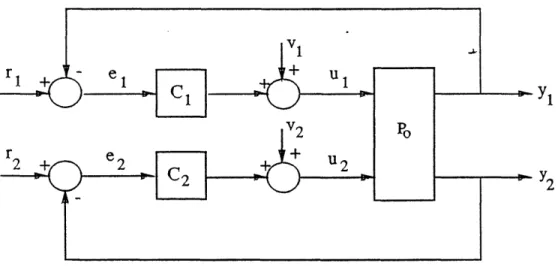
Figure 1 illustrates the two channel decentralized control problem. From [1] the parameterization of all stabilizing decentralized compensators for the two channel case with stable plant takes the following form
Lemma 1 (see [1, p. 124, Thm 4.3.5] for proof) Given that P E m(H), where m(H) corresponds to the matrix ring of stable systems, then Cd = diag(C1, C2) is a decentralized stabilizing compensator for
=
iff
Cd =
Q
(1)
P21 P22 ° (Q22 - Q2P22)-lQ2
Qll
Q
1P
12for some Qll, Q22,
Q,Q2
Em(H)
such thatQ
= is unimodular (2)Q
2P
21Q22
If the plant P is initially decoupled the interaction constraint (eq. 2) reduces to Q11 and Q22 being unimodular. To prove this the following lemma will be useful.
Lemma 2 (see [6, p. 393, Fact B.1.26] for proof) F E m(H) (where m(H) corresponds to the matrix ring of proper stable systems) is unimodular iff {Ft is a unit in H (where H corresponds to the ring of proper stable transfer functions).
For a decoupled plant, P1 2 = 0 and P21 = 0, the interaction constraint reduces as follows
Q
= diag(Q11, Q22) is unimodular<
Ql is a unit (by Lemma 2)Since IQI = IQ 11 IQ221 and Qll, Q22 are elements of rn(H) then
IQ1ll,
I221 must be units in H which by Lenuna 2 implies Q11 and Q22 are unimodular. The lack of coupling in the plant willr
e1
u
r
2e2
[u
Aj)
X
Iu22
Figure 1: The Two Channel Decentralized Control Problem
allow reformulating the individual compensator parameterizations in eq. (1) to the one parameter
Youla form [3]. The observation that Q11 and Q22 must become unimodular as the coupling
vanishes facilitates this reformulation. Specifically, for Cd = diag(C
1, C
2) both compensators can
be rewritten as
Ci = (Qi - QiPii)
-Qi
for i = 1 or 2
=(Qii(I- QQiPii))' Q,
where
Q
=
i
(3)
where
=Qj-Q
(3)
Since Qii is unimodular, Q7'Qi is an element in mr(H) and therefore Qi is also an element in m(H).
This then places eq. (3) in the Youla parameterization form for the case of stable plant operators
Pll and P22.
accounting for the effect of the cross coupling on the Q1, Q2'terms. This effect will be accounted for in terms of a norm bound on the Q1, Q2 parameters. The following induced operator norm will be used
IIPII
= sup &(P(iw)) (4)wER
Before deriving the bound on the Youla parameters the following lenmma will prove useful.
Lemma 3 (see [6, p. 22, Lemma 2.2.191 for proof) For R E m(H) if IIRII < 1 then {I - RI is a unit in H.
To derive the bound we begin with the interaction constraint from eq. (2).
Q = is unimodular
(5)
Q2P21
Q22
Invoking lenuna 2 and using the well known Schur determinantal formula [7], constraint 5 becomes
IQI
=
IQiIQ22-
(Q2P21)(QxD1)(Q1P12)1 is a unit (6)= 1 IQI Q221 I - Q21Q2P2 1Q 11Q1P1 2 (7)
Requiring Q11 and Q22 to be unimodular ensures parameterization given by eq. (3). In addition, since Qll, Q22 are elements of m(H), QI will be a unit if and only if I -QQ2P21Q Q1P12 is
1 i Qthi2s
c21oq-tlQaint
s
a unit. Substituting Q1 for Q 1Q1 and Q2 for Q-2XQ2 this constraint becomes
IQ9 is a unit
II-
Q2P 21Q1 P1 2 is a unit (8)Note that Q2P2 1Q1P1 2 is a element of m(H) and invoking lemma 3 means I - Q2P2 1Q1P1 2I will
be a unit if 11Q2P21Q1P12II < 1. Use of the submultiplicative property of induce operator norms
gives
1Q,
2P
21Q
1P?
211
< I{Q,2111IP21.llI
IIIIP/211
(9)
Therefore, forcing {lQ
2111IP
21lI{0Q1l[I[P121{ <
1ensures
IQI
is a unit and provides the following bound
on the design parameters in terms of the off diagonal plant operators
IIQ
21111P
2111QlH1IIIIP1211
< 1
(10)
IIQ21111Q111
<
(11)
Thus the controller parameterization of eq. (3) will provide for closed loop stability if the above bound, eq. (11), is satisfied.
3
Remarks
The following is a set of remarks which provide interpretation and checks on the bound of eq. (11).
Remark 1 As lIP12 ll 0 and
I{P
2111
-- 0, effectively the restrictions on the parameters Q1 and02 disappear. That is the upper bound of eq. (11) becomes virtually infinite and the set of Youla parameters expands to encompass the entire matrix ring of proper stable systems m(H). This is the expected result and quantifies the notion of weak coupling. Specifically, the bound of eq. (11) specifies an upper bound on the Youla parameters in terms of the off diagonal operators P1 2 and P2 1. The expectation is that as the cross coupling in the plant becomes small (i.e.
IIP2ll
E andIIP
211ll - E where E < 1) stabilization of the overall system is not compromised by simply ensuring that the individual compensators for Pll and P2 2provide stabilization for these individualloops. And as this coupling goes to zero the expectation is'that the set of individual stabilizing compensators for P1 1 and P22 grows to encompass the entire set of all stabilizing compensators for P11 and P22 (i.e. the parameterization in eq. (3)). In effect this is exactly what the bound of eq. (11) provides and precisely how the set of stabilizing compensators grow to encompass the entire set, is quantified by the upper bound placed on the Youla parameters in terms of P1 2 and P2 1
Remark 2 It is expected for a block triangular plant (i.e. IIP1 211 = 0 or IIP2lll = 0) that no restriction should exist on the individual stabilizing controllers that can be applied to P1 1 and P2 2. That is stabilization of the overall system is once again not compromised by simply stabilizing the individual subsystems, P1 1 and P2 2. The bound of eq. (11) satisfies this condition. For example as lIP1 2ll goes to zero the bound on the Youla parameters Q1 and Q2 disappears. An interesting aspect of this is that the bound in the face of weak triangular coupling behaves similarly to case of weak coupling discussed in remark 1. That is as {IP1 211 ' E (or I[P2lll -+ e) for E << 1 there exist a rather large set of stabilizing compensators for P1 1and P22 which also do not destabilize the overall system. As e -+ 0 this set grows to encompass the entire set of all stabilizing compensators for P1 1
and P2 2
-4
Relation to Bound Derived From Small Gain Theorem
The problem can be approached from a robust stability point of view where the decoupled plant is treated as the nonminal plant and the off diagonal plant operators, P1 2 and P2 1, become an additive perturbation. Using the parameterization of eq. (3) we seek the constraints placed on the Youla parameters by the Small Gain Theorem. It will be shown that any Youla parameters which satisfy
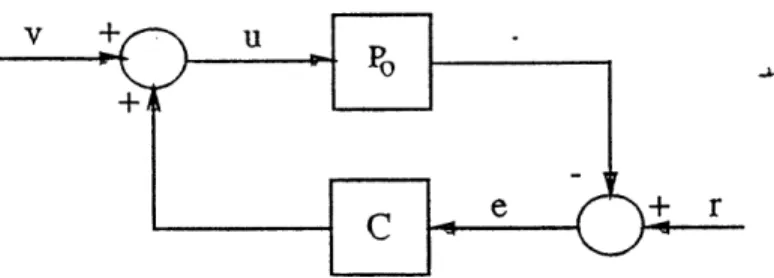
Figure 2: Centralized Two Block Problem
this small gain constraint will also satisfy the bound of eq. (11). This is reassuring in the sense that the bound of eq. (11) is derived via small gain arguments (see lemma 3). It is extended beyond the small gain bound only as a consequence of the existence of a simple determinantal formula (eq. 7) for the two channel case which allows separation of the Youla parameters from the off diagonal plant operators. As will be seen in the multi-channel case (section 5), when using the same line of reasoning as in section 2, the absence of a similar simple determinantal formula results in a bound from the nlulti-channel unimodular constraint which is identical to a small gain bound derived using only the robust stability framework of this section.
The Plant P can be decomposed in the following manner
[Pi
0
0
P1 2P=Po+
A=
+I
(12)
0 P22 P21 0
Gundes and Desoer [1] formulation of the two channel decentralized control problem (see figure 1) is in the form of the two block problem where the controller is constrained to be block diagonal (see figure 2). The parameterization of eq. (3), where C = Cd = diag(C1, C2) guarantees internal stability for the closed loop map of the two block problem illustrated in figure 2. That is for the
U M
e
+
r
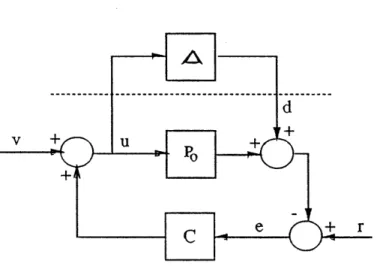
Figure 3: Transformation to Small Gain Loop
closed loop map
H W, Po) r
e
where H(CPO)
(I + PoC)-1
-(I + Poc)-1Po
H(C', Po):
[
1
1
where H(C',
Po)=
(13)
v
u
(I + CPo)-
1C
(I + CPo)
-'all transfer functions which are elements of H(C,P) are in m(H) (i.e. they are stable). By
applying the additive perturbation to the two block problem and performing the linear fractional
transformation indicated in figure 3 the closed loop system is now in a form where the Small Gain
Theorem can be applied directly. Note that the operator M is defined as
M : d -- u where M
=
-(I + CPo)-1 C (14)and M E mr(H) by internal stability, also A E rn(H) since P E m(H). Because M and A are both
stable the Small Gain Theorem [8] provides that the closed loop remains stable as long as
IIMll < 1
(15)
Substituting C = diag(Cl, C2) and Po = diag(P11, P2 2), Ml becomes
M = -(I + CPo)- C =
(16)
0
-(I
+ C
2P
22)-1C
2Substituting in the Youla parameterization from eq. (3) each term in M reduces as follows
-(I + CiPPi-)lC = -(I + (I - Q~P?)-IQ('PL)-(I - QOPii)-l'Q for i = 1 or 2
= - ((I - QiPii)(I + (I - QiPii)
4QiPii))
Q - ((I- ipi, + QiPii) Qi= -Qi (17)
And MA becomes
-Q
1 0
0
P
120
-Q
1P
12(18)
0 -Q2 P21
o0
-Q2P210
To find the constraint on the Q1 and 02 the following leimna will prove useful Lemma 4
O H12
For H= IIHII < 1 iff IIH1211 < 1 and IIH2111 < 1 (19)
H21 0
Proof IIHul = sup &(H(iw))
wER
sup [m,,\m,(H*(iw)H(iw))]l/2
0 H12 0 H12])
EwE
L
U* 1H2 1 0 H21sup Amax
= sup [IlaX [/\max(H;l121)1/2, max(f2512 )/2]
=
max [sup [/\max(H;2H1 21)1/2] ,sup [.max(H*2H 2)l/2]]
m=ax sup &(H2l(iW)), sup a(H 2(iw))]
wER wERJ
max [1H=2l II, IIHl2ll]
Therefore
IIHII
<1
IIH
1211
< 1
andIIH
2111
< 1
aThus to find the constraints on Q1 and Q2 we invoke lemma 4. That is
IIMAII
< 1 iff IIQ1P1211 < 1and
1Q92P2111
< 1. This then leads to the following constraint on the Youla parameters due to the Small Gain TheoremIIQl[1
< lP
12and
11Q211
<
1(20)lIP121
lIP
2111
From the above bound we can derive the bound in equation 11 as follows1
1)<
11
11t21111l111
<
< (21)
IIP2 111IPl211
This then says that any Youla parameters which satisfy the Small Gain bound of eq. (20) also satisfies the bound found earlier in section 2 given by eq. (11). However, the converse is not true.
This is seen by considering the following example. If I1P12
1l'
-- 0 the bound onQ1
and Q2 from eq. (11) disappears but as can be seen from eq. (20) the Small Gain bound still constrains Q2 whenIlP21lll
$
0. Hence arbitrary parametersQ1
andQ2
which satisfy the bound given by eq. (11) maynot satisfy the bound imposed by the Small Gain condition given by eq. (20). This illustrates that the bound of eq. (11) encompasses a larger set of Youla parameters which will stabilize the closed loop system then is given by the small gain bound eq. (20). Note however that in a fundamental sense these two seemingly different frameworks (unimodular constraint v.s. stability robustness) give precisely the same conditions for stability and hence result in the same bound. This is seen as follows, stability of the closed loop involving the stable operators A and M in figure 3 is guaranteed as long as
II
-MAI{
is a unit. Substituting in the matrix values for MA from eq. (18) results in precisely the constraint of eq. (8) which is derived from the unimodular constraint of eq. (5).5
Generalization to Multi-Channels
From [1] the unimodular constraint for the m channel case where P E m(H) is
Q11 Q1P1 2 Q1P1 3 ... Q1Plm
Q2'P2 1 Q22 Q2P23 .' Q2P2tn
Q
=
I
Q3P3 1 Q3P3 2 Q33 ... Q3Ptn (22)QtnPml QtnP7n2 QmPtn3 ..--. Qmm
Directly generalizing the method in section 2 for finding an interaction measure in the form of a norm bound on the Youla parameters for the individual subsystem compensators would require
finding a determinantal formula for the following matrix
I Q1Pi2 Q1P13 ... Q1Plm
Q2P21 I Q2P23 ... Q2P2m
Q
=
Q03P3 1 Q3P3 2 I ... Q3Pin (23)QmPmn QmPm2 QmPrn3 I
And deriving a norm which would allow separation of the Qi's and Pij's in the form of an inequality which provides that {10 is a unit (see section 2 eq. (5) through eq. (11)). The complexity of determinantal formula for the m channel case precludes this approach. Another approach which generalizes the intent of the bound in eq.(11) for the multi-channel case and takes advantage of the equivalence of the stability constraint in both the robust stability framework and unimodular interaction setting (as noted at the end of section 4) is as follows. Rewriting eq. (23) we obtain
~I
0
o P12~Q,
... PImI 2 P2 1 0 ... P2m
9-
+
(24)
I Qm Ptnl Pm2 0.. o
By application of lemma 3, 1Ql will be a unit if
91
0
P1 2 ... P1m Q2 P2 10
... P2 (25) (25) Qm r Prn1 Pni 2 ... 0 or equivalently 0 P1 2 ... Plm P2 1 0 P2.(26)
Pml Pm2 "' 0 or by lenllua 4 -1 0 P12 ... P,, P2 10
... P2,[1
QiI
<
l P21
°
P~m
.
V i
(27)
Pml Ptn2 0' 0Note however that this bound is identical to that given by the Small Gain Theorem for the multi-channel case. For the multi-multi-channel case
0 P1 2 ... Plt
Q2 P21 0 ... P2mn
Ml = a
=
(28)Qm P 1 Pr2 ... 0
The Small Gain bound requirement fIlMAll < 1 is equivalent to eq.(25). Remarks from section 3 extend in an analogous fashion to the above multi-channel bound.
6
Conclusion
The set of stabilizing compensators for a decoupled, two channel, plant consists of a compensator of the form Cd = diag(Cl, C2) where the individual compensators C1 and C2 have a Youla pa-ramneterization. For coupled stable plants this parameterization can be extended by constraining the norm of the Youla parameters by the norm of the off diagonal plant operators P12 and P2 1 as was done in section 2, eq. (11). This bound was derived from the unimodular interaction con-straint associated with the parameterization of stabilizing compensators found in section 2, lemma 1, eq. (2). One result from such a bound is the quantification of weak coupling with respect to stabilizing decentralized compensators. This bound provides for the recovery of the entire set of stabilizing compensators for the individual plant operators P1 1and P2 2as the coupling goes to zero. A relationship is made to a bound derived using the Small Gain Theorem. It is shown that Youla parameters for the decentralized controllers which satisfy this small gain bound (eq. 20) will also satisfy the bound derived via the interaction constraint (eq. 11). It is noted that fundamentally the robust stability framework setup in section 4 effectively produces the same stability constraint as the unimodular interaction constraint of section 2. This observation is then used in section 5 when extending the bound to the multi-channel case.
References
[1] GCundes, A.N. and Desoer, C.A. Algebraic Theory of Linear Feedback Systems with Full and Decentralized Compensators: Lecture Notes in Control and Information Sciences, Vol. 142. Springer-Verlag, 1990.
[2] Tan, X.-L. and Ikeda, M. Decentralized stabilization for expanding construction of large-scale systems. IEEE Trans. AC, Vol. 35, pp. 64/4-651, 1990.
[3] Francis, B. A Course in H, Control Theory: Lecture Notes in Control and Information Sci-ences, Vol.
88.
Springer-Verlag, 1987.[4] Sandell Jr., N.R. Varaiya, P. Athans, M. and Safonov, M.G. Survey of decentralized control methods for large scale systems. IEEE Trans. AC, Vol. 23, pp. 108-128, 1978.
[5] Gajic, Z. Petkovski, D. and Shen, X. Singularly Perturbed and Weakly Coupled Linear Control Systems: Lecture Notes in Control and Information Sciences, Vol. 140. Springer-Verlag, 1990.
[6] Vidyasagar, M. Control System Synthesis: A Factorization Approach. MIT Press, 1985.
[7] Horn, R.A. and Johnson, C.R. Matrix Analysis. Cambridge University Press, 1985.
[8] Desoer, C.A. and Vidyasagar, M. Feedback Systems: Input-Output Properties. Academic Press, 1975.
![Figure 1 illustrates the two channel decentralized control problem. From [1] the parameterization of all stabilizing decentralized compensators for the two channel case with stable plant takes the following form](https://thumb-eu.123doks.com/thumbv2/123doknet/14455553.519522/4.924.156.847.441.635/figure-illustrates-decentralized-parameterization-stabilizing-decentralized-compensators-following.webp)