HAL Id: hal-00521268
https://hal.archives-ouvertes.fr/hal-00521268v2
Submitted on 7 Nov 2010
HAL is a multi-disciplinary open access archive for the deposit and dissemination of sci-entific research documents, whether they are pub-lished or not. The documents may come from teaching and research institutions in France or abroad, or from public or private research centers.
L’archive ouverte pluridisciplinaire HAL, est destinée au dépôt et à la diffusion de documents scientifiques de niveau recherche, publiés ou non, émanant des établissements d’enseignement et de recherche français ou étrangers, des laboratoires publics ou privés.
Bootstrapping a Classification of French Verbs Using
Formal Concept Analysis.
Ingrid Falk, Claire Gardent
To cite this version:
Ingrid Falk, Claire Gardent. Bootstrapping a Classification of French Verbs Using Formal Concept Analysis.. Interdisciplinary Workshop on Verbs, Nov 2010, Pisa, Italy. pp.6. �hal-00521268v2�
Bootstrapping a Classification of French Verbs Using Formal Concept
Analysis.
Ingrid Falk INRIA/Nancy 2, Nancy, France Claire Gardent CNRS/LORIA, Nancy, France AbstractWe use Formal Concept Analysis (FCA) to bootstrap a classification of French verbs. We show that the resulting classification has good factorisation power, compare it with the English Verbnet and report on a partial qualitative evaluation.
1 Introduction
Verb classifications have often been proposed which group together verbs with similar syntac-tic and/or semansyntac-tic behaviour. On the pracsyntac-tical side, verb classes permit capturing generalisations about verb behaviour thus reducing both the effort needed to construct a verb lexicon and the likeli-hood that errors are introduced when adding new entries. On the theoretical side, (Levin, 1993) has shown that syntax reflects semantics and conse-quently, that verbs that belong to a syntactic class can be shown to often share a semantic compo-nent.
In this paper, we explore the use of Formal Con-cept Analysis (FCA) to acquire classes for French verbs from available lexical resources. We start by outlining the intuition behind the proposal and de-scribing the lexical resources used. We then show how FCA can be used to produce a verb classifica-tion and compare it with the English Verbnet1.
2 Formal concept analysis
FCA (Ganter and Wille, 1999) is a classification technique which permits creating, from a so-called formal context, a concept lattice where concepts associate sets of objects with sets of attributes. Here, the concept objects will be verbs while the attributes will be syntactic frames and semantic features. Intuitively, a concept is a pair hO, Ai
1Other applications of FCA to linguistics and lexical
re-sources are presented for eg. in (Priss, 2005) and (Valverde-Albacete, 2008).
such that all the objects in O have exactly the at-tributes in A and vice versa, all atat-tributes in A are true of exactly all the objects in O. That is, our concepts will group together sets of verbs which share exactly the same set of syntactic and seman-tic features.
More formally, a formal context K is a triple hO, A, Ri such that O is a set of objects, A a set of attributes and R a relation on O × A. Given such a context, a concept is a pair hO, Ai such that O = {o ∈ O | ∀a ∈ A. (o, a) ∈ R} and vice versa A = {a ∈ A | ∀o ∈ O. (o, a) ∈ R}. Two operators, both denoted by 0, connect the power sets of objects 2O and attributes 2Aas follows: 0 : 2O → 2A, X0 = {a ∈ A | ∀o ∈ X. (o, a) ∈ R}. The operator0is dually defined on attributes. For a formal concept hO, Ai ∈ O × A we have O0 = A and A0 = O. O is called the extent or extension and A the intent or intension of the formal concept. A concept C1 = hO1, A1i is smaller than an-other concept C2 = hO2, A2i (written C1 ≤ C2) iff O1 ⊆ O2 and A1 ⊇ A2. The set of all fmal concepts of a context K together with the or-der relation ≤ form a complete lattice called K, the concept lattice of K. That is, for each sub-set of concepts there is always a unique greatest common subconcept and a unique least common superconcept.
3 Lexical resources
We now present the linguistic resources used to build and evaluate a classification of French verbs namely, Dicovalence, the LADL tables and Verb-Net.
Dicovalence (van den Eynde and Mertens, 2003) is a syntactic lexicon for French verbs which lists among other things the valency frames of 3 936 French verbs. We use here a version of Di-covalence converted (Gardent, 2009) as follows. Each verb is associated with one or more valency
frame characterising the number and type of the syntactic arguments expected by this verb. Fur-ther, each frame describes a set of syntactic ar-guments and each argument is characterised by a grammatical function2 and a syntactic category3. For instance, the frame of Jean maintient ouvert le robinet / Jean maintains the tap open will be SUJ:NP, OBJ:NP, ATO:XP.
The LADL tables (Gross, 1975), (Guillet and Lecl`ere, 1992) were specified manually over sev-eral years by a large team of expert linguists and contain syntactic and semantic information about French verbs. For instance, a table might state that the subject of all verbs in that table must be hu-man; or that the object is a destination, etc. The LADL tables group 5076 verbs into 61 distinct ta-bles each table being associated with a defining valency frame and an informal description of the properties shared by verbs in that table4.
VerbNet (Schuler, 2006) is a verb classification for English which was created manually and clas-sifies 3 626 verbs using 411 classes. Each VerbNet class includes among other things a set of verbs and a set of valency frames.
4 Acquiring verb classes
Our ultimate aim is to create a classification which facilitates the maintenance and verification of lex-ical verbal information such as in particular, va-lency frames and thematic grids. In the present paper however, we take an intermediate step to-wards that goal and aim at finding a method for producing verb classifications which display the following properties.
Factorisation: the number of classes remains relatively small (no more than a few hundred) and in average, classes are balanced and well popu-lated. That is, there are not too many classes with either very few frames or very few verbs.
Coverage: The classification covers most of the verbs and (verb, frame) pairs present in Dicova-lence.
2
SUJ refers to the subject grammatical function, OBJ to the object, P-OBJ, A-OBJ and DE-OBJ describe preposi-tional objects introduced by any preposition, `a or de respec-tively and ATO indicates an object attribute.
3NP indicates a noun phrase, PP a prepositional phrase,
CL a clitic and XP any major constituent
4The columns of the table give further more detailed
in-formation about each verb in the table but we do not use this information here.
Similarity: The classes group together verbs sharing both a syntactic (frames) and a seman-tic (selectional restrictions, event type, argument structure) component
The FCA lattice. To create verb classes which capture both a shared syntactic behaviour (a shared set of valency frames) and a shared mean-ing component, we first build a concept lattice5 based on the formal context hV, F, Ri such that the set of objects V is the set of verbs contained in the intersection of Dicovalence and the LADL tables, the set of attributes F is the union of the set of valency frames used in Dicovalence with the set of LADL table identifiers and the relation R the mapping such that (v, f ) ∈ R if either Dico-valence or the LADL tables associates the verb v with the frame/table f .
Filtering. The resulting lattice contains 36065 concepts. Not all these concepts are interesting verb classes however. In particular, many concepts only have 1 or 2 verbs and can hardly be viewed as classes. Similarly, concepts with few frames are less interesting especially if many of the verb subclasses of the extension of these concepts have more frames than there are in their intension. To select from this lattice those concepts which are most likely to provide appropriate verb classes, we consider only concepts (i) whose attribute set con-tains at least one table identifier and one valency frame that is, which share both a syntactic and a semantic feature and (ii) that are intensionally sta-ble (Kuznetsov, 2007). Intensional stability is a measure which helps discriminating potentially in-teresting patterns from irrelevant information in a concept lattice based on possibly noisy data. The intensional stability of a concept (V, F ) is defined as σi((V, F )) = |{A⊆V |A
0=F }|
2|V | . In words, the
sta-bility of a concept (V, F ) is defined as the number of those object subsets of V which have the same set of attributes as V divided by the total number of subsets of V . Intuitively, a more stable con-cept is less dependant on any individual object in its extent and is therefore more resistant to outliers or other noisy data items. Selecting concepts with high intensional stability yields classes which pro-vide a good level of generalisation (their frame set is true of many verb sets).
5We used the Galicia Lattice Builder software (http:
//www.iro.umontreal.ca/˜galicia/) to build the lattices
Coverage. One drawback with our filtering method is that since not all concepts are kept, some verbs and some frames might not be covered by the classification. In practice however, taking the 430 concepts with stability threshold 0.9995 (Class430 in the following) and whose attribute set obey the set constraints (i.e., at least one table and one frame) yields a classification which cov-ers 98.41% of the verbs, 25% of the frames and 83.17% of the (verb, frame) pairs. That is, the re-sulting classification covers most of the input data except for frames that have a rather low coverage due to many frames (in particular VPinf subject frames) with low frequency.
5 Quantitative evaluation
We first comment on the classification obtained based on a quantitative comparison with Verbnet. 5.1 Comparison with Verbnet.
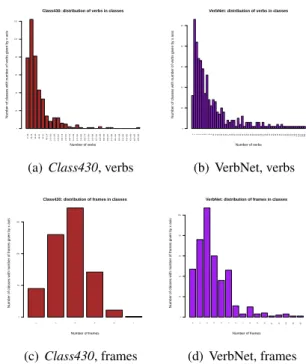
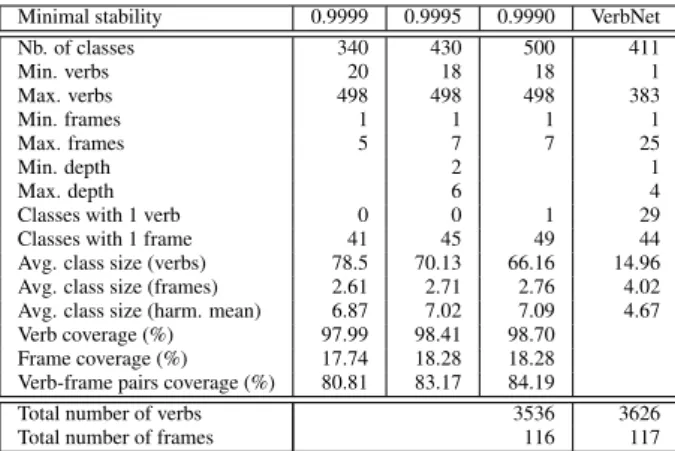
Table 1 gives a more detailed presentation of the impact of the stability threshold on the obtained classification. A threshold of 0.9995 yields a num-ber of classes closest to that observed in Verb-net (430 against 411 in VerbVerb-net). Fig. 1, a com-parison of the distributions of verbs and frames in classes for VerbNet and Class430, shows that the distributions are similar, although VerbNet has more classes with a small number of verbs. The main difference between Verbnet and our classifi-cation stems from the inventories of frames used. Although Dicovalence and Verbnet use approxi-mately the same number of frames (116 and 117 respectively), many frames have a low frequency in Dicovalence so that our classification only re-tains 29 of the 116 initial Dicovalence frames. As a result, Verbnet has classes with a higher num-ber of frames (average and maximum) and relat-edly a lower number of verbs. Interestingly, finer grained classes are used in Verbnet where in par-ticular, NP and PP categories are sometimes spe-cialised with thematic roles (e.g., NP.patient vs NP.topic) and sentential arguments are differenti-ated into whether/how/what sentences. In future work, we intend to extend the classes and frames with thematic roles which might result in a classi-fication distribution closer to that of Verbnet. 5.2 Factorisation.
Each class is associated with one or more semantic label (i.e., LADL table) and between 1 and 7
va-17−3334−4950−6566−8182−9798−114115−130131−146146−162163−178179−194195−210211−226227−242243−258259−274275−290291−306307−322323−338339−354355−370371−386387−402403−418419−434435−450451−466467−482483−498
Class430: distribution of verbs in classes
Number of verbs
Number of classes with n
umber of v erbs giv en b y x axis 0 20 40 60 80 100 120
(a) Class430, verbs
012345678910111213141516171819202122232425262728303132333537383940414344454647515569849495115119127242383
VerbNet: distribution of verbs in classes
Number of verbs
Number of classes with n
umber of v erbs giv en b y x axis 0 10 20 30 40 50 (b) VerbNet, verbs 1 2 3 4 5 7
Class430: distribution of frames in classes
Number of frames
Number of classes with n
umber of fr ames giv en b y x axis 0 50 100 150 (c) Class430, frames 0 1 2 3 4 5 6 7 8 9 10 11 12 13 16 25
VerbNet: distribution of frames in classes
Number of frames
Number of classes with n
umber of fr ames giv en b y x axis 0 20 40 60 80 100 (d) VerbNet, frames Figure 1: Number of classes with the number of verbs/frames given on the x-axis for VerbNet and Class430.
lency frames. Furthermore, the resulting classes each contain between 18 and 498 verbs. Over-all thus, the classification obtained associates verb sets with an informative syntactico-semantic char-acterisation; groups together a satisfactory number of verbs and frames; and permits covering a ma-jority of verbs and (verb, frame) pairs present in Dicovalence.
We also plotted the LADL tables against the number of classes they include. For most tables (61%), less than 5 classes are identified. There are 5 tables which are assigned no class – these are all relatively small tables (around 20 verbs) for which no class could be found whose verbs were included in the set of verbs contained by the table. 5.3 Example class.
An example class extracted by this method as-sociates the LADL tables 32RA (Make Adjv), 8
(Verbs with sentential complement in de) and the frames SUJ:NP; SUJ:NP,OBJ:NP; SUJ:NP,DE-OBJ:PP with the verb set { blanchir (to whiten), bleuir (to turn blue), blˆemir (to turn pale), pˆalir (to turn white), rajeunir (to become younger), rosir (to turn pink), rougir (to blush ), verdir (to turn green), vieillir (to age)}. That is, the class groups together verbs which indicate a change of state (mainly colour and age) and which can be used with and without object as well as with a
senten-Minimal stability 0.9999 0.9995 0.9990 VerbNet Nb. of classes 340 430 500 411 Min. verbs 20 18 18 1 Max. verbs 498 498 498 383 Min. frames 1 1 1 1 Max. frames 5 7 7 25 Min. depth 2 1 Max. depth 6 4
Classes with 1 verb 0 0 1 29
Classes with 1 frame 41 45 49 44
Avg. class size (verbs) 78.5 70.13 66.16 14.96
Avg. class size (frames) 2.61 2.71 2.76 4.02
Avg. class size (harm. mean) 6.87 7.02 7.09 4.67
Verb coverage (%) 97.99 98.41 98.70
Frame coverage (%) 17.74 18.28 18.28
Verb-frame pairs coverage (%) 80.81 83.17 84.19
Total number of verbs 3536 3626
Total number of frames 116 117
Table 1: Some features of the verb classification depending on the chosen stability threshold.
tial de-object.
6 Qualitative evaluation
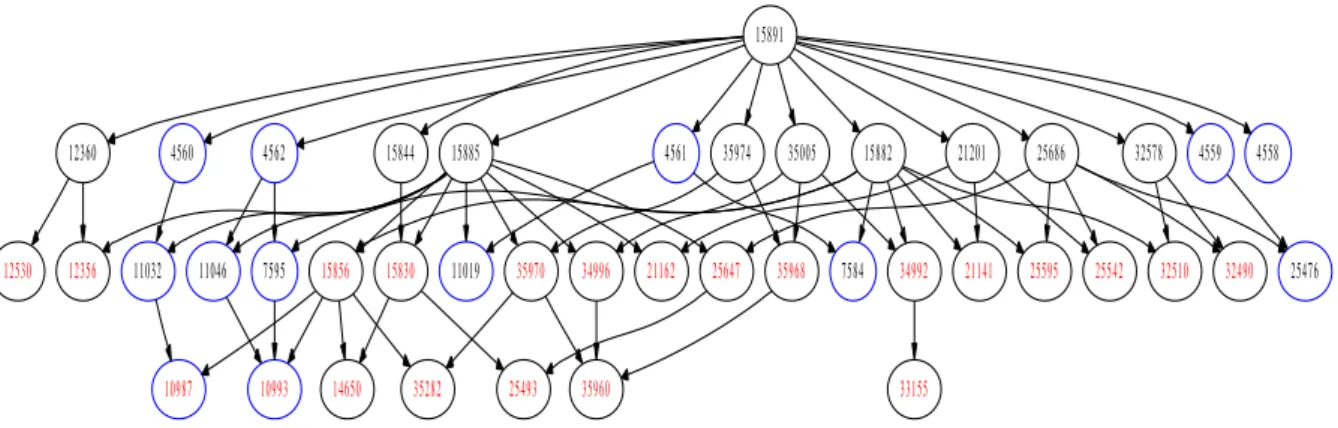
To explore the extent to which our classes group together verbs with identical thematic grids, we focus on psychological verbs i.e., verbs which, in the LADL tables, are described by table 4. Fig-ure 2 shows the subgraph of our classification (Class430) rooted in the class with table 4 as se-mantic feature. By inheritance all classes in this subgraph also have table 4 as semantic feature.
Table 4 contains 616 verbs describing emotion or psychological verbs. All verbs in this table en-ter a transitive construction where the object is al-ways human and the subject may be clausal (eg. Que Luc agisse ainsi amuse Max /That Luc be-haves this way amuses Max). Because the sub-ject of table 4 verbs may be phrasal, the EXPE
-RIENCER is always the object (not the subject).
Furthermore, the subject may accept both a (non-agentive) CAUSEand a (volitional) AGENT read-ing. Consequently, the thematic grid of verbs in this subclassification is [(CAUSEor AGENT), EX
-PERIENCER].
We now consider the subclassification in more detail and point out to several interesting ways in which the FCA approach interacts with polysemy and linking i.e., the mapping between syntactic ar-guments and thematic roles.
6.1 Polysemy
In Fig. 2, we outlined in blue the classes which have an additional table identifier in their at-tribute set and therefore may have an additional
meaning6. For instance, class 4562 is associated not only with table 4 but also with table 32C which contains transitive verbs with a concrete object (Eg. toucher le mur/touch the wall). This suggests that the verbs in this class have both a psychological reading (Table 4, toucher le public/move the audience) and a concrete object reading (Table 32C, toucher le mur/touch the wall). More specifically, this suggest that verbs in class 4562 accept not one but 2 thematic grids and linkings namely:
Table 32C Table 4
NP.AGENTNP.PATIENT NP.CAUSE/AGTNP.EXP.
Jean touche le mur Jean touche le public
Jean touches the wall Jean moves the audience
6.2 Linking
Next we considered those classes (marked with a red font in Fig. 2) which are not characterised by an additional table and have at least 3 frames (marked with a red font in Fig. 2). That is, we con-sider classes which are semantically homogeneous (Table 4 only) and syntactically varied (several frames). For these classes, we examined whether it was possible to consistently determine linking i.e. to consistently assign thematic roles to syntac-tic arguments in the various frames.
This worked well for most of the 20 classes ful-filling our selection criterion (table 4, more than 3 frames). For instance, class 14650 (28 verbs) could be assigned the following linking informa-tion:
NP.CAUSE ORAGENTNP.EXPERIENCER
Jean irrite Marie/Jean irritates Mary
NP.CAUSE ORAGENT
Jean irrite/Jean irritates.
NP.EXPERIENCER, reflexive
Marie s’irrite/Marie irritates herself
NP.EXPERIENCER, PP.CAUSE ORAGENT, reflexive
Marie s’irrite contre Jean/Marie irritates herself against Jean. Interestingly, Class 15856 departs from Class 14650 in that it groups together verbs for which the thematic role of the subject is ambiguous (Cause or Experiencer) when the verb is used in the intransitive form:
NP.CAUSE ORAGENTNP.EXPERIENCER
La douleur ´etouffe Marie/The pain suffocates Marie.
NP.CAUSE
La douleur ´etouffe/Pain suffocates.
NP.EXPERIENCER
Marie ´etouffe./ Marie suffocates
NP.EXPERIENCER, reflexive
Marie s’´etouffe/Marie suffocates.
6In the LADL tables, the same verb occurring in
differ-ent tables usually indicate that the verb has several possible meanings.
10987 10993 11019 11032 11046 12356 12360 12530 14650 15830 25493 15844 15856 35282 15882 21141 25595 32510 34992 7584 7595 15885 21162 25647 34996 35970 15891 21201 25686 32578 35005 35974 4559 4558 4560 4562 4561 25542 32490 25476 33155 35960 35968
Figure 2: Hierarchic representation of verb/frame classes for LADL table 4
For the other eight classes with intransitive ir-reflexive frames this ambiguity did not appear, in particular the linking between syntactic argu-ment and thematic role is straightforward in the three cases where the subject of the intransitive is clausal.
Finally, class 25647 (with 37 verbs) suggests that a more fine-grained representation of prepo-sitional objects is needed to correctly determine linking. More specifically, information about preposition type (locative vs. beneficiary) is re-quired to determine whether the EXPERIENCER role is realised by the object NP (les jeunes) or the prepositional object (en moi). Here, taking into account prepositions may help at separating the verbs of this class according to the syntactic realisation of EXPERIENCER.
NP.CAUSENP.EXPERIENCER
Ceci exasp`ere/anime Marie.
NP.EXPERIENCER, reflexive
Marie s’exasp`ere/s’anime.
NP.CAUSE/AGENT, NP1, P-OBJ:PP
Elle exasp`ere [en moi]P-OBJ:EXPERIENCERce d´esir.
Paul anime[les jeunes]NP1:EXPERIENCERcontre moi.
To sum up, this case study shows that the pro-posed classification scheme permits associating thematic role with syntactic arguments for a large majority of classes.
7 Conclusion
Developing a verb classification by hand is time consuming and error prone. It also makes it difficult to ensure consistency within and across classes. The results presented in this paper sug-gest that FCA is an appropriate framework for bootstraping a verb classification for French from existing lexical resources. First, concepts natu-rally model the association between object (verbs) and attributes (syntactic and/or semantic features).
Second, like fuzzy clustering, FCA permits “soft clustering” in that a data element may belong to several classes – a property of the produced classi-fications which is essential for our task since verbs are highly polysemous and may belong to several syntactic and/or semantic classes. Third, stable concepts and symbolic filtering on the attribute sets permit creating classes with good factorisa-tion power (e.g., a few hundred syntactic classes to cover roughly 3 500 verbs) and linguistically sound, empirical content (good average number of verbs and frames within the classes). Fourth, a preliminary and partial qualitative evaluation sug-gests that the classes built adequately describe the association between verb sets, syntactic frames and thematic grids.
Ongoing work concentrates on enriching the classification with additional features such as pas-sivisation, reflexivisation, middle voice, etc.; and on further evaluating the classes obtained in partic-ular, wrt their ability to group together verbs with identical thematic grids.
Acknowledgments
The research reported in this paper was par-tially supported by the French National Research Agency (ANR) in the context of the Passage project (ANR-06-MDCA-013). We would like to thank Yannick Toussaint for his suggestion to use stability as a filter as well as for general feed-back and help on the topics addressed in this paper and Corinna Anderson for help and suggestions on several linguistic issues.
References
[Ganter and Wille1999] Bernhard Ganter and Rudolph Wille. 1999. Formal concept analysis: Mathemati-cal foundations. Springer, Berlin-Heidelberg. [Gardent2009] Claire Gardent. 2009. Evaluating an
Automatically Extracted Lexicon. In 4th Language & Technology Conference, Poznan, Poland.
[Gross1975] Maurice Gross. 1975. M´ethodes en syn-taxe. Hermann, Paris.
[Guillet and Lecl`ere1992] A. Guillet and Ch. Lecl`ere. 1992. La structure des phrases simples en franc¸ais. 2 : Constructions transitives locatives. Droz, Geneva.
[Kuznetsov2007] Sergei O. Kuznetsov. 2007. On sta-bility of a formal concept. Annals of Mathematics and Artificial Intelligence, 49(1-4):101–115. [Levin1993] Beth Levin. 1993. English Verb Classes
and Alternations: a preliminary investigation. Uni-versity of Chicago Press, Chicago and London. [Priss2005] Uta Priss. 2005. Linguistic Applications of
Formal Concept Analysis. In Bernhard Ganter, Gerd Stumme, and Rudolf Wille, editors, Formal Concept Analysis, volume 3626 of Lecture Notes in Com-puter Science, pages 149–160–160. Springer Berlin / Heidelberg.
[Schuler2006] Karin Kipper Schuler. 2006. VerbNet: A Broad-Coverage, Comprehensive Verb Lexicon. Ph.D. thesis, University of Pennsylvania.
[Valverde-Albacete2008] Francisco J.
Valverde-Albacete. 2008. Extracting Frame-Semantics
Knowledge using Lattice Theory. Journal of Logic and Computation, 18(3):361–384, June.
[van den Eynde and Mertens2003] Karel van den
Eynde and Piet Mertens. 2003. La valence:
l’approche pronominale et son application au lex-ique verbal. Journal of French Language Studies, 13:63–104.