Mostefa Benboulaid, Batna 2 University Faculty of Letters and Languages
Department of English
Developing Students' Intercultural
Competence through the Use of Literary
Culture-Based Texts:
An Experimental Approach
The Case of Second Year Students at the Department of English,
Batna University
THESIS
Submitted in Partial Requirement for the Degree of Doctorate Es-Science in Language and Civilization
Submitted By: Supervised by:
Houda BOUHIDEL Pr. Hachemi ABOUBOU
Board of Examiners:
Chairman: Pr. Med Salah NEDJAI University of Batna 2 Supervisor: Pr. Hachemi ABOUBOU University of Batna 2
Examiner: Dr. Souhila HELLALET University of Batna 2
Examiner: Pr. Hacene SAADI University of Constantine
Examiner: Pr. Said KESKES University of Sétif
Examiner: Pr. Riadh BELOUAHEM University of Constantine
I
dedicate this work toTo my husband Abdelhakim, without his support, this work could have never seen light. To my dear sons; Abderrahmane and Abderrahim who will certainly understand one day
that it’s for them that I kept doing my best all the time.
To my father and mother, whose love and prayers were the light to the dark nights and hard days.
To my sisters Manel, Hassina, Amina, Asma, Zineb and their husbands To my brother Karim and his wife
To my mother and father in law To my sisters and brothers in law
Acknowledgments
If there is one I should acknowledge his help and support in the first place, then He is certainly Allah the Almighty, the most Gracious and the most Merciful. When I felt weak, he gave me strength, and when I felt alone, he was always by my side.
Allah also taught us to thank his people who stood by our side when we needed them, thus if there is someone I should start with, it would certainly and without doubt be my supervisor Pr. Hachemi Aboubou. All the words making all languages and tongues cannot describe his kindness and help. He kept encouraging me and believing in me, when I felt weak and thought that the task is really hard to realize.
I am also thankful to the founding father of our department of English, Pr. Med Salah Nedjai whose wisdom and insightful remarks were of a great help to all of us.
I am also grateful to Pr. Omar Ghouar who never ceased to give all the help and support we needed in times of hardships.
I am also indebted to Pr. Amel Bahloul whose pieces of advice kept echoing in my ears all the time.
Deep gratitude goes to the members of the jury Dr. Souhila Hellalet, Pr. Said Keskes, Pr. Hacene Saadi and Pr. Riadh Belouahem who accepted kindly to read and evaluate my work.
I am also thankful to all my colleagues who never ceased to show their moral sustain especially the teachers of culture who accepted kindly to answer my questionnaire.
Finally I can’t conclude without expressing my deepest gratitude to my dear students, who took part in the experiment and truly believed in what I was doing. Thus, they kept faithful till the last day; to them I say: “All the work is really meant for you”
Abstract
The present work attempts at shedding light on the current situation of culture teaching at the Department of English, Batna2 University. It tries to demonstrate that culture teaching has gained a special attention and focus from educators and researchers in our country, especially in the last few decades. However, it seems that the efforts made towards realizing some of the objectives sought from culture teaching are not yielding the desired outcomes. Courses in culture are most of the time considered courses in literature or history and; therefore, are treated negatively by our students, who are still convinced that learning English can be achieved successfully without these courses. Not knowing that, if one hopes to learn the foreign language successfully, he has to give culture learning the same weight he gives to language learning, complicates the task for teachers and educators. Thus, and in an attempt to clarify better the situation and try to suggest some possible remedies to it, we hypothesized that integrating literary texts in the course/s of culture is expected to bring changes in the students’ negative attitudes and behavior by developing their intercultural communicative competence. In pursuing this objective, we made use of two methods, the experimental and the descriptive. Both require the gathering of the necessary data using specific tools. Thus, two questionnaires, administered to two samples from two different populations, second year students and teachers of culture at the Department of English, Batna 2 University, in addition to an experiment, carried out with a sample from second year students, were utilized to obtain the necessary quantitative and qualitative data. Results demonstrated that, although little importance has been accorded to the courses of culture by students learning English as foreign language, the introduction of literary texts, as an alternative teaching strategy to culture, proved very effective in enhancing students’ intercultural communicative competence, and in improving their learning of the target language as a whole.
Table of Contents
Acknowledgment ... I Abstract ... II List of Figures ... …..IX List of Tables ... X List of Abbreviations ... XIII
General Introduction ... 1
I. Background of the Study ... 1
II. Statement of the Problem ... 4
III. Hypotheses ... 6
IV. Objectives of the Study ... 6
V. Research Methodology ... 7
VI. Structure of the Thesis ... 9
Part A: Review of Literature A.I. Chapter One: Culture and Intercultural Communicative Competence in Foreign Language Teaching Introduction ... 11
A.I.1. Defining Culture ... 12
A.I.2. The Elements of Culture ... 13
A.I.2.1 Language and Culture Relationship ... 15
A.I.3. Culture Teaching and the Language Classroom ... 17
A.I.4. Rational for Culture Teaching in the Language Classroom ... 19
A. I.4.1. Language Teaching and Culture ... 19
A.I.4.3. Interculturality and Language Learning ... 22
A.I.5.Culture and Foreign Language Teaching ... 24
A.I.5.1.Culture and Vocabulary ... 25
A.I.5.2.Culture and Listening ... 25
A.I.5.3. Culture and Speaking ... 26
A.I.5.4. Culture and Reading ... 26
A.I.6. Approaches to Culture Teaching in Foreign Language Education ... 27
A.I.6.1. The Grammar Translation Method ... 27
A.I.6.2. The Direct Method ... 28
A.I.6.3. The Audio-lingual Method ... 28
A.I.6.4. The Functional Approach ... 29
A.I.7.Difficulties of Teaching Culture in the Foreign Language Classroom ... 30
A.I.8.Intercultural Communicative Competence and Language Teaching ... 31
A.I.8.1.Intercultural Competence Vs Intercultural Communicative Competence ... 34
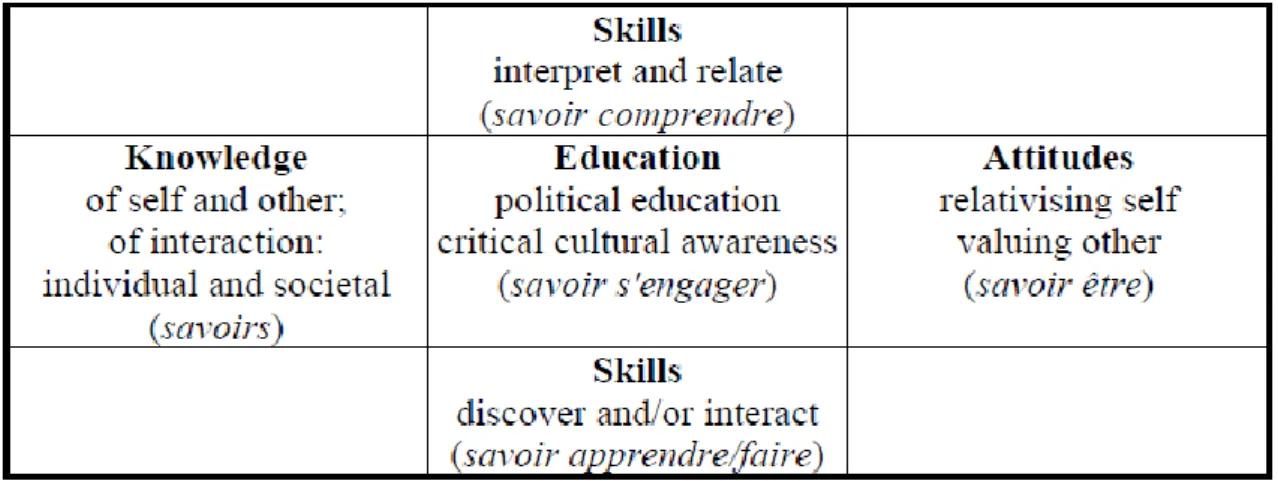
A.I.8.2.Dimensions of Intercultural Communicative Competence ... 35
A.I.8.3.Models of Intercultural Competence ... 35
A.I.8.4.Byram’s Model of Intercultural Communicative Competence ... 39
A.I.8.5.Assessing the Three Dimensions of ICC ... 41
A.I.8.5.1.Assessing intercultural knowledge/saviors ... 41
A.I.8.5.2.Assessing Intercultural know-how/Savoir-faire ... 41
A.I.8.5.3.Assessing Intercultural being/savoir-être ... .41
A.I.8.6.Methods of Assessment ... 42
Chapter Two: Reading, Literature, and Intercultural Communicative Competence
Introduction ... 46
A.II.1 Literacy Vs Cultural Literacy ... 47
A.II.2.The Essence of Reading ... 50
A.II.3. Reading and Discourse ... ..52
A.II.4. Reading and Sociocultural Schemas ... 53
A.II.5. Reading and Shared Cultural Values ... 56
A.II.6. Reading and Text Selection ... 58
A.II.7. Criteria for Text Selection ... 58
A.II.7.1. Authenticity ... 59
A.II.7.2. Readability ... 60
A.II.8.Approaches to Text Selection ... 62
A.II.8.1.Freirean Approaches ... 63
A.II.8.2.Language Experience Approach ... 64
A.II.9. Literature and Intercultural Competence ... 64
A.II.9.1. Defining Literature ... 65
A.II.9.2. Reasons to Include Literature in Foreign Language Teaching ... 66
A.II.9.2.1. Literature and Language Acquisition ... 66
A.II.9.2.2 Literature and Authenticity ... 69
A.II.9.2.3. Literature and Cognitive/Affective Development ... 72
A.II.9.2.4. Literature and Culture Bridging ... 73
A.II.9.2.5. Literature and Intercultural Competence Development ... 75
A.II.10. Criteria for Selecting Literary Texts ... 78
A.II.10.1. The Type of Course... 78
A.II.10.2.1. The Student’s Cultural Background ... 79
A.II.10.2.2. The Student’s Linguistic Proficiency ... 79
A.II.10.3. Criteria related to the Text ... 80
A.III. Literary Texts and Classroom Activities ... 81
A.III.1. Pre-reading Activities ... 82
A.III.2 While Reading Activities ... 83
A.III.3. Post reading Activities ... 83
A.III.4. Follow up activities ... 83
Conclusion ... 84
PART: B Research Methodology Design Chapter Three: Research Methodology Introduction ... 85
B.I. Choice of the Method ... 85
B.II. The Participants ... 87
B.II.1 The Population ... 87
B.II.2 The Sample ... 87
B.III. Data Gathering Tools ... 88
B.III.1. The Students’ Questionnaire ... 89
B.III.2. The Teachers’ Questionnaire ... 89
B.III.3 The Experiment ... 90
B.III.3.1 The Rating Scale ... 90
B.IV. The Procedures ... 92
B.IV.2 After the pre-Tests ... 92
B.IV.3 The Progress Tests ... 92
B.VI.4. The Post Test ... 93
Conclusion ... 94
PART C: FIELD WORK Chapter Four: The Students’ Questionnaire Introduction ... 95
C.I.1 Description of the Questionnaire ... 95
C.I.2 Administration of the Questionnaire ... 96
C.I.3 Discussion of Results ... 97
Conclusion ... 119
Chapter Five: The Teachers’ Questionnaire Introduction ... 121
C.II.1. Description of the Questionnaire ... 121
C.II.2. Administration of the Questionnaire ... 122
C.II.3. Discussion of the Results ... 123
Conclusion ... 153
Chapter Six: The Experimental Design Introduction ... 155
C.III.1. The Experimental Design Procedures ... 155
C.III.1.1. Selection of Texts ... 155
C.III.1.2. Classroom Management... 156
C.III.2. The Experimental Design Results ... 158
C.III.2.1. Results of the Pre-test ... 158
C.III.2.2.1. Results of Progress Test 1 ... 162
C.III.2.2.2. Results of Progress Test 2 ... 173
C.III.2.2.3. Results of Progress Test 3 ... 184
C.III.2.3. Results of Post test ... 195
C.III.2.4. The t-test ... 199
Conclusion ... 202
Recommendations ... 205
General Conclusion ... 209
Bibliography ... 212
List of Figures
Figure 1: Iceberg Model ... 14
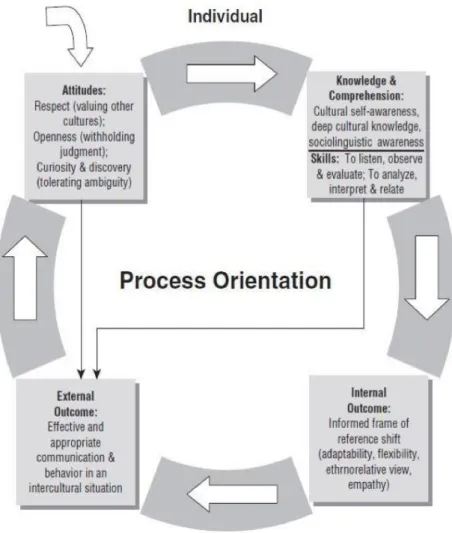
Figure 2: Deardorff’s Process Model of Intercultural Competence ... 39
Figure 3: Factors in Intercultural Competence ... 76
Figure 4: Distribution of Teachers’ Age ... 124
Figure 5: Distribution of Teaching Years ... 125
Figure 6: Teachers’ Experience in Culture Teaching ... 127
Figure 7: Sources of Students’ Positive Attitudes ... 133
Figure 8: The Utilized Teaching Materials ... 144
Figure 9: Reasons behind Students’ Demotivation to Read ... 146
Figure 10: Pre-test Results ... 161
Figure 11: Students’ Scores in Progress Test N°1 (TS) ... 172
Figure 12: Students’ Scores in Progress Test N°1 (AS) ... 172
Figure 13: Students’ Scores in Progress Test N°2 (TS) ... 183
Figure 14: Students’ Scores in Progress Test N°2 (AS) ... 183
Figure 15: Students’ Scores in Progress Test N°3 (TS) ... 194
Figure 16: Students’ Scores in Progress Test N°3 (AS) ... 195
List of Tables
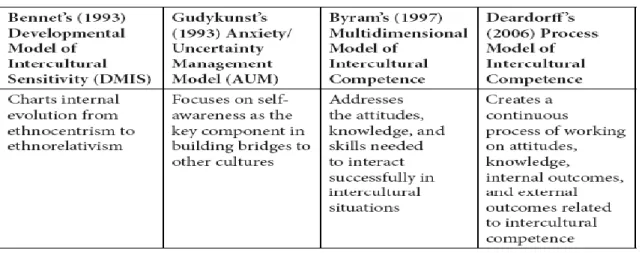
Table 1: Summary of the four major theories and factors that contribute to the development of
intercultural competence ... 37
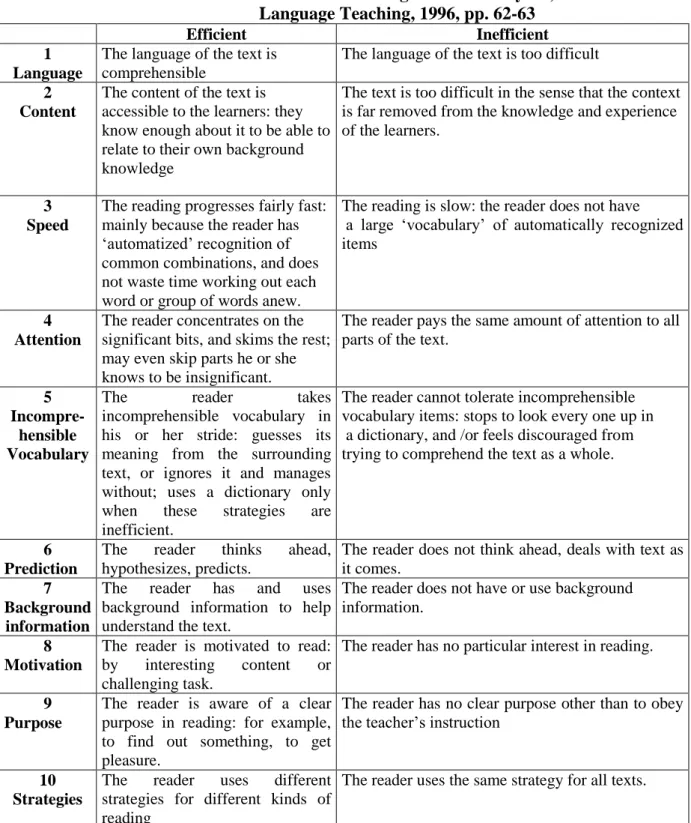
Table 2: Efficient and Inefficient Reading Source: ... 57
Table 3: Checklist for Choosing Literary Texts ... 81
Table 4: Assessment Criteria of Intercultural Competence. ... 91
Table 5: Students’ Gender ... 97
Table 6: Students’ Age ... 97
Table 7: Students’ Understanding of Culture ... 98
Table 8: Language and Culture Relationship ... 99
Table 9: The Possibility to Learn Language without Culture ... 100
Table 10: The Most Important Aspect in Learning a Language ... 100
Table 11: Language Courses and Cultural Content ... 102
Table 12: Students’ Likes and Dislikes of Culture Courses ... 103
Table 13: Reasons behind Students’ Dislike of Courses in Culture ... 105
Table 14: The Teacher of Culture and Culture Teaching ... 106
Table 15: Reasons behind Teacher’s Incapacity to Teach Culture ... 107
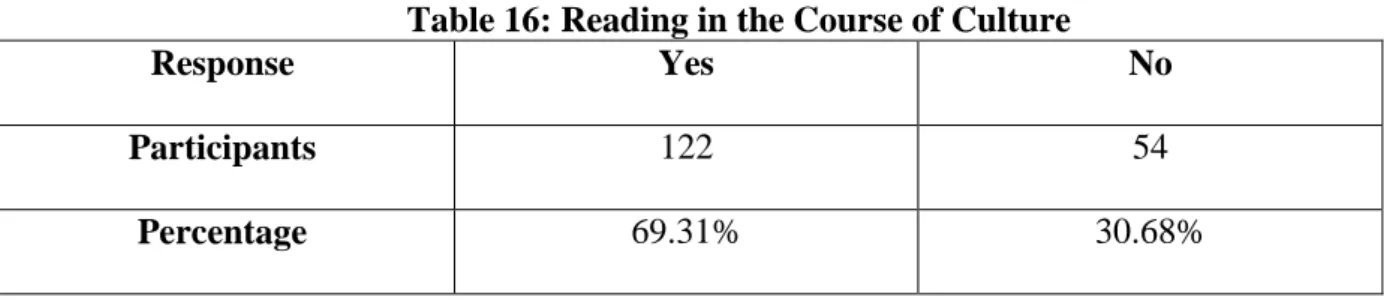
Table 16: Reading in the Course of Culture ... 109
Table 17: Students’ Reading of the Selected Readings ... 109
Table 18. Reasons behind Students’ Positive Attitudes towards Reading ... 110
Table 19: Reasons behind Students’ Negative Attitudes towards Reading ... 111
Table 20: Reading and the Type of the Acquired Knowledge ... 112
Table 21: The Inclusion of Literature in the Readings ... 112
Table 22: The Preferred Type of Literary Texts to Students ... 113
Table 24: Reading Literature and Students’ Acceptance of Cultural Differences ... 115
Table 25: Students’ Readiness to Live in a Different Culture ... 117
Table 26: Teachers’ Gender ... 123
Table 27: Teachers’ Age ... 123
Table 28: Teachers’ Teaching Experience ... 124
Table 29: Teachers’ Contact with the Target Language and Culture ... 126
Table 30: Teachers’ Contact with the Target Language and Culture ... 126
Table 31: Teaching Years of Civilization Courses ... 127
Table 32: Teachers’ Views about the Link between Language and Culture ... 128
Table 33: Teachers’ Differentiation between Culture and Civilization ... 129
Table 34: Teachers’ Opinion about Students’ Interest in the Course of Culture ... 131
Table 35: Teachers’ Explanation of Students’ Negative Attitudes ... 131
Table 36: Teachers’ Explanation of Students’ Positive Attitudes ... 133
Table 37: Teachers’ Choice of Culture Course Content ... 134
Table 38: Teachers’ Role in Showing the Difference between Native and Target Cultures . 136 Table 39: Teachers’ Capacity to Teach the Target Culture ... 141
Table 40: Teachers’ Use of Extra Teaching Materials ... 143
Table 41: The kind of Teaching Materials ... 144
Table 42: Teachers’ Opinion about Students Attitudes towards Reading ... 145
Table 43 . Sources of Students’ Demotivation to Read ... 146
Table 44: Students’ Beliefs about Authenticity of Literature ... 150
Table 45: Scores of the Pre-test test for the Experimental Group ... 159
Table 46: .Scores of the Pre-test for the Control Group ... 160
Table 47: .Means of Scores in the Pre-test of the EG and CG. ... 161
Table 49: Scores of Progress Test N°1 for the Control Group ... 170
Table 50: Students’ Scores in Progress Test N°1 ... 171
Table 51: Scores of Progress Test N°2 for the Experimental Group ... 180
Table 52: Scores of Progress Test N°2 for the Control Group ... 181
Table 53: Scores of Progress Test N°3 for the Experimental Group ... 191
Table 54: .Scores of Progress Test N°3 for the Control Group ... 192
Table 55: Students’ Scores in Progress Test N°3 ... 194
Table 56: Scores of Post-test for the Experimental Group ... 196
Table 57: Scores of Post -test for the Control Group ... 197
Table 58: Means of Scores on the Post-test of the EG and CG. ... 198
Table 59: Frequency Distribution of the CG and EG ... 200
Table 60: Mean, Variance and Standard Deviation for the Control Group ... 200
Table 61: Mean, Variance and Standard Deviation for the Experimental group ... 201
List of Abbreviations
CCL: Culture and Civilization of Language CG: Control Group
EFL: English as a Foreign Language EG: Experimental Group
FL: Foreign Language
General Introduction
I.
Background of the Study
Globalization which brought cultures closer to each other more than any time before, altered also the primary objectives sought from foreign language education. Acquiring a basic understanding of culture in learning foreign languages has become a basic goal for both politicians and educators. Assuming that learning a language should go hand in hand with the culture of the social group was reflected in the teaching methodologies and in the tremendous efforts carried out by educators to promote culture teaching. Different methodologies have been designed to meet the different teaching contexts and realize the objectives sought by both educators and politicians, who consider “culture teaching” a necessity to be pursued with all means.
Language is the most common medium through which culture is taught, as it is believed to be a mirror to culture and by teaching the language we are, at the same time, teaching something about the culture of the people who speak the language. Thus, words of a language acquire their meanings, only when we relate them to the whole social and cultural context of use, and any breakdowns during the communicative act should not be attributed to the difficulty or the misunderstanding of vocabulary, but to the ignorance of the cultural background behind its use.
The early teaching methodologies integrated culture in the curriculum with the basic goal of improving the linguistic performance of learners only, although culture proved to be a determining factor for the success or failure of language acquisition, and it would be very simplistic to assume that acquiring a new language is a mere acquisition of the language system.
By teaching culture, the learner will be exposed to a new culture and to a new way of thinking, feeling and acting. The language teacher must be aware of these facts and work for
the integration of an intercultural dimension in teaching the foreign language, as he/she is not in a position to decide whether to teach culture or not. The decision would rather be about the possible teaching methodologies that could best promote cultural understanding among learners. Deciding about the best way to teach culture relates to the objectives and the means employed. These have always observed a continuous change over time and space. For example, the Communicative Approach, considers the learner a key element in any learning process, thus; enabling him to communicate in different contexts is a central aim to be realized through teaching the language of everyday use. So, the language to be taught has to be situated in its cultural and social contexts.
Talking about culture and the importance of culture in foreign language education raises many questions about the way/s in which a cultural element can be added to the teaching of English as foreign language mainly in our educational contexts, where English is limited to the classroom and with fewer opportunities for real-life situations.
Reading, one of the oldest teaching methods to language, proved to be successful in transmitting thought and knowledge between cultures. And although new methods along with new technologies came to meet the requirements of the new age, reading never lost its fame among the different teaching methodologies in foreign language education, and it proved to play a crucial role in constructing the needed bridges between cultures and in creating a new kind of literacy.
How to establish such a bridge between cultures taking into consideration the differences characterizing the students’ native language and culture, and the foreign language and culture of the texts to be read has always been a crucial matter. Research conducted on reading in foreign language education proved that this latter is quite different from reading in the first language. Several factors interact and make it a difficult process to be observed and understood. Students may think that difficulty to understand texts in the foreign language is
due to the difficulty of understanding the meaning of words, although the problem lies elsewhere. Complexity of language is not only due to the lexical meanings of words, but to the complexity and newness of context. Not knowing the social and cultural background behind words makes it difficult, if not impossible, for learners to guess their meaning.
The above situation resulted in a considerable regress along a constant struggle with the reading activity among our students. Most of them read out of external forces which cannot be resisted. But, who is to blame for this? Surely, many are involved. Yet, realizing the role of reading in achieving cultural understanding and awareness in the foreign culture would ease some of these difficulties. Moreover, deciding about the kind of readings is another problem that language teachers may face, while trying to make a selection of the reading material. So, what to read?
For a long time, it has been assumed that literature holds all the assumptions, beliefs, attitudes and values of any culture and social group. Therefore, reading literature should not always be taken as an entertaining activity, but as a unique experience between two cultures which come into contact through the written or spoken word. The focus on literature as a rich and important material to be used in foreign language education leads us to ask the following: why literature in particular? Different arguments were in favor of using literature in the language classroom as a useful and resourceful material. Usefulness of literature was perceived in different ways, but one makes it different from all other kinds of material used in teaching foreign languages.
Since most of the students learn the foreign language, especially the English language, knowing that there is little hope of being one day in direct contact with the language in its authentic setting. Teachers in foreign language classrooms, who are also aware of this truth, attempt to bring for this lack. Different authentic materials are used in classroom contexts with the expectation to bring for this lack. Literature is seen as one of the most valuable
authentic materials that teachers can make use of. Students are not in need to passports and to trips to be in direct contact with the language in its native context. Literature is capable of creating the same authentic settings met in real life situations through language only. It is also a vehicle to the target culture. However, despite the strong arguments advocating the use literature in foreign language classrooms to construct a bridge to the target culture, the issue entails more complexity than it seems to be.
II.
Statement of the Problem
In Algeria, teaching foreign languages has gained significance and importance. Acquiring a linguistic competence in the language plus having some knowledge in the culture of the people who speak the language make two basic goals for teachers and curriculum designers. The situation, which is to a great extent recent in our country, existed in the western world many years ago, as teaching culture became a primary concern in foreign language education. Europeans as well as Americans were the first to make progress in this field and their teaching methodologies translated deeply their desire of awarding culture teaching the same importance as language teaching in foreign language education. In the Algerian educational system, there are attempts to make of culture and culture teaching integral components in foreign language teaching. Curriculums have been designed towards this objective and students learning English as a foreign language are introduced in a variety of ways to the culture/s of the people who speak the language.
A close observation of the cultural content taught to our students reveals that courses in culture are usually considered and, therefore; treated as courses in history or literature. True, history and literature are important components in the culture of any nation, but they are not all that defines its culture. Teachers tend to introduce courses in culture to students cross-historically by narrating the past of the target civilization, or by studying and analyzing one the major works in its literature. But, can we assume that these courses have achieved the
ultimate goals for which they have been taught? Are students interested in them? And are they aware of their true significance? In fact, the teaching of culture should be more than a narration to the past or an analysis of literary works. Students learning the foreign language must be given the opportunity to discover and understand the different ways of thinking and behaving of the target culture/s through these courses. Since, having students capable of perceiving the different worldviews, and transcending their mono-cultural vision, is the ultimate goal from culture teaching.
Yet, the current situation in the department of English at Batna 2 University tells a different truth. Students tend to give little importance to these courses, and most of the time they are regarded as an extra load. Courses in grammar, writing, phonetic or linguistics are, according to many, more important than courses in culture, as they teach them the language, the goal for which they are studying English. Add to this is the fact that the way they are taught risks to lose them their true significance. Thus, they are taught like courses in history or in old literature. Both are not of much attraction to our students. Furthermore, the kind of students we have in our classes today is complicating the task for teachers. Today’s students are making a new generation of learners who are willingly controlled by the new technologies. Teaching and learning transcended the borders of the classroom, and teachers can easily be replaced by the net. Thus traditional ways of teaching have become of very little charm and attraction to many.
Having demotivated students in our classes, plus the unclear vision of the objectives sought from teaching culture is losing more and more the true significance of such courses. Although, exceptions can be found, but they are very tiny to be observed or even noticed. Therefore, trying to make of reading and literature alternative strategies to teach the target culture seems to be a difficult task in our context. Teaching students who are, not only showing a constant struggle with the reading activity, but also a demotivation to study
literature will certainly complicates the task for us. Thus, and in the light of all what have been stated, the present research attempts to answer two basic questions:
►What are the possible ways that can make of reading an enjoyable activity leading to the development of the students' intercultural competence? And
►How can teachers be creative in using literature and literary texts as a kind of reading material to promote a desire among students to read extensively in English, practice and improve their skills in the foreign language, and develop a zone of intercultural understanding?
III. Hypotheses
To demonstrate the role that reading literature has on enhancing the students’ intercultural competence and therefore a better acquisition of the target language the following hypotheses are set:
Hypothesis 1
It is supposed that a reconsideration of the importance accorded to reading by teachers, students and curricular designers would give reading some of the basic goals it was meant for, such as practicing and improving the students' skills in the foreign language, and developing a zone of cultural understanding?
Hypothesis 2
It is expected that the use of literary texts, as a reading material would enhance cultural understanding among students and improve their intercultural competence.
IV. Objectives of the Study
The present work attempts at shedding light on an important issue, which may have not gained the importance it deserves a long time ago. The status that culture in foreign language education has acquired in Algerian universities does not correlate with the rapid changes characterizing the world. The present situation warns that a mutual understanding
between the different cultures has become a necessity rather than a choice. Therefore, the goals sought from culture teaching in foreign language education need to be reconsidered.
Students must be aware of the fact that the different ways of thinking, behaving are culturally determined. Such awareness would reduce the prejudices students may hold when learning the foreign language. Yet, what theories state is quite different from what real teaching contexts hold. Students may be aware of the changes taking place at a global scale, but there is doubt of whether they are conscious of being part of these changes, or that learning a foreign language goes beyond a mere linguistic competence to be acquired in the target language. Students should be able to communicate effectively and be able to perform adequately when interacting with others who are linguistically and culturally different.
Consequently attempts to demonstrate the tight link between language teaching and culture teaching and the importance of culture teaching, which should not be minimized or viewed, with marginal consideration is a primary objective in this work. On the other hand, students must be made aware of the significance lying behind teaching culture, if they are looking to a better mastery of the English language. This awareness, however, should not be a student’s only. Teachers are part of the issue and are expected to make the first steps towards a real change in their teaching strategies for better cultural teaching and learning.
Thus, stress will be on the fact that a reconsideration of the objectives sought from culture teaching, along with new teaching strategies are capable of improving the students’ understanding and perception of the target culture, which will ultimately lead to enhancing their intercultural communicative competence and to a better mastery of the English language.
V.
Research Methodology
There exist different methods in research, and only the problem under investigation can determine the method to be used. In education, inquiring about human issues cannot obey easily to the exactitude and explicitness required in scientific research. As we attempt in our
work to lay ground for the held assumption that introducing texts literary to students learning English as a foreign language would improve their intercultural competence and enhance their achievement in learning English as a foreign language, we think that combining two methods, the experimental method and the descriptive method would enable us reach the objectives sought from the research and prove the previously set hypotheses.
Thus, to have a close examination of the effects those culture-based literary texts may have on enhancing students’ intercultural competence and improving their achievement in learning English as a foreign language, the experimental method has been adopted. The condition being evaluated is known as the independent variable and the criterion used to evaluate this condition is the dependent variable. Therefore, the independent variable we attempt to investigate about in this work would be the literary texts, whereas the dependent variable would be the students’ intercultural competence. If the experiment is well conducted, the researcher is allowed to attribute any change in the dependent variable to the independent variable, yet factors other than the independent variable may interfere in the course of the experiment, and be a cause to the change observed in dependent variable. Thus, to avoid the occurrence of such interference and to guarantee the validity of the obtained results, the appropriate experimental design has to be adopted. Therefore, the Pretest Post-test Control Group Design is believed to enable us conclude that any difference is due to the independent variable and not to other extraneous variables.
In addition to the experimental design, the descriptive method has been also used with the basic goal of obtaining necessary qualitative data, as the nature of the problem requires a different kind of information to be treated differently. The present research deals with two different populations, students and teachers. Thus, knowing their attitudes towards the issue under investigation will bring to the surface important facts, before one attempts to try the new treatment on the concerned subjects. Thus, surveys taking the form of attitude
questionnaires were administered to both populations and the obtained data made another important source of information to the researcher. An appropriate selection of the sample, in addition to a systematic analysis and interpretation of the results is supposed to reduce any negative influence caused by extraneous variables and make the adopted design valid and reliable to the work.
Thus, being able to determine the relationship between the use of literary texts and the students’ intercultural competence in the target language, would give credit to the chosen methods, allow for future generalization and open new ways for making use of literary texts in teaching English as a foreign language.
VI. Structure of the Thesis
The thesis is composed of six main chapters. The first chapter aims at clarifying basic concepts and notions related to culture, culture teaching and intercultural communicative competence. So, after defining culture and explaining how it links to language, focus will be on culture teaching in the language classroom, and more precisely in the foreign language classroom. Thus, an explanation of the main reasons that made of culture a central element that must be included in the teaching of language will be provided. We will also identify some of the difficulties teachers may face in the process of culture teaching. In the second part of the chapter, intercultural communicative competence or ICC, a key concept in the present work will be devoted enough space to clarify its meaning, present its different dimensions, and show how it is different from intercultural competence. We will also present examples of some of the models to ICC with a special focus on Byram’s Model. Finally, an explanation of how to assess ICC and what to assess in ICC will be provided.
The second chapter, however, tackles the heart of issue. It starts by examining the different conceptualizations of two basic terms, literacy and cultural literacy. Then, it shows how reading relates to other basic notions such as schematic knowledge and shared cultural
values. After that, it identifies the criteria used when selecting texts and discusses how literature can be a very effective material used in culture teaching. Stress, however, will be on how literature can be of an immediate link with intercultural competence development. Finally, the different classroom activities that can be used along literary texts are carefully presented.
The third chapter highlights the main research methodology adopted in this research work. It explains the rationale behind the use of two methods, the experimental method and the descriptive method. Also, an explanation of the criteria used to choose the populations and the samples for the study is also provided. After that, analysis and interpretation of the found results is carefully presented in this chapter.
The fourth chapter and fifth chapters are devoted to the description and analysis of the surveys administered to students and teachers prior the experimental study. Therefore, a description of the items included in the two questionnaires, in addition to a systematic interpretation of the respondents’ answers is carefully presented and illustrated with figures and/or tables, whenever the element under description requires that.
Chapter six covers the experimental design, which has been adopted in this work. Thus, a detailed explanation of the different steps followed during the experiment is provided. Choice of texts, the activities used along these texts, plus the techniques employed to measure students’ ICC are detailed in this chapter. More importantly, the obtained results are calculated, and then statistics are clearly presented in tables and figures. Furthermore, the different mathematical formulas, which were used in the interpretation of results, are also provided and explained.
CHAPTER ONE
Culture and Intercultural Communicative Competence in Foreign
Language Teaching
Introduction
Culture has become an integral part in foreign language education. All research conducted in the field proved the necessity to incorporate a cultural element in the teaching and learning of the foreign language. Therefore, the main concern in our classes has shifted from a mere linguistic competence to be achieved in the target language to a different competence which enables learners communicate not only in the target language, but interact effectively with the people from the target culture as well. Intercultural communicative competence is the new competence that most teaching methodologies are focusing on its learning and development. A lot of efforts were and are still made towards realizing this objective, yet what theories state is completely different from what reality holds. A lot of handicaps are standing against realizing the dream of bridging the gap between cultures and languages.
Therefore, this chapter will introduce readers to basic concepts related to culture and culture teaching. It starts by clarifying the meaning of culture and how it relates to language. Then, it discusses the issue of culture teaching in the language classroom and the reasons why culture teaching should go hand in hand with language teaching. After that, focus will turn to culture teaching, but in the context of the foreign language classroom. The reasons why culture teaching has become a necessity rather than a choice in foreign language teaching will also be explained. Furthermore, a brief historical background of the different methodologies to culture teaching in EFL classrooms will be traced back. Finally, the concept of intercultural communicative competence or ICC will make the second part of the chapter. Thus, it starts by clarifying its meaning and specifying its main dimensions, and differentiating it from
intercultural competence. There will be also a description of the different models to ICC, but focus will be on Byram’s model, as it is the model to be adopted and then adapted to the experimental design of the present research. At last, like all kinds of learning which require assessment, the teaching of culture needs also to be evaluated, to see if any progress is being made in the teaching of intercultural communicative competence or not. For that reason, we will define the different areas of ICC to be assessed, in addition to the different methods that can be used in assessment.
A.I.1 Defining Culture
Although defining culture proved to be no easy task for scholars and researchers in different fields of study, several attempts were and are still made with the hope of coming with a satisfactory definition and an understanding of the concept. Many scholars felt the necessity to come with representative definition, thus; two types of culture have been distinguished, big culture or Big C and little culture or Little c ( Kun, 2013).
The former was associated with a general knowledge of the arts and literature. It is traditionally taught with standard national languages (Kramsch, 2012). Culture with the capital letter "C" stands for “the culture of English, including the economic, society, politics, history, heroes, writers, and artists in English speaking countries”(Kun, 2013, p.197). Little C, however; has become the most relevant concept since the 80’s. It included all that constitutes people’s way of life including behaving, eating, talking, and believing (Kramsch, 2012). It is also the way people believe, act and interact, and how they define themselves through specific kinds of behaviors, attitudes, and traditions, which are passed on through generations (Kun, 2013).
Although, several definitions of culture exist, but it is important for teachers to decide on one, before students are engaged in cultural discussions (Frank, 2013). Students, for example, can be guided through activities that need their reflection about matters that relate to
their native culture, as to how people think, make and do. Frank (2013, p. 3) summarizes the most important elements that students can be guided through and asked about in the following questions:
• What behaviors reflect our culture, and how are they learned and shared?
• What important factors (social, religious, and economic) influence our culture? • What are some important traditions that are unique to our country?
• What ideals and values bind our culture together?
• How does culture in our country function as a way for humans to live with one another? • What symbols are prevalent in our culture?
If EFL learners are allowed to discuss matters like these in the classroom, they will be prompted to think not only about their culture, but also make connections across cultures. Creating a zone on intercultural understanding can be achieved when students are allowed to construct their own concepts of culture instead of being injected with specific information about such topics (Frank, 2013).
A.I.2 The Elements of Culture
As it has been provided earlier in the definition of culture, two types of culture have been distinguished. Culture, either with big C or small c comprises several elements that have been distinguished by The Standards for Foreign Language Learning (NSFLEP 1999) and which have become known as the 3P model of culture. The 3P model includes the following elements:
• Perspectives (what members of a culture think, feel, and value) • Practices (how members communicate and interact with one another)
• Products (technology, music, art, food, literature, etc.; the things members of a group create, share, and transmit to the next generation) (cited in Frank, 2013, p.3).
In this model, the elements of culture suggested under products can be easily identified, as they include things that can be seen, heard, tasted and touched. However, perspectives and practices tend to be more difficult to be observed, as they exist at the level of the psyches of individuals who make up a society (Frank, 2013). Brooks (1968, 1997) clarifies better this distinction and provides two terms that distinguish the two types of culture and they are as follow: “formal culture” including literature, fine arts, history, etc. and “deep culture” comprising patterns of social interactions, values, attitudes, etc (cited in Frank, 2013, p.3).
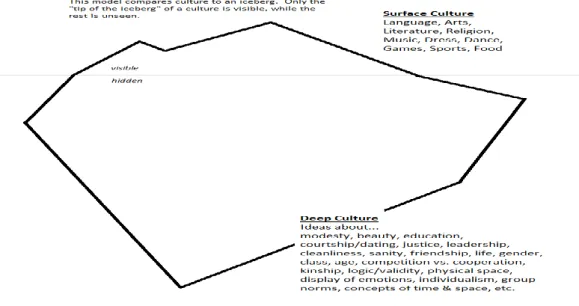
Edward T Hall (1976) developed a tool that can help students understand better the elements of culture. Hall’s analogy is known as the “cultural iceberg”. Such an analogy has been used to help people entering a new culture differentiate between what can easily be seen like the products of a culture (the tip of the iceberg) and the what is not readily observable, such as the behavior of a specific culture (the submerged part of the ice berg).
Figure 1: Iceberg Model
Adapted from US History 11, Global Trade Source:www.globaltradeandlogistics.org/
Teachers can make use of the iceberg analogy to contrast the students’ own culture with English- speaking cultures. Students, for example, can be reminded that if an American
guest enters their house while wearing shoes, this does not mean he is rude, but he is not aware of a rule that pertains to their society. Deep culture is the most difficult kind of culture to be easily identified by students. So, while some kinds of behavior seem quite normal in some societies, they look odd and wrong in others. Examples of unconscious values and attitudes include nature of friendship, gender roles, concepts of food, and so on. Hence, it is of immense importance that teachers raise their students’ necessary awareness of cultural elements to explain the differences in behavior between different people belonging to different cultures.
However, the difficulty that teachers may face in making students aware of such differences is that they themselves may not understand the complexity of English –speaking countries, because they have little or no experience at all with these cultures. However, the internet is enabling today’s teachers to have access to different information to educate both themselves and their students. Frank (2013, p.4) stresses the importance of this kind of education and says:
It is increasingly important for EFL teachers to be cultural informants as well as language experts. Teachers’ professional development plans should include active, ongoing familiarization with the cultures associated with English speakers through individual research and collaboration with peers.
A.I.2.1 Language and Culture Relationship
Culture is inseparable from language. The two complement each other in perfect harmony. Language carries culture, and all that constitutes culture such as beliefs, customs, and arts are described, analyzed and evaluated by language. They are also stored and transmitted by language (Kun, 2013). Kramsch (2012) explains that language, in addition to other symbolic systems, gives meaning to the habits, beliefs, institutions and monuments that
are considered part of what makes culture. Meaning is given by a language. Language in other words constitutes a system of arbitrary signs that obtain their meaning after their use.
Language and culture are a reflection of each other; therefore, the understanding of one requires understanding of the other. Our social lives are principally conducted via language and when language is used for communicative purposes, it links to culture in a variety of ways. For example, language can be an expression of cultural reality, where words are pronounced to express facts, ideas or events referring to a shared knowledge by people or to attitudes, beliefs, and point of view. Also, language embodies cultural reality and experience is given meaning through the medium people choose to communicate with one another. The way in which the medium itself is used creates meanings that are comprehensive to them, for example, a speaker's tone of voice, conversational style, gestures, and facial expressions. Furthermore, language symbolizes cultural reality and speakers see language as a symbol of their social identity; therefore, not being able to use it means a rejection of their social group and their culture (Kun, 2013).
The intricate link between culture and language can also be observed through the dynamism that characterizes culture, so when culture changes, language will change too and there will be no transmission of culture without language. However, using language to express ourselves or interact within the social group requires an appropriate and an accepted use of the language, which in turn depends largely on being immersed directly in the culture of the specific social group (ibid).
Thus, trying to get meaning from the language used would be difficult if not impossible, if no reference is made to the cultural context which has produced it. Language, in a way, is the embodiment of culture, and members of the culture have created it to carry out and identify all their cultural practices and their cultural products.
A.I.3
Culture Teaching and the Language Classroom
The possibility of teaching culture in the language classroom had been much debated by two different views. The first denies the possibility of making the classroom the appropriate setting to teach culture. Believing that learning in the classroom is governed by rule- guided pedagogy limits culture teaching to cultural facts only; while dynamic culture remains beyond reach (Damen, 1987 cited in Gonen and Saglam p.26, 2012). Krashen supports this views and argues saying that the language classroom is not the most appropriate setting to teach language rules ( 1982, cited in Gonen and Saglam , 2012) and; therefore, remains limited to cognitive crossing, which makes of learners’ previous experiences and knowledge hidden ( Nocon, 1996 cited in Gonen and Saglam , 2012) . Thus, it can’t be the best place to teach culture.
Yet, other researchers assert that just the opposite is possible. According to Kramsch and Byram, language becomes functional only when it is located in its proper cultural context and teachers should think of how to include elements of context when teaching language (2008, cited in Gonen and Saglam, 2012). The same holds true in foreign language classrooms, where problems to communicate meaning to speakers from the target culture may pose problems to learners of a foreign language. Thus, to overcome these communication obstacles, it is highly requested to study language in its context and show how native speakers use language in a variety of contexts.
Teaching culture in the foreign language classroom; however, does not entail taking language separately from culture, since studying language brings automatically the target culture to the surface (Bada, 2000 cited in Gonen and Saglam, 2012). In other words, trying to take away culture from language means that learners will be deprived of the capacity to know more about the people who speak the target language and the country where the language is spoken. And all this turns language meaningless (Pulverness, 2003 cited in Gonen and
Saglam, 2012). Therefore, teachers’ role is try to build a certain content to teach, taking into consideration what learners know about the target culture, and what they themselves bring to their learners in terms of knowledge.
Interaction between learners’ knowledge and teachers’ knowledge decides about the teaching strategies to culture, bearing in mind that it is not only the target culture that matters, but also the different cultures that exist in the classroom. Therefore, making students aware of these cultural differences will help later in raising similar awareness, but between the students’ native culture and the target culture of the foreign language (Montgomery, 2001 cited in Gonen and Saglam, 2012).
Certainly the teaching of culture remains one of the most challenging tasks that foreign language teachers are facing today. The exclusion of some cultural background, when teaching the foreign language, has become a myth, and all research conducted in the field proved the impossibility to teach language without culture. Therefore, focus has turned towards establishing a methodology that would meet the goals of policy makers and educators, and would also satisfy learners’ needs and interests. Seven goals have been identified from culture teaching and they are as follows:
Making students aware of the way people act; the effects of social variables such as age, sex, and social class on the way they speak; how people in the target culture conventionally act under different circumstances; culture in the most commonly used words and phrases; being critical about the target language culture; developing skills necessary for locating and organizing materials about the target culture; and developing intellectual curiosity about the target culture and empathy towards its people.
A.I.4 Rational for Culture Teaching
in the Language Classroom
A.I.4.1 Language Teaching and Culture
The fact that language and culture proved to be interwoven entities made language teachers conclude that teaching language cannot be accomplished without the inclusion of culture in that process. Peck referred to the importance of the issue in these words: “without the study of culture, foreign language instruction is inaccurate and incomplete” (p.1, cited in Chahak & Basirizadeh, 2012). Therefore, the teaching of language proved to be more than the teaching of grammar or syntax. Cultural elements are present in different forms of language use. In the reading of original texts, in the utterances of native speakers…etc.
There are, also, some cultural norms that govern conversations and failing to make students aware of such cultural elements would lead to misunderstandings and misconceptions of the target culture (Chahak & Basirizadeh, 2012). What grammar books provide as authentic examples stemming from real life situation is not enough and may even sound closer to fiction than to reality, if it is not linked to some background knowledge. Thus, learners need to relate the abstract form of language to real people and places by having access into cultural aspect of language (Chastain, 1971 cited in Genc & Bada, p.74).
Consequently, acquiring a new language goes beyond a mere acquisition of the language system. The learner will encounter a new culture and experience a new way of thinking, feeling and acting (Brown, 1987).
A.I.4.2 Cultural Affectivity and Language Learning
Another reason for including culture in language teaching is affective. Both teachers and educators are recognizing the important role affectivity has in language learning and how the emotional side of learning is a determining factor in the success or failure of language acquisition. If the learner does not feel confident within the new language system, he would resist and achieve poorly in learning and acquiring the language (Brown, 1987). Thus,
learners need the necessary motivation to learn and achieve well in the language, and culture proved to have a great role in this. Genc and Bada ( 2005, p.74) clarify better this as follows:
In achieving high motivation, culture classes does have a great role because learners like culturally based activities such as singing, dancing, role playing, doing research on countries and peoples, etc. The study of culture increases learners’ not only curiosity about and interest in target countries but also their motivation.
Selinger, similarly, pointed to the affective side of culture in language learning and says: “since language is used in social exchanges, the feelings, attitudes and motivation of learners in relation to the target language itself, to the speakers of the language, and to the culture will affect how learners respond to the input to which they are exposed” (Cited in Byram & Morgan, 1994).
Therefore, holding either positive or negative attitudes towards the target culture may determine largely the learning of the language. Therefore teachers should work to reduce all kinds of prejudice and stereotypes and reinforce tolerance and mutual understanding, because we are living in an age where we need “to understand not only the other culture but also our own culture” (Genc & Bada, 2005, p.74).
Viewing the target culture positively or negatively would either lessen or increase the learners' interest in knowing more about it and ultimately in their response to the language itself. Teachers should minimize the negative attitudes of learners and make them react positively. In other words, they should help learners build an objective view of things and have a logical reasoning, which would result in an objective judgment of the target culture they are introduced to. All kinds of prejudice should be taken away since, “the encouragement of tolerance is one of the unchallenged beliefs of language teachers” (Byram, 1989, p.15).
However, if teacher fail in making learners understand and accept people holding different views of the world, they may end up rejecting or ignoring the new culture and, therefore; can be described as culture bound people (Genc & Bada, 2005). Being culture bound is not a guilt for which people should be blamed, it is rather a quality that defines who we are and to which culture we belong. In this sense, Kramsch (2001, p. 6 cited in Genc & Bada, 2005, p. 75) explains how people shape their views of the world and what helps in maintaining these views:
People who identify themselves as members of a social group (family, neighborhood, professional or ethnic affiliation, nation) acquire common ways of viewing the world through their interactions with other members of the same group. These views are reinforced through institutions like the family, the school, the workplace, the church, the government, and other sites of socialization through their lives. Common attitudes, beliefs and values are reflected in the way members of the group use language-for example, what they choose to say or not to say and how they say it.
Yet, people who hold a fixed vision of the world and refuse to modify it, even if it proves to be wrong, are in fact developing stereotypes. Brown (1987) defines a stereotype to be a previous, predetermined and may be false preconception of other cultures. The formation of cultural stereotypes originates from the cultural milieu of the individual learner, hence building a view of any culture is based on what learners hear and see around them. The possibility of being in touch with our global neighbors has increased in the new age, via different mediums of communication systems, like TV and the Internet. And this has also enlarged the cultural milieu of learners. It is not the family or the school, but the larger world.
Therefore, teachers should adjust their teaching to the requirements of the new age. Byram (1989) talks about Buttjes’ view of learners whose ability to construct their own views and avoid holding beliefs that are not theirs categorize them as good learners, who are able to think deeply and critically of their own culture and the culture they are introduced to. Therefore, perceiving the world differently and avoiding a mono-cultural vision of things can be made easy, if learners are introduced to other cultures via culture classes (Genc and Bada, 2005).
A.I.4.3 Interculturality and Language Learning
Enabling learners become intercultural speakers, capable of engaging with different identities without using or referring to stereotypes in their perception of the other, who is different from them and who needs to be discovered, is a major aim to an intercultural dimension in language teaching, as it helps in guarantying respect for individuals and equality of human rights. An intercultural dimension in language teaching is supposed to help learners acquire the linguistic competence needed to communicate their ideas, either in writing or speaking in appropriate ways and develop their intercultural competence which ensures a dual capacity to be understood by people belonging to different social identities
( Byram, Gribkova & Starkey, 2002).
Integrating the target culture in the teaching and learning of the target language has become a necessity, and if learners fail to understand some cultural influence on using English, they won’t be able to function and communicate effectively in the target language in an English-speaking country (Mc Kay, 2000 cited in Jenkins, 2008). This assumes the role of culture within the context of a global language spoken across linguistic and cultural boundaries.
The desire to produce learners similar to native speakers in linguistic competence, in knowledge of what is appropriate language and in knowledge about a country and its culture
was challenged by an opposing argument which assumed that, despite the fact that English today is gaining a larger role as an international language used by a large community and which assumed the necessity to teach culture along the teaching of English, some researchers broke the belief for this necessity. Bada (2000) believes that learners are not expected to conform to cultural norms and values as the purpose from being aware of them is to “refine the self so that it can take a more universal and less egoistic form” (p.100).
Also, when a language acquires the features of being an international language, it becomes denationalized and, therefore, loses its national character. And as larger members of the world community are using it for communication, allows for transcending its geographical boundaries. So, the more it is used, the less the language becomes connected to its culture (Jenkins, 2008). In the same context, Alptekin (2002) argues that international communicative competence is favored over native-like competence as long as the use of English by international community is restricted to academic studies, business and professional contacts (cited in Genc & Bada, 2005). The international status of English makes the teaching of culture and the internalization of the cultural norms of native speakers needless and culture becomes a medium that facilitates communication (Smith, 1996 cited inGenc & Bada, 2005).
Moreover, students are learning the language to use it in local context, then, it would make little sense to insist on incorporating culture. Therefore, this incorporation becomes of little significance if institutions or students are using the language to communicate local ideas and culture. It is used as a medium and a tool only.
Knowing the relationship between language and culture, helps teachers decide about the best approach to adopt in teaching the language. Two main approaches to language learning have been presented by Byram (1998, cited in Jenkins, 2008).
1-An intercultural approach to language learning: this approach calls for learning the language and basics in the target-language culture without necessarily identificatifying with this latter.
2- A bicultural approach to language learning: in contrast with the intercultural approach, this latter insists on incorporating and internalizing the culture while learning the language. Avoiding the risks of incorporating the culture of the target language, when it is not desired, or a certain cultural material, which is considered inappropriate by the local culture, can be best achieved by adopting an intercultural approach by default. When adopting this approach, key elements need to be considered. Amongst them is the knowledge of the local culture. It helps in differentiating the appropriate from the inappropriate and understands better the teaching context. And this is possible only if teachers learn about the function of English in the local community and also about the culture to be able to determine cultural appropriateness. Teachers in the light of obtained knowledge should develop materials to be culturally appropriate to help learners achieve better in acquiring English in their local contexts (Byram, 1998, cited in Jenkins, 2008).
These are just some of the reasons which fostered the teaching of culture in the language classroom. And from all what has been said, one can realize that teachers are not in a position to decide whether to teach culture or not. The decision would be rather of the possible teaching methodologies that could best promote cultural understanding among learners. Deciding about the best way to teach culture would take us into a journey to the past to have an idea about the old teaching methodologies that are still in use or have been updated to meet the requirements of the new age.
A.I.5 Culture and Foreign Language Teaching
“Learning a language without culture is a recipe for becoming what Bennett (1993) calls a fluent fool” (cited in Gonen and Saglam, p.26, 2012). Being able to speak well the language, but ignoring totally the social and philosophical content makes of foreign language learners fit the above label suggested by Bennett. Being acquainted with the grammar, syntax or phonetics of English does not mean gaining insight into the different details of the people
whose language they are learning. This fact is urging teachers to include socio cultural factors in their teaching (Palmer & Sharifian, 2007 cited in Frank, 2013).
But, before tackling the issue of culture teaching in foreign language teaching, it is important to show how culture influences some components of language learning such as vocabulary, speaking, reading and speaking.
A.I.5.1 Culture and Vocabulary
As shown earlier in the chapter, language carries culture, and because vocabulary is “the basic ingredient of language” (Choudhury, p.4, 2014), cultural differences are easily observed in the vocabulary of the language. Hence, explaining vocabulary will certainly reveal a lot about the culture and show cultural differences between languages. For example, the meaning denoted by colors varies from one culture to another. The white color, for instance, while in most western societies stands for purity and nobility; it refers to weakness and absence of vitality in Chinese culture. Therefore, people dress in white during funerals. Hence, knowing the meaning of words implies also knowledge of the cultural factors that are behind their significant composition (Choudhury, 2014).
A.I.5.2Culture and Listening
Learners always complain from the difficulties they encounter while trying to develop their listening comprehension in the foreign language. Listening to tape recorders for long hours didn’t help in improving the situation and alleviating the hardships encountered by these learners. Many reasons have been identified, but certainly culture is one the most influential factors that can either help or hinder the listening comprehension of foreign language learners. Lacking the necessary background knowledge may not help in recognizing the meaning implied in the language the learner is listening to. Sometimes even when the lexical meaning of words can easily be identified, still not knowing the necessary cultural background makes their true meaning beyond reach (Choudhury, 2014).
A.I.5.3 Culture and Speaking
The ability to communicate and interact successfully in the foreign language goes beyond correct pronunciation or good intonation. Foreign language learners need some cultural background in the target culture to achieve successful communication in the target language. Language teachers are expected to sustain learners’ efforts by integrating materials that relate to daily life situations stemming from the target culture. Such training will help them produce correct language, not only in terms of linguistic appropriateness, but also a language that is culturally acceptable. This will certainly avoid making mistakes or having misunderstandings while interacting in the target language (Choudhury, 2014).
A.I.5.4 Culture and Reading
Reading which is usually regarded as the decoding of written language proved to be a very complicated process where various elements come into interaction. In more exact terms:
The reading process is not simply the repetition and reappearance of the language knowledge which the students already have, but it is a complicated process under the stimulations of outside information to decode, recognize, analyze, judge, and infer the material through the cognitive system.
(Larsen-Freeman & Long, 2000, pp.193-196 cited in Choudhury, 2014).
It is obvious that linguistic knowledge determines our capacity to read, but only to a certain degree. Most of the difficulties that are faced during the reading process arise not because of language knowledge, but because of cultural knowledge. If one fails to see cultural differences in background information, words, sentences and texts structures, it is likely that reading will be a very difficult process. Students may understand the meaning of words, but still the meaning of the whole text remains unclear. Cultural differences between the students