Nucleotide sequences of 16 transmissible plasmids identified in nine
multidrug-resistant Escherichia coli isolates expressing an ESBL
phenotype isolated from food-producing animals and healthy humans
Juan Wang
1, Roger Stephan
2, Karen Power
1, Qiongqiong Yan
1, Herbert Ha¨chler
2and Se´amus Fanning
1,3*
1
UCD Centre for Food Safety, School of Public Health, Physiotherapy & Population Science, University College Dublin, Belfield, Dublin 4, Ireland;2Institute for Food Safety and Hygiene, Vetsuisse Faculty, University of Zurich, Winterthurerstrasse 272,
CH-8057 Zurich, Switzerland;3Institute for Global Food Security, School of Biological Sciences, Queen’s University Belfast, Stranmillis Road, Belfast BT9 5AG, Northern Ireland
*Corresponding author. Tel:+353-1-716-2869; Fax: +353-1-716-1147; E-mail: [email protected]
Received 7 March 2014; returned 20 April 2014; revised 13 May 2014; accepted 16 May 2014
Objectives: Nine extended-spectrum b-lactamase (ESBL)-producing Escherichia coli isolated from healthy humans and food-producing animals were found to transfer their cefotaxime resistance marker at high fre-quency in laboratory conjugation experiments. The objective of this study was to completely characterize 16 transmissible plasmids that were detected in these bacterial isolates.
Methods: The nucleotide sequences of all 16 plasmids were determined from transconjugants using next-generation sequencing technology. Open reading frames were assigned using Rapid Annotation using Subsystem Technology and analysed by BLASTn and BLASTp. The standard method was used for plasmid multi-locus sequence typing (pMLST) analysis. Plasmid structures were subsequently confirmed by PCR amplification of selected regions.
Results: The complete circularized nucleotide sequence of 14 plasmids was determined, along with that of a further two plasmids that could not be confirmed as closed. These ranged in size from 1.8 to 166.6 kb. Incompatibility groups and pMLSTs identified included IncI1/ST3, IncI1/ST36, IncN/ST1, IncF and IncB/O, and those of the same Inc types presented a similar backbone structure despite being isolated from different sources. Eight plasmids contained blaCTX-M-1genes that were associated with either ISEcp1 or IS26 insertion sequence
elements. Six plasmids isolated from humans and chickens were identical or closely related to the IncI1 reference plasmid, R64.
Conclusions: These data, based on comparative sequence analysis, highlight the successful spread of blaESBL
-harbouring plasmids of different Inc types among isolates of human and food-producing animal origin and pro-vide further epro-vidence for potential dissemination routes.
Keywords: conjugation, CTX-M, TEM, resistance genes, IncI1
Introduction
The emergence and spread of antimicrobial resistance has become a major global public health concern. A component element of this problem is the spread of the plasmid-encoded extended-spectrum b-lactamase (ESBL) genes, which confer resistance to third-generation cephalosporins.1Third-generation cephalosporins are clinically significant antimicrobial compounds, licensed for use in human and veterinary medicine.2,3Plasmids
expressing an ESBL phenotype often also carry genes encoding resistance to other commonly used antimicrobial drug classes (including aminoglycosides, fluoroquinolones, phenicols, tetracy-clines or trimethoprim).4–6
The emergence and spread of antimicrobial resistance genes in microorganisms is a complex process and has been mainly driven by insertion sequences, transposons, integrons and plasmids, some of which are homologous in isolates from both food-producing animals and humans.7,8Thus investigation of the
mobile genetic elements, especially plasmids, is a key component required for a better understanding of the dissemination of ESBL genes and others.
In an earlier study we reported on the characterization of higher generation cephalosporin-resistant Escherichia coli, which were isolated from food-producing animals and healthy humans in Switzerland.6Nine of these were selected for more detailed study as they were found to transfer their plasmids efficiently. #The Author 2014. Published by Oxford University Press on behalf of the British Society for Antimicrobial Chemotherapy. All rights reserved. For Permissions, please e-mail: [email protected]
J Antimicrob Chemother 2014; 69: 2658 – 2668
doi:10.1093/jac/dku206 Advance Access publication 11 June 2014
Sixteen transmissible plasmids were identified in the correspond-ing transconjugants,6 and in this follow-up study the DNA sequence of all 16 plasmids was determined and a comparative analysis of these structures carried out.
Materials and methods
Selection of bacterial isolates for study
Nine ESBL-producing E. coli isolated from faecal samples of food-producing animals and healthy humans had previously been studied (Table1).9,10
Using a broth mating protocol, these isolates were found to transfer their cefotaxime resistance marker at high frequency in laboratory conjugation experiments.6Laboratory protocols applied for the maintenance of
bac-teria, conjugation experiments, purification of plasmid DNA and subsequent downstream methods were previously described in detail.6
Plasmid sequencing and annotation
Sixteen plasmids contained in the nine multidrug-resistant (MDR) E. coli isolates were sequenced commercially from their transconjugants by next-generation sequencing technology on the Roche 454 GS FLX platform (Eurofins MWG Operon, Ebersberg, Germany). Open reading frames (ORFs) were designated using the Rapid Annotation using Subsystem Technology (RAST) annotation pipeline.11Initial sequence analysis was carried
out over the web, using the BLASTn and BLASTp programs (http://blast. ncbi.nlm.nih.gov/Blast.cgi). The ORF Finder program (http://www.ncbi. nlm.nih.gov/projects/gorf) was also used to identify features. Nucleotide sequences showing the highest similarity were identified in GenBank database using the BLAST search tool from the National Center for Biotechnology Information (http://blast.ncbi.nlm.nih.gov/Blast.cgi). Plasmids of the IncI1 and IncN groups were further typed by plasmid mul-tilocus sequence typing (pMLST) and the sequence types (STs) were obtained using the PubMLST database (http://pubmlst.org/plasmid). Plasmid structures were subsequently confirmed by the PCR amplification of selected regions using the primers shown in Table S1 (available as Supplementary data at JAC Online).
Nucleotide sequence accession numbers
The nucleotide sequences of all 16 plasmids were deposited in the GenBank database under accession numbers KJ484626–KJ484641.
Results and discussion
Plasmids identified in healthy human MDR E. coli isolates
Nine plasmids from isolates of healthy humans and belonging to different Inc groups were fully sequenced and annotated: pH2332-166 (IncFII and IncFIB), pH2332-107 (IncB/O), pH2291-144 (IncFII and IncFIB), pH2291-112 (IncI1), pH1519-88 (IncI1), pH1519-76 (IncFII), pH1519-7, pH1519-2 and a novel pH1038-142 (IncF and IncN).
Plasmids identified in chicken MDR E. coli isolates
Five conjugative plasmids from MDR E. coli cultured from chicken were sequenced and annotated. Four of these (pC60-108, pC59-112, pC49-108 and pC23-89) were determined to be IncI1 group plasmids, with one plasmid, pC59-153, being typed as IncF group. Among these, two plasmids, pC60-108 and pC23-89, were sequenced but not confirmed as closed by PCR (data not shown).
Plasmids identified in an MDR E. coli isolate from a lamb
Two conjugative plasmids from an MDR E. coli isolate of a healthy lamb and belonging to different Inc groups, IncB/O (pL2-87) and IncN (pL2-43), were fully sequenced and annotated.
Comparison of plasmid backbones
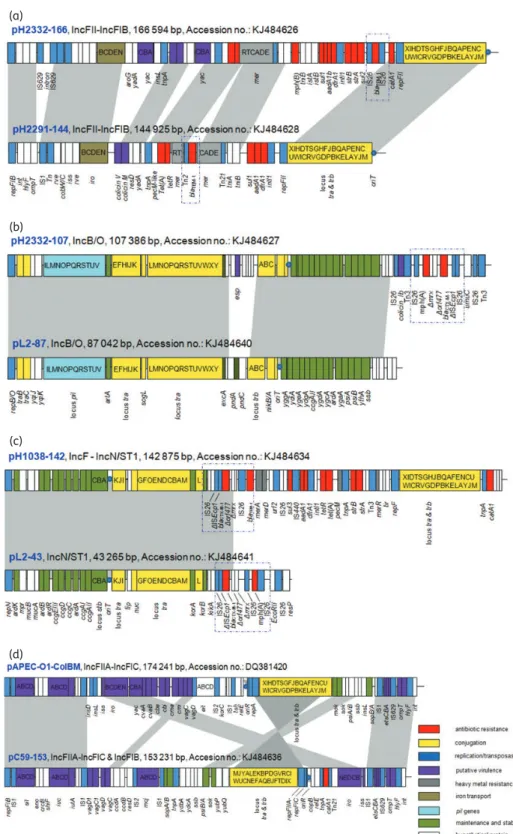
In summary, plasmids showing the same incompatibility groups shared a common set of backbone modules even when they were isolated from different sources. Two plasmids from human sources, pH2332-166 and pH2291-144 (IncFII-IncFIB type plas-mids; Figure1a) were determined to be 99% identical at the nucleotide level. Similarly, pL2-87 (IncB/O) and pL2-43 (IncN) from the lamb isolate (Table1) showed a high degree of nucleo-tide similarity (. 90% identical at the nucleonucleo-tide level) when com-pared with the two plasmids from human isolates, pH2332-107 (IncB/O) and pH1038-142(IncF-IncN), respectively (Figure1b and c). Five IncI1 plasmids containing a blaCTX-M-1gene identified
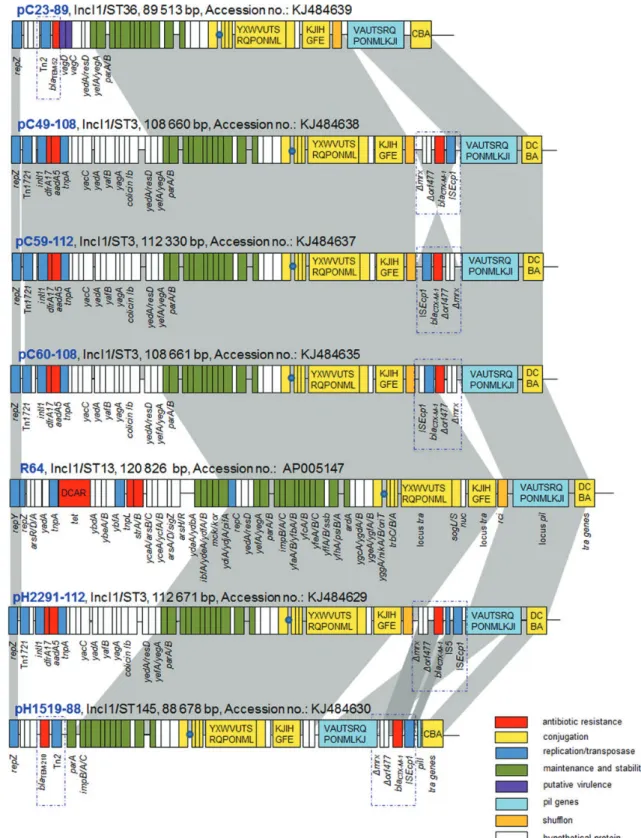
in this study were isolated from human and chicken samples, and these were either identical or closely related to the reference IncI1 plasmid R64 (Figure2). Furthermore, plasmid pC23-89 (IncI1 plas-mid harbouring a blaTEM-52gene) was determined to be 99%
simi-lar at the nucleotide level to R64 (Figure2). A detailed comparative description of all of these plasmids is provided below.
Comparative analysis of pH2332-166 and pH2291-144
The two largest plasmids sequenced, pH2332-166 (accession no. KJ484626) and pH2291-144 (accession no. KJ484628), were identified in MDR human E. coli isolates. These plasmids were 166 594 and 144 925 bp in size with an average G+C content of 50.9% and 50.6%, respectively. They contained 252 and 205 ORFs, respectively, as determined after annotation. Each plasmid also con-tained two replication systems, denoted as IncFII and IncFIB.
The backbone-containing regions of pH2332-166 and pH2291-144 can be divided into four functional modules consist-ing of antimicrobial resistance-encodconsist-ing loci, along with plasmid replication, plasmid transfer and plasmid maintenance functions (Figure1a). The plasmid transfer region in each case contained a complete tra-encoding locus of 32 847 bp composed of 24 tra genes, 9 trb genes, 1 artA gene and 1 finO gene. These loci were similar to the transfer region of the typical E. coli F plasmid (acces-sion no. U01159) and were 99% identical at the nucleotide level. The oriT-encoding gene is 463 bp in size and is located prox-imal to traM. It is highly conserved in both pH2332-166 and pH2291-144 (Figure1a). In plasmid pH2332-166 several replicons are recognized. The first is a 978 bp region (located between posi-tions 78499 and 79476 bp) and this locus encodes a repA gene, syn-onymous with the IncFIB replicon type; two copies of IncFII (repA1 and repA2, located at positions 11 145 through to 12 486 bp) mapped downstream of the F plasmid transfer region. These replica-tion regions were completely conserved in pH2291-144 (Figure1a). BLASTn comparisons identified two completely novel scaffolds, wherein pH2332-166 was determined to have a 71% coverage and 99% nucleotide identity with pNRG857c (accession no. CP001856), whilst pH2291-144 had a 74% coverage and 99% iden-tity with pTN48 (accession no. FQ482074). Plasmid pNRG857c was a non-b-lactam antimicrobial resistance-containing plasmid that had previously been isolated from a clinical isolate of adherent
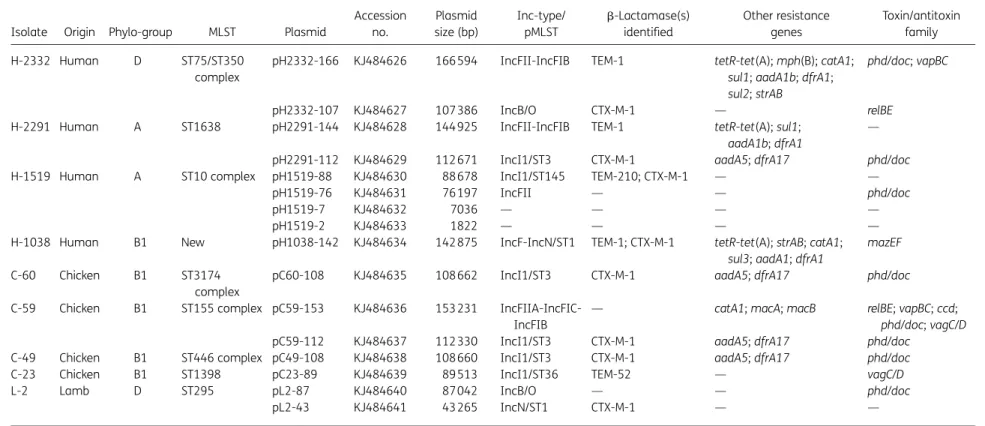
Table 1. Summary of the features associated with all 16 sequenced plasmids purified from nine ESBL-producing E. coli isolates cultured from healthy human and food-producing animal origin previously reported in Switzerland
Isolate Origin Phylo-group MLST Plasmid
Accession no. Plasmid size (bp) Inc-type/ pMLST b-Lactamase(s) identified Other resistance genes Toxin/antitoxin family H-2332 Human D ST75/ST350 complex
pH2332-166 KJ484626 166594 IncFII-IncFIB TEM-1 tetR-tet(A); mph(B); catA1; sul1; aadA1b; dfrA1; sul2; strAB
phd/doc; vapBC
pH2332-107 KJ484627 107386 IncB/O CTX-M-1 — relBE
H-2291 Human A ST1638 pH2291-144 KJ484628 144925 IncFII-IncFIB TEM-1 tetR-tet(A); sul1;
aadA1b; dfrA1
—
pH2291-112 KJ484629 112671 IncI1/ST3 CTX-M-1 aadA5; dfrA17 phd/doc
H-1519 Human A ST10 complex pH1519-88 KJ484630 88678 IncI1/ST145 TEM-210; CTX-M-1 — —
pH1519-76 KJ484631 76197 IncFII — — phd/doc
pH1519-7 KJ484632 7036 — — — —
pH1519-2 KJ484633 1822 — — — —
H-1038 Human B1 New pH1038-142 KJ484634 142875 IncF-IncN/ST1 TEM-1; CTX-M-1 tetR-tet(A); strAB; catA1;
sul3; aadA1; dfrA1
mazEF
C-60 Chicken B1 ST3174
complex
pC60-108 KJ484635 108662 IncI1/ST3 CTX-M-1 aadA5; dfrA17 phd/doc
C-59 Chicken B1 ST155 complex pC59-153 KJ484636 153231
IncFIIA-IncFIC-IncFIB
— catA1; macA; macB relBE; vapBC; ccd;
phd/doc; vagC/D
pC59-112 KJ484637 112330 IncI1/ST3 CTX-M-1 aadA5; dfrA17 phd/doc
C-49 Chicken B1 ST446 complex pC49-108 KJ484638 108660 IncI1/ST3 CTX-M-1 aadA5; dfrA17 phd/doc
C-23 Chicken B1 ST1398 pC23-89 KJ484639 89513 IncI1/ST36 TEM-52 — vagC/D
L-2 Lamb D ST295 pL2-87 KJ484640 87042 IncB/O — — phd/doc
pL2-43 KJ484641 43265 IncN/ST1 CTX-M-1 — —
—, feature not identified.
W
ang
et
al
.
2660(a)
(b)
(c)
(d)
Figure 1. Comparison of major structural features of (a) plasmids pH2332-166 and pH2291-144; (b) plasmids pH2332-107 and pL2-87; (c) plasmids pH1038-142 and pL2-43; and (d) pC59-153 in comparison with plasmid pAPEC-O1-ColBM (accession no. DQ381420). Areas shaded in grey indicate homologies identified across the plasmid scaffold regions. Antibiotic resistance genes are indicated by red boxes. The individual conjugation-related genes (associated with tra and trb) are indicated with capital letters inside the yellow boxes. Blue boxes denote transposon-, integron- or replication-associated genes. The putative virulence-related genes are indicated by violet boxes. Green boxes indicate maintenance- and stability-related genes. Grey boxes indicate heavy metal resistance-related genes and the brown box shows the iron transport genes. White boxes indicate hypothetical proteins or mobile element proteins. The pil genes are indicated in light blue. The origin of transfer oriR is indicated by a blue circle. The figure is not drawn to scale. This figure appears in colour in the online version of JAC and in black and white in the print version of JAC.
Figure 2. Major structural features of pC23-89, pC49-108, pC59-112, pC60-108, pH2291-112 and pH1519-88 in comparison with the IncI1 reference plasmid R64 (accession no. AP005147). Areas shaded in grey indicate homologies in plasmid scaffold regions. Antibiotic resistance genes are indicated by red boxes. The individual conjugation-related genes (associated with tra and trb) are indicated with capital letters inside the yellow boxes. Blue boxes denote transposon-, integron- or replication-associated genes. The putative virulence-related genes are indicated by violet boxes. Green boxes indicate maintenance- and stability-related genes and white boxes indicate hypothetical proteins. The origin of transfer oriT is indicated by a blue circle. The pil genes are indicated by light blue boxes. The figure is not drawn to scale. This figure appears in colour in the online version of JAC and in black and white in the print version of JAC.
Wang et al.
and invasive E. coli.12In contrast, pTN48 was characterized as a multiresistance IncFII/FIB plasmid, which contained a blaCTX-M-14
-encoding gene.13
The accessory regions of the two plasmids, containing the anti-microbial resistance encoding genes, were highly similar when comparing pH2332-166 and pH2291-144. Uniquely, the former plasmid contained a single copy of catA1 and mph(B), encoding resistance to chloramphenicol and macrolides, respectively. In addition, two streptomycin resistance-encoding genes (strA and strB) and one sulphonamide resistance gene (sul2) were identified and found to be located downstream of a class 1 integron in pH2332-166 only. Both plasmids contained a single copy of a blaTEM-1gene, along with a tetR-tet(A) locus and a class 1
inte-gron, containing two gene cassettes in a classical head-to-tail arrangement with the dfrA1-aadA1b and dfrA1-aadA1 genes, respectively. In pH2332-166, the blaTEM-1-encoding gene was
flanked by a putative transposon along with two identical copies of IS26, whilst in pH2291-144 this same gene was associated with a remnant of transposon Tn2, which was truncated within a mer-cury resistance cassette (Figure1a).
Comparative analysis of pH2332-107 and pL2-87
Plasmid pH2332-107 (accession no. KJ484627) was identified in an MDR E. coli isolate cultured from a human source and desig-nated as human-2332 of ST57/ST350 complex; pL2-87 (accession no. KJ484640) was purified from a lamb E. coli isolate, and the lat-ter was an ST295 type. Plasmid pL2-87 was devoid of any resistance-encoding genes. Both plasmids were identified as IncB/O types, which were found to be closely related to the IncI1 family of replicons14and the mechanism of replication con-trol of this group of plasmids is similar to that of IncFII plas-mids.15,16 The DNA sequence of pH2332-107 consists of a
circular double-stranded DNA molecule of 107 386 bp and con-tained 149 putative ORFs as identified after RAST annotation. The G+C content of this plasmid was 52.4%. Plasmid pL2-87 was 87 042 bp in size, encoding 113 predicted ORFs and with a 52.9% G+C content. The RepA proteins of pH2332-107 and pL2-87 shared 99% amino acid identity with one residue differ-ence (data not shown). As these two plasmids were from the same Inc group (IncB/O), the core regions of pH2332-107 and pL2-87 showed a high degree of sequence similarity, having a 99% nucleotide identity (Figure1b).
The pH2332-107 sequence exhibited a highly organized struc-ture consisting of five major functional regions of replication, drug resistance, stability, transfer leading and conjugative transfer (Figure1b). The transfer region of pH2332-107 comprises 19 tra genes, 7 trb genes and 1 finO gene. It also contains 12 genes (pilI, pilL, pilM, pilN, pilO, pilP, pilQ, pilR, pilS, pilT, pilU and pilV) encoding a functional type IV pilus that is thought to be involved in pilus-mediated conjugal transfer.17,18These pili are considered a virulence factor that, in association with resistance determi-nants, may support their successful dissemination.19The transfer
leading and conjugative transfer regions in pH2332-107 and pL2-87 were 44 671 and 44 668 bp in size, respectively, and were 99% identical at the nucleotide level (Figure1b).
Using pH2332-107 as the query sequence, BLAST searching revealed a 99% nucleotide identity with one recently reported multiple antimicrobial resistance virulence plasmid, pO26-CRL125
(accession no. KC340960). Similarity for pL2-87, BLAST
comparisons showed 99% identity with pO111-CRL115(accession
no. KC340959). When plasmids pH2332-107 and pL2-87 were compared with plasmids pO26-CRL125and pO111-CRL115, the
core regions, including the transfer and stability region of both, exhibited a high degree of sequence similarity. The transfer mod-ules in pO26-CRL125and pO111-CRL115were also virtually
identi-cal and contained type IV conjugative transfer operons.20
Interestingly, plasmid pO26-CRL125and pO111-CRL115contained
two separate replication regions consisting of a complete IncZ replicon and a partial IncQ replicon, respectively.20These two MDR plasmids belonging to different pathotypes (Table1) were originally purified from a human O26:H- enterohaemorrhagic E. coli and a bovine O111 atypical enteropathogenic E. coli respectively.20
In a more detailed assessment of pH2332-107, a segment of 5331 bp that contained two copies of IS26 and a single copy of the blaCTX-M-1gene was identified and this region exhibited
signifi-cant homology with pHHA45 (accession no. JX065630) and pKCT398 (accession no. GQ274931). This locus contained one blaCTX-M-1gene flanked by the characteristic insertion sequence
(IS) element ISEcp1 and which interestingly in this case was dis-rupted by an IS26 element. A similar arrangement was also noted in plasmids pH1038-142 and pL2-43 and analogously in the case of a recently reported blaCMY-2gene of equine origin.21Plasmid
pH2332-107 exhibited mosaic features distal to the blaCTX-M-1
gene. A macrolide resistance gene cluster was identified, contain-ing a truncated mrx gene (denoted as Dmrx) followed by an mph(A) gene, which encodes a macrolide 2′-phosphotransferase, and then followed by a second IS26 element. This gene module IS26-DISEcp1-blaCTX-M-1-Dorf477-Dmrx-mph(A)-IS26
was recently identified in plasmids purified from E. coli, including those from the successful clone ST131 and from isolates from pigs in Germany.22This block of genes is more often encountered in
IncN type plasmids,23whilst the arrangement noted here is the first report of this structure in an IncB/O type plasmid background (Figure1b). Sequence comparisons as shown in Figure1b indicate that the Dmrx-mph(A) junction in the blaCTX-M-1gene module may
serve as a hotspot for the insertion of IS elements and other anti-microbial resistance-containing transposons.
Comparative analysis of pH1038-142 and pL2-43
A plasmid of 142875 bp with 191 ORFs and 52.2% G+C content was identified in an E. coli of undefined ST and denoted as pH1038-142 (accession no. KJ484634). This E. coli isolate was ori-ginally cultured from a healthy human. Plasmid pH1038-142 was transferred by conjugation and contained two incompatibility-group-encoding genes, IncF and IncN. Furthermore, two replicons were identified on pH1038-142, the first of which was contained in a 1410 bp region with repA1 and repA2; these were 100% iden-tical at the nucleotide level to the subgrouped IncFII region. In addition, a repA locus (related to IncN plasmids) was located upstream of the ardK gene (Figure1c).
Plasmid pL2-43 (accession no. KJ484641) was a 43 265 bp structure and the smallest conjugative plasmid among those characterized in this study (Table1). It was identified in a lamb faecal sample from which an E. coli ST295 isolate was cultured. Plasmid pL2-43 had 59 predicated ORFs with an average G+C con-tent of 50.9%. The backbone region was 37 209 bp and this encoded plasmid replication, horizontal transfer functional
regions, maintenance and stability functions, and an additi-onal continuous 6056 bp variable region, which included the blaCTX-M-1resistance gene, insertion sequences or transposons.
Comparing pL2-43 with pH1038-142, the former exhibited 99% nucleotide identity with pH1038-142 (Figure 1c). However, pL2-43 was determined to be IncN type and was devoid of the IncF transfer region and blaTEM-1gene cassettes noted in the
human-derived plasmid (Figure1c).
The conjugative transfer system of pH1038-142 was the most complicated region identified in this study. The transfer region was composed of two separate elements. Plasmid pH1038-142 contained the complete sequence of the typical F transfer region (E. coli F sex factor transfer region, accession no. U01159) and comprised 24 tra genes and 8 trb genes (Figure1c). In com-parison with the IncFII-IncFIA plasmid pEC_L46 (accession no. GU371929), which contained a blaCTX-M-15gene and was originally
isolated from a human in Belgium,24it showed 66% coverage and
98% nucleotide identity with pH1038-142. The IncN-type transfer locus on pH1038-142 was identified and found proximal to the blaESBL-gene-containing region on this plasmid (Figure 1c).
It included 14 tra-encoding genes. In general the structure of pH1038-142 could be divided into four main functional modules, involved in plasmid replication, transfer, stability and antimicro-bial resistance. BLAST analysis revealed two b-lactam resistance genes, blaCTX-M-1and blaTEM-1, which were located on
pH1038-142 (Figure1c). It also carried eight other resistance-encoding genes—strA, strB, tet(A), tetR, catA1, the dfrA1-aadA1 gene cassette array (linked to the intI1 gene of the class 1 integron integrase) and sul3 coding for resistance to streptomycin, tetra-cycline, chloramphenicol, trimethoprim, streptomycin/spectino-mycin and sulphonamide, respectively.
A sequence analysis of pL2-43 showed a high degree of similarity with three other IncN antimicrobial resistance-containing plasmids: pHHA45 (accession no. JX065630), pVQS1 (accession no. JQ609357) and R46 (accession no. AY046276). Plasmid pHHA45 was identified from a pig E. coli containing blaCTX-M-1in Denmark
and pVQS1 originated from a Salmonella Virchow isolate cultured from a human in Switzerland, which contained the blaTEM-1and
qnrS1 genes.23,25A comparative analysis of pL2-43 and
pH1038-142 with the IncN reference plasmid R46 demonstrated that they both contained the typical IncN plasmid scaffold, including the replicon gene (repA), the stbA-stbB-stbC genes required for plas-mid stability, the mucA-mucB genes involved in mutagenesis enhancement, the ardA-ardB and ardK-ardR genes providing anti-restriction functions, the ccg genes that encode products protecting plasmid DNA from the type I restriction system and the regions composing the conjugative apparatus (traL, traM, traA, traB, traC, traD, traN, traE, traO, traF, traG, traI, traJ and traK).23,26These regions
showed 99% nucleotide identity in plasmids pH1038-142 and pL2-43. It is interesting to note that plasmid pH1038-142 could be considered to be a structural derivative of plasmid pL2-43. The former contained all the main function modules identified in pL2-43, including the IncF-type transfer region together with an array of accessory genes, inserted as an IS26-DISEcp1-blaCTX-M-1
-Dorf477-Dmrx-IS26 gene module into pH2332-142 (Figure1c).
Molecular characterization of pC59-153
The complete sequence of a 153 231 bp plasmid, denoted as pC59-153 (accession no. KJ484636), from a ST155 complex
E. coli was determined. The bacterial isolate was cultured from a chicken faecal sample (Table1). The plasmid contained 193 putative ORFs with G+C content 49.8% and IncF replicons (repFIIA-repFIC and repFIB). It was found to contain virulence-associated genes, antimicrobial resistance genes, plasmid trans-fer genes, plasmid maintenance genes, mobile genetic elements and genes encoding hypothetical proteins of unknown function (Figure1d).
Plasmid pC59-153 contained a transfer region spanning 37189 bp, which was similar to those of the previously character-ized virulence plasmid pAPEC-O1-ColBM (accession no. DQ381420), the virulence plasmid pVir68 (accession no. CP001162) and the typical F sex factor transfer region (accession no. U01159). The transfer region of pC59-153 shared 99% nucleotide sequence similarity with the previously published sequences of pAPEC-O1-ColBM (Figure1d). Downstream of the transfer region was one of the two plasmid-encoded replicons. The first of these shared the highest homology with the RepFIIA and RepFIC repli-cons, albeit with some interesting variations. For example, the first 600 bp of this region contained the copB repressor and flanking DNA sequences from the RepFIC region, but not the repA1 gene of this replicon that it has been found to repress.27,28Plasmid pC59-153 also appeared to be a member of the IncFIB incompati-bility group, based upon BLAST homology and alignment with pro-teins of the RepFIB replicon (data not shown). Within this region the repA replication gene and a site-specific integrase (int) were involved in recombination.29This region shared 99% nucleotide
homology with the RepFIB replicons from pAPEC-O1-ColBM (accession no. DQ381420), which contained a putative virulence cluster and had been previously isolated from an avian patho-genic E. coli (APEC) (Figure1d).30
APEC strains cause a complex of diseases in birds, and because of their phylogenetic background they are also suspected to be a potential zoonotic risk for humans.31,32Large plasmids are com-monly associated with virulence in APEC isolates. According to recent studies, most virulence genes associated with APEC are often located on IncF plasmids,33 namely the ColV plasmids
because of their ability to code for the production of colicin V, a small protein from the microcline family.34,35ColV plasmids are
associated with E. coli in general and with APEC in particular. Interestingly, pC59-153 showed high levels of similarity with sev-eral other ColV plasmids, such as pAPEC-O1-ColBM (accession no. DQ381420) with 79% coverage and 99% nucleotide identity, pJIE186-2 (accession no. JX077110) with 71% coverage and 99% nucleotide identity, and pAPEC-O2-ColV (accession no. AY545598) with 69% coverage and 99% nucleotide identity. However, pC59-153 belonged to the non-ColV plasmids as the multiple bacteriocin-producing modules (cvaABC) for the produc-tion of colicin V were absent.36
Plasmid pC59-153 was found to contain several genes that have previously been associated with APEC virulence. The com-parison of pC59-153 with one ColV plasmid pAPEC-O1-ColBM is shown in Figure1d. The virulence factors of both were located to a 60 kb region (Figure 1d) that included the following: sitABCD, genes of a putative ABC transport system involved in iron and manganese transport;30iucABCD and iutA, genes of the aerobactin siderophore system;37iroBCDEN, genes of the
salmo-chelin siderophore system;38iss, which functions to promote
serum survival by resisting complement-mediated killing;39
estABC, genes of another ABC transport system;30ompT and
Wang et al.
hlyF.28,36Additionally, pC59-153 also contained one bacteriocin module, mcjABCD encoding microcin J25, which is known to be involved in inhibition of the RNA polymerase and operates on the cell membrane, which was absent from pAPEC-O1-ColBM (Figure1d). The presence of this module appears to be unique as it has only been reported once from completely sequenced plasmids from Enterobacteriaceae deposited in GenBank.36Two
copies of vagCD with only 86% nucleotide identity were located on pC59-153 and were designated vagC1D1 and vagC2D2. These were 100% identical to the same genes on plasmid pJIE186-2 (accession no. JX077110).36All the virulence factors identified on pC59-153 are reported to be present among APEC isolates and furthermore these share a high degree of homology with the corresponding regions of ColV plasmids, suggesting that they may be derived from the same ancestral multiple virulence plasmid backbone.
It is interesting to note that no antimicrobial resistance gene(s) have been reported on ColV virulence plasmids. Plasmid pC59-153 contained a catA1 gene conferring resistance to chloramphenicol that was flanked by Tn21. No other antimicrobial resistance-related genes were identified.
Molecular characterization and comparative analysis
of pH1519-76, pH1519-7 and pH1519-2
The MDR E. coli isolate human-1519 (Table1) was identified as a member of the ST10 complex and contained four transmissible plasmids ranging in size from 2 to 88 kb. Following an examination of the annotation in each case, only the 88 kb plasmid was found to contain antimicrobial resistance genes and this plasmid showed a high degree of similarity when compared with R64 (outlined below). Plasmid pH1519-76 (accession no. KJ484631) was the second largest plasmid from the human-1519 E. coli isolate and was found to be 76 197 bp in size and belongs to the IncFII type. Interestingly, no antimicrobial resistance gene(s) was detected on this structure. The smaller plasmids, pH1519-7 (accession no. KJ484632) and pH1519-2 (accession no. KJ484633), were 7036 and 1822 bp in size, respectively, and were most likely transferred in an in trans mode.
Plasmid pH1519-76 contained 119 putative ORFs and its gen-ome consisted of three major regions: replication, conjugative transfer regions and stability regions. BLASTn comparison revealed a novel plasmid scaffold. Some regions of plasmid pH1519-76 showed 78% coverage and 99% nucleotide identity with a large virulence plasmid pTC (accession no. CP000913), which encoded the STa and STb heat-stable enterotoxins along with a tetracycline resistance gene.40Plasmid pHK01 (accession
no. HM355591) also shared a high degree of homology with pH1519-76, with 76% coverage and 99% nucleotide identity. The former belonged to the IncFII type and carried a blaCTX-M-14
gene, which was related to the blaCTX-M-14/24 gene currently
being disseminated across mainland China and Vietnam.41 Non-transfer associated genes were identified on pH1519-7 and pH1519-2, both of which were non-conjugative plasmids. In this case, such plasmids may parasitize a conjugative plasmid, availing itself of the transfer mechanisms in trans and transferring at high frequency.
Twelve ORFs were detected on pH1519-7. A comparative ana-lysis of pH1519-7 with the current database showed that it exhib-ited 99% nucleotide identity to a non-conjugative colicinogenic
plasmid ColE1 (accession no. J01566) that can be transmitted efficiently from cells containing a conjugative plasmid such as an F or R factor.42 The plasmids pH1519-7 and ColE1 both
harboured an imm gene that encoded the colicin E1 immunity protein. Colicin E1 acts by forming membrane channels leading to a depolarization of cell membrane potential and a dissipation of the cell’s proton electrochemical gradient.43In pH1519-2 only
two ORFs were detected, one related to replication and the other encoding a hypothetical protein.
Analysis of six plasmids with high similarity to R64
Six large plasmids showed a high degree of nucleotide similarity with the reference plasmid for the IncI1 group, R64 (accession no. AP005147). These could be divided into two groups based on their original bacterial sources. The first group, containing four plasmids—pC23-89 (accession no. KJ484639), pC49-108 (accession no. KJ484638), pC59-112 (accession no. KJ484637) and pC60-108 (accession no. KJ484635) (Figure2)—were from different chicken E. coli isolates. The remaining two plasmids, pH2291-112 (accession no. KJ484629) and pH1519-88 (acces-sion no. KJ484630) (Figure2), were from human E. coli isolates (Table1).
Plasmid pC23-89 was 89 513 bp in size, and in this structure 125 putative ORFs were predicted. The G+C content was deter-mined to be 50.2%. Plasmid pC23-89 shared a 99% identity of its DNA sequence with R64, albeit with considerable rearrange-ments, particularly relating to the stability and drug resistance regions (Figure2). When compared with R64, pC23-89 lacked the arsenic, tetracycline and streptomycin resistance genes; this region was substituted by another resistance element including Tn2-blaTEM-52. The collinearity between the pC23-89 and R64
plas-mid scaffolds was conserved across the transfer functional region. The R64 transfer region was highly organized into four major func-tional gene clusters.44The traABCD regulatory gene cluster was located at the distal end of the type IV pili locus region as shown in Figure2, and was located immediately upstream of the replication region in the R64 circular genome. In contrast, in pC23-89, a traD gene was absent and was substituted by a gene encoding an ORF for a hypothetical protein of 183 amino acid residues. Based on previous studies, two genes from this clus-ter, traB and traC, were reported to be essential for conjugative transfer, not only in liquid, but also in solid medium.44,45The tra/
trb gene cluster contained 21 tra genes and 3 trb genes required for conjugation in pC23-89. Located towards one end of the pC23-89 and R64 transfer loci was an oriT operon consisting of the origin of transfer, oriT and nikAB genes, which were required to initiate the DNA transfer.46Furthermore, the pil gene cluster
that encodes a type IV pilus locus in pC23-89 and R64 were 95% identical at the nucleotide level.
Comparing the stability region of pC23-89 with that of R64, two types of phage growth inhibition systems recognized in the latter were absent in pC23-89, and similarly the mck and kor genes known to be involved in a toxin –antitoxin system for the mainten-ance of R64 were absent in pC23-89.44Nonetheless, pC23-89 car-ried several plasmid maintenance and partitioning modules (yefA, parAB, impABC, ssb, yfhA, psiAB, ardA), ensuring stable plasmid inheritance. In addition, two virulence associated genes, vagC and vagD, were also detected on pC23-89, and these were flanked by a blaTEM-52gene on the proximal side (Figure2).
The sizes of three plasmids, pC49-108, pC59-112 and pC60-108, were 108660 bp, 112 330 bp and 108 661 bp, respect-ively (Figure 2). They all possessed an overlapping region of 61 145 bp and were 99% identical with R64. The G+C content for these was determined to be 50.9%, 51.1% and 50.9%, respectively. All three plasmids shared a common backbone module design that encoded initiation of plasmid replication, con-jugative transfer, plasmid maintenance and stability, and anti-microbial resistance regions (Figure2). They all possessed 14 pil genes encoding a group of proteins corresponding to a type IV pilus that is known to be involved in the formation of donor – recipient cell aggregates during the conjugation in liquid media.47 The conjugative transfer and stability regions in pC49-108, pC59-112 and pC60-108 were 99% identical at the nucleic acid level when compared with pC23-89 and R46 (Figure2). The trans-fer regions consisted of 21 tra genes and 3 trb genes. The traABCD regulatory gene cluster was 99% identical with the same locus in pC23-89. Similarly for pC23-89 described above, these plasmids differed primarily in their accessory regions when compared with plasmid R64. These differences were mainly associated with insertion sequences and transposases, class 1 integrons and antimicrobial resistance determinants. An analysis of these regions revealed the presence of several accessory gene clusters implicated in resistance to multiple antimicrobial agents. One of these regions occurred between pilVA and rci (in plasmid R64) and consisted of a 2.9 kb module containing ISEcp1-blaCTX-M-1
-Dorf477-Dmrx encoding resistance to broad-spectrum cepha-losporins. Another accessory region was located distal to the repZ gene and was identified as a partial class 1 integron contain-ing dfrA17-aadA5, encodcontain-ing trimethoprim and streptomycin/ spectinomycin resistance, but lacking the complete 3′-conserved structure. These accessory regions were conserved across all three plasmids.
The second group of plasmids was composed of pH2291-112 and pH1519-88, which were 112 671 and 88 678 bp in size (Figure2). The overall G+C content was determined to be 50.7%
and 49.7%, respectively. Both of the plasmids were 99% similar to R64 at the nucleotide level and overlapped by 44 904 and 46 998 bp with R64, respectively (Figure 2). The structure of these plasmids can be divided into four functional modules related to replication, plasmid transfer and maintenance, stability and antimicrobial resistance.
As with the first group described above (shown in Figure2), the plasmids in the second group also showed a high degree of nucleotide similarity with R64 (99% identity) within their conjuga-tive transfer regions. pH2291-112 and pH1519-88 both contained the tra/trb cluster for conjugation, the pil gene cluster encoding the type IV pilus biogenesis system, and the oriT and nikAB gene clusters for conjugative DNA processing. Similar to pC23-89, the traD gene of unknown function was substituted by a hypothetical protein in pH2291-112. In pH1519-88 the traC was flanked by a pilI gene, and no traD was identified (Figure2).
Another interesting finding within pH2291-112 and pH1519-88 was the presence of the accessory regions. On plasmid pH2291-112 there were two antimicrobial resistance regions, which showed 99% identity with those identified on pC49-108. A class 1 integron was located at the distal end of the repZ gene, containing dfrA17-aadA5 encoding trimethoprim and streptomycin/spectinomycin resistance. A second integron was located between pilVA and rci, but the cluster consisting
of ISEcp1-IS5-blaCTX-M-1-Dorf477-Dmrx was rearranged in
pH2291-112 with respect to pC49-108 by the insertion of an IS5 element (Figure2). Plasmid pH1519-88 showed 99% identity to R64 and contained two resistance genes, blaCTX-M-1and a novel
blaTEM-210gene. Furthermore, similar to pC49-108, pH1519-88
also contained the ISEcp1-blaCTX-M-1-Dorf477-Dmrx module, but
in this case the cluster was located between the pilJ and pilI genes instead of between pilVA and rci (as in pC49-108; Figure2). The blaTEM-210was identified as a new blaTEMvariant
with two amino acid substitutions, at positions 49 and 69, when compared with the progenitor blaTEM-1sequence (accession
no. J01749).
A comparative analysis of these IncI1 plasmids purified from E. coli isolates of human and poultry origin clearly highlights a high degree of structural conservation. These plasmids carry one or more antimicrobial resistance genes including those related to the blaESBLclass. These data also provide evidence of
the dissemination of an R64-type IncI1-like plasmid between ani-mal and human sources.
Concluding remarks
In this study we determined the sequences of 16 transmissible plasmids, including eight containing a blaCTX-M-1-encoding gene
together with five others carrying a blaTEM-encoding resistance
gene. These plasmids ranged in sizes from 1.8 through 166.6 kb and were purified from nine MDR E. coli of different STs in Switzerland. All eight blaCTX-M-1genes were located within various
genetic environments, with either a complete or a truncated ISEcp1 gene identified proximal to each of these resistance genes. Three of the five blaTEMgenes were detected within the
complex transposon Tn2, whilst the other two were found to be flanked by IS26 elements. These data highlight the range of gen-etic contexts within which bla-encoding genes can be found.
In this study bla genes were identified on plasmids with similar genetic backbones and located in unrelated human, poultry and lamb E. coli isolates. This observation points towards a plasmid transfer that had occurred historically among these bacterial iso-lates of human and animal origins. This is potentially suggestive of a common gene pool capable of contributing to the transfer of bla resistance genes between bacteria of the same (and unrelated) genera. Furthermore, it underscores the need for continued mon-itoring for these mobile genetic elements.
From the bioinformatics analysis of the plasmid structures in each case, those of the same plasmid incompatibility types shared a high degree of similarity across their backbone scaffolds. Of note, two plasmids purified from two MDR E. coli isolates cul-tured from healthy humans were very similar structurally when compared with two plasmids purified from an E. coli cultured from a lamb sample. Furthermore, six plasmids from human and chicken sources shared the R64 backbone structure. These features can be expected to contribute to the mosaic nature of plasmids themselves and to facilitate the dissemination of bla and other resistance-associated integrons/transposons, as previ-ously reported in other microorganisms.48,49Interestingly, the well-characterized features of R64, including its replication locus, the pil gene cluster and its associated conjugative transfer genes, were highly conserved among all six R64-like plasmids characterized in this study. Based on these observations, it is tempting to speculate that the R64-like elements are contributing
Wang et al.
to the genetic exchange of resistance-encoding genes including b-lactamase genes along with other resistance/virulence-associated loci between humans and animals in Switzerland. Further studies will be necessary to extend our understanding of the precise role played by this element in particular.
In conclusion, the evolution of different plasmid structures and their potential for dissemination among bacteria between and in different ecological niches represent a significant challenge to the control of antimicrobial resistance. Carefully monitoring the selective pressure imposed, through the use of these chemother-apeutic compounds in food-producing animals and in humans, may limit the dissemination, and it will be important to quantify success here. In the future, larger scale molecular epidemiological studies allied to an in-depth analysis of drug usage should be con-sidered as a means of uncovering those factors contributing to these dynamics and providing the basis for an improved under-standing of the driving forces associated with horizontal gene transfer.
Funding
This study was supported by internal funding.
Transparency declarations
None to declare.
Supplementary data
Table S1 is available as Supplementary data at JAC Online (http://jac. oxfordjournals.org/).
References
1 Rossolini GM, D’Andrea MM, Mugnaioli C. The spread of CTX-M-type extended-spectrum b-lactamases. Clin Microbiol Infect 2008; 14: 33– 41. 2 Wegener HC. Antibiotics in animal feed and their role in resistance devel-opment. Curr Opin Microbiol 2003; 6: 439–45.
3 Bush K. Bench-to-bedside review: the role of b-lactamases in antibiotic-resistant Gram-negative infections. Crit Care 2010; 14: 224. 4 Harajly M, Khairallah MT, Corkill JE et al. Frequency of conjugative trans-fer of plasmid-encoded ISEcp1 - blaCTX-M-15and aac(6′)-lb-cr genes in
Enterobacteriaceae at a tertiary care center in Lebanon – role of trans-ferases. Ann Clin Microbiol Antimicrob 2010; 9: 19.
5 Rogers BA, Sidjabat HE, Paterson DL. Escherichia coli O25b-ST131: a pan-demic, multiresistant, community-associated strain. J Antimicrob Chemother 2011; 66: 1– 14.
6 Wang J, Stephan R, Karczmarczyk M et al. Molecular characterization of blaESBL-harboring conjugative plasmids identified in multi-drug resistant
Escherichia coli isolated from food-producing animals and healthy humans. Front Microbiol 2013; 4: 188.
7 van Hoek AH, Mevius D, Guerra B et al. Acquired antibiotic resistance genes: an overview. Front Microbiol 2011; 2: 203.
8 Stalder T, Barraud O, Casellas M et al. Integron involvement in environ-mental spread of antibiotic resistance. Front Microbiol 2012; 3: 119. 9 Geser N, Stephan R, Hachler H. Occurrence and characteristics of extended-spectrum b-lactamase (ESBL) producing Enterobacteriaceae in food producing animals, minced meat and raw milk. BMC Vet Res 2012; 8: 21.
10 Geser N, Stephan R, Korczak BM et al. Molecular identification of extended-spectrum-b-lactamase genes from Enterobacteriaceae iso-lated from healthy human carriers in Switzerland. Antimicrob Agents Chemother 2012; 56: 1609– 12.
11 Aziz RK, Bartels D, Best AA et al. The RAST Server: rapid annotations using subsystems technology. BMC Genomics 2008; 9: 75.
12 Nash JH, Villegas A, Kropinski AM et al. Genome sequence of adherent-invasive Escherichia coli and comparative genomic analysis with other E. coli pathotypes. BMC Genomics 2010; 11: 667.
13 Billard-Pomares T, Tenaillon O, Le Nagard H et al. Complete nucleotide sequence of plasmid pTN48, encoding the CTX-M-14 extended-spectrum b-lactamase from an Escherichia coli O102-ST405 strain. Antimicrob Agents Chemother 2011; 55: 1270–3.
14 Couturier M, Bex F, Bergquist PL et al. Identification and classification of bacterial plasmids. Microbiol Rev 1988; 52: 375–95.
15 Womble DD, Dong X, Wu RP et al. IncFII plasmid incompatibility prod-uct and its target are both RNA transcripts. J Bacteriol 1984; 160: 28 –35. 16 Stougaard P, Molin S, Nordstrom K. RNAs involved in copy-number con-trol and incompatibility of plasmid R1. Proc Natl Acad Sci USA 1981; 78: 6008– 12.
17 Dudley EG, Abe C, Ghigo JM et al. An IncI1 plasmid contributes to the adherence of the atypical enteroaggregative Escherichia coli strain C1096 to cultured cells and abiotic surfaces. Infect Immun 2006; 74: 2102–14. 18 Leyton DL, Sloan J, Hill RE et al. Transfer region of pO113 from entero-hemorrhagic Escherichia coli: similarity with R64 and identification of a novel plasmid-encoded autotransporter, EpeA. Infect Immun 2003; 71: 6307– 19.
19 Carattoli A. Plasmids and the spread of resistance. Int J Med Microbiol 2013; 303: 298–304.
20 Venturini C, Hassan KA, Roy Chowdhury P et al. Sequences of two related multiple antibiotic resistance virulence plasmids sharing a unique IS26-related molecular signature isolated from different Escherichia coli pathotypes from different hosts. PLoS ONE 2013; 8: e78862.
21 Karczmarczyk M, Wang J, Leonard N et al. Complete nucleotide sequence of a conjugative IncF plasmid from an Escherichia coli isolate of equine origin containing blaCMY-2within a novel genetic context. FEMS
Microbiol Lett 2014; 352: 123– 7.
22 Cullik A, Pfeifer Y, Prager R et al. A novel IS26 structure surrounds blaCTX-Mgenes in different plasmids from German clinical Escherichia coli
isolates. J Med Microbiol 2010; 59: 580–7.
23 Dolejska M, Villa L, Hasman H et al. Characterization of IncN plasmids carrying blaCTX-M-1and qnr genes in Escherichia coli and Salmonella from
animals, the environment and humans. J Antimicrob Chemother 2013; 68: 333– 9.
24 Smet A, Van Nieuwerburgh F, Vandekerckhove TT et al. Complete nucleotide sequence of CTX-M-15-plasmids from clinical Escherichia coli isolates: insertional events of transposons and insertion sequences. PLoS ONE 2010; 5: e11202.
25 Karczmarczyk M, Stephan R, Hachler H et al. Complete nucleotide sequence of pVQS1 containing a quinolone resistance determinant from Salmonella enterica serovar Virchow associated with foreign travel. J Antimicrob Chemother 2012; 67: 1861–4.
26 Paterson ES, More MI, Pillay G et al. Genetic analysis of the mobilization and leading regions of the IncN plasmids pKM101 and pCU1. J Bacteriol 1999; 181: 2572– 83.
27 Maas R, Wang C. Role of the RepA1 protein in RepFIC plasmid replica-tion. J Bacteriol 1997; 179: 2163– 8.
28 Johnson TJ, Johnson SJ, Nolan LK. Complete DNA sequence of a ColBM plasmid from avian pathogenic Escherichia coli suggests that it evolved
from closely related ColV virulence plasmids. J Bacteriol 2006; 188: 5975– 83.
29 Gibbs MD, Spiers AJ, Bergquist PL. RepFIB: a basic replicon of large plas-mids. Plasmid 1993; 29: 165–79.
30 Johnson TJ, Siek KE, Johnson SJ et al. DNA sequence of a ColV plasmid and prevalence of selected plasmid-encoded virulence genes among avian Escherichia coli strains. J Bacteriol 2006; 188: 745–58.
31 Ewers C, Li G, Wilking H et al. Avian pathogenic, uropathogenic, and newborn meningitis-causing Escherichia coli: how closely related are they? Int J Med Microbiol 2007; 297: 163–76.
32 Moulin-Schouleur M, Reperant M, Laurent S et al. Extraintestinal patho-genic Escherichia coli strains of avian and human origin: link between phylogenetic relationships and common virulence patterns. J Clin Microbiol 2007; 45: 3366– 76.
33 Mellata M, Touchman JW, Curtiss R. Full sequence and comparative analysis of the plasmid pAPEC-1 of avian pathogenic E. coli chi7122 (O78:K80:H9). PLoS ONE 2009; 4: e4232.
34 Tivendale KA, Allen JL, Ginns CA et al. Association of iss and iucA, but not tsh, with plasmid-mediated virulence of avian pathogenic Escherichia coli. Infect Immun 2004; 72: 6554–60.
35 Johnson TJ, Skyberg J, Nolan LK. Multiple antimicrobial resistance region of a putative virulence plasmid from an Escherichia coli isolate incri-minated in avian colibacillosis. Avian Dis 2004; 48: 351– 60.
36 Zong Z. Complete sequence of pJIE186– 2, a plasmid carrying multiple virulence factors from a sequence type 131 Escherichia coli O25 strain. Antimicrob Agents Chemother 2013; 57: 597–600.
37 de Lorenzo V, Neilands JB. Characterization of iucA and iucC genes of the aerobactin system of plasmid ColV-K30 in Escherichia coli. J Bacteriol 1986; 167: 350–5.
38 Dozois CM, Daigle F, Curtiss R 3rd. Identification of pathogen-specific and conserved genes expressed in vivo by an avian pathogenic Escherichia coli strain. Proc Natl Acad Sci USA 2003; 100: 247–52.
39 Nolan LK, Horne SM, Giddings CW et al. Resistance to serum comple-ment, iss, and virulence of avian Escherichia coli. Vet Res Commun 2003; 27: 101– 10.
40 Fekete PZ, Brzuszkiewicz E, Blum-Oehler G et al. DNA sequence analysis of the composite plasmid pTC conferring virulence and antimicrobial resistance for porcine enterotoxigenic Escherichia coli. Int J Med Microbiol 2012; 302: 4 –9.
41 Ho PL, Lo WU, Wong RC et al. Complete sequencing of the FII plasmid pHK01, encoding CTX-M-14, and molecular analysis of its variants among Escherichia coli from Hong Kong. J Antimicrob Chemother 2011; 66: 752– 6.
42 Chan PT, Ohmori H, Tomizawa J et al. Nucleotide sequence and gene organization of ColE1 DNA. J Biol Chem 1985; 260: 8925–35.
43 Gould JM, Cramer WA. Studies on the depolarization of the Escherichia coli cell membrane by colicin E1. J Biol Chem 1977; 252: 5491–7. 44 Sampei G, Furuya N, Tachibana K et al. Complete genome sequence of the incompatibility group I1 plasmid R64. Plasmid 2010; 64: 92– 103. 45 Komano T, Yoshida T, Narahara K et al. The transfer region of IncI1 plasmid R64: similarities between R64 tra and Legionella icm/dot genes. Mol Microbiol 2000; 35: 1348– 59.
46 Komano T, Funayama N, Kim SR et al. Transfer region of IncI1 plasmid R64 and role of shufflon in R64 transfer. J Bacteriol 1990; 172: 2230– 5.
47 Yoshida T, Furuya N, Ishikura M et al. Purification and characterization of thin pili of IncI1 plasmids ColIb-P9 and R64: formation of PilV-specific cell aggregates by type IV pili. J Bacteriol 1998; 180: 2842–8.
48 Chen YT, Lin JC, Fung CP et al. KPC-2-encoding plasmids from Escherichia coli and Klebsiella pneumoniae in Taiwan. J Antimicrob Chemother 2014; 69: 628–31.
49 Takahashi H, Shao M, Furuya N et al. The genome sequence of the incompatibility group Igamma plasmid R621a: evolution of IncI plasmids. Plasmid 2011; 66: 112– 21.