Can the declining prevalence of
left-handedness with age be due to smoking?
BRUNA GALOBARDES, MARTINE S. BERNSTEIN, ALFREDO MORABIA *
The objective of this study was to assess whether smoking habits can explain the decline in left-handedness prevalence with age. Subjects participating in a population-based survey (n=3,071) in Geneva, Switzerland, completed a questionnaire on innate hand preference, current hand preference for writing and smoking habits. The prevalence of innate left-handedness in the Geneva population was 9.4% in men and 7.4% in women. There was no association between smoking and left-handedness. It is concluded that smoking is not associated with hand preference and is an unlikely cause of overmortality in left-handed subjects.
Keywords: left>handedness, smoking, prevalence
T,
he average prevalence of left-handedness ranges from 5% to 10% but is lower in older generations.1 This age effect could reflect a stronger societal pressure to switch to the right hand earlier in the century than nowadays. ' On the other hand, switching from left to right hand preference does not fully explain the decline of left-handedness with age.^ An alternative explanation is that left-handed people have a shorter life expectancy than the rest of the population,4 but the association of left-handedness with specific diseases or traumatic events is controversial.5'6Although there is no a priori reason to believe that left-handed people have different smoking habits, tobacco exposure is the main known environmental risk factor that, if associated with left-handedness, could result in an increased mortality among left-handed persons. In this case a strong effect is expected as, according to Doll et al. only 8% of heavy smokers are still alive at the age of 85, compared to 30% among the never smokers.' Thus, if smoking resulted in shorter survival in left-handed people, left-handedness would be positively associated with smoking in the younger generation. In contrast, a weaker association would be found in the older group as left-handed smokers would have already died from tobacco-related diseases. The objective of this study is to assess whether exposure to tobacco smoke during adult life could explain the decline of left-handedness prevalence with age.
SUBJECTS AND METHODS
The Bus Sant6 2000 project is a long-term, ongoing, community-based survey of cardiovascular risk factors
* B. Galobardes1, M.S. Bernstein', A. Morabia1
1 Division of Clinical Epidemiology, University Hospital of Geneva, Geneva, Switzerland
Correspondence: Bruna Galobardes, Division of Clinical Epidemiology, University Hospital of Geneva, 24 rue Mkheli du Crest 1211 Geneva 14, Switzerland, tel. +41 22 372 9552, fax +41 22 372 9565,
e-mail: bruna.galobardesOficuge.ch
conducted every year in men and women since 19938. Data reported here compnse 3,071 participants randomly selected throughout 1993 to 1996, to represent the 89,000 men and 98,000 women non-institutionalized residents aged 35 to 74 years. Overall participation rate was 63%.
Participants completed a self-administered standardized questionnaire covering lifestyle factors, among them an extensive and detailed smoking history section. Two questions, introduced in 1993 for men and 1994 for women, assessed hand preference:
• 'What was your innate hand preference?' and • 'Which hand do you use for writing?'
with three possible answers 'Right-handed', 'Left-handed' and 'Ambi-dextrous'.
Subjects were defined as never smokers (subjects who had never smoked or smoked less than 100 cigarettes in their lifetime), current smokers (subjects who smoked at least 100 cigarettes in their lifetime) and former smokers (sub-jects who had stopped smoking for at least one year and were not currently smoking). Among current and former smokers, the number of cigarettes per day and the number of years of smoking was computed.
Statistical analysis relies on age-adjusted odds ratios (OR) and their 95% confidence intervals (CI) obtained using logistic regression.
RESULTS
The prevalence of innate left-handedness in the Geneva population was 9.4% (95% confidence interval (CI): 8.0-10.8%) in men and 7.4% (95% CI: 5.8-9.0%) in women. Prevalence of innate left-handedness was 10.5%, 8.9%, 7.2% and 5.7% in the age groups 35-44, 45-54, 55—64 and 65—74 respectively.
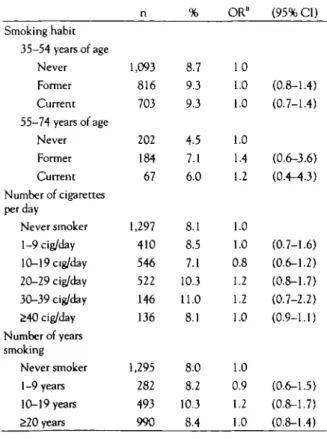
No association between smoking habits and left-handed-ness was found whether smoking was measured as smoking status, amount smoked or duration of smoking habit
Left'handedness and smoking
association of smoking status was assessed separately in older and younger subjects.
This study was funded by die Swiss National Fund for Scientific Research (Grants No 32.31.326.91,32-37986.93 and 32-49847.%).
DISCUSSION
We found a decrease of innate left-handedness prevalence with age which is consistent with previous reports.1 Left-handed subjects were not more likely to smoke than the rest of the population, either in younger or older ages. We failed, therefore, to demonstrate that the decline of left-handedness with age could potentially be attributed to higher exposure to smoking. On the other hand, die increase of right hand writing with age suggested that left-handed subjects had switched hand preference,2 most likely because of society pressure.
A possible limitation of this study was the question on innate left-handedness which did not refer to any specific task (for example writing, brushing teeth, taking the telephone). It has been shown, however, that this type of global question is often answered in reference to hand preference for writing.' On the other hand, this study had the advantage of being based on a large and representative sample of the general population of a European urban area.
We conclude that smoking is not associated with hand preference and it is an unlikely cause of overmortality in left-handed subjects.
1 Porac C. Lateral preferences and human behavior. New York: Springler-Verlag, 1981.
2 Galobardes B, Bernstein MS, Morabia A. The association between switching hand preference and the declining prevalence of left-handedness w i t h age. Am J Public Health 1999,89:1873-5.
3 Brackenridge a Secular variation in handedness over ninety years. Neuropsychologia 1981;19:459-62.
4 Coren S. The diminished number of older left-handers: differential mortality or social-historical trend? Int J Neurosci 1994;75:1-8.
5 Bryden MP, McManus IC, Bulman-Fleming MB. Evaluating the empirical support for the Geschwind-Behan-Galaburda model of cerebral lateralization. Brain Cogn 1994,26:103-67.
6 McManus IC Bryden MP, Bulman-Fleming MB. Handedness and autoimmune disease. Lancet 1993;341:891-2.
7 Doll R, Peto R, Wheatley K, Gray R, Sutherland I. Mortality in relation to smoking: 40 years' observations on male British doctors. BMJ 1994;309:901-11.
8 Morabia A, Bernstein M, Hentier S, YIN A.
Community-based surveillance of cardiovascular risk factors in Geneva: methods, resulting distributions, and comparisons with other populations. Prev Med 1997,26:311-19.
Received 21 March 2000, accepted 10 August 2000
Table 1 Proportion (%), adjusted odds ratio (OR) and its 95% confidence interval (95% Cl) of innate left hand preference compared to innate nght hand preference, by smoking exposure. Geneva, Switzerland 1993-1996 Smoking habit 35-54 years of age Never Former Current 55-74 years of age Never Former Current Number of cigarettes per day Never smoker 1-9 cig/day 10-19 cig/day 20-29 cig/day 30-39 cig/day 240 cig/day Number of years smoking Never smoker 1-9 years 10-19 years £20 years
a; Adjusted for age and gender
n 1,093 816 703 202 184 67 1,297 410 546 522 146 136 1,295 282 493 990 % 8.7 9.3 9.3 4.5 7.1 6.0 8.1 8.5 7.1 10.3 11.0 8.1 8.0 8.2 10.3 8.4 OR" 10 1.0 1.0 1.0 1.4 1.2 1.0 1.0 0.8 1.2 1.2 1.0 1.0 0.9 1.2 1.0 (95% CI) (0.8-1.4) (0.7-1.4) (0.6-3.6) (0.4-4.3) (0.7-1.6) (0.6-1.2) (0.8-1.7) (0.7-2.2) (0.9-1.1) (0.6-1.5) (0.8-1.7) (0.8-1.4)