Restructuring during pretreatment of platinum/alumina
for enantioselective hydrogenation
T. Mallata, S. Frauchigera, P.J. Kooymanb, M. Sch¨urcha and A. Baikera,∗
aLaboratory of Technical Chemistry, Swiss Federal Institute of Technology, ETH-Zentrum, CH-8092 Zurich, Switzerland E-mail: [email protected]
bNational Centre for High Resolution Electron Microscopy, Rotterdamseweg 137, 2628 AL Delft, The Netherlands Received 26 June 1999; accepted 30 September 1999
The influence of reductive and oxidative heat treatment on the enantioselectivity of chirally modified Pt/alumina has been reinvesti-gated, using the hydrogenation of ketopantolactone as a test reaction. Enhancement in ee by 39–49% has been observed after treatment in hydrogen at 250–600◦C, as compared to untreated or preoxidized catalysts. The changes in ee after reductive and oxidative treatments are reversible, and always the final treatment is decisive. A HRTEM study indicates that adsorbate-induced restructuring of Pt crystallites during hydrogen treatment at elevated temperature can play a role in the selectivity improvement, but the changes are superimposed by the strong structure-directing effect of the alumina support. The possible contribution of other effects (complete reduction of Ptn+ surface species, removal of impurities, or change of Pt particle size) could be excluded.
Keywords: enantioselective, hydrogenation, ketopantolactone, cinchonidine, catalyst pretreatment, adsorbate-induced restructuring
1. Introduction
The concerted effort of several research groups in the past two decades led to a substantial improvement in under-standing of Orito’s reaction [1,2], the enantioselective hy-drogenation of α-ketoesters over Pt modified with cinchona alkaloids (see, e.g., [3,4]). Nevertheless, there are still some interesting and important observations which deserve an un-ambiguous explanation. It was shown early [1,2,5–7] that preheating the catalyst in H2 has a great influence on the enantiomeric excess (ee). In the most impressive example the ee to (R)-ethyl mandelate increased from 34 to 84% after prereduction of 5 wt% Pt/alumina in H2at 400◦C [2]. On the other hand, preheating of Pt/alumina in air or vac-uum has no positive effect on the ee in α-ketoester hydro-genation [8].
Orito et al. [2] assumed that the positive effect of re-ductive pretreatment was due to the removal of oxygen adsorbed on Pt. However, in the hydrogenation of ethyl 2-oxo-4-phenylbutyrate, reoxidation of a Pt/alumina catalyst in ambient air, subsequent to prehydrogenation at 400◦C, diminished the ee only by 2% [9]. Apparently, the ox-idation state of Pt at the beginning of the hydrogenation reaction had no influence on the enantioselectivity.
In some studies the positive effect of reductive pretreat-ment depended on the catalyst support: Pt/alumina was con-siderably more sensitive to thermal treatment than Pt/SiO2 and Pt/C [6,9]. However, no feasible explanation for this difference has been provided yet.
Enhancement of enantioselectivity after reductive heat treatment of Pt/alumina is not limited to the hydrogenation ∗To whom correspondence should be addressed.
of α-ketoesters. Under otherwise identical conditions the ee could be doubled in the hydrogenation of trifluoroace-tophenone [10], ketopantolactone (KPL) [11] and some pyrrolidine-triones [12].
It has also been shown that the average particle size of Pt increases during heat treatment in H2 [11]. This obser-vation corroborates a former proposal [8,13] that small Pt particles (<3–4 nm) are less selective in the hydrogena-tion of ethyl pyruvate. The metal particle size can in-fluence the distribution of exposed face, edge or corner atoms [14], and hence the adsorption of hydrogen and or-ganic species.
A feasible explanation for the positive effect of H2 at high temperature could be the role of surface morphology of supported Pt particles. Adsorbate-induced restructur-ing [15] of Pt durrestructur-ing reductive pretreatment may favour the appropriate adsorption of reactant and chiral modi-fier, and their interaction on the metal surface, in the subsequent hydrogenation reaction. Striking topographic changes were observed by STM when Pt(111) was ex-posed to H2, O2 or CO at 150◦C [16]. The corrosive restructuring of Pt(111) and Pt(110) surfaces, induced by CO adsorption, was detectable already at room tempera-ture [16,17].
The aim of the present work is to investigate possible restructuring of supported Pt particles during pretreatment at elevated temperature and its role in the enantiodifferen-tiating ability of cinchona-modified Pt. The performance of alumina-supported Pt is tested in the hydrogenation of KPL to the industrially important (R)-pantolactone [18], according to scheme 1.
Scheme 1.
2. Experimental
The 40–50 µm fraction of a 5 wt% Pt/alumina (Engel-hard 4759) was used for the experiments. Catalyst pretreat-ment was performed in a fixed-bed reactor by flushing the catalyst with 12.5–30 cm3min−1H2(99.999%, <2 ppm O2,
<0.5 ppm CnHm), Ar (99.9998%), air (0.033% CO2) or
CO (<3 ppm O2) for 1.5 h. Reductive and oxidative treat-ments were separated by flushing with nitrogen (99.995%,
<10 ppm O2) for 0.5 h at the temperature of the next treat-ment. Finally, the catalyst was cooled to room tempera-ture in the gas flow used in the last pretreatment step, and transferred into the autoclave under exclusion of air. For HRTEM measurements, treatments in H2 and air were per-formed at 600◦C also for prolonged time (14.5 h).
Hydrogenation of ketopantolactone (KPL) was carried out in a mechanically stirred 100 cm3 stainless-steel au-toclave (Parr 4560 Mini, n = 700 min−1). Pressure was held at a constant value and hydrogen uptake followed by a computerized constant volume–constant pressure equip-ment (B¨uchi BPC 9901). Under standard conditions, 60 mg pretreated catalyst, 2 g (15.6 mmol) KPL, 50 cm−3toluene and 27.2 µmol cinchonidine were used at 70 bar and−9◦C. KPL was dissolved in toluene and dried by azeotropic distil-lation before each reaction. The reaction was stopped after 2 h, except when the hydrogen consumption ceased earlier. The slurry was diluted with 20 cm−3ethanol and analyzed by a HP 5890A gas chromatograph with a chiral capillary column (WCOT Cyclodextrin-β-2,3,6-M-19, Chrompack). Enantioselectivity is expressed as ee = R (%)− S (%); sd = ±0.5%. Initial rate (r0) was determined from the hydrogen consumption curve by extrapolating to zero time (from the region above 20% conversion). Under standard conditions the rate of hydrogen uptake was independent of the stirrer frequency, but depended on the catalyst particle size. This indicates some pore diffusion limitation, likely due to product crystallization in the pores at the low reac-tion temperature [19]. Accordingly, the calculated values cannot be considered as intrinsic kinetic rates.
X-ray diffraction patterns were obtained on a Siemens D5000 powder X-ray diffractometer using Cu Kαradiation
(Ni filter). The sample was rotated during measurement by 30 rpm. Mean Pt particle size was calculated from the line broadening of the (111) reflection by the Scherrer formula. XPS measurements were performed with a Leybold Heraeus LHS11 apparatus using Mg Kα radiation. The
work function of the spectrometer was set so that the Au f7/2 line for metallic gold was located at 84.0 eV. Thin sample films were pressed on a sample holder, evacuated in a load lock, and subsequently transferred into the UHV chamber for analysis. Slight sample charging was corrected
using the C 1s line at 284.6 eV as an internal standard. Dif-ferential charging was estimated by varying the potential of a tubus in the lens system of the analyzer. The analysis is complicated by the overlapping of the most intensive Pt line (4f) with that of Al 2p [20], and only the Pt 4d5/2lines could be used.
Transmission electron microscopy (TEM) was per-formed using a Philips CM30T electron microscope with a LaB6filament as the source of electrons operated at 300 kV. Samples were mounted on a microgrid carbon polymer sup-ported on a copper grid by placing a few droplets of a suspension of ground sample in n-hexane on the grid, fol-lowed by drying under ambient conditions, all in an Ar glove-box. Samples were transferred to the microscope in a special vacuum-transfer sample holder under exclusion of air. Volume-weighted mean particle size was calculated using the formula: d =Pnid4i/
P
nid3i.
3. Results
3.1. Catalytic hydrogenation
The effect of catalyst heat treatment in different at-mospheres on the performance of 5 wt% Pt/alumina in the KPL → (R)-pantolactone hydrogenation is illustrated in table 1. Pretreatment in flowing hydrogen enhanced con-siderably the ee, showing a broad maximum between 250 and 600◦C. After prereduction at 400◦C, TEM and XRD measurements indicated a ca. 30% increase in Pt particle (crystallite) size. The presence of water vapour in hydro-gen at 400◦C had practically no influence on the perfor-mance of Pt, but the average metal particle size decreased to 2.8 nm, which contrasts the behaviour in the absence of water where the particle size increased to 4.2 nm.
Oxidative treatment in air barely influenced the Pt parti-cle size, the initial rate and enantioselectivity. That is, heat treatment alone of the already oxidized Pt has no positive influence on its performance. This and the former con-clusion are in good agreement with our results obtained in ethyl pyruvate hydrogenation [8,13]. Catalysts pretreated in pure Ar or CO afforded medium enantioselectivities. Due to their moderate effect, the influence of these gases will not be discussed further.
Reductive catalyst pretreatment increased also the initial rate of hydrogen consumption. For the interpretation of this change we have to consider that when using an untreated catalyst (stored in air), before hydrogenation of the reactant the surface PtOxhas to be reduced to the active Pt0species.
This transient period is short or may be completely absent for Pt/alumina prereduced at high temperature, resulting in an apparent higher initial reaction rate. However, the av-erage rates of KPL conversion accounting for the whole reaction were rather similar, almost independent of the pre-treatment procedure.
It is interesting to consider the two extreme cases, the heat treatments in hydrogen and air, in more detail. Data
Table 1
Influence of various pretreatment procedures on the catalytic performance of 5 wt% Pt/alumina.
Catalyst Temp. dTEMa dXRDb r0 Conversion ee
pretreatment (◦C) (nm) (nm) (mmol g−1min−1) (%) (%)
No treatment – 3.3 3.1 11 99 46 H2 100 – – 13 95 67 H2 250 – – 24 80 86 H2 400 4.2 4.1 32 87 89 H2 500 – – 58 97 86 H2 600 – – 20 84 85 H2/H2Oc 400 2.8 – 42 87 87 Air 400 3.3 3.2 10 97 46 Air 600 – – 16 98 40 Air/H2Oc 400 – – 7 99 40 Ard 400 – – 13 97 68 CO 400 – – 16 97 57
aVolume-weighted mean particle size determined by TEM. bCrystallite size determined by XRD line broadening. cGas flow saturated with water at room temperature. dTreatment for 2 h.
Table 2
Influence of the sequence of reductive and oxidative pretreatments on the catalytic performance of 5 wt% Pt/alumina.
Catalyst pretreatment r0 Conversion ee
(temperature in◦C) (mmol g−1min−1) (%) (%)
H2(400)–air (400) 14 99 44 Air (400)–H2(400) –a 99 87 Air (600)–H2(400) 32 69 89 Air (400)–H2(400)–air (400) 10 99 45 H2(400)–air (400)–H2(400) 37 95 89 H2(400)–air (25) 20 84 84 Air (400)–H2(25) 21 99 57 aNot measured.
collected in table 2 demonstrate that the changes during these treatments are reversible. When applying several sub-sequent reductive–oxidative heat treatments, always the last step in the cycle determined the performance of the cata-lyst. Treatments at room temperature either in hydrogen or air led only to minor changes.
Interestingly, no difference in the oxidation state of Pt after reductive and oxidative treatments at 400◦C could be detected by XPS analysis. Only Pt0was detected, indepen-dent of the pretreatment conditions. The likely explanation is that the surface layer of the sample was easily reduced in the load lock due to the reducing conditions (reducing gas in the zeolite trap, hydrogen from the ionization gauge, or pump oil vapor [21]).
3.2. Transmission electron microscopic measurements
The 5 wt% Pt/alumina after various pretreatments has been investigated by HRTEM. Two types of alumina could be distinguished: a properly crystalline and a less crys-talline form. (Note that XRD indicated the presence of only
γ-Al2O3.) The catalyst in an oxidized state (treated in air at 600◦C for 14.5 h) contained predominantly spherical parti-cles on both types of alumina. After a reductive treatment at 600◦C the morphology of Pt particles depended mainly on
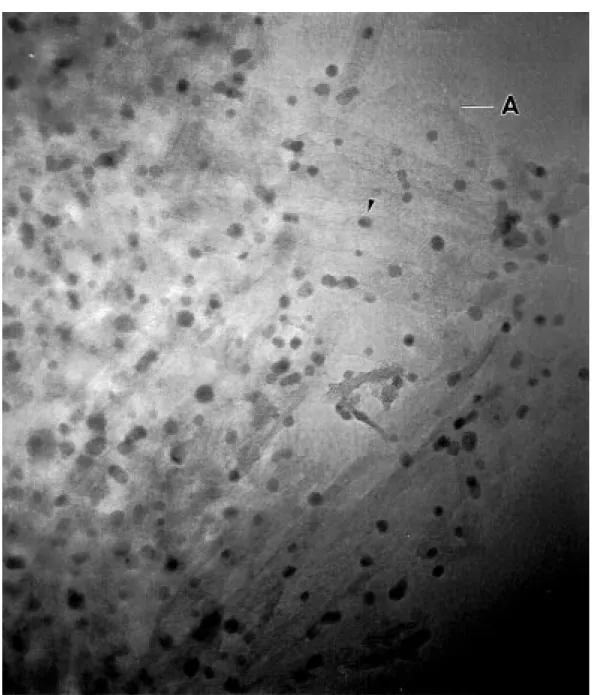
the crystallinity of the support: mostly faceted (cube-like or hexagonal) on crystalline alumina, whereas rounded shapes dominated on the less crystalline alumina. Corresponding electron micrographs are shown in figure 1. This behavior was less clear after pretreatments under milder conditions. Besides, TEM confirmed that the shape and size of Pt particles after treatments at 400◦C in pure H2 or H2 satu-rated with water were similar, in agreement with the result of the catalytic study. Similarly, an exposure to ambient air of the sample reduced at high temperature did not influence the morphology of Pt particles.
4. Discussion
The studies corroborate the former observation [11] that catalyst treatment in flowing hydrogen at 400◦C can ap-proximately double the ee to (R)-pantolactone, compared to the performance of untreated or preoxidized Pt. A new observation is that the change in ee after reductive and ox-idative treatments is reversible and always the last treatment determines the catalytic performance.
There are several possible reasons for the improved enantiodifferentiation after reductive heat treatment of Pt:
(i) cleaning of the surface from impurities, (ii) increase of Pt particle size,
(iii) complete reduction of Ptn+at high temperature, and (iv) special surface geometry of hydrogen-treated Pt
parti-cles.
Surface impurities can certainly play a role in many in-stances and reductive removal of some strongly adsorbed species (e.g., residues from precursor) can contribute to the observed effect. Thermal analysis (TG and DTA com-bined with MS) and XPS did not show the presence of any impurity in significant amount in the Pt/alumina catalyst. Also the reversible changes observed after reductive and
Figure 1. High-resolution transmission electron micrographs of the 5 wt% Pt/alumina catalyst after treatment at 600◦C (same magnification, scaling bar: 7.5 nm). (A) Air-treated sample showing mainly spherical metal particles irrespective of the local morphology of alumina; (B) hydrogen-treated
sample showing both faceted and spherical particles mainly present on the properly crystalline parts of alumina.
oxidative heat treatments (table 2) suggest that the effect of impurities is negligible.
The similar behaviour of Pt/alumina irrespective of the particle size (dav= 2.8 or 4.2 nm), established after prere-duction in dry or humid hydrogen (table 1), indicates that the size of Pt particles in this range does not significantly influence the enantiodifferentiating step.
The influence of the oxidation state of Pt before and during enantioselective hydrogenation has been the tar-get of previous research, leading to contradictory conclu-sions [2,8,9,22,23]. Incomplete reduction of supported Pt particles at room temperature could be a feasible expla-nation for the positive effect of high-temperature catalyst prereduction (table 1). It was shown by TPR experiments
that complete reduction by hydrogen of surface PtO2 and PtAl2O4species on a Pt/alumina catalyst required minimum 100–220◦C, and the reduction behavior was a function of metal dispersion and preoxidation conditions [24]. Also XPS analysis of a series of 1.4–10 wt% Pt/alumina showed that at least 150◦C was necessary for complete reduction to metallic Pt, and the lower the metal loading, the higher was the minimum reduction temperature [20]. However, the use of Cl-containing Pt precursors for catalyst prepa-ration in the above two studies can seriously distort the results. The high surface Cl concentration during catalyst reduction [25] can stabilize the oxidized state of Pt and hinder its facile reduction at ambient temperature. Besides, the explanation by Hwang and Yeh [24] seems to be rather
Figure 1. (Continued.)
speculative as there is no evidence in the open literature for the existence of PtAl2O4.
We have found by XPS that even after an oxidative treat-ment the 5 wt% Pt/alumina was easily reduced at room temperature. Accordingly, we propose that in our case the presence of unreduced surface Ptn+ species cannot play an important role in the enantioselective hydrogenation of KPL.
There is no doubt that adsorbates such as H2, O2 or CO can induce dramatic surface restructuring of Pt already at 150◦C [15–17]. Supported Pt requires higher temper-ature for the transformation and at ambient tempertemper-ature it can exist indefinitely in this metastable configuration [26]. Heating at 450–625◦C of 2–20 nm Pt particles supported on silica or alumina afforded cube-like shapes with facets in hydrogen and spherical particles in air or N2 [26,27]. The changes in particle shape monitored by TEM were re-versible. Restructuring during annealing could be modelled by simple first-order calculations, based on the different adsorption energies of hydrogen on Pt(100), Pt(110) and Pt(111) faces [27]. Reversibility of substrate-induced re-structuring and the rounded shape after annealing in air has been confirmed later, but spherical shape for <5 nm
parti-cles and near-cubooctahedral shape for larger partiparti-cles were observed in H2[28]. The discrepancy was partly attributed to surface contaminants of support materials, but Pt precur-sors containing Cl ions or organic ligands could also con-tribute to the absence of restructuring of small Pt particles. Our HRTEM investigations indicate that the morphol-ogy of Pt particles is related to both the morpholmorphol-ogy of the alumina support and the pretreatment procedure. The expected faceted Pt particles after reductive heat treatment could be observed only on properly crystalline γ-alumina, while rounded shape was typical for Pt particles located on less crystalline γ-alumina regions, indicating that the alu-mina support has some structure-directing influence. In or-der to arrive at a final conclusion concerning the relevance of adsorbate-induced restructuring during pretreatment, the present studies have to be extended to specially designed model systems which allow the structure-directing influence of the support material to be ruled out.
5. Conclusions
There are several important parameters which can in-fluence the behaviour of Pt-catalyzed enantioselective
hy-drogenation of activated ketones. Catalyst pretreatment in hydrogen at elevated temperature (200–600◦C) belongs to the most influential parameters, which procedure can double the efficiency of cinchonidine-modified supported Pt cata-lysts. Several assumptions have been considered for the interpretation of this puzzling effect, including the removal of surface contamination, increased particle size, complete reduction of Ptn+surface species, and the adsorbate-induced surface restructuring. Our catalytic, TEM, XPS, XRD and CO chemisorption experiments with Pt/alumina suggest that surface restructuring may be a feasible explanation but an unambiguous interpretation of the dramatic changes in enantioselectivity after reductive and oxidative heat treat-ments, and the excellent reversibility of these variations, requires further research.
Acknowledgement
XPS analysis by T. B¨urgi and XRD measurements by M. Maciejewski, and the financial support by the Swiss National Science Foundation and NWO (The Netherlands) are kindly acknowledged.
References
[1] Y. Orito, S. Imai and S. Niwa, J. Chem. Soc. Jpn. (1979) 1118. [2] Y. Orito, S. Imai and S. Niwa, J. Chem. Soc. Jpn. (1980) 670. [3] M. Bartok, J. Czombos, K. Felf¨oldi, L. Gera, G. G¨ond¨os, `A. Moln`ar,
F. Notheisz, I. P`alinko, G. Wittman and `A.G. Zsigmond, in:
Stereo-chemistry of Heterogeneous Metal Catalysts (Wiley, Chichester,
1985) p. 511.
[4] A. Baiker, J. Mol. Catal. A 115 (1997) 473.
[5] S. Niwa, S. Imai and Y. Orito, J. Chem. Soc. Jpn. (1982) 137. [6] H.U. Blaser, H.P. Jalett, D.M. Monti, J.F. Reber and J.T. Wehrli,
Stud. Surf. Sci. Catal. 41 (1988) 153.
[7] I.M. Sutherland, A. Ibbotson, R.B. Moyes and P.B. Wells, J. Catal. 125 (1989) 77.
[8] J.T. Wehrli, A. Baiker, D.M. Monti and H.U. Blaser, J. Mol. Catal. 49 (1989) 195.
[9] H.U. Blaser, H.P. Jalett, D.M. Monti and J.T. Wehrli, Appl. Catal. 52 (1989) 19.
[10] T. Mallat, M. Bodmer and A. Baiker, Catal. Lett. 44 (1997) 95. [11] M. Sch¨urch, O. Schwalm, T. Mallat, J. Weber and A. Baiker, J. Catal.
169 (1997) 275.
[12] A. Szabo, N. K¨unzle, T. Mallat and A. Baiker, Tetrahedron: Asym. 10 (1999) 61.
[13] J.T. Wehrli, A. Baiker, M. Monti and H.U. Blaser, J. Mol. Catal. 61 (1990) 207.
[14] R. van Hardeveld and F. Hartog, Surf. Sci. 15 (1969) 189. [15] G.A. Somorjai and M.A. van Hove, Prog. Surf. Sci. 30 (1989) 201. [16] G.A. Somorjai and G. Rupprechter, Stud. Surf. Sci. Catal. 109 (1997)
35.
[17] T. Gritsch, D. Coulman, R.J. Behm and G. Ertl, Phys. Rev. Lett. 63 (1989) 1086.
[18] R. Schmid, Chimia 50 (1996) 110.
[19] M. Sch¨urch, N. K¨unzle, T. Mallat and A. Baiker, J. Catal. 176 (1998) 569.
[20] J.Z. Shyu and K. Otto, Appl. Surf. Sci. 32 (1988) 246.
[21] J.D. Grunwaldt, M.D. Wildberger, T. Mallat and A. Baiker, J. Catal. 177 (1998) 53.
[22] P.A. Meheux, A. Ibbotson and P.B. Wells, J. Catal. 128 (1991) 387. [23] R.L. Augustine and S.K. Tanielyan, J. Mol. Catal. 118 (1997) 79. [24] C.P. Hwang and C.T. Yeh, J. Mol. Catal. 112 (1996) 295. [25] S.D. Jackson, J. Willis, G.D. McLellan, G. Webb, M.B.T. Keegan,
R.B. Moyes, S. Simpson, P.B. Wells and R. Whyman, J. Catal. 139 (1993) 191.
[26] T. Wang, C. Lee and L.D. Schmidt, Surf. Sci. 163 (1985) 181. [27] A.C. Shi and R. Masel, J. Catal. 120 (1989) 421.
[28] A.S. Ramachandran, S.L. Anderson and A.K. Datye, Ultrami-croscopy 51 (1993) 282.