Compendium
of Sanitation Systems
and Technologies
2
nd
rev i sed
edition
Compendium of Sanitation Systems and Technologies
2
ndrevised edition
Our special thanks go to: the Sustainable Sanitation Alliance (SuSanA) and the International Water Association (IWA) specialist groups. We would like to thank the following individuals
for their contributions and comments: Magalie Bassan, Chris Canaday, Pierre-Henri Dodane, Jan-Olof Drangert, Andrin Fink, Roman Grüter, Heino Güllemann, Heike Hoffmann, Elisabeth Kvarnström, Christian Riu Lohri, Antoine Morel, Peter Morgan, Eberhard Morgenroth, Elisabeth von Münch, Sara Oppenheimer, Jonathan Parkinson, Eddy Perez, Annette Remmele, Samuel Renggli, Christian Rieck, David Robbins, Roland Schertenleib, Anjali Sherpa, Mingma Sherpa, Hansruedi Siegrist, Dorothee Spuhler, Linda Strande, Gabor Szanto, Kai Udert, Björn Vinnerås, Carolien van der Voorden, Nanchoz Zimmermann
We would like to acknowledge support from: The Swiss Agency for Development and Cooperation (SDC) The Water Supply & Sanitation Collaborative Council (WSSCC)
Elizabeth Tilley, Lukas Ulrich, Christoph Lüthi, Philippe Reymond and Christian Zurbrügg
Compendium of Sanitation Systems and Technologies Fo re w o rd
Undisputedly, sanitation is a key element of sustainable development and signifi-cantly influences people’s health and wellbeing worldwide. The International Water Association (IWA), the Water Supply and Sanitation Collaborative Council (WSSCC) and Eawag have made considerable efforts to promote improved sanitation by pro-viding an easily accessible knowledge base and guidance about how to achieve these improvements. Working collaboratively under the Urban Sanitation Initiative, we continue to foster innovation, disseminating information about the full range of sanitation technologies and building the capacity of practitioners who use this information.
The first Compendium produced by Eawag (Department Sandec) and WSSCC in 2008 went a long way towards this objective. It provides knowledge on a wide range of sanitation technologies without bias and/or agenda, and helped to increase the recognition that a fully functioning sanitation ‘chain’ must link toilets to a treatment facility via an operational collection and transportation system. It also presented resource recovery and reuse options as a necessary objective for the sustainable management of excreta.
In recent years, the Compendium has become the most popular technical com-pilation in the sanitation sector and is widely acclaimed by a large audience as an international reference tool. This expanded second edition provides updates and presents information about an increased range of technologies and will be an important resource for stakeholders in their decision making planning process. The eCompendium version allows for improved on-line access to the information and flexibility of use, and makes updating easier.
We believe that our on-going collective efforts will help to ensure the achievement of the Sustainable Development Goals regarding sanitation and also those relating to health, water and environmental sustainability.
Foreword
Christian Zurbrügg Eawag Jonathan Parkinson IWA Chris Williams WSSCCCompendium of Sanitation Systems and
Technologies
Table of Contents
Table of Contents
Introduction 7
Background and Target Audience 7
What’s New in the Second Edition? 7
Structure and Use of the Compendium 7
Complementary Sanitation Sector Development Tools 8
Compendium Terminology 10
Sanitation Systems 10
Products 10
Functional Groups 12
Sanitation Technologies 13
Part 1: System Templates 15
Using the System Templates 16
System 1: Single Pit System 20
System 2: Waterless Pit System without Sludge Production 22
System 3: Pour Flush Pit System without Sludge Production 24
System 4: Waterless System with Urine Diversion 26
System 5: Biogas System 28
System 6: Blackwater Treatment System with Infiltration 30
System 7: Blackwater Treatment System with Effluent Transport 32
System 8: Blackwater Transport to (Semi-) Centralized Treatment System 34
System 9: Sewerage System with Urine Diversion 36
Part 2: Functional Groups with Technology
Information Sheets 39
Reading the Technology Information Sheets 40
U User Interface 42
U.1 Dry Toilet 44
U.2 Urine-Diverting Dry Toilet (UDDT) 46
U.3 Urinal 48
U.4 Pour Flush Toilet 50
U.5 Cistern Flush Toilet 52
U.6 Urine-Diverting Flush Toilet (UDFT) 54
S Collection and Storage/Treatment 56
S.1 Urine Storage Tank/Container 58
S.2 Single Pit 60
Compendium of Sanitation Systems and
Technologies
Table of Contents
S.4 Double Ventilated Improved Pit (VIP) 64
S.5 Fossa Alterna 66
S.6 Twin Pits for Pour Flush 68
S.7 Dehydration Vaults 70
S.8 Composting Chamber 72
S.9 Septic Tank 74
S.10 Anaerobic Baffled Reactor (ABR) 76
S.11 Anaerobic Filter 78
S.12 Biogas Reactor 80
C Conveyance 82
C.1 Jerrycan/Tank 84
C.2 Human-Powered Emptying and Transport 86
C.3 Motorized Emptying and Transport 88
C.4 Simplified Sewer 90
C.5 Solids-Free Sewer 92
C.6 Conventional Gravity Sewer 94
C.7 Transfer Station (Underground Holding Tank) 96
T (Semi-) Centralized Treatment 98
PRE Pre-Treatment Technologies 100
T.1 Settler 102
T.2 Imhoff Tank 104
T.3 Anaerobic Baffled Reactor (ABR) 106
T.4 Anaerobic Filter 108
T.5 Waste Stabilization Ponds (WSP) 110
T.6 Aerated Pond 112
T.7 Free-Water Surface Constructed Wetland 114
T.8 Horizontal Subsurface Flow Constructed Wetland 116
T.9 Vertical Flow Constructed Wetland 118
T.10 Trickling Filter 120
T.11 Upflow Anaerobic Sludge Blanket Reactor (UASB) 122
T.12 Activated Sludge 124
T.13 Sedimentation/Thickening Ponds 126
T.14 Unplanted Drying Beds 128
T.15 Planted Drying Beds 130
T.16 Co-Composting 132
T.17 Biogas Reactor 134
POST Tertiary Filtration and Disinfection 136
D Use and/or Disposal 138
D.1 Fill and Cover/Arborloo 140
D.2 Application of Stored Urine 142
Compendium of Sanitation Systems and
Technologies
Table of Contents
D.4 Application of Pit Humus and Compost 146
D.5 Application of Sludge 148
D.6 Irrigation 150
D.7 Soak Pit 152
D.8 Leach Field 154
D.9 Fish Pond 156
D.10 Floating Plant Pond 158
D.11 Water Disposal/Groundwater Recharge 160
D.12 Surface Disposal and Storage 162
D.13 Biogas Combustion 164
Emerging Sanitation Technologies 166
Compendium of Sanitation Systems and
Technologies
Intr
oduction
Introduction
Structure and Use of the Compendium
Like the first edition, the Compendium is divided into
two parts: (1) the System Templates and a description
about how to use them; and (2) the Technology
Infor-mation Sheets.
It is recommended that the Compendium user first review the sections “Compendium Terminology” (pp. 10-13) and “Using the System Templates” (pp. 16-19), to become familiar with the key terms and structure of the system templates and their components. There-after, the user can move between the system templates and technology information sheets (they are cross-ref-erenced) until he/she has identified systems and/or technologies appropriate for further investigation. Even-tually, the user should be able to develop one or several system configurations to present to the community of the intervention area. Following the community’s sug-gestions, the Compendium can then be used to re-eval-uate and redesign the systems accordingly.
The Compendium is only one document in the field to facilitate informed decision-making on the part of differ-ent stakeholders involved in improving environmdiffer-ental sanitation services, and should be used in conjunction with other available publications and tools. An overview of complementary sanitation sector development tools is provided on the following double page.
Background and Target Audience
The Compendium of Sanitation Systems and Technolo-gies was first published in 2008 during the Internation-al Year of Sanitation. Since then it has been translated into several languages and distributed digitally by var-ious sector organizations. The document’s popularity lies in its brevity – structuring and presenting a huge range of information on tried and tested technologies in a single document. As in the first edition, we do not consider sanitation technologies that are under devel-opment or that exist only as prototypes. Also, we only include “improved” sanitation technologies that provide safe, hygienic, and accessible sanitation. Like the first edition, we include the whole range of urban, peri-urban and rural technologies (e.g., from single pits to conven-tional sewers).
The Compendium is a guidance document for engineers and planners in low- and middle-income countries, pri-marily intended to be used for communicative planning processes involving local communities. It is also intend-ed for persons/experts who have detailintend-ed knowlintend-edge about conventional high-end technologies and require information on infrastructure and different system con-figurations. It is not intended as a stand-alone document for engineers, making decisions for the community, e.g., expert-driven decision-making.
What’s New in the Second Edition?
The revised, second edition has more content, and offers:
1. Simplified user guidance
2. Revised technology descriptions with updated refer-ences and improved illustrations based on reviews by renowned sector experts and taking into account key developments in the sector over the last six years 3. A more elaborate presentation of input and output
products that clarifies the compatibility between technologies and streamlines system configuration 4. Five new technology information sheets and a
sec-tion on emerging technologies
5. An additional sanitation system, “System 5: Biogas System”
Technologies
y Sanitation Sector De
velopment
Tools
Complementary Sanitation Sector Development Tools
Community-Led Urban Environmental Sanitation : CLUES
Complete Guidelines for Decision Makers with 30 Tools
CLUES presents a complete set of guidelines for sanitation planning in low-income urban areas. It is the most up-to-date planning framework for facilitating the deliv-ery of environmental sanitation services for urban and peri-urban communities. CLUES features seven easy-to-follow steps, which are intended to be undertaken in sequential order. Step 5 of the planning approach relies on the Compendium, apply-ing the systems approach to select the most appropriate technological option(s) for a given urban context. The document also provides guidance on how to foster an enabling environment for sanitation planning in urban settings.
By Lüthi, C., Morel, A., Tilley, E. and Ulrich, L. (2011). Eawag (Sandec), WSSCC, UN-HABITAT. Free PDF available at: www.sandec.ch/clues
Sanitation 21
A Planning Framework for Improving City-wide Sanitation Services Sanitation 21 presents an internationally recognized planning framework based upon key principles of sanitation planning and recommended process guidelines. Built upon practical experience and best practices, Sanitation 21 brings together decisions about technology and management options with stakeholder needs and preferences to help inform the choice of appropriate sanitation systems. It is written in non-technical language to be relevant to policy makers and practitioners who are interested in providing appropriate and affordable sanitation services and presents recommended activities to guide the development of a city sanitation plan. This revised version of the Sanitation 21 framework builds upon the increase in knowl-edge and experience in city-wide planning.
By Parkinson, J., Lüthi, C. and Walther, D. (2014). IWA, GIZ, Eawag (Sandec). Free PDF available at: www.iwahq.org and www.sandec.ch
How to Design Wastewater Systems for Local Conditions in Develop-ing Countries
This manual provides guidance in the design of wastewater systems in developing country settings. It promotes a context-specific approach to technology selection by guiding the user to select the most suitable technologies for their area. It pro-vides tools and field guides for source characterization and site evaluation, as well as technology identification and selection. This manual is primarily addressed to private and public sector service providers, regulators and engineers/development specialists in charge of implementing wastewater systems.
By Robbins, D. M. and Ligon, G. C. (2014). IWA Publishing.
In the past few years, a number of documents have been published that com-plement this work and add to the growing body of sustainable technology reference materials and practical guides. Some are presented below:
How to Design Wastewater Systems for Local Conditions in Developing Countries
David M Robbins and Grant C. Ligon
How to Design Wastewater Systems for Local Conditions in Developing Countries
David M Robbins and Grant C. Ligon
This is a practical handbook providing a step-by-step approach to the techniques used for characterizing wastewater sources and investigating sites where collection, treatment and reuse/disposal technologies will be installed. It is intended to help enable local implementation of on-site and decentralized wastewater treatment systems (DEWATS) for wide scale use in development settings.
Designing Wastewater Systems According to Local Conditions helps local service providers and regulatory officials make informed decisions through the use of tools, checklists and case studies. It will include a link to a web based community of on-site and decentralized wastewater professionals, which contains related tools and case studies. This handbook will serve as a reference for training classes, certification programs, and higher education programs in civil and sanitary engineering. There is an increasing interest on the part of local government officials and private sector service providers to implement wastewater treatment systems to solve sanitation problems. The model presented in this handbook promotes activities that first generate data related to source and site conditions that represent critical inputs, and then applies this information to the technology selection process. Matching the most appropriate technologies to the specific needs of the wastewater project is the key that leads to long term sustainability.
Designing Wastewater Systems According to Local Conditions is an invaluable resource for public sector decision makers and private sector service providers in developing countries. It is also a useful text for students at engineering colleges in developing countries interested in taking a class that teaches the methods of DEWATS development.
Ho w t o Design W as te wat er Sys tems f or Loc al Conditions in De vel oping Countries Da vid M R obbins and Gr ant C. Ligon www.iwapublishing.com ISBN: 9781780404769 (Paperback) ISBN: 9781780404779 (eBook)
Compendium of Sanitation Systems and Technologies Complementar y Sanitation Sector De velopment Tools
Faecal Sludge Management
Systems Approach for Implementation and Operation
This is the first book to compile the current state of knowledge on faecal sludge management. It addresses the organization of the entire faecal sludge management service chain, from the collection and transport of sludge, to the current state of knowledge of treatment options, and the final end use or disposal of treated sludge. It presents an integrated approach that brings together technology, management, and planning, based on Sandec’s 20 years of experience in the field. It also dis-cusses important factors to consider when evaluating and upscaling new treatment technology options. The book is designed for undergraduate and graduate students, engineers, and practitioners in the field who have some basic knowledge of environ-mental and/or wastewater engineering.
By Strande, L., Ronteltap, M. and Brdjanovic, D. (Eds.) (2014). IWA Publishing. Free PDF available at: www.sandec.ch
Hygiene and Sanitation Software – An Overview of Approaches
In sanitation and hygiene programme and service delivery, several methods are used to engage target groups in development programmes to enable behavioural change and/or create a demand for services. These methods or approaches are generally referred to as ‘software’, to distinguish them from the provision of ‚hard-ware‘. This publication takes an in-depth look at the various hygiene and sanitation software approaches that have been deployed over the last 40 years in all types of settings – urban, informal-urban and rural, and aims to address such issues as what a particular approach is designed to achieve, what it actually comprises, when and where it should be used, how it should be implemented and how much it costs, etc. This publication was developed as a companion to the Compendium.
By Peal, A., Evans, B. and van der Voorden, C. (2010). WSSCC. Free PDF available at: www.wsscc.org
The following on-line tools provide useful guidance and downloadable resources that complement the documents listed above.
eCompendium
The digital version of the Compendium is a stand-alone digital resource, structured around the different sanitation systems and the 57 featured technologies. This elec-tronic version allows for easier updating and flexibility of use on the part of different user groups. Additionally, it is an integral part of the SSWM Toolbox.
Available at: www.sandec.ch/ecompendium
Sustainable Sanitation and Water Management Toolbox
The SSWM Toolbox is the most comprehensive collection of tools and approaches of water management and sustainable sanitation available. It combines planning tools and software, and links them with publications, articles and web links, case studies, and training material.
Available at: www.sswm.info
An Overview of Approaches Additional on-line resources Systems Approach for Implementation and Operation
Faecal Sludge
Management
Editors Linda Strande Mariska Ronteltap Damir Brdjanovic Faec al S lud ge Mana gement Lind a S trande Mar isk a R ont elt ap D amir Br djano vicOver a billion people in urban and peri-urban areas of Africa, Asia, and Latin America are served by onsite sanitation technologies. Until now, the management of faecal sludge resulting from these onsite technologies has been grossly neglected. Financial resources are often lacking, and onsite sanitation systems tend to be regarded as temporary solutions until sewer-based systems can be implemented. However, the reality is that onsite sanitation is here to stay, either as an intermediate or permanent standalone solution, or in combination with sewer-based systems. The appropriate and adequate management of faecal sludge deriving from onsite technologies is imperative for the protection of human and environmental health. This is the first book dedicated to faecal sludge management. It compiles the current state of knowledge of this rapidly evolving field, and presents an integrated approach that includes technology, management and planning. It addresses the planning and organization of the entire faecal sludge management service chain, from the collection and transport of sludge and treatment options, to the final enduse or disposal of treated sludge. In addition to providing fundamentals and an overview of technologies, the book goes into details of operational, institutional and financial aspects, and provides guidance on how to plan a city-level faecal sludge management project with the involvement of all the stakeholders.
www.iwapublishing.com ISBN: 9781780404721 (Hardback) ISBN: 9781780404738 (eBook)
Compendium of Sanitation Systems and Technologies Compendium T er minology
Compendium Terminology
Sanitation SystemsThe Compendium defines sanitation as a multi-step process in which human excreta and wastewater are managed from the point of generation to the point of
use or ultimate disposal. A Sanitation System is a
context-specific series of technologies and services for the management of these wastes (or resources), i.e., for their collection, containment, transport, trans-formation, utilization or disposal. A sanitation system
is comprised of Products (wastes) that travel through
Functional Groups which contain Technologies that
can be selected according to the context. By
select-ing a Technology for each Product from each appli-cable Functional Group, one can design a logical Sanitation System. A sanitation system also includes
the management, operation and maintenance (O&M) required to ensure that the system functions safely and sustainably.
A System Template defines a suite of compatible
technology combinations from which a system can be designed. In Part 1 of the Compendium, nine different sanitation system templates are described. A detailed explanation of how system templates function and how they are used is given in the section “Using the System Templates” on pp. 16-19.
Products
Products are materials that are also called ‘wastes’ or ‘resources’. Some products are generated directly by humans (e.g., Urine and Faeces), others are required in the functioning of technologies (e.g., Flushwater to move Excreta through sewers) and some are generated as a function of storage or treatment (e.g., Sludge). For the design of a robust sanitation system, it is nec-essary to define all of the products that are flowing into (inputs) and out of (outputs) each of the sanitation tech-nologies in the system. The products referenced within this text are described below.
Anal Cleansing Water is water used to cleanse
oneself after defecating and/or urinating; it is generat-ed by those who use water, rather than dry material, for anal cleansing. The volume of water used per cleaning typically ranges from 0.5 L to 3 L.
Biogas is the common name for the mixture of
gas-es released from anaerobic diggas-estion. Biogas is com-prised of methane (50 to 75%), carbon dioxide (25 to 50%) and varying quantities of nitrogen, hydrogen sul-phide, water vapour and other components. Biogas can be collected and burned for fuel (like propane).
Biomass refers to plants or animals cultivated
using the water and/or nutrients flowing through a sanitation system. The term Biomass may include fish, insects, vegetables, fruit, forage or other beneficial crops that can be utilized for food, feed, fibre and fuel production.
Blackwater is the mixture of Urine, Faeces and
Flushwater along with Anal Cleansing Water (if water is used for cleansing) and/or Dry Cleansing Materials (see Figure 1). Blackwater contains the pathogens of Faeces and the nutrients of Urine that are diluted in the Flush-water.
Brownwater is the mixture of Faeces and
Flush-water, and does not contain Urine. It is generated by Urine-Diverting Flush Toilets (U.6) and, therefore, the volume depends on the volume of the Flushwater used. The pathogen and nutrient load of Faeces is not reduced, only diluted by the Flushwater. Brownwater may also include Anal Cleansing Water (if water is used for cleansing) and/or Dry Cleansing Materials (see Fig-ure 1).
Compost is decomposed organic matter that
results from a controlled aerobic degradation process. In this biological process, microorganisms (mainly bacte-ria and fungi) decompose the biodegradable waste com-ponents and produce an earth-like, odourless, brown/ black material. Compost has excellent soil-conditioning
Compendium of Sanitation Systems and Technologies Compendium T er minology
ÜBERSICHTSGRAFIK
Figure1: Definition of Excreta, Brownwater and Blackwater
Flushwater
Blackwater
Brownwater Excreta
Anal Cleansing Water Dry Cleansing Material Faeces
properties and a variable nutrient content. Because of leaching and volatilization, some of the nutrients may be lost, but the material is still rich in nutrients and organic matter. Generally, Excreta or Sludge should be composted long enough (2 to 4 months) under thermo-philic conditions (55 to 60 °C) in order to be sanitized sufficiently for safe agricultural use. This temperature is not guaranteed in most Composting Chambers (S.8), but considerable pathogen reduction can normally be achieved.
Dried Faeces are Faeces that have been
dehydrat-ed until they become a dry, crumbly material. Dehydra-tion takes place by storing Faeces in a dry environment with good ventilation, high temperatures and/or the presence of absorbent material. Very little degrada-tion occurs during dehydradegrada-tion and this means that the Dried Faeces are still rich in organic matter. However, Faeces reduce by around 75% in volume during dehy-dration and most pathogens die off. There is a small risk that some pathogenic organisms can be reactivated under the right conditions, particularly, in humid envi-ronments.
Dry Cleansing Materials are solid materials used
to cleanse oneself after defecating and/or urinating (e.g., paper, leaves, corncobs, rags or stones). Depend-ing on the system, Dry CleansDepend-ing Materials may be col-lected and separately disposed of. Although extreme-ly important, a separate product name for menstrual hygiene products like sanitary napkins and tampons is not included in this Compendium. In general (though not always), they should be treated along with the solid waste generated in the household.
Effluent is the general term for a liquid that leaves
a technology, typically after Blackwater or Sludge has undergone solids separation or some other type of treatment. Effluent originates at either a Collection and Storage or a (Semi-) Centralized Treatment technology. Depending on the type of treatment, the Effluent may be completely sanitized or may require further treat-ment before it can be used or disposed of.
Excreta consists of Urine and Faeces that is not
mixed with any Flushwater. Excreta is small in volume, but concentrated in both nutrients and pathogens. Depending on the quality of the Faeces, it has a soft or runny consistency.
Faeces refers to (semi-solid) excrement that is
not mixed with Urine or water. Depending on diet, each person produces approximately 50 L per year of faecal matter. Fresh faeces contain about 80% water. Of the total nutrients excreted, Faeces contain about 12% N,
39% P, 26% K and have 107 to 109 faecal coliforms in
100 mL.
Flushwater is the water discharged into the
User Interface to transport the content and/or clean it. Freshwater, rainwater, recycled Greywater, or any combination of the three can be used as a Flushwater source.
Greywater is the total volume of water
generat-ed from washing food, clothes and dishware, as well as from bathing, but not from toilets. It may contain traces of Excreta (e.g., from washing diapers) and, therefore, also pathogens. Greywater accounts for approximate-ly 65% of the wastewater produced in households with flush toilets.
Organics refers to biodegradable plant material
(organic waste) that must be added to some technol-ogies in order for them to function properly (e.g., Com-posting Chambers, S.8). Organic degradable material can include, but is not limited to, leaves, grass and mar-ket waste. Although other products in this Compendi-um contain organic matter, the term Organics refers to undigested plant material.
Pit Humus is the term used to describe the
nutri-ent-rich, hygienically improved, humic material that is generated in double pit technologies (S.4-S.6) through dewatering and degradation. This earth-like product is also referred to as EcoHumus, a term conceived by Peter Morgan in Zimbabwe. The various natural
decom-ÜBERSICHTSGRAFIK
Figure1: Definition of Excreta, Brownwater and Blackwater
Flushwater
Blackwater
Brownwater Excreta
Anal Cleansing Water Dry Cleansing Material Faeces
12
Compendium of Sanitation Systems and
Technologies
Compendium T
er
minology
position processes taking place in alternating pits can be both aerobic and anaerobic in nature, depending on the technology and operating conditions. The main dif-ference between Pit Humus and Compost is that the degradation processes are passive and are not subject-ed to a controllsubject-ed oxygen supply, C:N ratio, humidity and temperature. Therefore, the rate of pathogen reduc-tion is generally slower and the quality of the product, including its nutrient and organic matter content, can vary considerably. Pit Humus can look very similar to Compost and have good soil conditioning properties, although pathogens may still be present.
Pre-Treatment Products are materials separated
from Blackwater, Brownwater, Greywater or Sludge in preliminary treatment units, such as screens, grease traps or grit chambers (see PRE, p. 100). Substances like fats, oil, grease, and various solids (e.g. sand, fibres and trash), can impair transport and/or treatment efficiency through clogging and wear. Therefore, early removal of these substances is crucial for the durability of a sanitation system.
Sludge is a mixture of solids and liquids,
contain-ing mostly Excreta and water, in combination with sand, grit, metals, trash and/or various chemical compounds. A distinction can be made between faecal Sludge and wastewater Sludge. Faecal Sludge comes from onsite sanitation technologies, i.e., it has not been transported through a sewer. It can be raw or partially digested, a slurry or semisolid, and results from the Collection and Storage/Treatment of Excreta or Blackwater, with or without Greywater. For a more detailed characterization of faecal Sludge refer to Strande et al., 2014 (see Sec-tor Development Tools, p. 9). Wastewater Sludge (also referred to as sewage Sludge) is Sludge that originates from sewer-based wastewater collection and (Semi-) Centralized Treatment processes.
The Sludge composition will determine the type of treat-ment that is required and the end-use possibilities.
Stored Urine is Urine that has been hydrolysed
naturally over time, i.e., the urea has been converted by enzymes into ammonia and bicarbonate. Stored Urine
has a pH of approximately 9. Most pathogens cannot survive at this pH. After 6 months of storage, the risk of pathogen transmission is considerably reduced.
Stormwater is the general term for the rainfall
runoff collected from roofs, roads and other surfaces before flowing towards low-lying land. It is the portion of rainfall that does not infiltrate into the soil.
Urine is the liquid produced by the body to rid
itself of urea and other waste products. In this context, the Urine product refers to pure Urine that is not mixed with Faeces or water. Depending on diet, human Urine collected from one person during one year (approx. 300 to 550 L) contains 2 to 4 kg of nitrogen. With the exception of some rare cases, Urine is sterile when it leaves the body.
Functional Groups
A functional group is a grouping of technologies that have similar functions. There are five different function-al groups from which technologies can be chosen to build a system.
The five functional groups are:
U User Interface (Technologies U.1-U.6): Red
S Collection and Storage/Treatment
(Technologies S.1-S.12): Orange
C Conveyance (Technologies C.1-C.7): Yellow
T (Semi-) Centralized Treatment
(Technologies PRE, T.1-T.17, POST): Green
D Use and/or Disposal
(Technologies D.1-D.13): Blue
Each functional group has a distinctive colour; technol-ogies within a given functional group share the same colour code so that they are easily identifiable. Also, each technology within a functional group is assigned a reference code with a single letter and number; the let-ter corresponds to its functional group (e.g., U for User Interface) and the number, going from lowest to high-est, indicates approximately how resource intensive (i.e., economic, material and human) the technology is compared to the other technologies within the group.
13
Compendium of Sanitation Systems and
Technologies
Compendium T
er
minology
U User Interface (U) describes the type of toilet,
pedestal, pan, or urinal with which the user comes in contact; it is the way by which the user accesses the sanitation system. In many cases, the choice of User Interface will depend on the availability of water. Note that Greywater and Stormwater do not originate at the User Interface, but may be treated along with the products that originate from it.
S Collection and Storage/Treatment (S) describes
the ways of collecting, storing, and sometimes treat-ing the products generated at the User Interface. The treatment provided by these technologies is often a function of storage and is usually passive (e.g., requir-ing no energy input). Thus, products that are ‘treated’ by these technologies often require subsequent treat-ment before Use and/or Disposal.
C Conveyance (C) describes the transport of
prod-ucts from one functional group to another. Although products may need to be transferred in various ways between functional groups, the longest, and most important gap is between User Interface or Collection and Storage/Treatment and (Semi-) Centralized Treat-ment. Therefore, for the sake of simplicity, Convey-ance only describes the technologies used to trans-port products between these functional groups.
T (Semi-) Centralized Treatment (T) refers to
treatment technologies that are generally appro-priate for large user groups (i.e., neighbourhood to city level applications). The operation, maintenance, and energy requirements of technologies within this functional group are generally higher than for small-er-scale technologies at the S level. The technologies are divided into 2 groups: T.1-T.12 are primarily for the treatment of Blackwater, Brownwater, Greywater or Effluent, whereas T.13-T.17 are mainly for the treat-ment of Sludge. Technologies for pre-treattreat-ment and post-treatment are also described (technology infor-mation sheets PRE and POST).
D Use and/or Disposal (D) refers to the methods
by which products are ultimately returned to the
envi-ronment, either as useful resources or reduced-risk materials. Furthermore, products can also be cycled back into a system (e.g., by using treated Greywater for flushing).
Sanitation Technologies
Technologies are defined as the specific infrastructure, methods, or services designed to contain and transform products, or to transport products to another functional group. Each of the 57 technologies included in this
Com-pendium is described on a Technology Information
Sheet in Part 2. There are between 6 and 17 different
technologies within each of the five functional groups. Only those sanitation technologies which have been prov-en and tested in the context of low- and middle-income countries are included. Moreover, they have only been included if they are considered “improved” in regards to the provision of safe, hygienic, and accessible sanitation. A wide variety of sanitation technologies in each func-tional group are either currently under development, exist only as prototypes or are not yet fully mature and available. Examples of the most interesting and promising developments with high potential for implementation in low- and middle-income countries are outlined in the sec-tion “Emerging Sanitasec-tion Technologies” (pp. 166-169). Hopefully, some of these technologies may be included in the form of a technology information sheet in a future edition of the Compendium.
The Compendium is primarily concerned with systems and technologies directly related to Excreta and does not specifically address Greywater or Stormwater manage-ment, although it does show when they can be co-treated with Excreta. This explains why the related Greywater and Stormwater technologies are not described in detail, but are still shown as products in the system templates. For a more comprehensive summary of dedicated Greywater systems and technologies, please refer to the following resource:
_ Morel, A. and Diener, S. (2006). Greywater Management in Low- and Middle-Income Countries. Review of Different Treatment Systems for Households or Neighbourhoods.
Swiss Federal Institute of Aquatic Science and Technology (Eawag), Dübendorf, CH. Available free for download at: www.sandec.ch
Compendium of Sanitation Systems and Technologies Par t 1: System Templates
Part 1: System Templates
Compendium of Sanitation Systems and
Technologies
Par
t 1:
System
Templates
A system template defines a suite of compatible and proven technology combinations from which a sanita-tion system can be designed. The system templates can be used to identify and display complete systems which take into account the management of all product flows between User Interface and Use or Disposal, and to compare the different options that are available in specific contexts.
This first part of the Compendium explains in detail how the system templates are read and used, and includes a presentation of the different templates. It describes the main considerations and the type of applications for which each system template is appropriate. The Compendium includes nine different system tem-plates, ranging from simple (with few technology choic-es and products) to complex (with multiple technology choices and products). Each system template is dis-tinct in terms of the number of products generated and processed. The nine system templates are:
System 1: Single Pit System
System 2: Waterless Pit System without Sludge Production
System 3: Pour Flush Pit System without Sludge Production
System 4: Waterless System with Urine Diversion System 5: Biogas System
System 6: Blackwater Treatment System with Infiltration
System 7: Blackwater Treatment System with Effluent Transport
System 8: Blackwater Transport to (Semi-) Centralized Treatment System
System 9: Sewerage System with Urine Diversion
These systems have all proven their feasibility in practical applications. Each has their own character-istic advantages and disadvantages, as well as scope of application. The Compendium, however, is not an exhaustive list of technologies and associated systems. In specific cases, technology combinations other than those presented in this document may be applicable. Although the system templates are predefined, the Compendium user must select the appropriate tech-nology from the options presented. The choice is con-text-specific and should be made based on the local environment (temperature, rainfall, etc.), culture (sit-ters, squat(sit-ters, washers, wipers, etc.) and resources (human, financial and material).
Using the System Templates
T D
U Input/OutputProducts S Input/OutputProducts C Input/OutputProducts Input
Products Collectionand Storage/
Treatment
Conveyance
User Interface (Semi-) Centralized Use and/orDisposal
Treatment
16
A sanitation system can be visualized as a matrix of
functional groups (columns) and products (rows)
that are linked together where potential combinations exist. Such a graphical presentation gives an overview of the technology components of a system and of all the products that it manages.
Products are successively collected, stored, transport-ed and transformtransport-ed along different compatible tech-nologies from the five functional groups. The output of
a technology in one functional group, thereby, becomes the input for the next.
It is not always necessary for a product to pass through a technology from each of the five functional groups; however, the ordering of the functional groups should usually be maintained regardless of how many of them are included within the sanitation system.
Figures 2 and 3 explain the structure and elements of a system template.
The colour-coded columns represent the different functional groups
The grey columns show the input/output products which enter/exit the functional groups
Figure 2: Explanation of the different columns of a
system template
Compendium of Sanitation Systems and
Technologies
Using the System
In put/Output Pr oducts In put/Output Pr oducts (Semi-) Centr alized Tr eatment In put/Output Pr oducts In put Pr oducts Collection and S tor ag e/ Tr eatment Con ve yance User Int er face
Use and/or Disposal
T
D
U
S
C
U .1 Dr y T oile t D.5 Application D .1 2 Sur face Disposal and S tor ag e D. 11 Disposal/ Rec har ge D.6 Irr ig ation D.7 Soak Pit D. 11 Disposal/ Rec har ge C.2 Human-P ow er ed Em ptying and Tr anspor t C.3 Mo tor ized Em ptying and Tr anspor t D.6 Irr ig ation D.9 Fish P ond D. 10 Plant P ond D. 11 Disposal/ Rec har ge C.7 Tr ansf er S tation D .1 Fill and Co ver/ Arbor loo U. 4 Pour Flush T oile t PRE Pre-Treatment T. 13 Sediment ation/ Thic kening T. 14 U nplant ed Dr ying Beds T. 15 Plant ed Dr ying Beds T. 16 Co-Com pos ting T. 17 Biog as R eact or Dr y Cleansing Mat er ial U rine Ex cr et a Faeces Blac kw at er Anal Cleansing Wat er Flushw at er Gr eyw at er Effluent Gr eyw at er T reatment St or m w at er Dr ains St or m w at er T. 1 Se ttler T. 2 Imhof f T ank T. 3 ABR T. 4 Anaer obic F ilt er T. 5 W SP T.6 Aer at ed P ond T. 7 FW S CW T. 8 HSF CW T.9 VF CW T.1 0 T ric kling F ilt er T. 11 U ASB T.1 2 A ctiv at ed Sludg e POST F iltration/Disinf ection Sludg e Effluent S.2 Sing le Pit S.3 Sing le VIP Sludg e 17Compendium of Sanitation Systems and
Technologies
Using the System
Templates Thin ar ro w s indicat e alt er nativ e flo w pat hs whic h ar e possible but no t alw ay s common or r ecommended Bold ar ro w s ar e used t o sho w t he mos t appr opr iat e flo w pat h The t ec hnology codes r ef er t o t he tec hnology inf or mation shee ts in P ar t 2 Figur e 3: Explanation of t he dif fer ent g raphical elements in a sy st em t em plat e In eac h functional g roup t he applicable t ec hnologies ar e sho wn in bo xes Tec hnologies T .1-T. 12 ar e used f or t he tr eatment of Blac kw at er , Br own w at er , Gr eyw at er or Effluent Tec hnologies T .1 3-T. 17 ar e used f or the tr eatment of Sludg e Multiple t ec hnologies in one bo x indicat e t hat t her e ar e dif fer ent alt er nativ es fr om whic h t he user can
select when designing a sy
st
Input/Output
Products Input/OutputProducts
Input/Output Products Input
Products Collectionand Storage/
Treatment
Conveyance
User Interface D Use and/orDisposal
U S C Urine Faeces Flushwater (Semi-) Centralized Treatment T
S.6 Twin Pits for
Pour Flush Pit Humus
C.2 Human-Powered
Emptying and Transport
U.4 Pour Flush Toilet Blackwater D.4D.12 Application Surface Disposal
and Storage
Figure 4: Example of how inputs enter into functional groups and are transformed
Steps for selecting sanitation options using the system templates
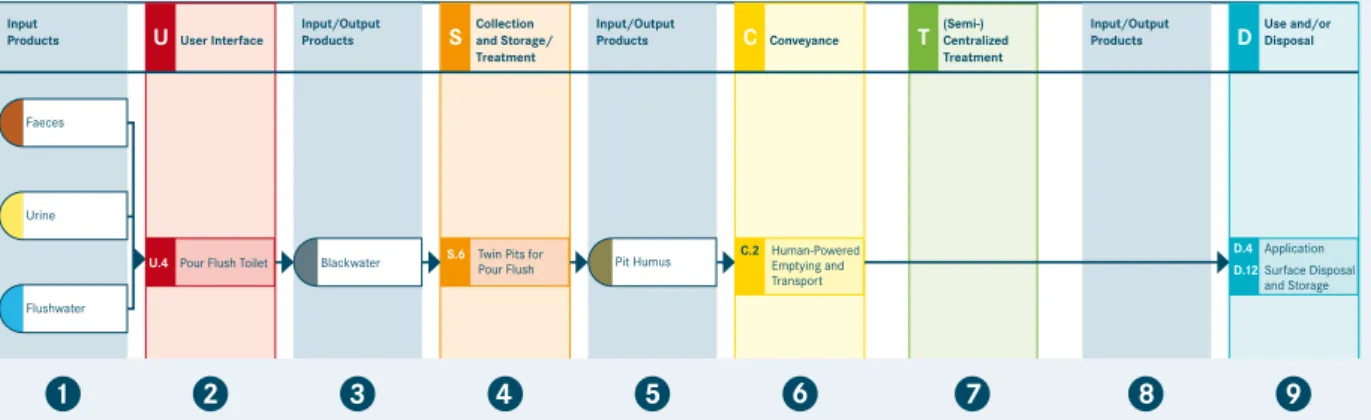
Figure 4 is an example from a system template. It shows how three products (Faeces, Urine and Flush-water) enter a system and are managed using different sanitation technologies. The following text describes how the products move from left to right through
col-umns 1 – 9 of the system template.
1 Three inputs (Faeces, Urine and Flushwater) enter
into 2 functional group U “User Interface” (Pour Flush
Toilet). The Blackwater generated 3 then enters into
4 functional group S “Collection and
Storage/Treat-ment” (Twin Pits for Pour Flush) and is transformed
into 5 Pit Humus through storage and natural
degra-dation. The Pit Humus enters into 6 functional group
C “Conveyance” (Human-Powered Emptying and
Trans-port) and skips over 7 functional group T “(Semi-)
Centralized Treatment“ (as it should be hygienically
safe), and with no further 8 input/output products. It
is directly transported to the final 9 functional group
D “Use and/or Disposal”, where two possibilities exist. Depending on the local conditions, needs and prefer-ences, the Pit Humus can be applied as a soil condi-tioner in agriculture (Application) or brought to a tem-porary storage or final disposal site (Surface Disposal and Storage).
18
Compendium of Sanitation Systems and
Technologies
Using the System
Templates
The nine system templates present the most logical combinations of technologies. However, the tech-nologies and associated links are not exhaustive and planners should not lose a rational engineering perspective when trying to find the best possible solution for a specific context. Designers should attempt to minimize redundancy, optimize existing infrastructure and make use of local resources, while taking into account the local enabling environment (especially, factors such as skills and capacities, socio-cultural acceptance, financial resources and legal requirements).
The following procedure can be used to pre-select potential sanitation options:
1 2 3 4 5 6 7 8 9
1. Identify the products that are locally generated and/ or available (e.g., Anal Cleansing Water, Flushwater or Organics for composting)
2. Identify the system templates that process the defined products
3. For each template, select a technology from each functional group where there is a technology choice presented (box with multiple technologies); the series of technologies make up a system 4. Compare the systems and iteratively change
individ-ual technologies or use a different system template based on user priorities, the demand
for specific end-products (e.g., Compost), economic constraints, and technical feasibility
19
Compendium of Sanitation Systems and
Technologies
Using the System
Templates
It may be useful to divide the planning zone under con-sideration into sub-areas so that each one has, within it, similar characteristics and conditions. The procedure can then be followed for each of the separate sub-areas, and any number of systems can be chosen.
A blank system template can be downloaded from www.sandec.ch/compendium. It can be printed and used to sketch site-specific sanitation systems, for example, when discussing different options with experts or stakeholders in a workshop.
A PowerPoint template is also available for download
Parts of a sanitation system may already exist; in that case it is the goal of the planners and engineers to integrate existing infrastructure or services, yet to maintain flexibility, with user satisfaction as the pri-mary goal.
that has pre-defined graphical elements (such as prod-ucts, technologies and arrows), facilitating the prepara-tion of customized sanitaprepara-tion system drawings. The nine system templates are presented and described on the following pages. Each system tem-plate is explained in detail.
Selection of sanitation options in the CLUES planning approach
In Community-Led Urban Environmental Sanitation Planning (CLUES), the fifth of seven steps is the “Identification of Ser-vice Options”. The CLUES guidelines (see Sector Develop-ment Tools, p. 8) give a detailed description of how the Compendium can be used in par-ticipatory expert and community workshops to select and discuss appropriate sanitation solutions for an area. www.sandec.ch/clues Step
1
Step2
Step3
Step4
Step5
Step6
Step7
Process Ignitionand demand creation
Launch
of the planning process
Detailed Assessment
of the current situation
Implementation
of the Action Plan Development of an
Action Plan Prioritisation of the community problems & validation
Identification of Service Options
Action Cross-cutting Tasks
Ex POSURE & C OMMUNICA TION C AP ACI TY D EVELOPMENT M ONI TORING & E VALU ATION expose community to facilities and pilots train and develop skills develop monitoring plan & assess progress monitoring & evaluation of implemen- tation report report workshop workshop workshop final workshop The fact that a large majority of the world’s population is without access to adequate water, sanitation, drainage and solid waste services, presents strong evidence that conventional approaches to environmental sanitation are unable to make a significant dent in the backlog which exists in most parts of the developing world.
These guidelines present guiding principles for the plan-ning and implementation of environmental sanitation infrastructure and services in disenfranchised urban and peri-urban communities. The planning approach builds on a framework which balances the needs of people with those of the environment to support human dignity and a healthy life. By involving all relevant stakeholders,
particularly the beneficiary community, it aims to consider the entirety of perspectives and expectations. This allows finding the best possible environmental sanitation solu-tion in a common agreement.
In Part 1 the seven steps of the actual planning approach are explained. Part 2 describes why an enabling environ-ment (political, legal, institutional, financial, socio-cultural and knowledge framework) is needed as a precondition for the success of a planning process and how it can be nurtured. Part 3 provides 30 practical tools in digital form which aim to support and streamline the implementation of the process. The toolbox is provided on the enclosed memory key.
Swiss Federal Institute of Aquatic Science and Technology www.eawag.ch
Water Supply and Sanitation Collaborative Council www.wsscc.org
UN-HABITAT www.un-habitat.org
> Overview of the CLUES planning approach
In put/Output Pr oducts In put/Output Pr oducts
Sanitation System 1:
Single Pit System
(Semi-) Centr alized Tr eatment In put/Output Pr oducts Collection and S tor ag e/ Tr eatment Con ve yance User Int er face
Use and/or Disposal
T
D
U
S
C
U .1 Dr y T oile t D.5 Application D .1 2 Sur face Disposal and S tor ag e D. 11 Disposal/ Rec har ge D.6 Irr ig ation D.7 Soak Pit D. 11 Disposal/ Rec har ge C.2 Human-P ow er ed Em ptying and Tr anspor t C.3 Mo tor ized Em ptying and Tr anspor t D.6 Irr ig ation D.9 Fish P ond D. 10 Plant P ond D. 11 Disposal/ Rec har ge C.7 Tr ansf er S tation D .1 Fill and Co ver/ Arbor loo U. 4 Pour Flush T oile t PRE Pre-Treatment T. 13 Sediment ation/ Thic kening T. 14 U nplant ed Dr ying Beds T. 15 Plant ed Dr ying Beds T. 16 Co-Com pos ting T. 17 Biog as R eact or Dr y Cleansing Mat er ial U rine Ex cr et a Faeces Blac kw at er Anal Cleansing Wat er Flushw at er Gr eyw at er Effluent Gr eyw at er T reatment St or m w at er Dr ains St or m w at er T. 1 Se ttler T. 2 Imhof f T ank T. 3 ABR T. 4 Anaer obic F ilt er T. 5 W SP T.6 Aer at ed P ond T. 7 FW S CW T. 8 HSF CW T.9 VF CW T.1 0 T ric kling F ilt er T. 11 U ASB T.1 2 A ctiv at ed Sludg e POST F iltration/Disinf ection Sludg e Effluent S.2 Sing le Pit S.3 Sing le VIP Sludg eCompendium of Sanitation Systems and
Technologies
System 1:
Single Pit System
Compendium of Sanitation Systems and
Technologies
System 1 – Single Pit System
This system is based on the use of a single pit tech-nology to collect and store Excreta. The system can be used with or without Flushwater, depending on the User Interface. Inputs to the system can include Urine, Faeces, Anal Cleansing Water, Flushwater and Dry Cleansing Materials. The use of Flushwater and/or Anal Cleansing Water will depend on water availability and local habit. The User Interface for this system can either be a Dry Toilet (U.1) or a Pour Flush Toilet (U.4). A Urinal (U.3) could additionally be used. The User Inter-face is directly connected to a Single Pit (S.2) or a Sin-gle Ventilated Improved Pit (VIP, S.3) for Collection and Storage/Treatment.
When the pit is full there are several options. If there is space, the pit can be filled with soil and a fruit or ornamental tree can be planted, which will thrive in the nutrient rich environment (D.1), and a new pit built. This is generally only possible when the superstructure is mobile. Alternatively, the faecal Sludge that is generat-ed from the Collection and Storage/Treatment technol-ogy has to be removed and transported for further treat-ment. The Conveyance technologies that can be used include Human-Powered Emptying and Transport (C.2) or Motorized Emptying and Transport (C.3). A vacuum truck can only empty liquid faecal Sludge.
As the untreated faecal Sludge is highly pathogen-ic, human contact and direct agricultural application should be avoided. The Sludge that is removed should be transported to a dedicated faecal Sludge treatment facility (T.13-T.17). In the event that such a facility is not easily accessible, the faecal Sludge can be discharged to a Transfer Station (C.7). From there, it will be trans-ported to the treatment facility by a motorized vehicle (C.3). A technology selection tree for faecal Sludge treatment plants is provided in Strande et al., 2014 (see Sector Development Tools, p. 9). (Semi-) Centralized Treatment technologies (T.1-T.17) produce both Effluent and Sludge, which may require further treatment prior to Use and/or Disposal. For example, Effluent from a faecal Sludge treatment facility could be co-treated with wastewater in Waste Stabilization Ponds (T.5) or Con-structed Wetlands (T.7-T.9).
Options for the Use and/or Disposal of the treated Efflu-ent include Irrigation (D.6), Fish Ponds (D.9), Floating
Plant Ponds (D.10) or discharge to a water body (Water Disposal/Groundwater Recharge, D.11). After adequate treatment, Sludge can either be used in agriculture (D.5) or brought to a Storage/Disposal site (D.12).
Considerations This system should be chosen only
where there is either enough space to continuously dig new pits or when there is an appropriate way to emp-ty, treat and dispose of the faecal Sludge. In dense urban settlements, there may not be sufficient space to access a pit for desludging or to make a new pit. This system is, therefore, best suited to rural and peri-urban areas where the soil is appropriate for digging pits and absorbing the leachate. It is not recommended for areas prone to heavy rains or flooding, which may cause pits to overflow.
Some Greywater in the pit may help degradation, but excessive amounts of Greywater may lead to quick fill-ing of the pit and/or excessive leachfill-ing. All types of Dry Cleansing Materials can be discarded into the pit, although they may shorten the pit life and make it more difficult to empty. Whenever possible, Dry Cleansing Materials should be disposed of separately.
This system is one of the least expensive to construct in terms of capital cost. However, the maintenance costs may be considerable, depending on the frequency and method of pit emptying. If the ground is appropriate and has good absorptive capacity, the pit may be dug very deep (> 5m) and can be used for several years with-out emptying (up to 20 or more years). However, the groundwater level and use should be taken into con-sideration when digging pits in order to avoid contam-inating it. Although different types of pits are common in most parts of the world, a well-designed pit-based system with appropriate transport, treatment and use or disposal is rare.
Guidelines for the safe use of Sludge have been pub-lished by the World Health Organization (WHO) and are referenced on the relevant technology information sheets.
S3: SINGLE PIT VIP
> 30cm
air currents
>11cmvent pipe fly screen
T11: SEDIMENTATION/ THICKENING PONDS 105
thickened sludge
scum supernatant ramp for desludging
grit chamber
screen liquid outlet
baffle
D11: LAND APPLICATION 137
sludge sludge
In put/Output Pr oducts In put/Output Pr oducts
Sanitation System 2:
W
aterless Pit System without Sludg
e Production
In put/Output Pr oducts Collection and S tor ag e/ Tr eatment Con ve yance User Int er faceUse and/or Disposal
D
U
S
C
Faeces Urine Organics Anal Cleansing Wat
er Dr y Cleansing Mat er ial Gr eyw at er St or m w at er (Semi-) Centr alized Tr eatment
T
U .1 Dr y T oile t S.4 Double VIP S.5 Fossa Alt er na S.8 Com pos ting Chamber C.2 Human-P ow er ed Em ptying and Tr anspor t D.4 Application Ex cr et aPit Humus Com
pos t D. 11 Disposal/ Rec har ge D .1 2 Sur face Disposal and S tor ag e D.6 Irr ig ation D.7 Soak Pit D. 11 Disposal/ Rec har ge Effluent Gr eyw at er T reatment St or m w at er Dr ains
Compendium of Sanitation Systems and
Technologies
System 2 –
W
aterless Pit System without Sludge Pr
This system is designed to produce a solid, earth-like material by using alternating pits or a Compost-ing Chamber (S.8). Inputs to the system can include Urine, Faeces, Organics, Anal Cleansing Water, and Dry Cleansing Materials. There is no use of Flushwater. A Dry Toilet (U.1) is the recommended User Interface for this system, although a Urine-Diverting Dry Toilet (UDDT, U.2) or a Urinal (U.3) could also be used if the Urine is highly valued for application. A Dry Toilet does not require water to function and in fact, water should not be put into this system; Anal Cleansing Water should be kept at a minimum or even excluded if possible. The User Interface is directly connected to a Double Ventilated Improved Pit (S.4), Fossa Alterna (S.5) or a Composting Chamber (S.8) for Collection and Storage/ Treatment.
Two alternating pits, as in the Double VIP or Fossa Alter-na, give the material an opportunity to drain, degrade, and transform into Pit Humus (sometimes also called EcoHumus), a nutrient-rich, hygienically improved, humic material which is safe to excavate. When the first pit is full, it is covered and temporarily taken out of service. While the other pit is filling with Excreta (and potentially Organics), the content of the first pit is allowed to rest and degrade. Only when both pits are full is the first pit emptied and put back into service. This cycle can be indefinitely repeated. As the Excreta in the resting pit is draining and degrading for at least one year, the resulting Pit Humus needs to be manually removed using shovels, and vacuum truck access to the pits is not necessary.
A Composting Chamber is not strictly a pit technology, but it can also have alternating chambers and, if proper-ly operated, produces safe, useable Compost. For these reasons it is included in this system template.
The Pit Humus or Compost that is generated from the Collection and Storage/Treatment technology can be removed and transported for Use and/or Disposal man-ually using a Human-Powered Emptying and Transport service (C.2). Since it has undergone significant degra-dation, the humic material is quite safe to handle and use as soil conditioner in agriculture (D.4). If there are concerns about the quality of the Pit Humus or Com-post, it can be further composted in a dedicated
com-posting facility before it is used. If there is no use for the product, it can be temporarily stored or permanent-ly disposed of (D.12).
This system is different from System 1 (Single Pit Sys-tem) regarding the product generated at Collection and Storage/Treatment level. In the previous system, the Sludge required further treatment before it could be used, whereas the Pit Humus and Compost produced in this system are ready for Use and/or Disposal following Collection and Storage/Treatment.
Considerations Because the system is permanent
and can be indefinitely used (as opposed to some Sin-gle Pits, which may be filled and covered), it can be used where space is limited. Additionally, because the product must be manually removed, this system is suit-able for dense areas that cannot be served by trucks for mechanical emptying (C.3). This system is especially appropriate for water-scarce areas and where there is an opportunity to use the humic product as soil con-ditioner. The material that is removed should be in a safe, useable form, although proper personal protection should be used during removal, transport and use. The success of this system depends on proper opera-tion and an extended storage period. If a suitable and continuous source of soil, ash or Organics (leaves, grass clippings, coconut or rice husks, woodchips, etc.) is available, the decomposition process is enhanced and the storage period can be reduced. The required storage time can be minimized if the material in the pit remains well aerated and not too moist. Therefore, the Greywa-ter must be collected and treated separately. Too much moisture in the pit will fill the air voids and deprive the microorganisms of oxygen, which may impair the degra-dation process. Dry Cleansing Materials can usually be collected in the pit or chamber together with the Excre-ta, especially if they are carbon-rich (e.g., toilet paper, newsprint, corncobs, etc.) as this may help degradation and air flow.
Guidelines for the safe use of Excreta have been pub-lished by the World Health Organization (WHO) and are referenced on the relevant technology information sheets.
Compendium of Sanitation Systems and
Technologies
System 2 –
W
aterless Pit System without Sludge Pr
oduction
U1: DRY TOILET
slab
option 1
option 2
System 2:
Waterless Pit System without Sludge Production
S5: FOSSA ALTERNA 1 2 3 max. 1 .50m soil R4: APPLICATION OF COMPOST/ECO-HUMUS
In put/Output Pr oducts In put/Output Pr oducts
Sanitation System 3:
P
our Flush Pit System without Sludg
e Production
In put/Output Pr oducts Collection and S tor ag e/ Tr eatment Con ve yance User Int er faceUse and/or Disposal
D
U
S
C
Dr y Cleansing Mat er ial Urine Anal Cleansing Water
Gr eyw at er St or m w at er Faeces Flushw at er (Semi-) Centr alized Tr eatment
T
D. 11 Disposal/ Rec har ge D.6 Irr ig ation D.7 Soak Pit D. 11 Disposal/ Rec har ge Effluent Gr eyw at er T reatment St or m w at er Dr ains D .1 2 Sur face Disposal and S tor ag e S.6 Twin Pits f or Pour Flush Pit Humus C.2 Human-P ow er ed Em ptying and Tr anspor t U. 4 Pour Flush T oile t Blac kw at er D.4 Application D .1 2 Sur face Disposal and S tor ag eCompendium of Sanitation Systems and
Technologies
System 3 – P
our Flush Pit System without Sludge Pr