All rights reserved
Prospective Study of Bowel Movement, Laxative Use, and Risk of Colorectal
Cancer among Women
Laurent Dukas,1* Walter C. Willett,1-34 Graham A. Coldttz,34 Charles S. Fuchs," Bernard Rosner,38 and Edward L. Giovannucci1-3'4
The authors prospectively examined the association between bowel movement frequency, laxative use, and the risk of colorectal cancer in 84,577 women of the Nurses' Health Study living in the United States, 36-61 years of age and free of cancer in 1982. Between 1984 and 1996, 611 incident cases of colorectal cancer were documented. After controlling for age, body mass index, fiber intake, postmenopausal status and hormone use, physical activity, and use of laxatives, the relative risks associated with having bowel movements every third day or less, compared with those with bowel movements once daily, were 0.94 (95% confidence interval (Cl): 0.69, 1.28) for colorectal cancer, 0.88 (95% Cl: 0.62, 1.26) for colon cancer, and 1.18 (95% Cl: 0.63, 2.20) for rectal cancer. Compared with women who never used laxatives, the muftivariate relative risks associated with weekly to daily laxative use were 1.00 (95% Cl: 0.72, 1.40) for colorectal cancer, 1.09 (95% Cl: 0.76, 1.57) for colon cancer, and 0.68 (95% Cl: 0.29, 1.57) for rectal cancer. These findings do not support an association between infrequent bowel movement, laxative use, and risk of colorectal cancer and indicate that simple questions directed at bowel movement frequency are unlikely to enhance our ability to predict colorectal cancer risk. Am J Epidemiol 2000; 151:958-64.
cathartics; colorectal neoplasms; constipation; prospective studies
It has long been suggested that low bowel move-ment frequency, by increasing concentrations of car-cinogens in the stool and increasing their contact with the gut wall, elevates the risk of colorectal cancer (1-9). In the United States, where colorectal cancer is the third highest cause of cancer mortality (10), 15-20 percent of adults are reported to suffer from constipa-tion, and a similar proportion use laxatives (11-13).
Previous epidemiologic studies, mostly retrospec-tive, have examined bowel movement frequency in relation to the risk of colorectal cancer. These studies tend to show inconsistent results, in part because of the
Received for publication March 24, 1999, and accepted for publi-cation June 25, 1999.
Abbreviations: Cl, confidence interval; RR, relative risk.
1 Department of Nutrition, Harvard School of Public Health, Boston, MA.
2 Geriatric University Clinic, Kantonsspital Basel, Basel, Switzerland.
3Channing Laboratory, Department of Medicine, Brigham and Women's Hospital and Harvard Medical School, Boston, MA.
4 Department of Epidemiology, Harvard School of Public Health, Boston, MA.
5 Division of Medical Oncology, Dana-Farber Cancer Institute, Boston, MA.
6 Department of Biostatistics, Harvard School of Public Health, Boston, MA.
Reprint requests to Dr. Edward Giovannucci, 665 Huntington Ave., Boston, MA 02115 (e-mail: edward.giovannucci©channing. harvard.edu).
complexity in characterizing bowel movements (13—24). The customary medical criterion for constipa-tion is an average stool frequency less than three times per week, but the term constipation remains ambigu-ous and may be used to describe infrequent bowel actions, hard stools, straining, or difficulty in defeca-tion (25-27). The report of no more than two bowel movements per week may be a more reliable and clin-ically important indicator of abnormal bowel function than the subjective complaint of constipation (24, 28-34).
The widespread use of laxatives further complicates the relation between bowel movement frequency and the risk of colorectal cancer. Possibly, the laxatives used to treat constipation, rather than constipation itself, increase the risk of colorectal cancer (34). Some studies indicate a genotoxic potential of some laxa-tives (15, 16). Even though infrequent bowel move-ment and laxative use are widespread, relatively few studies have examined these in relation to colorectal cancer risk, and data from cohort studies are particu-larly sparse. Thus, we investigated prospectively the association between infrequent bowel movements (every third day or less) and the use of laxatives in relation to incidence of colorectal cancer in US women.
MATERIALS AND METHODS Study cohort
In 1976, 121,700 female registered nurses aged 30-55 years were enrolled in the Nurses' Health Study by return of a mailed questionnaire. Every 2 years, follow-up questionnaires have been mailed to the par-ticipants to update information on risk factors and major medical events. Dietary intake data were col-lected in 1980, 1984, 1986, and 1990 by means of self-administered, semiquantitative food-frequency ques-tionnaires (35, 36). A total of 90,611 women provided information about their bowel movement frequency in 1982. Possible answers for bowel movement were more than once daily, daily, every other day, every 3—4 days, every 5-6 days, and once a week or less. In the 1982 questionnaire we also queried participants about the use of laxatives, including softeners, bulk agents, and suppositories. Possible answers were laxative use daily, at least once a week, 1-4 times a month, less than once a month, and never. The reasons for laxative use and type of laxatives were not assessed.
Of the 90,611 women who answered the bowel movement frequency and laxative question in 1982, we excluded 924 women who reported a diagnosis of ulcerative colitis and 5,110 women who reported a cancer diagnosis other than nonmelanoma skin cancer prior to 1984 (n = 84,577). Through 1996, follow-up was completed for 94.7 percent of potential person-years.
Case ascertainment
On each biennial follow-up questionnaire, we asked whether cancer of the colon or rectum had been diag-nosed during the previous 2 years. We also used the National Death Index and the US Postal Service to identify fatalities, and we estimate that more than 98 percent of deaths were ascertained (37). When a study participant (or next of kin for decedents) reported a diagnosis of cancer of the colon or rectum on our follow-up questionnaire, we asked her (or next of kin) for permission to obtain relevant hospital records and pathology reports. A study physician, blinded to the exposure information, reviewed the medical records to extract information on the histologic type, the anatomic location, and the stage of the cancer. Proximal colon cancers were defined as those from the cecum to, and including, the splenic flexure; distal colon cancers were defined as those in the descending and sigmoid colon. Cancers other than adenocarci-noma were excluded.
To minimize any influence of symptoms of colon cancer on the exposures of interest, we considered
cases diagnosed 2 years (1984) or more after exposure assessment (1982). The 12-year follow-up analysis from 1984 to 1996 of 84,439 women included 611 incident cases of colorectal cancer (428 colon cancer,
126 rectal cancer, and 57 site unspecified).
Statistical analysis
Bowel movement frequency and the use of laxative were analyzed as categorical variables according to the questions asked in 1982. Before any exclusions, the relatively few women who reported bowel movements every 5-6 days (n = 870) and once a week or less (n = 282) were combined with those who reported bowel movement every 3-4 days (n = 6,876). To min-imize any influence of symptoms of colorectal cancer on the exposures of interest, we excluded the first 2 years of follow-up and computed person-time of follow-up from the month of return of the 1984 ques-tionnaire to the date of colorectal cancer diagnosis, death from any cause, or May 31, 1996, whichever came first. For bowel movement frequency and laxa-tive use, person-months of follow-up were allocated according to status in 1982. Relative risks estimated by odds ratios and their 95 percent confidence intervals for each category were calculated using the daily cate-gory for bowel movement and the never-use catecate-gory for laxative use as the comparison groups. Trends were tested by using midpoint values of each category of bowel movement frequency or laxative use frequency as a continuous variable in a logistic regression model. The p values for the trends are two sided.
We used pooled logistic regression models to control simultaneously for several potentially confounding vari-ables. This approach has been used in prospective cohort analyses with repeated measures of exposures and has been shown to be asymptotically equivalent to Cox regression analysis if the time intervals are short and the probability of an event is small for each time interval (38). We included in the models covariates that are a pri-ori potential risk factors for colorectal cancer and possi-bly related to bowel movement physiology, including age (in six 5-year categories), body mass index (in quin-tiles), fiber intake (in quinquin-tiles), and nonoccupational physical activity (quintiles of metabolic equivalents per week). We also considered menopausal status and hor-mone replacement use as covariates, because use of postmenopausal hormones is related to lower colorectal cancer risk in this cohort (39) and could influence bowel movement physiology. Because these variables could either be true confounders (independent risk factors) or determinants of bowel movement frequency, we consid-ered models both with and without these factors. In a subanalysis, we checked for a change in the relative risks by adding aspirin intake (yes/no), multivitamin use
(yes/no), alcohol intake (in quintiles), and consumption of red meat (beef/pork/lamb as a main dish in six cate-gories) to the model. Except for age, body mass index, postmenopausal status, and hormone use, which were updated biennially, we used the covariate status as of 1984.
In an additional analysis we excluded women who had undergone endoscopic examination before the study began (n — 12,726), because a difference in the rate of removal of premalignant adenomas by bowel movement frequency or laxative use status could bias results. Our major endpoints were total colorectal, colon, and rectal cancer; we also examined proximal and distal colon cancers separately as etiologic differ-ences could exist by subsite.
RESULTS
During 991,660 person-years of follow-up over a 12-year period (1984 through 1996), we documented
428 cases of colon cancer and 126 cases of rectal can-cer among 84,439 women; 57 cases had unspecified sites. These were included with colon cancers because most cases of colorectal cancer were in the colon, and results with or without these were very similar. Within the study population, 8.6 percent reported infrequent bowel movement (every third day or less), and 27.9 percent reported use of laxatives, 5.3 percent on a weekly to daily basis. Table 1 presents age-standard-ized risk factors for colorectal cancer and other selected factors according to bowel movement and lax-ative use in 1982. Women who reported bowel move-ments more than once daily or daily were slightly older, and women who reported use of laxatives were slightly younger. Compared with women with daily bowel movements, those with infrequent bowel move-ments had lower total energy intake, a lower body mass index, and lower alcohol intake and were more likely to use aspirin and less likely to exercise regu-larly and use multivitamins. Compared with women
TABLE 1. Characteristics* of the study participants according to bowel movement and use of laxatives, Nurses' Health Study questionnaire, 1982
Bowel movement frequency >1/day(n = 8,461) Daily (n = 53,432) Every 2 days (n = 15,378) Every 3 days or less [n = 7,306) Laxative use
Weekly-daily (n= 5,081) Monthly {n = 3,790)
Less than monthly [n = 14,467) Never (n = 61,239)
Bowel movement frequency >1/day(n= 8,461) Daily (n = 53,432) Every 2 days {n = 15,378) Every 3 days or less (n = 7,306) Laxative use
Weekly-daily {n = 5,081) Monthly {n = 3,790)
Less than monthly {n = 14,467) Never (n = 61,239) Age (yoars)t 49.5 49.0 47.5 47.5 48.3 49.4 49.2 50.4 Aspirin Intake (%)§ 28.1 26.0 23.7 22.6 21.7 19.9 22.3 27.0 Body mass index* 26.1 24.5 24.1 24.0 24.1 24.4 24.7 24.6 Use of muttf-vitamins (%)§ 39.5 37.7 35.7 32.7 45.7 41.9 39.2 35.6 Total energy intake (kcal/day) 1,832 1,751 1,715 1,670 1,725 1,734 1,729 1,751 Regular physical activity (%) 41.5 43.6 41.4 37.6 43.3 43.1 42.1 42.5 Alcohol Intake (g/day)§ 7.3 7.2 6.3 5.9 6.7 6.9 6.7 7.1 Use of hormones (%) 10.4 9.5 9.9 11.4 15.0 13.0 11.5 8.7 Protein 71.3 71.5 71.0 70.4 71.9 71.6 71.7 71.1 Current smoking (%) 27.2 28.2 23.2 24.5 25.1 25.5 26.9 27.2
Dietary intake (g/day) Carbo-hydrates 185 185 187 186 186 186 185 186 Famfly history of colorectal cancer(%) 9.1 8.5 8.9 8.4 9.7 8.6 8.7 8.5 FatH 56.2 56.1 56.4 57.3 56.2 56.4 56.4 56.2 Laxative use weekly to dally (%) 4.0 4.2 8.6 16.2 Dietary fiber 16.1 16.4 16.4 16.0 17.0 16.7 16.5 16.3 Bowel movement frequency every 3 days or less (%) 23.2 27.4 12.8 5.3 * Values are means directly standardized according to the age distribution at baseline of the respective cohort in its entirety. Dietary val-ues represent the mean energy-adjusted intake,
t Mean age in 1982 not standardized. $ Weight (kgVheight (mf.
§ Use in 1980.
who never used laxatives, women who used laxatives weekly to daily were more likely to use postmenopausal hormones and multivitamins and less likely to smoke (table 1).
Bowel movement frequency
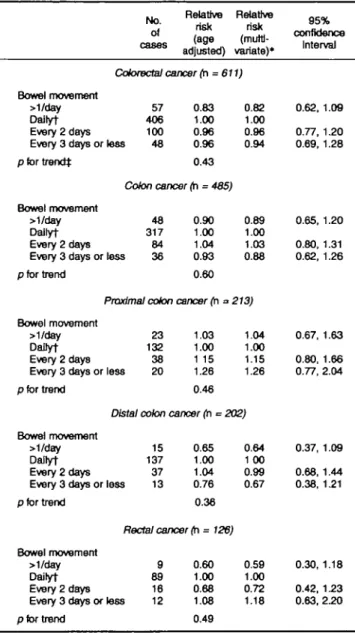
Age was by far the most powerful risk factor for colorectal cancer, but the age-adjusted and multivari-ate relative risks showed similar results. On the basis of the 1982 questionnaire and follow-up from 1984 to 1996, the multivariate relative risks for individuals with infrequent bowel movements, relative to those with daily bowel movements, were 0.94 (95 percent confidence interval (CI): 0.69, 1.28) for all colorectal cancer, 0.88 (95 percent CI: 0.62, 1.26) for colon can-cer only, and 1.18 (95 percent CI: 0.63, 2.20) for rectal cancer only (table 2). Excluding women who had had a colonoscopy or sigmoidoscopy prior to 1984 led to similar results: the multivariate relative risk was 0.88 (95 percent CI: 0.63, 1.23) for all colorectal cancer, 0.79 (95 percent CI: 0.53, 1.17) for colon cancer only, and 1.23 (95% CI: 0.66, 2.30) for rectal cancer only. No trend was evident for any of the endpoints. There were no changes in the relative risks after adding aspirin use, multivitamin use, alcohol intake, and red meat consumption to the model. Among women who reported bowel movement more than once a day, we noted a slight suggestion of a decreased risk for distal colon cancer and rectal cancer, but this was not statis-tically significant (table 2). The subanalysis excluding all women who used laxatives showed similar results as for the whole sample (multivariate relative risk (RR) for colorectal cancer = 0.95, 95 percent CI: 0.60, 1.50 for bowel movements every third day or less).
Laxatives
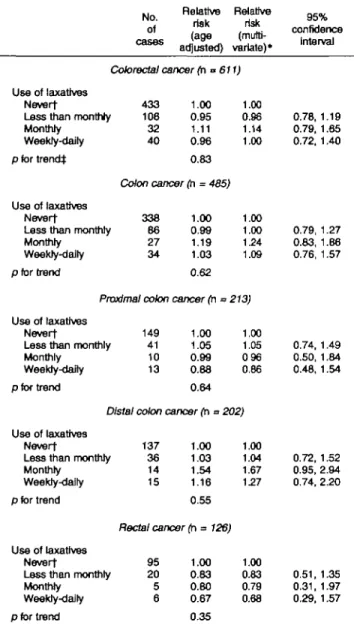
No significant association was seen between laxa-tive use and colorectal cancer risk. The age-adjusted and multivariate odds ratio showed similar results. The multivariate relative risk for women who used laxatives weekly to daily relative to those who never used laxatives was 1.00 (95 percent CI: 0.72, 1.40) for colorectal cancer, 1.09 (95 percent CI: 0.76, 1.57) for colon cancer, and 0.68 (95 percent CI: 0.29, 1.57) for rectal colon cancer. For distal colon cancer, monthly laxative use was associated with an elevated risk (RR = 1.67, 95 percent CI: 0.95, 2.94), but with weekly to daily laxative use this relative risk was attenuated (RR = 1.27, 95 percent CI: 0.74, 2.20) (table 3). No trend was evident. The exclusion of women who reported previous sigmoidoscopy or colonoscopy before 1984 resulted in slightly stronger, yet nonsignificant associations: relative
TABLE 2. Relative risks of colorectal cancer according to bowel movement In a prospective study of women, Nurses' Health Study, 1982-1996 No. of Relative Relative risk risk (age (muttJ-adjusted) variate)* 95% confidence Interval Colorectal cancer (h = 611) Bowel movement >1/day Dailyt Every 2 days Every 3 days or less pfortrendj 57 406 100 48 0.83 1.00 0.96 0.96 0.43 Colon cancer (n = 485) Bowel movement >1/day Dailyt Every 2 days Every 3 days or less p for trend 48 317 84 36 0.90 1.00 1.04 0.93 0.60 0.82 1.00 0.96 0.94 0.89 1.00 1.03 0.88
Proximal colon cancer (h = 213) Bowel movement
>1/day DaDyt Every 2 days Every 3 days or less pfor trend 23 132 38 20 1.03 1.00 1 15 1.26 0.46 1.04 1.00 1.15 1.26
Distal colon cancer (n •= 202) Bowel movement
>1/day DaDyt Every 2 days Every 3 days or less pfor trend 15 137 37 13 0.65 1.00 1.04 0.76 0.36 Rectal cancer (h = 126) Bowel movement >1/day Dailyt Every 2 days Every 3 days or less pfor trend 9 89 16 12 0.60 1.00 0.68 1.08 0.49 0.64 1 00 0.99 0.67 0.59 1.00 0.72 1.18 0.62, 1.0S 0.77, 1.20 0.69, 1.28 0.65, 1.20 0.80, 1.31 0.62, 1.26 0.67, 1.63 0.80, 1.66 0.77, 2.04 0.37, 1.09 0.68, 1.44 0.38, 1.21 0.30, 1.18 0.42, 1.23 0.63, 2.20
* Adjusted for age, body mass Index, fiber intake, physical activity, post-menopausal status and hormone use, and use of laxatives.
t Reference category.
t p for trend calculated by using the median of each category of bowel movement as a continuous variable in the pooled logistic regression model.
risks for daily to weekly users were 1.04 (95 percent CI: 0.72, 1.49) for colorectal cancer, 1.16 (95 percent CI: 0.78, 1.72) for colon cancer, 0.65 (95 percent CI: 0.26, 1.63) for rectal cancer, and 1.30 (95 percent CI: 0.71, 2.39) for distal colon cancer. With laxatives, too, there were no changes in the relative risks after adding aspirin use, multivitamin use, alcohol intake, and red meat consumption to the model.
Thus, for regular laxative users a slight but non-significant association was found for colon cancer. This association was limited to distal colon cancer. We
TABLE 3. Relative risks of colorectal cancer according to 'laxative use In a prospective study of women, Nurses' Health
Study, 1982-1996 No. of cases Relative Relative risk risk (age (mutti-acfjusted) variate)* 95% confidence interval Colorectal cancer (n » Use of laxatives Nevert
Less than monthly Monthly Weekly-daily pfortrendj 433 106 32 40 1.00 0.95 1.11 0.96 0.83 611) 1.00 0.96 1.14 1.00 Colon cancer (n = 485) Use of laxatives Nevert
Less than monthly Monthly Weekly-dally p for trend 338 86 27 34 1.00 0.99 1.19 1.03 0.62 Proximal colon cancer (h Use of laxatives
Nevert
Less than monthly Monthly Weekty-daity p for trend 149 41 10 13 1.00 1.05 0.99 0.88 0.64 Distal colon cancer (h = Use of laxatives
Nevert
Less than monthly Monthly Weekty-daity 137 36 14 15 1.00 1.03 1.54 1.16 1.00 1.00 124 1.09 ^213) 1.00 1.05 096 0.86 '202) 1.00 1.04 1.67 127 0.78, 1.19 0.79, 1.65 0.72, 1.40 0.79, 1.27 0.83, 1.86 0.76, 1.57 0.74, 1.49 0.50, 1.84 0.48, 1.54 0.72, 1.52 0.95, 2.94 0.74, 2.20 p for trend 0.55 Rectal cancer (n = 726; Use of laxatives Nevert
Less than monthly Monthly Weekly-dairy p for trend 95 20 5 6 1.00 0.83 0.80 0.67 0.35 1.00 0.83 0.79 0.68 0.51, 0.31, 0.29, 1.35 1.97 1.57
* Adjusted for age, body mass Index, fiber intake, physical activity, post-menopausal status and hormone use, and bowel movement frequency.
t Reference category.
i p for trend calculated by using the median of each category of intake as a continuous variable in the pooled logistic regression model.
found a slight indication of a decreased risk for rectal cancer for all categories of laxative users, but again this result was not statistically significant.
Infrequent bowel movements and laxative use
In a further subanalysis we classified women simul-taneously by both bowel movement frequency and lax-ative use. In a multivariate analysis, the rellax-ative risk for colorectal cancer for women who had both infre-quent bowel movements and weekly to daily use of laxatives was 0.68 (95 percent CI: 0.31, 1.53)
com-pared with those who had daily bowel movements and never used laxatives.
DISCUSSION
In these prospective data, self-reported frequency of bowel movements was not associated with an increase in the incidence of colorectal cancer. This result was consistent for colon and rectal cancer. Most of the pre-vious data on bowel movement and colorectal cancer risk have been based on case-control studies. A recent meta-analysis has summarized results of 14 published case-control studies and demonstrated a statistically significant increased risk for colorectal cancer with constipation or infrequent bowel movements (pooled odds ratio = 1.48) (17). The findings were stronger for colonic than for rectal cancers. However, the results across the individual studies were relatively inconsis-tent. Another recently published case-control study found a positive association between colon cancer and weekly to monthly constipation (RR = 2.0) and more than weekly constipation (RR = 4.4) (19). The results of the meta-analysis and the case-control study are contrary to our findings. This may be due to the fact that, in the case-control study by Jacobs and White (19) as well as in the case-control studies included in the meta-analysis (17), the assessment of the exposure of interest may not accurately reflect bowel movement frequency, as described below. Furthermore, the possi-bility of biased recall of bowel function by a patient with colorectal cancer cannot be excluded in some of the case-control studies. In an ecologic study of fecal weights and transit times in rural and urban Finnish and Danish populations with markedly different cancer incidence, no difference between the two populations in either fecal weight or intestinal transit time was found (20). The inconsistency of existing data con-cerning low bowel movement frequency and risk of colorectal cancer may be partly explained by the fact that the relevant time period when risk factors act in the process of cancer development is often unknown. Colorectal cancer entails a long process occurring over decades, but most studies have focused on the time period relatively shortly before the diagnosis.
In the above-mentioned meta-analysis (17), a statis-tically significant increased risk of colorectal cancer was seen with the use of laxatives. However, the authors state that, since laxative use was associated with lower odds ratios (pooled odds ratio = 1.46) than for various dietary components, this excess risk could reflect the confounding influence of underlying dietary habits. As for bowel movement, the included studies assessed laxative use in diverse ways and for various durations of use. While some assessed laxative use in general, others considered use of specific
laxa-tives such as anthraquinones and phenolphthalein-containing laxatives. It is likely that different types of laxatives would have varying effects, if any, regarding cancer. An increased risk has been found in two case-control studies for the use of anthraquinone laxatives (RR = 3.04, 95 percent CI: 1.18, 4.90) (21) and for phenolphthalein-containing laxatives (RR = 1.37; nonsignificant) (16). For these two case-control stud-ies, recall bias cannot be excluded. Jacobs et al. also reported a positive association among constipation, laxative use, and colorectal cancer risk. When adjusted for each other, the association for laxative disappeared while the association for constipation remained strong (19), suggesting that laxative use may have been act-ing as a marker of constipation. Three other case-control studies and one retrospective cohort study found no association between laxative use and colorectal cancer (22-24). In general, among the stud-ies that found an association between use of laxatives and the risk of colorectal cancer, the association was stronger for women than for men (18, 23).
We observed little relation between laxative use and risk of colorectal cancer. A weak and not statistically significant direct association was seen between monthly laxative use and distal colon cancer and an inverse association between monthly and weekly to daily laxative use and proximal and rectal cancer. However, considering the low number of cases for these specific cancer sites, the attenuation by greater laxative use for distal colon cancer, the fact that no trend was evident, and that no relative risks were sta-tistically significant, we believe these findings are most probably a result of chance. Furthermore, the weak inverse association between laxative use and some sites of colorectal cancer may be caused by mechanisms other than bowel movement frequency. Laxatives influence intestinal pH and modify the metabolism of the intestinal flora, factors that may modify colorectal cancer risk (40).
The major strengths of our study are its prospective nature, the ability to control for other known or sus-pected risk factors for colorectal cancer, and the rela-tively large size. A limitation of this study is that the questions about bowel movement and the use of laxa-tives were only asked once without updating during ongoing study. Some authors consider bowel move-ment frequency to be the most adequate question to assess bowel transit time (12, 28-34). Others disagree, assuming that people are inaccurate in recalling their bowel frequency; however, the study population observed by these authors comprised patients with irri-table bowel syndrome, a disease where the complaint is mostly loose stools (41-45). In contrast to constipa-tion, bowel movement frequency is clearly defined,
and we consider this the variable that can most feasi-bly assess bowel transit time in larger studies. Although the self-report of bowel movement fre-quency and laxative use could not be directly vali-dated, the nurses have been shown to report highly accurate medically related information for a variety of conditions. The relations between frequency of bowel movement transit time and colorectal cancer may be complex, but from a practical perspective our results indicate that a single assessment of bowel movement frequency is unlikely to be informative regarding sub-sequent risk of colorectal cancer. Another limitation is that we could study only the overall impact of laxative use and not the effects of specific types of laxatives.
In conclusion, these prospective data do not support any substantial risk of colorectal cancer associated with infrequent bowel movement or laxative use. Further studies are needed to determine whether spe-cific types of laxatives and alternative assessment of bowel transit time besides bowel movement frequency influence the risk of colorectal cancer.
ACKNOWLEDGMENTS
The work herein reported was supported by grant CA4O356, the main Nurses' Health Study grant Dr. Dukas was supported by a grant from the Swiss National Science Foundation.
REFERENCES
1. Wynder EL. The epidemiology of large bowel cancer. Cancer Res 1975,35:3388-94.
2. Byers T, Graham S. The epidemiology of diet and cancer. Am J Epidemiol 1980;112:247-52.
3. Hill MJ. Some leads to the etiology of cancer of the large bowel. Surg Ann 1978;10:135-49.
4. Weisburger JH, Reddy BS, Spingaru NE, et al. Current views on the mechanisms involved in the etiology of colorectal can-cer. In: Winawer S, Schottenfeld D, Sherlock P, eds. Colorectal cancer prevention, epidemiology and screening. New York, NY: Raven Press, 1980:19-41.
5. Burkitt DP. Epidemiology of cancer of the colon and rectum. Cancer 1971;28:3-13.
6. Burkitt DP. Colonic-rectal cancer: fiber and other dietary fac-tors. Am J Nutr 1978;31:S58-64.
7. Graham S, Mettlin C. Diet and colon cancer. Am J Epidemiol 1979; 109:1-20.
8. Burkitt DP. Fiber in the etiology of colorectal cancer. In: Winawer S, Schottenfeld D, Sherlock P, eds. Colorectal can-cer prevention, epidemiology and screening. New York, NY: Raven Press, 1980:13-18.
9. Reddy BS, Hedges AR, Lasko K, et al. Metabolic epidemiol-ogy of large bowel cancer. Cancer 1978;42:2832-8.
10. Boring CC, Squires TS, Tong T. Cancer statistics 1992. Cancer J Clinicians 1992,42:19-38.
an apparently well population. Dis Colon Rectum 1986;29: 243-7.
12. Everhart JE, Go VLW, Johannes S, et al. A longitudinal survey of self-reported bowel-habits in the United States. Dig Dis Sci 1989;34:1153-62.
13. Wu AH, Paganini-Hill A, Ross RK, ct al. Alcohol, physical activity and other risk factors for colorectal cancer: a prospec-tive study. Br J Cancer 1987;55:687-94.
14. Kune GA. Laxative use not a risk for colorectal cancer data from the Melbourne Colorectal Study. Z Gastroenterol 1993; 31:140-3.
15. Siegers CP, von Hertzberg-Lottin E, Otte M, et al. Anthranoid laxative abuse—a risk factor for colorectal cancer? Gut 1993; 43:1099-101.
16. Mueller OS, Eckert I, Lutz WK, et al. Genotoxicity of the lax-ative drug component emodin, aloe-emodin, and danthron in mammalian cells: topoisomerase II mediated? Mutat Res 1996;371:165-73.
17. Sonnenberg A, Mueller AD. Constipation and cathartics as risk factors for colorectal cancer a meta-analysis. Pharmacology 1993;47(suppl l):224-33.
18. Vobecky J, Caro J, Devroede G. A case-control study of risk factors for large bowel movement Cancer 1984;54:1475-7. 19. Jacobs EJ, White E. Constipation, laxative use, and colon
can-cer among middle-aged adults. Epidemiology 1998;9:385-91. 20. Jensen OM, MacLennan R, Wahrendorf J. Diet, bowel func-tion, fecal characteristics and large bowel cancer in Denmark and Finland. Nutr Cancer 1982;4:5-19.
21. Siegers CP. Anthranoid laxatives and colorectal cancer. (Review). Trends Pharmacol Sci 1992;13:229-31.
22. Nusko G, Schneider B, Ernst H, et al. Melanosis coli—a harm-less pigmentation or a precancerous condition? Z Gastroenterol 1997;35:313-18.
23. Nusko G, Schneider B, Mueller G, et al. Retrospective study on laxative use and melanosis coli as risk factors for colorec-tal neoplasma. Pharmacology 1993;47(suppl 1):234-41. 24. Kune GA, Kune S, Field B, et al. The role of chronic
consti-pation, diarrhea, and laxative use in the etiology of large-bowel cancer. Data from the Melbourne Colorectal Cancer Study. Dis Colon Rectum 1988;31:507-12.
25. Probert CSJ, Emmet PM, Cripps HA, et al. Evidence of the ambiguity of the term constipation: the role of irritable bowel syndrome. Gut 1984;35:1455-8.
26. Kallman H. Constipation in the elderly. Am Fam Physician 1983;27:179-84.
27. Elliot DL, Watts WJ, Girard DE. Constipation. Mechanism and management of a common clinical problem. Postgrad Med
1983;74:143-9.
28. Milne JS, Williamson J. Bowel habits in older people. Gerontol Clin 1972;14:56-60.
29. Longstreth GF. Bowel patterns and anxiety: demographic fac-tors. J Clin Gastroenterol 1993;16:295-9.
30. Whitehead EW, Drinkwater D, Lawrence JC, et al. Constipation in the elderly living at home. Definition, preva-lence, relationship and health status. J Am Geriatr Soc 1989; 37:423-9.
31. Campbell AJ, Busby WJ, Horvath CC. Factors associated with constipation in a community based sample of people aged 70 years and over. J Epidemiol Community Health 1993;47:23-6. 32. Talley NJ, Weaver AL, Zinsmeister AR, et al. Onset and dis-appearance of gastrointestinal symptoms and functional gas-trointestinal disorders. Am J Epidemiol 1992;136:165—77. 33. Drossman DA, Sandlers RS, McKee DC, et al. Bowel patterns
among subjects not seeking health care. Gastroenterology 1982;83:529-34.
34. Connell AM, Hilton C, Irvine G, et al. Variation of bowel habits in two population samples. Br Med J 1965;2:1095-9. 35. Chute CG, Willett WC, Colditz GA, et al. A prospective study
of body mass, height, and smoking on the risk of colorectal cancer in women. Cancer Causes Control 1991 ;2:117—24. 36. Martinez ME, Giovannucci EL, Colditz GA, et al. Calcium,
vitamin D, and the occurrence of colorectal cancer in women. J. Natl Cancer Inst 1996;88:1375-82.
37. Stampfer MJ, Willett WC, Speizer FE, et al. Test of the National Death Index. Am J Epidemiol 1984; 119:837-9. 38. Cupples LA, D'Agostino RB, Anderson K, et al. Comparison
of baseline and repeated measure covariate techniques in the Framingham Heart Study. Stat Med 1988:7:205-12.
39. Grodstein F, Martinez ME, Platz EA, et al. Postmenopausal hormone use and risk for colorectal cancer and adenoma. Ann Intern Med 1998;128:705-12.
40. Huchzermeyer H, Schumann C. Lactulose—a multifactorial substance. Z Gastroenterol 1997;35:945-55.
41. Devroede G. Dietary fiber, bowel habits, and colonic function. Am J Clin Nutr Suppl 1978;31:157-60.
42. Verhom A, Devroede G, Bouchoucha M, et al. Megarectum. Dig Dis Sci 1988;33:1164-74.
43. Bouchoucha M, Devroede G, Arhan P, et al. What is the mean-ing of colorectal transit time measurement? Dis Colon Rectum 1992;35:773-82.
44. Hutchinson R, Notghi A, Harding LK, et al. Symptoms in the irritable bowel syndrome do not correlate with colonic transit abnormalities. (Abstract). Gut 1993;34(suppl 4):S4.
45. O'Donnell LJD, Vujee J, Heaton KW. Detection of pseudodi-arrhoea by simple clinical assessement of intestinal transit rate. BMJ 1990;300:439-40.