Do Individual and Situational Factors Explain the Link Between Predrinking and Heavier Alcohol
Consumption? An Event-Level Study of Types of Beverage Consumed and Social Context
Florian Labhart1,*, Samantha Wells2,3,4, Kathryn Graham2,3,5,6and Emmanuel Kuntsche1,7
1Addiction Switzerland, Research Institute, Lausanne, Switzerland,2Social and Epidemiological Research Department, Centre for Addiction and Mental Health,
London, ON, Canada,3Dalla Lana School of Public Health, University of Toronto, Toronto, ON, Canada,4Department of Epidemiology & Biostatistics, Western University, London, ON, Canada,5Department of Psychology, Western University, London, ON, Canada,6National Drug Research Institute, Curtin University,
Perth, Australia and7Behavioural Science Institute, Radboud University, Nijmegen, The Netherlands
*Corresponding author: Addiction Switzerland, Lausanne, Switzerland. Tel.: +41-21-321-29-51; Fax: +41-21-321-29-40; E-mail: [email protected]
(Received 11 October 2013; first review notified 8 November 2013; in revised form 20 December 2013; accepted 31 December 2013)
Abstract— Aim: Predrinking (drinking in private settings before going to licensed premises) has been shown to be positively asso-ciated with amount of alcohol consumed. The present study assesses whether this association is explained by general drinking patterns or situational factors, including drinking duration, beverage type and drinking companions. Methods: In a sample of 183 young adults from French-speaking Switzerland, data on alcohol consumption, whereabouts and drinking companions were collected using question-naires sent to participants’ cell phones at five time points from 5 p.m. to midnight every Thursday, Friday and Saturday over five con-secutive weeks. Means and proportion tests and multilevel models were conducted based on 6650 assessments recorded on 1441 evenings. Results: Over the study period, predrinkers drank more frequently than did non-predrinkers and, among males, predrinkers drank more heavily. Predrinking was related to increased drinking duration and thus total consumption in the evenings. Larger groups of people were reported for predrinking compared with off-premise only drinking situations. Among women, the consumption of straight spirits (i.e. not mixed with soft drinks) while predrinking was associated with higher total evening alcohol consumption. Among men, drinking with exclusively male friends or female friends while predrinking was associated with higher consumption. Conclusion: Heavier drinking on predrinking evenings mainly results from longer drinking duration, with individual and situational factors playing a smaller role. Prevention efforts on reducing the time that young adults spend drinking and harm reduction measures such as restriction of access to on-premise establishments once intoxicated are recommended.
INTRODUCTION
Drinking in private settings before attending a social event or activity, called ‘predrinking’, ‘prepartying’, ‘preloading’ or ‘pregaming’ (Pedersen and LaBrie, 2007;Wells et al., 2009;
Foster and Ferguson, 2013), has been intensively discussed as a particular drinking pattern of young people in the inter-national literature. Studies in the USA have revealed that more than two-thirds of college students engaged in predrinking in the previous weeks (Pedersen et al., 2009; DeJong et al., 2010). Research conducted in European countries and Australia has also revealed that a large proportion of young adults engaged in predrinking before going to a licensed premise (Hughes et al., 2008, 2011; Forsyth, 2010; Wahl et al., 2010;Labhart et al., 2013;Miller et al., 2013). In con-trast to the American contexts, which tends to involve ‘preg-aming’ with underage peers prior to a social event, predrinking among young adults in countries where the alcohol purchase age limit is 18 or lower might occur in more diverse contexts, such as having a glass of wine for dinner with family members, several glasses of champagne at birth-day celebrations or large quantities of different drinks at private parties. Still, across countries, predrinking has been found to increase amount of alcohol consumed on drinking occasions as well as the risk of experiencing adverse conse-quences, including alcohol poisoning, drunk driving or black-outs (Foster and Ferguson, 2013).
A central question is whether the association of predrinking with heavy drinking reflects the type of people who engage in this activity or whether it has more to do with situational factors, such as the duration of the drinking episodes (both predrinking and later drinking), the type of beverage con-sumed and the social context. Some evidence suggests that predrinkers are heavier drinkers who drink more often
and in larger quantities per occasion than non-predrinkers (Kenney et al., 2010;Read et al., 2010). For example, in an intercept survey of young people in a restaurant/bar district,
Barry et al. (2013) found that predrinkers had higher scores on the three-item Alcohol Use Disorder Identification Test (AUDIT-C) compared with non-predrinkers.
Evidence also suggests that predrinking involves unique situational circumstances and practices that may affect alcohol intoxication, including the consumption of spirits (e.g. shots or shooters) and fast-paced drinking, often as part of drinking games (Pedersen and LaBrie, 2007; Pedersen et al., 2009;
Kenney et al., 2010;Read et al., 2010). For example, in focus groups conducted by DeJong et al. (2010), participants reported consuming spirits during predrinking for their high alcohol content and ‘rapid-fire’ drinking of shots. Hummer et al. (2013) found that, although equivalent blood alcohol levels (BALs) were found for predrinking compared with non-predrinking events, predrinkers reached these BALs in about half the time.
The number and type of drinking companions are also known to influence alcohol consumption in social settings. Early studies examining the influence of companions on drinking found that group size was positively associated with amount consumed and pace of drinking (Aitken and Jahoda, 1983) and duration of the drinking occasion (Cutler and Storm, 1975;Rosenbluth et al., 1978). Gender composition of the social group may also be linked to predrinking and the drinking behaviors that result. For example, Grazian (2007)
found that young men engaged in male-only predrinking ses-sions to boost their confidence before encountering the oppos-ite sex. Furthermore,Hummer et al. (2013)found that males reached higher BALs when predrinking, especially in male-only groups. Although no research has compared pre-drinking with friends vs. family, research on the context of
Alcohol and Alcoholism Vol. 49, No. 3, pp. 327–335, 2014 doi: 10.1093/alcalc/agu001
Advance Access Publication 30 January 2014
drinking generally suggests that people drink more with friends than with family, especially when drinking in licensed premises (Harford, 1983).
Finally, another explanation for heavier consumption when predrinking might be that predrinking extends the drinking duration, which has consistently been shown to be associated with amount of alcohol consumed (Kessler and Gomberg, 1974;Cutler and Storm, 1975;Aitken and Jahoda, 1983). Both duration and amount consumed may also be related to the fact that predrinking generally involves drinking in multiple loca-tions. For example, in a study of persons arrested for driving while intoxicated, Wieczorek et al. (1992)found that multi-location drinkers had higher BALs at arrest than those who drank at a single location. Also,Wells et al. (2008)found that students who drank at three or more different places were more likely to experience aggression than people who drank at fewer places, which might be explained by higher intoxication levels.
Current evidence regarding the individual and contextual factors associated with predrinking remains limited due to the methods used by previous studies. Those that used retrospect-ive assessments or qualitatretrospect-ive interviews do not provide event-level data and are subject to recall bias due to memory deficits (Ekholm, 2004;Kuntsche and Labhart, 2012). Those that used intercept study designs only capture segments of drinking behaviors related to a specific location on a specific evening. Moreover, none of these methods allowed event-level comparisons of predrinking situations with other drinking situations within the same individuals and over multiple eve-nings. To overcome these limitations, we collected informa-tion on the locainforma-tion of the participants, the social context and alcohol consumption at six time points from 5 p.m. to 11 a.m. over multiple weekend evenings. Because multiple evenings were recorded for the same individuals, the study design enables an event-level intra-individual analysis, with partici-pants serving as their own controls. Although predrinking is sometimes conceptualized as the consumption of alcohol before attending any social event or party, the present study focuses on drinking before going to licensed premises because (a) licensed premises are high-risk locations for heavy drink-ing and alcohol-related harm (Graham and Homel, 2008) and (b) these are common destinations for young adults on party-ing nights in Switzerland.
In a previous analysis of these data, we found that young Swiss young adults drank almost twice as much on nights when they predrank [7.12 drinks (SD = 5.6)] compared with non-predrinking nights [4.31 drinks (SD = 4.4) off-premise only, 4.22 drinks (SD = 3.8) on-premise only; see Labhart et al., 2013]. The aim of the present study is to identify indi-vidual and situational factors associated with heavier alcohol consumption on predrinking evenings. We hypothesized the following.
(1) Predrinkers will be heavier drinkers than non-predrinkers; that is, consistent with previous research (Kenney et al., 2010;Read et al., 2010;Barry et al., 2013), predrinkers will drink more frequently and consume more drinks per occasion than will non-predrinkers.
(2) Because intoxication was identified as a key motivation for predrinking (Pedersen et al., 2009; Wells et al., 2009;DeJong et al., 2010) and spirits are frequently consumed when predrinking (Pedersen and LaBrie,
2007;DeJong et al., 2010;Hughes et al., 2011), partici-pants will be more likely to drink spirits and at a faster pace during predrinking than during off-premise only drinking situations.
(3) Because socializing with friends is a frequently cited reason for predrinking (Pedersen et al., 2009;Wells et al., 2009;LaBrie et al., 2012;Foster and Ferguson, 2013;Zamboanga et al., 2013), participants will be more likely to drink with friends than with family and the number of friends will be larger for predrinking than for off-premise only drinking situations.
(4) Larger amounts of alcohol consumed on predrinking nights will be associated with (a) longer duration of drinking, (b) consumption of spirits when predrinking and (c) predrinking with same-sex friends.
METHOD
Participants’ recruitment and registration
Participants were recruited from three higher education institu-tions with undergraduate and graduate students in the two major cities in French-speaking Switzerland. Students were sent an invitation email with detailed information on the aim and procedure of the study and a link to the study webpage. After participants entered their cell phone number in the regis-tration online form, they were sent a unique validation code by text message (SMS) used to confirm their participation agree-ment and obtain access to a baseline internet questionnaire (for more details on the registration procedure; seeKuntsche and Labhart, 2012).
Study design
The study applied the internet-based cell phone-optimized assessment technique (ICAT:Kuntsche and Labhart, 2013b), a data collection method designed to collect event-level data by means of the participants’ personal cell phones. Every Thursday, Friday and Saturday evenings, participants were sent six SMS (at 8, 9, 10, 11 p.m., midnight and the next morning at 11 a.m.) containing unique hyperlinks giving access to questionnaires from the cell phone browser. The five first questionnaires contained questions about the location, the number and types of alcoholic drinks consumed and the social context during the preceding hour, except for the 8 p.m. ques-tionnaire which covered the period from 5 to 8 p.m. A sixth questionnaire, sent the next morning, included reporting of number of drinks since midnight and experiences of alcohol-related consequences. To reduce recall bias, questionnaires could only be accessed within a 12-h period. The study was conducted between April and July 2010 and approved by the Research Ethics Board of Lausanne University (Canton de Vaud Protocol No. 223/08).
Sample
During the 1-week recruitment period, 276 participants regis-tered and completed the baseline questionnaire. Of these, 24 did not participate in the cell phone data collection. The remaining 252 participants submitted 10,353 assessments over a total of 2412 evenings. To ensure sufficient information
about drinking over the course of each evening, evenings with more than one missing assessment before midnight were removed, resulting in the exclusion of 2286 assessments and 53 participants. In addition, 16 participants who did not report any alcohol consumption during the whole study were excluded. The final dataset includes 183 participants [97 women (53.0%), mean age = 23.1 (SD = 3.1)], who submitted 7828 assessments over 1441 evenings. In instances where as-sessment points were missing (n = 818), data were imputed by means of chained equations using the Stata ICE procedure (Royston, 2005). For a detailed flowchart of the sample selec-tion, see Kuntsche and Labhart (2012). For the present analysis, only the five first assessments for each evening were used, i.e. a total of 6650 submitted and 555 imputed assessments.
Individual-level measures
Gender and age were recorded in the baseline questionnaire. Frequency of alcohol consumption was assessed using the question:‘Thinking back on your drinking over the past year, how often do you have a drink containing alcohol?’ Response options were ‘never’ (coded as 0, for the past 30 days), ‘monthly or less’, ‘two to four times a month’, ‘two to three times a week’, ‘four to six times a week’ and ‘every day’. To create a measure reflecting the number of times a person consumed alcohol within the past 30 days, mid-points of cat-egories were used and multiplied by 4.29 to account for the average number of weeks per month (e.g. two to three times a week = 2.5 * 4.29 weeks per month = 10.7 times in the past 30 days).
Number of drinks per usual occasion was assessed with the question:‘Thinking back on your drinking over the past year, how many drinks containing alcohol do you have on a typical day when you are drinking?’ Response options were ‘1 or 2’ (coded as 1.5),‘3 or 4’ (3.5), ‘5 or 6’ (5.5), ‘7, 8 or 9’ (8) and ‘10 or more’ (11). Examples of beverage-specific glasses con-taining ~10 g of pure ethanol were provided to illustrate usual standard drink sizes.
Frequency of binge drinking was assessed using the ques-tion:‘Thinking back on your drinking over the past year, how often do you have five or more drinks if you are a man—four or more drinks if you are a women—on one single occasion?’ Response options were ‘never’ (coded as 0, for the past 30 days),‘less than monthly’ (0.5), ‘one to three times a month’ (2), ‘one to three times a week’ (8.6) and ‘daily or almost daily’ (25.7).
Drinking pattern during the event-level study was assessed with two variables: the proportion of drinking evenings, calcu-lated by dividing the number of evenings reporting alcohol use by the total number of evenings reported, and the mean number of drinks per drinking evening, calculated by averaging the number of drinks consumed across drinking evenings.
Predrinkers were defined as participants who predrank at least once during the event-level study.
Situation-level measures
Predrinking situations were defined as the consumption of alcohol in an off-premise location before attending an on-premise location. Two dichotomous situational variables related to drink-ing location (i.e. off-premise drinkdrink-ing vs. on-premise drinkdrink-ing situations) and predrinking (i.e. non-predrinking vs. predrinking
situations) were crossed to obtain four types of drinking situa-tions: (a) off-premise only, (b) predrinking (i.e. off-premise drinking prior to going on-premise), (c) on-premise without prior predrinking and (d) on-premise after predrinking. Situational-level measures described below were aggregated into these four drinking situations.
Beverage-specific alcohol consumption. Each assessment asked the following: ‘How many of the following alcoholic drinks did you have between [relevant time frame specified, i.e. 5–8, 8–9, 9–10, 10–11, 11 p.m.–midnight]’: ‘beer’, ‘wine and champagne’, ‘aperitifs and liqueurs’, ‘spirits’, ‘cocktails and self-mixed beverages (e.g. whiskey–coke)’ and ‘premixed drinks’. Response options were ‘0’, ‘1’, ‘2’, ‘3’, ‘4’ and ‘5 or more’ (coded as 5.25). The two latter categories were com-bined to reflect ‘spirit-based mixed drinks.’ Dichotomous variables were created indicating whether or not each type of beverage was consumed and the total number of drinks consumed was calculated by summing all drinks consumed.
Type of companions present. At each assessment, partici-pants were asked how many‘male friends (including romantic partner)’, ‘female friends (including romantic partner)’ and ‘family members’ were with them during the above-mentioned timeframes. Response options were‘0’, ‘1’, ‘2–4’ (coded as 3), ‘5–20’ (12.5) and ‘more than 20’ (23.75). Based on the assess-ments that reported alcohol use, dichotomous variables were created indicating whether or not drinking companions included male friends only, female friends only, male and female friends, and family members. The mean number of persons present was calculated by averaging the number of persons present across the assessments where alcohol consumption was reported.
Drinking duration. At each assessment, participants were asked how much time they spent at the following locations:‘at a home’, ‘travelling (bus, car, on foot)’, ‘outdoors (public park or natural setting)’, ‘at work, in class’, ‘in a restaurant, pub or nightclub’ or ‘in a cultural or sporting venue (cinema, stadium, etc.)’. The two latter locations were considered as on-premise locations and the four others as off-premise locations. The drinking duration was obtained by summing the time spent for the assessments where alcohol consumption was reported.
The number of drinks per hour (i.e. pace of drinking) was obtained by dividing the total number of drinks by the dur-ation of the situdur-ation.
The estimated time of first drink for each drinking situation was estimated as follows: one drink between 8 and 9 p.m. = 8:30 p.m.; two drinks = 8:20; three drinks = 8:15, etc.
Analytic strategy
Owing to known gender differences in alcohol use (Graham et al., 1998; Kuntsche and Labhart, 2013a), analyses were conducted for men and women separately. Additionally, because the location of alcohol consumption was only assessed until midnight, results were computed only for the period between 5 p.m. and midnight.
On the individual level, t-tests and χ2-tests were used to compare predrinkers with non-predrinkers in terms of demo-graphic characteristics, past-year drinking pattern, as well as proportion of drinking evenings and number of drinks per drinking evening throughout the event-level study.
On the situation level, t-tests and χ2-tests were used to compare on-premise vs. off-premise by predrinking vs. non-predrinking situations in terms of type of beverage consumed,
time of first drink, pace of drinking, drinking duration and type of companion present. Standard errors were adjusted to account for the effect of evenings being nested within indivi-duals using the software STATA 11 (StataCorp 2009).
To investigate individual and situational predictors of total number of drinks consumed over the evening, multilevel re-gression models were estimated separately for off- and on-premise drinking situations, and for males and females using the software Mplus 6.1 (Muthén and Muthén, 1998– 2010). Age and usual number of drinks per occasion were included at the individual level. Situation-level variables included: whether predrinking occurred; duration of the drink-ing occasion; pace of drinkdrink-ing; type of beverage consumed; presence of drinking companions. The extent that the relation-ship of contextual factors with total consumption for the evening was modified by whether drinking involved predrink-ing and was assessed by testpredrink-ing the interaction of predrinkpredrink-ing with contextual variables after main effects and individual-level variables had been included in the models. Reported effect sizes were unstandardized regression coefficients (B), standard errors (S.E.) and explained variance (R-square).
RESULTS
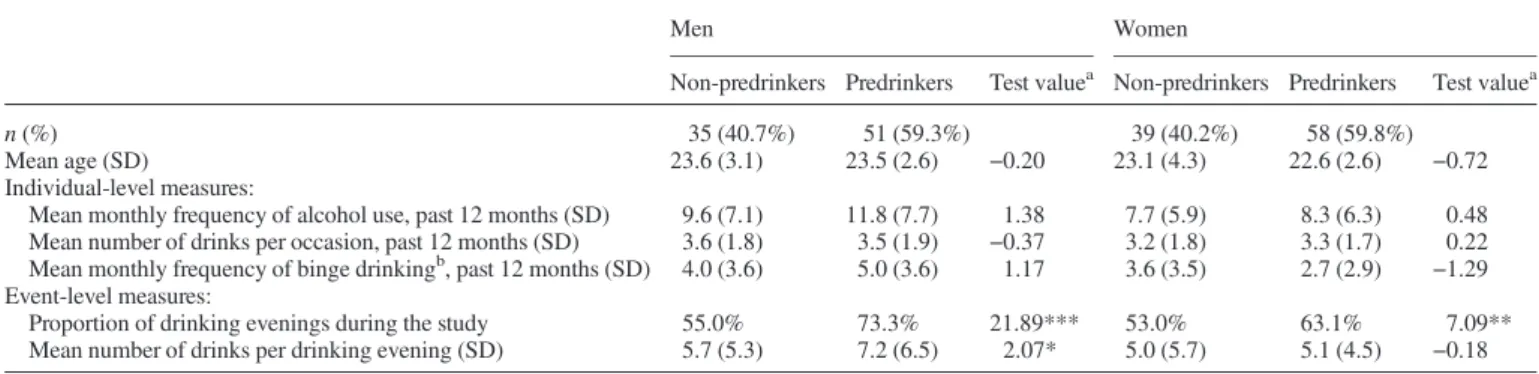
Of the 1441 evenings analyzed, alcohol was consumed on 861 evenings. Of these, there were 189 predrinking evenings (i.e. off-premise drinking prior to going on-premise; 97 among men, 92 among women), 295 on-premise only drinking eve-nings (130 among men, 165 among women) and 349 off-premise only drinking evenings (177 among men, 172 among women). These exclude 28 on-premise evenings where the participant attended a licensed drinking establishment but con-sumed alcohol only after having left it. The majority of partici-pants (59.6%) predrank at least once during the event-level study. As shown in Table 1, past-year drinking pattern vari-ables reported at baseline were not significantly different between predrinkers and non-predrinkers. However, event-level differences were found, with the proportion of drinking evenings being higher for predrinkers compared with non-predrinkers, for both men and women. Additionally, the mean number of drinks per drinking evening was higher for pre-drinking men than for non-prepre-drinking men.
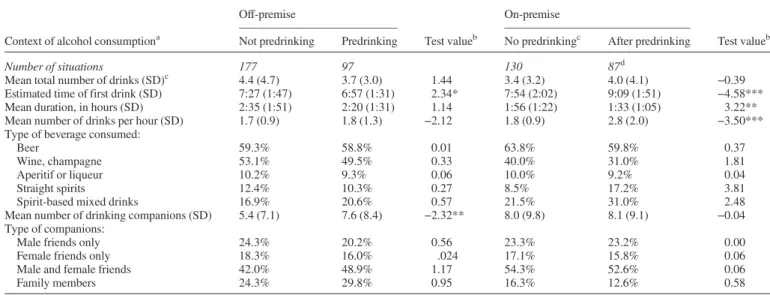
Tables2and3display, for men and women separately, the results of the situation-level comparisons for off-premise and on-premise drinking situations by whether the situation involved predrinking (for off-premise drinking) or followed predrinking (for on-premise drinking). Overall, there were few significant differences between drinking situations with and without predrinking. For both genders, drinking started earlier for predrinking compared with off-premise only drinking situations, while on-premise drinking started later and lasted a shorter period of time when it followed predrinking. For both genders, the number of drinks was no different for predrinking compared with off-premise only drinking situations, while the total number of on-premise drinks was significantly lower for women and similar for men if on-premise drinking followed predrinking than when no predrinking had occurred. Among men, the pace of drinking in on-premise locations was signifi-cantly higher when on-premise drinking followed predrinking than when no predrinking had occurred. In addition, the number of drinking companions was significantly higher for both men and women during predrinking compared with off-premise only drinking situations.
Within on- and off-premise evenings, there were no signifi-cant differences for types of beverages consumed and compa-nions present by whether predrinking occurred. Across drinking contexts, beer was the most frequently consumed beverage by men, followed by wine, and male participants were most commonly joined by male and female friends. Wine was the most frequently consumed beverage by women, except for after predrinking when beer consumption was more likely, and women were most commonly joined by male and female friends.
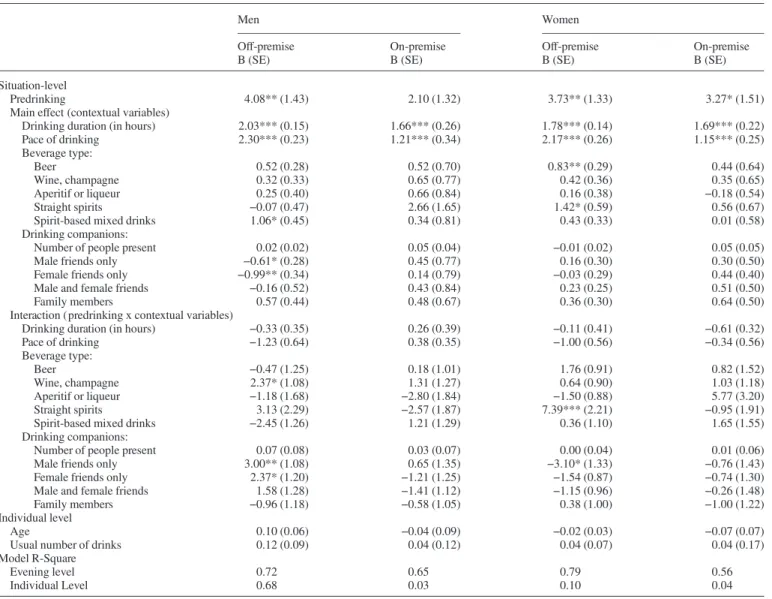
As shown in the regression model (Table4), over and above the effect of contextual variables, predrinking was significant-ly associated with higher consumption over the evening in both off-premise situations (i.e. when predrinking) and on-premise situations (i.e. following predrinking), except that the effect did not meet statistical significance for on-premise drinking by men. Longer drinking duration and faster pace of drinking were also significantly associated with increased con-sumption. In off-premise only drinking situations (i.e. main effect without interaction), consumption of spirit-based mixed drinks by men, and beer and straight spirits (i.e. not mixed with soft drinks) by women were positively related to higher
Table 1. Comparison of predrinkers and non-predrinkers on age, usual drinking pattern and event-level measures of drinking behavior, by gender
Men Women
Non-predrinkers Predrinkers Test valuea Non-predrinkers Predrinkers Test valuea
n (%) 35 (40.7%) 51 (59.3%) 39 (40.2%) 58 (59.8%)
Mean age (SD) 23.6 (3.1) 23.5 (2.6) −0.20 23.1 (4.3) 22.6 (2.6) −0.72
Individual-level measures:
Mean monthly frequency of alcohol use, past 12 months (SD) 9.6 (7.1) 11.8 (7.7) 1.38 7.7 (5.9) 8.3 (6.3) 0.48
Mean number of drinks per occasion, past 12 months (SD) 3.6 (1.8) 3.5 (1.9) −0.37 3.2 (1.8) 3.3 (1.7) 0.22
Mean monthly frequency of binge drinkingb, past 12 months (SD) 4.0 (3.6) 5.0 (3.6) 1.17 3.6 (3.5) 2.7 (2.9) −1.29 Event-level measures:
Proportion of drinking evenings during the study 55.0% 73.3% 21.89*** 53.0% 63.1% 7.09**
Mean number of drinks per drinking evening (SD) 5.7 (5.3) 7.2 (6.5) 2.07* 5.0 (5.7) 5.1 (4.5) −0.18
a
T-tests were used to test for differences between continuous data;χ2-tests were used to test for differences between proportions.
bBinge drinking is defined as five or more drinks for men, four or more drinks for women.
*P < 0.05. **P < 0.01. ***P < 0.001.
total evening consumption. Similarly, off-premise only drink-ing with male friends only and female friends only was nega-tively related to total alcohol consumption by men.
Regarding the interaction of predrinking with the contextual variables, consumption of wine/champagne in predrinking situations (compared with off-premise only drinking) was Table 2. Volume of alcohol consumed from 5 p.m. to midnight, time drinking started, duration of drinking, number of drinks per hour, type of beverage
consumed, and number and gender of drinking companions by location and whether predrinking was involved (men)
Context of alcohol consumptiona
Off-premise On-premise
Not predrinking Predrinking Test valueb No predrinkingc After predrinking Test valueb
Number of situations 177 97 130 87d
Mean total number of drinks (SD)c 4.4 (4.7) 3.7 (3.0) 1.44 3.4 (3.2) 4.0 (4.1) −0.39
Estimated time of first drink (SD) 7:27 (1:47) 6:57 (1:31) 2.34* 7:54 (2:02) 9:09 (1:51) −4.58***
Mean duration, in hours (SD) 2:35 (1:51) 2:20 (1:31) 1.14 1:56 (1:22) 1:33 (1:05) 3.22**
Mean number of drinks per hour (SD) 1.7 (0.9) 1.8 (1.3) −2.12 1.8 (0.9) 2.8 (2.0) −3.50***
Type of beverage consumed:
Beer 59.3% 58.8% 0.01 63.8% 59.8% 0.37
Wine, champagne 53.1% 49.5% 0.33 40.0% 31.0% 1.81
Aperitif or liqueur 10.2% 9.3% 0.06 10.0% 9.2% 0.04
Straight spirits 12.4% 10.3% 0.27 8.5% 17.2% 3.81
Spirit-based mixed drinks 16.9% 20.6% 0.57 21.5% 31.0% 2.48
Mean number of drinking companions (SD) 5.4 (7.1) 7.6 (8.4) −2.32** 8.0 (9.8) 8.1 (9.1) −0.04
Type of companions:
Male friends only 24.3% 20.2% 0.56 23.3% 23.2% 0.00
Female friends only 18.3% 16.0% .024 17.1% 15.8% 0.06
Male and female friends 42.0% 48.9% 1.17 54.3% 52.6% 0.06
Family members 24.3% 29.8% 0.95 16.3% 12.6% 0.58
aLocation of alcohol consumption was assessed until midnight. b
T-tests were used to test for differences between continuous data;χ2-tests were used to test for differences between proportions.
cOnly drinks consumed on-premise until midnight are represented. Additionally, men drank on average 1.2 off-premise drinks in between or after on-premise
attendance (i.e. 4.6 drinks in total; SD = 4.0).
dOn 10 occasions, participants did not drink on-premise alcohol after predrinking.
*P < 0.05. **P < 0.01. ***P < 0.001.
Table 3. Volume of alcohol consumed from 5 p.m. to midnight, time drinking started, duration of drinking, number of drinks per hour, type of beverage consumed, and number and gender of drinking companions by location and whether predrinking was involved (women)
Context of alcohol consumptiona
Off-premise On-premise
Not predrinking Predrinking Test valueb No predrinkingc After predrinking Test valueb
Number of situations 172 92 165 76d
Mean total number of drinks (SD)c 3.6 (3.7) 3.5 (3.8) 0.21 2.6 (2.5) 2.1 (2.0) 2.61*
Estimated time of first drink (SD) 7:40 (1:46) 7:12 (1:32) 2.22* 8:12 (1:44) 9:19 (2:02) −2.86**
Mean duration, in hours (SD) 2:26 (1:37) 2:09 (1:30) 1.41 1:40 (1:16) 1:15 (1:03) 4.04***
Mean number of drinks per hour (SD) 1.5 (0.9)c 1.8 (1.4) −1.47 1.7 (1.0) 2.0 (1.6) 0.02
Type of beverage consumed:
Beer 37.2% 48.9% 3.38 44.8% 47.4% 0.13
Wine, champagne 62.2% 63.0% 0.02 51.5% 44.7% 0.96
Aperitif or liqueur 11.0% 14.1% 0.54 4.2% 9.2% 2.35
Straight spirits 7.6% 4.3% 1.03 9.7% 9.2% 0.01
Spirit-based mixed drinks 17.4% 23.9% 0.31 27.3% 34.2% 1.21
Mean number of drinking companions (SD) 5.9 (7.8) 8.7 (10.6) −2.39* 6.9 (10.3) 9.7 (12.8) −1.93
Type of companions:
Male friends only 16.1% 13.5% 0.30 11.1% 12.5% 0.11
Female friends only 19.0% 18.0% 0.04 20.4% 21.6% 0.05
Male and female friends 42.3% 51.7% 2.08 48.8% 56.8% 1.48
Family members 33.3% 25.8% 1.53 27.8% 20.5% 1.62
a
Location of alcohol consumption was assessed until midnight.
bT-tests were used to test for differences between continuous data;χ2-tests were used to test for differences between proportions. c
Only drinks consumed on-premise until midnight are represented. Additionally, women drank on average 0.8 off-premise drinks in between or after on-premise attendance (i.e. 3.4 drinks in total; SD = 3.5).
d
On 16 occasions, participants did not drink on-premise alcohol after predrinking. *P < 0.05.
**P < 0.01. ***P < 0.001.
associated with higher consumption for men, while among women, consumption of straight spirits during predrinking was even more strongly associated with total consumption [B = 8.81 (1.42 + 7.39)]. In addition, predrinking with male friends only or female friends only was associated with higher consumption among men, whereas there was a negative rela-tionship with overall consumption for women who predrank with male friends only.
DISCUSSION
The present study investigated the extent to which individual and situational factors associated with predrinking could explain the findings that young people drink almost twice as much on predrinking evenings than on other drinking eve-nings (LaBrie and Pedersen, 2008; Barnett et al., 2013;
Labhart et al., 2013).
Our first hypothesis that predrinkers are heavier drinkers than non-predrinkers (Kenney et al., 2010;Barry et al., 2013) was partially confirmed, with predrinkers having more drink-ing evendrink-ings durdrink-ing the 5-week study period and male predrin-kers drinking more per evening than non-predrinpredrin-kers. Among females, however, it appears that predrinkers may drink more frequently but not more per occasion than non-predrinkers. Surprisingly, no difference was found in the past-year drinking pattern measures between predrinkers and non-predrinkers. A possible explanation for significant differences for event-level measures of consumption but not overall consumption is that event-level data are more accurate and reliable (Gmel and Rehm, 2004;Kuntsche and Labhart, 2012). A case in point is the mean number of drinks per drinking evening (event-level measure), which was considerably higher than the mean usual number of drinks per occasion ( past 12 months) for both pre-drinkers and non-prepre-drinkers. Another consideration is statis-tical power, which was greater in the event-level analyses. Table 4. Unstandardized regression weights of multilevel regression model for men and women predicting the total number of drinks consumed until midnight in
off- and on-premise locations by predrinking involvement (yes = 1; no = 0), contextual variables [drinking duration, pace of drinking, types of beverages consumed (yes = 1; no = 0), number of drinking companions, gender and type of companions (yes = 1; no = 0)], and significant interactions of contextual variables
with predrinking
Men Women
Off-premise On-premise Off-premise On-premise
B (SE) B (SE) B (SE) B (SE)
Situation-level
Predrinking 4.08** (1.43) 2.10 (1.32) 3.73** (1.33) 3.27* (1.51)
Main effect (contextual variables)
Drinking duration (in hours) 2.03*** (0.15) 1.66*** (0.26) 1.78*** (0.14) 1.69*** (0.22)
Pace of drinking 2.30*** (0.23) 1.21*** (0.34) 2.17*** (0.26) 1.15*** (0.25) Beverage type: Beer 0.52 (0.28) 0.52 (0.70) 0.83** (0.29) 0.44 (0.64) Wine, champagne 0.32 (0.33) 0.65 (0.77) 0.42 (0.36) 0.35 (0.65) Aperitif or liqueur 0.25 (0.40) 0.66 (0.84) 0.16 (0.38) −0.18 (0.54) Straight spirits −0.07 (0.47) 2.66 (1.65) 1.42* (0.59) 0.56 (0.67)
Spirit-based mixed drinks 1.06* (0.45) 0.34 (0.81) 0.43 (0.33) 0.01 (0.58)
Drinking companions:
Number of people present 0.02 (0.02) 0.05 (0.04) −0.01 (0.02) 0.05 (0.05)
Male friends only −0.61* (0.28) 0.45 (0.77) 0.16 (0.30) 0.30 (0.50)
Female friends only −0.99** (0.34) 0.14 (0.79) −0.03 (0.29) 0.44 (0.40)
Male and female friends −0.16 (0.52) 0.43 (0.84) 0.23 (0.25) 0.51 (0.50)
Family members 0.57 (0.44) 0.48 (0.67) 0.36 (0.30) 0.64 (0.50)
Interaction (predrinking x contextual variables)
Drinking duration (in hours) −0.33 (0.35) 0.26 (0.39) −0.11 (0.41) −0.61 (0.32)
Pace of drinking −1.23 (0.64) 0.38 (0.35) −1.00 (0.56) −0.34 (0.56) Beverage type: Beer −0.47 (1.25) 0.18 (1.01) 1.76 (0.91) 0.82 (1.52) Wine, champagne 2.37* (1.08) 1.31 (1.27) 0.64 (0.90) 1.03 (1.18) Aperitif or liqueur −1.18 (1.68) −2.80 (1.84) −1.50 (0.88) 5.77 (3.20) Straight spirits 3.13 (2.29) −2.57 (1.87) 7.39*** (2.21) −0.95 (1.91)
Spirit-based mixed drinks −2.45 (1.26) 1.21 (1.29) 0.36 (1.10) 1.65 (1.55)
Drinking companions:
Number of people present 0.07 (0.08) 0.03 (0.07) 0.00 (0.04) 0.01 (0.06)
Male friends only 3.00** (1.08) 0.65 (1.35) −3.10* (1.33) −0.76 (1.43)
Female friends only 2.37* (1.20) −1.21 (1.25) −1.54 (0.87) −0.74 (1.30)
Male and female friends 1.58 (1.28) −1.41 (1.12) −1.15 (0.96) −0.26 (1.48)
Family members −0.96 (1.18) −0.58 (1.05) 0.38 (1.00) −1.00 (1.22)
Individual level
Age 0.10 (0.06) −0.04 (0.09) −0.02 (0.03) −0.07 (0.07)
Usual number of drinks 0.12 (0.09) 0.04 (0.12) 0.04 (0.07) 0.04 (0.17)
Model R-Square Evening level 0.72 0.65 0.79 0.56 Individual Level 0.68 0.03 0.10 0.04 *P < 0.05. **P < 0.01. ***P < 0.001.
Regarding situational factors, for both off-premise and on-premise drinking, only a few significant differences were found for evenings that involved predrinking compared with those without predrinking. The finding that drinking events started earlier when they involved predrinking is consistent with previous research, suggesting that young people gather early when predrinking to extend the drinking duration and time spent socializing with friends before going to noisy and crowded bars and clubs (Wells et al., 2009). Although young adults appeared to have more drinks per hour during predrink-ing compared with off-premise only drinkpredrink-ing situations, these differences were not significant. This finding is not consistent with previous assertions that predrinking situations are charac-terized by‘rapid-fire’ drinking (Pedersen et al., 2009;DeJong et al., 2010;Kenney et al., 2010;Read et al., 2010). Given that most previous research on predrinking involved college stu-dents in the USA, conflicting results may reflect differences in cultural drinking patterns between American and Swiss young adults. Interestingly, the present analyses indicated that the pace of drinking was faster for on-premise drinking after pre-drinking (significant only for men) compared with on-premise only drinking. This suggests that predrinking may influence pace in the subsequent drinking venue. However, too little is known about how the sequencing of different drinking places influence drinking across the night; this remains an important topic for future research.
Our hypothesis that spirits would be more prevalent during predrinking than during off-premise only drinking situations (Pedersen and LaBrie, 2007;DeJong et al., 2010) was not con-firmed. Preferred beverages were beer and wine for both genders, a choice that largely reflects Swiss drinking culture, where beer and wine are traditionally used more than spirits in the general population (Gmel and Rylett, 2011) and among young people (Kuntsche et al., 2006). However, as evident from the regression model, consumption of straight spirits (i.e. not mixed with soft drinks) during predrinking was signifi-cantly associated with heavier consumption over the evening among women and tended in that direction for men. Thus, al-though the consumption of straight spirits may not be the norm, its consumption may reflect the intention to drink heavily on a particular occasion among young people in Switzerland, as was reported among US college students (DeJong et al., 2010).
Our hypothesis that predrinking when compared with off-premise only drinking situations would involve a larger number of drinking companions was confirmed, corroborating prior evidence and theory that predrinking serves an important social function (Pedersen et al., 2009; Wells et al., 2009;
LaBrie et al., 2012;Zamboanga et al., 2013). The hypothesis that consumption would be higher when predrinking with same-sex companions was supported for men, corroborating previous evidence that predrinking among male-only groups results in a unique social dynamic characterized by heavy drinking (Grazian, 2007;Hummer et al., 2013). Interestingly, while predrinking with opposite-sex only companions was also positively related to men’s consumption, it was negatively related to women’s consumption. This might reflect that men are predrinking more heavily with ( potential) female partners in order to boost self-confidence and overcome shyness. In contrast, women’s drinking is often affected by anticipated consequences of drinking (Suls and Green, 2003), and drink-ing to intoxication is preferred when in the company of
trustworthy friends (Sheard, 2011). Thus, when predrinking with male-only companions, women might drink less to reduce the risk of negative consequences, such as sexual ag-gression. Another explanation might be that women tend to drink less when they are with their partners. Because these findings were unexpected, further research is needed to confirm the finding and interpret its meaning. Surprisingly, the hypothesis that predrinking would be less likely to occur with family members was not supported. This may be because the study was conducted among young adults in French-speaking Switzerland, an area where moderate alcohol consumption occurs often accompanying meals, as is traditionally found in wine-producing areas (Room, 2001; Kuntsche et al., 2004;
Kuendig et al., 2008). Therefore, young adults having a drink or two with family before going out is common.
Finally, in all drinking situations, duration of drinking was positively associated with amount consumed over the evening. Drinking pace and duration of the drinking occasions were similar for off- and on-premise drinking regardless of whether they involved predrinking. Therefore, increased consumption and drinking duration on predrinking evenings may essentially be due to the accumulation of two or more drinking occasions in different locations within the same evening.
Results of this study contrast with many US studies, in which predrinking is often described as planned heavy drink-ing behavior that involves fast-paced drinkdrink-ing in unsupervised environments. They demonstrate that this definition may not apply to predrinking in the Swiss drinking culture, where, e.g. young adults are likely to continue drinking on-premise, drinking pace is not higher in predrinking than in off-premise only situations and drinking with family members before going out is not unusual. Because the present findings might also apply to other (European) countries with a similar drink-ing culture, more attention to the cultural differences in pre-drinking practices should be given in future research.
Limitations and strengths
A number of limitations should be acknowledged. First, a non-random sample was used which may not be representative of young adults in French-speaking Switzerland. To minimize possible selection bias, participants were recruited from three different types of higher education schools and in two different cities. Second, although mobile internet access was common in Switzerland in 2010, the ICAT procedure may have pre-vented some people from participating. Third, in order to de-crease response burden, the hourly assessments were kept short and conducted only until midnight. Future research might incorporate additional information regarding the characteristics of particular drinking events (e.g. family meal, celebration or party), as well as time and location of the last drink and on contextual changes after midnight. Also, partici-pants reported on their drinking behavior for an average of about 10 out of 15 possible nights, with no information pro-vided for the remaining nights. While it is possible that missing nights were mostly non-drinking occasions, we have no way of testing this and are unable to determine the extent to which the results reported are affected by these missing data; however, there is no reason to believe that the relationship of context with predrinking would be affected by whether some drinking evenings were not reported. Finally, after a couple of drinks, participants may have had difficulty remembering
exactly how many drinks they had consumed during the previous time period. By using short timeframes (i.e. mostly 60 min) and multiple assessments, however, we minimized potential recall bias.
Among the study’s strengths is its complex and unique design, allowing collection of event-level data on many aspects of drinking occasions with minimal recall bias. In addition, recording multiple evenings within the same individuals enables event-level intra-individual analyses, with participants serving as their own controls. Finally, predrinking occasions were identified based on participants’ successive reports over the night. This measure is therefore free of both recall bias and participants’ subjective definitions of predrinking, and takes into account all predrinking occasions, even those that were not planned or during which only a few drinks were consumed.
CONCLUSION
Based on 6650 event-level assessments of 183 individuals fol-lowed over 15 weekend days, these findings lead us to con-clude that, at least within the Swiss drinking culture, both individual and situational factors contribute to higher alcohol consumption on predrinking evenings. In terms of individual factors, predrinkers drank more often and more alcohol per oc-casion during the study than did non-predrinkers. In terms of situational factors, types of beverage consumed and compa-nions present were mostly similar between predrinking and non-predrinking situations. Nevertheless, total alcohol con-sumption on predrinking evenings appeared to be influenced by consumption of straight spirits among women and being with exclusively male friends among men while predrinking. In addition, the present study supports the supposition that pre-drinking adds to the total amount of alcohol in the evening by extending the duration of the drinking period over the evening.
From a public health perspective, our results highlight the importance of focusing prevention efforts on reducing the length of time young people spend drinking, such as earlier closing times at licensed premises, and limiting the accumula-tion of drinking situaaccumula-tions over the course of a single evening. To address predrinking more generally, promising strategies may include promoting self-monitoring, promotion of and com-mitment to low drinking goals and providing normative feed-back, e.g. via dedicated cell phone applications (Grossberg et al., 2010;Cohn et al., 2011). Finally, harm reduction mea-sures including restriction of access to on-premise establish-ments once intoxicated as well as staff training to detect inebriated patrons before they enter the premises and to ensure responsible beverage service (Stockwell, 2001;Toomey et al., 2007) are also likely to prevent intoxication among those who have engaged in predrinking.
Acknowledgements— The authors thank Valentin Vago (www.irata.ch) for his technical assistance during the entire data collection process.
Funding— The study was funded by the Swiss National Science Foundation (grant no. 100014_126643 and 100014_124568/1).
Conflict of interest statement. The authors do not have any conflicts of interest. The study procedure was approved by the ethical committee of Lausanne University (Canton de Vaud Protocol No. 223/08).
REFERENCES
Aitken PP, Jahoda G. (1983) An observational study of young adults’ drinking groups - I. Drink preferences, demographic and structural variables as predictors of alcohol consumption. Alcohol Alcohol 18:135–50.
Barnett NP, Orchowski LM, Read JP et al. (2013) Predictors and con-sequences of pregaming using day- and week-level measure-ments. Psychol Addict Behav 27:921–33.
Barry AE, Stellefson ML, Piazza-Gardner AK et al. (2013) The impact of pregaming on subsequent blood alcohol concentrations: an event-level analysis. Addict Behav 38:2374–77.
Cohn AM, Hunter-Reel D, Hagman BT et al. (2011) Promoting be-havior change from alcohol use through mobile technology: the future of ecological momentary assessment. Alcohol Clin Exp Res 35:2209–15.
Cutler RE, Storm T. (1975) Observational study of alcohol consump-tion in natural settings. The Vancouver beer parlor. J Stud Alcohol 36:1173–83.
DeJong W, DeRicco B, Schneider SK. (2010) Pregaming: an explora-tory study of strategic drinking by college students in Pennsylvania. J Am Coll Health 58:307–16.
Ekholm O. (2004) Influence of the recall period on self-reported alcohol intake. Eur J Clin Nutr 58:60–3.
Forsyth AJM. (2010) Front, side, and back-loading: patrons’ ratio-nales for consuming alcohol purchased off-premises before, during, or after attending nightclubs. J Subst Use 15:31–41. Foster JH, Ferguson C. (2013) Alcohol‘pre-loading’: a review of
the literature. Alcohol Alcohol. http://alcalc.oxfordjournals.org/ content/early/2013/09/17/alcalc.agt135.abstract. (Epub ahead of print).
Gmel G, Rehm J. (2004) Measuring alcohol consumption. Contemp Drug Probl 31:467–540.
Gmel G, Rylett M. (2011) Consumption. In World Health Organization (WHO)s (ed), Global Status Report on Alcohol and Health. Geneva: WHO.
Graham K, Homel R. (2008) Raising the Bar: Preventing Aggression in and Around Bars, Pubs and Clubs. Cullompton Devon, UK: Willan Publishing.
Graham K, Wilsnack R, Dawson D et al. (1998) Should alcohol con-sumption measures be adjusted for gender differences? Addiction 93:1137–47.
Grazian D. (2007) The girl hunt: urban nightlife and the performance of masculinity as collective activity. Symbolic Interact 30:221–43. Grossberg P, Halperin A, Mackenzie S et al. (2010) Inside the physi-cian’s black bag: critical ingredients of brief alcohol interventions. Subst Abuse 31:240–50.
Harford TC. (1983) A contextual analysis of drinking events. Int J Addict 18:825–34.
Hughes K, Anderson Z, Morleo M et al. (2008) Alcohol, nightlife and violence: the relative contributions of drinking before and during nights out to negative health and criminal justice out-comes. Addiction 103:60–5.
Hughes K, Quigg Z, Bellis MA et al. (2011) Drinking behaviours and blood alcohol concentration in four European drinking envir-onments: a cross-sectional study. BMC Public Health 11:918. Hummer JF, Napper LE, Ehret PE et al. (2013) Event-specific risk
and ecological factors associated with prepartying among heavier drinking college students. Addict Behav 38:1620–28.
Kenney SR, Hummer JF, LaBrie JW. (2010) An examination of pre-partying and drinking game playing during high school and their impact on alcohol-related risk upon entrance into college. J Youth Adolesc 39:999–1011.
Kessler M, Gomberg C. (1974) Observations of barroom drinking; methodology and preliminary results. Q J Stud Alcohol 35:1392–96.
Kuendig H, Plant MA, Plant ML et al. (2008) Alcohol-related adverse consequences: cross-cultural variations in attribution process among young adults. Eur J Public Health 18:386–91. Kuntsche E, Labhart F. (2012) Investigating the drinking patterns of
young people over the course of the evening at weekends. Drug Alcohol Depend 124:319–24.
Kuntsche E, Labhart F. (2013a) Drinking motives moderate the impact of pre-drinking on heavy drinking on a given evening and
related adverse consequences-an event-level study. Addicition 108:1747–55.
Kuntsche E, Labhart F. (2013b) ICAT: development of an Internet-based data collection method for ecological momentary assessment using personal cell phones. Eur J Psychol Assess 29:140–48.
Kuntsche E, Rehm J, Gmel G. (2004) Characteristics of binge drin-kers in Europe. Soc Sci Med 59:113–27.
Kuntsche E, Knibbe RA, Gmel G et al. (2006)‘I drink spirits to get drunk and block out my problems...’ beverage preference, drink-ing motives and alcohol use in adolescence. Alcohol Alcohol 41:566–73.
Labhart F, Graham K, Wells S et al. (2013) Drinking before going to licensed premises: an event-level analysis of predrinking, alcohol consumption, and adverse outcomes. Alcohol Clin Exp Res 37:284–91.
LaBrie JW, Pedersen ER. (2008) Prepartying promotes heightened risk in the college environment: an event-level report. Addict Behav 33:955–9.
LaBrie JW, Hummer JF, Pedersen ER et al. (2012) Measuring college students’ motives behind prepartying drinking: develop-ment and validation of the prepartying motivations inventory. Addict Behav 37:962–69.
Miller P, Pennay A, Jenkinson R et al. (2013) Patron Offending and Intoxication in Night-Time Entertainment Districts (POINTED), Monograph Series 46. Canberra: National Drug Law Enforcement Research Fund.
Muthén LK, Muthén BO. (1998–2010) Mplus Users Guide, 6th ed. Los Angeles, CA: Muthén & Muthén.
Pedersen ER, LaBrie JW. (2007) Partying before the party: examin-ing prepartyexamin-ing behavior among college students. J Am Coll Health 56:237–45.
Pedersen ER, LaBrie JW, Kilmer J. (2009) Before you slip into the night, you’ll want something to drink: exploring the reasons for prepartying behavior among college student drinkers. Issues Ment Health Nurs 30:354–63.
Read JP, Merrill JE, Bytschkow K. (2010) Before the party starts: risk factors and reasons for‘pregaming’ in college students. J Am Coll Health 58:461–72.
Room R. (2001) Intoxication and bad behaviour: understanding cultural differences in the link. Soc Sci Med 53:189–98.
Rosenbluth J, Nathan PE, Lawson DM. (1978) Environmental influences on drinking by college students in a college pub: behavioral observation in the natural environment. Addict Behav 3:117–21.
Royston P. (2005) Multiple imputation of missing values: update. Stata J 5:1–14.
Sheard L. (2011) ‘Anything could have happened’: women, the night-time economy, alcohol and drink spiking. Sociology 45:619–33.
StataCorp LP. (2009) Stata: Release 11. Statistical Software. College Station, TX: Stata Press.
Stockwell T. (2001) Responsible alcohol service: lessons from eva-luations of server training and policing initiatives. Drug Alcohol Rev 20:257–65.
Suls J, Green P. (2003) Pluralistic ignorance and college student perceptions of gender-specific alcohol norms. Health Psychol 22:479–86.
Toomey TL, Lenk KM, Wagenaar AC. (2007) Environmental policies to reduce college drinking: an update of research findings. J Stud Alcohol Drugs 68:208–19.
Wahl S, Kriston L, Berner MM. (2010) Drinking before going out— a predictor of negative nightlife experiences in a German inner city area. Int J Drug Policy 21:251–54.
Wells S, Mihic L, Tremblay PF et al. (2008) Where, with whom, and how much alcohol is consumed on drinking events involving ag-gression? Event-level associations in a Canadian national survey of university students. Alcohol Clin Exp Res 32:522–33.
Wells S, Graham K, Purcell J. (2009) Policy implications of the wide-spread practice of‘pre-drinking’ or ‘pre-gaming’ before going to public drinking establishments: are current prevention strategies backfiring? Addiction 104:4–9.
Wieczorek WF, Miller BA, Nochajski TH. (1992) Multiple and single location drinking among DWI offenders referred for alco-holism evaluation. Am J Drug Alcohol Abuse 18:103–16. Zamboanga BL, Casner HG, Olthuis JV et al. (2013) Knowing where
they’re going: destination-specific pregaming behaviors in a multiethnic sample of college students. J Clin Psychol 69:383–96.