Powder diffraction methods for studies
of borohydride-based energy storage materials
Dorthe B. Ravnsbæk*, I, Yaroslav Filinchuk*, II, III, Radovan Cˇerny´*, IVand Torben R. Jensen*, I
I Center for Materials Crystallography (CMC), Interdisciplinary Nanoscience Center (iNANO) and Department of Chemistry, Aarhus University,
Langelandsgade 140, 8000 Arhus C, Denmark
II Swiss-Norwegian Beamlines at ESRF, BP-220, 38043 Grenoble, France
IIIInstitute of Condensed Matter and Nanosciences, Universite´ Catholique de Louvain, Place L. Pasteur 1, 1348 Louvain-la-Neuve, Belgium IVLaboratory of Crystallography, University of Geneva, 1211 Geneva, Switzerland
Received September 13, 2010; accepted October 9, 2010
Powder X-ray diffraction / Hydrogen storage / Borohydrides / Structure analysis / Polymorphism
Abstract. The world today is facing increasing energy demands and a simultaneous demand for cleaner and more environmentally friendly energy technologies. Hydrogen is recognized as a possible renewable energy carrier, but its large-scale utilization is mainly hampered by insufficient hydrogen storage capabilities. In this scenario, powder dif-fraction has a central position as the most informative and versatile technique available in materials science. This is illustrated in the present review by synthesis, physical, chemical and structural characterisation of novel boron based hydrides for hydrogen storage. Numerous novel BH¢
4 based materials have been investigated during the past few years and this class of materials has a fascinating structural chemistry. The experimental methods presented can be applied to a variety of other materials.
Introduction
The sun is the primary energy source for the earth and the energy influx is 8000 times larger than the total human energy consumption (2008 values) (MacKay, 2009). Nat-ure has converted sun-energy to chemical energy (bio-mass) during the past 2 billion years via photosynthesis and, since then, there has been storage of biomass in the crust of the earth. Biomass is slowly, over hundreds of millions of years, converted to carbohydrides, known as fossil fuels. Utilisation of fossil fuels forms the basis for development of the industrialised world, initiated in 1769 by James Watt’s patent of his steam engine. This has lead to an extreme human energy consumption and we have burnt a large fraction of the available fossil fuels during the past only hundred years and will likely burn a major fraction of the remaining reserves during the coming only hundred years. The carbon dioxide level in the atmosphere
has been oscillating between 180 to 280 ppm within the past 420.000 years (Petit et al., 1999), however, the use of fossil fuels undeniably increases CO2 concentrations in the atmosphere and in the surface of the oceans and today we are far off ancient times CO2 levels. Today we are facing CO2 concentrations of 390 ppm, which may in-crease further to 450–550 ppm already in year 2030 and possibly 750 ppm in year 2050 (International Energy Agency, 2008). Notice also, that this is caused by our cu-mulative CO2 production rather than our yearly, increasing CO2 production. This calls for abrupt and significant changes in our way of living rather than reduction in CO2 production by saving energy (MacKay, 2009). Unfortu-nately, there is today a close correlation between energy price and the economical growth and stability in the indus-trialised world, i.e. the western societies are strongly de-pendent on unlimited and cheap energy; fossil fuels.
An obvious carbon-free alternative to fossil fuels is re-newable energy, e.g. from sun-, wind-, water-, wave-, geothermal-energy etc., which can generate either heat or electricity. Electricity, which is the other main energy car-rier today beside carbohydrides, cannot be stored effi-ciently, so production and consumption have to be main-tained in a very delicate balance (Eberle et al., 2009). Renewable energy is unevenly distributed both over time and geographically, therefore it must be stored in an effi-cient way. Further, most countries cannot rely on a single source of renewable energy, but need to combine several contributions, therefore a common energy carrier would facilitate integrations of the energy contributions and hy-drogen is suggested as a possible future energy carrier. In this scenario hydrogen is produced from renewable energy, which can then be stored, transported and utilised at an-other place and time than where it was harvested. Water can be ‘split’ to oxygen and hydrogen either electrochemi-cally from ‘renewable’ electricity or in the future maybe by direct photo catalytic water splitting (Kudo and Miseki, 2008). Hydrogen can then be efficiently converted electro-chemically to electricity, heat and water as the only ex-haust gas, using a fuel cell. Furthermore, hydrogen is non-poisonous and forms (kinetically) stable compounds with
* Correspondence authors (e-mail addresses: [email protected], [email protected], [email protected], [email protected])
oxygen. Hydrogen, the lightest element, has a huge gravi-metric energy density of 120 MJ/kg, approximately 3 times higher than gasoline. On the other hand, the volumetri-cally energy density is low due to low density both in the gas and liquid state of only 0.089 and 71 g/L, at 298 and 21 K, respectively. Therefore, physical storage of hydro-gen as a gas or liquid provide limited energy content and dense storage of hydrogen remain a major obstacle in or-der to create an efficient ‘hydrogen-society’. However, so-lid state hydrogen storage has the potential to reach signif-icantly higher hydrogen storage capacities, which are needed for mobile propulsion.
Historically, the interstitial metal hydrides formed by the heavier d- and f-block metals have received significant interest because they store hydrogen reversibly. Unfortu-nately, the gravimetric hydrogen storage density is too low, e.g. rm(TiFeH2) ¼ 1.86 wt%, see Table 1. Simultaneously, the abundant and cheap metal, magnesium was investigated due to high gravimetric hydrogen storage density of rm(MgH2) ¼ 7.6 wt%. Unfortunately, due to unfavourable thermodynamic properties, DHf ¼ 75 kJ/mol H2, bulk MgH2 must be heated to 600 K in order to release hydrogen at p(H2) ¼ 1 bar. However, significant improvements in ki-netic properties are observed for ball-milled samples of Mg/MgH2 with V2O5 or Nb2O5 (Dornheim et al., 2007) and thermodynamic properties may be changed by alloying the Mg/MgH2 system (Andreasen et al., 2006; Andreasen et al., 2005). This may allow practical utilisation under more moderate conditions. Experimental studies have shown that the thermodynamic properties are more favour-able for nano particles (5 nm) (Paskevicius, Sheppard and Buckley, 2010) and nanoconfinement have been shown to improve the reversibility, stability, kinetics, and possibly also the thermodynamic properties of chemical reactions in-volved in reversible release and uptake of hydrogen (Niel-sen et al., 2009; Niel(Niel-sen et al., 2010).
Bogdanovic´ and Schwickardi, 1997 showed that NaAlH4 can reversible store hydrogen at more moderate conditions by doping with titanium compounds. One of the most frequently used additives is TiCl3 but other d- and f-block metals have similar properties. This observation introduced a paradigm shift within the research field of ‘hydrogen storage materials’. Covalently bonded hydrogen in complex aluminium and boron based hydrides has been revisited during the past decade (Schlesinger and Burg, 1942; Marks and Kolb, 1977) and notably the lighter boro-hydrides have received significant attention during the past few years (Grochala and Edwards, 2004). Table 1
illustrates that borohydrides can have extreme hydrogen contents, but unfortunately, thermodynamic and kinetic properties are insufficient for practical applications. Lithium borohydride, LiBH4 has an extreme gravimetric hydrogen content of rm¼ 18.5 wt%. However, the use of LiBH4as a solid-state hydrogen storage material is hampered by the un-favourable high thermal stability; that is, release of H2 takes place at temperatures above 670 K and, importantly, uptake of H2only occurs under extreme conditions.
Numerous unsolved problems remain on our way to-wards a sustainable, carbon free energy system based on renewable energy and hydrogen as a future energy carrier. Novel materials form the back-bone in most emerging en-ergy related technologies. Here we review the recent pro-gress in synthesis and characterization of structure and re-activity of novel boron based light hydrides achieved with the help of powder diffraction. The use of powder diffrac-tion in materials science is a powerful tool that may essen-tially bring us to a sustainable, carbon free future.
Methods
Mechanochemistry
During the past decades mechanochemistry, such as ball milling has become increasingly important, and the major-ity of novel metal borohydrides are synthesized by this solvent-free method (Suryanarayana, 2001, Balema et al., 2002). Reactant composition and pressure obtained by col-lision between balls and container wall are of major im-portance, in particular for high-energy ball milling, in con-trast to the solution-based techniques, which are mainly temperature ‘driven’ (Hagemann and Cˇerny´, 2010a).
This preparation method yields fine powders, which are often a mixture of several known and unknown com-pounds. Powder X-ray diffraction is a very powerful tool to identify and structurally characterize the reaction path-ways, intermediates and reaction products. A variety of actions can occur and in some cases several competing re-actions are observed simultaneously. Metathesis, or double substitution reaction, is a well known mechanism for che-mical reactions during ball milling, yielding a metal boro-hydride and a metal chloride as a byproduct. However, of-ten bimetallic borohydrides are formed via more complex chemical reactions (Hagemann et al., 2008, Ravnsbæk et al., 2009, Cˇerny´ et al., 2010a, b), possibly by a combi-nation of metathesis and addition reactions, see Eqs. (1) and
M
(g/mol) r(wt%)m r(g HV 2/L)
Tdec
(K) Ref.
TiFeH2 105.73 1.86 101.7 265 Reilly and Wiswall, 1974
MgH2 26.31 7.60 110.0 600 Grochala and Edwards, 2004
LiAlH4 37.95 10.6 74.0 >398 Zu¨ttel et al., 2003
LiBH4 21.75 18.4 124.0 >650 Zu¨ttel et al., 2003
Al(BH4)3 71.51 16.8 118.0 293a Schlesinger et al., 1953
Notice the relation between volumetric (rV), gravimetric (rm) and material densities
(r): rV¼ rm¡ r.
a: Slow decomposition at 293 K.
Table 1. Selected hydrides and their molar weight, M, gravimetric hydrogen content, rm,
volumetric hydrogen content, rv and
(2) (Ravnsbæk et al., 2009).
2 ZnCl2 þ 5 NaBH4 ! NaZn2(BH4)5þ 4 NaCl , (1) ZnCl2þ 3 NaBH4! NaZn(BH4)3þ 2 NaCl. (2) The reactions observed within the Zn-containing systems, involving ZnCl2––MBH4 reactants, illustrate that small de-viations in the composition of reactants may lead to signif-icantly different reaction products and shows that it is cru-cial to perform ball-milling of starting mixtures in several different ratios (Ravnsbæk et al., 2009; Cˇerny´ et al., 2010c). The variation of relative Bragg peak intensities in ball-milled samples with different mixture ratios may pro-vide information about the composition of new com-pounds. A reliable estimate of the composition of new compounds may be a crucial information facilitating struc-tural solution from PXD data (Cˇerny´ et al., 2010c).
Furthermore, mixed-cation mixed-anion borohydrides can be prepared via addition reactions, e.g. ball milling a mixture of ZnCl2––KBH4 (1:1) leads to a phase pure pro-duct, of KZn(BH4)Cl2(Ravnsbæk et al., 2010a).
Side reactions can also take place involving either one of the reactants and the metal chlorides formed as a bypro-duct during formation of the novel borohydrides (see Eqs. (1) and (2). This can lead to formation of ternary metal chlorides by addition reactions, e.g. for the zinc based system ZnX2––MBH4, X ¼ Cl or Br and M ¼ Li, Na or K (Ravnsbæk et al., 2009).
ZnX2 þ 2MX ! M2ZnX4. (3)
The reaction shown in Eq. (3) has increasing dominance for heavier elements: Na, K > Li, Br > Cl, but Eq. (3) is only weakly coupled with the formation of the borohy-drides. In other words, reaction Eqs. (1) and (2) are faster than reaction Eq. (3). This is in contrast to the system ScCl3––MBH4, M ¼ Na or K, which yields MSc(BH4)4 without any detectable diffraction from MCl, owing to a fast formation of M3ScCl6 via an addition reaction similar to eq. 3 (Cˇerny´ et al., 2010a, b). These observations sug-gest that the formation of M3ScCl6is much faster than the formation of MSc(BH4)4 and the overall reaction for the ScCl3––NaBH4 1:2 ratio is described in Eq. (4), which leads to the maximal borohydride yield of 22 wt%.
2 ScCl3 þ 4 NaBH4! NaSc(BH4)4þ Na3ScCl6. (4) Ball milling can also facilitate formation of solid solutions as well known for alloying of metals, e.g. lithium borohy-dride may dissolve 10% lithium chloride as described in Eq. (5) (Arnbjerg et al., 2009).
xLiCl þ (1 ¢ x)LiBH4! Li(BH4)1¢xClx. (5) This type of reaction can also take place for other alkali borohydrides, e.g. NaBH4––NaCl (Ravnsbæk et al., 2010d). In situ synchrotron radiation powder
X-ray diffraction (SR-PXD)
The analysis of the ball-milled products is typically done by powder X-ray diffraction (PXD), in conjunction with spectroscopic methods like Raman, infrared and NMR spectroscopy as well as thermal desorption studies. For the
metal borohydrides hydrogen desorption reactions are typi-cally associated with significant changes in both composi-tion and structure. Furthermore, solid crystalline materials are involved in reactions during hydrogen release and up-take from most known solid hydrides. Therefore, even though hydrogen has the lowest X-ray scattering power of any element, one can clearly observe hydrogen absorption and desorption as structural changes (Hauback, 2008; Gray, Cookson and Blach, 2006; Orimo et al., 2007).
In order to collect PXD diffraction data as a function of the thermal decomposition it is necessary to perform in situ time- and temperature-resolved experiments. X-ray scatter-ing typically requires a shorter data acquisition time com-pared to neutron diffraction and is therefore more amenable both to study fast reactions involving metastable com-pounds and intermediate decomposition products and also for kinetic studies of hydrogen absorption and desorption. Thin-walled glass capillaries commonly used as sample holders give a relatively high amorphous background and react with some borohydrides at elevated temperatures. Sin-gle-crystal sapphire capillaries are an option to remove both undesired effects. Strong diffraction spots from the sapphire should be masked when using 2D detectors.
We have developed sample cells for in situ diffraction studies under variable gas pressure and temperature. One cell is based on a single-crystal sapphire (Al2O3) capillary, which allows for measurements under gas pressure of up to 300 bar. Since the gas pressure is simultaneously applied to both ends of the sample, it allows fast change of pres-sure by 3–4 orders of magnitude within a few seconds. The temperature is measured by a thermocouple, placed inside the sapphire capillary ca. 1 mm from the sample and the sample cell can be operated at extreme temperatures, in principle up to the melting point of Al2O3 at 2053 K (Chupas et al., 2008, Jensen et al., 2010).
Another cell employs standard commercial thin-walled glass or quartz capillaries and is used at lower pressures up to 100 bar and typically in the temperature range 80 to 500 K, in principle up to the melting point of SiO2at 1920 K (Clau-sen et al., 1991; Norby et al., 1997; Jen(Clau-sen et al., 2010). Both sample cells are fast and easy to use, can be handled under inert conditions in a glove box and allow collecting high quality powder and single-crystal diffraction data.
There are a few specific recommendations for collect-ing diffraction data on light hydrides under high pressure. Most interesting transitions occur at moderate pressure of less than 20 GPa. This allows use of large holes in gas-kets, thus illuminating by the X-ray beam a large sample volume and collecting data suitable for structure solution. Also in this pressure range borohydrides provide relatively good hydrostatic conditions without any pressure transmit-ting medium. Substances composed of the light elements give a weak diffraction signal and therefore a lower than usual signal-to-background ratio. The signal is even weak-er for small samples contained in a diamond anvil cell (DAC). Area detectors accumulate extremely high total intensity, thus reducing impact of statistical noise and pro-viding a good time resolution. However, a long exposure time of >10 min. may be necessary to obtain good statis-tics for the high-angle peaks. For that, the low-background image plate detectors have an advantage over the CCDs.
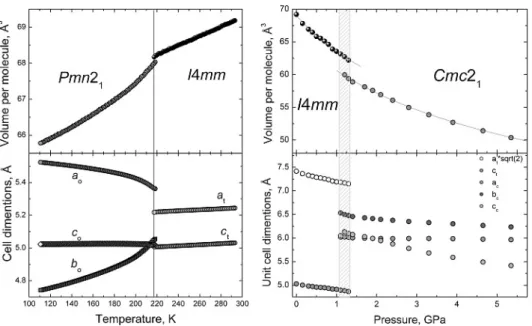
A combined use of the temperature- and pressure-in-duced evolution of crystal structures and their polymorphic transformations is a way to reveal the interactions responsi-ble in particular for the hydrogen storage properties. A power of the in-situ powder diffraction at a synchrotron source can be illustrated by an example of ammonia bor-ane, NH3BH3, a compound containing 19.5 wt% of hydro-gen (Fig. 1). High data quality allowed for solving the crystal structure, identify the structural distortions and pro-pose a generic p-T phase diagram (Filinchuk et al., 2009a). Ab-initio structure determination
The diffraction methods for structural characterization of metal hydrides have recently been reviewed by Cˇerny´, 2008. In the case of lightweight hydrides, hydrogen be-comes a non-negligible X-ray scatterer, i.e. for LiBH4 hy-drogen atoms have been located unambiguously by PXD alone (Soulie´ et al., 2002). Although the precision of the metal-hydrogen bond lengths obtained from PXD data are lower than usually attained by neutron diffraction. The po-sitions of H-atoms determined from X-ray diffraction data must be displaced from B-atom along the B––H bond by 0.08 A due to the displacement of the electron cloud, and by 0.034–0.10 A due to the libration motion of BH4 groups, which is both temperature and structure dependent (Filinchuk et al., 2008a). The synchrotron X-ray diffraction is nowadays routinely used to study light metal borohy-drides (Filinchuk et al., 2010a), typically using an area detector and a Debye–Scherrer geometry. The advantage of this setup is the simple sample environment and fast data collection, which allows in-situ studies, high data col-lection rates, excellent time resolution, highly accurate measurements of diffracted intensities (good powder aver-age), and a lower sensitivity to preferred orientation ef-fects. A combination of high counting rates with excellent reciprocal space resolution provided by curved solid state detectors (Mozzanica et al., 2009) allows even more com-plex structures to be studied in-situ.
The bottle-neck of the ab-initio structural studies of new compounds is indexing of the powder pattern, which
is extremely challenging for multiphase samples prepared by ball milling. A successful strategy consists of the so-called ‘decomposition-aided indexing’, which utilizes in-situ diffraction as a function of the temperature (T-ramp-ing) up to the decomposition temperature of different phases. This procedure allows to separate diffraction peaks of individual phases illustrated in Fig. 2 by SR-PXD for a ball milled KBH4––ScCl3 mixtures (Cˇerny´ et al., 2010b). In this system a ball-milled sample contains two new phases, KSc(BH4)4, K3ScCl6 and non-reacted KBH4. Only T-ramping has allowed the assignment of observed peaks to individual phases, and led to a successful indexing of powder patterns. Useful guidelines for successful indexing can be found in (David and Shankland, 2008, Cˇerny´ and Favre-Nicolin, 2007).
Fig. 1. Variation of the molecular vol-ume and unit cell dimensions of am-monia borane, NH3BH3, as a function
of temperature and pressure (Filinchuk et al., 2009a). The circles represent ex-perimental data, and the lines are the best fits to the Murnaghan equation of state (right panel).
Fig. 2. In situ synchrotron radiation X-ray powder diffraction data for a ball milled sample of KBH4––ScCl3(2:1) (RT to 580 K, DT/Dt ¼ 5 K/min,
l ¼ 0.9707 A). Only utilization of T-ramping allowed for determination of attribution of observed peaks to individual phases, KSc(BH4)4and
K3ScCl6, and led to a successful indexing of powder patterns (Cˇerny´
Space group determination can be another critical point: “While observing lattice-centering extinctions is usually re-latively easy, the determination of the correct space group symmetry elements is generally more challenging” (David and Shankland, 2008). This is even more valid for poorly crystallized hydrides with broad peaks and strong pseudo-symmetry, which is difficult to detect in the X-ray pattern due to weak X-ray scattering power of hydrogen.
Crystal structures of light metal hydrides may be solved either by reciprocal or direct space methods (Cˇerny´, 2008). An excellent example is Mg(BH4)2, which is a complex structure solved independently by both methods (Cˇerny´ et al., 2007; Her et al., 2007). The most popular direct space program in the “hydride world” is Fox (Favre-Nicoline and Cˇerny´, 2002). The complexity of the structures solved by this program ranges from 2 to 55 in-dependent atoms. Guidelines for efficient use of Fox can be found in Cˇerny´ and Favre-Nicolin, 2007.
Refinement of the final structural model against powder data is done by the Rietveld method. For details of the method and for guidelines, see McCusker et al., 1999. Two programs are often used: FullProf (Rodrı´guez-Carvajal, 1993) and TOPAS (Coelho, 2004). Both allow for joint refinement of several powder patterns, rigid body model-ing, anisotropic line broadening modeling (even if not of-ten observed in borohydrides) and so-called sequential re-finement, i.e. refinement of many powder patterns as a function of temperature, pressure etc.
Typically the structures of borohydrides are solved and refined with the BH4 groups as semi-rigid ideal tetrahedra with one common refined B––H distance. For the BH4 groups situated on a symmetry element the BH4tetrahedra are allowed only to translate and to rotate following the operations of the symmetry element. The anti-bump dis-tance restraints are usually needed to stabilize the refine-ment. However, examples of restraint-free refinement are known (Cˇerny´ et al., 2010a). The displacement parameters are refined isotropically. For rigid body refinement the un-certainties of crystallographic coordinates of hydrogen atoms are usually not available from the least squares ma-trix, and can be estimated by the bootstrap method (Efron and Tibshirani, 1986). The high values of c2often observed reflect mainly the extremely high counting statistics of the powder diffraction data obtained from modern solid state detectors.
High-pressure phases may show a pronounced preferred orientation of crystallites with respect to the compression direction, as observed e.g. for the cubic and tetragonal phases of NaBH4(Filinchuk et al., 2007; Chernyshov et al., 2008) and in case of the strong texture it may prevent sol-ving a crystal structure. Therefore it might be essential to model the texture by including one parameter in the global optimization by direct space methods and testing plausible directions of the preferred orientation. For more details spe-cific to the treatment of the high-pressure diffraction data on metal hydrides see Filinchuk, 2010.
A post-experimental DFT-optimization helps to validate new structures, locate light hydrogen atoms, especially when using high-pressure diffraction data (Filinchuk et al., 2008c; Filinchuk et al., 2009a), and even correct the sym-metry and some structural details (Dai et al., 2008,
Fi-linchuk et al., 2009b; Lindemann et al., 2010). In some cases it allows to achieve a global minimum in a Rietveld refinement and thus can be highly recommended for the systems containing so light elements as hydrogen.
Mono- and bimetallic borohydrides
and anion-substituted derivatives
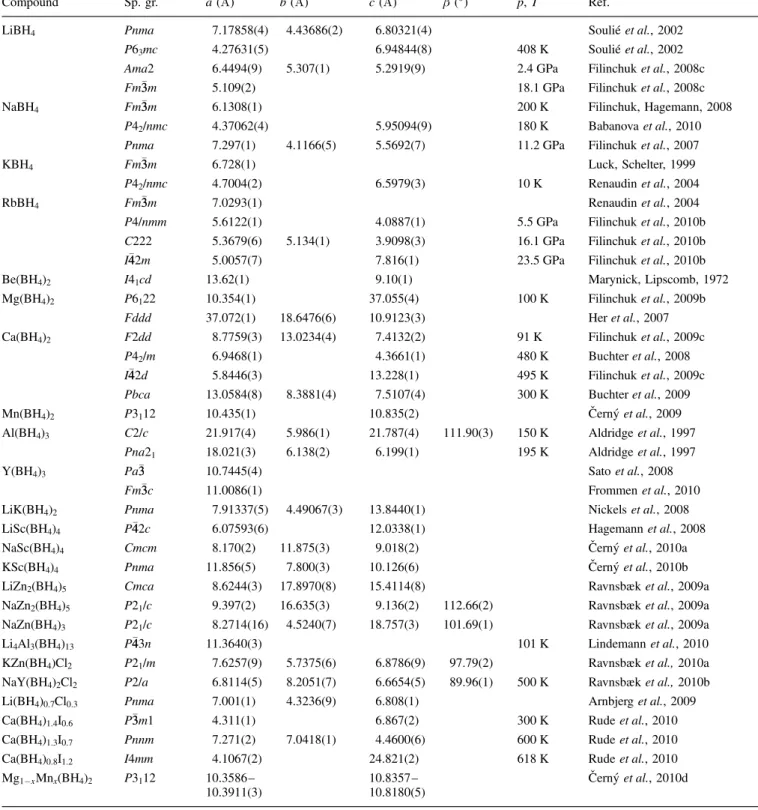
The past few years have seen a significant increase in the number of new borohydrides and of experimental and the-oretical studies on their structural and solid-state chemis-try. The investigations have been summarized in several recent reviews on crystal structures (Filinchuk et al., 2008b; Filinchuk et al., 2010a), physical properties (Orimo et al., 2007; Sundqvist and Andersson, 2009) and phase relations at different p-T conditions (Sundqvist, 2009). In this chapter we review the experimentally determined crys-tal structures of mecrys-tal borohydrides, summarized by their crystallographic characteristics in Table 2, with a reference to the most accurate structural study. Most structures were determined and polymorphic transformation detected by synchrotron X-ray powder diffraction.
The alkali metal borohydrides exhibit dominantly ionic character in the M-BH4 coordination, mainly due to low electronegativity of the metal leading to an almost com-plete charge transfer from the metal to the BH4 group. However, the intensive structural studies during the past couple of years of borohydrides based on the alkaline earth and transition metals have revealed directionality and some degree of covalency in the M-BH4 interaction. This observation may be attributed to higher electronegativity, causing smaller charge transfer from the metal atom to the BH4 group and associated destabilization of this unit. Thus, the metal borohydrides can roughly be subdivided into two groups: one with the more stable compounds with predominantly ionic character and another group of the less stable compounds exhibiting strong directionality and partly covalency in the M-BH4bonding.
Furthermore, a number of borohydride compounds con-taining halide anions have been investigated, e.g. mixed-ca-tion mixed-anion borohydrides or solid solumixed-ca-tions of alkali borohydride-alkali halide systems. These materials are trea-ted as a separate class of derivatives of metal borohydrides. Borohydrides with dominantly ionic M-BH4bonding LiBH4. Four phases of LiBH4 are known: two at ambient (Fig. 3a, b) and two at high pressure (Fig. 3c, d). Struc-tures of the ambient pressure polymorphs were studied using synchrotron powder diffraction by Soulie´ et al., 2002. The low-temperature Pnma structure transforms into the wurtzite-like high-temperature phase at 380 K. More detailed studies by neutron powder diffraction on the iso-tropically substituted 7Li11BD
4 (Hartman et al., 2007) and by synchrotron diffraction on single crystals and powders (Filinchuk et al., 2008a) show that the BH4 groups in these two phases have a nearly ideal tetrahedral geometry and reveal large and anisotropic displacements for hydro-gen atoms in the P63mc phase (Fig. 3b). An entropy con-tribution from the disorder is considered as a factor
stabi-lizing the hexagonal structure (Filinchuk et al., 2008a), which shows superionic conductivity (Matsuo et al., 2007). At room temperature and 1.2–10 GPa pressures, a phase with a pseudo-tetragonal Ama2 structure containing the BH4 group in a novel square-planar coordination by four Li atoms forms (Filinchuk et al., 2008c). Above 10 GPa another LiBH4 phase appears (Filinchuk et al., 2008c), isostructural to the cubic NaBH4.
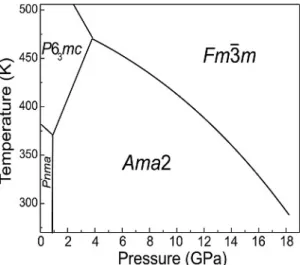
Combination of volumetric (Pistorius, 1974) and syn-chrotron X-ray powder diffraction (Dmitriev et al., 2008)
studies were used to map the p-T diagram (Fig. 4) and follow structural evolution of the polymorphs. Existence of cation-anion layers in all four LiBH4 phases are sug-gested from the phenomenological analysis of mechanisms of phase transitions (Dmitriev et al., 2008). It has been shown that the order parameter in LiBH4 can be parame-terized as a shift of layers formed by Li and BH4, together with in-layer deformations. Cation-anion layers can easily be identified in the hexagonal phase, with three short Li––B contacts in the basal plane and a long one parallel
Table 2. Known phases of metal borohydrides and their crystallographic characteristics. Ambient pressure and temperature is assumed if not otherwise specified.
Compound Sp. gr. a (A) b (A) c (A) b () p, T Ref.
LiBH4 Pnma 7.17858(4) 4.43686(2) 6.80321(4) Soulie´ et al., 2002
P63mc 4.27631(5) 6.94844(8) 408 K Soulie´ et al., 2002
Ama2 6.4494(9) 5.307(1) 5.2919(9) 2.4 GPa Filinchuk et al., 2008c Fm33m 5.109(2) 18.1 GPa Filinchuk et al., 2008c
NaBH4 Fm33m 6.1308(1) 200 K Filinchuk, Hagemann, 2008
P42/nmc 4.37062(4) 5.95094(9) 180 K Babanova et al., 2010
Pnma 7.297(1) 4.1166(5) 5.5692(7) 11.2 GPa Filinchuk et al., 2007
KBH4 Fm33m 6.728(1) Luck, Schelter, 1999
P42/nmc 4.7004(2) 6.5979(3) 10 K Renaudin et al., 2004
RbBH4 Fm33m 7.0293(1) Renaudin et al., 2004
P4/nmm 5.6122(1) 4.0887(1) 5.5 GPa Filinchuk et al., 2010b C222 5.3679(6) 5.134(1) 3.9098(3) 16.1 GPa Filinchuk et al., 2010b I442m 5.0057(7) 7.816(1) 23.5 GPa Filinchuk et al., 2010b Be(BH4)2 I41cd 13.62(1) 9.10(1) Marynick, Lipscomb, 1972
Mg(BH4)2 P6122 10.354(1) 37.055(4) 100 K Filinchuk et al., 2009b
Fddd 37.072(1) 18.6476(6) 10.9123(3) Her et al., 2007 Ca(BH4)2 F2dd 8.7759(3) 13.0234(4) 7.4132(2) 91 K Filinchuk et al., 2009c
P42/m 6.9468(1) 4.3661(1) 480 K Buchter et al., 2008
I442d 5.8446(3) 13.228(1) 495 K Filinchuk et al., 2009c Pbca 13.0584(8) 8.3881(4) 7.5107(4) 300 K Buchter et al., 2009 Mn(BH4)2 P3112 10.435(1) 10.835(2) Cˇerny´ et al., 2009
Al(BH4)3 C2/c 21.917(4) 5.986(1) 21.787(4) 111.90(3) 150 K Aldridge et al., 1997
Pna21 18.021(3) 6.138(2) 6.199(1) 195 K Aldridge et al., 1997
Y(BH4)3 Pa33 10.7445(4) Sato et al., 2008
Fm33c 11.0086(1) Frommen et al., 2010
LiK(BH4)2 Pnma 7.91337(5) 4.49067(3) 13.8440(1) Nickels et al., 2008
LiSc(BH4)4 P442c 6.07593(6) 12.0338(1) Hagemann et al., 2008
NaSc(BH4)4 Cmcm 8.170(2) 11.875(3) 9.018(2) Cˇerny´ et al., 2010a
KSc(BH4)4 Pnma 11.856(5) 7.800(3) 10.126(6) Cˇerny´ et al., 2010b
LiZn2(BH4)5 Cmca 8.6244(3) 17.8970(8) 15.4114(8) Ravnsbæk et al., 2009a
NaZn2(BH4)5 P21/c 9.397(2) 16.635(3) 9.136(2) 112.66(2) Ravnsbæk et al., 2009a
NaZn(BH4)3 P21/c 8.2714(16) 4.5240(7) 18.757(3) 101.69(1) Ravnsbæk et al., 2009a
Li4Al3(BH4)13 P443n 11.3640(3) 101 K Lindemann et al., 2010
KZn(BH4)Cl2 P21/m 7.6257(9) 5.7375(6) 6.8786(9) 97.79(2) Ravnsbæk et al., 2010a
NaY(BH4)2Cl2 P2/a 6.8114(5) 8.2051(7) 6.6654(5) 89.96(1) 500 K Ravnsbæk et al., 2010b
Li(BH4)0.7Cl0.3 Pnma 7.001(1) 4.3236(9) 6.808(1) Arnbjerg et al., 2009
Ca(BH4)1.4I0.6 P33m1 4.311(1) 6.867(2) 300 K Rude et al., 2010
Ca(BH4)1.3I0.7 Pnnm 7.271(2) 7.0418(1) 4.4600(6) 600 K Rude et al., 2010
Ca(BH4)0.8I1.2 I4mm 4.1067(2) 24.821(2) 618 K Rude et al., 2010
Mg1¢xMnx(BH4)2 P3112 10.3586–
to the c-axis. These layers are corrugated in the Pnma phase, they flatten and the distance between them in-creases at higher temperatures (Hagemann et al., 2009). Directional interaction of the tetrahedral BH4 with the spherical metal atoms explains the relative complexity of LiBH4 structures and of the p-T phase diagram as com-pared to NaCl, where both the cation and the anion are spherical.
NaBH4. Under ambient conditions NaBH4 has a cubic structure, isomorphous to NaCl, desribed in either Fm33m or F443m space groups. The estimated enthalpy of the tran-sition at 190 K (Johnston and Hallett, 1953) is consistent with the transformation from the fully orientationally dis-ordered high-temperature cubic phase to the dis-ordered low-temperature tetragonal phase. Therefore, the cubic phase should have the Fm33m space group symmetry (Stock-mayer and Stephenson, 1953), as later confirmed using synchrotron diffraction on a single crystal at 200 K (Fi-linchuk and Hagemann, 2008). On cooling below 190 K (Fischer and Zu¨ttel, 2004) or upon a compression to 6 GPa at room temperature (Kumar and Cornelius, 2005) a phase with closely related ordered tetragonal structure appears. It was first reported in the space group P4421c (Fischer and Zu¨ttel, 2004) but later revised in a higher symmetry P42=nmc (Babanova et al., 2010). Comparing to the cubic phase, the BH4 groups in the tetragonal phase are ordered in two different orientations. As a result, the number of the
shortest H. . .H contacts in the tetragonal phase is reduced by one third comparing to the disordered cubic phase, and the network of the repulsive H. . .H contacts changes from isotropic three-dimensional to two-dimensional oriented in the ab plane. Consequently, the c=a ratio changes discon-tinuously from 1 to 0.964 upon the cubic-to-tetragonal tran-sition at 186 K (Babanova et al., 2010) due to the con-traction of the c-axis.
Above 9 GPa yet another phase was detected (Kumar, Cornelius, 2005) and its structure has been solved from synchrotron powder diffraction data measured at 11.2 GPa in BaSO4 structure type (Filinchuk et al., 2007). Both the cubic and the tetragonal phases are strongly textured in diamond anvil cells (Filinchuk et al., 2007; Chernyshov et al., 2008). For the successful solution of the tetragonal structure, it was essential to model the texture, including one parameter in the global optimization. In all three structures, Na atoms and BH4 groups are octahedrally co-ordinated.
KBH4. This substance shows a similar behaviour to NaBH4. Its cubic phase has been studied at room tempera-ture by X-ray diffraction on single crystals (Luck, Schelter, 1999) and by neutron powder diffraction (Renaudin et al., 2004): in both cases it was described in the space group Fm33m. The cubic phase transforms to tetragonal at 65–70 K with a structure equivalent to the tetragonal NaBH4. The cation size in the cubic alkali borohydrides, MBH4 in-creases as M goes from Na to Cs, thus the unit cell ex-pands and the shortest H. . .H distances between the neighbouring BH4 anions increase. As a result, the weaker H. . .H repulsion leads to lower temperatures of the cubic-to-tetragonal transition (Renaudin et al., 2004).
RbBH4. The ambient pressure cubic phase is not ob-served to order at temperatures down to 10 K (Renaudin et al., 2004), however, it undergoes a number of pressure-induced transitions. Diffraction experiments at ambient temperature reveal three phase transitions, at 3.0, 10.4 and 18 GPa, at which the space group symmetry changes in the order Fm33m ! P4=nmm ! C222 ! I442m (Filinchuk et al., 2010b). The three high-pressure structure types are new in the crystal chemistry of borohydrides. RbBH4 polymorphs reveal high coordination numbers (CNs) for cation and anion sites, increasing with pressure from 6 to 8, via an intermediate 4 þ 4 coordination. Different ar-rangements of the tetrahedral BH4 group in the Rb envir-onment define the crystal symmetries of the RbBH4 poly-a
b c d
Fig. 3. Crystal structure of LiBH4phases: Pnma (a), P63mc (b), Ama2 (c) and Fm33m (d). Two orientations of the disordered BH4group in the
cubic phase are shown by bold and thin lines.
Fig. 4. p-T phase diagram of LiBH4 from synchrotron powder
morphs. The resulting close-packed structures confirm the highly ionic bonding scheme in RbBH4. The structural evolution in the MBH4 series is determined by the cation sizes, as it differs drastically for M ¼ Li (CNs ¼ 4, 6), Na (CN ¼ 6), and Rb. The only structure common to the whole MBH4 family is the cubic NaCl type, which is a typical ionic crystal. Its bulk modulus linearly decreases as the ionic radius of M increases, indicating that the com-pressibility of the material is mainly determined by the repulsive BH4. . .BH4 interactions (Filinchuk et al., 2010b).
LiK(BH4)2. The first bi-alkali metal borohydride, LiK(BH4)2, has been obtained recently by Nickels et al., 2008. Li and K atoms have four and seven BH4 neigh-bours, respectively. The decomposition temperature for this compound is nearly an average of those for the two components. The distortion of the BH4anions observed in LiK(BH4)2 is rather related to experimental inaccuracies than to an influence of the polarizing cations suggested by Nickels et al., 2008.
Borohydrides with directionality in the M-BH4 bonding
Be(BH4)2. The only known phase was studied by single crystal X-ray diffraction (Marynick and Lipscomb, 1972). Its tetragonal structure contains helical polymeric chains, where the only independent Be cation is coordinated by two bridging borohydride anions and one terminal borohy-dride anion. Be atom has a trigonal-planar environment made by three BH4 groups, and the bridging BH4 group has a linear Be––B––Be geometry. Thus, the low coordina-tion number for the Be atom leads to a reduced dimen-sionality (1D) of the polymeric structure, where coordina-tion potential of the BH4 ligands is not fully realized.
Mg(BH4)2. The first polymorph, a-Mg(BH4)2, has been reported in P61space group symmetry by two independent groups (Cˇerny´ et al., 2007; Her et al., 2007) using powder diffraction data. However, DFT studies suggested a possi-bly higher P6122 symmetry (Dai et al., 2008), which was confirmed by single-crystal diffraction at 100 K (Filinchuk et al., 2009b). Analysis of the published P61 models shows that the location of the H-atoms from powder data posed the main problem for the identification of the cor-rect symmetry. The a-phase transforms into an orthorhom-bic phase above 490 K. The latter is metastable on cool-ing, showing anomalous cell parameter temperature dependence (Filinchuk et al., 2009b). The orthorhombic phase exhibit sharp diffraction peaks and can be described by an Immm structure with all peaks modeled, assuming an anti-site disorder, in the eight times bigger super cell with Fddd symmetry (Her et al., 2007).
An intriguing aspect of the Mg(BH4)2structures is their complexity. On the local level, both phases possess the same principles of structural organization. Each Mg atom is surrounded by four BH4 tetrahedra in a strongly deformed tetrahedral environment, while each BH4 is nearly linearly coordinated by two Mg cations via the opposite tetrahedral edges. a-Mg(BH4)2 contains an unoccupied void, account-ing for 6.4% of space in the structure (Filinchuk et al., 2009b). It is large enough (37 A3) to accommodate a small
molecule, such as H2O (see Fig. 5). The high-temperature b-phase is 3% less dense and contains no unoccupied voids. Unusual crystal chemistry and the high structural complexity of Mg(BH4)2 is unprecedented for this class of compounds, but typical for the coordination polymers, such as MOFs, highlighting the structure-forming character of the directional BH4. . .M interaction. 1H and 11B spin-lat-tice relaxation NMR study of the BH4 reorientational mo-tion support the highly anisotropic BH4. . .Mg interaction in a-Mg(BH4)2(Skripov et al., 2010).
Ca(BH4)2. Riktor et al., 2007 reported on existence of several Ca(BH4)2 phases. The structure of the a-phase was first reported by Miwa et al., 2006 in the space group Fddd and later revised in F2dd by Filinchuk et al., 2009c. Besides much better fit to the powder diffraction data, the noncentrosymmetric structure shows a group-subgroup re-lation with the symmetry of the high-temperature phase. The latter forms via a second order phase transition at 495 K and was described in the space group I442d (Fi-linchuk et al., 2009c). Above 450 K, the closely related F2dd and I442d phases kinetically transform into a comple-tely different b-phase. Determination of its space group symmetry is ambiguous, and its structure was described in two similar models, giving the lowest DFT energies, namely in the space groups P42/m (Buchter et al., 2008) and P44 (Filinchuk et al., 2009c). It is likely that the BH4 group in b-Ca(BH4)2 is intrinsically disordered, similar to the high-temperature phase of LiBH4 (Filinchuk et al., 2008a). According to the systematic absences of the dif-fraction peaks the true symmetry of the disordered struc-ture might be P42nm (Filinchuk et al., 2009c). The high-temperature phase is 4–6% denser than the F2dd and I442d phases, it is metastable on cooling, and at room temperature it slowly transforms back into the orthorhom-bic phase (Fichtner et al., 2008). Another phase, called g-Ca(BH4)2, obtained by wet chemical synthesis, has an orthorhombic structure (Buchter et al., 2009). It is meta-stable at all temperatures and irreversibly transforms into the b-phase at 590 K. Crystal structures of all four Ca(BH4)2phases contain calcium cations virtually octahed-rally coordinated by six borohydride anions, which suggest a high degree of ionic character, however, the existence of non-densely packed phases points towards directionality in the Ca––BH4bonding.
Mn(BH4)2. The first crystal structure of a 3d-metal boro-hydride has been determined only recently for Mn(BH4)2
Fig. 5. Crystal structure of a-Mg(BH4)2, where the unoccupied voids
by Cˇerny´ et al., 2009. The compound forms at ambient conditions in ball-milled mixtures of alkali metal borohy-drides and MnCl2, crystallizes with the space group sym-metry P3112 and is stable from 90 up to 450 K, where the compound melts. The structure of Mn(BH4)2 shows a close similarity to a-Mg(BH4)2, both with respect to the local atoms environment and in terms of the structural orga-nization. Moreover, Mn(BH4)2 is not densely packed and contains isolated voids with estimated volume of 21 A3 each, which occupy in total 6% of the space. Furthermore, mixed (Mg, Mn)(BH4)2 was observed by Cˇerny´ et al., 2010d.
Al(BH4)3. At ambient conditions, this substance is a liquid. However, two crystalline phases are known at low temperatures, with a transition temperature in the range 180 to 195 K. Their structures have been studied by sin-gle-crystal X-ray diffraction (Aldridge et al., 1997). Each phase is made up of discrete Al(BH4)3 units, where Al has a trigonal-planar environment of the BH4 groups coordi-nated via the tetrahedral edges. Locally, the Al(BH4)3 structures resemble the one for Be(BH4)2.
Y(BH4)3. Two polymorphs, a low and high temperature phase denoted a- and b-Y(BH4)3, respectively, are found for this compound,. Ball milling LiBH4 and YCl3 yields a-Y(BH4)3 and in some cases small amounts of b-Y(BH4)3. Transformation from a- to b-Y(BH4)3is obtained by annealing in a narrow temperature interval of 450– 475 K, as the decomposition starts above. The high-tempera-ture phase is stable on cooling. The two phases have closely related cubic structures, the major difference is in the order-ing schemes for the BH4anions and the deformation of the octahedral environment for the Y atom: in the low-tempera-ture Pa33 phase it is distorted (Sato et al., 2008), while in the high-temperature phase it is undistorted. Furthermore, the high-temperature phase is 4.6% less dense than the low tem-perature one and contains relatively large unoccupied voids of 39 A3, accounting for almost a quarter of the volume.
The metal atom substructure in the high-temperature phase, detected by synchrotron X-ray powder diffraction, has the regular ReO3 type (Ravnsbæk et al., 2010c). An independent study by neutron powder diffraction (From-men et al., 2010) revealed a Fm33c superstructure with an ordered arrangement of the BH4 groups, where half of these are flipped to minimize H––H repulsion on the cost of a less densely packed structure (Fig. 6). This study shows that X-rays alone may see only half the truth: The only superstructure reflection is of very low intensity and is difficult to detect in a typical measured X-ray pattern. However this reflection becomes the strongest peak in a neutron pattern. In a DFT study by Lee, Shim and Cho, 2010, the high calculated energy barrier for the BH4 order-ing was found to partly account for the slow phase transi-tion observed in Y(BH4)3, in contrast with the facile BH4 flipping in NaBH4.
MSc(BH4)4 (M ¼ Li, Na, K). These compounds can be described as complexes containing a discrete tetrahe-dral [Sc(BH4)4]¢ anion. In all cases Sc atom coordinates the BH4 groups via the faces, yielding a 12-fold coordina-tion by H atoms. In LiSc(BH4)4 the Li ions are disordered along the z axis of the tetragonal cell, thus the coordina-tion of the Li atom is not clearly defined (Hagemann
et al., 2008). The structure of NaSc(BH4)4 (Cˇerny´ et al., 2010a) consists of the similar isolated [Sc(BH4)4]¢ anions located inside slightly deformed trigonal prisms of Na atoms. The packing of Naþ cations and [Sc(BH4)4]¢ an-ions in NaSc(BH4)4 is a deformation variant of the hexa-gonal NiAs structure type. The structure of KSc(BH4)4 (Cˇerny´ et al., 2010b) is of the BaSO4 type where the BH4 tetrahedra are on the positions of oxygen. Regarding the packing of Kþ cations and [Sc(BH4)4]¢ anions in KSc(BH4)4, the structure can be seen as a distorted variant of the orthorhombic Np metal structure type. The structur-al organization in this series suggests a close packing of Mþ cations and [Sc(BH
4)4]¢anions.
MZn2(BH4)5 (M ¼ Li, Na). LiZn2(BH4)5 represent a novel type of structure which has no distinct analogues among other known inorganic compounds (Ravnsbæk et al., 2009). The structure of NaZn2(BH4)5 is a monocli-nical distorted derivative of the orthorhombic Li-contain-ing analogue. Two independent Zn atoms in MZn2(BH4)5 have a trigonal-planar coordination by three BH4 groups, similar to the Be atoms in Be(BH4)2 (Marynick, Lips-comb, 1972). The BH4 groups are almost linearly coordi-nated by two metal atoms (the angles vary from 164.5 to 179.6) via the two opposite edges, bridging either two Zn
Fig. 6. Yttrium coordination in the low-temperature (left) and high-temperature (right) phases of Y(BH4)3 (Ravnsbæk et al., 2010c). Two
BH4groups in equatorial plane (marked 3 and 4) and the upper
appi-cal group are flipped when LT-phase transforms to HT-phase creating less packed structure but with no short H––H contacts.
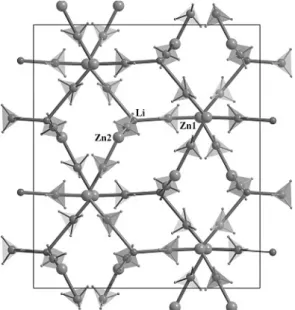
Fig. 7. The doubly interpenetrated three-dimensional framework in LiZn2(BH4)5(Ravnsbæk et al., 2009), highlighted in blue and red.
atoms or one Zn and one M atom. It is remarkable that MZn2(BH4)5 consists of two identical doubly-interpene-trated three-dimensional (3D) frameworks (Fig. 7). This type of structural topology, which suggests directionality of the metal-BH4 interaction, is common for the coordina-tion polymers involving organic ligands but observed for the first time in metal hydrides. Considering only the strongly associated Zn atoms and BH4 units, the MZn2(BH4)5compounds contain isolated [Zn2(BH4)5]¢ an-ions, counter-balanced by cations Mþ.
NaZn(BH4)3. This phase shows a new type of struc-ture, containing a 3D framework of the metal atoms and the BH4 groups. Two independent studies by synchrotron X-ray powder diffraction (Ravnsbæk et al., 2009; Cˇerny´ et al., 2010b) showed that Zn atoms in NaZn(BH4)3 have an intermediate coordination between a distorted tetrahe-dral and a flat-trigonal, while the DFT optimization of the experimental structures clearly prefers and IR spectra agree with the latter (Cˇerny´ et al., 2010b). Hence the com-pound may be rationalized as containing isolated [Zn(BH4)3]¢ anions counter-balanced by cations Mþ. Si-milar to NaZn2(BH4)5, the Na atom has a saddle-like coor-dination by the BH4groups.
Li4Al3(BH4)13. Its P443n structure was determined from synchrotron X-ray powder diffraction data supported by DFT calculations (Lindemann et al., 2010). The unexpected composition can be rationalized on the basis of a complex cation [(BH4)Li4]3þand a complex anion [Al(BH4)4]¢. The refinements from synchrotron powder diffraction of differ-ent samples revealed the presence of limited amounts of chloride ions replacing the borohydride on one site. Anion substituted derivatives
KZn(BH4)Cl2 and NaY(BH4)2Cl2. The first compound (Ravnsbæk et al., 2010a) contains a heteroleptic complex anion [Zn(BH4)Cl2]¢, where Zn has a nearly flat trigonal environment. K atom, having 8 neighbouring anions, acts like a counter-ion. The second compound is polymeric (Ravnsbæk et al., 2010b). Its pseudo-orthorhombic crystal structure is built of edge- and corner-sharing octahedral coordination polyhedra of yttrium coordinated to 4 Cl and 2 BH4 and sodium coordinated to 2 Cl and 4 BH4. Combi-nation of the second anion, such as a halide or an amide (Filinchuk et al., 2006), extends the structural diversity of metal borohydrides. Combining different ligands in modi-fied metal borohydrides is one of the ways to adjust their stability with respect to hydrogen desorption.
Li(BH4)1¢xClx. LiBH4––LiCl is the first system where a gradual replacement of BH4 has been found (Mosegaard et al., 2008), showing a partial replacement of the borohy-dride anions by chloride anions at elevated temperatures (>389 K). The size of anions change according to the se-quence I¢ > BH¢
4 > Br¢ > Cl¢ (Filinchuk and Hage-mann, 2008), giving an efficient tool to tune the unit cell volume and an internal lattice pressure in borohydrides. Even the small chloride anion stabilize the hexagonal phase at significantly lower temperatures, the latter de-pending on the degree of the anion substitution (Arnbjerg et al., 2009). Heating a LiBH4––LiCl mixture produces highly chloride-substituted hexagonal lithium borohydride,
Li(BH4)1¢xClx, with x 0.42. At higher temperatures the solubility is higher, and the process of the LiCl entrance into LiBH4 is reversible on heating/cooling (Arnbjerg et al., 2009). The orthorhombic low-temperature LiBH4 phase shows a lower solubility of LiCl than the hexagonal one. Notice, there is no indications of any dissolution of LiBH4in LiCl.
Ca(BH4)2 –– xIx. A partial substitution of the BH4 group by halide anions opens the way to modify metal borohy-drides and influence their structural stability. During ball milling, calcium borohydride readily dissolves in the trigo-nal calcium iodide structure, forming a solid solution Ca(BH4)2¢xIx with an anisotropically contracted trigonal unit cell. It transforms at 450 K to an orthorhombic phase of the same composition with a CaCl2-type structure (distorted b-Ca(BH4)2). Further heating leads to a transi-tion to a tetragonal phase having a new structure type. It was observed for the series of I-substituted Ca(BH4)2 (Rude et al., 2010) that the smaller anion tends to dissolve in the compound containing the larger anion. Furthermore, it has been shown that 10% CaCl2 can dissolve into the lattice of b-Ca(BH4)2 whereas no dissolution is observed in the system of b-Ca(BH4)2––CaF2 (Lee et al., 2010).
Reactive hydride composites
A significant challenge for the possible future utilisation of metal borohydrides for hydrogen storage materials is discovering new reversible systems that function under technically viable conditions. Secondly, stabilisation of boron in the solid dehydrogenated phase is also important, i.e. suppression of release of borane gasses. Recently, Bar-khordarian, Klassen and Bormann, 2005 and Vajo, Skeith and Mertens, 2005 discovered a very promising class of reversible hydrogen storage systems and demonstrated that different light metal/complex metal hydrides, so-called active hydride composites (RCH), may react during re-lease of hydrogen, see Eqs. (6) and (7).
2 LiBH4þ MgH2$ 2 LiH þ MgB2þ 4 H2, (6) Ca(BH4)2þ MgH2$ CaH2 þ MgB2þ 4 H2. (7) This may provide a more useful reaction enthalpy and re-versibility at more moderate conditions as compared to the individual hydrides.
However, the desorption temperatures of the investi-gated systems are still higher than predicted by estima-tions based on thermodynamic consideraestima-tions and there-fore limited by kinetic constraints. Hence, studies by different means to solve this problem are of vital impor-tance and in situ X-ray powder diffraction conducted at variable temperature or pressure has proven to be a power-ful tool, and a variety of other different RHC systems have also been studied, e.g. LiBH4––Al (Jin et al., 2008, Friedrich et al., 2009), LiBH4––LiAlH4 (Mao et al., 2007), LiBH4––NaAlH4 (Shi et al., 2008; Ravnsbæk and Jen-sen, 2010e) and LiBH4––Mg(BH4)2 (Fang et al., 2010). Furthermore, some mixed systems may form eutectic melts have been studied in mixtures of metal borohy-drides, e.g. LiBH4––Ca(BH4)2 (Lee et al., 2009) and LiBH4––Mg(BH4)2(Hagemann et al., 2010b).
Studies have also shown that the drawbacks of poor kinetics may be overcome by suitable choice of catalysts (Bo¨senberg et al., 2010a, b) or by nanoconfinement, i.e. LiBH4 and MgH2 are infiltrated in a nanoporous carbon aerogel scaffold with pore size Dmax¼ 21. The hydrogen desorption kinetics is significantly improved compared to bulk conditions, and the nanoconfined system has a high degree of reversibility and stability and possibly also im-proved thermodynamic properties. The reactions taking place in the scaffold and the actual incorporation of the materials into the nano pores have been studied in great detail by in situ X-ray powder diffraction. This new scheme of nanoconfined chemistry may have a wide range of interesting applications in the future, for example, with-in the mergwith-ing area of chemical storage of renewable en-ergy (Nielsen et al., 2010a).
Conclusion
Hydrogen is recognized as a possible renewable energy car-rier, however, its utilization is mainly hampered by insuffi-cient hydrogen storage capabilities. Therefore, there is an urgent need for development of novel hydrogen storage ma-terials. We have reviewed the recent development within an interesting class of light element boron based materials, which have gained a significant number of new family mem-bers during the past few years. Several of the bimetallic bor-ohydrides have high hydrogen contents and some also low decomposition temperatures. Decomposition temperatures in the range 100–200C may be associated with reduction of the metal coordinated to borohydride and release of dibor-ane, e.g. zinc based materials. Others release hydrogen in the temperature range 200–300C and form metal borides. This is an indication that reversible hydrogen storage may be pos-sible. Furthermore, the physical properties of borohydrides may be tailored by anion substitution, which illustrates sig-nificant diversity within the structural, physical and chemi-cal properties. This new class of BH¢
4 based materials pos-sess a fascinating structural chemistry, exhibiting bonding ranging from ionic to more covalent with some degree of directionality in the M-BH4interaction. Metal borohydrides are often found as fine powders in synthesis products con-taining several compounds and the structural analysis is ex-tremely challenging. We argue in this review, that in situ time and temperature resolved powder X-ray diffraction data is the most important analysis technique capable of provid-ing data for structural analysis, and givprovid-ing detailed insight into the structural chemistry, and chemical reactions taking place during synthesis and decomposition. This demon-strates that powder diffraction is likely our most valuable and versatile tool in order to discover and characterise no-vel materials, which can form the basis for new, sustain-able and carbon free energy technologies.
References
Aldridge, S.; Blake, A. J.; Downs, A. J.; Gould, R. O.; Parsons, S.; Pulham, C. R.: Some tetrahydroborate derivatives of aluminium: crystal structures of dimethylaluminium tetrahydroborate and the a and b phases of aluminium tris(tetrahydroborate) at low tem-perature. J. Chem. Soc., Dalton Trans. (1997) 1007–1012.
Andreasen, A.; Sørensen, M. B.; Burkarl, R.; Møller, B.; Molen-broek, A. M.; Pedersen, A. S.; Andreasen, J. W.; Nielsen, M. M.; Jensen, T. R.: Interaction of hydrogen with an Mg––Al alloy. J. Alloys Compd. 404–406 (2005) 323–326.
Andreasen, A.; Sørensen, M. B.; Burkarl, R.; Møller, B.; Molen-broek, A. M.; Pedersen, A. S.; Vegge, T.; Jensen, T. R.: Dehydro-genation kinetics of air-exposed MgH2/Mg2Cu and MgH2/MgCu2
studied with in situ X-ray powder diffraction. Appl. Phys. A 82 (2006) 515– 521.
Arnbjerg, L. M.; Ravnsbæk, D.; Filinchuk, Y.; Vang, R. T.; Cerenius, Y.; Besenbacher, F.; Jørgensen, J.-E.; Jacobsen, H. J.; Jensen, T. R.: Structure and dynamics for LiBH4––LiCl solid solutions.
Chem. Mater. 21 (2009) 5772–5782.
Babanova, O.; Soloninin, A.; Stepanov, A.; Skripov, A.; Filinchuk, Y.: Structural and dynamical properties of NaBH4 and KBH4:
NMR and synchrotron X-ray diffraction studies. J. Phys. Chem. C. 114 (2010) 3712–3718.
Balema, V. P.; Wiench, J. W.; Pruski, M.; Pecharsky, V. K.; Mechanically induced solid-state generation of phosphorus ylides and the solvent free Wittig reaction. J. Am. Chem. Soc. 124 (2002) 6244–6245. Barkhordarian, G.; Klassen, T.; Bormann, R.; German patent pending
10 2004 061 286.2, int. patent pending PCT/EP 2005/003494.136 Bogdanovic´, B.; Schwickardi, M.; Ti-doped alkali metal aluminium
hydrides as potential novel reversible hydrogen storage materials. J. Alloys Compd. 253–254 (1997) 1–9.
Bo¨senberg, U.; Kim, J. W.; Gosslar, D.; Eigen, N.; Jensen, T. R.; Bellosta von Colbe, J. M.; Zhou, Y.; Dahms, M.; Kim, D. H.; Gu¨nther, R.; Cho, Y. W.; Oh, K. H.; Klassen, T.; Bormann, R.; Dornheim, M.: Role of additives in LiBH4––MgH2 reactive
hy-dride composites for sorption kinetics. Acta Mater. 58 (2010) 3381–3389.
Bo¨senberg, U.; Ravnsbæk, D. B.; Hagemann, H.; D’Anna, V.; Minel-la, C. B.; Pistidda, C.; van Beek, W.; Safonova, O.; Jensen, T. R.; Bormann, R.; Dornheim, M.: Reaction pathway of the desorption reaction in reactive hydride composites in dependency of pressure and temperature. J. Phys. Chem. C 114 (2010) 15212–15217. Buchter, F.; Łodziana, Z.; Remhof, A.; Friedrichs, O.; Borgschulte,
A.; Mauron, Ph.; Zu¨ttel, A.; Sheptyakov, D.; Barkhordarian, G.; Bormann, R.; Chłopek, K.; Fichtner, M.; Sørby, M.; Riktor, M.; Hauback, B.; Orimo, S.: Structure of Ca(BD4)2 b-phase from
combined neutron and synchrotron X-ray powder diffraction data and density functional calculations. J. Phys. Chem. B. 112 (2008) 8042–8048.
Buchter, F.; Łodziana, Z.; Remhof, A.; Friedrichs, O.; Borgschulte, A.; Mauron, Ph.; Zu¨ttel, A.; Sheptyakov, D.; Palatinus, L.; Chłopek, K.; Fichtner, M.; Barkhordarian, G.; Bormann, R.; Hau-back, B. C.: Structure of the orthorhombic g-phase and phase transitions of Ca(BD4)2. J. Phys. Chem. C. 113 (2009) 17223–
17230.
Cˇerny´, R.; Favre-Nicolin, V.: Direct space methods of structure deter-mination from powder diffraction: principles, guidelines and per-spectives. Z. Kristallogr. 222 (2007) 105–113.
Cˇerny´, R.; Filinchuk, Y.; Hagemann, H.; Yvon, K.: Magnesium boro-hydride: synthesis and crystal structure. Angew. Chem. Int. Ed. 46 (2007) 5765–5767.
Cˇerny´, R.: Solving crystal structures of metal and chemical hydrides. Z. Kristallogr. 223 (2008) 607–616.
Cˇerny´, R.; Penin, N.; Hagemann, H.; Filinchuk, Y.: The first crystal-lographic and spectroscopic characterization of a 3d-metal borohy-dride: Mn(BH4)2. J. Phys. Chem. C. 113 (2009) 9003–9007.
Cˇerny´, R.; Severa, G.; Ravnsbæk, D. B.; Filinchuk, Y.; D’Anna, V.; Hagemann, H.; Haase, D.; Jensen, C. M.; Jensen, T. R.: NaSc(BH4)4: A novel scandium-based borohydride. J. Phys.
Chem. C. 114 (2010a) 1357–1364.
Cˇerny´, R.; Ravnsbæk, D. B.; Severa, G.; Filinchuk, Y.; D’Anna, V.; Hagemann, H.; Haase, D.; Jensen, C.M.; Jensen, T.R.: Structure and characterization of KSc(BH4)4. J. Phys. Chem. C (2010b)
DOI: 10.1021/jp106280v.
Cˇerny´, R.; Kim, K.Ch.; Penin, N.; D’Anna, V.; Hagemann, H.; Sholl, D.S.: AZn2(BH4)5 (A ¼ Li, Na) and NaZn(BH4)3: structural
stu-dies J. Phys. Chem. C 114 (2010c) 19127–19133.
Cˇerny´, R.; Penin, N.; d’Anna, V.; Ruziska, J.; MgxMn(1¢x)(BH4)2
(x ¼ 0–0.8) first cationic solid solution in a bimettalic borohy-dride. J. Phys. Chem. C (2009d) in preparation.
Chernyshov, D.; Bosak, A.; Dmitriev, V.; Filinchuk, Y.; Hagemann, H.: Low lying phonons in NaBH4 studied by inelastic scattering
of synchrotron radiation. Phys. Rev. B. 78 (2008) 172104. Clausen, B.S.; Steffensen, G.; Fabius, B.; Villadsen, J.;
Feiden-hans’l, R.: In situ cell for combined XRD and on-line catalysis tests: Studies of Cu-based water gas shift and methanol catalysts. Topsøe, H. J. Catal. 132 (1991) 524–535.
Coelho, A.A.: TOPAS-Academic. (2004) http://members.optusnet.com.au/alancoelho
Remark: Commercial version containing more comfortable GUI may be obtained from Bruker AXS.
Chupas, P. J.; Chapman, K. W.; Kurtz, C.; Hanson, J. C.; Lee, P.L.; Grey, C. P. J.: A versatile sample-environment cell for non-ambient X-ray scattering experiments. Appl. Cryst. 41 (2008) 822–824. Dai, B.; Sholl, D. S.; Johnson, J. K.: First-principles study of
experi-mental and hypothetical Mg(BH4)2 crystal structures. J. Phys.
Chem. C. 112 (2008) 4391–4395.
David, W.I.F. ; Shankland, K.: Structure determination from powder diffraction data. Acta Cryst. A64 (2008) 52–64.
Dmitriev, V.; Filinchuk, Y.; Chernyshov, D.; Talyzin, A.; Dzwilews-ki, A.; Andersson, O.; Sundqvist, B.; Kurnosov, A.: Pressure-tem-perature phase diagram of LiBH4: synchrotron X-ray diffraction
experiments and theoretical analysis. Phys. Rev. B. 77 (2008) 174112.
Dornheim, M.; Doppiu, S.; Barkhordarian, G.; Boesenberg, U.; Klas-sen, T.; Gutfleisch, O.; Bormann, R.: Hydrogen storage in magne-sium-based hydrides and hydride composites. Scr. Mater. 56 (2007) 841–846.
Eberle, U.; Felserhoff, M.; Schu¨th, F.: Chemical and physical solu-tions for hydrogen storage. Angew. Chem. Int. Ed. 48 (2009) 6608–6630.
Efron, B.; Tibshirani, R.: Bootstrap methods for standard errors, con-fidence intervals, and other measures of statistical accuracy. Stat. Science 1 (1986) 54–77.
Fang, Z.-Z.; Kang, X.-D.; Wang, P.; Li, H.-W.; Orimo, S.-I.: Unex-pected dehydrogenation behavior of LiBH4/Mg(BH4)2mixture
as-sociated with the in situ formation of dual-cation borohydride. J. Alloys Comp. 491 (2010) L1–L4.
Favre-Nicolin, V.; Cˇerny´, R.: FOX, ‘‘Free objects for crystallogra-phy”: a modular approach to ab initio structure determination from powder diffraction. J. Appl. Crystallography 35 (2002) 734– 743. See also http://objcryst.sourceforge.net/Fox.
Fichtner, M.; Chłopek, K.; Longhini, M.; Hagemann H.: Vibrational spectra of Ca(BH4)2. J. Phys. Chem. C. 112 (2008) 11575–
11579.
Filinchuk, Y. E.; Yvon, K.; Meisner, G. P.; Pinkerton, F. E.; Balogh, M. P.: On the composition and crystal structure of the new qua-ternary hydride phase Li4BN3H10. Inorg. Chem. 45 (2006) 1433–
1435.
Filinchuk, Y.; Talyzin, A.; Chernyshov, D.; Dmitriev, V.: High-pres-sure phase of NaBH4: crystal structure from synchrotron powder
diffraction data. Phys. Rev. B. 76 (2007) 092104
Filinchuk, Y.; Hagemann, H.: Structure and properties of NaBH4¡ 2 H2O and NaBH4. Eur. J. Inorg. Chem. (2008) 3127–
3133.
Filinchuk, Y.; Chernyshov, D.; Cˇerny´, R.: The lightest borohydride probed by synchrotron diffraction: experiment calls for a new the-oretical revision. J. Phys. Chem. C. 112 (2008a) 10579–10584. Filinchuk, Y.; Chernyshov, D.; Dmitriev, V.: Light metal
borohy-drides: crystal structures and beyond. Z. Kristallogr. 223 (2008b) 649–659.
Filinchuk, Y.; Chernyshov, D.; Nevidomskyy, A.; Dmitriev, V.: High-pressure polymorphism as a step towards destabilization of LiBH4. Angew. Chem. Int. Ed. 47 (2008c) 529–532.
Filinchuk, Y.; Nevidomskyy, A. H.; Chernyshov, D.; Dmitriev V.: High-pressure phase and transition phenomena in ammonia bor-ane NH3BH3 from X-ray diffraction, Landau theory, and ab initio
calculations. Phys. Rev. B. 79 (2009a) 214111.
Filinchuk, Y.; Cˇerny´, R.; Hagemann, H.: Insight into Mg(BH4)2with
synchrotron X-ray diffraction: structure revision, crystal chemistry, and anomalous thermal expansion. Chem. Mater. 21 (2009b) 925–933.
Filinchuk, Y.; Ro¨nnebro, E.; Chandra, D.: Crystal structures and phase transformations in Ca(BH4)2. Acta Mater. 57 (2009c) 732–738.
Filinchuk, Y.: Light metal hydrides under non-ambient conditions: probing chemistry by diffraction? In ‘‘High-pressure crystallogra-phy”, ed. E. Boldyreva and P. Dera, NATO Science for Peace and Security Series B (2010) 281–291.
Filinchuk, Y.; Chernyshov, D.; Dmitriev, V.: Crystal chemistry of light metal borohydrides. In ‘‘Boron hydrides, high potential hy-drogen storage materials”, ed. U.B. Demirci and P. Miele, Nova Publishers (2010a); arXiv: abs/1003.5378.
Filinchuk, Y.; Talyzin, A. V.; Hagemann, H.; Dmitriev, V.; Cherny-shov, D.; Sundqvist, B.: Cation size and anion anisotropy in struc-tural chemistry of metal borohydrides. The peculiar pressure evo-lution of RbBH4. Inorg. Chem. 49 (2010b) 5285–5292.
Fischer, P.; Zu¨ttel, A.: Order-disorder phase transition in NaBD4.
Ma-ter. Sci. Forum. 443–444 (2004) 287–290.
Friedrichs, O.; Kim, J. W.; Remhof, A.; Buchter, F.; Borgschulte, A.; Wallacher, D.; Cho, Y. W.; Fichtner, M.; Oh, K. H.; Zu¨ttel, A.: The effect of Al on the hydrogen sorption mechanism of LiBH4.
Phys. Chem. Chem. Phys. 11 (2009) 1515–1520.
Frommen, C.; Aliouane, N.; Daledda, S.; Fonneløp, J. E.; Grove, H.; Lieutenant, K.; Llamas-Jansa, I.; Sartori, S.; Sørby, M. H.; Hau-back, B. C.: Crystal structure, polymorphism, and thermal proper-ties of yttrium borohydride Y(BH4)3. J. Alloys Compd. 496
(2010) 710–716.
Gray, E. Mac.; Cookson, D. J.; Blach, T. P.: X-ray diffraction cell for studying solid–gas reactions under gas pressures to 100 bar. J. Appl. Crystallogr. 39 (2007) 850–855.
Grochala, W.; Edwards, P. P.: Thermal decomposition of the non-in-terstitial hydrides for the storage and production of hydrogen. Chem. Rev. 104 (2004) 1283–1315.
Hagemann, H.; Longhini, M.; Kaminski, J. W.; Wesolowski, T. A.; Cˇerny´, R.; Penin, N.; Sorby, M. H.; Hauback, B. C.; Severa, G.; Jensen, C. M.: LiSc(BH4)4, a new complex salt with discrete
Sc(BH4)4¢ions. J. Phys. Chem. A. 112 (2008) 7551–7555.
Hagemann, H.; Filinchuk, Y.; Chernyshov, D.; van Beek, W.: Lattice anharmonicity and structural evolution of LiBH4: an insight from
Raman and X-ray diffraction experiments. Phase Trans. 82 (2009) 344–355.
Hagemann, H.; Cˇerny´, R.: Synthetic approaches to inorganic borohy-drides. Dalton Trans. 39 (2010a) 6006–60012.
Hagemann, H.; d’Anne, V.; Rapin, J. P.; Cˇerny´, R.; Filinchuk, Y.; Kim, K. Ch.; Sholl, D.; Parker, S. F.; New fundamental experi-mental studies on a-Mg(BH4)2 and other borohydrides. J. Alloys
Compd. (2010b) DOI: 10.1016/j.jallcom.2010.10.068.
Hartman, M. R.; Rush, J. J.; Udovic, T. J.; Bowman, R. C. Jr.; Hwang, S. J.: Structure and vibrational dynamics of isotopically labeled lithium borohydride using neutron diffraction and spectro-scopy. J. Solid State Chem. 180 (2007) 1298–1305.
Hauback, B. C.: Structures of aluminium-based light weight hydrides. Z. Kristallogr. 223 (2008) 636–648.
Her, J.-H.; Stephens, P. W.; Gao, Y.; Soloveichik, G. L.; Rijssenbeek, J.; Andrus, M.; Zhao, J.-C.: Structure of unsolvated magnesium borohydride Mg(BH4)2. Acta Cryst. B. 63 (2007) 561–568.
International Energy Agency (IEA): World Energy Outlook 2008. OECD/IEA (2008). www.iea.org/books.
Jensen, T. R.; Nielsen, T. K.; Filinchuk, Y.; Jørgensen, J. E.; Cere-nius, Y.; Gray, E. MacA.; Webb, C.: Versatile in-situ powder X-ray diffraction cells for solid-gas investigations. J. Appl. Cryst. (2010) 43 (2010) DOI: 10.1107/S0021889810038148.
Jin, S.-A.; Shim, J.-H.; Cho, Y. W.; Yi, K. W.; Zabara, O.; Fichtner, M.: Reversible hydrogen storage in LiBH4––Al––LiH composite
powder. Scripta Mater. 58 (2008) 963–965.
Johnston, L.; Hallett, N. C.: Low temperature heat capacities of inor-ganic solids. XIV. Heat capacity of sodium borohydride from 15– 300K. J. Am. Chem. Soc. 75 (1953) 1467–1468.
Kudo, A.; Miseki, Y.: Heterogeneous photocatalyst materials for water splitting. Chem. Soc. Rev. 38 (2009) 253–278.
Kumar, R. S.; Cornelius, A. L.: Structural transitions in NaBH4under
pressure. Appl. Phys. Lett. 87 (2005) 261916.
Lee, L. Y.; Ravnsbæk, D.; Lee, Y.-S.; Kim, Y.; Cerenius, Y.; Shim, J.-H.; Jensen, T. R.; Hur, N. H.; Cho, Y. W.: Decomposition reac-tions and reversibility of the LiBH4––Ca(BH4)2 composite. J.
Phys. Chem. C 113 (2009) 15080–15086.
Lee, Y.-S.; Shim, J.-H.; Cho, Y. W.: Polymorphism and thermody-namics of Y(BH4)3 from first principles. J. Phys. Chem. C 114