A. Active Plasma Systems
Academic and Research Staff
Prof. L. D. Smullin Prof. R. R. Parker Prof. R. J. Briggs Prof. K. I. Thomassen
Graduate Students
D. S. Guttman B. R. Kusse J. A. Mangano
F. Herba R. K. Linford J. A. Rome
RESEARCH OBJECTIVES
The interests of the Active Plasma Systems Group cover a variety of topics in gaseous plasmas and charged-particle beams, the majority of which have as central focus the generation of highly ionized plasmas for application to controlled fusion. In the realm of "turbulent plasma" studies, we shall continue our work on the beam-plasma discharge with present emphasis on techniques for describing and measuring a turbulent plasma, possible plasma sources other than gas injection, and ion heating by excitation at the ion-cyclotron frequency. Related topics are the heating of plasmas by stochastic fields and the synthesis by injection of electron and ion beams in vacuum. A discussion of particular topics follows.
1. Radiation and Turbulence in Beam-Plasma Discharge
The radiated RF spectrum of the BPD is complex and shows marked incoherencies, both temporal and spatial. Besides the primary interaction at the upper frequency, there is a very broad noiselike spectrum in the range (typically) 100 MHz-2000 MHz. We plan to study the spatial coherence (correlation) of this noise and will relate it to fluctuations in the plasma density. There are some basic problems in relating the radiated field from a plasma of finite dimensions to its internal structure, and it is not yet clear how far one-dimensional theory can be pushed.
L. D. Smullin, R. R. Parker
2. Ion-Cyclotron Heating
We plan to exploit the possibility of heating a plasma by using a short-wavelength coil coupled to a plasma column in a nonuniform (mirror) magnetic field. Our initial experiments have shown that it is possible, in this way, to transfer energy to the plasma over a broad range of frequencies, corresponding to local ion-cyclotron resonance under different parts of the coil. It would appear that this should lead to more uniform heating than has been the case in previous experiments, thereby producing a hot plasma that would be less susceptible to velocity-space instabilities.
R. R. Parker
(XX. APPLIED PLASMA RESEARCH)
3. Electric Arc Thruster Study
An electric thruster using teflon as a fuel element is now used in a Lincoln Labora-tory, M. I. T., communication satellite. An arc discharge over the teflon surface is repelled by the return current, thereby forming a type of rail accelerator. Gasdynamic thrust also plays a role.
The purpose of this research program is to study the discharge properties and develop a model to explain the observed thrust (several pounds during the l-pLsec dis-charge).
K. I. Thomassen
4. Plasma Stabilization by Feedback
Several recent experiments on the Ogra machine, in U. S. S. R., have demonstrated the stabilization of flutes and cyclotron waves by feeding back the low-frequency oscil-lations from a Langmuir probe to conducting plates running the length of the discharge. The method is similar to that used by Melcher to stabilize a Rayleigh-Taylor instability.
In our experiment we shall use a hot-cathode PIG discharge, which is known to be unstable to resistive drift waves, to explore the mechanisms for stabilizing the discharge.
K. I. Thomassen, R. R. Parker
5. Titanium Hydride Plasma Source
A commercially available hydrogen-loaded titanium cylinder, with an insulating gap on its surface, expels plasma when an arc is struck across the gap. This source is being explored to determine its suitability as a highly ionized plasma source.
K. I. Thomassen
6. Stability of Sheared Electron Flow
In high-perveance magnetically focused electron beams, a substantial velocity shear can be generated by the potential depression in a drift region. We are, at present, investigating the stability of oscillations in such systems; part of the practical motiva-tion is a better understanding of noise generamotiva-tion or amplificamotiva-tion in high-power beam tubes. We have derived general criteria for stability, and we are now investigating in detail the stability properties of particular velocity profiles.
R. J. Briggs
7. Plasma Synthesis
As a variation on our beam-plasma discharge studies, we are investigating the generation of a plasma in a "hard" vacuum by the injection of counterflowing electron and ion beams. The ion source is a solid thermionic emitter which is capable of 1-5 mA emission of potassium ions. The system has been constructed and the ion emitters tested; preliminary tests of the injection of both ions and electrons are under way.
The basic goal of this research is to test in a small-scale experiment the feasibility of plasma accumulation and heating by the nonadiabatic effects arising from cooperative
instabilities in a two-stream configuration.
R. J. Briggs
8. Waves in Inhomogeneous Media
During the past year, we developed a technique for determining the critical lengths for absolute instabilities in mildly inhomogeneous media. We intend to investigate further the connections between the stability of infinite homogeneous media and mildly inhomogeneous systems.
R. J. Briggs
1. ION-CYCLOTRON RESONANCE IN A NONUNIFORM
MAGNETIC FIELD
Work has begun on investigating the possibility of using a short-wavelength coil to transfer power to a plasma in a nonuniform magnetic field. The basic idea is to excite the coil at a frequency that will be equal to the ion-cyclotron frequency somewhere under the coil. In this way, relatively broadband coupling could be achieved, and the possibility would then exist of using a wideband noise source for heating. This in turn should result in uniform heating of the plasma.
The initial experiment of measuring the resistance of a short-wavelength coil sur-rounding a plasma in a mirror field has been carried out. The theoretical and experi-mental results are discussed in this report.
Theoretical Discussion
We consider the system shown in Fig. XX-1, which consists of a plasma column surrounded by a reverse-turn coil. The plasma is assumed to be in a magnetic field that may be nonuniform. We also assume that the plasma is cold, and its electrical properties may be characterized by the cold-plasma dielectric tensor.
If an RF source with current I is connected to the terminals of the coil, the power delivered by the source will be- R I 2, where R is the real part of the impedance of the coil. By applying Poynting' s theorem to the cylinder whose cross section is shown
L
(XX. APPLIED PLASMA RESEARCH)
dashed in Fig. XX-1, and neglecting wave generation in the axial direction, we find for the resistance
wE *
R = Im • K. E dr, (1)
l 12
where the volume integral is carried out over the volume enclosed by the cylinder. (We have assumed perfectly conducting walls and that the coil itself has zero resistance.)
To make further use of Eq. 1, we need to find E, and this requires the self-consistent solution of Maxwell' s equations. For the case of uniform magnetic field, this problem has been solved by Stix1 who simplified the problem by neglecting electron iner-tia. By examining the solution given by Stix, it is possible to show that, under certain conditions, the expression given in Eq. 1 for the resistance will be accurate even if the vacuum electric field is used, rather than the self-consistent electric field. The con-ditions for this are P2 >> k2K and Pa < 1, where p is the dominant wave number asso-ciated with the coil, k =
- -,
K is the diagonal component of the dielectric tensor, and a is the radius of the plasma column. These conditions ensure that the coil does not couple strongly to any of the normal modes of the plasma column.These conclusions were realized some time ago by Glenn,2 who also realized the importance of using a coil of finite wavelength. The finite wavelength of the coil is nec-essary in order to periodically reverse the sign of the polarization charge which results, because of ion motion. The axial variation of the polarization charge drives axial elec-tron currents that maintain charge neutrality, thereby allowing the vacuum field to pen-etrate. Neutralization cannot occur for a coil of zero wavelength, that is, a long solenoid, and for this case Eq. I is not correct to any nontrivial order if the vacuum field is used.
Based on these results for the case of the uniform magnetic field, we propose to use Eq. 1 with the vacuum electric field for the case of the nonuniform magnetic field. In order that the required charge neutrality can be maintained, however, we assume that the magnetic field is symmetric with respect to the midplane of the coil.
For a coil whose radius is less than its axial wavelength, the electric field is essen-tially proportional to radius. If the current in the coil is I, and the wavelength is X, the
fundamental component of the electric field is j2w iorI 2,
E = i sin z, (2)
where z is the axial coordinate, and z = 0 is located at the center of the coil. Equa-tion 2 is valid under the coil, while near the ends of the coil the field rapidly decays to
zero. While Eq. 2 is not strictly valid near the ends, we shall neglect end effects, and assume that Eo is given by Eq. 2 for Iz < L/2, where L is the length of the coil, and0
zero for Iz > L/2. We shall also neglect the contribution of other space harmonics.
Inserting Eq. 2 into Eq. 1, we obtain 2 4w3 2 E p (r) R = 2 00 Im 2 2(r-- 2 r2 sin2 z dr (3a)(3 c 32 24 ooopa rL/2 sin
k
z = 2w 2 Im L/2 sin 2 dz. (3b) 2 L/2 o2 (z) -o 2 cHere w and wc are the ion plasma and cyclotron frequencies, respectively. In obtaining Eq. 3b from Eq. 3a, we have neglected the spatial variation of the density caused by the bulging of the magnetic field lines.
The integral in Eq. 3b, apart from the sin2 z factor, is similar to that defining 3
the resistance of a planar capacitor filled with nonuniform, cold plasma. As in the last case, the integral is improper, since it involves integration through a pole. This is resolved by giving the frequency a small, negative, imaginary part and then analytically continuing to the Im c = 0 axis. The result is
32 24
p oE w a s.22w
oop sin z.
R (w) = 2Tr2 0 0 2 2 , (4)
Wc(zi) I c (Zi)
where z. are the roots of the equation 2 (z = 2 ; z <L
1 c i 2
An interpretation of Eq. 4 can be made with the aid of Fig. XX-2. In Fig. XX-2a, we show a sketch of the cyclotron frequency as a function of z, and indicate the positions where local resonance is occurring, that is, where wc = w. Since the electric field is varying sinusoidally, as in Fig. XX-2b, the electric field at the position of resonance will in general be nonzero, and hence the current density will be infinite. But since the current density is infinite over zero width, the total power absorbed, and hence the resistance, are finite, thereby giving rise to the result in Eq. 4.
It is of interest to see how a nonzero collision frequency modifies this result. For this purpose, we take the cyclotron frequency to be of the form
o2 =o 1 + 2
c co
where wco and f are constant, and insert a phenomenological collision frequency, v, into the dielectric tensor. This can be accomplished readily by replacing the ion maas, m., by mi(l -j v). The result can then be integrated and expressed in
(XX. APPLIED PLASMA RESEARCH)
--- ----(.
Fig. XX-2. (a) Shape of the magnetic field, showing positions of local resonance. (b) Axial variation of the magnitude of the electric field.
the sine and cosine integral of complex argument. We find for the
resis-3 24 2 R=r Im co 1 -cos a LL X In a- - In a+ L a2 2 S rro ai (±1m j a + L - CI (fa -CmL--cOS --- x - 2-- + sin 4 a[Si ( (a + L
)-
Si (4-- (a 2 (5)where a = (Q2-1+jNQ)1/2, = and N - . The functions Cin and Si are defined in Abramowitz and Stegun.4 co co
For a pure real or pure imaginary, that is, for v = 0, Eq. 5 reduces to Eq. 4. For small, but nonzero v, the precise effect is hard to estimate. It is possible, however, to show that for
N
1/2 > X the effect will be to smear out R(w) as given in Eq. 4 near those2 27T frequencies for which sin zi = 0.
Experiment
To test our theory, a two-wavelength coil was inserted into System D, the beam-plasma discharge located at the Francis Bitter National Magnet Laboratory. It was
C C
(a)
(b)
terms of tance R,ry*
ry*
z D
0.75 0.80 0.85 0.90 0.95 1.00 1.05
NORMALIZED CYCLOTRON FREQUENCY, wc/w
Fig. XX-3. Measured change in the resistance of the coil vs normalized cyclotron frequency.
found to be much easier to measure the resistance of the coil as a function of c, rather than of w. Hence the experiment consisted of recording the coil resistance of a fixed frequency, c, as the magnetic field was swept.
The result of a typical experimental run is shown in Fig. XX-3, where we have plotted AR, the difference between coil resistance with and without a plasma, against Wc/w. While Eq. 4 appears to explain the main features of the curve, there are two dis-crepancies between the experimental results and the theory. First, the experiment reveals a background resistance whose magnitude is approximately twice that of the "resonant" part of the resistance; and second, only one relative peak in the resistance curve has been definitely identified, rather than the two peaks predicted by Eq. 4. It is possible that one effect of nonzero collision frequency as given in Eq. 5 is to smear out the other distinct resonance. Numerical evaluation of Eq. 5 will be carried out to see if this might be the case.
R. R. Parker
References
1. T. H. Stix, The Theory of Plasma Waves (McGraw-Hill Book Company, Inc., New York, 1962).
2. W. Glenn, "Plasma Diagnostics near Ion-Cyclotron Resonance," Ph.D. Thesis, Massachusetts Institute of Technology, 1966.
3. H. M. Schneider, "Oscillations of an Inhomogeneous Plasma Slab," Ph.D. Thesis, Massachusetts Institute of Technology, 1968.
4. M. Abramowitz and I. A. Stegun, Handbook of Mathematical Functions (Dover Pub-lications, New York, 1965).
XX. APPLIED PLASMA RESEARCH
B. Plasma Effects in Solids
Academic Research Staff Prof. G. Bekefi
Prof. G. A. Baraff Graduate Students
S. R. J. Brueck C. S. Hartmann D. A. Platts
E. V. George R. N. Wallace
RESEARCH OBJECTIVES
We are continuing our studies of many-body, plasmalike effects of free carriers in solids. We emphasize those aspects of the problem that have to do with unstable modes of oscillation and wave propagation when the solid is subjected to external electric and/or magnetic fields. At the present time, we are concentrating our efforts on the microwave emission from Indium Antimonide at 77°K and on the microwave and radio emission that we have recently discovered in Bismuth Antimony alloys at 4°K. These emissions are still largely not understood. Before a theoretical model can be con-structed two major experimental questions need to be answered. (i) What are the dispersion characteristics of the unstable waves? (ii) To what extent do contacts play a role in generating or triggering the instability? Partial answers to these questions have been obtained during the past year.
G. Bekefi
1. MICROWAVE INSTABILITIES IN A SEMICONDUCTOR SUBJECTED TO DC ELECTRIC AND MAGNETIC FIELDS
Phonon Effects
Many authors have theorized that the responsible mechanism for the generation of low-field microwave noise was the interaction of phonons with drifting electrons. If phonons are the major generating mechanism for the microwave emission and if they propagate at some angle to the magnetic field, then when these phonons strike the sur-face of the sample they should perturb the sursur-face in some manner. If this hypothesis is correct, it may be possible to detect this surface motion, and, from its frequency
spectrum and its dependence on the electric and magnetic field applied to the sample, to verify the existence of phonons that behave in a manner similar to the observed microwave emission. Moreover, since the conversion of phonon waves to electromag-netic waves is very weak, one should also be able to verify that the phonons are the
pri-mary generating species for the radiation or that they are only secondary (i. e. , being
themselves generated by the microwave radiation) generating species.
It is necessary, therefore, to estimate (with order-of-magnitude calculations) the maximum motion of the surface. If the radiation possesses some amount of phase coherence (recent experiments with the spiked emission seem to indicate this), then we can writel
(P)E. M. = - P )Acoustic' where
SP)E. M. = average electromagnetic power emitted at frequency v
(P)Acoustic = average acoustic power at frequency v y = conversion efficiency. Now,I 22 (P A 4 v Cu2 (P)Acoustic vsound where v = frequency v = sound velocity C = elastic constant
A = surface area of the sample u = displacement.
Using characteristic values of these constants for InSb, we obtain 422
P)Acoustic 10
For an emitted power (at ~100 MHz) of ~10- 6 W, we obtain
1 -3
U ~ 10 A.
(XX. APPLIED PLASMA RESEARCH)
u 1A
if phonons are the generating mechanism for the radiation. We shall illustrate a method for making very small displacement measurements.
Phase Modulation in a Michelson Interferometer
In this analysis we shall neglect the radial dependence of the electric field of the laser beam; that is,
E las Ee laser
ejr/r (wt-kz)
E ej (t-kz)
o
The radial dependence can be included in the analysis if one wishes, the only difference will be that in the final result an integration over r (also an integration over if the laser is not in the TEM00n mode) will be required. It is also necessary that 2 (Z 1- 2)i <
coherence length of the laser. This is easily achieved if the laser operates in a single transverse and longitudinal mode. The laser used in this experiment operated in a
single transverse mode, but ran in a multilongitudinal mode. (See Fig. XX-4.)
We assume that the displacement of the vibrating surface, over the spot size of the
I VIBRATING SURFACE Z BEAM SPLITTER PHOTOMULTIPLIER 2 Z2
z
2 FIXED MIRRORFig. XX-4. Modified Michelson interferometer. Z1 = Distance from the beam splitter
to the equilibrium position of the vibrating surface.
Z2= Distance from the beam splitter to the fixed mirror.
E , E = Electric field of the laser beam in the respective arms of the interferometer.
laser beam at the surface, is given by S = S sin c t,
o m
where So is the amplitude of vibration, and cm is the driving frequency. We shall neglect the Doppler-shifted frequency resulting from surface velocity and its resultant spectrum.
The output current of the photomultiplier will be of the form
i(t) = K (E1+E2)(E 1 +E2)* , (1)
where K is a proportionality constant depending on the characteristics of the photomul-tiplier. Now (note the beam splitter transmission coefficient is contained in E0 1 and E02),
El =E
0 1exp
Ect
+
Z1 +
(
S) andE = E2 exp ct + Z 2 'T
2 02 ?Lc c 2)i
where fc = c. are the frequency and wavelength of the He-Ne laser beam ( =
6 c 2 TT c C
6328 A). Substituting these values in Eq. 1 and collecting terms, we obtain
i(t) = K E01+E02+2E01E02 cos (1-5+6sinwmt) , (2)
where c/ c and 4rr 6 S N. o c
If the interferometer were optically stable, with regard to mirror vibrations, then r -could be replaced by some constant 0; that is,
rl - = 0 (optically stable).
The problem is more complex if the interferometer is not optically stable, since in general random vibrations in, say, rl are not correlated with vibrations in
a.
In this(XX. APPLIED PLASMA RESEARCH)
case
n
- cannot be replaced by 0.Considering the optically stable case and making use of the Bessel expansions,
cos (6 sinw mt) = Jo(6)
co sin (6 sinomt) = 2 n= 1 we obtain i(t) = K E + E02 + 1 02 + - 4E01E02 n= 1 00 + 2 JZn(6) cos 2nwmt n= 1 J2n-1(6) sin (2n-1)wm t,
ZE01E02 .0{(6) + z J n(6) cos 2n mt cos 0
n= 1
2n-1(6) sin (2n-1)wmt sin 2n- 1
The frequency spectrum consists of a DC term, the modulation frequency, and its harmonics. Notice that the amplitude of, say, nom is given only by J (6). This spec-trum and the form of 5, that is, 6 = So , independent of wm , is a form of phase
mod-ulation. c
In order to verify the theory, a small mirror was mounted on a ceramic transducer.
Fig. XX-5.
Spectrum analyzer output for an arbitrary value of So. Horizontal scale (frequency) 1 kHz/cm center frequency = 5 kHz. Vertical scale is power output in arbibtary units.
Any desirable value of So could be obtained by adjusting the driving voltage to the ceramic transducer. The output of the photomultiplier was fed into a spectrum analyzer. Figure XX-5 illustrates the output of the spectrum analyzer for some arbitrary value of So . It was possible experimentally to obtain the first few zeros of J (6) by adjusting S .
First Zeros Second Zeros
Modulation J1(6) = 0 J 2() = 0 J3(6) = 0 J1(6) = 0 J 2(6) = 0 Frequency
(Hz) 6 = 3. 882 6 = 5. 135 6 = 6. 379 6 = 7. 016 6 = 8.417
Volts Normalized Volts Calculated Volts Calculated Volts Calculated Volts Calculated
1000 93 3. 88 124 5. 18 157 6.56 175 7. 31 200 8. 35
2000 76 3.88 104 5.32 126 6.45 134 6.85 164 8.39
3000 83 3.88 118 5.52 142 6.65 154 7.21 186 8.70
(XX. APPLIED PLASMA RESEARCH)
By changing the modulating frequency, we could verify the form of 6. That is, 6 should be independent of cim , within the frequency sensitivity of the transducer, whereas, if the spectrum were a form of frequency modulation, 6 would vary inversely with wM Table XX-1 lists the values of some of the zeros of J (6) for several modulation frequen-cies. Although Eq. 3 predicts that by suitable adjustment of 0 either the odd or even frequency harmonics can be made to vanish, this was not possible experimentally, because of small vibrations in the mirrors of the interferometer.
As we have pointed out, the amplitudes of vibration which we seek are small, con-sequently 6 is small. Keeping only the lowest order term in Eq. 3, we have
( K 2
i(t) K 1+E+2E01E0 2 cos
- 25 (sin wmt) sin
o}].
(4)To obtain a value for the minimum detectable surface motion, the ceramic trans-ducer was replaced by a quartz single-crystal transtrans-ducer. The thickness of the trans-ducer was chosen so that its first resonant frequency occurred at approximately 30 MHz. For this crystal,
-10
S = d V = 2 X 10 V,
ODC where
S = displacement off resonance (in cm) °DC
V = voltage applied to the crystal (in Volts) On resonance, to a fair approximation, one can write
SoResonance QSoDC
where Q is the Q of the quartz transducer.
Table XX-2. Sensitivity of quartz transducer.
Minimum Detectable Minimum Detectable RF Voltage
Frequency (peak-to-peak) (V) Motion (A)
115 kHz 2 0. 04
520 kHz 0. 5 0. 01
As before, the output of the photomultiplier was fed into a spectrum analyzer and the minimum detectable signal above receiver noise was recorded. Table XX-2 lists the results of this experiment.
Experimental Results
In order to obtain some amount of optical stability, the sample of InSb was mounted firmly to a cold finger. Figure XX-6 illustrates this new holder. The surface of the InSb crystal was mirror polished and a lens was incorporated into one arm of the Michelson cavity. A probe was also mounted close to the sample so as to monitor the microwave radiation output from the sample simultaneously with the output from the photomuliplier. Figure XX-7 illustrates the experimental arrangement.
A sample was constructed and mounted on the cold finger, and DC electric and
InSb
SAPHIRE COATING
MICROWAVE PROBE
SIDE VIEW FRONT VIEW
Fig. XX-6. InSb sample holder attachment for a cold finger.
MAGNETIC FIELD POLE PIECES MAGNETIC FIELD POLE PIECES NS / FIXED MIRROR
(XX. APPLIED PLASMA RESEARCH)
magnetic fields were applied to the sample. A large amount of microwave noise was detected from this sample. The laser light was then focused to a small spot and moved so as to probe the surface of the sample from approximately its middle to one end. Opti-cal probings were made for both polarities of DC electric field.
Preliminary results on this one sample indicate that the signal attributable to phonon activity is down into the noise of the receiver. This indicates that if there is surface motion at all, it is smaller than -(0. 4) A. The He-Ne laser will create electron-hole pairs at the surface, and these could possibly alter locally the emission process. Work is under way to coat the surface with a very thin layer of insulation, and then apply a very thin gold overcoating so that the laser light will not penetrate to the surface of the InSb. We plan also to probe the end of the sample because if the phonons propagate exactly along the magnetic field, the technique of probing the surface of the sample would not detect them.
E. V. George, Marie D. Beaudry References
1. C. Hartman, "Direct Coupling of an Acoustic Wave in a Piezoelectric Semiconductor to an Electromagnetic Wave in Free Space," S. M. Thesis, M. I. T., August 19, 1968.
2. MICROWAVE RADIATION FROM BiSb ALLOYS Introduction
Microwave radiation has been observed from electrically biased (as low as 0. 9 V/cm) BiSb alloys at 4. 2'K. The radiation is observed in the absence of a magnetic field and, moreover, is very sensitive even to weak magnetic fields. Radiation is observed from semiconducting BiSb alloys, but not from the semimetallic alloys. The purpose of this study was to examine BiSb alloys for microwave radiation.
Sample Information
The band structure of Bi Sb alloys has been the subject of a number of investiga-x
1-4 1-x x
tions in the small x region. While the details of the band structure are still being debated,5 it is generally agreed l ' 2 that for antimony concentrations of x < 0. 05 to 0. 07 the alloys are semimetallic, with overlapping conduction and valence bands. Above x = 0. 05 to 0. 07 the system becomes a semiconductor with a very small energy gap that
increases with increasing (up to approximately x = 0. 15) Sb concentrations. We have
This is a report of a joint experiment with Bell Telephone Laboratories, Inc., Murray Hill, New Jersey.
examined some of these alloys (from x = 0. 00 to 0. 12) for emission of microwave radia-tion when the samples are cooled to cryogenic temperatures and subjected to biasing electrical and magnetic fields.
The samples were cut from boat-grown BiSb alloys prepared from 6-9 pure Bi and Sb. The crystals were grown by utilizing magnetic stirring and very slow growth rates in order to avoid constitutional supercooling. Examination of the resulting alloys with x-ray fluorescence showed that the alloys were uniform to better than 0. 5%. The samples were cut either with a jeweler's saw or spark cutter to rectangular parallelepipeds
having typical approximate dimensions of 1 X 1 X 10 mm 3 , andthe surfaces were lapped and polished to an optical finish. The concentrations and mobilities of most samples were determined by conventional Hall or helicon techniques. Gold wires were soldered
to the ends of the samples with a variety of solders with low melting points. The samples were then placed near the end of a coaxial transmission line immersed in a cryogenic fluid with a magnetic field parallel to the sample current direction. The transmission line was connected to a conventional radiometer with a sensitivity of ~10 - 1 4
W. The sys-tem had been previously used to investigate6
microwave radiation from InSb. Micro-second current pulses were applied to the low-impedance samples by means of a strip line.
Microwave Emission Results
Table XX-3 lists the samples tested for microwave radiation (1-3 GHz), gives their concentration and mobility, and states whether or not radiation was observed from them. The most striking aspect of this table is that no microwave radiation (with various com-binations of current densities to -20, 000 A/cm2 and magnetic field to 5 kG) was observed
Table XX-3. Samples in which radiation was sought (T = 4. 20
K).
Sample Concentrations Mobility Radiation
Bi n= p= 2.5X 10 17/cm3 107 cm 2/V-sec No
Bi97Sb03 n= p = 4 X 101 6/cm3 ? No
Bi95Sb05 n =? ? No
Bi95Sb05 n = 7. 1 x 10¹⁵/cm3 160, 000 cm2/V-sec Yes
Bi92Sb08 n - 2. 3 X 10¹⁶/cm3 2, 000, 000 cm2/V-sec Yes
(XX. APPLIED PLASMA RESEARCH)
from samples having :5% Sb concentrations, whereas radiation is observed from all samples having concentration in excess of this value. (The reason why one 5% alloy radiates and the other does not is unknown, unless they have small differences in con-centration.) This strongly suggests that the semimetallic alloys do not radiate micro-waves, whereas the semiconducting ones do.
The radiation as a function of electric field was typically a combination of spiked and continuum radiation; sometimes the spikes came at lower electric fields than the con-tinuum and sometimes vice versa. The threshold characteristics for microwave emis-sion from BiSb alloys were found to be vastly different from the threshold characteristics for InSb.7 In BiSb alloys the effect of increasing magnetic field was first, to increase the electric field threshold from its minimum value at zero magnetic field, and second, to completely quench the radiation. In some of the alloys the magnetic field required to quench the radiation was 100-200 G. The effects of the externally applied magnetic field are complicated by the fact that the self-fields of the sample current were 10-40 G at the surface of the sample at the onset of radiation.
Figure XX-8 shows a series of curves of microwave radiation of 1 GHz from the 12% Sb sample taken at various values of magnetic field. As well as showing the effect of magnetic field on the structure, each of the curves has a series of spikes that come closer together as they approach the threshold for the background continuum radiation. For the 8% Sb sample there was no continuum radiation, but the radiation consisted of a series of discrete spikes. The spike structure of all samples, furthermore, was sen-sitive to the polarity of the electric field. Our sample resistances were very low (always <0. 5 2) and very nearly ohmic for both directions of current until impact
ioniza-8
tion conditions were reached. Each of the three samples giving rise to radiation employed a different solder with low melting point. The solders used in 5, 8, 12% Sb samples were Wood's metal, BiSnPb (Au doped), and In solders. Various of these same solders were also used in the nonradiating samples.
No radiation was observable from the bismuth-antimony alloys at liquid-nitrogen temperatures.
Microwave Emission (Spike) Spectra
To examine the frequency spectra of the spiked emission from BiSb alloys, the pulsed microwave output from the coaxial sample holder was fed directly into an RF
spectrum analyzer. To reduce the ambiguity regarding image frequencies on the spec-trum analyzer display, use was made of bandpass filters. The synchroscope (video) output of the spectrum analyzer was displayed on an oscilloscope simultaneously with the voltage across the sample. The dispersion of the spectrum analyzer was set to its minimum value (~1 MHz), in order to reduce the uncertainty in the measured frequency.
E (V/cm)
Fig. XX-8. Curves of I-GHz (bandwidth, 10 MHz) microwave emission as a function of electric bias for several values of magnetic field in Bi88Sbl2. Attenuation in the top curve is 6 dB, and 2 dB in others. T = 4.2 K.
(XX. APPLIED PLASMA RESEARCH)
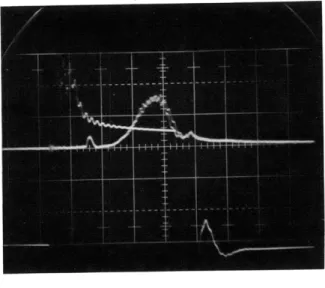
Fig. XX-9. Synchroscope (Video) output and voltage pulses applied to the sample as a function of time. Horizontal scale (time), 1 jsec/cm; vertical scales 5 V/cm (voltage), 0. 5 V/cm (Video). Observation frequency, 2330 MHz.
Figure XX-9 illustrates both the voltage pulse and synchroscope output from the Bi92Sb08 sample. This sample was chosen, since its microwave emission consisted of spike emission with no continuum radiation.
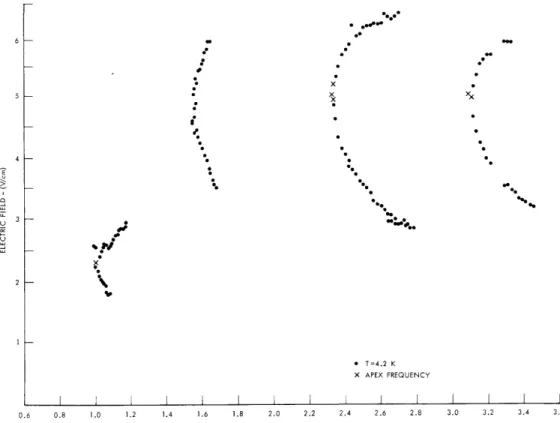
Figures XX-10 and XX-11 illustrate the electric field frequency dependence for the spiked emission from Bi92Sb08 at constant magnetic field. Many interesting features are evident from these figures. For a given spike there is a minimum frequency below which the spike fails to appear; this minimum frequency was called the apex frequency. The output from the synchroscope was dramatically different when the spiked radiation was at the apex frequency. This is illustrated in Fig. XX-12. The positions of the apex frequencies in Figs. XX-10 and XX-11 are denoted by the symbol X. These frequencies
(for the mid-electric field range) were fl = 775 MHz, f2 = 1540 MHz, f3 = 2320 MHz, and f4 = 3110 MHz. This type of spectrum is suggestive either of nonlinear generation of higher harmonics or parametric coupling of two or more waves. It was also observed that the lower frequency spikes emitted more microwave power than the higher frequency spikes.
In taking the data for Fig. XX-10 a triggering problem in the voltage pulser caused the sample to be heated. This heating apparently caused some sample damage. Fig-ure XX-11 gives data taken after sample damage. The effect of this damage appeared only to shift the electric field position of the spike apex but not its frequency.
To see whether heating was affecting the shape of the upper portion of the curves at higher sample voltages, the temperature of the liquid helium was lowered below its
D *0 0; 00
%
* T=4.2 K X APEX FREQUENCY I I I I I 0.6 0.8 1.0 1.2 1.4 1.6 1.8 2.0 2.2 FREQUENCY -(GHz) 2.4 2.6 2.8 3.0 3.2 3.4 3.6Fig. XX-10. Frequency, electric-field dependence of spiked emission from Bi92Sb08
at constant magnetic field of 2. 9 G. T = 4. 2oK before sample damage.
0 a C:P CP 0 0 - 0 0 00 - x 0 0Q 0 0 sl 0 o 0 odBo D00 00000 0 oYo000 00 00 00 Fig. XX-11. Frequency, electric-field dependence of spiked emission from Bi92Sb08 at constant magnetic field of 2. 8 G, for two sample temper-atures, 4.20K and 1.70K, after sample damage.
o T =4.2 K o T 1.7 K X APEX FREQUENCY SII I I I 0.6 0.8 1.0 1.2 1.4 1.6 1,8 2.0 2.2 FREQUENCY (GHz) 2.4 2.6 2.8 o000o 0.0 OoO °°°O00o, 3.0 3.2 ,,% Io I i I I 1 I I I POc o
Fig. XX-12.
Synchroscope (Video) output and voltage pulse applied to the sample as a function of time. Horizontal scale (time) 1
psec/cm;
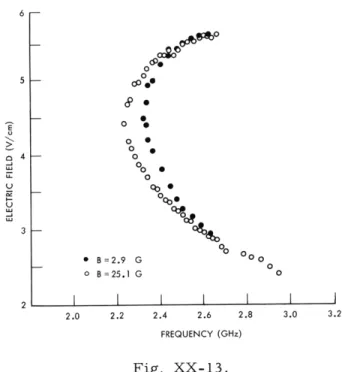
vertical scales, 5 V/cm (voltage), 0.5 V/cm (Video). Observation frequency, 2320 MHz (Apex). o000 o9 o 0 o o-0 o o 0 0 * B=2.9 G 0 0 - O o 8=25.1 G o I 1 1 2.0 2.2 2.4 2.6 2.8 3.0 3.2 FREQUENCY (GHz) Fig. XX-13. Spike spectrum for two values field for the Bi9 2Sb0 8 sample.0 0 0 0 0 0 0 0 0 0 0 o I I I I I I I 4 8 12 16 20 24 MAGNETIC FIELD (G) 28 32 ' 36 40
Fig. XX-14. Apex frequency, magnetic-field
Bi 9 2Sb0 8 sample. T = 4. 2K.
characteristics for the
of magnetic T = 4. 2°K. 3.2 -3.0 -2.8
-'I
U 2.6 S2.4 -2.2 --I I I I I I I. . . .I O OX-point. At this lower temperature the shape of the curve about an apex is more sym-metric. The data taken at this lower temperature are illustrated in Fig. XX-11 and is denoted by the symbol O . At this lower temperature we also found another spike branch at higher sample voltages. Notice also (Figs. XX-10 and XX-11) that the electric field at the apices occurs at approximate multiples of the lowest electric field apex.
In Fig. XX-13 the effect of magnetic field on the shape of a spike spectrum is illus-trated, and in Fig. XX-14, the effect of the magnetic field on the frequency of two apices.
C. A. Nanney, E. V. George [Dr. C. A. Nanney is at Bell Telephone Laboratories, Murray Hill, New Jersey.]
References 1. A. L. Jain, Phys. Rev. 144, 1518 (1959). 2. S. Tanuma, J. Phys. Soc. Japan 14, (1959).
3. S. Mase, J. Phys. Soc. Japan 13, 434 (1958); 14, 585 (1959). 4. D. M. Brown and S. J. Silverman, Phys. Rev. 136, 290 (1964). 5. S. Golin (to appear in The Physical Review).
6. E. V. George, Quarterly Progress Report No. 88, Research Laboratory of Elec-tronics, M.I.T., January 15, 1968, pp. 202-204.
7. E. V. George, Quarterly Progress Report No. 90, Research Laboratory of Elec-tronics, M.I.T., July 15, 1968, pp. 108-111.
XX. APPLIED PLASMA RESEARCH
C. Plasma Physics and Engineering
Academic and Research Staff
Prof. D. J. Rose Prof. E. P. Gyftopoulos Prof. T. P. Ziebold Prof. T. H. Dupree Prof. L. M. Lidsky Dr. R. A. Blanken
Prof. W. M. Manheimer Graduate Students
N. M. Ceglio M. Hudis K. Ohmae
H. Ching T. R. Hulick C. E. Wagner
D. G. Colombant M. A. LeComte R. J. Vale G. R. Odette
RESEARCH OBJECTIVES AND SUMMARY OF RESEARCH
1. High-Intensity 14-MeV Neutron Source
Our investigation of a possible design for a 14-MeV neutron source with 1015 n/sec total intensity is being continued. The source is small enough to achieve a surface flux of 1014 n/cm2 sec at this intensity - a flux high enough to test materials for fusion reactor use. The key feature of the source is the use of the Mach line of a freely expanding gas jet as the target for a high-energy tritium beam. The gasdynamic prob-lem has been solved; we are proceeding to study the optimum system parameters and scaling laws.
D. C. Colombant, L. M. Lidsky
2. Stuffed Cusp Experiment
Our original objective in this work was the investigation of the stability boundaries of hot-electron plasmas in several magnetic field structures. The plasma, formed by the beam-plasma interaction, has turned out to be very complex. We have therefore turned to a simpler version of the original problem - an attempt to measure and under-stand the nature and stability boundaries of the observed electron-cyclotron frequency instabilities. We shall use the plasma data gathered in pursuit of our first objective in conjunction with measurements obtained by use of a new high-frequency probe in this effort.
C. E. Wagner, L. M. Lidsky 3. Smaller Scale Experiments
We shall continue some smaller scale experiments based on the use of the HCD plasma source. These experiments are generally done as Master's research topics of approximately one year duration. The topics are chosen for their combination of educa-tional merit and scientific interest. Present topics include plasma rotation studies by Doppler-shift interferometry, diffusion studies by tracer injection, and ion acoustic wave propagation in the low-frequency ( <w ci) regime.
L. M. Lidsky
This work was supported by the National Science Foundation (Grant GK-2581).
4. Pulsed 10. 6 I. Laser Systems
We are investigating several schemes for increasing the Q-switch power output of the 10. 6 i H2-CO -He laser systems. The most promising idea at the moment involves using the afterglow of a high-pressure strongly excited discharge. The objective of this study, in addition to our increased understanding of the dynamics of the N2-CO2-He excitation transfer processes, is the development of simple techniques capable of pro-ducing pulses in the 0. 1-1. 0 MW peak power range.
L. M. Lidsky 5. Plasma Transport in the Hollow -Cathode Discharge
Although it is generally agreed that fluctuating electric fields are the cause of exper-imentally observed enhanced plasma transport, the expected quantitative relations between the magnitude and frequency of the fluctuations and the speed and direction of transport are not often satisfied. We have developed a new technique for the direct
mea-surement of diffusion flux and are using it to investigate plasma flows in the HCD. Our immediate goals are twofold.
a. To understand and control the coherent and turbulent oscillations of the plasma column. This will allow us to observe the nature of plasma transport in regimes in which directed drifts are dominant and in which true stochastic diffusion is dominant.
b. To compare the measurements obtained with our new synchronous probe tech-nique with those obtained by density-potential correlation techtech-niques under the same conditions. This will aid us in understanding why correlation techniques often fail.
M. Hudis, L. M. Lidsky 6. Plasma Confinement in a Levitron of Small Aspect Ratio
Construction of a model Levitron of small aspect ratio with a supported 10-cm diam-eter ring has been completed. Plasma is produced via electron-cyclotron resonance heating at 2. 8 GHz with up to 1 MW of power being supplied in a 10-[sec pulse. We plan to study plasma confinement in this device, focusing particular attention on the relation-ship between the structure of the low-frequency electric fields and diffusion.
R. A. Blanken, A. S. Ratner 7. Synchrotron Radiation from High-Density Plasmas
During this past year, the synchrotron emission from hot test electrons immersed in a dense background plasma has been examined theoretically and compared with pre-viously obtained experimental data. Using the results of these studies, we plan to
examine the synchrotron radiation process in high-density plasmas, especially in rela-tion to the energy balance of mirror reactors.
R. A. Blanken
8. The nonlinear stabilization of a variety of linearly unstable waves that propagate at multiples of the electron or ion cyclotron frequencies is being studied theoretically. Many of these waves become damped if real w is shifted by a small amount Aw << w. Such waves are easily stabilized if nonlinear effects broaden the wave-particle reso-nance by an amount A w.
(XX. APPLIED PLASMA RESEARCH)
9. A fine scale granulation of the plasma density is caused by the semirandom convec-tion of plasma by waves. This granulation appears to produce some interesting effects that are being investigated theoretically. For example, the grains or blobs can produce greatly enhanced Bremsstrahlung cyclotron radiation. The granulation also leads to a greatly enhanced fluctuation spectrum over a wide range of frequency and wave number. Such spectra are observed experimentally but do not seem to be just a superposition of plasma waves.
T. H. Dupree
10. The nonlinear properties of a standing drift wave are being studied by following ion trajectories numerically on a digital computer. In this way, one can obtain the harmonic distortion in the wave, particle transport across the field, and other quantities that can be compared with experiments.