The Design, Synthesis and Properties of
Pressure-Processable Biodegradable Block
Copolymers
by
Nathan Gary Lovell
B. Comp. Sci., University of Utah (2002)
B.S. Chemistry, University of Utah (2001)
SET
TCHN
2O5y
LBEP2 9 20 0 5
LIBRARiES
Submitted to the Department of Materials Science and Engineering
in partial fulfillment of the requirements for the degree of
Master of Science in Materials Science and Engineering
at the
MASSACHUSETTS INSTITUTE OF TECHNOLOGY
September 2005
( Massachusetts Institute of Technology 2005. All rights reserved.
Author
...
...
Department of Materials Science and Engineering
/*t -
August 11, 2005
Certified by
... ... .-..
...-.
j.
- '-Ann/I. Mayes
Toyota Professor of Materials Science and Engineering
MacVicar Faculty Fellow
Thesis Supervisor
Accepted by ...
Ge r · · · · . · Ci e. de....Gerbrand Ceder
R.P. Simmons Professor of Materials Science and Engineering
The Design, Synthesis and Properties of
Pressure-Processable Biodegradable Block Copolymers
by
Nathan Gary Lovell
Submitted to the Department of Materials Science and Engineering
on August 11, 2005, in partial fulfillment of the requirements for the degree of
Master of Science in Materials Science and Engineering
Abstract
In this thesis, biodegradable block copolyesters were specifically designed and
synthesized for their susceptability to pressure-induced mixing. These baroplastic
materials are capable of being processed and molded through the application of
pressure at temperatures far below those needed in traditional melt-processing
of biodegradable polyesters. Pressure molding at low temperatures reduces the
danger of chain degradation during processing that is ubiquitous in biodegradable
plastics.
The compressible regular solution model (CRS), in combination with group
contribution (GC) methods and pressure-volume-temperature (PVT) data, was
used to predict the phase behavior and pressure-induced miscibility of several
block copolymer systems. Small-angle neutron scattering (SANS) experiments
confirmed that amorphous forms of the poly(E-caprolactone-ran-5 ethylene ketal
-caprolactone)-block-poly(lactic acid) (PmCL-b-PLA) system exhibit
pressure-induced miscibility, and small angle x-ray scattering (SAXS) revealed that the
position of the upper disorder-to-order temperature (UDOT) in those systems
is near the values predicted by the CRS model. Differential scanning
calorime-tery measurements suggest that poly(1,5-dioxepan-2-one)-block-poly(lactic acid)
(PDXO-b-:P'LA), which was calculated as being more miscible than PmCL-b-PLA
by the CRS model, resides in a mixed state at ambient pressure and temperature.
The CRS predictions were found to be more accurate with component parameters
derived directly from GC than from PVT data.
Pressure processing of multiple systems at low temperatures was conducted,
and the mechanical properties of these biodegradable baroplastics (bbps) were
measured. Crystallinity plays a complex role in baroplastic behavior that has
not been fully elucidated. The strain-to-break and modulus of the bbps is good,
but somewhat reduced relative to solvent-cast or melt-processed samples. The
tunability of the properties of bbps, combined with their low-temperature
pro-cessability, make them promising candidates for biomedical materials and
envi-ronmentally friendly plastics.
Thesis Supervisor: Anne M. Mayes
Title: Toyota Professor of Materials Science and Engineering
MacVicar Faculty Fellow
Acknowledgments
This research was supported by the MRSEC program of the National Science
Foundation under award DMR-0213282. Additional sponsorship in the form of a
fellowship was provided by the DuPont-MIT Alliance and the National Science
Foundation. This work also benefited from use of the Intense Pulsed Neutron
Source at the Argonne National Laboratory, funded by the U.S. Department of
Energy, and the Institute for Soldier Nanotechnologies, under contract
DAAD-19-02-0002 with the U.S. Army Research Office. Drs. Pappannan Thiyagarajan,
Aravinda Raghavan, and Brian Pate, instrument scientists in those facilities,
pro-vided support and were essential to the collection and analysis of the scattering
data.
My amazing groupmates and advisor, Professor Anne M. Mayes, were the
source of inestimable academic guidance. Finally, I would not be here without
the perpetual example of knowledge applied and open-minded optimism of my
Contents
1 Introduction
1.1 Motivations for the Development of Biodegradable Baroplastics
1.2 Summary of Contents ...
2 Background
2.1 Biodegradable Thermoplastics.
2.1.1
Unique Uses and Limitations
. .
2.1.2
The Lineup.
2.1.3
Industry Supply and New Markets
2.1.4 Impediments to Adoption .
.2.2 Baroplastics.
2.2.1 Introducing Baroplasticity . . . . 2.2.2 Origins . . . .2.'2.3 Design Parameters ...
2.'2.4 Possible Mechanisms ...
2.3 Designing Biodegradable Baroplastics . .
2.3.1
The CRS Model ...
2.3.2
The Third Term of the CRS and BBP Systems
2..3.32.3.4
Morphology: Block Copolymers vs. Core-shell Nanoparticles
Crystallinity in a Baroplastic
...
15
15 1719
... . ...19 . . . .. . . .2219 ... . . . .. 20 22 . . . 23 . . . 23 . . . 23 . . . 24 . . . .25 25 . . . .27 . . . .27... . .30
31 322.3.5
On to BBPs.
3 Methods
3.1 Modeling .
3.1.1 Using the Compressible Regular Solution Model ...
3.1.2 Spreadsheet Calculations ...
3.1.3 Other Implementations.
3.2 Synthesis.
...
3.2.1 Reagent Purification ...
3.2.2 Monomer synthesis.
3.2.3 Poly(E-caprolactone)-block-poly(L-lactic acid)(PCL-b-PLLA).
3.2.4 Poly(E-caprolactone-ran-5 ethylene ketal
E-caprolactone)-block-poly(L-lactic acid)
(PmCL-b-PLLA).
3.2.5
Poly(1,5-dioxepan-2-one)-block-poly(L-lactic acid)
(PDXO-b-PLLA).
3.2.6
Poly(D,L-lactic acid) (PDLLA).
3.3 Chemical Characterization ...
3.3.1
Nuclear Magnetic Resonance Spectroscopy
3.3.2
Gel Permeation Chromatography (GPC) .
3.4 Thermodynamic Characterization ...
3.4.1
Small-Angle X-ray Scattering (SAXS) . . .
3.4.2
Small-Angle Neutron Scattering (SANS)
3.4.3
Differential Scanning Calorimetry (DSC)
3.5 Mechanical Characterization ...
3.5.1
Extrusion.
3.5.2
Processing.
... ...40
.... .. .. . .41... . .41
(NMR) ....
41
...
....41
... .... 42 ... .... 42 ... .... 42 ... .... 43 ... .... 43... . .43
... .. ..43
3335
35 35 37 37 37 37 38 39 403.5.3
Reprocessing
3.5.4 Tensile Testing ...
4 Results and Discussion
4.1 Modeling and Suitable Homopolymer Pairs
4.2 The BBP Candidates ...
4.2.1 Synthetic Batches . . . .
4.2.2 Thermodynamic Properties .
.4.3 The Reality Check: Baroplastic Processing
4.3.1 Processing Behavior . . . .
4.3.2
Extrusion.
4.3.3
Molding and Recycling ...
4.3.4
Mechanical Properties.
5 Conclusions
5.1 The CRS Model ...
5.1.1
Of UDOTs and Component Properties ...
5.1.2
The CRS Third Term and Pressure-Induced Miscibility
5.2 Baroplasticity, Mechanism of ...
5.3 Future Directions.
A Tables of Accessory Parameters
B Supplemental Data
44 4445
45 49 49 51 65 65 66 67 6977
77 77 79 80 8285
87
...
...
...
...
...
...
...
...
...
...
...
List of Figures
2-1 Ring-Opening Polymerization of PCL and PLA ...
21
2-2 The chemical structure of some candidate biodegradable polymers.
32
2-3 The chemical structure of PmCL ...
33
4-1 Phase diagrams calculated with the CRS model
...
48
4-2 Fluffy bbp candidate block copolymers
.
...
49
4-3 Representative DSC heating traces of different bbp candidates...
52
4-4 Temperature behavior of the SAXS of amorphous bcps ...
54
4-5 Phase diagrams for PmCL-b-PLA calculated with CRS model
.
56
4-6 SANS data from 30 kDa PmCL-b-PDLLA
.
...
58
4-7 SANS data from 80 kDa PmCL-b-PDLLA with pressure ...
60
4-8 Different deconvolutions of SANS depressurization data.
...
62
4-9 Peak trends in the scattering data of 80 kDa PmCL-b-PDLLA...
63
4-10 "Tree trunk" type phase behavior ...
64
4-11 A sample box top molded via pressure from PDXO-b-PLLA. ....
67
4-12 Plate processing a bbp from powder. ...
...
68
4-13 Gel permeation chromatography traces before and after processing
69
4-14 Summary of the mechanical property range of bbps ...
70
4-1 5 Trends in PmCL-b-PLLA mechanical properties with weight % LA. 72
5-1 The effects on SAXS of processing time in PmCL-b-PDLLA
. . .
81
5-2 Rapid aging in PmCL-b-PDLLA under processing conditions . . .
82
List of Tables
2.1 Properties of Selected Biodegradable Polymers ...
.
21
2.2 Some Systems Conforming to the Third-Term Criterion ...
31
4.1 Candidate BBP Component Properties ...
46
4.2 Results of CRS Calculations ...
..
47
4.3 Batches of Potential BBPs . . . .. . 50
4.4 Mechanical Properties of BBPs ...
75
Chapter 1
Introduction
1.1 Motivations for the Development of
Bio-degradable Baroplastics
The development of synthetic thermoplastics over the last century has ushered in
sweeping changes in products, packaging, and manufacturing. So profound have
these changes been that the Twentieth Century has been called the beginning of
the "Plastics Age", reflecting a paradigm shift as significant as that caused by
the introduction of bronze and iron in ages past.
However, with new paradigms come new challenges. The cheapness and
use-fulness of plastics made possible an unprecedented level of disposable society, a
phenomenon widespread in the United States today. In 2000, more than 9 billion
kilograms[:l] of plastic was used for packaging alone. By 2004, that number had
climbed to almost 12 billion kilograms[l]. Although landfill space is not considered
to be in short supply, the aesthetic impact of virtually everlasting packaging
scat-tered across the landscape is considerable. In addition to solid waste, that plastic
represents the consumption of energy, water, fossil fuels, and other resources.
Recycling programs recover some of the resin (for example, three-fourths of a
billion kilograms of bottles (21% of the production) in 2003[2]) for reprocessing.
That recycling in return recovers some of the initial resource investment, but the
economy and effectiveness of recycling is limited by deterioration of the polymer
resin; thermal degradation of additives such as antioxidants, UV stabilizers, and
plasticizers; the energy used to reheat the plastic; and the difficulty and expense
of separating and sorting the post-consumer feedstream.
Biodegradable thermoplastics are a small but important subset of the plastics
industry. In contrast to nonbiodegradables, they are not widely used for packaging
or durable goods. However, they have many biomedical applications, where the
biocompatibility and biodegradability of such polyesters as poly(glycolic acid)
1(PGA), poly(lactic acid)l (PLA) and poly(E-caprolactone) (PCL) make them
ideal components in tissue scaffolds, stents, sutures, and encapsulants for
con-trolled pharmaceutical delivery. From the FDA approval of PGA-based
ab-sorbable sutures in the 1960s, abab-sorbable polymers grew into an estimated $300
million industry in the U.S. by 1998, with 95% going to sutures[3]. Much
biomed-ical research is being done that makes new uses of these polymers, but there are
many factors involved in choosing device materials. In the case of load-bearing
applications, both the mechanical properties, geometry, and the rate of
degra-dation of the material must be matched to the local tissue properties and rate
of healing to avoid stress shielding and allow normal regrowth[4]. The rigorous
scrutiny given a potential biomedical material before it is approved by the FDA
limits the palette of polymers available for incorporation into new devices, and can
make it difficult to match the use with a suitable material. An additional obstacle
to the use of biodegradable polymers is the very property that makes them so
1Historically, nomenclature has been based on the monomer (e.g. polygycolide, polylactide), but the trend is to follow the International Union of Pure and Applied Chemistry (IUPAC) guidelines and name based on the repeat unit.
useful: their sensitivity to degradation by moisture requires very thorough drying
before melt-processing. Heat can also have the undesired effect of driving
back-wards the ring-opening polymerization reaction, the most typical biodegradable
polymer synthetic mechanism, producing monomers that may act as plasticizers
and modify the polymer properties. Finally, the high temperature required for
processing also prohibits the incorporation of easily denatured pharmaceuticals.
Recent developments have revealed a class of polymeric materials that can
be processed at reduced temperatures using pressure[5, 6]. The exact economic-,
energy- and waste-savings that non-biodegradable versions of these
"baroplas-tics" will make possible in the realm of conventional industrial thermoplastics are
presently being evaluated[7].
A biodegradable plastic material that did not need high-temperature
melt-processing., such as a biodegradable baroplastic, would likewise have advantages
over conventional biodegradables. This thesis describes the synthesis and
char-acterization of a family of pressure-processable, biodegradable plastic materials
dubbed biodegradable baroplastics ("bbp" s
1).
1.2 Summary of Contents
Chapter 2 describes the background of the theoretical and experimental basis
for bbps.
Chapter 3 reports the computational, synthetic, and characterization methods
used in the research, as well as the parameters of the instruments used.
Chapter 4 describes the results obtained, and discusses their relevance in the
context of this thesis.
Chapter 5 concludes this thesis with comments on the merits of the methods
and bbps created, as well as possible future developments.
Chapter 2
Background
2.1 Biodegradable Thermoplastics
2.1.1 Unique Uses and Limitations
Once snubbed for their lack of durability in environmental conditions, synthetic
polymers with backbones containing hydrolytically cleavable bonds are now the
main players when the booming bioengineering field picks materials for a new
implant device intended to break down as tissue rebuilds. Some bonds that have
this biodegradable characteristic are esters, anhydrides, amides, and orthoesters.
Not surprisingly, many naturally-occurring polymers (e.g. proteins) are built up
using these bonds.
The challenges inherent in purifying natural polymers and preventing patient
immune response to them are still topics of research. Nevertheless, Mother Nature
has been making polymers far longer than human industry, and catgut" (actually
-97% collagen fibers from sheep intestines) degradable sutures were once the most
commonly used. Catgut sutures are still on the market, in spite of "moderate"
The first totally synthetic absorbable suture was developed from polyglycolide
(PGA) in the 1960s[3]. PGA, like many biodegradable polymers, is semicrystalline
(-50%). This crystallinity makes it insoluble in most solvents and very stiff; too
stiff, in fact, for use as a monofilament suture: it has to be braided.
This is one example of the types of material properties limitations that are
encountered and must be dealt with when selecting an appropriate biodegradable
polymer for biomedical uses. A more complete enumeration of the criteria[3]
includes:
1. Mechanical properties that match the application, tissue, and time scales
2. Ease of processing into the needed form
3. Biologically benign: no immune or toxic effects
4. Break-down products that are fully metabolized
5. Acceptable shelf life
6. Easily sterilized
The latter four criteria are dependent principally on the chemical composition
of the polymer; the first two are accessible via structure and morphology. This
thesis therefore treats the issues of mechanical properties, processing, and
struc-ture of biodegradable polymers, taking as a starting point the array of accepted
bioresorbable materials already known.
2.1.2 The Lineup
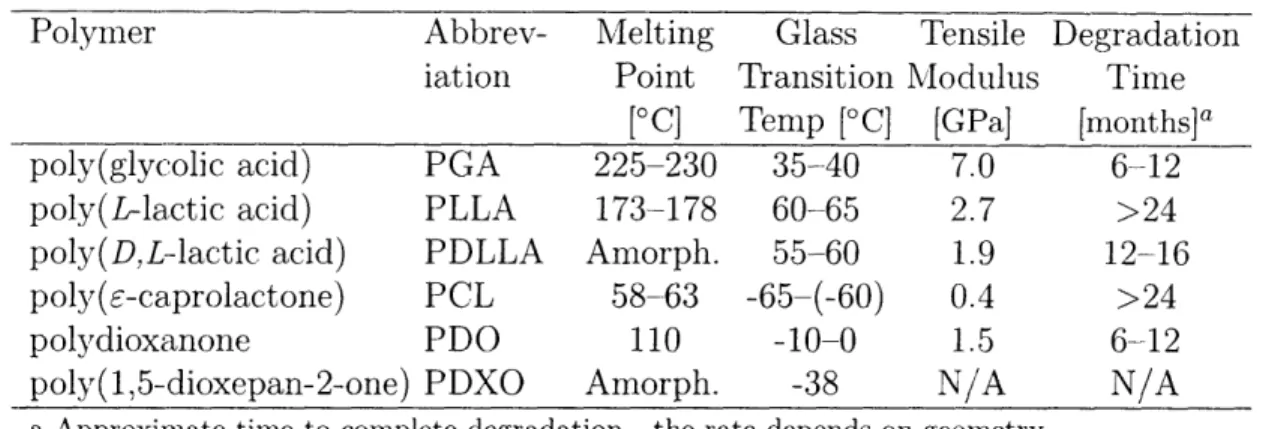
The characteristics of some of these biodegradable polymers are listed in Table
2.1. These are all aliphatic polyesters, the most common class of polymers in
early biomedical devices. Although other polymer chemistries have come into
Table 2.1: Properties of Selected Biodegradable Polymers
Polymer
Abbrev-
Melting
Glass
Tensile Degradation
iation
Point
Transition Modulus
Time
[°C] Temp [C] [GPa] [months]a
poly(glycolic acid)
PGA
225-230
35-40
7.0
6-12
poly(L-lactic acid)
PLLA
173-178
60-65
2.7
>24
poly(D,L--lactic acid)
PDLLA
Amorph.
55-60
1.9
12-16
poly(E-caprolactone)
PCL
58-63
-65-(-60)
0.4
>24
polydioxanone
PDO
110
-10-0
1.5
6-12
poly(1,5-dioxepan-2-one) PDXO
Amorph.
-38
N/A
N/A
a Approximate time to complete degradation-the rate depends on geometry.
Sources: [3, 9, 10].
use, the polymers listed here comprise a broad spectrum of degradation times
and mechanical properties. Consider that the blends and copolymers of these
components can be designed to fall between the extremes, and even this small
group of polymers is very versatile. An added benefit is that these polymers share
a common synthetic method (ring-opening polymerization [Fig. 2-1], typically
with a stannous octoate or aluminum isopropoxide catalyst).
O
= 0
0
-toJV
0
O
Figure 2-1: Ring-Opening Polymerization of PCL and PLA
As has been mentioned, these are mostly semicrystalline polymers, except
where both isomers of the monomer are present or some other main-chain feature
exists that prevents orderly packing. So effective is the crystallinity at stabilizing
the chains that the softer, amorphous (D,L) form of PLA is used for drug
encap-sulation, while the hard, durable crystalline form is used in orthopedic implants.
We will return to the issue of crystallinity in a later section.
2.1.3 Industry Supply and New Markets
Historically, natural, biogenic polymers were viewed as being too difficult to
produce reliably [3], with preference given to traditional petrochemical-derived
monomers and chemical synthetic processes. Even with traditional processes,
high production costs have limited the use of biodegradable polymers as
com-modity plastics. However, changing public perceptions, legislation, and industry
concerns for the continuation of reliable and inexpensive petroleum feedstock have
motivated alternative approaches. DuPont and Cargill Dow have released new
polymers synthesized, at least in part, from corn fermentation products. DuPont's
Sorona is a copolymer of 1,3-propanediol (PDO) and terephthalate, and just a
single step in the company's goal to have 25% of their products derived from
re-newable sources by 2010[11]. Cargill Dow's recently completed NatureWorks plant
in Nebraska has the capacity to produce 140 million metric tons of poly(lactic
acid)[11]. While both of these product lines require microbial action to
pro-duce their monomer (in fact, DuPont engineered the microbes to propro-duce PDO),
the polymerization is carried out using traditional synthetic methods. However,
Metabolix (Cambridge, MA) is actually synthesizing polymers completely
bio-logically: polyhydroxyalkanoates (PHAs, sold as Biopol), which are produced by
bacteria for energy storage. Metabolix has been in business since 1992 developing
bacterial strains able to produce a variety of PHAs with much higher efficiency
than wild strains[ll].
poly-mers and also opening new markets for those polypoly-mers. Sorona and NatureWorks
PLA have been developed into excellent textiles[ll]. The increased efficiency and
economy of scale of the new Cargill Dow plant allows NatureWorks to produce
food packaging films at competitive rates. Metabolix PHA found its first
non-comissioned industrial use as a residue-free binder in the fabrication of complex
metal parts[11].
2.1.4 Impediments to Adoption
Although the scale of these new endeavors has reduced the cost of biodegradable
polymers to rates competitive with conventional commodity plastics, they still
have some disadvantages. The low thermal stability of the aliphatic polyesters
such as PLA and PGA has prompted researchers to incorporate other components
to stabilize them. Aromatic compounds like phthalates are chosen for their
stabil-ity and stiffness. These additives have the unfortunate, but not unexpected, effect
of decreasing biodegradability and raising molding temperatures (and hence,
en-ergy consumption)[12, 13]. They may also pose a health risk. For example, the
phthalic acids produced by hydrolysis of the polymer have been recognized as
endocrine disrupters[14]. A different, better solution to the problem is in order.
2.2 Baroplastics
2.2.1 Introducing Baroplasticity
Recent research has demonstrated that pressure is a thermodynamic alternative to
temperature for inducing polymer flow, or otherwise enhancing processability. A
series of publications[5, 6, 15-17] on the behavior of polymer pairs under applied
pressure demonstrate that certain pairs undergo a pressure-induced miscibility
that, in combination with their chosen respective "soft" and "hard" textures (low
and high Tg, respectively) at room temperature, makes them "baroplastic" in
nature. This opens the door for a class of plastic materials that become
process-able with the application of hydrostatic pressure at greatly reduced temperatures
relative to traditional thermoplastic processing.
2.2.2
Origins
In 1998, Russell and coworkers reported that the miscibility of the blocks of
poly-styrene-block-poly(n-butyl methacrylate) (PS-b-PBMA), as measured by
small-angle neutron scattering (SANS), is enhanced by pressure[6]. Follow-up studies
showed similar behavior for block copolymers (bcps) of PS with other n-alkyl
methacrylate species[16-18]. Polybutadiene-block-polyisoprene does the same[19],
as does poly(ethylene propylene) when in a bcp with poly(ethyl ethylene)[20] or
poly(dimethyl siloxane)[21]. This transition from order to disorder brings with it
all the phenomena observed in the upper disorder-to-order temperature (UDOT)
when reached thermally, including the change in stiffness from solid to melt as
measured rheologically[22, 23] and the decrease of the scattering intensity of the
SANS correlation hole of the bcp.
Recognizing the merits of a pressure-based means of reaching the melt state,
Mayes and coworkers developed several baroplastic systems using the predictions
[Section 2.3.1] of an extension of the Flory-Huggins regular solution model[15].
The PS/poly(n-butyl acrylate) (PS-b-PBA) and PS/poly(2-ethylhexyl acrylate)
(PS-b-PEHA) systems were synthesized and tested; first, as bcps. Then, due to
the relatively high cost of bcps in industry, core-shell particles were synthesized
via a sequential emulsion process[5]. In both structures, the final precipitate could
be molded at ambient temperature using a hydraulic press. The resulting rigid
parts were transparent and very true to the mold. Furthermore, the material was
shredded and remolded ten times, with little change in properties.
2.2.3 Design Parameters
The requirements for a baroplastic utilizing pressure-induced miscibility are that
it:
1. comprise material which is pressure-induced miscible
2. is composed of a hard (high Tg) and a soft (low Tg) component
3. has components which are unmixed at ambient temperature
4. has a high degree of interfacial surface area.
The core-shell nanoparticle and block copolymer structures both satisfy this
final point, so long as the core-shell diameter is small and the particles are never
heated above the hard component Tg. Should the core-shell structure be given
sufficient mobility, macrophase separation would occur, irreversibly eroding the
mechanical properties of the material. Polystyrene (Tg
9100 °C) also makes a
good hard component with PBA (Tg -54
°C) or PEHA (Tg
-
-50 °C) as the
soft component, because of the aforementioned pressure-induced miscibility.
2.2.4 Possible Mechanisms
Pressure-induced Miscibility and Semi-solid Processing
The initial theoretical basis and impetus for these baroplastics was the
observa-tion of pressure-induced miscibility between the component polymer pairs. Closer
analysis of the baroplasticity phenomenon reveals some interesting details. The
first of these is that the processing mechanism seems to be via, semi-solid flow,
sim-ilar to some metal fabrication processes[24]. In this mechanism, a small amount
of liquid phase mobilizes the remaining solids. In a baroplastic system, the soft
component is free to solvate and flow with the hard component under mixed
conditions. If this mixing of hard and soft phases was completed during each
pro-cessing step, the system could reasonably be expected to freeze in some fraction
of mixed phase as the pressure was released. Yet a study of the Tgs in
differen-tial scanning calorimetry (DSC) traces of samples as precipitated, and after ten
processing-recycling cycles, showed very little variation in the relative fraction of
mixed and unmixed material. When it is considered that the fully mixed-state
Tg of a typical example of these materials (66 wt percent PS)-estimated
by the
relationship
1/Tgmi =
wl/Tg,l + w2/Tg,2(2.1)
from the component Tgs and weight fractions-is 28 °C, it is clear that simple flow
of a homogeneous mixture is not a likely explanation for the baroplastic
process-ability. This lends support for the semi-solid processing mechanism hypothesis,
as the fully mixed system would not have the mobility to flow.
Small Particle Compaction
It is interesting to note that even polymer systems that have been shown to
have the opposite reaction to pressure (pressure-induced immiscibility) can be
processed to a limited degree from the initial core-shell powder. The polystyrene/
polyisoprene control bcps resisted attempts to pressure mold, but the core-shell
nanoparticles of that system could be formed into transparent films. However,
these films had little strength, and reprocessing them resulted in poor cohesion[5].
Similar results were obtained with a polystyrene/poly(lauryl methacrylate)
core-shell system[25]. Hence, the flow properties are largely linked to the
soft-to-hard component ratio, while the resulting mechanical properties depend on pair
miscibility.
2.3 Designing Biodegradable Baroplastics
2.3.1 The CRS Model
The strategy in statistical mechanics is to find useful ways to approximate the
behavior of complex molecular systems with simpler, more tractable models.
Ide-ally, the predictions these models make about physical properties can then be
verified experimentally. One application of this strategy is to predict the phase
behavior of polymer blends or block copolymers (bcps). In the case of a bcp,
where two different types of polymer molecules coexist in close proximity due
to their covalent tether, the available phases are most simply described as
dis-ordered, when the two components are thermodynamically compatible (mixed);
and ordered (the incompatible components assume regular, periodic morphologies
as they minimize interfacial area).
Two basic types of transitions between the mixed and unmixed phases have
been reported in polymer blends[26-28] which have corresponding
disorder-to-order counterparts in bcps: one that occurs as the temperature increases past a
coexistence curve with a maximum called the upper critical solution temperature
(UCST), causing a transition from an unmixed state to a mixed state; and a less
common one at a lower critical solution temperature (LCST) leading back into
an unmixed state. The respective equivalent bcp transitions occur at the upper
disorder-to-order temperature (UDOT) and lower disorder-to-order temperature
(LDOT), when the blocks of the copolymers mix, and then segregate and order
again.
Flory's original lattice-based model for free energy of mixing (per site),
AGT A In A + B In B + OAOBXFH (2.2)
predicts is reached when the entropic contribution (the first two terms)that a UCST
equals the enthalpic interactions. i is the volume fraction of component i, and Ni is the degree of polymerization of component i. The enthalpic interactions are encapsulated in the Flory-Huggins chi parameter (XFH), which captures the difference in energy
between self-interactions
(EAA, EBB)and A-B interactions
(EAB),xFHz[
EAA +EBB/kT
X
FH= Z AB -
/T
(2.3)
and is defined as inversely proportional to temperature and independent of polymer chain length, composition, and pressure (z is the lattice coordination number). Thus, the UCST is driven by the decrease in enthalpy with increasing temperature until combinatorial entropy finally triumphs. Due to the simple mixing rules leading to XFH and the rigid lattice being fully populated with segments of the two polymer species (no free volume: A + /B = 1), this model is said to be an incompressible regular solution
model.
However, because of these simplifications Flory made in creating the model, it lacks the ability to predict complex behavior. For example, it is not able to predict the LCST transition without altering the expression for XFH. More complex models have been described[15, 16, 29-34] to increase the information in X and include density (compressibility) effects. These methods are able to model the LCST transition, which occurs as the temperature continues to rise past the enthalpy-based UCST until a point is reached where the free volume and entropy effects prevail in turn over the combinatorial entropy. In addition, the models predict the existence of another UCST (u-UCST) above the LCST for certain polymer pairs. At the u-UCST, the temperature-dependence of entropy leads to a final return to a mixed state.
Previous work by Ruzette et al. (see e.g. the doctoral thesis[35] and concurrent publications[15, 16]) exploring the behavior of block copolymers under hydrostatic pressure, also proposed the compressible regular solution (CRS) extension to the Flory-Huggins model and demonstrated its accuracy in correctly predicting the phase behavior of more than 30 polymer systems[15, 16, 36].
Although the CRS reduces to the lattice-based Flory-Huggins model in the incom-pressible limit, it is modified to account for compressibility at finite temperatures:
/g\mi, - kT TAPA In A tPB
lnB
+ OAqBPAPB(4AO - BO)LNA
VABV
+
qAqB[(A
A-
B)(j -
5j)]
(2.4)
Here, v is the hard core segmental volume, io and i are the solubility parameters at temperatures 0 K and T, respectively, and Pi = Pi/P*, where p is the hard core density (0 K), i is the reduced density, and Pi is the density at temperature T. The enthalpic portion (2 nd term) here is similar to FH with a geometric mean approximation for A-B interactions, but the interactions are diluted by the amount of free volume.
The CRS model is not a full equation of state (EOS) because it lacks a pressure component, but it improves on the limitations of e.g. the lattice-fluid model[32, 33], in that taking the second derivative with respect to composition yields the spinodal criterion:
kT
4
-FA t1BNBP 3 ] +2PAPB(6AO-B + ) 2(A B)( 0 (2.5)This expression allows the mixed-state stability to be evaluated using only pure compo-nent properties as input. These parameters can be extracted from temperature-volume data, or estimated using a group contribution (GC) scheme[37, :38]. The GC approach makes it straightforward to predict phase behavior for systems lacking any experimen-tal data. The independence from experimenexperimen-tal interaction parameters is achieved by assuming Berthelot's mixing rule (a geometric mean of pure component parameters) for the solubility parameter[15, 16],
JAB = VAABB
(2.6)
As might be expected, small variations in the parameters can significantly affect the calculated transitions. It has not surprisingly been observed[35] that the behavior of
polymers with strong interactions (polarity, H-bonding) are poorly modeled this way. The other limitation of the CRS in the present application is that no consideration is made for the unique characteristics of block copolymers: the model is derived for polymer blends.
2.3.2 The Third Term of the CRS and BBP Systems
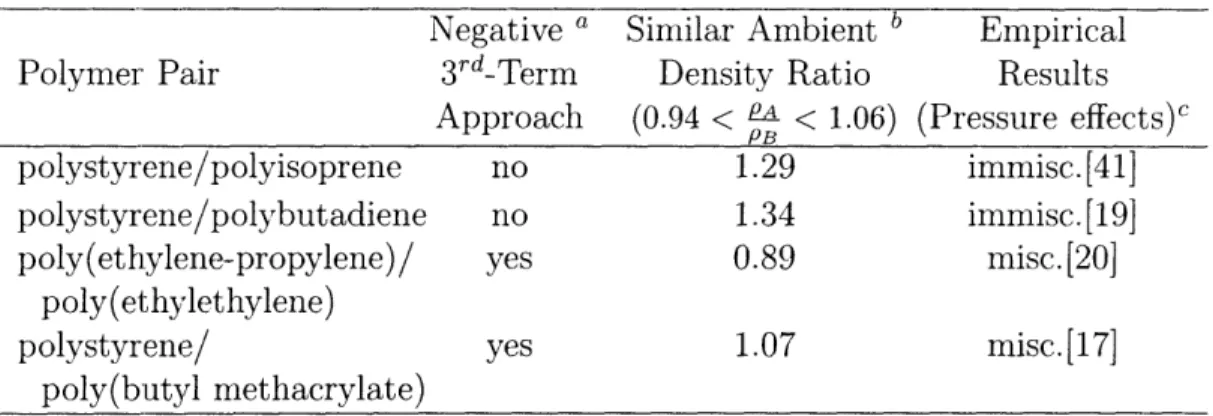
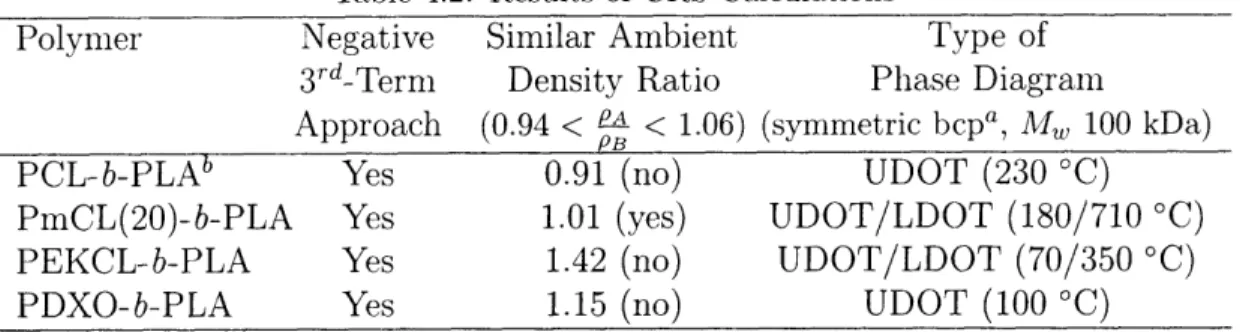
The lack of pressure as a parameter in the CRS expression precludes using the model directly to predict pressure-dependent shifts in phase transition temperatures (the UDOT/ UCST and LDOT/LCST). Instead, analysis of the second derivative of the CRS free energy expression (the spinodal criterion) [Eqn. 2.5] yields a predictive tool. The first two terms are analogous to the Flory-Huggins entropy (-) and enthalpy (+) of mixing terms, and the enthalpy term dominates when X is large; however, the third term is due to differences in compressibility. It can either favor (-) or oppose (+) seg-mental mixing, tending to zero in the incompressible limit. It was previously noted[5] that many systems with similar ambient densities (0.94PA < PB < 1.06PA)[39], in which the third term approaches zero at 0 K from negative values, exhibit pressure-induced miscibility. By comparison, the third term for the two commercially important block copolymer systems PS/polyisoprene and PS/polybutadiene, which exhibit reduced mis-cibility with applied pressure[40, 41], approaches from the positive side. The third term may therefore be useful as a guideline when designing baroplastic systems from pure component properties. This, in combination with the characteristics of the temperature-composition phase diagram of the systems under investigation, was used as criteria for the bbp candidates. Table 2.2 lists some polymer pairs with previously characterized pressure behavior, and the results of the third-term calculations for each. Note that the ambient density ratios PA/PB for the pressure-induced miscible systems are near unity compared to those systems which do not have pressure-induced miscibility. Their ratios are, however, outside the acceptable range of 6% arrived at previously for these same systems[5] because they are taken from parameters derived completely from the group contribution methods. The reasons for using excusively the GC parameters in
this context will become apparent in chapter 4.
Table 2.2: Some Systems Conforming to the Third-Term Criterion
Negative
aSimilar Ambient
bEmpirical
Polymer Pair
3rd-Term
Density Ratio
Results
Approach
(0.94 <
a< 1.06) (Pressure effects)c
PB
polystyrene/polyisoprene
no
1.29
immis
polystyrene/polybutadiene
no
1.34
immis
poly(ethylene-propylene)/ yes 0.89 misc
poly(et;hylethylene)
polystyrene/ yes 1.07 misc
poly(butyl methacrylate)
a Calculated from group contribution-derived parameters.
b Ambient density extrapolated from GC melt-state value using GC-derived a. c Pressure-induced miscibility (misc) or none (immisc).
c.[41]
Cc.[19] .[20]
.[17]
2.3.3
Morphology: Block Copolymers vs. Core-shell
Nano-particles
It was described earlier how both bcps and core-shell nanoparticles were proven to be effective structures for baroplastic processing. The cost advantages of the two-stage emulsion polymerization available for the styrene/acrylate based systems make it an obvious first choice from a production cost standpoint (emulsion polymerization is used in the production of latex paint, among other things). Unfortunately, the condensation or ring-opening polymerization mechanism in polyester synthesis disallows the emulsion technique. Thus, all the potential bbps investigated for this thesis were block copolymers synthesized via ring-opening polymerization. Figure 2-2 shows the chemical structures of some of the monomers.
-o
o
o
o
poly(lactic acid) poly(c-caprolactone) poly(m-caprolactone) poly( 1,5-dioxepan-2-one)
Figure 2-2: The chemical structure of some candidate biodegradable polymers.
2.3.4
Crystallinity in a Baroplastic
The simple UDOT-LDOT phase behavior discussed earlier, and the CRS model used for predicting that behavior, ignore the possibility of polymer crystallinity. This is fine when working with atactic (irregularly ordered) polystyrene and poly acrylates, which are highly amorphous; however, as Table 2.1 shows, many biodegradable polymers are semicrystalline. The crystallinity gives these polymers rigidity and resistance to hydrol-ysis, which extends their useful life. However, it also seems possible that the immobility and density of crystallized polymer chains could disrupt the pressure-induced miscibility mechanism of baroplasticity.
By altering the tacticity or appending a side-group to a normally crystalline poly-mer, crystallinity can be disrupted. For this study, both crystalline and amorphous versions of common biodegradable polymers were synthesized and tested as bbps. The chiral center of the lactide monomer make this task straightforward, as levoratory
(L) and dextrorotary (D) stereoisomers will copolymerize into amorphous PDLLA.
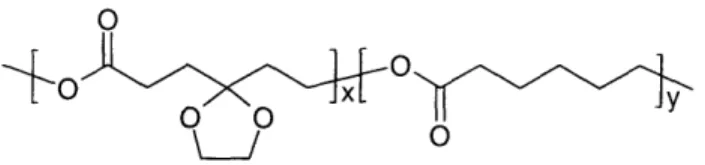
However, for achiral monomers like -caprolactone, a modification of the chain is required to achieve an amorphous state. A method of oxidizing the carbon of the -caprolactone[42-44] to a ketal produces 1,4,8-trioxa[4,6]spiro-9-undecanone (TOSUO). When this modified caprolactone is polymerized (yielding poly(5 ethylene ketal -caprolactone), or PEKCL) or copolymerized with up to 0.81 mol fraction e-caprolactone, the resulting polymer is amorphous. The copolymer [Fig. 2-3], poly(E-caprolactone-ran-5 ethylene ketal -caprolactone) (PECLEKTEC, or more simply, PmCL)1, has a Tg of
1
PmCL will typically be followed parenthetically with the mol percent PEKCL in the E-caprolactone.
0
00 o
poly(E-caprolactone-ran-5-ethylene-ketal-c-caprolactone)
Figure 2-3: The chemical structure of PmCL
-60 °C to .-40 °C. The backbone of the amorphous polymer PDXO is similar to that of PCL and PEKCL, except that the 6-carbon, which is oxidized to the ketal in PEKCL, is replaced in PDXO by an oxygen.
2.3.5 On to BBPs
It is clear that both a use and a precedent for bbps exist: The low-temperature process-ability removes one of the most serious obstacles to the production of biodegradable plastic devices, and non-biodegradable baroplastics have already been engineered that have the potential to reduce processing energy and time costs over the current commod-ity plastics.. The theoretical and experimental basis for designing bbps was described here, and the challenges considered: If a hard and soft biodegradable polymer pair with predicted pressure-induced miscibility can be found, synthesized with a structure that provides high interfacial area, and then processed into cohesive parts via the applica-tion of pressure at low temperature, in spite of crystallinity, degradability, and different synthetic chemistry, then this research will have accomplished its goals.
Chapter 3
Methods
3.1 Modeling
3.1.1 Using the Compressible Regular Solution Model
The CRS model was employed to design the potential biodegradable baroplastic (bbp) systems. To do so required that we: (i) Obtain the relevant EOS parameters. It was necessary to obtain the thermal expansion coefficient aT and hard core density p* or volume v*, which is the segmental volume extrapolated to 0 K with the melt-state thermal expansion coefficient by the relation[15, 16]:
p(T)= p*exp(-aT)
(3.1)
These were approximated with group contribution (GC) or gleaned from the literature.
(ii) Find the solubility parameters () for each polymer. The cohesive energy density
(32) can be extracted from molecular dynamics simulations of homopolymer melts, or from GC or literature. (iii) Implement a program to evaluate the spinodal criterion
[Eqn. 2.5], as a function of temperature and composition, with the component properties as parameters.
parame-ters for many polymers have been reported[45]. Additionally, empirically derived group contribution methods have been described which show a reasonably good ability to pre-dict polymer properties[37, 38]. These tools were used to calculate the necessary param-eters for the various candidate biodegradable polymers. For the copolymer PmCL, the contribution of each homopolymer to the EOS and solubility parameters was calculated according to molar and weight fractions following the reported methods[35]. Two alter-native ways of calculating the parameters are used here. The first follows the previous works on the CRS, and consists of GC-derived solubility parameters and the thermal expansion coefficient ao taken from the melt state of pressure-volume-temperature data. The hard core density p is then calculated by extrapolating backwards from the density in the melt state. Component parameters with a partial PVT origin like this are re-ferred to as PVT parameters, while those derived exclusively from group contributions are reffered to as GC parameters.
With the component parameters calculated, the phase behavior of various polymer pairs was plotted using the CRS free energy stability criterion. Although the CRS model was derived for polymer blends, an approximation for block polymer phase behavior was made by using a bcp-to-blend degree of polymerization (N) equivalence of 5.25
(which is a direct consequence of the Flory-Huggins model). In other words, the block copolymer modeling calculations were based on a blend with NA = NA,bCp/5.25 and
NB = NB,bcp/5.25. The polymers PLLA1, PDLLA, PCL, PmCL, and PDXO were each analyzed as baroplastic candidates by calculating the approach of the third term of the CRS expression to zero at 0 K[Section 2.3.2]. Table 2.2 lists systems previously studied and found to exhibit pressure-induced miscibility or immiscibility, along with the result of fully GC-based CRS third-term calculation. (Note: PGA was rejected prior to the
calculations due to its high degree of crystallinity and relatively low Tg.)
1
3.1.2 Spreadsheet Calculations
Preliminary evaluative studies were made with a spreadsheet that calculated a phase diagram using "real" polymer data from the table in [15] to verify the implementation.
Then the data for the biodegradable polymers were used to study their potential for
baroplastic processing.
3.1.3 Other Implementations
A program written in the C++ language was used to verify and enhance the spreadsheet results. The program reads in values for each of the component parameters and traverses the phase diagram from 0 K upward. At each step, X is calculated to find the local
maximum or minimum in energy using the third derivative of the CRS free energy with composition,
dgo c=kT
2PA _ PB1=0
(3.2)ANAVA o2BV7~J
which can be solved directly for a given temperature. In this fashion, a critical point is found when gQ changes sign. This program permitted a more comprehensive, auto-mated investigation of the parameter space of the model[46]. The program finished by outputing a temperature-composition phase diagram for the polymer pair.
3.2 Synthesis
The synthetic protocols for the bbps were developed by Dr. Ikuo Taniguchi, who also synthesized many of the bbps used in researching this thesis.
3.2.1 Reagent Purification
1,4-Cyclohexanedione monoethylene acetal (Alfa Aesar, MA), 3-chloroperoxybenzoic acid (ca. 70%, Aldrich, WI), tetrahydro-4H-pyran-4-one (Aldrich), and stannous oc-toate (SnOct2) (Alfa Aesar) were used as received. Toluene (Aldrich) was dried by
refluxing over calcium hydride and then distilling in a nitrogen atmosphere. L-lactide (L-LA) (Aldrich) and D,L-LA (Alfa Aesar) monomers were purified twice by recrystal-lization in dry toluene and dried under reduced pressure (10-2 mmHg) for at least 12 hours before use. -caprolactone (E-CL) (Aldrich) was dried over calcium hydride for 48 hours at room temperature and distilled under reduced pressure just before use. Alu-minum isopropoxide [Al(OiPr)3] (Aldrich) was distilled twice under reduced pressure
and then dissolved in dry toluene under nitrogen. The concentration of this distillation of Al(OiPr)3 was determined from the degree of polymerization of poly(E-caprolactone)
(PCL) after ring-opening polymerization of -CL with this catalyst. Ethanol (Alfa Aesar) was dried over 3 A molecular sieves (Mallinckrodt Specialty Chemicals Co., Kentucky). Other organic and inorganic compounds were of reagent grade and used
without further purification.
3.2.2 Monomer synthesis
1,4,8-trioxa[4,6]spiro-9-undecanone (TOSUO)
TOSUO was synthesized by Baeyer-Villiger oxidation of 1,4-cyclohexanedione mono-ethylene acetal using methods similar to those reported by Tian et al[42-44]. Briefly, 3-chloroperoxybenzoic acid (36 g, 146 mmol) was added to 220 mL dichloromethane, followed by anhydrous MgSO4 to remove water. After filtration, 1,4-cyclohexanedione
monoethylene acetal (21 g, 135 mmol) was added gradually to the ice-bath chilled resulting solution. The reaction mixture was refluxed at 40 C for 16 h, and then cooled to 0 C and filtered to remove the white precipitate. Fifteen grams of sodium bisulfite and 50 mL water were added to eliminate the remaining peroxybenzoic acid and the corresponding benzoic acid. After stirring vigorously for 3 h, sodium bicarbonate was added to the mixture until no further gas evolution was observed. The organic
phase was collected and dried with MgSO4, and the solvent was evaporated. The crude
yield of TOSUO was ca. 85%. The TOSUO was then twice purified by recrystallization in anhydrous ether and dried under reduced pressure (10-2 mmHg) for at least 6 h.
'H-NMR (400 MHz in CDC13), (ppm): 1.88 (t, 2H, CH2), 2.01 (t, 2H, CH2), 2.68 (t,
2H, CH2CO), 3.97 (s, 4H, CH2), 4.26 (t, 2H, CH2OC).
1,5-dioxepan-2-one (DXO)
DXO was also synthesized via Baeyer-Villiger oxidation; specifically, of tetrahydro-4H-pyran-4-one acetal, following the methods reported by Mathisen et al.[9] Typically,
3-chloroperoxybenzoic acid (42 g, 170 mmol) was added to 300 mL dichloromethane followed by the addition of anhydrous MgSO4 to remove water. After filtering, the
tetrahydro-4H-pyran-4-one acetal (15 g, 150 mmol) was added gradually to the ice-cooled solution. The reaction mixture was allowed to reflux at 40 °C for 16 h. The crude DXO was isolated just as the TOSUO was, with a yield of ca. 80%. Just before use, the DXO was distilled twice under reduced pressure. 'H-NMR (400 MHz in CDCl3),
(ppm): 2.90 (t, 2H, CH2CO), 3.83 (t, 2H, OCH2CH2OCO), 3.89 (t, 2H, OCH2CH2CO),
4.30 (t, 2H, CH20CO).
3.2.3
Poly(E-caprolactone)-block-poly(L-lactic
acid)
(PCL- b-PLLA)
To a previously flame-dried round-bottom flask equipped with a magnetic stir bar, SnOct2 (80 mg, 0.2 mmol) and ethanol (70 mg, 1.5 mmol) were added inside a glove
box (Unilab (1200/780), Mbraun, NH) with a nitrogen atmosphere. -CL (11.4 g, 100 mmol) and 5 mL dry toluene were successively injected into the flask through the rubber septum. The reaction mixture was stirred at 110 C for 24 h, when 100% conversion of E7-CL was confirmed by 1H-NMR. The reaction flask was returned to the glove box and opened to permit the addition of L-LA (10.2 g, 71 mmol). After resealing the flask, it was kept at 110 C for a week with constant stirring. Following the block copolymerization, dichloromethane was added to dissolve the polymer, which was recovered by precipitation in methanol containing excess 1N HC1 to remove the
3.2.4 Poly(c-caprolactone-ran-5 ethylene ketal
s-caprolact-one)-block-poly(L-lactic acid)
(PmCL- b-PLLA)
The typical method for synthesis of high molecular weight PmCL-b-PLLA was as fol-lows: To a previously flame-dried round-bottom flask equipped with a magnetic stir bar, TOSUO (2.5 g, 15 mmol), SnOct2 (40 mg, 0.1 mmol) and ethanol (8 mg, 0.2
mmol) were added inside a glove box, under nitrogen. After resealing, -CL (7.2 g, 63 mmol) and 5 mL dry toluene were successively injected into the flask through a rubber septum. The ring-opening polymerization technique was the same as for PCL-b-PLLA, and L-LA (8.0 g, 56 mmol) was used as the monomer for the second block in the copolymer synthesis. However, for the synthesis of low molecular weight PmCL-b-PLLA, Al(OiPr) 3 was used as the catalyst instead of SnOct2. For those syntheses,
total monomer and initiator concentrations were kept to 1 M and 13 mmol, respectively. After 15 h at 25 C, a certain amount of L-LA was added in a glove box, and the vessel was resealed. The reaction mixture was kept at 80 C for 72 h. The resulting polymers were recovered by reprecipitation in cold methanol containing excess N HC1. However, because Al(OiPr)3 has three initiation sites for L-LA (although just one for s-CL), it
was necessary to remove PLLA homopolymer by reprecipitation in cold acetone, which precipitates only the PLLA homopolymer[47].
3.2.5
Poly(1,5-dioxepan-2-one)-block-poly(L-lactic
acid)
(PDXO- b-PLLA)
In a glove box, SnOct2 (40 mg, 0.1 mmol) and ethanol (8 mg, 0.2 mmol) were added to
a previously flame-dried round-bottom flask equipped with a magnetic stir bar. DXO (4.7 g, 40 mmol) and dry toluene (5 mL) were successively injected into the sealed flask through the rubber septum. The subsequent ring-opening polymerization procedures and purification were the same as described above, with L-LA (7 g, 49 mmol) used as
the monomer for the second block in the copolymer synthesis.
3.2.6
Poly(D,L-lactic acid) (PDLLA)
BBPs incorporating a non-crystalline hard block were synthesized just as those de-scribed above, excepting the use of D,L-lactide monomer to synthesize the second block.
3.3 Chemical Characterization
NMR, GPC, and DSC were used to confirm the block copolymer nature of the synthe-sized polymners, as well as calculate the component fraction and size.
3.3.1 Nuclear Magnetic Resonance Spectroscopy (NMR)
1H- and 1 3C-NMR spectra were recorded from samples in CDCl
3 at 25 C using a
Bruker AM400 apparatus operating at 400 and 100 MHz, respectively.
3.3.2 Gel Permeation Chromatography (GPC)
The size exclusion chromatography (SEC) system consisted of a Viscotek GPCmax VE2001 and a Viscotek VE 3580 RI detector (Viscotek, TX). Styragel HR4 gel columns of T92881B 12, W21721G 024, and T53311A 08 (7.8 x 300 mm in each column, Waters, MA) in series were used, and tetrahydrofuran was used as an eluent at a flow rate of 1.0 mL//rrin and temperature of 25 C. The molecular weight was calibrated to
3.4 Thermodynamic Characterization
3.4.1
Small-Angle X-ray Scattering (SAXS)
Test samples were prepared from a pressed sheet of bbp or directly from the purified polymer in the case of low Mw, amorphous bbps. Small-angle x-ray scattering data were collected with an instrument (Molecular Metrology, Northampton, MA) consisting of a Cu Ka x-ray source (A = 1.542A), 3-pinhole-collimated beam of diameter 0.6unm; 2D, and a gas-proportional, multi-wire Gabriel detector 1.465 m from the sample. All measurements were taken under vacuum. Data was collected at temperature intervals during both an upward and downward temperature sweep, and also from samples at am-bient temperature differing in length of processing time. The latter were prepared using a small diameter piston to develop a hydrostatic pressure, and were vacuum annealed at -85 C overnight before pressurizing for intervals of 1 minute to over 30 minutes, followed immediately by the scattering measurements. All data were processed using the software package Datasqueeze, and calibrated using a silver behenate standard.
3.4.2
Small-Angle Neutron Scattering (SANS)
The SAND instrument (A -1 to 14 A; Sample-to-Area Detector Distance 2.0 m; Q range 0.0035 to 0.6 A-1) at the Intense Pulsed Neutron Source of Argonne National Laboratory was used in conjunction with a small pressure cell to measure the in situ pressure effects on bbps of up to 30,000 psi (207 MPa), with nitrogen as the pressurizing fluid. Each scan consisted of 27,000 pulses (- 15 minutes) of transmittance measure-ments, followed by 81,000 pulses ( 45 minutes) of scattering measurements. The cell was sealed during the measurements, but residual moisture and air may have been present. The cell temperature was kept just below the nominal UDOT (as measured by a SAXS temperature sweep) to increase the possibility of observing a pressure-induced transition. Multiple pressurizing-depressurizing cycles were made to check for repro-ducibility.
The bbp samples were prepared from a sheet formed by the application of gentle pressure otherwise following the protocol described below.
The data were processed with the facility Isaw software, and the lower 48 channels of each scan were masked to remove scattering artifacts caused by the sapphire windows of the pressure cell.
3.4.3 Differential Scanning Calorimetry (DSC)
A TA Q-100 (TA instruments, DE) was used to measure the glass transition tempera-tures (Tgs) and the melting temperatempera-tures (Tms) of the bbps. A typical scan consisted of cooling the sample to -100 °C and then heating it to 180 °C at a rate of 10 °C/min. For the measurement of heat of crystallization (AHC) and heat of fusion (AHm), the sample was cooled/heated at 3 C/min.
3.5 Mechanical Characterization
3.5.1 Extrusion
A small piston mold with 1.5 mm diameter orifice was filled with the polymer powder and subjected to a constant force ranging from 11-89 kN according to polymer M$ and stiffness. Extrudate length, regularity, and mechanical strength were used to evaluate the success of the extrusion.
3.5.2 Processing
Each block copolymer was processed by compression with a Grimco hydraulic press (Grimco, NJ) under a piston pressure of 34.5 MPa (an applied force of 78.5 kN) for 5 min, and using either two smooth plates or a mold. If 5 minutes proved to be insufficient to produce a well-molded, defect-free sample, a new quantity of powder was processed at. an elevated temperature. In particular, even in some of the polymers which process into transparent slabs, residual stresses caused warping after removal from the
mold. The optimal temperature for processing PDXO-b-PLLA and PmCL-b-PLLA in 5 minutes was found to be 20-50 °C, depending on composition and molecular weight, while PCL-b-PLLA was processed at 65 °C.
3.5.3 Reprocessing
Previously processed bbp was recycled by either cutting products into -0.3 cm pieces or freezing in liquid nitrogen and grinding to a coarse powder. The material was then processed as described above.
3.5.4
Tensile Testing
A sample of each bbp was processed from powder into a flat sheet 0.4 to 1.1 mm thick. Using a custom dogbone-shaped specimen cutter, several test samples 1.87 to 2.25 mm wide and approximately 45 mm long were prepared from each sheet. Each specimen was subjected to a uniaxial tensile test on an 8848 MicroTester (Instron, Norwood, MA) with displacement rates of 0.25 mm/s and 0.5 mm/s (strain-rates between 0.6 and 1.4% s-1) to find Young's modulus and strain-to-break. For the purpose of calculating stress and
strain from the measured displacement and force data, the thickness and width of each
specimen were measured several times before the test using a micrometer, and the cross-sectional area was taken to be the product of the median of the dimensions measured. The length of the specimen between the instrument clamps was also measured with a small ruler immediately prior to testing. Additional bbp samples were held at room temperature for a period of three weeks to allow for crystallization before testing. The commercial biodegradables PCL (Aldrich, Mn -80k) and PLLA (Aldrich, Mw 85-160k) were processed and tested in the same fashion, but at processing temperatures of 65 °C and 170 °C, respectively.
Chapter 4
Results and Discussion
4.1 Modeling and Suitable Homopolymer Pairs
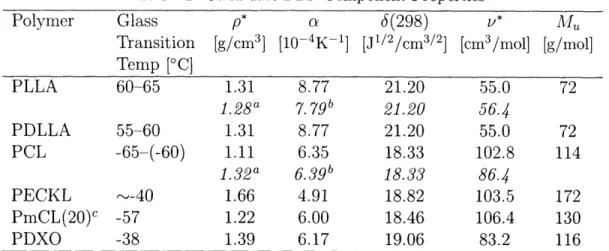
After a review of the known biodegradable polymers (see e.g. Table 2.1), several were selected for modeling as bbp components [Fig. 2-2]. The CRS model input parame-ters used for this purpose are listed in Table 4.1. Where pressure-volume-temperature
(PVT) data was available (for PLLA and PCL), p* and ac parameters derived from the melt-state empirical results following [16, 35] are given in italics. Because PVT data
was not available for PDLLA, PmCL and PDXO, their component properties (p*, , and a) were derived exclusively from GC values to use in calculating phase diagrams. We will discuss the relative merits of the two data sets following the presentation of
other results.
The criteria for initial polymer selection included potential as a hard or soft com-ponent (T9 significantly above or below ambient temperature), lack of crystallinity
(especially in the soft components), and availability and acceptance of the polymer in biomedical and other uses.
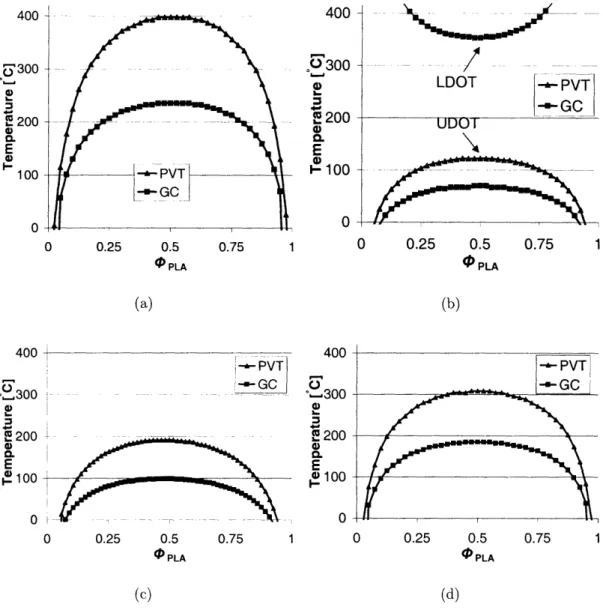
Following the initial selection, the CRS third-term criterion was applied, and phase diagrams of each possible bbp were calculated. The results are presented in Table 4.2 and Fig. 4-1. Although each of the potential bbp polymer pairs complies with the