DETERMINATI USING
IN
ON OF SEISMIC ATTENUATION OBSERVED PHASE SHIFT
SEDIMENTARY ROCKS by JEAN M. BARANOWSKI B.S., Universit (1980 SUBMITTED TO THE EARTH AND PLANE IN PARTIAL FULFI REQUIREMENTS FOR MASTER OF SCIENCE y of Arizona
)
DEPARTMENT OF TARY SCIENCE LLMENT OF THE THE DEGREE OF IN GEOPHYSICS at theMASSACHUSETTS INSTITUTE OF TECHNOLOGY May 1982
© Massachusetts Institute of Technology 1982
Signature
Certified
of Author ... u
by...'....
-4 I
Department of Earth and Planetary Science
.. '..M *. . N.s~/ v . Z o.. ... M. Nafui To
s z
Thesis Sup visor
Accepted
Theodore R. Madden g .lp
i
P
Chairman, DepartmentWInlbI,ra Graduate Committee
FROM 1932
MIT LIBFRARIES
DETERMINATION OF SEISMIC ATTENUATION USING OBSERVED PHASE SHIFT IN SEDIMENTARY ROCKS
by
JEAN M. BARANOWSKI
Submitted to the Department of Earth and Planetary Science on May 24, 1982 in partial fulfillment of the requirements for the Degree
of Master of Science in Geophysics
ABSTRACT
Seismic attenuation has been measured in dry and water saturated samples of Berea sandstone, under varying pressure conditions. Ultrasonic P waveforms were studied to determine seismic quality factor, Q.
Two methods of data processing were used, both of which assume that Q is constant over the frequency range analyzed. The first is an amplitude spectral ratio technique, which involves comparing the amplitude spectrum of a rock sample waveform to the spectrum of an aluminum calibration
standard.
Viscoelastic theory predicts that seismic attenuation must be accompanied by phase velocity dispersion. The second method of measurement exploits the model-dependent relationship between attenuation and dispersion to calculate Q from observed phase spectra. As with amplitudes, the
phase spectrum of an aluminum standard is needed to cancel source and geometric effects.
Q is found to increase with pressure, and is lower for saturated than for dry samples. Q values determined from both methods are not systematically in agreement,
particularly in cases where dispersion is slight over the narrow frequency range sampled.
Thesis Supervisor: Dr. M. Nafi Toksiz
CONTENTS page Title 1 Abstract 2 Contents 3 I Introduction 4 II Definitions 6
III Attenuation-Dispersion Theory 9
IV Data Analysis Method 17
V Results 24
VI Conclusions 28
List of Symbols Used in Text 30
Acknowledgements 31
References 32
Table 1 34
Figure Captions 35
I. INTRODUCTION
Amplitude spectral ratio methods are commonly used to measure seismic sei smi c al., 197 requires causal it between Mor that wil Johnston Brennan The method o velocity as a fun distance method m refl ecti dispersi attenuat general, than ign testing fi 9). attenuation studies (McD thematical mo including y. The sam velocity di *e detailed 1 be presen (1981), B1 and Smylie purpose of )f measuring -attenuatio Iction of fr . When pha iay prove pr on data. T on theory; ion, sed eous this velocity in ona del di s e models pos spersion and discussions ted in this and (1960), (1981). this study attenuation n relationsh equency when se shift can actical for he analysis if the mater dispersion is imentary rocks
rocks and thus theory. laboratory 1 et al ing of persion tulate attenu of the study a Aki and experiments and .,1958, and Toks6z et seismic attenuation in order to satisfy a specific relationship ation. viscoelastic models re found in Toks6z and
Richards (1980) and
is to test a compl imentary using the phase
ip. Phase shift is measured the wave propagates a known be measured accurately, this measuring Q from seismic
also provides a test of the ial has significant
more accurately measurable. I are more attenuating (lower Q)
may provide a good medium for
5
relationship to attenuation in' body waves has also been
reported by Wuenschel(1965) and Ganley and Kanasewich(1980). They have found that measured dispersion is in agreement with viscoelastic models.
The form of phase velocity variation may also be used to investigate the mechanism
influence on the semi -consol i dated seismic explorati materials may be taking into accou solid components. dominant at lower
The data for with ultrasonic 1
of attenuation. elastic propetries
sediments are of on. Frequency depe modeled by the Bio nt the relative mo
The Biot effect frequencies for m this study consis aboratory p n t t i e t apparatus, Pore fluid of sedimentary rocks rimary interest in dence of Q in these effect (Biot,1956), ion of the fluid and s predicted to become dia with low Q.
s of P waveforms reco and
rded using Berea sandstone under varying pressure and saturation conditions. Vertical seismic profiling data would also be compatible with a very similar analysis.
Attenuation calculated using amplitude spectral ratios can be compared with that calculated using phase velocity, as a check on the theory and the internal consistency of data analysis.
II. DEFINITIONS
Standard usually given
definitions of Q (seismic quality factor) are as (2.1) energy loss per deformation cycle,
(2.1) - AE
2 7E
where E is the total energy i-n a the phase lag between stress and
cycle or (2.2) in terms of strain,
= tan 6 (2.2)
where tan 6 = Im(M(w) friction coefficient relating stress and s
To show the equi cast them in a form u expresses equation (2 than energy. Since f
then:
E ca AE a
I = and
)/Re(M(w)), tan 6 is the internal
and M(w) is a complex modulus function train.
valence of these definitions, and to seful for data analysis, one first
.1) in terms of wave amplitude rather or linear media,
2AAA
AA
TA (2.3)
Now AA is the amplitude difference from one cycle to the next; it can be expressed in differential form as
AA = x dA
X is the wavelength. of phase velocity, c,
Substituting for wavelength in
yields X = 2rrc/w. Hence, 1 = -dA 2c dA = -w dx -- YT-T-(2.5) (2.6)
One dimensional wave propagation in the x-direction has been assumed. Integrating equation (2.6) and solving for A,
A(x) = AO exp{-wx/2Qc}
= AO exp{-ax} ,
(2.7)
which defines the attenuation coefficient, a = w/2Qc. The complex modulus M(w) can be related to Q by reference to the complex wavenumber K, where
K(w) w
c-T
From the one-dimensi pu =
+ i a(w) .
(2.8)
onal wave equation, aa
ax (2.9)
where p = density, u = di a = stress, substituting:
a(w) =
splacement in the x-direction, and
M(w).E(w) = M(w)au/ax. where
terms
u a exp{i(Kx-wt)}: 2 2M p( = K
M(W)
Then M() = - c2(w)p (1 + i/2Q)Taking the ratio of real and imaginary
Rem . (2.11)
(7ETw)
+i a(TTT
(2.12) parts, = -Q/(Q2-.25) -1/Q (2.13)Note that the approximation requires Q >> 1/2. For Q on the order of 10, for example, a .25% error is introduced,
is not considered measurable to such an accuracy in geologic materials.
but Q Assume a solution of the form
III. ATTENUATION-DISPERSION THEORY
Attenuation (Q) of seismi many investigators to be const
range; i.e., a(w) is approxima Examples available in the geop numerous; see, for example, Kn al.,(1964), Gordon and Davis(1l Mathematical models of at observation require velocity d physically possible pulse prop causality.
As shown by Stacey(1975), input, and it travels a time T (phase velocity) constant, the.
c waves has been reported by ant over a large frequency tely linear with frequency. hysical literature are opoff(1964), Gardner et
968), and Toksiz et al.(1979). tenuation that fit this common ispersion in order to produce agation; i.e., to satisfy
if in att a delta funct a medium with enuated spect ion is the both Q and c rum is: Ft(w) = exp{-wT/2Q - iwT}
or, in the time domain,
ft(t) = I I 2r -Ft(w)exp{i t }dw 1 . T/2Q Tr (T/2Q)2 + (T-t)2 In this equation it is, the derivation pulse peaks at t=T
can impli and i
be readily seen that es non-causality. Th s symmetric about T;
ft(O)*O; that
is attenuated half the energy
(3.1)
has arrived before the assumed velocity predicts.
Observation predicts sharp rise times and longer fall times. Clearly the assumptions have violated physical reality
somewhere. Models allowing velocity dispersion have been formulated that do not encounter this contradiction.
Models that have been proposed are based on causality criteria. In general, assuming a wave number of the form given in equation (2.8),
K(w) = 'W
c w)
+ ict(w)
and requiring causality,
u(x,t) = 0
implies that any must satisfy:
c
T
(Aki and Richards, transform, definedfor t < x/c(.)
attenuation-dispersion pair relationship
= T
1981)
by:
+ H[a(w)] (3.3)
where H[f(w)] is the Hilbert
00
H[f(w)] = I f
J')
dw' r -00 ( - W)The Hilbert transform returns advance to all components. A
the function with a 7/2 phase causality relation analagous to
equation (3.3) in Kramers-Kronig dis From equation (equation (2.7)), circuit theory is persion relation. (3.3), therefore, this requires known as the
and the definition of Q
= 2Qa(w) = c(
c ( 00)
+ H[a( ) ]
One function set which satisfies (3.5) Azimi et al.(1968), assumes that a(w) frequency, except at very high frequen
that was is almost cies: suggested by linear with a(w) = a 1 + al" H[a(w)] = 2 0an w 7(1-
aFT-a
In[1/alw] .The corresponding dispersion has been found to many seismic observations (Brennan and Smylie,1 form of a(w) has become widely accepted in rece seismological literature.
The phase velocity is found from (3.5) and
c
C( )
c( )
+ 2 a _(7 agree 981), nt with and this (3.6): In [1/alw] (3.7)or, neglecting (alw) 2 I c(w) = 1 c
(
co + 2a In[1/alw] IT (3.8) m c--3 (3.5) ( alw<<l) (3.6a) (3.6b)Taking a ratio of phase velocities at two different frequencies,
c(wI)
1 + 2ac co) In[W2/W1]
7r
1 + 1 In[w2/wl]
Q
(3.9)where terms of order greater than 1/Q are neglected. A recent thorough discussion and comparison of many attenuation models can be found in Brennan and Smylie(1981) As they have pointed out, although many models have been derived from various mechanisms, most give basically
equivalent attenuation-dispersion relations. Models can be considered either a)empirical; worked out to satisfy
causality and the known attenuation response of the medium, or b) based on an assumed form of the medium's viscoelastic behavior.
An approach to attenuation modeling based on visco-elasticity uses frequency dependent stress-strain functions formulated in terms of creep-relaxation mechanisms. The creep function is defined as the strain response to
application of a constant stress. Conversely, the relaxati function is the stress response to a unit step of strain. That is, if a(t) = u(t) E(t) = e(t), . on then (3.10)
u(t) = 0, t<0 1, t>0 a(t G(t e(t = creep function = stress = strain. Similarly, if S(t) = u(t) a(t) = *(t), where: To relate th modulus, consider O(t) = relaxation e creep-relaxation a time domain vers
function.
functions to the complex ion of equation (2.10);
a(t) = m(t)*E(t).
Substituting from equation (3.11),
*(t) = m(t)*u(t) =
fm(t-
T)dT= m(t).
M(w) = {F(
(t)}-where F denotes the Fouri The inverse relation complex compliance functi
er transform.
ship to equation (3.12) defines the on, s(t):
C(t)
=
s(t)*a(t),
where: then (3.11) (3.12) or, dt Then (3.13) (3.14) (3.15) (3.16)so that there is a corresponding relationship with creep:
d (t) = s(t). (3.17)
Once a form for the function M(w) is found, then, analagous versions of the classical one-dimensional wave equation are found by substituting the frequency dependent elastic modulus in equation (2.10).
Here two proposed creep functions and their
corresponding dispersion relations will be discussed. The Lomnitz(1956) logarithmic creep law is based on laboratory data. In the notation used above, the creep function
becomes:
*L(t) = _ (-1 + q In(1+at)), t>0
M
(3.18)
where:
Aki and Richards( function results equivalent to the
M = elastic modulus a00 = initial stress
a = high frequency limit
q = constant determined in laboratory measurements.
1980) have shown that this type of creep in an approximate dispersion relation
Azimi(1968) relation noted earlier(3.9):
where Q = 2/wq, Q>>1, and wl, 2 are different seismic frequencies.
Another creep law has been proposed by Kjartansson (1981), formulated to result in frequency-independent Q. This function is basically a power law:
k(t) 0 IM+2
t
12 M(w) = MO(w / mO )ei7TY, t>O.
W, >O. (3.19) (3.20)where wo, to are any reference frequency and time, the exponent to be fit to the power law. Note that argument of the modulus is independent of w. From (2.2) therefore,
= tan(rry).
The dispersion formula equations (2.8) and (2 Li3 and y is the equation (3.21)
is found by substitution into .11): + ic(w) = W (I + i/2Q)
zC
(Wy
= w(p/Mo) 1 / 2 (/o0) Y- ei n / 2 Therefore, c(w) = (MO/p 1/2(cos(wy/2) ) - 1 (wlwoO)= co(w/w0 OY = phase velocity Then:
(3.22)
a(w) = (w/c(w)) tan(ry/2)
= absorption coefficient.
One fundamental d formulations is that t instantaneous elastic becomes "almost" insta relationship between t (3.23) in a Maclaurin
c(w) a (W/
ifference between these he Kjartansson relation
response; for high Q the ntaneous. Approximation he two dispersion laws. seri es, oO)YY 1 + yln(w/o0) + two assumes no response s show the Expanding
where terms of order (yln(w/w0)]2 and higher have been
neglected. Since y ~ 1/7Q for high Q and the frequency range of a given observation will generally not be large, the Azimi and the Kjartansson dispersion laws can be seen as
equivalent for high Q. Similarly, expansion of Futterman's (1962) dispersion law gives the same expression for phase
velocity as equation (3.9).
Sedimentary rocks can be highly attenuating (low Q). Therefore in the work described here the dispersion relation of equation (3.23) is used.
and (3.24)
IV. APPLICATION TO LABORATORY DATA
The initial data set consists of P waveforms recorded after propagation through laboratory rock samples or an aluminum calibration sample. Assuming that the waveform generation, propagation, and recording system can be modeled as a linear system, output waveforms can be expressed by:
Oa(t) = S(t)*Pa(t)*U(t-(ta+tO) (4.1)
Or(t) = S(t)*Pr(t)*U(t-(tr+tO) (4.2) where:
O(t) = output waveform (a-aluminum,r-rock)
* convolution operator
P(t) = effects introduced by propagation through the medium
S(t) = effects introduced by the system: includes source waveform, transducer coupling, recording
instrument effects. These are assumed to be the same for the aluminum standard and rock samples. U(t-ti) = 0, t < t i
1, t > ti
ta = travel time through the aluminum calibration sampl e
tr = travel time through the rock being tested
including the sample In the frequency Oa(w ) = Or(w ) = (or standard) domain, then, S(w) S(w) itself. e-i w(ta+t0) e-i w(tr+t0) To get the introduced (4.4), desired express by the rock med
ion ium,
for the propagation effects rearrange equations (4.3) and
Pr(w) = Pa(w) Or(w) e-i (tr-ta) wOaT
Since aluminum has been observed to have Q values on the order of 150,000 (Zamanek and Rudnick, 1961) , it will be assumed to be nondispersive and nonabsorptive compared to the rock. This is equivalent to assuming that propagation through the aluminum does not change any of the source
amplitude or phase information, i.e.,
Pa(f) = 1 (4.6)
Rewriting equation (4.5) using amplitude and phase representations,
lapr(w) ei pr(w)
where p subscripts
= e-i(tr-ta)
Jaor(
w ei or(m)Iiaoa(
) eI Poat-Yrefer to propagation effects and o
(4.3) (4.4)
(4.5)
subscripts to observed outputs.
It is by equating the amplitudes in (4.7) that Q values are calculated with amplitude spectra,
lapr(w) = laor(w) I/aoa(w)l (4.8)
Each amplitude can be described by a function of the form,
a(w) = Am(x)exp{-am(w)x} (4.9) where x i geometry standard same labo function taking th
s the propagation distance and of the medium being tested. Si are of the same dimensions and ratory equipment, it will be as Am is not frequency'dependent. e ratio of Fourier amplitudes:
Am depends on the nce the sample and are tested using the sumed that the
Then am is found by
= Ar e-(ar-aa)x
In I aoa i
ln
Ara - ( ar-a)x
(Toksiz et al.,1979). Since a=w/2Qc and Qa>>Qr, aa can be neglected and Qr can be found from the slope of a line
fitted to Inlaor(w)/aoa(w) vs. frequency.
a (a w7)
or,
(4.10)
By equating the phases in (4.7)
lpr(w) = 4or(w) - oa(w) - w(tr - ta) + 27n (4.12)
where n is an integer. Phase velocity is defined by c(w)=w/ where k is the wavenumber, which is constant in this case. is related to the inverse of the time delay for each
frequency component, w = 2r/t, where t is the delay for the individual frequency. Then, pr(w)/w + tr = delay, for a given frequency. The phase velocity can then be calculated from the measurable quantities in equation (4.12) by:
C(w) = xll
pr(w)+mtr
or() -Foa(WT + ata + 2nn (4.13)
From equation (4.13) phase velocities are calculated using the observed ouput phase spectra from rock samples and an
aluminum standard of the same length. Since the phase could equivalently be equal to the determined value plus or minus a multiple of 2n there is a degree of nonuniqueness in the
phase spectrum. In practice, this has not been a problem since the group velocity is quite well known and only a single value of n gives reasonable phase velocities. Phase
unwrapping is done using the algorithm developed by Tribolet (1977).
Equations (4.11) and (4.13) then, are the basis for the computational procedure. The P and S waveforms are
digitized as 1024 point time series with a sampling rate of 100 nanoseconds.
The Fortran software used in this analysis was written by Mark Willis (Willis, 1982) for borehole seismolo
applications; it required only minor modificatio applied to ultrasonic data.
The waveforms are first windowed to include first few cycles, thereby removing later arrival due to reflections within the medium and the sys point sine taper is applied to the edges of the waveform.
To measure attenuation from amplitude spect series, corresponding
are Fast Fourier Transformed plotted along with a plot of vs. frequency. The user int window, and Q is found from squares line fit over the wi slope is equal to ar; since is found from a=w/2cQ. The somewhat sensitive to the wi
gy ns to be only the s which are tem. A 15 windowed
ra, two time to the standard and sample waveforms,
The two amplitude spectra are the log of their spectral ratio eractively defines a frequency the slope of the best fit least ndow. From equation (4.11) the the velocity has been measured Q determined Q turns out to be ndow chosen, so
the results were standardized by using window cutoffs defined by 25% of the maximum amplitude in the rock.
For phase velocity determination, the phase spectra of the same pair of windowed waveforms is used to calculate
phase velocity, using equation (4.13) and the measured travel time in the aluminum calibration. Phase velocities are
plotted simultaneously for three different values of the integer constant n. The criteria used for choosing a value of n were: minimum dispersion and velocity near the velocity measured in the lab.
The appropriate dispersion curve is then used to
calculate Q vs. frequency based on the dispersion relation, equation (3.23):
*1
=(0/00)'
(tan- (1/Q))
c/co (4.14)
Taking logarithms of both sides and solving for Q,
Q = cot[w(ln(c(w))-ln(c)/ln()/ )-ln(w0o))] (4.15)
Q(w) calculated from equation (4.15 dispersion curve and the rock amplitude singularity at wO by averaging around it a source of ambiguity; theoretically it frequency for which the phase velocity i bandwidth of the amplitude spectrum is f
) is plotted with the spectrum, removing th . The choice of w0 i
is any reference s known. The energy airly narrow, and any
e
c0,w0 pair must come from the data within this range. It might be preferable to have a reference velocity
corresponding to a known frequency outside the bandwidth. It would therefore be useful to perform the same experiments with varying transducer resonant frequencies. However, the data acquisition apparatus currently precludes this.
The calculation of equation (4.15) can get unstable when dispersion is small. The reference frequency used in the
reported results was 1 MHz. This is the resonant frequency of the transducers and is above the frequency corresponding to the maximum of the experimental amplitude spectra. Since the least variation in phase velocity occurs at high frequency, it seems reasonable to assume an wO in this range. Although the choice of wO is presumably arbitrary, the same wO was used consistently for all results.
V. RESULTS
The analysis described in the previous section has been performed on waveforms recorded by Karl Coyner (Coyner, 1982) at MIT. The rock was Berea sandstone, tested under both oven dry and distilled water saturated
conditions. Data recorded with differential pressures of 100, 250, and 450 bars were analyzed.
The resulting Q values calculated for P waves are summarized in Table 1 and Figure 1. For dry samples,
Q
calculated from amplitude spectral ratios (Qpa) increases monotonically with increasing pressure. Q calculated from dispersion (Qpd) increases for the lower pressures but is apparently low for the higher pressure. This discrepancy may be related to a difference in filter settings on the recording electronics.
For the other five comparisons the high pass filter in the recording system was set with the same band edge for comparable aluminum and rock tests. The data recorded for dry Berea sandstone at 400 bars used a lower pass band edge than was used for aluminum at the same pressure. The
difference in filter settings is not large (70 vs. 38 kHz) compared to the signal bandwidth. The difference seems to occur at a frequency that is much too low to affect the amplitude spectra. However, the filter has an unknown and possibly significant effect on the phase. For a more
conclusive comparison of the high pressure results the data should be collected using identical filter settings.
Preliminary analysis of S wave phase velocity data was hampered by an apparently greater sensitivity to the filter settings employed in the measurement. No consistent results have been obtained from limited S wave data because sample and reference spectra at comparable pressure and filter parameters are not yet available.
For water saturated samples, Qpd and Qpa are in fairly close agreement at the three pressures. The Q values
increase with pressure but are significantly lower than
those for the dry samples, and appear to approach a constant value with pressure.
Plots of the amplitude and phase spectra, fits for amplitude spectral ratios, phase velocities, and dispersive Q are shown for the six data sets in Figures 2-28.
Figures 2-7 are plots of the fits of Q determined from amplitude spectral ratios, with pressure and saturation as detailed in figure captions. Data reference numbers are at the top of each figure and are listed in Table 1 for
reference.
The lower of the two graphs in each of figures 2-7
plots the amplitude spectrum of the aluminum as a solid line and the amplitude spectrum of the rock as a dashed line. The upper half shows the log of the ratio of rock to
aluminum amplitude spectra. A straight line is fit over the portion of this graph delineated by the vertical bars. Q is calculated from the slope of the line, M, by M=x/2Qc, where x is sample length and c is velocity as measured in the laboratory.
Inspection of the plots of amplitude spectral ratios shows that the assumption of' constant Q is a reasonable one over the frequency range sampled, as the log of the ratios does not vary greatly from a straight line over the
frequency range fit.
Phase velocities as calculated with equation (4.13) are shown in Figures 8-13. Curves for three different values of n are given, and the curve chosen in Q calculations is the one showing the least dispersion over the sampled frequency range. Phase velocity
frequencies effectively has arrived during the
Figures 14-19 illu calculated using the ap
reference frequency of half of each figure sho c(w) in Kft/sec, along The upper half plots Q where rock amplitude is
goes to zero for this data at low since no energy at these frequencies sampled time.
strate the results when Q is
propriate phase velocity data and a 1MHz in equation (4.15). The lower ws the chosen dispersion curve with with the rock amplitude spectrum. from equation
greater than
(4.15), in the region 25% of the maximum amplitude.
the reference vel extremely large. 16-19), there is constant. For tw
low pressure ther minima have been
error analysis ju varying reference reference frequen curve around this
ocity, the calculated Q values For most of the cases tested, a distinct region where the Q i o cases (Figures 14 and 15) of e is no distinct region of cons chosen as determined values. N stifies this choice, but trials
frequencies indicate that a lo cy would result in a flat porti
minimum. The ambiguity of ref
become (Figures s apparently dry rock at tant Q, and o systematic with wer on of the erence frequencies does not allow a conclusive result for this method.
Only when dispersion is expected to be significant (>1% over the frequency range measured) can calculation of Q by this method be expected to be very useful. However, this
includes many of the crustal sedimentary rocks and sediments being explored with various seismic techniques, such as VSP and reflection seismology.
Figures 29-37 are the waveforms analysed. Ideally, both amplitude and phase operators can be developed
produce synthetic waveforms for comparison with the observed pulse shapes, thereby using more of the information
VI. CONCLUSION
Both of the methods used in this analysis of amplitude spectral ratios dispersion, give similar results, but consistent for all data. Viscoelastic the two approaches are mathematically certain assumptions, so the choice of depends upon the application. Where d under study predominates compared with dispersion (for example, geometric eff seismic applications), calculation of
paper to evaluate Q, and of phase velocity the comparison is not theory predicts that equivalent under which is more useful
ispersion in the medium other sources of
ects in borehole phase velocity may reveal attenuation simply.
Comparison of the results presented here with those of Johnston (1978) shows that his Q values for the same
sandstone exhibit the same behavior with pressure and saturation but are somewhat higher. Q can vary within a formation due to clay content, and the accuracy of
measurement decreases with increasing Q.
Since the various theoretical models predict forms of dispersion-attenuation relations that are quite similar for our purposes, there is no particular model that is favored the results. Investigation of attenuation over a wider frequency range would be necessary to distinguish among model s.
Models assuming constant and near constant Q have been considered for practical purposes, keeping in mind their
potential pitfalls when dealing with real earth data. When measurement of Q in a particular upper crustal region of the earth is the objective, a constant Q approximation gives
consistent results. When extrapolating Q over wide frequency ranges or to great earth depths, the approximations break down.
The assumption of analysis. Attenuation rock types and from var Some apparent variation but this does not limit parameter.
constant Q has been made in this
varies significantly between different ying rock saturation conditions.
from a constant Q value is observed the usefulness of Q as a seismic
LIST OF SYMBOLS USED IN TEXT A = amplitude c = phase velocity E = energy F[ ] = Fourier Transform H[ ] = Hilbert Transform K(w) = complex wavenumber
M(w) = complex elastic modulus
Q
= seismic quality factorQpa = P-wave Q calculated from amplitude spectral ratios
Qpd = P-wave Q calculated from observed phase velocity dispersion
t = time
u = displacement in one dimension
x = sample length, or propagation direction
= attenuation coefficient
y = exponent fit in proposed power law creep function = strain X = wavelength p = density a = stress = relaxation function S = creep function W = angular frequency
ACKNOWLEDGMENTS
I would like to first thank my advisor, Professor Naf Toksiz, for his continuing support, guidance and encourage ment during my stay at MIT.
My work on this thesis was completed only with the gracious assistance of Mark Willis and Karl Coyner. Thank to Mark for the use of his programs and for his generosity with time given to help and discussions. Thanks to Karl f the use of ultrasonic data collected in his lab.
Others whose help is most appreciated are Darby Dyar, for introducing me to yet another computer, and Steve
McDonald, for convincing two computers to talk to each oth A special word of thanks to Ron Marks for help in data transmission, editing, and legwork, not to mention all
purpose cheerful moral support.
I'd like to also take this chance to thank all my friends in the Earth and Planetary Science Department at M staff, students, and faculty - for making the department a friendly and supportive work environment.
During part of this work I was supported by a Chevron Fellowship and as an employee of the Chevron Oil Field Research Co., and I acknowledge their help.
i -S or er.
IT-REFERENCES
Aki, K., and Richards, P.G., Quantitative Seismology: and Methods, W.H. Freeman and Co., San Francisco, Azimi, S.A., Kalinan,
B.L., Impulse and linear and quadra USSR Phys. Solid
A.Y.,Kalinan. V.V., and P Transient Characteristics tic Absorbtion Laws, Izv. Earth, 1968, 2, p.88-93
ivovarov, of media Acad. Sci
Biot, M.A., Theory of Propagation Fluid-Saturated Porous Solis. Jour. Acoust. Soc. Am., 1956,
of Elastic Waves in a
II. Higher Frequency Range, 28, 179-191.
Bland, D.R., The Theory of Linear Viscoelasticity, Press, Oxford, 1960
Brennan, B.J. and Smylie, Dispersion in Seismic Space Phys., 1981, 19,
Pergamon
D.E., Linear Viscoelasticity and Wave Propagation, Rev. Geophys. and 2,p.233-246
Coyner, K.B., Ph.D. Thesis, in preparation, M.I.T., 1982 Futterman, W.I., Dispersive Body Waves, Jour. Geophys. Res.,
1962, 67, p.5279-5291 Ganley, D
and D Res.,
C., and Kanasewich, 'E.R., Measurement of Absorption spersion from Check Shot Surveys, Jour. Geophys. 1980, 85, 5219-5226.
Gardner, G.H.F., Wyllie, M.R.J., and Droschak, D.M., Effects of Pressure and Fluid Saturation on the Attenuation of elastic waves in sands, Jour.Petrol. Tech., 1964, 16, p.189-198
Gordon, R.B., and Seismic Waves Res., 1968, 7
Davis, L.A., Velocity in Imperfectly Elastic 3, p. 3917-3935
Johnston, D.H., The attenuation of Saturated Rocks, Ph.D. Thesis, Kjartansson, E., Jour. Geophy Knopoff, L., Q, p. 625-660 and Attenuation of Rock, Jour.Geophys. Seismic Waves M.I.T., 1978 Constant Q-Wave Propagation and s. Res., 1979, 84, p. 4737-4748 Rev. Geophys.
in Dry and
Attenuation,
Space Phys., 1964, 2,
Lomnitz, C., Creep Measurements in 1956, 64, p. 473
Igneous Rocks, J. Geol., Theory
1980
McDonal, F.J., Angona, F.A., Mi Nostrand, R.G., and White, and Compressional Waves in 1958, 23, p. 421-439
lls, R.L., Sengbush, R.L.,
J.E., Attenuation of Shear Pierre Shale, Geophysics,
Stacey, F.D Hastie, Pulses, , Gladwin, L.M., Anela Geophysical M.T., stic Surv McKavanagh Damping of eys, 1975, , B., Acoust 2, p. Linde, ic and 133-151 A.T., and Sei smi c
Toksiz, M.N., and Johnston, D Attenuation, Geophysics r Toksiz, M.N., Johnston, D.H.,
Seismic Waves in Dry and Measurements, Geophysics,
.H., eds., Seismic Wave eprint series, no.2, 1981
and Timur, A., Attenuation of Saturated Rocks: I.Laboratory
1979, 44, p. 681-690 Tribolet, J.M. A New Phase
on Acoustics, Speech an no.2, 170-177
White, J.E., Seismic Waves: Attenuation, McGraw-Hil Willis, M.E., Ph.D. Thesis,
Unwrapping Algorithm d Signal Porcessing, Radiation, Transmission, i, New York, 1965 in preparation, IEEE Trans. 1977, ASSP25, and M.I.T., 1982 Wuenschel , Study, P.C., Dispersive Geophysics, 1965
Body Waves - An Experimental , 30, 539-551
Zamanek, J.Jr., and of elastic waves Soc. Am., 1961,
Rudnick, J., Attenuation and dispersion in a cylindrical bar, Jour. Acoust. 33, p. 1283-1288
34
Table 1
DRY BEREA SANDSTONE
pressure (bars) 100 250 400 Qpd 22 45 35 Qpa 25 46 74 Vp (ft/sec) 11272 12810 13244 Data reference no. BR1118.2A BR1118.5A BR1118.7A
WATER SATURATED BEREA SANDSTONE
*pressure (bars) 100 250 400 Qpd 15 30 27 Qpa 16 30 32 Vp (ft/sec) 12805 13330 13588 Data reference no. BR1122.5B BR1124.8B BR1210.10B
* differential pressure, fluid pressure in all saturated cases is 100 bars.
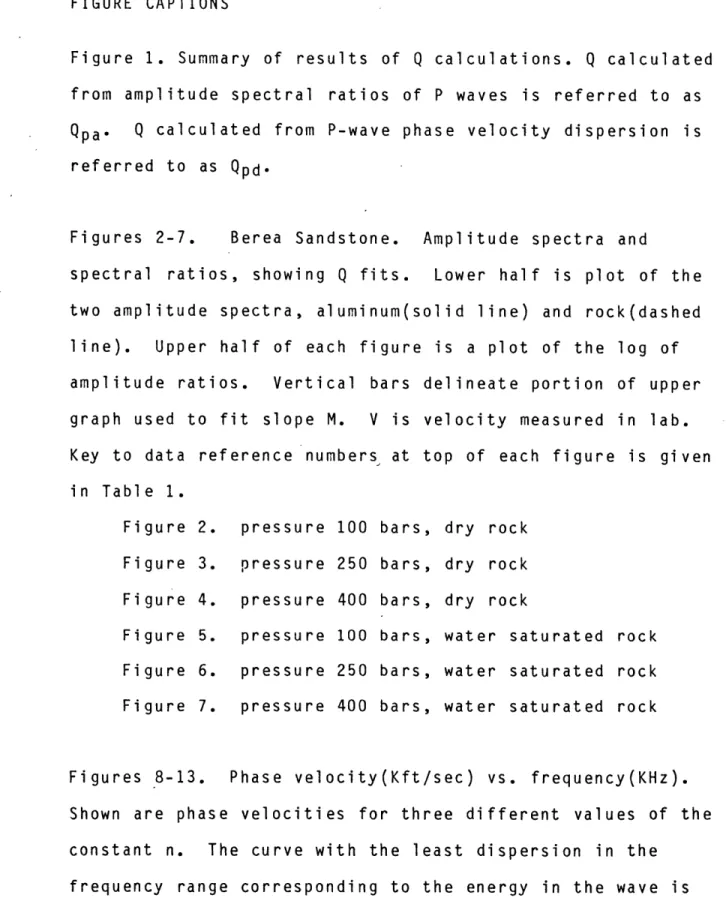
FIGURE CAPTIONS
Figure 1. Summary of res from amplitude spectral Qpa. Q calculated from
referred to as Qpd. ults of ratios P-wave Q calculations. Q calculated of P waves is referred to as phase velocity dispersion is
2-7. Berea Sandstone. ratios, showing Q fits itude spectra, aluminum
pper rat d to hal f ios. fit of ea Verti slope reference nu 2. pressure 3. pressure 4. pressure 5. pressure 6. pressure 7. pressure ch f cal M. mber 100 250 400 100 250 400 i gure bars V is s at bars bars bars bars bars bars
Amplitude spectra and
Lower half is plot of the olid line) and rock(dashed
is a plot of the log of delineate portion of upper velocity measured in lab. top of each figure is given
dry rock dry rock dry rock water satu water satu water satu rat rat rat rock rock rock
Figures 8-13. Phase velocity(Kft/sec) vs. frequency(KHz). Shown are phase velocities for three different
constant n. The curve with the least dispersi frequency range corresponding to the energy in
values of on in the the wave U de se Figures spectral two ampl line). ampl itu graph u Key to in Tabl Fi Fi Fi Fi Fi Fi data e 1. gure gure gure gure gure gure the
these to calculate Q. Figure 8. pressure gure gure gure gure gure pressure pressure pressure pressure pressure
100 bars, dry rock 250 400 100 250 400, dry dry wat wat wat
Figures 14-19. c(Kft/sec), , ampl frequency. Lower half plots the d amplitude spectrum of rock. Upper from equation (4.15) for region ar Figure 14. pressure 100 bars, Figure 15. pressure 250 bars, Figure 16. pressure 400 bars, Figure 17. pressure 100 bars, Figure 18. pressure 250 bars, Figure 19. pressure 400 bars,
Figures 20-28. Phase is in radi Figure 20. Figure 21. Figure 22. Figure 23. Figure 24. Amplit ans. pressu pressu pressu pressu pressu rock rock er saturated rock er saturated rock er saturated rock itude, and Qd vs.
ispersion curve used, and half plots Q calculated ound amplitude maximum.
dry rock dry rock dry rock
water saturated rock water saturated rock water saturated rock
ude and phase spectra of waveforms.
100 250 400 100 250 bars, bars, bars, bars, bars, aluminum aluminum aluminum dry rock dry rock chosen from
Figure 25. Figure 26. Figure 27. Figure 28.
pressure 400 bars, dry rock
pressure 100 bars, water saturated rock pressure 250 bars, water saturated rock pressure 400 bars, water saturated rock
Figures 29-37. Figure 29. Figure 30. Figure 31. Figure 32. Figure 33. Figure 34. Figure 35. Figure 36. Figure 37. Windowed waveforms. pressure 100 bars, pressure 250 bars, pressure 400 bars, pressure 100 bars, pressure 250 bars, pressure 400 bars, pressure 100 bars, pressure 250 bars, pressure 400 bars, Time in microseconds. aluminum aluminum aluminum dry rock dry rock dry rock
water saturated rock water saturated rock water saturated rock
Figure 1
dry
sat
*100
200
300
Qpd
Qpa
400
pressure
(bars)
0 9 w80
60
40
20
BR1118.2A P 10-L N R A T 0 0 200 400 2 A P S 1--i l 1 FREQUENCY, KHZ Figure 2
BR1118.SB P 0 200 400 600 800 1200 1400 800 1000 FREQUENCY, KHZ Figure 3
xis
5.0 A M P S 2.5 0.0 1600 1 00BR1118.7B P - .00 L N R A T O XTP 5.0 A M P S 2.5 0.0 400 600 800 1000 0 200 400 600 800 1000 Figure 4 FREQUENCY, KHZ Figure 4 I I 1200 1400 1600 1200 1400 1600 9 9 W 0 200
BR1122.SB P
FREQUENCY, KHZ
Figure 5
BR1124.8B P L 1 * .00 N R A T x II 0 200 400 600 800 1000 1200 1400 1600 5.0-QU 30.4 A Ma 0.129380E-05 M P V* 13330.000 S 2.5--0.0- - "1 0 200 400 600 800 1000 1200 1400 1600 Figure 6 FREQUENCY, KHZ 0 0
BRi210.109 P Do- 4.00 !- -
--
I " - IrI 00 FREQUENCY, KHZ Figure 7 0 9 0XiP
S.0 0.0 I1folo 1200ow 1400 10 aloo 4 d bto t 800BRiil8.2A P
0 200 400 600 800 1000 1200 1400 1600
FREQUENCY, KHZ
PR1118.SB P
0 200 400 600 800 1000 1200 1400 160CI
FREQUENCY, KHZ
Figure 9
BRiiI8.7B P
FREQUENCY, KHZ
Figure 10
10
BRI182.SB P
0 200 400 600 800 1000 1200 1400 1600
FREQUENCY, KHZ
Figure
BR1124.8B P
0 200 400 600 800 1000 1200 1400 1600
FREQUENCY KHZ
BRI210.10B P FREQUENCY, 1600 KHZ Figure 0 9
BRl118.2A P 400 600 800 1000 FREQUENCY, KHZ 1200 1400 Figure 14 100 50 0 20 10 1600 200 1600 FT s aQ oS oo °
L , '
I
'
'
' ...
...
BR1118.5B P 0 200 400 600 800 1000 1200 1400 1600 0 200 400 600 800 1000 FREGUENCY, KHZ 1200 1400 1600 Figure 15 9 9 100 50 0 20
BRi118.7B P D- 4.00
-I
I
I .
I ,
1
1
.. _ ! _
I
100 Q 5SO 0 I 6e 0 200 400 600 Figure 16 I ' I ' I ' I 800 1000 1200 1400 1600 800 1000 1200 1400 1600 FREQUENCY, KHZ I ' I 200 400 0BR1122.SB P 0 200 Figure 17 400 600 800 1000 FREQUENCY, KHZ 1200 1400 0 0 100 50 0 20 10 0 1600 1600 T a -C " n
,
---
, -,
...
,-
,", ,
...
.
- I/**-.**
I I
*"
....
...
ee a
*** ****-- 10 0- 20-BR1124. 8B P DI 4.00 I ' I o 200 ' I 400 I ' I 600 800 1000 I ' 1200 I ' 1400I 1600 0 200 400 600 800 1000 1200 1400 1600 FREQUENCY, KHZ Figure 18
BRi210.10B P 0 200 400 600 800 1000 FREQUENCY, KHZ Figure 19 1200 1400 1600 S* t 100 0 50 0 20 * w 0
BR1ii18.A P A40000-M P 0-400 -P -P H A S 200-E S I I I I I I I I II I I I I
I'
500 1000 1see500 000 FREQUEHCY, KHZ Figure 20 500ee 100eee 1500 2000 2500 A -1 2s500 I I I IBRl124.8B P A10000-M 5000 -0 0 400200 -01 500 1000 1500 2000 2500 500 1000 1500 2000 2500 FREQUENCY, KHZ Figure 21
BR1ii8.7B P 10000 A P 400 I I ' ' ' i i I i I 0 500 1000 1500 2000 FREQUENCY, KHZ Figure 22 e a 0 500 1000 1500 2000 200 0 -200 2500 2500
BRII18.2A P FREQUENCY, KHZ Figure 23 A10000 M P 400 200
PRi118.5B P FREQUENCY, KHZ Figure 24 5000 M 2500 0 400 P H A S 200. E 0
BR1118.7? P e 500 1000 1500 FREQUENCY, KHZ Figure 25 A 5000 A M P 2500 0 400 P H A S 200 E m 2500
BR1122.SB P A 1 0 0 0 0 D 4.00 M P 5000 -0 500 1000 1500 2000 2500 400 P H A S 200 --E 0 500 1000 1500 2000 2S00 FREQUENCY, KHZ Figure 26
BRI124.8B P FREQUENCY, 4000 2000 0 400 200 Figure KHZ 2500
BRI210.OB P A 4000 D 4.00 2000
0
-
I
I
0 500 1000 1500 2000 2500 400 H S 200-E 0 500 1000 1500 2000 2500 FREQUENCY, KHZ Figure 284000 2000 ---4000 0 10 20 30 TIME (MICROSEC) Figure 29 D- 4.00
1500 1000 500 0 -500 -1000 0 10 Figure 30 60 40 TIME (MICROSEC)
1000 500-co 0
-500--1eee
,
,
,
-
J
, ,
,
I
"I
,
,
,
I
,
,I
i
,
j
, ,
I1
,
,
,
,
I
0 10 20 30 40 50 60 TIME (MICROSEC) Figure 31400 20- 0200 -400 -- -600-0 1 0 20 30 40 50 68 TIME (MICROSEC) Figure 32
400 200-0-A 200 -0 10 2T 3( 40 50 0R TIME (MICROSEC) Figure 33
600 400 200 -- 0--400-
1
I
i
I
I
I
I
0 10 20 30 40 50 60 TIME (MICROSEC) Figure 34600 400 200 0
(\
M V -200 -400 ---600I
I
I
I
' 0 10 20 30 40 50 60 TIME (MICROSEC) Figure 35j
300 0-200 100 -0 10 20 30 40 SO 60 TIME (MICROSEC) Figure 36
400 200 0 -200 0 10 20 30 40 50 60 TIME (MICROSEC) Figure 37