Determinants and Consequences of Trust
in
Online Environment
by
Yakov Bart
Diploma, Mathematics/Applied Mathematics (1999) Lomonosov Moscow State University
SUBMITTED TO THE SLOAN SCHOOL OF MANAGEMENT
IN PARTIAL FULFILLMENT OF THE REQUIREMENTS FOR THE DEGREE OF MASTER OF SCIENCE IN OPERATIONS RESEARCH
AT THE
MASSACHUSETTS INSTITUTE OF TECHNOLOGY SEPTEMBER 2002
@2002 Massachusetts Institute of Technology All rights reserved
Signature of Author...,. ...
Yakov Bart Operations Research Center August 2, 2002 C ertified by ... .... ... ... ... ... ... . ...
Glen L. Urban David Austin Professor of Management, Sloan School of Management
Acceptd by... ... ... James B. Orlin Co-Director, Operations Research Center
MASSACHUSETTS INSTITUTE OF TECHNOLOGY
V
OCT 0 4 2002
Determinants and Consequences of Trust in Online Environment
by
Yakov Bart
Submitted to the Sloan School of Management on August 2, 2002 in partial fulfillment of the requirements for the Degree of Master of Science in Operations Research ABSTRACT
The fundamental role of trust in numerous business transactions, and especially in customer relationship management, has been widely acknowledged by both industry and academia. The establishment of trust is a necessary condition for the long-term success of any business enterprise. This is particularly true in the Internet environment, where rapid technological advances accompany the rise and fall of many companies in a relatively short period of time. Previous studies have emphasized the significance of trust in Internet strategies; virtual experiences created by online systems eliminate or minimize face-to-face contact, but human trust is still essential for the experience to be effective. However, while the importance of trust in online environments is recognized, the determinants and consequences of customer trust have not been systematically investigated across a variety of industries, particularly in B2C context.
This research is designed to investigate consumer perceptions of trust and the role of trust in consumer behavior in e-Business environments. It examines the following key research questions: What exactly is online customer trust? How is online trust different from offline trust? How does online trust affect customer behavior on a website? What are the antecedents and consequences of online trust?
To address these questions, a model is developed that links consumer perceptions of website characteristics to perceptions of overall trust in a website, and perceptions of trust to consumer behavior related to the website. The proposed model identifies a number of factors that drive online trust, shows how website cues and online trust shape customer decision process, and identifies special role of online trust as a mediator in the link between website characteristics and consumer behavior. A large-scale empirical study is presented that applies this model across a variety of websites in various industries, using a structural equation modeling approach (LISREL), coupled with application of
moderator/mediator analysis techniques. A holdout sample is utilized to test the validity of the model. Managerial implications for successful Internet strategies, incorporating appropriate usage of different website trust cues for different categories of customers, are presented.
Thesis Supervisor: Glen L. Urban
Acknowledgements
First of all, I would like to thank my research advisor and principal investigator of this project, Glen Urban. His clear vision and remarkable dedication played a very
important role in my initial decision to participate in the project, and I've never had a moment's regret about this choice. I have learned a great deal from Glen over the last 1.5 years. Besides acquiring unique research skills from scientific interactions, I was also fortunate enough to benefit from his personal experience and wisdom, which had a crucial impact on my decision to continue on a graduate program and become a Marketing professor.
I'm also in great debt to John Hauser, John Little and many other faculty members at the MIT Marketing Group. They all were of enormous help to me and gave me a lot of advice on many topics, both related and not related to the research. Venkatesh Shankar and Fareena Sultan were very helpful over the course of the project. I'm also grateful to all the Marketing Ph.D. students, who were the best officemates I've ever had.
Finally, I want to thank my parents, who as always have supported me more than they could and should and less than they wanted to, even if they were not quite sure what it was that I've been doing here for the last three years. Thanks for all your love.
Table of contents:
1. Introduction... ... 9
2. Literature review... 12
2.1. Offline trust literature... 13
2.1.1. Management literature... 13
2.1.2. Marketing literature ... ... ... 16
2.2. Online trust literature ... 20
3. Mediation/Moderation Analysis: review ... ... 30
3.1. The nature of moderators ... 31
3.2. The nature of mediator variables ... 35
3.3. LISREL vs. Multiple Regression Analysis... 39
3.4. Combining Mediation and Moderation effects ... 41
4. Research Methodology ... 43
4.1. Exploratory Stage ... 44
4.2. Sampling and data collecting stage ... 46
4.3. Sample splitting ... ... 49
5. Specifying and Analyzing the Model... ... 50
5.1. Exploratory factor analysis .... ... 53
5.1.1. Group descriptions... 53
5.1.2. Exploratory factor analysis: procedure and results... 60
5.2. Measurement model: Confirmatory Factor Analysis ... 65
5.2.1. One-Stage versus Two-Stage estimation ... ... 65
5.2.2. Measurement model: Specification and Identification ... 66
5.2.3. Parameter Estimation: Validity and Reliability Checks ... 67
5.3. Testing Affection and Cognition as Mediators of Trust ... 69
5.3.1. Model Identification Issues ... ... 71
5.3.2. Problems with Assessment of Model Fit ... ... 72
5.3.3. Choosing Best-Fit Model ... 73
5.4. Testing Trust as a Mediator for Action ... 76
5.4.1. Choosing Best-Fit Model ... 78
6. Cross- Validation Analysis ... 82
6.1. Implementing loose replication strategy ... ... 83
6.2. Implementing tight replication strategy ... ... 85
7. Analysis of M oderator Variables ... ... ... 86
7.1. M ethodology and results ... 87
8. Conclusions ... 95
8.1. Recom mendations for Practitioners ... 95
8.2. Limitations and implications for future research ... 99
8.3. Conclusion ... 102 Appendix A ... 103 Appendix B ... ... ... 131 Appendix C ... 141 Appendix D ... ... ... 145 Appendix E ... ... 155 Appendix F ... 167 Appendix G... 173 References... ... 205
1. Introduction
Over the last several years, the World Wide Web has become popular not only with technically savvy consumers, but it has also extended its influence to a much wider audience. According to recently issued industry monitoring and projections data, there were 124.7 million (m) US online users in the year 2000, and this number is expected to increase to 210.8m in 2006 (JMM 2002). Electronic commerce is accordingly growing at exponential rate; the number of US households shopping online has increased from 5m in
1997 to 32. 1m in 2001, and is projected to reach 62.9m in 2007 (Forrester Research
2002). Unfortunately, many consumers still regard e-commerce as "an excursion beyond the unknown into the unknowable" (McKnight and Chervany 2002).
Early commercial transactions, such as purchasing grocery goods from a local supermarket or performing financial transactions in a local bank, involved dealing with real goods and real people, whose quality and reputation could be checked by asking trusted friends and verified by the client's own experiences. Later on, the growth of urban populations and greater turnover of working force necessitated the introduction of
institutional regulations and licensing procedures, so that any individual was able to verify the reputation of a particular vendor, bank or lawyer by inspecting an appropriate certificate or license. The reason many consumers are cautious about online shopping, is that e-commerce has been traditionally provided few means for verifying either the quality of goods or the reputation of merchants. Physical separation of the buyer and seller, the absence of a salesperson, the separation of the product and the buyer, and the
overall environment of perceived insecurity on the Internet provide unique challenges to Web marketers, who must find ways to develop trust-based relationships in order to attract and retain customers (Warrington, Abgrab et al. 2000).
Lack of trust is perceived to be one of the most prominent triggers of the latest downturn in e-commrnerce and bankruptcies of numerous Internet companies. A Forrester survey in 2000 found that 51% of companies would not trade with parties they do not trust over the Web. Concerns about trust issues were identified as one of the greatest barriers inhibiting online trade between buyers and sellers who are unfamiliar with each other (CommerceNet 2000). In supply-chain management, the root cause of the failure to collaborate effectively appears to be the lack of trusted relationships (Gallagher 2001). During the 2001 holiday season, consumers feeling the pressure of an economic downturn, bought predominantly from the most trusted websites (Neuborne 2001).
Even though there is a general agreement that the transactions of either money or information on the Web require trust on the users' part, there are still many questions that have remained largely untouched by scientific research. What exactly is online customer trust? How is online trust different from offline trust? How does online trust affect customer behavior on a website? What are the antecedents and consequences of online trust? What are the underlying dimensions of online trust? What factors influence trust in a website, and what specific website trust cues associated with these factors? All these questions are crucial for the future development and growth of online shopping; without clear answers to these questions, virtual merchants will not be able to develop and sustain their relationships with online customers.
In this study, we present a model linking consumer perceptions of website characteristics to perceptions of trust and perceptions of trust to consumer behavior online. The proposed model identifies a number of factors that drive online trust, shows how website cues and online trust shape customer decision process, and identifies the special role of online trust as a mediator in a link between website characteristics and consumer behavior. A large-scale empirical study is presented that examines this model across a variety of websites in various industries. Among the unique features of the study are the large number and diversity of survey respondents, applying moderator/mediator analysis techniques in a structural equations modeling context, and using a holdout data sample to test the validity and assess the predictive power of the model.
The rest of this paper is organized as follows: in section 2, we review offline and online literature on the topic and based on that, motivate the current study. Section 3 describes moderator/mediator analysis techniques that are used for defining trust role in customer online experience. We follow in section 4 with presenting our research
methodology and collected data. In section 5, we analyze the data with exploratory factor analysis tools, specify several structural equation models linking website characteristics and consumer behavior, and conduct mediation tests. Section 6 uses a holdout sample to validate, replicate and assess the predictive power of the resulting model. In section 7, we proceed with several moderation variables tests, involving user characteristic and
demographic variables. Section 8 draws several conclusions of the conducted study, presents some limitations and suggests a set of implications for further research.
2. Literature review
Trust has been a topic of research in communication, philosophy, political science, sociology, computer science, psychology, management science and marketing since the 1950s (Deutsch 1958), and each field has established its own conceptual
framework. Although these frameworks are quite different, they all have contributed to a better understanding of trust in general. For obvious reasons, most of the studies have focused on offline trust, though research activity in the area of online trust has been growing exponentially over the last several years. We begin this section by reviewing offline trust literature from several different fields, mostly from management science and marketing, and then concentrate on existing studies on online trust and discuss our contribution in this area.
2.1.
Offline trust literature
Trust has been defined by researches in many different ways. Describing the concept of trust can be compared with the story of the six blind men and an elephant (Lewicki and'Bunker 1995). Each nmal perceived the elephant ("trust") to be something different, because of the narrow portion of the elephant that they blindly felt. They each thought the elephant was what they felt because they were unable to see the big picture of what an entire elephant is like. Similar situation with trust: economists tend to view trust as a rational choice mechanism (Williamson 1993), sociologists have viewed trust as structural in nature (Lewis and Weigert 1985), and psychologists are more inclined to view trust as a personal attribute (Rotter 1967). Although there have been attempts to conceptualize trust as an interdisciplinary construct (McKnight and Chervany 2002) and derive a mathematically precise and statistically rigorous universal definition of trust (Bhattacharya, Devinney et al. 1998), the success of such attempts remains to be seen.
2.1.1. Management literature
Because our focus here is on customer trust, we will concentrate on the trust literature from management science and marketing. Although there is no universally accepted definition of trust in management science and/or marketing, trust has been defined in various terms ranging from "the willingness to be vulnerable to the actions of another party" (Mayer, Davis et al. 1995) to "the probability one attaches to cooperative behavior by other parties" (Hwang and Burgers 1997). Rousseau proposed the following
helpful generalization of trust definition in the management literature (Rousseau, Sitkin et al. 1998):
Trust is a psychological state comprising the intention to accept vulnerability based upon positive expectations of the intentions or behavior of another.
The importance of trust has been a key issue in many management studies. It is a form of organization control (Creed and Miles 1996), and it is a transaction
cost-reduction mechanism (Wicks, Berman et al. 1999). Trust is also used for reducing uncertainty (Mayer, Davis et al. 1995) and predicting satisfaction (Driscoll 1978). Moreover, previous research indicates that trust might assume a special role in online environment, similar to its role in virtual organizations (Handy 1995) and in response to technological advances (Zuboff 1982).
Management scholars have also created various taxonomies of trust for different subject levels. Barber distinguishes between general trust and specific trust, where general trust represents natural moral social order and specific trust is either competence trust or trust in goodwill (Barber 1983). Dodgson studies interorganizational level of trust and distinguishes between competence, good will and contractual trust (Dodgson 1993). Lewicki and Bunger distinguish among deterrence, knowledge and identification-based trust, and argue that we can make a distinction between different stages of trust
development (Lewicki and Bunker 1996). Understanding the influence of national culture on the development of trust through five cognitive trust-building processes (calculative,
prediction, intentionality, capability and transference) is the focus of another study (Doney, Cannon et al. 1998). Especially relevant to the online environment is distinction between swift and slow trust (Meyerson, Weick et al. 1996).
Lewicki et al argue that not only we should treat trust as a multidimensional concept, but it is also might be necessary to reconsider traditional bipolar paradigm of trust and distrust concepts (distrust is not the same as low trust level) (Lewicki,
McAllister et al. 1998).
Various hypotheses have been suggested about the causes of particular types of trust. Repeated interaction (Shapiro, Sheppard et al. 1992) and the alignment of interests (Bhattacharya, Devinney et al. 1998) were hypothesized to cause deterrence-based trust. Shared identity (Bhattacharya, Devinney et al. 1998) and increased perceived similarities were put forward as possible causes of identification-based trust. Careful choosing partners (Bhattacharya, Devinney et al. 1998) and predictability (Shapiro, Sheppard et al.
1992) are seen as causes of knowledge-based trust.
Researchers are also active in proposing possible causes of trust in general. Integrity, competence, consistency, loyalty and openness were discussed in several studies (Whitney 1994; Sheppard and Sherman 1998; Baba 1999). Mayer et al. argue that trust involves a belief that the other has ability, benevolence and integrity (Mayer, Davis et al. 1995). Others report that reliability and fairness also play significant role in creating trust (Whitney 1994). Similarly, good relationships and effective communication are advanced as causes of trust (Dodgson 1993). Repeated alliances between the same partners are shown to lead to interfirm trust (Gulati 1995). In the meta-analysis study of
65 articles and books that provide definitions of trust, four second-order categories (competence, benevolence, integrity and predictability) were found to cover 91.8% of all characteristics-based trust definitions (McKnight and Chervany 2002).
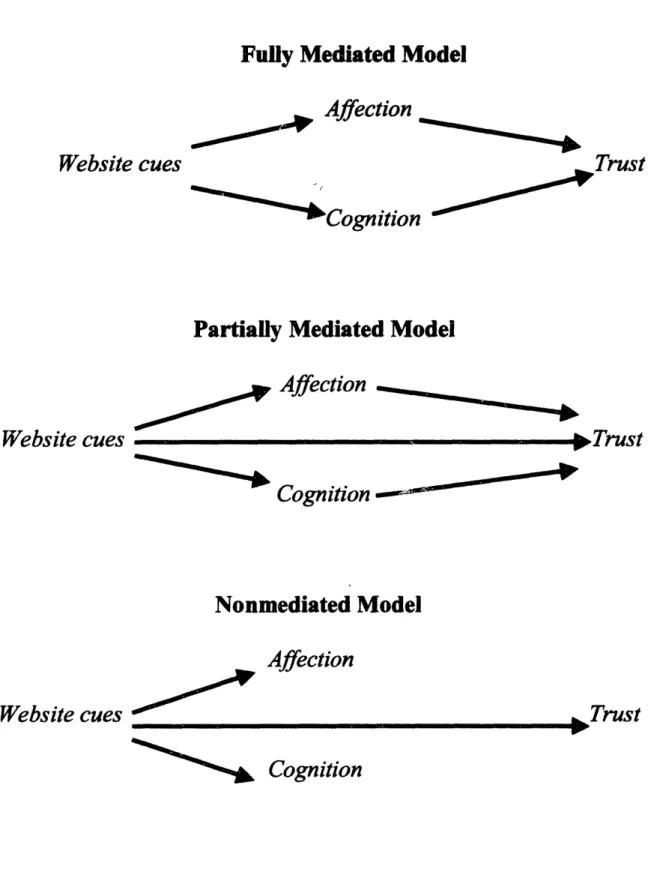
Finally, McAllister developed conceptual and empirical versions of trust that differentiated trust's cognitive and emotional aspects (McAllister 1995). This study found evidence for a clear distinction between affect-based and cognition-based trust, both in terms of factor separation, and in terms of distinct relationships with other concepts. This hypothesis of two distinct forms of trust is tested in our study (Section 5). Specifically, we will first look at reliability of the constructs of affection-based trust and cognition-based trust. Then we proceed with testing whether including these constructs as
underlying dimensions of trust increase goodness-of-fit of the structural equation model, and compare several rival model specifications in order to test whether these two
concepts serve as mediators of website trust cues (privacy, brand, content etc) to trust.
2.1.2. Marketing literature
Generally, trust in marketing has traditionally been a center of discussion in relationship marketing, where many researchers recognize it as an essential ingredient in building successful relationship marketing strategy (Dwyer, Schurr et al. 1987; Ganesan 1994; Morgan and Hunt 1994; Kumar 1996; Doney and Cannon 1997; Geyskens, Steenkamp et al. 1999). A frequently used definition is "willingness to rely on an
exchange partner in whom one has confidence" (Moorman, Deshpande et al. 1993). That is, trust can be viewed as both a belief in the trustworthiness of a partner and a behavioral
intention to rely on a partner in a situation of vulnerability. Several studies identify credibility and benevolence as underlying dimensions of trust (Ganesan 1994; Doney and Cannon 1997; Ganesan and Hess 1997). Credibility is based on the buyer's belief in the vendor's expertise to do the job effectively and reliably. Benevolence, on the other hand, refers to the buyer's belief that the vendor has positive intentions and will act in a way that is beneficial to the buyer even in new situations for which no commitments have yet been made (Ganesan 1994). Other multidimensional conceptualizations of customer trust include competence and benevolence (Singh and Sirdeshmukh 2000).
Several determinants of trust have been identified in the literature. The buyer's trust in a seller is increased if the seller has a reputation for reliable, consistent and fair behavior (Ganesan 1994). Trust is also increased by a perception that the vendor organization has made investments in the relationship (Ganesan 1994; Doney and Cannon 1997), large size of the vendor (Doney and Cannon 1997), and effective communication and shared values between the vendor and buying firms (Morgan and Hunt 1994).Trust can be decreased by perceptions of opportunistic behavior by an exchange partner (Morgan and Hunt 1994). Such factors as expertise, likeability, frequency of business contacts, dependability, honesty and customer orientation were proposed as causes of trust in marketing relationships involving a salesperson (Swan, Trawick Jr et al. 1988; Andaleeb and Anwar 1996; Doney and Cannon 1997). Swan describes the trust development process as a function of buyer's personality, buyer's experience with the salesperson and image of the salesperson's firm (Swan and Nolan 1985). Interpersonal factors, such as perceived integrity, willingness to decrease
uncertainty, expertise, tactfulness and sincerity were found to be good indicators of trust in market research relationships (Moorman, Deshpande et al. 1993).
Trust can lead to successful long-term exchange relationships (Ganesan 1994), cooperation (Morgan and Hunt 1994) and satisfaction (Grewal, Comer et al. 1999), but trust in a seller firm or salesperson may not affect the buyer's choice of the seller if factors such as delivery performance, price and product performance are appropriately accounted for (Doney and Cannon 1997). However, it is possible that price and
performance may drive both the buyer's trust and its choice of the seller.
Trust has been recognized as a key mediator construct in successful relational exchanges in general (Morgan and Hunt 1994), and in the relationships between agency mechanisms and satisfaction and between satisfaction and loyalty in particular (Singh and Sirdeshmukh 2000). Trust also has been described as a primary mediator construct
between the buyer's attitudes and future intentions (Garbarino and Johnson 1999). Andaleeb demonstrates how the behavioral intentions of marketing channel members are likely to be moderated by trust and reveals the important role of trust in explaining intentions to cooperate, exert controls, and adopt a strong influence stance in a buyer-seller dyad (Andaleeb 1995). Other researchers examine the moderating role of trust in the link to loyalty in a conceptual model of buyer-seller relationships (Chow and Holden 1997), and trust in a working relationship was identified as an essential element in the causal model of distributor firm and manufacturer firm working partnerships (Anderson and Narus 1990).
In a meta analysis of 71 studies of trust and satisfaction in marketing
relationships, Geyskens et al. show that environmental uncertainty, own dependence, partner's coercive power use, communication and economic outcomes are the primary antecedents of trust, while satisfaction and long-term orientation are the consequences of trust (Geyskens, Steenkamp et al. 1999).
When applied to online trust, these studies have important implications. For instance, credibility and benevolence could be two important underlying dimensions of online trust as well. Moreover, a firm's reputation and size, the user's past experience with the firm and its website, the user's dependence on the firm, and communication between the firm and the user are also potential antecedents of trust in the online context. Finally, satisfaction, commitment, and long-term success could be some of the
consequences of online trust.
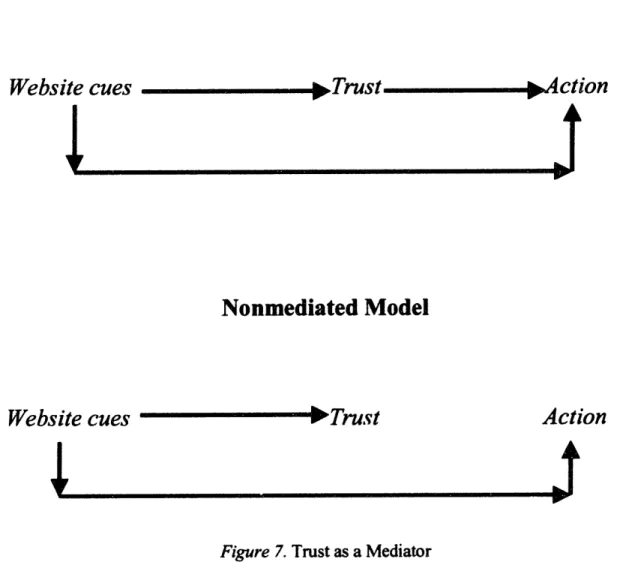
Sections 5 and 6 of this study test whether trust is a mediator construct for the relationship between website characteristics and customer behavior at the website. First, we test whether including trust as a mediator construct improves the goodness-of-fit of our structural equations model. Second, we assess how well this mediation model can predict customer intentions to make a purchase at the website, and in section 7, we investigate whether user and demographic characteristics moderate this mediation.
2.2.
Online trust literature
Trust is important in the adoption of new technologies such as the Internet (Fukuyama 1995), and researchers in the areas of electronic commerce and human-computer interactions have repeatedly addressed various trust issues in their studies. We discuss some of these studies here and conclude with describing the contribution of our study to the field.
Surprisingly, there is still no agreement on the object of trust among e-commerce researchers. Some argue that technology itself is a proper object of trust (Marcella 1999), while others suggest that people trust other people, but not machines (Friedman, Kahn et al. 2000). Yet there is another point of view in the field, which is that people can trust websites and thereby trust the companies behind the sites (Jarvenpaa, Tractinsky et al.
1999). A similar framework is adopted in research that explores how online organizations
might build trust by using hypertext links to associate themselves with other, more trusted organizations and by creating an association with the more trust-inducing traditional retail channel (Stewart 1999). A cognitive trust transference model of how such
associations influence users' perceptions and trust in a target organization is supported by the experiments she has described.
Jarvenpaa et al. distinguish between trust in the early and mature stages of e-commerce (Jarvenpaa, Tractinsky et al. 1999). In the early stages, online trust might have more to do with the performa., of the technology, whereas in the later stages, trust may be more dependent on differencez in firms' implementation of Internet technology.
and maintaining trust over time (Marcella 1999). Trust is driven by past experiences, long-term orientation, positive trusting stance, and feeling of control (Jarvenpaa,
Tractinsky et al. 1999). From a privacy standpoint, trust can be viewed as the customer's expectation that the online business will treat the customer's information fairly. The quantity, quality and timeliness of information can enhance trust (Urban, Sultan et al. 2000). Their testing of virtual personal advisors resulted in high values for both trust and acceptance levels. Moreover, rapid technology advancements allow researchers to test whether virtual conversational agents help in establishing a trusting relationship
(Bickmore and Cassell 2001). In an experiment with an embodied conversation agent, a social dialogue was demonstrated to have an effect on trust for users with a disposition towards extroversion. Another study examined the early formation of trust in different communication media, e.g. the phone vs. the web (Basso, Goldberg et al. 2001). The results indicate that real-time interactivity, though not necessarily voice interactivity, increased judgments of friendliness and the trustworthiness of the salesperson.
Dayal et al. propose a trust pyramid in which state-of-art security, merchant legitimacy, and fulfillment are the core drivers of online trust while customer control, tone and ambience and consumer collaboration are the differentiating drivers (Dayal,
Landesberg et al. 1999). Other potential drivers of online trust include site longevity, selection of items, online community, links to and from other sites, the presence of search engine on the site, and privacy (Smith, Bailey and Brynjolfsson 2000). Hoffman et al focus on security and privacy as the key drivers of online trust. They argue that environmental control or the consumer's ability to control the actions of a Web vendor
directly affects consumer perception of security and privacy online (Hoffman, Novak et al. 1999).
Another study focuses on the role of trust in the relationships among information availability, problem resolution and customer satisfaction in the online support context (Shankar, Sultan et al. 2002). The authors show that trust moderates the relationships between perceived information availability and problem resolution and between problem resolution and customer satisfaction. The positive effects of perceived information
availability and problem resolution on customer satisfaction are significantly enhanced by trust with the online provider.
Trust spans several aspects including browsing, buying, and security according the assessment criteria of Case Trust (UHK 2000). Jarvenpaa et al. found that perceived size and perceived reputation of an electronic store determined trust which affected the buyer's attitude, risk perception and willingness to buy from that electronic store (Jarvenpaa, Tractinsky et al. 2000). Brand, as a symbol of quality and assurance, is also very important to the development of trust in Web-based relationship marketing (Davis, Buchanan-Oliver et al. 1999).
Several attempts were made to build a trust model of consumer Internet shopping. Consumer trust was modeled to be driven by trustworthiness of the Internet merchant, trustworthiness of the Internet shopping medium, contextual factors (e.g., security, privacy), and other factors (e.g., company size, demographic variables) (Lee and Turban 2001). The findings of this study indicate that merchant integrity is a major positive determinant of consumer trust in Internet shopping, and that its effect is moderated by the
individual consumer's trust propensity. In another study, a generic model of trust for electronic commerce is presented (Tan and Thoen 2000). The model consists of two basic components, party trust and control trust, and it is based on the concept that trust in a transaction with another party combines trust in the other party and trust in the control mechanisms that ensure the successful performance of the transaction.
Others investigate the development of trust in a Web-based vendor during two stages of a consumer's Web experience: exploration and commitment (McKnight, Choudhury et al. 2000). Through an experimental design, the study tests the effects of third party endorsements, reputation, and individual differences on trust in the vendor during these two stages. In another study, the trust model includes four components: pre-interactional filters assumed by the users, the interface properties of the site, the
informational content of the site, and relationship management (Egger 2001). Each of these components includes several factors. For example, the informational content component of e-commerce trustworthiness includes information about products, services and the company, security and privacy.
An empirical analysis of the role of familiarity and trust in e-commerce shows that both familiarity with an Internet vendor and its processes, and trust in the vendor influenced the users' intentions to make a purchase (Gefen 2000). Additionally, the data reveal that while familiarity indeed builds trust, it is primarily people's disposition to trust that affected their trust in the vendor. A similar idea is used in another theoretical model (Cheung and Lee 2000), where consumers' trust in Internet shopping is affected by two groups of antecedent factors, namely, trustworthiness of Internet vendors and
external environment. In addition, the effects of these factors on online trust in the model are moderated by consumers' propensity to trust.
Some researchers have investigated the function of trust in particular types of online businesses. In a study on the adoption of Internet banking (Kim and Prabhakar 2000), the authors propose that both the level of initial trust in e-channels and the level of trust in the bank positively influence the adoption of Internet banking. Online investing is the topic of another study (Menon, Konana et al. 1999), which is concerned with users' perceptions of the trustworthiness of online financial transactions and of electronic brokerage firms. The model suggests that individual investors' trust beliefs are influenced by investor characteristics, investor perceptions of the broker, and investor perceptions of the transaction process.
The role of online trust has been analyzed in the context of adopting an electronic commerce intermediary (Chircu, Davis et al. 2000). The paper analyzes both the direct effects of trust and expertise on adoption intention, as well as the indirect effects of two mediating variables widely used in adoption studies, usefulness and ease of use. These effects are thought to be further moderated by the level of transaction complexity. Trust is also assumed to have a large impact on the likelihood of purchase behavior of
consumers in another exploratory study (N6teberg, Christiaanse et al. 1999).
Trustworthiness can be built up from seals of approval (logos of security firms), branding, fulfillment, navigation, presentation and technology (Cheskin/Sapient 1999).
These six building blocks can be further divided into 28 specific ways to establish trustworthiness. An extension of this study was undertaken to explore the dimensions of
online trust in Latin America (Cheskin 2000). Their findings show that a global market requires universal symbols of online security. Since then, numerous websites have started to display trust seals, such as TRUSTe (Benassi 1999), to send a clear signal to users that they have openly agreed to disclose their information gathering and dissemination
practices, and that their disclosure is backed by credible third-party assurance. Displaying trust seals has therefore become a basic trust requirement in e-business (Jones, Wilikens et al. 2000).
A few other studies investigate the role that culture plays in the formation of
online trust. A cross-cultural comparison between Finland and Sweden identified the differences between the users' perceptions of trust that might depend on the differences in cultural backgrounds (Karvonen, Cardholm et al. 2000). A similar study, which included users from 12 countries, indicates that site quality and online trust are critical in explaining both the purchase intentions and loyalty of visitors to the site (Lynch, Kent et al. 2001). This research shows that the impact of trust varies across different regions of the world and across different product categories.
Several studies identified how a website interface might affect trust. Kim and Moon focused on the visual elements of an interface. They found that the manipulation of visual elements, such as the use of color and clipart, can influence the user's perception of trustworthiness of an electronic commerce interface (Kim and Moon 1997). Further work indicates that the factors positively related to trust include: provision of
comprehensible information, perception of shared values between the e-tailer and the user, perception of frequent, high-quality communication, and internet store specificity
(Lee, Kim et al. 2000). In addition, it was found that the level of involvement with the product moderates the effects of these factors on trust. Another paper discusses the notion of online trust from a semiotic point of view, seeking to understand and analyze the signs of trustworthiness that the design of a website is sending (Karvonen and Parkkinen 2001). This study identified a set of visual and content cues that might enhance online trust.
Fogg and Tseng define trust as "a positive belief about the perceived reliability of, dependability of, and confidence in a person, object or process". They argue that the trustworthiness of a computer is a key element of computer credibility, along with computer expertise (Fogg and Tseng 1999). Four types of computer credibility are proposed: presumed, reputed, surface and experienced credibility. In the subsequent study, Fogg et al. conducted an empirical study of people's perception of the website credibility on 1400 students in the U.S. and Europe, who evaluated 51 different website site elements relating to trust (Fogg 2001). Real-world feel, ease of use, expertise, trustworthiness, and personalization turned out to be the most important factors affecting Web credibility, in that order. These factors were defined and the scale items were designed a priori and were not empirically derived.
A few studies have examined the effect of trust on prices and price dispersion on the Internet. In a study of price competition between pure play and bricks-and-clicks e-tailers across eight product categories, it was found that online trust had a positive impact on web site traffic in two categories (gifts/flowers and computer hardware), but no significant effects in the other six categories (Pan, Shankar et al. 2002). The effects of trust on prices were insignificant in all the eight categories they studied. In a study of
price levels and price dispersion across another eight categories, they found that trust is positively associated with prices only in the consumer electronics category (Pan,
Ratchford et al. 2001). It was not significant in five categories, and in fact negative in two categories (DVDs and desktop computers). In all these studies, the
operationalization of trust was the number of trust seals present on an e-tailer's Website. Therefore, only the security and privacy aspects of trust were addressed.
Based on the antecedents of trust from past studies, trust can be diminished or lost due to problems such as inferior product quality, poor content of the Web site, complex or unintuitive navigation, technology failures, inferior customer service, poor response time, and problems in order fulfillment. A number of studies actually give
recommendations on how companies should focus on enhancing online trust.
. Urban et al. recommend the following ways to building trust online: maximize
cues that build web site trust, use virtual-advisor technology to gain customer confidence and belief, provide unbiased and complete information, include information on
competitive products, increase reliability and keep promises (Urban, Sultan et al. 2000). Others suggest that user-driven personalization may be key to enhancing trust at higher levels (Dayal, Landesberg et al. 1999). Trust can be improved by quoting policies of customer satisfaction, returns and refunds (Jarvenpaa, Tractinsky et al. 2000). Giving consumers the opportunity to be anonymous or pseudonymous when engaging in information exchanges and online transactions seems to enhance online trust as well (Hoffman, Novak et al. 1999). It is also recommended that companies disclose patterns of past performance, provide references from past and current users, get third-party
certifications, and make it easy to locate, read and enforce policies involving privacy and security (Shneiderman 2000). Another study confirms that privacy statements and third-party involvement can improve trust (Palmer, Bailey et al. 2000). Because different organizations (e.g., retailer, shipping courier, and bank) are involved in an online transaction, online trust may be increased if these organizations work well together (Shankar, Sultan et al. 2002).
A problem that runs throughout most of the studies on online trust is the lack of clear distinctions between the underlying dimensions and antecedents of online trust. For example, although Dayal et al. discuss security, merchant legitimacy and fulfillment as important determinants of online trust, they also allude to them as the core elements of online trust (Dayal, Landesberg et al. 1999). Elements and determinants of online trust are used interchangeably in many studies. For example, researchers claim that
trustworthiness affects credibility, but these two constructs are blurred and not well differentiated (Fogg 2001).
In the current study, the scale items were designed based on consumer reactions to focus group surveys, and the dimensions and antecedents of trust are well differentiated and empirically derived. The survey respondents were chosen across the entire spectrum of age, education, Internet usage patterns, expert levels, etc. Our large-scale empirical analysis includes reliability and validity checks for all model constructs, and mediators and moderator variables are identified through rigorous procedures, involving structural equation modeling. The large sample of collected survey responses allowed us to use a holdout sample for replication, cross-validation and assessing predictive power of the
model. All these unique features advantageously differentiate our study from previous research and support our confidence in the value of our contribution to a better
3. Mediation/Moderation Analysis: review
The purpose of this section is to provide a brief discussion of two conceptual functions of third variables: mediation and moderation. These two functions have been extensively used in the social sciences for quite a long time, and their application in
management science is growing. As we proceed with the empirical procedures for testing our hypotheses of moderation and mediation between constructs in the following
sections, it is essential to distinguish between the properties of mediator and moderator variables and to understand the analytical procedures appropriate for making the most effective use of the mediator/moderator distinction. Specifically, we differentiate between the following functions of third variables (Baron and Kenny 1986):
* The moderator function of third variables, which partitions a focal independent variable into subgroups that establish its domains of maximum effectiveness in regard to a given dependent variable
* The mediator function of a third variable, which represents the generative mechanism through which the focal independent variable is able to influence the dependent variable of interest
3.1.
The nature of moderators
Generally, a variable is called a moderator if it affects the direction and/or strength of the relation between an independent variable and a dependent variable. A common framework for capturing the properties of a moderator variable is illustrated by the following path diagram (Baron and Kenny 1986):
Predictor
N 1 .--Mvoaerator
Predictor
X
Moderator
Figure 1. Moderator model.
Outcome
Variable
-- I - --- C
The model diagrammed in Figure 1 has three causal paths that lead to the
outcome variable: the impact of the predictor, the impact of moderator and the interaction of these two. The moderator hypothesis is supported if the interaction is significant. There may also be significant main effects for the predictor and the moderator, but these are not directly relevant conceptually to testing the moderator hypothesis.
In addition, it is always recommended that the moderator variable be uncorrelated with both the predictor and the outcome variable to provide a clearly interpretable term. Another property of the moderator variable that is apparent from Figure 1 is that, unlike the mediator-predictor relation (where the predictor is causally antecedent to the
mediator), moderators and predictors are at the same level in regard to their role as causal variables antecedent to certain outcome effects. It emphasizes the position of moderators as independent variables, whereas mediator variables shift roles from effects to causes, depending on the focus of the analysis.
Within this framework, moderation implies that the causal relation between two variables changes as a function of a moderator variable. The statistical analysis must measure and test the differential effect of the independent variable on the dependent variable as a function of the moderator. This task is accomplished in this study by using the "multigroup" nested goodness of fit strategy in LISREL, a structural equation modeling application.
In order to test the interaction effect, two steps are required. The first step involves a "multiple-group" solution in which LISREL derives parameter estimates for each group separately. LISREL also calculates a measure of goodness of fit of the model
for both groups considered simultaneously (Jaccard and Wan 1996), where each group consists of the observations with identical moderator value (e.g. if gender were the moderator variable we would have two groups, males and females). The overall test of goodness of fit is based on a pooling of the fit measures from each group separately. The step one analysis does not formally evaluate the interaction effect, but it provides
perspectives on how well the model fits the data when LISREL is permitted to estimate coefficients in each group separately without constraints across groups. In step two, we re-estimate the model, but this time we impose an equality constraint on the solution. Specifically, we permit LISREL to fit the data as best as it can using the model as a framework, but now with the constraint that the path coefficients for the causal relation of interest be equal in all groups. If there is indeed no interaction effect and the path
coefficients are equal in all groups, that such a constraint should not adversely affect model fit relative to the analysis in step one. If there is a reasonably sizable interaction effect, then such a constraint will adversely affect model fit, and based on the size of the difference in fit indexes, we can make a conclusion about the interaction effect.
Traditionally, chi square statistics are used as a fit index, and any conclusion on the presence or absence of moderation effect depends on whether the chi square difference between two steps is significant or not.
In addition to testing for the presence of an interaction effect, it is also desirable to obtain some indices of effect size in order to gain an appreciation of the magnitude of the effect. Two commonly used indices exist: one is the difference in the magnitude of the relevant standardized latent regression coefficients, and the other is the incremental
explained variance in the criterion that the interaction adds, over and above the model
with no moderation effect. It is suggested in the literature (Jaccard and Wan 1996) that
both indexes are only crude estimates of relative effect size and should be used in a
purely descriptive fashion.
3.2.
The nature of mediator variables
In general, a given variable may be said to function as a mediator to the extent
that it accounts for the relation between the predictor and the criterion (Baron and Kenny
1986). Mediator variables tell us how or why certain effects occur, while moderator
variables merely specify when such effects occur. For a better illustration of the
properties of a mediator, we use the fobowing path diagram for depicting a causal chain:
Mediator
Independent
Variable
Figure 2. Mediational model.
Outcome
Variable
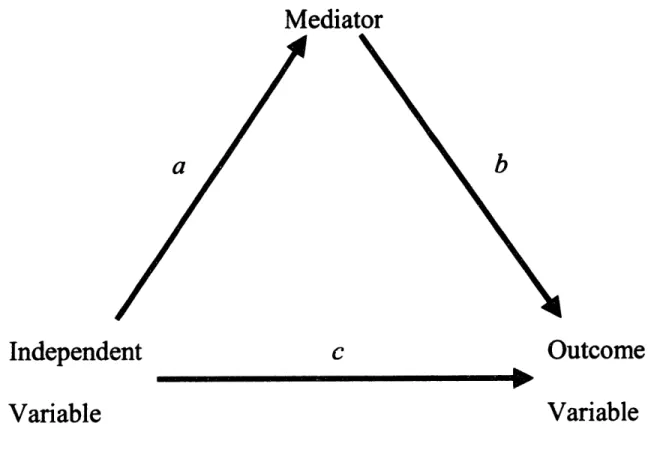
The model in Figure 2 assumes a three-variable system in which there are two causal paths leading into the outcome variable: the direct impact of the independent variable (path c) and the impact of the mediator (path b). There is also a path from independent variable to the mediator (path a). A variable functions as a mediator when it meets the following conditions:
* Variations in levels of the independent variable significantly account for variations in the presumed mediator (path a)
* Variations in the mediator significantly account for variations in the outcome variable (path b)
* When paths a and b are controlled, a previously significant relation between the independent and dependent variables is no longer significant.
In case when path c is zero, it is described as a case of perfect mediation.
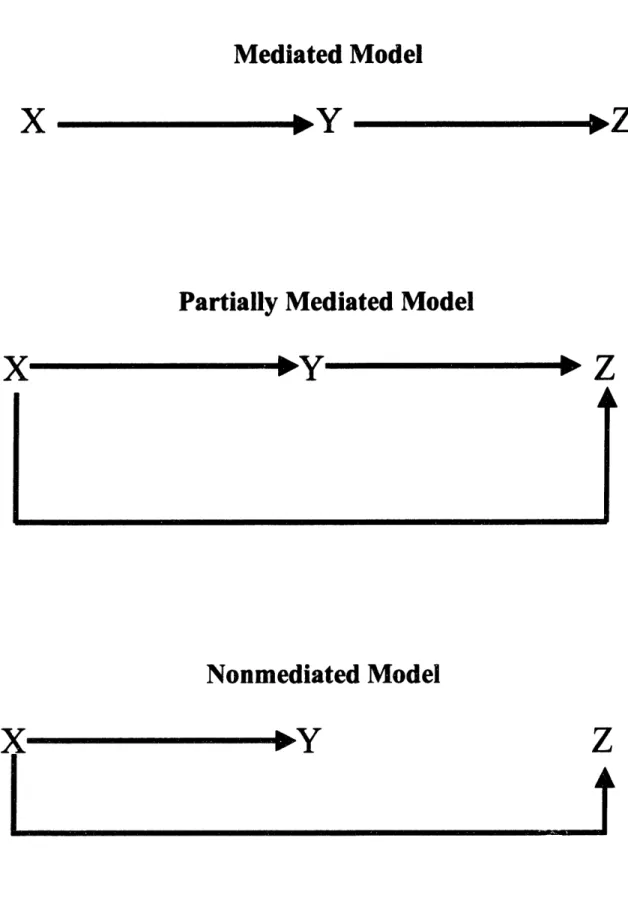
LISREL allows testing for mediation effects by estimating several models within a nesting sequence (Kelloway 1998). Specifically, for each mediated relationship in a model, there are two plausible rival specifications: a partially mediated model and a nonmediated model. To illustrate these models, consider the diagrams presented in Figure 3:
Mediated Model
X
Partially Mediated Model
x-
-lh-Nonmediated Model
Figure 3. Nested causal paths for mediation testing
'I I · I~~ L I-·-I · I
- -- pp,
~--
--:e ·
g IlPLEach diagram gives a plausible account of how X is related to Z. First, the mediated model suggests that X causes Y, which in turn causes Z. Second, the partially mediated mode! suggests that X causes both Y and Z directly. In the partially mediated model, Y also is hypothesized as a cause of Z. Finally, the nonmediated model suggests that X causes both Y and Z, but there is no direct relationship between Y and Z.
The decision on the presence of a mediation effect depends in this case on which model provides the best fit on the data. Additionally, path coefficients of the causal relation X ->Z should be checked for partially mediated and nonmediated models. If these coefficients are significant in a nonmediated model, but not significant or
significantly smaller in a partially mediated model, a positive conclusion on the presence of the mediation effect should be made.
3.3.
LISREL vs. Multiple Regression Analysis
This subsection provides a brief discussion of the main advantages of LISREL over more traditional multiple regression analysis tools in testing for moderation and mediation effects. First, multiple regression analysis assumes no measurement error in independent variables, an assumption that is unrealistic in many situations, especially when dealing with survey response data. The presence of measurement error in the mediator tends to underestimate the effect of the mediator and overestimate the effect of the independent variable on the dependent variable when all coefficients are positive, which in effect can result in missing some successful mediators (Judd and Kenny 1981). Moreover, in regard to moderation analysis, multiple regression analysis cannot
accommodate the scenario in which the reliability of measures differs in the various subgroups being considered, therefore leading to a bias in interaction terms and potentially incorrect identification of moderation effects (Jaccard and Wan 1996).
Another important difference between the two analytic techniques concerns the assumption of homogeneity of residuals across the various groups defined by the qualitative moderator variable. In traditional multiple regression, it is assumed that the variance of the residual scores is equal in all the groups being compared. Violations of this assumption can reduce statistical power and affect Type I errors (Alexander and DeShon 1994), whereas the LISREL strategy of testing for moderation effect does not require the assumption of homogeneous residual variances across groups and hence is more flexible.
mediation variables stems from the following features, not supported by traditional multiple regression analysis:
* Allows for heterogeneous measurements errors in independent variables
* Uses multiple indicators for each construct
* All the relevant paths are directly tested and none are omitted
However, LISREL also has several disadvantages in comparison to multiple regression analysis. Using single indicators for latent variables, for example, often lead to an unidentified model, and in many cases using as much as three indicators per each of latent variables is recommended. In addition, LISREL models are not as amenable to small sample analyses as traditional multiple regression models.
Another issue relates to violations of positive definiteness. Problems with
indefinite matrices can occur at three points in the model building process (Dillon, White et al. 1997):
* The input sample covariance matrix may not be positive definite because of multicollinearity.
* The model covariance matrix may not be positive definite because of the choice
of parameter starting values.
* The parameter estimates can assume values that are not in a strict sense permissible, for example, negative estimates of a parameter variance.
3.4.
Combining Mediation and Moderation effects
In the previous subsections, we discussed mediation and moderation relationships separately. However, this does not imply that in any given model only one of two
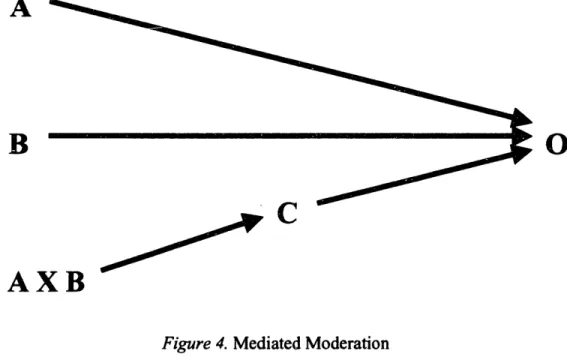
relationships might be possible. We now describe two cases where mediator and moderator variables interact with each other, the models of mediated moderation and moderated mediation. The path diagram of the first model is depicted in Figure 4:
A
B
O
-d
AXB
Figure 4. Mediated Moderation
Model variables are described as following: A is an independent variable, O is an outcome variable, B is a moderator variable, and C is a mediator. In regard to variables
A, B and 0, the model is a canonical example of a moderator effect, but in addition to
this, C is mediating the interaction effect of AxB on O. Therefore, this is the case of a mediated moderation model.
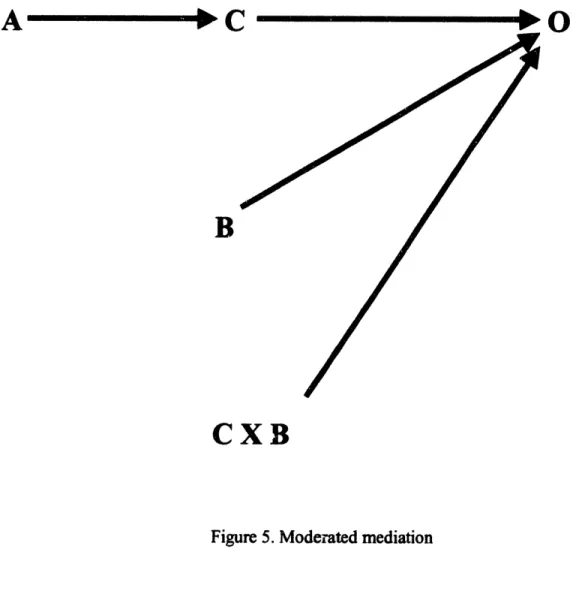
The path diagram of the second model is depicted in Figure
5:
A
IC
10
B
CXB
Figure
5.
Moderated mediation
Model variables are described as following: A is an independent variable, O is an
outcome variable, C is a mediator and B is a moderator variable. In regard to variables A,
C and 0, the model is a canonical example of a mediation effect, but there is in addition
to this an interaction effect of CxB on O. Therefore, this is a case of a moderated
4.
Research Methodology
Exploratory research on Internet customer experience with an emphasis on trust
and usability was the first stage of our research project. It was done in October 2000 in
collaboration with McCann-Erickson WorldGroup and Zentropy Partners. After
identifying vocabulary and terminology of trust from the customer point of view, initial
survey questions were refined and reevaluated. Later that year, NFO WorldGroup
conducted the survey and collected a representative data sample, taking into account the
set of recommendations from the first stage of the research project. The first wave of
responses was heavily disproportionate on a gender basis and was therefore unacceptable
for further use in estimating the model parameters, but the second wave of responses in
March 2001 satisfied all the requirements and was used for the empirical part of this
paper.
4.1.
Exploratory Stage
In order to perform quantitative research to validate the drivers and role of trust, an exploratory qualitative research was first conducted. Pre-testing the data collection methodology and the self-administrated questionnaire in order to recommend
improvements was the main objective of the first stage.
The research was conducted over three days (October 2-4, 2000) at a focus group facility in Boston. Each day consisted of 8 one-on-one, in-depth, face-to-face interviews lasting 45 minutes and conducted by a trained qualitative moderator. In total, 24
interviews were completed, and each interview was audio- and video-recorded. In order to obtain a representative sample of data, participants were chosen from different
demographic groups and had different interests and levels of familiarity with the Internet. During each session, a respondent was assigned to a website and asked to perform a task there while the moderator left the room. After the respondent had completed the task and had some time to browse the site, the moderator asked both general questions about the experience and more specific questions regarding the site's layout, navigation, content, trust and other issues. Lastly, respondents were asked to circle words/phrases in the survey that they found confusing, reword statements in their own words and make any other general comments about the statements.
Among the various findings from the first stage on procedure and content improvement, the following set of recommendations was identified as essential for the success of the quantitative study:
* Add quotas for different levels of comfort with Internet-based tasks, such as
information gathering, shopping, banking/investing, etc
* Create quotas for age by Internet usage
* Prescreen respondents based on degree of interest in various categories and assign
them randomly to visit a predetermined website within one of those categories
* Prescreen respondents based on familiarity with proposed websites, and obtain a
quota sample for both "familiar" and "unfamiliar"
* Categorize websites into comparable levels of experience and activities as
delivered by the company today, such as shopping for small items, managing
personal finances in real time, general searching for information, etc
* Assign specific tasks for a respondent based on category of business and what the
current website allows you to do today
* Allow the respondent at least 20 minutes to conduct the assigned task, and to
explore the website appropriately
These recommendations were adopted in the quantitative stage of the research
project, which we describe below.
4.2.
Sampling and data collecting stage
NFO WorldGroup conducted the first wave of survey data collection at the end of
2000, but the resulting sample turned out to be heavily disproportionate on a gender scale and therefore was inadequate for further use in estimating the model. Hence, another wave of survey data collection was conducted at the beginning of 2001, and this
produced the suitable balanced sample that is used in the empirical part of this paper. The sampling and data collecting procedures are described in the following chronological report of the second, successful wave:
* 2/19/01 - 2/22/01: NFO designed a sample of 120,000 U.S. online individuals with the following parameters:
o key balancing demographics included: age, gender, income, geography, market size and household size
o These 120,000 individuals were divided into 20 groups - 10 female and 10 males groups - each group being representative of the U.S. online
population. The groups were created to facilitate releasing invitations on an as-needed basis.
* 2/22/01: 70,000 panelist invitations (35,000 male and 35,000 females) were emailed to participants, along with the pre-screener survey (see Appendix A).
* 2/26/01: 10,000 panelist invitations (5,000 male and 5,000 female) were emailed to participants.
* 3/2/01: 6078 male 18-29 panelist invitations were emailed to participants and
3548 18-24 females panelist invitations were emailed to participants.
* 3/8/01: 3100 male 18-24 panelist invitations were emailed to participants.
* 3/8/01: Returns from the first 70,000 pre-screener invitations (qualifying and non-qualifying) were weighted based on quotas of a representative U.S. Online
population for: age, gender, income, geography, market size and household size. Only returns from the first 70,000 invitations were used because this was the most balanced sample and involving the other groups might have biased the weighting. The weighted data was used to cross interest category by demographics to
determine ideal quotas for the sample build for each website in phase two. The data for each individual was sourced as follows:
o NFO Master Panel Data was used for: household size, income, geography, income
o Survey data was used for: age, gender
* 3/13/01: the pre-screener portion of the study closed.
* 3/13-3/15/01: NFO designed 27 sample groups (one sample group per website) according to the following criteria:
o All individuals answering Ql, codes 1,2 or 3 AND Q2 any code were used to create the 27 sample groups.
o In order to achieve 150 completes per website, each group contained 575-855 panelists.
o Individuals were assigned to websites based on their expressed interest in the category (Q2 of the pre-screener).
o The first priority was to create the necessary groups for the low incidence categories, saving the high incidence categories for the last sample builds. o When possible, websites groups were balanced to quotas determined by
the demographics profile of each category.
* 3/15/01: NFO invited 27 groups of panelists to view the respective websites and to participate in the final survey (Appendix A). The average time per session is 45 minutes, and the amount of cash reward is $20
* 3/26/01: The study closed, and data processing commenced.
Out of 27 websites initially chosen for the study, two (www.etown.com and
www.softseek.com) went out of business during the data collection stage. The resulting list of 25 websites assessed in the study is included in Appendix A. Basic statistics for all variables in the collected sample of 6831 observations are included in Appendix A as well.
4.3. Sample splitting
Before proceeding with any data analysis, the sample was randomly split into a proportion of 2:1, with 4554 observations in the so-called "calibration" sample, and 2277 observations in the so-called "validation sample". Calibration data sample was
subsequently used in exploring the factor structure, choosing the best model and estimating model parameters (Section 5), while validation data sample was used for model validation and assessing the predictive power of the model (Section 6).
5. Specifying and Analyzing the Model
There are numerous methods that could be used for analyzing the collected data, identifying possible determinants of trust, and linking trust with other important concepts. Structural equation modeling (with preceding exploratory and confirmatory factor
analysis) was chosen for the following reasons:
The necessity of using factor analysis procedure arises from the fact, that some variables of interest cannot be observed directly. These unobserved variables are usually referred to as latent variables or factors. While latent variables cannot be directly observed, information about them can be obtained indirectly by noting their effects on observed variables. Factor analysis is a statistical procedure for uncovering a smaller set of latent variables by studying the covariation structure among a set of observed variables.
* Since we did not specify the set of concepts and sets of variables related to the concepts before the study, exploratory factor analysis is necessary to
empirically identify the latent variables and to choose the sets of observed variables that have higher loadings on the concepts of interest. After identifying these variables and concepts (latent variables), the covariance structure model will be formulated and assessed. Notice here, that while exploratory factor analysis and other specification search techniques provide
useful information, it is important to realize that since the sample data is used
to select a model, the same data cannot be used to formally assess the fit of the
model. This is one of the reasons why we split the data into calibration and
validation samples: it allows us to use exploratory analysis and model
selection on the calibration sample, with subsequent application of the best
selected model to the validation sample for model validation.
* After identifying the concepts of interest and appropriate scales (related
observed variables), we need to conduct confirmatory factor analysis to assess
the measurement properties of the scales. Estimating latent variables through
the confirmatory factor analysis is necessary in order to eliminate errors in
measurement. Reliability checks are also performed at this stage.
* While the confirmatory factor model can provide correlations among latent
variables, these are generally insufficient to determine the structural
parameters of interest. This is why we need the second part of covariance
structure model, where we estimate structural parameters through the
application of a structural equation model (SEM) to the factors. Both
confirmatory factor analysis and the incorporation of structural relations
among latent variables can be accomplished with the LISREL model, which
was developed by Karl Joreskog and Dag Sorbom in the 1970s. The LISREL
model has been extensively used in a number of disciplines, including psychology, sociology, economics and marketing.
* It is necessary to notice that the fit of a model to data in itself conveys no information about the validity of our theory of causal relationships. Although the hypotheses underlying model development may be causal in nature, assessing the fit of a model does not provide a basis for causal inference. Therefore, a more carefully designed study is needed to validate the causal relationships in the model (see implications for future research in Section 8).