HAL Id: tel-01366449
https://tel.archives-ouvertes.fr/tel-01366449
Submitted on 14 Sep 2016HAL is a multi-disciplinary open access
archive for the deposit and dissemination of sci-entific research documents, whether they are pub-lished or not. The documents may come from teaching and research institutions in France or abroad, or from public or private research centers.
L’archive ouverte pluridisciplinaire HAL, est destinée au dépôt et à la diffusion de documents scientifiques de niveau recherche, publiés ou non, émanant des établissements d’enseignement et de recherche français ou étrangers, des laboratoires publics ou privés.
allocation for cloud-empowered future wireless networks
Jessica Oueis
To cite this version:
Jessica Oueis. Joint communication and computation resources allocation for cloud-empowered future wireless networks. Web. Université Grenoble Alpes, 2016. English. �NNT : 2016GREAM007�. �tel-01366449�
Pour obtenir le grade de
DOCTEUR DE L’UNIVERSIT ´
E DE GRENOBLE
Sp ´ecialit ´e : Informatique Arr ˆet ´e minist ´erial : 7 ao ˆut 2006
Pr ´esent ´ee par
Jessica Oueis
Th `ese dirig ´ee par Andrzej Duda et codirig ´ee par Sergio Barbarossa
pr ´epar ´ee au sein CEA -LETI/DSIS/STCS/LESC - et UMR 5217 - LIG - Laboratoire
d’Informatique de Grenoble
et de MSTII
Gestion conjointe de ressources de
communication et de calcul pour les
r ´eseaux sans fils `a base de cloud
Th `ese soutenue publiquement le 12 F ´evrier 2016, devant le jury compos ´e de :
M., Josep Vidal
UPC Barcelona, Rapporteur, Pr ´esident
M., Kei Sakaguchi
Fraunhofer HHI, Tokyo Institute of Technology, Rapporteur
M., Valerio Frascolla
Intel, Examinateur
M., Andrzej Duda
Grenoble INP-Ensimag, Directeur de th `ese
M., Sergio Barbarossa
Universit ´e de Rome, La Sapienza, Co-Directeur de th `ese
M., Emilio Calvanese Strinati
Mobile Edge Cloud brings the cloud closer to mobile users by moving the cloud computational efforts from the internet to the mobile edge. We adopt a local mobile edge cloud computing ar-chitecture, where small cells are empowered with computational and storage capacities. Mobile users’ offloaded computational tasks are executed at the cloud-enabled small cells. We propose the concept of small cells clustering for mobile edge computing, where small cells cooperate in order to execute offloaded computational tasks. A first contribution of this thesis is the design of a multi-parameter computation offloading decision algorithm, SM-POD. The proposed algorithm consists of a series of low complexity successive and nested classifications of computational tasks at the mobile side, which leads to an offloading decision to each of the tasks. The tasks are either computed locally using the handset resources, or offloaded to the cloud. To reach the offloading decision, SM-POD jointly considers computational tasks, handsets, and communication channel parameters. In the second part of this thesis, we tackle the problem of small cell clusters set up for mobile edge cloud computing for both single-user and multi-user cases. The clustering prob-lem is formulated as an optimization that jointly optimizes the computational and communication resource allocation, and the computational load distribution on the small cells participating in the computation cluster. We propose a cluster sparsification strategy, where we trade cluster latency for higher system energy efficiency. In the multi-user case, the optimization problem is not con-vex. In order to compute a clustering solution, we propose a convex reformulation of the problem, and we prove that both problems are equivalent. With the goal of finding a lower complexity clus-tering solution, we propose two heuristic small cells clusclus-tering algorithms. The first algorithm is based on resource allocation on the serving small cells where tasks are received, as a first step. Then, in a second step, unserved tasks are sent to a small cell managing unit (SCM) that sets up computational clusters for the execution of these tasks. The main idea of this algorithm is task scheduling at both serving small cells, and SCM sides for higher resource allocation efficiency. The second proposed heuristic is an iterative approach in which serving small cells compute their desired clusters, without considering the presence of other users, and send their cluster parameters to the SCM. SCM then checks for excess of resource allocation at any of the network small cells. SCM reports any load excess to serving small cells that re-distribute this load on less loaded small cells. When no small cell is overloaded, the SCM validates the clusters set up accordingly. In the final part of this thesis, we propose the concept of computation caching for edge cloud computing. With the aim of reducing the edge cloud computing latency and energy consumption, we propose caching popular computational tasks for preventing their re-execution. Our contribution here is two-fold: first, we propose a caching algorithm that is based on requests popularity, computation size, required computational capacity, and small cells connectivity. This algorithm identifies re-quests that, if cached and downloaded instead of being re-computed, will increase the computation caching energy and latency savings. Second, we propose a method for setting up a search small cells cluster for finding a cached copy of the requests computation. The clustering policy exploits the relationship between tasks popularity and their probability of being cached, in order to identify
possible locations of the cached copy. The proposed method reduces the search cluster size while guaranteeing a minimum cache hit probability.
Keywords
Mobile cloud computing, Local cloud, Edge cloud, Small cells cluster, Resource allocation, Com-putation offloading, ComCom-putation caching, Load distribution
Journal Papers
[J1] J. Oueis, E. Calvanese Strinati, S. Sardellitti, and S. Barbarossa, “Joint Computation and Communication Resource Allocation in Edge Cloud Computing Clusters”to be submitted,
2015.
Conference Papers
[C1] Oueis, J.; Strinati, E.C.; Barbarossa, S., “Multi-parameter decision algorithm for mobile computation offloading,” in Wireless Communications and Networking Conference (WCNC), 2014 IEEE , vol., no., pp.3005-3010, 6-9 April 2014
[C2] Oueis, J.; Calvanese-Strinati, E.; De Domenico, A.; Barbarossa, S., “On the impact of backhaul network on distributed cloud computing,” in Wireless Communications and Net-working Conference Workshops (WCNCW), 2014 IEEE , vol., no., pp.12-17, 6-9 April 2014
[C3] Oueis, J.; Strinati, E.C.; Barbarossa, S., “Small cell clustering for efficient distributed cloud computing,” in Personal, Indoor, and Mobile Radio Communication (PIMRC), 2014 IEEE 25th Annual International Symposium on , vol., no., pp.1474-1479, 2-5 Sept. 2014
[C4] Oueis, J.; Strinati, E.C.; Barbarossa, S., “The Fog Balancing: Load Distribution for Small Cell Cloud Computing,” in Vehicular Technology Conference (VTC Spring), 2015 IEEE 81st , vol., no., pp.1-6, 11-14 May 2015
[C5] Oueis, J.; Strinati, E.C.; Sardellitti, S.; Barbarossa, S., “Small Cell Clustering for Effi-cient Distributed Fog Computing: A Multi-user Case,” in Vehicular Technology Conference (VTC Fall), 2015 IEEE 82nd , vol., no., pp., Sept. 2015
[C6] Oueis, J.; Strinati, E.C.; Barbarossa, S., “Distributed Mobile Cloud Computing: A Multi-user Clustering Solution,” submitted to the International Conference on Communications (ICC), 2016 IEEE , 23-27 May, 2016
[C7] Oueis, J.; Strinati, E.C.; Barbarossa, S., “Energy Aware Computation caching on the Edge cloud,” to be submitted, 2015.
[C8] Oueis, J.; Strinati, E.C.; Barbarossa, S., “Uplink Traffic in future mobile networks: pulling the alarm,” submitted to CROWNCOM 2016.
Patents
[P1] J. Oueis, E. Calvanese Strinati, and A. De Domenico, “Method for Modifying The State of Local Access Points in a Cellular Network,” US20140220994, EP2763469 A1.
[P2] J. Oueis, E. Calvanese Strinati, and S. Barbarossa, “Method for Offloading the Execution of Computation Tasks of a Wireless Equipment,” DD14763SP.
[P3] J. Oueis, and E. Calvanese Strinati, “Method, Devices and System for Cloud Constitution With Signal Response Time,” DD15918SP.
[P4] J. Oueis, and E. Calvanese Strinati, “Method for distributed Local Cloud Cluster Formation with Multiple joint Communication and Computing UE requests,” DD16683SP.
[P5] J. Oueis, and E. Calvanese Strinati, “Caching and Fog Distributed Clustering Offloading,” DD16782SP.
Abstract i
List of Publications iii
Contents v
List of Figures ix
List of Tables xi
Abbreviations and Acronyms xiii
Introduction and Thesis Outline 1
1 The Evolution of Cloud Enable Mobile Wireless Networks 7
1.1 Motivation . . . 8
1.2 5G Cellular: The Future of Mobile Networks . . . 9
1.2.1 5G: Design Essentials . . . 10
1.2.2 5G Requirements and Enabling Technologies . . . 10
1.2.2.1 5G Requirements and Capabilities . . . 10
1.2.2.2 5G Enabling Technologies . . . 12
1.3 Cloud Technologies and Network Architecture: A Joint Evolution . . . 18
1.3.1 Cloud Computing . . . 18
1.3.1.1 Definition and Characteristics . . . 18
1.3.1.2 Service and Deployment Models . . . 19
1.3.1.3 Cloud Computing Enablers . . . 20
1.3.2 Cloud Technologies in Cellular Networks . . . 20
1.3.2.1 Classic Base Station Architecture . . . 21
1.3.2.2 Cloud Radio Access Network (C-RAN) . . . 22
1.3.2.3 Mobile Cloud Computing: Remote Clouds . . . 23
1.3.2.4 Mobile Cloud Computing: Cloudlets . . . 27
1.3.2.5 Mobile Edge Computing . . . 28
1.3.3 Fog Computing . . . 31
1.4 Uplink Traffic in Future Mobile Networks: Pulling the Alarm . . . 33
1.4.1 Motivation . . . 33
1.4.2 Why Uplink Traffic is Growing . . . 34
1.4.2.1 Increase in Number of Mobile Subscribers and Devices . . . . 34 v
1.4.2.2 Evolution of Cellular Networks . . . 34
1.4.2.3 Emergence of Cloud Technologies and Dense Heterogeneous Networks . . . 35
1.4.2.4 New Applications and Services Ecosystem . . . 36
1.4.2.5 Crowded Networks Scenarios . . . 37
1.4.2.6 Sensor and MTC Networks . . . 37
1.4.3 Uplink Improvement Related Work . . . 38
1.4.3.1 Range Extension in Heterogeneous Networks . . . 38
1.4.3.2 Downlink and Uplink Decoupling . . . 39
1.4.3.3 Uplink CoMP Techniques . . . 39
1.5 Conclusion . . . 40
2 Edge Cloud Cluster Computing: Challenges and Trade-offs 43 2.1 Introduction . . . 44
2.1.1 Contribution . . . 44
2.2 System Model . . . 44
2.2.1 Small Cells Edge Computing . . . 44
2.2.2 Computation offloading . . . 45
2.2.3 Computation Small Cells Cluster . . . 46
2.3 Preliminary on Communication Trade-offs in Heterogeneous Networks . . . 49
2.4 Advanced MEC trade-offs: Joint Communication and Computation . . . 51
2.4.1 Computation Offloading Trade-offs . . . 51
2.4.2 Small Cell Cloud Clustering Trade-offs . . . 52
2.4.3 Local Computing vs Computation Offloading . . . 56
2.4.4 Performance and Energy Savings . . . 56
2.4.5 System Energy Efficiency, Cells Density, and EMF Exposure . . . 58
2.4.6 Small Cell Cluster Cloud . . . 60
2.5 Extending the Impact of Backhaul Network on Small Cell Cloud Computing . . . 61
2.5.1 System Model . . . 61
2.5.2 Latency Models . . . 62
2.5.2.1 Full Mesh Topology . . . 63
2.5.2.2 Wireless LTE Backhaul . . . 63
2.5.2.3 Tree Topology . . . 63
2.5.2.4 Ring Topology . . . 64
2.5.3 Power Consumption Models . . . 65
2.5.3.1 Wireless LTE Backhaul . . . 65
2.5.3.2 Fiber Backhaul . . . 66
2.5.3.3 Ring topology . . . 66
2.5.3.4 Microwave Backhaul . . . 66
2.6 Numerical Evaluation . . . 67
2.6.1 Cluster Latency . . . 67
2.6.2 Cluster Communication Power Consumption . . . 69
2.7 Conclusion . . . 70
3 Multi-parameter Computation Offloading Decision 71 3.1 Introduction . . . 72
3.1.1 Motivation . . . 72
3.1.3 Contribution . . . 74
3.2 System Model . . . 75
3.3 Problem Statement . . . 76
3.4 Proposed Offloading Decision Algorithm: SM-POD . . . 77
3.5 Numerical Evaluation . . . 80
3.6 Conclusion . . . 83
4 Small Cells Clustering for MEC: From Single-user to Multi-user 87 4.1 Introduction . . . 88
4.1.1 Motivation . . . 88
4.1.2 Related Work . . . 89
4.1.3 Contribution . . . 90
4.2 System Model . . . 92
4.3 Single-user Multi-cloud Use Case . . . 93
4.3.1 Problem Statement . . . 93
4.3.2 Latency Minimization . . . 94
4.3.3 Cluster Sparsification . . . 97
4.3.4 Minimization of Cluster Power Consumption . . . 99
4.3.5 Minimization of Small Cell Selfish Power Consumption . . . 102
4.3.6 Numerical Evaluation . . . 102
4.4 Multi-user Multi-cloud Use Case . . . 104
4.4.1 Multi-user Clustering Optimization . . . 105
4.4.2 Numerical Evaluation . . . 108
4.5 Conclusion . . . 111
5 Small Cells Clustering Approaches for MEC 113 5.1 Introduction . . . 114
5.1.1 Motivation . . . 114
5.1.2 Related Work . . . 114
5.1.3 Contribution . . . 116
5.2 System Model . . . 116
5.3 Small Cell Cloud Clustering: A Scheduling Approach . . . 117
5.3.1 General Algorithm . . . 117
5.3.2 Algorithm Implementations . . . 118
5.4 Small Cell Cloud Clustering: An Iterative Approach . . . 119
5.5 Numerical Evaluation . . . 122
5.6 Conclusion . . . 127
6 Computation Caching in Cluster-based Cloud Computing 129 6.1 Introduction . . . 130
6.1.1 Motivation . . . 130
6.1.2 Related Work . . . 131
6.2 Contribution . . . 133
6.3 System Model and Notations . . . 133
6.4 Computation Caching for Edge Computing . . . 134
6.5 Proposed Caching Algorithm . . . 136
6.6 Caching Algorithm Evaluation . . . 138
6.7.1 Motivation . . . 140
6.7.2 Contribution . . . 141
6.7.3 Concepts and Notations . . . 142
6.7.3.1 Notations Definition . . . 143
6.7.3.2 Traffic Classification . . . 144
6.7.4 Proposed Search Cluster Sparsification Method . . . 144
6.7.5 Numerical Example of Search Cluster Sparsification . . . 147
6.8 Conclusion . . . 151
Conclusions and Future Work 153
1.1 Bandwidth and latency requirements for potential 5G applications [1]. . . 10
1.2 Illustration of Massive MU-MIMO systems [2]. . . 12
1.3 Hidden terminal problem with HD and FD scenarios . . . 17
1.4 System architecture with cloud-based radio access network . . . 17
1.5 Total global monthly data and voice traffic [3]. . . 21
1.6 Traditional base station model . . . 21
1.7 RAN distributed architecture . . . 21
1.8 C-RAN architecture . . . 22
1.9 Mobile cloud computing architecture [4] . . . 24
1.10 Offloading decision based on mobile device energy consumption . . . 25
1.11 Network architecture with cloudlets . . . 27
1.12 Mobile edge applications and use cases [5] . . . 30
1.13 Mobile subscriptions by technology [6] . . . 35
1.14 High level simplified M2M architecture . . . 37
1.15 Cell Range Expansion (CRE) impact of base stations footprint . . . 38
1.16 Uplink CoMP usecase example . . . 39
2.1 Small cell cloud basic architecture and process principles . . . 48
2.2 Small cells density vs service latency for wired and wireless backhaul . . . 50
2.3 Small cells density vs deployment efficiency . . . 50
2.4 Transmit power vs computational capacity trade-off . . . 53
2.5 Cluster size vs service latency vs power consumption trade-off . . . 54
2.6 Cluster size vs SEE vs aggregated computational capacity trade-off . . . 55
2.7 Power consumption dependency on relative cell load. (PA: Power Amplifier, RF: small signal RF transceiver, BB: Baseband processor, DC: DC-DC converters, CO: Cooling, PS: AC/DC Power Supply, Red mark: BS sleep mode power con-sumption) [7] . . . 59
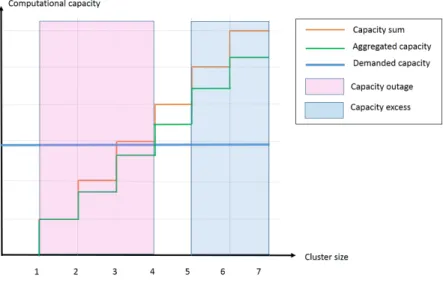
2.8 Example of aggregated computational capacity with respect to the cluster size . . 59
2.9 Specific absorption rate in respect with distance and transmit power [8] . . . 60
2.10 Cellular deployment of small cells. . . 61
2.11 Wireless backhaul topologies: (a) full mesh topology, (b) tree topology, and (c) ring topology. . . 63
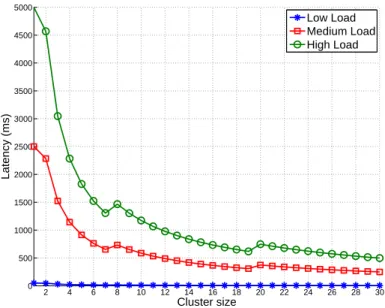
2.12 Wireless LTE full mesh backhaul cluster latency for different traffic loads. . . 68
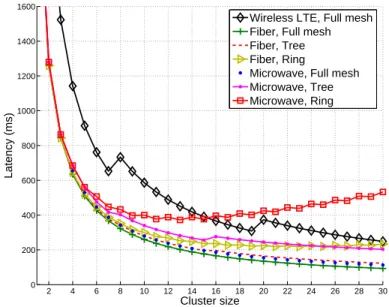
2.13 Cluster backhaul latency for different backhaul technologies and topologies for medium traffic load. . . 68
2.14 Equal load distribution (ELD) and optimal load distribution (OLD) comparison. . 69
2.15 Microwave backhaul traffic power consumption for different traffic loads. . . 69 ix
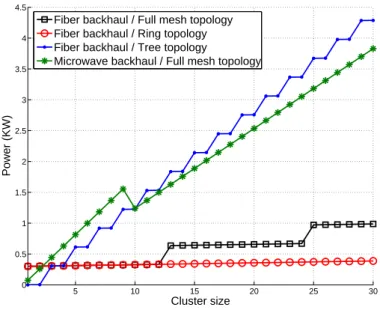
2.16 Cluster backhaul power consumption for different backhaul topologies and
tech-nologies. . . 69
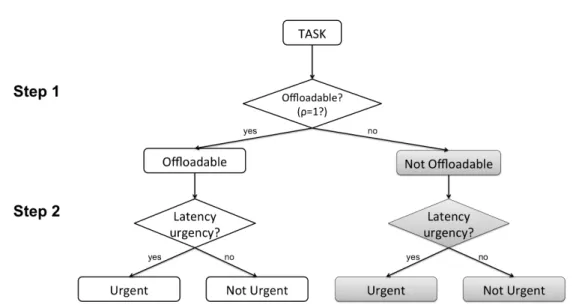
3.1 First and Second classification steps of the proposed algorithm. . . 77
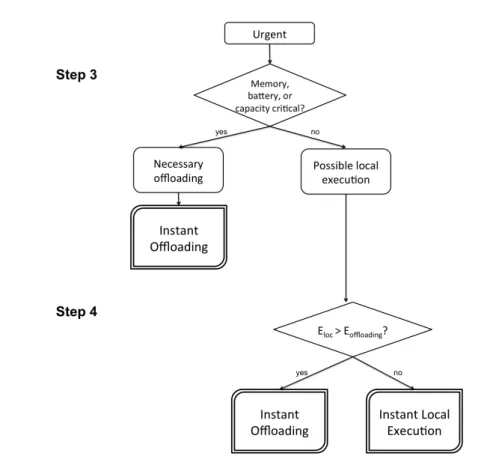
3.2 Third and fourth classification steps of the proposed algorithm. . . 79
3.3 Last steps of the proposed algorithm. . . 80
3.4 Successive classifications of the offloading decision proposed algorithm. . . 80
3.5 Max-Max Scenario: Mobile battery discharge due to tasks computation/offloading for all considered algorithms . . . 82
3.6 Min-Min scenario: Mobile battery discharge due to tasks computation/offloading for all considered algorithms . . . 83
3.7 Mix-Mix scenario: Mobile battery discharge due to tasks computation/offloading for all considered algorithms . . . 83
4.1 Single-user small cell cloud scenario. . . 93
4.2 Cost function F2(x) variation withα . . . 98
4.3 Cost function F3(x) variation withγ . . . 98
4.4 3GPP apartment grid with small cells emplacement . . . 102
4.5 Comparison of load distribution to each HSC set and SSC for latency and power consumption minimization . . . 103
4.6 Latency gain of different strategies comparing to∆app . . . 103
4.7 Power consumption gain for different strategies comparing to the maximum power consumption . . . 104
4.8 Ratio of used HSCs for different strategies . . . 104
4.9 Power consumption distribution for power saving strategies . . . 105
4.10 Multi-user small cell cloud scenario. . . 105
4.11 Cluster load distribution according small cells distance to SSC . . . 109
4.12 Users satisfaction ratio in dependence on number of users per small cell . . . 109
4.13 Average power consumption per user in dependence on the number of users per small cell . . . 110
4.14 Average user latency gain in dependence on the number of users per small cell . . 110
5.1 Scheduling aware clustering proposed algorithm scheme . . . 117
5.2 Resource blocks allocations of several requests r of delay constraint∆rwith hori-zontal and vertical allocations. . . 119
5.3 Proposed iterative clustering algorithm scheme . . . 122
5.4 Users satisfaction ratio in dependence on number of users per small cell . . . 123
5.5 Users satisfaction ratio in dependence on the number of users per small cell . . . 124
5.6 Average latency gain in dependence on number of users per small cell . . . 125
5.7 Average power consumption per user in dependence on number of users per small cell . . . 126
5.8 Average Number of Iterations Needed for Cluster Establishment . . . 126
5.9 CDF of the Number of Iterations Needed for Cluster Establishment . . . 126
6.1 Cached requests ratio for different connectivity levels and memory space . . . 139
6.2 Cached requests probability in function of popularity . . . 139
6.3 Energy consumption of different caching algorithms . . . 139
6.4 Energy consumption gain of different caching algorithms . . . 139
1.1 Cloud architecture evolutions comparison . . . 35
1.2 Cloud architecture evolutions comparison . . . 41
2.1 LTE wireless backhaul parameters [9] [10]. . . 67
2.2 Fiber backhaul parameters [11] [12]. . . 67
2.3 Microwave backhaul parameters [11] [12]. . . 67
2.4 Comparison of backhaul technologies. (⋆ ⋆ ⋆ -the best, ⋆ -the worst) . . . 70
3.1 Mobile Handset Characteristics. . . 75
3.2 Applications and tasks Characteristics. . . 76
3.3 Computation offloading virtual buffers labels and decisions . . . 80
3.4 Simulations results for scenarios 1, 2, and 3 . . . 84
4.1 Simulation parameters values . . . 103
4.2 Simulation parameters values for the multi-user case . . . 109
5.1 Simulation parameters values . . . 123
5.2 Algorithm implementation metrics and policies . . . 124
6.1 Simulation parameters values . . . 138
6.2 Computation and SSC association . . . 148
6.3 In cache probability of search clusters . . . . 150
ACK Acknowledgment
AMC Adaptive Modulation and Coding ANN Artificial Neural Network
BB Baseband
BBU Baseband Unit BER Bit Error Rate BFD Best Fid Decreasing BS Base Station
CAC Call Admission Control CAPEX Capital Expenditure CoMP Coordinated Multi-Point
CRAM Cloud Resource Allocations for Mobile applications C-RAN Cloud (Centralized) Radio Access Network
CRE Coverage Range Extension CSI Channel State Information DHT Distributed Hash Table
DL Downlink
D2D Device to Device EDF Earliest Deadline First
EDGE Enhanced Data rates for GSM Evolution EE Energy Efficiency
EHF Extremely High Frequency EMF Electro Magnetic Field
eICIC enhanced Inter-Cell Interference Coordination EPI Energy Per Instruction
FD Full Duplex
FFD First Fit Decreasing FFT Fast Fourier Transform FIFO First In First Out
GPRS General Packet Radio Service GPS Global Positioning System
GSM Global System for Mobile communications HD Half Duplex
Het-Nets Heterogeneous Networks HSC Helper Small Cell
HSPA High Speed Packet Access IaaS Infrastructure as a Service
ICN Information Centric Networking ICP Internet Cache Protocol
IFFT Inverse Fast Fourier Transform IoT Internet of Things
IP Internet Protocol
ISP Internet Service Provider LAN Local Area Network LRU Least Recently Used LSA Licensed Shared Access LTE Long Term Evolution LoS Line of Sight
MAC Media Access Control MCC Mobile Cloud Computing MDP Markov Decision Process MEC Mobile Edge Computing
MILP Multiple Integer Linear Programming MIMO Multiple Input Multiple Output MIPS Million Instructions Per Second mmW millimeter Waves
MTC Machine Type Communications MUE Mobile User Equipment
NACK Negative Acknowledgment NFN Named Function Networking NLoS Non Line of Sight
OPEX Operational Expenditure OTA Over The Air
PaaS Platform as a Service PER Packet Error Rate PF Proportional Fairness QoE Quality of Experience QoS Quality of Service RAN Radio Access Network RF Radio Frequency RRH Radio Remote Head
RRM Radio Resource Management SaaS Software as a Service
SAR Specific Absorption Rate SC Small Cell
SCC Small Cell Cloud SCM Small Cell Manager SHF Super High Frequency
SINR Signal to Interference and Noise Ratio SLA Service Level Agreement
SSC Serving Small Cell SNR Signal to Noise Ratio SIR Signal to Interference Ratio TDD Time Division Duplex TTL Time To Live
UL Uplink
VM Virtual Machine WAN Wide Area Network WSN Wireless Sensor Networks
The imminent emergence of mobile cloud computing to wireless networks is today a real-ity. Mobile equipments are henceforth a platform that consumers are using to replace their desk-top applications. Mobile equipment offers nowadays not only communication services, but also sensing, computing and storage. Mobile communicating devices are becoming ubiquitous, from smartphones in the hands of billions of persons, to wireless sensors, to connected things (vehi-cles, machines, cities, etc.). As a result, there is an increasing proliferation of various domains in the wireless communication such as medicine, health monitoring, business, banking, image pro-cessing, and home monitoring. It becomes more and more obvious that wireless devices need to have greater capabilities in terms of communication resources, computational capacities, storage space, and most importantly great autonomy. As new functionalities have been integrated in mo-bile connected devices over the last couple of decades, devices have grown in features, capacities, capabilities, and sometimes in size. However, battery technology has not been able to cope with the development of mobile devices and their increasing demand of energy. Indeed, sensing, com-puting and communicating through mobile equipment increase the energy consumption and thus decrease the devices battery lifetime. Mobile Cloud Computing is one of the most powerful solu-tions for allowing mobile devices to do more while consuming less. Mobile cloud computing is an attempt, that is proving success, at extracting the functionalities that have been added to mobile equipment without depriving mobile equipment users from accessing the offered service. In other terms, mobile devices will always have the result of a certain computation without necessarily calculating it on their own. Mobile cloud computing is a ‘mobile delivery service’ that is offered to mobile devices at a lower cost. The base of a mobile cloud computing service is computation offloading from mobile devices to the available cloud.
In addition to empowering mobile users’ devices, in the IoT paradigm, computation offloading is also important to empower simple devices, like e.g. tiny sensors, with computational capacities that they could have otherwise. In addition, moving computations from base stations to the cloud is a form of computation offloading that is the central issue of centralized-Radio Access Network (RAN), which can be efficiently implemented as Cloud-RAN. In this case, computation refers to the various blocks in the radio chain, such as de-multiplexing, decoding, etc. In this particular case, computation offloading is primarily for reducing the computational load of base stations, rather than mobile devices.
The focus in this thesis is put on the mobile edge cloud architecture where cloud functionalities are driven to proximity of mobile users. Mobile edge cloud could take place in small cells base stations, in connected routers, in network switches, or in any connected entity that can be equipped with computational and storage capabilities. First, aiming at minimizing mobile equipment power consumption, but also, and more importantly, guaranteeing a good quality of experience, we shall examine computation offloading decision algorithm design for mobile cloud computing. Indeed, one of the most important ingredients of the success of mobile cloud computing process is to have the right offloading strategy.
Second, we shall look into the computation services on the edge cloud. We consider edge cloud clustering possibility where several computing entities participate in the computation of users’ tasks by forming a computation cluster. Therefore, intra-cluster resource management should be well orchestrated in order to achieve high quality of experience. To this end, it should be inter-esting to combine communication and computation resource allocation inside every computation cluster. Computation load distribution and/or balancing, communication resources allocation, and computational capacities association at each of the cluster participants should be studied for a reli-able computational cluster performance and high service quality delivery. Computational tasks are mostly subject to latency constraints and computation capacity requirements. In a cluster-based computation on edge cloud, overall perceived service latency incorporates transmission delays and
computation time. Transmission delays result from intra-cluster communication where comput-ing entities exchange computational data and results. Respectcomput-ing latency constraints, couples the allocation of communication and computation resources, as well as load distribution. Finally, we shall investigate possible mechanisms and novel paradigms that could be considered for reducing computational clusters power consumption. Since mobile edge cloud infrastructure is distributed, scalable, adaptable, and mostly based on user deployed network nodes, power consumption is an important issue in this kind of architectures. Reducing the edge cloud power consumption makes mobile edge cloud computing an interesting solution, especially in the green networking framework.
The challenge of this thesis is to investigate how we can jointly optimize communication and computation resources in a mobile edge cloud cluster while improving the delivered quality of service and guaranteeing mobile users’ requests satisfaction. The outline of the thesis is as follows:
• In Chapter 1 we discuss the proliferation of a new services and applications ecosystem in the mobile networks. We show how future mobile cellular networks are based on new technical breakthrough that will allow the mobile network to maintain the capability of serving the increasing number of mobile users and their generated traffic. We present a quick review on future 5G networks and their requirements set to be in line with the network traffic ex-plosion. 5G networks are required to support massive devices connectivity but also massive system capacity. Higher data rates are at the top of the requirements list along with very low latency, which will enable more real time services and applications. To achieve the set of 5G requirements, a number of enabling technologies are being widely discussed. A main enabler technology is massive MIMO, which has proved to achieve higher data rates through the equipment of communicating devices and nodes with multiple antennas. We also discuss the use of wider spectrum and the introduction of millimeter waves and full duplex radio. Furthermore, we focus on the emergence of ultra-dense heterogeneous net-works, and the integration of cloud services. These two technologies are the key enablers for the mobile edge cloud architecture. Then, we zoom on cloud technologies evolution in mo-bile networks, and show how the cloud integrated wireless communication systems through evolving and various architectures. We start by describing the Cloud-RAN architecture as one of the first cloud based networks, and we continue with mobile cloud computing plat-forms like cloudlet based mobile cloud, edge cloud, and fog. We show the advantages and characteristics of each of the architecture in terms of availability, reliability, experienced latency, mobility support and proximity to users. The final part of the chapter discusses the upcoming uplink traffic explosion, which is mainly caused by the increase of mobile cloud computing traffic. We explain why it is just a matter of time before an uplink traffic explo-sion hits the mobile network. Mobile networks which have always been designed and scaled according to downlink traffic requirements, have always accorded lower attention, and lower capacities to the uplink direction. While this was supported by justified reasons, the traffic patterns are now changing, and uplink is not less important than downlink anymore. In this chapter we discuss several factors that contribute in the uplink data traffic increase such as the growing number of mobile subscribers, the number of connected devices, and the evolu-tion of mobile networks. The emergence of cloud technologies is one of the main factors of the uplink traffic increase, not to forget the convergence of IT and wireless communication systems, and the integration of the Internet of things, wireless sensor networks, and machine to machine communication to the mobile networks. Furthermore, this chapter presents a set of trade-offs that are faced in the mobile edge computing framework. A part of the material of this chapter is reported in conference paper [C8].
• Chapter 2 describes the adopted mobile cloud computing architecture in this thesis. We present the advantages and characteristics of the adopted architecture, while pointing out the assumptions that are made within this thesis. We discuss the limitations, optimization parameters, and objectives that we tackle in this thesis. We explain why a joint commu-nication and computation resource allocation, and load distribution is needed in the edge cloud computing architecture based on small cells computing clusters. A study over the existing trade-offs in the adopted architecture is presented. The proposed architecture is based on heterogeneous cellular networks. Therefore, we give a preliminary overview on the communication-related trade-offs of heterogeneous networks. We extend the study to incorporate computation-related parameters, brought by the edge cloud integration of mo-bile networks. We discuss a series of trade-offs showing that the edge cloud shifts the heterogeneous networks optimization paradigm to a whole new level by adding additional resources to optimize. Energy efficiency from both mobile and system perspective, com-putation and communication resource allocation efficiency, users quality of experience, and network deployment efficiency are some of the trade-offs actuators that are studied in this chapter. In a cluster environment, an important bottleneck of future wireless networks is backhaul. In the last part of this chapter we present a comparative study on the impact of backhaul technology and topology on small cell clusters, in terms of latency and power con-sumption. We compare the full mesh, tree, and ring topologies for fiber, microwave, and wireless LTE technologies. Wireless backhaul use is important to complement the standard wired backhaul, especially in dense small cell networks.
A part of the material of this chapter is reported in conference paper [C2].
• In Chapter 3, we review some of the offloading decision mechanisms and algorithms pre-sented in literature for the context of mobile cloud computing. We show that the majority of these mechanisms are based on the energy trade-off between local computation on mobile handsets, and computation offloading to the cloud. While mobile handsets energy consump-tion is an important parameter to consider for deciding on computaconsump-tional tasks offloading, it is not the only parameter that affects the decision. Users’ quality of service should be the main parameter that contributes to the decision process. The trade-off of energy con-sumption and quality of service should then be studied and optimized in order to enable mobile handsets to do more while consuming less. Furthermore, computational tasks are mostly constrained by latency limits and memory requirements. These constraints impose a minimum computational capacity that should be allocated to the tasks. Few are the exist-ing offloadexist-ing decision strategies that consider the totality of these parameters. Most of the existing algorithms are based on mathematical optimization, multi-criteria utility functions, and solved using linear programming, integer (or multi-integer) linear programming. Hence, the complexity of these algorithms increase with the number of considered parameters. The material of this chapter is reported in conference paper [C1]
• A mobile user may decide to run its applications locally, if energy and time are not an issue, or at the nearest cloud-enhanced fixed device, or in a cluster of federated devices, depend-ing on energy consumption and latency constraints. In Chapter 4 we focus on edge cloud clustering for computational purposes. We propose and study optimization formulations of computation cells clustering. Our models are based on joint optimization of communica-tion and computacommunica-tion resources inside the computacommunica-tion clusters. Each cluster is responsible for fulfilling a computational request. The optimized solution identifies the cells to include in the cluster. Furthermore, it distributes the computation load on the participating cells.
Indeed, each of the cluster participants computes a part of the computational load, with a computational capacity that is also defined by the derived solution. As computational tasks are received at first at one cell, the load is distributed, and necessary information is transmit-ted to helping cells in the clusters. The transmit power used for sending the necessary data between cluster participants is the third degree of freedom defined by the cluster optimiza-tion soluoptimiza-tion. The three parameters (transmit power, load distribuoptimiza-tion, and computaoptimiza-tional capacity allocation) define the total edge cloud computing process latency. The total per-ceived latency includes both transmission and computation delay. The optimization solution is constrained to always respect the latency constraints imposed by the computational tasks. We start by studying the single user case where only one task has to be computed. We pro-pose four different cluster optimization strategies. The first has the objective of minimizing the cluster perceived latency. The second is based on the latency vs power consumption trade-off, and searches to sparsify the cluster by excluding some of the participating cell and increasing the load of others. The two remaining strategies aim at reducing the cluster power consumption from a whole cluster and single participant point of view, respectively. Then, in the second part of the chapter, we evolve the considered scenario to a multi-user sit-uation where several clusters are to be formed at once, using the same pool of resources. The optimization problem that is presented has an objective of minimizing the overall clusters power consumption, while guaranteeing users’ quality of service by respecting the delay constraints imposed by each task. As the formulated problem is not convex, we propose an equivalent convex problem that leads to efficient implementation of the solution. We evaluate all of the proposed clustering solutions in an indoor small cells deployment, where mobile edge computing is offered by the set of active small cells. We compare the proposed solutions, and show their effectiveness in terms of users’ satisfaction ratio. Furthermore, we evaluate their energy consumption and perceived latency.
The material of this chapter is reported in part in journal paper [J1] and conference papers [C3] and [C5].
• In Chapter 5, we propose clustering algorithms that are characterized by lower complexity than the optimization algorithm studied in the previous chapter. Heuristics are proposed in order to keep the quality of service delivered by edge cloud computing while reducing the process complexity. The chapter contribution is based on the idea of exploiting the low complexity optimization of computation cluster for the single user case. Both algorithms that are proposed rely on the single user selfish cluster optimization.
A first algorithm consists of scheduling computational tasks at the serving cell where they are received. The serving cell is the cell that receives the computational requests from mobile users. The scheduling policies that can be adopted are various, such as earliest deadline first, and proportional fair to name a few. Computational resources are allocated at the serving cell. Unserved requests are then sent to a centralized entity that re-schedules the tasks sent from all serving cells. Unserved requests are then computed, while respecting the task scheduling, by computational clusters using the single user optimization. Three different implementations of this algorithm are proposed. They differ in the scheduling metrics and the clustering objectives.
The second algorithm we propose is an iterative algorithm. It is based on operations at the serving cells and a centralized cluster manager, respectively. As a first step, each serving cell selfishly forms the clusters for each of the received requests. The selfish clustering is done by serving cells without considering the presence of other users. As a second step,
clusters report to a centralized entity that controls the feasibility of the resource allocation from all serving cells. Since the same resources can be allocated by several serving cells, the centralized control management validates or corrects the requested clusters according to resources availability. Excess of allocated resources is identified, and feedback is sent to serving cells in order to notify them on remaining requests to be computed, and relative correction values.
We benchmark the proposed algorithms by simulating an indoor mobile edge cloud envi-ronment. We evaluate the performance of both algorithms and compare them in terms of requests satisfaction ratio and cluster power consumption.
The material of this chapter is reported in part in patent [P4] and conference papers [C4] and [C6].
• Finally, in Chapter 6, we propose to exploit, in addition to computation capacity, the stor-age capacity available at the Edge cloud. We introduce the novel concept of computation
caching. Cache memories at Edge small cells are used for caching users’ computations.
When a cached computation is requested, it is not computed. The serving small cell retrieves the request from the cache memory. Our proposal is based on exploiting the knowledge of computational requests popularity at each small cell, to choose the requests to be cached. We consider, in this chapter, the same architecture of the small cell cloud clusters. How-ever, we introduce the approach of small cell clustering for cache search. A search cluster is thus defined as the set of small cells whose cache memories are searched for finding the requested computation.
In the first part of the chapter, we propose a caching algorithm. Caching algorithms de-fine the computations requested to be saved in the cache memories at each small cell. The proposed caching algorithm takes into account, not only the computation request popular-ity, but also the amount of required computational capacity for its execution, the imposed latency constraints, and the small cell connectivity in the network. The algorithm caching policy aims at increasing the computation caching gains in terms of both latency, and power consumption. We compare the performance of the proposed algorithm with the state-of-the-art, and show that even though less computational requests are cached, higher performance gains can be achieved, especially when the storage space at the Edge cloud is limited. After the computational requests are cached at the Edge of the network, small cells should be able to locate the cached copies of each request. In the second part of this chapter, we propose a method that allows reducing the set of small cell to be searched for retrieving a computational request. The proposed method exploits the established relationship between requests popularities and their caching probability. This relationship depends on the adopted caching policy. Knowing the popularity of each request in the network small cells, the most
probable caching location of each request can be identified. Then, according to the small
cells connectivity in the network, the cache location that are reachable are identified. The proposed method identifies the small cells that have a copy of the requested computation, which can be retrieved while respecting the latency constraints of the application.
The Evolution of Cloud Enable Mobile
Wireless Networks
1.1
Motivation
The famous ‘dramatic increase of mobile data traffic’ is already happening! Mobile communica-tion is nowadays an essential component in millions of people’s lives and daily activities around the globe. The number of mobile subscribers, number of mobile applications, and thus, mobile data traffic are subject to an exponential increase. Indeed, traffic forecasts foresee further data traf-fic abundance in the coming years [3]. We are currently witnessing a new revolution of the Internet where people and smart objects are connected together in smart environments. The Internet world is converging with cellular mobile communication networks to form a complete services package for mobile users. Data services have been widely incorporated in cellular networks. For instance, 3G and 4G networks are both Internet Protocol (IP) based. Unlike 3G, 4G uses IP even for voice communication data. The interaction and inter-connection between people, devices, sensors, and service providers have opened the door for an eruption of mobile over-the-web applications. New innovative applications are released at a daily basis covering wide areas of communication pur-poses, going from entertainment and social networking, to industrial and health-care applications. These applications are accessible from mobile devices connected to the Internet through cellular mobile network. The diversity of services that are henceforth available is as large as the diver-sity of life essentials. Indeed, we are witnessing a rapid creation of an e-life where different essential utilities, favorite interests, and daily life requirements can be controlled, checked or ac-complished through a mobile device, throughout a large variety of applications. The merge of IT and communication networks is downright a reality bringing services closer and making them more accessible to mobile users. As a consequence, connectivity is becoming an essential life component rather than a privilege. The enormous amount of web-based applications launched through mobile networks generates a non-negligible amount of additional data traffic, as well as computational requirements in terms of both computation capacity and storage space. Therefore, ubiquitous connection and resources accessibility are essential requirements of cellular networks. Mobile networks should be able to deliver high quality services with high speed connection, as-sure resources (computing, storage, sensing) availability and reachability by mobile subscribers. On the other hand, mobile users expect to enjoy high end services with a minimal cost especially in devices battery consumption and in latency delay. As a matter of fact, two of the most impor-tant marketing keys for mobile devices are autonomy and long battery lifetime. The challenge to overcome is allowing mobile devices to achieve more with the same, nay much lower costs in terms of energy consumption, experience quality degradation, and latency delay. As mobile users will continue to generate increasing amount of data for communication, but also, and more importantly, for computational services, mobile networks face the challenge of delivering high service quality despite the traffic increase. Through the different generations of mobile networks, the architecture has been and is still evolving, and new mechanisms are still being proposed in order to improve service quality and to efficiently integrate computing services. Two essential requirements for overcoming the big data/large computations challenge are the following: (i) a breakthrough in cellular networks functionalities, capacities, and capabilities in order to cope with the ongoing, and upcoming, tsunami of data and the ever-increasing number of connected devices. (ii) Find an adequate location, both geographical and in network, for implementing powerful com-puting solutions. The computational burden in mobile networks is composed of network required signal processing and solution computing for various Radio Resource Management (RRM) mech-anisms, and of the users launched computation request through mobile-friendly applications. In the remainder of this chapter, we discuss the future generation of mobile networks, 5G, and show how it can be seen as the next breakthrough for mobile communications to overcome the quickly evolving market. Then, we give a panoramic view of the evolution of network architecture with
a focus on cloud technologies integration within. This overview shows the effort done for mobile networks to incorporate, increase and grant accessibility of computational capacities by means of various solutions.
With the incorporation of cloud services in wireless networks, an important change in traffic patterns takes place: the increase of uplink traffic. While wireless networks have always been designed based on downlink traffic, that represents the largest share of mobile traffic, current networks may not be able to cope with the increase in uplink traffic. Uplink to downlink traffic ratio depends on the application type. However, cloud services promote applications and services that are based on high uplink traffic ratio, such as, computation offloading and online photos and videos storage. In the last part of this chapter, we point out the upcoming traffic changes, the contributing factors, and emerging solutions.
1.2
5G Cellular: The Future of Mobile Networks
Mobile and wireless traffic volume is continuously and rapidly increasing. It is foreseen that the mobile data traffic will grow 1,000 times higher from 2010 to 2020 with a rate that is roughly the double per year [13]. This traffic increase is due to many factors. Mobile devices nowadays are a platform for accessing various types of services requiring high volumes of data. The in-crease in the number of mobile subscribers, and thus the number of wireless connected devices (e.g. smartphones, tablets) generates additional traffic that approaches the limits of what current cellular networks could deliver. Indeed, the number of mobile-connected devices exceeded the world’s population in 2014. Moreover, the forecasts on the number of connected devices by 2019 state that there will be 1.5 mobile devices per capita, i.e. the number of mobile-connected de-vices will exceed the number of people on earth in 2019 [14]. Furthermore, the scopes of the services that are made available to users through mobile networks are expanding. Some of these services are linked to essential aspects of people’s everyday life such as e-banking, e-health, and e-learning, and will continue to be further adapted to mobile environments [15]. Others are on-demand services launched directly by mobile users or through mobile applications. These kinds of services are evolving every day and including more and more complex and data hungry appli-cations such as face recognition, online gaming, augmented reality, instant translation, and video decoding. The expansion of applications in number and diversity leads to an explosive increase of data usage. The interactive side of some of these applications requires a network that supports lower latencies and higher data rates. As the worlds of IT and telecommunication networking are converging, the exploding Internet data traffic has driven towards a new 5th generation of cellu-lar wireless networks. Moreover, various market drivers have pushed towards the conception of this new generation of wireless communication. The Internet of Things (IoT) and its wide range of applications are quickly proliferating in the wireless communication services. IoT is expected to further expand in the future and to impose billions of devices deployment which need to effi-ciently rely on highly scalable network architecture. In addition of scalability, the network should deliver a high level of reliability since the IoT applications can be linked to highly sensitive do-mains as tele-medicine for example. Furthermore, with IoT applications such as smart grids and infrastructure monitoring, the latency of the network can be higher than the maximum time delay required by this type of applications. 5G linked applications cover a wide variety of domains such as social networking, automotive, sports, smart cities, industrial monitoring, home security, and health care. Figure 1.1 shows different types of 5G applications and how they differ in latency and bandwidth requirements. 5G networks have been the subject of extensive research in the last years. As the next step in the evolution of mobile communication, 5G capabilities must extend far
Figure 1.1: Bandwidth and latency requirements for potential 5G applications [1].
beyond previous generations to meet increasing requirements. Despite the fact that 5G is not fully and uniquely defined yet, its technical requirements have been set using an explicit formulation, by one of the first large-scale projects on 5G, the European Project METIS (Mobile and Wireless Communications Enablers for the 2020 Information Society) [16], as follows [17]:
• 1000 times higher mobile data volume per area • 10 to 100 times higher typical user data rate
• 10 to 100 times higher number of connected devices • 10 times longer battery life for low power devices • 5 times reduced end-to-end latency
1.2.1 5G: Design Essentials
The new 5th generation of mobile networks design has to allow the fulfillment of all 5G require-ments. Key design principles are needed to guide all requirements and technical solutions. Two main characteristics of 5G networks design are defined by Nokia: flexibility and reliability [18].
• Flexibility : As stated earlier, 5G use cases and application cover a very wide area of domains. As seen in Figure 1.1 it can go from use cases that require a data rate as low as
1 Mbps and a latency of 1 second, to others that require data rate in the order of Gbits per seconds and a latency in the order of milliseconds. This gives an example of how the size of the packet to transmit through the network extremely varies depending on the use case in question. Consequently, the quantity of resources that need to be allocated and the urgency of completing the packets transmission are not the same. 5G communication system need to be flexible enough to guarantee a full adaptation to various traffic speeds in both uplink and downlink. This needs to be done without increasing the complexity of the network management nor affecting the mobile users’ quality of experience.
• Reliability : Reliability is another key design principle for 5G networks that guarantees a quality of experience beyond the best effort and towards reliable communication. Reliability is a very important key principle of 5G networks design since 5G will be the platform of various QoE critical use cases (e.g. e-health, tele-medicine, monitoring). 5G should incorporate new technologies, protocols, designs, and network layers in order to guarantee sufficient reliability for mobile users in all types of applications.
1.2.2 5G Requirements and Enabling Technologies
1.2.2.1 5G Requirements and Capabilities
Even though the 4th generation of cellular networks brought new advances in both design and evolution, the market trend and the expanding connectivity that reached both people’s devices and smart objects are imposing new breakthrough in cellular communications. 5G is facing challeng-ing targets that, if met, will allow the network to absorb the ever-increaschalleng-ing data traffic explosion and services high requirements. Many industries, institutions, and research centers have presented a view over the future 5G networks. Nokia [18], Ericsson [19], Huawei [20], GSMA intelli-gence [1], NTTDOCOMO [21], and others have published white papers in which each company presents its vision of 5G. These 5G requirements, as described by all of these works, converge to the same set of challenges which are the following:
Massive system capacity
The number of mobile devices expected to be connected to the 5G network is in the order of billions. Traffic volumes are expected to be larger by many orders of magnitude that could reach at least 1,000 fold higher capacity demand. The required capacity of the network in order to handle such an extremely high number of connections, including both signaling and data traffic volume, provides a serious challenge. This is considered as the most challenging requirement for 5G networks. Some targets have been set by NTTDOCOMO to achieve a 1000-fold system capacity per km2 compared to LTE [21]. 5G networks should guarantee a high traffic handling capacity while maintaining mobile users Qos and QoE.
Higher data rates
As the next evolution of cellular networks, 5G should be able to offer, as a minimal requirement, higher data rates compared to its predecessors. However, the focus for previous generations has been on peak data rates instead of individual data rates in all possible real life scenarios. With the proliferation of new services and applications that can be launched by mobile users anytime and anywhere, peak data rates are less significant. Focus should now be accorded to real-life scenarios and the data rate that can be offered to users whenever needed. Various scenarios with different
data rate targets should be studied. According to [19], indoor and dense outdoor environments scenarios should guarantee a data rate for mobile users which is as high as 10 Gbps. For urban and suburban scenarios, Ericsson set a target in the order of 100 Mbps. Furthermore, a minimum data rate of 10 Mbps should be seamlessly and ubiquitously guaranteed at any location even in sparsely-populated areas. NTT-DOCOMO also focused on the target of achieving uniform experience for mobile users. Their target has been set for a 1 Gbps of peak user throughput everywhere.
Massive availability, connectivity, and reliability
5G networks should be able to support all kind of use cases that will be integrated into the cellular network. From cloud services support to IoT devices, all components should always find their way into being connected to the network. 5G networks should have massive connectivity to embrace the increasing number of simultaneously connected devices. It should also enable high reliability and availability especially in use cases that handle critical situations or crisis management. In other use cases such as cloud services, the network should be available whenever on-demand resources are required from the users’ side. Additional key requirement for 5G networks is robustness. A robust and reliable network is required for guaranteeing data, users, and infrastructure security. Finally, 5G networks will be the essential platform of mission-critical management and monitoring applications such as public safety, water and gas distribution, and home security. This further amplifies the need of a future network with an ultra-high availability and reliability.
Very low latency
5G will gather heterogeneous use cases with requirements that are very different in terms of both required capacity and latency constraints. Some of the applications to be implemented over 5G networks require very low time delay, in the order of milliseconds. Autonomous driving, 3D gaming, and augmented reality are very good examples of this type of applications. Targets have been set to an overall latency in the order of 1 ms, a reduction of 5× to 10× in latency compared to previous generations.
Reduced cost and higher energy Efficiency (EE)
Energy consumption in mobile networks can be seen from two distinct perspectives. A first per-spective is related to energy consumption on the network side. One way to reduce the overall network energy consumption is to increase spectral efficiency. However, due to the exploding traf-fic volumes, attention should also be accorded to the energy consumption per bit (Joules/bit) that has a direct effect on the network energy efficiency. Moreover, network energy performance is a very important component for reducing operational costs [19]. In another perspective, the energy consumption on the wireless devices side should also be considered. Very low energy consump-tion for wireless devices has always been a well sought requirement. With the integraconsump-tion of IoT that could include various types of sensors, a long battery lifetime is a must. Targets have been set for batteries lifetime of around a decade. Therefore, 5G devices should be able to operate on a very low energy consumption conducted by both adequate hardware design and high energy efficient communication protocols and techniques.
1.2.2.2 5G Enabling Technologies
Based on the key design principles described in 1.2.1 and on the expected capabilities of 5G networks, several driver technologies have been defined. These technologies will help cope with the challenges imposed by the data increase. They will help increase capacity, improve energy efficiency, and reduce spectrum utilization. And in light of the key design features, they will allow better and easier scalability, and help increasing the network reliability.
Massive MIMO
Massive MIMO (Multiple Input Multiple Output) is the evolution of single point-to-point MIMO and Multiuser MIMO (MU-MIMO). In MU-MIMO a set of base stations equipped with more than one antenna (less than 10) serves a set of users, each of which has a single antenna. Massive MIMO is the result of an effort made to expand the MU-MIMO vision into a large scale antenna system where each base station is equipped with approximately 100 or more antennas. Figure 1.2 shows a snapshot of what a massive MIMO system could look like. The concept was proposed by Marzetta
Figure 1.2: Illustration of Massive MU-MIMO systems [2].
[22] [23]. His works showed that as the number of antennas in a MIMO cell grows to infinity, small-scale fading effect is eliminated, and the required energy per bit for transmission is nulled. When a very large number of antennas is available, serving a significantly smaller number of users, then many degrees of freedom are available. These contribute in better shaping the signals to be hardware-friendly, or reducing interference [2]. The extra available antennas allow the system to achieve higher throughput and improve radiated energy efficiency. Indeed, with a large number of antennas, the energy can be concentrated in smaller regions of space, thus energy efficiency is increased by using beam-forming like techniques [24]. Moreover, higher capacity, in the order of 10-fold increase, can be achieved by Massive MIMO systems. This is due to the fact that massive MIMO rely on spatial multiplexing. Interference between terminals in such systems is already lowered thanks to the extreme sharpness of destination- focused energy. The spatial multiplexing is based on channel quality knowledge on the base station side of both uplink and downlink. To
obtain this information relying on reciprocity of the channel, a TDD approach is adopted. In fact, there appears to be a general agreement that the propagation channel is reciprocal a priori. Massive MIMO relies on the law of large numbers and beam-forming which allow to (i) avoid fading clips and thus improve overall transmission latency; (ii) eliminate the effect of frequency domain scheduling and therefore each terminal is granted the whole bandwidth, which simplifies the multiple access layer. Finally, massive MIMO systems can be built with non-expensive and low power components. With all the benefits that could be added by massive MIMO, it does not come challenge-free. One of the most important challenges of the massive MIMO systems is referred to as “pilot contamination”. Pilot contamination is caused by the reuse of uplink pilots (used in the TDD channel estimation) from one cell to another. The pilots should be orthogonal for all users. However, the number of existing orthogonal pilots is limited. Therefore pilots are repeated and thus channel estimation for a single user is contaminated by a linear combination of the channel of other users using the same pilot.
Device-to-Device (D2D) communication systems
Device-to-Device communication is the direct communication between two end equipments with-out going through the network infrastructure. In cellular networks, it serves as an additional tier that helps improve network capacity. Network nodes collaborate in relaying information to benefit from spatial diversity advantages. D2D is based on the proximity of end users. Devices can com-municate together using either the same spectrum as macro-cells, or unlicensed spectrum. With the recent trends in the wireless market and the introduction of new services that require location and context information, communication between neighbor devices can be useful. When several devices or clusters of devices are acting as relays for each other, they form a massive ad-hoc mesh network. This can serve for offloading traffic into the D2D tier of the network and thus increase per area capacity. As an example of such scenarios, we can think of crowded areas, such as malls or stadiums, where a high number of devices are operating at a close distance. Furthermore, D2D helps reduce end-to-end delay and power consumption. For example, in cell edge scenarios, mobile users require a higher power consumption. However if mobile users communicate with neighbor devices at a proximity acting as relays, power consumption is reduced and end-to-end delay is lowered. D2D communication also plays role in different levels of the network. D2D can have a major role in mobile cloud services, especially in what is linked to mobile cloud com-puting. Devices at proximity of each other create pools of resources that could be shared among users for a better quality of experience for mobile users. There are four different types of D2D communication as envisioned in [25]:
• Device relaying with operator controlled link establishment (DR-OC) where mobile devices act as relays for each other. Link establishment is fully or partially controlled by nodes of the operator’s network by communicating with the relaying device. The cell edge scenario is a good use case for using this type of D2D communication.
• Direct D2D communication with operator controlled link establishment (DC-OC) where mobile devices do not act as relays, but communicate through direct links. Data transfer and information exchange happen without the assistance of the operator’s network, however, it centrally handles links establishment between devices. A centralized links formation policy helps control interference that results from D2D communication using the same spectrum as other core network linked base stations.
for each other, but operator’s network does not play any role in link establishment. It is for the devices (source and relay) to coordinate relay communication links between each other. • Direct D2D communication with device controlled link establishment (DC-DC) Devices are responsible for creating communication links between source and destination. Devices do not act as relays to operator’s base stations; they act as source and destination nodes that directly exchange information through the self-established link. This type of D2D commu-nication is the most exposed to interference and collision problems.
To resume, D2D serves to increase coverage, guarantee connectivity when the link with in-frastructure is weak or brakes, increases capacity per area and spectrum utilization, and reduces end-to-end latency and power consumption. Nevertheless, D2D carries some challenges. Security and privacy issues are probably the most constraining in D2D communications. One challenge is to protect user data against any potential attacks. Two devices access modes are then defined.
Closed access is a mode where mobile devices only communicate with a set of authorized devices
that are in their trusted devices list. Open access is the communication type where no restrictions are made. All devices can communicate through D2D links with a device configured as open ac-cess. Another significant challenge for D2D communication is interference management. When links are established with the help of the operator network nodes, it is easier to control interfer-ence since management is centralized. However, in the device controlled link establishment use cases, interference is not centrally managed. Two types of interference can be identified. The first is between the two tiers of the operator network and D2D communications. If both tiers are communicating using the same licensed bands, D2D communicating devices will affect devices communicating with the network base stations. To reduce the impact of inter-tier interference on the existing operator base stations, smart interference management and adequate resource al-locations strategies should be designed for the two-tier network. Then, there is the interference between several devices in the D2D tier. Using D2D in the same band by neighbor devices results in possible collisions and interference. This can be addressed through designing smart resource allocation, admission control techniques, and peer discovery protocols.
Ultra-dense heterogeneous networks (Het-Nets)
5G will witness a huge expansion in user base and an in diversity of technologies operating in dif-ferent bands. From these trends arises the necessity of deploying shorter links to connect mobile users, and the necessity to increase connectivity as well. Network densification is a key mechanism for 5G and for mobile wireless evolution in general. It allows the network to meet the requirements of very high capacity, connectivity and availability. For achieving ultra-dense networks, hetero-geneity of network nodes will play an important role [26]. Heterogeneous networks introduce a sort of a dynamic aspect to the cellular network, especially with the introduction of moving net-works and ad-hoc netnet-works. With the presence of low transmit power devices that are randomly and densely deployed, the number of network nodes is increasing, and the network itself is getting ultra-dense. This approach will improve spectral efficiency since it reduces the distance between base stations and mobile users [27]. According to a work by Bhusnan et al., which network densi-fication is the main focus area, networks densidensi-fication is a combination of spatial densidensi-fication and
spectral aggregation [28]. Spatial densification is the act of increasing the number of base stations
deployed in a geographical area. It can also be achieved by increasing the number of antennas at each operating base station node. Several types of base stations co-exist in Het-Nets and can be densely deployed. However, further deployment of macro base stations imposes significant costs of both Operating Expenses (OPEX) and Capital Expenditures (CAPEX). In addition, deploying
![Figure 1.2: Illustration of Massive MU-MIMO systems [2].](https://thumb-eu.123doks.com/thumbv2/123doknet/12741837.357860/32.892.154.701.573.825/figure-illustration-of-massive-mu-mimo-systems.webp)
![Figure 1.12: Mobile edge applications and use cases [5]](https://thumb-eu.123doks.com/thumbv2/123doknet/12741837.357860/52.892.141.713.533.742/figure-mobile-edge-applications-use-cases.webp)
![Figure 2.9: Specific absorption rate in respect with distance and transmit power [8]](https://thumb-eu.123doks.com/thumbv2/123doknet/12741837.357860/84.892.205.646.485.833/figure-specific-absorption-rate-respect-distance-transmit-power.webp)