HAL Id: hal-00964406
https://hal.archives-ouvertes.fr/hal-00964406
Submitted on 1 Jun 2020
HAL is a multi-disciplinary open access
archive for the deposit and dissemination of
sci-entific research documents, whether they are
pub-lished or not. The documents may come from
teaching and research institutions in France or
abroad, or from public or private research centers.
L’archive ouverte pluridisciplinaire HAL, est
destinée au dépôt et à la diffusion de documents
scientifiques de niveau recherche, publiés ou non,
émanant des établissements d’enseignement et de
recherche français ou étrangers, des laboratoires
publics ou privés.
Recurrent selection for resistance to Sclerotinia
sclerotiorum in sunflowers using artificial infections
Felicity Vear, Denis Tourvieille de Labrouhe
To cite this version:
Felicity Vear, Denis Tourvieille de Labrouhe. Recurrent selection for resistance to Sclerotinia
sclero-tiorum in sunflowers using artificial infections. Agronomie, EDP Sciences, 1984, 4 (8), pp.789-794.
�hal-00964406�
Recurrent
selection for resistance
to
Sclerotinia
sclerotio-rum
in
sunflowers
using
artificial
infections
Felicity VEAR Denis TOURVIEILLE DE LABROUHE*
LN.R.A., Station damelioration des Plantes, Domaine de Crouelle, F 63039 Clermont-Ferrand *
LN.R.A. Station de Pathologie végétale, Domaine de Mon-Desir, F 63039 Clermont-Ferrand
SUMMARY Three generations of recurrent selection for Sclerotinia sclerotiorum resistance have been carried out on 2 popu-lations of sunflower. For the first 2 cycles a test measuring the extension rate of S. sclerotiorum mycelium on the back of the capitulum was used. For the 3rdcycle this test was employed together with one based on inoculation of the floral surface of the capitulum with an ascospore suspension, after which the length of the latent period
until symptom appearance was measured.
From the I " to the 2"d cycle, both populations showed considerable improvement. The mean of mycelium
exten-sion on the restorer population was reduced from 200 of that 0l0 on control variety ’Remil’ to 104 Vo and on the
maintainer population from 281 0lo to 91 %. At the same time the variance was considerably reduced. However the results of the 3‘d cycle did not show any improvement. The restorer population had the same mean, 106 07o as
in the second cycle, although with a further reduced variance and the maintainer population was slightly poorer than in the 2"dcycle (with a mean of 113 %).
In the 3‘dcycle there was no correlation between results of the mycelium and ascospore tests. The results of the latter showed wide variation, with the population mean between those of ’Airelle’ and ’Remil’, so it should be
possible to breed for resistance to ascospore installation. Since this test is similar to the natural cycle of S. sclero-tiorum most weight should be given to its results.
The possible reasons for the lack of improvement with the mycelium test are discussed. It is proposed to continue the programme with a weaker selection pressure for both characters during several generations in order to deter-mine whether real increases in S. sclerotiorum resistance can be obtained.
Additional key words : Test, mycelium, ascospores.
RÉSUMÉ
Sélection récurrente pour la résistance à Sclerotinia sclerotiorum chez le tournesol avec
emploi
d’infections artificielles.
Trois générations de sélection récurrente pour la résistance à Sclerotinia sclerotiorum ont été menées sur 2 popu-lations de tournesol. Pour les 2 premiers cycles, un seul test a été appliqué, mesurant la vitesse d’extension du
mycélium de Sclerotinia sur la face stérile des capitules. Pour le 3ecycle, on a employé à la fois ce test et un autre,
consistant en l’infection des faces fleuries des capitules avec une suspension d’ascospores, la variable mesurée étant le délai jusqu’à l’apparition des symptômes.
Du 1 au 2ecycle, les 2 populations ont montré une amélioration très nette. La moyenne de la croissance
mycé-lienne sur la population restauratrice est passée de 200 % à 104 % par rapport au témoin « Remil » et, sur la
population mainteneuse, de 281 % à 91 %. En même temps, la variance a été considérablement réduite. Cepen-dant, au troisième cycle, il n’y a pas eu d’amélioration ; la population restauratrice avait la même moyenne
qu’au deuxième cycle, bien qu’avec une variance encore réduite, et la sensibilité moyenne de la population
main-teneuse était légèrement supérieure à celle calculée pour le 2ecycle.
Au 3ecycle, il n’y avait pas de corrélation entre les résultats fournis par le test mycélium et par le test ascospores. Les résultats de ce dernier test montraient une variabilité importante par rapport au témoin. Il devrait donc être possible de poursuivre la sélection en utilisant ce test. Puisqu’il est plus proche du cycle naturel de Sclerotinia, il semble raisonnable de lui attribuer un poids plus élevé. Les raisons possibles des limites de l’utilisation du test
mycélium sont discutées. Il sera nécessaire de poursuivre la sélection avec une pression moins élevée pour 2 carac-tères pendant quelques générations, afin de déterminer si de réels progrès en résistance à Sclerotinia sont
possi-bles.
I. INTRODUCTION
Sclerotinia .sclerotiorum
(Lib.)
deBary
isprobably
the mostimportant pathogen
of sunflowers notcontrolled
chemically
orby complete
genetic
resistance,
in the world as a
whole,
and in France inparticular.
However,
observations of thefrequency
of natural attack have shownsignificant
differences insusceptibility
between genotypes(L
ECLERCQ
,
1973 ;
TO URVIEILLE
&
V
EAR
,
1984).
In differentcountries,
different forms of attack are observed : in
Canada,
Romania and the U.S.A., mostdamage
is causedby
root and basal stem attack
(HOES
&H
UANG
,
1980 ;
IDESCU : pers. comm. ; ZIMMER & FICK, 1974) ; in
Yugoslavia,
leaves and flower buds are attacked(CUK,
1976) ;
in France andHungary
Sclerotinia disease takes the form ofcapitulum
rot afterflowering
(REGNAULT
T etal., 1976 ;
KURNIK etal.,
1978).
The relative resistance orsusceptibility
of sunflower genotypes tothese 3 forms of attack does not appear
closely
related
(TOUR
VIEILL
E
&V
EAR
,
1984),
ornecessarily
of the same type(C
UK
,
1980).
Breeding
for resistance to each form may thus be consideredseparately, although
local conditions mayrequire
combinedbreeding
programmes. The present paper dealsonly
withcapitulum
rot, since this is at present theeconomically
most
damaging
form in France.In addition to
significant
differences betweensun-flower
hybrids,
observations of natural attack haveshown
significant
heritable effects ofparental
lines(V
EAR
,
internalreport).
In this case, resistance toS. sclerotiorum
appeared
additive for there were nosignificant
effects of interactions betweenparental
lines inhybrid
combinations. Thus it appearspossible
toselect for
partial
resistance in sunflowers.However,
in order to carry outbreeding
pro-grammes, it has been necessary to
develop
tests useableeach year,
regardless
of climaticconditions,
to selectbetween individual
plants
and families. VEAR & GUILLAU
CvItN
(1977)
described a testusing
mycelium,
which measured the rate of extension of S. sclerotiorumon sunflower
capitula.
Results were heritable andsig-nificantly
correlated with field observations. Morerecently,
testsusing
ascospores,repeating
much moreclosely
the naturalcycle
of S. sclerotiorum have beendeveloped.
First results were describedby
TOURVIEILLEet al.
(1978)
andL
AMARQUE
(1980)
and furtherdeveloped by
TOURVIEILLE& VEAR(1984).
This paper discusses the 1!
cycles
of recurrentselection in sunflower
populations
using
thesemycelial
and ascospore tests.II. MATERIAL AND METHODS
A. Sunflower
populations
Two
populations,
one destined togive fertility
resto-rer « male » lines and the other male
sterility
main-tainer « female » lines were obtainedby intercrossing
in isolated
plots
about 30mostly
unrelated genotypes in each case. These genotypes had been chosen becausethey,
or theirhybrids,
showedsatisfactory
results infield trials or in
mycelium
tests.They
were ofRussian,
American, Canadian,
Romanian and Frenchorigin.
Inthe female
population
some lines with translocationsfrom Helianthus tuberosus were included and in the male
population
the male parent of the controlhybrid :
’Remil’ was used.B. Control varieties
These were ’Remil’ the most S. sclerotiorum resistant
hybrid
so farcommercialized,
and‘Airelle’,
a rathersusceptible hybrid.
Results aregiven
as percentages of those of’Remil’,
whose reaction is taken as the baselevel for selection. ’Airelle’ was used
simply
toverify
the
pathogenic activity
of the inoculum.C. Inoculum
The Sclerotinia sclerotiorum
mycelium
and asco-spores areprepared
according
to the methods describedby
TOURVIEILLE & VEAR(1984).
D.
Breeding
programmeA recurrent selection programme for S. sclerotiorum
resistance was carried out, with alternate
generations
ofinterpollination
between chosengenotypes
in isolatedplots
without selection(when possible
in a winternursery)
and selfpollination
andtesting
of asample
of about 400plants
in the summer at Clermont-Ferrand.For the
interpollinations, equal quantities
of seed of the chosengenotypes
were mixed and sown at random in the isolatedplot,
at 2 dates to favorise crossesbetween
early
and late genotypes. The harvest was inbulk and the 400
plants
tested constituted a randomsample.
Selection thereforedepended entirely
onindi-vidual
performance.
Selfpollination
was obtainedby
covering
thecapitulum
with asulphurised
paperbag
just
beforeflowering.
The tests wereapplied during
and after
flowering
and the bestgenotypes
wereretained for the
following generation. Although
reac-tion to S. sclerotiorum was the main selection
criterion,
excessively tall,
late or self-sterileplants
were elimina-ted.For the lstand 2nd
cycles, only
themycelium
test wasused. In the
3!d cycle,
an ascospore test wasintroduced,
with
comparison
of 2 systems :for the restorer
population,
the main stem of eachplant
was cut above thel
st
pair
of trueleaves,
so that 2axillary
stemsdeveloped,
eachproducing
acapitulum
with about the same
flowering
date.One
wasinoculat-ed with ascospores in the
field,
while the other washar-vested after
flowering
and inoculated withmycelium
ina
growth
chamber(see
diagram
infigure 1) ;
the other
method,
used on the maintainerpopu-lation,
was to inoculate all theplants
with ascospores andthen,
when about 70 Vo of theplants
showedsymptoms,
theremaining
30 Vo were harvested and themycelium
testapplied.
E.
Mycelium
testThis test is described in detail
by
VEAR & GUILLAU6 weeks after
flowering,
the sunflowercapitula
areharvested and
placed
in agrowth
chamber with theirstems
soaking
in water at a relativehumidity
of 100 %and a
temperature
of 18 °C in darkness. Three agarexplants containing
young S. sclerotiorummycelium
are
placed
on the back of eachcapitulum
and the areasattacked
by
thefungus
after 3days
are measured. Themean area of diseased spot per
plant
is thenexpressed
as a
percentage
of the mean on the 6 controlplants
infected the same
day.
F.
Ascospore
testThis test is described in detail
by
TOURVIEILLE &V
EAR
(1984).
The floral surfaces of the
capitula
aresprayed,
dur-ing
theperiod
of antherdehiscence,
with 5 ml of asuspension
of ascospores in water(concentration :
5
spores/mm’).
Thecapitula
are then covered with paperbags.
Theplants
are examined for symptoms twice a week. Resistance is measured as the number ofdays
until diseasesymptoms
appear on the sterile sideof the
capitula.
III. RESULTS
A. Selection for resistance
by
themycelium
testFigure
2 showshistograms
of the evolution over3
cycles
of the restorerpopulation
and the controlvariety.
In table I it may be noted that the variance of the control was reduced fromcycle
tocycle.
This wasprobably
due toimproved techniques
and the use ofmore
exactly
controlled conditions.Although
the genotypes used to constitute thepopulation
had been chosen for their useful reaction toSclerotinia,
there was considerable variation among theplants
of the 1 Slcycle
of selection with extremes of 0and 940 % around a mean of 200.3 %. The 46
genoty-pes chosen for
interpollination
togive
the2
nd
cycle
hadonly
13.5 % of thegrowth
of S. sclerotiorum on‘Remil’.
There was considerable
improvement
fromcycle
I tocycle
2 : the mean diseased area on theplants
tested wasreduced from 200 070 of that on ’Remil’ to 104 %
(table
la).
The variance was alsoreduced,
much more than for ’Remil’ and whereas in the 1’!cycle
on24.7 % of the
plants
the diseasespread
at least 3 timesas
rapidly
as on’Remil’,
in the2
nd
cycle
this was thecase for
only
4.8 8 Vo of theplants.
However,
the reduced variance was also visible among the more resistantgenotypes,
the 50 chosen to make up the3
11
cycle
sho-wed more S. sclerotiorum
growth
(27.7
070 of that on’Remil’)
than those selected from the lstcycle (13.5 %).
The
3
rd
cycle
did not show anyimprovement
in the average level of resistance to S. sclerotiorumextension,
the mean
(106 Vo)
notbeing significantly
different fromthat of the
2
nd
cycle.
The variance was reducedonly
to the same extent as that of the control but it may be
noted that the mean of the best 50
plants
increased to32.7 % of ’Remil’.
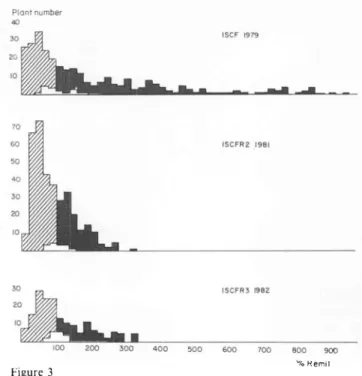
Figure
3 and table lbgive
the results for the main-tainerpopulation.
From the first to the secondcycle
theimprovement
was even morespectacular
than for therestorer
population.
Meanspread
of thefungus
dropped
from 281 070 of that on ’Remil’ to 91 070. The variance was reducedby
97 01o and the averageexten-sion on the 50
plants
chosen forinterpollination
increased from 24.2 0l0 of ’Remil’ in the ls!cycle
to 28.3 070 for the2
nd
cycle.
The
3!a
cycle
showed notonly
noimprovement
but aslight
reverse in the evolution of thepopulation,
themean
being
113 070 of ’Remit’.However,
it is notentirely comparable
with the othercycles
since anascospore test was
applied
andonly
the 186plants
which showed no symptoms after 30
days
were tested withmycelium.
B. Selection for resistance to ascospore inoculation The
plants
of the3
rd
cycle
of the restorerpopu-lation were inoculated with ascospores at 1 of 4 dates
(July
6,
9,
13 and16,
1982), according
to their date offlowering.
Thedelay
in symptom appearance for each inoculation date is shown infigure
4. For thesmall number
(18)
ofplants
inoculated onJuly
6th,
disease symptoms
appeared
morerapidly
than on theplants
inoculated later. This is in agreement with other results(TouRVIEI1.LE
&VE
AR
,
1984)
which suggest that the increased rate ofsymptom
appearance is related tohigher
temperatures beforeJuly
10th. The closest relation between number ofdays
after inoculation andproportion
ofplants showing
symptoms was seconddegree
(r
=0.99)
but with a linear relation there was a verygood
correlation(r
=0.96-0.98).
Comparison
of the linear
regressions
for the 3 dates shows thatthey
are not
significantly
different. The results for these3
days
were thereforepooled
and symptom appear-ance isgiven
as number ofdays
after inoculation. Thehistogram
offigure
5 shows the variation from 13 tomore than 50
days (after
which thedry capitula
wereharvested).
The mean was 31days
above the level of ’Airelle’(28 days)
but well below that of ’Remil’(42 days).
There was no
significant
correlation between the results of this test and those of themycelium
testapplied
on thepairs of capitula
of eachplant
(r
=0.04).
This could be due to an absence of real variation
for reaction to the
mycelium
test. Earlier studies(T
OURVIE
JI.
LE
&V
EAR
,
1984)
showed asignificant
correlation between the 2 tests.
The appearance of symptoms on the
plants
of the maintainerpopulation
followed a similar pattern(fig. 6).
Theslightly
earlier appearance of symptomsmay be
genetic,
but could also be due to the different inoculation dates(13, 16, 20,
23July,
1982).
When 70 *Vo of theplants
inoculated at agiven
date showedsymptoms the
remaining
30 % were harvested and themycelium
test wasapplied.
The 3days
in very humidconditions in the
growth
chamber led tosymptoms
from the ascospore inoculation in
only
a few cases. For the4
th
cycle
theplants
were thus chosen from amongthe 30 % most resistant to ascospores and with 43.9 % of the
mycelial growth
on ‘Remil’.IV. DISCUSSION
The results
reported by
TOURVIEILLE & VEAR(1984)
indicate that it is
possible
to use themycelium
and ascospore tests each year.Thus,
it should bepossible
tobase a resistance
breeding
programme on them. Theabsence of correlation between the results of the 2
tests suggests that the characters studied may be
independant
so that the best programme would appearto be one
using
both testsconcurrently
in order to combine the genes necessary for each character. Sincein both cases resistance is
partial,
addition,
of genes for each character shouldgive
a better total level ofresistance. This idea is
comparable
with that ofL
ECOQ
et al.
(1982)
inbreeding
for resistance to viruses ofmelons,
peppers and tomatoes.However,
examination of the results obtained so farsuggests that it is necessary to vary the
weight given
and the selection intensitiesapplied
for the 2 tests.The
mycelium
test has been used since 1976. Thatyear, there was a
significant
correlation for 25hybrids
between the results of the test and observations ofnatural attack
(VEAR
&GuILLAUIVnN,
1977) but,
in1982,
the results for 9hybrids
did not show anysignificant
correlation(TO
UR
V
I
E
ILL
E
&VEAR,
1984).
Since the test repeatsonly
part of the S. sclerotiorum infectioncycle,
it must be used inconjunction
with other tests to obtain most useful results.Nevertheless,
resistance tomycelial
extension isimportant
for ifsymptoms appear on any
present-day
varieties the wholecapitulum
is rotted within a week andyield
islost. With sufficient resistance for the disease to
spread
only slowly
it would bepossible
to harvest beforecomplete capitulum disintegration.
During
the firstcycle
of recurrentselection,
therewas a considerable
improvement
but this was notmaintained. This could be due to
phenotypic
varia-bility :
while individualgenerations
show reversetend-encies
improvement
is nevertheless visible over alarge
number of
generations
of selection. Such a result wasobtained
by
LENG(1961)
whenselecting
maize forhigh
and low oilprotein
contents.Alternatively
the lack ofgiving
greater resistance tomycelium
extension than those of ’Remil’ either not present at all in the popula-tions orpresent
but linked to other less favourablegenes such that their favourable effect on resistance is
not discernible. The strong selection pressure
applied
may have resulted in too little recombination between
generations
of selection. This would becomparable
with theproblems
foundby
MATHER & HARRIS(1949)
in the mass selection forhigh
bristle number inDroso-phila
where further increases above a certain level wereobtained
only
afterstopping
selection for severalgene-rations. The continued reduction in variance without
any
change
in meanprovides
evidence for this. Todistinguish
between thehypotheses,
it isplanned
to continue selection for a few
generations
but with areduced pressure such that a wider range of genotypes
for the control of
mycelial
extension are included in theinterpollination.
If genesgiving
bettermycelial
resistance are present it should be
possible
to combinethem
gradually
andthey
should become apparent. The reducedweight placed
on themycelial
test will make itsimpler
to select at the same time for resistance to theascospore test.
As
might
beexpected
from the absence ofcorre-lation,
the 2generations
of selection formycelial
resistance do not appear to have any effect on the
population
reaction to ascospores. There is a wide variation in thelength
oflatency
with the mean situatednearer to that of ’Airelle’ than that of ’Remil’ but with
extremes
surpassing
both. Selection for this character should thus bepossible although heritability
needs tobe confirmed. Since even with
only
9 genotypes the results of ascospore tests weresignificantly
correlatedwith field observations
(T
OURVIEILLE
&VE
AR
,
1984)
itseems reasonable to put the greatest
weight
on this testand select for
mycelial
resistanceonly
amongplants
which havegood
ascospore resistance.Following
theproblems
with the 1 stgenerations
ofrecurrent
selection,
for the4
th
cycle
the 50plants
chosen were among the 40 07o best for the ascosporetest. It remains to be seen whether a selection pressure
of this type will
give
a slow but continued increase inresistance. It also remains to determine whether the
plants
that did not show symptomsescaped
andgive
progeny which are no better than the average or are in
fact
highly
resistant with such adelaying
action onsymptom appearance that
they
dried before the diseaseappeared.
Comparison
of the 2 inoculationtechniques
indica-ted that both were useful but for different purposes.The
technique
with 2capitula
perplant
was verysatis-factory
forcomparing
reactions to the 2 tests, butretarded
plant development
made itimpossible
to mea-sureplant height
and seedproduction
and the topheavy plants
weresusceptible
tolodging.
Therefore thistechnique
will be continuedmainly
forgenetic
stu-dies. Thetechnique
in which the ascospore test isapplied
first followedby
themycelium
test on the sameplant
has thedisadvantage
that it is notpossible
to follow appearance of symptoms for ascospore inoculation on the more resistantplants.
However for abreeding
programme once the selection level has beendecided,
when agiven proportion
ofplants
showssymptoms, those
remaining
can besubjected
to themycelium
test without anyproblems
and thesecondary
selection criterionapplied.
Re!u le 12 mars 1984.
Accepté le 2 mai 1984.
REFERENCES BIBLIOGRAPHIQUES
Cuk L., 1976. Breeding sunflower for resistance to Scterotinia liber-tiana Fuckel. Proc. 7th Int. Sunflower Conf., Krasnodar, URSS,
227-237.
Cuk L., 1980. Resistance evaluation of sunflower genotypes naturally
infected by Sclerotinia sclerotiorum (Lib.) de By. Proc. 9th Int.
Sun-flower Conf., Malaga, Spain, 182-186.
Hoes J., Huang M., 1980. Effect of population density on
develop-ment of Sclerotinia wilt and yield of sunflower. Proc. 9th Int.
Sunflo-wer Conf., Malaga, Spain, 275-280.
Kurnik E., Leranth J., Parragh J., Voros J., 1978. « Pseudo
resis-tance » phenomenon to head rot in Hungary. Proc. 8th Int.
Sunflo-wer Conf., Minneapolis, U.S.A., 271-279.
Lamarque C., 1980. Obtention d’ascospores de Sclerotinia
sclerotio-rum et techniques d’inoculation utilisables dans la selection vari6tale de tournesol. Inforrnations techniques CETIOM, 71, 22-27.
Leclercq P., 1973. Influence des facteurs héréditaires sur la resistance
apparente du tournesol a Sclerotinia sclerotiorum. Ann. Ametior.
Plant., 23, 279-286.
Lecoq H., Pochard E., Pitrat M., Laterrot H., Marchoux G., 1982. Identification et exploitation de resistances aux virus chez les plantes
maraicheres. Cryptogam. Mycol., 3, 333-345.
Leng E., 1961. Predicted and actual responses during long term selec-tion for chemical composition in maize. Euphytica, 10, 368-378. Mather K., Harrison B., 1949. The manifold effects of selection.
Heredity, 3, 131.
Regnault et al., 1976. Répartition des principales maladies du
tourne-sol en France. Proc. 7th Int. Sunflower Conf., Krasnodar, URSS, 179-188.
Tourvieille de Labrouhe D., Guillaumin J. J., Vear F., Lamarque C.,
1978. Role des ascospores dans l’infection du tournesol par Scleroti-nia sclerotiorum (Lib.) de By. Ann. Phytopathol., 10, 417-431.
Tourvieille de Labrouhe D., Vear F., 1984. Comparaison de metho-des d’estimation de la resistance du tournesol au Sclerotinia
sclerotio-rum (Lib.) de By. Agronomie, 4 (6).
Vear F., Guillaumin J. J., 1977. Etude de méthodes d’inoculation de tournesol par Sclerotinia sclerotiorum et application à la selection. Ann. Amélior. Plant., 27, 523-537.
Zimmer D., Fick G., 1974. Some diseases of sunflowers in the United-States - their occurrence,
biology and control. Proc. 6th Int.