HAL Id: halshs-00564574
https://halshs.archives-ouvertes.fr/halshs-00564574
Preprint submitted on 9 Feb 2011
HAL is a multi-disciplinary open access archive for the deposit and dissemination of sci-entific research documents, whether they are pub-lished or not. The documents may come from
L’archive ouverte pluridisciplinaire HAL, est destinée au dépôt et à la diffusion de documents scientifiques de niveau recherche, publiés ou non, émanant des établissements d’enseignement et de
Does Community Driven Development Work? Evidence
from Senegal
Jean-Louis Arcand, Léandre Bassole
To cite this version:
Jean-Louis Arcand, Léandre Bassole. Does Community Driven Development Work? Evidence from Senegal. 2011. �halshs-00564574�
Does Community Driven Development Work?
Evidence from Senegal
∗
Jean-Louis Arcand
†CERDI-CNRS, Université d’Auvergne and EUDN
Léandre Bassole
CERDI-CNRS, Université d’Auvergne
This draft: 27 March 2006
Abstract
Community Driven Development (CDD) programs are an extremely important component of the World Bank’s portfolio in the developing world, representing close to $7 billion in 2003, yet solid empirical evidence on their impact is relatively scarce, especially for Subsaharan Africa. In this paper, we consider the impact on access to basic services, household expenditures and child anthropometrics of the PNIR (Programme National d’Infrastructures Rurales) CDD project in Senegal using a unique multidimensional panel dataset on rural households that we followed over a two-year period. Using a variety of estimation procedures, including instrumental variables, and working at different levels of aggregation, we find no evidence for an impact of the PNIR on household expenditures, but find statistically significant effects of the program on access by villagers to clean water and health services, as well as on two standard measures of child malnutrition. The latter effects are particularly important, quantitatively, for children in poor households. The identification strategy we adopt in order to assess the impact of completed projects on beneficiary welfare highlights the importance of the role played by village chiefs and sub-regional politics in determining which eligible villages receive projects and which villages do not.
Keywords: Impact evaluation, Community Driven Development, Multidimensional panel data models. JEL Classification numbers: O19, H43, I12, I38.
1
Introduction
Community Driven Development (CDD) is very big business. In 2003 alone, it represented $7 billion in World Bank commitments (Mansuri and Rao (2004)). Given the absolute magnitude of CDD programs, as well as their very important share of development assistance at the global level, and given that it is unlikely that their importance will decline in the near future, it is of considerable interest to know whether, and how, they work.
There is a growing controversy surrounding CDD, spurred by the presumption that they are not as "bottom up" as they are meant to be. Indeed, critics of CDD, as well as of similar "participative" approaches, argue that they are not community-driven or -based at all, and that they essentially furnish a thinly-disguised veil behind which local elites or opportunistic development entrepreneurs hijack resources that never reach their intended recipients (Platteau and Gaspart (2003)). This "elite capture" view of CDD operations has
∗We thank Adama Diaw, Mamadou Kane, Samba Mbaye, Grégoire Rota-Graziosi, Mokhtar Thiam and El Hadj Adama
Touré for lengthy discussions and extensive collaboration over the past four years on the PNIR program. Financial support from the PNIR program and the hospitality of the Université Gaston Berger in Saint Louis, Sénégal, is gratefully acknowledged. This work would not have been possible without the dedication, above and beyond the call of duty, of the PNIR survey teams. Finally, we are especially thankful for the cooperation of the several thousand villagers who took the time to answer our questions, over a 2 year period. The usual disclaimer applies.
†Corresponding author: CERDI-CNRS, Université d’Auvergne, 65 boulevard François Mitterrand, 63000 Clermont Ferrand,
also been coupled with the critique that no existing evaluations of CDD programs allow one to identify any significant gain to their participative element, with respect to "standard", top-down alternatives (Mansuri and Rao (2004)).1
In light of these controversies, the purpose of this paper is to provide an assessment, based on a unique panel dataset, of the impact of a major CDD program in Senegal. The empirical approach of the paper is three-pronged. First, we study the impact of treatment by the program on the accessibility of basic services, household expenditures and child anthropometrics, using a quasi-experimental approach in which geographical units treated by the program were matched, based on the explicit criteria used by the program initiators to establish deployment, with equivalent geographical units that were not treated. This provides us a with an estimate of the impact of the "intent to treat".
Second, we provide instrumental variables estimates of the impact of completed projects on the household and child response variables, using an identification strategy based on the workings of elite capture at the village level and its interraction with the efforts deployed by a given village to obtain a completed project, as measured by the opinions expressed by village chiefs. This allows us to assess the magnitude of the impact of "treatment on the treated".
Finally, we use instrumental variables methods to estimate the impact of completed projects within geographical units that eventually get treated by the program (who therefore act as their own controls), where our identification strategy is augmented to include instrumental variables based on various measures of the political power at the sub-regional level of individual villages.
Our empirical results, whether they are based on quasi-experimental methods or on instrumental variables estimates, suggest that the PNIR-CDD program (i) significantly improved village access to clean water and health facilities, (ii) significantly reduced the prevalence of underweight and stunted children, with this effect being particularly pronounced for children residing in poor households, while it (iii) did not significantly affect household expenditures per capita. Moreover, our identification strategy, as revealed by the reduced forms explaining the likelihood of a village taking delivery of a completed project, highlights the importance of the role played by village chiefs and by local democratic politics at the sub-regional level.
2
The context
A countrywide consultative process was undertaken in Senegal in 1996 and revealed that the priority needs of the rural population were primarily improved access roads, drinking water, access to health and education services, and improved economic opportunities in rural areas. The population also expressed a strong desire to participate in the key decisions affecting local development, and to assume an increased share in the funding of local development plans.2
Within the context of its overall development strategy, the Senegalese government drafted, with the participation of civil society, a Letter of Decentralized Rural Development Policy (LPDRD). The LPDRD set out a long-term strategy designed to promote sustainable and equitable economic growth in the rural sector, as a means for effective rural poverty reduction. The key objectives of the strategy were to ensure effective implementation of the decentralization policy; promote partnerships between the various actors involved in the participatory local development planning process to facilitate the broadening of the decision-making platform; ensure an increased and predictable flow of resources for investments in community-based social
1Wassenich and Whiteside (2003) and Rawlings, Sherburne-Benz, and Van Domelen (2004) provide assessments of current
Bank practices in terms of impact evaluation of CDD programs.
and economic infrastructure; and strengthen the capacity of rural communities to assume full responsibility for local development planning and implementation.3
The World Bank- and IFAD-initiated Programme national d’infrastructures rurales ("National Rural Infrastructures Program", henceforth, PNIR) constitutes one of the keystones of this strategy, and operates at the level of the smallest sub-regional administrative unit in Senegal –the Communauté rurale ("rural community", henceforth, CR). An average CR includes 42 villages (the number varies between 3 and 132 villages over the 320 CRs in Senegal), and has a population of 13,391 souls (std. = 12,799). 90 CRs were chosen from among the poorest in the nine rural regions of Senegal for treatment by the PNIR. 78% of the poor in Senegal live in rural areas, where the average incidence of poverty is about 40%, as compared with 16% in urban areas. The rural population to benefit from the project is estimated at nearly two million people, more than half of whom are currently poor.
One of the major goals of the PNIR is to operationalize decentralized rural development processes, including matched grant funding aimed at providing target rural communities with basic social and economic infrastructure. In theory, the project is designed to support the decentralization and fiscal reform processes; strengthen the capacity of CRs and local governments to plan, prioritize, manage, and maintain community-based infrastructure; and provide funding for demand-driven community-community-based rural infrastructure that is managed in a sustainable way. It is hoped that the resulting community infrastructure, combined with improvements in the access of communities to the national road network, will revitalize the local economy and provide enhanced opportunities for income and employment generation.
The project’s participatory processes for identification of needs, priority setting, decision-making and management are, in theory, designed to ensure that the infrastructures to be funded correspond to the highest priorities of each rural community; and that they will benefit the majority of its population. A central tenet in project design is ensuring the proper representation of the vulnerable and/or marginalized groups (the young, women, and specific castes) in the identification, design and implementation of community development plans. The formal inclusion of these groups in the local community development committee (Commité de concertation et de gestion –CCG), and in the microproject implementation and maintenance committees, is supposed to enhance responsiveness to the needs of these groups, and to ensure that the local elites do not monopolize project benefits. The effective participation of these groups is, again in theory, part of the eligibility criteria for funding. The menu of eligible infrastructures includes health, educational and sanitary facilities, potable water and access roads. The long-term vision of the PNIR is one of CRs planning and managing their own development programmes, and mobilizing the necessary financial resources.
The timing of treatment by the PNIR was determined in 2002, before our involvement in the project, and the planned deployment of the program, despite sometimes intense political pressure from local officials, underwent almost no changes. Treatment was explicitly determined on the basis of five indices at the CR level, attributing a score from 0 to 100 based on the proportion of the population with access to water, a health center, a school, a road, and a market. Based on these indices, 90 CRs were chosen for treatment out of a total of 320.
In order to construct our main counterfactual in a quasi-experimental manner, we therefore selected our control group CRs by running a simple probit where the dependent variable took on the value 1 when the CR had been chosen to be treated by the PNIR, and zero otherwise. The explanatory variables, in addition
3There are a large number of poverty alleviation programmes in rural Senegal. Most are based on decentralized and
participatory approaches, in which community investments are demand-driven. In this context, the Canadian International Development Agency (CIDA) is spearheading efforts to decentralize fiscal and financial management procedures. Bilateral donors, such as France and Germany, the European Union, the UNDP and others, are funding or plan to fund other decentralized rural development programmes.
to regional dummies, were the five indices utilized by the program initiators. We then selected 18 treated CRs, which we matched with 18 control CRs based on the predicted probability of treatment. These 36 CRs were chosen amongst those included in the 2001 ESAM2 survey in order to allow us to test the parallel trends assumption between ESAM2 and our own baseline (more on this below). The timing of treatment is presented in Table 1, along with the number of completed projects, by type of infrastructure.4
3
Basic results: treatment by the PNIR
At the lowest level of disaggregation, our specification is given by the panel regression:
ycivjt= Tjtγ + x0civjtθ + εcivjt, (1)
where c = 1, ..., C denotes children, i = 1, ..., I denotes households, v = 1, ..., V denotes villages, j = 1, ..., J denotes CRs and t = 0, ..., T denotes time periods; ycivjt denotes the response variable, Tjt is a dummy
variable that is equal to 1 if CR j is treated by the PNIR in period t and 0 otherwise, xcivjt is a matrix
of covariates that always includes period dummies in order to account for common shocks that affect all observations in a given period, and εcivjt is a disturbance term that we shall decompose in various manners
depending upon the context. In increasing order of aggregation, our response variables are constituted by child anthropometrics (for children aged between 0 and 36 months), household expenditures per capita, and access to various types of basic infrastructure by the village community.
Our basic purpose is to estimate the magnitude of the average treatment effect (ATE), also known as the "intent to treat", given by the parameter γ, as well as its associated standard error. When the unit of observation is the household, for example, the specification given in (1) will correspond to a panel regression where the disturbance term will account for household-specific effects, thereby yielding what is essentially a difference-in-differences (DD) estimator.5
Since treatment by the PNIR is defined at a higher level of aggregation than the response variables, it is essential to adjust standard errors for clustering (Moulton (1986), Moulton (1990)). Failure to do so will result in downward-biased standard errors that lead to the possibility of spuriously identifying a statistically significant effect of treatment. As such, all of the standard errors presented below, since observations are at a level of aggregation lower than that of a CR, are clustered at the CR level.6
Table 2 compares the distributions of the 4 response variables (household expenditures per capita and three standard anthropometric indicators for children) in our baseline survey (t = 0) and confirms that there is no statistically significant difference between households or children living in CRs that are eventually treated (over the following 2 years) and those that will not be. This is true whether we consider means, or whether we consider the entire distribution of the response variables using the Bartlett or
Kolmogorov-4The 18/18 split between treated and non-treated CRs corresponds to t = 1 –our second survey (t = 0 corresponds to
our baseline). Of the 18 CRs initially in the control group, 3 received treatment at t = 2. Treatment at the CR level corresponds to a bundle of services, and the potential economies of scale in service delivery that can be obtained through multisectoral interventions have been stressed by Fay, Leipziger, Wodon, and Yepes (2005) on the basis of a cross-country regression framework that exploits within-country variation between asset quintiles (they highlight the positive interaction effect associated with a multiplicative health×infrastructure variable). See also Chong and Hentschel (2003) on bundling of services in Peru, and Jalan and Ravallion (2003) on the interaction between infrastructure and health knowledge in reducing child diarrhea in India.
5A similar approach is adopted by Alderman, Hoogeveen, and Rossi (2006), who consider the effect of the Partage program
on child malnutrition using the four rounds of the Kagera (Tanzania) LSMS survey.
6On this topic, see also Donald and Lang (2004). In related work, we consider estimates based on propensity score matching
Smirnoff test statistics. This is a first indication that the quasi-experimental approach used to select our counterfactual CRs will not bias our results either in favor or against identifying effects of treatment by the PNIR.
Descriptive statistics on the full sample over the five rounds of our surveys (t = 0 to t = 4) are provided in Table 3. The households in the villages considered here are particularly poor, even by Senegalese standards: mean expenditures per capita (which include an estimate of the opportunity value of home-produced and consumed agricultural output), over a 4 month period, are equal to FCFA 13,614, which is roughly equivalent to $US 0.23 per household member per day. Even expressed in adult-equivalent terms, the corresponding figure is $US 0.28. Households are large –almost 11 members on average– and a surprizingly high number of heads, given their mean age (53) are literate (35.9%). The villages in the sample are relatively large (1,113 inhabitants), and are overwhelmingly not connected to the national electricity grid (74.8%).
The anthropometric results for children reveal better average performance for girls than for boys, a fact that has often been noted in Subsaharan Africa over the past 40 years, as noted by Svedberg (1990). There is significant heterogeneity when one breaks down the averages by age category, with a tendency for the mean z−scores to be better for very small children (0 to 12 months). Note also that intra-household heterogeneity in child anthropometrics is important, as is intra-child heterogeneity, a fact that will be important, in terms of identification, given our use in what follows of within-household and within-child estimation procedures.
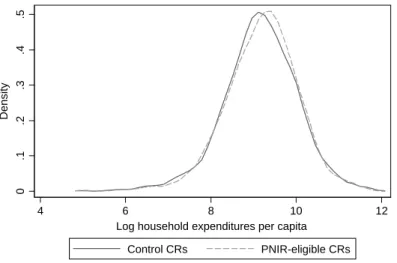
Figures 1, 2, 3 and 4 provide kernel density estimates that represent the unconditional distributions over the five sample periods of log expenditures per capita and three different anthropometric measures of child health, for households living in PNIR-treated and control-group CRs. With respect to households residing in control-group CRs, the unconditional distribution of log expenditures per capita appears to be shifted slightly to the right for treated households (especially towards the middle of the distribution), and a much more noticeable shift to the right is apparent in the distribution of the weight-for-age z−scores (WAZ) for children who reside in treated CRs. The same would appear to be true for the distribution of weight-for-height (WHZ), with the shift in the distribution of the height-for-age z−scores (HAZ) being much less noticeable.
These graphic results are considered more explicitly on a period-by-period basis in Table 4, which provides simple tests of the difference in the unconditional means of the response variables, between treated and control group CRs. In unconditional terms, expenditures per capita are significantly greater in PNIR-treated households than in control-CR households at t = 3 and t = 4. For height-for-age and weight-for-age, children in PNIR-treated CRs have significantly better anthropometric outcomes at t = 4 (for WAZ, this is also true at t = 3), whereas there is no statistically significant difference in terms of weight-for-height. Of course these results are purely suggestive of the impact of the PNIR on household expenditures and child malnutrition, in that they do not control for any source of time varying or time-invariant heterogeneity.
3.1
Household expenditures
In analyzing the impact of the PNIR on the logarithm of household expenditures per capita, our basic specification is given by:
yijt = Tjtγ + x0ijtθ + εijt, (2)
where λi denotes household-specific effects. Our broadest sample is an unbalanced panel consisting of
756 households, distributed in 71 villages in 36 CRs, and observed at least over 2 periods, yielding 3, 446 observations. Of these, 1, 948 are eligible at one time or another for treatment by the PNIR program. Note that the within-household estimator also sweeps out any village- or CR-specific effects. Results are presented in the upper portion of the first column of Table 5. The estimated average treatment effect (ATE) corresponds to an increase of 5.5% in household expenditures per capita, but with a standard error that renders this effect statistically indistinguishable from zero (s.e. = 0.08).
In order to see whether the insignificant average effect hides any heterogeneity, we then consider the subsample of households which are observed in our baseline survey (t = 0), and divide households into three expenditure classes, corresponding to the poor (the first quintile), the "middle class" (corresponding to quintiles 2, 3 and 4), and the rich (the top quintile), based upon their expenditures per capita at t = 0. This yields a balanced subsample of 562 households (2, 810 observations, of which 1, 573 are treated) which we follow over all 5 periods. We then estimate our basic household expenditures specification separately on each of these three classes of households, whose identities are therefore constant over time.7 Results are
presented in the lower part of Table 5 (column 1), and confirm the absence of statistically significant effects on expenditures per capita.8
None of these results change appreciably when we replace expenditures per capita with total household expenditures, or with expenditures per adult equivalent. Similarly, results are the same when variables are expressed in levels instead of in logarithms.9
3.2
Child anthropometrics
We consider three measures of child health: the z-scores for weight-for-age (WAZ), height-for-age (HAZ), and weight-for-height (WHZ). Each observation corresponds to a child, aged between 0 and 36 months, followed over at least two periods, yielding the panel specification:
ycijt = Tjtγ + x0cijtθ + εcijt, (4)
εcijt = λi+ ηcijt, (5)
where λi denotes household-specific effects. The within-household estimator will control for village- and
CR-level effects, but will leave child-specific, time-invariant unobserved heterogeneity unaccounted for. An
7Note that it is essential that the identities of the households be constant over time, and that the expenditure classes be
defined exogenously in terms of the initial period. A multiplicative dummy specification in which the PNIR treatment dummy would be multiplied by an expenditure class dummy is inconsistent, since households can move between expenditure classes from one period to the next, and the right-hand-side treatment variables would then be correlated with the response variable by construction. An approach that we are currently investigating makes use of the panel quantile regression estimator developed by Koenker (2004), to whom we are grateful for providing us with his code.
8The estimated ATE on this subsample is equal to a 3.6% increase in household expenditures per capita, which is statistically
indistinguishable from zero (s.e. = 0.09).
9An additional check of the absence of an effect of treatment by the PNIR on expenditures per capita, can be had by
exploiting between-household and between-village variation and estimating a three-dimensional variance components model, where one replaces (3) with a nested specification: εivt= νv+ λiv+ ηivt, where νv∼ i.i.d (0, σ2v)denotes the vth unobservable
village-specific effect and λiv∼ i.i.d (0, σ2λ)denotes the nested effect of the ith household within the vth village; the remainder
disturbance, ηivt, is assumed to be i.i.d (0, σ2η). Results are very similar when one replaces this with a household-RC nested
specification that takes the form εijt= νj+ λij+ ηijt. In order to estimate the variance components, we implemented both a
Wallace and Hussain (1969) and a Wansbeek and Kapteyn (1989) estimator (see Baltagi, Song, and Jung (2001) for a discussion of their relative merits, as well as more sophisticated alternatives). Again, we find no statistically significant impact of the PNIR on log expenditures per capita, on average, and when we estimate separately over our three initial expenditure classes, and the appropriate Hausman tests do not reject any of the specifications. Moreover, the σ2
vand σ2λare found to be relatively
small with respect to σ2
ηindicating that it is time-varying household-village effects that are driving our results. These results
alternative specification which controls for unobserved child-specific heterogeneity replaces (5) with:
εcijt= λc+ ηcijt, (6)
where λcdenotes a child-specific effect.10 There are 993 children in our sample, who belong to 496 households
(these constitute a subset of the 756 households considered earlier). Given that a number of children are observed for more than 2 periods, our sample consists of 2, 057 observations, of which 1, 109 are treated by the PNIR.
WAZ is a measure of short-term malnutrition and may vary in the short-run as a result of transitory income and health shocks; it is also referred to as underweight. HAZ, also referred to as stunting, is a measure of long-term malnutrition, and will reflect the cumulative impact of disease spells and income shocks over time. WHZ, also known as wasting, is a measure of short-term malnutrition that combines the weight and height metrics. Our purpose in assessing the impact of the PNIR program on these variables is certainly not to argue that CDD programs are the best or even a good manner of addressing the issue of child malnutrition. Rather, our purpose is to examine the impact of a CDD program on alternative measures of household welfare that may, in addition, reflect changes in the intra-household allocation of resources induced by treatment.
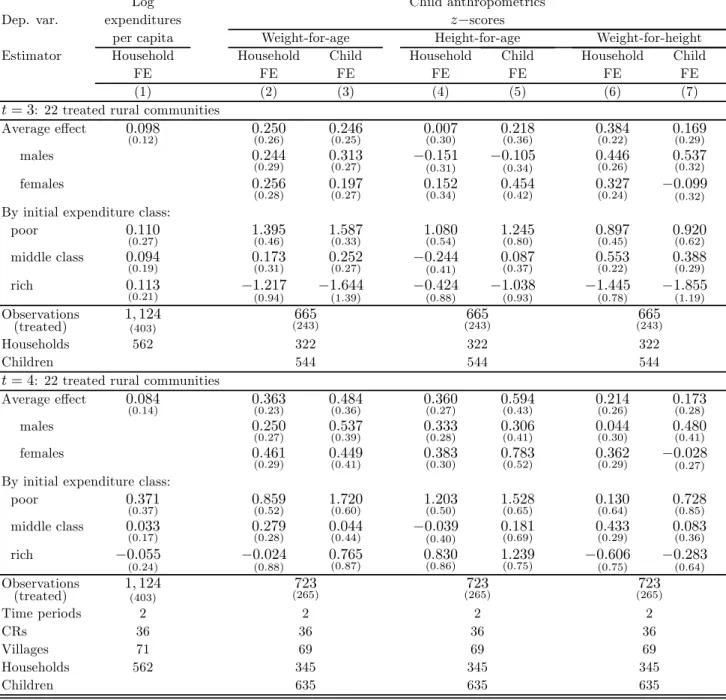
Results are presented in columns 2 to 7 of Table 5. In columns 2 and 3, we consider the effect of the PNIR on WAZ. Whether we include household- or child-specific effects changes the results little, in that both ATEs are statistically indistinguishable from zero. For HAZ, on the other hand, the ATE is of 0.304 standard deviations of the z−scores using household-specific effects, and 0.406 standard deviations with child-specific effects. The result which controls for child-specific effects is statistically significant at the usual levels of confidence, with an associated standard error of 0.15. Note also that most of this effect appears to stem from the impact of the PNIR on girls (the female-specific coefficient is equal to 0.484, s.e. = 0.21 –the male-specific coefficient is statistically indistinguishable from zero at the usual levels of confidence), and older children (the coefficient associated with the 24 to 36 month age category is equal to 0.519, s.e. = 0.15).11
Taken in conjunction with the absence of significant effects of treatment on expenditures per capita, these results indicate that improvements in the welfare of some household members do obtain as a consequence of treatment by the PNIR, but that they do not appear to be caused by an increase in household expenditures per capita.12
As shown by the results presented in the lower portion of Table 5, in which we restrict our attention to the balanced subsample of children belonging to households which we observe in our baseline survey and which we follow over the following two years, the average effect obscurs significant differences across expenditure classes, just as was the case for the sex and the age of the child.13 For the WAZ indicator with child-specific effects, the ATE for poor families is 4 times greater than the average effect (the associated coefficient is equal
1 0See Behrman and Hoddinott (2005) for an example of the use of child-specific effects in identifying the impact of program
treatment (the Mexican PROGRESA, in their case) on child malnutrition.
1 1Though somewhat surprizing at first sight, note that the average WAZ scores are the worst for children in the 24 to 36
months age class (see Table 3), and that the HAZ scores are the second worst among the three age categories, for older children. If there are diminishing marginal returns to treatment as nutritional status improves, the WAZ result is less surprizing than one might think.
1 2There are no statistically significant effects of the PNIR on WHZ. Note that the WAZ, HAZ and WHZ equations may be
correlated, see Morales, Aguilar, and Calzadilla (2004), and that it may be possible to improve on the efficiency of estimation by taking this into account.
1 3This subsample is constituted by 798 children, who belong to 383 households (these constitute a subset of the 562 households
considered earlier in the balanced household subsample). In terms of quantile regression methods alluded to earlier, the only study that we are aware of that studies the determinants of stunting in children is Borooah (2005).
to 0.964, s.e. = 0.36). In contrast, the WAZ of children in middle class and rich households are unaffected by the PNIR. The same can be said for HAZ, where the impact on children from poor households is twice the average effect (when we control child-specific effects), whereas children in the upper four quintiles of the baseline expenditure per capita distribution are unaffected. These results suggest, despite the absence of targetting in the PNIR, that it is the children of poor families who appear to benefit the most from the program, by dint of the simple fact that the marginal benefits to a given improvement in village infrastructure will be greater for the poor than for the rich or the middle class.
3.3
Access to basic services
Our village level surveys collected information concerning the access of villagers to four basic services: drinking water, health services, a primary school, and a paved road. Our response variable yk
vjt takes on
the value 1 when basic infrastructure k is available to villagers within the village, and zero otherwise. In order to identify the impact on the accessibility of basic services attributable to treatment by the PNIR, we consider the following village-level linear probability model:14
yvjtk = Tjtγ + x0vjtθk+ εvjt, (7)
εvjt = λv+ ηvjt, (8)
where λv is a village-specific effect. Results are presented in Table 6. Treatment by the PNIR increases
the probability that villagers will have access to drinking water within the village by 22.3% (s.e. = 0.06), whereas the corrresponding increase for access to basic health services (constituted by a "case de santé") is 24% (s.e. = 0.09). If we assess village access to health services on the basis of a "poste de santé", a much larger structure than the "case de santé" which is meant to serve several villages, and code the variable to equal 1 if the "poste de santé" is either within the village or within 5km, the corresponding coefficient indicates an ATE of 15.3% (s.e. = 0.07). For all of the results on access to basic services presented in Table 6, the point estimates are roughly the same and the standard errors slightly smaller when we restrict ourselves to a balanced panel consisting of the 60 villages that are observed over each of the five time periods. Finally, despite the important road-construction component of the PNIR program, we find no significant effects in terms of access to a paved road. This is due to two reasons. First, on a general level, it is likely that the late implementation of this component of the program (with respect to the timing of our surveys) renders it difficult to identify any significant effect over the 2003-2005 period. Second, no road construction appears amongst the completed projects in the villages treated by the PNIR in our sample.
3.4
Robustness
While the test statistics presented in Table 2 did not reject the null hypothesis that the distributions of our household and child-specific response variables were the same for "eventually" treated and control ob-servations in our baseline survey (thus supporting the validity of the quasi-experimental construction of our control CRs), a number of other concerns could significantly bias our results. In order to assess the robustness of our findings, we therefore consider whether: (i) the "parallel trends" assumption is verified; (ii) serial correlation issues significantly bias our standard errors (in all likelihood downwards, in the case of the child anthropometrics results); and (iii) the inclusion of time-varying child- or household-specific covariates
significantly alters our results.
3.4.1 The parallel trends assumption
A key assumption, on which our results are based, is that our counterfactual is properly constructed. In particular, it is essential not only that the treated group and the control group be indistinguishable in the baseline survey, but also that they would have evolved over time in the same manner, in the absence of the program. Though one cannot test this hypothesis directly over the entire sample, the availability of data on the same households prior to our baseline survey allows us to test the "parallel trends" assumption.15
These data are constituted by the ESAM2 survey, carried out 2 years prior to our baseline, and upon which we based our sampling scheme for this purpose.16
In order to test the parallel trends assumption, we artificially code the observations in our baseline survey (t = 0) that will eventually be treated over the following two years (t = 1 to t = 4) as if they were treated at t = 0.17 Combining our baseline survey (t = 0) with the ESAM2 data on the same households (t = −1)
yields a balanced panel dataset of 1,400 observations (700 households), of which 474 are "treated" at t = 0. We then implement a simple DD estimator where the initial period is given by ESAM2 (t = −1) and the final period is given by our baseline (t = 0).18 Finding a statistically significant effect of this "placebo" treatment would imply rejection of the parallel trends assumption in that it would indicate a significant divergence in the evolution over time of our response variables between the treated and control households. If, for example, the "treated" households were systematically improving in terms of their response variables between t = −1 and t = 0, with the control households’ response variables remaining unchanged on average, the positive impact of treatment that we uncovered for a number of anthropometric response variables between t = 0 and t = 4 could be entirely spurious. A similar spurious finding of a significant effect of treatment by the PNIR would occur if the control observations’ situation were systematically worsening over time, with the "treated" observations’ response variables remaining stable. As such, failure to reject the parallel trends assumption is crucial in terms of the credibility of our empirical findings concerning the impact of the intent to treat.
The results of a series of tests of the parallel trends assumption are presented in Table 7. As should be clear, the parallel trends assumption is not rejected, on average, be it for log expenditures per capita or for our three measures of child anthropometrics. Moreover, the parallel trends assumption is not rejected for log expenditures per capita and for child anthropometrics, even when we estimate separately over the three different initial expenditure classes. Similarly, when we disaggregate the impact of the "placebo" PNIR treatment by sex and by age category for the anthropometric indicators, there is no statistically significant effect.
To the extent that the non-rejection of the parallel trends hypothesis supports the assumption that treated and control CRs would have evolved in a similar manner over the two years of our surveys in the absence of the PNIR, our estimates of the effects of treatment would appear not to be systematically biased either upwards or downwards.
1 5See, e. g., any standard reference such as Wooldridge (2002).
1 6The ESAM2 (Enquête sénégalaise auprès des ménages ) survey is essentially a Senegalese LSMS. 1 7Results are the same if we only consider those CRs that are treated at t = 1.
1 8Note that we must restrict our attention to a specification that includes household-specific effects in that there are no
children that we can follow over the 2 year period that separates ESAM2 and our baseline. Our child sample is constituted by 837 children belonging to 450 households that have children aged between 0 and 36 months over both surveys, of which 232 children are "treated" at t = 0.
3.4.2 Serial correlation
As forcefully argued by Bertrand, Duflo, and Mullainathan (2004), (positive) serial correlation can signifi-cantly bias standard errors downwards (even when intra-CR cluster effects have been accounted for), raising the possibility that statistically significant effects may be erroneously attributed to treatment. In order to assess whether our results were subject to this problem (particularly those results pertaining to WAZ and HAZ), we re-estimated our basic specification in terms of simple DD estimators restricted to two periods.19
Results are presented in Tables 8 and 9. For log expenditures per capita, little changes with respect to the results presented in Table 5: irrespective of the final period that is chosen, the ATE of the PNIR is always statistically indistinguishable from zero, and this remains true when we estimate separately over each of the three initial expenditure classes.20
For the WAZ indicator of child anthropometrics, taking the t = 4 minus t = 0 case as an example, the ATE is statistically indistinguishable from zero, (as in Table 5), while the effect on the WAZ of children in poor households almost doubles in size with respect to the results presented in Table 5 (to 1.720, s.e. = 0.60) when we control for child-specific effects, and remains statistically significant at the usual levels of confidence.
For HAZ, on the other hand, the results reveal that the standard error associated with the ATE reported in Table 5 (which implied a statistically significant impact of the PNIR on HAZ, on average, using child-specific effects) was underestimated: though the point estimate of the ATE for each DD is similar in magnitude to the average effect over 5 periods, the reported standard errors yield simple DD estimates of the ATE that are not statistically significant, at the usual levels of confidence. This is not surprizing for the HAZ measure of child anthropometrics, in that, in contrast to WAZ, it will exhibit a good deal of persistence over time because of its cumulative reflection of spells of malnutrition. On the other hand, and though the standard errors increase substantially, this phenomenon is not sufficient to eliminate the statistically significant effect of the PNIR on the HAZ of children from poor households. Indeed, if we take the t = 0 to t = 4 DD with child-specific effects as our preferred specification, the point estimates increase substantially with respect to the effects reported in Table 5, reaching 1.528 (s.e. = 0.65).
Thus, while there is some evidence that serial correlation biases the standard errors for the effect of the PNIR on HAZ presented in Table 5 downwards, the t = 0 to t = 4 DD results confirm that while treatment by the PNIR does not affect expenditures per capita, it does significantly improves the nutritional status of children living in poor households.
3.4.3 Covariates and alternative specifications
A final test of the robustness of our findings involves studying the effect on our results of the inclusion of a number of time-varying child, household and village characteristics, as well as considering alternative specifications for our anthropometric response variables. Covariates include child age, the age and literacy status of the household head, the population of the village, whether the village is connected to the electricity
1 9Note that an alternative approach involves the GLS estimator proposed by Hausman and Kuersteiner (2004), who show
(using Montecarlo simulations) that it is not optimal in terms of efficiency to entirely discard the temporal dimension of the data, though a degree of temporal aggregation may be desirable.
2 0An alternative approach to dealing with the serial correlation issue that can be applied to the expenditure per capita
data involves rewriting our basic equation in terms of a dynamic panel specification that includes a lagged-dependent variable: yijt = αyijt−1+ Tjtγ + x0ijtθ + εijt, where the disturbance term continues to be decomposed as in (3). Since the
within-household estimator is no longer appropriate, because yijt−1will be correlated by construction with the household-specific effect
if the time dimension is finite (reasonable asymptotics in the present context let T be finite and I be large), one must resort to instrumental variables. Application of the usual difference-GMM or system-GMM estimators (see e.g. Arellano (2003)) yields no evidence of a statistically significant impact of the PNIR on expenditures per capita, be it either on average, or when we consider our three initial expenditure classes separately. Results are available upon request.
grid, and whether a literacy program exists in the village. While inclusion of these time-varying covariates changes the point estimates somewhat, it does not affect the basic story in which treatment by the PNIR has no statistically significant effect on household expenditures per capita, while it reduces the prevalence of underweight and stunted children, with these effects being particularly important in poor households.21 For example, the ATE of the PNIR on the weight-for-age z−score of children living in households that were poor in our baseline survey is equal to 0.953. (s.e. = 0.40), when we include the full set of covariates, while the corresponing number for HAZ is 0.816 (s.e. = 0.38).
A final check of our results involves transforming the anthropometric response variables into dichotomous variables that equal 1 when the z−score falls below −1.5 –an indication of a moderate level of malnutrition for each of the indicators– and zero otherwise, and applying a linear probability model (results are similar if we use a fixed effects (conditional) logit specification). For the WAZ of children in poor households, for example, the point estimate indicates that treatment by the PNIR reduces the probability that a child will be severely underweight by 30.0%, with the corresponding figure for severe stunting being 23.4%.
4
Instrumental variables estimates of the impact of completed
PNIR projects
We now turn to estimating the impact of completed PNIR projects, on household and child welfare, in contrast to treatment at the CR level, which is essentially akin to eligibility. In the standard Manski (1996) terminology, this corresponds to "the effect of treatment on the treated", as opposed to "the intent to treat". The distinction is important for two reasons. First, while eligibility of the inhabitants of a village for the PNIR occurs at the CR level, the implementation of actual infrastructure projects is village-specific. In other words, there are numerous villages within PNIR-treated CRs that have received no infrastructure projects at all. Second, while being eligible for the PNIR is clearly exogenous in that it depends solely on the village’s physical location within a treated CR, actually obtaining an infrastructure project is not exogenously determined, and is likely to be correlated with observable and unobservable village characteristics. Insofar as we shall be identifying the effect of completed projects using a within-household or within-child estimator, time-invariant village-specific unobservables are controlled for. On the other hand, there may be unobservable village-specific and time-varying factors that simultaneously affect the response variable and the probability that an infrastructure project gets completed in a given village. In this case, the within-household or within-child estimators used so far will result in inconsistent parameter estimates.
4.1
The full sample
We begin by considering the same sample of household as in part 3, which includes 22 CRs that are treated by t = 4 and 16 control CRs. The estimated effect of completed projects is thus the difference in the response variables between households or children that live in villages that receive a project, and those that do not, where the counterfactual includes households and children that reside in control CRs (which are not eligible for PNIR projects), as well as those that reside in villages that become eligible by t = 4 but that do not receive a completed project. As with treatment by the PNIR at the CR level, identification is thus
2 1A number of results are interesting in and of themselves, but do not constitute the focus of the paper. For example, we
uncover the usual U-shaped effect of age on z-scores; see Thomas, Strauss, and Henriques (1992). The full results which include covariates are available upon request.
achieved through both cross-sectional and time-series variability (see Table 1 for the timing of completed projects, by type).
4.1.1 Identification strategy
The process by which a PNIR project actually gets identified and formulated at the village-level, transmitted to the Conseil rural, and implemented suggests that a number of village characteristics may constitute admissible instruments. For this to be the case, the variables in question must (i) have no direct effect on the welfare of the households residing in the village (so as to be orthogonal with respect to the structural equation’s disturbance term) and (ii) be correlated with the likelihood of the village obtaining a PNIR project (i.e. the instruments must be sufficiently "strong"). A first obvious instrument with which to identify the impact of completed projects is eligibility per se (Imbens and Angrist (1994)), as given by the PNIR treatment dummy that has been considered up until now: using this IV on its own would yield a local average treatment effect –LATE. The results presented in part 3 can also be thought of as reduced forms in which one of the instrumental variables used to identify the effect of completed projects is entered directly into the structural equation.
Apart from eligibility for a completed PNIR project, our identification strategy here is based upon the opinions expressed by the village chief, a key player in terms of the setting of village priorities and of the urgency with which potential project proposals will be formulated and followed up on. In particular, because of the participatory process inherent to CDD through which marginalized groups are supposed to gain voice in village decisionmaking, it is possible that there are divergences between the chief’s opinions and actual conditions in the village, and that these divergences will be amplified by the CDD process. The success of a village in obtaining a project will then depend in part upon the outcome of the interaction between the village chief and the villagers. As such, the reduced forms which explain the likelihood of a village taking delivery of a completed project are the result of the interaction between the elite capture process alluded to in the introduction and the reaction of the villagers within the CDD context, though they do not of course constitute a formal test of its existence.
We begin by considering the correspondance between village priorities, as perceived by the chief, and those types of projects that are eligible for PNIR funding. We construct a dummy variable that is equal to 1 when the main priority of the village, as identified by the chief, is compatible with the menu of projects that are eligible under PNIR funding. If the village chief identifies a village priority that is compatible with funding by the PNIR (health, educational and sanitary facilities, potable water and access roads) and is able to influence the choice of project that gets transmitted by the village to the Conseil rural, then one would expect this to increase the likelihood of the village obtaining a project.
Of course, it is possible that the opinions concerning village priorities expressed by the chief correspond to the actual situation in the village in terms of available infrastructure, though our fieldwork leads us to favor a "pet project" view of the opinions of village chiefs in Senegal. Consider the three main types of rural infrastructure focused on by the PNIR which turn up as completed projects in our dataset: water, health and schooling (we also consider road access, though this does not appear among the completed projects in our sample). If the priority identified by the village chief systematically corresponds to the type of infrastructure lacking in the village, then our instrument would be suspect, as it could be correlated with the structural equation’s disturbance term. In order to ascertain whether this is the case, Table 11 presents a linear probability regression, with period dummies and village-specific fixed effects, in which the dependent variable is equal to one when the village chief identifies water as being the main priority in the village, and
the explanatory variable is a dummy variable that is equal to one when the villagers do not have access to water (column 1). We do the same for access to a school and for access to a health center (columns 2 and 3). In all three cases, there is no evidence of a statistically significant correlation between the village chief’s opinion and the absence of the infrastructure in question in the village. While this does not conclusively establish that the chief’s priority for the village is uncorrelated with the disturbance term in the structural equation, it suggests that the likelihood of this being the case is low. Moreover, it suggests that a degree of elite capture could obtain in the villages in our sample in that the chief’s opinion is unrelated on average to the actual priorities of the villages.
Our second instrumental variable is given by the chief’s expectations concerning the future evolution of economic conditions in the village, which is likely to affect the effort furnished by villagers in proposing and following up on funding requests. We construct a dummy variable which is equal to 1 when the village chief’s expectation is that economic conditions in the village will deteriorate during the next 5 years. A priori, the urgency attached to formulating a request for a PNIR project should be increasing in the expected deterioration of economic conditions, if the chief’s perception is the key factor that determines the drive of villagers in submitting proposals. On the other hand, and again because of the participatory nature of the PNIR process that is theoretically designed to run counter to traditional power structures, it may be the case that the village chief’s opinions are systematically discounted in collective decisionmaking, and that the opposite phenomenon will obtain. Another, independent mechanism through which an expectation of deteriorating economic conditions could decrease the likelihood of receiving a project is if such an opinion re-flects the perception that current conditions are particularly good (in relative terms) and can only get worse: if current conditions are perceived as being particularly good (by the chief and the village’s population as well), this may decrease the urgency with which projects are formulated and submitted, thereby decreasing the likelihood of taking delivery of a completed project. Though there is no reason a priori for the chief’s expectations concerning the future to be correlated with unobservables that would affect household expen-ditures or child health (especially once time-invariant heterogeneity is controled for), it is important, for the IV in question to furnish some modicum of identification, that the chief’s opinion concerning the future be correlated with the opinions of the villagers (whether this correlation is positive or negative is immaterial from the statistical standpoint, but interesting from the social standpoint).
Though we cannot directly test the correspondance between the village chief’s expectations concerning the future and those of the village inhabitants, we can assess the coherence of their views concerning the past. If we regress a dummy variable that is equal to 1 when the chief perceives the past year as having been negative on the proportion of the village population that believes the same, while allowing for village-specific effects and period dummies (see column 6 of Table 11), the estimated coefficient is positive and statistically significant at the usual levels of confidence. This indicates, at least as far as the past is concerned, that the chief’s opinions concerning economic conditions are in line with those of the villagers.
Our third instrumental variable is based on the chief’s perceptions concerning the likely form that will be taken by the villagers’ contribution to an eventual PNIR project, since financial participation by the villagers is a requisite for PNIR funding. We construct a dummy variable that is equal to 1 when the village chief is of the opinion that villagers will be willing to contribute only labor to the implementation of a PNIR infrastructre project in the village, as opposed to labor and money –money alone occurs very rarely. A financial contribution by the villagers of between 5 and 20% (depending upon the type of infrastructure) of each project’s costs is a key aspect of the PNIR’s implementation process, and the willingness of the villagers to contribute financially is likely to affect the likelihood of them being successful in taking delivery
of a completed project. If the chief’s perception of the villagers corresponds to their actual opinions and subsequent acts, one would expect the "only labor contribution" dummy to decrease the probability of the village receiving a project. On the other hand, the opposite would be true if the chief’s opinions do not reflect the true preferences of the villagers, or if the CDD process per se leads to a heightened willingness on the part of villagers to contribute financially, of which the village chief is not aware.
For this instrument to be admissible, it must of course be the case that it is not correlated with income shocks to the village that could affect household expenditures or child health. That this exclusion restriction is likely to be satisfied, at least in terms of the perceptions of the chief, is illustrated in column 5 of Table 11 by the lack of correlation betwen the chief’s perception that the villagers would be willing to contribute only labor and his perception of whether the village is poor.
Summary statistics for the three village chief IVs, for the full sample, are presented in the left-hand portion of Table 10.
4.1.2 Results
Let Pvjt be a dummy variable that takes on the value 1 when a PNIR project has been completed in village
v, in CR j, at time t, and 0 otherwise. Consider estimating the log expenditure per capita equation given in (2), where we replace Tjt by Pvjt:
yijt = Pvjtδ + x0ijtθ + εijt, (9)
and where Pvjtis instrumented using the excluded IVs discussed in section 4.1.1. Results for the full sample
are presented in the upper portion of Table 12, while the lower parts of the same Table considers the impact of completed PNIR projects by initial expenditure class, using the balanced sample.
For all of the child anthropometrics IV results presented in Table 12 we use the full set of potential IVs, including PNIR eligibility, the chief’s identification of PNIR-eligible projects as village priorities, the chief’s expectations concerning the future evolution of economic conditions in the village, and the chief’s belief that villagers will only be willing to contribute labor, since in no case does this instrument set lead to the rejection of the overidentifying restrictions. For the household expenditures per capita results, on the other hand, we confine ourselves to PNIR eligibility and the chief’s identification of PNIR-eligible projects as village priorities. Adding the two remaining excluded IVs did not change the point estimates appreciably, but did result in the rejection of the tests of the overidentifying restrictions.
For purposes of comparison, the first line of the results of Table 12 presents an estimate of the impact of completed PNIR projects without instrumenting.22 For log expenditures per capita, the point estimate
is 4 times the magnitude of the corresponding effect of the intent to treat (see column 1 of Table 5), and is statistically significant at the usual levels of confidence. Moving to the IV estimates in the second line of the Table decreases the point estimate somewhat, but also increases the standard error sufficiently for the result to be no longer significant at the usual levels of confidence. Considering the balanced sample and disaggregating by initial expenditure class reveals no statistically significant impact on household expenditures of completed projects. Thus, whether we consider eligibility for treatment (as in part 3) or completed projects, the evidence suggests that the PNIR has little if any impact on household expenditures per capita.
In columns 3 and 5 of Table 12, we present IV estimates, which control for child-specific effects, of the
2 2This is similar to the methodology adopted by Behrman and Hoddinott (2005) to study the impact of treatment by the
impact of completed projects on WAZ and HAZ. The estimates of the impact of treatment on the treated are twice as large as those for the intent to treat presented in Table 5, and they are statistically significant at the usual levels of confidence. The same is true when we move to the balanced sample and consider the impact of completed PNIR projects on the WAZ and HAZ of children living in households that are poor in our baseline survey. As with the intent to treat, no statistically significant effects of completed projects can be detected for wasting (WHZ).
The upshot is that completed PNIR projects significantly improve the nutritional status of children, and that this effect is particularly important for children living in poor households. Moreover, to the extent that one can compare the magnitude of the effect of the intent to treat (Table 5) and the effect of treatment on the treated (Table 12), with the latter being roughly twice the size of the former, the story that emerges is that the gains to CDD operations in Senegal do not accrue solely on the basis of completed projects: simply residing in a PNIR-eligible CR brings statistically significant benefits in terms of child health (perhaps because of spillovers from neighbouring villages that receive completed projects), with completed projects yielding additional improvements.
Note, as indicated by the Shea (1997) R2 and F −statistics from the "partialled out" reduced forms
presented in Table 13, that there is no indication that a "weak instruments problem" biases our results.23 Moreover, the Hahn and Hausman (2002a) test of instrument validity, based on the bias-adjusted 2SLS or Nagar (1959) estimator proposed by Donald and Newey (2001), does not reject the joint null of instrument validity and instrument strength.24 In addition, results based on the Fuller (1977) or LIML estimators are
similar to those presented in Table 12, as are the standard errors if one bases them on the Bekker (1994) formula.
The reduced forms that underly the results presented in Table 12 are interesting in and of themselves in terms of what they tell us concerning those factors that determine why certain villages obtain PNIR projects and others do not. They are also of independent interest in that they describe the outcome of the interaction between village chiefs and villagers in terms of obtaining a project.
Table 13 presents estimates of the reduced forms that correspond to the IV regressions presented in Table 12.25 Consider the reduced forms that correspond to the child anthropometrics results with child-specific
effects presented in columns 5 and 6.26 Three aspects of the results are worthy of note. First, when a village chief identifies a village priority that is eligible for PNIR funding, this has positive impact on the likelihood of the village taking delivery of a completed PNIR project. This suggests that the support of the village chief is crucial, in terms of the CDD mechanism, in successfully obtaining projects (at least insofar as
2 3On the weak instruments problem, see the surveys by Stock, Wright, and Yogo (2002) and Hahn and Hausman (2003),
and an excellent short primer on the ensuing biases by Hahn and Hausman (2002b). Note that Cruz and Moreira (2005) have shown that these tests can be extremely poor indicators of instrument weakness, and F −statistics below the usual cutoff value of 10 do not necessarily indicate that a weak instruments problem is present.
2 4Asymptotic properties of the test are presented in Hausman, Stock, and Yogo (2005). For conciseness we do not present
these results which are, of course, available upon request.
2 5Village-, household- and child-level controls are included in the structural equation results presented in Table 12, (and,
of course, in the reduced forms presented in Table 13), where applicable, and are given by the covariates discussed in section 3.4.3. Results, in terms of the point estimates and associated standard errors, are almost invariant to the inclusion or exclusion of these covariates, be it in the structural equations or in the reduced forms. Note that village population has a positive and statistically significant impact on the probability of taking delivery of a completed PNIR project, indicating that there a significant bias in favor of large villages.
2 6A slightly puzzling aspect of the reduced forms is that the corresponding coefficients are of the opposite sign in the
household-specific effects reduced forms that underly the household expenditures per capita IV results. Note however, that in the reduced forms corresponding to the anthropometric results with household-specific effects presented in columns 3 and 4, the chief ’s priorities have no statistically significant impact on the likelihood of taking delivery of a completed project. Whether one controls for child- or household-specific heterogeneity is therefore a crucial aspect both of our structural estimates, and of our reduced forms.
child anthropometrics is concerned), and this despite the lack of correlation between actual priorities in the village and the chief’s perceptions. Second, the village chief expecting economic conditions to deteriorate in the future significantly decreases the probability of the village obtaining a completed PNIR project. Third, when the village chief is of the opinion that villagers will be willing to contribute only labor to a PNIR project, the likelihood of receiving a completed PNIR project increases dramatically (by 8.1 to 9.4% on average). Thus, village chiefs may systematically err in their assessment of the willingness of villagers to contribute financially, or the CDD process may lead to grass roots mobilization that is particularly strong in villages whose inhabitants, in the opinion of the chief, would not have been willing to contribute money.
We provide a partial test of the mobilization argument in column 7 of Table 11, where we consider those factors that affect the emergence of a functional Comité de Concertation et de Gestion (CCG) –a village-level institution one of whose purposes is to identify and formulate project proposals which are then forwarded to the Conseil rural, and which only exists (if at all) within PNIR-treated CRs. The existence of a CCG is a sine qua non for obtaining PNIR funding, and is a good indicator of the level of political mobilization achieved in the village through the CDD process. Moreover, its interactions with traditional village authorities, such as the chief, are likely to have non-negligible consequences in terms of the likelihood of a village taking delivery of a PNIR project. As should be clear from the results presented in column 7 of Table 11, the probability of a CCG emerging in a village is uncorrelated with the chief believing that the villagers will be willing to contribute only labor. Similarly, there is no relationship between the chief expecting the future to be less than rosy and our indicator of grassroots political mobilization. Finally, there is no relationship between the chief identifying priorities that are PNIR-compatible, and the likelihood of a CCG emerging. The mechanism through which our village chief IVs affect the probability of a project being completed therefore does not appear to be based on political mobilization induced by the CDD process.27
On the other hand, the identification being provided by the excluded IVs may stem from elite capture effects, though it is difficult to see how to test for them explicitly.
4.2
CRs that are eventually treated
We now turn to the effect on household and child welfare of completed projects for the subsample of house-holds that belong to CRs that ultimately become eligible for treatment by the PNIR (a total of 22 CRs). Though this reduces the size of the counterfactual sample (control CRs are not included), the PNIR program resulted in the strengthening of a number of institutions that are potentially important in determining deliv-ery of a completed project, yielding additional instruments with which to identify the impact of treatment on the treated. In particular, detailed data pertaining to the makeup of the Conseil rural are available for these CRs. Note that the identification of the impact of completed projects on household expenditures or child health in this context is still achieved both through time-series and cross-section variation in the pattern of completed projects, within the 22 CRs that eventually become eligible for PNIR treatment, although most of the identification comes from the 19 CRs that become eligible at t = 1.
4.2.1 Identification strategy
In addition to the village chief instruments considered in section 4.1, our identification strategy in this section is based on the politics of the Conseil rural, and the leverage that each village enjoys within this institution.
2 7It would seem unwise to use the CCG dummy as an additional excluded IV in the completed project reduced forms
because the emergence of a CCG and taking delivery of a completed project are likely to be jointly affected by time-varying unobservables. See footnote 31 for further discussion.
Constructing additional instruments that will vary between villages in a given CR is particularly important for the sample of CRs that are eventually treated by t = 4 because it is likely that most of the identification furnished by the village chief IVs stems from differences between these 22 CRs and the control CRs that never become eligible.
Our key IV is given by a measure of the stock of political capital that a particular village may enjoy within the Conseil rural of the CR to which it belongs. The intuition is as follows: the Conseil rural in a CR is one of the main institutional actors that determines whether PNIR projects proposed by various villages within the CR obtain PNIR funding, and it is the Conseil rural that must arbitrate between the competing claims of several villages. The Conseil rural is constituted by individuals who originate from different villages within the CR.28 Consider three villages within the same CR: there are no individuals from
village A who are members of the corresponding Conseil rural ; there is one individual from village B who has been a member of the Conseil rural for 24 months, whereas village C has 5 individuals who between them account for a total of 120 months of tenure within the Conseil rural. Then the stock of political capital within the Conseil rural of village A is equal to 0, while the corresponding figures for villages B and C are 24 and 120, respectively. Our hypothesis is that the probability of a village obtaining a project, when it is eligible (i.e. when the village is within a CR that is treated by the PNIR), is an increasing function of its stock of political capital within the Conseil rural.29
Given the vibrant nature of party politics in Senegal at the sub-regional level, two additional instruments can be constructed on the basis of this same intuition, by taking into account the party affiliation of a village’s stock of political councillors within the Conseil rural. First, we consider whether at least one of the village’s councilors has a party affiliation that corresponds to the party which controls the greatest number of seats on the Conseil rural (the party in question may therefore not possess an absolute majority). On the one hand, it is possible that belonging to the political party that controls the largest block of votes within the Conseil rural may increase the political leverage of the village’s councilors. On the other hand, standard political economy arguments suggest that one might uncover a "dictatorship of the minority" effect, in which belonging to a minority group increases one’s power through one’s ability to block proposals. Note that there are a total of 16 different political parties represented in the Conseil ruraux in our dataset, though 2 –the ruling Liberal party of President Wade, and the Socialist party of former President Diouf– are by far the most important. Second, we consider the same variable, but defined in terms of the absolute majority on the Conseil rural, when such a majority exists.30
For all of these politically-motivated instrumental variables, the exclusion restrictions are that they do not have any effect on expenditures per capita or child health within the village, apart from the indirect effect that obtains through the probability that the village receives a PNIR project. Given that we control for household- or child-specific effects, these exclusion restrictions are robust to time-invariant unobservables that would affect both the political instruments and household income or child health. For our exclusion
2 8See Sénégal (1998) for the institutional details.
2 9The "tenure of political councilors" component of our identification strategy is reminiscent of that used by Levitt (1997)
to identify the impact of police hiring on violent crime in the US.
3 0An alternative manner of using the information concerning the makeup of the conseils ruraux is to compute an index of
the political power of each village, the most commonly used indices being those developed by Shapley and Shubik (1954) and Banzhaf (1965). Based on the concept of the value of an n-person cooperative weighted voting game, power indices, which are sometimes referred to as semivalues (Dubey, Neyman, and Weber (1981)), measure each village’s a priori possibilities of influencing the outcome of a vote in the conseil rural. The Shapley-Shubik index, for example, represents the expected number of times a given player (village) will be in a pivotal position, where being pivotal means that one’s defection from a winning coalition would turn it into a losing one, and assumes that all permutations (i.e. vote sequences) are equally probable. The Banzhaf index, on the other hand, assumes that all coalitions are equiprobable. We are currently experimenting with different power indices as additional excluded IVs.