Can my algorithm be my opinion?:
An AI + Ethics Curriculum
for Middle School Students
by
Blakeley H. Payne
B.S., University of South Carolina (2017)
Submitted to the Program of Media Arts and Sciences, School of
Architecture and Planning
in partial fulfillment of the requirements for the degree of
Master of Science in Media Arts and Sciences
at the
MASSACHUSETTS INSTITUTE OF TECHNOLOGY
May 2020
c
○ Massachusetts Institute of Technology 2020. All rights reserved.
Author . . . .
Program of Media Arts and Sciences, School of Architecture and
Planning
May 28, 2020
Certified by . . . .
Cynthia Breazeal
Associate Professor
Thesis Supervisor
Accepted by . . . .
Tod Machover
Academic Head, Program in Media Arts and Sciences
Can my algorithm be my opinion?:
An AI + Ethics Curriculum
for Middle School Students
by
Blakeley H. Payne
Submitted to the Program of Media Arts and Sciences, School of Architecture and Planning
on May 28, 2020, in partial fulfillment of the requirements for the degree of
Master of Science in Media Arts and Sciences
Abstract
Children of today can be considered “AI natives.” In the same way that children of the 90s were considered to be digital natives, children of the early 2000s and 2010s have grown up in a world where much of their access to information is mediated by artificial intelligence systems. Furthermore, we expect their futures to be increasingly affected by AI, as consumers and designers.
For this reason, there is a movement to teach AI concepts to K-12 students. Drawing on a tradition of scholarship in Science and Technology Studies and a surge in recent research on the ethical issues associated with the construction of AI systems, it is clear that students not only need a technical education of AI, but an education that will allow them to become conscientious consumers and ethical designers of it.
This thesis presents a set of standards which describe what every child should know about the ethics of artificial intelligence: that it is not an objective or morally neutral source of information and, given that, how to design AI systems with stakeholders in mind. It then describes a series of open-source, largely unplugged activities which address these standards by blending together ethical and technical content. Finally, it presents results from a pilot where students engaged with these activities.
Findings about students’ initial understanding of AI and the ethical dilemmas associated with it are presented, as are students’ understanding after engaging with the curriculum. After participating, students moved from seeing AI as an objective tool to a tool that can be both objective and subjective. By the end of the curriculum, students were able to identify more stakeholders of technical systems and design their own systems according to the values of those stakeholders. This work shows that students can transform into conscientious consumers and ethical designers of AI. Thesis Supervisor: Cynthia Breazeal
Can my algorithm be my opinion?:
An AI + Ethics Curriculum
for Middle School Students
by
Blakeley H. Payne
The following people served as readers for this thesis:
Professor Cynthia Breazeal . . . .
Associate Professor, Program in Media Arts and Sciences
MIT Media Lab
Professor Ethan Zuckerman . . . .
Associate Professor of the Practice in Media Arts and Sciences Director,
Center for Civic Media,
MIT Media Lab
Professor Joseph A. Paradiso . . . .
Alexander W. Dreyfoos Professor,
Acknowledgments
Of the many things I’ve written throughout my life - papers, blog posts, essays - this acknowledgments section has been the most meaningful, tear-jerking, and joyful to write. To all of you - of whom there are many - infinite thanks. This thesis is not my sole creation, but also yours, in more ways than you will likely ever know.
To the best of husbands, best of men, Mark: I love you. Thank you for all of your support - for quizzing me on SAT vocabulary words in 2011, for asserting that I belong at a place like MIT, for being at my side during the many times I thought I would just quit, and for telling me that it would be okay if I wanted to quit - but also gently reminding me that I am strong. At your request: Bortles!
Mom and Dad: I love you from Cambridge to Columbia and back (and more). There are not enough words to thank you for all that you’ve given me, but I do want to thank you for instilling in me from a young age an appreciation for education and for letting me ask you endless questions about teaching. I’m really grateful, and extremely proud, to be your daughter.
Matt and Susie: Joining your family has been such a gift. Thank you for the trips up and down the East Coast, for the airport pickups, for reading and editing countless pages about AI and ethics. I feel very blessed to have each of you in my life.
Cynthia: When I was an undergraduate doing research for the first time in an assistive robotics lab, some of the first research papers I read were yours. I remember admiring your work and wondering if someday I could be a researcher like you. Over time, my interests changed (and changed again), and never did I imagine that someday you would become my advisor. But I feel so lucky that all the twists led me here. Thank you so much for giving me a Media Lab home and family. Thank you for listening to my ideas, encouraging them, and becoming an advocate for AI ethics education everywhere. Thank you for supporting me as a researcher, writer, advocate, and whole person. Continue being our fearless leader.
making me a better reader, researcher, writer, and a more compassionate person. Not only did I do my best learning and growing in your classrooms, the times I spent learning with each of you are some of the happiest memories of my graduate school career. Thank you.
Joe: Thank you for joining this journey, even in its final hour.
Daniella: Your friendship is the best thing I will take away from my experience at MIT. Your enthusiasm, joy, thoughtfulness, and leadership no doubt improved this work but also made me a better a person, made Personal Robots a better research group, and made the Media Lab a happier, safer, better place to be. I cannot wait to see what great things you will build, and I will always be more than grateful to be your cheerleader, editor, collaborator, and friend.
Kate: There have been many things I have learned since coming to MIT. Some of them have been a joy to learn while others have been a tough lesson - but the most important things I have learned are to be brave in the face of powerful men, and to use my privilege to amplify the voices of others. Both of these things I learned from you. Keep persisting.
Kayla and Maribeth: Y’all are the best friends a girl could ask for, and y’all both do it while being 3,000 miles (or more) away. You are both inspirations to me.
Randi: Thank you for seeing me during my first semester at the Media Lab and helping me to become a happy robot. Thank you for being a fierce advocate for students within MIT and a thoughtful, generous collaborator. Your conviction that kids can learn about and create AI is inspiring, I can’t wait to see the many amazing things you will do in the future.
Michael: Graduate school has been no easy task for either of us - thank you for always listening, for solidarity, and math puns that I only sometimes understand.
Judy: You are one of the strongest people I know, and I admire your strength so much because its source is kindness. Thank you for your unyielding support through the many twists and turns we faced together, for listening to me, crying with me, and laughing with me when I needed it the most. You are a brilliant researcher and friend, and I am so blessed to have you in my life.
Zivvy: You have been a great collaborator and friend since day one. So much of what is in this thesis I learned alongside or with you. Thank you for your everlasting enthusiasm, chats about AI, pushing me to be an artsier, weirder, more confident, better version of myself.
To Judy, Zivvy, Abhi, Matt, Isabella, Morgan, Eddy, Richard, Neil, and Pinar: I could not ask for better lab-mates and friends during my first year of graduate school. Thanks for all the thoughtful research, fun conversations, and for being advocates for myself and each other.
To my Personal Robots family: thank you for taking me in, making me feel welcome, and supporting me as a researcher and as a person.
Ilana Pelzman-Kern: Thank you for your help with the summer workshop, for sharing your ideas, and tons of laughter. Keep using your strong, smart, and beautiful voice for good.
Rachael: Thank you for being a beautiful soul and friend, for making it normal to talk about and to chase dreams, for writing poetry, for your introspection, for your ability to listen, and for trailblazing a path to personal fulfillment those of us behind you can follow.
Thank you to Monica and Linda for your patience, guidance, and support. Thank you to Benjamin Moseley, Roman Garnett, and Gustavo Malkomes for encouraging me to apply to graduate school.
Thank you to Casey Fiesler for your incredible research which paved the way for this work to be done, but also for your kindness and your mentorship.
Thank you to Justin Aglio, Maeve Ronan, and Danny Plouffe for your help with teaching and coordinating the workshops which made this work possible.
Thanks to Alex, Barron, Irene, and Kyle for being so enthusiastic about this work and for bringing Teachable Machines into the world.
Thank you to the many people who took the time to answer my questions about how to improve this work, including Nick Seaver, Alexis Hope, Saber Khan, Jaleesa Trapp, Kade Crockford, Joy Buolamwini, Cathy O’Neil, Kevin Robinson, Sydney Levine, and Jeff Behrends.
Finally, thank you to my University of South Carolina family for challenging me, nurturing me, encouraging me, and lifting me up. Specifically, thank you to Duncan Buell, Jason O’Kane, Jenay Beer, Joshua Cooper, Ed Munn Sanchez, and the many other faculty who encouraged me. I think of you all often. Thank you to Jan Smoak for your unending support and confidence. Thank you to the Land Family for your generous gift in supporting my undergraduate pursuits - you gave a girl from Irmo the opportunity of a lifetime. Forever to thee.
Contents
1 A Note on Terminology 19
1.1 What Is Artificial Intelligence? . . . 19
1.2 What Is a Useful Definition of Artificial Intelligence? . . . 21
1.3 The Algorithm . . . 22
1.4 The Ethics of Artificial Intelligence . . . 24
2 Preface 26 3 Educating Children in the Era of AI 30 3.1 The Need for K-12 Education . . . 32
3.2 The Need for AI Ethics Education . . . 34
3.3 Children as Conscientious Consumers of AI . . . 34
3.4 Children as Democratic Designers of AI . . . 35
3.5 Contributions of Thesis . . . 36
4 Background and Prior Work 38 4.1 Children’s Knowledge of AI + Ethics . . . 38
4.1.1 Children’s Prior Knowledge . . . 39
4.1.2 Anticipating Barriers . . . 40
4.2 The State of AI + Ethics Education . . . 41
4.2.1 K-12 AI + Ethics Education . . . 42
4.3.1 Toward Integrated Ethics . . . 47
5 What Should We Be Teaching When We Teach “AI + Ethics”? 50 5.1 Popular Notions of AI + Ethics . . . 51
5.1.1 The Problem with Killer Robots . . . 51
5.2 Becoming Conscientious Consumers . . . 52
5.2.1 Seeing Technology as Political . . . 52
5.2.2 From “What Ethics?” to “Whose Ethics?” . . . 54
5.3 Becoming Ethical and Democratic Designers . . . 55
5.3.1 The Need for Inclusive Design . . . 56
5.3.2 Designing with Stakeholders in Mind . . . 57
5.3.3 A Note on AI for Good . . . 59
5.4 Moving from AI Ethicists to Ethical Designers of AI . . . 60
6 Designing the Curriculum 62 6.1 Why Focus on Middle School? . . . 62
6.2 Supporting Educators . . . 63
6.3 Design Principles . . . 64
6.3.1 Accessibility . . . 65
6.3.2 “I Do, We Do, You Do” & Leveraging What Kids Know . . . . 66
6.3.3 Integrated Ethics Education . . . 67
7 Pilot Workshop 68 7.1 Protocol . . . 69
7.2 Lessons . . . 69
7.2.1 Lesson 1: Introduction to Supervised Machine Learning and Algorithmic Bias . . . 69
7.2.2 Lesson 2: Algorithms as Opinions and the Ethical Matrix . . . 71
7.2.3 Lesson 3: YouTube Redesign . . . 73
7.3.1 What Students Already Know about Ethics and AI . . . 74
7.3.2 What Students Learned . . . 78
7.4 Curriculum Design Recommendations . . . 83
7.4.1 Best Practices . . . 83
7.4.2 Content Recommendations . . . 85
7.4.3 Structure Recommendations . . . 86
8 Standards and Curriculum 87 8.1 Overview . . . 87
8.2 Another Note on Terminology . . . 87
8.3 Suggested Standards . . . 89
8.4 Curriculum Activities . . . 90
8.4.1 AI Bingo . . . 91
8.4.2 Algorithms as Opinions . . . 92
8.4.3 Ethical Matrix . . . 94
8.4.4 Introduction to Supervised Machine Learning and Algorithmic Bias . . . 95
8.4.5 Speculative Fiction . . . 97
8.4.6 YouTube Scavenger Hunt . . . 98
8.4.7 YouTube Redesign Activity . . . 98
8.4.8 YouTube Socratic Seminar . . . 99
9 Study Protocol 101 9.1 Format . . . 101 9.2 Instructors . . . 102 9.3 Participants . . . 103 9.4 Data Collection . . . 103 9.4.1 Workshop Surveys . . . 104
9.4.2 Mural and Interviews . . . 105
10 Results 107
10.1 What Do Children Already Know about AI? . . . 107
10.1.1 What Do Children Already Perceive about the Ethics of AI? 110 10.2 What Can Children Learn? . . . 115
10.2.1 Understand the Basic Mechanics of Artificial Intelligence Systems115 10.2.2 Recognize the Many Stakeholders in a Socio-Technical System 120 10.2.3 Applying Their Understanding . . . 123
10.3 What is the Effect of Learning about Ethics and AI? . . . 129
10.3.1 Perception of Artificial Intelligence . . . 129
10.3.2 Perceptions of Themselves as Empowered Designers . . . 131
11 Discussion 132 11.1 What Students Learned . . . 132
11.2 Design Recommendations . . . 134
11.2.1 What Worked . . . 134
11.2.2 What Didn’t Work . . . 136
11.3 Study Limitations . . . 138
11.4 Future Work . . . 139
12 Conclusion 140 12.1 Answers to Research Questions . . . 140
12.2 Final Thoughts . . . 143
A Curriculum 144 B Assessments 145 B.1 Pre- and Post-Assessment Survey . . . 145
B.2 End of Day Reflections . . . 160
B.2.1 Standard End of Day Reflection . . . 160
B.2.2 Final Reflection . . . 160
B.3 Teachable Machine Understanding Check . . . 161
C Educational Resources 164
C.1 Teachable Machines . . . 164
C.2 Speculative Fiction Activity Tools . . . 165
C.3 "Free Time" Activities and Resources . . . 165
D Quotes from Women in AI, Ethics, and Education 167 D.1 Tess Posner . . . 168
D.2 Cathy O’Neil . . . 168
D.3 Casey Fiesler . . . 168
D.4 Randi Williams . . . 169
D.5 Vivienne Ming . . . 169
D.6 Madeleine Clare Elish . . . 170
D.7 Joy Buolamwini . . . 170
D.8 Sherri Spelic . . . 170
D.9 Rachel Thomas . . . 171
D.10 Hannah Fry . . . 171
List of Figures
1-1 A snapshot of a student-composed mural. Students explore what the “ethics of artificial intelligence” means by writing about their hopes, questions, and concerns around AI. . . 25 3-1 A group of 5th, 6th, and 7th grade “AI natives” are excited to learn
not only about AI, but also the ethics associated with it. . . 33 4-1 The “Five Big Ideas in Artificial Intelligence,” as identified by the
or-ganization AI4K12. . . 41 5-1 An example of an ethical matrix on the problem of recidivism risk
scor-ing algorithms. Reprinted from Weapons of Math Destruction, Ethical Matrix, Nate Silver and More Highlights from the Data Science Leaders Summit at https://www.kdnuggets.com/2018/07/domino-data-science-leaders-summit-highlights.html. . . 58 7-1 Students use Google’s Teachable Machines tool to build their own
clas-sifier. . . 70 7-2 Students watch as scholar Joy Buolamwini explains her research
show-ing that commercial facial recognition systems work better on lighter skinned male faces than darker skinned female faces. . . 71 7-3 Students complete an ethical matrix around self-driving cars in pairs. 73 7-4 An example of students’ ethical matrix and justification for their redesign. 80
7-5 A paper prototype of “age appropriate” YouTube. . . 81
7-6 Another paper prototype of “age appropriate” YouTube. . . 82
7-7 A paper prototype of "polite" YouTube. . . 83
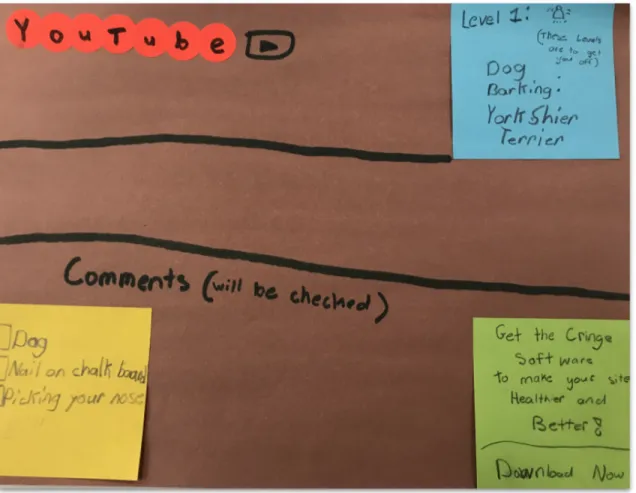
7-8 A paper prototype of “less addictive” YouTube. . . 84
8-1 An example of an AI system given in class. For the purposes of this class, all AI systems are broken down into three parts: a dataset, learning algorithm, and prediction. . . 91
8-2 An example of a student’s AI bingo card. . . 92
8-3 As a class, students discuss that the “best” PB&J sandwich could mean the most delicious sandwich, the healthiest, or the quickest to make. . 93
8-4 An example of an ethical matrix the class completes together before students. . . 94
8-5 A group of students work on filling out various ethical matrices for their PB&J sandwich algorithm. . . 95
8-6 A student experiments with training his own supervised machine learn-ing model with Google’s Teachable Machine platform. . . 97
8-7 A student interacts with a GAN tool before engaging in the speculative ficition activity. . . 98
8-8 Students work on their paper prototypes for the YouTube Redesign activity. . . 99
9-1 Some of the workshop students having fun on a tour of MIT. . . 102
9-2 Students add their hopes, questions, concerns, feelings, and drawings of AI to the classroom mural. . . 106
10-1 How strongly students agree or disagree with various descriptions of artificial intelligence. . . 114
10-2 Assessment used to check students’ understanding of the three parts of a supervised machine learning system. . . 115
10-3 Assessment used to check students’ understanding of how supervised machine learning works. . . 116 10-4 Assessment used to check students’ understanding of the effect training
data has on the accuracy of a machine learning system. . . 118 10-5 Assessment used to check students’ understanding of how the
com-position of training data affects the outcome of a supervised machine learning system. . . 119 10-6 Assessment used to check students’ understanding of how the
com-position of training data affects the outcome of a supervised machine learning system. . . 120 10-7 A visualization of the stakeholder-value pairs from students’ YouTube
Redesign projects. . . 121 10-8 A paper prototype of a YouTube optimizing for "time well spent." . . 124 10-9 A paper prototype of a YouTube optimizing for entertainment. . . 125 10-10A paper prototype of a YouTube optimizing for entertainment and profit.127 10-11Shift in students’ perceptions of AI as objective, subjective, unbiased,
List of Tables
4.1 Existing K-12 AI curricula. . . 44 9.1 Participant Demographics . . . 104 10.1 The number of participants that use each technology. There were 19
participants in total. . . 108 10.2 Students’ initial conceptions about which popular technologies use AI. 109 10.3 Students’ familiarity with eight common narratives around AI. . . 112 10.4 Students rate how excited or concerned they are about different
nar-ratives surrounding AI. . . 112 10.5 Students rate how likely or unlikely they believe different AI narratives
are to come true. . . 113 10.6 Students rate how likely or unlikely they believe different AI narratives
will have an impact during their lifetime. . . 114 10.7 Students’ conceptions about which popular technologies use artificial
intelligence after learning how supervised machine learning works. . . 117 10.8 YouTube Redesign Goals and Reasoning . . . 122
“Artificial intelligence is tech but
also an idea. We’re creating
ourselves in a machine.”
Tess Posner
1
A Note on Terminology
Both of the terms “artificial intelligence” and “ethics” are loaded terms in today’s society. Both terms can be used as general shorthand, abbreviations for longer, more holistic meanings, or can be used in very precise ways with quite technical definitions. This can make usage of these terms quite confusing. In this section, I would like to provide some clarity on the usage of these terms in this thesis.
1.1
What Is Artificial Intelligence?
This is a difficult question to answer. AAAI, the largest professional society for those working in the field of artificial intelligence, defines artificial intelligence as “the scientific understanding of the mechanisms underlying thought and intelligent behavior and their embodiment in machines”[5]. There are two key phrases in this
definition which illustrate why this question is so difficult to answer: “mechanisms” and “intelligent behavior.”
When the field was conceived, AI professionals worked on logic and symbolic rea-soning, which to today’s AI professionals might seem closer to “pure mathematics” than to the popular or common AI methods of today. The field then moved to expert systems where programs would “derive knowledge” from knowledge bases of facts. Intelligent agents became the next popular focus for AI professionals, where AI sys-tems were imagined as individual agents with goals and means of maximizing those goals. Today, machine learning (often conflated with similar but not equivalent terms like: “data science,” “deep learning,” “neural networks”) is a popular AI methodology [8]. When differentiating machine learning from artificial intelligence, AAAI offers this quote from “The Discipline of Machine Learning” by Tom Mitchell: “The field of Machine Learning seeks to answer these questions: How can we build computer systems that automatically improve with experience, and what are the fundamental laws that govern all learning processes?” [17]. There is tremendous debate within the professional and academic AI communities whether any of these methodologies can be considered artificial intelligence. There is debate if the rules-based systems of the past, the “if this happens, then do this”code, should still be considered artifi-cial intelligence in comparison to the so-complicated-that-they-are-often-inexplicable machine methodologies of today. There is debate whether machine learning can be considered artificial intelligence, given its roots in fields like statistics rather than symbolic reasoning. I might point out that it must be difficult to argue if a thing, such as machine learning, belongs in a category as some other things, such as knowl-edge bases or rules-based systems, when the definition of that thing is a question. All this to say, if artificial intelligence is to be defined by its mechanics, there is no consensus as to what those mechanics are.
Furthermore, what is considered “intelligent behavior?” For this, there is even less consensus, as often the measure of intelligence in a behavior is dependent upon the mechanism. A robot which completes a maze by following a pre-programmed route may appear to be intelligently navigating the maze, but might be considered very
different in “intelligence” to a robot which perceives through sensors the maze around it and navigates accordingly.
1.2
What Is a Useful Definition of Artificial
Intelli-gence?
Instead of debating the true nature or best definition of artificial intelligence - should such things exist - I instead ask: what is a useful definition of AI for this thesis? Or, what is a useful definition of AI when educating K-12 students? As will be elaborated on later, I argue that this definition should depict a technology children know in their everyday lives and should empower them relative to that technology.
For this reason, “artificial intelligence” in this thesis is used most commonly to refer to systems reliant on machine learning. This is because the curriculum presented in this thesis heavily leverages currently popular technologies such as YouTube, Google Search, or Instagram, which employ machine learning in their most familiar features. The definition given to children in the curriculum (further described in chapter 7) is that artificial intelligence is any system that takes in a dataset as input, uses a learning algorithm to recognize patterns within that dataset, and outputs a prediction. This definition is not used to exclude other, legitimate types of AI; rather, it is used because the most influential systems in their lives follow this pattern and the ability to recognize those systems as utilizing datasets and making predictions (which is notably different from “knowing an answer”) is empowering.
There is, however, one additional confusion that a definition so inclusive of appli-cations presents which is that the real world implementations of specific, recognized AI methodologies are often bundled together with algorithms not classified as arti-ficially intelligent systems. For example, YouTube’s recommendation system, which suggests new videos for the user to watch, employs categorical AI techniques such as collaborative filtering. However there is a disconnect - not all code that contributes to these recommendations are implementations of AI systems. The code which scrapes
tags, likes and dislikes, or comments from videos is categorically not AI. The code which places new recommended videos within the interface is categorically not AI. The code which maintains a user’s viewing history is categorically not AI. However all of these pieces together make the AI component effective and useful, and all of them are changeable and susceptible to critique. As Seaver notes, these different pieces of code are often - intentionally and not - referred to as “the algorithm” by those in critical fields like ethics, science and technology studies, and anthropology [88].
1.3
The Algorithm
In this thesis, the terms “artificial intelligence system” and “algorithm” are also used almost entirely interchangeably unless specifically noted. This is in part due to these AI and non-AI bundles like the YouTube recommender algorithm. However, as Seaver notes, there is some risk in using the terms interchangeably. He writes, “Moreover, the ‘correct’ definition of algorithms has been used precisely to isolate them from the concerns of social scientists and humanists, and it has been picked up by advocates and critics alike to set algorithmic processes apart from cultural ones.” That is to say, there is a risk in using the general term “algorithm” that technical people will shrug off valid criticism (and therefore, better ethical practices) using the ambiguity of “algorithm” as a shield for their more specific work (even if the ambiguity is correct for the systems in question). However, Seaver argues that the term “algorithm” is actually useful because it points to the existence of a larger, broader socio-technical system. He writes,
Following Laura Devendorf and Elizabeth Goodman, I find this a useful way to approach algorithms – not as stable objects interacted with from many perspectives, but as the manifold consequences of a variety of hu-man practices.... If we understand algorithms as enacted by the practices used to engage with them, then the stakes of our own methods change. We are not remote observers, but rather active enactors, producing al-gorithms as particular kinds of objects through our research. Where a
computer scientist might enact algorithms as abstract procedures through mathematical analysis, an anthropologist might use ethnographic meth-ods to enact them as rangy sociotechnical systems constituted by human practices. Presuming that algorithms must have a stable and coherent existence makes it harder, not easier, to grapple with their production and ongoing maintenance. [88]
This idea is further supported by Adam Burke in his paper “Occluded Algo-rithms,” where he argues the more ambiguous definition, which is common among non-technical and technical people, is useful when thinking critically about technol-ogy. He writes,
Corporations, states, journalists, technologists, and users of all kinds may also use the term ‘algorithm’ less precisely to refer to phenomena around computational systems. This important observation can be explained by a secondary, popular definition of algorithm, when viewing an opaque computational system as a disempowered user... Given this, the precision of the secondary, algorithm as system, definition, and its characterization as a popular definition, is preferred. [37]
The purpose in defining AI as a technology which utilizes a dataset to make a prediction, to align that definition with popular, commercial technologies, and the choice to refer to these blurry, applied mixes of AI and non-AI technologies as “the algorithm” is to ultimately point toward the broader social system where these technical systems exist. If a student is able to recognize that a technical artifact they use is a form of artificial intelligence, and that the system uses a dataset and makes a prediction, they are one step closer to considering who is affected by that dataset and how that prediction may help or harm. The use of the term “the algorithm” extends this line of thinking beyond the individual AI system to include to the entire socio-technical ecosystem.
1.4
The Ethics of Artificial Intelligence
Perhaps even more hotly contested than the phrase “artificial intelligence,” is the phrase “ethics,” especially in the context of technology. A person who studies the ethics of AI could study a wide variety of topics: law and regulations to a specific technology or technology companies, the macro-economic or social impacts of a par-ticular technology, the power dynamics within a technology company, constructing particular optimization constraints for an AI system in a very specific domain... and so much more. In 2019, the Berkman Klein Center for Internet and Society analyzed 32 “principle documents” from governments, technology companies, advocacy groups, and more, which outlined each organization’s guidelines and principles around de-veloping ethical and human-rights-centered AI. Their analysis recognized eight large themes in these documents: accountability, fairness and non-discrimination, human control of technology, privacy, professional responsibility, promotion of human val-ues, safety and security, and transparency and explainability [64]. This means that “ethics” is often used as a shorthand for this long list of possibilities. Which topics are covered in this curriculum and why are discussed in later chapters.
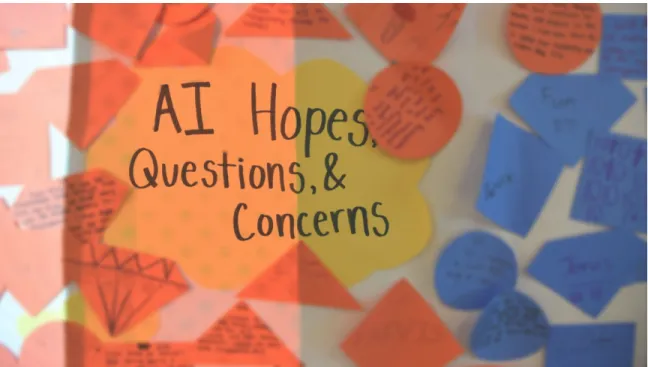
Figure 1-1: A snapshot of a student-composed mural. Students explore what the “ethics of artificial intelligence” means by writing about their hopes, questions, and concerns around AI.
“Algorithms are opinions
embedded in code.”
Cathy O’Neil
2
Preface
In fall 2016, I was a junior at the University of South Carolina studying computer science. My best friend, Maribeth, was a year ahead of me and had just begun her senior year. And with the arrival of her senior year came the task of finding a “real” post-graduation job.
I remember one Friday night we hung out at her apartment and watched The Martian, a movie Maribeth often referenced (some joke about a space pirate or some-thing) but I had never seen. As I settled in to watch the movie, Maribeth opened her laptop and started filling out job applications: typing in her name, her work history, and uploading her very carefully curated résumé.
One of the companies she applied to that night was Twitter, at 7:48 p.m. We stayed up, watched Mark Watney become a space pirate, and agreed to meet up the following day to work on some homework.
I returned to Maribeth’s apartment the following day. Her first words to me were: “Twitter has already rejected me.”
Less than 24 hours later, on a Saturday, Maribeth had been notified that she wasn’t a “good fit” for the role. She was devastated. “Am I out of my league applying to a company like Twitter?” she wondered. “I must be, for them to reject me so quickly.”
But here’s the thing – Maribeth was a good student. Better than good, actually, one of the best in her class. Despite switching majors from chemistry to computer science, she had somehow maintained a perfect GPA, was a founding member and president of our Women in Computing organization, and had glowing recommenda-tions from a previous software engineering internship. And she had done her home-work when it came to constructing her résumé for these applications: she included keywords that were known to be appealing to recruiters and formatted it into one column to be machine readable.
So why had she been rejected so quickly? We had a hunch. Not many students from the University of South Carolina joined companies like Twitter. We also knew that not many Twitter engineers had the title “President of Women in Computing” on their résumé - at the time, less than 10% of software engineers at the company were women. What if Maribeth had been rejected because a computer algorithm had never seen a successful candidate from the University of South Carolina before? Or because most software engineers who got promoted were never affiliated with an organization like Women in Computing?
This was 2016, and although Cathy O’Neil’s now famous book Weapons of Math Destruction had been published just shy of a month prior and told stories of biased hiring algorithms, it had not yet become a common headline in the news. At the time, a hunch was all we had.
A few weeks later Maribeth and I ventured to Houston, Texas, to attend the Grace Hopper Celebration of Women in Computing. This is where Maribeth would find a job. She was sure of it.
an IKEA showroom: each tech company had clearly hired an architect and interior decorator to build booths with interactive murals, full service bars, cotton candy machines. It was overwhelming, but immediately Maribeth turned to me and said, “I’m just going to go talk to someone at Twitter. Maybe they won’t reject me so quickly in person.”
And she was right. Her courage paid off. Later that day, Maribeth started the first round of interviews with Twitter. And several weeks later, she accepted a job at a company that was just the right fit for her: Google.
Maribeth was powerful in this situation, and there were three advantages she had that most people do not. First, she was aware that an algorithm had made a decision about her. Second, she knew this decision was wrong. Third, she ultimately decided that her opinion of herself was more important than the opinion of this algorithm. And she acted on it.
I’d like to underscore that these are hard things to do.
Even when algorithms are recognized, they are often viewed as objective arbiters of the truth – not as opinions. Take for example: the following tweet from a con-servative columnist, “Socialist Rep. Alexandria Ocasio-Cortez (D-NY) claims that algorithms, which are driven by math, are racist.” Although the tweet boasts hun-dreds of replies explaining how algorithms can, in fact, be racist, it also boasts 9.8K likes [85]. Mathematics, it would seem, is immune to racism.
Algorithms, and artificial intelligence by extension, are marketed to the public as omniscient and therefore trustworthy. In her book Hello, World, mathematician Hannah Fry tells the story of Robert Jones, who was driving through West Yorkshire when he realized his gas tank was almost empty. His GPS, however, offered him a shortcut through a nearby valley to get to the closest gas station. Grateful for modern technology, Robert followed the path, and kept following even after the path turned from pavement to dirt. It wasn’t until his car was just about to tip over the edge of the cliff that Robert abandoned his car. The GPS had led him astray. Despite seeing a cliff ahead, and despite driving thousands of miles a week for his job, Robert continued to trust the GPS over his own experience. “I had no reason not to trust
it,” he later recalled [57].
Moreover, it’s not just adults who place authority in these systems. In 2017, two colleagues of mine conducted a study where they had children ages 3-10 play with smart devices such as Amazon Alexa or Google Home. After the children had the opportunity to play with these devices, they were asked a question: do you think this device is less smart, just as smart, or smarter than you?
Among the three and four year olds, 20% of them responded and said the Alexa device was smarter than them. None of the three and four year olds thought Google Home was smarter than them.
However, the six through ten year olds had quite different responses: 100% of them thought Alexa was smarter than them, and 43% reported thinking Google Home was smarter than them [48]. This makes me wonder: how do we ensure that these children have every advantage Maribeth had? How do we ensure these children don’t grow up to drive their vehicles off a cliff?
“...one of many steps that need to be taken toward this change is at the level of education -and whatever else we can do to ensure that no one is ‘just an engineer’ anymore.”
Casey Fiesler
3
Educating Children in the Era of AI
In February 2018, the Wall Street Journal published an article titled “How YouTube Drives People to the Internet’s Darkest Corners,” which recounted an investigation the journal had done into YouTube’s recommender system. The recommender system, it seemed, suggested increasingly conspiratorial or extreme content to its users, regard-less of whether the user was searching for it or not. The article shows screenshots of “suggested videos” that were recommended to a brand-new user with no previ-ous viewing history. The suggestions included videos containing conspiracy theories around the Pope (“How Dangerous is the Pope?” read the top recommendation) and videos implying that the Earth is flat (“Lunar Eclipse doesn’t work on your Globe!” read another recommendation) [77].
Just a month later, professor and techno-sociologist Zeynep Tufecki penned an opinion piece in the New York Times called “YouTube, the Great Radicalizer,”
cor-roborating the experience described in the Wall Street Journal article. “What we are witnessing is the computational exploitation of a natural human desire: to look ‘behind the curtain,’ to dig deeper into something that engages us,” Tufecki writes [102]. Since the publishing of her op-ed, the New York Times has published several stories portraying how YouTube’s recommendation algorithm has influenced young people’s ideology. They tell the story of Caleb Cain, a man who, after dropping out of college, found comfort in watching self-help videos on YouTube. Those videos recom-mendations, however, eventually turned into recommendations for white nationalist propaganda. Cain was hooked [84]. These stories also portray the political situation in Brazil, where YouTube’s recommendation algorithm popularized far-right individ-uals, especially with young men. One of these individuals was Jair Bolsonaro, the current president of Brazil who is known to support human rights violations [55]. Tufecki continues to write:
In effect, YouTube has created a restaurant that serves us increasingly sugary, fatty foods, loading up our plates as soon as we are finished with the last meal.... This situation is especially dangerous given how many people – especially young people – turn to YouTube for information. [102] And she’s right.
Pew Research Center reports that 44% of teens are online “almost constantly,” and that 32% of teens use YouTube most often when they’re online. However, it’s not just teens who are on YouTube. Pew also reports that 81% of all parents with children under the age of 11 let their children watch YouTube videos, and it’s known that the same recommender system that prioritizes increasingly conspiratorial and longer content accounts for 70% of watched content on the platform [26].
Children’s interactions with AI do not end with YouTube, though. The children of today live in a world where almost all information and interactions are mediated by artificial intelligence, whether that be getting information from Google search results or chatting with a friend using predictive texting. Common Sense Media reports that 39% of children (the plurality) use social media as their main news source while Pew
Research Center reports that teens are more likely to spend time with their friends online than in person. It’s estimated that 16% of Americans have a smart speaker in their home, and many news articles have dubbed these smart speakers as this era’s “Mary Poppins.” Today’s children are not just digital natives, they are AI natives. They are comfortable navigating AI-mediated life. To them, it’s normal.
3.1
The Need for K-12 Education
There is a problem with this normality, however. While children - and the public at large - are becoming increasingly dependent on AI-mediated technologies to learn new information or connect with others, AI itself has become more complicated, less transparent, and sometimes invisible to the people who use it. For example, a study in 2015 has shown that 62.5% of Facebook users are unaware that the content on their News Feed is curated by an AI system rather than showing posts in chronological order [50]. Additionally, research has shown that children are willing to disclose personal information to robots and smart toys and are unaware that this information is being recorded by the device, and that parents are extremely worried about their children’s trust in AI-mediated toys and devices [105].
Furthermore, although AI is ubiquitous in the developed world, only a small mi-nority (approximately 10%) of Internet users consider themselves to be an expert in AI [67]. According to a report by Tencent in 2017, only 300,000 people in the world have the skills needed to build AI systems [103]. Compare this number to the World Economic Forum’s prediction that there will be 58 million new jobs related to AI by 2022 [99].
This number alone motivates the need for widespread AI K-12 education. Many arguments for AI education follow the same logic as the arguments for greater K-12 STEM education efforts: this is where the secure, well-paying jobs will be in the future, so let’s get kids interested in the topic from a young age! This sentiment is echoed by the AI4K12 initiative, an organization dedicated to democratizing K-12 AI education in the United States, in their “blue sky” paper [101].
Moreover, this is not the only reason why AI K-12 education is needed. As re-searcher Randi Williams addresses in her master’s thesis, the field of AI is suffering from a “diversity crisis.” Although AI is used by many, it is built by few, and a ho-mogenous few at that. Williams writes, “Thousands of people cannot build technology that equitably addresses the concerns of billions” [104]. Many examples throughout history prove Williams correct and show the dangers of having one kind of person (al-most exclusively Caucasian men) build technology. Seat belts are known to protect men better than women in car accidents due to crash testing with almost exclu-sively male dummies [33]. Now, in the era of AI, we know hiring algorithms are biased against women’s résumés and facial recognition systems aren’t trained to de-tect darker skinned faces [59, 36]. Williams writes, “How do we start changing the face of AI? One way is by empowering the youngest members of society, the next generation of technologists” [104].
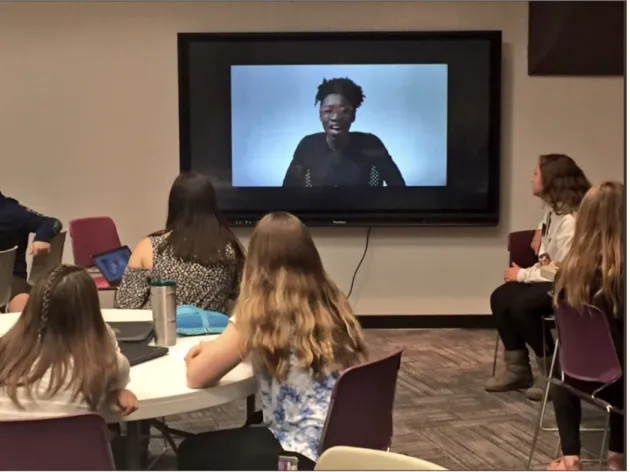
Figure 3-1: A group of 5th, 6th, and 7th grade “AI natives” are excited to learn not only about AI, but also the ethics associated with it.
3.2
The Need for AI Ethics Education
Teaching students how AI works is not enough. In the 1988 text Education for Democracy, Jean Piaget wrote,
The principal goal of education in the schools should be creating men and women who are capable of doing new things, not simply repeating what other generations have done; men and women who are creative, inventive and discoverers, who can be critical and verify, and not accept, everything they are offered.
Indeed, there are many mistakes we do not want the next generation of AI engi-neers to repeat, from mistakes as simple as building AI that is a bad sport at Tetris to building AI that associates the search term “black girls” with pornography, or that violates laws like the Fair Housing Act [32, 78, 100].
When YouTube employees were designing their recommendation algorithm to sug-gest videos to users, they were likely trying to answer the question, “how do I build a recommender that suggests videos users would like to see?” rather than the ques-tion “how might this “recommender harm communities?” or the even bigger quesques-tion “should I build a recommender system that measures success in number of views?” It is this line of thinking - or “unthinking” as feminist data scientist Caroline Cri-ado Perez likes to say - coupled with a culture of “move fast and break things” and techno-solutionism that gave us a platform dubbed “The Great Radicalizer” [82].
The next generation of AI designers needs to be prepared to both think of and answer all of these questions. Until this point in time, most AI education has focused on the first question - the so-called “technical question” - and not the latter two, the questions of ethics. It’s time for the boundaries to fall.
3.3
Children as Conscientious Consumers of AI
There are reasons beyond a child’s possible employment as a software engineer as to why they still need to learn about the ethics of AI systems.
The first reason is the need for AI literacy and the ability to recognize, as ex-emplified in the preface, that algorithms are like opinions. Children need to know that when they conduct a search on Google, the results displayed are not ranked by “factual accuracy.” Rather, they are optimized in such a way that negotiates the user’s perceived interests and Google’s need to match users with ads from advertis-ers. As consumers, it is important that children recognize the mechanism responsible for ranking search results is essentially the same as asking for Google’s opinion for the “most relevant” results...and knowing that Google’s opinion likely favors its own interest over that of the user. Similar to media literacy, this form of AI literacy might translate into a child clicking to the second or third page of search results.
Furthermore, while a child may never become a software engineer, it is likely that their future careers will involve AI. In October 2017, reports surfaced that Amazon was building a machine learning hiring algorithm, and that the algorithm was biased against women.1 Amazon was ultimately planning to sell this algorithm to other companies to use [44]. Although many children might not grow up to be the engineers who build such an algorithm, they might grow up to be the employee who purchases the algorithm or who uses it to hire new employees into their company. In both circumstances, knowing that an algorithm could be designed and built to pass over qualified candidates is essential knowledge.
3.4
Children as Democratic Designers of AI
In May 2019, San Francisco became the first city in the United States to ban facial recognition technology. In June 2019, it was banned in Somerville, MA, and then in July it was banned again in Oakland, CA [107]. While there have been many hearings before Congress about the use of technology in the United States, each decision was made by informed, local governments [14]. In the case of the Somerville
1Some argue that even though the algorithm was known to rate more men higher than women with equivalent qualifications, it might have been less biased than a human recruiter. While this may be true, I argue that (1) without ethics education, personnel involved might never think to test this due to a culture of techno-solutionism, and (2) engineers with ethics training would have been able to seek out even better data to train the system on.
ban, comments from the Security Industry Association, the American Civil Liberties Union, and 119 Somerville residents contributed to this decision [6]. In order to participate in a democratic process such as this, it is important that children as citizens are aware of the potential benefits and harms AI technologies pose.
3.5
Contributions of Thesis
With this motivation in mind, the main contribution of this work is an open-source, largely unplugged AI and ethics curriculum designed for middle school students. This curriculum is unique not only in that it is one of (if not the only) few K-12 AI curricula to have an integrated approach to ethics, it is one of few AI curricula at any level to approach AI from an ethical design standpoint. This curriculum, including materials and teacher guides, can be found at url: https://bit.ly/mit-ai-ethics. However, in designing - and later assessing - this curriculum, many other contributions were also made.
First, a review of what educational activities or curricula exist with respect to AI and ethics is given in the next chapter. Chapter 5 gives an overview of the broad, and growing, field of “AI and Ethics,” and a framework by which we can prioritize and organize topics into future curricula.
Second, in addition to these reviews, the two pilot studies performed (described in Chapters 7 - 11) provide insight as to what children already know about artificial intelligence and the ethical issues associated with it. Furthermore, key themes from many interviews with educators, philosophers, AI experts, policymakers, and more are provided to give context as to what content should be included in such a curriculum as well as how that content should be taught. The findings from these interviews are presented in Chapter 5 and Chapter 6. All of this information can be used to design future curricula either related to ethical design, artificial intelligence, or both.
Third, lessons learned from two pilot studies are presented. The design recom-mendations given from the initial pilot are described in Chapter 7 and utilized in a second version of the curriculum. The effectiveness of this second curriculum is
as-sessed in Chapter 10, and design recommendations for similar projects in the future are given in Chapter 11.
Fourth, and finally, this thesis presents an initial list of suggested standards for what all children should know about the ethical design of AI. These standards are presented in Chapter 8, and design recommendations for future iterations of them are presented in Chapter 11.
Through this work, I will answer the following research questions:
1. Which concepts in the realm of AI and ethics should be prioritized for such a curriculum? (Chapters 2, 3, 5, and 11)
2. What are children’s preconceptions of artificial intelligence and the ethical issues associated with it? (Chapters 4, 7, 10 and 11)
3. What are children capable of learning about key concepts in AI and ethics? And how does this inform a developmentally appropriate curriculum? (Chapters 4, 7, 10, and 11)
4. How can a curriculum be designed so that it is useful, accessible, supports educators, and is effective in student learning? (Chapters 6, 7, 8, and 11) 5. How does learning about the ethical design of artificial intelligence change
chil-dren’s perceptions of artificial intelligence? (Chapters 7, 10, and 11)
6. How does learning about the ethical design of artificial intelligence change their perceptions of themselves as empowered designers? (Chapters 7, 10, and 11) It is my hope that this work will provide a path for others - educators, parents, technologists, and more - to encourage the children of today to be empowered ethical AI designers of tomorrow.
“...it is important that we democratize AI now. When anyone can learn about and use AI in creative ways, then AI can become a tool for positive change.”
Randi Williams
4
Background and Prior Work
The previous chapter established why we need to educate children about the topic of ethics and artificial intelligence; this chapter reviews what children already know about artificial intelligence and what tools currently exist to educate children on the topic of ethics as it relates to technology and more specifically, to artificial intelligence.
4.1
Children’s Knowledge of AI + Ethics
In designing a curriculum on any topic, it is important to ask the following questions: 1. What do the students already know prior to an intervention?
2. What potential barriers to learning can we anticipate and mitigate?
know about about AI: where it’s used, how it works, and whom it affects. It is also important to know what types of AI children interact with in their everyday life in order to best motivate the curriculum to them. This information, in combination with any anticipated barriers students may face in learning about AI, will assist in designing lessons that meaningfully connect with children.
4.1.1
Children’s Prior Knowledge
First, it is important to examine research related to what children already know about artificial intelligence and, if possible, the ethical issues associated with it. Although this question is of increasing importance, it still remains largely unclear what children think of artificial intelligence devices.
The large majority of previous research on children’s perceptions of AI focuses on children’s perceptions of embodied devices such as robots, smart speakers, or smart toys. For example, many works, such as [31], explore how children perceive embodied AI devices to be “alive,” while [89] shows children nine years of age or younger are more likely to prescribe particular mental characteristics to embodied AI agents.
These studies have motivated further research to understand what attributes -such as objectivity, authority, trustworthiness, helpfulness, etc. - children ascribe to these embodied devices. For example, [74] shows children find smart toys to be trustworthy, as children would divulge personal information to smart toys, while [105] shows some children (and parents) perceive these devices to be smarter than they are. At this point in time, there is little parallel research which asks similar questions on disembodied AI agents, such as online recommender or classification systems. While results from [31, 72, 104] suggest that children who have the opportunity to learn technically how these agents work perceive these technologies differently, it is unclear if those findings generalize to disembodied forms of AI.
The best available information about children’s prior knowledge of AI systems is about their usage. For example, Common Sense Media reports that children’s most preferred news source is social media, with YouTube and Facebook being the most popular platforms among tweens and teens [18]. Pew Research suggests slightly
different usage, with YouTube being the most popular social media platform followed by Instagram and Snapchat [28]. While there is little information about students knowledge of how AI works or what their perceptions of AI are in general, we do know which AI systems children interact with and can connect with as examples in the classroom.
Similarly, there is no research at this point in time about children’s perceptions of the ethical issues surrounding artificial intelligence - whether they perceive the technology as a whole to be a force for good or bad in society, or what hopes and concerns they might have for the future of the technology. In fact, there is little research on public adult perception of the ethics of artificial intelligence beyond [40]. This thesis aims to close some of these gaps and provide clarity with regards to children’s perceptions of AI (beyond embodied agents) and their perceptions of the ethical ramifications of AI.
4.1.2
Anticipating Barriers
In addition to considering what children might already know about AI and ethics, it is important to anticipate what, if any, potential barriers might prevent students from learning about the subject.
One such potential barrier that may exist is children’s ability to reason about various ethical dilemmas. As children grow, it is known that their moral reasoning abilities increase. Moral reasoning is the ability to reason about why something might be right or wrong, or the process by which someone determines an action to be right or wrong. The fact that moral reasoning ability changes with age was shown in 1958 by moral psychologist Lawrence Kohlberg, who classified moral reasoning abilities into stages based on his participants’ ability to justify particular actions in hypothetical ethical dilemmas [69].
For example, the first stage of moral development is called the “preconventional stage,” and children in this stage are likely to choose an action based on their percep-tion of whether the acpercep-tion will be punished or rewarded. Children in this stage are not able to differentiate between a morally wrong action and an action that is punished.
Typically, children move on from this stage of moral development around age ten, or approximately in the fifth grade, to the “conventional stage,” where morally good actions are associated with maintaining friendships or social order.
This theory suggests that younger children may struggle with some ethical dilem-mas, while older students may be more equipped to inspect morally ambiguous situ-ations.
4.2
The State of AI + Ethics Education
Beyond children’s preexisting schema and the potential barriers to their learning, it is important to see what other curricula, tools, and platforms exist which teach artificial intelligence, and in particular, what kind of ethics topics are included and how they are presented.
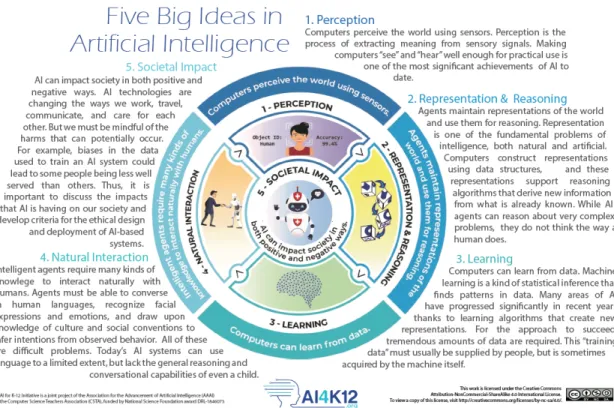
Figure 4-1: The “Five Big Ideas in Artificial Intelligence,” as identified by the orga-nization AI4K12.
4.2.1
K-12 AI + Ethics Education
At the beginning of 2019, the organization AI4K12 published a paper: “Envisioning AI for K-12: What should every child know about AI?” [101]. AI4K12 is an organization jointly sponsored by the Association for the Advancement of Artificial Intelligence (AAAI) and the Computer Science Teachers Association (CSTA) whose goal is to both develop national guidelines for K-12 AI education and to develop a repository of resources to enable teachers to bring AI to the classroom. The paper they published was a “blue sky” paper - it outlined the current state of AI education tools as well as what future tools should be like. Part of the paper included a list of the five “big ideas” in AI, as seen in Figure 4-1:
1. Computers perceive the world using sensors.
2. Agents maintain models or representations of the world and use them for rea-soning.
3. Computers can learn from data.
4. Making agents interact comfortably with humans is a substantial challenge for AI developers.1
5. AI applications can impact society in both positive and negative ways. Since the paper’s publication, the number of tools and resources for K-12 AI education has been rapidly expanding. However, despite “societal impact” being listed as one of AI4K12’s five “big ideas” for K-12 AI education, there are still currently very few tools available to educators which incorporate a discussion of societal impact or ethics into AI education. Below I discuss the many categories of resources available to educators and which tools include some form of ethics.
Extensions
Many tools, such as Cognimates, eCraft2Learn, and Machine Learning for Kids extend the capabilities of popular visual programming languages such as Scratch or App
1This language has since been changed to “Intelligent agents require many types of knowledge to interact naturally with humans.” [45]
Inventor and allow children to independently build, train, and test their own AI systems [10, 11, 16]. Many of these platforms hook into popular AI APIs, such as IBM Watson, to allow students to build on top of preexisting project templates. Of these tools, eCraft2Learn is the only platform which calls attention to an ethics issue by including a video about algorithmic bias as a part of a project template. However, the project template only focuses on awareness of the issue and does not provide guidance on how to avoid algorithmic bias from a technical or design perspective [66]. This is unsurprising as these platforms function more similarly to a programming language, and they are designed to be used as a teaching tool within a curriculum and intended to be paired with guided instruction as opposed to self-contained teaching modules. Visual Explainers and Games
Other educational AI web tools function less as construction tools and more as ex-planatory tools. Examples from this category include tools like the many AI Experi-ments by Google, TensorFlow Playground, and Google’s “What If?” tool [2, 22, 24]. These tools, through games or visualizations, give students an intuition how vari-ous kinds of AI (typically neural networks or generative adversarial networks) work. Again, in this category, only one of these tools explicitly delves into an issue of ethics. Google’s “What If?” tool acts as a visual explainer for algorithmic bias and shows the user how an algorithm can have disparate outcomes for different groups as training data is changed or as different loss functions are minimized. This particular tool, however, is likely to be reserved for very advanced high school classrooms, as it was designed to be a tool for AI engineers and requires a large quantity of preexisting, expert-level technical knowledge.
Curricula
Several AI curricula do exist at the K-12 level. Some of these exist primarily as re-search platforms and show the capability of students at various ages to grasp AI and machine learning concepts or explore the advantages of various pedagogies. One such example includes the PopBots curriculum, a toolkit for children ages 4-6 years old to
# Platform Topic Type Age Range Cost Ethics 1 Calypso for Cozmo [9] Rules-based systems, Perception, State machines Programming language, Lesson plans 8-15 years old Requires Cozmo Robot; $14.99 2 ECS Alternate Curriculum on AI [87] Neural networks, Algorithmic
bias Lesson plans High school Free X
3 Elements of AI [79] Bayesian probability, Neural networks Online modules Advanced
high school Free X
4 ReadyAI Curricula [83] Varied topics across Big 5 Lesson plans, Teacher training, hardware 5-14 years old Free -$3,000 X 5 Techsplorer by NVIDIA and Technovation [19] Neural networks,
Self-driving cars Lesson plans
9-14
years old Free Table 4.1: Existing K-12 AI curricula.
explore AI topics alongside a programmable social robot [104]. PopBots showed that preschool age children are able to understand concepts like supervised machine learn-ing, portrayed the benefits of constructionist pedagogy, and demonstrated the impact early STEM education can have on children’s perceptions of their own scientific and engineering abilities.
Other curricula are currently available to educators, as depicted in Table 4.1. This list is rapidly expanding in real time however, and more resources can be found at aieducation.mit.edu.
It is worth noting that three of the five resources here contain an ethics component, all of which reserve ethics content to the last modules of the curriculum.
All of the ECS curriculum (#2), Elements of AI (#3), and ReadyAI (#4) curricula include a unit or module on the societal impact of artificial intelligence at the end of
the curriculum, typically as the final module, and typically on the topic of algorithmic bias or the impact of automation on the workforce. The ECS curriculum (#2) also teaches on the topics of algorithmic bias and about the impact of automation, but also discusses AI’s impact on the future of news media.
AI for Good
In addition to these tools and curricula, there is also a current trend toward AI education events, extracurriculars, and summer programming. Many of these ex-periences fall under the umbrella of “AI for Good.” AI for Good is both a United Nations platform in partnership with technology companies, academic institutions, and national governments, as well as a flavor of computer science project found in academic and STEM outreach programs - the latter is the focus of this section. AI for Good projects are typically characterized by the pairing of a computer scientist to a community issue (at the UN level, these issues are typically related to the UN’s sustainability goals, while in the classroom these issues are often related to the local community) and having said computer scientist use AI or machine learning methods to “solve” the issue [4].
These experiences include WAICY, or the World AI Competition for Youth, or teen-targeted summer programs like AI4All or Teens in AI [25, 3, 21]. Students begin each of these experiences by participating in an intensive, introductory AI bootcamp. After learning “the basics,” students are divided into teams and asked to identify a community issue that could be remedied with an AI solution. In particular, WAICY asks students to focus on solutions that also utilize AI concepts and robotics concepts since the competition heavily leverages a Cozmo robot [25].
Similarly, the Technovation AI Family Challenge guides parents and children through a similar process at home. The Family Challenge begins by introducing technical concepts like neural networks to children and eventually has them apply their learning using one of the aforementioned tools, such as Machine Learning for Kids, to build an “invention” that will assist their local community [20].
amount of evidence which suggests students, especially underrepresented students, are more likely to become interested in a STEM topic if the topic is presented in relationship to social justice issues or service learning [34, 68]. However, there is some debate if AI for Good experiences can be considered ethics training for AI developers [71]. The following chapter discusses the relationship between the notion of “AI for Good” and other perspectives on the ethics of AI.
Digital Citizenship and Media Literacy Curricula
A few efforts exist which aim to teach that the Internet does not necessarily relay neutral, authoritative sources of information. Notably, there has been a trend in recent years of updating “digital citizenship” curricula. Digital citizenship curricula exist to teach children to be critical thinkers as they navigate the web, and tend to have many media literacy learning objectives. Two prominent curricula exist in this space: Common Sense Media’s “Digital Citizenship” curriculum as well as Google’s “Be Internet Awesome” curriculum. Both curricula focus on teaching the importance of keeping identifying information private, being kind to other Internet users, as well as identifying the bias of information sources. While neither of these curricula seek to give students an understanding of how AI works (either from a technical perspective or a societal one), both of these curricula have been recently updated to make students aware of issues exacerbated by artificial intelligence. For example, both curricula now include lessons on false news, misinformation, and how misinformation can be spread by algorithms. Google’s “Be Internet Awesome” curriculum includes lesson plans on how to identify bots and about the fallibility of digital voice assistants’ responses [7]. Common Sense Media’s curriculum now includes lessons about the existence of filter bubbles and how filter bubbles can affect one’s ability to find balanced information [13].
EthicalCS
Another movement which does not seek to specifically educate children on the topic of artificial intelligence but does seek to highlight the subjective nature of algorithms
and their impact on society is EthicalCS. EthicalCS is a community of researchers, ed-ucators, and computer science professionals who seek to provide resources to teachers so that they may center ethics in their computer science teaching. Resources provided by EthicalCS include a range of unplugged (no computer needed) activities and dis-cussion based activities on topics such as bias in datasets and questioning whom an algorithm serves. Most of the activities provided are constructed as single activities to be integrated into a larger, technical computer science course or as amendments to popular computer science lessons, and are not meant to be concatenated into a curriculum [12].
4.3
AI + Ethics in Higher Education
Although this curriculum focuses on middle school education, it is worth examining AI + ethics at the undergraduate and graduate level. When examining AI+ ethics education in higher education, it becomes unsurprising that the majority of K-12 AI resources leave out an ethics component altogether, or that many resources that do include ethics content, relegate that content as the last content to be learned. These patterns strongly reflect the teaching practices, content focuses, and standards at the undergraduate and graduate level of study.
4.3.1
Toward Integrated Ethics
In 2014, computer science professor Arvind Narayanan and philosophy professor Shan-non Vallor wrote an article entitled “Computing Ethics: Why Software Engineering Courses Should Include Ethics Coverage.” In the article, they argue that college software engineering courses should include ethics education. They write:
Habits are powerful: Students should be in the habit of considering how the code they write serves the public good, how it might fail or be misused, who will control it; and their teachers should be in the habit of calling these issues to their attention.... What matters in these exercises is not