The Chameleon project: An art
installation exploring emotional contagion
The MIT Faculty has made this article openly available.
Please share
how this access benefits you. Your story matters.
Citation
Gonsalves, T. et al. “The chameleon project: An art installation
exploring emotional contagion.” Affective Computing and Intelligent
Interaction and Workshops, 2009. ACII 2009. 3rd International
Conference on. 2009. 1-2. © 2009 IEEE
As Published
http://dx.doi.org/10.1109/ACII.2009.5349522
Publisher
Institute of Electrical and Electronics Engineers
Version
Final published version
Citable link
http://hdl.handle.net/1721.1/59344
Terms of Use
Article is made available in accordance with the publisher's
policy and may be subject to US copyright law. Please refer to the
publisher's site for terms of use.
978-1-4244-4799-2/09/$25.00 ©2009 IEEE
Abstract
This demonstration allows the audience to interact with prototype 07 of the Chameleon interactive artwork installation. It is part of a project exploring emotional contagion,and communication, built by a cross disciplinary group of artists, scientists and engineers and a curator, that also includes the ACII 2009 poster presentation and paper by Iacobini, Gonsalves, Berthouze, Frith, et al [5]
1. Introduction
1.1. Background
Chameleon is built over two years (2008-2010), and ten prototypes. The project investigates the scientific foundations of emotional contagion, transforming this into an art experience. It both follows and critiques the scientific methodology, creating scientific and artistic research, as well as new models to be used in scientific experiments, and new ways to experience art.
The aim of the installation is to build an emotional communication loop with the audience. It uses emotion face reading technology developed by collaborators Youssef Kashef, Abdelrahman N. Mahmoud and Rana el Kaliouby [4] to classify the emotional state of the audience within a group of six emotions (happy, neutral, sad, angry, disgusted, surprised). It then uses this information and an emotional algorithm to respond empathically by playing the appropriate video selected from a database of portraits. To do this, social neuroscientist Chris Frith devised a simple probabilistic model of emotional transference in social situations based on an evolutionary hypothesis. Frith’s model predicts the probability of how a person will respond to a stimulus within the same group of six emotions. Iacobini, Gonsalves and Berthouze tested Frith’s emotional transference model in the laboratory [5]. This model is implemented into the learning algorithms of the
video engine software, so that the video portraits can be triggered in a way representative of how we transfer emotions in day-to-day life.
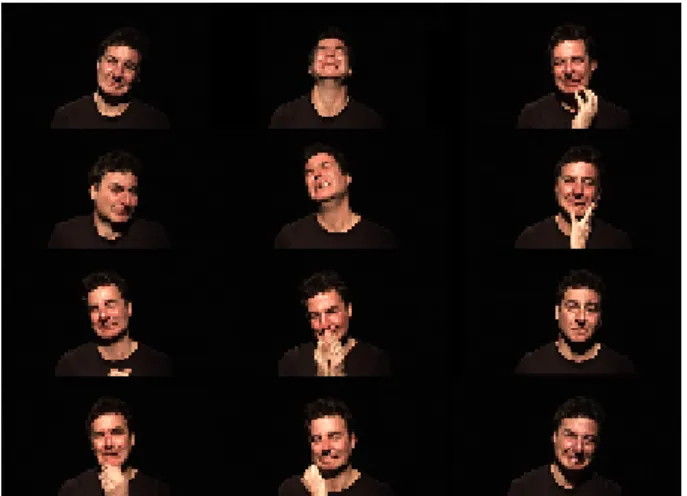
The video engine has been created by Australian/UK based artist Tina Gonsalves and Berlin based artist Jeff Mann. Tina Gonsalves has also created a database of short video portraits showing a mixture of actors and non-actors expressing emotions (figure 01). Subjects were shot around the world in a studio space with a neutral black background, using a range of techniques, recommended by the neuroscientific collaborators for their capacity to elicit emotional responses from the subjects. One of the subjects reported: “The whole
process from entering the darkened studio, to being confronted with a camera that stood only half a metre away from my face, I instantly thought would promote a perhaps less sincere and maybe uncomfortable response; but I was amazed to find how easily my recalling of these particular emotionally significant events unravelled, and how moments of embarrassment were soon ousted”. Another subject reports about the
experience in the studio “in the attempt to recreate the
emotion, the feelings flooded back. I felt quite moved
Figure 01. Chameleon Project, Video portrait 06, sadness channel
The Chameleon Project: An Art Installation Exploring Emotional Contagion
Tina Gonsalves,
Chris Frith,
Bruno Averbeck
UCL Wellcome Trust Centre for Neuroimaging
UK [email protected] [email protected] [email protected]
Youssef Kashef,
Abdelrahman N.
Mahmoud, Rana el
Kaliouby, Rosalind
Picard
American University in Cairo, Egypt MassachusettsInstitute of Technology, USA [email protected] [email protected]
Nadia Berthouze
Matt Iacobini
UCL Interaction Centre (UCLIC) UK [email protected]. uk [email protected] kHugo
Critchley
Brighton and Sussex Medical School, UK h.critchley@ bsms.ac.ukHelen
Sloan
Bournemouth University UK helen @scansite.orgboth during and after as it bought up for me feelings about friends, relatives that I had forgotten or moved on from in the business of my mind and life” (email
correspondence between participants and artist June 2009).
Each of the ten progressive stages has been exhibited in a range of gallery and museum spaces, research labs, social spaces and a hospital foyers. Initial feedback suggests that the work is affecting, and that there is a sense of emotional interaction. When asked if the participant felt an emotional connection, one replied
“...Yes, with one of them I did. And he was being quite flirtatious. The feeling I had inside was like having a connection with someone that you had met in a bar or something. We were mimicking each other...” Another
participant discusses“....there was a bit where I was
trying to make him angry, and he was just laughing at me. And that was just making me more angry really....”
(video transcript from interview at Lighthouse exhibition, March 2009).
1.2. A brief Description of Demonstration Set
Up
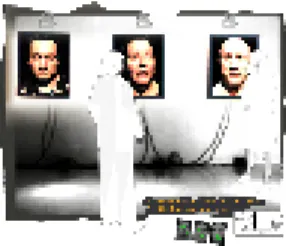
The participants will enter a defined space (figure 02). Three screens are connected to three computers. Each screen will be displaying a digital portrait of an everyday person showing expressions that can be classified within six emotional states (happy, neutral, sad, angry, disgusted, surprised).
The digital portraits are programmed to wait in the background until the emotional face reading system senses a participant’s face. After sensing the emotional expression of a participant’s face, the video portrait will walk forward to address the participant, attempting to begin an emotional dialogue with the participant that would be perceived as emotionally congruent to the participant’s emotional expression. The video portrait will attempt to stimulate the participants in such a way as to elicit an emotional facial expression from them that is recognized by the emotion face reading system.
The system constantly monitors the facial expression of the participant, selecting video portrait segments that aim to respond to the audience in an ‘emotionally intelligent’ way, in order to build an emotional bond with the audience. The work can interact with three people at a time (figure 03). If the system finds that one participant has a particularly strong emotional expression, the emotion is propagated to all three monitors (figure 04). People can leave and enter as they wish.
Figure 02. Video portraits wait in distance until participants come closer. Cameras monitor facial expression
Figure 03. The video engine responds to the emotional facial reading technology data.
Figure 04. Sustained emotional expressions
Support Material and References
[1] T. Gonsalves. The Chameleon Project. http://www.tinagonsalves.com/chamselectframe02.htm [2] S. Ceurstemont. Digital Portraits Probe the Contagion of
Emotion. New Scientist, 2009 http://www.newscientist.com/article/dn16964-digital-portraits-probe-the-contagion-of-emotion.html
[3] T. Gonsalves. The Chameleon Project. Expression From
Darwin to Contemporary Arts. published on the occasion
of the exhibition, “After Dawin: Contemporary Expressions”, Natural History Museum, London 2009 [4] el Kaliouby, R., Robinson., P., "Real-Time Vision for
HCI" , chapter ~ Real-time Inference of Complex Mental States from Facial Expressions and Head Gestures, 181-200. Spring-Verlag, 2005
.
[5] M. Iacobini, T. Gonsalves, N. Berthouze C. Frith, “Creating Emotional Communication with Interactive Artwork”, Conference proceeding of ACII 2009