Publisher’s version / Version de l'éditeur:
Vous avez des questions? Nous pouvons vous aider. Pour communiquer directement avec un auteur, consultez la première page de la revue dans laquelle son article a été publié afin de trouver ses coordonnées. Si vous n’arrivez pas à les repérer, communiquez avec nous à [email protected].
Questions? Contact the NRC Publications Archive team at
[email protected]. If you wish to email the authors directly, please see the first page of the publication for their contact information.
https://publications-cnrc.canada.ca/fra/droits
L’accès à ce site Web et l’utilisation de son contenu sont assujettis aux conditions présentées dans le site LISEZ CES CONDITIONS ATTENTIVEMENT AVANT D’UTILISER CE SITE WEB.
Society of Light & Lighting / International Symposium on Workplace Lighting
[Proceedings], pp. 1-4, 2004-04-01
READ THESE TERMS AND CONDITIONS CAREFULLY BEFORE USING THIS WEBSITE.
https://nrc-publications.canada.ca/eng/copyright
NRC Publications Archive Record / Notice des Archives des publications du CNRC :
https://nrc-publications.canada.ca/eng/view/object/?id=0cc0d335-187a-460d-b8db-29a13056bcfd https://publications-cnrc.canada.ca/fra/voir/objet/?id=0cc0d335-187a-460d-b8db-29a13056bcfd
NRC Publications Archive
Archives des publications du CNRC
This publication could be one of several versions: author’s original, accepted manuscript or the publisher’s version. / La version de cette publication peut être l’une des suivantes : la version prépublication de l’auteur, la version acceptée du manuscrit ou la version de l’éditeur.
Access and use of this website and the material on it are subject to the Terms and Conditions set forth at
What's new in lighting research? The broad view
What’s new in lighting research? The broad view
Veitch, J.A.
NRCC-47032
A version of this document is published in / Une version de ce document se trouve dans :
International Symposium on Workplace Lighting, Dublin, Ireland, April 1-3, 2004, pp. 1-4
Society of Light & Lighting / International Symposium on Workplace Lighting, Dublin, Ireland, Aprl 1-3, 2004
© 2004, Her Majesty in Right of Canada. National Research Council of Canada, Ottawa, Ontario
Figure 1. Integrated model of lighting quality.
What’s new in lighting research? The broad view Jennifer A. Veitch, Ph.D.
National Research Council of Canada Institute for Research in Construction
Bldg M-24, 1200 Montreal Road Ottawa, ON K1A 0R6
Canada
T +1 613-993-9671 / F +1 613-954-3733 / [email protected]
Abstract
Those who work on the technology side of lighting are excited about new light sources and intelligent controls of various kinds, which they believe will revolutionize lighting application. Lighting researchers whose focus is on the people who experience and use lighting should be no less excited, for we have the beginnings of a revolution in understanding, as we move from lighting for vision to an integrated model of lighting quality. This model recognizes that responses to lighting are contextual - that is, they depend on characteristics of the person, the setting, and the culture - and they may be measured in many behavioural and physiological ways. With this broader view comes evidence that decision-makers say they want in order to justify investments in lighting. For the first time we have evidence that people who appraise their lighting as better also show greater pleasure and improved visual and physical comfort. Among the recent findings about desired lighting conditions are evidence that people prefer a combination of direct and indirect lighting in offices; that individual control over lighting can improve motivation as well as resulting in energy savings; and, that the best outcomes occur when daylight is part of the lighting design. Although we have much still to learn, the time has come for design practice and recommendations to face the challenges created by this new way of thinking about lighting and people.
Executive Summary
Lighting research, no less than lighting technology, is undergoing a sea change, from a narrow to a wide field of view. This presentation will describe the new research model and provide several
examples of recent findings from studies that have taken the broad view. It will conclude with suggestions for the way forward from here.
Where we were
The first century of lighting research was dominated by two, relatively circumscribed, themes: visibility, which focused on threshold viewing conditions, and visual comfort, which focused on the threshold between comfort and discomfort. The efforts of many researchers have resulted in a good understanding of most of the factors that underlie visibility, and have influenced (however imperfectly)
illuminance recommendations (Boyce, 1996). Visual comfort research in interiors has resulted in the competing mathematical models VCP (RQQ, 1966) and UGR (CIE, 1995), but there is agreement on the factors that predict discomfort caused by high-luminance areas in the field of view. These efforts, too, have influenced lighting
recommendations, such as the ISO/CIE standard Lighting of indoor work places (CIE, 2001). Other lighting design issues were not entirely ignored during the 20th century, but received comparatively less attention. Rules of thumb such as the 1:3 (3:1) luminance ratio between task and surround have been promulgated, but their origins are unknown.
Where we are
The limitations of this approach became apparent to many in the early 1990s, when there was a simultaneous
Lighting research: The broad view Page 2 Personal Control Luminous Conditions Non-task Surface Brightness
Appraisal Visual Comfort Visual
Capabilities Preference Mood (Affect) Competence Motivation Health and Well-Being Task Performance
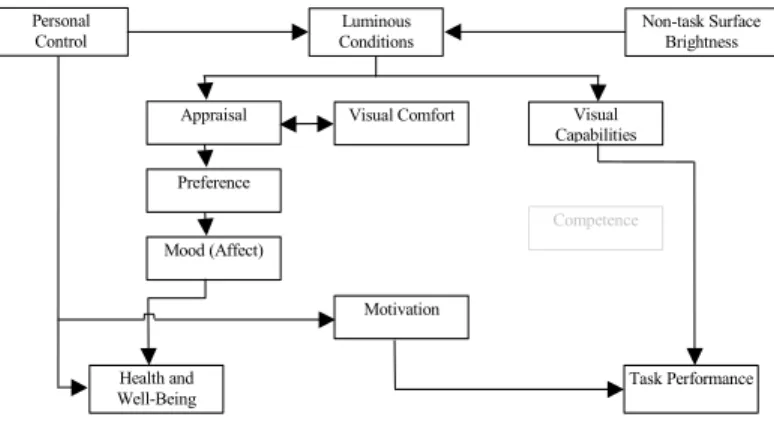
Figure 2. Lighting appraisal links to health and well-being. From Boyce et al. (2003).
expression of interest in lighting quality among researchers and practitioners in many countries. One model that emerged from various discussions and conferences is the model of lighting quality shown in Figure 1, which appeared in the IESNA (2000) Lighting Handbook 9th edition. The key differences between this approach and others are:
• Lighting does more than reveal fine details (visibility) and control glare (visual comfort); it serves a broad range of needs for people in spaces.
• Good lighting conditions are contextually determined. Two key implications of this model for research are:
• Research should address a broad range of behavioural and physiological outcomes in relation to light and lighting.
• Individual and cultural differences are contextual factors worthy of more attention.
This broad approach has begun to inform lighting research, not only work performed in our laboratory at NRC but elsewhere. Four
examples are:
1. Lighting appraisal matters. As part of a pair of experiments into the effects of lighting design on performance, mood, and satisfaction in a simulated office, Boyce, Veitch, Newsham, Myer, and Hunter (2003) tested a model of relationships between lighting appraisal, room appraisal, mood, and satisfaction (Figure 2). The model was supported in two independent data sets, across all lighting conditions. This is the first time in which researchers have demonstrated that lighting that people rate as being better has a connection to health (physical and visual comfort) and well-being (satisfaction).
2. Direct/indirect preferred. For office lighting, researchers have observed that occupants prefer a combination of direct and indirect illumination. Although the precise balance has varied from one study to another, the desire for some indirect lighting is consistent across several research methods (cf. Boyce et al., 2003; Houser, Tiller, Bernecker, & Mistrick, 2002; Veitch & Newsham, 2000).
3. Individual controlÆ preferred lighting conditions. Two recent experiments have found
satisfaction improvements associated with individual control over lighting (Boyce et al., 2003; Newsham, Veitch, Arsenault, & Duval, 2004). Adapting an analytic technique common to thermal comfort studies shows that the satisfaction improvement is associated with obtaining one’s preferred lighting conditions (Newsham & Veitch, 2001; Newsham et al., 2004). Individual differences in preferences are large enough that individual control is the only way to allow people to obtain their preferred conditions.
4. Daylight and windows. That people prefer daylight and access to a view is well known (e.g., Heerwagen & Heerwagen, 1986; Veitch & Gifford, 1996); however, environmental psychologists have found that both direct sunlight and access to view can reduce the ill effects of daily stressors (e.g., Kaplan, 2001; Leather, Pyrgas, Beale, & Lawrence, 1998). A large field investigation of satisfaction in open-plan offices found a complex interaction: having a window strongly improved satisfaction with lighting, but decreased satisfaction with ventilation and overall environmental satisfaction (Veitch, Charles, Newsham, Marquardt, & Geerts, 2003). Having access to daylight without a window increased both satisfaction with lighting and overall environmental satisfaction, in comparison to having neither window nor daylight. We
Lighting research: The broad view
think that this pattern reveals the potential problems with thermal gains or draught associated with exterior façades.
Summary
The broad view seen in today’s research has three important characteristics:
• Theory-driven research: We are beginning to see investigations designed to test theories drawn from other areas and incorporating contextual variables. For example, Boyce et al. (2003) set out to test linked mechanisms, at the behest of the project sponsors.
• Multiple research methods for design and statisical analysis: The studies discussed today used laboratory experiments, field simulations, and cross-sectional surveys. Others, not discussed, have used unobtrusive observation (e.g., Jennings, Rubinstein, DiBartolomeo, & Blanc, 2000) and field interventions (e.g., Manniccia, Rutledge, Rea, & Morrow, 1999).
• Multiple outcomes: Recent research has begun to compare patterns of effects across different
behaviours, or to use multiple measures to triangulate on a single phenomenon. The preference for an indirect component for office lighting has emerged from self-set lighting choices, ratings of lighting systems in a realistic setting, and semantic differential ratings of settings viewed for a short time.
This broad view will enrich our understanding of how the lighting we provide and the light we use influence us - and how light and lighting relate to other building systems. Although the findings might be messy and their application challenging, we should embrace this approach as the only way to achieve better environments for all of us.
References
Boyce, P. R. (1996). Illuminance selection based on visual performance - and other fairy stories. Journal of the Illuminating Engineering Society, 25(2), 41-49.
Boyce, P. R., Veitch, J. A., Newsham, G. R., Myer, M., & Hunter, C. (2003). Lighting quality and office work: A field simulation study (PNNL 14506). Richland, WA, USA: Pacific Northwest National Laboratory. Commission Internationale de l'Eclairage [CIE]. (2001). Lighting of indoor work places (ISO 8995:2002 CIE S 008 /
E:2001). Vienna, Austria: CIE.
Commission Internationale de l’Eclairage [CIE]. (1995). Discomfort glare in interior lighting (Publication No. 117-1995). Vienna, Austria: CIE.
Committee on Recommendations for Quality and Quantity of Illumination [RQQ]. (1966). Outline of a standard procedure for computing visual comfort ratings for interior lighting - Report No. 2. Illuminating Engineering, 61, 643-666.
Heerwagen, J. H., & Heerwagen, D. R. (1986). Lighting and psychological comfort. Lighting Design + Application, 16(4), 47-51.
Houser, K. W., Tiller, D. K., Bernecker, C. A., & Mistrick, R. G. (2002). The subjective response to linear fluorescent direct/indirect lighting systems. Lighting Research and Technology, 34(3), 243-264.
Illuminating Engineering Society of North America (IESNA). (2000). Lighting Handbook: Reference & Application (9th ed.). New York: Illuminating Engineering Society of North America.
Jennings, J. D., Rubinstein, F. M., DiBartolomeo, D., & Blanc, S. L. (2000). Comparison of control options in private offices in an advanced lighting controls testbed. Journal of the Illuminating Engineering Society, 29(2), 39-60.
Kaplan, R. (2001). The nature of the view from home: Psychological benefits. Environment and Behavior, 33(4), 507-542.
Leather, P., Pyrgas, M., Beale, D., & Lawrence, C. (1998). Windows in the workplace: Sunlight, view, and occupational stress. Environment and Behavior, 30(6), 739-762.
Manniccia, D., Rutledge, B., Rea, M. S., & Morrow, W. (1999). Occupant use of manual lighting controls in private offices. Journal of the Illuminating Engineering Society, 28(2), 42-56.
Newsham, G., Veitch, J., Arsenault, C., & Duval, C. (2004). Effect of dimming control on office worker satisfaction and performance. Submitted to Illuminating Engineering Society of North America Annual Conference. New York: IESNA.
Newsham, G. R., & Veitch, J. A. (2001). Lighting quality recommendations for VDT offices: A new method of derivation. Lighting Research and Technology, 33, 97-116.
Lighting research: The broad view
Veitch, J. A., Charles, K. E., Newsham, G. R., Marquardt, C. J. G., & Geerts, J. (2003). Environmental satisfaction in open-plan environments: 5. Workstation and physical condition effects (IRC-RR-154). Ottawa, ON: National Research Council Canada, Institute for Research in Construction.
Veitch, J. A., & Newsham, G. R. (2000). Exercised control, lighting choices, and energy use: An office simulation experiment. Journal of Environmental Psychology, 20(3 ), 219-237.
Veitch, J. A., & Gifford, R. (1996). Assessing beliefs about lighting effects on health, performance, mood, and social behavior. Environment & Behavior, 28(4), 446-470.