Assessing the Impact of Container Marking Implementation
byIris Marie Zielske
B.S. Industrial & Systems Engineering, University of Florida, 2009 B.A. Linguistics, University of Florida, 2009
Submitted to the Institute for Data, Systems and Society and the MIT Sloan School of Management in partial Fulfillment of the Requirements for the Degrees of
Master of Science in Engineering Systems
And
Master of Business Administration
In conjunction with the Leaders for Global Operations Program at the Massachusetts Institute of Technology
June 2016
02016 Iris Marie Zielske. All rights reserved.
The author herby grants MIT permission to reproduce and to distribute publicly copies of this thesis document in whole or in part in any medium now known or hereafter created.
Signature of Author
Signature redacted
Institute for Data, Systems and Society, MI loan School of Management
7 May 6, 2016
Signature redacted
Certified byDrt/Jarrod Goentzel, Thesis Supervisor Research Associate, Center for Transportation and Logistics Director, MIT Humanitarian Response Lab
Certified by_
Signature redacted
Dr. Y. Karen Zheng, Thesis Supervisor Assistant Professor of Operations Management, MIT Sloan School of Management
Accepted by
Signature redacted
7
'Dr. John N. TsitsiklisClarence J. Lebel Professor of Electrical Engineering
IDD graduate Officer
Accepted by_
Signature redacted
I LV - %-.V %- V V Maura He'son
Director, MBA Program
MASSACHUSETTS INSTITUTE MIT Sloan School of Management
OF TECHNOLOGY C
The author wishes to acknowledge the Leaders for Global Operations
Assessing the Impact of Container Marking Implementation
by
Iris Marie Zielske
Submitted to the Institute for Data, Systems and Society and the MIT Sloan School of Management on May 6, 2016 in partial Fulfillment of the Requirements for the Degrees of
Master of Science in Engineering Systems and Master of Business Administration
Abstract
Amgen is implementing new capabilities across the Amgen manufacturing network in order to code containers at the unit-level to reduce the possibility of mix-ups of unlabeled drug products. In order to prepare for the rollout of these new capabilities, an assessment of the impact to throughput, packaging yield and eject rates was conducted. Discrete event simulation was utilized to assess the impact of implementing these new container marking capabilities on a vial inspection and packaging line at one of Amgen's key manufacturing sites. The impact assessment confirms that the new capabilities will have no impact to the throughput of the production line and minimal to no impact on packaging yield and eject rates. This assessment provides confidence that implementation can move forward without concerns of negative impacts to the production lines.
Dr. Jarrod Goentzel,
Thesis Supervisor, Director, MIT Humanitarian Response Lab
Dr. Y. Karen Zheng,
Acknowledgements
I wish to acknowledge the Leaders for Global Operations program, Amgen, Inc., and my thesis
advisors, Karen Zheng and Jarrod Goentzel, for their support of this work.
I would like to thank Amgen, Inc. for sponsoring this internship. I would like to specifically
thank my supervisor, Bruce Hastings, for his guidance and support. I also want to thank Armando Rivera, Matthew Santiago, Coraliz Morales, and Dave Stadolnik for their support and help. I am also thankful to have shared my internship experience with my fellow LGO colleague,
J Mota.
Lastly, I would like to thank the community of family and friends that have been behind me and cheering me on through my time at MIT.
Table of Contents
A b stra ct ... 3 Acknowledgements...4 L ist o f F ig u re s ... 7 1 In tro d u ctio n ... 8 1.1 P roject C o n text ... 8 1.2 Problem Statement...8 1.3 Project Approach ... 8 1.4 Thesis Overview ... 92 Amgen and Biopharmaceutical Background... 11
2.1 Biopharmaceutical Industry ... 11
2.1.1 Regulatory Environment... 11
2.1.2 Packaging & Labeling...14
2 .2 A m g en In c ... 14
2.2.1 M anufacturing Network & Supply Chain... 15
2.2.2 Amgen Packaging & Labeling ... 16
2.2.3 Control of Product Identity ... 18
3 Container M arking Strategy ... 20
3.1 Standardization Across M anufacturing Network ... 20
3.2 Key Implementation Options... 20
3.3 Container M arking Process ... 23
4 Impact Assessment...26 4 .1 A p p ro ach ... 2 6 4.2 Process Flows...26 4 .3 D ata In p u ts ... 3 0 4.5 Simulation Scenarios... 31 4.6 Simulation Results ... 32 5 C o n clu sio n s ... 3 5 5.1 Container M arking Initiative ... 35
5.2 Future W ork ... 35
Appendix A: Select FDA Regulations Regarding Packaging and Labeling ... 37
List of Figures
Figure 1: Example of Neupogeno Primary Packaging ... 16
Figure 2: Example of Xgeva® Secondary Packaging ... 16
Figure 3: Glass Vial With Stopper and Vial with Stopper, Crimp Seal and Flip Cap... 17
Figure 4: Vials of Two Nplateo Dosages... 17
Figure 5: 2D Laser Code on Crimp Seal... 22
Figure 6: Alphanumeric Inkjet Code on Crimp Seal ... 22
Figure 7: 2D UV Inkjet Code on Flip Cap... 22
Figure 8: Container Marking Process Flow ... 24
Figure 9: Master Simulation Model... 29
Figure 10: Container Marking Submodel... 30
Figure 11: Average Throughput of Simulation Scenarios ... 32
Figure 12: Average Eject and Reject Rates of Simulation Scenarios... 33
Table 1: Simulation Data Inputs and Sources ... 30
1 Introduction
Amgen's mission is to serve patients. This mission is carried out through discovery, developing, manufacturing and delivering medicines to treat serious illnesses. Amgen has a presence in over 75 countries worldwide and Amgen's medicines have reached millions of patients. Amgen is one of the world's leading biotechnology companies and a worldwide leader in biologics manufacturing. [1]
1.1 Project Context
To allow for delayed differentiation and to maintain control of labeling, some Amgen products are filled and labeled at different manufacturing sites. Although multiple layers of control are in place to prevent accidental mislabeling, marking each individual vial, syringe or cartridge with a
2D barcode that can be read electronically at the receiving sites before labeling will further
ensure all products are correctly labeled. The focus on unit-level marking of all containers has increased as the Amgen manufacturing network has grown and the number of products being produced has also increased.
1.2 Problem Statement
With the commitment to implement container marking capabilities allowing for coding at the unit-level of products that are filled and labeled at different sites, there is a need for a deep understanding of the impact of implementing container marking capabilities on production lines at the manufacturing sites. The intuitive expectation is that implementing these capabilities in vial packaging lines will have minimal impact on production throughput, packaging yield, and headcount dedicated to a production line. However, an objective, quantitative assessment is necessary for management to make definitive conclusions.
1.3 Project Approach
The first phase of container marking implementation at Amgen will be focused on vial products and therefore the impact assessment considered a vial packaging line at a key Amgen manufacturing site. In order to assess the impact of implementing container marking capabilities on a vial packaging line at an Amgen site, the current vial inspection and labeling process was modeled using discrete event simulation and the process with container marking was modeled.
Data inputs to the model were gathered through conducting time studies and analyzing historical production data. Stakeholders from manufacturing, industrial engineering, quality engineering and package engineering were engaged in the process of model development and data collection.
Before modeling the new container marking capabilities, sites across the Amgen manufacturing network were engaged to gain network alignment on key aspects of container marking,
including: marking method, code format, and information to be contained in the code. Equipment vendors were engaged to understand anticipated run rates, eject rates and reject rates. This data was incorporated into the simulation model.
1.4 Thesis Overview
This thesis is organized into five chapters:
e Chapter one provides an introduction and an overview of the project context, problem
statement and project approach.
e Chapter two provides relevant background on the biopharmaceutical industry and
regulatory environment as well as pertinent information on Amgen as a company and the specific context of this work.
e Chapter three provides details on the broader container marking initiative at the company
and key implementation decisions made for the entire manufacturing network.
" Chapter four details the discrete event simulation model used to assess the impact of
implementing new container marking capabilities on a vial packaging line at a key site in the Amgen manufacturing network.
2 Amgen and Biopharmaceutical Background
2.1 Biopharmaceutical Industry
The term biotechnology was first used in 1919 by Karl Ereky, a Hungarian agricultural engineer. Ereky used the term to describe production processes in which products are made from raw materials and living organisms. It was not until the 1970s that the term biotechnology was adopted worldwide. [2]
"In contrast to most drugs that are chemically synthesized and their structure is known, most biologics are complex mixtures that are not easily identified or characterized" [3]. Traditional pharmaceutical medicines are also referred to as small molecule medicines because the active ingredients are small in size compared to larger, more complex molecules, such as proteins. Biologics are large molecule medicines because they have large, complex molecules that cannot be made by chemical processes alone. Biologics are produced using living organisms. [4]
Two significant scientific discoveries that laid the foundation for biotechnology as we know it today are the discovery of the structure of DNA in 1953 and the introduction of recombinant
DNA (rDNA) technology in 1972 [5]. Recombinant DNA is the result of segments of DNA being cut and pasted together in order to form new sequences and is the basis for genetic engineering. "Genetic engineering is the cornerstone of modem biotechnology" [6].
2.1.1 Regulatory Environment
The biopharmaceutical industry is highly regulated. The regulations in place exist in order to protect public health and many changes in regulations came in response to specific adverse incidents. There are many regulations that apply to product development, clinical trials and the approval of new drugs ensuring safety, efficacy and quality of new drugs before they are approved for marketing and sale. The manufacturing of drugs for commercial sale is also highly regulated. The regulatory authorities set standards and requirements for quality assurance systems and good manufacturing practice (GMP). [7]
Different regulatory bodies are involved in regulating the production and sale of drugs and medicines in different countries or regions of the world. The US Food and Drug Administration
(FDA) regulates over-the-counter, prescription drugs and biologics in the United States. The
European Medicines Agency (EMEA) is the regulatory agency responsible for the evaluation and supervision of medicines for human use in the European Union. Other regions and countries have their own agencies that regulate the development, production and sale of drugs.
Packaging and labeling of drugs is also highly regulated. Packaging and labeling operations are to be carried out in a way that minimizes the possibility of a product mix-up. The issuing of labels is tightly controlled and label reconciliations are required. Any unused labels with printed batch information are to be destroyed after the batch is fully processed. Line clearance is also very important when different products are packaged and labeled on the same production line to ensure no units are mislabeled. [7]
The FDA has extensive regulations and requirements for labeling of drugs including detailed requirements for the content to be included on labels. FDA approval is also required for any changes to labeling after a drug's approval, but changes are required in order to include the most up-to-date information on a drug, including new side effects, new ways of dosing, and new uses
for the drug [8].
The FDA regulations for GMP (Title 21, Part 211) also include specific regulations for packaging and labeling control. Some of these specific regulations will be discussed here and more detail on these regulations can be found in Appendix A: Select FDA Regulations Regarding Packaging and Labeling. Labeling issuance regulations (211.125) require strict control, careful examination, reconciliations, and destruction of lot specific labeling. Additionally, regulation 211.125(e) states, "Returned labeling shall be maintained and stored in a manner to prevent mixups and provide proper identification." The regulations for packaging and
labeling operations (211.130) also speak to measures to prevent product mixups:
(a) Prevention of mixups and cross-contamination by physical or spatial separation from operations on other drug products.
(b) Identification and handling of filled drug product containers that are set aside and
individual containers, lots, or portions of lots. Identification need not be applied to each individual container but shall be sufficient to determine name, strength, quantity of contents, and lot or control number of each container.
(e) Inspection of the packaging and labeling facilities immediately before use to assure that all drug products have been removed
from
previous operations. Inspection shall also be made to assure that packaging and labeling materials not suitable for subsequent operations have been removed Results of inspection shall be documented in the batch production records.The regulations for drug product inspection (211.134) require inspection during finishing operations and additional visual examination of a representative sample of each lot packaged. [9]
Additionally, the General Biological Products Standards (Title 21, Part 610) require identity testing for finished lots of biologics (610.14):
The contents of a final container of each filling of each lot shall be tested for identity after all labeling operations shall have been completed The identity test shall be specific for each product in a manner that will adequately identify it as the product designated on final container and package labels and circulars, and distinguish it from any other product being processed in the same laboratory. Identity may be established either through the physical or chemical characteristics of the product, inspection by macroscopic or microscopic methods, specific cultural tests, or in vitro or in vivo immunological tests. [10]
Identity testing is completed for a sample of finished products from each lot and is destructive, leading to any testing units being destroyed.
Great care must be given to packaging and labeling to ensure no product mixups occur and how these regulations are followed must be clearly documented in standard operating procedures for companies manufacturing and packaging drugs. There are currently no regulations that require marking or unit-level identification of filled, unlabeled drug products. Identity testing would detect if an entire lot of unlabeled drug product was mixed up, but would not likely detect one or a few units of a different product mixed in with a lot. Line Regulations do change over time and
if there was to be a significant mixup due to storage or transport of unlabeled drug product, new regulations may require unit-level identification of unlabeled drug products.
2.1.2 Packaging & Labeling
Biologic therapeutics are primarily administered to patients via subcutaneous injection and therefore these drugs have traditionally been packaged either in vials or prefilled syringes. With a trend for providing biologic therapeutics in a ready-to-use device that patients can administer themselves, more products are being packaged in prefilled syringes or cartridges that are inserted into a device such as an auto injector or on-body injector. Vials and syringes have traditionally been glass, but plastic vials, syringes and cartridges are available on the market. Many products
are still packaged in glass vials and syringes.
As previously discussed labeling is highly regulated for drugs. The regulations for labeling vary in different markets. The FDA stipulates the regulations in the US, but other countries and regions have different regulations. In addition to different regulations or requirements for labeling, different countries require labels to be in different languages. These variations in language and regulatory requirements leads to different labels for different countries across the world and a final labeled and packaged product being dedicated for sale only in specific end markets. This has significant inventory implications for companies that sell their products in many different countries across the world.
Being able to delay labeling provides inventory benefits through delayed differentiation. Inventory levels and safety stock levels would be higher if units were differentiated to a specific market earlier in the process. Additionally, shipping unlabeled drug products allows for Amgen to maintain control of labels and labeling and packaging in cases where a contract manufacturer
is involved in filling.
2.2
Amgen Inc.
Amgen was founded in 1980 and was one of the early pioneers in biotechnology. The company is headquartered in Thousand Oaks, California. The mission of Amgen is to serve patients and Amgen focuses on areas of high unmet medical needs and patients suffering from serious illness. Amgen was an early pioneer in biotechnology and is still a market leader in the industry.
2.2.1 Manufacturing Network & Supply Chain
Amgen's products are produced in a number of sites across the world. Different manufacturing sites focus on different parts of the production process. Some manufacturing sites focus on the upstream bulk drug substance (DS) production. A bulk drug substance will be frozen, stored and transported to a site where the drug substance is turned into drug product. Drug product production involves formulation, filling and finishing. Formulation involves producing the required concentration for each dosage of medicine. Filling involves taking the formulated drug product and filling it into sterile primary containers (vials, syringes, or cartridges). Finishing involves labeling of the primary containers and secondary packaging, providing the drugs in the presentation that will be sold. Some of the sites in the manufacturing network focus on drug product production or even specifically on labeling and packaging. Other manufacturing sites have both drug substance and drug product operations.
Amgen's manufacturing network has grown over time and includes both internal Amgen sites and contract manufacturing sites. The number of end markets served and the number of total products Amgen produces has also grown over time. Previously, Amgen focused on serving primarily the US and European markets, but Amgen now has a presence in over 75 countries. Amgen's initial success was the result of their first two products: EPOGEN* (epoetin alfa) and NEUPOGEN* (filgrastim). By 2002 Amgen had five different products and 10 products by 2010. By the end of 2015 Amgen had 16 products. Amgen also has a robust pipeline and will see additional growth in products in the future. With the increase in the number of end markets served, the number of products being produced and the number of sites involved in manufacturing, the complexity of Amgen's supply chain has significantly increased.
2.2.2 Amgen Packaging & Labeling
Primary packaging refers to the filling of drug products into individual containers in which the products will be sold. Examples of primary packaging of Neupogen* in vials and prefilled syringes are shown in Figure 1 [I I]. After primary packaging labels are applied to the primary container, and the next step is secondary packaging. Secondary packaging involves units being packaged in the final presentation of one or more individual units. An example of secondary packaging for Xgeva , with a final presentation for a single vial, is shown in Figure 2 [12]. Secondary packaging also includes kitting or assembly of devices, such as prefilled syringes in auto injectors.
Figure 1: Example of Neupogen* Primary Packaging
Figure 2: Example of Xgeva* Secondary Packaging
Although the variety of primary containers and secondary packaging is increasing, there are still a few primary containers that are used across many different products. Even with the introduction of devices such as auto injectors and mini dosers, most of Amgen's products are still largely sold in vials and prefilled syringes. Many products are sold in standard 3cc vials or lmL prefilled syringes. Standard vial and syringe sizes allow for the use of the same packaging materials across different products, but this also increases the possibility for unlabeled units of different products to look very similar.
Beyond size, another differentiator of unlabeled drug products in vials is crimp seal and flip caps. The key components of a vial packaging system are the glass vial, a stopper, a crimp seal and a flip cap. The vial on the left in Figure 3 [13] has a stopper only while the vial on the right has a stopper, crimp seal and flip cap. Most of Amgen's products have standard, uncolored aluminum crimp seals as seen in Figure 4 [14]. The flip cap colors do vary across products and doses, but colors are not dedicated to specific products and flip cap color is not considered a sufficient differentiator. As seen in Figure 4 two different concentrations of Nplate* have different flip cap colors.
Figure 3: Glass Vial WNith Stopper and Vial with Stopper, Crimp Seal and Flip Cap
NFlaTw Nplate*
2.2.3 Control of Product Identity
With unlabeled drug products being shipped between different manufacturing sites, Amgen has established a number of controls to ensure product identity and prevent any mixups of unlabeled products. The existing controls include reconciliation processes at both the shipping and receiving sites, visual inspection of shipping and product containers, multiple identifying labels, and tamper proof indicators on the shipping cases. The shipping cases for unlabeled containers are labeled both on the outside and inside each case. The case labels are also tightly controlled.
Amgen also performs identity testing on a subset of each lot of fully labeled and packaged products. This identity testing ensures the identity of the drug inside the primary containers. This is required by FDA regulation for all biologic products for humans. Amgen wants to stay ahead of new requirements and continues to anticipate potential changes to regulatory requirements.
3 Container Marking Strategy
Container marking is the Amgen initiative to implement unit-level electronic identification capabilities to allow individual units of unlabeled drug products to be marked with an identifier before they are shipped to another site for labeling. These units of unlabeled drug products are to be read electronically before labeling at the site that received the unlabeled drug products. These capabilities will allow for future assurance that no units that are filled and labeled at different sites would ever get mixed up and then mislabeled. While many controls are currently in place to prevent mixups or mislabeling, many of those controls are focused at the case-level or even the lot-level and not at the individual unit-level. Container marking is specifically focused at the unit-level and even a single unit that somehow got mixed in with another lot after filling would be identified and prevented from being labeled incorrectly. Amgen plans a phased approach for implementing container marking capabilities across products and manufacturing sites. The first phase of implementation will focus on vial products.
3.1 Standardization Across Manufacturing Network
The motivation for container marking is clear and Amgen Quality has set forth requirements for how container marking will be carried out in the Amgen manufacturing network, but there are still options for implementation. The Process Technology group within the Package Engineering Labeling and Human Factors group at Amgen is responsible for leading the container marking initiative across the network. As this initiative involves many manufacturing sites, both internal Amgen sites and contract manufacturing sites, there is a need for standardization on key container marking implementation options. Key implementation options include: information to include in the code, pre-marking containers or marking on site, placement of the code on the container, marking method, and code format.
3.2 Key Implementation Options
One of the key implementation decisions was what information to include in the code applied to each unlabeled container. It was decided that lot number would be the information included in the container marking code on each unit. This goes a step beyond just identifying the product and concentration of drug in the container. Product and concentration would ensure no units are mislabeled, but would not catch if a unit of the same product and concentration got mixed with another production batch of the same product and concentration. As lot number is included on
the final secondary packaging, utilizing lot number in the container marking code ensures that each unit has the correct lot number of the final packaging. Choosing only the lot number also allows for less integration with information systems than going all the way to a serial number or unique identifier for each unit.
Another key implementation decision was choosing to mark the containers at the manufacturing sites instead of getting pre-marked containers from suppliers. Pre-marked containers would have limited the type of information included in the code and marking on site makes it easier to use lot number as the identifying information in the code. Additionally, having pre-marked containers with different codes dedicated to different products and concentrations would have increased inventory levels and inventory carrying costs.
The placement of the code on the container was another important implementation decision. It is more challenging to mark on glass compared to other materials such as plastic and metals. Siliconization of glass syringes can leave silicon oil on the surface of the container, which makes it difficult to get consistency when printing codes with inkjet on the glass syringes [15]. Laser marking presents different challenges when marking on glass, including concern for the integrity of the glass being affected by the stress placed on the glass from laser marking or the introduction of micro-cracks. In 2009, Robert Hardy conducted lab testing on glass syringes with laser marked codes to determine the effect of laser marking technology on the integrity of the glass. Hardy concluded, "Although processing speeds and read rate accuracy are in the range necessary for application to biopharmaceutical fill-finish processes, the structural testing as to the structural impacts on the syringe remain inconclusive. Given the focus on risk mitigation in this business and industry, large-scale studies would need to be executed to ensure that this technology did not introduce unintended breakage" [15]. The implementation of container marking for glass syringes will take place after vials and was not the focus of the scope of this thesis.
For vials there are two options for placement of a code that avoid marking directly on glass: the crimp seal and the flip cap. Additionally, coding vials by placing a code on the crimp seal or flip cap is not new to the industry. Vial coding has been used for a long time, even if it has not been utilized consistently across the biopharmaceutical industry. A number of packaging equipment
companies sell equipment capable of printing codes on vial crimp seals and flip caps. Figure 5
[16] and Figure 6 [17] show codes on crimp seals as demonstrations of vial coding equipment
from FP Developments and Marchesini Group S.p.A. respectively. Figure 7 shows a 2D inkjet code on top of a flip cap. The impact assessment conducted evaluated coding on the vial crimp seal.
Figure 5: 2D Laser Code on Crimp Seal
One of the key implementation options was the marking method. For container marking of vials both inkjet marking and laser marking were considered. Inkjet is more typical for vial coding in the industry, but presents some challenges. Inkjet codes are not permanent; inkjet codes can be removed from the crimp seal. This ability to remove a code would allow for removal of any unreadable code and then subsequent recoding. Laser codes are indelible and could not be removed which means any units with a code that was unreadable during the verification after coding would have to be scrapped. The laser codes do not provide the opportunity for recoding, but this was of less concern because laser coding provides high resolution and therefore results in fewer unreadable codes. Laser coding was initially the best option for marking method and the impact assessment was conducted for laser coding. Laser coding on the crimp seal did raise concerns about corrosion and studies were done to understand oxidation after laser coding, but the results of these studies were not available until after the work for this thesis was completed.
Another key implementation option is the code format. The two options considered for vial coding were 2D data matrix codes and alphanumeric codes. 2D data matrix codes can contain more information in a smaller area than alphanumeric codes and are easier to verify with an electronic vision system. Alphanumeric codes have been used more often for vial coding in the past and some sites within the Amgen network have the capabilities for alphanumeric vial coding on the vial crimp seals, which would allow for faster implementation with lower capital costs. Alphanumeric codes are also human readable, which would allow for any units that are unreadable through the vision system to go through manual inspections to verify the codes. The directive for container marking from quality emphasized electronic verification of codes before labeling and electronic verification of alphanumeric codes is more challenging than electronic verification of 2D data matrix codes. It was decided that the best code format for container marking was 2D data matrix.
3.3 Container Marking Process
Understanding the flow for the new container marking process was important. This process involves coding of the containers and then an inspection of the code. The high-level process is the same for all container types, but the thesis discussion will focus on vials from the first phase of container marking implementation. If the code is read correctly during the code inspection the vials continue on to the next step of the process, which will typically be traying of the bulk vials.
If the code does not pass inspection there are two different routes. If the code was unreadable, a
bad read, then the vial is ejected and goes through manual inspection. If the code is still unreadable the unit will be rejected and scrapped. If the manual inspection results in the correct verification of the code the unit will continue on to traying. Units that fail the initial inspection and are ejected will be counted in the total number of ejects for a batch and contribute to the overall eject rate that is tracked. Units that are both ejected and then rejected because they also fail the manual code verification will be included in the total rejects for a batch and contribute to the overall reject rate that is tracked. If there is a bad match during the initial code inspection, this means that a unit had a readable code, but it did not match the lot number for the lot being processed, and this would result in the line stopping and a QA lockout. The process flow is depicted in Figure 8. A discussion of the integration of this new process into the current production process is included in Chapter 4, Section 4.2 Process Flows.
QA LOCKOUT
Machine stops 3 restarts
for hand scan machine
Bad Match
Bad Match' Bad Match Operator
Or Bad Read Manual code Or -Bad Read scraps /
Bad Read inspection Bad Read? reworks
rejected vial
Correct Cod
Code Printing Code Inspection Code OK? - Yes out edase vai area
4 Impact Assessment
Before implementation of container marking there was a need to better understand the impact of implementing new container marking capabilities on the packaging lines at manufacturing sites. An impact assessment was conducted focusing on automated vial inspection and labeling at Amgen's manufacturing site in Puerto Rico. This site was selected because of the number of products and volume of products processed at this site as well as this site being both a sending and receiving site. The site in Puerto Rico will fill and inspect vial products that are sent to other sites for labeling and packaging and this site also receives bulk shipments of unlabeled vials that are labeled and packaged here. The impact assessment was conducted assuming vials would be marked with a 2D code on the vial crimp seal using laser coding as the marking method.
4.1 Approach
The approach to this impact assessment was to use discrete event simulation to model the inspection and labeling process with and without container marking. Discrete event simulation allows for deeper assessment that takes into account variation in the process and allows for simulating different future scenarios. This approach involved understanding the current production process without container marking and also the proposed process with container marking capabilities integrated into the production line. Additionally, simulation parameters were determined from historical data of the existing process and anticipated performance of the new container marking equipment and processes. The discrete event simulation was performed using Process Simulator Professional, a process improvement solution developed by ProModel*.
The key areas of interest for the impact assessment were the impact of container marking capabilities on throughput, packaging yield, and headcount for the production line. These are the key metrics that manufacturing wants to understand in depth before moving forward with the
implementation of container marking.
4.2 Process Flows
Container marking will be integrated into the packaging process in Puerto Rico after vial inspection and before labeling, so it was important to fully understand the current process for vial inspection and labeling without container marking. There are two different process flows
currently: one for lots that will be inspected and packaged at this site and another process for lots that will be inspected and then bulk packed and sent to another site for labeling and secondary packaging. Container marking will impact the lots that are bulk packed as unlabeled drug products, but will not initially impact the lots that are inspected, labeled and packaged at this site.
The impact assessment therefore focused on the bulk pack process.
The flow for the new container marking process was detailed previously in Chapter 3, section 3.3 Container Marking Process and the flow was depicted in Figure 8: Container Marking Process Flow. The master simulation model included a number of submodels. Submodels were used in order to simplify the overall model and make the model more user-friendly and scalable for future use. Submodels were utilized for automated inspection, 100% manual inspection, 200% manual inspection, leak testing, and container marking. The master simulation model with both the current process and an option for container marking is depicted in Figure 9.
The process flow for this production line begins with filled vials being brought into the production room and sitting in a storage area. Trays of uninspected vials are emptied into the infeed of an automated inspection machine. The vials are inspected for color, fill volumes, particulate matter and cosmetic defects during the automated inspection process. If a vial does meet the color or fill volume specifications it is ejected from the machine and these vials accumulate in a reject bin. There is no manual inspection process for these vials and they stay in the reject bin until they are manual moved on to a reject management station. Vials that have particulate matter detected through the automated inspection are ejected into an eject bin and vials that have cosmetic defects detected through the automated inspection are also ejected into an eject bin.
Ejected vials accumulate in eject bins and then are batched into trays that are taken to the 100% Inspection Cage. The trays of ejected vials stay in the Inspection Cage until manual inspection begins. All of the particulate and cosmetic defect ejects go through a 100% manual inspection, a 200% manual inspection and a leak check. If an ejected vial does not pass any of these additional inspections it will be rejected and placed in a reject bin. Ejects that pass the 100% manual
inspection, 200% manual inspection and the leak test will be returned to the turn table with the vials that passed the automated inspection.
Vials that pass the automated inspection are accumulated in a turn table. The current process then has the vials either continuing on to labeling or being bulk packaged through a manual traying process into pizza box style boxes. The bulk pack, unlabeled vials go through two manual count verifications to ensure the correct number of vials are in each box. Labels are placed both inside of each box and outside of each box and the boxes are sealed so avoid an possibility of tampering, which all is included in the "shipping process". This is the end of the process for bulk packed lots that will be shipped to another site for labeling and final packaging. Vials that are labeled and packaged on this line continue on to labeling after automated inspection. Labels are applied to the vials and are inspected. If a vial does not pass the labeling inspection it is ejected. The ejects go through eject evaluation in which it is determined if the vial can be reprocessed or will be rejected and scrapped.
Ejects and rejects are tracked for every batch and thorough line clearance procedures are carried out after each batch is finished processing before a new batch is brought in for processing. All rejected units go through a reject management process which includes counts and recording of reasons for rejects.
The new container marking process will take place after automated inspection and before the bulk packaging and is a decision point in the simulation model as not all batches will go through the container marking process. The impact assessment was focused on bulk pack batches as this
Automated
HIi Inspection
Inve tory Uninspected Vials
Vials Vlm Storage olur C 017% Container Marking Option -Cosmetic. K2CA2%-- Particulate '-99 931%. s -573 Defect TurnTablf n 1I9% Tray 1 Tray 2 100% In p Cage 200% In Ip Cage 100% 200% Inspection Inspection/ Pass 100%.' "Pass 200% -100% Iejects 200' ejects 1 427', I I Tray Wilcom t Cage Leak Check Pass Leak ', - 9 977
n
-Wilcoma Code? Container Marking Verified Code? Inventory 2Bulk or Apply Label - Label Eject Ent
I Label Turn able 2 Manual Tray Load
-1DE.
Pizza B x Rack 100% Quantity inspection' 200% Quantity inspection S g (ppin Proceass Eii-I Label Jects Eject Evaluation Rejec Rejet Repro Rejects --71%'0 RejectMlanagement abeler Rejects
Figure 9: Master Simulation Model
:t or
cess
23-The submodel for container marking is depicted in Figure 10. Vials that go through container marking have a code applied to the vial crimp seal and then this code is read electronically. If the code is read corrected the vials continue on in the process to the next turn table, labeled Turn Table 2 in Figure 9. If the code does not read correctly during the electronic code verification then the vial is ejected and a manual code verification will be performed. If this manual verification results in the a correct read then the vial will be returned to Turn Table 2. If this manual verification results in an incorrect read the vial would be ejected into a reject bin and these vials would be scrapped and would contribute to the over all rejects for the line.
(Exit) (To Parent)- - _ _
--- Continue
o---95%-Correct __Manual Code C7 _
-* Apply Code Read? Verfication Correct? -5% (Exit) (To Parent).
Storage Storage 2
Reject
Figure 10: Container Marking Submodel
4.3 Data Inputs
The simulation model relies on a number of data inputs. For the existing vial inspection and labeling processes data was gathered through engagement with manufacturing, industrial engineering and quality engineering stakeholders. A list of the sources of data for different data inputs are listed in Table 1.
Data Type Source of Data
Process Times Standard run rates (automated equipment) Time studies (manual steps)
Movement Times Times studies
Eject Rates Historical data
Reject Rates Historical data
Equipment downtime Historical data
Time studies were conducted in order to capture the variation in process times of the manual steps as the times are less standardized for manual processes and manual movement.
Data inputs for the container marking processes are estimates based on engagement with vendors and experience of the container marking implementation team at Amgen. Equipment downtime was assumed to be the same as for the automated inspection equipment.
4.5 Simulation Scenarios
Five different scenarios were simulated as listed in Table 2. The baseline scenario represents the current process with no container marking. The other four scenarios all have container marking with variation in two key parameters: marking speed and container marking eject rates. Marking speed is the run rate of the container marking equipment. The equipment that will do the container marking coding and verifying is equipment that Amgen does not currently have, so expected speeds were determined through engagement with a number of equipment vendors. Two different eject rates were also evaluated with the lower rate being what is expected, which was determined through engagement with equipment vendors, and the higher rate being the worst case scenario. The eject rate is anticipated to be closer to the lower rate of 0.005%, but as this is a key driver of how much additional manual handling will be involved, the higher rate was also important to consider.
Container
Container
Marking
Marking
Scenario
Marking
Speed
Eject Rates
Baseline No
-Scenario 1 Yes 400 upm 0.005%
Scenario 2 Yes 400 upm 0.50%
Scenario 3 Yes 300 upm 0.005%
Scenario 4 Yes 300 upm 0.50%
4.6 Simulation Results
The key areas of interest for the impact assessment were: throughput, packaging yield and headcount dedicated to the production line. These key areas of interest translated into focusing the evaluation of the simulation results on three areas: throughput of vials, reject rates and eject rates. An increase in reject rates would equate to a decrease in the overall packaging yield. Eject rates was focused on for understanding an impact to headcount because the container marking process will be primarily an automated process with the exception of the manual handling and manual code verification for the vials that do not pass the automated code verifications step and are ejected.
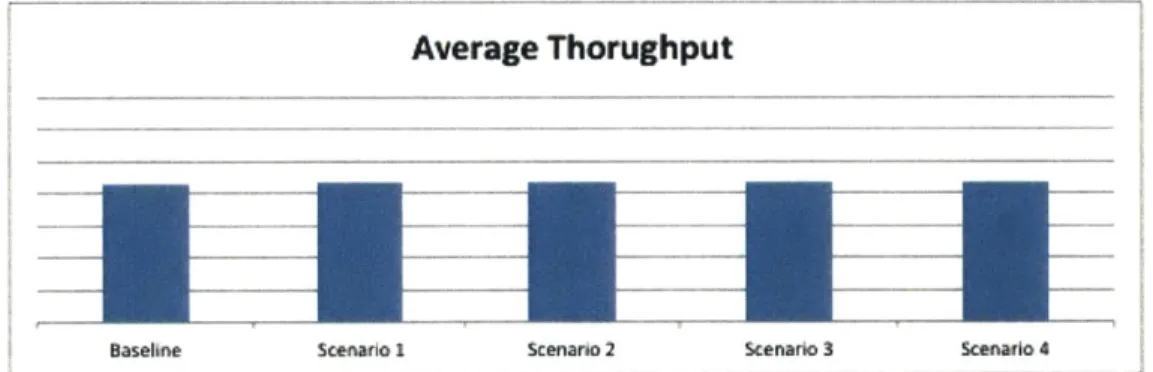
The simulation showed that container marking would have no impact on the throughput for the line. This makes sense as the manual tray loading of the unlabeled vials into the boxes in which they are shipped is the limiting factor of the line. The average throughput of the baseline and each of the simulation scenarios is shown in Figure 11. The specific values of throughput are omitted for confidentiality purposes.
Average Thorughput
Baseline Scer gc Scen t io 2 S ,enano 3 s cenario 4
The simulation showed that there would be up to a 0.52% increase in the eject rate when container marking is implemented. This is in the worst-case scenario and is driven by the higher eject rates in simulation scenarios 2 and 4. Even with the potential increase in ejects, there is a minimal impact to overall packaging yields. The maximum average reject rates among the container marking simulation scenarios is 0.05% higher than the average reject rate seen with the baseline scenario without container marking. The average eject and reject rates of the baseline and four container marking scenarios are shown in Figure 12. The values for eject and reject rates are omitted for confidentiality purposes.
Eject and Reject Rates of Simulation Scenarios
Baseiine Scelaro 1 Scenario 2 Scenario I Scenario 4
3Average Eject% 0 Ave rage Reject %
-~,
5 Conclusions
Utilizing discrete event simulation it was confirmed that implementing container marking capabilities on a vial inspection and packaging line at a key Amgen manufacturing site will have no impact to throughput, negligible impact to packaging yield and a small increase in ejects that require manual handling. The biggest impact seen through the simulation was on the amount of ejects that would require manual handling, but the time to verify a container marking code on the vial crimp seal will be much less than the manual inspection of vials. The potential increase in manual handling of the additional container marking ejects will not impact the headcount dedicated to this production line as there have been recent improvements to eject rates from the automated inspection process and therefore less resources are needed to handle the 100% and 200% manual inspection process, which will be sufficient to cover the need for manual code verification for container marking.
5.1 Container Marking Initiative
The container marking initiative should move forward as it further reduces the risk of any product mixups without any significant impact to the production lines. The simulation model could be updated as implementation planning progresses. When more accurate run rates, expected downtime, eject rates and reject rates are known the model could be updated with better estimates for these key inputs to the model. The model could also be easily updated to evaluate the impact of implementing capabilities on the line to code vials with a UV inkjet code on the flip cap of the vial. This update would involve updating the inputs to the container marking steps in the process, namely the run rate of the coding equipment and the eject and reject rates.
While there is no regulatory mandate for coding at the unit-level yet when unlabeled units are sent between sites, this could be required in the future. Through moving forward with implementing these capabilities, Amgen is staying ahead of regulatory requirements for ensuring product identity and preventing product mixups.
5.2 Future Work
The base simulation model could be used to evaluate additional changes to automated vial inspection and packaging lines. Additional scenarios could be evaluated, including future product introductions or the introduction of additional flexibility to the line to process a greater
-~-~
variety of vial sizes. Simulating the impacts of these types of changes to the line before implementation will help better predict the impact the changes will have and also can be used to help make key implementation decisions. The model could also be used for further analysis of resource allocation on the production line.
Similar models could be built to assess the impact of implementing these new capabilities for other container types and at other sites. Understanding and quantifying the anticipated impact of such a large-scale implementation is very important and is key to the success of container marking.
Container marking is focused on reducing the possibility of product mixups when unlabeled units are shipped between sites. Additional work could be done to identify other areas where the opportunity for a mixup could occur, including within a single facility.
Appendix A: Select FDA Regulations Regarding Packaging and
Labeling
Title 21: Food and Drugs
PART 211-CURRENT GOOD MANUFACTURING PRACTICE FOR FINISHED PHARMACEUTICALS Subpart G-Packaging and Labeling Control
211.125 Labeling Issuance.
(a) Strict control shall be exercised over labeling issued for use in drug product labeling operations.
(b) Labeling materials issued for a batch shall be carefully examined for identity and conformity to the labeling
specified in the master or batch production records.
(c) Procedures shall be used to reconcile the quantities of labeling issued, used, and returned, and shall require evaluation of discrepancies found between the quantity of drug product finished and the quantity of labeling issued when such discrepancies are outside narrow preset limits based on historical operating data. Such discrepancies shall be
investigated in accordance with 211.192. Labeling reconciliation is waived for cut or roll labeling if a 100-percent
examination for correct labeling is performed in accordance with 211.122(g)(2). (d) All excess labeling bearing lot or control numbers shall be destroyed.
(e) Returned labeling shall be maintained and stored in a manner to prevent mixups and provide proper identification.
(f) Procedures shall be written describing in sufficient detail the control procedures employed for the issuance of
labeling; such written procedures shall be followed.
[43 FR 45077, Sept. 29, 1978, as amended at 58 FR 41354, Aug. 3, 1993]
Title 21: Food and Drugs
PART 211-CURRENT GOOD MANUFACTURING PRACTICE FOR FINISHED PHARMACEUTICALS Subpart G-Packaging and Labeling Control
211.130 Packaging and labeling operations.
There shall be written procedures designed to assure that correct labels, labeling, and packaging materials are used
for drug products; such written procedures shall be followed. These procedures shall incorporate the following features:
(a) Prevention of mixups and cross-contamination by physical or spatial separation from operations on other drug products.
(b) Identification and handling of filled drug product containers that are set aside and held in unlabeled condition for
future labeling operations to preclude mislabeling of individual containers, lots, or portions of lots. Identification need not
be applied to each individual container but shall be sufficient to determine name, strength, quantity of contents, and lot or
control number of each container.
(c) Identification of the drug product with a lot or control number that permits determination of the history of the manufacture and control of the batch.
(d) Examination of packaging and labeling materials for suitability and correctness before packaging operations, and
documentation of such examination in the batch production record.
(e) Inspection of the packaging and labeling facilities immediately before use to assure that all drug products have been removed from previous operations. Inspection shall also be made to assure that packaging and labeling materials not suitable for subsequent operations have been removed. Results of inspection shall be documented in the batch
production records.
Title 21: Food and Drugs
PART 211--CURRENT GOOD MANUFACTURING PRACTICE FOR FINISHED PHARMACEUTICALS Subpart G-Packaging and Labeling Control
211.134 Drug product inspection.
(a) Packaged and labeled products shall be examined during finishing operations to provide assurance that containers and packages in the lot have the correct label.
(b) A representative sample of units shall be collected at the completion of finishing operations and shall be visually
examined for correct labeling.
(c) Results of these examinations shall be recorded in the batch production or control records.
Title 21: Food and Drugs
PART 610--GENERAL BIOLOGICAL PRODUCTS STANDARDS Subpart B-General Provisions
610.14 Identity.
The contents of a final container of each filling of each lot shall be tested for identity after all labeling operations shall
have been completed. The identity test shall be specific for each product in a manner that will adequately identify it as the product designated on final container and package labels and circulars, and distinguish it from any other product being processed in the same laboratory. Identity may be established either through the physical or chemical characteristics of the
product, inspection by macroscopic or microscopic methods, specific cultural tests, or in vitro or in vivo immunological
References
[1] "Amgen Fact Sheet." [Online]. Available:
http://www.amgen.com/-/media/amgen/full/www-amgen-com/downloads/fact-sheets/factsheetamgen.ashx. [Accessed: 20-Feb-2016].
[2] J. Holl6 and U. P. Kralovinszky, "Biotechnology in Hungary.," Adv. Biochem. Eng.
Biotechnol., vol. 69, pp. 151-173, 2000.
[3] FDA, "What Are 'Biologics' Questions and Answers." [Online]. Available:
http://www.fda.gov/AboutFDA/CentersOffices/OfficeofMedicalProductsandTobacco/CB
ER/ucm133077.htm. [Accessed: 25-Feb-2016].
[4] "What Is Biotechnology?
I
An Introduction to Biotechnology." [Online]. Available: http://biotechnology.amgen.com/biotechnology-explained.html. [Accessed: 25-Feb-2016].[5] K. Buchholz and J. Collins, "The roots -A short history of industrial microbiology and biotechnology," Appl. Microbiol. Biotechnol., vol. 97, no. 9, pp. 3747-3762, 2013. [6] "The Science of Biotechnology
I
An Introduction to Biotechnology." [Online]. Available:http://biotechnology.amgen.com/biotechnology-science.html. [Accessed: 25-Feb-2016].
[7] J. J. Tobin and G. Walsh, Medical Product Regulatory Affairs. Weinheim, Germany: Wiley-VCH Verlag GmbH & Co. KGaA, 2008.
[8] "FDA Basics -Why do some drug labels get changed so often ?" [Online]. Available: http://www.fda.gov/AboutFDA/Transparency/Basics/ucm194979.htm. [Accessed:
28-Feb-2016].
[9] "Current Good Manufacturing Practice for Finished Pharmaceuticals," C.FR. Title 21. [Online]. Available:
http://www.ecfr.gov/cgi-bin/text-idx?SID=127db3327385a35b6cfd36994113420e&mc-true&node=sp21.4.211 .g&rgn=div 6. [Accessed: 29-Feb-2016].
[10] "General Biological Products Standards," C.F.R. Title 21. [Online]. Available:
http://www.ecfr.gov/cgi-bin/retrieveECFR?gp=&SID=639996220638cbl5c80280decc0ac5dc&mc=true&n=pt21.7 .610&r=PART&ty=HTML. [Accessed: 29-Feb-2016].
[11] "Is Neupogen@ (filgrastim) Right For Me?" [Online]. Available:
http://www.neupogen.com/about/. [Accessed: 10-Mar-2016].
[12] "XGEVA@ International Dosing & Administration Information." [Online]. Available:
http://www.xgeva-international.com/xgeva-dosing/. [Accessed: 10-Mar-2016].
[13] "Bausch + Stroebel - Pharmaceutical Packaging Machinery and Equipment * Closing." [Online]. Available: http://www.bausch-stroebel.com/en/closing--f close.html. [Accessed:
06-Mar-2016].
[14] "Dosing & Injection Administration
I
Nplate@ (romiplostim)." [Online]. Available: http://www.nplatehcp.com/nplate/about-nplate/dosing-and-administration.html.[Accessed: 03-May-2016].
[15] R. (Robert A. Hardy, "Evaluation of marking technology for risk management in the
biopharmaceutcal supply chain." Massachusetts Institute of Technology, 2010.
[16] "FP Developmentsvial codinglWilliamstown NJ." [Online]. Available:
http://www.fpdevelopments.com/#!vial-coding/cwl3. [Accessed: 06-Mar-2016].
[17] "Coding Machine for Vials." [Online]. Available:
http://www.marchesini.com/uploads/tx-mgsolutionproduct/CODY-eng-ita-2014.pdf [Accessed: 06-Mar-2016].