Black Hole Singularities in the Framework of
Gauge/String Duality
by
Guido Nicola Innocenzo Festuccia
Submitted to the Department of Physics
in partial fulfillment of the requirements for the degree of
Doctor of Philosophy
at the
MASSACHUSETTS INSTITUTE OF TECHNOLOGY
May 2007
@
Guido Nicola Innocenzo Festuccia, MMVII. All rights reserved.
The author hereby grants to MIT permission to reproduce and
distribute publicly paper and electronic copies of this thesis document
in whole or in part.
Author
...
Department of Physics
1
May 18, 2007
Certified by.
C
Hong Liu
Assistant Professor
Thesis Supervisor
Accepted by...
Professor and
... A
p .
m
..
. 2homas
eytak
Associate Department Head for Education
LIBRARIES
Black Hole Singularities in the Framework of Gauge/String
Duality
by
Guido Nicola Innocenzo Festuccia
Submitted to the Department of Physics
on May 18, 2007, in partial fulfillment of the
requirements for the degree of
Doctor of Philosophy
Abstract
In this dissertation black hole singularities are studied using the AdS/CFT
correspon-dence. These singularities show up in the CFT in the behavior of finite-temperature
correlation functions. A direct relation is established between space-like geodesics in
the bulk and momentum space Wightman functions of CFT operators of large
dimen-sions. This allows to probe the regions inside the horizon and near the singularity
using the CFT. Information about the black hole singularity is encoded in the
expo-nential falloff of finite-temperature correlators at large imaginary frequency. We also
find a UV/UV connection that governs physics inside the horizon. For the case the
bulk theory lives in 5 dimensions the dual theory is an SU(N) Yang-Mills theory on a
sphere, a bounded many-body system. The signatures of the singularity we found are
only present as N
-+oo. To elucidate the emergence of the singularity in the gauge
theory we further study the large N limit. We argue that in the high temperature
phase the theory is intrinsically non-perturbative in the large N limit. At any nonzero
value of the 't Hooft coupling A, an exponentially large (in N
2) number of free theory
states of wide energy range (or order N) mix under the interaction. As a result the
planar perturbation theory breaks down. We argue that an arrow of time emerges in
the gauge theory and the dual string configuration should be interpreted as a stringy
black hole.
Thesis Supervisor: Hong Liu
Title: Assistant Professor
Acknowledgments
It is with deep gratitude that I thank my advisor Hong Liu for his unwavering support.
The many discussions held with him in the last four years constitute an important
part of my education as a physicist. I will look at his unprejudiced, open attitude
toward research and his relentless aim to understand completely all the facets of a
problem as a source of inspiration in my future work.
Many thanks also go to my friend Mauro Brigante with whom I had the
priv-ilege of collaborating on many projects. My dearest friends Antonello Scardicchio
and Alexander Boxer have been a constant source of support as has been Qudsia
Jabeen Ejaz. The discussions I had with all of them provided both entertainment
and occasions to learn new physics or to get a clearer understanding of many issues.
I also want to thank all my fellow students and in particular Sergio Benvenuti, Brian
Fore, Claudio Marcantonini, Rishi Sharma and Leonardo Senatore. Finally I want to
congratulate the staff and faculty of CTP for providing an incredible learning
envi-ronment and in particular professors Amihay Hanany, and Daniel Freedman for being
good teachers and answering many questions of mine.
Contents
1 Introduction
15
1.1 Parametric relations in AdS/CFT
.
. . . .
... . .
21
1.2 Black holes in AdS/CFT ...
23
1.3 Time arrow and space-like singularities
.
...
30
2 AdS Black Holes and AdS/CFT at Finite Temperature
35
2.1 Black hole geometry ...
35
2.2 Finite temperature correlation functions in boundary theories .. . . 40
2.3 AdS/CFT correspondence in the black hole background ...
43
2.3.1
Bulk propagators ...
46
2.3.2
An alternative expression ...
..
49
2.3.3
Analytic properties ...
51
3 Two Point Correlators in the Black Hole Background
55
3.1 Approximate expressions for Lorentzian correlation functions for small 1 55
3.1.1
An approximation for d =
4
...
55
3.1.2
An alternative approximation
.
...
62
3.2 A "semi-classical" approximation and relation with bulk geodesics
. .
63
3.2.1
A "semi-classical" approximation
.
...
. .
.
.
64
3.2.2 Relation with bulk geodesics. ...
..
.
67
3.2.3 Analytic continuation
.
. ...
...
..
68
3.3 Quasi-normal modes ...
70
3.3.1
Locations of poles in the large v limit: infinite mass black hole
73
3.3.2 Long-lived quasi-particles for strongly coupled SYM theories on S3 . . . . . . . . . . . . . . . . . . . . . . . .
4 Excursions Beyond the Horizon
4.1 Decoding the bulk geometry ...
4.1.1 UV/UV connection for physics beyond the horizon . . . . 4.2 Asymptotics of G+ at finite k ...
4.2.1 Light-cone limit . . . . 4.3 Manifestations of singularities in boundary theories . . . . 4.4 Discussions: Resolution of black hole singularities at finite N ? . . . .
5 The Arrow of Time and Thermalization in Large N 5.1 Prelude: theories and observables of interest . . . . .
5.1.1 Matrix mechanical systems ... 5.1.2 Energy spectrum ... 5.1.3 Observables ...
5.2 Non-thermalization in perturbation theory . . . . 5.2.1 Free theory ...
5.2.2 Perturbation theory . . . . 5.3 Break down of Planar perturbation theory . . . .
5.4
5.5
5.6
Gauge Theory 97 . . . . . 98 . . . . . 98 . . . . 99 . . . 101 . . . . . 106 . . . 106 . . . . . 109Physical explanation for the breakdown of planar expansion A statistical approach ...
D iscussions . . . .
6 Conclusion
A Appendix A
A.1 Bulk propagators in the Hartle-Hawking vacuum . . . . A .2 B T Z . . . .
A.2.1 Exact solution ... A.2.2 Structure of poles ...
A.2.3 Asymptotic behavior of G+ . . . . 110
118
122129
133
137
137 139 139 141 14281
81
85
86
90 91 93A.2.4 Large v limit ...
...
142
A.2.5 Geodesic approximation
.. .. . . 143
A.3 Solutions to 3.2 ...
144
A.4 An alternative approximation . . . .
.. .. . . .. . . 146
A.4.1 Retarded propagators ...
150
A.5 A more sophisticated WKB analysis . . . 153
A.5.1 general remarks ....
.
...
. .. .
.. . . . ...
153
A.5.2 k=0 ...
..
...
156
A.5.3 The k=0 case for large u ...
...
.
159
A.5.4
k / 0 ... ...
.. ....
... . .
161
A.6 Explicit expressions of the integrals 3.42 . . . .... . .
161
A.6.1 The d= 4 case ...
..
...
. 162
A.6.2 d=4andk=0 ...
...
...
164
A.6.3 d= 3, d= 6 ...
...
....
165
A.6.4 conventions for elliptic integrals ...
. . . 166
A.7 Asymptotic behaviour of Z(E, q) ...
.
167
A.7.1 q=0 ...
...
168
A.7.2 q 5 0 case ...
...
...
.
169
A.7.3 The light-cone limit ...
175
A.8 Tortoise coordinate ...
...
...
...
...
177
B Appendix B 181
B.1 Self-energy in the real time formalism ....
. . . .
....
. .
181
B.1.1 Analytic properties of various real-time functions . . . 181
B.1.2 Self-energy in real-time formalism ...
. . . 183
B.2 Energy spectrum and eigenvectors of sparse random matrices . . . 186
B.3 Single anharmonic oscillator .. ...
. . . 187
B.4 Estimate of various quantities . . . .
...
. . . 190
.
B.5 Some useful relations ...
....
...
.. ..
192
B.5.1 Density of states .
...
192
B.5.2 Properties of XE(e) and p,(E) . ... 193 B.5.3 A relation between matrix elements and correlation functions
in free theory . .. ... ... ... ... ... 194 B.6 Derivation of matrix elements ... ... 196
List of Figures
1-1 Penrose diagram for the AdS
5Schwarzschild black hole. Each point
in the diagram represents a three sphere S
3. The radius of this sphere
shrinks to zero at the past or future curvature singularities which are
represented by wavy lines. The diagram is separated in four regions by
the red lines representing the horizon. Near the two vertical
bound-aries the spacetime is asymptotic to AdS
5. The Schwarzschild time
coordinate maps the region outside the horizon on the right to the real
line and is constant on the blue lines. The region on the left of the
diagram can be associated with a Schwarzschild time having an
imagi-nary part equal to
+±T-
and flowing from up to down. This geometry
is considered in detail in chapter 2.1 . . . .
23
1-2 Spacelike geodesics connecting t + 0/ and -t at the boundary. As
t -- t. (black arrow) the geodesics becomes null and approaches the
singularity. The extremal geodesic is dashed in figure. ...
26
2-1 Penrose diagram for the AdS black hole. A null geodesic going from
the boundary to the singularity is indicated in the figure. ...
36
2-2 A choice of fundamental domain in the Im z - Im t plane is indicated.
The red dots belong to the real Lorentzian section of the geometry. The
dot at the origin corresponds to region I in 2-1. The dots with Im z = 2
4correspond to regions II/IV and the dot at Im t
=
2 corresponds to
region III. . . . .. . .. . . .
. . . .
37
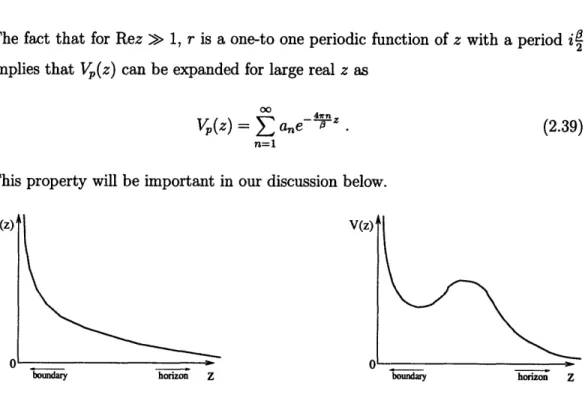
2-3 Schematic plots of the potential 2.35 or 2.36 for 1 < Ic (left) and
1
>lc
(right)... . . 47
3-1 Poles for G+(w,p = 0) for d = 4 in the complex w-plane. We use
ro
= 1,rl = V.
...
...
..
57
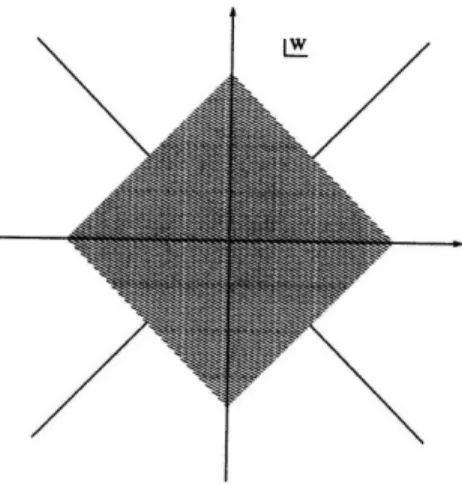
3-2 This picture shows the area in the complex w plane where there are no subdominant contributions to G+(w) in the limit w = vu and v - c0.
The straight lines are lines of poles. . ... 60
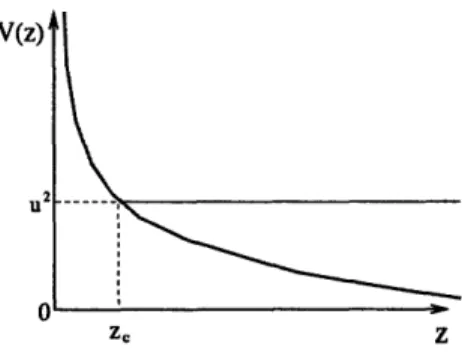
3-3 Schematic plot of the potential 3.26 for k E R. The boundary is at z = 0 the horizon at z= = oo. ... 65
3-4 The potential 3.26 for -k 2 = q2 > 1 admits bound states. In the z coordinate the boundary is at z = 0 and the horizon at z = oo. ... 75
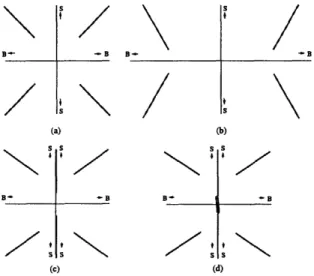
3-5 The structure of the branch cuts for (a): k2 = 0, (b): k2 > 0, (c): -1 < k2 < 0, (d): k2 < -1. At finite v, the branch cuts become lines of poles. We also labeled the asymptotic regions by S or B, indicating whether the corresponding turning point approaches the black hole singularity (S) or the AdS boundary (B). . ... . . 75
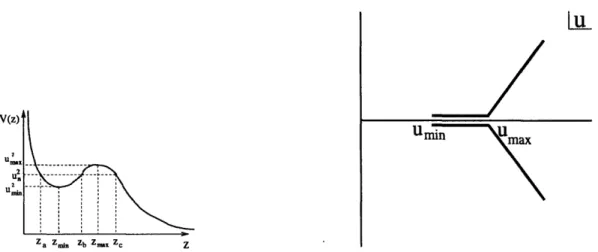
3-6 The figure at the left is a schematic plot for the potential V(z) for k > ke. The resulting pole lines in G+(vu, vk) are shown in the right plot. In the right plot we only show the right half of the complex u-plane. The poles in the left half are obtained by reflection with respect to the imaginary axis. ... 76
4-1 The potential U for (a): k2 = 0, (b): k2 > 0, (c): -1 < kc2 < 0,
(d): k2 < -1. The horizontal axis is r and vertical axis is U(r). The horizon is at r = 1 ... 83
5-1 A family of diagrams which indicates that the perturbation theory break down in the long time limit. Black and red lines denote propa-gators of M1 and M2 respectively. ... 113
5-2 By including the diagrams on the left with all possible i,
j,
k> 0 we can
get contribution at every even order of A instead of 5.38. r
0denotes
a single propagator. Diagrams on the right can also contribute to the
odd orders if 5.3 contains additional interactions of the form trA
2B
2. 1165-3 The energy spectrum of free AF
=
4 SYM on S
3is quantized. Typical
degeneracy for an energy levelc
- 0(1) is of order 0(1). Typicaldegeneracy for a level of energy
e-
O(N2)is of
order eO(NI). ... 119 A-1 The structure of poles for G+ for (a): p2 = 0, (b): p2 > 0, (c): -v 2 <p
2< 0, (d):
p2 <_-
2.
In (d), the blue dot in the upper half w-plane
correspond to a bound state ...
141
A-2 Pattern of Stokes lines near a turning point . ...
153
A-3 schematic representation of the active region. The red dashed lines
are branch cuts while the arrows are in the direction of decreasing real
part for Z . . . 155
A-4 Stokes line diagrams for the two cases of the connection formula at a
turning point ...
...
...
.. ...
. 155
A-5 Pattern of Stokes lines for Re(z) > 0 and Im(u) > 0 ...
157
Chapter 1
Introduction
The classical theory of general relativity predicts that reasonable initial matter
distri-butions will evolve generically into spacetime singularities[47, 77, 46]. In the resulting
space-time there are geodesics that cannot be extended for an arbitrary proper time
either in the past or in the future'. An observer traveling along such a geodesic
will hit in a finite time a singularity after which the theory of general relativity is
not predictive. Many solutions of great physical relevance are singular such as the
Schwarzschild metric for a black hole and the Big Bang in the
Friedmann-Robertson-Walker spacetime which should describe our universe. Therefore singularities arise
in many situations of physical interest and their understanding is essential both in
cosmology and as a necessary step towards the clarification of the structure of the
theory itself. In this introduction we will review known facts about the physics of
singularities, motivate the direction of the research described in later chapters and
summarize its main results.
The theorems implying the generic formation of singularities typically involve
three classes of assumptions:
* First an energy condition on the matter distribution is assumed. An example
usually referred to as the "weak energy condition" is that the energy density of
the matter is non negative in any frame. Classically matter coming from any
reasonable source satisfies this condition2
* Also some global structure on the spacetime is imposed like the absence of closed time-like curves.
* The final requirement is that gravity must be strong enough to trap a region as happens if a spatial cross section of space-time is closed.
The singularity resulting from the evolution of a nonsingular matter distribution satisfying the assumptions can be of different kinds.
* It can be possible for timelike observers to see the singularity before hitting it. In this case there is a region of spacetime lying in the future of the singularity. The evolution of spacetime in this region depends in principle on what happens at the singularity and therefore general relativity is not predictive there. The surface separating the future of such a singularity from the rest of spacetime is called a Cauchy horizon and the singularity itself is denoted as timelike.
* If no observer can see the singularity before hitting it we are in the presence of a spacelike3 singularity. This kind of singularity constitutes a genuine boundary of spacetime as the evolution of a timelike observer could in principle follow the laws of general relativity up to the singularity. The ensemble of all the world-lines of timelike observers which do not intersect the singularity is separated from the rest of spacetime by a surface called an event horizon. By its definition it is possible for an observer outside the event horizon not to fall into the singularity indefinitely while observers inside the horizon will hit it in a finite proper time.
Cosmic censorship hypothesis have been put forward asserting in their weak form that any observer who has observed a singularity is destined to fall into it eventually. Nature should abhor naked singularities and any Cauchy horizon should be chastely cloaked by an event horizon. This at least would make the theory of general relativity
2
Quantum fluctuations of the energy momentum tensor however can modify this picture 3
predictive for any observer outside the event horizon of the singularity[76, 33]. In
order to understand the fate of observers falling inside the horizon a theory beyond
general relativity is required. It has to be noticed in this respect that many spacelike
singularities like for example the Schwarzschild black hole or the Big Bang singularity
are such that the curvature of spacetime blows up in their neighborhood. Then as
the radius of curvature is of the order of the Planck length quantum effects should
become important and a quantum mechanical theory would be necessary to describe
the evolution of the system.
The fact that quantum mechanical effects have to be taken into consideration to
understand the physics of a black hole singularity can also be ascertained in a different
way. The mass M of a black hole solution is simply related to the area A of its event
horizon by the following relation
4:
dM = dA (1.1)
87rG
The area of the event horizon moreover can be proven to increase in any physical
process under quite general assumptions [15]. The two facts above are strikingly
similar to the first and second law of thermodynamics dE
=
TdS, dS > 0 and
indicate that one should associate to the black hole a finite entropy proportional
to the area of its event horizon. This idea finds an astounding confirmation in the
realization by Hawking that quantum mechanical effects are responsible for radiation
to be emitted from the horizon [42]. At the level of his semiclassical analysis this
radiation has a thermal nature with temperature
TBH =
.
(1.2)
21r
Classically the black hole horizon absorbs anything which crosses it, the consideration
of quantum mechanical effects albeit only at the semi-classical level shows that it
also emits thermal radiation. The requirement of consistency with the first law of
thermodynamics then implies that the entropy of the black hole should be given by
AS
(1.3)
4hG
The assignment of a nonzero entropy to a particular solution to the theory [43,
15, 16] however is a perplexing concept and seems to point out to the fact that
the black hole spacetime is the effective macroscopic description of a system with
many microstates. A more fundamental theory incorporating quantum mechanics
consistently should be able to recognize what these microstates are and to count
them matching the entropy S of the event horizon.
The association to a black hole of a finite entropy which is proportional to the
area of its event horizon has other interesting ramifications. Consider for example
some system occupying a spherical region of area A having entropy S1. We can now
collapse some spherical distribution of matter in such a way to form a black hole
whose horizon is exactly the boundary of the sphere we started with. This black
hole will have an entropy SBH
=
Awhichmust be greater than S1. We therefore
obtain a bound on the entropy of a system proportional to the area of the surface
enclosing the system itself [17]. This is quite peculiar as we would expect the entropy
to scale as the volume of the system as happens for example for any local quantum
field. It appears that a local quantum field theory has no hope of describing a theory
of quantum gravity unless such description is holographic in nature, that is the field
theory lives in one less dimension than the gravity theory.
The fundamental inconsistency of the picture obtained above with our usual
un-derstanding of a quantum mechanical system is made even clearer by the following
consideration: The time evolution of the state describing some mass distribution
un-dergoing a gravitational collapse has to be unitary but this is at odds with the fact
that, after the evaporation of the black hole, what remains is radiation described by
a density matrix! The resolution of this "information paradox" [44] has to come from
a more refined analysis of the quantum gravitational effects, an analysis for which,
presumably, a complete consistent theory is required.
If the full theory of quantum gravity is unitary we expect that all the information
about the state collapsing to form a black hole must be found in the radiation emitted
by the horizon before the black hole evaporates. This information would then be
stored in long time correlations in the emitted radiation and its recovery would be
possible only over a period comparable to the evaporation time of the black hole.
This description is acceptable for an observer outside the black hole for whom a lump
of matter falling into the horizon will never quite reach its surface
5and will somehow
thermalize there, all information remaining trapped just above the horizon. However
the description seems to be completely inconsistent from the point of view of an
observer falling with the lump of matter into the black hole for whom the crossing of
the horizon, where spacetime is smooth, will not be registered in a particular way and
all the information will cross the horizon. The principle of black hole complementarity
[89] states that such a difference in the description of the localization of information
for the two classes of observers is not contradictory.
String theory is the leading candidate for a theory of quantum gravity
6and should
provide a consistent framework in which to study the physics of spacelike
singular-ities. The theory has already been proved to resolve many time-like singularities
'.Unfortunately the high curvature of the geometry near a black hole singularity makes
the theory strongly coupled. Nevertheless we will see how string theory can provide a
microscopic description of the microstates of a black hole and how it makes plausible
the principle of black hole complementarity. Moreover we will see that it allows for
an holographic description of the degrees of freedom of a quantum gravity theory.
A fundamental object in any string theory are closed strings. These can be
visual-ized as small loops with length- 1, propagating in time, sweeping a 1+1 dimensional
world sheet. The strings can interact by splitting and joining and the strength of the
interaction is governed by a string coupling constant g which is determined
dynam-ically. Each string has several oscillation modes which, for an observer who cannot
5In fact signals sent from the black hole horizon will reach an external observer only after an infinite time
6
Introductory treatises about string theory are for example [79, 35] 7see for example [26, 54, 36]
distinguish the finite size of the string, propagate as particles of different masses. The
growth of the number of these particles with their mass is exponential N(m) - emlg.
There are always massless modes corresponding to the propagation of a particle which
can be associated with the graviton. The low energy limit of a consistent string theory
is therefore a theory of gravity. This low energy limit is valid as long as the curvature
radius of spacetime is much bigger than the string scale 1,. For definitiveness we will
consider type II string theory whose low energy limit is type II supergravity in 10
dimensions. 6 of these dimensions can then be compactified to get to a low energy
effective theory in 4 dimensions with gravitational constant G " g21.Consider a black hole solution of this low energy theory with fixed entropy
sS.
As G is proportional to g
2the area of the event horizon goes like g
2because of 1.3.
Decreasing g the radius of the horizon decreases and the curvature radius reaches 1,
at some point. At this point the low energy description is invalid and one has to
describe the solution as some collection of stringy excitations. For a Schwarzschild
black hole in four dimensions, with the radius of the horizon being ro, the entropy and
mass scale as M = -o and S - -. The Newton constant in four dimension is related
to the string length and the string coupling as G
=g212. Therefore at ro
=1, we have
2M •S
i . Around this point we should switch to a stringy description of
the black hole. The degeneracy of string excitations with mass m is given by
emls.
Setting the entropy to be equal at ro = 1, therefore implies m = = 2M which
differs from the mass of the Schwarzschild solution by a factor of order 0(1). The
fact that this factor is not one reflects our lack of precise knowledge about the region
of parameters where we match the two descriptions but we nevertheless realize that
string theory has the ability to give a microscopic account of the entropy of a black
hole[501. In fact by exploiting the fact that some protected quantities can be computed
reliably at weak coupling string theory has very successfully described the microscopic
degrees of freedom providing the entropy of certain extremal supersymmetric black
holes [87, 23].
Consider now an observer falling through the horizon of a black hole and at a small
distance d from it, then because of the red-shift effect a timescale At measured by the
in-falling observer will be seen as a timescale At by an external observer. Therefore if
an external observer looks at a string falling into the horizon with a time resolution
of order one this corresponds to a proper time resolution of order O(d). A general
property of string theory is that the size of a string grows when looked with better
and better time resolution At. The growth of the volume occupied by the string is
logarithmic in At while the total length of the string
9grows like (At)-'. Therefore
as the string approaches the horizon an external observer will see it grow in size
and become denser never quite reaching the horizon but spreading and thermalizing
over it instead. An observer falling with the string however will always look at it at
the same time-scale and therefore will not see any difference in the string as it falls
through the horizon. String theory gives therefore an intuitive explanation of the
complementarity principle plausibility which relies on its qualitative difference with
respect to a theory of point-like particles [89].
Finally AdS/CFT [64] provides us with a non-perturbative holographic
descrip-tion of string theory. According to the strongest form of the correspondence it is
conjectured that M
=
4 SU(N) super Yang-Mills theory gives a nonperturbative
description of type IIB superstring theory in AdS
5x S5.
In the following we will
often refer to the string theory as the bulk theory and to the gauge theory as the
boundary theory. The next section gives a brief review of the terms of the
correspon-dence, with special attention to the limit in which the bulk theory reduces to classical
supergravity, before describing how we can use it to learn more about the quantum
theory of black holes.
1.1
Parametric relations in AdS/CFT
Af
=
4 SU(N) super Yang-Mills theory, is a conformally invariant theory with two
parameters: the rank of the gauge group N and the 't Hooft coupling A
=
g MN.
From the operator-state correspondence, physical states of the theory on S
3can be
obtained by acting with gauge invariant operators on the vacuum and their energies are given by the conformal dimensions of the corresponding operators. As S3 is compact the spectrum of the gauge theory is gapped and discrete for any finite N. Below any energy E we only find a finite number of states, in this respect the theory is similar to a quantum mechanical system with a finite number of degrees of freedom. The AdS string theory also has two parameters: the ratio between string length
1,
and the curvature radius R of AdS, and the ratio between the (10d) planck length,l and R. These ratios respectively characterize classical stringy corrections and quantum gravitational corrections beyond classical supergravity. For small 1,/R and
1,/R, the parameters of the SYM theory and of the bulk string theory are related
bylo [64]
a/ oN -1 GN
G
= 1 1G = 1 2g
C1'
4 . (1.4)R2
8
N
21'
The above relations indicate that the classical supergravity limit is given by the large
N and large A limit of the SYM theory. In particular, a departure from the large N limit of the Yang-Mills theory corresponds to turning on quantum gravitational
corrections in the AdS spacetime, while a departure from the large A limit (with
N = oo) corresponds to turning on classical stringy corrections.
AdS/CFT implies an isomorphism between the Hilbert space of the two theories. In particular, any bulk configuration with asymptotic AdS5 boundary conditions can be associated with a state (either pure or a density matrix) of the Yang-Mills theory. The mass M of the bulk configuration is related to the energy E in the YM theory as [39, 96]
E - MR. (1.5)
Depending on how E scales with N in the large N limit, states of Yang-Mills theory are related to different objects in string theory in AdS. For example those whose E do not scale with N (i.e. of order O(No)) should correspond to fundamental string
states. An object in AdS with a classical mass M satisfies
GNM = fixed,
GN/R
8 -+ 0(1.6)
From 1.4 and 1.5 the corresponding state in YM theory should have E
O(N
2).1.2
Black holes in AdS/CFT
tt
Figure 1-1: Penrose diagram for the AdS
5Schwarzschild black hole. Each point in
the diagram represents a three sphere S
3. The radius of this sphere shrinks to zero at
the past or future curvature singularities which are represented by wavy lines. The
diagram is separated in four regions by the red lines representing the horizon. Near
the two vertical boundaries the spacetime is asymptotic to AdS
5. The Schwarzschild
time coordinate maps the region outside the horizon on the right to the real line and
is constant on the blue lines. The region on the left of the diagram can be associated
with a Schwarzschild time having an imaginary part equal to +±Tj
and flowing from
up to down. This geometry is considered in detail in chapter 2.1
The classical supergravity equations admit a solution describing a Schwarzschild
black hole embedded in AdS
511. This solution describes an eternal black hole, there
are past and future spacelike singularities separated by horizons from an asymptotic
observer. For large enough mass the black hole has positive specific heat and is in
equilibrium with its own Hawking radiationl2.
"in this introduction we will always refer to this five dimensional background even if most of the results of the main text are valid in a different number of dimensions.
One can define a canonical ensemble for semi-classical quantum gravity in an AdS. background [45]. The system undergoes a first order phase transition at a temperature THP, for T > THP, the ensemble is dominated by the contribution of the stable black hole with TBH = T. The AdS-CFT correspondence then dictates
that the boundary theory in the state corresponding to a thermal density matrix at temperature T > THP must be dual to the stable black hole bulk configuration with the same temperature13. Time evolution in the boundary theory is identified with the bulk Schwarzschild time. The symmetries under time translation and SO(4) rotations in the internal S3 for the gauge boundary theory extend to isometries of the bulk black hole spacetime. This leads to the following two sets of questions:
* 1 Does the finite temperature boundary gauge theory encode information about
the spacetime region inside the horizon of the black hole? If yes in the strongly coupled large N limit the gauge theory should correspond to a classically singu-lar field configuration; how is the singusingu-larity encoded in the boundary theory?
* 2 In case we are able to pinpoint the manifestations of the black hole singularity
in the gauge theory we can study how these are affected by going to finite N, corresponding to the consideration of the quantum theory in the bulk, or by going to finite coupling A which corresponds to giving strings a finite size.
To study the first set of questions we must consider the physical observables in the boundary theory which are finite temperature correlation functions of gauge invariant operators. The possibility that these can be used to probe the region inside the horizon is complicated by the fact that the conformal field theory evolves through the bulk Schwarzschild time. This time coordinate, appropriate to describe physics as seen from an asymptotic external observer maps the region outside the horizon to the complete real line and therefore does not probe directly the region beyond the horizon. If time evolution inside the horizon of a black hole is to be described by the boundary theory, time has to be generated holographically. While challenging
13This correspondence established at the Euclidean level extends to real time [64, 4]. At temper-ature T = THp the gauge theory also undergoes a first order deconfinement phase transition in the
this opens the possibility to describe holographically time evolution in the regions
containing the past and future singularities which can be viewed as Big Bang or Big
Crunch cosmologies.
The notion of an horizon is intrinsically non-local as, for example, the future
hori-zon corresponds to the boundary of the past of the future infinity and therefore the
determination of its location involves the knowledge of the future evolution of
space-time. If gauge theory correlators were to encode only the region of the spacetime
outside the horizon this would entail that the Ads-CFT correspondence is very non
local in time. Considerations of this nature led to imagine some gedanken-experiment
to disprove this possibility. For example by assuming the existence of precursors
(non-local operators encoding the bulk "instantaneously") in the gauge theory [80, 29] it
would be possible to recover information about an event P in the bulk before the
col-lapse of some matter distribution would form a black hole whose horizon encompasses
P [51].
The quest for understanding if and how the region beyond the horizon is encoded
in the boundary conformal theory was undertaken by many. In particular the
au-thors of [28] were able to pinpoint an interesting albeit subtle manifestation of the
singularity in the gauge theory correlation functions. We now describe in more detail
their work as it plays an important place in the results described below.
The starting point is the consideration of the following finite temperature two
point function for a gauge invariant scalar operator O(t) in the boundary theory:
G
12(2t)
=
K0
(t
+
Oi3)
0 (-t))
(1.7)
where ()Q represents the expectation value on the canonical ensemble at temperature
T = . The possibility that this quantity could encode the geometry inside the
horizon had already been suggested in [64]. The operator O(t) is dual to a scalar field
propagating in the bulk black hole geometry. The mass of the field being proportional
to the conformal dimension of O. The two point function G
1,
2(2t) in the large N limit
propagation of the scalar field in the black hole background with point-like sources
positioned on the boundary at times t + 1/0 and -t respectively. As the mass m of
the scalar field becomes large the correlator can be evaluated in the semi-classical
geodesic approximation and is given by
G12(2t) = e- mc(t)
where £ is the proper length of the spacelike geodesic joining the boundary points
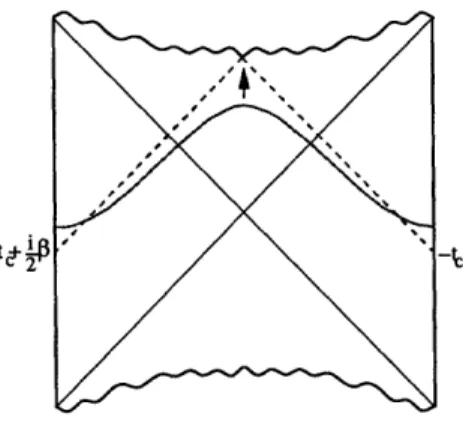
14Figure 1-2: Spacelike geodesics connecting t + i3 and -t at the boundary. As t -+
tc (black arrow) the geodesics becomes null and approaches the singularity. The
extremal geodesic is dashed in figure.
As can be seen from the figure the geodesic passes through spacetime regions inside
the horizon. There exists a particular time tc beyond which there are no geodesics
connecting the two boundaries. Moreover as t
-+
t- the length of the geodesic diverges
as L(t) , log(te
-
t). This corresponds to a light-cone singularity in the field theory,
since the geodesics are becoming almost null and would imply the following singular
behaviour for the correlator:
1
G12 (t t)m
However such a divergence is excluded by the following simple spectral consideration:
IG+(t + i)I =
IZ(/)
-1
En,m e- •(En+Em)-it(En-Em)I (mIO(O) n)12
< IZ()-' n,m e-I,(En+Em)I (mlO(O) n)121
-IG+(O)I
(1.8)
where the sums run over all the states in the theory, the
E,
are their energies and
Z(3)
= E, exp(-3E,).
The source of the problem lies in the assumption that it is the bouncing geodesic we
have drawn in figure that has to be considered in evaluating the correlation function.
By a careful consideration of the analytic continuation of the correlation function
from Euclidean time to real time the authors of [28] conclude that, on the contrary,
for any real value of t the correlator is dominated by the contribution of two geodesics
in the complexified spacetime which do not approach the singularity. The correlator
however turns out to be a multivalued analytic function of t (in the large m limit) and
the contribution of the singular geodesic can still be obtained by a subtle continuation
of the two point function on a different Riemann sheet.
This suggestive result provided a starting point for our investigation which is
described in detail in chapters 3 and 4. We considered a scalar operator O(t, 2) in
the gauge theory
(X
being the position on the S
3the boundary theory lives on) and
its finite temperature two point Wightman function G+(t, ) = (O(t, )O(O))f. As
the theory is invariant under time translations and rotations in the S
3directions it is
convenient to perform a Fourier transform in time and consider a decomposition in
spherical harmonics in the X directions:
G+(w, 1)
=
J
dte
-w
tj
dY
13Y*(x)G+(t,
)
where 1 is a set of SO(4) quantum numbers.
We obtain the following results about the structure of G+(w, 1) in the N = oo and
A -+ oo limit:
the presence of the horizon in the dual bulk theory. All the singularities of the correlation function are away from the real axis which implies an exponential decay in time of its Fourier transform back into coordinate space.
* (Ch 3) The analytic structure of the correlation function is such that the com-plex w plane can be divided into several asymptotic regions. In two of these regions w --+ 00 while in the remaining two w --+
±ioo.
The asymptotic ex-pansion of the function G+(w) for large w in each of these sectors cannot be obtained by analytic continuation from the one valid in another sector.* (Ch 3.2) Let the conformal dimension of O be A = 2
+
v then asymptoticallyfor v -- oo we have the following WKB expansion for the two point function:
G+(w =
vu, 1= vk)
2VeVZ(u,~l)(1+
O(v-))The function Z(u, k) can be determined by studying spacelike geodesics in the black hole background. These are labeled by the value of the integral of motion
E coming from the isometry under Schwarzschild time translations and p coming
from the isometry under SO(4) rotations. For each geodesic we can evaluate its length15 which will depend on E and p. The Legendre transform of this function in the (E, p) variables is Z(iE, ip).
* Ch (3.2.3) For each (w, 1) we determine the geodesic which has to be considered in computing G+(vu, vk) in the large v limit. For w - 00oo this geodesic approaches the boundary of the spacetime. For w -- +ioo the geodesic is the one represented in the previous figure, it enters the region beyond the horizon and comes closer and closer to the singularity. The turning point of the geodesic scans the black hole spacetime as we change (w, 1), in particular the timelike coordinate inside the horizon is holographically generated and encoded in the behaviour of gauge theory correlation functions for imaginary w. The different asymptotic sectors of G+ (w) for large w correspond to the geodesic approaching
the boundary or the singularity.
* (Ch 4.3) We identify two manifestations of the presence of the singularity in the
asymptotic behaviour of G+(w, 1) for w --+
±ioo along the imaginary w axis.Thefirst manifestation is that G+(w) decays exponentially along the imaginary axis.
This asymptotic behavior is due to the fact that light-like geodesics reach the
singularity in a finite time. By various different methods we prove that this
exponential decay survives in the case O has a finite conformal dimension and
is controlled by a simple parameter encoding the geometry of the black hole in
the region inside the horizon. The second manifestation is given by the divergent
behaviour of the k derivatives of Z(u, k) as u --+ ioo:dk
2nZ(iu, k)
Ik=O"
U2n U _ 00This divergence is due to the shrinking of the radius of curvature as we approach
the singularity.
* (Ch 4.4) At any finite N the boundary theory has a discrete spectrum being a
bounded quantum mechanical system. We can then write a spectral
decompo-sition of G+(w, 1)
G+(w,
1)
=27r
e-PEm Pmn(w - En+ Em)
m,n
where the sum is over all the states in the system. The correlator is a sum
of delta functions on the real axis and cannot be analytically continued for
imaginary w. In particular the signatures of the singularity we found in the large
N limit at strong coupling disappear indicating that quantum effects should
resolve the singularity. This still leaves open the possibility that stringy effects
(small coupling) could resolve the singularity already at the classical (large N)
level.
We see that a first step towards the understanding of the resolution of spacelike
singularities is the study of the appearance of a continuous spectrum in the large N
limit of the boundary theory. So far we know that in the N -- o00 limit G+(w, 1) develops a continuous spectrum. For any finite N it is quasi-periodic in time but it decays exponentially in the N -- 00oo A -+ o00 limit. The emergence of a continuous spectrum and time decay in the gauge theory is connected with some of the deepest features of the physics of spacelike singularities and the resolution of the information paradox.
1.3
Time arrow and space-like singularities
The equations of general relativity are time symmetric, but in presence of spacelike singularities an intrinsic arrow of time can be generated. This happens in both the examples of FRW cosmologies and the formation of a black hole in a gravitational collapse. We have stated that a black hole behaves like a thermodynamical system, thus in the case of a gravitational collapse, the direction of time appears to have thermodynamical nature. It has also been speculated that the thermodynamic arrow
of time observed in nature may be related to the big bang singularity [76].
With the tools provided by the AdS/CFT correspondence we can try to achieve a microscopic understanding of the emergence of thermodynamic behavior in a grav-itational collapse in an anti-de Sitter spacetime.
The classical gravity limit of the AdS string theory corresponds to the large N and large 't Hooft coupling limit of the boundary theory. As we have described, a matter distribution of classical mass M in AdS can be identified with an excited state of energy E = MN2 in the SYM theory with p a constant independent of N. This mass distribution1 6 can collapse to form a black hole which we can identify
with a thermal density matrix in the gauge theory [97, 64]. Then the gravitational collapse of the matter distribution should be identified with the thermalization of the corresponding state in SYM theory. We can speculate that the appearance of a spacelike singularity at the end point of a collapse should be related to certain
16Assume M is sufficiently big that a big black hole in AdS is formed, which also implies that Mi should be sufficiently big.
universal aspects of thermalization in the SYM theory
17In the boundary theory consider the following correlator of an arbitrary gauge
invariant operator 0 which when acting on the vacuum creates a state of finite energy
of order O(No).
Gi(t)
=
(ilO(t)O(O)li) - (ijO(O)ji)
2(1.9)
where [i) is a generic energy eigenstate in the high energy sector E - N
2.
Thermaliza-tion occurs and an arrow of time is generated, if for all such operators O and generic
states |i) with energy big enough that their dual field configuration can collapse in a
stable black hole, we have
Gi(t) - O,
t -+ oo
(1.10)
In particular, 1.10 implies that information is lost as one cannot distinguish different
initial states from their long time behavior.
A crucial element for the emergence of thermalization in the boundary theory is
the large N limit. fN
=
4 SYM theory on S
3is a closed, bounded quantum mechanical
system with a discrete energy spectrum. At any finite N, no matter how large, such a
theory is time reversible and never really thermalizes. However, to match the picture
of a gravitational collapse in classical gravity, an arrow of time should emerge in
the large N limit for the SYM theory in a generic state of energy E
=
AUN
2with
sufficiently large A. At finite N, the theory is unitary and there is no information
loss. But in the large N limit, the information is lost, since one cannot recover
the initial state from the final thermal equilibrium. Thus the information loss in a
gravitational collapse is clearly a consequence of the classical approximation (large
N limit), but not a property of the full quantum theory. AdS/CFT implies that the
time evolution of the quantum gravity theory is unitary and therefore in principle
resolves the information loss paradox
is.
"1Some interesting ideas regarding spacelike singularities and thermalization have also been dis-cussed recently in [8].
In order to reconcile the unitary time evolution at finite N with the emergence of an arrow of time and thermalization implied by the bulk theory in its classical limit we have to accept that these are effects of the large N limit in the gauge theory. Then we are challenged to answer the following questions:
* 1. What is the underlying physical mechanism for the emergence of an arrow
of time and thermalization in the boundary gauge theory?
* 2. We know such a mechanism must involve the large N limit. Is the large 't
Hooft coupling limit also needed? It could be that an arrow of time emerges only for a certain range of A therefore implying the presence of a large N phase transition as the coupling is decreased from oo to 0.
* 3. If an arrow of time also emerges at finite 't Hooft coupling A, what would
be the bulk string theory interpretation of the SYM theory in a state of high energy which thermalizes? A stringy black hole? Is a singularity present in such a black hole?
It would be very desirable to have a clear physical understanding of the questions above as it could shed light on how spacelike singularities appear in the classical limit of a quantum gravity theory and lead to an understanding of their resolution in a
quantum theory.
In Chapter 5 we suggest a simple mechanism for the emergence of an arrow of time in the gauge theory in the large N limit and initiate a statistical approach to understanding the quantum dynamics of a Yang-Mills theory in highly excited states. We avoid the complications of working with correlation functions on specific highly excited states and take into consideration correlation functions computed in the canonical ensemble. The temperature must be such that the average energy of the states in the ensemble is of order pjN2. For the case of a SU(N) Yang Mills theory compactified on S3 it has been proven [1, 97] both at small coupling and at large coupling that this is the case for T > Tdec where Tdec is a function of A of order
remains a puzzle whether one can recover the lost information using a semi-classical reasoning; see e.g. [64, 12, 11, 10, 57, 49, 67, 62, 6] for recent discussions.
N
O19. As a second simplification we consider a simpler quantum mechanical system
(see Chapter 5.2) with far less degrees of freedom than A( = 4 SYM on S
3but which
shares with it many features like the existence of a finite T
cin the large N limit.
We obtain the following results:
* 1 We first prove that in the large N limit at any finite order in perturbation
theory the boundary theory does not thermalize.
* 2 We prove that for high enough temperature (such that the system probes
states of energy of order N
2) the large N perturbation theory does not converge
for any value of A.
* 3 We interpret this as due to the fact that the high energy states E - N
2in the free theory are exponentially degenerate eN
2in N
2. We show that the
introduction of a tiny perturbation A Z 0 would strongly mix an exponentially
large (in N
2) number of free states which span an energy interval of order AN.
Thus for any finite A the theory is nonperturbative in the large N limit in the
high energy sector. As a consequence the small A and the long time limits do
not commute at infinite N.
* 4 We finally develop a statistical method for studying the dynamics of the
theories in highly excited states, which indicates that time irreversibility occurs
for any nonzero 't Hooft coupling A.
In particular, we argue that the perturbative planar expansions breaks down for
real-time correlation functions and that there is a large N "phase transition" at zero
't Hooft coupling
20. We also argue that time irreversibility occurs for any nonzero
value of the 't Hooft coupling in the large N limit therefore answering some of the
questions we posed.
19for T < Tdec the average energy computed in the canonical ensemble is O(NO). In the large N limit we therefore have a phase transition which was identified as due to the deconfinement of the theory at large temperature.
20
Chapter 2
AdS Black Holes and AdS/CFT at
Finite Temperature
This chapter sets the stage for our investigations. We describe how to compute real
time thermal boundary correlation functions from gravity. In the first two sections
we first introduce the AdS Schwarzschild black hole geometry and then review some
of the properties of real time correlation functions in finite temperature field theory.
In the last section we describe how to compute them using AdS/CFT.
2.1
Black hole geometry
In this section we briefly-review the classical geometry for a Schwarzschild black hole
in an AdSd+1 (d > 3) spacetime. The metric can be written as
ds
2=-f(r)dt
2+ f(r)-
1dr
2+ r
2df2_
1
(2.1)
with
f(r) = r
2+ 1
+
I
(where yi is proportional to the mass of the black hole and dQ2_d
denotes the metric on
a unit (d - 1)-sphere. We have set the curvature radius of AdS to be unity, as we will
do throughout the thesis. As
r
-- oo, the metric goes over to that of global AdS with
t identified as the boundary Yang-Mills theory time. The fully extended black hole
spacetime has two disconnected time-like boundaries, each of topology Sd-
1X IR (see
Fig. 1 for the Penrose diagram).
Figure 2-1: Penrose diagram for the AdS black hole. A null geodesic going from the
boundary to the singularity is indicated in the figure.
The event horizon radius
ro
is given by the unique positive root of the equation
r2 + 1 = -0
rd-2
and the inverse Hawking temperature is given by
47r 47rro
f'(ro) dr2 + (d - 2) (2.3)
In the limit that the mass of the black hole goes to infinity, i.e. A --, oo and thus
ro -+ oo, after a scaling of the coordinates
r -+ ror,
t
-- t/ro, r 2d _1 = dx2(2.4)
the metric becomes
1
ds2 = -fdt 2+ 1dr2 + r2dx2
36
with
f
= r2 - (2.6)rd-2
In the above dx
2denotes the metric for a flat (d - 1)-dimensional Euclidean space.
After the rescaling, the horizon is located at
ro =
1 and the inverse Hawking
temper-ature is
41r
S= -
.
(2.7)
The boundary manifold now consists of two copies of
lRd' .The black hole singularities are located at
r =
0 in region II and IV respectively,
at which f blows up and the radius of the three sphere in 2.1 or the overall size of
1R
3in 2.5 goes to zero.
Im(t)
2 Im(z)
Figure 2-2: A choice of fundamental domain in the Im
z -
Im t plane is indicated.
The red dots belong to the real Lorentzian section of the geometry. The dot at the
origin corresponds to region I in 2-1. The dots with Im
z
= 0 correspond to regions
II/IV and the dot at Im t = • corresponds to region III.
To describe the black hole geometry it is often convenient to use the tortoise
coordinate
z = oo dr 4-
1
z(r) ==
dr
(r ) -:
d-1f'(ri)
1 log(r -ri)
(2.8)where r
2are zeros of f with ro being the horizon.
The region outside the horizon (region I) corresponds to z E (0, +oo). At the
boundary r -* oc, we have z .d -+ 0. At the horizon r -+ ro, we have
z r -- log(r - ro) --
+
. 47rIn region I of the Penrose diagram 2-1, the Kruskal coordinates can be written in terms of z and t as
U = -e-2(t+z), V = e (t- z ) (2.9)
and therefore U < 0, V > 0. General real values of U, V cover the full Lorentzian section of the spacetime with the horizon at UV = 0, the boundaries at UV = -1,
and the singularities at UV = e- with / a constant to be introduced below. We will extend 2.9 to the fully complexified Kruskal spacetime in which both z, t and
U, V take general complex values. Values of z and t which lead to the same values of U, V are identified, i.e.
m+n m-n
t - t + i-m / z - z + i
3,
m, nEZ. (2.10)2 2
In terms of complex z and t, in region II/IV we have Im t =
+,
Im z = and in region III Im t = , z E R+. A choice of fundamental domain in the Im z - Im t plane is shown in 2-2, where we also indicate points which correspond to the real Lorentzian section of the complexified spacetime.In the fully complexified spacetime the boundary has complex codimension-one and is located at z = 0. The black hole singularity is a complex codimension-one singularity located at (up to the identifications 2.10)
zo = z(r = 0) = 0
=
=
+ iP)
.
(2.11)
o
f(r)
4
The imaginary part of zo, which is one quarter of the inverse Hawking temperature